Friday, June 15, 2012

Socialism and the left (1986)

From the January 1986 issue of the Socialist Standard

The Socialist Party is opposed to "left wing" movements because they are reformist organisations which, if they achieved political power, would enforce the basi features of capitalism through the repressive machinery of state. They distort the language of socialism, obscuring all its objectives, and they are conspiratorial and authoritarian in ways which leave no doubt that work for socialism would come under serious threat should they ever realise their aims.

There is a proliferation of such groups sharing a general outlook, distinguished from each other only by points of detail and varying loyalties to different leading personalities. Since they are all given to frequent use of the word "socialism", it is useful clearly to define what the Socialist Party means by the word. This can be summarised under three main headings - common ownership of the means of life; democratic control of society; and production solely for human need.

Common ownership means a relationship where the means of producing goods and services, and the earth's resources, are held in common by the whole community. This is distinguished from minority class ownership of the means of production under capitalism, in either its privately owned or state monopoly forms.

By democratic control we mean a system of administration through which the whole community would be able to make democratic decisions about the use of productive resources, the general arrangement of social affairs and the immediate priorities and long term objectives of social action. This is distinguished from the operation of systems of government which impose decisions on the wider community through the enforcement of law. By their nature, governments express class interests.

By production solely for human need we mean direct co-operation between people in producing goods and maintaining services directly for need. This requires the abolition of the market, including that for labour power in socialism, production would not begin with an economic exchange of labour time for wages and salaries, but would arise as social co-operation in direct response to community requirements. Free access by the community to available goods and services would replace the present restricted access to goods based on buying and selling, and the use of money as a means of exchange.

This is what socialism means and the Socialist Party has consistently held this as its sole object since its formation in 1904. It was not, however, originated by the Socialist Party but taken up from the struggles and ferment of ideas of the nineteenth century, when there was more common agreement about the meaning of socialism than now. The clarification of the meaning of socialism was not, unfortunately, an end to the debates between those who wished to replace capitalism with the new system. On the contrary, it opened up a new debate about how to get from one society to the other, an argument at the heart of the matter of reformism versus revolutionary socialism and one which is highly relevant to the socialist criticism of the various left wing movements today.

The stand taken by the Socialist Party arose from a Marxian analysis of capitalist society and the limitations of political action within capitalism. It worked on the self-evident assumption that any means which were inconsistent with the socialist objective would in effect be hostile to it. It is impossible to establish socialism by seeking to form a government to run capitalism of any kind; to abolish the domination of society by capital by retaining it and accepting all the economic consequences; to abolish the wages system by continuing its operation. Similarly, it is impossible to establish production solely for need and free access to what is produced by retaining the market system of buying and selling which has the sole objective of realising profit.

Each and every one of the so called left wing governments which have come to power in the name of socialism from the British Labour Party to the Russian Bolsheviks, have retained and further developed the basic features of capitalist society. They share the common aim of working for a system of state capitalism, though they dress this up in the language of socialism. Perhaps they retain some remote thought that political power would enable them to manage capitalism and control the direction of its development - presumably towards socialism. No credible theory of such political management has ever been produced; on the contrary, it is a fallacious idea which is now thoroughly discredited by experience.

It was argued at the beginning of the century, for example by some of those who helped form the Labour Party, that a "working class government" could be formed to run capitalist society in the interests of the working class and to carry out measures which would gradually change the structure of society. First of all, it was argued that such a government would immediately enact a programme of reforms to improve conditions of work, create shorter working hours, and continuously expand health and education services. There would be a massive programme of house building and generous pensions for the aged, the disabled and the disadvantaged. Unemployment would be abolished and the production of required goods and services would be continuously increased. At the same time nationalisation would be the beginning of common ownership of the means of production. Tax measures would ensure that the rich would be taxed out of existence. All this was to be carried through by an alliance of working-class political organisations in control of the state and unions operating on the industrial front.

When this put forward at the beginning of the century the early members of the Socialist Party said that it was completely impractical, a very dangerous illusion. They pointed out that these left wing reformists had failed to take into account the lessons of the Marxian economic analysis of capitalism. Then it was a matter of theoretical debate, now it is also a matter of bitter experience. The fallacy of its general theory has been acted out by left wing reformists themselves time and again, both in this country with the Labour Party, in Russia following the Bolshevik take-over, and in many other places.

The reality is that in any system of commodity production and capital accumulation, irrespective of whether it is privately managed or run by the state, there is an irreconcilable conflict between the value factors and the socially useful factors of production, in which the value factors must always predominate. The driving force is capitalist accumulation and this works within a set of constraints which limit time action in every social, economic and political sphere. Whatever may be done in any of these spheres is conditional on the governing factor that capital should accumulate through the economic exploitation of workers involved in the exchange of labour time for wages. Workers generate value over and above the value of their own labour power and this surplus value is realised through the sale of commodities in the market. In this way the original capital investment is expanded and realised in its money form. It makes no difference whether it is state capital operating through a state enterprise or private capital operating through private enterprise, the profit motive and the conditions of the world capitalist market limit the social possibilities of society under capitalism. In the light of this hard economic reality, the reformist dreams of left wing movements are shown to be completely impractical.

In addition to the false ideas about what a "working class government" could do, there is the survival of a further article of faith arising from Leninism - the belief that socialism would emerge in some generally unspecified way from the class struggle in a time of acute crisis when capitalism breaks down in chaos. In this situation, it is said, a "revolutionary vanguard" could take political control and then form a "working class government". The logic of this idea is that left wing movements should intensify the disruptions of the class struggle with a view to bringing this acute crisis about. So we see all about us, Trotskyite groups attempting to use industrial conflict for their political ends.

This is another dangerous misconception made all the more so because it is founded on an element of truth. It is obviously true that socialism arises from the class division of capitalism and will be the outcome of the class struggle. It is also true that because it is based on class antagonisms capitalism will continuously produce chaos in the form of strikes and other disruptions such as riots. But the task of the revolutionary socialist is to show by analysis and persuasive argument that whatever form such struggles may take they arise continuously from one basic cause, which is capitalist society. The positive socialist role is to clarify the cause of struggle, equip it with socialist consciousness and thus direct it on a course of practical political action aimed at dispossessing the capitalist class of their ownership of the means of life and establishing common ownership.

Without socialist knowledge, working-class struggles will always be fought on a battle ground where the forces of capitalism will always win. A crucial factor is the power of the state. While capital retains control of the state and commands the forces of repression - the police and the armed forces backed by the law - workers must always face ultimate defeat. On the other hand a socialist majority would win because it would, in the most determined democratic manner, take political power and bring all the powers of government under its own control. It would then enact common ownership and replace the state with a system of democratic administration, concerned solely with the organisation of production for use. A socialist society can only be established and operated by a majority of men and women who have decided that a world organised solely for human needs is the world they want and prepared to act on that basis. Therefore socialism can only be established by a majority of conscious socialists.

If in some time of acute economic and political crisis a left wing movement was able to take control of the state, nothing would alter except a change of political bosses. It would be state capitalism with the forces of capital still dominating the lives of workers and confining the life of society within the demands of profit as against need. All that would change would be the individuals in the governing positions of power and privilege. In power, as we have seen over and over again, a left wing regime would mean the now entirely discredited policies of nationalisation, the retention of capital, the wages system, commodity production, the market and the profit motive. It would mean all the sectional privileges arising from this, imposed on the working class by the forces of the state.

In their present state, despite their illusory pretensions about acting in the interests of workers, the left wingers wait in the political wings of capitalism, ready to pounce on any opportunity for the continuation of capitalism on the basis of their own control. While they remain contained they are a political gift to the capitalist class, tending to stabilise the exploitative pattern of capitalist relationships by providing a sterile refuge for the frustrations of class society. In this way they are useful to capitalism because they channel working class struggle into a political dead end.

The idea of a revolutionary vanguard mirrors the elitism of those in power positions of capitalism, who justify their privilege with an inflated self-image based on the view that workers are incapable of running society. This is the inverted prejudice of the left that workers can only ever be the tools of change, never the democratically organised and politically conscious agents of it. Acting on the Leninist belief that workers can never go beyond trade unionism, the left wing elitists see themselves as the political manipulators able to convert industrial disruption into political change.

The fact is that everywhere about us we see workers running every useful part of production and necessary services. In the modern world the knowledge required for this is certainly no less than the socialist knowledge required to run the entire structure of industrial organisation and administration in their own interests and through their direct co-operation. Throughout the world there exists a highly developed structure of useful production which is available to be developed solely for human needs.
Pieter Lawrence


Tuesday, June 12, 2012

The Naff Caff (2000)

A Short Story from the June 2000 issue of the Socialist Standard

Dillon's Diner stands in a narrow alleyway in the centre of the city. At first glance it is a mean-looking building nestling between a baker's shop and a trendy gift shop (the latter frequented by tourists and those people who are eager to fritter their money away on largely useless items). It sits there solid as a rock, the wood surrounding the huge windows painted a workhouse green. Dillon's Diner is better viewed from within. The café is known locally, though not by the proprietors I hope, as the Naff Caff.

Smart people or tourists seldom visit the Naff Caff. From my place at a table inside I have a clear view of anyone stopping by to study the menu and to peer into the steamed-up windows; either they don't like the look of the people inside or the blatant message of the menu—sausage, egg and chips, bacon sandwiches, chicken nuggets, tea at thirty-five pence a cup, has no attraction for them as few of them ever come in. The clientele includes city buskers, Big Issue sellers, students from the local school and people who like me who welcome a cup of tea and a plate of chips cooked in vegetable oil. The Naff Caff is known by reputation or by those who, years before, wandered in on a wet day and got hooked on the atmosphere.

Almost everyone talks uninhibitedly. At one oilcloth-covered table a group discuss Unidentified Flying Objects and crop circles, whilst at another politics are more the priority. Occasionally people sitting at one table will leave it to join those sitting at another table if the conversation sounds more inviting. Sometimes voices are raises and raucous laughter fills the air. We all take it in our stride and most of the time so does Mr Dillon, the proprietor though he is idiosyncratic to say the least. He has strong political opinions mainly about the iniquities of local government. He will deliver speeches at the top of his voice either from behind his counter or standing at a table to harangue customers over their chips and baked beans. He rarely pauses for breath and his language is colourful.

One day Mr Dillon ordered a man off his premises for making racist remarks about a young Asian man. But on another day he banished a young woman because of her Mohican hairstyle and the three tiny rings she wore through her nose. She came into the café with her mother and her young son and sat quietly at a table waiting for a place of chips to be served to the little boy. Mr Dillon told her that "this is a respectable establishment and you will frighten my customers with that weird hairdo". This in a café where long hair and beards, ragged jeans, anoraks and appearances suggestive of lurking poverty are the order of the day. I witnessed the incident but it all happened too quickly for me to intervene. I chided myself for days afterwards for not having lifted a finger to protest.

The Naff Caff is cheap but it isn't chic and the grub is unremarkable. Even its nickname is derisory so why do so many people have an affection for it? Well, it is unpretentious, honest and clean. And it is alive. The clientele can either converse animatedly or sit silently over a cup of tea for two hours and nobody will give them any hassle. Within the walls of the Naff Caff dwells a little bit of socialism. The prevailing environment speaks of comradeship, mutual respect and social harmony. It was the customers who long ago created this idea. In what other public place have I come across people who will unashamedly eavesdrop on a conversation where a tricky and personal problem is being aired and make it their business to offer helpful solutions? And the astonishing thing is that nobody seems to mind. Perhaps it is that showing an interest in and caring about the fate of others is always preferable to indifference. The Naff Caff responds to a need in our society. Every city should have one.
Heather Ball

Sunday, June 10, 2012

Editorial: Voting Against Austerity (2012)

Editorial from the June 2012 issue of the Socialist Standard

The people of Iceland did it first. Twice. In two referendums they rejected a deal their government had negotiated with international creditors. They even put a former prime minister on trial. It didn’t make any difference. Now they have been followed by voters in France and, more dramatically, in Greece. It won’t make any difference there either. Because, in capitalism in a slump, there is no alternative to falling living standards for the majority.

Nobody wants their standard of living to be reduced, whether as cuts to their wages or their pensions or as the reduced income unemployment brings. But that’s what they get, even though they might vote against it. It’s understandable that, given the chance in an election, people should vote to reject austerity. At least it shows they are not prepared to accept things lying down. For the people of Greece to have voted back those promising yet more austerity would have been to brand themselves as gutless.


To imagine that electing another set of politicians is going to make any difference, though, is an illusion. It assumes that governments control the way the capitalist economy works whereas in fact they have to govern on its terms of ‘no profit, no production’. They have to give priority to profits and profit-making. In a slump that means imposing austerity.


Henry Ford is reputed to have said that you can have a car of any colour so long as it’s black. Capitalism in a crisis is like that. You can elect any government, but that government will impose austerity. Even if Greece defaults and withdraws from the euro, the cruel fact is that any government, even one elected on an anti-austerity basis, would have to do this.


The fuel that drives capitalism is profits. A slump means that capitalist businesses are investing less than before because it’s not so profitable. The only way capitalism can get out of this is if profitability revives. This happens spontaneously in a slump. The assets of failing and bankrupt firms pass cheaply to others, who can therefore use them more profitably. Interest rates fall, allowing firms that borrow money to invest to keep a larger proportion of their profits. Increased unemployment exerts a downward pressure on wages, increasing the share of profits in new production.


Left-wingers and trade union leaders think that the way out of a slump is to increase spending. Get the government to spend more, they say, and that will get production going again. But it won’t. For the simple reason that the increased wages or government spending would have to be at the expense of profits; which would make things worse. Some governments may start off trying to do this but they are very quickly obliged by the economic laws of capitalism to effect a U-turn and impose austerity.


That’s the way capitalism works, and it’s the only way it can work. Capitalism is a system that puts profits before people and cannot be reformed to do otherwise. The only way forward is not to vote for a change of government policy or to reform some aspect of capitalism, but to act to replace capitalism with socialism so that the Earth’s resources really can become the common heritage of all and used to serve human welfare.

Rising in the Valley (1980)

Book Review from the April 1980 issue of the Socialist Standard

The Merthyr Rising by Gwyn A. Williams (Croom Helm)

By 1831, forty per cent of the pig iron produced in Britain was being made in South Wales. The centre of the industry was Merthyr Tydfil which, with a population of some 27,000, was the largest town in Wales. Merthyr was dominated by four great iron companies, which together employed at least nine thousand workers, who lived lives of wearisome toil, grinding poverty and nagging insecurity. These workers carried out an insurrection that spread its shock waves well beyond their native valleys, left over two dozen of them dead, and provided Wales with its first working class martyr. The insurrection is chronicled by Gwyn Williams in a vivid and detailed book now available in paperback.

From 1829 there was a severe economic depression in the Merthyr area, as the market price of bar iron fell drastically, and the employers were forced to cut wages and lay people off. This led to many working-class families into debt with shopkeepers and thus into the clutches of the Court of Requests, a special local institution whereby bailiffs were entitled to confiscate a debtor's property and sell it in order to pay the shopkeeper.

The economic crisis coincided with the agitation over the Great Reform Act of 1831. A leading local advocate of Reform was William Crawshay II, owner of the giant Cyfarthfa iron-works. Crawshay mobilised the iron workers and miners he employed into action against his Tory opponents, only for them to discover that Reform by itself could not abate the depression. For while he spoke of Reform and democracy, Crawshay was giving notice of wage reductions and lay-offs.

On May 30 1831, a great working-class rally was held outside Merthyr at Waun Fair, ostensibly in favour of Reform. But it was a meeting with many strands and many influences, the more so as there were no obvious "leaders". One motion demanded the abolition of the Court of Requests, and one speaker demanded that the Court be brought down. The next day saw the first defiance of the law and act of rebellion; people in the village of Penderyn used physical force to stop a Court of Requests  distraint on one of their neighbours, Lewis Lewis, who was to become prominent in the insurrection and its aftermath.

It was on the morning of 2 June that the insurrection proper broke out. A crowd moved through Merthyr from house to house, locating goods that had been sequestered by the hated Court of Requests and returning them to their original owners. The action continued in the afternoon, and in the evening the workers sacked the house of the Court's President. Faced with such attacks on private property, the local magistrates, traders and employers could not stand idle. They installed themselves in the Castle Inn in the High Street and sent for soldiers.

About eighty Argyll and Sutherland Highlanders arrived from Brecon on the morning of the following day and halted outside the Castle Inn, where a crowd of up to ten thousand gathered. After a fruitless attempt at negotiation, the crowd became restless and were ordered to disperse. From an upper window, Crawshay offered to redress his employees' grievances if they would send delegates to see him in a fortnight. Angered, the crowd surged forward and seized the muskets of the front rank of soldiers. After further skirmishes, the soldiers were ordered to fire. They did, again and again, right into the crowd. By the time the street was cleared, some twenty-four workers had been killed.

The masters realised that they were prime targets for revenge and so removed to Penydarren House, just outside the town, and sent for more soldiers. By the evening of 3 June, Merthyr had been abandoned to its workers. A full-scale insurrection was now under way, with workers arming themselves, setting up road blocks in an attempt to isolate the town, and sending spokesmen to Monmouthshire to gain support. Some of the soldiers trying to get through to Penydarren were intercepted, disarmed and sent packing.

Of course it could not last. The efforts to spread the insurrection elsewhere were fruitless and gradually the military - numbering about eight hundred by now - regained the initiative. On 6 June the movement collapsed: crowds dispersed, men buried their weapons and returned to work. The prominent rebels were arrested; by the end of June, twenty-six of them were housed in Cardiff jail.

The Home Secretary decided to avoid provocation and not prosecute any of them for treason, and in the event only four cases came to trial. But that was enough for four sentences of transportation and one of the death penalty. The latter was on Richard Lewis (otherwise known as Dic Penderyn), a miner, who was found guilty of wounding a soldier at the Castle Inn confrontation on 3 June. Despite a petition to the king for mercy, and the extremely flimsy nature of the identification evidence against, Dic Penderyn was hanged at Cardiff on 13 August. The government had been determined that someone should die for what had been done at Merthyr. In choosing Dic Penderyn they murdered not a leader but a man who was, and represented, the ordinary worker. In Williams' words:

"it was not any 'leadership' which made him a martyr; it was his very innocence, his innocuousness, his sense that he 'was only doing what thousands of others did'. He did literally 'die for thousands'."
Unrest did not cease with the putting down of the rebellion or the execution of Dic Penderyn. In August 1831 the first trade union lodges were formed in South Wales. Two of the large Merthyr ironworks demanded that workers leave the union on pain of dismissal, and began lock-outs. It took until November for the workers' will to be broken and the union smashed. Merthyr ended 1831 still under military occupation.

The Merthyr Rising deserves a place on every worker's bookshelf, just as the event merits a place in any working class history. The insurrection must not be built up out of proportion, for it was not and could not be the beginning of a revolution. There was no way in which the Merthyr rebels could have "won". But that does not stop us noting their solidarity in the face of vicious ruling-class brutality and saluting their courage.
Paul Bennett

Editorial: Labour capitalism (1989)

Editorial from the October 1989 issue of the Socialist Standard

The Labour Party is not and never has been a socialist party. As we record in this issue, most Labourites have seen "socialism" as either nationalisation or some milder form of what exists in Russia. They have, in other words, confused socialism with state capitalism. Some, it is true though more in the past than in recent times, have like us wanted a society based on common ownership, democratic control and distribution according to need, except that they saw this as coming about through a series of piecemeal reforms introduced by Labour governments.

This attempt to introduce within capitalism what will undeniably be features of socialist society - such as free public services and the abolition of unearned income from shares - was bound to fail as it took no account of the fact that capitalism cannot be reformed to work other than as a profit-making system governed by blind economic laws. The economic operation of the capitalist system has meant either that these reforms have eventually been undermined or that they have had unintended side-effects. At the same time Labour governments, having come into office under capitalism, have had no alternative but to preside over the running of the capitalist system in the only way that it can: as a system in which profit-making takes priority in all fields over meeting needs.

Aneurin Bevan once described the National Health Service as "pure socialism". He was wrong, but for the right reason. Wrong because you cannot have bits of socialism within capitalism, but right because health care in socialism will be free. The free NHS began to be dismantled, under economic pressure of capitalism, even by the Labour government that had introduced it, and the free aspect has been whittled away ever since as successive Tory and Labour governments have introduced more and more charges.

Earlier Labour theorists, such as R. H. Tawney, saw Labour's role as to suppress unearned income, correctly regarded as a tribute levied by property-owners on the rest of society, by gradually taxing it out of existence. As, once again, socialism will indeed be a society in which shareholding will have no place, the higher taxes on unearned income by Labour governments were sometimes presented, wrongly, as a step towards socialism.

Now such pretences are to be dropped. The Policy Review document to be adopted at this month's Labour Conference shows that the Labour leaders, eager to get their hands on the reins of office, are preparing to accept capitalism as it has evolved in Britain -  a profit-driven market economy providing unearned income for those who own the means of production - and to abandon the attempt to impose on it isolated features of a socialist society.

The document has to be read to be believed. It opens with an introduction by Kinnock in which he states that Labour's aim is to help "make the market system work" and goes on to talk about Labour's priority being to establish "an internationally competitive economy", achieving "success in the marketplace", and creating "a new partnership with business".

This does not represent the abandoning by Labour of its socialist principles (that would be difficult since it never had any), but rather the tacit recognition by Labour of the failure of the strategy of gradually trying to reform capitalism out of existence which, at an earlier period, was accepted by many in the Labour Party. Not only have the actions of Labour governments not brought socialism one step nearer, but instead of Labour gradually changing capitalism it is capitalism that has gradually changed the Labour Party.

As socialists who predicted this failure, we draw the lesson that the only way to get to socialism is to work to build up a political movement dedicated to ending capitalism by bringing all the means of production, in one go and without compensation, into common ownership by all the people. For us, the failure of gradualist reformism vindicates the need for a social revolution, to be carried out by essentially peaceful, democratic means, from class ownership and control and production for profit to common ownership, democratic control and production for need.

The Labour leaders, opportunist politicians that they are (but then, as professional politicians, their main ambition in life has to be to achieve ministerial office), have typically drawn a different conclusion. They want to abandon the failed reformist strategy, but in favour of accepting capitalism as it is, market, unearned incomes and all.

This is not a development that need surprise since ideology can always be expected to sooner or later come into line with practice-and Labour's practice when in office has always been to accept capitalism and its logic. Every Labour government has worked with private business and has accepted that capitalists must be allowed to make profits (indeed, has taken steps such as freezing and restraining wages to ensure that they did). It is just that at this year's Labour Party Conference we shall be witnessing the precise point in time at which the gap between ideology and practice which has existed up to now will be closed, with Labour accepting a new ideology that conforms to what has long been its practice.

Tuesday, May 29, 2012

Socialism, Saints and Muffin the Mule (1996)

From the June 1996 issue of the Socialist Standard
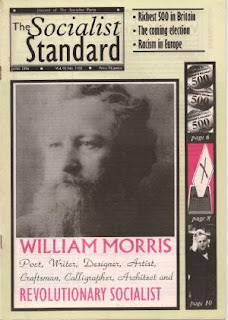
William Morris lived from 1834 to 1896. During his lifetime he involved himself in a bewildering array of activities. The last quarter of his life was spent in the cause of socialist revolution and he left a considerable body of socialist writings when he died.
Saint William Morris? It had to be a hoax. Actually, it wasn't. The Church of England, in its pathetically opportunist bid to recruit anyone with a credible image to its side, proposed canonising Morris, the nineteenth-century Marxist revolutionary who resolutely rejected all gods and religions. When he died in the late morning of 3 October 1896, Morris's last reported words were "I want to get mumbo-jumbo out of this world." Hardly the stuff of which saints are made. If it weren't for mumbo-jumbo every clergyman would be on the dole looking for real work.

In an age when, as the Stranglers reminded us, there are no more heroes (we're all cynics now), the present writer readily confesses to more than a passing admiration for William Morris. Here was a man born into affluence and opportunity: educated at Marlborough public school, where he famously stated that he learned nothing except by walking in the local countryside and observing nature and reading useful books in the local library, and then Exeter College, Oxford, where he was sent to train for the priesthood and left stating: "I won't sign the 39 Articles" (1855) because he had seen through the sham of the Church's authoritarian morality. Like many others of his age and class he could have become just another time-wasting ponce, living in thoughtless indolence upon the hard work of the majority. But Morris took a different course.

Talented Artistic Creation
Morris's belief was that art and society are inseparable. How often do we meet those dullards of the artistic establishment who, cocooned like monks in their galleries, pontificate about art as if it is something to be hidden behind bullet-proof screens: either a purchasable indulgence for the rich or a thing of beauty for school groups of working-class kids to be allowed to gawp at as a spectacle. Morris hated this idea of art. For him, art was about making things which were useful and accesible and beautiful to look at and to touch. He was, to be sure, a man of immensely varied talents: probably the most versatile and talented artistic creator of the last century. As an architect Morris revolutionised house design, with his building of the Red House near Bexleyheath. as a designer of textiles and wallpapers Morris revolutionised the skill, reviving approaches to colour and inventing methods of production. With Burne-Jones, his closest artistic friend, he did the same with the design of stained-glass windows in which their productions were unsurpassed in their splendour. As a poet of the second Victorian generation Morris was respected as being a superb writer, not only composing great long works such as 'The Dream of John Ball' (with its invigorating sense of how history changes in ways often unclear to those living through it), but also translating Greek classical poetry as well as the Icelandic sagas which so inspired him. When Tennyson was offered the poet laureatship in 1892 it had been planned to offer it to Morris who, needless to say, would have no part in being appointed to write flattering ditties for royal parasites. Not content to write poetry, Morris was a pioneer in the field of typography in which during the latter years of his life, he devoted himself to revolutionising printing methods and building up his own press which could produce words pleasurable not only to read but to look at.

What kind of man embodied these talents? Yeats, who came to know Morris in his London days (and was even tempted for a while by his revolutionary ideas until the folly of the fairies drew him to the mysticism of Irish nationalism which ended in a personal attraction to fascism), wrote of William Morris that "You saw him producing everywhere organisation and beauty, seeming in the same instant helpless and triumphant; and people loved him as children are loved." By all accounts, Morris seems to have been one of the most undisliked men of his century. When he died, only in his early sixties, a century ago, the doctor declared that he died of simply being William Morris. It is understandable that vicars, usually noted for adding little to the world and most in their element when burying the dead rather than energising the living, might look at the enormous vivacity of Morris's character and assume that he must have been superhuman, fit for sainthood. Morris would have hated such an idea of himself. For him, there was nothing that he could do which, given the opportunity, others could not learn to do also. Unlike the precious artists, so often second-rate, who surround themselves with a mystique of creative specialness, Morris's achievements were always intended as inspiration, not exclusivity.

For most of his life Morris was just a critical complainer against the effects of capitalism, but, like so many others, one who never knew what capitalism was or even that it existed. At first he bemoaned the loss of true arts in the nineteenth century, pursuing the criticisms of his teacher, Ruskin, against the regimentation, waste and tackiness of urban, industrial squalor. But he knew not what caused this to be. As a supporter of the radical wing of the Liberals (the equivalent of Labour today, as the anti-Conservative but pro-capitalist party of his time) he joined the Eastern Question Association in protest against the atrocities being committed in the Balkans to which the rest of the world turned a cynical blind eye. (What changes?) As Treasurer of the EQA Morris was forced to look in the face the hypocritical posturing and limited vision of the capitalist politicians. Meanwhile, as a founder of SPAB (the Society for the Protection of Ancient Buildings), Morris and his friends were fighting a losing battle to preserve some of the beauties of the pre-industrial world from the ravages of vandalism for profit.

Socialist Activist
William Morris was over fifty when something important developed within his thinking. He came to realise that all of these hideous acts of destruction against art, beauty and human life were not accidents of history or the consequences of wrong government. They were the inevitable effects of the capitalist system which can no more put beauty and life before rent, interest and profit than the church could put science before superstition. What was wrong with the times in which he lived was the system. Morris was no less energetic about this revelation than he had been about any of his other occupations. He set himself to read Marx (in French, for Capital was yet to be translated into English) and became an active member of the newly-formed Social Democratic Federation, the first revolutionary socialist body in Britain.

Within a year of joining the SDF (and giving it time, money and enthusiasm hitherto reserved for artistic creation) Morris found himself in a majority on its Executive Council refusing to endorse some of the policies being pursued. Firstly, there was the arrogance of the Eton-educated self-appointed leader, Hyndman, whose belief that the SDF was almost his own personal property, and whose contemptible imperialism and anti-Jewish racism, was too much for those like Morris, Eleanor Marx and Belfort Bax to stomach. Then there was the question of reform. Hyndman and his supporters took the view that a socialist body should advocate reforms of capitalism under the illusion that these would be "Stepping Stones to Socialism". Morris had read Marx too well to believe that the inherent class robbery of capitalism could be reformed in the interest of the robbed. He took the view that only by educating those who are robbed by capitalism of the cause of their miseries and the hope of a real alternative could socialism ever be achieved. Like Marx, Morris maintained that there could be no socialism without conscious socialists to bring it about. So, in December 1883 Morris and the others, though a majority on the EC of the SDF, resigned from it and established the Socialist league. Soon they had their own journal, Commonweal: the political contributions made to it by Morris have now been collected in two volumes in the William Morris Library (edited and introduced by Nicholas Salmon) and these, together with A.L. Morton's excellent little edition of the Political Writings of William Morris are amongst the finest socialist writings ever produced. (Every socialist owes it to themselves to read these.)

In 1890 Morris took upon himself the task, tried by others but never with anything close to the same force of clarity and imagination, to depict what a socialist society might look like. More than that, what it would feel like to live in. Morris's News From Nowhere is more than just a pretty picture of utopia. Readers may like bits and discard others, and Morris the libertarian would respect them more for doing so: he was no prophetic author of blueprints for the future. What Morris attempted to do - and succeeded with brilliance - was to show that a society based upo common ownership and democratic control could exist; that free access to wealth without the existence of the market or money as social fetters upon human freedom could work effectively; that a society could exist co-operatively and humanely without the need for the state, with its governments, police and prisons; that human nature is not opposed to human decency in the world. What had happened to the world to allow this great transformation to happen? It did not require the coming to earth of some miracle-making messiah who, in line with infantile religious belief, would purify the earth so that Saint Morris could write about it. No such claptrap for Morris: his depiction of the new age of humanity depended upon the assumption that workers had united to get rid of capitalism. There was no other way to bring about the socialist alternative.

It was once said of Morris that whereas the reformers had told people what to want, Morris had told them how to want. He had attended to the education of desire, teaching people that their dreams of a better world could only be realised as visions to be enacted if they would organise on the basis of knowledge and co-operation. He was right. How much more refreshingly right than those sad relics of the museum of political postures on the British Left, marching not to the socialist Nowhere but the capitalist nowhere being planned for by that emblematic nobody, Tony Blair.

There is something of an irony that in this year of the centenary of his death, vast numbers of people will file past the great Morris exhibition at the Victorian and Albert Museum and many more will remember him with self-deceiving selectivity: every Sunday supplement is running something about Morris, but they will neglect to mention that he dedicated his later life to the creation of a moneyless, wageless, stateless society. Not only did he write about it, but he gave endless lectures and speeches, from Secular Halls to open-air platforms across the country. He talked to striking Northumbrian miners and small gatherings of drunks and autodidacts in damp rooms and windy street corners. He was a fighter and an inspiration to many of us who were born long after he died.

Better than any saint, it could be argued with some force that Morris's contribution to the sum of human history was rather greater than that of Muffin the Mule. Not so according to the Post Office which has rejected a proposal to produce a commemorative stamp to mark his death on the grounds that "William Morris was not of sufficient stature". (Instead, stamps with pictures of Muffin the Mule and the glove puppet, Sooty, will be produced.) There has been a minor outcry from a few Labour MPs (currently led by a human glove-puppet, operated with much dexterity by the Stock Exchange) which is the usual respect paid by Labour leaders to long-dead socialists. Had Morris been alive today, advocating the revolutionary abolition of the market and production for profit, his condemnation as "irrelevant", "utopian" and "not in line with practical politics" would be churned out by the very Labour MPs who like looking at Marxists as long as it's only on a stamp.
Steve Coleman

One World Administration (1996)

From the August 1996 issue of the Socialist Standard
In a socialist society, for the first time ever, the globe-spanning communications networks - which capitalism itself has built up and which socialism will develop even further - will be used to ensure that everyone can have an input into the decisions which affect their lives on a global, regional and local basis.
A united humanity, sharing a world of common interests, would also share world administration. This is the socialist alternative to the way that capitalism divides the planet into rival states and sets people against each other. Driven by class interests and profit and spurred by the attitudes of nationalism, racism and religion, war and civil strife continue to cause death and misery. During this century more people have been killed than in any previous century. Yet, during this time there has been developed a world framework of communications and administration that in socialism could be swiftly adapted for the needs of all people. Just as capitalism has developed powers of production that could provide every person with a comfortable and secure life so it has also developed means of organising a world of co-operation.

It is sometimes said that world administration would mean power of central control over local democracy. A lot of argument is wasted over opposing options about where control should be placed. But a system of world democratic administration in socialism need not be based in either world, regional or local spheres. We can envisage an integrated system that would be adaptable and could be used for decision-making and action on any scale between the local and the world. Practical necessity would require such adaptability and we can suggest some principles which determine this.

Local democracy
In socialism, for the first time, local communities will be free to make decisions about the development of their areas. With the release of productive resources solely for needs, for the first time they will enjoy real powers to act on those decisions. These would be decisions about local services such as health, education and transport, public facilities such as parks, libraries, leisure centres and sports grounds; local housing, the siting of production units, management of farming, care of the local environment, cultural events, and so on.

We anticipate that with people being able to co-operate much more in their own interests there would be a stronger and more active sense of local community than exists now and this would be expressed through bodies adapted from present parish and district councils. The principle determining the practice of local democracy would be that decisions affecting just local populations would be made by them and not for them by any larger or outside body.

World production
The importance of local democracy has to be seen in the context of modern production which is world-wide. There may be some scope for local production for local needs but in the mean, even simple articles of use are made with additions of labour which extend across the globe. For example, a ball-point pen needs world mining, the oil industry, chemicals and world transport, etc. We eat fruit, vegetables and spices from every climate. Our lives would be much more limited if we were restricted to what could be produced or grown in our local areas.

With the abolition of capitalist corporations many of which duplicate their operations on a world scale it is likely that socialism would want to use the most economical and structure of production. This could operate from world scale extractive industries like mining to regional centres of industrial processing and manufacture and final distribution to local populations. This could correspond to a similar network of administrative levels on world, regional and local scales.

An obvious example of production that has to begin from a world perspective is energy. The use of the earth's finite resources such as fossil fuels, the prediction of world energy needs, concern for the increase of radio-activity and carbon gases in the environment, the risk of accidents, the development of benign technologies, etc, all combine to make energy policy a world issue. This is a case where in socialism a single world energy authority would have the advantage of a complete overview of the problems and would be able to draw on information from every community.

This is not to suggest that such a single agency based in New York or Geneva or whatever would be making policy decisions for everyone on the planet. Its function could be to provide information and propose various development strategies so that alternatives could be decided democratically. From where we stand now a lot of people would say that priority should be given to ecologically benign methods such as wind, wave, solar power, etc. With the freedom to make such a decision without the economic constraints of capitalism, socialism could do it. The sole motive would be the needs of people and this would be in sharp contrast to the way in which governments decide matters now from the point of view of national economic and military interests.

Multi-citizenship
The example of energy policy means that people in socialism won't just be concerned about whether a piece of local land should be sued for housing, growing food, a cricket pitch or left as it is. People will also be engaged with issues affecting them which extend far beyond their local areas. So, as well as being citizens of their parish or district they would also be citizens of the world with all the opportunities for, and responsibilities of decision making and action in every sphere of life.

One of the great technical developments under capitalism has been electronic communications with satellites linking radio, television, telephones, etc., and the rapid processing and distribution of information. These media alter our awareness of being in the world and the boundaries between what is local and distant are shifted or become blurred. From one moment to another we are able to take in local news, issues and events and those on the regional or world scene.

The importance of these media is not only for their potential as means of organising administration and production, they are just as important for enjoyment and leisure. In socialism we could enjoy great sporting festivals such as the Olympic games and the World and European Football Cups without them being tainted by nationalism or commercialism. Similarly such concerts as those performed by the 3 tenors, Pavarotti, Domingo and Carreras would be events shared by many millions across the globe.

Communications also bring home to us with force and immediacy the often tragic results of disasters such as earthquakes and floods. Even in the cynical, alienated world of capitalism people do what they can to help and with the resources available in socialism world organisation would move swiftly to minimise the damage and the suffering. In a quite different way which can equally show the common identity of all people expeditions into space demonstrate that every person on earth shares a tiny planet in a vast cosmos. No doubt these exciting projects will continue in socialism organised by a World Space Agency.

So, as well as the face-to-face contacts of our daily lives at work, home, at the shops, in the library, at the football pitch or leisure centre with friends, neighbours and relatives, and as well as our part in local affairs, at the same time we would be involved with all other people in world issues and events of every kind.

Continuity
The abolition of class ownership and production for profit together with the establishment of common ownership and production for needs will begin a period of great re-organisation. In production the principle will be that work related to marketing and he profit system will become redundant - it will cease. Examples are banking, selling and accounting. Work that is socially useful related to the real needs of people like farming, building, energy supply, transport, etc. , will be continued and further developed. Practicality will require that socialism will begin with the structures it takes over, these to be fully democratised.

The same principle will apply to decision-making bodies and administration. Socialism will begin with its delegates being in control of national and local governments and from this point the role of these bodies as part of a state machine will be replaced by democratic organisation operating solely for the needs of communities. It follows that all the socially-useful parts of the previous state machine will be continued. At the local level these include planning, education, health and transport developments, etc.

At the national level there are useful ministries such as housing and agriculture and those which administer health and education on the broader scale. The United Nations also includes useful world bodies such as the World Health Organisation and the Food and Agricultural Organisation. This is the world-wide structure already developed by capitalism which would be taken over and developed for the needs of the world's population. For example, one problem that socialism would have to solve as quickly as possible will be the supply of enough good quality food for every person. This will require co-operation at every social level and the existing FAO, national ministries of agriculture and local departments could be swiftly adapted for the task.

The Way Forward
The practice of a fully democratic system requires more than communications technique. The potential of the various media to bring people together over great distances cannot be realised in the divided world of capitalism where power remains in the hands of governments and those who own and control production and the earth's resources.

Federalists aim at world administration but they are talking about world government - a world capitalist state. People would still be class divided and subject to all the tyrannies and insecurities of the profit system. In any case, governments are not going to give up the economic interests of the class they represent in favour of world administration.

Only the workers of all countries share a real interest in working to establish a world based on common ownership where all means of production and all resources will be held in common by all people. Production would then operate through voluntary co-operation and part of that co-operation will be the work of deciding what should be done in the interest of the whole community and then acting on those decisions. This is the basis on which the world communications and administrative bodies which have been developed for the objectives of capitalism can be used for the whole population. That we have no country but still have a world to win is still our best slogan and the best hope for all people.
Pieter Lawrence

Sunday, May 27, 2012

An inevitable result of vanguardism (1996)

Book Review from the January 1996 issue of the Socialist Standard 

Grey Granite by Lewis Grassic Gibbon (Canongate Press) 

The novel Grey Granite, the third volume of Lewis Grassic Gibbon's trilogy A Scots Quair, is a text that fits rather snugly within the canon of twentieth-century literary modernism, even though it is rarely to be found on a university syllabus, at least outside Scotland. 

 The plot primarily involves Chris Colquohoun and her son Ewan Tavendale, making a "new life" for themselves after moving to the industrial city of Duncairn from the country. While Chris works in a boarding house, Ewan goes to work at Gowans, the local steel works. The general relationships between these and other characters are obviously one of the main elements of the plot, but these relationships and the other events presented in the text are heavily coloured, if not determined, by Ewan's movement from an apparently self-reliant and individualist conception of his "self" to a more collective and class-conscious position. From an encounter (and argument) with an English socialist school teacher (who is largely, it seems, inspired by William Morris), Ewan comes first to an objective and rational recognition of a collective working-class interest which then develops through sympathy and empathy into a deeper subjective and emotional recognition of his shared experience with, and inclusion in, the working class. It is important to recognise that this movement from an exclusive individualist conception of his self to an inclusive class-conscious conception of self does not entail any loss of individuality. Rather it is in some sense a dialectical process in which the individual ego is lifted up, surpassed and preserved in the intersubjective collectively. 

Later, though, Ewan's individuality, preserved in the initial movement into class-consciousness, suffers some loss on his entry into and identification with the Communist Party, after which everything else is subordinated to their interests and aims. Part of the reason for this is the Communist Party's own identification of itself as "the working class" - that is, they substitute themselves for the class they see themselves as representing. This is, of course, an inevitable result of their vanguardism. Placing themselves in a position of leadership over the workers they then come to substitute themselves for the workers. As such, while ostensibly working for the overthrow of a hierarchical capitalist system, they come to institute a new hierarchy (quite apart from the fact that they would only bring about state capitalism rather than socialism if they succeeded in their aims); instead of serving the interests of the workers, they use the workers to serve the interest of the Party. This means that the workers remain in a subservient, subaltern position in relation to the Communists even while apparently struggling to free themselves from all hierarchical domination. 

Structurally, any vanguardist party, whatever its explicit intentions, is doomed to repeat this process, so betraying the revolutionary project it espouses. All this is made abundantly clear within the novel, in episodes in which the Communists lie to the workers in order to try and manipulate them for the Party's own ends as well as in the clearly-stated attitude of Jim Trease, a Communist leader: "For it's you and me are the working class, not the poor Bulgars gone back to Gowans." 

This is a novel with plenty to interest socialists, as should be clear from the above. It provides ample illustration of the hopelessness of the ideologies and strategies of both Labourist and Leninist parties and, by implication at least, of the necessity for the working class to organise and educate themselves for socialism, without leaders or hierarchies and against the constant capitulations and and political myopia that are the necessary results of reformism. I must finally state, though, that this is not simply a historical document or a political treatise. It is a wonderful example of literary modernism offering as much aesthetic pleasure as it does anything else, with great believable characters, full of human ambiguity, and a use of language that is simultaneously down to earth and poetic. 
Jonathan Clay

Monday, March 19, 2012

Editorial: The Whole of Capitalism is Unacceptable (2012)

Editorial from the March 2012 issue of the Socialist Standard

Following the 2010 General Election, the new government published the Conservative- Liberal Democrat Coalition Agreement. In this initial policy document were proposals to reform banking, which stated: “We will bring forward detailed proposals for robust action to tackle unacceptable bonuses in the financial services sector...” But what is an “unacceptable bonus”?

Should RBS bank boss Stephen Hester have been forced into waiving all his bonus, worth almost a million pounds? Is it okay that Barclays Bank Chief Executive Bob Diamond is getting a bonus estimated to be around £2million: or should it be less? The total amount of bonuses to be shared out around the City for the 2011-2012 period is £4.2 billion – that’s £2.5bn less than in 2010-2011 but peanuts compared with profits that capitalist firms rake in. Is that still too much? What should the amount be?

When it comes to answering questions like these, to paraphrase Rhett Butler, frankly, any socialist or right-thinking person won’t give a damn. Not about the greed and gross inequality, but about trying to come up with palatable reforms.

How much bankers get paid compared to teachers, nurses or refuse collectors is a distraction from the real problem, which is that a tiny minority have a right to own vital natural resources and industrial assets that provide the majority with all of the products and services that make life possible and acceptable and only allow those resources to be used if there is a profit in it for them.

Politicians encourage people into wanting, believing or hoping that capitalism can actually be made fair, when it can’t. For this deception they employ a we’re-all-in-this-together rhetoric and insincere calls for “responsible capitalism”, “performance-linked pay”, “value for money for taxpayers” and “rewards for success, not failure”. Reactionary newspapers and broadcasters play their part in spreading and reinforcing this futile reformism with their sole focus on capitalistic so-called ‘solutions’. And to be seen on the side of the austerity-penalised majority during an economic crisis, populist exercises are undertaken, like taking away an ex-banker’s knighthood or pressurising a few out-of-favour executives into trousering less money than usual (which can always be got back when the heat’s off).

If most voters just want to see the pay and bonuses of bankers cut back because their greed helped crash the economy, or because they don’t deserve the sizeable amounts they get, or because there’s such a thing as a fair profit, then there’s never going to any meaningful and lasting progress made. While capitalism carries on, there’ll always be widespread inequality in incomes and living standards because capitalism is irreversibly a system that exploits the many to benefit a few. Always has been. Always will be.

The alternative – a classless, moneyless socialist society – is actually very easy to achieve and maintain. A clear majority just knowing what it is and wanting it can bring it about. And as a much more efficient, unwasteful and uncomplicated system, compared to the present one, keeping it going certainly isn’t going to be a problem (not something that can now be said about outdated, failing capitalism).

Seeking to reform the bonus culture will achieve nothing because capitalism can never be made nice. It only thrives on inequality, ruthlessness and selfishness. Only completely replacing capitalism with real socialism will permanently end the disgusting inequality and greed seen in the present class-divided society.

Gifts and Giving (2012)

Book Review from the March 2012 issue of the Socialist Standard

Life without Money edited by Anitra Nelson and Frans Timmerman (Pluto Press)

Several of the chapters in this volume are based on work which has appeared elsewhere. For instance, the chapter by Socialist Party member Adam Buick re-uses passages from the Socialist Standard.

It is certainly refreshing to come across a book that deals seriously with the idea of a world without money. As the editors say in the first chapter, ‘for us non-market socialism means a money-less, market-less, wage-less, class-less and state-less society that also aims to satisfy everyone’s basic needs while power and resources are shared in just and “equal” ways.’ A number of different perspectives on such a society are presented, some of which are more persuasive than others.

Two chapters look at small-scale attempts to live without money. One deals with the Twin Oaks intentional community in Virginia (http://twinoaks.org), which relies on a very complex system of labour credits. The other covers the squatter community in the Barcelona area. The squatters live by, for instance, recycling food (which would otherwise be dumped) from the port area, but they do need small amounts of money.

John O’Neill and Adam Buick deal with the economic calculation argument that in socialism there can be no single unit by means of which alternative actions can be compared (such as prices supposedly provide under capitalism). They point out that no such unit would be needed, since decisions can be taken by considering alternatives directly. Nor is some vast central plan needed.

Terry Leahy contributes an interesting essay on a gift economy where ‘products are either consumed directly by producers or made available to others as gifts’. This is a standard concept in the work of anthropologists looking at pre-modern (and some modern) societies, and it’s worth entering ‘gift economy’ in an internet search engine. It might be acceptable as a partial characterisation of socialism, except that in a complex industrial society producers cannot consume much of their own products, and most goods are produced by many different workers co-operating at different stages. Leahy also emphasises the role that might be played by hybrids of a gift economy and capitalism, developments which involve increased control of production and distribution by producers on some basis other than profit. The idea is that these hybrids could gradually be expanded so that ultimately a gift economy could take over from capitalism completely. Now, it’s possible that, as the socialist movement grows, hybrid-type arrangements will become more common, as people increasingly reject wage labour, but it will hardly be possible for this to replace a revolution to make the world’s resources common property.

A final chapter by the editors reinforces this notion of a gradual changeover, including the idea of ‘non-monetary exchange’ (as opposed to the socialist proposal to abolish exchange entirely). Despite this, though, the volume as a whole offers a refreshing look at alternatives to capitalism.
Paul Bennett

Saturday, October 1, 2011

Banking Reform: is it relevant? (2011)

From the October 2011 issue of the Socialist Standard
Banking reforms are never going to stop capitalist crises.
Last month the Independent Commission on Banking, chaired by Sir John Vickers, published its final report. As expected, it recommended that banks should separate their ordinary High Street activities from their more risky (and more profitable) investment banking (their dealings in derivatives, securitised loans, etc). The aim is to avoid a future bail-out of the whole of a bank in the event of another banking crisis like that of 2007-8. If this happened again a bank’s investment arm would be allowed to sink or swim while the proposed requirement for extra capital reserves for the High Street arm should be enough to allow it to weather the storm.

The banks are up in arms and have been lobbying strongly against any such reform because it will hit profits for their shareholders, first, by tying up more of their capital and accumulated profits in reserves and second, by constraining their investment banking activities, since without the prospect of an eventual government bail-out they will become more risky and so more costly to fund. It remains to be seen how successful this lobbying will be, but the government has said it will accept the Commission’s recommendations and implement them sooner or later, if later rather than sooner.

Should we as workers care either way? In a word, no. This is an internal problem for the capitalist class, a fight between two of its factions. The non-banking faction is annoyed at having to pay for what it regards as the irresponsible activity of the banks which contributed to making the 2007-8 crisis worse than it would otherwise have been. They don’t want to be put in this position again and have been exploiting people’s dislike of banks to gain their support for moves towards more bank regulation.

People don’t like banks because they perceive them as parasitic on real activity. Indeed they are, but they are still essential to capitalism. Whereas, the role of industry is to profit by investing money in production, the role of banks is to lend industry that money and, in return, receive a share of its profit in the form of interest. Since profit is derived from the unpaid labour of those who work, banks are parasites on parasites.

But don’t banks lend to individual workers as well as to businesses? Yes, they lend workers money to buy a house or a car or some other big expenditure which couldn’t be paid out of monthly wages or salaries. Banks naturally charge interest on these loans but calculate that in time they will get both the interest and the loan back out of the future wages of the borrower. So, to this extent, worker-borrowers are affected by the level of interest rates.

Does this mean that low interest rates could be said to be in the interests of the working class? It’s not as simple as that because other workers are savers and prefer high interest rates. Some populist demagogues (such as reform-dangling Trotskyists) propose low interest rates for borrowers and high interest rates for savers. At the time of the Northern Rock crisis Militant said that they had “always demanded nationalisation, but on the basis of safeguarding all jobs as well as giving favourable deals to ordinary depositors and mortgage holders” (The Socialist, 19 February 2008.) But it’s not possible to pay depositors a higher interest rate than that offered to borrowers, as banks (and building societies) get their principal income from the difference between the rate they pay depositors and the rate they charge borrowers.

In any event, this is an academic issue since interest rates are not fixed to benefit workers and there is nothing workers can do to influence them.

How banks work
The Report does provide an insight into how banks work. There’s no nonsense here about banks being able to make loans out of thin air by a mere keyboard stroke. Banks are recognised as “financial intermediaries” whose role is to “bring together savers and borrowers”. Banks of course do other things as well (such as deal in derivatives and securities, and underwrite share issues). The Report proposes to “ring-fence” a bank’s “core economic function of intermediating between depositors and loans” from these other activities. It proposes that only what it calls “ring-fenced banks” (which will include building societies) should be able to take deposits from and provide overdrafts to individuals and small and medium-sized businesses (fewer than 250 employees). If they choose, they will also be able to accept deposits from bigger but non-financial businesses and make loans to them. Non-ring-fenced banks will not be able to take deposits from or make loans to individuals or small businesses, but they will be able to do everything else they have been doing until now.

The clear assumption throughout the Report is that a bank’s loans are financed out of its deposits. Ring-fenced banks will, however, be able to borrow money from the money market in a limited way to cover a short-term need to make payments. Here, the Report makes a reference to the famous (or notorious) cash reserve which banks have to keep to deal with withdrawals, and which forms the basis of so-called “fractional reserve banking”. The reserve is not very high now (about 2-3 percent) and doesn’t all have to be kept in cash; part may be held as very liquid assets (i.e. assets that can be converted more or less instantly into cash). “Within a bank”, says the Report, “the treasury function maintains an appropriately sized pool of liquid assets so that it can be confident of meeting its obligations to pay out depositors and other creditors”. The rest of what is deposited with the bank it can lend out (if it can find enough suitable borrowers).

This aspect of banking (which applies equally to building societies, credit unions and savings clubs) has given rise to all sorts of misunderstandings and confusions. Some even believe it to mean that when a bank receives a cash deposit it can immediately make a loan of many times the amount. As stated, the Report doesn’t give any credence to this sort of nonsense. It simply takes it for granted that banks make loans out of deposits.

The Report does propose a new capital ratio requirement. This is the ratio of a bank’s own capital to its assets (loans) and is not the same as the cash reserve requirement. The Report suggests that this should be “at least 10 percent of risk-weighted assets”. This would not normally restrict the amount a bank can lend, nor is it intended to. The money to build up its capital to the required level would not come from depositors but from the bank’s profits or from a share issue. Similarly, a ratio in excess of 10 percent would not mean that the bank would lend more. The Report sees this as increasing a bank’s “loss-absorbing capacity, and is trying to ensure that banks have enough capital and accumulated profit to sustain a potential big loss.

The Report does not go the whole hog and propose a complete separation of “ring-fenced banks,” as was done in America from the 1930s till 1991. Lloyds, HSBC, Barclays, etc can continue to exist as universal banks, but they will have to take legal steps to “ring-fence” their lending and deposit-taking to and from individuals and small businesses, and so separate them from their investment activities. No doubt the banks are already thinking up ways to get round this and, when the present crisis is history, to launch a campaign for de-regulation.

One thing that the banking reform will not do is to stop another economic and financial crisis, as some politicians are suggesting. We hold no brief for the banks but they did not cause the present slump. This was caused by capitalism’s tendency to overproduce for particular markets in a boom, not by monetary policy or institutional arrangements, even if they were an exacerbating factor. So, no banking reform is not going to eliminate the boom/slump cycle that is built-in to capitalism.
Adam Buick

Editorial: Libya: job done? (2011)

Editorial from the October 2011 issue of the Socialist Standard

The ‘Arab Spring’ flowered in Libya in February of this year. A series of protests against living conditions, then against the government, quickly escalated into a civil war aimed at removing the dictator Muammar Gaddafi. On 19 March, the British government, with its American and French partners, launched a bombing campaign, ostensibly to ‘protect citizens’ from Gaddafi’s troops. Just six months later, on 15 September, the French president, Nicolas Sarkozy, and the British prime minister, David Cameron, landed in the Libyan capital, Tripoli, to declare, in effect, ‘job done’.

But what job is being done? If you’re gullible enough to believe the rhetoric of politicians, then Western intervention in Libya was all about protecting citizens from dictators and helping revolutionaries establish democracy. But the real reason for Nato’s concern is quite obvious. The real reason is oil.

You needn’t take socialists’ word for it. Mustafa Abdul Jalil, a former Gaddafi henchman and now chairman of the National Transitional Council, was anxious to assure Cameron and Sarkozy of the intentions of the new regime: “The supportive role of France and Britain will have a future influence. Until now we have signed no [oil] contracts and we will honour all previous contracts. But our friends will have a premier role according to their efforts in supporting Libya,” he said (Financial Times, 15 September).

Indeed, it’s so blindingly obvious that the Western intervention in Libya was about oil that it is instructive to watch commentators who are obliged, for ideological reasons, to deny it.

George Friedman of Stratfor.com, for example, in one of his regular email reports (30 August), said that he “sympathised” with those who thought the war must be about oil and tried to find “a deep conspiracy” to explain it. But Friedman dismisses the “theory” for the simple reason that Gaddafi “loved selling oil”, that he would simply change the arrangements about oil if pressure was brought to bear because he “was as cynical as they come”, and it was therefore “not necessary to actually go to war to get whatever concessions were wanted”. Friedman then concludes that the official explanation is therefore “the only rational one”.

It’s a daft argument. Friedman is dismissing a silly theory no one believes in – that there was a “deep conspiracy” to start a war to steal Gaddafi’s oil – in order to discredit and dismiss a different theory which is obviously true, but socialist, and hence to be suppressed – the theory, namely, that all capitalist economies have a vital strategic interest in guaranteeing their supplies of raw materials, most crucially oil, and that therefore those countries’ states pursue foreign policies with such interests in mind. Formerly, that meant installing and arming the dictatorships the Arab Spring rose up to overthrow. Since the Arab Spring, it has meant scrambling to come up with some other way of installing or supporting regimes that will be subservient to Western capitalist interests.

And it is in this sense that, for now at any rate, the Nato intervention seems to be going so well. For a relatively low cost, and with relatively few Western casualties, Britain, France and America looks like it has got rid of a tyrant they had struggled to control for decades, staged a brilliant PR exercise supporting a democratic revolution in the Middle East, and are about to help install a regime friendly to its vital strategic oil interests in a country with the largest oil reserves in Africa. Job done indeed.