Showing posts with label Arthur Koestler. Show all posts

Monday, May 16, 2022

Notes by the Way: The Little Corporal: Then and Now (1941)

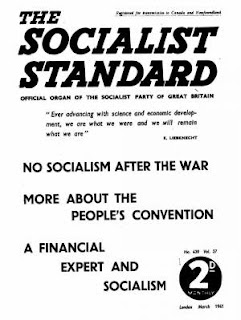
The Notes by the Way Column from the March 1941 issue of the Socialist Standard

The Little Corporal: Then and Now

One of the curious by-products of the rise of Hitler has been the revision of formerly accepted views of his predecessor, Napoleon. Typical of this swing-over are the following: —

On August 12th, 1940, the Daily Telegraph published an article by Mr. E. C. Bentley entitled “Hitler’s Mirror can reflect no Napoleon”; with the sub-heading “The Corsican, for instance, was a gifted and constructive despot: To his vassal states he brought order, not a gang wielding whips of persecution.”

Then on December 15th, 1940, 100 years after the ceremonial burial of Napoleon’s ashes brought home from St. Helena, The Times wrote similarly, saying: ”English historians have assessed scarcely less highly than French the value of Napoleon’s contribution to the structure of European civilisation.” The Times finds the following distinction between Buonaparte and Hitler: —
“The difference is that, whereas the opinions that Napoleon’s arms carried across the Continent were in their origin noble, and only became debased by the manner of their propagation ; we fight to-day against opinions that are evil in their very conception.”
If this is true it prompts the two-fold reflection that the British ruling class contemporary with the French Revolution and Napoleon held very different views, and that quite a number of their successors who witnessed the progress of Nazi brutality in our time were convinced that there was a lot of merit in Nazism.

On February 13th, 1941, the Manchester Guardian also explained that “in a great many cases his [Napoleon’s] own ideas were, of course, more enlightened and more just than the arrangements in force in old Europe.”

Now contrast these views with the abuse heaped on “Boney” by all and sundry when he was rampaging across Europe and Russia and threatening invasion of England. Not much then about his “enlightened” views.

Mr. Seymour Cocks, M.P., speaking in the House of Commons on December 19th, 1940, recalled the words applied to Napoleon by the Allied Powers which defeated the French armies over 100 years ago—”having broken every pledge and treaty, had placed himself outside the bounds of civil and social relations and, as the general enemy and disturber of the peace of the world, was abandoned to public justice.” Mr. Cocks wants the British and Allied Governments now to issue a similar declaration about Hitler.

William Cobbett, in his letter written in 1803 urging the Government to issue an appeal to the British public to resist Napoleon’s invasion, used words curiously like those now applied to the Nazis : 
“Now, like gaunt and hungry wolves, they are looking towards the rich pastures of Britain; already we hear their threatening howl, and if, like sheep, we stand bleating for mercy, neither our innocence nor our timidity will save us from being torn to pieces and devoured. The robberies, the barbarities, the brutalities they have committed in other countries, though, at the thought of them the heart sinks, will be mere trifles to what they will commit here … no man, woman, or child would escape violence of some kind or other. . . .”
If the capitalist historians could wash off all those blemishes from Napoleon it looks as if the principal qualification required of them is a capacity to wield a whitewash brush. What will they be doing with Hitler 20 years ahead ?


Merchant of Death

In years past the Communists have been among those who have expressed their horror at the spectacle of munition firms making profit by supplying weapons and materials of war to both sides engaged in a war. Now it seems that circumstances alter cases. The Russian Government is interested in the profits to be made out off international trade, including trade in essential war materials, and when the Russian Government cynically supplies such materials to those whom it denounces as the enemies of the working class and of democracy its apologists can see nothing wrong. A case in point is a letter written to the Manchester Guardian by Mr. Albert Inkpin, Secretary of the Russia To-day Society. Here is what Mr. Inkpin says:—
“Germany is importing oil products, raw materials, and grain from the U.S.S.R. Commenting on the recent new agreement, the official Soviet newspaper, “Izvestia,” states the willingness of the Soviet Union to trade “with other States, both belligerent and non-belligerent,” thus showing its readiness to trade also with Britain.” (Manchester Guardian, January 21st, 1941.)
A somewhat similar line is taken by Mr. Pat Sloan, though he was dealing with the fact that while the Italian Government was destroying Abyssinian troops and civilians by aerial bombardment the Russian Government went on supplying Italy with the necessary oil fuel for their aeroplanes. (It will be recalled that at the time the Communists were very indignant at the suggestion that this was happening.) This is Mr. Sloan’s statement, in a letter to Reynolds News (February 16th, 1941): —
“According to your book review, “Nazi Ways in Russia,” Arthur Koestler has written a novel the U.S.S.R. in which an “Old Revolutionary” goes anti-Soviet because the U.S.S.R. sold oil to Italy during the Abyssinian war and trades with Germany to-day.

As one who was in U.S.S.R. during the Abyssinian war, I may say that the Soviet people were proud that their Government was the first to apply sanctions against Italy, and that it proposed the application of further sanctions. I never met a single individual who advocated unilateral sanctions without the cooperation of the other States.

I may also say that nobody I ever met in the U.S.S.R. objected to trading with Britain so soon as the British Government adopted a reasonable attitude to the U.S.S.R.”
Now it is quite true that the Russian Government offered to support international action to stop oil supplies reaching Italy, but how does the refusal of other states to take action relieve the Russian Government of its responsibility in the matter ? Take the parallel case of the munition firms, they use precisely the same argument and excuse. British and American munition firms have repeatedly excused their action in selling arms (in peace-time) to all and sundry on the ground that if they did not get the trade somebody else would. The one difference between the Russian Government and the munition makers is not in their action but in their professions. The “merchants of death” admitted that they were concerned with trade and profit; the Russian Government affects to be guided by loftier motives.

There was a time when the Communists were demanding a world boycott of the Fascist countries and condemning the international trade union movement for its failure to make such a boycott effective, but we have not heard what reply, if any, the Communists and the Russian Government have given to the appeal made by the Greek trade unions (reported in The Times, November 2nd, 1940) asking workers in Russia and other countries to insist that their governments forbid exports of raw materials to Italy.


A Labour Peer on Profit

Writing to the Picture Post (January 11th, 1941), Lord Strabolgi, a Labour Peer, put in its briefest form the attitude of mind of the Labour Party as a whole on the subject of Capitalism and Socialism. He wrote: —
“I agree with Douglas Jay that monopolies should be broken ; but we are not ripe for the complete abolition of the profit motive.”
It is true enough that the majority of the workers are not yet ripe for Socialism, but whose fault is that ? What has the Labour Party been doing to make them ripe ?


Graziani Flatters Them

When Marshal Graziani, Italian Commander-in-Chief in Libya, retired with his defeated army from a village near Cyrene, he is reported to have told the village priest that the Italian settlers had nothing to fear : —
“The British are gentlemen. . . . They will treat you kindly and leave you to work in peace. . . .” (Daily Herald, February 7th, 1941.)
This was all right but we cannot help feeling that Graziani’s final words betray a slightly wrong idea if they are intended to apply to the British “gentry” as a whole. What he told the priest was: “If you want anything, ask them for it.”

Graziani cannot have seen the stony glare that some of the very best people in this country can put on when their workers ask them for another few bob a week.


“The Niceties of Civilization”

Fears have been expressed that tribesmen in Abyssinia may exact a savage revenge on the Italian settlers in Abyssinia when Italian control of the country breaks down. The tribesmen have bitter memories of the way the Italian invaders, armed with all the latest weapons of the modern arsenal, treated them five years ago. But what exactly did the Daily Mail Services Correspondent have in mind when he wrote (February 5th, 1941) that some of the tribesmen have “little regard for the niceties of civilisation” ? Niceties is hardly the word we would apply to modern war between “civilised” countries.


What is “Economic Democracy”?

The Labour Party has always fought shy of committing itself to any explicit proposal for the abolition of capitalism and its replacement by Socialism. That is why in the last 20 years Labour speakers and writers have made so much use of the term “economic democracy” as a description of their aim. It appeared to say a great deal but was capable of any number of interpretations.

Now comes Mr. J. A. Cecil Wright, M.P., writing to The Times (February 5th, 1941) to say that he, too, is all in favour of it. But before jumping to the conclusion that Mr. Wright is declaring for Socialism read the following: —
“If we are going to retain a capitalist system, and I hope we shall, because with safeguards it is the fullest system of life in an industrialised world (in fact it is economic democracy), then we must see to it that the essential ingredients of capitalism and democracy are there . . . .”
Edgar Hardcastle

Wednesday, November 13, 2019

Whither Arthur Koestler (1947)

Book Review from the January 1947 issue of the Socialist Standard

“Thieves in the Night,” Arthur Koestler’s new book, has the sub-title, "Chronicle of an Experiment," the experiment being the foundation of a Palestinian Settlement. Actually the purpose of the book appears to be to tell us about Koestler's latest ideas hopes and fears, these being expressed through characters who are rather mouthpieces than individuals with a life of their own.

The scene of "Thieves in the Night" is laid in pre-war Palestine and opens with the arrival of Jewish refugees armed with tractors and fertilisers at yet another settlement, determined as always to make "the desert blossom as the rose," and to put to shame the miserable Arabs scratching the earth with a wooden plough. Both these intentions are realised. Meantime persecution of Jews in Europe proceeds apace, the British Government limits immigration into Palestine in 1939, and as a reaction Jewish terrorism breaks out. It is indeed a topical book!

It states the case for the Jews, more particularly the so-called Revisionists against the Arabs in a forcible manner. But even the editor of the "Jewish Standard" (the organ of the Revisionists of Great Britain) reviewing the book, feels that Koestler is a little unfair to the Arabs. The Revisionists are one of the very many sects or parties of Zionists, perhaps the most radical, who violently oppose partition and any form of compromise short of having the whole of Palestine for the Jews, with the Arabs as a minority. Vladimir Jabotinsky was the founder of the movement, and it is to him that the book is dedicated.

Koestler was a Revisionist in pre-war Vienna, and it would appear that he is par excellance a man basing all political aspirations on emotions and the whim of the moment, his sympathies moving as on a pendulum. In 1931 he joined the Communist Party and spent a year in the U.S.S.R. In 1936 he went to Spain as a journalist to cover the Spanish War. He was filled with indignation at the horrors of civil war and from it emerged "Spanish Testament.” His works, “Darkness at Noon" and the "Yogi and the Commissar,” portrayed his disillusionment with Soviet Russia and his swing away from the Communist Party. It was whilst he was enamoured of [the] Soviet Russia that he dropped Zionism believing that "Socialism,” though presumably by this he meant Russian State capitalism, would be the solution to the Jewish problem. This did not, however, worry his Jewish friends, who knew his pendulum-like temperament; Jabotinsky is reputed to have said, “he will return to the fold again.” He appears to have done so. Bauman, the Jewish terrorist leader of “Thieves in the Night,” says:—“We can’t wait until Socialism solves all racial problems. That will perhaps happen one day, but long before that day we shall have been exterminated ” (page 296).

Koestler has now concluded that Socialism is not the solution to Palestine's problems but it is not Socialism but merely his misconception of Socialism that is at fault. The Socialist Party of Great Britain did not make his mistake concerning the Russian revolution, hence it does not experience Koestler’s disillusionment, nor yet conclude that terrorism is the solution.

The Revisionists view Britain’s intentions in Palestine in a decidedly realistic manner. They realise that British capitalism requires Palestine as a Middle Eastern base, and wish to deny it to any potential enemy. They realise that no base is effective if the native population is definitely hostile. Their terrorist acts are based on the supposition that if the Jews in Palestine show themselves capable of waging war and thus make the use of the base untenable the British will fall in with their wishes and hand over Palestine to their control.

This does not, however, take into account the fact that the Palestinian Arabs do not stand alone, but are backed by the Arab Federation plus the might of Great Britain. A bloody civil war therefore is not unlikely if their present terrorism continues. Dissension also exists among the Jews. The Jewish Agency has pledged itself to reduce terrorism and it was reported in the Daily Telegraph (November 11th, 1946) that the Haganah, the Jewish defence organisation, had begun an underground war to suppress the terrorist organisations, the Stern Gang and the Irgun Zvail Leumi.

The real solution of the Jewish problem seems distant. It does not lie in terrorism nor yet in partition. The problem will remain while capitalism remains. The working class, whether they be Jews or Arabs, must free themselves from the chains of nationalism and tackle their class problem on the basis of Socialist understanding. Nationalism is a cloak that covers the real aims and interests of the ruling class of the major capitalist countries and is a hindrance to the development of a Socialist movement. International comradeship for a Socialist world may seem at the moment a long way off; but it must come if we are to survive. Koestler’s acceptance of terrorism as a solution to the problem of Palestine (and he appears to accept it as such, in this book) helps nobody.
W. P.

Wednesday, March 20, 2019

The God That Failed (1950)

Book Review from the June-July 1950 issue of The Western Socialist

The God That Failed edited by Richard Crossman [Harper & Brother]

Six (presumably) wise men, tending their intellects, looked to the East, and saw a “new star in Bethlehem.” Pour of these savants actually journeyed to the Soviet Bethlehem, but instead of a new God, they found but another Pope. The remaining two gazed from afar, until after some meditation, they concluded the star to be a piece of cardboard, wrapped about with tinfoil.

Thus is The God That Failed, a collection of the sagas of six intellectuals who journeyed into “Communism,” and returned, a little wiser for their experiences. Three of these (Arthur Koestler, Richard Wright, and Ignazio Silone) were actually members of the German, American, and Italian Communist Parties, respectively, whereas the other three (Andre Gide, Louis Fischer, and Stephen Spender) were sympathizers and lauders of the Russian system.

The editor, Richard Crossman, Labor member of the British Parliament, terms the first group “The Initiates,” the second “Worshippers from Afar.” The title of this book originated from the play Oedipe by Gide, in which the author “is forced to the realization that man without God is doomed to defeat and despair, unless he substitutes some other idea for God. Oedipus at the end rejects God for man, and Gide looked toward Communism.” So writes Enid Starkie who edited Gide's comments. The God That Failed, indeed! After reading this sextet of confessional breast-beating, this reviewer believes that a more proper title would have been, The Understanding That Failed. In reaching out for their God, their concept of “communism,” [1] these intellectuals showed very little understanding of exactly what kind of revolution occurred in Russia in November 1917, and exactly what type of society was instituted. Later on, when their star dimmed, blinked, and then went out, they began to grasp a little more of the truth about Soviet Russia. Especially was this so in the case of Arthur Koestler who, at the conclusion of his essay, mentioned that in another of his books (The Yogi and the Commissar) he tried to expose the “fallacy of the unshaken foundation that a state-capitalist economy (Russia) must of necessity lead to a socialist regime.”

The Pull To The East
Our assertion that these individuals showed very little understanding of the nature of communism and the Soviet economy can be underlined by examining the reasons they present for either joining the Communist Party or becoming fellow travelers and sympathizers.

Arthur Koestler — a writer, as are the other five intellectuals.— entered the Communist Party in Germany because he believed that the Stalinists had the answer to unemployment, insecurity and war. Ignazio Silone became a member of the Italian Socialist Party for basically the same reasons, and although he does not state so, he allegedly switched to the Italian Communist Party out of the same motivation.

One of the most outstanding Negro writers today, Richard Wright, attached himself to the John Reed Club in Chicago, first because of a desire to further his writing. Later he signed an application card in the Communist Party of the United States when he was told that he would have to do so in order to remain Secretary of the Club.

As for the worshippers from afar, with Andre Gide it was, as the title states, the search for a new God.
“It was not through Marx, but through the Gospels, that Gide had reached communism,” writes Enid Starkie. Gide himself put it in this wise, “My conversion is like a faith.”

Louis Fischer, the noted journalist and author, and Stephen Spender, the English poet, likewise viewed the Soviet Union as the “white hope of humanity,” in contrast to the demoralized aspect represented by the Western capitalist powers.

Despair In The West
Richard Crossman, the editor, perhaps sums it all up the most satisfactorily in his foreword to the book. He emphasizes that it was the failure of Western capitalism which accounted for men of such intellectual capacities hitching their wagons to the Red Star. In general, this is a correct evaluation. At the same time does this not also prove our previous claim, that fundamentally it was lack of understanding on the part of these writers that brought them to their sorry pass?

Whether these men viewed Soviet Russia as a new faith, a Utopia, or as an answer to capitalism’s inability to solve the problems of the working class, not one of them at any time displayed an awareness of the nature of socialism, and of Soviet society. Such an awareness would have spared them the snares and later disillusionments of Russian capitalism. A scientific socialist understanding would have taught them that the material conditions were not suitable for socialism in Russia in 1917, that what the Bolsheviks did, was merely to institute capitalism under control of the state because of the inability of any strong and cohesive capitalist class to organize private capitalism.

This understanding, further, would have convinced these intellectuals that the means employed by the Bolsheviks — assassinations, character and physical, slanders, deceit, and outright lying — are not inseparable from the ends sought, but exposed the real objective of the various Communist Parties, to establish a dictatorship over the proletariat, not of it, another class society, not a classless society.

Retrospect Is Easy
Let us not be too severe on these individuals. Our understanding permits us to see how in the past several decades the Soviet Union and the Stalinists could have been the drawing cards they were. In the World Socialist Party today and in the other companion parties of socialism are many who were likewise sucked into the Soviet circle. In the absence of large scientific socialist parties to spread the knowledge of a clear concept of socialism, Russian pseudo-communism could and did make tremendous gains among workers and intellectuals seeking a way out of capitalist wars and depressions. In the lack of the development of scientific socialist ideas among the workers which would have brought socialism closer to reality, Bolshevism represented a “we-are-doing-something-about-it” movement, and drew followers unto it on this emotional basis.

What did it all add up to? The God That Fails helps furnish part of the answer. Defection and disenchantment, revulsion against a cause once held dear. Unacquainted with socialism, these six intellectuals could not have had the proper understanding to avoid the traps set by the Russian bear (a case of the hunted becoming the hunter!)

This can be overlooked. One learns by experience. One’s political views reflect one’s conception of the material world at any one time. But after these six men had gone through the hell and welter of the Russian maze, it is not too much for us to expect that they should have profited thereby.

But they haven’t except, in a negative sense, that they learned enough to be opposed to Stalinism (the term erroneously used by many to describe modern Russian state Capitalism) and all it represents. On the positive side, however, all of them, in one form or another, have returned to the support of capitalism, from which, unknowingly, they never departed when they affiliated themselves to the Russian Church. [2] Now they look upon “Western democracy” without understanding its economic base, any more than they understood the economic base of “Soviet democracy.” In spite of Louis Fischer’s theory of the “Double Rejector” — “rejecting the evils of dictatorship and of democracy,” that it is possible to steer a clear path between the rocks of Stalinism and the reefs of capitalism, events have proved there is no middle ground.

Looking at history opportunistically and from an immediate viewpoint, a middle ground may seem a likely attraction. The socialist, however, knows that in the end one must choose between capitalism and socialism — the latter, not as propagandized by Soviet state capitalism, but. as we conceive it, as the ownership of the means of production by the entire population, and democratically controlled by it.

It is a comfortable feeling between wars and depressions to rationalize that one is combatting the evils of Russian capitalism, at the same time not condoning the sins of capitalism elsewhere. But this is a luxury which perhaps only intellectuals have the mental bankroll to afford. When the drums roll and the swords are unsheathed for the third World War; when the factory gates swing shut for “lack of work,” and millions pound the pavements looking for non-existing jobs — where, then, the middle ground intellectuals?

Where they were when they joined “Stalinism,” where they were after deserting it — in search of a new “star in the East,” a new faith, a new God. Perhaps we shall be treated to a second, and even third edition of The God That Failed, with only a change in the time and the characters.

The Book Has Merits
The book has tremendous merits, in spite of our criticism of the protagonists. Through the eyes of Arthur Koestler the reader is taken through the turbulent pre-Hitlerian days in Germany and shown how the German Communist Party was used in the interests of the Soviet ruling class, not in the interests of the German workers. Later on, in his trip to the Soviet Union, Koestler reveals how foreign writers are paid royalties, not for their books (some of which are not even published), but for their support and flattery of Stalinism.

Ignazio Silone exposes how he was asked by the Executive Committee of the Communist International in Moscow to condemn a document by Trotsky without ever having read it.

For the reader in the United States, the essay by Richard Wright perhaps furnishes the most sustained interest, since it deals with the experiences of the author in the Communist Party in Chicago.

Andre Gide, who has written extensively of his trips to the Soviet Union, gives the reader a good insight into conditions in the Soviet Union. Although Gide did not see state capitalism in Russia, he was astute enough to point out that “the disappearance of capitalism has not brought freedom to the Soviet workers . . .  It is true of course that they are no longer exploited by shareholding capitalists, but nevertheless they are exploited, and in so devious, subtle and twisted a manner that they do not know whom to blame . . ." 

Louis Fischer furnishes more insight into the stifled situation within Russia, and explains how the Spanish Civil War, and the new Russian Constitution in 1936 gave Stalinism a new lease on life. Stephen Spender also deals with the Spanish Civil War, and has an interesting theory why distinguished scientists like Haldane, Bernal and Joliot-Curie become supporters of movements like Stalinism.

Conclusion To Confusion
Perhaps we cannot better conclude this review than by reciting the circumstances under which Stephen Spender joined the British Communist Party for a few weeks during the winter of 1936-7. After writing Forward from Liberalism, he was invited by Harry Pollitt, head of the British CP, to visit him. Pollit objected to Spender’s criticism of the Moscow Trials in his book. At the same time he suggested that since Spender was in agreement with the Party on the Spanish Civil War, he should join the Party. Spender was to write an article in the Daily Worker criticizing the Stalinists, at the same time he joined the Party! “I accepted this offer,” Spender relates. “I received a Party card, and my article appeared. The article infuriated the Communists in Scotland and the North of England, and my membership in the Party was quickly forgotten.”

Was it the God, or was it understanding, that failed in the case of these six men who spent a “Lost Weekend in Utopia?”

Socialists are not looking for a star, a God, but for their fellow workers to join them in a movement which is understood by all, controlled by all, and in the interests of all — Socialism.
Karl Frederick

Notes:
[1] The Russian Revolution and the appearance of the Communist Parties and the Communist International have caused those who believe in common ownership under democratic control to be all the more careful to call themselves “socialists” in order not to be identified with the state capitalist regime in Russia and the dictatorial methods and objectives of the Stalinists everywhere. However, in terms of the nature of societies, no difference exists between communism and socialism, both being defined as in the previous sentence.

[2] This statement applies as well to Ignazio Silone. Although at the end of his essay he reaffirms his belief in socialism, his concept of the latter is that of Social Democracy, according to latest reports. Social Democracy not only supports capitalism, even strengthens it by reforms, but also sees state capitalism as “socialism.” It is not enough to say one is a “socialist” to be one. One must advocate the revolutionary abolition of capitalism and refuse to work for its reform, in order to wear the label of "socialist.”

Saturday, January 20, 2018

Notes By The Way: Should Women Have Equal Pay with Men? (1941)

The Notes By The Way column from the December 1941 issue of the Socialist Standard

Should Women Have Equal Pay with Men?

The propaganda of the organisations which favour equal pay for men and women doing the same job has made much progress recently and a poll organised by the British Institute of Public Opinion showed a majority of over two-thirds in favour. (News-Chronicle, November 17th, 1941.)

The main reason for the change of attitude this poll indicates is, however, not propaganda, but the fact that under war conditions there is a limitless demand for women’s labour. As the Economist says: “. . . temporarily, at any rate, the war has done the reformers’ work for them. The demand for women workers has increased; and the number of occupations into which they are eagerly admitted is growing. But in spite of the greatly increased number of women coming forward, there is still a shortage . . .”—(Economist, November 29th, 1941.)

It should not be imagined that the propaganda for equal pay is new. It was in full swing 40 years ago and was, for example, commented on in The Socialist Standard for December, 1904. Apart from the war-time demand for women workers the problem has only changed in the past 40 years in one respect, that there are now a larger number of occupations in which it is normal for women to be employed. The claim that the job should carry the same pay whether done by a man or a woman is still a mere tinkering with the real problem of the working class, both men and women. Short of getting rid of the wages system and the employing class, as under Socialism, the whip-hand is always that of the employing class. They will always seek what is for their particular concern the cheapest labour and will always use unemployment as a lever to force down wages towards the minimum of subsistence. The advocates of equal pay who imagine that the acceptances of the principle by the employers will make any material change are overlooking the easy loophole it provides. If an employer accepts the principle of equal pay for a certain grade of work and then finds that there are plenty of unemployed women able and willing to do the job for a lower wage, all he has to do is to take all the men off that work. The work then becomes a purely woman’s job, and the principle of equal pay ceases to have any application.


Douglasites Repudiate Douglas

The following paragraph appeared in the Daily Telegraph (November 17th, 1941): —
   Three persons have been excommunicated this weekend by the Green Shirts. They are Major C. H. Douglas, who invented Social Credit, the Dean of Canterbury and the Duke of Bedford.
  This information I obtain from The Message from Hargrave, the weekly sheet of foolscap expounding the views of the “Social Credit Party of Great Britain,” which I have been receiving since I announced, last July, that Mr. Augustus John had become a Green Shirt.
   I read that the Social Credit Party repudiated the "authority and directives” of Major Douglas in July, 1938. He is now once more repudiated for “confusing his own economic logic by developing an anti-Semitic propaganda.”
   Dr. Hewlett Johnson’s excommunication is for becoming that “quite ridiculous thing—a Christian Bolshevik.” The Duke of Bedford, who, as I read, is even better known than the dean for his advocacy of Social Credit, is placed under the ban for his out-and-out advocacy of the views he holds on the war.

Under-Feeding Among Edinburgh Workers

The Weekly Scotsman (July 5th, 1941) summarises the result of a recent inquiry into the income and expenditure of a number of families on the ”unskilled labourer" level of income.
  Out of 75 families whose food bill was investigated, only 8 were spending enough to buy an adequate diet. From various causes none of the families was in fact getting a diet adequate in every respect. There are figures of the large slice of their income which some families spend on hire purchase or sickness and burial insurance. Over half the families were living beyond their incomes and running into debt; in particular, “it was found that a high percentage of Service families were in part dependent upon hospitality from relations.”

Restrictions on Political Propaganda

On November 27th, 1941, the News-Chronicle published the following: —
                                                        POLITICS BANNED.
   While the war is on, politics are to be banned in the factories (writes the Labour Correspondent).
   The T.U.C. has agreed with the Government that political parties shall not be allowed to propagate their policies inside the establishments of private firms, as well as Government factories and dockyards.
    This does not apply to trade union meetings.
Probably, though it is not stated, the justification offered for this ban is that political discussions interfere with output.


A Question to Federal Unionists

Reviewing a book (“Scum of the Earth," by Arthur Koestler), Mr. A. J. P. Taylor, writing in the Manchester Guardian, puts a pertinent question to supporters of Federal Union. Koestler, who supports Federal Union, had recounted some of the brutalities he witnessed in French and Spanish jails. Mr. Taylor asks: —
   "Koestler believes in European Union. Why should the police of the Union be any improvement on Koestler’s French or Spanish gaolers . . . ? In short, why should European Union—even if it ended wars—end man’s inhumanity to man?”
It is a good point because it brings out one of the fallacies of Federal Union. Is the world out of joint because of the way frontiers are drawn or because of the existence of a class-divided society, with oppression of one class by another, behind each frontier?

Socialists carry Mr. Taylor’s question further and ask whether Federal Union will end wars or only alter and enlarge the frontiers of the warring powers.


Echoes of the People’s Convention

It is an old saying that new converts are more zealous than old believers. The People’s Convention since its overnight conversion to war on the night of June 22nd is now a whole-hogger.
   The Peoples Convention, which in January wanted immediate peace and an appeal to the German people over Hitler’s head, now presses for intensified war effort and. the creation of a second front.
    At an Anglo-Soviet rally in Friends' House, Euston Road, London, yesterday, every utterance in favour of our more active participation in the war was loudly cheered.
    “We are letting the golden days go past,” said Dr. Hewlett Johnson, Dean of Canterbury.
   “If we had invaded the Continent in June the Dneiper Dam would still be working and Russia would have retained most of her lost industries. We have lengthened the war immeasurably.”—(“Sunday Express,” November 2nd, 1941.)
Mr. Pollitt, in his new role, writes as follows : —
   Russia is working, fighting and dying in a manner unknown in world history. So must we in Britain. So we can in Britain if the Government sets out to command the unstinted support of the people by proving by every one of its actions that Russia and Britain are in a real alliance, in which we take our full share and make the same sacrifices that the victory over Hitler is demanding. —(“Workers’ News.”)

Communists Support for Conservative Candidates

The Communists have a simple faith : Whatever the Russian Government does is right, whether it be Pacts with Hitler or war with Hitler. Whatever helps the Russian Government is right, whether it be denouncing the Labour Party for associating with Conservatives or voting for Conservatives.

Viewed thus there is no inconstancy in the recent Communist support for Conservative candidates at Lancaster and Hampstead. At Lancaster, where the National Conservative candidate was opposed by an Independent Liberal and by Mr. Fenner Brockway of the I.L.P., "a Communist deputation visited the Conservative campaign headquarters in Lancaster this afternoon and offered to work for the return of Mr. Maclean, the National Government candidate."—(Daily Telegraph, October 14th, 1941.)

At Hampstead there were four candidates, all with the same policy, vigorous prosecution of the war and aid for Russia. The Communists supported the official Conservative candidate, Flying Officer Charles Challen, who won the seat.

An interesting sidelight on the Lancaster election was the statement made by the I.L.P. candidate to the Manchester Guardian : —
   Mr. Brockway himself told the writer that a number of Labour voters who did not wholly accept his views about the war had told him they would vote for him for “old acquaintance sake ” and as a protest against “too much Toryism in the House of Commons."
Edgar Hardcastle

Tuesday, October 10, 2017

Editorial: The Sterility and Futility of Ex-Communist "Intellectuals" (1950)

Editorial from the August 1950 issue of the Socialist Standard

The Manchester Guardian for the 10th July contains an article giving a report of the “Congress for Cultural Freedom" that was held in Berlin from June 26th to 30th. The article is by H. R. Trevor-Roper who attended as one of the British delegates and who appears to have summed up the nature of the congress and the delegates with a considerable amount of clear-sightedness.
   “This congress turned out to be a political demonstration. As such it was well organised and no doubt successful. My only objection is that it was not advertised as such, and I do not think it would have obtained all its sponsors or all its delegates if it had been correctly advertised.”
As the article makes clear the congress was certainly not one for cultural freedom; it was in fact dominated by renegade communists who made vicious attacks upon their late friends and upon the ideas they had formerly backed as the essence of all that was advanced in culture, and deserving of world wide support, with them, of course in the vanguard of the movement—the admired leaders! Unfortunately for themselves they were, as always, only ignorant tools. When they discovered this they turned their impotent fury upon the hands that led them up the garden.

Mr. Trevor-Roper describes some of the incidents that make plain the narrow personal outlook of these would-be leaders of the world, and how little this outlook has to do with cultural freedom. Some quotations from this article are enlightening.
   “The printed prospectus offered highly intellectual terms of reference, and Professor Ayer (one of the English delegates), in his opening speech, kept to them. To a disapproving audience he quoted Mill and examined the philosophic justification of tolerance. The Greek chairman then explained that this was irrelevant, since our enemies were too intolerant to be tolerated; and a German, declaring that ‘in our times John Stuart Mill cannot help us,’ appealed for a rival dogmatism as a more useful weapon of war. Professor Herman J. Muller, of Indiana, then spent forty five minutes denouncing Lysenko as an ignoramus.”
Mr. Trevor-Roper remarks that after this it was impossible to return to an intellectual level. The next day they discussed “The defence of peace and freedom," Mr. James Burnham opening on the subject. This is what Mr. Trevor-Roper has to say of Mr. Burnham’s contribution:
   “Mr. Burnham’s prophecies have always been oracular and infallible in form, but their content has needed frequent revision. At the moment he is prophesying the inevitable defeat of Communism. In his speech he advocated a somewhat expensive method of securing the inevitable, for he preached total war; denounced pacifism, then (by an imperceptible transition) peace; and urged his audience to judge the morality of atom bombs according to the nationality of their manufacturers.”
Then Mr. Arthur Koestler added his contribution: 
   “Mr. Koestler made, altogether, three speeches, and his theme was constant if unconstructive. It was that Right and Left are meaningless terms; that the choice before us is Communism or Anti-Communism; and he who is not with us is against us. On this occasion he developed his theme into a long attack on England as parochial and isolationist for refusing to see the problem in these clear terms.”
Mr. Koestler has always been a master at seeing problems in clear terms, only the terms get mixed up— one day on one side and the next day on the other side.

The ex-communist Franz Borkenau also made a contribution about which the writer of the article makes the following comments :
   “Pouring out his German sentences with hysterical speed and gestures, he screamed that he was a convert from Communism and proud of it; that past guilt must be atoned for; that the ex-communists alone understood Communism and the means of resisting it; that Communism could only mean perpetual war and civil war; and that it must be destroyed at once by uncompromising frontal attack, and yet, terrible though it was, this fanatical speech was less frightening than the hysterical German applause which greeted it. It was different from any other applause at that congress. It was an echo of Hitler’s Nuremburg.”
The writer of the article adds that with that speech and the applause the whole structure of the congress was revealed as an alliance between two parties—the ex-communists among the delegates and the German Nationalists in the audience. “Cultural freedom,” he says, “ was nowhere.”

The concluding paragraph of the article is .an example of the clear-headedness of the writer, at least on this particular question. He sums up as follows:
   “The congress was in no sense an intellectual congress. . . .  It was simply Wroclaw in reverse—the Wroclaw of the ex-communists. Signor Silone once suggested that the coming struggle would be between the Communists and the ex-Communists. After the sterile congresses of Wroclaw and Berlin I am confirmed in my view that a more satisfactory solution will be offered by those who have never swallowed and therefore never needed to re-vomit, that obscurantist doctrinal rubbish whose residue can never be fully discharged from the system.”
These ex-Communists (Burnham, Koestler, Borkenau, Hook, Lasky and the rest) are incapable of understanding now the mainspring of their own fatuous conduct. Blinded by a false conception of their own importance, always wrong, and violently wrong, they still hope to occupy the centre of the political stage and bolster up their empty egoism with the plaudits of equally blind followers. Yet so great is their political ignorance that they are fated always to back the wrong horse. Their actions demonstrated that it is they, more than any, who fail to understand the basis of the Russian dictatorship and its imperialist policy, and that it is also they who are the more easily rendered impotent. They fall for every wrong social theory, for every futile movement, and are used and cast aside by political climbers of every brand; their contradictory professions, fleeting loyalties and futile actions brand them as what they are—servile tools of ambitious political groups always ready, like mangy curs, to snap at the heels of those who have fed them. Blindly imagining that they arc superior to the working class they are in fact but the scum that floats on the surface of that class.

Tuesday, June 20, 2017

The Rehabilitation of Pavel Dybenko (1964)

From the May 1964 issue of the Socialist Standard

Ever since the death of Stalin, the rulers of Russia and of the farcically named Peoples Democracies have been engaged in a new industry—the rehabilitation of ghosts from their murky past. So far they have not actually succeeded in bringing back to life one of Stalin's murdered victims, but, no doubt, they are working on that; while another feature is that the bones which are now moved up to the more desirable plots in the cemeteries are always those of Communists—and usually Stalinist Communists at that. So far there is no sign of life from Trotsky, Bukharin, Zinoviev and all the other Bolshevik victims of the grisly thirties let alone any of the countless swarms of anti-Bolsheviks and non-Bolsheviks. Presumably they must rot unhonoured and unmourned.

It may be instructive to take a look at a recent example of the rehabilitation business, that of Pavel Dybenko. As the papers were not slow to point out, added interest attaches to this case because Dybenko was the basis of one of the important and tragic characters in a famous work of fiction— Koestler’s Darkness at Noon, a novel about the purge trials of the Stalin Terror (a book that is well worth reading even though its central thesis, that the false confessions made by leading Bolsheviks before being butchered were the result of ideological devotion to the Soviet system at all costs, was false; as Krushchev has since shown, the simple explanation was quite good enough—they were extracted by brute force and barbaric torture). But apart from that, the case of Dybenko is of fascinating interest in that it shows the degeneration of a hero who has hitched his waggon to a false star and therein lies a lesson about the falsity of the old maxim—"the end justifies the means."

Dybenko first became news in 1915 when, as an ordinary sailor, he led a mutiny on a Tsarist warship on the Black Sea and it was, therefore, not surprising when he figured prominently in the fighting in Petrograd in the 1917 Revolution. He was by then a leader of the rebellious sailors of Kronstadt, the famous naval station near the then Russian capital (now Leningrad). The very name of Kronstadt has a terrible irony in this context. Dybenko led the sailors in their revolt against Tsarism, an undoubted tyranny, but he and his comrades used their strength to help the Bolsheviks overturn both the Tsarist tyranny and the Provisional "Liberal" government of Kerensky and substitute an iron dictatorship of the Communist Party whose yoke is still firmly around the neck of the Russian proletariat to this day.

From this stage the story of Dybenko takes a bizarre turn. After the Bolshevik victory in November, 1917 (with its accompanying massacre of the young cadets and the women soldiers in the Winter Palace along with the murder in a prison hospital of two defenceless members of the Provisional Government) the next stage was the calling in January, 1918, of the Constituent Assembly which the Bolsheviks had, not without some justification, accused the Government of delaying.

From all corners of Russia the delegates came to the Parliament which was going to give Russia its new democratic government. But there was a flaw. The new Parliament had an anti-Bolshevik majority and elected an anti-Bolshevik chairman. This sort of democracy did not suit Lenin and the Bolsheviks who had control of the armed forces in Petrograd, so the Assembly was broken up—an inglorious end to the first relatively free election in Russia's tragic history and, of course, the last.

But whilst the sailors of Kronstadt contributed to the Bolshevik victory, they soon came to realise that they had blundered; that there was no semblance of liberty or democracy in the regime they had helped to create. In due course this led to the Kronstadt mutiny of 1921, the last open act of defiance by any Russian body of men against the new tyranny. This mutiny posed serious problems for the Communists and for Trotsky, their commander-in-chief, for the Kronstadt sailors were strong both in arms and men and in addition they had the revolutionary prestige attaching to the heroes of 1917. The problem was duly solved by the classical mixture of force and fraud that is inevitably used by ruling cliques whenever their position is threatened, whether they call themselves Communist or anything else. And who were the leaders of the Red Army which crushed the mutiny? Firstly General (later Marshal) Tukhachevsky and, at his right hand, the same Pavel Dybenko who had formerly been the outstanding figure among the sailors but who was now a member of the ruling clique and the husband of the famous Bolshevik Madame Kollontai. And it is instructive to note that all this took place not under Stalin, the so-called betrayer of the Revolution, but in the heyday of Trotsky and of Lenin himself.

The subsequent story of our "hero" only shows the sad progress of his decline into a vicious instrument of tyranny. He became the President of the Military Court—one of Stalin's hanging judges. And his most famous victim in that role? None other than the same Marshal Tukhachevsky with whom he had helped to crush the sailors of Kronstadt. The Marshal, who had become the C-in-C of the Red Army, had fallen foul of Stalin's megalomaniac fury and himself became a sacrifice to the executioner along with his wife and family—a grisly monument to Stalin’s "Communism” which, of course, evoked never a bleat of protest from the Communist Parties of Great Britain and the other western countries.

Finally Dybenko, having betrayed and butchered his former comrades in the service of this monstrous travesty of Communism. himself found that he was caught in the net and in 1938 duly paid with his life in the Stalinist blood-bath. The lesson of all this bloodshed and double-dealing? Surely, none other than that no amount of heroism and even of sincerity (for it is certain that people like Dybenko at first believed in the rightness of their actions) can bring Socialism in a world where, as in Russia, the mass of the people do not understand or want it. The idea that a minority of Communists could lead the uneducated masses into the promised land was condemned as dangerous futility in these pages nearly 50 years ago. And how tragically the Russian workers have paid in blood and suffering for their folly.

And what of the present? Does anyone really believe that Krushchev is leading the Russian State Capitalist machine towards Socialism? Why, only recently he was quoted as denouncing the principle of equality in wages which had always been an ostensible goal of the Bolsheviks, and defending “differentials" (and what differentials!) like any good capitalist. And whom does his regime rehabilitate when it condemns the days of Stalin? Democratic heroes? No, Communist murderers, the victims of other Communist murderers. And still the repression goes on as the executions for "economic crimes" and the continued barbaric imprisonment of people like the mistress of the writer Pasternak, and her daughter, abundantly testify.

One day, in Russia as in the rest of the world, there will be a Socialist revolution. But it will take place as a result of a majority of thinking Socialists deciding to end the capitalist regimes in all countries, not least in the Soviet Union.
L. E. Weidberg

Sunday, March 26, 2017

Reaction in Germany and Spain. (1938)

Book Reviews from the March 1938 issue of the Socialist Standard

Germany Puts the Clock Back, Edgar Mowrer (Penguin Special, 6d.).
Spanish Testament, Arthur Koestler (Gollancz. Left Book Club, 2s. 6d.).

These two books have much in common. Both are written by working journalists, both are easy to read, and both seek to provide a background to the events which they portray. Mowrer, in his “Germany Puts the Clock Back," paints a vivid picture of the social disintegration which eventually led to the triumph of Hitler and the National Socialist Workers' Party of Germany. In so doing he also partially provides an answer to a question so frequently asked of Socialists: “How is it that the German workers, with their numerically strong Social-Democratic and Communist Parties, their highly-organised and well-disciplined trade unions, fell so easy a prey to the Nazis?" The answer is to be sought in the political and economic background of German capitalism. German capitalism made its appearance at a relatively late stage, and a preponderant part was played by the State in its consolidation. The state bureaucracy, with its Prussian ideals of unquestioning obedience and strict discipline, early became a strong social force, and its outlook undoubtedly impressed itself on German society as a whole. Only personal experience can give an idea of the awe in which even the most insignficant “Staatsbeamte” (State official) was held. This reverence for “duly constituted authority” was no less reflected in the ranks of the German workers themselves. And the leadership of the German workers’ organisations could count on this tradition of blind obedience and discipline, no matter how contrary to working-class interests the actions of those leaders might be.

The upheaval of 1918, although largely the work of the working class, was not Socialist. It was the outcome of a widespread distrust of the monarchy and of the military clique, reinforced by an extreme war-weariness that affected civilians and troops alike. The Social-Democratic Party found itself the largest party in the Reich, and promptly proceeded to usher in the dawn of a new world by enlisting discredited generals and military adventurers to bloodily dispel any misguided notions entertained by radical sections of the working class. Having successfully accomplished this, the most democratic constitution in the world (on paper) was created, in the shape of the so-called “Weimar” Republic; a republic which entrusted its administration to officials who took no pains to conceal their contempt of the constitution they had sworn to serve. It is impossible to read the account of this sorry episode without forming the conclusion that the entire shabby, paltry edifice of this most “democratic” republic was designed to serve as a screen, behind which the old bureaucratic and militarist elements could rehabilitate themselves. Like many other observers of the German scene, Mowrer is misled by the preponderant part the military machine plays in German affairs, to the extent that he assigns it an independent role. That is, as if the German ruling class existed for the army, and not the other way about. Olden makes a similar mistake in his “Hitler the Pawn.” The army is an indispensable tool of German capitalism, and as such has received loving attention from politicians of all shades, from radical Social-Democrats to reactionary Nazis. But it still remains a tool, to be used when, where and how the ruling class of Germany thinks politic.

Expressed tentatively, it would appear that the later a particular national capitalism makes its appearance the more important is the part played by the State in making that appearance effective; the more important the State, the more outstanding the role of one of its organs: the armed forces. This would explain the prominent part played by the armed forces in such countries as Japan, Russia and Turkey.

Mowrer effectively disposes of the myth, broadcast by both the Communists and Hitler— but for different reasons—that Hitler saved Germany from Bolshevism, or, if the other version be preferred, that Hitler was the last desperate throw of a capitalist class faced with imminent social revolution. The truth of the matter is that German capitalism found itself in profound difficulties, and that the increasing misery of the masses, instead of manifesting itself in intelligent organisation for the purpose of abolishing the cause of that misery, found expression in sporadic strikes, street battles, and blind kicking against the effects of capitalism. Although this in itself did not constitute a threat to the capitalist system, yet it did interfere with smooth running of German economy. Hitler, leader of the largest single party in Germany, was entrusted with the task of “pacifying” the German proletariat; and, of course, he has more than fulfilled his promise. For the time being, political brawls, strikes, and social disturbances are a thing of the past in Germany. Hitler has created the profound peace of the graveyard, the peace of penal settlement. Notwithstanding, since Hitler, like his predecessors, is committed to administering capitalism, the causes that make for social unrest still exist, and not all the concentration camps or the terrorism can in the end suffice to prevent expression of that unrest. It is only to be hoped that the German workers have learned their lesson, and that the mistakes of 1918 will not be again repeated.

This book also provides an explanation of the ease with which the German reactionaries prevailed upon the German people to make such tremendous sacrifices—sacrifices which have subsequently been epitomised in the phrase “Guns instead of butter.” On all occasions the parties of “national resurgence” urged that the distress of the masses was due to the Versailles Treaty, to "Versailles Slavery.” The masses were told that their well-being could only be achieved when Germany was free (i.e., when the German capitalist class had regained its political and economic freedom of action). To this end sacrifices had to be made, so that the means of effecting this freedom, a strong army, could be built up. Consequently, the attention of the workers was largely diverted from the capitalist system to a quarrel between different national capitalist interests, and in this they were ably aided and abetted by social reformers of all kinds, from the late General Ludendorff’s Freedom Party to the Communist Party of Germany.

As far as the limitations of this book are concerned, Socialists hardly need to be made aware of them. The author bears all the hall-marks of a sentimental Liberal of the old school that persists in confusing State-intervention in social and economic affairs with Socialism. His solution of the problem of Fascism is a “renewal of the belief in universal(!) values—in international organisation, in collective security, in democracy and personal freedom.” Of an understanding that these “values” can only be realised when the international working class achieves its emancipation there is not the slightest inkling. And this can only be accomplished, not merely through belief, but through organisation under the banner of Socialism and the class-struggle.

“Spanish Testament” was the December choice of the Left Book Club, and thus assured of a large public. The author was for a time imprisoned by the Franco forces in Spain, and part of the book is taken up by a description of his prison experiences. Like the preceding book, Koestler also provides a background to the events he seeks to portray, and the importance of the agrarian question is well brought out. The author more than once draws attention to the similarity between the present condition of Spain and that of Tsarist Russia. A mediaeval agrarian economy predominated in Russia, as it predominates in Spain to-day. The driving force in the former was a land-hungry peasantry, plus a weakly-established capitalist class striving to assert itself; the same driving force operates in the latter. One thing emerges quite clearly, all talk of a Socialist revolution in Spain at the moment, such as is indulged in by the P.O.U.M. and its brother party here, the I.L.P., is so much romantic Utopianism, which can only spell disaster to those sections of the Spanish working class that fall for it. The Communists here are proving for the time being much greater realists. Their aim is one within the realm of possibilities, the establishment of a Liberal, Democratic capitalist republic, with a constitution resembling in all essentials those prevailing in England and France. The Communist case against the P.O.U.M. and I.L.P., however, is considerably weakened if the conditions in present-day Spain and pre-revolutionary Russia are closely analogous, for in that case there is no more justification for the Communist characterisation of the Russian revolution as Socialist than there is for the I.L.P. claim that possibilities for Socialism exist in Spain to-day. In spite of a vicious campaign waged by the Communists against the I.L.P. and P.O.U.M. (in the case of the P.O.U.M. embracing such tactical niceties as political murder), the leadership of the I.L.P. still retains a pathetic belief in the Socialist “basis” of Soviet Russia, and is never tired of appealing to dear “Comrade” Stalin to mend his ways.

In dealing with the role of the Roman Catholic Church emphasis is laid on the nature of the opposition to that church in Republican Spain. This opposition is by no means the outcome of antagonism to religion as such, but is largely the result of the secular and political part played by the priesthood in the Spanish social system. Closely bound up as the Church is with those reactionary elements from which it derives its economic and social influence, it is hardly to be wondered that particularly this aspect of the “Holy Church” arouses almost fanatical hatred amongst Spaniards having the slightest pretensions to enlightenment. One need not be a prophet to predict that if the Church is to survive in the Spain of the future it will have to considerably adapt itself.

The account of the atrocities committed by the Franco forces, although sickening enough, are, on the whole, not treated sensationally. The author argues, where the mass of the population are opposed to you, terrorism becomes not solely an expression of individual sadism, but also, and chiefly, a political necessity. One thing seems certain, that without the aid given by foreign powers Franco would have been long since vanquished. In fact, it is more than doubtful whether he would have started his insurrection in the first place had he not been assured beforehand of military aid from outside sources. Although the author advances convincing proof of the existence of Italian and German support for the rebels, hardly any mention is made of the nature and extent of Russian aid to the Republican Government of Spain. The role of Russia in Spain seems clear enough. German and Italian domination in Spain would seriously diminish the value of France as a partner in the Franco-Soviet Pact. Consequently, it is in the interests of Soviet Russian foreign policy to see that the pro-German and Italian forces are defeated in Spain, whilst at the same time the movement is kept within bounds acceptable to Russia's present allies and to any probable allies of the future.

Like Hitler and Mussolini, Franco has appointed himself one of the co-saviours of the world from "Bolshevism." In spite of the frenzied declarations of political respectability on the part of the Communists, their murky past of the period of "heavy civil wars," "revolutionary upsurges," and all the rest of the pseudo-revolutionary tarradiddle is utilised by the reactionaries to justify the massacre of all working-class opposition.

That section of the book which deals with the personal experiences of Koestler make interesting reading, but need not be dealt with here. It only remains to remark that the Duchess of Atholl contributes the introduction.
Arthur Mertons

Sunday, January 24, 2016

The Illusion of Disillusionment (1950)

Book Review from the June 1950 issue of the Socialist Standard

Because of its inner contradictions Capitalism is a dying and decadent social order. This decadence is reflected not only in its institutions but in its literature. That is why some of its most effective literature is that of despair, cynicism and protest.

The first World War did much to shatter the complacency of 19th century Capitalism. The slumps, massive unemployment and wide “Labour unrest” which followed it, seemed for many to threaten social disintegration.

It was in this period of shell-shock disillusionment that many “intellectuals” began to lose faith in Capitalism and to search desperately for a new faith. Having no real historic evaluation of social development, they had no real solution to existing social problems. It became easy—fatally easy—for them to seek escape from the obsessional anxieties of a dark capitalist reality in the wishful thinking of an enchanted socialist fairy-land—Soviet Russia.

A miracle had happened. Socialism had been established in an economically backward country, All things were now possible. Not only were the “toiling masses” to be freed but art and literature would also be freed from its degrading commercial morality and cash payment. For many “intellectuals” well might Russia look to be “ All this and Heaven too.”

The six contributors to “The God That Failed” (Hamish Hamilton) could easily be fitted into that category of intellectuals. The dust cover also announces it as “Six Studies in Communism.” The contributors are Arthur Koestler, Ignazio Silone, Andre Gide, Louis Fischer, the American negro writer Richard Wright and the poet Stephen Spender. All are Soviet apostates, ideological crusaders in an holy war against their once adopted Russian Fatherland.

This book is not primarily about the objective state of affairs in Russia but the subjective state of mind of each of the writers over Russia; their doubts, inner conflicts and guilt feelings as part of the protracted process of disillusionment resulting from the shattering impact of their experiences inside Russia or the Communist Party or both. Each appears not so much as an objective commentator on Russia but rather in the role of a Dostoevsky of a fallen and disgraced ideology.

In the first fine careless rapture of their conversion they regarded themselves as “servants serving a higher purpose”—vide Mr. Crossman, M.P.. who writes the preface. They were however “intellectuals” and, according to Mr. Crossman, better able to interpret the social significance of an age than were the inarticulate millions. How catastrophically they failed in this respect their own confessions bear damning testimony.

The totalitarian requirements of Russian State Capitalism were unwilling or unable to make concessions even to gifted servants. Mr. Crossman tells us that these intellectuals were treated with indifference by the Party apparatus. He also makes the suggestion that the Kremlin might have regarded their influence as negligible. It does seem that this “indifferent’ of the Kremlin towards them gives the book its strong personal edge on Russia. This accounts for their concern when “The Party line” affected them as individuals and consequently clashed with their own preconceived ideas on their role and status as “intellectuals.” It might also explain why on matters that affected them less, i.e. the glaring anomalies in Russian social life, they showed, in spite of the overwhelming proof at their disposal, an almost unbelievable capacity to believe what they wanted to believe and an almost incredible credulity in swallowing Kremlin rationalisations of the ugly contradictions and crass inconsistencies existing in Russia.

Indeed Mr. Crossman in a revealing passage tells us that “If the Comintern had only shown an occasional mark of respect for the western intellectual it could have won the support of the largest body of progressive thought in the world.” He adds that “not one would have hesitated to have returned in the protracted process of withdrawal if the Party had shown a gleam of understanding of his belief in human freedom and human dignity.”

So for “an occasional mark of respect” these intellectuals could have got round the awkward dilemma of vast social inequalities in “Socialist Russia;” have ignored the brutality and repression of its state machinery, its Moscow trials and slave camps. They might even have returned to the cess pool unconscious of its mud and slime, all for “ an occasional mark of respect.”

Perhaps these people were deceived by the Kremlin but most of all they deceived themselves. In spite of their inner conflicts and Dostoevskian torments they never achieve the level of objective self-criticism; never see that their own attitude as intellectuals and their claim to interpret social reality in a way different from the “ inarticulate millions ” has, in its way, contributed to the perpetration and perpetuation of the Russian myth as effectively as Soviet inspired propaganda.

People like Gide and Silone are in essence religious idealists. They preferred to regard Soviet Russia less as a social phenomenon than as a religious revival, and Socialism as not basically the transformation of one set of productive relations to another set, but as a way of living like the early Christians. To their patronage of Marxism they brought the authority of the Gospels. Marx, it seemed, played the role of “ John the Baptist ” to Lenin’s “Jesus Christ.”

Richard Wright came to Communism he says knowing nothing of economics which meant he knew nothing of Socialism (the terms Socialism and Communism are of course synonymous). He also was a religious convert to the Communist Party and brought to it that humourless, deadly earnestness with its readiness to live and even die for “the cause,” so typical of many Communist converts. For him, the cause was mainly the "coloured question.” It was Stalin’s National and Colonial Question that won his interest. His internationalism was in effect merely a black and white cosmopolitanism. He fails to appreciate that only the abolition of Capitalism can guarantee the emancipation of workers, black or white, from their real thralldom, the thralldom of those denied access to the productive resources to a privileged section who own those resources. His writing becomes at times almost hysterical. His account of his persecution at the hands of the Chicago Local is more reminiscent of the Ku Klux Klan than a so called proletarian party.

Louis Fischer’s is the most objective account—that of a humane and sympathetic supporter whose sentiments over Russia led him badly astray. Stephen Spender is just another of the pink poets who left the Fabian drawing-room in search of red-blooded political adventure. He appears to have wandered back without ever finding out what it was all really about.

Koestler is the most orthodox of these “Communist” converts. He even claims to have accepted Marxism, although his account of it is never more than the tedious rubber-stamped version of the typical communist editorial. In effect he was one of the many highly emotional anti-Fascists who believed that the Communist Party was the best instrument for serving such ends.

Koestler’s account of his seven year membership of the Communist Party is a piece of sheer self-dramatisation. Indeed Marxism merely serves as a somewhat dubious literary device for sustaining the suspense and tension of a thriller. The chief impressions one gathers from his tale are of a temporary period of conspiratorial anonymity; visits of party “contacts,” from whom he received instructions and to whom he gave bits of information gleaned in his journalistic capacity in a big newspaper publishers; his studies in the art of going underground and acquiring techniques for insurrection; his participation—although he was, he says, never in the actual shooting frays—in the political cum Chicago— gangster warfare between Nazis and Communists. All of which activity suggests not so much adult political reasoning but rather an adolescent desire to play “Cops and Robbers.”

He left the Communist Party as the result of three carefully chosen phrases which he used at a meeting of German emigre writers. One was “ No movement, party or person can claim the privilege of infallibility.” Another was a quotation from Thomas Mann—“A harmful truth is better than a useful lie.” Although at the meeting he uttered no criticism of Russia or the Communist Party, it was, he says, a declaration of war. A few days later he resigned his membership.

This piece of typical Koestlerian crypticism simply adds up to the plain fact that he had merely discovered that lies and corruption are still lies and corruption no matter under what guise they appear; that the end does not justify the means because in such practices the means themselves become the end. It took seven years of intense political experience and on-the-spot observation for this intellectual to painfully acquire what the newest convert to our organisation regards as an almost self evident proposition.

Nevertheless “ Fight Fascism ” was still for him the political categorical imperative. He supported the war. He regarded it in the character of a crusade. In an article in the New York Times Magazine during the war he referred to the war as a showdown between the powers of light and darkness. He did make the half hearted reservation that it was not the final showdown. Nevertheless he left no doubt about his belief that it was a showdown.

Koestler is always getting his political objectives mixed up with his “ id ” and “ super ego ” As an admirer of Freud he is always seeking truth, not at the level of empirical observation but in the dark depths of his “unconscious,” to which he seeks to descend. Occasionally he comes up for air but it is never with the truth but always another error.

Koestler tells us in the preface to “The Yogi and the Commissar” that since his schooldays he has not ceased to marvel at the fool he was the year before. He says this is still true today although in a modified form. For some that may be a Koestlerian epigram. For us it would be fitting words for his political epitaph.

We cannot resist the temptation of saying that what is happening in Russia today is an empirical confirmation of the correct position we took up right from the first as to the real nature of Russian social and economic development, while the intellectual Christopher Columbuses were feverishly discovering “The Socialist Sixth of the World.”

“The God That Failed” might provide one of the popular formula’s which serve as current explanations of Russia. They are often successful because, although they do not say anything objectively valid about Russia, they do give the illusion of understanding what they do not really understand. It will perhaps be accepted by people who are politically naive and no more than merely curious about social affairs.

The writers of this book seem to have forgotten nothing and learned nothing. Russia still remains for them a sinister historical enigma. All of them still believe Russia had got on the right path but somehow has taken the wrong turning. Believing as they do in a non Marxist sense that men make history, they believe that bad men make bad history.

Having started with illusions they were ripe—rotten ripe one might say, for disillusionment. In substance their disillusionment consists of the replacing of one set of illusions with another set. One hardly knows whether to call the book a study in tragic futility or a lesson in futile tragedy.

But this is where we came in.
Ted Wilmott

Friday, September 18, 2015

The Ineffectuals: Old and New (1951)

From the February 1951 issue of the Socialist Standard

On Monday, the 15th January, the B.B.C. produced another of their programmes on the present half-century. It covered the twenties and was written by Rebecca West. The whole of it was an example of the ignorance, inexperience and fatuousness of the "Bright young things" who emerged into the practical world from the "upper class." We were told about the "treasure hunts" lasting most of the night, and of various futile capers, which Rebecca West defended on the ground that behind it all they were searching for a solution of the problem of war and of poverty; that the feminine section were let loose on the world to enter the professions and the like for the first time and that their freedom temporarily went to their heads. She herself belonged to that generation and she told us how their hopes were built on the expectation of abolishing war—and then these hopes were shattered; of their hopes to abolish poverty by supporting "Labour," and how thrilled they were when the first real Labour Government was voted to power in 1929—and again how their hopes were shattered. In fact the whole programme was a record of the fatuous illusions and the inevitable disillusionment of the self-styled "Intellectuals." The facts of social life and the essentials of its economic basis seemed to be outside of their knowledge and experience and they lost themselves in airy futilities. From the programme one gleaned nothing of the fact that working-class girls had been working and wrestling with the problems of life for long years before the women of Rebecca West's circle had emerged from the cocoon of pampered privilege and became writers, artists, and so forth.

But the "Intellectuals" never learn. Convinced that the sun shines out of them, they go on blowing their coloured bubbles, changing the colours as each bubble bursts without any conception of the reason the bubbles burst.

A recent example of their bubble-blowing was the "Congress of Cultural Freedom" held from June 25th to the 30th, 1950. From the Report of this Congress, published under the title "Freedom Takes the Offensive," the reader can satisfy himself on the type of people who took part in the Congress.

The Introduction informs us that the "Manifesto on Cultural Freedom" was "draw up . . . by leading intellectuals from 24 nations." Let us glance at some of the statements made by these "men of brains."

Pages 1 to 3 of the Report contain messages from nine people, all of whom see intellectual freedom in the West and intellectual chains in the East. No reference is made to the economic bondage that exists in both East and West and hampers working-class aspirations in both spheres. But as we shall see the "intellectuals" are not concerned about any but their own little circle of wind-bags.

The first contribution is by Arthur Koestler. He makes a series of muddled statements, without any clear definitions, that leave the reader in the air. His second paragraph runs as follows:—
"In fact, the thesis which I wish to put before you is that the antinomies "Socialism and Capitalism," "Left and Right," have to-day become virtually empty of meaning, and that so long as Europe remains bogged down in these false alternatives which obstruct clear thinking, it cannot hope to find a constructive solution for its problems."
After this one would expect some definition of Socialism, but it is not given, and, although there is some criticism of nationalisation, one is left with the idea that Mr. Koestler identifies nationalisation with Socialism. For instance on page 8 he says, "Equally problematic is the question: just how much nationalisation makes a country Socialist or Capitalist?" The concluding paragraph of his contribution is a pearl. It is an excellent example of the impotence of his tribe:
"Sometimes I have a feeling in my bones that the terrible pressure which this conflict [between Capitalism and Socialism] exerts on all humanity might perhaps represent a challenge, a biological stimulus as it were, which will release the new mutation of human consciousness; and that its content might be a new spiritual awareness, born of anguish and suffering, of the full meaning of freedom. And I don't mean by that freedom from want, freedom from fear, and the rest. Since the dawn of civilization people have fought under the slogan of freedom; but it was always freedom from some particularly irksome oppression, freedom in a restricted sense. I mean freedom in a much deeper and fuller sense than any we can conceive to-day or see realized anywhere in organic nature. If that is the case, then we are indeed living in an interesting time, and the answer we shall give to destiny's challenge is not without import for the future of our species."
What a pity he did not reveal that which is inconceivable to-day.

Sidney Hook poses a number of questions but does not give the answers, and James T. Farrell makes a fervent plea for "artists, thinkers and scientists," and gives an imaginary picture of freedom in the West, ending with a plea for the "moral impulse." Here are some extracts from his contribution: —
"Our task is to make as clear and as explicit as we can the meaning of freedom of culture, and, having done this, to show . . . what differentiates us from totalitarianism. To show how we live under different conditions of cultural life than do artists, thinkers and scientists in the stricken lands behind the Iron Curtain . . .
"We are free to admire what we value, and to reject what we do not value. We can criticize and we can oppose. We can participate in or ignore politics, as we think best. We can act as free artists, thinkers and scientists. And it is these rights which we should defend, use and expand. In these rights, we find the essence of cultural freedom . . .
"The freedom we possess should impose an obligation and a sense of duty upon us. In one of his great speeches, Abraham Lincoln used the phrase: 'With malice towards none, with charity for all . . . ' I hope that, without any sacrifice of firmness of purpose, we all permeate our thinking with the spirit implied in these words of Lincoln. Especially when we look towards Soviet-dominated countries where artists and thinkers and scientists are forced to wear the uniform of totalitarianism, and where the dignity of men and women has been ground into dust. To these suffering people, to the terrorised artists and thinkers behind the Iron Curtain, we cannot and should not bear malice."
Lack of space deprives us of the opportunity of tearing to pieces the above and the rest of the nonsense Mr. Farrell has contributed about the "traditions of civilisation." If Mr. Farrell could tear his attention away from the "artists, thinkers, and scientists" for a few moments he might notice the existence of conscripts, of wage-freezing, of heresy hunting, of form-filling that puts our life-histories at the disposal of the State, the lack of housing accommodation, the armaments drive, and the numerous other joys of our jolly old Western democracy.

Another contributor, Richard Lowenthal, finishes his little piece with what reads like a plea for war: —
"The defence of freedom, then, is nothing else but the defence of this vital Western capacity for growth, and it resolves itself into a dual task: the task of going on to find creative solutions to the West's internal problems, and the task of defending the Western society's territory against the pressure of Soviet totalitarianism from outside."
Like the rest of the contributors, Mr. Lowenthal offers no solution "to the West's internal problems." However, if his remarks read like a plea for war, James Burnham is quite open about it, as the following remarks of his show: —
"Moreover, I must add, in order to be fully honest, that I am not, under any and all circumstances, against atomic bombs. I am against those bombs, now stored or to be stored later in Siberia or the Caucasus, which are designed for the destruction of Paris, London, Rome, Brussels, Stockholm, New York, Chicago . . . Berlin, and of Western Civilisation generally. But I am—yesterday and to-day at any rate—for those bombs made in Los Alamos, Hanford, and Oak Ridge, and guarded I know not where in the Rockies  or American deserts."
A nice discriminating and humane lover of peace and freedom is Mr. Burnham! This final example of the wisdom of the intellectuals is perhaps a fitting point at which to finish.
Gilmac.