Showing posts with label Agricultural Labourers. Show all posts

Tuesday, August 12, 2025

It’s a lock-out (1979)

From the November 1979 issue of the Socialist Standard

Suddenly, the cry “All out, brothers” threatens to take on a new meaning, becoming not the command of the shop steward but the frustrated wail of the locked out worker, pressing round the unyielding factory gate.

For over a year now, workers in The Times newspapers have been locked out —and there are reports that, rather than face another twelve months of negotiations, the Thompson Organisation will close the papers down permanently. In case anyone has forgotten, this dispute began over the workers’ resistance to new methods of compositing, with likely redundancies. During the recent two day strikes in the engineering industry, the companies who are members of the Engineering Employers’ Federation retaliated by laying off workers and locking out others—notably at Rolls Royce. An article in the Observer (23.9.79) by Robert Taylor gave the substance of some guide lines issued by the EEF:
“Industrial action, such as go-slows, refusal to work normally and blacking of employees, products or machines should not he tolerated for more than a few days. After warning, with a sufficient period allowed for reflection, suspension without pay should be the normal response.”
This attempt at the sort of solidarity more usually expected from trade unionists —which employers, because of the essentially competitive nature of capitalism, will find rather more difficult—was illuminating. When factories stop because of a strike, we are subjected to a barrage of clap-trap from the press about, disruptive workers preventing the production of essential goods needed by pensioners, sick children . . But when the employers, also in the act of protecting their interests in the class struggle, bring production to a halt there is not a word of protest; withers in Fleet Street remain unwrung over jeopardised export markets, frustrated customers, deprived consumers and so on.

Agriculture
Perhaps the press will need a little time to catch on. The relative prosperity of British capitalism for some twenty years after the war outmoded lock-out; it was usually better to pay up on a wage claim than to shut the firm down. But it was not always so.

In the earlier days of British capitalism, before the unions were strong enough to offer effective resistance, the lock-out was often wielded to beat down living standards. In the 1830s it was used against the attempts to form an Operative Builders’ Union: the employers won, as the lock-out forced the OBU into deep financial trouble. In 1897 the Amalgamated Society of Engineers struck for an eight hour day, after a prolonged wrangle over the introduction of new machinery. The employers retaliated, with the first national lock-out ever. After six months the ASE was crushed and the employers, proclaiming themselves “masters in our own shops”, dictated the terms of the surrender.

There was a similar’ bitter story in agriculture, where workers were trying to live on appallingly low wages. In 1872, in Warwickshire, 200 farm labourers struck for a rise to 16s (80p) a week for their eleven hour day. Their case was such as to attract some support from the press (although not, presumably, in Church Times; the Bishop of Gloucester advocated throwing the strikers into the village pond). It was a bitter fight, which spread as the farmers imposed a general lock-out. At Chipping Norton, two magistrates who were also clergymen did their duty by both god and Mammon by sentencing sixteen women, some still suckling their babies, to hard labour for “intimidating” blacklegs. The strikers were defeated, partly by the effects of the agricultural depression of the 1870s, which helped to cripple their union.

Coal Mines
The Webbs described this type of dispute as the “.. . insurrection of the village and the autocratic spirit which it aroused in the owners of land and tithe. . . ” an attitude which lingered, even in more modern industry, almost as if the employers saw some advantage in behaving like feudal barons.

Before the First World War, there were about 1,500 separate companies owning the coal mines in Britain. In many cases, the company was personified by one rich, influential owner—Lord Londonderry, Sir Philip Cunliffe-Lister, Lord Rhondda, Evan Williams. Some of these companies were more “liberal” and “enlightened” than others — and some more efficient and profitable—and the mines were a traditional battlefield over wages and conditions, marked like shell-holes by strikes and lock-outs. The miners were bonny, experienced fighters and among the higher paid workers in Britain.

As part of British capitalism’s war effort, the mines were taken effectively under state control in 1917. After the war, there was a brief, hectic boom for the British coal industry as it filled the gaps left by the devastated French mines and the immobilised German pits. This did not last long and the British export markets in Europe and South America abruptly contracted. Coal had been the basis of the power of Victorian capitalism; now it symbolised that power’s decline. By 1921 the losses of the mines were growing beyond the scope of government subsidies and in April that year, with a wage claim pending, the industry was abruptly passed back to the private owners.

Far from being about to negotiate a rise in wages, the private owners were proposing a reduction of over £2 a week. Flexing their muscles as they took over the pits again, they posted lock-out notices. The miners expected support from the railwaymen and the transport workers and when this did not happen the episode became notorious as “Black Friday”. The struggle went on for three months, until the miners were forced back to work on terms worse than they might have hoped to get originally.

Newspapers
More recent times have seen little use of the lock-out in Britain although, according to Robert Taylor, in France and Germany it is more common than the strike. But now, with the employers struggling from the desperation of a prolonged recession, may be the time for its revival. Writing in the Sunday Telegraph (23.9.79) Peregrine Worsthorne gloated over the engineering workers:
“Last year an engineering strike might have shown the workers to be invincible. So may one next year. But the same could be said about any momentous historical miscalculation — even the Charge of the Light Brigade.”
Of course Worsthorne, like all the conventional observers of capitalism, is seeing things very much in the immediate, superficial sense. Every dispute has its immediate causes and how it is fought out—and who wins—must depend on the conditions prevailing at the time. Strikes have a better chance of succeeding in a boom and by the same token a lock-out is more likely when there is a slump. This was the case with the farm labourers and the engineering workers in the 19th century and with the miners in 1921. And it is so today.

The Times shut down was an episode in a long decline in the newspaper industry, in which many papers perished and the profits of the survivors have been under strong pressure. The malaise is widespread; the September report of the Confederation of British Industry showed how the rest of the employers view their prospects. They expect their profitability for 1979 and 1980 to fall below the previous poor levels of 1974-5.

Behind such immediate prospects, and behind the temporary changes in balances of strength, lies the basic, inescapable fact ‘of the class struggle. This struggle continues without pause — often without its participants realising that they are involved in it.

Firstly, the struggle is about the division of wealth in capitalist society and this is where the unions and the employers’ federations operate. There are still a few strange people who doubt the need for the struggle, who doubt that wealth is divided so that some people have vastly more of it than others.

Poverty
Reality is against them. For a long time a mass of evidence has been accumulated, using different methods—income tax returns, estate duties, social surveys—measuring the extent of this inequality. Sir Joshua Stamp, in 1919, estimated that one per cent of the population owned over 65 per cent of the national wealth. Nearly sixty years later Louie Burghes found that one per cent owned 31 per cent of the wealth and the top 10 per cent owned 70 per cent. An article by Anthony Giddens in New Society (4.10.79) estimated that the top five per cent of “the rich” own 98 per cent of the total of privately held corporate stocks and shares. At the other end of the scale the Low Pay Unit reports that at the end of 1977 one family in eight was living at or below the supplementary benefits line, which itself is little better than starvation. The figures, along with the methods of collecting them, may vary from time to time. But the fact of inequality—and of the existence of riches alongside poverty—remains.

This brings us to the wider, more fundamental, aspect of the class struggle. In this case we are not discussing a struggle participated in by thousands of trade unionists, which gets the big headlines and has union leaders hurrying to and from Downing Street. We are talking about the ultimate, about the struggle over who owns the means of production and about establishing a new society of common ownership and free access to wealth.

For the present this struggle is the work of a minority, of a few who are aware of what capitalism is and of how it operates. This conscious few know that industrial disputes are not moral issues; they know that workers who strike, and employers who lock out, are simply acting in accordance with their interests in the class struggle. They are expressing the fact that capitalism does not produce its wealth for the benefit of its people, that capitalism is a society of disharmony.

And capitalism continues only because the rest— the unconscious majority—want it to. This was the symbolic quality about those pictures of the engineering workers hammering on the factory gates. The limit of their ambition is another style of exploitation. They are, brothers and sisters, on their way to nowhere.
Ivan

Tuesday, March 25, 2025

Editorial: Capitalism and the food shortage (1946)

Editorial from the March 1946 issue of the Socialist Standard

THE Governments of the world are worried about the food problem. Mr. Herbert Lehman, Director- General of U.N.R.R. A., declares that: “More men, women and children in Europe and the Far East are hungry this winter than at any time in modern history." He calls it “the greatest critical emergency which has faced the United Nations since the end of the war.” The defenders of capitalism do not admit that the existence of the problem and the inhuman and bungling way in which it is being handled are evidences of the inherent defects of that social system, but that is what they are. It is not true that the shortage exists only as a bye-product of war, for in pre-war years, when there were great surpluses of wheat and other products there were, alongside of them, millions of undernourished workers and peasants too poor to buy the food they needed. War is itself an inevitable outcome of capitalist trade rivalries and has, too, a result that is welcome from the capitalist standpoint, of removing for a time the huge unsaleable surpluses of raw materials and foodstuffs. One of the reasons why war propaganda like that of the Nazis was listened to by the workers was that it was linked up with promises that territorial expansion would provide more food. Presumably with this in mind, Mr. Clinton Anderson, Secretary of Agriculture in the United States, demanded, in a broadcast in October, 1945, that: “hunger must be eliminated as a primary cause of war,” and “ the United Nations must not permit the pangs of hunger to bring about the basic fears and greeds which result in war.” —The Times, 15 Oct., 1945.

He went on to say that “two-thirds of the world’s population was undernourished, yet science and technology had advanced to such a point that the earth’s agricultural resources could fill the need of all.”

In a Socialist world, if a general or local shortage of food existed all the resources of the world would at once be available to move foodstuffs to the area where they were needed, or to increase total production if that was necessary. If, as a temporary measure, consumption of food generally had to be reduced to help a locality where shortage existed, there would be no obstacles in the shape of private ownership and the profit motive.

In the world as it exists to-day not even the realisation that starvation or semi-starvation threatens millions of people can prevent capitalism from functioning in its normal way. People in Europe need dried eggs, while in America, according to the Daily Express (8 Feb., 1946), there is “a glut of eggs” and “poultry farmers are facing ruin as a result." In the same country farm output could have been increased, but because farmers consider the price offered for their grains is too low “ they prefer to feed them to their stock rather than to sell" (The Times, 9 Feb.), and they have deliberately kept output below what it could have been (Daily Telegraph, 9 Feb.). American farmers had not forgotten the ruin that faced them before the war because they had produced too much, not too much for the needs of the population, but more than they could sell at a profit. The Times (9 Feb.; says that with the ending of the war the “fears of agricultural surpluses which haunted the United States between the wars were revived. In spite of the golden prosperity brought by the war years, the farmers recollection of the deep agricultural depression of the twenties and thirties is as active a political force as the ghost of the hungry forties was for a long time in the political history of this country. But the fear of being under an avalanche of farm surpluses, attended by a catastrophic collapse of prices, has proved to have been a misreading of the portents, and the miscalculation has been aggravated by the determination of farmers to hoard grain as a protest against the price levels imposed by Washington.”

At the same time that millions are undernourished—in U.S.A., as well as in other countries—because they cannot afford to buy more, there is not a country in the world in which the rich cannot buy the best food; either openly or in the black market, in unrestricted amounts. In every country labour and resources that could be used to supply the needs of the ill-fed and ill-clothed masses of the population are being used, often with the deliberate encouragement of the Governments, on production of luxury articles for the wealthy or goods for the export drive, or armaments. Hundreds of millions of pounds being spent by the leading Powers on perfecting the bomb or building up peace-time armies, navies and air forces. In Britain, simultaneously with the declaration about the need for more food, we read of booming exports of British cars and other products. The Evening News (9 Feb.), under the heading “British Car Exports Booming,” reported that the Nuffield organisation alone will have sent abroad 20,000 cars by the end of June, when its production will have grown to 1,000 cars a week.

Britain is short of food and because we live under capitalism low-paid agricultural labourers are so anxious to escape to the relatively better paid work in industry that the Labour Government—while refusing to carry out the Labour Party’s own oft- repeated demand that land workers should have wages not less than those in industry—uses the war-time emergency powers to tie agricultural workers to their jobs.

Capitalism is indeed a mad and sorry system, which has long outlived its usefulness

Thursday, July 18, 2024

Editorial: The Sweets of Rusticity ! (1907)

Editorial from the March 1907 issue of the Socialist Standard

A recent enquiry into the housing conditions of a small Hertfordshire village, known as Chipperfield has apparently been greatly agitating the Daily News and our pro-stock exchange, anti-gambling, nonconformist contemporary is of course mightily shocked at the revelations which have been made as to the unhappy state in which the villagers,—or some of them—exist so far as their lodgement is concerned. Most of the houses in which the agriculturist (the backbone of England’s greatness—see Tariff Reform Handbook) has his abode, have no sanitary conveniences ; many of them are in bad repair (in one case it is alleged that the happy tenant would go to bed on wet nights with an umbrella up !) and there is the usual scarcity with its inevitable overcrowding and comparatively high rents.

Excepting, perhaps, the somewhat novel feature of an umbrella protected bedroom, these are not unusual features of village life. Few villages indeed can boast of being free from all of them. They are just complementary to the private ownership of the land and housing accommodation, and there is no adequate and final remedy apart from the complete abolition of such private ownership and the extirpation of the capitalist and land-owning class. Conceivably the local authority could erect sanitary and well constructed houses even under present conditions, but as the obsession peculiar to local authorities is comprised in the necessity for showing a profit on any work of this character they may undertake, and as the great labour statesman at the head of the Local Government department has expressed his strong disapproval of any suggestion of increased indebtedness (and thereby earned the “well done good and faithful servant” of his capitalist paymasters) it is hardly conceivable, under present conditions, that the local authority would let any house erected by them at a rental within the possibilities of the agriculturist’s attenuated purse.

What generally happens is that houses are erected ostensibly for those in want of them, and let to those for whom they are not supposed to be intended, because these last only are in a position to pay the rental demanded. That is to say that in practice the Housing of the Working Classes Act is, like most other capitalist “working-class” Acts—a fraud.

The agriculturists of Chipperfield and elsewhere will therefore—unless it suggests itself as it very well may to the local authority or local landowner as good business to lose a little on the swings in order to get it back on the round-abouts—have to continue pigging together until such time as better housing accommodation is thrown to them as a sop to stay their conscious progress toward that Socialism which is the only sure cure for housing and other economic ills. Hopeless though it may seem, the agriculturist will have to organise himself in company with his town bred fellow for the overthrow of capitalist domination. There is no other way.

[Press Cuttings.] (1907)

From the March 1907 issue of the Socialist Standard

Child Labour on Farms.
It passes one’s comprehension that after 100 years’ legislation on behalf of factory children, the farmer and other individuals may yet employ younger children than were ever dragged into cotton mills, and may work them for longer hours than were ever known in the history of the factory system ! 
Co-operative News.

____________

Street bookmaking is practically dead ; but its place has been taken by bookmaking through the post. This—according to a prominent member of the Metropolitan Police force, who has been engaged for twenty-five years in the prosecution of street bookmakers—is the main result of the new Betting Act increasing the penalties for street betting, which came into operation at the beginning of the year.

So that in getting rid of one evil it is questionable whether a greater evil is not being created. Street betting has probably disappeared, but the betting will be carried on just as much as before. 
Daily Chronicle

____________

Of all the Western industries introduced into Japan, the one which has made the most rapid progress is, says Engineering, that of cotton-spinning and manufacturing. Its products are also those which compete most directly with the corresponding British manufactures. Some of the most enterprising men of the Japanese Empire control the factories; and behind the young industry is the whole force of the paternal Government urging it on. There are 49 cotton-spinning companies in Japan, operating eighty-five mills. At present Japanese mills are making profits, not because of any special skill of their operatives, but simply on account of the difference in price between the raw materials and the simplest forms of manufactures therefrom. It is simply a question of keeping the belt on the tight pulley ; and that they are doing this to the fullest extent is shown by the fact that for the last six months of the period covered by this report, 81 out of 85 mills ran both night and day, and averaged over 22 hours a day.

____________

The Law Journal, referring to the question raised in the music hall strike whether pickets, whose proceedings lead to the gathering of crowds in the streets can be fined under the provisions of the Highway Act, 1835, having regard to the fact that peaceful picketing is legal under the provisions of the Trades Disputes Act, says it should have supposed that the section was intended to take away doubts as to the legality of picketing itself, and not to make the pickets entitled to over-ride public rights as well as molest individuals in the course of a trade dispute. If Mr. Atherley Jones’s reading of the Trades Disputes Act is correct, pickets would be entitled to trespass on private property in furtherance of their trade dispute.


Blogger's Note:
Llewellyn Atherley-Jones was the son of the famous Chartist, Ernest Jones.

Sunday, June 30, 2024

Letter: The Wages of Agricultural Workers (1939)

Letter to the Editors from the June 1939 issue of the Socialist Standard

Shrewsbury.
April 22nd, 1939.

To The Editor,
The Socialist Standard

Dear Comrade,

As one who has been a District Organising Secretary for the National Union of Agricultural Workers for twenty-one years, and have served as a Workers’ representative (officially) on Agricultural Wages Committees covering thirteen counties, I can assure your contributor, T. R. V. Andrews, that your statement that, as many as twenty-five per cent. of all the 580,000 who work for wages are paid less than the minimum wage legally applicable to them, is more than correct. If your statement errs at all, it more of an understatement of the real actual position than an overstatement. My experience, and I have since 1924, when the present Agricultural Wages Board Act operated, recovered 1,000 pounds of underpayment per year myself on behalf of members of our Union. And if one takes into account the number of hours actually worked by the agricultural wage-workers, there are quite fifty per cent. of all the wage-workers who do not get ALL that is legally payable under the Board’s orders. And for every farmer prosecuted by the Ministry of Agriculture there are five more cases which the Ministry do not get hold of. And the Ministry, even in those cases where a prosecution takes place, do not recover more than one-half of the underpayments due in those particular cases. Remembering that the local courts are packed with landowner and farmer magistrates, the Ministry only prosecute in straightforward cases, and will not press underpayments of overtime at all.

It is quite true that wage-workers who are not members of their Union will not report underpayments because, in addition to losing their jobs, and being turned out of the tied cottages, they are boycotted by all farmers for fifty miles around. The farmers, as far as their wages-slaves are concerned, are 100 per cent. class-conscious.

All this proves that legislation is of no use unless it is applied. And no matter what legislation may be placed upon the Statute book, it is not worth the paper it is printed on unless those whom it should benefit have the power, through a Trade Union, to enforce its application. And whenever a “Socialist Government,” with a majority, establishes Socialism by legislation, it will require the most perfect Industrial Organisation of the wage-workers in the big key industries in order to give practical effect to that Socialist legislation. So that the wage-workers must not only organise themselves politically for Socialism but must consciously build up class-conscious Industrial Organisation also, that has as its object the taking over, in practice, of the Land, and all other means of Production and Distribution. That means Daniel De Leon’s “Organisation by Industry,” or Industrial Unionism.
Yours fraternally,
W. T. Fielding.


Reply:
[We are obliged to Mr. Fielding for his further information about the wages of agricultural workers, but we differ from the conclusion he draws in his last paragraph. The value of trade union organisation under capitalism as a weapon of defence against the employers is agreed, but after the workers have conquered the powers of Government it will be through their control of the machinery of Government, including the armed forces, that the workers will be enabled to bring to an end the capitalist ownership and control of the means of production and distribution.—Ed. Comm.]

[We have also received a letter from Mr. J. Gill, Editor of The Record, organ of the Transport & General Workers’ Union. Mr. Gill writes : “While it is difficult to say what percentage of farm workers are not being paid the legal minimum rate (it may be more than twenty-five per cent.) there is no doubt that some thousands are being underpaid.” Mr. Gill draws attention to the refusal of the Minister of Agriculture, in the House of Commons on February 13th, 1939, to appoint more inspectors. The Government has persistently taken up this attitude, though the existing number of inspectors “is totally inadequate to cover all the farms in England and Wales.”]

Tuesday, February 13, 2024

The Machine in Agriculture. by L. H. Roblin (1906)

From the September 1906 issue of the Socialist Standard

The Machine in Agriculture. By L. H. Roblin, Deputé de la Nièvre
.
The formidable crisis which accompanied the introduction of machinery into industry at the beginning of last century is well known. From day to day thousands of workmen were thrown out of work upon the pavement of the towns, without money and without bread. As the factory chimneys rose, as the progress resulting from the slow elaboration of ages, and produced by the successive efforts of past generations, replaced the less docile, less rapid and more costly hand of man in the daily labour by the brutal strength of steam and electricity, cries of poverty and anguish came from the breasts of the workmen violently expropriated from their living, hunted from the workshops by the discoveries of science by the onward march of mankind. It is remembered to what extremities misery forced the crowds of famished men, who threw themselves upon and broke into pieces the machines which had been substituted for them.

The same events which happened nearly a hundred years ago in industry are being repeated to-day in agriculture. Machinery is being introduced everywhere in our fields. The consequence of this new state of things, if it does not end as formerly in violence of the worst kind, is nevertheless most important and most dangerous to social life.

It is not only from to-day, however, that the machine has made its appearance in agriculture : twenty-five or thirty years ago the use of the steam threshing machine became general and replaced (by the aid of the traction engine which takes it from farm to farm) the antiquated threshing with the flail on the barn floor which occupied an entire staff of workers on all important farms during the whole of the winter. This transformation, however, was hardly felt because it occurred at a time when agriculture was at the height of its prosperity, when cultivators had not yet passed that crisis which has weighed upon them for so long a time and has caused them to modify more or less completely their old manner of life and ancient customs.

During the agricultural crisis the landowners and farmers have been led to cut down expenses, and they have sought to restrict in particular that item which costs most the labourer. Wherever possible they have abandoned the culture of cereals in favour of meadow and pasture for which practically no labour is required. It is indeed to be remarked that cattle raising has never suffered so much from market depreciation as the production of wheat, oats or rye. In many districts to-day only sufficient corn is sown to provide the straw necessary for wintering the cattle.

Cultivation, which was the great occupation of the rural population in former times, is much restricted to-day. Enforced idleness exists during a considerable portion of the year ; indeed, scarcely, except at the times of haymaking and harvesting, is the agricultural labourer sure of finding work. During these two periods of hard labour, the peasants, in several countries, have sought to earn more than in the past in order to compensate by a temporary but suitable wage for the long days of unemployment that they suffer during the winter and autumn. Conflicts, declared or veiled, have arisen recently between farmers and labourers, and they become each day more and more numerous. In order to oppose the demands of the labourers the masters shake before them the spectre of the machine. “If you create difficulties for us,” they say, “we will purchase machines. Then you will have no more work and you will earn nothing. It is preferable for you that you accept what we propose, even though you find it insufficient.”

A large number of farmers have passed from threats to acts. With the openly avowed aim of undermining the least manifestation of energy and combination among the agricultural labourers, they have purchased mowers, patent rakes and self binders, which enable them with an extremely reduced staff to take in their crops in a few days.

The development of machinery in our fields became generally noticeable four or five years ago, and it grows more and more in importance as rural knowledge becomes awakened. It is the direct reply of the exploiters to the demands of the exploited. It must also be remembered that the employers have been helped by recent improvements in agricultural machinery. Formerly the machines consisted only of a few parts, and when one of these was put out of action during operations (by the shock of a stone for instance) it was necessary to stop work and wait a considerable time for an urgent repair. At the present time, however, the new American machines are composed of many interchangeable parts, and when one of them is put out of truth or broken it is only necessary to unscrew a bolt and replace the part on the spot. The interruption of work is scarcely noticeable.

These various reasons are the cause that, this year in particular, complete train loads of harvesting machinery were to be met with in the stations of all agricultural districts. Everywhere, from every side, the agricultural labourer saw hitherto unknown machines arrive in the fields to displace him, and a dark anger takes possession of him as he sees these machines progressing and working by means of which it is designed to starve him into submission.

There have as yet been no acts of violence or grave and general disorders; nevertheless it sometimes happens, in the shadow of the hedge and under cover of night, that a machine left in the fields is destroyed.

As immediate consequence, the advent of machinery will hasten still more the exodus of the inhabitants of our hamlets and villages toward the towns. The periods of unemployment already so terrible will become intolerable, and the able-bodied of our country proletariat will be compelled to fly toward other destinies, to go into the great centres of population to find again the same poverty that they will have left behind in their cottages.

It is always said that “agriculture is short of hands.” No. It is agriculture that no longer employs the hands which are at its disposal. The rural proletariat in the literal sense of the word is no longer able to live. The advent of machinery has given it the final blow ; so true is it that, under capitalism, the most useful discoveries, the most remarkable inventions, every progress of science, if they profit a few, are nevertheless for the others—the victims—a cause of poverty and ruin.
—L’Action. (Translated by F.C.Watts)

Thursday, August 31, 2023

Finance and Industry: Trade Unions fears about funds (1963)

The Finance and Industry column from the August 1963 issue of the Socialist Standard

Trade Unions fears about funds

We hear stories from time to time about the huge funds alleged to be held by the trade unions. There are jibes about the millions of pounds held in. capitalist stocks and shares, or reassurances about how nice it is to see workers' organisations with a stake in the country's wealth.

In fact, its all a lot of irrelevant bunkum. Take the National Union of Railwaymen as an example.

At their recent annual conference the railwaymen heard some hard words from their auditor. He told them that although their total funds increased by £250,000 to £6½ million, this did not mean a thing. All this money, he said, could be wiped out “literally overnight." Most of it was locked up in investments anyway and even if these could be realised at their full value, which, of course, would be highly unlikely, it would only be enough to provide each member with less than £10.

Strike pay works out at £1 per day, hardly enough to keep a worker and his family in luxury. Ten days on strike and they would blue the lot. No wonder there were no die-hard resolutions about fighting Beeching to the last penny of N.U.R. funds!

Thus is demolished yet another of the myths about workers’ affluence. Given favourable economic circumstances under capitalism, the trade unions may be able to bargain rather more effectively. But immediately the economic climate changes for the worse, the shakiness of their bargaining position is ruthlessly exposed.

If the N.U.R. do ever decide to make a do-or-die stand against Beeching, they will need to rely upon more than their £6½ million reserves. They will find their “stake in capitalism” small and transient indeed.


Agricultural exodus

In this country agriculture has become so mechanised that now only 5 per cent. of the British population depend on the land for their living. In Germany the proportion is 15 per cent., in France, 25 per cent., and in Italy it is as high as 44 per cent.

Even in Britain agricultural workers continue to drift into the towns. Year by year the number of machines increases at the expense of men, and more and more small farmers are forced off their holdings. But in other countries, the flow is even faster, the State actively encouraging this movement by paying small farmers to leave their land or by paying grants towards the amalgamation of smallholdings into bigger farms. But it is the basic economic forces within capitalism itself, in all countries, that provide the main impetus; the peasants are forced inexorably off the land and into the towns and factories.

France is a perfect example. A few years ago it was calculated that about 100,000 people were destined to leave the land every year. Many observers thought this an exaggeration. But now the recent census has shown that this figure, far from being an exaggeration, was in fact a hopeless understatement- no less than a quarter of a million of the rural population are apparently pouring into the towns every year.

At the same time, French agriculture, like the British, is becoming more and more industrialised. Within a few years the number of tractors in the country will be the highest in the world, after the United States and Russia. Inevitably, output continues to rise, to the point where surpluses have already become a grave problem. Equally inevitably, it seems, the problem will get worse, in spite of all the French government can do to find outlets for the increased output.

There have already been many violent peasant demonstrations; this year, it looks as though there will be even more. In Brittany, there have been protests at the entry of North African potatoes whilst the home farmer has been struggling to dispose of his own production (ironically, the British farmers have been making the same bitter complaints about Breton potatoes undercutting their produce).

In the South of France, there are similar troubles over fruit and tomatoes; the production of peaches, apricots, and tomatoes promises to be higher than ever. At the same time, British farmers are already disquieted about how the French are going to dispose of their forthcoming cereals crop. They feat dumping on a large scale.

All this explains why the French government seem to be taking an easier line over Britain and the Common Market. French agriculture wants freer access to the German market and Germany refuses to budge until France takes an easier line over Britain's eventual entry into the Common Market.

We are going to hear a lot about agriculture in the months to come.


Taxation without tears

We have often commented in these columns about the folly of making wealth comparisons under present day capitalism, without taking taxation into account. Thus, although one-tenth of the population of the country still owns about nine-tenths of its wealth, the gulf seems not half so glaring if one compares incomes, and even less glaring when one compares incomes after tax.

But what is always forgotten when this argument is used to bolster up the idea of the affluent society, and of how much better off the workers are relatively in comparison with the capitalists, is the way in which our capitalists make use of the tax system to add all sorts of hidden emoluments and “perks” to their incomes. Expense accounts on the firm are only the most publicised means they have of achieving this; there are many others, all quite legal and often more rewarding.

The Sunday Times recently ran an article which showed wonderfully well what scope there is, and all above board, for this type of operation.

At the moment, there is a nice market for selling “executive aircraft” to the bigger firms. One such plane is the Hawker Siddeley H.S.125, selling at £200,000, which is hardly a bagatelle even for our bigger capitalists. But so generous are the Inland Revenue with their allowances that, over five years flying, the firm buying one of these aircraft needs actually to pay out only £35,000 for it.

Ostensibly, of course, these planes are for transporting our businessmen quickly from place to place so that they can transact their big deals and be back at their big desks the next morning. But if they alternate their business trips with the odd flip to Paris or the South of France, in company with their wives, friends, and families, who is to know? Plus the usual hotels, good food, the best wines, and any other expenses on the firm, it all works out very nicely and makes a useful tax-free addition to the annual income.

Its an affluent society alright—for those for whom it has always been affluent, the capitalist class.
Stan Hampson

Thursday, July 13, 2023

A Socialist Searchlight. (1931)

From the July 1931 issue of the Socialist Standard

The Labour Monthly and the S.P.G.B. 

It has for many years been the childish policy of the Communists to attack the S.P.G.B., but never to mention us by name. The Acting Editor of the Labour Monthly, in a letter to a reader, has now offered an explanation for this policy. The following is an extract from the letter, which is dated April 23rd :—
“We do not take notice of the Socialist Party of Great Britain as an organization, because as such it plays no part in the struggle of the working class. Individual members of it may be active in the movement, but the body itself is in the fullest sense a sect, which proclaims as its first principle that it is cut off from every other party. That is to say it is concerned only with a certain set of principles and not with taking part in a movement and taking part in the struggle which goes on outside it. 
The strength of the Communist movement lies not least in that it is part of the working class and merely represents the most advanced part of it. The very fact that the Marxism of the S.P.G.B. is divorced from application, and that it stands outside the Communist International, condemns it as a mere propaganda body, which does not reflect the immediate problems before workers or show in any way how they are being being tackled.”
The letter deserves some comment, although it has to be remembered that the Labour Monthly is not an official Communist organ, and represents nobody but the Editor. He is, however, a Communist and is, or was, on the Party Executive.

It is true that the S.P.G.B. stands by a certain set of principles which it tries to get the workers to accept and act upon. What is the alternative which the Communists and the Labour Party have both in their different ways followed? They say, in effect, “If we cannot get the workers to accept Socialism, then let us put up a programme which they will accept.” So they have both put forward their long and frequently changed programmes of capitalist reforms. So little did the two parties’ programmes differ, that for years the Communists and the Labour Party were found supporting the same candidates at elections, and the Communists will be voting Labour again just so soon as Moscow in its tricky stupidity orders them or permits them to do so.

And what has come of it ? For the Labour Party leaders the reward has been the plums of office. For the Communists there has been no reward whatever. They are more ineffective, more despised, more unpopular and. more ridiculous than at any time in their history.

As regards industrial disputes, the Communist Party, as a party, is just as much a mere propaganda body as we are. It controls no single Trade Union. There is no important Union in which its members are a majority or even influential. The chief difference between the Communists and ourselves is that the Communists pretend to believe that the issuing of a “call to action” to the few thousand readers of its daily paper, a call which they are completely impotent to respond to, is “action,” whereas it is in fact not only mere words, but words which are misleading and are intended to be misleading. The S.P.G.B., being an independent and democratic party, has no need or wish to carry on deception for the purpose of getting money from the Russian Government.

The Acting Editor of the Labour Monthly criticises us because we cut ourselves off from every other party. This refers, presumably, to the Communist Party’s former electoral allies, the Labour Party. Since when, we would like to know, has a willingness to co-operate with a party of capitalism been the hall-mark of a Socialist party?

* * *

Is this working-class education? 

In his “Portrait of Oxford,” Mr. J. G. Sinclair has the following sidelight on Ruskin College, where working-class students acquire “culture” and learn how to climb out of the ranks of their class :—
“A week or two after their arrival the working class students are indistinguishable in appearance from the conventional undergraduate. . . . 
As soon as a RUSKIN COLLEGE student “feels the atmosphere” he discards his colliery trousers, or, as the case may be, his porter’s cap. He is no longer a working man. He is “up at Oxford.” As quickly as possible he gets into a pair of flannel trousers ; walks the “Corn” bareheaded ; and shapes his tongue with all available speed to the twang of the ‘Varsity. He receives invitations from rich ladies, and influential hosts, to tea, to talk over “the condition of the working classes.” If he is clever, the dons know how to flatter him. His ambitions are greatly encouraged. And he soon learns how to balance the two sides of every question in Balfourian style ! 
The RUSKIN COLLEGE student sets the ‘eights which “Jimmy” Thomas and Frank Hodges have so successfully scaled. (Do not lives of Great Men all remind us, we can make our lives sublime !) No more colliery trousers ; no more porters’ caps. It is personal, rather than communal, uplift that RUSKIN COLLEGE student seeks now.”
* * *

The Land Workers' "Living Wage." 

Agricultural workers are supposed by law to be entitled to the minimum wage fixed by the Wages Committees. The Labour Government introduced the Act in 1924, and since coming into office for the second time has appointed more inspectors to enforce it and to inquire into cases of non-payment of the minimum. Like all such reforms, the Act cannot alter the conditions which determine the workers’ position in the capitalist system. Low as the minimum wages are, thousands of workers dare not ask for them, for fear of losing their jobs and their cottages. According to Reynolds’s Illustrated News (April 12th, 1931), in 1930, 4,523 farms were inspected, as a result of which there were 1,630 claims for arrears of wages. Reynolds’s Agricultural Correspondent estimates that “one farmer in four throughout the country is violating the law.” This estimate is based on official inspections over a number of years in every part of the country.

When it is remembered that the minimum rates are so low that a large number of agricultural workers would have received as much, or more, had there been no Wages Act, the small value of such reforms is obvious. In Scotland the land workers’ union refused the “benefits” of such regulation of wages. They preferred to depend upon ordinary Trade Union bargaining.

* * *

Sir Josiah Stamp on Wages. 

Sir Josiah Stampj who constantly advises lower wages as a means of improving trade (and, incidentally, the employers’ profits), and who is paid many thousands of pounds a year by his employers, the L.M.S. Railway, for so doing, says, in his book, “Criticism and Other Addresses” (Ernest Benn, 15s.) :—
“You cannot permanently have the unsheltered engineer, receiving 50s. per week from work in a tram-car, at the front of which his less skilled colleague, as driver, works less hard for £4.”
Sir Josiah Stamp does not explain how lowering tramwaymen’s wages will help the engineer, nor does he explain why you must permanently have an investing class living on its investments without the need to work at all. And what are his thoughts when he rides behind an engine-driver on the L.M.S. Railway who receives as wages perhaps one-twentieth of the amount paid to Stamp?

Sir Josiah Stamp cannot even claim that as an economist he is efficient. As Mr. J. H. Thomas feelingly pointed out recently, Stamp failed to foresee the present depression. Had he done so, Mr. Thomas might not have so lightheartedly taken on the job of tackling unemployment, and might thus have saved his reputation.

* * *

Why the Railwaymen are apathetic. 

Mr. C. T. Cramp, General Secretary of the National Union of Railwaymen, stated recently in the Railway Review (quoted in The Times, April 9th) that the railwaymen are apathetic about nationalisation of the railways. Why should they be otherwise than apathetic? Did not Mr. Cramp, when giving evidence in favour of nationalisation before the Royal Commission on Transport, reply to the question, Would nationalisation of the railways lead to higher wages? with “Certainly not”? (see Daily Telegraph, January 17th, 1929). Taking all things into consideration, the position of the workers is just as unfavourable in State concerns as in private ones. The pay of Government employees is consciously based on rates of pay outside, and Mr. Snowden recently told the Civil Service that they ought not to expect their pay to be kept up, in view of the low pay of miners and others. The pay of Underground railwaymen has, in fact, recently been quoted by Post Office workers, before the Civil Service Commission, as an instance of higher levels of pay in a comparable private company.

For the employers, nationalisation has certain attractions, especially at a time when the future course of railway profits is obscure owing to the competition of road transport. So we learn from the Parliamentary Correspondent of the Daily Express that “powerful support for nationalisation will come from the owners’ side, though two of the groups are said to be unconvinced and hostile” (Daily Express, May 20th).

Of course, the rigging up of nominal opposition to a scheme of nationalisation has often been used with great success as a means of getting better terms.

The Government are now considering the advisability of electrifying the main line railways, as recommended in the Report of the Weir Committee. Railwaymen will be interested to learn that the Committee estimate securing great savings, in running costs, including a saving of £10 millions a year on the wages of drivers and other train staffs.
Edgar Hardcastle

Wednesday, July 5, 2023

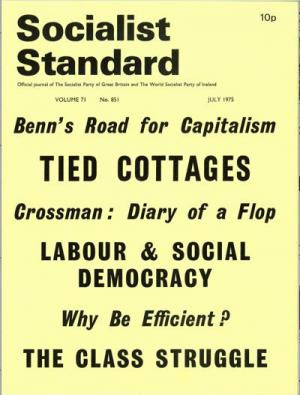
The Abolition of Tied Cottages (1975)

From the July 1975 issue of the Socialist Standard

The government has promised legislation in the near future to end the tied cottage system in farm employment. A report on it was published on 11th June by the Tavistock Institute of Human Relations, supported by the Minister of Agriculture. Last year the Shelter organization produced a report condemning the system.

The promise has a long history. Tied cottages have been a grievance of farm workers throughout the century, and their abolition was part of the Labour Party’s programme in the nineteen-twenties. In Sharpen the Sickle! The History of the Farm Workers’ Union, 1948 (pages 215-220) Reg Groves describes the expectations that the second Labour Government in 1929 would legislate on the lines of statements and pledges made; and the great bitterness when it failed to do so.

The number of farm workers is smaller today than ever before, of course. The total number was 1,591,300 in 1881 and 1,198,000 in 1931 (Astor and Rowntree, British Agriculture, 1939). In 1951 it had fallen to 882,000 and was only 352,000 by 1970, including seasonal and part-time workers (Agricultural Statistics, MAFF). Thus, it can be said of the tied cottage — as of many another social problem — that the reformers step in valiantly when the high tide has gone, forty or fifty years late.

Poverty the Problem
According to the Tavistock Institute report, about 90,000 farm workers live in tied cottages today. The official term is “service tenancy”, and it should be pointed out at once that agricultural tenancies of this kind are part of a much larger member covering various occupations and circumstances. The provision of a dwelling subject to remaining in a job applies to tenant licensees of public houses policemen, many shop workers, caretakers, country teachers, and others.

When the employment ceases so does the right to the dwelling. The worker may have bad health, or be sacked, or choose another job; in the end anyway he must retire; and in all these circumstances he can be and generally is told to go. Though a court order is required to evict him, there is no case he can present against it. The NUAAW reports about 300 farm-cottage evictions a year, but these are the cases reported to it and the true number is estimated to be three times greater. If a worker dies, his widow and children may be evicted.

A large number of workers in service tenancies make early applications for council houses, and this is where reformers have always sought the remedy. In 1925 Noel Buxton, Minister of Agriculture in the first Labour Government and a former President of the farm workers’ union, wrote:
The tied cottage is an almost equally serious grievance suffered by the farm-worker. Adequate provision by local authority of cottages in or near villages is the solution best calculated to deal with this evil.
(The Book of the Labour Party, Vol. 2)
The deputy director of Shelter says the same thing in 1975: ‘“That is where the problem must be tackled — by ensuring that adequate housing is made available in the rural areas,’ he said,” (Guardian, 11th June.) This well-established “answer” contains its own implication that it is addressed to the wrong question. The tied cottage system is an effect, not the cause, of farm workers’ miserable situation. Adequate housing is available — see the property advertisements in any local paper, or Country Life; but poverty makes it inaccessible and makes them mendicants to employers and local councils (the same people, quite likely).

Past and Present
Despite its promises, the Labour Party in office was no more likely than any other government to abolish tied cottages in the past. In the nineteen-twenties farm workers’ wages fell from a national minimum of 46s. in 1920 to an average of about 28s. in 1924 and in 1938 were about 35s. Agriculture was depressed, with bankruptcies common and land going out of cultivation. According to sources quoted by Groves, one reason for farm wage cuts in 1923 was “a hope that a big upheaval might bring Government action to help farmers”.

Tied cottages (together with living-in by unmarried farm hands and domestics) helped keep wages down, and legislation which would have tended to raise them was therefore impossible. It can be added that the standard of accommodation was rock-bottom. Rural areas were almost universally without piped water, electricity or drainage, and the maintenance of cottages cost practically nothing.

The position today is much different. Farming is supported by subsidies; not only does it employ only a quarter of its pre-war numbers, but there is now a high proportion of skilled workers. The dissolution of small farms has meant a further reduction in the dwellings required, and in the last ten or fifteen years large numbers of cottages and farmhouses have been sold as private houses. In many cases they are certified as unfit for habitation, but this makes them eligible for the high-priced market in which they are renovated to become "period cottages" and "houses of character”.

A further consideration from the Government viewpoint is that maintaining evicted families in public institutions, as well as intensifying a grievance, is costly. This is the "practical" case urged by the reformers; since the families have to be housed by local authorities in the end, why not recognize that and do it in the beginning? Along with this goes the fact that farm wages are now rising. In the opinion of many farmers there is an imminent shortage of skilled labour and wages must rise higher. In that case, the farm operative may pay a council-house rent or have a mortgage like any other worker: the problems of the tied cottage are redundant.

Reform leading Where ?
At any rate, farmers are not strongly opposed to the idea of abolition. The Guardian report on 11th June said that 46 per cent. of them claimed tied cottages to be necessary; which, put the other way round, means that more than 50 per cent. apparently do not mind.

There is a special reason why many should not. Between 30 and 40 per cent. of farmers in Britain are tenants (figures given in Farming in Britain Today, J. G. S. and F. Donaldson, 1972) and are themselves required to move out on retirement or in difficulty. Though the majority would not have to fall back on council housing, legislation which protected them from the demands of takeovers, for instance, would be very acceptable.

One other motive which should not be overlooked is the Labour Party’s hopes of winning votes in rural constituencies which are mostly Conservative. Only about 30 per cent. of farm workers belong to the NUAAW and about 5 per cent. to the Transport and General Workers’ Union. This is largely due to the difficulty of organizing workers who are scattered over wide areas; but it also represents disappointment with the unions’ inability to extract the fulfilment of Labour promises in bygone years.

The tied cottage system as it has always existed is a crude example of what the working class gets from capitalism — cheap maintenance, and out on the scrap-heap after use. If an end to it is made, we shall have the familiar situation over reforms: a grievance remedied when it has diminished, not for humane reasons but to suit the needs of capitalism, and with other beneficiaries than those named.

Of course nobody would wish a system which permits summary evictions to continue. However, if the proposed legislation is to aim at farm cottages only, the facility for evictions from other service tenancies can still remain. Certainly farm workers will find that when bad old days have gone things will have altered less than they may have thought, and their basic position not at all. That will happen only when they and other workers decide to change to Socialism.
Robert Barltrop

Wednesday, August 17, 2022

Between the Lines: The Workers Who Switched Off Wogan (1989)

The Between the Lines column from the August 1989 issue of the Socialist Standard

The Workers Who Switched Off Wogan

When, in happier times to come, the history of these rotten years of capitalism are written. special praise will be recorded for those men and women of the working class who pulled the plug on Terry Wogan. An industrial dispute is in progress at the BBC. and the bosses are being made to learn that without the workers to operate their means of mass communication even such unstoppable giants as Nicholas Witchell and ever-smiling Tel will be left talking to themselves.

The workers have called for a 16 per cent pay increase: profit-conscious Beeb-bosses refuse to offer more than 7 per cent—which is less than the current rate of inflation. The Chairman of the BBC, Marmaduke Hussey, is paid £679 a week for doing his unelected, part-time job of running the BBC in line with the wishes of the government. The unelected BBC governors—all part-timers, with other incomes—receive £407 a week. In 1987 the top four BBC bosses were paid £225,000: this was increased by 33 per cent, to £340.000, last year This year the 140 top managers at the BBC have been given a £2,000 pay increase. Meanwhile, a clerk in the BBC's Engineering Department starts on £125 a week before tax: researchers in BBC News and Current Affairs start on £208 before tax. Since 1982 the pay of BBC staff has risen even more slowly than teachers, nurses and ambulance drivers.

At a strike meeting in London in June BBC workers were told by workers from the World Service that during the demonstrations in Peking workers there had passed on messages of solidarity to the BBC strikers. These are the people who do the really important work in the broadcasting service. Of course, there is a terrible irony in the fact that when the BBC workers are not out on their one-day strikes they are having to put out programmes attacking the action of other strikers whose problems are the result of the same wages-profit system which puts making money for the idle minority before rewarding hard work. It has been really encouraging to see the power of the unions to blank the BBC screens and force the management to show repeat programmes and abbreviated news reports.


Wogan does homelessness

All good things come to an end. and just as the strikers took off Wogan from our screens. so it came to pass that the strike day was over and the Million-Dollar Smile returned. On 3 July Wogan "did" homelessness. Well, it was a good subject to do. Esther Rantzen had "done" incest and Lenny Henry had "done" starvation in Africa last year.

So, let's "do" the homeless. In half-an-hour, of course. That should crack the problem. This is the way TV “does" social problems. Bring on Tel—my word, he looks sincere tonight, they must be "doing" a Big Subject. Trot on a couple of homeless kids from cardboard city. They look like sad cases. It’s all wrong that they should be homeless. Tel looks compassionate. Then he looks at his watch. Hang on to your hats, lads and lasses, the half hour's nearly over and we ain't “done" the experts.

On trips David Trippier, the Junior Housing Minister. With him is Sheila McKechme of Shelter who explains just how miserable life is for the homeless. She says that there are an official 370,000 homeless people in England and Wales (116,000 homeless families) plus the 100,000 or 150,000 unrecorded kids who sleep rough, beg for a living and are not even counted by the government statistics. She points out that if you are under eighteen and not on a YTS scheme you are not entitled to state income support—but if you're homeless you can't get on to a YTS scheme. The young homeless are compelled to beg.

Trippier waffles on about the importance of housing associations to provide cheap accommodation. (Which is odd, because in the last ten years, while the Thatcher government has placed its hopes in such bodies to build homes, the number of houses built by housing associations has fallen from 40,000 to 25,000 a year). There are 102,000 empty properties in Britain. Nobody has counted the unused bedrooms, but one would not lose too much cash in a bet that our Terry has more than a few in his house.

Enough of such talk; half-an-hour's up and we've "done" the homeless. Switch over to Coronation Street. No homeless people there. Although I for one would rather live in a cardboard box than in Albert Square—better homeless than brainless. I say.


Down on the Farm

The Killing Fields (BBC1, 2 July, 11.05am) was about the dangers facing farm workers. Last year 56 workers were killed on British farms—agriculture is second only to the construction industry for occupational fatalities. These deaths are sometimes caused by personal negligence, but often by cost-cutting refusal by farm employers to bother with safety standards. There are only 160 safety inspectors for the whole of Britain; they cover about 2.000 farms each and do not visit farms more than once every three to nine years. Children of thirteen are legally allowed to drive tractors on farms and this was defended by Richard Epton of the National Farmers Union who pointed out that this kind of work is good training for kids to become efficient farm workers later in life. We were told the sad story of fourteen-year-old Brendan Dixon who was killed on a Norfolk farm where he was a part-time employee.

Another case of profit before safety: money before life. Now, that could be a subject for Wogan to "do" if he finds himself with a spare half-hour to fill—that is, if the BBC strikers haven't filled it in for him.
Steve Coleman

Friday, June 17, 2022

Reform or Revolution? (1942)

From the May 1942 issue of the Socialist Standard

The Workers Will Decide
Changes are needed ! For the present, at any rate, everybody seems to agree on that point. Charters, New World Orders, schemes for post-war improvement of this and that—with these the worker is regaled to convince him that this time he will not be forgotten when “peace” returns.

We ask the workers to consider carefully these questions: What kind of a change is it going to be? Is it to be only the reform of present-day society, capitalism? This is the kind of change the capitalist class and their supporters envisage. Or will the workers act in their own interest, and perform the revolutionary act of abolishing capitalism and establishing Socialism?

We ask the workers these questions because the nature of the change society undergoes will depend upon their choice. This is a point too frequently forgotten in these days when the world has so many so-called “great men.” Yes, the choice rests with the working-class. If they want reforms, mere modifications of capitalism which will still leave them fundamentally in the same position as they occupy to-day, they can have them. On the other hand, should they decide to have done once and for all with capitalism, its private property, profits and privileges for the few and its wage-slavery and poverty for the vast majority, there is no one who can prevent them. Let those who doubt this remember that the Nazis succeeded in gaining power in Germany because the majority of German workers had become either antagonistic to the Social Democrats and Communists and were impressed by the promises of the Nazis or else they had become apathetic and were ready to give the new party a chance. Another proof that the working-class can decide the nature of society is amply afforded by the present war. This has been called a war of propaganda. And, indeed, propaganda is poured out ad nauseum by the belligerent governments to keep their respective workers in the fighting mood. The ruling class realise that without the support of their workers he war could not be prosecuted.

The lesson is plain, therefore; in highly developed capitalist countries the workers, the bulk of the population, can decide how society is going to be changed. Should the workers support plans for the reform of capitalism? Or should they take matters into their own hands, abolish the present system, and establish Socialism?

The Weakness of Reformism
Since capitalism came into existence, it has had its many evils. Moreover, these evils have weighed heavily upon the mass of the people, upon those who do the work, the working-class. Hurriedly constructed hovels, unemployment for some and excessive toil for others, malnutrition—these are just a few of the evils that capitalism generates and which must be borne by the working-class only. Not for the rich employing class are these evils, for they all spring from the poverty which afflicts those who must work.

Now for many years, in fact since the early days of capitalism, efforts have been made to make the lot of the worker more bearable, to ease the chafing of his chains. The reformists who busy themselves with this task start with the assumption that capitalism will remain. Any changes they advocate are to be brought about within the framework of capitalism. This is the essence of reformism. Capital and wage-labour, the two bases of capitalism, they leave fundamentally untouched. They do not seek to eradicate these roots of capitalism. They merely try to lessen the pains inflicted on society by the capitalism system.

Herein lies the weakness of reformism.

Capitalism cannot be so modified by reform measures that it becomes “the best of possible worlds” for the working-class. All reformist efforts to solve the fundamental problems of the workers are bound to fail. An analysis of capitalism will show why this is so.

Capitalism, it must be understood, is a system of society organised so as to provide profit to the owners of industry, the capitalist class. To do this, the wage-worker is set to work, and what he produces belongs to the employers, the capitalists. The wage-worker is given back, in the form of wages, only a portion of what he produces ; the rest, the surplus, the capitalist owner retains. Thus is the worker exploited and kept on the poverty line, for the portion he receives as wages is just about sufficient to keep him fit enough to perform his particular job and reproduce his kind—future wage-slaves for the service of the capitalist class. Hence the worker is born poor, he lives his life in poverty and dies still poor.

Frequently, to increase his profit (part of the surplus we spoke of), or to compete more successfully in the markets of the world, the capitalist cuts down his production costs. Then he seeks to enforce wage reductions, or he may replace workmen by labour-saving machinery or by adopting a new technique. Moreover, the growth of the unemployment problem has been particularly favourable to the capitalist class in its attack upon the workers’ standard of living, for as soon as there is a reserve army of unemployed workers, the keeping down of wages becomes a more simple matter for the owners of industry, since the workers compete with each other for jobs.

The motive power of capitalism being the lust for profit, any wage increases won by the workers are, if possible, offset by the employing class, for wage increases mean an attack on profits. Hence wage increases are usually the signal for the introduction of more labour saving devices, of more machinery. Thus, very frequently, more production is squeezed out of fewer workers. The exploitation of the worker becomes more intense.

From the foregoing brief examination of capitalism we can see why reformists must fail to solve the workers’ problems. Whatever reforms are introduced, so long as the present system remains, the following evils will persist: —
  1. The bulk of what the workers produce will be taken from them.
  2. They will be kept on or near the poverty line, and will be thus forced to continue in a slave position, dependent on the capitalist class for a living. They will still stand in need of doles, old age pensions and all the other accessories of poverty.
Just one other point about the weakness of reformism. It is an important point. Often reforms carried to improve the lot of the worker prove but of short duration. Should they be of inconvenience to the capitalist class in whose interests present-day society operates, they are, as soon as a favourable opportunity arises, either abandoned altogether or modified to the disadvantage of the workers. All that is necessary is for an industrial crisis or a war to arise—and both these come crashing in on us with regularity—and years of effort for reform measures are as nothing. Then we must say good-bye to the reforms “for the time being,” or at least the reforms are drastically altered. It will suffice if we remind the reader of the crisis 1929-31 with all its cuts. The impermanence of reforms, therefore, is a fundamental weakness of the reformist position.

The lesson the S.P.G.B. has learnt from all this is that the ills afflicting the working-class are due to capitalism, with its profit-making motive.

How Reformists Help the Workers
We have just shown why the Socialist Party of Great Britain is opposed to refornism. But we have heard it uttered that the Labour Party ought not to be so opposed because really it does not support capitalism. We shall see how much truth there is in this assertion by examining recent writings of a Labour M.P. He is Mr. Tom Smith, M.P. for Normanton,, not one of the “big shots,” but just an ordinary Labour Member, whose outlook is typical ol his colleagues.

Mr. Tom Smith championed the cause of the farm workers in their demand for a minimum wage of three pounds a week, and spoke on their behalf in the House of Commons.

Recently, in a letter to The Dairy Farmer (January, 1942), Mr. Smith wrote as follows about his efforts for the agricultural workers: —
“With regard to wages, I am proud to feel that I have been of some little assistance in securing the £3 per week minimum. I have felt for a long time that the agricultural worker never had the recognition that his services warranted, and I am hoping to see the day when conditions in the countryside, both in regard to housing, education and other social amenities, will be vastly improved.”
No doubt the average worker who has not reached an understanding of his position in society and who, in consequence, is too ready to take “the short view” and accept appearances for facts, is moved to exclaim: ” Good old Tom!” and support the Labour Party, the party to which Mr. Smith belongs.

Not so the Socialist. He cannot enthuse when L.P.-ers (or any other people) make efforts to obtain immediate improvements for the workers.

It is not because he objects to an improvement in the condition of the working-class that the Socialist adopts this attitude. It is, as we have already shown earlier in this article, because he maintains that such efforts, even if successful, do too little to eradicate the numerous and ghastly evils of capitalism. The problems confronting the working-class are too big to be remedied by reforms of the existing system.

The S.P.G.B. opposes Mr. Tom Smith (and his colleagues) for this very reason. Let us return to his letter in The Dairy Farmer and see how he wishes to retain the capitalist system. The following quotations should be carefully studied by all those who believe the Labour Party is out for a new form of society. Mr. Smith writes: —
  1. “With regard to the future of agriculture, The action of the Ministry of Agriculture in announcing more security of tenure for the farmers; the assurance that planning can take place till at least the 1945 harvest . . . are steps in the right direction.”
  2. “In my opinion, if this question of distribution were tackled as it ought to be tackled, I see no reason why the producer shouldn’t have a reasonable price without unduly burdening the consumer in the urban districts ” (our emphasis).
From these quotations, it is obvious that Mr. Tom Smith, while concerned to help the land worker, cannot envisage the removal of the system which robs and enslaves the workers. He accepts the preservation of private property; he wants “reasonable prices” and presumably “reasonable” profits.

Mr. Smith, like most reformists, is therefore in this position: he wants to improve the lot of the worker (we do give him credit for this) and yet is prepared to help preserve the very system which causes so much suffering to the worker. And let us emphasise that Mr. Smith is just a typical example of other reformists.

The Socialist, on the other hand, must point out on all occasions that if the present system is maintained with its problems of wages, profits, prices, currency, etc., poverty will always be the workers’ reward.

What Should The Worker Do ?
Because no salvation is possible for the worker under capitalism, we of the S.P.G.B. are out to abolish it and to replace it by Socialism. We aim at nothing less, because we know nothing less will satisfy the needs of the class to which we belong. It is also for this reason that we are opposed to all other parties, all of which, at the most, aim merely at modifications of present-day society.

The workers should study Socialism. That is the first step towards their salvation. We are confident that a little study will convince them that only by going to the root of their problems can their position be permanently improved. They will realise the need for abandoning reform movements. They will realise the need for revolutionary action, for replacing capitalism by Socialism, that is by a society wherein there will be no private property, no profit making and no wages. Socialism is, in fact, a social system wherein the means of life belong to all society and wherein, consequently, production is carried on to satisfy the needs of society. Socialism, having no “ulterior motive,” will make unnecessary the present-day strivings for “a living wage” (which still leaves the workers robbed of the bulk of what they produce). Let the worker, then, change his motto. With Marx, we say, “Instead of the Conservative motto, ‘A fair day’s wages for a fair day’s work !’ they ought to inscribe on their banner the revolutionary watchword, ‘Abolition of the wages system !’ ”

A Word of Warning
The Socialist Party of Great Britain stands for the revolutionary transformation of society. Because of this and because history has proved that a party for revolution cannot be built up on reform programmes, the S.P.G.B. does not seek to win support by advocating reforms.

We do not expect, therefore, to gain the support of people still unconvinced of the need for Socialism—nor do we desire to be supported by non-Socialists. Until the majority desire and are prepared to organise for the specific job of establishing Socialism, the achievement of the new society is an impossibility. Our task now then is, to propagate Socialist principles, to make Socialists. Non-Socialists, people interested in the reform of capitalism, would hamper us in that job.

Then, again, as Leibnecht showed long ago in his “No Compromise,” once a revolutionary party begins to compromise with capitalism and is willing to help in its administration and reform, such a party is doomed as a weapon for Socialism. It ceases to be revolutionary.

The reason for this is plain to see. Once a party adopts reform programmes, it appeals to many kinds of people who are anything but Socialist. The result is that the Socialists are swamped, and Socialism is pushed further and further into the background on the party programme; Socialism ceases to be the object of the party.

Workers desiring Socialism should, therefore, remember these things and study the case of the S.P.G.B.. They should refuse to give their support to any party which, while claiming to be Socialist, fights elections on a reformist programme. Such parties could not introduce Socialism even if they won power. Their mandate would be for the reform of capitalism, not for Socialism.

This is one of the reasons the I.L.P. cannot stand for Socialism. When one of its members, Fenner Brockway, stood as a candidate at the Lancaster election last October, it was admitted in the New Leader (October 25th, 1941) that his advocacy of certain reforms had won him support. Still interested in votes rather than in Socialism, Fenner Brockway is “fighting” the Cardiff election. In his election address he has expressed his sympathy with Welsh Nationalism (see New Leader, April 11th, 1942).

It should be obvious that such parties as the I.L.P. which use plenty of revolutionary jargon but which have suitable reform programmes ready for time and place cannot bring to an end the workers’ wage-slavery. Socialism alone will do that, and such parties are merely reformist.

Let the workers, then, reject reformism, and embrace revolution. Let them cease to spend their forces on reformist futilities. Let them concentrate their strength in the S.P.G.B.—the weapon for Socialism that will not falter.
Clifford Allen

Monday, June 6, 2022

Editorial: News from New Zealand (1941)

Editorial from the November 1941 issue of the Socialist Standard

How the workers fare under Labour Government.
Mr. W. Holmes, General Secretary of the National Union of Agricultural Workers, former President of the Trades Union Congress, has paid a visit to New Zealand, and contributes to the “Landworker” (October, 1941) an article on his impressions. He calls it “New Zealand: A Workers’ State. A Triumph of Labour and Democracy.” He is, of course, chiefly concerned with the economic and social changes that have taken place since the Labour Party took over the government in 1935.

An earlier account of New Zealand’s Labour Government was published in this country by the Labour Party in 1937. It was called “New Zealand’s Progress under Socialism.”

Both the article and the Labour Party pamphlet contain a description of the achievements of the Labour Government, and an indication of what else it aims to achieve, but neither the things done nor the things promised give any warrant for the use of the terms “Workers’ State” and “Socialism.” New Zealand is not a country in which the able-bodied non-worker has no place. Property incomes from the ownership of land or industrial capital are still the rule. Goods are still produced by the working class but owned by the capitalist class. Inequality of wealth may possibly have decreased; it has certainly not been abolished. Nor is it the intention of the Labour Party to abolish capitalism and introduce a system based on common ownership.

There is therefore no justification for claiming that Socialism is in being. That is the first quarrel the Socialist has with the supporters of Labourism; and it is not merely a dispute about words. Progress towards Socialism is not helped but hindered by propaganda which represents as Socialism what is no more than Labour Party administration of Capitalism.

The Other Side of the Picture.
Mr. Holmes, though he says, “Long life and increasing success” to the Labour Government of New Zealand, has not been swept off his feet by what he saw. He praises—but he also makes comparisons between life under Labour Government and life under frankly Capitalist Government. Sometimes his praises contain comparisons that he does not appreciate, and here we will help him out. Now for a few of his illuminating remarks. “The New Zealand Workers’ Union organises the country workers, and has already secured excellent arbitration awards for shearers, musterers, packers, and drovers; while the dairy workers are also covered by awards; but the ordinary farm and station workers are difficult to organise, and their conditions are not much better than those of the British farm workers.”

So it is obvious that in this “Workers’ State” the workers are not in ownership and control. They must still organise and struggle for livelihood, and the ordinary farm workers are not much better off than their brothers in this country agitating in vain for a wage of £3 a week !

Mr. Holmes searched for the reason for this state of affairs, and quotes a New Zealand Trade Union official as follows: —
“The present economic position of New Zealand farming could not support the introduction of trade union awards and conditions throughout the whole industry.”
Mr. Holmes, when he heard this plea about depressed industry and “the employers can’t afford to pay,” must have felt that he had made his journey of thousands of miles only to find things remarkably like they are at home.

Many Labour Party supporters have an answer to all such pleas. “Let the State take over the industry,” they say, “and then it will be run efficiently and will be able to pay higher wages.” Mr. Holmes probably shares this view, for he remarks: “I visited many workshops connected with railways, which belong to the nation, and saw the great strides they are making in war production. I also visited the State timber works and the State flax mills which have recently been established. There are also State mines and State forests.”

Again we shall have to recall the wanderer from the Antipodes and ask him to notice that here in Britain we have our State capitalist Postal, Telegraph and Telephone services, and they, too, are steadfast to resist when higher wages are demanded. Quite a number of the Post Office employees would like to get the £3 minimum which Mr. Holmes’ Union is trying to obtain for land-workers.

Mr. Holmes inspected housing schemes in New Zealand, for one of the Labour Party’s promises was good houses “at low rentals.” But he finds that “the housing of the country people is not very good” and “the rents are rather heavier than in England.” He notices, too, that the New Zealand Government, when it goes into the business of building houses and renting them to the workers, ”expects to get about 5 per cent. on its outlay.” Mr. Holmes apparently did not ask why they required any interest at all.

As regards the cost of living in general, “food seems to be about the same price as in England, but clothes and boots are dearer.” These are factors to be allowed for when making comparison between the higher levels of wages in New Zealand.

He gives an imposing list of social reforms introduced by the Labour Government, including old-age pensions of 30s. a week, children’s allowances, and free hospital treatment, but rather knocks the gilt off when he adds: “Of course, all these things have to be paid for, and there is a direct tax of 10 per cent. on all wages.”

Still a Capitalist World.
Some defenders of the Labour Party, faced with the above criticisms of Labour Government at work, will readily abandon the claim that New Zealand is a “Workers’ State” or has achieved Socialism. They will retort, however, that, apart from this, the criticism is unfair since it does not allow for the fact that in a capitalist world New Zealand must remain capitalist, and that capitalism places limits to the improvement of the workers’ standard of life. Socialists do not dispute this. We do not argue that Labour Governments fail in their task of administering capitalism through want of will or bad faith. They may be well-intentioned but the road to capitalist crises and capitalist war is paved with the good intentions of social reformers.