Showing posts with label Art and Socialism. Show all posts

Sunday, December 7, 2025

SPGB London Meeting: “The Romantics’ Critique of Capitalism.” (2025)

An SPGB meeting next Saturday at their Head Office in South London. Cut and pasted below is a post from Johnny Mercer, who will be the speaker at the meeting:
"CALLING All ROMANTIC REVOLUTIONARIES: Mulled wine and a Christmas critique of capitalism, what’s not to love? In this talk I’ll be discussing the revolutionary ideas of people like Shelley, Turner, and Mary Wollstonecraft. I’ll be analysing how romantic concepts influenced socialists from Marx to Morris. And how these ideas continued in art/anti-art movements from Dada, to the Situationists, to a bit on my own arts practice. As ever plenty of time for questions and discussion! 3pm Sat 13th of December, 52 Clapham High Street. PLEASE SHARE LONDON ARTSY FOLKS!"


Friday, August 1, 2025

Letter: Socialist Art (1975)

Letter to the Editors from the August 1975 issue of the Socialist Standard

Socialist Art

Concerning your article on “Art and Civilization” in the March issue, I thought you might be interested in hearing the following comments by way of a corollary.

One of the effects of the domination of society by one class (whether openly by it alone or by extensions) is to concentrate subjective expression as an abstractly separated aesthetic in a small number of individuals. Necessarily, of course, they must come from the ruling class. Art as such sets itself apart from the daily experience of society because the ruling class must have an idea point of reference, an orientation, a theoretical statement in which it is emotionally represented as “the good,” the beneficial, the healthy, the desirable, etc — this, as part of its self-identification as authority. Which means that high Art presupposes a system of organized deprivation, oppression and manipulation; Socialist art, on the contrary — or rather, art under Socialism — is based on the direct universality of all persons, and so is pre-eminently a practical art, an art of practice. Under these conditions, what is artistic cannot really be separated from what is “practical,” and indeed, art must automatically be a matter of social practice — a separate pole from the thinking activity as such, but no more a separate compartment of existence. It is therefore to be concluded that, under Socialism, theoretical art would tend to disappear and to be replaced by an “art of praxis”; under conditions of classical communism (as indicated by Marx), daily existence would itself contain all the characteristics which theoretical art today corrals together in a separate and isolated function.
Ronald Elbert

Monday, September 25, 2023

Letters: Nuclear Power (2006)

Letters to the Editors from the September 2006 issue of the Socialist Standard

Nuclear Power

Dear Editors,

I would like to take issue with the Pathfinders article “Radioactive Days” (August Socialist Standard). The anonymous author – shouldn’t articles that do not express a consensus of socialist opinion be signed? – argues that continued reliance on nuclear fission as a major source of energy may be unavoidable, even after the establishment of socialism. However, no account is taken of the widely recognized fact that the supply not only of oil, but also of uranium and plutonium for fission reactors, is likely to run out in the course of the present century.

Conceivably, development of a closed fuel cycle might solve this problem, as well as that of radioactive wastes. It is also conceivable that nuclear fusion will become a viable alternative sooner than some people expect. Or perhaps a way will be found to store solar energy, enabling us to rely on the main fusion reactor in our vicinity–the sun.

Nevertheless, it is quite possible that none of these solutions will materialize in time to avert a real energy crisis. If this proves to be the case, it will not necessarily be because the technological obstacles are insuperable. The most likely cause will be the short time horizons used in capitalist profit calculations.

Given all these uncertainties, we need to think about a wide range of scenarios for energy policy in socialism. A guaranteed abundance of safe and non-polluting fusion or solar energy is one scenario. But humanity may have no choice but to adapt to a low energy way of life.
Stephen Shenfield, 
Providence, USA

Reply:
Actually, the Pathfinders column does not necessarily express a consensus of socialist opinion on every issue, as many of the scientific issues discussed are very much open for debate and development by socialists and others. – Editors.


Asked and answered

Dear Editors,

I’ve spent some time over the past few months reading a lot about political and social structures, for no purpose other than my own interest. I, like many, am discontented with the situation as it stands. The solution proposed by your organisation resonates with me, as few others have. As a result, I have read Marxist works, and much about varied forms of left-wing politics like Leninism and Maoism, etc.
 
 I do, however, keep coming back to your site. I have read all of the available information but still have a few questions I was hoping you could answer. I sincerely hope you can find the time to assist.

1. In a practical sense, how would labour be distributed in a socialist society? I’m not suggesting some jobs are any less important than others, but how would personal ambition (not ambition for material reward, but ambition of a personal nature, to achieve and feel accomplishment in a particular field) be matched with the needs of society? Could I, for example, say ‘I want to be an electrician’ and get trained? And what if, for example, nobody wanted to be a cleaner? Would people be assigned jobs on a take it or take it basis or is there an element of negotiation? If so, how much?

2. What would happen to people who refused to work/contribute?

3. What is your position on the punishment of serious criminals?

4. How are the creative arts perceived?

As a necessary part of a healthy society, or as unnecessary? Could someone be, for example, a full-time writer, in a socialist society as you describe? Even if they were no good at it?
Name and address withheld by request (by email).

Reply:
1. The general principle of socialist society of “from each according to their abilities, to each according to their needs” clearly recognises the obvious fact that different people have different abilities. How will these individual abilities be matched with the social need for particular jobs to be done? We can’t give a blueprint (and don’t want to, since this would be to try to dictate to the future when the details can only be decided democratically at the time), but we can imagine something like the “job centres” of today,only completely freed from any trace of coercion, monetary considerations and stigma.In other words, places where jobs to be done could be advertised and where people could go to volunteer to do them. Or maybe the whole thing could be done via the internet. If there is a shortage of people taking up a particular job,then a special effort would have to be made to encourage people to train for and take up these jobs. We are confident that socialist society will be able to find a practical solution to a practical problem such as this.

 2. We don’t think that, in the context of socialist society where a real community and community spirit will exist, there will be many people, if any, who would refuse to contribute. After all, there is nothing more boring than lying around all day trying to do nothing. Humans are social animals who need to be active as well as appreciated by others.

 3. Since over 90 percent of crimes today are crimes against property and since property and poverty will disappear in socialist society where everybody will automatically be able to satisfy their material needs, the main “crimes” that would remain would be such things as breaking traffic regulations or hosepipe bans. But by “serious criminals” we assume you mean people who kill or harm other people. Any such behaviour is likely to be highly exceptional but, should it occur, the person responsible would have to be stopped and, if need be, detained. We are not sure that “punishment” is the right word since most such instances are likely to be medical cases.

 4. Yes, of course the “creative arts” are a necessary part of any society, but in socialism won’t be confined to such things as opera and poetry. We go along with William Morris in saying that the everyday work of producing something useful can also be creative and art. And we would imagine that most people will want to take advantage of the possibility socialist society will offer them of being able to do a variety of jobs (even in the same week) rather than being tied to the same job, day after day, year after year – Editors.

Friday, August 11, 2023

Free access to services (2007)

From the August 2007 issue of the Socialist Standard 

Apart from material things, socialism will bring many intangible benefits that capitalism denies us.

In our June issue we discussed some of the ways in which production solely for needs and free access (socialism) will replace production for profit and buying and selling (capitalism). In July we considered some problems of consumption in socialism, such as dangerous products, access to outer space, and when restricted access would be sensible. Here we extend the discussion to matters of services rather than goods: education; health and welfare; leisure, entertainment and sport; arts and culture; and dispute resolution.

Education
At present in schools, colleges and universities, access is available (free or at a price) to a wide range of knowledge. But the emphasis is always on the norms and values of the profit system. Learning how to buy and sell things seems to be more important than making them and getting them to the people who really need them.

In socialism teachers and educational bodies will be geared to the needs of the new form of society. There may be historical lessons about capitalism, but on a similar scale to the teaching about pre-capitalist societies today. The proportion of people who choose teaching as their main contribution to society will be much greater than today. “Jobs” needed only to run capitalism will have disappeared.

With the advent of world socialism a priority will be to offer free access to education to those who have had none or too little because they or their parents could not afford to pay for it. That is not to say that children in Africa, Asia, South America and elsewhere will be given what is today considered a “good” education by European or North American standards. It will take time for world socialist education to develop its own character, and there is no reason to suppose that it will take the same form for everyone everywhere.

Health and welfare
Some health and welfare services are now available to some people free at the point of delivery or consumption. But many are not. In socialism the principle of free access according to reasonable need will be universally applied. Of course there will be some limitations, but far fewer than at present. Health and welfare problems resulting from accidents and natural disasters like floods or earthquakes will continue to require emergency measures. But the problems won’t be as extensive. For one thing, people living in disaster-prone areas will be offered removal to safer environments.

Having to seek paid employment when jobs are scarce, experiencing money problems, just living in a world that places so much emphasis on “must have” personal possessions — all this causes sickness and shortens lives. So in socialism there won’t be such a widespread demand for health and welfare services. You won’t need to take pills to get you through the day or night.

Leisure, entertainment and sport
Today the leisure industries promote and sell you what is profitable for them to supply. You can choose to entertain yourself with pastimes or hobbies, or in social gatherings with little or no resort to the market. But there is heavy pressure on you to be a customer of one or more of the leisure industries. Most people who say they are interested in sport don’t actually play a game or even attend a live event – they mean they watch it on TV.

With socialism there won’t be buyers and sellers of leisure, entertainment and sport experiences. But there will surely be more participants. There won’t be a distinction between amateurs and professionals, though some people will continue to be better at some things than others. So audiences will be bigger or smaller – but never paying anything except attention and respect. Whether or not individuals or teams are champions at some level at whatever, they will have the same free access to what they reasonably need as everyone else.

Arts and culture
Capitalism allows the very rich to possess rare items of art and culture, and even to lock them away from public view. Not so with socialism. It won’t be sensible to let everyone have the freedom to keep original masterpieces in their own homes. But it will be feasible and desirable to store and maintain rare artefacts in supervised public places.

With regard to access to popular events such as concerts, there might have to be restrictions. The relative merits and demerits of advance booking, first come first served, and even rationing would need to be sorted out. However, one way or another, access to artistic and cultural artefacts and events will be available to all, not just to a privileged minority.

Dispute resolution
With the abolition of the killer disease of nationalism, wars and the whole destructive war industry will be a thing of the past. Many other disputes about property – divorce settlements, allegations of mis-selling, for example – will also have gone. Some rules and regulations, emphasising pro-social behaviour not punishment, may still be desirable. But the law as we know it today will have no place in a socialist world.

Reasonable though the vast majority of people will have to be before socialism is introduced, it is unreasonable to expect all of us to be good boys and girls all the time. There will no doubt be a few disputes that will call for some procedure of resolution. This will probably best be done by some form of mediation, by people interested in, and perhaps trained for, this form of public service.
Stan Parker

Thursday, July 13, 2023

Socialist Forum: Socialism and Distribution. (1931)

Letter to the Editors from the July 1931 issue of the Socialist Standard
A correspondent (N. T. T.) asks us the following questions about the organisation of society on a Socialist basis :—
“(1) There are always people, in any stage of civilization, who do not like and do not tone with their surroundings. People live to-day who would be much more happy lying in the sun all day, and picking their food from the trees. I wonder what would be considered the fair share of work for such people? Would they, desiring none of the absurd luxuries of mechanised and artificial civilization, be yet forced to do as much to maintain such a state as any lover of cigars, motorcars, and epicurean meals.

(2) All valuable (not in a monetary sense) works of art, will not be able to be kept in public museums. It is barely possible to consider all our paintings and sculptures thus placed—but for whom are our few Stradivarius violins, to mention but one type of art which cannot be left to rot in a museum ? There are, as I have said, but a few ; but there is a multitude of people who ache to possess them. And this is not greed. It is the very natural desire of the artist to express himself through as fine a medium as possible.

We cannot call those things details, and pass them over. They touch very vital chords of human nature, and must be considered.


Reply.
Our correspondent’s first question is phrased in such a way that it tends to obscure the real issue. We are asked to consider the case of the man who will desire “none of the absurd luxuries of mechanised and artificial civilisation,” and who, therefore, will wish to avoid working to make them possible. He wants, instead, to lie in the sun all day and feed himself from the trees ! If the illustration is to be taken literally, it is itself absurd and impossible. Anyone who tried to live like this in England would have a very strenuous, brief and painful existence. He would be compelled to avoid all cultivated plants, because these are the products of our “mechanised and artificial civilisation,” and would be so busy trying to secure a sufficiency of uncultivated but edible articles, that he would have no time for sunning. He would doubtless soon fall ill. Moreover, not the social organisation, but the climate would effectively prohibit his mode of life for 90 per cent. of the time. But if he then decides to seek sunnier climes, he will again have to fall back on those — to him — detestable mechanical devices, the steamship or the aeroplane.

The real problem is that of the persons whose tastes do not fully coincide with those of their neighbours—but that includes everybody. Everybody would want some but not others of the articles produced by society’s co-operative effort, and would therefore appreciate the need for give and take. It is a problem implicit in every form of human society. The adjustments will be easier when the luxuries of some are not obtained at the cost of the necessities of others. Now the poverty of the poor is forcibly imposed on them in order to safeguard the privileges of the propertied class.

Our correspondent’s second question has nothing to do with Socialism. We are not advocating Socialism on the ground that we have discovered a perfect method of dividing half-a-dozen Strads among a multitude of people. In the nature of the case there is no method of satisfying the desire of the multitude (if, indeed, they exist) who ache to possess a Strad. What Socialism will do will be to remove, society’s means of production and distribution from the ownership and control of a small minority. Having done that, we do not think that the foundations of Socialist society will rock on account of the unsolved problem of the Strads and first editions and other unique relics of this, that, or the other dead hero. Capitalism gives the Strads to its most successful exploiters who can afford to pay monopoly prices—but nobody seems to mind very much. Artist-craftsmen will again find an opening for the production of masterpieces under the new social conditions.

Wednesday, July 5, 2023

Letters: Trade Unions & Jobs (1975)

Letters to the Editors from the July 1975 issue of the Socialist Standard

Trade Unions & Jobs

You have repeatedly pointed out, in the SS that membership of a Political Party, other than the SPGB, only strengthens Capitalism and brings Socialism not a wit nearer. Your reasoning compels me to accept the logic of this viewpoint. The Labour Party, beloved by so many of the working class, has proved itself a hypocritical fraud on innumerable occasions.

One of the main props of the Labour Party, the Trades Unions, must also support Capitalism as they are a reformist body and nowhere do they support Socialism, therefore it follows that membership of the SPGB and any Trade Union are irreconcilable, or so I should have thought. Could I have your thoughts on this.

I should also like your views on another point that has been bothering me. In the April edition of the SS paragraph 3 page 63, R. Barltrop says that unemployment means a loss of respect for the worker. As I am unemployed I would concur, but how can you advocate employment when to work degrades us to the position of being a mere wage slave. Surely the SPGB should not concern itself with employment, full or otherwise. The object of the Party is the establishment of Socialism, there are plenty of other parties to concern themselves with such things.
P. Steed,
Tyne & Wear


Reply
We are aware of the limitations of Trade Unions but workers are in a better position to bargain over pay and conditions if they are organized in a Union. The jobs of some of our members may necessitate their Union membership. No Socialist pays the political levy to the Labour Party.

In the article you mention, past Labour Party aims concerning unemployment were contrasted with the fact that, despite the Welfare State, unemployment is still a dread prospect for the working class. It is essential to be well informed about capitalism the better to show that the system has outlived its usefulness. This does not mean we advocate reform of the problems we analyze. You will not find Socialists in the ranks of those demanding “the right to work”. In fact the article said that reform cannot remove a problem “in-built in capitalism”. As you rightly say the object of the SPGB is Socialism.
Editors.


Can We Predict ?

The article “Is Socialism Inevitable?” is a model of left-wing revolutionary positivism, and underlines the crude deterministic interpretation given by the SPGB to the Materialist Conception of History.

Let me remind your readers of the sentiments expressed. “Socialist society will be the result of historical necessity. There is a law of social development which traces the birth, growth and decay of social systems . . . its scientific validity has been demonstrated repeatedly . . . Socialist ideas are indestructible and cannot be destroyed any more than you can abolish the law of gravity”.

Comparison is therefore made between the “laws” of natural science and those social laws of development supposedly discovered by Marx and Engels. As the Law of Gravity enables us to predict with certainty that the apple will fall, so the social laws enable us to predict with equal certainty the eventual fall of capitalism.

Such is the stuff of which dreams (and SPGB dogma) are made. Evolutionary positivism, with its portrayal of nature and a vast mechanical structure operated by the laws of science now long since expired — put out of its misery by Planck and Einstein. Events can no longer be predicted with certainty only with a degree of statistical probability. The apple does not necessarily fall, neither do men necessarily become “conscious of the need for social change”.

But this is perhaps a philosophical (do I hear you say bourgeois?) quibble. A more serious objection to be made against assertions such as “There is a social law of development which traces the birth, growth and decay of social systems” is that no distinction is made therein between a law and a trend. A law is a statement of regularity such that of two classes of event the occurrence of an event of the other kind. A knowledge of the laws which hold in a given situation is never by itself sufficient to enable us to predict. To predict we must know both the relevant laws, which enable us to infer correctly from the occurrence of certain causes, the occurrence of certain effects — and in addition, the antecedent and concomitant conditions which hold. A man who tries to make predictions without a knowledge of these is a man who tries to infer the conclusion “an event of type Y (e.g. men changing society) will occur”, with the premise whenever an event of type X occurs (e.g. men seeking and gaining Socialist knowledge), an event of type Y will occur, without seeing that he can only derive his conclusion validly if he is also able to assert that “an event of type X will occur” — and to do this he must be certain that no external interests will prevent the occurrence of an event of type X. Can you be certain that these will not occur, can you be certain for instance that reformist propaganda will not continue to spread?

A trend is a sequence of historical events moving in a certain uniform direction. Clearly one cannot predict a trend without knowledge of both the relevant laws and the relevant antecedent and concomitant conditions; when the SPGB and its mentor Engels try to predict trends unconditionally that is, independently of antecedent and accompanying circumstances, they are both mistaken.
T. J. Caulfield, 
Manchester


Reply
Our correspondent’s criticism amounts to this: (1) the SPGB interprets the Materialist Conception of History is a crude deterministic way: (2) that it is impossible to predict the eventual fall of capitalism: (3) that men do not necessarily become conscious of the need for social change; (4) we do not distinguish between a law and a trend.

Our correspondent objects to our maintaining that there is a social law governing the activities of men living in society. The law referred to in the text of the article is the law of social growth known as the Materialist Conception of History, which explains the rise, growth and decay of social systems throughout history, and the reasons why social change occurs. He appears to recognize the existence of the MCH but attacks us because of our alleged crude deterministic interpretation of the theory. We are left in the dark as to what his interpretation is, as he offers no evidence, nor does he state his own view. He claims that we predict the demise of capitalism without having any knowledge of the factors involved. Again, he does not name the factors which we have failed to take into account. He accuses us of confusing laws with trends: a trend he tells us is a “sequence of historical events moving in a uniform direction”, but he adds that you cannot predict this trend without knowledge of the relevant law. But even this is insufficient. We must also know the antecedent and concomitant conditions in addition to knowing the law. We find this very confusing. The law of social growth to which the article refers is a scientific proposition and as such takes into account all the factors dealing with the evolution of society, past, present and future. It is these factors which go to make up the law. Whoever heard of a metereologist predicting the weather without taking into account all the factors involved — wind, sun, time of year, local conditions, etc? It is part of the science of metereology that everything that relates to that particular science is considered. So it is with the science of socialism. It is a historical fact that men, again and again, socially organized in different social classes, did take part did become conscious of their conflicting interests in class struggles, did change the basis of society, and did promote the unrestricted development of the productive forces. What is there to prevent men doing this again? Surely, if through a study of the evolution of human society you are able to identify a pattern of social change and development, and the causes responsible, you are entitled to arrive at certain conclusions as to the future course of social change. We predict correctly that capitalism causes unemployment, crises, war and poverty. We explain the laws governing its operation. In the same way we predict that we will get control of the political machinery when we have a majority of Socialists. At the moment we do not know the speed of the socialist revolution but we do know its specific direction. We are certain of our goal and of the efficacy of the methods we use to achieve it.

The substance of our correspondent’s letter suggests to us that the writer does not wish to be hampered in his criticism by the existence of the laws of history and economics, and would prefer to keep his purely negative criticism on some academic philosophical level. For our part, the simple issue is — are the historical conditions present which will enable Socialism to be established; can the workers understand Socialism and establish it, and where are the factors which prevent it?
Editors.


Fair Comment

Let no-one say the readers of the Socialist Standard are uncritical! In the May issue, in writing of the “Myth of the Middle Class”, I commented: “There’s no such thing as fairness in fixing the price of labour-power, any more than in the fixing of the market price of any other commodity.”

In case these words seem ambiguous (and I have at least one critic sharpening his hatchet), I wish to stress that I was not saying that wages are unfair. In general, labour-power is sold at or around its value — like other commodities.

The point I was trying to make is that all talk of fairness (or unfairness) in connection with wages, the price of our labour-power, is as irrelevant as talk of a fair or just price for a house. The question of fairness just doesn’t come into the picture. Perhaps it ought to, but that’s not how capitalism works.

I would like to add that capitalism’s inefficiency is, if anything, understated in the Socialist Standard. For instance, in the article on “The Housing Shortage”, we learn that it takes almost 21 months to complete a dwelling for local authorities and over 14 months to completion in the private sector. Yet on a Woking site some houses on a prepared site were built in May from start to finish in the course of one week. I repeat, one week. On the assumption that site preparation took about 3 weeks on average, that gives 4-6 weeks as necessary time from the production side. The rest of these endless months are presumably frittered away in legal and financial haggling, tax juggling and the like. Meanwhile the tele-pundits wring their hands and wonder why there are battered wives and battered babies, broken families and millions taking pills for unhappiness and depression . . .

Finally we should note that capitalism does one thing very well indeed. It is continually producing evidence to support our arguments. In April I wrote that “even Civil Servants go on strike”. By the time the May Standard reached its readers, the university dons and professors had followed suit, and as of now the hospital consultants are still in dispute with the NHS. No wonder John Gorst’s Middle Class Association was still-born!
C. Sultan, 
Woking


The Helping Hand

I read with great interest your article “Charity begins and never ends”. As a receiver and a giver of capitalist charity you put me in a great dilemma. Looking at the problem of the homeless from both sides I ask myself how does one get these humans politically orientated towards a socialist programme. I find the answer, sad as it may seem, negative. Do I now await the great day while my friends on the embankment die of exposure and malnutrition, or do I continue to try and rehouse and feed these unfortunate people? I would like your opinion on this.

One point about your article; you state the Salvation Army provided 8,001,323 meals and 1,636,578 beds. This is very misleading. The Sally Army charge extortionate prices for the food and shelter; dormitory accommodation at 80p a night, tea at 5p a cup etc. which is another example of capitalist exploitation.
George Watts,
London S.W.1


Reply
Over the years we have been asked many times about the plight of those in desperate need, the implication being that solving their problems could not wait for Socialism. So decades of well-meaning effort have been wasted in attempts to solve the problems in isolation from their cause. Socialists are not different from other individuals in that we will give in a personal way such help as we are able to those we find in distress — but one of the reasons why we are in the Socialist Party is our awareness that the distress remains as a social problem. When attempts to relieve distress are put on an organized basis, the inevitable result is reform movements perpetuating it. A little help to friends is part of being human, but not to be confused with the need to change society.
Editors.


Population & Plumage

You should be ashamed of yourselves for attacking Thomas Malthus. By attacking Malthus you are helping the Catholic Church and also the so-called Communist Party. The wise man has always had bother from the masses as well as the boss-class. You should know the boss-class like the ignorant masses to have big families so they can get more cheap labour.

Your Party does rather keep within the bounds of legality. One good way to refute that reputation would be for Party members to be more non-conformist in dress. Most people are cowardly conformist in dress. Why not some Marxist clothing? I should like to see garments with “Abolition of the wages system”, "Why tolerate buying and selling?” and the head of Karl Marx. Why not be different?
J. E. Catercole,
London N.4.


Reply
The Catholic Church does not oppose birth-control from enthusiasm for Malthus, but for its own reasons. The argument that by attacking a false theory one is helping different opponents of it would, if heeded, prevent any criticism of anything. We criticize Malthus because he was wrong.

The Socialist Party keeps “within the bounds of legality” because that is the means to attain our Object, not for the sake of reputation. If you like garments with slogans and pictures, by all means wear them; but don’t imagine that conformity or non-conformity in dress has anything to do with working for Socialism.
Editors.


More About Art

Your reply to my letter “Art and the Ruling Class” (May SS) seemed to me to be quite superficial. Because of your assumption that Historical Materialism can explain all art and aesthetic tastes then, no doubt, from your point of view I am confused.

You say if the ideas embodied in Beethoven’s music — or Shakespeare’s plays or Burns’s poems — did not come from society, where did they come from? The obvious answer to that is from the minds of these creative men of genius. Can you explain Burn’s “Tam O’Shanter” through economics? And what had Coleridge’s “The Rime of the Ancient Mariner” to do with capitalist society?

And again, why did the Muslims who believed in the same God as the Christians build mosques and not cathedrals? What is the historical materialistic explanation of the aesthetic taste of the Muslims? And why did the Chinese prefer pagodas to Indian temples?

You also talk about Socialist art, but where is it, and what is it?
Ron Smith,
Dundee


Reply
Part of your letter is not reproduced because it only repeats assertions made in the previous one. It will be in place here to recall a line from Goldsmith’s The Deserted Village:
E’en though vanquish’d, he could argue still.
We do not at all dispute that there are differences in ability among people: good poets, composers, engineers, etc., while the capabilities of others run in different directions. Do you imagine that Socialists don’t appreciate Shakespeare, Beethoven and The Rime of the Ancient Mariner? We say of the arts what Marx said of all human activity: “Man makes his own history, but he does not make it out of the whole cloth, he does not make it out of conditions chosen by himself, but out of conditions such as he finds close at hand.”

This is opposite to your sweeping claim that it all comes from “the minds of these creative men of genius”. You do not mention Shelley, but he wrote: “The mass of capabilities remains at every period materially the same; the circumstances which awaken it to action perpetually change.”

Variations in architecture arise from the technical means available: in particular the local materials and the state of scientific knowledge. Building a pointed arch requires the solving of a mathematical problem (which precedes “aesthetic taste” in the matter). Classical Greek architecture was the elaboration of the one arch-shape available — the lintel — in the material available. Its magnificence shows those restrictions caused by the organization of society to have been the source of what you would call works of genius.

Likewise, other architectural forms have been the making grandiose of one of two shapes which were technically possible — the round arch, the ogee, and so on — and of structural necessities like the buttress. Why the ancient Egyptians did not build a St. Paul’s can be explained from their stage of society, but not by words like “preference”.

Socialist art is the products of man in the Socialist future.
Editors.


Women's Lib, Go Home

When the equal pay for Women Law becomes operative hell will be let loose, and Speaker’s Corner (where the SPGB speak). Charing X Road and Lincoln Inn Fields won’t be in the picture !

Women only use the industrial field as a stop-gap till such times as they get married, then the men become enslaved and tied up with capitalism more than ever!

The capitalist class don’t fear women on the industrial field as they can easily be used, thus increasing the profits of the capitalist class.

Women under capitalism play a rôle, a dominant middle rôle, and playing a rôle is not the same as being a product of capitalism. If my remarks are correct, then it is the duty of all men to avoid and not work with women on the economic jungle.
R. J. Todd,
London S.E.17


Reply
We hope you will soon feel better. In the meantime, give some thought to the following.

First, women have had equal pay in a number of occupations for several years. Have you noticed hell being let loose among teachers or Civil Servants?

Second, you want women out of "the economic jungle” but say that marriage makes men worse enslaved in capitalism. If you had your way on the first count you would be still more discontented on the second: men would then have to support not only wives but non-working daughters, sisters and others.

Third, you do not explain how women getting equal pay would increase the profits of the capitalist class. The latter do not seem to be grasping the opportunity you discern. The Equal Pay Act has been on the statute book since 1970, and the complaint of those specially interested in it is of lack of progress and a general lack of concern on the part of employers.

We do not understand your remarks about “a dominant middle rôle”. Middle of what?
Editors.

Wednesday, April 14, 2021

William Morris 1834-1896 (1934)

From the April 1934 issue of the Socialist Standard
“A life in which every human being should find unrestricted scope for his best powers and faculties.”
When Morris proclaimed this as his hope and ambition for the future he was treated as a silly dreamer; the mere idea was dismissed as puerile fantasy. But there was nothing dream-like about Morris’s sturdy propagandist methods of fighting to achieve this, his strongest desire, and nothing fanciful about his acceptance of the hard fact that its achievement was bound to be a long and often disillusioning process. However, for a persistent stresser of the class issue, as Morris was, misrepresentation is inevitable. What is our view? We know, as he did, that such an extension and encouragement of individuality throughout society is historically possible; we hold, with him, that its attainment is well worth the struggle; he constantly maintained, as we do, that the oppressively different conditions prevalent to-day are the result solely and only of the division of society into classes, exploiting and exploited, and that the one possible means of changing those conditions is to do away with class society.

Who, then, was this William Morris? Contemptuously referred to in his day as the “poet upholsterer” or the “craftsman Socialist”, he presents to our study one of the most admirable personalities and complex intellects of the nineteenth century. Orthodoxy knows him best as artist and craftsman, reviver of dead or dying arts such as tapestry, weaving, dyeing, and the staining of glass, a maker of dignified furniture, rich textiles and fine books. But, alas for orthodoxy, here was an artist who would not conform to artistic tradition and spurn the affairs of this world. He knew, and cried it from the housetops, that art is a social phenomenon, and that for an artist to attempt to divorce himself or his works from society is mere childishness. To Morris art was inseparable from the everyday life of society, or else it was poisoned at the roots; and the underlying cause of the sordid “eyeless vulgarity” of current everyday life was, he saw and insisted, simply the private ownership of the means of life. His art and his Socialism are inseparable. (It must, of course, be understood that, although in many respects his “Socialism” was a good deal nearer to our position than that of most of his contemporaries, he naturally had by no means a complete grasp of the Socialist case as we understand it. In particular he was no student of economics, and admittedly found the subject bewildering apart from broad essentials.)

Born in 1834, two years after the Reform Bill, he grew up in the period of definite capitalist ascendancy and consequent smugness. His family was well-to-do; he had, however, the good fortune to run wild considerably and thus both gathered reserves of vitality and escaped much of the conventional training and discipline. A great deal of his childhood was spent roaming Epping Forest (wilder then than now) where he acquired a deep love of open air and stored up rich memories of the shapes, colours and movements of wild plants, which, years later, were incorporated in his designs and decorations. Early in life, also, he showed a fondness for studying architecture, particularly the simple, massive, spacious Gothic.

He was sent to Oxford to take Holy Orders, but religion seems to have slipped almost unperceived from his life after his early days at college. He found there a group of unconventional friends, and, before long, had decided on architecture as a career. His Oxford friends, the chief of whom was Burne-Jones, were all connected with the Pre-Raphaelite movement in painting, and in revolt against the ugliness of contemporary life. The emotional reaction against drabness and dirt was expressed by means of glowing colours applied to subject-matter deliberately archaic, as far removed as possible from hated industrialism. Morris, on leaving Oxford, worked in London as an architect, living with his friend Burne-Jones, in close association with Rossetti, the leader of the Pre-Raphaelite school. Presently he gave up architecture and began learning to be a painter, writing poetry meanwhile; but his real career started when, after his marriage in 1859, he attempted to furnish a house, but failed to find any goods on the market fine enough either in design, material or workmanship to suit his taste. Characteristically undaunted, he decided to design personally, with the enthusiastic help of a group of friends, not merely the furniture and decorations, but the house itself. So the Red House at Upton was built and furnished. In the course of its building the firm of Morris & Co. was founded. The firm’s history is one of magnificent technical achievement in every branch of decorative art, the details of which are not, however, relevant to our purpose here. Suffice it to say that Morris always resented the fact that the competitive and exploiting social system made it impossible for his beautiful products to reach the mass of the population, although it was not until the firm had been in existence for some fifteen years that he began to realise that, with the Socialist movement, lay the explanation of his difficulties and the solution of his problems.

His first appearance on public platforms was in connection with the Society for the Preservation of Ancient Buildings, which he helped to found, and which he facetiously nicknamed the Anti-Scrape. A little later he joined the Eastern Question Association, then the National Liberal League, and, finally, in 1883, the Democratic Federation. There followed a period of strenuous political activity, lecturing, writing and street-corner propaganda. The DF became the SDF and produced a weekly paper, Justice, but it was not long before Morris and Hyndman found themselves unable to agree. Continual dissension as to tactics, principles and authority led to the secession of Morris, at the end of 1884, and the formation of the Socialist League. This body held that the time was not ripe for Parliamentary action, and that the business of the moment, and, indeed, of some time to come, was simply to make Socialists, however slow and unspectacular that task might prove.

When a sufficient number of Socialists had been made, they said it would be time enough to consider taking political action. In 1886 and 18867 a number of “Free Speech” demonstrations, and, in particular, the events of Bloody Sunday, when an unemployed demonstration was broken up by force of arms, helped to make the Socialist League’s name known for its propagandist activities on these occasions, and Morris became a prominent political figure. But opportunism was creeping in; Morris found his policy opposed, he was considered too slow; Anarchist tendencies also began to show themselves. In 1889 he was deposed from the editorship of the Party journal, the Commonweal, and, in the following year, he withdrew from the League, his local branch forming itself into the independent Hammersmith Socialist Society. The League rapidly degenerated into loud-mouthed Anarchism, while the Hammersmith Socialist Society never achieved much more than a local influence except in so far as the lectures delivered there by Morris were subsequently published and had a fair sale.

It must be remembered that, throughout his life, even at the height of his political activities, he continued to make beautiful objects of every kind, to lecture frequently on art, and to write romances, poems and translations from Greek, Latin and Icelandic. All his work is outstanding for its consistent high quality; in nothing is he less than good. He was a man of superb energy, of unconquerable vitality, beset by an ever-present conception of things as they might be, as they some day would be, and yet always able to take a youthful delight in the homely pleasures of cooking, camping or playing hide and seek. “An incorrigible dreamer, if you like, but master of his dreams; not drifting hither and thither on the tide of his emotions, but navigating his imagination with a port in view; no visionary enveloped in an atmosphere of vague idealism, but a sane level-headed man if ever there was one.”

His theories on art have been much discussed of late. His—rather Ruskin’s—definition of art as man’s expression of joy in his labour has been so bandied about and manhandled that it is not easy to strip off all recent associations and discover what Morris was really trying to convey. Art, he declared, cannot be produced by someone who is unhappy in their work, whereas people whose general everyday occupation gives them joy will consciously, or unconsciously, find means of embodying that joy in the products of their labour and attempting to convey it to others. It does not follow, and Morris certainly did not mean, that everything that anyone has found pleasure in making must be a work of art. He applied the definition in a general social sense rather than to each particular product. He always emphasised the social foundations of art, and, by means of this definition, he wished to make it clear that capitalism, by its ruthless exploitation of the mass of mankind, by forcing almost all men to toil at uncongenial occupations, is destroying all possibility of genuine widespread artistic creation.

It must be repeated that, to Morris, art, if confined to a small leisured class, did not deserve the name. He was very much influenced by the art theories of Ruskin, particularly by his conception of the intimate relationship between beauty and utility. Ruskin had declared, in special reference to unnecessary ornamentation in architecture, that a thing that is not useful cannot be beautiful. This is also true in a sense which, perhaps, neither Ruskin nor Morris intended, that is, that beauty—for example, rich and varied colours, rhythmic movements, harmonious sounds, graceful lines, intertwining patterns—is physically useful to us in that it exercises and develops our five senses, our “best faculties”. It gives us “life, and that more abundantly”. But, apart from that, Morris very astutely perceived that this same distinction between beauty and utility has as its basis the class factor; it can only arise in class-divided society. Abolish classes and establish production for use instead of profit, and you destroy for ever this arbitrary distinction between use and beauty.

To assess Morris’s Socialism, taken as a whole, is a confusing task. At first sight his avoidance of any but the most generalised economic problems, and his exuberant claim that the thirteenth and fourteenth centuries were something of approaching a Golden Age, make him appear no more than a muddled-headed old Utopian with his heart in the right place and his head in the clouds. But go a little deeper and you find that, on many points, he took up a position similar to that of the SPGB. He never ceased to maintain that the fundamental cause of all present social problems was class-divided society, production for profit and not for use. He insisted that the only true practical task for many years to come must be simply, to use his famous slogan, “Education towards Revolution”. He disliked seeing untaught masses rushed hither and thither by hotheads and careerists: “Of course”, he said, “as long as people are ignorant, compromise plus sentiment always looks better to them than the real article.” He early learned, from experience of the slow progress of the one important work of making Socialists, that “Socialism in our time” was a vain hope. Nevertheless, though he gave the social reformers credit for the best of intentions, he steadfastly repeated that no amount of reform could give us Socialism. Neither did he advocate that strange hybrid, “State Socialism”; by Socialism he meant common ownership of the means of life, production not for profit, but for use, and he was not to be put off by any fake or substitute.

To sum up, we may say that William Morris was, indeed, a man of contradictions. He glorified in the past, but dreamed of the future; too energetic to be thoroughly reflective, he was yet too reflective not to see the limitations inflicted on his energies by capitalism; an idealistic view of history and a bourgeois life of honest industry and artistic endeavour led him to Marxist Socialism and soap-box propaganda; he detested capitalism’s “sordid, aimless, ugly confusion”, yet he was fascinated by such things as railway organisation; his personality was assertive, emphatic, virile; none the less, the main bulk of his literary work (The Earthly Paradise, The Life and Death of Jason, and the many prose romances), though its quality is always good and his writing is outstanding for its melodious clarity in a rather pretentious period, is yet inclined to be discursive, lacking in concision, in that terse economy of phrase that gives lasting virility to style. His books always paint a colourful and pleasing picture; his craftsmanship maintains a fine level; yet from a man of his extreme vigour and bluffness this general impression of sunny meadows, serene rivers and calm-browed heroes comes, somehow, incongruously. This is not to dismiss his work as anaemic; and, in short poems here and there, in many descriptive passages in his longer works, his manner is as forthright as anyone’s. The main flavour of his literary work, however, is pleasantly satisfying rather than stimulating, graceful rather than incisive. Similarly, with much of his decorative work, the detail of his designs has a grand robustness, but the total effect is over complicated and inclined to monotony, though this, of course, is more apparent to modern taste than it would be in his own day.

But all these contradictions fail to detract at all from his vivid, simple exuberance; they serve, in fact, to show up the directness and simplicity of his personal relationships as yet another contradiction, for such characteristics seem strange indeed in one who embodied so many conflicting tendencies. The man himself was an unresolved contradiction, personifying the contradictory forces ever present in capitalist society, but only in the 1850-1890 period becoming crystallised and apparent to all careful observers. It has been said that he was born as the tide of bourgeois ascendancy was setting in, but capitalism bears within itself the seeds of its own destruction, and it is in the time of capitalist expansion and complacency that those seeds begin to take firm root, ready, in course of time, to produce class-conscious Socialists and ultimately a Socialist working class. Just at that epoch of industrial consolidation and political criticism came Morris, in truth, “a wanderer between two worlds”. His life, inasmuch as it condenses within itself innumerable streams of nineteenth century thought and feeling, is an illuminating study. Many of his theories seem strangely remote from us, though it is not yet forty years since his death, but it may be that capitalism has so blunted our senses that we can no longer appreciate his meaning. Most of his Socialist propaganda is clear enough, however, and there is nothing dreamlike or effeminate about this:-
   
“Intelligence enough to conceive, courage enough to will, power enough to compel. If our ideas of a new society are anything more than a dream, these three qualities must animate the due effective majority of the working people: and then I say the thing will be done.”
Stella Stewart

Monday, March 30, 2020

An Aspect of Socialism. (1920)

From the February 1920 issue of the Socialist Standard

The aim of the Socialist Party is to make Socialists ! That is a truism so obvious that it would seem that only a platitudinarian would think it worth his while to repeat it. But the fact is that this truism—perhaps because it is so obvious—is sometimes lost sight of by many whose theory and practice of the principles of Socialism are beyond dispute.

Socialism has two aspects, one of which may be called the "present," and the other the "future" aspect, and because of the presence of these two aspects, a certain amount of confusion often occurs.

The "present" aspect of Socialism may be defined as those activities, exercised by the men and women who have realised their position as wage-slaves, and who have, therefore, a desire for a system of society wherein they shall be economically free, which have for their object the overthrow of capitalism and the establishment of the Socialist Commonwealth. The "future" aspect of Socialism comprises all the manifold activities which will be possible when the new social system—Socialism—has been established.

Many Socialists forget, if they have ever known, that Socialism is not an end in itself, but the means to a fuller and more richly endowed way of life. No manifestation of life, whether it be economic or political, artistic or philosophical, is or can be an end in itself. Life moves on to a higher or lower plane, aided or hindered, as the case may be, by the activities of its agents, who, in their turn, are acted upon, and re-act upon, the eternal and unresting forces of nature.

The aim of the Socialist Party is to make Socialists! How, then, shall we, who have torn the veil of illusion from our modern social system and seen the naked body of Capitalism in all its hideous deformity, use our knowledge to bring to our way of thinking the men and women of the working class, without whose assistance our ultimate object is unattainable? We must show that capitalism has outlasted its usefulness; must emphasise and criticise the evils which are now the inevitable consequence of its continuance; we must point out that capitalism as a social force has played its part and that the time is ripe for the next stage in the evolution of society to be born.

Capitalism is in its death-throes, but its time in dying will be determined by the efforts of the working class as a whole to hasten its demise. Even the question as to whether or not the death-night of Capitalism will herald the dawn of the Socialist Commonwealth depends upon the growth of the political and economic intelligence of the workers.

The first aspect of Socialism, the "present" aspect, is more applicable to actual members of the Socialist Party. This can, therefore, be left for the time being. The writer will, perhaps, revert to it in a future article.

The second aspect, the "future" aspect, is particularly important with regard to the making of Socialists. Many people, while sympathetic to the idea of Socialism, hesitate to join up with the Socialist Party because they are unable to visualise what conditions of life, other than the material, will obtain when the old system of Capitalism has passed and the new system of Socialism has taken its place. Many people consider, for instance, that under a system where the necessities and comforts of life are assured to everyone, society will lapse into a state of apathy and negligence. They cannot understand that, where people work for use and not for profit, the better the work done by the individual, the greater the benefit bestowed upon the society of which the better worker is a unit. The workers under the Socialist regime will work for themselves as a collective body and not, as now, for a comparatively few social parasites, who by reason of their class position as capitalists as against the workers' position as wage-slaves, hold in their hands the power of dealing with the very lives of the majority of the community, not as they will, but as the fluctuations of economic circumstance may force them to.

Again, many sympathisers with Socialism and Socialists, who have a smattering of artistic knowledge and appreciation—in most cases only a very minute smattering is possible to a member of the working class—seem obsessed with the idea that the advent of Socialism would mean the cessation of all artistic activities. Actually, the advent of Socialism would have the opposite effect. At present the working-class boy who happens to show any aptitude for literature or art very soon learns that such things are not for him. He learns that they are the prerogative of those people whom he is taught to consider as his "betters." Without help or encouragement, any desire he may have to become a writer or a composer quickly dies of inanition—before it has even had time to try its wings. Moreover, when it is considered that, generally speaking, a long and costly training is necessary in order to develop the literary and artistic faculties, it can be seen how improbable it is for a boy, say of 14 years or younger, who is compelled on leaving school to find work as an errand- or office-boy, or in some suchlike inane and enervating capacity, ever to know the joy of creating a great work in the realm of literature or art. He is soon too busy trying to discover how to earn a few more shillings a week to trouble himself about such unremunerative things as books, or painting, or musical notation.

Under Socialism, which we who are Socialists conceive as an intelligent and ordered system of society, the youthful mind would be encouraged to develop along the lines most in accordance with its particular receptivity. There would be no need for the youth of either sex to stampede, immediately on leaving school, to the factory or office door. They would have advantages similar to those now enjoyed by the children of the wealthy class, and it is not too much to say, I think, keeping in mind our knowledge of the modern university and college product, that the children of the working class would far outstrip, in the way of science, art and literature, the individuals who now leave their universities and colleges, in the majority of cases, with little else to show for their training than an "Oxford accent" and an unbounded conceit.

Socialism would mean the opening to the youth of the working class of a world undreamt of by them at present. To those members of the working class who cavil at Socialism because they fear that the downfall of Capitalism would mean the downfall of what they consider "art" and "literature," I would ask, "What are art and literature to you? What really do you know or care about the great artistic products of the world ? You have neither the time, nor the inclination, nor the means, to make a study of such things. Your business is to work in order to get the wherewithal to live. Leave such things to your masters, so long as you are content to have masters."

Even if the destruction of Capitalism meant the destruction of all known art and literature, what then? If the men and women of the working class are incapable of building a more lofty tower of art than any that has yet been erected, they are not worthy to occupy the somewhat stunted edifice which by much toil and suffering has grown to what it is. The writer, however, is confident that, given the opportunity that Socialism would give to every member of the community, art and science would advance in an irresistible fashion far beyond anything yet known. Men, take them all an all, do not desire to rise superior in their activities to the activities manifested by the men preceding them.

One word more to those who, although themselves members of the working class, have such a poor opinion of the potentialities of their fellows. Why not change your tactics? Why not employ the powers you possess in helping to found a state of affairs wherein the members of the working class—your own class— shall have a chance of showing what they can do? Understand Socialism. Organise for Socialism. Propagate Socialism. Work for Socialism. Do not worry so much about the future. The future, you may be assured, will be quite safe in the hands of an intelligent democracy. We ask for the co-operation of all who accept the principles of Socialism, so that when the inevitable disintegration of Capitalism takes place, we, the workers as a whole, shall be ready, equipped for any emergency, to enter into the new world to be won.
F. J. Webb

Tuesday, January 16, 2018

Exhibition Review: Morris & Co (1961)

SPGB pamphlet from 1907.
Exhibition Review from the May 1961 issue of the Socialist Standard

At the Victoria and Albert Museum in April there was to be seen an Exhibition, Morris & Company 1861—1940. On show were specimens of textiles, tapestries, wall papers, etc., produced by the firm of which William Morris was chief partner and designer. These art and craft products are considered to be the most artistic of their period. But such fine work was not for the homes of the great multitude, as Exhibit 61 (an order book) quite clearly showed.

Looking at this exhibition there was nothing to indicate that for the last 13 years of Morris’ life be worked full speed in the Socialist movement of his day as shown in these words in his essay How I became a Socialist (1894). “But the consciousness of revolution stirring amidst our hateful society prevented me, luckier than many others of artistic perceptions, from crystallizing into a mere railer against ‘progress’ on the one hand, and on the other from wasting time and energy in any of the numerous schemes by which the quasi-artistic of the middle classes hope to make art grow when it has no longer any roots, and thus I became a practical Socialist.”

These words from the chief partner and designer of the Morris firm indicate that under capitalism “Art for the People” is just a phrase but that under Socialism where goods will be produced for use and not for profit Art will be a part of daily life and work in such ways as a free people living in a democratically owned and controlled society wish. 

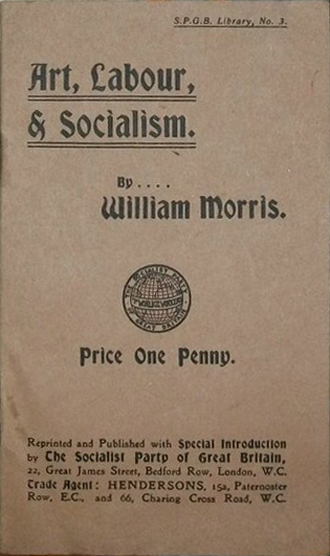
Morris wrote a number of essays and gave lectures on Art and Socialism. Our pamphlet No. 3 Art, Labour & Socialism was a clear statement on the subject and it is possible that before long we may republish it, it having been out of print for many years now.
Ted Kersley

Tuesday, July 4, 2017

Socialist pioneer (2000)

Book Review from the March 2000 issue of the Socialist Standard

The Essential William Morris by Iain Zaczek, Dempsey Parr, London & Bath, 1999.

This is a very large, coffee-table book, beautifully illustrated with 150 of Morris's drawings, illustrations tiles, wallpaper designs, pained panels, tapestries and much else. All the illustrations are carefully described by the author.

There is also an introductory biography of Morris's life by Claire O'Mahony, in which she traces the origins of his family, his early childhood at Woodford Hall in Epping Forest, his schooling at Marlborough College and, later, Exeter College, Oxford, where is discovered "the idyllic medieval city, the circle of idealistic undergraduates and the writings of the Tractarians, Ruskin and Carlyle". Later, after leaving Oxford, Morris sought out the Pre-Raphaelite painter, Dante Gabriel Rossetti.

O'Mahony states that "the medievalism of Morris's youth provided a consistent thread to his political morality of later years, which was so firmly rooted in the Socialism theorised by Karl Marx". She mentions that, in 1871 and 1873, Morris visited Iceland where "he experienced a reawakening of his social conscience when he witnessed the simple dignity of classless life amidst the unrelenting hardships experienced in Reykjavik". She very briefly mentions Morris's membership of, first, the Liberal League; his dissatisfaction with Liberalism, his joining the Social Democratic Federation of Henry Mayers Hyndman in 1883, and his founding with 10 others of the Socialist League, as "one of the strongest advocates for a socialist revolution in 1880s' Britain". His friendships with "the Russian émigré anarchist Prince Kropotkin and Friedrich Engels", are noted.

O'Mahony says that "Morris's socialism is most lucid in his writings on art and society". Morris was one of the few privileged members of the capitalist class in Victorian England who fully embraced, and developed, socialist ideas. And despite the coffee-table style of this book, this is stressed in the introduction. Whether readers have coffee tables or not, The Essential William Morris is worth reading, and keeping for the superb illustrations.
Peter E. Newell

Saturday, January 28, 2017

Socialism and Art. (1930)

From the January 1930 issue of the Socialist Standard
  “The whole way along, Capitalism has stifled Art and tortured the artist. For Art there has been a cramped and narrowed existence; for the artist starvation during his best years, and fame when he was too old to enjoy it. There never was a system which was so noxious to Art as this of Capitalism. All the accusations that it hurls at Socialism will rebound with redoubled vigour against its own lying head. The most inconceivably unrefined Socialistic state could not do worse than degrade Art and starve the artist. What will the ordinary Socialist State of our dreams do?    
  “Firstly, with regard to your genuises. Well, the bureau idea is a rotten one. We have the rudiments of it now in the various scholarships to Schools of Painting and Schools of Music, although they have not tried it yet in respect to Literature. You may discover and encourage technical talent like this—but the “chances are that genius will go unnoticed, if nothing more. In such schemes you are bound to have examiners and selectors of a sort, and anything novel (as all works of genius are bound to appear until you get used to them) may give them the impression that it is only bad or eccentric. Genius takes some little time to be appreciated, and then a whole people, is always a safer judge than an individual who is asked to give an immediate opinion. But. frankly, is there any reason why you should thus keep the artists as a breed apart, a sort of Levites? A poet eats, sleeps, and drinks, and (if he is a sensible man) plays billiards. There seems to me to be no valid reason why he should not spend three or four hours a day in some socially necessary labour, mental or physical— always giving him a choice of occupation, of course. Our error at present is not in forcing artists to take up other work in order to earn their living, but in giving them so much of this other work, or such distasteful work, that their energies are sapped and their thought deadened."    
   “And as for the community at large, it seems as clear as daylight to me that better material conditions and a freer life will bring out again all those instincts which in many men are suppressed under Capitalism. Art will give pleasure to work and beauty to the world. And beauty breeds like every other living thing—except the upper classes. The more beautiful the world becomes, the more men’s efforts will be centred on making it beautiful. On what lines these efforts will run it were a little rash to attempt to forecast. Men will attempt to abolish ugliness wherever possible; ugliness in social conditions of all sorts, in their dwellings, in their clothes, in their habits, in every single article they use. One can scarcely agree with Ruskin that the destruction of all machinery is desirable. But still, it is highly probable that in a Communist society, men, as regards certain articles of everyday use, would rather go without machinery, and do a little more work, in order to get the beauty that only handicraft can give. Many ugly things, too, that we see around us to-day. would disappear of their own accord, because they are only in existence to satisfy an artificial need created by the Capitalists in order to find an investment for a portion of their surplus capital. . . . Every man who is working for human happiness is, whether he knows it or not, following in the footsteps of the great artists of the past and clearing the road for the great artists of the future."   J. C. Squire
The above is taken from a pamphlet published by the Social Democratic Federation in 1907. It is interesting as an artist’s viewpoint, for Squire was a very fine poet, as most modern anthologies bear witness. It is also interesting from another point of view. Squire became a leading writer for one of the most influential Capitalist papers, the Sunday Times, and eventually stood as Liberal candidate for a London division. As he points out, the artist, like every other human being, must eat and drink in order to live—and the hand of Capital is heavy!
Gilmac.

Thursday, February 11, 2016

IS ART THE ENEMY OF THE PEOPLE? (1980)

Book Review from the December 1980 issue of the Socialist Standard

Art, An Enemy of the People by Roger L. Taylor (Harvester Press 1978)

Last month the professors of fantasy returned to their State-funded studies in universities throughout the country. The scholars of literature and art; the men and women whose wisdom is based upon an intimate awareness of the motives of non-existent characters in unimportant novels, poems and plays. One’s reputation is based upon a detailed understanding of paintings that have no meaning to the ordinary person; another is respected for his analysis of an ancient Icelandic epic poem; yet another has written the definitive work on the meaning of the pauses in Pinter’s plays.

What have these “experts” got to offer the majority of people? Very little indeed. Literary scholarship and appreciation under capitalism has always been the preserve of an élite. Those who have no compulsion to enter the process of producing wealth spend their time engaging in superior social pursuits which they choose to call Art. The working class is generally excluded from artistic fulfilment because we lack the time, money, education and experience. The ruling class control social culture by owning the production of Art—and by controlling social culture they do much to maintain the workers in a position of political ignorance.

In an age when the mass of humanity commonly faces so many socially produced evils can we afford to divert our mental energies towards such considerations as currently dominate the world of artistic scholarship? In a badly written, but interestingly argued, book called Art, An Enemy Of The People (published in the Harvester Philosophy Now series), Roger L. Taylor has argued that the function of art is one of class domination and aesthetic scholars are responsible for illusions about art which give ordinary people an unjustified sense of inferiority. The book costs £3.50 and should be compulsory reading for trainee editors; if you make your way through the muddled exposition you will find much that is worth considering:
The bourgeoisie as a whole is not fulfilled by Capitalist society. The growth of applied science, the increase in mechanisation, the objective of production being the accumulation of profits, the fragmentation and dehumanising aspects of the production process . . .  all add up, within the bourgeoisie itself, to an impulse to deny, escape from, or compensate for the economic base upon which bourgeois, material security is dependent . . . the social need to make something out of the “cultural life” is not some mythical quality of human-ness expressing itself in the midst of bourgeois dehumanisation, but rather the expression of culturally conditioned expectations. Art, as we know it now, is the result of these various processes working themselves out (pp. 46-7).
You will also find much that is confused and confusing:
In the Third World Marxism is a number of things. It is terrorism, bombs, sporadic violence, guerrilla warfare, as well as being infiltration by the larger Communist powers, involving, as it does, things like liaisons between local capitalists and Moscow so as to expel the influence of American capital. Marxism is, also, and this is the main thing that it is, the history of the various societies referred to as Communist both by themselves and by Western, capitalist societies. The reality of Marxism in the modern world is, then, many sided.
The nonsense which finds its way into Taylor’s book need not prevent us from answering the question which the book seriously poses: Is Art an enemy of the people or can we envisage a society in which art will perform a healthy function for the majority of people?

Taylor says that art can only flourish where human existence is not socially harmonious. This view can be compared with William Morris’s contention that true art can only exist when it is social, and that socialism
. . . will give an opportunity for the new birth of art, which is now being crushed to death by the moneybags of competitive commerce (Art, Labour and Socialism).
Taylor certainly has a point if he is saying that the study of, and participation in, social art on the part of members of the working class is likely to inhibit political consciousness. By fantasising about unreal characters in unreal situations workers are less likely to perceive genuine social contradictions. When you are at school it is considered “cultured” and “classy” to talk at length about the rather dull plays of the sixteenth century court lackey, Shakespeare; to talk at length about Z Cars is considered “uncultured”; to talk about why the majority of kids don’t have enough money to spend is not only “uncultured” but “ill-mannered”. Anyone who has been to the theatre will have witnessed crowds of usually well-paid workers (those who imagine themselves to be middle class) talking in phoney accents about matters of characterisation and plot that are of no consequence to anybody. Can we afford to be complacent that, people’s minds are so diverted in a society which is so in need of change? The plays that they are watching and discussing usually have little social significance. We are entitled to criticise those who make such effort to blend in with the culture of capitalism for not using their energies to a more positive end. Taylor is probably right that the illusions, fantasies, prejudices and pretentiousness of Art is an enemy of the mass of the people in capitalist society. This reviewer takes with much seriousness Taylor’s advice that “Art is a value the masses should resist, not just ignore” (p. 155).

But Taylor’s arguments become unstuck when he claims that art will have no role when the ruling class no longer exists. Taylor’s failure to understand the need for socialised art must result from the fact that he clearly understands little about social history and less about socialism. The socialist, William Morris — whom Taylor strangely does not refer to in his book — did understand the meaning of socialism and thus recognised that in socialist society creative labour would be the highest form of art. When all members of society own and control the means of producing art there will be a synthesis of social productive activity and art which presently stand in antithesis to one another.

It is because Taylor fails to see the possibility of such a synthesis — a failure shared by all non-socialist critics of capitalist culture — that he cannot understand that art, like all other social features, is subject to historical development. The weakness of Morris is that he too occasionally succumbed to a romanticised perception of culture which led him to believe that true art, arising from a socialised environment, could be found in pre-capitalist forms of property society.

The only relevant role for art in modern capitalism is as the voice of social revolutionaries. Considerations of art in separation from the historical study of society is what professional literary scholars exist for. They have no ideas to offer to society which are relevant beyond the works of art that they spend their time studying; the class war rarely intrudes into the lives of the fictional “characters” with whom they are concerned just as the majority of the world’s population rarely intrudes into the exclusive confines in which they dwell. Masters of the values of fantasy, they are blind to the objective laws of society: are we too bold to predict that such “scholarship” will one day be behind us?
Steve Coleman