Wednesday, January 17, 2018

Editorial: The "High Wage" Myth (1961)

Editorial from the January 1961 issue of the Socialist Standard

Every half-year the newspapers publish Ministry of Labour figures of the average earnings of manual workers, and the figures always excite, angry letters from readers who don't believe that the average is now over £14 a week.

The latest inquiry related to April, 1960, and it showed that the average weekly earnings were £14 2s. 1d. for men; £6 3s. Id. for youths and boys; £7 5s. for women of 18 and over; and £4 13s. 1d. for girls under 18.

For men the £14 2s. 1d. was for a working week of 48 hours, that is to say, it included pay for six or more hours’ overtime; also for night work and Sunday work, and all kinds of bonus additions to ordinary pay. It was before any deductions had been made.

Being an average it included some industrial groups with earnings far above the average and some far below it. The top section was the motor vehicle group with £17 10s. 3d. a week, and the lowest, central and local government. £10 15s. 6d. a week. If the motor vehicle inquiry had been made in November, with something approaching 100,000 on short-time, the figure would have been far below £17 10s.

In any event it should not be thought that the £14 a week wage is an average for all the 14 million men employed in all industries. It is in fact based on fewer than five million men employed in manufacture and some non-manufacturing industries, but it does not include agriculture, coal, railways or the distributive and catering-trades. (Nor does it include non-manual workers.)

If all the industries were included the average would be brought down quite a lot.

Many workers, including craftsmen, earn only their standard weekly rates or not much more, and, as the Royal Commission on the Police showed in its recent Report, the general level of skilled rates is nothing like £14. They obtained 34 craftsmen’s rates from the Ministry of Labour (as at November 1. I960) and found that the average for the 34 rates is only £10 8s. 3d. a week.

And the distributive trades are even worse off. The Union of Shop Distributive and Allied Workers is campaigning for higher pay and shorter hours for shop assistants and that Union is responsible for the statement that “one and a half million shop workers in Britain are only entitled to a wage of well below £10 a week for 46 or more hours’ work ” (Reynolds News, 4/12/60).

Reynolds News is the Cooperative Sunday newspaper and when it tells its readers “Don’t Shop at Sweatshops" it means the worst payers among the private traders, but though the Cooperative societies often pay rather more, their wage agreements are not exactly princely. The Cooperative Agreement made in July, 1959, fixed a rate for men shop assistants ranging from £8 15s. in Provincial areas up to £9 9s. in London, and in July, 1960, the Union applied for a national minimum of £10 a week in cooperative societies as well as a reduction of hours from 44 to 40. The claim has not been conceded. Large numbers of railwaymen and government workers get below £9 a week, along with the agricultural worker on his new minimum of £8 9s.

The Real Army Game (1961)

From the February 1961 issue of the Socialist Standard

So an Army commanding officer banned his troops from viewing the television programme, “The Army Game”, on the grounds that it “appears to portray little that bears any relation to the present-day Army.”

But would Major Bill Cook really approve a true depiction of the Army—whether of today or of earlier days of the present order? Would he like to see revealed, for instance, the purpose of armies in current society? If so, he can well be accommodated by socialists.

Society as today constituted is composed of two classes, the capitalist class and the working class. Although the [capitalists are] the dominating faction. This is due to workers, in numbers, overwhelmingly preponderate, it is the capitalists who are the circumstance that the capitalist class owns (in the form of the land, factories, machines etc.), the means of producing the means of life.

The workers, on the other hand, have no such means and implements of production, and to secure food, clothing and shelter and provision for their families. must offer for sale to the owning class their mental and physical energies. The price (or wages) paid for these energies are at a level that will roughly purchase the necessities of life. But those very energies (or labour power) are bought for working spells more than sufficient to produce the value of the wages paid for them. In a five-day working week this value may be produced by the end of the third day; the value produced on the fourth and fifth day. therefore, is a value in excess of the workers' labour-power value and thus the wages that represent that value in monetary terms of the food, clothing etc., required for the restoration of expended energies. This excess is thus a surplus value congealed, as it were, in the products (or commodities) the workers have produced for their masters. Surplus value, with the sale of the commodities incorporating it, is realised as profit; which, by continually flowing to the capitalist class enables them to further capitalise their businesses and live without the necessity of working.

Thus one sees the capitalist class as a relatively tiny section of the community, but a section which enjoys benefits denied to that much larger section, the working class. And added to the economic advantage of ownership of the productive means goes the political advantage of a State apparatus, the machinery of government, which since the birth of capitalism has carried out its appointed function of preserving the social set-up, and of conserving the masters' monopoly of the wealth produced by the working class. Included in this State apparatus are the coercive and armed forces which, possibly when all other official influences have failed, will be called upon to protect or restore “law and order” against any development likely to interrupt capitalism's normal productive and distributive processes or to subvert in any way the privileged position of the capitalists over the workers. And among the armed coercive forces, of course, is the Army.

As a force intended to be the last resort “persuaders” of large numbers of people—hungry and desperate strikers and unemployed demonstrators as in some cases—the Army is provided with weapons and taught how to use them. The result is that, in cases of threatened subversion etc., the Army is an efficient repressive force through its trained ability to maim or kill. Whether or not years elapse without such measures being applied, this remains one of the purposes behind the Army's existence.

There, then, lies the capitalist need for armies in the country of their being. But each national capitalist grouping also needs an armed force to defend or further its interests outside its homeland. Behind each of these national groupings, whatever the nation encompassing it, lies the pressure of competition. American capitalism contends with Russian, British with German, French with Japanese—indeed, each nation contends with all others in a quest for markets by which to sell its commodities, which have been produced by the workers of each competing country.

Hence between the national capitalist factions, there exists a struggle for markets, but for each competitive needs as cheaper fields of exploitation, economical trading routes, and all the other advantages that will enable their possessors to offer their commodities at competitive prices. Often the acquirement of these advantages can be effected only by filching them from rivals. From the diplomatic moves, the changing strategies, there come the international crises, the tensions, the cold wars—too often to end in a hot war.

If is then that the Army of each country concerned is ordered, with the other armed services, to carry out its function as the protector of the foreign interests of its native capitalist class. Not that the protection of capitalist interests will be the reason given for hurling masses of young men, mostly members of the working class, into bloody conflict against other masses of young men, similarly mainly workers. The various propaganda machines will manufacture high-sounding excuses. The war is a fight for “democracy over autocracy”, for “breathing-space”, to defend “the rights of small nations”. Augmented now by hosts of wartime conscripts the task for each army is to wreak what havoc, destruction and death it can upon the armies of the “enemy” countries. For no other reason than that they have been ordered to do so by their respective governments, man kills man so that his masters' trading interests are furthered or at least protected from damage.

One can scarcely expect a socially progressive and enlightened development among men trained to carry out the anti-social act of war. Certain it is that many of those whose military job is to make “good soldiers” are of necessity tyrannous and not far different to “The Army Game’s” Sergeant-Major Bullimore.

But perhaps this portrayal is too realistic for Major Cook. However, the Major need have no fear that “The Army Game” will in any way harm the Army. The Government, as the virtual executive committee of British capitalism, will see to that.
F. W. Hawkins

A Parable by Leo Tolstoy (1961)

A Short Story from the March 1961 issue of the Socialist Standard

I see mankind as a herd of cattle inside a fenced enclosure. Outside the fence are green pastures and plenty for the cattle to eat. While inside the fence there is not quite enough for the cattle. Consequently, the cattle are trampling underfoot what little grass there is and goring each other to death in their struggle for existence. I saw the owner of the herd come to them and when he saw their pitiable condition, be was filled with compassion for them, and thought of all he could do to improve their condition. So he called his friends together and asked them to assist him in cutting grass from outside the fence and throwing it over the fence to the cattle. And that they called Charity. Then because the calves were dying off and not growing up into serviceable cattle, he arranged that they should each have a pint of milk every morning for breakfast. Because they were dying off in the cold nights, he put up beautiful, well-drained and well-ventilated cow-sheds for the cattle. Because they were goring each other in the straggle for existence, be put corks on the horns of the cattle, so that the wounds they gave each other might not be so serious. Then he reserved a part of the enclosure for the old bulls and the old cows over seventy years of age. In fact, he did everything he could think of to improve the condition of the cattle, and when I asked him why he did not do the one obvious thing, break down the fence and let the cattle out. he answered: “If I let the cattle out. I should no longer be able to milk them."

The War Between The States (1961)

From the April 1961 issue of the Socialist Standard
100 years ago this month the American civil war began with the bombardment by the Confederate forces of the South of the Government held Ford Sumter. By the time it ended, four years later, it is estimated that out of a population of 31,000,000, between 750,000 and 1,000,000 men lost their lives, and many more wounded. The devastation was enormous. In many ways, it was the fore-runner of the total warfare we know today.
The revival of interest in the American Civil War is a phenomenon of the last decade. Chicago boasts of a successful book store where only Civil War items can be bought. Every week sees at least two new books on the War. What prompts this sustained interest is anybody's guess. Is it, perhaps, a search for a tranquilizer that will narcotize America to the many setbacks of recent years?

The Socialist searching through the mountain of Civil War books, is hard put to apply his yardstick of historical materialism. What seems to occupy the attention of the various authors, for the most part, is the spectacular bravery and dauntless courage displayed by Union warriors and Rebels alike. The social forces underlying the conflict, with the exception of the Slavery issue, are buried in a mass of drum and thunder history. It is easy for the casual reader to be left with the thought that the North was engaged in a crusade to wipe out slavery while the South was imbued with the "noble” ideal of saving it through secession. While this might have been typical of the average ideology of the War, it was certainly not a basic force in its origin.

If the abolition of slavery was an all important issue to the North, then why were Wendell Philips and William Lloyd Garrison mobbed in Boston, the centre of abolitionist ferment? Why was Lovejoy lynched in Illinois? Why was Douglass, friendly to the South and its institutions, elected to the Senate by the same State that started Lincoln on his road to fame?

Then too, the idea of opposition to slavery on moral grounds becomes ridiculous when one regards the low moral conscience of Northern industrialism. There was no revulsion at the horrible mills and mines where men, women and children toiled long hours for a pittance; at the miserable slums, unfit for human habitation in all the cities and towns; at the periodic crises which threw the workers on the streets to starve; at the universal blacklist for those who spoke of unionization.

Certainly it was not opposition to slavery on moral grounds, that prompted Massachusetts, in the early 18th century, to abolish it. John Adams wrote: “that the real cause was the multiplication of labouring white people who would not suffer the rich to employ these sable rivals so much to their injury." And the fact was that a committee appointed by the Massachusetts Council in 1706. recommended the abolition of slavery because “white servants were cheaper and more profitable than black slaves." Nor were Lincoln and his party, a century and a half later, concerned with the morals of slavery. In fact, the Emancipation Proclamation was issued as a war measure against the Rebels and did not apply to those slave States loyal to the Union. The Republican Party made quite plain the fact that it was not opposed to the continuance of slavery in the South provided that it was not spread into the frontier areas in which the Northern industrialists wished to establish their own slave system — wage labour.

Chattel slave labour has to fill certain requirements in order to be a practical substitute for "free" wage-labour: (a) it must be cheaper; (b) there must be a climate which permits the use of cheap, coarse and scanty clothing: (c) the product worked must require little, if any, skilled labour; (d) there must be no complex machinery; (e) there must be an unlimited supply of new and fertile land that can be brought into cultivation as the old land becomes exhausted; (f) a one crop system is desirable; and (g) employment must be steady because chattel slaves must be supported continuously.

Obviously, the conditions for this type of labour did not exist in the North, whereas in the South, the cultivation and ginning of cotton for nine months of the year filled the bill. There were, however, serious contradictions which prevented the peaceful co-existence of the Southern and Northern economic systems, and which caused the Southern system to disintegrate prior to 1860.

The American South, despite its slave labour, was basically a commodity society in which goods (including slaves) and services were produced for sale on the market with a view to profit. A more fitting designation for the system is Plantation Capitalism. Certainly the South fought to maintain the chattel status of its Negroes, hut mainly because this type of labour was vital to its economy and because its very system was falling apart largely as a result of Congressional laws which favoured Northern interests and which helped make chattel slave labour too costly. The moral justification for slavery was naturally provided by the Southern churches for the benefit of their aristocratic “partners."

It was largely because of the law against the importation of slaves and the consequent need of breeding these “vocal tools" that a field hand who in 1808 sold for 150 dollars, brought from two to four thousand dollars in 1860. The control of Congress by the North resulted in high tariffs on imported manufactured goods which interfered with the important trade of Southern raw cotton for English textiles. The development of Northern seaports and railways also brought about a loss of trade to the South from the Western agricultural regions—long ship hauls down the Mississippi to the Port of New Orleans became unnecessary. And the South, which desperately needed new land lo replace that used up by their wasteful one-crop system, was losing out in its bid to bring in frontier areas as slave states.

As its losing economic war with the North and its internal contradictions progressed, the beneficiaries of the Southern plantation system became fewer, their holdings ever larger. In 1860, only about one-half million of a population of 9 million Southern whites are reckoned to have made any profit from chattel slavery, of which a mere 10,000 were the actual ruling class. In this crumbling fabric of the South, the problem confronting the 10,000 was how to maintain dominance under universal white suffrage. Support came from the professional class and the clergy with their one or two personal slaves. Also from the poor, degraded “white trash” who squatted on the poorest land and fiercely defended the institution of chattel slavery which provided another economic groups over whom they could vaunt their “superiority.” As an added bonus, there was the lift to their spirits to be had by identifying themselves with the Southern aristocrats.

The elections of 1860 tore any remnants of control of the national government from the hands of the Southern rulers. Secession became necessary. The plantation capitalists knew that their social system could never prosper with a government they could not control. They had no more need for the North, since their system was barred by soil and climate from expanding in that direction. With a government they could control, expansion to the south could proceed, in harmony with the grand visions of the Southern “Manifest Destinators.” There was Mexico to be conquered, Central America, Cuba, and even the vast continent of South America —all offering vast areas of land for the smooth operation of their economy. Their backs were to the wall, they had nothing to lose, so they took the plunge and the hot war began.

The Armed Conflict

The South, as an oligarchy, was better prepared in 1861 to begin a war than the more industrialized, but highly disorganized North. Productive work falling on the Negroes, the Rebels could put their entire fighting strength into the field without disturbance, and they inflicted defeat after defeat upon the army of farmers, mechanics and sailors of the North. The united South was faced by a North, divided, and to a considerable extent dominated, by the border states which were loyal but which were certainly not in favour of Abolition. The North found it difficult to raise the 300,000 men requested by Lincoln. Conscription was introduced for the first time in American history but an escape clause which permitted a man to buy a substitute for $300.00 enabled the rich to become legal dodgers and brought about riots in New York City against conscription.

But the outcome was inevitable. In the long run, despite the terrible initial defeats and despite the manipulations of such crafty patriots as J. P. Morgan who made a fortune by selling thousands of previously condemned rifles to the War Dept with a profit of $18.00 on each, the relatively highly developed North prevailed, and under such ruthless and capable generals as Sherman and Grant, swept away the last vestiges of chattel slave labour in America.

The socialists of the period, for the most part, actively interested themselves in the cause of the North. In England, the ruling class gave sympathy and support to the South. Karl Marx worked within the International Workingmen’s Association to rally the workers to the support of Lincoln. During the period of Northern reverses, the pioneer of scientific socialism held firm in his belief that the “North will make war seriously, adopt revolutionary methods and throw over the domination of the border statesmen; that the defeats being suffered by the North were due to the conducting of the war on constitutional and diplomatic instead of revolutionary lines.” He also pointed out “the failure to take cognizance of slavery as a military weapon . . . that the slaves should be declared free and that a single Negro regiment would have a remarkable effect on Southern nerves.”

Whatever the validity of the motives which influenced the socialists of the period, they definitely gave their support to what they regarded as a progressive type of capitalism. Looking back, we can question some of their views and the emphasis they gave to the chattel slavery issue and show that their all-out support of Northern capitalism was unwarranted.

With peace, the youngsters who had fought in one of the bloodiest wars in history (more than half of the Union Army were under 19 years of age and more than 300,000 were between 15 and 16) went out in the world to resume or begin the task of earning a living. Many of them, having become quick with the gun, were shortly to dot the Boot Hills of the new towns and mining camps and to help write the blood history of the West.

Those who returned to the industries found a new foe, warlike and pitiless, but in industrial rather than military warfare. These were the “captains” of industry—the Fricks, Carnegies, Vanderbilts, Rockefellers, Hills, Huntingtons, Flaglers and, of course, the redoubtable J. P. Morgan.

With the 70's came the business panics and the great strikes. In the Pennsylvania coal fields a bloody war raged with pistol and dynamite between the owners and the Molly Maguires (a secret society of rebellious workers). Alan Pinkerton, a spy of Lincoln’s, now became the leading industrial spy and strike breaker in the land. By worming his way into the inner circle of the society, he was instrumental in bringing about the exposure of the Molly Maguires. Ten of their members were hanged and many more sent to prison, bringing to an inglorious end the careers of some of the former heroes of the Union Army. Many more of the veterans were to witness the same generals who had led them to “victory” now march upon them with their former brothers-in-arms, to shoot, kill and jail them. It was a rude awakening and was to teach them that the war was not fought for them, as they had thought, but to build an economic system that would enrich a handful.
Sam Orner

Editorial: The Shadow over our Lives (1961)

Editorial from the April 1961 issue of the Socialist Standard

It is not to satisfy historical curiosity that we publish in this issue of the Socialist Standard an article which marks the centenary of the outbreak of the American Civil War. The strategy of attrition of that war, and the way in which it organised the resources and population of' the Union into an all-out effort, was a foretaste of the two great wars of the twentieth century. It is hardly too much to say that modern warfare is one hundred years old this month.

Can we say that the bloodshed and misery have been worthwhile? That the world has been improved by the sacrifices which the working class have made during the wars? The bitter fact is that the world is no safer for peace today than it was in 1861. War, actual or potential, is as much a part of our lives as any other aspect of modern society. Although we are at present living in a period of peace, we know that all over the world national powers, great and small, have their bases and their forces in readiness for a future conflict. In Holy Loch, Proteus tends to her missile-carrying submarines. The Soviet Union has developed accurate intercontinental missiles of fearful destructive power.

By any standards of sanity, it is incredible that a society which possesses such enormous productive potential should devote so much of its effort to making weapons of destruction Should we, then, join the campaign to persuade the government to renounce nuclear weapons? That would be to approach the problem from the wrong end. Weapons are not produced to satisfy a government’s destructive impulses. They are produced to prosecute the armed conflicts which in turn are caused by the economic rivalries of capitalism. All of these are inseparable. What it amounts to is that weapons of war are an inevitable product of capitalist society. Those who support capitalism. yet wish that its governments would voluntarily deprive themselves of the most powerful weapons available. are baying for something even more remote than the moon.

Into this category fall the unilateralists. the pacifists and some members of the Labour and similar parties. Some of these accuse the Socialist Party of turning our backs on capitalism’s day to day troubles. It is true that we refuse to be sidetracked from our purpose of Socialist propaganda in order to advocate some reform of capitalism, although during our fifty-odd years of existence we have heard many appeals to do so. Unemployment. Nazi Germany, nuclear weapons these are only some of the issues upon which we have been urged to concentrate our efforts at the expense of our Socialist integrity.

We have rejected these appeals because we know that such problems find their roots in capitalism's property basis To end them, we must establish a Socialist society in which the world’s wealth is owned by the world. Such an objective is the only thing worth demonstrating for.

The Reward of Genius (1934)

From the December 1934 issue of the Socialist Standard

It is claimed on behalf of capitalism that the most important part played in the production of wealth is that of outstanding men who made possible the highly-developed civilisation of to-day. Inventors, painters and literary men are held up as examples of this, the implication being that the present capitalists or their forefathers were of this select band.

On previous occasions we have shown the baselessness of these assertions and in general have pointed out how each generation simply adds its little bit to the achievements of the past, and the discovery or production put to the credit of one individual exaggerates his part in the business. Briefly, the position is similar to that of a footrace. Society or production sets a problem and one of the participants gets there first.

We do not propose going into the matter any further at the moment, but it may be interesting to give a short list of outstanding figures in various walks of life who are accepted as having made considerable contributions to the wealth and the happiness of modern society. At the same time it may also be interesting ta show how capitalism has rewarded its “men of genius."

John Kay.—A weaver and mechanic. Inventor of the fly shuttle, one of the most important inventions in the textile industry, as well as other inventions. He took his case to the courts in the endeavour to obtain recognition and recompense for his work: was beggared by litigation, and starved to death in France.

Joseph Marie Jacquard.—Inventor of the silk-weaving loom that brought about a revolution in the art of weaving. He could obtain no recognition until he was an old man. He sacrificed all he possessed to carry on his inventions, and became a labourer and a soldier.

Henry Cort.—Invented “puddling" process for converting pig-iron into malleable metal, as well as other inventions. He patented his inventions and became involved in law suits—like so many of his kind. He was eventually utterly ruined. The Government took up his invention and granted him a pension of £200.

James Hargreaves.—A carpenter. Invented the spinning jenny, but died a poor man. He suffered from dishonest manufacturers.

Samuel Crompton.—A cotton spinner, combined the old water frame and spinning jenny into the mule, and is considered to have been practically the organiser of modern industry. He died in poverty.

Richard Roberts.—Inventor of the self-acting mule: was left to fight poverty in his old age.

Richard Trevithick.—Inventor of high pressure d the steam locomotive; died in poverty.

Gutenberg.—Inventor of printing: was in financial difficulties all his life.

Bernard Palissy.—A French potter. Discovered the process for manufacture of enamel. Struggled for sixteen years in the lowest depths of poverty, having to burn his furniture to keep his fires alight. He was arrested, and died in the Bastille.

John Harrison.—A mechanic. Invented the marine chronometer. He was in necessitous circumstances all his life. Struggled for years to obtain the reward that had been offered for such an invention, and after considerable difficulty finally obtained it when eighty years old.

Frederick Koenig.—Inventor of the steam printing-machine. Had his patents infringed. After a long struggle and illnesses he died in poor circumstances.

Eugen Turpin.—Inventor of melenite and over forty other inventions: was always in poor circumstances.

General Shrapnel.—Inventor of the explosive that bears his name and that helped to build up many rich armament firms, as well as blowing thousands to eternity: died in 1842, a poor and bitter old man.

Antoine Laurent Lavoisier.—Described as the father of modern chemistry: had to accept a position as tax-farmer in order to carry on his experiments, and perished under the guillotine.

Rev. Hannibal Goodwin.—Invented film photography, and after a long fight obtained a patent in 1898. When he was about to put the film on the market, he died in 1900. His widow formed a company and carried on a fight with the powerful interests opposed to her, and finally obtained a judgment in the United States Supreme Court in 1914 that the Goodwin patent was the basis of film photography. Success, however, came too late, for Mrs. Goodwin was 81 and in failing health.

Franz Schubert.—A schoolmaster, whose musical compositions have delighted myriads of people and whose life has provided material for films. “Left the world," as one biographer puts it, "a rich heritage of considerably more than a thousand works of extreme brilliance, and who received in return £575 as the sum total of his life's earnings "! !

Count de Chardonet.—Inventor of artificial silk: died a poor man. In 1928 M. Heriot unveiled a statue to him at Lyons. No doubt he would have preferred a little more bread while he was alive!

Horace van Ruith.—A famous artist, who painted a study of Nurse Cavell that was greatly admired. At the age of 80, when living in poverty, an exhibition of his works was held covering a period of nearly 70 years, and he pathetically expressed the hope that some of them would find purchasers and so allow him to spend his last days without depending on friends.

Henrick Heine.—Germany’s leading lyrical poet: had a struggle for existence all his life.

Herbert Spencer.—The philosopher of individualism: could only complete his Synthetic Philosophy by means of the subscriptions of friends.

Linnteus.— Described as the father of modern botany: had to work his way to the Universities of Lund and Upsala, living on £8 a year, and making his own boots from the bark of trees. Had he not attracted the notice of a man of similar tastes, the famous Classification of the Animal and Vegetable Kingdom might have had to find another author.

The above are only a few of the illustrations picked out of a large field and placed in a handy form for reference.

There was one inventor, however, who realised fame and fortune while his brothers struggled and starved. That one was Sir Richard Arkwright, sometime barber and horse-dealer, to whom is attributed the invention of the water-frame, which he patented in 1767. But Arkwright has the unique distinction of not having invented the contrivance that bears his name. The invention in question was actually the work of Thomas Highs, who built a spinning machine in 1767 at the village of Leigh. This was known to Arkwright, who had married a woman from Leigh. The case was fought through the courts, and Arkwright never produced any satisfactory evidence of the origin of his invention. When the case was tried in 1785 Arkwright’s patent was declared lapsed. However, he died in 1792, a knight, a high sheriff of the County of Derby, and left half a million pounds!

A full account of this case will be found in Mantoux’s “Industrial Revolution” for those who are interested.

Just a word of warning before concluding. The writer is not concerned with whether all the inventions named above were in fact the work of those to whom they are ascribed. The point is the inventions in question are ascribed to them by the capitalists and their paid writers, and the reward such pillars of modern society received for their work was, in the main, worry, toil and misery, while those who owned the means of production profited by their work and amassed fortunes.
Gilmac.

Fallacious Arguments: The Threat of War (1980)

From the June 1980 issue of the Socialist Standard

It would be rather nice were we not all blown up in a nuclear war, but it is by no means certain that we shall not be. Why is this? Perhaps there has been a conscious and reasoned decision on the part of the world's population to put an end to the unsatisfactory standard of life. After all, did Dostoevsky not say that suicide was the only form of freedom? If the rush to mass destruction is the result of a world debate, in which a majority expressed the opinion that life on earth is no longer worthwhile and we should all transfer to the mythical kingdom of God, why were socialists not invited to put our ideas to it? The reason is that there has not been such a debate. Unlike the inconsequential matter of whether or not the British capitalist class should join the Common Market, there has been, and will be, no referendum to ask "the public" whether they fancy being blown up. There is nothing democratic about war.

Exterminating human beings seems to be an unintelligent way of running a society, especially when it is considered that the main purpose of a society is to ensure the survival of its inhabitants. One would think that any system of society that ceases to ensure survival would meet with the disapproval of its members. But there are a number of currently popular arguments that are intended to justify mass legalised murder:
  1. The economic argument. War can be profitable for one or other of the sides.
  2. The philosophical argument. Rationality is an inadequate method of explaining and solving social problems. We should recognise that humans will sometimes act in ways that cannot be explained and the causes of war are attributable to such inevitable irrationality.
  3. The moral/religious argument. The enemy in war is invariably immoral, valueless and ungodly and thus deserves to be killed.
  4. The anthropological argument. Men like fighting because they are naturally aggressive. (And women like bandaging their wounds because they are naturally caring and impressed by the virility of warfare.)
  5. The political argument. Murder is right when it is in defence of the Queen/President/State/State-to-be/ideology.
Such justifications of war are wholly unworthy of popular acceptance. Yet they prevail, which must either mean that the majority of people agree with them, or that the majority of people are excluded from making decisions about their own survival. To account for both possibilities, we shall first consider why the above-mentioned "justifications" are unworthy of working class acceptance, and we shall secondly consider the means by which the majority of the world's population can voice our rejection of war.

THE ECONOMIC ARGUMENT

Wars in a capitalist society are concerned with profit accumulation, the concentration of wealth and power into the hands of a class that owns and controls the means of wealth production and distribution. According to the recently published report of the Royal Commission on the Distribution of Wealth and Income, 1 per cent of the British population owns more wealth than the bottom 80 per cent. Wars are not fought between the owners and non-owners of wealth, but between one set of owners and another. Every war in the history of capitalism has been fought, directly or indirectly, to secure markets or raw materials. Russia and China, as much as their power rivals in the West, are concerned with this squalid battle over who owns what in and on the earth, for they are both state capitalist countries obsessed, no less than their avowedly capitalist enemies, with markets and profits. If it were made clear to the majority that wars are fought to protect and expand the prosperity of a minority class then the workers, who are expected to fight the wars and who gain nothing, would cease to accept the economic argument. The businessmen of seventeenth century England responded in this way when many of them refused to finance the commercial adventures of William III: they realised that there was nothing in it for them and so told William what he could do with his foreign policy. The economic nature of modern war is disguised by conditioning the majority to believe that the interests of society (survival) are the same as the interests of the owners of the means of life (profit). Their battles are our battles. We die for them, they live off us. Nation first.

More enlightened members of the working class will recognise that the struggle that should concern them is not that between rival sections of the capitalist class, but that between the two main classes of society: those who possess but do not produce and those who produce but do not possess. They will realise that the power and wealth of the capitalists results from the acquiescence of the working class to exploitation, to be paid wages that are less than the value of the commodities that they produce. In September 1914, The Socialist Standard published a statement on war that made clear the real interest of the working class:
"Whereas the capitalists of Europe have quarrelled over the questions of the control of trade routes and the world markets, and are endeavouring to exploit the political divisions and blind passions of the working class of their respective countries in order to induce the said workers to take up arms in what is solely their masters' quarrel, THE SOCIALIST PARTY OF GREAT BRITAIN, having no quarrel with the working class of any country, extends to our fellow workers of all lands the expression of our goodwill and Socialist fraternity, and pledge ourselves to work for the overthrow of capitalism and the triumph of Socialism." 
The plunder of war is part of the economic rationale of capitalism and so it is no use complaining about "unjust" wars. What is required is a social system in which the material interest of the many rather than the few is what constitutes justice.

THE PHILOSOPHICAL ARGUMENT

Ever since the Enlightenment of the eighteenth century there has been a school of thought that has rejected rationality as a way of explaining and changing social affairs. Irrationalists argue that human beings are motivated by inexplicable accidents of sentiment and that it is impossible to work out a method of understanding how and why social phenomena occur. Faith, trust and sensual responsiveness are the guidelines to which they direct. Many fascists in the early twentieth century argued that the inhumanity of society was due to innate stupidity, malleability and lack of consciousness on the part of the mass of people. "The masses" were seen as stooges to be used by an elite for its own purpose. The link between such anti-democratic beliefs and the similar beliefs of Leninism is based upon a common perception of the limitations of human self-assertion. The Irrationalist idea of "the masses" has understandable appeal among those who seek to lead people. It supposes that only a minority is capable of scientific thought, that most people are blended into the crowd and have no desire to act in their own interests, and that consequently irrational events like war are inevitable. Such views are likely to be attractive to "intellectuals" who imagine that they are members of the intelligent minority and are not as susceptible as the masses.

It is not justifiable to conclude that irrational social behaviour is an inevitable human feature. In an anti-social environment like capitalism, that contrives to keep its wage slaves in the most degraded, unfree and stupid condition, the forces of rationality are fighting an uphill battle. But the contradictions of capitalism will force workers to see the folly of their own irrational ideas.

THE MORAL/RELIGIOUS ARGUMENT

Moralists and religious believers are forced to present rewards for being good and punishments for evil-doing. So, if you kneel in the church and obey the law you get to heaven, and if you are hungry and steal some food you go to Hell. When wars take place moralists are brought in to tell the fighters that they are doing God's work because the enemy is evil. One of the early members of the Socialist Party of Great Britain said that the sight of the priests blessing the guns in 1915 made him first consider becoming a socialist. In the last war the messengers of God blessed the aeroplanes of both the British and the Nazis before they went off to carry out their respective holy missions of murder.

Most workers accept morality because they feel powerless to reject the guidance of their rulers. The church encourages this sense of impotence by telling us that not only is it sinful to kill, but it is unpatriotic and sinful not to kill when our masters so decide.

THE ANTHROPOLOGICAL ARGUMENT

Anthropologists who have asserted that homo sapiens is essentially aggressive have been opposed by many empirical observations. Where there is a social harmony of interests, non-aggressive, cooperative people are found. It is not "human nature" for men to wish to kill one another, and if it is why do they have to wait for a legal decree before war can commence? The anti-social conception of mankind is not indicative of inherent human characteristics, but of a system that forces people to act inhumanly and, in that sense, unnaturally. The myth about "the Glory of War" has been somewhat exposed by stories that have followed the war in Vietnam: war is not about bravery and heroism, but about the indignity of plunder and the inhumanity of slaughter. Of course, there might be some people who do wish to kill other people for pleasure. But should society accommodate the perverse tastes of the would-be killers? At present it does, and we are told that "It's a Man's Life in the Army".

THE POLITICAL ARGUMENT

The least convincing justification of war is the argument that murder is alright if it is in defence of something that people fanatically believe in. For example, there is no doubt a considerable number of people in Britain who would be prepared to lay down their lives for the Queen. Perhaps it would be a solution if they were simply to lay down their lives and be given honorary peerages; this would at least prevent involving those of us who do not want to die on behalf of monarchs, nations or beliefs. Islamic fanatics, left-wing insurrectionists and nationalists like the IRA are not only claiming the right to die for their cause, but are demanding that other workers die with them. A system of society that compels workers to fight for a nation that they do not own is urgently in need of being removed. If there is a nuclear war – or even a serious conventional war – millions of workers would die in defence of countries that are not and cannot be theirs. The workers have no country and therefore no worker should fight in a war.

There is no need for war, just as there is no natural need for poverty or mass starvation or housing shortages or hospital waiting lists. It is because society is organised to provide profits for the few rather than satisfaction for the many that these problems face us. There is no immediate likelihood of the world being destroyed by natural means, but there is more than a slight probability that it will be destroyed by the social madness of mankind, a madness that is created and maintained by the long outdated ideology of capitalism.'The working class has only to say "stop" and the entire present. system of society will cease to be. We have only to take the means of wealth production and distribution into the common ownership and democratic control of the whole community to put an end to the need for fighting over markets and resources and frontiers. We need only withdraw our consent to capitalism, in a majority, to set in motion the revolution from the pre-history to the civilised history of society. Or alternatively, perhaps we ought to pray to the sky that we're not blown up. At least that way one cannot be accused of being naive, or worse still, of being a social revolutionary.
Steve Coleman

Marx and Engels Wrong on War (1980)

SPGB 1950 pamphlet.
From the June 1980 issue of the Socialist Standard

We are a Marxist party but we recognise that the conditions of the time, when Capitalism was relatively young and Feudalism had not yet been completely swept away, led Marx and Engels into a false position on war in the course of pursuing their pioneer work. It was a time when freedom was in chains, when the barricade seemed to be the answer to oppression and when war took on a somewhat different aspect from what it does today. The road of the pioneer is difficult; those who follow profit by his work and his errors and have a wealth of experience to help them. The Bolsheviks and their followers, however, were not Marxists. They threw overboard Marx's fundamental tenets and borrowed a few of his views (the erroneous ones) that helped them in their struggle for dictatorship. They did not profit by the work of Marx; they only sought to profit by his name. Marx relied on the workers; they spurned the workers.

Those who continue to hold nineteenth century conceptions about the possibly "progressive" nature of war are refusing to learn the bitter lessons of experience. They fail to see that the instrument of war that served the rise to power of the capitalist minority cannot be used to achieve the emancipation of the working class. Socialism is held back by the lack of understanding in the ranks of the working class. Armed force cannot make up for the backward political development of the working class. With the development of the technique of destruction war now means the wholesale destruction of human life by atom bombs. It is the supreme irony that some who claim to seek to save the human race by achieving Socialism should be able to contemplate pursuing that aim through the mass destruction of human life.

The Socialist Party of Great Britain will continue on its way loyal to international Socialism in the sure knowledge that it is the duty of all who seek Socialism to oppose war.

From "The Socialist Party and  War" (1950)

Tuesday, January 16, 2018

Exhibition Review: Morris & Co (1961)

SPGB pamphlet from 1907.
Exhibition Review from the May 1961 issue of the Socialist Standard

At the Victoria and Albert Museum in April there was to be seen an Exhibition, Morris & Company 1861—1940. On show were specimens of textiles, tapestries, wall papers, etc., produced by the firm of which William Morris was chief partner and designer. These art and craft products are considered to be the most artistic of their period. But such fine work was not for the homes of the great multitude, as Exhibit 61 (an order book) quite clearly showed.

Looking at this exhibition there was nothing to indicate that for the last 13 years of Morris’ life be worked full speed in the Socialist movement of his day as shown in these words in his essay How I became a Socialist (1894). “But the consciousness of revolution stirring amidst our hateful society prevented me, luckier than many others of artistic perceptions, from crystallizing into a mere railer against ‘progress’ on the one hand, and on the other from wasting time and energy in any of the numerous schemes by which the quasi-artistic of the middle classes hope to make art grow when it has no longer any roots, and thus I became a practical Socialist.”

These words from the chief partner and designer of the Morris firm indicate that under capitalism “Art for the People” is just a phrase but that under Socialism where goods will be produced for use and not for profit Art will be a part of daily life and work in such ways as a free people living in a democratically owned and controlled society wish. 

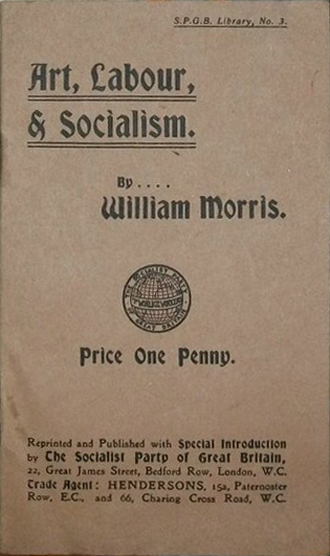
Morris wrote a number of essays and gave lectures on Art and Socialism. Our pamphlet No. 3 Art, Labour & Socialism was a clear statement on the subject and it is possible that before long we may republish it, it having been out of print for many years now.
Ted Kersley

William Morris: Art for Everyone (1961)

A quote from the May 1961 issue of the Socialist Standard

Unless something or other is done to give all men some pleasure for the eyes and rest for the mind in the aspect of their own and their neighbours’ houses, until the contrast is less disgraceful between the fields where beasts live and the streets where men live, I suppose the practice of the arts must be mainly kept in the hands of a few highly cultivated men, who can go often to beautiful places, whose education enables them, in the contemplation of the past glories of the world, to shut out from their view the everyday squalors that most men move in. Sirs, I believe that art has such sympathy with cheerful freedom, openheartedness and reality, so much she sickens under selfishness and luxury, that she will not live thus isolated and exclusive. I will go further than this and say that on such terms I do not wish her to live. I protest that it would be a shame to an honest artist to enjoy what he had huddled up to himself of such art, as it would be for a rich man to sit and eat dainty food amongst starving soldiers in a beleagured fort.

I do not want art for a few, any more than education for a few, or freedom for a few.

From "The Lesser Arts," first given as a lecture in 1877, and included in "William Morris —Selected Writings.” (Nonesuch Press.)

What next in Algeria? (1961)

Editorial from the June 1961 issue of the Socialist Standard

The Algerian tragedy continues its melancholy course. Rising to high drama at one moment, it topples over into anti-climax and something often close to farce the next.

We are still too near to the event to know the full story of the “four days” last April. In fact, it is likely that we shall never know, so complex are its ramifications, so inextricably is it caught up in a web of intrigue, treachery, and fanaticism, so overlaid with high-sounding idealism and underlaid with the basest self-seeking.

Regardless of speculation de Gaulle proceeds at full speed to implement the plans he has been working towards ever since he came to power in 1958. The Army has played into his hands, its morale and self-confidence shattered, at least for the moment. The way has been left wide open to the objective he has sworn to achieve before he dies—the "decolonisation” (he uses the word as though he was talking of getting rid of a disease) of France. But he will need to move fast.

Wiser to the ways of the world of modern capitalism and more far-seeing than many of the ruling-class he represents, he sees the march of events and where they are leading. He knows that no Power in the modern world can hold on to its possessions according to the old imperialist traditions of the past. In the three years of his administration almost the whole of the former French empire has been granted independence. Of the former important territories of that empire, only Algeria remains. And, says de Gaulle, with that characteristically withering turn of phrase, devoid alike of delusion and sentiment, "l'Algerie de Papa est morte" — "Daddy's Algeria is dead"!

Daddy’s Algeria may well be dead, but nobody knows what the new one will be like. De Gaulle is staking all on an independent Algeria still within the orbit and influence of French capitalism, as he has successfully achieved with the great majority of the other former French territories. What is supremely important now for the French ruling-class is to retain their control over the Saharan oilfields and the vast deposits of natural gas. not to speak of the mineral wealth they also hope to discover in the future.

That is the hope. But there are many perils and possible pitfalls ahead. Nobody can say what the talks at Evian between the French and the F.L.N. will bring. Nobody knows what the European settlers will do, particularly the fanatics among than — there is already evidence that these latter are prepared to go to any lengths to frustrate de Gaulle’s plans. Nor does anybody have any real idea of what is in the minds of the leaders of the F.L.N.. preoccupied for seven years in fighting a bitter war and now faced with sitting round a conference table. There is still a terrible possibility that the next news to come out of Algeria will be of carnage and devastation as to make even the last seven years of its sufferings only a prelude in comparison.

We know that history, by which we mean in this case the inexorable demands of capitalism, will catch up with Algeria, as it will with East Africa. Angola, and South Africa.

But what a terrible price it will have exacted in human suffering by the time it does so.

Monday, January 15, 2018

Britain and the Common Market (1961)

Editorial from the July 1961 issue of the Socialist Standard

The Common Market has become a burning issue for British capitalism. After being convinced for years that it would fail, the Government has now belatedly realised that it may after all be here to stay. But so late have they left it, and so long have they dithered, that if they are to do something about joining they must do it quickly. Otherwise, it will be impossible for them to jump on the bandwagon at all.

Hence Mr. Macmillan's somewhat panicky efforts to get matters straight with the Commonwealth and his undignified haste to prepare the ground at home.

For it is clear that the issue of whether Britain should go into the Common Market is causing a lot of heart-searching in many quarters. Not only is the Government worried, but industry, the Commonwealth, the Conservative Party, the Labour Party, even the trade unions. And not only worried, but very much divided. Even allowing for the fact that the Labour Party has long abandoned all pretence of being anything but an appendage of capitalism, it is indeed strange, for example, to see Mr. Michael Foot and Viscount Hinchinbrooke lined up against Britain's entry, at the same time as Mr. Shinwell vies with the Daily Express in concern for the Commonwealth. And on the other side, Mr. Woodrow Wyatt, Rev. Donald Soper, and Lord Home certainly make an odd collection!

As far as industry is concerned, to the giants like l.C.I. the whole question is academic. They are going into the Common Market regardless of what decision the British Government may take. Confident of being able to compete on equal terms with the Europeans, the only thing they are afraid of is being left outside. On the other hand, there are many industries and firms that are very much afraid of meeting European competition and who are consequently violently opposed to going in.

The majority of the agricultural interests share this view, worrying whether their system of protection will disappear once the British market is thrown open to efficient Dutch production and the fast rising food surpluses of France. These anxieties are also shared by Commonwealth countries like Australia, Canada, and New Zealand whose agricultural outlets in Britain would be seriously threatened and who have nothing to gain and everything to lose in a unit which is largely self-sufficient in foodstuffs save for those of tropical origin.

These are only some of the conflicting economic interests which the Government is being called upon to resolve. Unfortunately for Mr. Macmillan on this occasion, however, the usual policy of British Governments when conflicting interests are at loggerheads to make a show of compromise that is really only a temporary camouflage for the dominant capitalist interest to have its way in the long run is a non-starter since the Common Market is itself in no mood for compromises. To them, it is either in or out. For the British Government, then, the long prevarication will soon have to end—a decision must be made one way or the other.

Strong rumour has it that the decision has already been made and that British capitalism is in. But this may be only part of Mr. Macmillan's softening-up tactics and the opposition may be stronger than he thinks. Whatever the outcome, it will throw interesting light on the political strengths of the various sectional interests in present-day British capitalism.

But much more interesting will it be to watch how the economic forces of capitalism, driving society’s development towards ever larger units, will eventually win the day—whatever the decision.

Ye Daughters of Israel Weep (1961)

From the August 1961 issue of the Socialist Standard
The State of Israel, now thirteen years old, has, by Jewish custom, come of age. It is timely, therefore, to attempt an assessment
(i) The Zionist Movement
The assumption underlying the Zionist movement was that to establish a "national home for the Jewish people” was the only way to end their age-old persecution, especially under the yoke of the Tsars. This closely mirrored the aspirations of other thwarted nationalities such as the Poles, the Czechs, the Finns and the like. There were, of course, workers who were taken up with this cause but very few of them prior to the first world-war. Cramped into a narrow strip of the vast Russian Empire, the Jewish millions lived almost entirely in the towns, where they formed the majority of the population. They were skilled and unskilled workers; some on the land, more in the factories and workshops; they were porters and cart drivers. Only a minority were merchants of any substance, bankers and factory owners. In this background it was the idea of Anarchism and Social-Democracy that gained the greatest acceptance. The Jewish Labour League, the Bund, which was affiliated to the Russian Social-Democratic Labour Party, had as its purpose Jewish cultural autonomy within a Social-Democratic Russia. They saw that on the principle of divide and rule the Tsars had actually fostered anti-semitism. They were convinced that the Jewish problem was a by-product of the private property system and would end with the end of that system. They did not think in terms of a return, to “the promised land” as a solution to their problems. Neither did the Anarchists.

Emigration to the freer and relatively more prosperous West, the Russian Revolution, and the rise of Nazism, affected Jewish opinion overwhelmingly. In the new conditions Anarchism died a natural death. Faith in a Social-Democratically reformed Capitalism withered in the face of the anti-semitic mass hysteria that was being harnessed to the needs of the German ruling-class. Faith in Bolshevism, on the part of others, was likewise to vanish when the Soviet reality became clear. The end of the second world-war saw Zionism reaping a harvest of disillusionment and despair.

Out of the ruins of war, emerged the Jewish survivors. Despite the brutally callous turning back of their ships by the British Labour Government, many joined with the pioneers to oust the British and set up the Jewish State, under a Labour Government strangely enough. Few who had witnessed the holocaust of the Jews could fail to be moved by the determination of the survivors to have a home of their own, to live in a land where they could walk with heads held high, where they could till the soil and make the desert bloom and little by little heal the wounds of two thousand years. But national ideals and political reality have never been compatible and never can be. True to form, the territorial demands of one set of Nationalists were diametrically opposed to the demands of the other set. The “solution” of the Jewish problem turned out to be its transference from Europe to the Middle-East.

(2) The Arab States
The Arabs, too, had national aspirations that had been thwarted by Turkish domination in the first instance and by an Anglo-French carve-up of the region subsequent to that. The Arabs were divided into several different states each of which was subservient to external forces. They were puppet states, mandates and protectorates. In order to weaken Germany’s ally Turkey, Britain had deliberately cultivated an Arab sense of national identity during the 1914-18 war. Once victory was won, this policy no longer served British Capitalism and it was dropped. Henceforth, playing off one oil producer against another, one tribal dynasty or one community against another, paid better dividends. Once created, however, Arab nationalism filled a need and the Pan-Arab capitalist class to be saw to it that not only did it survive but that it flourished. In Palestine, where a majority of Arabs had lived for centuries, the territorial demands of Jewish and Arab nationalism proved utterly irreconcilable. When the clash came the Zionists, who were then militarily superior to the combined Arab armies, gained a victory sufficient to set up a state, but with less territory than had traditionally been demanded. The price, in human terms, entailed an entire new exodus.” A million Arab refugees subsist to this day on the verge of starvation, caged like animals, within sight of Israel’s borders. They refuse to move. They, too, insist on going home.

The popular insistence on an eventual "ingathering of the exiles” does not, in fact, explain why the Arab governments have left the refugees idly by the frontier, breeding and hating. With the calculating cynicism normal to ruling classes, they are seen as an invaluable political weapon.

Over the past thirteen years the situation within the Arab states surrounding Israel has not remained static. The Zionist claim that hostility towards Israel was fostered by corrupt feudal potentates out of fear that their peoples would demand similar living standards and civil rights obviously has some truth in it. But this is less the case now than hitherto. The United Arab Republic and Iraq have both undergone substantial changes in social organisation. Many of the kings who had been propped up by foreign and feudal interests have been swept away. A rigorous process of national capitalist development is taking place. Today, a key reason for continued hostility to Israel is an external one. In facing the pressures of both western and eastern imperialism, a show of Arab unity is of no mean value in the bargaining chamber of the United Nations. Conflicting as their economic interests are, hostility to Israel presents the one issue on which they can all agree. Had Israel not existed, the Arab states would have had to invent it!

It would be a mistake, however, to forget the real possibility of Israeli expansion which would inevitably be at the expense of the Arab states. If increased to any extent, the pressure on land and resources is bound to become explosive if Russia was to permit the emigration of any number of her two million Jews, for example. Meanwhile, Israel’s governments being subject to the wishes of an increasingly nationalistic electorate, cannot afford to ignore their expansionist demands.

In the sort of way that the Russian Revolution was able to command a great deal of passionate though misplaced devotion, so Israel could never have been established without tragic sacrifices and self-less idealism on the part of many of its people. But as in all cases where it has been argued that the end justified the means, it is the very idealists who are most bitterly disappointed by the outcome. Self-styled Socialists, whose working-class solidarity was suspended “for the duration” in order to slaughter their Arab neighbours, are shocked that what was begun as a tactical measure has become a permanency. Militarism, even trigger-happiness at times, has come to stay. A flag-wagging mentality, convinced that one Israeli is worth any three Arabs, is easier to pound out of the propaganda machine than the former subtle distinctions between reactionary Arab rulers and misguided soldiers who were but pawns in the game. Strikers have learnt that Jewish truncheons wielded by Jewish policemen feel just as unpleasant. They even have a Jewish problem in Israel, what with pietists who deny the authority of a man-made Jewish state which profanes the language of the Bible by every day usage, and the religious discrimination against Indian Jews as regards marriage rights.

(3) Communal Farms
For the Zionist who had ideals, the bitterest pill of all is the changing rôle of the Kibbutz. The pioneers regarded these communal farms, this utopian Socialism of a kind, as the pattern of the future nation. Just as the American “wild- west” was penetrated and peopled in the first instance by dissenting communities of one kind or another; just as they imagined they were building Christianity or Communism all by themselves, so the Kibbutznik has extended and strengthened the national horizon to see, on arrival, the growth of a way of life the very antithesis of all that he stood for. Who but ascetics or visionaries could have built a city at Salt Lake or planted a forest in the Negev? Yet they pave the way for class divided capitalism of one kind or another.

If the heirs to the mighty Russian Revolution were to be forced by the exigencies of their historic and economic situation along paths not of their choosing, how much less realistic were the hopes of those who saw in a “national home" an end to struggle and to strife? Israel’s international position, a tiny state among the giants, illustrates their dilemma. What Jew would have believed thirteen years ago that Israel-made machine guns would be used by the German Army? Did the Zionist, on the morrow of statehood, think it possible that his country’s subsequent dependence upon French aid and arms would make him victim of the same moral degeneration which France itself has suffered under the weight of iniquity in Algeria? Which of their Labourites could have foretold an alliance with the British Tory Government over Suez?

(4) The Eichmann Trial
And now in this year of reckoning, year thirteen, Eichmann, demoniac scourge of the Jews stands, as Torquemada never did, in the dock at Jerusalem before the judges of Israel. Underlying the whole structure of bourgeois law is the maxim that “might is right.” But if we were to accept its claim to dispense a timeless “justice” to all men it would be hard to deny the monumental appropriateness of the exterminator’s trial before his surviving victims. However, we Socialists spread throughout the world as we are, hold that for justice to be done the entire social system would have to stand trial and be found guilty. But what can we say of Capitalist morality which sanctifies the annihilation of Hiroshima or approves the crushing of Budapest but heaps all wrath on the head of one of its creations? Courts of law are not competent to judge the barbarity of our present social system. They are there to condemn those who lose the struggles that go on within it. Then all sense of common guilt, all sense of common responsibility that weighs so heavy on the conscience of man in Capitalist society, can be relievingly focused on some now helpless perversion of a man.

As to the why and wherefore of this latest show-piece of the prevailing quality of moral standards, we strongly suspect an element of political manoeuvre. Ben-Gurion faces other contenders for power as the recent “Lavon Affair’’ showed. With French backing he was able to take up an intransigent attitude towards his enemies. Despite General de Gaulle’s assurances to the contrary at their recent meeting, once France has made peace with Algeria her enthusiasm for Israel is likely to wane. Friendship with an oil producing Arab Algeria will have far greater rewards to offer. With diplomatic relations re-established with Nasser, Israel cannot expect supplies of arms from Britain. Nor does Kennedy have the slightest intention of jeopardising the interests of the class he represents for the sake of Israel, however much it grieves the New York Jewish voters. His aim is to woo the “uncommitted” nations, most of which side with the Arabs.

An increasing fear of military isolation in a situation where Russian training and arms have immensely strengthened the Arab armies has resulted in pressure from some Israeli quarters for some sort of compromise with the Arabs. If Ben-Gurion, by staging a show-trial which by its ghoulish racital of the most hideous details of Nazi crime, can raise a wave of nationalistic frenzy, he will ride it to victory at the polls.

The evidence is with us. Zionism has failed to achieve its objectives. Inevitably so. So long as there are Jewish workers attached in any numbers to the divisive and anti-working-class national idea, so long as their (and our) Arab brothers believe likewise, so long will strife ensue, so long will their respective ruling classes remain in the seat of power. The Jewish problem remains with us. It is an Iaspect of the working-class problem which has no solution outside of world-wide Socialism.
Eddie Grant

Party Pars. (1908)

Party News from the September 1908 issue of the Socialist Standard

Every opportunity should be taken to push the sale of the Party Organ, with a view not only to present needs but to enlargement. The paper is worth special attention—see that it gets it.

#    #    #    #

Rumours of certain alterations in the police regulations affecting street collections have brought the E.C. into communication with Scotland Yard. Will branches report at once to centre any steps taken by the authorities locally ?

#    #    #    #

The Tariff Reformers, debating in haste, are now repenting at leisure. Bat the discouraging experiences of their champions at Battersea and Paddington hardly justify the action of the Watford Tariff Reformers against our propaganda in that town. There our comrades have had to deal with no argument or intelligent questioning but with rowdyism organised to smash meetings in the Market Place. This, however, has only had the effect of rousing local opinion against the tactics of hooliganism, and far larger meetings are being now held than might otherwise have been the case. Watford, with tho assistance of London comrades, have kept their end up well.

#    #    #    #

A verbatim report of the debate between Comrade Fitzgerald and Mr. Lawler Wilson, of the Tariff Reform League, which took place some weeks ago at the Battersea Town Hall, will be published in pamphlet form as soon as funds permit. This will be an excellent addition to our propagandist literature. A pamphlet on Religion and Socialism is projected, and only waits upon the production of the harmless, necessary money. The third of the Kautsky pamphlets is nearing completion, and will appear directly it has run its length through these columns.

#    #    #    #

The Western Clarion (Vancouver) has reprinted in their entirety the two articles “Past, Present, and Future” and “The Old Age Pension Snare,” by Comrade A. E. Jacomb, which appeared in recent numbers of THE SOCIALIST STANDARD. The Western Clarion is apparently several miles in front of the London Clarion in power of appreciation of a good thing. The Party Organ may fairly claim to be amongst the most quoted journals; notwithstanding this the pries will remain the same.

#    #    #    #

Manchester are still making their presence felt, as is shown by the local Press reports, often running to a full column length. We are assured that we may look for another branch in the district shortly. Good! But why don’t these fellows die instead of falsifying the S.D.P. prophecy so?

#    #    #    #

At the great August “Labour” demonstration in Burnley, John Tamlyn (who spoke for the Party) after refusing the cool request of Dan Irving, S.D.P., chairman of a Demonstration platform, that the S.P.G.B. stand be shifted, went on to show (says the local Express and Advertiser) how the S.D.P. went in “for the palliation of Capitalism,” and why it was “nothing more than a mere reform organisation.” Good literature sales were effected.

#    #    #    #

In the debate at Bury between Comrade Fitzgerald and McDavis (S.L.P.) the latter was compelled to the significant admission that the S.L.P. was a political party out to capture political power, in order to get control of the fighting forces to protect the Industrial Unionists working in mills and factories. If this is the official attitude of the S.LP., a lot of literature has been wasted in explaining that it isn’t.

#    #    #    #

Resolutions for the Agenda of the Party meeting upon Municipal Action to be held shortly are due by Sept 28th. Branches please note.

#    #    #    #

F. McCarthy, in resigning from the Ardwick S.D.P. and applying for membership of our Manchester Branch writes that lie has come to the conclusion that the reformist attitude of the S.D.P. is absolutely wrong. The last straw in his case was “the treacherous action of Herbert Burrows.”