Saturday, April 9, 2022

The cancelled debate with Mr. Bradley (1940)

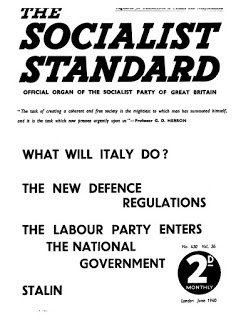
Party News from the June 1940 issue of the Socialist Standard

A large audience filled Conway Hall on May 19th to hear a debate between Comrade Rubin, for the S.P.G.B., and Mr. G. Bradley, for the Fourth International. Unfortunately, the debate did not take place, owing to the non-appearance of Mr. Bradley. Without any preliminary warning a letter was received from Mr. Bradley at the Hall itself, at the time the debate was to have taken place, saying that he was prevented from attending owing to illness.

As the debate was off, Comrade Rubin gave an address on the question at issue (“Which Way to Socialism — Democracy or Insurrection?”), which was greatly appreciated by the audience.


To Readers of 
“The Socialist Standard” (1940)

Party News from the June 1940 issue of the Socialist Standard

Hitherto war-time conditions have not placed as many obstacles in the way of producing and distributing The Socialist Standard as had been expected. Now, however, difficulties are rapidly increasing. Paper is more costly and the shortage has already made it impossible to print as many copies as could have been sold. Later on it is probable that the size will have to be reduced.

At the moment, however, a more pressing problem is the difficulty of selling The Socialist Standard at meetings in streets and parks. The number of meetings has been reduced, and, for various reasons arising out of war-time conditions and restrictions, opportunities for selling The Socialist Standard in the streets may be drastically curtailed.

We therefore ask readers who have been in the habit of buying The Socialist Standard at meetings to cease relying on this and take out a subscription for six months or a year.

All that is necessary is to send a postal order to the Literature Secretary, at 42, Great Dover Street, S.E.l.

The cost has been increased owing to the recent raising of the postage rates, but it will still cost you only 1s. 6d. for six months, or 3s. for twelve months.

Send in your order now if you want to be sure of receiving your The Socialist Standard regularly each month.

Please cross your postal orders.

ORDER YOUR “SOCIALIST STANDARD”
Your retail newsagent will get The Socialist Standard for you from his wholesaler.

You can have it sent by post each month by taking out a subscription: 1s. 6d. for six months or 3s. for twelve months (post free). Send your postal order (crossed) to Literature Secretary, 42, Great Dover Street, London, S.E.l.

Newsagents in Central London who Stock "The Socialist Standard”
Holloways, Fleet Street, E.C.l.
Colletts, 66, Charing Cross Road, W.C.2. 
I.L.P. Bookshop, 35, St. Bride’s Street, E.C.4. 
Marble Arch Kiosk, Hyde Park, W.l.

The Lie (1940)

From the June 1940 issue of the Socialist Standard

Lying , as an art, flourishes in modern civilisation. The lie which is the main concern of Socialists, is the one which is persistently repeated by the Communist Party and its crude satellites, namely, that SOCIALISM exists in Russia, The average worker, not understanding the principles of Socialism, is misled by a cunning, though simple, device. The Communist Party propaganda consists of playing upon the petty grievances of the workers in demagogic fashion and the frequent use of the words “Socialist Russia.” Never will they lecture on “Socialism,” because an understanding of Socialism would enable the workers to KNOW themselves whether or not Russia was Socialist. This, the Communist Party avoid at all costs, and is the KEY to Socialist Party work. The question arises WHY ?—and the answer is clear. Russia is a land of STATE CAPITALISM with a totalitarian dictatorship. Being a capitalist power, she is faced with the competition for markets by other capitalist powers. This makes her plan out a method of obtaining allies, so she subsidises her agents abroad. It would be impossible to obtain support on the ground of Nationalism (this is only useful if you are a SMALL nation) so Russia is called Socialist. However bewildered the workers may be as to what Socialism IS, they are not consciously ANTI-Socialist, and the Bolshevists strike a good note by playing on this sentiment. There are, however, Socialists who DO understand the meaning of Socialism and who point out that the existence of WAGES—PRICES—PROFITS, plus group dictatorship, is a denial of Socialism and a feature of capitalism. The art of lying now is seen. In order to justify the CAPITALISM masquerading as “Socialism,” Moscow INVENTS a difference and says “Socialism” is a stage on the road to “Communism,” and instructs its followers to popularise this lie. Men who, for twenty years and more, have never shown any difference between the two terms, now deliberately pass on this perversion and lie to the innocent workers. Just as the Nazis pass on the lie of “National Socialism” to cover up their capitalism, so the Bolshevists spread their lie of “Socialism” in Russia to cover up their form of capitalism. Two of a kind. This lie must be exposed and can only be done so by a party having Socialism as its goal, hence the need for the Socialist Party.
Lew.

The Great Nazi Fraud (1940)

From the June 1940 issue of the Socialist Standard

Seven years ago the world was offered a statement to the effect that a revolution had taken place in Germany. A revolution, which being peculiarly German, was unique in history. By persistent propaganda and the constant shouting of slogans, the Nazis almost converted the world to the belief that they had done something original. Well! where is this revolution ? When we talk of the French revolution we mean Feudalism transformed into Capitalism. When we speak of the Industrial revolution we mean the transformation from handicraft, etc., to steam and machine industry. Whenever we speak of revolution throughout history we can always show what WAS and then what IS. In this mysterious Nazi “revolution” it seems as we say in Yorkshire “You can’t tell t’other from which.” The more it changes, the more it remains the same, as the wanderer in an old melodrama said on his return— “same old street, same old house, same old picture on the wall, my God! how things have changed.” Let us ask a few questions. Was it a revolution against foreign domination ? Long before the Nazis came to power all foreign troops had left Germany. Was it against a despotism which denied the Nazis the franchise ? The Nazis gained a majority at the election. Was it a majority, enslaved by a group, which seized office ? Hitler went to Hindenburg and asked for the “power of Mussolini” and when refused, said he could wait, being much younger. After the State power had been HANDED OVER to him he proclaimed his “revolution.” The word is merely used as a cover for savage brutality and plundering gangsterism. The Chicago brand was less astute. Their German counterpart knew the value of POLITICAL POWER. No wonder Al Capone exclaimed “What a racket.” He was an expert.

It is quite true that the property of some capitalists has been confiscated— only to be given to other capitalists or Nazi supporters.

CAPITALISM, however, has not been abolished, merely re-arranged. It may have been a revelation, but never a REVOLUTION. The means of production and distribution are still in capitalist hands. The workers still sell their labour-power for wages. The coloured shirt and salutes were taken from Italy, the “four years plan” was borrowed from Russia, the persecution of Jews was an old stunt in Russia, Roumania, Poland, Spain, etc., the mania for a “Saviour Leader” has whiskers on—Moses, Genghis Khan, Aladdin and his lamp—their name is legion. No ! not until the world’s workers have established SOCIALISM, can we say there has been a REVOLUTION in Germany.
Lew.

The Miners’ Strike (1972)

From the February 1972 issue of the Socialist Standard

The National Coal Board was set up in 1947 to run the collieries the post-war Labour government bought from the old owners. Miners up and down the country celebrated vesting day, 1 January 1947, as the dawn of a new era; traditional Labour songs were sung and placards displayed claiming that the mines now belonged to the people. Few miners realised that nationalisation was merely an administrative change aimed at making the provision of coal for British capitalist industry more efficient (even if it did at the same time provide a framework within which real improvements in miners’ working conditions could be, and were, made).

The NCB’s task of supplying coal as cheaply as possible inevitably brought it into conflict with the miners whose wages were a large part of the costs of mining coal. Collective bargaining, strikes and even the prosecution of strikers continued. Lord Robens, who was NCB Chairman until last August, used to describe the Coal Board as “state capitalism”. He chose the right term. Despite nationalisation the collieries continued to be used to exploit the wage-labour of the miners. That the NCB does not make profits (does not extract surplus value from its employees) is a myth. It does, and always has done, even if this hasn’t always showed up in its own accounts.

The profits from the unpaid labour of the miners still found its way into the pockets of the capitalist class. First, coal was for many years sold to industry below its value so allowing private capitalist firms to make bigger profits. Second, the NCB has had to pay interest on the bonds given the old owners as compensation (for years of mercilessly exploiting the miners) or purchased by new investors. Since 1956 the NCB has borrowed money direct from the government so its interest payments—the fruits of course of the miners’ toil—now go directly into the pockets of the capitalists who own the National Debt.

Anticipating nationalisation the miners’ unions decided in 1945 to reorganise themselves to face the new employer. The Miners Federation of Great Britain, and its constituent unions, became the National Union of Mineworkers, and its “Areas”. Despite the name not all these Areas are geographical; some are trade or occupational catering for some craftsmen, clerks, foremen, etc. The NUM is supposed to be a national industrial union but still retains many of the features of a federation. The Areas, which until the Industrial Relations Act were registered trade unions in their own right, enjoy considerable autonomy. In fact the miner’s first loyalty is to his Area, not the national union, which often hinders the effectiveness of the NUM as a national industrial union. Militant and moderate Areas alike are equally guilty of sectionalism here.

1967 was a turning point in the mining industry. It saw the adoption of the Labour government’s fuel policy; the introduction of the National Power Loading Agreement (NPLA); and the beginning of moves to force the union’s national executive to take a more militant line on wages.

The Labour Party, including the NUM, had long called for a National Fuel Plan. When it came it can hardly have been what the miners expected for it provided for a drastic cut in coal production and a massive pit closure programme. Actually, as has now become evident—and this well shows that capitalist production can not in fact be planned—this policy was based on the temporarily low price of oil at the time it was drawn up. Since then oil prices have risen making coal more competitive so that the pit closure programme has been stopped or, as will probably be the case, delayed.

In the four years from April 1965 to April 1969 (all years of Labour government) 204 pits were closed. This caused considerable suffering and unrest in the coalfields and has helped prepare the ordinary miner for the present strike.

The NPLA was introduced to take account of the replacement of hand hewing by machine cutting. Previously colliers had been paid on a piecework system. Under the NPLA they switched to timework. Undoubtedly this meant reductions in pits where geological conditions were easier, even though the union’s leaders had a point when they said it was unfair that those in the older, and so harder-to-mine, coalfields should be penalised because of conditions beyond their control.

Up until 1967 the annual wages settlement with the NCB was put for approval to a vote of the Areas (with block voting in accordance with the Areas’ numerical size). But in 1968 the moderate majority on the union’s executive felt than an Area vote might turn down the settlement. So they by-passed Areas and put it straight to an individual vote, which accepted the settlement since the mass of any union’s membership—as the executive’s moderate majority well knew—tend to be moderate in the sense of thinking that a bird in the hand is worth two in the bush.

In 1969 such was the pressure from militants, both in the Areas and on the executive, that the executive had to refer the settlement first to a special conference. The conference (with a voting system similar to an Area vote) did in fact reject the settlement, but an individual ballot again voted for a bird in the hand.
Not to be outmanoeuvred a third time the militant South Wales Area put down a resolution for the 1970 conference at the Isle of Man calling for a £5 a week increase for all grades and adding that a strike should be called if this was not conceded by the Coal Board. South Wales refused to allow their resolution to be “composited” (i.e. emasculated by a moderate-dominated business committee) and, despite the opposition of the executive, it was carried by a narrow majority.

There are three main grades in mining: the men doing ordinary jobs on the surface; the men doing ordinary jobs underground away from the coal face; and the men working at the face with machines, or “power-loaders”. After the 1970 conference the NUM was committed to calling a strike ballot if the Board did not offer to increase the wages of these three grades to £20, £22 and £30 respectively. The Board offered increases of £2.50. The resulting strike ballot gave 55½ percent in favour, well below the then required two-thirds. So the executive had no constitutional authority (nor, most of them, any desire) to call a strike. The Coal Board offered another 50p which was accepted by a majority of the executive and by another individual ballot.

At the 1971 conference the two-thirds rule was replaced by a 55 per cent rule and a resolution (a composite one at that!) calling for £26, £28 and £35 and a strike ballot “in the event of an unsatisfactory response” was carried unanimously. Not surprisingly the Coal Board’s offer of a mere £1.75 for most grades was unsatisfactory, not to say insulting. A special conference unanimously called for the strike ballot and an immediate ban on overtime. This time 59 per cent voted for the strike. A month’s notice to strike ( to comply with the Industrial Relations Act, and to get over the Christmas holiday period) from midnight on 8 January was given. The Board offered an extra 15p (yes, 15p!) a week—an offer so derisory as to suggest that the Board either wanted a strike or thought one inevitable (they may, for instance, believe that one big strike now will end the unofficial strikes which have become an annual event since 1968. Or they may want an excuse to resume the pit closure programme). Later they offered a few more pennies for some grades.

The strike ballot revealed that the largest Area, Yorkshire, with a 75 per cent strike vote, is now making the running in the NUM (the strike vote in South Wales and Scotland slumped drastically, but this was because under the NPLA powerloaders there were due for an increase from 31 December of £2.77½ a week—on top of the £1.90 the Board had offered, and so a very attractive bird in the hand). Yorkshire in fact supplied the figures of £26, £28 and £35 for what the union thinks the basic wage for the three grades should be.

A comment on these figures is in order since the Board has made such play of them. Since the three grades are now paid £18, £19 and £30 they represent increases of 44, 47 and 17 per cent respectively, or an increase of over 40 per cent on the Coal Board’s wages bill. But the miners are not really striking for an increase of this order. Their executive would have considered (and will consider) settling for much less. The strike is to get the Coal Board to offer more than the £1.90 they have—which to a power-loader is only 6.3 per cent, far less than the rise in the cost of living between November 1970 and November 1971.

Of course the figures are unrealistic in the sense that the union has no chance of obtaining them given its present bargaining position, but they are by no means unreasonable. After all, most people would demand a lot more than £28 a week before they would agree to go and work down a dirty, dusty, dangerous hole in the ground. Besides, the following statistics speak for themselves:

During the same period the cost of living (the index of retail prices) increased 27 per cent (These figures can all be checked in the official Department of Employment Gazette).

Over the past four years, in other words, the standard of living of the average miner had actually declined. It has been estimated that in order to restore the miners to the position they enjoyed in the wages league in 1967 (what might perhaps be called their relative standard of living) an increase in basic wages of at least £5 a week would be needed. The miners will be lucky to get half that, even by striking.

The whole sad episode of the miners’ wages illustrates the limitations of trade union action, including strikes. Trade unions can only work with labour market trends. Miners have slipped down the wages league for the simple reason that coal-mining is a relatively unprofitable and so declining industry, a fact their union cannot alter (indeed, some would argue that this strike is an expression of the miners frustration at this fact-of-capitalist-life). This does not mean that trade unions are useless. Far from it. Without their union, for all its previous moderation, the miners would have fared even more badly.

So the miners are striking to maintain and re-establish their standard of living. They should have the support of all other workers, despite the inconvenience the strike will cause some of them. Strikes inevitably cause inconvenience, not least to the strikers (and, remember, thanks to recent government legislation, the miners and the families will be existing below the official poverty line for the duration of the strike), because they are battles in the continuous class war between all workers and all capitalists over the control of the means of production. Resentment should not be directed against the strikers, or their union, or their union’s leaders, or even against the members of the Coal Board, but against the system which compels human beings to have to struggle like this just to get the basic necessities of life.
Adam Buick

Blogger's Note:
In the actual published Socialist Standard, the article was signed off as written by the mysterious initials of  'B.K.'. 'B. K.' was Adam Buick, writing under a temporary pen-name because of . . .  well, you know.

Why must the rent go up (1972)

From the February 1972 issue of the Socialist Standard

House-property is, proverbially, the best investment. The proverb in fact dates back to before the first world war, when over 90 per cent of the households in Britain were rented from private landlords. The legislation for rents at present being framed by the government has already given it some fresh vigour. A house bought as investment—that is, for income from unfurnished letting—may now cost half as much again as a year ago, in a rising market created by anticipation of the new Act.

Today about 20 per cent of houses and 30 per cent of households are privately rented (the figures given by Robert Millar in The New Classes, 1966, and D. V. Donnison in The Government of Housing, 1967, are 21 per cent and 28 per cent respectively). The difference is accounted for almost entirely by furnished letting. Nearly 50 per cent of houses are owner-occupied, and the remainder—approximately a third of the total—are council-owned dwellings. The only other mode of tenure, by housing associations, is statistically insignificant : less than 1 per cent.

The proportions vary, of course, from place to place. The 1965 Report of the Committee on Housing in Greater London informs us that while Kensington has only 5 per cent council tenants in its population, Dagenham has 67 per cent. Nearly half of Newcastle lives in council houses. Under Labour governments since 1945 local-authority building has been favoured over building for sale, while the Tory emphasis has been the opposite. In rural areas council building is small-scale, concerned chiefly with housing the elderly whose working lives and therefore their tenure of tied farm cottages are over. Over Britain as a whole, however, more than half the population are tenants, and have to pay the rent.

All private tenancies except those of furnished accommodation are governed by the Rent Acts of 1957 and 1965, which lay down control of rents and security of tenure. “Furnished” lettings have only minimal sketchy controls. The tenant—usually of a flat or rooms—may be evicted at two months’ notice. He may appeal to a local Tribunal over his rent, and be given six months’ security while he does so; but legal intervention ends there. This is the only form of letting in which a market exists. There are special agencies for directing tenants to furnished flats, the normal fee being one week’s rent.

The 1957 Act solidified the processes begun by the Rent and Mortgage Interest Act of 1915 (which marked, in fact, the beginning of the end of private building for letting). It fixed rents at the figures being paid by tenants in 1956, but with a “repairs increase”. The aim was to arrest the deterioration of older houses with rents kept low by the previous legislation. Landlords had protested since the first world war that rent restriction made it impossible to maintain houses decently from income. From the governmental point of view, slums were being created by the failure of proper maintenance; to allow two-fifths extra on rents was at least a palliative.

The next few years opened disparities, however. Under the 1957 Act, rent control ceased when a house became vacant: the owner could charge what he liked to the next tenant. This itself was an inducement to “Rachmanism”, the harrassing of statutory tenants to leave so as to make way for exorbitant rents. More generally, as wages and prices rose in the nineteen-sixties a wide gap appeared between the “controlled” and the “decontrolled” rent. To give examples, a London suburban house built before 1914, in reasonably good condition but lacking modern amenities, might have been let before 1956 at 19s.6d a week; and the increase permitted by the 1957 Act took this to 27s.6d. Should the tenant have died or moved away in, say, 1963 the house immediately became available for letting at £5 or more.

The 1965 Act was to some extent a consequence of the newspaper publicity over Peter Rachman’s activities. It extended controlled tenants’ security of tenure to the decontrolled, who were now to be known as “regulated”. Local Rent Officers were set up, to consider applications from tenants or landlords of these properties to have “fair rents” settled-upon and registered. These are for three-year terms, and supply-and-demand is excluded as a factor in determining rent. To return to the example of the last paragraph, the “fair rent” of the same house under the 1965 Act would be perhaps £3.15s. a week.

Theoretically, the 1965 Rent Act was a tenants’ charter. In practice, more landlords than tenants invoked it. “Decontrolling” after 1957 had been so new a phenomenon that many landlords has not fully grasped the opportunity offered, and had been cautious about asking rents hugely disparate from “controlled” figures. Controlled rents became a mounting grievance amongst landlords, however: houses paying not much more than £1 a week, when one might rent a garage for not much less !

The governmental problem has been to try to maintain the stock of habitable houses. The improvement grants system has had hardly any effect on landlord-and-tenant housing. A landlord may increase rent by, annually, one-eighth of his own expenditure on recognised improvements. If he received a grant of £400 (the maximum standard grant under the pre-1969 system) and spent £400 himself, the extra return would be less than £1 a week. The revision of the system under the 1969 Act offered the special inducement that a “controlled” house brought thoroughly up to standard would thereby pass into the “regulated” class. So far, it has remained unattractive to most landlords.

The economics are simple. A house standing empty represents a realisable value of, say, £4,500. The installation of a tenant at £4 a week at once reduces the capital value to about £1,500. The return on the capital is, therefore, roughly 7½ per cent. If repairs and insurance are deducted, the figure comes down to about 6 per cent. A fairly substantial outlay on improvements raises the capital value and the income; but within the present rent structure the increases are not enough to make the expenditure worth the property-investor’s while.

Moreover, tenants themselves are frequently opposed to improvements which would raise their rent: a sad demonstration of the chronic poverty-problem of the working class. Before 1969, a landlord could not modernise a house without the tenants agreement. Now, if he is determined about it, he can go to the County Court and apply for an order that the tenant let work be done and pay the consequent increase. In every city there are large areas of near-slum dwellings which, much as the reformers inveigh against them, are sought after and tolerated by the occupants because they are the only cheap housing available.

From the landlords’ point of view, cheap housing is either a safe but poor investment, or one made adequate from neglect permitted by the tenants’ poverty. Since the Rent Acts, the most profitable form of letting has been “furnished”. Most often it means the division of houses into rooms and flatlets, producing multiple rents from single properties; it means tenants can be got rid of, and in any case tend to be short-term; and, besides higher rents, there are means of additional profit from gas and electric meters that arc permitted by law. The obvious effect of this situation has been to reduce further the stock of unfurnished housing available for letting.

The new legislation is therefore a Bill to increase rents—in this case, the controlled-property rents which have been static since 1957. They are to be put on the same basis as regulated rents, which means something over a million households will have proportionately far greater additions to pay each week than were permitted in 1957. As an estimate from the kinds of figures now laid down as “fair rents” for regulated tenancies, the increase is likely to be 150 per cent above the present “controlled” amounts—as against the 1957 increment of 40 per cent.

Conscious of the economic consequences of so heavy an increase in the cost of living, the government proposes that it be staggered over a two-year period. It is proposed, too, that the rent-subsidy scheme become general so that poorer-paid workers can have some or all of the increase made up. This, posing as a paternalistic scheme to help the needy, is a strategy to try to keep wages in check. The principle, which was first applied socially in Family Allowances, is to see that extra money to meet extra expenses is paid only in the cases where the expenses exist. Why, the reasoning runs, should an army of workers claim more pay when the ones to whose need it refers can be selected?

One interesting aspect of the proposed Bill is that it intends taking local-authority houses into the rent structure. Until now, councils have been outside the Rent Acts. They have been able to levy increases according to the needs of their housing accounts, to impose their own conditions of tenancy, to serve notice on tenants without showing reason. Their incorporation in a general system with private landlords, to whom these privileges have been an irritation, may well mean their becoming the pace- and precedent-setters in applications for rent increases in the future.

Why do half the people in this country have to pay rent for their homes? It is an ignominy that is taken for granted: a weekly fee for living in someone else’s house, with the assurance of being able to stay a matter of the temper of parliamentary Acts. The answer to the question is that under capitalism you get only what you can buy, and half the population can buy only the use of a house week by week. Not that the alternative, owner-occupation, gives exemption from the problem. For most people it means crippling mortgage repayments for the greater part of their working lives, and the same shadow always there: if you can’t pay, you’re out.

The proposed legislation is another in the endless series of attempts to solve particular problems in the complex of the housing problem. It seeks to extend the lives of older houses by making investment in them more profitable, and so forestall the need for expensive clearance schemes and the addition to housing lists of still more people in sub-standard accommodation. The fact is that the majority of the working class have never been satisfactorily housed since capitalism began. Even today, many are not housed at all — living in hostels, on muddy caravan sites, with relatives — and, in appalling cases which come to light, in places like the back seats of cars.

In 1872 Engels wrote, in The Housing Question: “But one thing is certain: there are already in existence sufficient buildings for dwellings in the big towns to remedy immediately any real ‘housing shortage’, given rational utilization of them.” This is at least equally true today. Two or three years ago a Housing Minister was slated on all sides for remarking that the number of empty houses in Britain was about the same as the number of housing applicants. Of course it was fatuous—the implication that the two could tidily be brought together, in society as it is. The more important implication, however, is that capitalism’s sovereign remedy of continually building more houses is no remedy at all.

Given houses built to the cheapest standard, whose maintenance is a matter of their profitability as investments, there is no end to the housing problem. As in Engels' day, the clearance and replacement of run-down houses is their being “. . . not abolished; they are merely shifted elsewhere! The same economic necessity which produced them in the first place, produces them in the next place also.” (Today, for instance, many councils use their “old”—i.e. pre-1939—housing estates for families deemed unsuitable for better new accommodation.) Thus, legislation like that of 1957 and its present continuation is inescapable under capitalism, but it cannot answer the problem inherent in the way society is organised.

Bricks and mortar are of vital importance to human beings. Housing is involved in innumerable social and personal questions: health, sex, the facilities for both privacy and sociability, education, recreation. Nor is bad or good housing a matter simply of the building by itself. A dwelling which is suitable at one phase of a person’s or a family’s life will be inconvenient at another; a well-to-do person can buy mobility as necessary or desired, but most people are stuck for life. Underlying it all are the coercions of the society which produces only for profit. One may compare the technical possibilities of our civilisation with the way people have to live, and see that in this regard as in all others Socialism offers what capitalism cannot.
Robert Barltrop

The fair rent system (1972)

From the February 1972 issue of the Socialist Standard

The “Fair Rent" system is fundamental to the operation of the 1965 Rent Act introduced by the Labour government. Broadly speaking, its object was to please both landlords and tenants, by ensuring that the tenant paid a “fair” rent, and that the landlord received a “fair” return on his capital. This was to be achieved by ignoring the existence of the laws of supply and demand. Not a very promising start. However, it is intended that this system will gradually replace the present forms of rent control which have existed since 1915.

State control over rents is supported by all political parties (except us), including Communist and Left-wing splinter groups, and is hailed by them as a measure which is in the interests of the working class. It is nothing of the kind. Since 1915 most rents from workers houses let by private landlords have been kept artificially low by successive statutes controlling rents. The result has been that little or no fresh capital has gone into working class housing, either to replace old houses or maintain existing ones. In 1915 there were 8 million houses in England, 90 per cent were owned by private landlords. In 1970 there were 17 million houses, of which 3.4 million or 20 per cent are now owned by them. (White Paper Fair Deal for Housing, 1971). In Scotland in 1915 practically all houses were owned by private landlords. In 1970 only 13 per cent are now owned by them. (Francis Committee on Rent Acts, 1971).

According to the White Paper Fair Deal for Housing, there are over 2 million houses without bathrooms or indoor sanitation, etc. and which urgently require basic improvements like installing hot water. When the alleged benefits of low rents and rent control are paraded by Labour and Communist reformers, this should always be balanced against the disadvantages and inconveniences suffered by those workers whose house is rapidly deteriorating into a slum. It cannot be said to be in the interests of the working class to live in overcrowded conditions in sub-standard decaying houses, even if the rents are low.

One other effect of rent control has been virtually to abolish the letting of unfurnished houses and considerably increase the rents of furnished apartments. In theory these are subject to control, but in practice, anyone taking advantage of the Acts to get his rent reduced almost signs his own eviction notice.

Governments always claim that through rent control they are protecting the tenant from exploitation by the landlord during periods of housing shortages. What in fact they are doing is to take the sting out of wage demands and prevent wages from rising. Wage restraint and rent control are twin policies pursued by all the major political parties. Undoubtedly some workers have benefitted initially from low rents at the expense of the landlords, but as their accommodation becomes dingy and dilapidated they will begin to wonder whether it was worth it.

The Labour Party rank and file have apparently miscalculated the effect of their own 1965 Act. Most of them thought it would reduce rents. The reverse has happened. The Committee on the Rent Acts (Francis Committee) reported in 1971 that in the majority of cases where an application was made to the Rent Officer the rent was increased. From 1965-1970 29.3 per cent of rents were decreased, 8.7 per cent were unchanged, and 62.0 per cent were increased. In over 40 per cent of the cases where the rent was increased, the increase was over a half.

Probably the unkindest cut of all was when the Tories decided that Labour’s Rent Act, based on the fair rent principle, should in future be applied to council houses. At present there are 4.5 million council houses in England and 894,000 in Scotland. Hitherto these have not been covered by the Rent Acts. The present Housing Finance Bill before Parliament will alter this. The subsidies, at present running at the rate of £220 million per year, will be discontinued. Rents will then be fixed on the “Fair Rent” principle, which, in effect, means they will rise. Local authorities are to be legally bound to charge economic rents. Tenants who cannot afford the new and higher rents will receive rent rebates up to a maximum of 60 per cent. For the purpose of calculating the rebate, the incomes of man and wife together with any interest on Post Office savings or other income, plus 0.1 per cent of any uninvested capital over £300, i.e. savings, will be included. This Means Test will also apply to tenants of private houses who, under this Bill, will be given cash grants to help pay their increased rent. The Means Test dragnet will leave nothing uncovered.

The general strategy is that those workers who can afford to pay the higher rents will help those who cannot, with the government making up any deficit. Any deficit will be spread over the general body of tenants, and rents adjusted upwards to get rid of it. This redistribution of poverty among the working class is nothing new. Neither is the appalling ignorance of Labour MP’s and their Communist and other supporters of how the capitalist system works. The worker, generally speaking, receives only sufficient wages to enable him to live and reproduce future workers. The value of his labour power determines his purchasing power. He cannot increase his wages without attacking the capitalists’ profits. He cannot get something for nothing, whether it be food, housing, etc. The social reformer will never face these facts.

The debate on the Housing Finance Bill has put the Labour Party, and their running dogs, the Communists and Trotskyists, in a curious position. They were responsible for the legislation embodying the “Fair Rent” principle, as the Tory government spokesmen shrewdly reminded them.

They are in real difficulty. If they vote against the Bill they will be voting against the principle of rent rebates (which they accept) and financial assistance being given to needy tenants living in private houses. If they support the Bill they will be in favour of supporting rent increases for millions of Council tenants. Such is the dilemma of the reformer. As it is, the entire effort that has gone into legislation to abolish or even ameliorate the workers’ housing problem has proved to be a complete waste of time.

After fifty-five years the greatest political minds working within all three of the major political parties have produced a solution to the housing problem which really amounts to the proposition—that the worker will get what he can afford to pay for.

The real solution to the housing problem is not financial but social. The freeing of the technical means of production from their financial stranglehold is a task of a Socialist society.
Jim D'Arcy

Letter: Women's freedom (1972)

Letter to the Editors from the February 1972 issue of the Socialist Standard

Dear Sir,

While there is a local branch of your party here, one finds the movement a little impersonal. It is easier for local people to get elected to the council than for any of them to discuss Socialism in the true sense. This town, a potential beauty spot, has had to become a "workers paradise” of cars and motorway systems, and for whose benefit I cannot find out, having little need of a private vehicle, yet travelling about a good deal.

It would be futile to ask whether you have yet successfully sponsored women advocating to serve the community on local councils, for this attitude seems to attract tremendous opposition from the working class. So if there is seen lo be a need for a non-monetary society, there is also a greater need for a non-discriminatory society. The laws discriminate so powerfully against women that it is only because their husbands keep them in absolute comfort that prevents them from standing up to be elected onto councils. The distress in wives who finally must take their freedom from the marriage bond, is actually measured in cash terms. If misery were money, most ex-wives would be tremendously rich from the experience.

So what do you do towards relieving women of their onerous position as carrier of the family burdens, but reaper of no rewards for it?
Yours faithfully,
H. Ibrahim, 
Stevenage.
Herts.


Reply:
H. Ibrahim is concerned about local issues—motorways etc.—and wants us to sponsor “women ... to serve the community on local councils”.

We do not sponsor candidates to help run capitalism at national or local level. This is a task for a reformist party, like Labour, not for The Socialist Party of Great Britain. All the problems facing local councillors and MP’s derive from the nature of capitalism—a society where motorways and cars pollute the land and endanger the people, not because this is the best means of transport, but because it suits a system of production for profit.

It would be wasted labour for Socialists to exhaust themselves mending the scars of a profit-seeking society and healing its self-inflicted wounds. Our job is to abolish it, and our candidates both men and women, stand for world Socialism, not a better bypass.

H. Ibrahim is particularly distressed by the position of women in capitalist society. There is, indeed, legal and financial discrimination against women of the working class, 97 per cent of women. (We will leave out the Jackie Kennedys from this discussion as the wealthy do not suffer hardships of this sort.)

Marriage is a bondage. The wife is “tied” to the kitchen sink and the drudgery of daily chores. Going out to work simply means two jobs, not one, as she still has the chores to do. The housewife has no fixed hours of leisure, no holidays and no prospect of retirement. She often does not get a dinner break and usually works overtime unpaid.

Yet work in the home is not counted as work. A recent BBC discussion led off with the remark that “At present around 25 million people are at work” — this on a Monday morning! The 25 million or so housewives then engaged in laundry, cleaning up after the weekend and getting dinner for the kids; their work was not paid so did not count. In capitalism people are supposed to work only for rewards — wages.

However, even under capitalism, the family is still organised in a socially co-operative way. No one, male or female, expects to get paid for helping in their own home. The family functions almost on the principle of “from each according to their ability, to each according to their needs”—the same principle which will operate in Socialist society.

Only when we have a society without wages, only then will women cease to demand “rewards”. Only then will they and their husbands feel secure enough to break up a bad relationship, without worrying over the mortgage and probable hardship for the children. Only then will men be relieved of money worry. Only then will love be free and marriage ceases to be a bond.

The emancipation of the workers will involve, necessarily, “the emancipation of all mankind, without distinction of race or sex”—and this does include women.
Editorial Committee.

Friday, April 8, 2022

Review: January 1972 (1972)

The Review of the Month column from the February 1972 issue of the Socialist Standard

At Home

The New Year came in to the ominous sound of politicians and economic experts assuring us that 1972 is going to be a boom time to remember. Ominous for those who recall, or who know about, all those other Januaries when the same forecasts from the same quarters turned sour. Most spectacularly, and most memorably, the year of the Great Crash—1929—was welcomed as a bumper year. There is plenty of evidence that the people who claim to control the economy of capitalism have no idea of what is happening but at times they make it too obvious.

Thus boom year 1972 opened with about one million out of work; what did they think, of the gay assurances on the city pages? of the reports of the bumper time many big investors had in 1971, and expect to better in 1972? It opened with the miners striking in a desperate attempt to hold the slide in their standard of living, with a strike. What sort of a boom is it, in the mining villages with only a ghost of a pit to remind them of the reality of capitalism’s economics—and its anarchy? When the experts tell us we are in for a good time, wise men take cover.

Some had to take cover literally, as the drums of poisonous chemicals from the sunken steamer came bobbing in on the tides along the beaches of southern England. This will not help the seaside landladies to get their share of boom time 1972. The incident sparked off, again, a great uproar about the environment and the way in which capitalism fouls the air we breathe, the water we drink, the food we eat.

In some ways this is all to the good; after all, who chooses to take their holiday swim in a sea full of sodium cyanide? But it is fair to ask, where the environmentalists have been all this time, while socialists have been spelling out the facts on the pollution which capitalism has to cause. A clean world fit for humans to live in is an impossibility while society is organised on the basis of production for sale and profit. Capitalism pollutes and corrupts everything it touches, not simply our directly physical environment. We have been hammering home this lesson for over sixty years; and it still isn’t too late to do something about it.


Abroad

The freeing of Sheik Mujib Rahman gave the people of East Pakistan a new god to worship; presumably they now feel secure and certain in their future. Nobody should be misled into thinking that the scenes of massive, hysterical rapture which followed Mujib’s release could happen only in a country like Pakistan. The memory of Nazi Germany, and of the mass adulation given to Churchill, is too close for that. The mob emotion in Pakistan is a symptom of the political backwardness of its people; just like their counterparts in more “advanced” countries, they are sure to be disappointed when they find how frail, how humanly impotent against the demands of class society, their new god is.

Meanwhile, a few thousand miles across the world the first preparations for the election of a new god are under way. In America the Democratic Party are beginning to sort out the contenders for their nomination for the next presidential election. From now until August there will be a series of primary elections, which will be contested with an intensity of purpose so strong that it may disguise the true nature of the whole affair. The same old promises, dressed up in up-to-date terms, will be dragged out and offered. There will be the same old talk about qualities of leadership, as each candidate modestly puts himself forward as the new superman who can solve all the problems of the American workers simply by being in the White House. A great deal of money will be spent in the campaigns. And the end result will be another leader of capitalism.


Politics

For some time it has been muttered, that Heath was about to reshuffle his government (“reshuffle” is a good word — after it all we’ve still got the same old cards) and present us with a new set of political bosses. There was some surprise, that this had not happened immediately in the New Year — and probably some anguish from the hopefuls who were looking to take the first steps up the ladder of political ambition. To the workers of Britain it need not matter, who rules over the part of capitalism they happen to live in. Their resolution for 1972 should be to do something about getting rid of the system, with all its suppression, its poisons, its cynicism and despair.

Editorial: The Class Struggle. A Lesson from Germany. (1927)

Editorial from the February 1927 issue of the Socialist Standard

There are large numbers of people who believe that discontent and social upheavals are caused by the propaganda of “agitators,” and conversely that they can be prevented by counter propaganda. For them Czarism was overthrown by Lenin, the miners’ strike was the work of Cook and the class struggle was created by Marx. They are unable to distinguish between the observation of facts and their causation. Marx did not preach the class war in the crude sense of desiring class hatred, either for its own sake or for any other purpose. What he did was to observe that in society as it existed before his eyes there was an employing, property-owning class and a propertyless employed class. No-one disputes this as the statement of an obvious truth, but for Marx it was not only interesting but also historically important. And having observed and examined the class division and consequent class struggle Marx rightly urged the need to apply this knowledge to current political movements. The workers must, he said, recognise that at bottom their movement, like the preceding movement by capitalists to establish and promote capitalism, is a class movement. It must eventually define clearly its class aim of transferring the means of production from private hands to the community. Marx never supposed that he, or other Socialists, “invented” the class struggle or the idea of Socialism. Socialism is the product of Capitalism in that the facts of the existing system gradually force themselves upon the notice of the workers. The task of the Socialist propagandist is to hasten recognition of the facts of social development by directing the workers’ attention to them.

The Socialist could not hope to propagate Socialist ideas outside of capitalist conditions or before the existence of capitalism. The propagandist with the Socialist idea is himself only the product of those conditions. A handful of Bolsheviks, intelligent and devoted though they may be, cannot build Socialist society in a country—Russia—which is overwhelmingly peasant in composition and organisation. They can and are doing the good work of speeding up development on modern industrial capitalist lines. Similarly unlimited capitalist propaganda in industrial Germany and England cannot prevent, it can only delay, the growth of Socialist ideas in the minds of the workers. It is with great pleasure that we read of an enquiry undertaken by the International Catholic Labour Unions “into the sentiments of those German workmen who are organised in the Roman Catholic ‘Christian Trade Unions’ which have a total membership of more than 600,000.” The enquiry is reported fully in the Manchester Guardian (January 1st, 1927) from which the following is reproduced :—
“INDUSTRIAL PEACE” IN GERMANY.
Views of Catholic Trade Unionists.
(From our Berlin Correspondent). 
“The idea of “industrial peace” and of “reconciliation between workmen and employers” has been promoted with as great energy, skill and sincerity in Germany as in any other country. Leading German industrialists, even when they themselves are Conservative, have publicly declared that Germany cannot be governed without the help of the working class, and that Germany should have a coalition Cabinet in which the Socialist party is represented.

What German workmen themselves think of “industrial peace” has been rather a mystery, to which the Labour Press has given no satisfactory clue. But members of the Roman Catholic Centre party have, on behalf of the International Catholic Labour Unions, made an inquiry into the sentiments of those German workmen who are organised in the Roman Catholic “Christian trade unions,” which have a total membership of more than 600,000.

The result is of extraordinary and universal interest. The Christian trade union, which have been criticised as “unrevolutionary,” as subservient to the Church, and as hostile to the class war, form the moderate right wing of the German Labour movement.

The inquiry has been conducted with that complete honesty which the German Centre party always shows when it tries to establish facts that are important to itself. Questionnaires were circulated amongst the Roman Catholic clergy throughout the industrial districts of Germany as well as amongst the officials of the Christian trade unions. The following is a brief summary of the main subjects of the questions, as well as of the answers that were returned. Many of the answers are detailed enough to fill a book, and many were after long discussions with the workmen. In every case the questions relate to Roman Catholic workmen organised in the Christian trade unions.

I. — RELATIONS BETWEEN WORKMEN AND EMPLOYER.
The general tendency of the answers is to record growing enmity. The mildest expression used is “cold neutrality.” Other answers mention “estrangement,” “distrust,” “opposition,” “tension,” or speak of downright hostility. One answer says that the employers “have no soul and no conscience,” and another that “the purely capitalist attitude of most employers does not allow trustful co-operation to grow up. . . . In the factory the workman feels that he is not treated like a human being. … In public and political life he sees that the employers are, for the most part, on the side of reaction, and hostile to democracy.” The possibility of any improvement is denied. Some of the answers show that the industrial peace overtures made by German employers have aroused nothing but suspicion. Those employers who are themselves Roman Catholics are criticised with special severity. One answer says that “there is bitterness over the fact that Roman Catholic employers limit their Catholic ethics to their private lives and are anxiously concerned not to allow these ethics to appear in their business activities.” Many complaints are made about the “soullessness” of the big industrial concerns. Complaints from smaller factories and workshops, where a more personal relationship between employer and employed is still possible, are, on the whole, less acrimonious.

II.— THE CLASS WAR.
Intellectually and as a Christian the Roman Catholic workman condemns the class war. But, as many of the answers show, hostility towards the possessing classes has a deep emotional influence upon him. Workmen who have no property of their own and are entirely dependent on their wages are filled with a sense of insecurity and dependence. They feel an ever-deepening resentment, “especially when wealth is displayed before their eyes by the propertied classes. It is their daily experience that the propertied treat the non-propertied classes as beings of a lower order — nothing, indeed, embitters a workman more than this.”

III. — THE INTELLECTUALS.
A common fate in the years of revolution and inflation created some fellow-feeling between workmen and intellectuals, but almost all traces of this have vanished. It is only “in an occasional priest or an occasional physician that the workman sees a true friend nowadays.” Generally speaking he likes and respects the clergy who are engaged in welfare work, but the clergy and the Roman Catholic Church as a whole are losing their hold upon him. An answer from the Rhineland states that “one must be blind in both eyes not to see that the authority of the clergy is dwindling.”

IV. — SOCIALISM.
There has been a great change; for whereas Roman Catholic workmen in Germany used to be hostile to Socialism, they are now no longer so, except in a purely theoretical manner. Almost all the answers agree on this point, although they vary in their attempts to explain it. In the economic struggle there is practically no difference between Socialist and Roman Catholic workmen. If the Church were to wage war on the Socialist movement, it could not, so the answers emphasise, expect the Roman Catholic workmen in Germany to show the slightest enthusiasm for such a war.

V.—COMMUNISM.
On the whole the prestige and the persuasive power of the Communist movement have diminished. It still takes a hold on those who think that Socialism is not coming quickly enough. Its influence on young and undeveloped workmen is considerable. The attempt to make Communism attractive to Roman Catholics by representing it as a kind of primitive Christianity has met with some success.

VI.—THE YOUNG GENERATION.
Youthful Roman Catholic workmen on the whole show great mental independence and an inclination towards Radicalism. They observe the formalities of the Catholic faith but without religious enthusiasm. There is a broad tendency amongst them to strive for a united trade union movement, irrespective of faith. Considerable numbers are attracted by the semi-military organisations of Fascist Right and Communist Left.”
Here we have extraordinary evidence of the truth of the materialist view of history. The highly organised, richly financed and skilful propaganda of the Roman Catholic Church is helpless against the educational effect of the actual conditions of working class life. Marx truly described religion as the “Opium of the People,” but to misquote a Biblical saying, “Man cannot live by opium alone.” In the long run he demands material comforts, and rejects the social system with the religious apologists for it, because they offer him the opium of religion when what he needs is bread.

The Monistic Conception of History by G. V. Plechanoff (part III) (1927)

From the February 1927 issue of the Socialist Standard

[Plechanoff’s Famous Work now translated.]


Chapter II.
“One of the most important conclusions to which one must come through the study of history is that the government is the most potent cause in shaping the character of the people; that the qualities and defects of nations, their strength or their weakness, their talents, their education or ignorance, are almost never due to climate or racial peculiarities; that nature gives everything to everybody, and the governments preserve or destroy the gifts of nature that constitute the common possession of the human race.” In Italy there were no marked changes either in climate or in race; “nature was the same for the Italians of all times; the only thing that did change was the government—and these changes always brought with them, or came together, with changes in national character.”

Thus argued Sismondi against those who tried to make the fate of nations dependent upon their geographic environment. His arguments contain some truth. Geography can really not explain much in history, especially because it (geography) is part of history, and because, as Sismondi says, governments do change, though the geographic environment remains the same. But this is only by the way ; we are interested in an other question. The reader must have already noticed that the fluctuations of the historical fate of nations is opposed to the stability of geographic environment. Sismondi knows of only one factor that can explain these changes : government—that is, the political order of a given country. The character of a nation is wholly determined by the character of its government. It is true that after dogmatically stating this theory, Sismondi tries later to soften it. Political changes, he says, come either before changes in national character or after them. That means that the character of the government is sometimes determined by the character of the people. Sismondi then has before him the same contradiction that the French “Enlighteners” had. The character of a nation is determined by the character of its government; the character of a government is determined by the character of the nation. Sismondi could just as little solve this contradiction as the French “Enlighteners.” He was therefore compelled to take as foundation for his discourse at one time one, at another time, another, member of this antinomy, But, as long as he has once taken the view that the character of a government determines the character of a people, he had to exaggerate out of all proportions the concept of government. It meant for him the whole social environment, all peculiarities of social relations. It would be more correct to say that for him, all peculiarities of a given social environment are affairs of government, the results of the political order. This is the stand point of the eighteenth century. When the French materialists wanted to express, in a short and vigorous manner, their convictions as to the all-powerful influence of the environment on man, they said : “C’est la Législation qui fait tout”—and whenever they spoke about legislation, they always meant political legislation, political order. Vico has a small article called Essays on a System of Jurisprudence in which the Civil Rights of the Romans are Explained by Their Political Revolutions. Though this essay was written just at the beginning of the eighteenth century, the ideas expressed in it, on relations between civil rights and the forms of government, were the accepted views until the restoration period. The “Enlighteners” reduced everything to politics.

But since the activity of a legislator, though not always teleological, is invariably conscious, and the conscious activity of a man is always dependent on his “opinions,” we come again to the thought then, that opinion is above everything else, although we set out to prove the supremacy of environment. The younger set of French historians took an entirely different view of this problem.

The course and results of the French Revolution, with its numerous surprises, was in itself a flaring denial of the power of “opinions.” Many had become entirely disappointed with “reason,” and others, who did not succumb to disappointments, became more and more inclined to the view that environment is all-powerful, and the investigation of its development became all-important. But their views on environment were also changed. The great historical happenings have demonstrated the weakness of legislators and political constitutions to such an extent that to declare them as the determining historical cause was ridiculous. Political constitutions began to be viewed not as a cause but as a result that is to be explained.

“A large number of writers, learned historians and publicists,” says Guizot in his Essais Sur L’histoire de France, “tried to explain the given state of society and state of civilisation through the prevalent political order. It would be far wiser to begin with the study of society itself in order to understand its political institutions. Before these institutions can become causes they are results ; society creates them before it begins to change itself under their influence. Instead of judging a people according to its political institutions, we must first study the people to find out what sort of a government it must of necessity possess. Society, its constituents, the life of its individual members, their dependency on their social positions, the relations between various classes of men—in short, the civil life of men (L’etat des personnes), these are the problems that should first engage the attention of the historian who wishes to know how people lived, and the publicist who wishes to know how they were governed.”

This view is just the opposite of Vico’s. The latter would explain civil laws through political revolutions; Guizot, on the contrary, would explain political institutions through civil life, that is, through civil laws. But the French historian goes even further in his analysis of society. According to him, the civil lives of all nations that entered the historical arena after the fall of the western Roman Empire, are strongly tied to their land relations (état des terres). The study of their land relations must therefore precede the study of their civil life : “In order to understand political institutions, it is necessary to study the different groups that constitute a given society, and their mutual relations.” In order to understand these groups, it is necessary to know the nature of their land relations. From this standpoint Guizot studies the French history of the first two dynasties. For him it is the history of a struggle between various groups of society. In his history of the English Revolution, he goes a step further, describing it as a struggle of the bourgeoisie against the aristocracy, and thus silently admits that in order to explain the political life of a country, it is necessary to study not only the land relations, but their property relations in general.

This view was not only held by Guizot, but was also shared by Mignet, Thierry and others.

In his Vous des Révolutions d’Angleterre, Thierry represents the history of the English revolution as a struggle between the bourgeoisie and aristocracy. “All those whose ancestors belonged to the conquerors,” he says in speaking about the first English Revolution, “deserted their castle for the King’s camp. At the time it could be said that the armies assembled—one in the name of leisure and power and the other in the name of labour and freedom. All those who did not work, all those who looked to life only for the pleasures that they could get without working for them, assembled under the King’s banner, to protect their common interests; all the descendants of the conquerors that were drawn into commerce fell in with the party of the people.”

The religious movements of that time were, according to Thierry, only reflexes of real life interests : “Both sides fought for real interests. All the rest was only for pretext. Those who were on the side of the subjects were mostly Presbyterians, that is, they did not want any subjection even in religion. Those who fought on the other side were Anglicans or Catholics, that is, they strove for power and taxes, even on the religious field.” Thierry quotes from the History of the Reign of James the Second the following words : “The Whigs looked on all religious opinions as politicians ; even their hate of the Pope was caused not by the prejudices and idol-worship of that unpopular sect, but by their desire to make the power of the state absolute.”

In Mignet’s opinion “social movements are determined by ruling interests. These proceed to their goals, stop as soon as the goal is achieved, and make place for other movements which are unnoticed at first but which grow to be predominant in time. This was the way of feudalism. Feudalism exists in the needs of men—but not yet in practice—this is the first epoch; in the second epoch it existed in practice, slowly ceasing to correspond to man’s needs and finally ceased to exist entirely. No revolution was accomplished in any other way than this.” In his history of the French Revolution Mignet interprets these events from the standpoint of the “needs” of different social classes. The struggle between these classes is for him the mainspring of what happened. Of course this standpoint did not find favour in the eyes of the eclectics of that time. The eclectics accused the new historians of fatalism, and the spirit of system. As it usually happens in such cases, the eclectics did not see the really weak points in these new theories and energetically fought against its strong points. At all events this conflict is old and at present uninteresting. It is more important to note that these views were defended by the St. Simonist, Bazar, one of the most brilliant representatives of socialist thought of that time.

Bazar did not think that Mignet’s book on the French Revolution was perfect. As one of its defects he considered the fact that according to Mignet the French Revolution was a thing in itself, without any connection with “that long chain of efforts which, after destroying the old social order, were to make the introduction of the new order easier.” He knows, of course, that the book undoubtedly has its good qualities. “The author strove to characterize those parties that led the Revolution consecutively. He wanted to show us the connections between those parties and the interests of certain social classes, to show how the development of events put first one party and then another at the head of the movement and caused them to disappear entirely afterwards. The spirit of system and fatalism, for which these historians have been so severely criticised by the eclectics are, in Bazar’s opinion, most valuable assets.”

If one should have asked Thierry, Guizot or Mignet whether the character of the people determines the form of its government, or the form of the government determines the people’s character, every one of them would have answered that in spite of the fact that between these two there is always a strong mutual influence, they must, nevertheless, both be explained by a third, more important factor : “by the social life of the people and their property relations.” And the contradiction that could not be solved by the French materialists of the eighteenth century, could thus be solved now.

(To be continued.)

Letter: The Single Tax and Socialism. (1927)

Letter to the Editors from the February 1927 issue of the Socialist Standard

The Editor,

Sir,—In various articles which appear in the Socialist Standard stress is laid on what the S.P.G.B. declaim a fact, that the working class can expect nothing under capitalism, only their upkeep, i.e., food, clothes and shelter.

It is also claimed by the S.P.G.B. that the standard of living of the working class tends to the downward grade.

This statement is true, but it does not follow that the standard of living cannot be raised instead of sinking. I claim that the single tax will raise the toilers’ living—by taxing the owners of land and compelling them to pay economic rent for land in use or not in use. This would solve the unemployed question, because the land will be open for anyone desirous of using it on conditions of paying the economic rent. The toilers working in factories, etc., could increase their wages, because there would be no competition for jobs. A. MacLaren, M.P. for Burslem, is regarded an expert on the land question, and I have heard him challenge all opposition, either in set debate or by questions, but S.P.G.B.ers have been conspicuous by their absence or silence.

The S.P.G.B. are flippant in abuse of Labour M.P.s and ought to be prepared to defend their position in debate.

Henry George spoke of Socialism as a noble ideal, which was sure to be realised.

I have no desire to write a lengthy letter, because space is needed for your own writers, but perhaps you will be kind enough to print my letter and also your reply.
Thanking you in anticipation,
Single Taxer.


Reply to “Single Taxer.”
The position of the working class in relation to taxes—single or compound—has been dealt with on numerous occasions in the pages of the Socialist Standard, but as our correspondent does not appear to have seen these articles, we may deal with the point again.

“Single Taxer” admits that our statements that the workers only receive, on the average, sufficient for maintenance and reproduction, with the standard of living tending to fall, is correct. But we need to know why this is so to meet “Single Taxer’s” claims.

The various things necessary for producing wealth—land, factories, machines, railways, etc.—are owned by one class in society—the capitalist class. The working class only possess their power to labour. Before they can apply this labour-power to either the land or the instruments of production, they must obtain permission from the capitalist class to do so. The latter class only give this permission when they calculate that they can sell the things produced at a profit. The fact that individual calculations may sometimes be erroneous does not affect the main point. Moreover, the capitalists are not concerned whether the articles are used for necessities, comforts, or even vices. If they can be sold at a profit the uses to which they can be put does not matter.

Another important point to bear in mind is that when the articles are produced they belong to the capitalists—not to the workers. Thus the workers are without any means of living—even after working—until a share of what they have produced is handed back to them in the form of wages. The share left to the capitalists, after paying wages and replacing the value consumed in production, is called surplus-value. Out of this surplus-value various charges such as advertising, rates, taxes, etc., are paid. “Single Taxer’s” theory is that by placing the whole burden of taxes upon the landowner the unemployed problem would be solved, “because the land will be open for anyone desirous of using it on conditions of paying the economic rent.”

The first point to be settled here is what does “Single Taxer” mean by “economic rent”? He does not say. Various definitions are given by different writers, but the one in general use is “the price paid for the use of land apart from any buildings or structures upon it.” How would this rent be fixed? Again, “Single Taxer” does not tell us. Generally single tax theorists claim that it will be settled by competition among those desiring the land. It is easy to see that this is how the bulk of such rent is decided to-day. For instance, a wealthy oil firm bought some land in the City of London a year or two ago upon which they built their offices. Now this land was “open for anyone desirous of using it on conditions of paying the economic rent,” and it may be asked why some labourer, suffering from lack of house room, did not take up this land and use it for himself. The answer would be “he could not pay the economic rent.” It thus is quite evident that the only people who could hire the land under the single tax scheme would be the same as those who hire it to-day— namely, those wealthy enough to pay for it. This would leave the working class exactly where they are now—unemployment and all.

“Single Taxer” may argue that the position would be different because the “economic rent” would be taken by the Government for the purposes of taxation, thus relieving industry of a burden it bears to-day. This may be granted, and from this point of view, the single tax is the ideal form of taxation for the capitalist as it would be placing the tax where it would be the least trouble to him. But “Single Taxer” cannot show how this would alter the position of the workers. They would still remain slaves to the capitalists and still receive, on the average, a maintenance wage. How the capitalists have to divide up the surplus value they have robbed from the workers is of little concern to the latter. Their interest and business is to abolish the robbery by taking control of political power for that purpose.
Editorial Committee.

Letter: A discussion of the Money Question. (1927)

Letter to the Editors from the February 1927 issue of the Socialist Standard

To the Editor,

“Socialist Standard.”

Dear Sir,

In reply to A.W.S. in the December issue of the Socialist Standard, on the question of currency, you deny that inflation had taken place during the war period, and, presumably during the years immediately after. In support of that contention you employ a formula which, as you insist, requires for its validity, “any given period under normal conditions” (italics mine).

2) It would be interesting to know by what line of reasoning, or by what stretch of imagination, the war period, and the post-war period up to the resumption of the gold-standard by this country, could be regarded as normal, and treated as such by you.

3) Gold was at no time during the actual war period allowed to function freely as a commodity. The whole supply of the British Empire representing upwards of 60 per cent. of the total gold output of the world, was commandeered by the Government for the use of the Bank of England. Consequently the possibility of measuring the depreciation of paper-currency, relative to gold-currency, which obtains during normal times, by the excess of the market-price of gold over its mint-price, was denied us.

4) No person was permitted to melt or export gold. Those who defied the law were known to make large profits; and thus the depreciation of the paper-pound could be gauged roughly by inference.

5) During the sterling exchange slump in 1915, the Bank made a gallant attempt to maintain the sanctity of the gold-standard and exported a considerable quantity of the metal over a short period. The pace was found too hot, however, even for a Bank that could monopolise for its exclusive use the major part of the newly mined gold, in the world, and the Government was compelled to come to its assistance and by the mobilisation of American securities held in this country, and by their subsequent sale abroad, managed to peg the dollar-exchange at a rate that made it more profitable to settle adverse balances by the purchase of bills, or drafts, than to export bullion.

6) The phenomenon of rising prices preceding the increases of currency during the war period you cite as proof evident that inflation could not have been the cause of high prices. A little consideration, however, will convince one that such precedence is quite in harmony with excessive issues of bank credit. The total credit-units, i.e., legal tender—currency, plus cheque currency, operating at a given time being conditioned by, and strictly limited to, the mass of credit entered on the books of the banks.

7) Thus in the sense that currency is merely an effect, the terms inflation, and deflation, of currency, are meaningless. The amount of currency employed being that needed to allow commodities to circulate at their prices ; which may, however, be paper prices.

The war-time inflation was a credit inflation which in its turn necessitated additions to the currency to give effect to it.

8) For example, as late as 1920 the Government still owed the Bank of England the sum of £400,000,000, which it had borrowed from time to time on “ways and means” account. Is it reasonable to suppose that when the Bank created that mass of credit (purchasing-power) goods of a gold value equivalent to the nominal amount of the loans, were actually available for exchange? And if not then rank “lawism” was being indulged in.

9) It is a matter of common knowledge that on the unpegging of the exchange in 1919, and when gold was again permitted to function freely on the open market it immediately commanded a premium ; thereby pricking the bubble of pretence of non-inflation.
I am, sir,
Yours faithfully,
William Nicholls.


Reply to W. Nicholls. 
For ease of reference we have numbered our correspondent’s paragraphs, but before dealing with his letter in detail it may be as well to note that the only place where he attempts to deny, definitely, our case is in the last line of his letter. All his other objections are in the form of suggestions and inferences.

1) This paragraph reads rather strangely. Mr. Nicholls introduces an emphasis not to be found in our reply to A.W.S., when he says we “insist” upon a certain formula, We did not “insist.” We merely stated the facts in ordinary terms. Why does Mr. Nicholls introduce the emphasis? Perhaps the second paragraph will supply the answer.

2) Neither in the reply to A.W.S., nor anywhere else, have we stated that the war period, or the post-war period, could be regarded as normal. This is a deliberate misrepresentation of our statements. When this is noticed the emphasis of his first paragraph may be explained as a stepping stone to the misrepresentation of his second.

3) This paragraph is just journalistic claptrap. For some time after the war had started gold was still in use as currency, but neither then, nor at any subsequent period would a sovereign purchase more commodities in the ordinary market than a £1 currency note. The two circulated as equals, proving there was no depreciation of the paper currency here.

4) This paragraph displays an ignorance of the economic basis of money. Outside of currency, gold is a commodity—a paper note is not. The only place where they can be compared accurately is in the country issuing the paper. (See June, 1922, S.S.)

5) This paragraph shows the confusion that arises from merely looking at the surface. The Government had to make huge purchases abroad, chiefly in America, and, with the issue of the war in doubt, the paper of every belligerent country was either only accepted with reluctance or entirely refused. But this has nothing to do with “inflation” here. If the amount of paper currency had been reduced to one tenth of the quantity then existing, it would have made no difference to the reluctance to accept this paper abroad. Hence the paying for the goods ordered by the securities called in.

6) Here Mr. Nicholls has to abandon his case. The careful reader will notice that he does not deny our statement of the facts. Neither does he say that the rise in prices was due to excessive issues of bank credit. He only suggests it by a non-sequitor. The question is not whether a rise in prices could
result from an excessive issue of bank credit, but whether the particular rise we are dealing with did so result. Mr. Nicholls does not definitely claim that this was the cause.

Although it is a side issue in the present discussion we may point out that there is no such thing as “cheque-currency.” Currency consists solely of legal tender. Cheques are not legal tender and therefore cannot be currency.

7) This paragraph gives us our case once more. That the wartime inflation was a “credit inflation,” we had already explained in our June, 1922, issue. But a credit inflation is not a currency inflation. Neither are additions to the currency necessarily inflation, as we have already explained.

8) This paragraph really has nothing to do with our case, but it shows once again how Mr. Nicholls has missed the essentials of the problem. For what purpose did the Government borrow the £400,000,000 “from time to time”? Firstly, for munitions of war. Secondly, to pay interest falling due on the loans. In the first case it is not only “reasonable to suppose,” but an actual fact, that goods of a gold value to the amount of the loans were available—and delivered—to the Government to be consumed in war operations. In the second case it is simply an alternative to raising taxes to pay this interest. Ultimately these loans will be liquidated by operations with the taxes.

9) This paragraph mixes two things—the so-called unpegging of the exchange, a Government manipulation—with the restoration of the gold standard. Gold was not permitted to “function freely” until the gold standard was restored in 1925 and only then if the “bull” may be permitted, under certain restrictions. That there was no such thing as “the bubble of pretence of non-inflation,” was shown by the fact that neither then nor now will a sovereign purchase more than a £1 currency note. And this despite the enormously important fact that, along with the so-called restoration of the gold standard, the £.l currency note was, for the first time, made inconvertible.
Editorial Committee.