Showing posts with label Ted Kersley. Show all posts

Thursday, November 12, 2026

SPGB Meetings and Outdoor Meetings (1952)

Party News from the November 1952 issue of the Socialist Standard


Blogger's Note:
Interesting set of meetings from 'R. Coster' (Robert Barltrop). I really wish there were transcripts available. James Hadley Chase is probably best known nowadays for the George Orwell's 1944 essay, 'Raffles and Miss Blandish'.

Wednesday, November 4, 2026

SPGB Meetings (1934)

Party News from the November 1934 issue of the Socialist Standard


Blogger's Notes:
'S. Globus' was Soloman Globus. He originally joined the Stepney Branch of the SPGB in December 1931, lapsing his membership in April 1934. He rejoined the SPGB via Hackney Branch in August 1934 but resigned his membership in May 1935 as it was "interfering with his work". He joined the SPGB for a third time in October 1935 - via its Southwark Branch - but at some point lapsed his membership again. (There's no date for when he left.)
'Kersley' was Ted Kersley. He was an early member of the SPGB, joining its Watford Branch in June 1910. His Socialist Standard obituary from May 1976 is a fascinating read.

Friday, October 2, 2026

Educational Visits (1935)

Party News from the October 1935 issue of the Socialist Standard

A capital start was made on September 7th with our series of Educational Visits. Comrade Kersley threw illuminating sidelights on art in relation to the Materialist Conception of History at the Tate Gallery. It is hoped to extend to more than the twenty auditors who listened to our comrade the benefit of his knowledge by means of a lantern lecture later on. Offers of loan of lantern to organiser. If successful, other Educational Visits will be also supplemented in the same way.


Blogger's Note:
More information and background on Ted Kersley is available via his obituary which appeared in the May 1976 issue of the Socialist Standard.

Thursday, October 1, 2026

SPGB Meetings (1961)

Party News from the October 1961 issue of the Socialist Standard


Blogger's Notes:
The advertised debate between CND's Richard Headicar and the SPGB's Melvin Harris was unfortunately derailed. Details of what happened are available at the following link.

As advertised above, Gilbert McClatchie's ('Gilmac') spoke on the subject of his recent political tour of the United States at the Paddington Branch of the SPGB on the 8th November 1961. He also wrote an article on his visit to the United States for the December 1961 issue of the Socialist Standard.

It's always worthwhile, where one can, to provide some background on the Socialist Party speakers from back in the day that populated the back pages of the Socialist Standard. It's a bit grim, but sometimes the best source of information for those members is their Socialist Standard obituaries. Linked to below are the obituaries for some of the speakers listed above in the October 1961 issue of the Standard.

Tuesday, October 14, 2025

Sunday, March 9, 2025

SPGB Meetings (1951)

Party News from the March 1951 issue of the Socialist Standard


Blogger's Note:
Sybil Morrison of the Peace Pledge Union was quite a well known pacifist and suffragette speaker and activist in her day.

Monday, November 20, 2023

SPGB Meetings (1956)

Party News from the November 1956 issue of the Socialist Standard


Blogger's Noted:
'R. Coster' was the Party name for Robert Barltrop during his first stint of membership of the SPGB. The ILPer debating Coster/Barltrop, Frank Maitland, was an interesting political figure. It's worth checking out his obituary from the Revolutionary History website.

Thursday, June 2, 2022

Debate: Socialism versus Religion (1957)

Party News from the June 1957 issue of the Socialist Standard

A debate was arranged under the above title between the Socialist Party, represented by Comrade Jarvis, and the Catholic Evidence Guild, represented by Mr. Barr. It took place at Head Office on Sunday, March 31st, with Comrade Kersley in the chair. It started promptly at 7.30 with all seats taken, and subsequently more people arrived and packed the hall. About half the audience were non-members.

Comrade Jarvis opened with a 20-minute speech, in which he said that it was agreed between the opponents that there were problems in the world waiting to be solved—the problem of war, poverty, hunger, misery, unemployment, crises, etc. It was the Socialist Party's view that these problems could only be solved by changing the social system from Capitalism to Socialism. His opponent, however, claimed that religion (or Catholicism) was the answer to the world's problems.

Comrade Jarvis then outlined the Party’s case as given in the pamphlet "The Socialist Party: Its Principles and Policy.” He stated that there was no room for religion or any form of mysticism in our policy. Religion was defined as man's knowledge of God, or “ the mental faculty enabling men to comprehend the Infinite.” There can be no religion without God, although there can be religious ritual and paraphernalia without God. Religion consists of five things, and all the necessary emotional trimmings accompanying them. These are:— ,
  1. Belief in God or gods.
  2. Belief in Holy or Inspired writings (Bible, Koran, Zend Avesta).
  3. Belief in after Life.
  4. Belief in the Efficacy of Prayer.
  5. Belief in Miracles.
If God does not exist it would follow that the last four of these fundamentals of religion are of no consequence. (To this Mr. Barr nodded approvingly.) The existence of God could not be proved, maintained Comrade Jarvis. Belief in God had declined in proportion to the growth of education and freedom of speech, whilst in the centuries of Catholic domination, when no opposition was permitted, the majority believed in God. Atheism and materialism had therefore grown with increased knowledge. This debate could never have occurred in the heyday of Catholicism, with its ruthless tortures and death penalties for all who questioned its authority.

After dealing briefly with the usual arguments offered for the existence of God, Comrade Jarvis went on to state that the problem of evil in the world, the existence of wars, poverty, unemployment, crime, crises, etc., made it clear that no Supreme Being existed. Nor could it be claimed that evil, cruelty and barbarity are just man made, for barbarity exists among the animals. The cat plays with a mouse until it has been slowly tortured to death and the jungles are filled with ferocious beasts who live by tearing to pieces smaller and weaker animals. If God could make herbiverous animals why not make them all like that instead of creating carnivorous ones. Everywhere the law of the jungle dominated human life under capitalism.

Since the discovery of the laws of Evolution, it was possible to trace the evolution of the idea of God in primitive society, and now that we know the origin of the God idea, this cuts the ground from under the feet of the theist. “The heavens no longer proclaim the glory Of God, nor does the firmament show his handiwork.'’ God who could reveal himself at any moment has now to be searched for. The time has come to conduct God to the frontiers, thank him for his services, and ask him not to call again and trouble us with his diversions, as we wish to change the economic basis of society, and for this purpose do not need spirits, spooks or ghosts (whether holy or otherwise).

Comrade Jarvis finished by challenging Mr. Barr to prove the existence of God, for upon this his whole case must rest, since if no personal God existed, no value could come out of religion which could help the working class to solve the problems which confront them.

Mr. Barr opened by declaring that he had heard all this before—years ago—but that he obviously had too little time at his disposal to deal with all the questions raised. He stated that he had no intention of dealing with the political issues raised in the opener’s remarks, firstly because he accepted many of them, and secondly because even former Popes had similar views. He never criticised the party’s cause in any way. He then went on to try to prove the existence of God, and declared that it could be inferred from the existence of mind and of order in the universe. He referred again to the shortness of time, and said each part of the debate contained sufficient material for a whole debate. He ended by stating that these debates get nowhere, and he knew in advance that it would be the case.

In Comrade Jarvis’s second speech he commenced by saying that Mr. Barr should not have complained of shortness of time, because he had 20 minutes just the same as himself, and as he declined to deal with the political issues, he had the whole of his time to deal with religion and show that it had something to offer mankind to help to solve the world's problems. Mr. Barr, however, had one question to answer—the existence of God—for on that the whole case rests, since if no God can be proved to exist, the edifice of religion crumbles.

Instead of God creating man in his image, man had created his God or gods and always in his own image. He instanced that the gods of the African tribes were black, with short black curly hair, and the gods of the Eskimos were fat and covered with thick furs, etc. In his reply to this Mr. Barr said that Jarvis knew full well that these gods were man-made and false, and consequently had nothing to do with the debate. Jarvis replied by stating that he agreed that they were all false, and therefore it would appear that the only real difference between himself and Mr. Barr was that he believed in one god less than Mr. Barr did, which was a very small difference to argue about.

Comrade Jarvis then read from a number of Catholic pamphlets: "This is the aim which Our Predecessor urged as the necessary object of our efforts: the emancipation of foe proletariat.” (The Social Order, Pius XI).“ For towards the close of the nineteenth century new economic methods and a new expansion of industry had in most countries resulted in a growing division of the population into two classes. The first, small in numbers, enjoyed practically ail the advantages so plentifully Supplied by modern invention; the second class, comprising the immense multitude of working-men, was made up of those who, oppressed by dire poverty, struggled in vain to escape from the difficulties which encompassed them." Comrade Jarvis suggested that Pope Leo XIII (the author of this statement m Rerum Novarum, re-quoted in The Encyclical Quadragesima Anno of Pius XI), had been reading some, of the banned books, as this passage had a strange resemblance to the writings of Karl Man.

Another pamphlet quoted from was Cyril Clump’s A Catholic's Guide to Social and Political Action, which contains a collection of extracts from the writings of the Holy Fathers—who. by the way, are not supposed to be fathers.

After the first two speeches were made on each side, the debate was thrown open to the audience and a special appeal was made from the chair for Catholics or other opposition to take part in the discussion, but these were conspicuously absent. The debate concluded with the two participants winding up, in which Comrade Jarvis again requested proof of God’s existence, and Mr. Barr, who in the meantime had received a host of questions from the audience, again pleaded the impossibility owing to lack of time.
Horace Jarvis

Thursday, October 11, 2018

All My Own Work (1959)

The Marlborough Tapestries at Blenheim Palace.
From the October 1959 issue of the Socialist Standard

All this summer in the Diploma Gallery of the Royal Academy there have been exhibited 60 signed charming paintings by Sir Winston Churchill and like the pavement artist he can truly say "All my own work.”

There are landscapes, "bottle scapes," etc., interiors of Blenheim showing tapestries, depicting victories of his ancestor, the 1st Duke of Marlborough.

Looking at these brought to mind Southey’s poem “Battle of Blenheim" with its unanswered question "What good came of it at last"? For there are other kinds of items "signed W.S.C." not in any Exhibition. They range back right through two World Wars to the Boer War which was being waged as this century came in. What a ghastly painting it would make: all the millions of dead, blind, insane, widows and orphans doomed in the wars supported by the Marlborough line.

But look a little closer. While W.S.C. could truly sign his paintings “All my own work" his signatures given in Wartime are basically your signatures. You, the working class, who in your overwhelming majority at election times sign your voting slip for Capitalism under its labels Conservative, Liberal. Labour, etc.

Time is now upon you again to give the O.K. to your wage slavery, wars, H-bombs etc., or for you to strike a blow for the freedom and brotherhood of all mankind. You have time before then to become a worker for Socialism. Read and understand the simple facts of your class position: get in top gear as soon as you can. For you, the working class are the power that can rid the world of the vast horrors of capitalist civilisation.
Ted Kersley

Tuesday, January 16, 2018

Exhibition Review: Morris & Co (1961)

SPGB pamphlet from 1907.
Exhibition Review from the May 1961 issue of the Socialist Standard

At the Victoria and Albert Museum in April there was to be seen an Exhibition, Morris & Company 1861—1940. On show were specimens of textiles, tapestries, wall papers, etc., produced by the firm of which William Morris was chief partner and designer. These art and craft products are considered to be the most artistic of their period. But such fine work was not for the homes of the great multitude, as Exhibit 61 (an order book) quite clearly showed.

Looking at this exhibition there was nothing to indicate that for the last 13 years of Morris’ life be worked full speed in the Socialist movement of his day as shown in these words in his essay How I became a Socialist (1894). “But the consciousness of revolution stirring amidst our hateful society prevented me, luckier than many others of artistic perceptions, from crystallizing into a mere railer against ‘progress’ on the one hand, and on the other from wasting time and energy in any of the numerous schemes by which the quasi-artistic of the middle classes hope to make art grow when it has no longer any roots, and thus I became a practical Socialist.”

These words from the chief partner and designer of the Morris firm indicate that under capitalism “Art for the People” is just a phrase but that under Socialism where goods will be produced for use and not for profit Art will be a part of daily life and work in such ways as a free people living in a democratically owned and controlled society wish. 

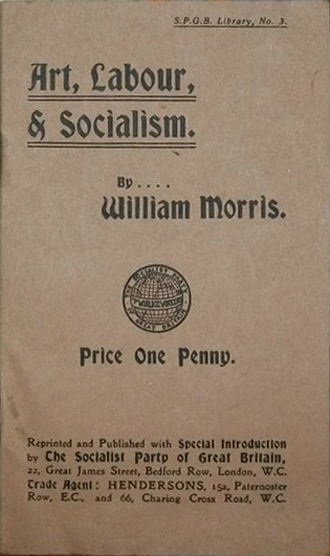
Morris wrote a number of essays and gave lectures on Art and Socialism. Our pamphlet No. 3 Art, Labour & Socialism was a clear statement on the subject and it is possible that before long we may republish it, it having been out of print for many years now.
Ted Kersley

Friday, February 10, 2017

The Art Racket Fairy-Godmother (1957)

From the January 1957 issue of the Socialist Standard

No, fellow-worker, this does not concern you except in one important way. When you read in the Press £27.000 paid for a painting by Corot, £25,000 for one by Murillo, £2,300 for a copy of “Comrade” William Morris’s Kelmscott Chaucer, thousands of pounds for old silver, jewels, porcelain, etc., you may wonder what Fairy Godmother has visited the buyers. But would you believe it, you are the Fairy Godmother. It all comes from the profits you are bound to make for the Boss. Works of fine art and the fine dwellings to put them in are part of your contributions to His Imperial Majesty the Boss for the privilege of working your life out for wages. Maybe here and there, of all the thousands of works of art sold, a very small proportion go into public museums and galleries, and 90 per cent. of the time , these Galleries are open, you are at work doing the Fairy . Godma act and so your cultural uplift gets the go-bye. When next you go to the Public Library, look at the fine art journals such as The Connoisseur, etc., and you will see this is not just soap box oratory, for from cover to cover you will see works of art and craftsmanship for sale; charming things to solace the Captains of Industry while they wipe the sweat off their brows. Yes, it goes very well with roast pheasant and champagne! Not many crumbs of the sort fall to you from the Rich Man’s table. But be of good cheer for you have just had Christmas, with peace and goodwill to all men.

Now come along and make a New year’s resolution, to find out what is behind the art luxury rackets which run parallel with your lives of rush and insecurity. We can help you; read our case and get to work to make a world of Peace and Goodwill. Compliments of the season.
Ted Kersley