Saturday, March 19, 2016

Exhibition Review: 'Broken Lives' (2016)

Exhibition Review from the March 2016 issue of the Socialist Standard
The International Slavery Museum in Liverpool (housed in the Maritime Museum) is hosting a display on slavery in modern India. Most of the enslaved are Dalits, which means ‘broken, crushed, oppressed’; the former term ‘untouchables’ is objectionable. The exhibition, which mainly consists of factual information plus extremely moving case studies and interviews, is produced in partnership with the Dalit Freedom Network (www.dfn.org.uk).
There are perhaps fourteen million people in ‘modern slavery’ in India, which means one person in a hundred and constitutes 40 percent of the world’s slaves. Indian slavery often applies to children, and can mean everything from bonded labour (paying off their parents’ debts) to sex trafficking and domestic servitude. Boys and girls as young as five may be forced into child beggar gangs, or set to work in brick kilns. Under the Sumangali scheme, girls work in textile factories, in dreadful conditions and with little leisure time; some of the clothes they produce are for big Western corporations.
Perhaps the most appalling is ritual sex slavery, by which girls are ‘dedicated to a goddess’ as a Jogini, serving in a temple and then raped by a local power-holder when they reach puberty. After that they are available for sexual purposes to any man. Up to 80,000 women and children are enslaved as Jogini. Like child labour, this is illegal, but it still continues.
Behind all this of course are the poverty and despair of so many Indian families, the profit demands of big companies, and the ignorance and hypocrisy of religion.
Paul Bennett

Proud to be British? (1983)

From the December 1983 issue of the Socialist Standard

Are you proud to be British? Do you stand up straight when they play the national anthem? Does your body stiffen with loyalty when the Union Jack is raised and the Queen waves to you from her Rolls Royce? Do you regard the British army as your army and Britain’s imperial history as your history? If so, you are suffering from that most nasty of diseases of the mind, known popularly as patriotism. It is known to afflict people of all ages, from gullible Boy Scouts to old ladies with blue hats who think that Churchill is still Prime Minister and that change is what you tip taxi drivers with.

The Patriotism Disease — otherwise known as nationalism — can affect people of all countries and even of regions which aspire to become countries. To be a nationalist you can hold a variety of political beliefs. Of course, the caricature of patriotism is to be found among the Tories. In his book. The Case For Conservatism, Quintin Hogg (now Lord Hailsham) wrote that
Conservative philosophy does lay a most particular stress upon the duty of loyalty and the sentiment of patriotism . . .  The nation, not the so-called class struggle, is therefore at the base of Conservative political thinking.
And it would be hard to find a more base example of ignorant nationalism than that exhibited at the Tory Youth rally, just before the June general election, when "the sentiment of patriotism" was summed up by the Tory Commissar for Entertainment, Kenny Everett, who shouted to his audience, "Let’s bomb Russia” and was responded to with loud cheers of nationalistic thuggery.

But when it comes to blinkered nationalism the Tories do not by any means have a monopoly. Indeed, capitalists who support the Conservative Party tend to favour greater international links between the different countries of the world. In general, they favour a world market which is not interfered with by tariff controls or political boycotts. The investors in the multinational companies are certainly not fooled by the rhetoric of their own nationalism: they will invest wherever they can make a profit. It is, in fact, the Labour Party, which poses as an internationalist organisation, but which advocates politics of economic nationalism, such as import controls and a return to pre-EEC trading practices. The Labour Party was the first party in the history of British government to pass the type of racist immigration laws which were designed to keep Kenyan Asians out of Britain. In 1976. Labour's leader. James Callaghan, declared that
I have never wavered from the view that a small, highly-populated country like Britain had to limit the number of immigrants it could absorb into its culture.
Neil Kinnock, the latest opportunist to walk the tightrope between the rhetoric of internationalism and the practical politics of national chauvinism, has said that 
. . .  we must show that we have positive policies which are based upon the implacable requirement that the interests of the British people must predominate. (Guardian, 18 July 1983)
What sort of narrow-minded nationalism is this in a world where over half of our fellow human beings are destitute and eight hundred millions of them are starving? Are we to check that they are "British people" before we think of positive policies to end their, and our, common poverty?

Needless to say, the plague of patriotism is alive and well within the Communist Party of Great Britain. In their pamphlet, Time To Change Course we are informed by the bogus communists that:
It is the British ruling class which . . .  is revealed as the traitor to the nation. It is the Communist Party which stands out as the real champion of the nation.
Which nation they champion we are not told, but the nationalists of the Kremlin have been known to buy up a few thousand surplus copies of the Morning Star each week.

Now, let us move on to the chronic patriotism ward and visit the National front as it lives its final hours. Once the movement which was going to elevate skinheads to the House of Lords and sweep the polls in a bid to rid Britain of non-Anglo-Saxons (Norway was expecting several million descendants of the Vikings to be repatriated), the NF is now just a gang of windbags in bovver boots who sit in rooms above pubs fantasising about the victory that never was. In the mid-1970s they published a pamphlet called Britain: World Power or Pauper State? in which they saw birth control as a plot to reduce the numbers of “the British race":
While in Britain . . . we persist in the absolutely insane policy of discouraging a high birth-rate, there is not the slightest hope that we will be able to send forth enough of our sons and daughters to populate the great empty acres that our ancestors won for us. There is no movement more dangerous to the survival of the British people than so-called family planning . . . Any intelligent assessment of the consequences of this trend must lead to the realisation that it points to the rapid enfeeblement and eventual eclipse of the British race.
It is not only from the politicians that such nationalistic rubbish comes forth: the media persistently refer to “us” and “our” when they are reporting about British business or British militarism; in schools we are educated to look at history from the angle of British ruling class interests; on the sporting fields, nationalism is used to persuade workers that "our” team must be supported against "theirs”; the churches spread the propaganda of “Queen and Country”. Even if you want to travel from one part of the world to another you must carry a card stating that you are "British”, even if you do not choose to attach that label to yourself.

Well, what is Britain? It is a geographical entity — an island — a spot on the map of the world. In this area called Britain there is land, there are natural resources, factories, offices, farms, mines, docks, buses, trains; who do they belong to? In Britain today approximately 400,000 people (one per cent of the population) own 25 per cent of all accumulated wealth. The poorer 80 per cent of the population own 21.9 per cent of accumulated wealth in Britain. The richest 10 per cent own more between them than the poorest 90 per cent. Only 7 per cent of people in Britain own any marketable shares in British wealth. Britain belongs to a minority of British people: to the capitalist class who own and control the means of life. The same is true throughout the world, although the form of ruling class power is different in the state capitalist countries like Russia and China.

The vast majority of people in all countries do not own the means of wealth production and distribution and are forced to sell their labour power for a wage or salary (a price) in order to live. As workers, the majority of people do not have any country. Workers of different countries have more in common with each other than they do with their native capitalist rulers.

It is time to destroy the socially created barriers which divide the world into nations. The world now is not the vast, relatively unconquered planet of the sixteenth century when nation-states first began to flourish in Europe. We are now living in a global village. Capitalist trade, and the technology of mass communication which has been created to facilitate it. have made worldwide production and distribution networks a thing of the present. Socialists do not need to dream of a future worldwide production system — capitalism has brought that into being and has then hindered the benefits which can be gained from it by maintaining the fetters of nationalism. Natural boundaries are no longer a barrier to travel; cultural interchange has ensured that Japanese workers can watch the latest happenings down Coronation Street while British workers are sampling the delights of Indian cuisine. It is noticeable that when astronauts in space take photographs of the earth there is not a red-coloured area called the Russian Empire or a label on a part of Ireland which says that it is British. These divisions are socially created and can only be socially removed by putting an end to the outdated social system of capitalism.

It is the socialist contention that human beings, wherever they are from, are much more similar than they are different. All of us have certain needs and socially produced desires which, by co-operating as humans, we can satisfy. Socialism, which can only be established worldwide, presents the possibility of people from different backgrounds and with different cultures (many of which they may want to retain in a world socialist society) combining our abilities to jointly provide for our common needs. To do this we must socialise the means of producing and distributing wealth by placing them in the hands of the democratically organised world community. Within a socialist society decisions will be taken at various geographical levels, depending on the nature of the decision to be made. Whatever difficulties the organisation of world society, based on production solely for use, will create, it will be a far more harmonious society than capitalism can ever possibly hope to be.

World socialism offers a temptation to the political imaginations of those whose minds have been narrowed by the ideology of nationalism. But the idea of establishing a world society is more than a nice idea to nod your head at. Ending capitalism, with its national frontiers, is a matter of urgency because every frontier has an army and every army has possession of lethal weaponry and that weaponry threatens to destroy us all, patriots and world socialists together. There is no way to obtain a world without war without creating a world which is united by the common interests of its inhabitants and there is no way to achieve such an identity of interests except by establishing socialism.
Steve Coleman

What's Right and Wrong (1968)

Book Review from the February 1968 issue of the Socialist Standard

Secularisation And Moral Change by Alasdair MacIntyre, Oxford University Press, 12s.6d.
A Short History of Ethics by Alasdair MacIntyre, Routledge Paperback, 15s.

What's right? What's wrong? At some periods in history these questions called forth firm, confident, even unanimous replies. Today there is a lot of uncertainty about even the most basic moral ideas. These two concise and useful books help us to understand why.

Secularisation And Moral Change begins by quoting Engels' prediction that the working-class, mainly indifferent to religion but still vaguely respecting it, would abandon even the remnants of belief and become solidly atheistic. MacIntyre has no difficulty in backing up his view that this prediction has not yet been fulfilled to any great extent. “The English working-class today is on the whole not strikingly more secularised than it was” when Engels wrote. A great deal of de-Christianising had taken place prior to Engels' observations, and this MacIntyre correctly identifies as due to “the destruction of the older forms of community, in many cases rapidly, and in particular the destruction of those features of them to which religion had given symbolic expression."

The development of capitalism and the cities gave rise in ethical theory to the dominance of the "secondary virtues"—virtues (like fair play, tolerance, a gift for compromise) which are only indirectly related to human ends. The view that “moral decline” is a result of Christian decline is false:
It is not the case that men first stopped believing in God and in the authority of the church, and then subsequently started behaving differently. It seems clear that men first of all lost any overall social agreement as to the right ways to live together, and so ceased to be able to make sense of any claims to moral authority. Social change and with it moral change is chronologically prior to the loss of belief effected by intellectual argument, except where a very small minority are concerned.
Today the spread of atheism is inexorable, but much slower (in Britain) than Engels expected. It is significant that the churches have a particular hold on people through christenings, weddings and funerals. Birth, love and death were in former times “explained” by the Church. Today this explanation is like the salt which has lost its savour, but no new system of attitudes and rituals has arisen to replace it. This is not surprising. The atomisation and shattering of community (and the education) which result from capitalism forbid the existence of any widely-accepted and consistent view of the world in terms of human values. Hence, the staying- power of Christianity MacIntyre attributes to the lack of any alternative.

The churches are trapped between introversion and assimilation, between escape and dilution. On the one hand there is what MacIntyre calls “enclave Christianity,” which will “provide a retreat from the conditions of urban secular life, and contribute nothing to urban secular life.” The other pole is that Christianity itself becomes secularised. Modern religious leaders, would love a theology of the secular, but all they have is a secular theology.

And MacIntyre makes short work of milk-and-watery Woolwich-type modernism. He points out that it is meaningful to say “Obey the spirit, not the letter of the law” only when there is a letter of the law. It is pointless to advocate a morality in which rules have been replaced by a principle of intent such as “love”, because when denied reference to specific prescribed courses of action, these labels are emptied of meaning. There can be no morality without rules.

MacIntyre argues clearly and rationally, and his analysis is firmly in the Marxist tradition. One grumble: he clings to the myth that there is a modern middle class. A Short History of Ethics is a more comprehensive work: not so much a sketch, more a standard textbook. It gives a fair outline of developments in moral thinking, a clear criticism, plus some very interesting observations on the relationship of morals to social change.

MacIntyre never forgets the historical and social aspects of ethics. Neither does he fall into the opposite trap of some lazy-minded “Marxists,” who delight in the unscientific game of finding a one- to-one correspondence between economic events and ideas, or who point out that such-and-such a viewpoint is in the interests of such-and-such a class, and think that this frees them from the need to evaluate that viewpoint logically.

He attacks the view of the field of moral philosophy as “the language of morals” pointing to the untranslatability of the chief moral terms of Ancient Greece. In a harmonious society virtue and happiness are closely linked concepts, but in a society like modern capitalism these concepts are independent, even antagonistic. So we get a division of opinion into those who advocate personal advancement and those who favour moral goodness. “Gather ye rosebuds while ye may” versus “Let justice be done though the heavens crumble.”

In England the rise of individualism meant:
That all the links between duty and happiness were gradually broken. The consequence was a redefinition of the moral terms. Happiness is no longer defined in terms of satisfactions which are understood in the light of the criteria governing a form of social life; it is defined in terms of individual psychology. Since such a psychology does not yet exist, it has to be invented. Hence the whole apparatus of appetites, passions, inclinations, principles, which is found in every 18th century moral philosopher.
MacIntyre apparently thinks that lack of consideration of the role of morals in the socialist revolution is a gap in Marx's theory, but he points out:
Marx resembles Hegel and the English idealists in seeing a communal framework as presupposed by morality; unlike them, he sees that it no longer exists; and he proceeds to characterise the whole situation as one in which moralizing can no longer play a genuine role in settling social differences. It can only be an attempt to invoke an authority which no longer exists and to mask the sanctions of social coercion.
Steele.

Patrick Pearse (1968)

Book Review from the February 1968 issue of the Socialist Standard

The Best of Pearse edited by Proinsias Mac Aonghusa and Liam O Reagain, The Mercier Press, Cork, 10s.

This book is a collection of the writings of Patrick H. Pearse who was executed by the military representatives of the British ruling class after the collapse of what has come to be known as the Easter Rising, in Dublin in 1916.

Pearse practised at the Bar for a brief period and is reputed to have originated the IRA tactic of refusing to recognise British Courts. Useful though such heroics, and their inevitable tactical offsprings, proved to the British Authorities (and later the N. Ireland and Eire governments) in creating “gaol battalions” of the IRA, it is not for this that Pearse is remembered.

Nor is his claim to fame to be found in his writings as a teacher and educationalist (some of which are found in this collection) though, in the latter capacity, he proved capable of observing the perverted purpose of education in the hands of the State—albeit that the “State” for Pearse was the English State and not the state of capitalism.

Pearse’s real claim to a place in Irish history was his execution by the British military after the abortive 1916 Rising. Also executed were the six other members of the Provisional Government of the proclaimed Republic, among whom was James Connolly.

Connolly (and the digression is deliberate) was a former member of the British Social Democratic Federation and was prominent in the maelstrom of controversy that shook that organisation immediately after the turn of the century. Out of that controversy was born the first of the Companion Socialist Parties (the Socialist Party of Gt. Britain) and the almost defunct Socialist Labour Party, of which Connolly was a prominent member.

Among “left-wing” organisations in Ireland and similar organisations of Irish emigrants in Britain the name of Connolly is revered as the “Lenin of Irish Socialism”. Despite the fact that Irish Capitalism, in the post-Connolly era, did not develop Russia style, the analogy is a good one—insofar as both Lenin and Connolly made effective contributions to the confusion of the working class by overlaying the simple case for Socialism with complex issues of concern only to the nebulous interests of capitalism in their respective countries. Since Connolly’s contribution in this respect was almost exclusively restricted to Ireland, where it is linked with the rabid nationalism of Pearse, we felt that somewhere in these writings we might unscramble the mystery of their association.

Apart from an insipid playlet and some mediocre poetry the collection contains a number of essays, often repetitive, in which Pearse deals with Nationalism, Education, Literature and Freedom. In a style reminiscent of the later ‘heroes’ of Hitler’s National ‘Socialism’ he declares his faith thus: The Irish political leaders
have conceived of nationality as a material thing whereas it is a spiritual thing. They have made the same mistake that a man would make if he were to forget his immortal soul. They have not recognised in their people the image and likeness of God. Hence the nation to them is not holy . . . a thing so sacred that it may not be bought in the market places at all or spoken of where men traffic.
Here, as with Connolly, is the failure to recognise that the very thing he edifies, the national state, is the political creature of that system whose effects he vilifies, capitalism. Again, in dealing with Freedom and Education, Pearse proves himself an observant reporter of effects but wholly off-course when it comes to cause. Thus, in The Murder Machine he imputes to the “English education system in Ireland” the fact that:
The modern school is a State-controlled institution designed to produce workers for the State.
and he quotes Professor Eoin Mac. Neill in comparing the same “English system in Ireland” with “slave education” designed not to make children “strong, proud and valiant, but to be sleek, to be obsequious, to be dexterous . . . to make them good slaves.”

The fact that the “English system of education” in Ireland was the same as it was in England, or anywhere else in the world of capitalism, a system designed to equip working class children for their adult role of wage slaves, was missed as was recognition of the fact that the great majority of “the English” had as little freedom and prosperity as their Irish counterparts. That, in fact, the common enemy of the great majority of Englishmen and Irishmen was the system of international capitalism.

As we struggled through this windy prose we were tempted to wonder what was Connolly's reaction to Pearse’s naive outpourings and then we remembered that his reaction was to become Pearse's comrade-in-arms.

The Best Of Pearse is artless, ignorant and its presumption to wit, monotonous—except, perhaps, when Pearse feels “sure that political economy was not invented by Adam Smith but by the devil”!
Richard Montague

Latin America (1966)

Book Review from the October 1966 issue of the Socialist Standard

An Atlas of Latin American Affairs by Ronald M. Schneider and Robert C. 'Kingsbury, Methuen, 7s. 6d.

There is more to Latin America than the popular conception of Carmen Miranda girls, dictators and brawling footballers. Schneider and Kingsbury say that it is an " . . . area whose importance has only recently been recognised in the United States as well as in Europe.”

And well it might be. By 1959 Foreign investment in Latin America came to almost $14,000 million, three-fifths of it from the United States. There is oil, bauxite and copper there, as well as many other valuable minerals—and, of course, the cattle of the .Argentinian Pampa as well as Cuba's famous sugar.

The continent has had a violent history. Once largely ruled by Spain, it began its movement towards independence, with all the customary misleading propaganda, at the beginning of the 19th Century, canonising the names of Jose de San Martin and Simon Bolivar.

Political change did not, however, reach down to the toiling people; they continued to scratch their living from the hot earth while the power struggle went on between the big landowners, the church and the army. These are still powerful elements in the politics of Latin America, sometimes challenged by industrial and commercial interests.

The United States has sufficient strategic interest in the area, apart from its economic usefulness, to make it keep a steady eye on Latin America's turbulent affairs. Washington at present aims at keeping popularly elected governments in being there—provided they accept their place in America’s sphere of control.

This is the background to the Cuba crisis, to the cynical diplomacy and to the busyness of the CIA in Latin America.

This book, the latest in the Methuen series, presents some of Latin America's history, economy and politics in an acceptable and easily digestible form. It is a paperback and small (127 pages), but it does a useful job.
Ivan

African Unions (1966)

Book Review from the October 1966 issue of the Socialist Standard

African Trade Unions by loan Davies. Penguin African Library, 5s.

As capitalism develops it brings into being the working class—that social group made up of those who depend on their wage or salary to live. In Africa capitalism dominates society, even if many are not yet wage-workers or cash crop farmers. Primitive production for use is being replaced by production for sale on the world market. Wage-workers in fact only make up a small part of the working population.

The proportion of wage-earners ranges from 25 per cent in the Congo to four per cent in Nigeria and the former French West African territories.

In Britain the comparable figure is over 95 per cent. Many of the workers in Africa are migrants who move between working for wages and working their tribal lands. This depresses wages to a minimum level, sufficient to keep an unskilled, single male worker. In some places, however, a permanent urban working class has come into being and this is the trend. In the Katanga copper mining area, for instance, there are second and third generation wage workers.

As can be imagined trade union organisation in these circumstances is difficult. Despite this trade unions, of varying degrees of permanency and effectiveness, have appeared. Nearly all have been associated with the nationalist movements. Not that, of course, independence has made much difference. A new privileged bureaucratic and commercial caste has appeared and the unions have been under pressure or turned into mere state agents for increasing production. One of the Ministers of Labour in what was Tanganyika has put it this way:
The union is required to educate wage earners in the need for harder work and the need for discipline and efficiency at the place of employment.
In all countries the new independent governments have come into conflict with the workers and their unions. Strikes have been outlawed or suppressed. Thus Ghana in September, 1961, suppressed a strike of dock and harbour workers and in 1964 a general strike broke out in Nigeria. This shows that nationalism is not in the interests of the world-wide working class.

Ioan Davies’ book is well worth the five shillings.
Adam Buick

Free speech in Belfast (1966)

Party News from the October 1966 issue of the Socialist Standard

The activities of the World Socialist Party in the North of Ireland are being hindered i by a ban on political meetings within a 15-mile radius of Belfast imposed by the government there. The Sunday evening outdoor meetings at the City Hall have had to be abandoned. Instead the WSP is running a series of meetings at their Head Office (53 High Street, Belfast) under the title “Free Speech Forum”. At these meetings other political groups are given a chance to express the views that the government ban would otherwise prevent being heard. The ban has been imposed as a result of religious sectarian incidents sparked off by the hooliganism of the Rev. Ian Paisley and his followers.

Friday, March 18, 2016

Imperialism and Revolution (1930)

Book Review from the June 1930 issue of the Socialist Standard

"Imperialism and World Economy,” by N. Bukharin. Martin Lawrence. 6s.

This work was written by Bukharin in 1915, and its references to statistics are largely out of date. But the essential arguments are in the main true to-day. The development of Imperialism in its economic aspects, has been treated in many books, such as John A. Hobson’s "Export of Capital” and also his work on "Imperialism.” Bukharin’s book covers much the same ground.

The discovery of raw materials in the backward parts of the world, together with a supply of cheap labour close at hand, gave a powerful impetus to the modern capitalist and banking company to invest abroad in search of a higher rate of profit. The rapid rise of large scale machine industry enabled the manufacturers to produce more than could be sold at home and a far-flung Empire provides a ready market for the goods.

Bukharin says little of the modern development of industry in the colonial and "backward” countries, resulting in a continual shrinkage in the world market.

The growth of trusts, cartels and monopolies is well sketched by Bukharin, much of his material being gathered from Hilferding’s “Finance Capital.” Bukharin shows how war results from the struggle for markets and for sources of raw materials. The last chapter indicates how greatly Bukharin counted on a revolt of the. workers at the end of the war, but nobody who saw how easily the workers were gulled in the developed capitalist world had any grounds for believing that world revolution would result.

The Communists condemn Bukharin’s book because he does not support the idea that the system is collapsing quickly. Bukharin bitterly opposed Trotsky, Zinovief, Radek and other leaders who-built up an opposition group in Russia, but Bukharin afterwards joined the opposition himself and held that Capitalism’s "collapse” was not in sight.

The present-day "intellectuals” of Communism criticize Bukharin’s book, alleging that he ignores colonial uprisings and internal conflicts. These "slogan merchants” ignore the fact that Lenin in his introduction to the book had no fault to find with it. The colonial revolts on which Communists based their hopes are largely beginnings of a struggle for national independence on the part of native employers and their allies and are not working class struggles for emancipation.

Modern Imperialism is a developed stage of capitalism rising out of the growth of productive forces in the hands of an exploiting class and the only way it can be abolished is by the working class struggling for, and establishing, Socialism. The Colonial revolts that were going to smash Imperialism become in the long run movements to build Capitalism in "backward” lands.

The chief fault with Bukharin’s manner of writing is that his language is not simple, and he lacks the power to make his points clear and plain.
Adolph Kohn

Air Sick (1985)

From the November 1985 issue of the Socialist Standard

In the wake of the Air India crash off Ireland, the Tristar accident in Dallas and the Japan Airline disaster, the victims lying in the makeshift mortuary of hangar no. 7 at Manchester Airport last month brought the total number of dead from air travel accidents this summer over the thousand mark.

Everyone hopes they can avoid just such a tragedy. But is luck all we have to rely on? Is our fate totally out with our control as one aviation specialist would have us believe: "God was not with that flight”? As the Chairman of the British Airline Pilots’ Association said:
. . . we have had a string of survivable accidents on all types of aircraft in which we believe the effects of smoke and fire have been critical for the people trapped in the fuselage . . .  a lot more people have died in these incidents than should have done.
(Guardian 29th August 1985)
So what factors are within our technical capacities; what safety measures are there available?

FUEL: ICI have developed a fuel additive which will prevent misting and so lessen the flammability of fuel. But to do this took seventeen years of research and ICI are waiting for funding before developing the lifesaving additive. Although undoubtedly safer, there is no guarantee that it will even be used—some airlines still use JP4 gasoline rather than the less flammable Jet A kerosene. A study by Cranfield Institute of Technology shows that, on average, five times as many passengers will be burnt to death before they can escape, if JP4 is used. JP4, though, is cheaper. (Flight International 14th September 1985)

MATERIALS: Most deaths in aircraft fires are due to the inhalation of toxic fumes from the combustion of the foam inside seats. Airlines have been slow to introduce new, safer upholstery, as regulations will require by 1987. The cost to the airline is $200 a seat, and will give passengers an extra ninety seconds to escape. Of course, even safer materials are available, but they are found only in the Space Shuttle as the cost of replacement by the airline companies is too large. (Newsnight, BBC 2, 22nd August 1985)

WEIGHT: “Every gramme of structure (is) a gramme of commercial payload lost” (The Safe Airline - J M Ramaden, 1976). Therefore light aluminium alloys are used for the aircraft body although they have very poor heat resistance. This argument has long been used by the airlines to counter the requests for more, or improved, safety equipment.

The standard Boeing 737 flight has one hundred and fourteen passengers in nineteen rows. A charter flight — like that which crashed at Manchester — packs in an extra three rows, giving three inches less of space for each person. The Air correspondent for BBC News asks,
Why were 130 of those souls crammed into seats spaced just thirty inches apart? . . . The answer, of course, is that the average passenger represents 140 lbs of high-value merchandise, and that if you can compress three additional rows of seats designed to provide comfort for one hundred and fifteen people, it means you can earn another £600 or so on a Mediterranean flight. Multiply that by ten aircraft making a couple of round trips a day during the peak summer and winter holidays, and you come out with substantial earnings approaching an additional million pounds a year. (The Listener, 5th September 1985)

So it is simply a case of the inexorable law of capitalism — payload and profits come a long way before safety. As David Vearmount of the Civil Aviation Authority said, "Airlines don’t mind applying the safety rules as long as all their competitors do so”. (Flight International, 14th September 1985) 

Considering the controversy that has surrounded the use of the emergency exits in the Manchester crash, it is important to note that British Airways are intending sealing two exits on their 747 Jumbo jets in order to increase seating capacity. (In case you had forgotten, BA are the airline that once claimed to “take more care of you”).

The risk, then, is quantified by the airline. Each passenger effectively has a price on their head — doubtless down to two decimal places. Under the facade of efficiency that is the accountants’ balance-sheets, the benefits of cost savings on cheaper fuel, or lighter planes, or more passengers is weighed against “acceptable” risks to safety:
It is on the definition of just what is an acceptable risk, however, that pilots and operators have some of their most bitter arguments, and many safety-conscious but disillusioned pilots have, perhaps unfairly, echoed Nevil Shute’s bitter comment, “of course operators are all for safety - just as long as it doesn’t cost them any money!” . . .  an airline may accept a risk, because to lessen it would put one or more particular departments over the allotted budget; while if a crash occurs, it is not the operator who foots the bill, but the insurer, (Pilot Error - A Professional Study of Contributory Factors, Ronald Aupt (Ed), 1976)
The definition of acceptable risk is rightly troublesome — whose risk is it, to fly (as passengers or crew) in a plane that could be safer? But who accepts the benefits?

The simple inequality, based on an inequality of ownership and control, explains why the interests of consumers (like the passengers flying on holiday) and of producers (like the cabin crew), are ignored in order to meet these needs of the minority class of owners, who don’t need to live on wages or salaries, and certainly don’t live for package flights to the Med once a year.

And as the bereaved families picked up their lives again, they were already being hounded by lawyers from America, who can get higher rewards — and a higher cut — from suits filed over there. One was reported to have booked into a hotel near Manchester Airport within 48 hours of the crash, fresh from a killing at Bhopal and now "ambulance-chasing” in Manchester. Definitely business as usual.
Brian Gardner 

History of anarchism (1993)

Book Review from the June 1993 issue of the Socialist Standard

Demanding the Impossible: A History of Anarchism. By Peter Marshall. Fontana. £9.99.

Peter Marshall's monumental history of anarchism from ancient Greece and ancient China to today is now available in paperback. The ideas covered—anyone opposed to the state, from whatever angle— group together people with widely divergent, not to say incompatible views: from anarcho-communists like Kropotkin who stand for common ownership and no money to anarcho-capitalists like Ayn Rand and Proudhon who want to abolish the state so as to allow the market economy free rein.

If the anarcho-communists feel confortable being grouped with these latter under a common title, we wouldn’t. Which is why we are dubious about the unindexed statement on page 495 that “some claim that the tiny Socialist Party of Great Britain is anarchist in inspiration"—even though we have always held that the state, as the public power of coercion composed of police, prisons and armed forces, will be abolished in socialism.
Adam Buick

Malcolm Xploited (1993)

From the June 1993 issue of the Socialist Standard
Hotter than 
a cross of fire 
hip refurbished 
black messiah 
hanging on 
the whitest walls 
for the biggest 
buck of all. 
                           Dave Bishop

Thursday, March 17, 2016

A Peep into the Art World (1955)

From the June 1955 issue of the Socialist Standard

The Financial Times (27/4/55) has an article under the title "High Prices for Venetians"; dealing with the spectacular rise in prices of works of art sold in London Sale Rooms, instancing a painting by Canaletto £10,500, a pair of F. Guardi £9,000, one by Zuccarrelli £1,900, one by F. Post “View in Brazil 1661” £1,650, and a very fine copy of Audubon’s “Birds of America,” published 1827-1838, £9,200. These prices represent a ten to 20 times increase in the last 10 to 20 years. What a fine racket thinks the speculator, better than whiskey, or bomb making.

What is behind it, you may wonder. While one must remember the fall in the purchasing power of the pound, that is not the great part. The supply of such works of are as these mentioned above grows less each year, but the demand increases with the growth of immense fortunes in countries that did well in the last two world wars: the South American Republics, the Scandinavian countries, U.S.A., and also the great oil fortunes in Western Canada. The last are a great factor in the prices of Canadian paintings by Krieghof (painted 100 years ago) which sell at as much as £1,000 as against £100 in pre-war days.

S. America is coming up fast and it was Brazil that put on the San Paulo collection at the Tate Gallery last year. F. Post was one of the very few well trained artists to go to Brazil in the 17th century, so for buyers of S. American early art the choice is strictly limited; the £1,650 “View in Brazil” could be bought 20 years ago for £100 and the Audubon book for a tenth of the recent price.

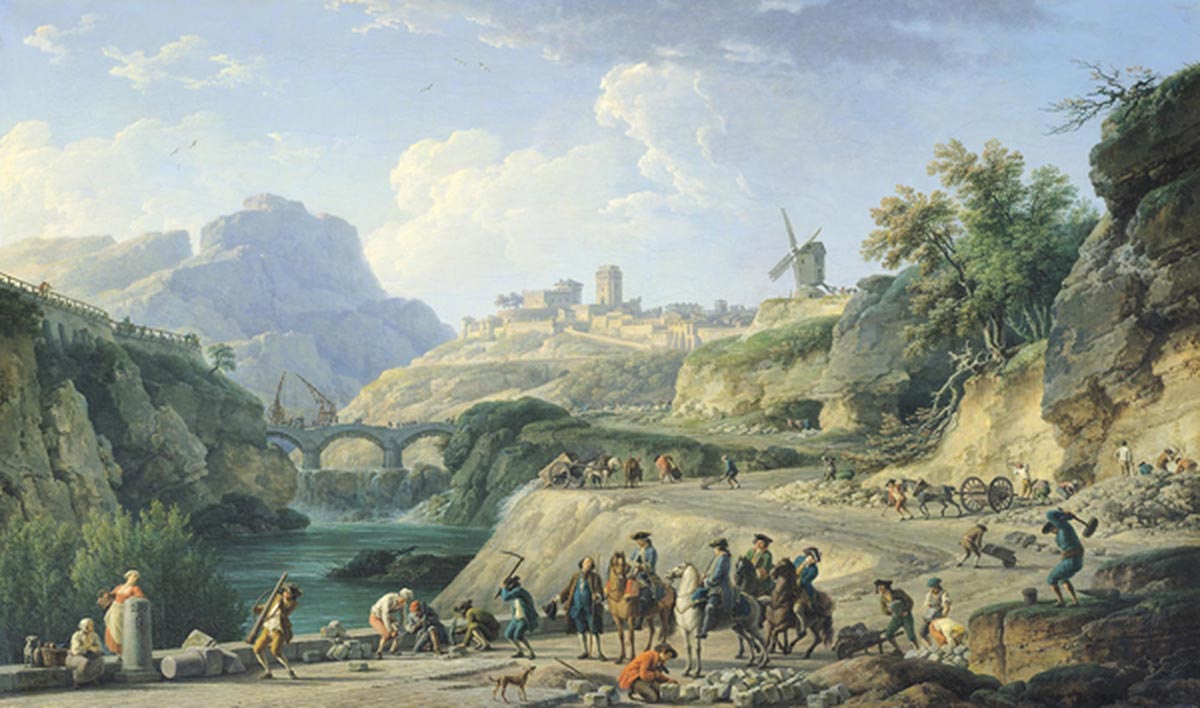
The present writer’s memory goes back to a day in January at the winter Royal Academy Show of 18 Century Art, to Exhibit 361, “Making a Road,” a painting by J. Vernet, signed and dated 1774. The picture shows a French Landscape by a river with a castle in the distance, a three-arched bridge being built in mid-distance by many workers with a high wooden crane. Up on the right is a windmill with two donkeys being loaded, beyond the bridge a group of men pulling a long waggon filled with huge blocks of stone, and all along the road dozens of men with hammers, picks, ramrods, chisels, etc., constructing the road. In the foreground are four horsemen. The first, splendidly dressed, is looking at a document that the ganger, hat in hand, has given to him, on the pommel of his saddle a brace of pistols. By his side another well dressed and pistoled gent sits with whip held erect in his hand and behind him two men, who look like guards. While admiring the picture another visitor approached and remarked: “Nice picture! Who owns these beautiful things? Who were they painted for?” This one, I replied, now belongs to The Louvre, but you will notice by the catalogue the great array of Lords, Baronets, etc., who own the bulk of this splendid exhibition. As to who this Vernet was painted for, perhaps for the pistoled gent or at least someone such as the owner of the distant castle. What you see there in the painting—well over 50 men working and two well armed gents not working but obviously of the class who own the means of production—sums up nicely who owned such works of art and who owns them now. There stands the master class whip and pistol in hand: the pistol you put and keep in their hands every, time you vote them into political-power and the whip of necessity that keeps you working for those who own the means whereby you live. The fine art trade, like the fine jewel trade, is patronised almost exclusively by that very small class who own the means of wealth production; while the vast bulk of the people get a trickle of chain store art and “ fine ” jewelry. It is up to the latter, the working class, to say yes or no to such a system. Look at the world you live in and get an understanding of Socialism, which will finish all the luxury racket and make possible a world in which art will cease to serve the ostentation and speculation of the wealthy and be a means of enjoyment for all.
Ted Kersley

Future of work and leisure (1993)

From the June 1993 issue of the Socialist Standard

One of the worst features of capitalism is the way it separates our lives into periods of paid work and paid-for leisure. Too often we speak of work as if it were only paid work, and it is easy to regard leisure as only entertainment we have to pay for. But even within capitalism there is much work that isn’t done for money and much leisure that doesn’t have a price tag. With socialism, work and leisure will not only be free from financial calculation but also the dividing line between the two will be much less than it is today.

Work done for money is really a distorted and alienating form of work. Employment means going to work because an employer expects to make a profit from buying your labour and selling what you produce. You may do something useful like growing food or building homes—or useless like guarding property or harmful like making weapons. I'he chances are you won’t like the job, although you may like the work, especially if it is creative or to do with people. You won’t like the job because it is done to someone else’s orders, in conditions that are usually less than ideal, and for longer than you would wish.

Even in capitalist society some men and women speak very warmly of their work. Helping people, teaching them, giving them services they appreciate, are all sources of work satisfaction, even enjoyment. These kinds of work will continue in socialist society and be extended to more people for more of the time. What will disappear will be work done only to make someone or some institution a profit. or to service the money system in some way (there are millions of such “jobs").

It may seem fanciful to say that we can play at our work. Some work is not easily associated with play: the kind that has to be done. “Who will do the dirty work?” is a cry that often goes up from those who cannot imagine anyone working except for money. But people do perform essential tasks quite happily without payment if they do so co-operatively and without a sense of being exploited. And they can gain deep feelings of pleasure and creativity from such work, from doing or producing something useful. Psychologists call this a sense of “flow", of immersing yourself in what you do. of losing any desire to watch the clock.

Tainted by money
Leisure in capitalist society is subject to market forces. Margaret Thatcher once announced. talking of the tourist industry, that there is money to be gained from other people's leisure. The providers may be commercial or "public". Both types rely on consumers paying either at the point of consumption or by taxes or licences. Most of this is casual leisure: you buy a ticket or press a button and you are duly "entertained".

There is, however, another kind of leisure on which the market has little or no effect. To distinguish it from capitalist entertainment it may be called serious leisure (which doesn't mean humourless leisure). It takes three main forms: amateur activities, hobbies and volunteering. Amateurs do the same things as professionals. but without payment. Perhaps they are musicians, or scientists of some kind. Hobbyists are like amateurs but without a professional equivalent. They could be collectors or model builders or enthusiasts of any one of a thousand hobbies. Then there are volunteers: people who spend some of their free time helping others in some way. Again there are very many different ways of volunteering.

Capitalism not only artificially separates work from leisure; it also opposes them. Paid workers have been known to say “Roll on five o’clock, lets get out of this place and start living", or something similar. Its a tragic waste of precious life. Leisure, too, is tainted by the money system. Millions of punters band together every week to make a tiny few (sometimes only one) of their own number very rich through the football pools. Follow-up studies of the big winners are not encouraging about their happiness. You can, of course, buy a good time without gambling, but you are usually expected to be a passive consumer rather than an active participant.

With socialism there will be enormous scope for bringing work and leisure closer together and making them both worthwhile parts of a whole life. Work will be organized democratically, not financially. It will be in direct response to need and not in the interest of profit-seeking. It will as far as possible be freely chosen. Leisure won’t be an “industry”—it will be that part of life in which things are done for their own sake and not in the service of something else. People will find it increasingly difficult to distinguish between what is work and what is leisure. In other words, why shouldn’t we have fun at our work and be serious about at least some of our leisure?
Stan Parker

Editorial: "Socialism" Everywhere. (1936)

Editorial from the March 1936 issue of the Socialist Standard

Years ago, Socialist propagandists used to point out to the reformists that their work of popularising old-age pensions, unemployment insurance, etc., would only end up with the openly capitalist parties dishing them by adopting the proposals for themselves and getting the credit. To clinch the matter, Socialists added that a time would come when the capitalists would steal the word “ Socialism ” itself and use it to gain a further lease of life for capitalism. Events have faithfully followed this anticipation. If what they say were really true, the workers’ difficulty to-day would be to find some spot where Socialism isn’t. First, there are Russia’s 170 millions supposed to be living under Socialism. Now Germany, with its “National Socialist Party” in the saddle, has just been officially declared to be Socialist. The Berlin correspondent of the Economist (February 1st) writes as follows: “ ... it is affirmed that Socialism is under way (indeed, this week it is officially stated to have already replaced capitalism).” Then the three Scandinavian countries, with their Labour Parties in power, are described as "Socialist” in the English Labour Press, along with New Zealand and Western Australia. At home we have the old-fashioned section of the Labour Party still insisting that the Post Office is Socialism, while the new gang (Mr. Morrison) calls the Transport Board “socialisation,” and tells us that we have a Socialist London County Council. Where the Government is not controlled by a Party calling itself Socialist, it often has one or more leaders who were Labour Party stalwarts, e.g., MacDonald and Thomas, Mr. Lyons the Austrian Premier, and Mussolini and several of his colleagues.

Only knowledge of Socialist principles will make the workers proof against being misled by capitalist and Labour Party misrepresentation.

Russia's capitalists (1985)

Book Review from the November 1985 issue of the Socialist Standard

What is the nature of the ruling class in Russia? Who are they and what is the basis of their power and wealth? Obviously, the answers to these questions cannot be found by simply comparing the Russian rulers with the capitalist class in the west. For example, no one in Russia has legal title to any of the factories, mines, mills, transport and communications systems, and to underline this there is an absence of shareholding and stock exchanges. Nevertheless, there is a social class there whose members live privileged lives in comparison with the vast majority of Russian people. Indeed, the higher ranks of this class enjoy luxurious lifestyles and have an army of servants to look after their every comfort.

How can all this be in a supposedly “socialist" society and how does this privileged class get its wealth if not from legal ownership? These questions, and many more, are dealt with by a dissident Russian scholar, Michael Voslensky, in his book Nomenklatura - Anatomy of the Soviet Ruling Class, published by The Bodley Head (£12.95). This book was first published in German but the English edition has been brought right up to date to include the periods in office of both Andropov and Chernenko.

Nomenklatura is a Latin word meaning an index of names. A more meaningful definition is contained in Structures of the Party, a manual of the Communist Party of the Soviet Union:
The Nomenklatura is a list of the highest positions, the candidates for these positions are examined by the various party committees, recommended and confirmed. These Nomenklatura party committee members can be relieved of their positions only by authorisation of their committees. Persons elevated to the Nomenklatura are those in key positions (p 2).
Anyone admitted to this magic circle is issued with a document confirming his or her exalted status and membership is virtually guaranteed for life.

Voslensky, who now lives in the west, was himself an important figure in Russia and writes with insight about his subject. He identifies the Nomenklatura as the secretaries and heads of departments and divisions of the Communist Party, Komsomol (communist youth) and trade unions; the central committees of those organisations at both national level and in the various republics; the heads of state administration and their deputies at national and republic levels plus a host of representatives of the state security services, the armed forces, the KGB, the diplomatic services, education, science, industry and agriculture. According to Voslensky the Nomenklatura totals about 750,000 and together with their families at around 3 million, or 1½ per cent of the population. So it is only those who have reached a certain rung on the Communist Party ladder who can become members, and even the international fame and personal wealth of such as writers, artists and film stars do not gain them admission.

Even if we could not put our finger on the exact point in the Communist Party set-up where someone becomes a member of the Nomenklatura, this need not concern us any more than what is the exact amount of capital someone in Britain must have invested before becoming a member of the capitalist class - is it £100,000 or £1 million? The undeniable fact is that despite any grey areas there is a capitalist class in this country which, because of its legal ownership, monopolises the means of production and distribution. Similarly there is a class in Russia, the Nomenklatura, which, because of its monopoly of political power, does exactly the same there.

Voslensky argues that the Nomenklatura are in fact the collective owning class in Russia. He points out that ownership does not have to be by individuals with legal title and cites the nationalised industries in the west where the state undertakes their management on behalf of the national capitalist class. If those industries show a profit then the capitalists will get their “dividend” in the form of tax cuts or of not having to pay tax increases to finance them. At the very least they will get industries which, even if not profitable, they can use to service the enterprises they themselves own. The capitalists in this case own not as individuals but collectively, as a class.

And collective ownership exists not only in nationalised industries. The Roman Catholic church owns vast wealth in property, investments, art treasures, etc, but no individuals, not even the Pope, have legal title to any of it. This wealth is owned collectively by the church hierarchy who use it to protect and extend their power and influence and, incidentally, to live very well, but none of them could, for instance, sell St Peter’s. Any such decision would have to be taken collectively because that is the basis of their ownership.

It is the same with the Nomenklatura. They own as a class and the state manages the production of wealth on their behalf. Their pay-out comes in the form of inflated salaries, the free use of luxury apartments, Black Sea villas, country houses (dachas), more or less free food, free use of cars and many other perks. Also, many of them are allotted more than one official post and receive a separate salary for each. This may not compare with the huge incomes of some western capitalists but, what the Nomenklatura get is a fortune to the average Russian.

Of course the top ranking members of this class do have incomes on the scale of western capitalists. How else can we view the disclosure that a district committee first secretary paid 192,000 roubles (about 160 years’ pay for the average Russian worker) into his wife’s bank account? Moreover, they have an open account at the state bank which allows them to draw out any money they require. Even western capitalists cannot do that. Those at the very top have no need to touch their salaries as everyone at this level simply lives at the state's expense. Stalin’s daughter, Svetlana, recalled how her father never touched his wages: “The drawers of his desk . . . were full of these sealed envelopes" (p 231). And yet the Nomenklatura denies its own existence as a class of exploiters and try to pass themselves off as “workers”.

This personal wealth is only a fraction of the surplus value which the Nomenklatura robs from the Russian workers. The entire state apparatus which keeps them in power is financed from this source. The armed forces, the arms industry and the spy and espionage systems which are used to protect their interests from the threat of their international rivals, the massive police force, prisons, labour camps, courts, militia, phony trade unions, all of which are employed in keeping the workers in line, are paid for from the proceeds of this robbery.

One significant similarity the Nomenklatura has with the capitalist class in the west is that it endeavours to hand on its privileges to its children. Although it is true that membership is not hereditary in any legal sense, in a practical sense it may as well be. Voslensky gives several examples of how the children of the Nomenklatura are as good as guaranteed important, well paid positions irrespective of their personal abilities and concludes that although entry to the Nomenklatura can be obtained by ordinary careerists, "... the chance of entering it by that route are becoming more and more restricted, while the royal road of birth is more and more frequently used” (p 102).

The most important difference between the Russian rulers and the western capitalists is explained by Voslensky.
What matters to the Nomenklatura is not property but power. The bourgeoisie is a class of power owners and is the ruling class as a consequence of that. With the Nomenklatura it is the other way around; it is the ruling class and that makes it the property owning class. Capitalist magnates share their wealth with no one, but gladly share power with professional politicians. Nomenklaturists take care not to share the slightest degree of power with anyone. The head of a department in the Central Committee apparatus never objects to an academician’s or a writer’s having more money or worldly goods than he, but he will never allow either to disobey his orders, (p 72)
So, in the west it is money which is paramount. In Russia what counts is power of which privilege is the proof. This explains why the Nomenklatura apparently have no wish to actually own a dacha. What is more prized is having a state-owned dacha made available to them. That is a sign that they have really arrived, and to actually own a dacha is considered to be bad form.

On occasion Voslensky reveals a sound grasp of the theories of Karl Marx. For example, he approvingly quotes an old Bolshevik ruefully explaining to him, as a schoolboy, why Russia was not ripe for the socialist revolution.
You and your friends, Misha, would like to be airmen or arctic explorers, but with the best will in the world it is impossible because you are still children, and you can no more skip your age than I, unfortunately, can become a schoolboy again. It is not we who determine the various stages of our life, it is those various stages that determine us. And that is true not only of individual human beings, it also applies to human beings in general, to human society. Could Russia or any other country at the same stage of social development, by a mere act of will take a single leap that would put it ahead of the most advanced countries? Marx said it could not and it was obvious (p 15).
He denounces Leninism as not Marxist at all but merely “. . . a strategy and tactics for the seizure of power decked out in Marxist slogans” (p 289) and goes on to pour scorn on the idea that the Nomenklatura are Marxists - "Marx would have turned away in disgust from the system they have established” (p 290).

Voslensky’s own conception of socialist/ communist would seem to be the same as our own, for he says
I believe the idea of a classless communist society as a free association of producers of material and intellectual goods to be a fine one (p 347).
Against this he shows some weakness on Marx’s theory of surplus value, confusing surplus labour - which is present in any society - with surplus value, which is produced under the specific conditions of capitalism’s commodity production. He also shows a certain naiveness in stating that government ministers in the west "live on their pay, just like other people”, and that their wives do the cooking and housework themselves (p 178)!

We can easily forgive Voslensky’s slips. By throwing more light on Russia’s rulers and by highlighting the class divided nature of Russian society together with its repressive state, his valuable book is surely one more nail in the coffin of the idea that socialism or communism exists in that tortured land.
Vic Vanni