Showing posts with label April 1989. Show all posts

Thursday, November 15, 2018

Intervention USA (1989)

From the April 1989 issue of the Socialist Standard

In these days of the enterprise culture, government involvement in industry, commerce, banking and other economic activities is not the flavour of the month. Market forces are in and intervention, or so we are told, is out.

Indeed it would appear that this is true, for all over the world, in Britain, France, Australia and elsewhere, governments have been getting rid of much of what is called “the public sector”. In fact nationalisation, the main form of government involvement in a nation’s economic activity and once seen as a device which would solve all of capitalism’s economic and social problems, is more or less a dead duck.

So obvious is this even to politicians of “the left” that the Labour Party here doesn’t intend to re-nationalise all the Tory sell-offs of the last decade, while in the so-called communist countries private enterprise is being encouraged to compete with ailing state enterprise.

From deregulation…
However, even in such times as these, governments still have to step in and intervene when they think that the interest of the national capitalist class is in danger. For example, in the United States, the very heartland of non-intervention, there has been the growing problem of the Savings and Loans banks. These S and Ls are the rough equivalent of Britain’s building societies and hundreds of them have gone bust while hundreds more are insolvent. Their losses were $6.8 billion in 1987 and $3.8 billion in the first quarter of 1988, although depositors are covered by a government insurance agency.

How did this happen? Just as nationalisation was once seen as the great cure-all, nowadays it is “deregulation” which fills the bill. This means that enterprises in an industry no longer have to conform to laid-down government regulations but are freer to operate as they see fit. This, it is claimed, will produce a capitalism without its attendant problems, will provide greater all-round prosperity, and so on.

Thus the S and Ls were allowed by the Carter administration in 1980 to borrow, not only from small investors for re-lending as mortgages as previously, but from the money markets at ever higher rates of interest. This laid them wide open to trouble, which duly arrived when the Reagan administration further deregulated by allowing the now exposed S and Ls to move into high-risk lending for big property deals and other get-rich-quick schemes of which they had no experience. The result was the spate of bankruptcies and insolvencies already mentioned.

… to regulation
At present the insolvent S and Ls keep afloat by continuing to borrow at high interest rates and their debts are estimated to be increasing by $35 million a day. Sooner or later the government will have to foot the ever-mounting bill. The implications of this are serious for American capitalism. How can it ever tackle its massive budget deficit of $150 billion while it throws away billions at this rate? More seriously, many American banks have collapsed in recent years (almost 200 in 1987 alone) and the additional collapse of hundreds more S and Ls could trigger a disastrous loss of public confidence in the entire American banking system. The Administration have therefore intervened to try to stop the rot.

Bush and his financial advisers have come up with a plan calling for a one hundred billion dollar issue of new bonds to bail out the S and Ls. The interest on the bonds is to be paid to the government by the S and Ls and the other banks though higher premiums for Federal insurance of all bank deposits. Critics of the plan say it breaks Bush’s election promise of “no new taxes” as “the taxpayer”, in the form of the banks’ customers, will have the extra premium passed onto them through higher bank charges. But this will not necessarily happen because the customers may refuse to pay up, in which case the banks and S and Ls will have to bear the extra cost themselves.

This rescue package also calls for a leaner and fitter S and L industry to be taken over and run by another government agency, the Federal Deposit Insurance Corporation, and amounts to back-door nationalisation. So whatever their ideological preferences any government will make use of intervention, even despised nationalisation, when it suits “the national interest”.

All of this reinforces the Socialist Party’s view that whether government use less intervention or more, they are helpless in avoiding capitalism’s pitfalls.
Vic Vanni

Monday, November 6, 2017

Independence No Benefit (1989)

From the April 1989 issue of the Socialist Standard

Chinese troops patrol the streets of Lhasa to clamp down on yet another group of men and women clamouring for Independence. But what exactly has "self-government" meant to those around the world who have managed to achieve it?

Since 1947, thirty-six territories previously part of the British Empire have become independent sovereign states, although most of them decided not to forego the economic aid and trade advantages inherent in being a member of the Commonwealth. What have the people of these countries gained from the change?

Various types of one-party dictatorships exist, and bloody civil wars have raged in Biafra and Somalia. In the latter there is wholesale denial of the most elementary political rights and more than a million refugees have fled into equally poverty-stricken Ethiopia and Sudan. New independence movements indiscriminately slaughter those of different groups or tribes in India and Sri Lanka as well as Somalia. Corruption is rife even in so-called democracies. Abject poverty is the rule among the vast majority, while the new ruling class who control the economy grow rich. To celebrate Independence in 1984 the Sultan of Brunei built the worlds largest palace with 2.000 rooms and 257 lavatories. His subjects have been provided with a "Welfare State" and pay no income tax; even so. it is safe to say that independence has made little difference to their lives. The government of Sierra Leone is so concerned for the health and welfare of its "independent" people that it has accepted, against payment of course, the dumping of tons of British lethal toxic waste just outside its capital, Freetown. It is very doubtful whether the "mother country" would have dared to do this while Sierra Leone was a British responsibility.

Lesotho (Basutoland) and Swaziland are completely dependent upon South Africa, have repressive regimes and widespread poverty. No Independence here and certainly no benefits for any but the ruling clique. Even in those few states where material and political circumstances of workers have been maintained or improved, changes have been minimal. The fact that some of the most repressive régimes refer to themselves as socialist is, of course, a mockery.

When asked why we do not support struggles for Independence by fellow workers in other parts of the world, we point out that, at best, they will simply be exchanging one lot of masters for another. They may win or be allowed a little more freedom within the system but while it remains they must depend on the capitalists — state or private — for their subsistence. For workers, independence is merely a change of rulers.
Eva Goodman

Saturday, May 6, 2017

What's next for privatisation? (1989)

From the April 1989 issue of the Socialist Standard
"They have monopolised everything that it is possible to monopolise: they have got the whole earth, the minerals in the earth and the streams that water the earth. The only reason they have not monopolised the daylight and the air is that it is not possible to do it. If it were possible to construct huge gasometers and to draw together and compress within them the whole of the atmosphere, it would have been done long time ago, and we should have been compelled to work for them in order to get money to buy air to breathe. And if that seemingly impossible thing were accomplished tomorrow, you would see thousands of people dying for want of air — or of the money to buy it — even as now thousands are dying for want of the other necessaries of life. You would see people going about gasping for breath, and telling each other that the likes of them could not expect to have air to breathe unless they had the money to pay for it. Most of you here, for instance, would think so and say so. Even as you think at present that it's right for a few people to own the Earth, the Minerals and the Water, which are all just as necessary as is the air. In exactly the same spirit as you now say: 'It's Their Land , It's Their Water'. It's Their Coal', It's Their Iron', so you would say ‘It's Their Air', 'These are Their gasometers, and what right have the likes of us to expect them to allow us to breathe for nothing?’”
— Owen to his fellow workers in Robert Tressell's The Ragged Trousered Philanthropists.

Saturday, May 14, 2016

Down with justice! (1989)

From the April 1989 issue of the Socialist Standard

There are words of which people should have learned to beware. Liberation, meaning it is your allies who will try to kill you this time instead of your enemies. Prosperity, a sure thing you are about to feel the pinch more tightly. Progress, the development of new ways to exploit the majority of people and turn creativeness sour. And justice. In Britain, they say. it is the best that money can buy. Demands and pleas for it echo through history and every day's newspapers So do threats of it: as well as the grail of the oppressed, justice is the first refuge of every oppressor. With each invocation of the word goes the feeling that a moral principle is involved, that there is an over-riding consideration of rights. Is there justice to be had?

One answer might be that it is impossible to get under capitalism, or has to be fought for against odds. On that basis, working-class claims for justice acquire greater weight and passion, because sentiment favours assaults on the inaccessible. Unfortunately, it is a superficial and mistaken answer. The mistake is in the assumption that there is true justice which is simply being with-held or misapplied. If hands could be laid on it, the belief goes, wrongs would be righted and truth prevail. In fact, justice is a concept established and elevated by property society for its purposes alone. Or, as Marx and Engels addressed the capitalist mind in the Communist Manifesto:
. . . your jurisprudence is but the will of a class made into law for all, a will, whose essential character and direction are determined by the economical conditions of your class. The selfish misconception that induces you to transform into eternal laws of nature and of reason, the social forms springing from your present mode of production and form of property — historical relations that rise and disappear in the progress of production — this misconception you share with every ruling class that has proceeded you.
What has to be realised is that there is no injustice — there is only justice. Does this mean that appeal is useless, that every personal and social oppression must be taken as inexorable and endured? By no means. But the argument and struggle had better be for concrete purposes, not for the phantom of a moral truth. Indeed, the Communist Manifesto points out that early major gains by organised workers were won "by taking advantage of the divisions among the bourgeoisie itself” — not by appeals to humanity and justice. In criminal actions it is only the defendant who asks for justice in court. The police and prosecutors know it is there: what they ask for is the penalties.

The futility of seeking social redress in the name of justice was ridiculed by Engels in Anti-Duhring, in 1878:
If for the imminent overthrow of the present mode of distribution of the products of labour, with its crying contrasts of want and luxury, starvation and debauchery, we had no better guarantee than the consciousness that this mode of distribution is unjust, and that justice must eventually triumph, we should be in a pretty bad way, and we might have a long time to wait.
Underlying the belief that some better kind of justice can be had is, inevitably, acceptance of capitalism s yard-sticks and axioms. The idea of rights and freedoms, the idea of equal opportunity — they sound like emancipated thought, but they denote thought sadly fettered. In effect, they propose alterations and exceptions to the rules; the question not asked is who makes the rules, and why they exist. Robert Tressell's biographer. F.C. Ball, relates how the author of The Ragged Trousered Philanthropists would suddenly ask men in argument: "What makes you think you are entitled to food and clothing?", "Can you tell me why your children should have shoes on their feet?” This is going to the heart of the matter. When the very means of living are owned by a minority, what can be said of the majority's right to live? What is the point of believing that justice can come true?

This is the difference between the reformist and the revolutionary or socialist. The reformist hopes (at a later stage perhaps pretends, professionally) to find a soft heart and a love of truth in capitalist society. Of course by their own professed moral standards those who rule and dispose in capitalism are perenially cynical, vicious and low; but that reveals only the spuriousness of the standards. The socialist knows that Engels, again, wrote in Socialism, Utopian and Scientific:
According to this conception, the ultimate causes of all social changes and political revolutions are to be sought, not in the minds of men. in their increasing insight into eternal truth and justice, but in changes in the mode of production and exchange: they are to be sought not in the philosophy but in the economics of the epoch concerned.
The socialist case holds no reference to justice or the rights of man. Its foundation, like that of capitalism, is in material interests. When the great majority who form the working class are ready to establish socialism, it will be not a matter of belief in eternal principle; but because they have had enough of deprivation, inferiority and modern barbarity as all capitalism can give, and propose to run society by themselves for themselves. That this society will be a thousand times better and more satisfying in every way is true — but the drive to it is not a moral one. So far from promising to inaugurate justice, opportunity and the recognition of rights, the revolutionary proposal is to do away with them and replace these slave-concepts with the human relationships of socialism. This too was one of the challenges laid down in the Communist Manifesto. Mimicking liberal-philosophical timidity, the authors say:
'There are. besides, eternal truths, such as Freedom. Justice, etc., that are common to all states of society. But Communism abolishes eternal truths, it abolishes all religion, and all morality, instead of constituting them on a new basis: it therefore acts in contradiction to all past historical experience.'
And the reply:
But whatever form they may have taken, one fact is common to all past ages. viz., the exploitation of one part of society by the other. No wonder, then, that the social consciousness of past ages, despite all the multiplicity and variety it displays, moves within certain common forms, or general ideas, which cannot completely vanish except with the total disappearance of class antagonisms . . .
   In place of the old bourgeois society, with its classes and class antagonism, we shall have an association, in which the free development of each is the condition of the free development of all.

Tuesday, March 29, 2016

Why ecology is important (1989)

Editorial from the April 1989 issue of the Socialist Standard

In recent years the environment has become a major political issue. And rightly so, because a serious environmental crisis really does exist. The air we breathe, the water we drink, the food we eat have all been contaminated and polluted to a greater or lesser extent.

Natural materials are being transformed into substances (including waste) which nature cannot decompose, or such substances are being created at too fast a pace for nature’s decomposing processes to be able to keep up with them. The result is the current environmental crisis — or, more accurately, the ecological crisis, since what is involved is much more than unsightly skylines in cities or ugly factories in rural areas. Substances which are poisonous or cannot be decomposed are being released into nature — for instance lead and the pesticide DDT and also the other heavy metals and a host of chemicals. These substances eventually find their way back to us through the air we breathe, the water we drink and the food we eat. Ecology is not just about protecting nature — animal rights, saving the whale and other moral issues. It is about human beings too — the way we live and the quality of our life.

Nature and the environment are being damaged today because productive activity is oriented towards the accumulation of profits rather than towards the direct satisfaction of human needs. The economic mechanism of the profit system can function in no other way. Profits always take priority both over meeting needs and over protecting the environment.

This is why the Earth's easily-accessible resources have been plundered throughout the history of capitalism without a thought for the future, why chemical fertilisers and pesticides are used in agriculture, why power stations and factories release all sorts of dangerous and noxious substances into the air and water, why road transport has replaced rail transport, why human waste is not recycled back to the land, why animals are injected with hormones, why detergents have replaced soaps, why lead is put into petrol, why goods are made not to last . . .  the list of anti-ecological practices indulged in under capitalism because more profitable is endless.

Where we differ from the various Green parties and movements which share this ecological perspective is over what should be done. To find an effective solution, awareness and indignation about a problem must be accompanied by an understanding of its cause.

Explanations of the cause of the environmental crisis which circulate among Greens differ from ours. Some blame modern technology rather than the use — or, more accurately, the abuse — that is made of it under the present system. Others attribute pressure on resources and the environment to overpopulation. Others say that humans are too greedy and preach restraint on consumption for moral reasons. But respecting the laws of ecology does not mean abandoning modern technological knowledge and going back to the productive methods and personal consumption levels that existed before the coming of industrial capitalism. It means rather using materials and methods compatible with a balanced functioning of nature. With appropriate modification, modern industrial techniques of production are quite capable of providing enough good-quality food, clothing and shelter for every person on Earth and of doing this without damaging the environment.

The Green Party in Britain sees the solution to the environmental crisis as lying in the achievement of "a system of human activity which is in harmony with the Earth's life-sustaining systems", as they put it in their 1987 General Election manifesto. However, they see this as being achieved through the election of a Green Party government which would take measures gradually to transform the present growth-oriented and profit-motivated capitalist economy into a decentralised, democratically-run and ecologically-sustainable one. While awaiting the election of such a government the Green party concentrates, like environmentalists in the Labour and other parties, on advocating reform measures to try to protect nature and the environment.

We are up against a well-entrenched economic and social system based on class and property and governed by coercive economic laws. Reforms under capitalism, however well meaning or determined, can never solve the environmental crisis — the most they can do is to palliate some aspect of it on a precarious temporary basis. They can certainly never turn capitalism into a democratic, ecological society.

The conclusion is clear: if the present environmental crisis is to be solved and the threat to — indeed the actual degradation of — the environment removed, then capitalism must go. It must be replaced by a socialist society based on the common ownership and democratic control of the means of production.

Friday, January 1, 2016

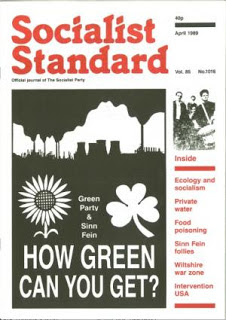
How green can you get? (1989)

From the April 1989 issue of the Socialist Standard

Throw away the red paint, lads; green is the latest fashion. Red banners and class struggles are out of date. These days, if you want to look radical you have to be green. From Number Ten the Green Goddess has sounded the clarion call: "Let’s pretend we care about the environment — there are votes in this one". Where Thatcher leads the hapless promise-makers in the Neil, David and Paddy camps follow. On this year's Labour agenda, vote-losing, truncheon-battered miners are out, vote-winning baby seals are in. The Green Party is printing application forms on recycled paper for those who like the sound of its late Eighties, health-conscious. conservation-minded message. Pity that those filling them in have not checked the parliamentary record of the German Greens who, in order to make a few legislative deals with other parties, voted in favour of a huge military budget. The Left is going green too. In the Communist Party the fetishism of commodities is distinctly passĂ©; Gramsci on the burning question of deodorant sprays and the ozone layer is big talk. The Two Royals, Phil and Charlie, are making speeches to whoever will listen about the importance of conserving this green and pleasant land. They own enough of it for the subject to be of direct interest. Meanwhile, they eagerly await the hunting and shooting season when they can pursue the noble sport of killing innocent animals. Elkington and Hailes Green Consumer Guide became a non-fiction best-seller last September, and now publishers are falling over one another to publish vegetarian recipes and shocking accounts about rain forests. It is fashionable to be green these days.

Socialists have been saying for a very long time that workers must wake up to the enormous threat of environmental damage which the profit system poses to the world around us. Nuclear weapons are just the most obvious and powerful symbol of self-destruction which capitalism has created. For decades it has been cheaper for capitalists to pollute the air workers breathe than to adopt clean techniques and practices. Methods of production which are unsafe, disease-spreading and potentially explosive have long existed. Workers' food has been adulterated for as long as there have been wage slaves; see Engels' comment about this in his book, Condition of the Working Class in England in 1844. In order to make a fast buck it has long been capitalist practice to destroy the earth’s irreplaceable resources. Animals are made to suffer and die needlessly; endangered species which have no exchange value in the market are free to become extinct. There is nothing new about any of this. It is not peculiar to the late Twentieth Century, and we did not require a new fashion to hit the tabloid headlines to recognise that we inhabit an endangered planet — endangered by the dictates of profit.

The Socialist Party is hostile to the Green Party. It is a party which stands for the continuation of the capitalist system, but in a different form. We stand for the abolition of capitalism in all forms. The two positions are irreconcilable. Those who vote for the Greens are doubtlessly sincere and caring people who want something different. In their own lifestyles, perhaps some of them have made genuine adjustments which are in line with a socially more co-operative way of living. So have many socialists, but we are well aware that individual lifestyle changes, whether they involve not eating meat or using what are called “environment-friendly" products, are not going to change the fundamental nature of the social system which oppresses us. A few million workers might give up using products which destroy the environment, but what power do we have in comparison with the minority who own and control the means of wealth production? The ruling class, be they multinational companies, state-capitalist bureaucrats or small manufacturers, have an interest in keeping their costs down. If their profits come before the long-term interests of workers, who can blame them for sacrificing workers’ needs? After all, workers voted for the profit system. Only by abolishing the system which is the cause of these problems can the effects be eliminated. The Greens, both in their own party and in the major parties, put out an on appealingly radical message, but when examined it becomes clear that it is a case for the market with a green tinge.

Green reformism
Let us imagine that a Green government is elected at the next General Election. What would it do? To begin with, it would govern. The job of governments is to run the coercive state on behalf of the capitalists who monopolise the means of life. So, like all previous governments, a Green one would be compelled to ensure that the workers are producing profits. In another sense, a Green government would not really govern at all: it would be governed by the profit system. Its Ministers would be constantly coming before us, like Labour reformists in the past, saying "Look, we honestly did want to reform this and that but. you see, with the capitalist economy being what it is..." And so the old story of reformist promises coming to nothing, followed by working-class disgust and disillusion, would go on. In Green Line (November 1988) Tim Andrews reported on a list of reforms which the Green Party Conference had just voted for: “the scrapping of the Common Agricultural Policy, the replacement of price support with income support . . . the party's intention to withdraw from the EEC unless reconstituted on ecological principles . . . opposition to free trade . . . commitment to economic as well as political decentralisation." In short, a package of policies to reform capitalism, many of which have been tried and failed in the past, and others which are just pious platitudes. A Green government of British capitalism would be no freer than any government before it to carry out changes which would conserve what is worth keeping in the world around us. Let us say that a Green government abolishes nuclear weapons, as they say it would. What weapons would it introduce instead? If none, then capitalism in Britain would be undefended and ripe for take-over by profit-hungry vultures from other states. If the Greens seek to introduce new, more humane, greenish weapons of murder, then let them spell out such a defence policy here and now. Likewise, let us assume that the Green government fails to persuade the EEC to reconstitute itself on ecological principles. Who will the British capitalists trade with? And why should non-EEC trading agreements be any less concerned with profit before need than the current ones are? Or would a Green government only agree to trade with nations which are ecologically principled? The question alone demonstrates the catastrophic implications of the expected green answer.

It is simply impossible to purify or humanise this capitalist system. And some of the more aware Green politicians, such as Jonathan Porritt, probably know this. They would argue that politics is about pragmatism, that is cynical compromise. It is about “lesser evils". But why vote for Porritt and his fellow would-be governors to administer the lesser evil when capitalism, which creates the evils, can be abolished altogether? The usual reformist answer is that the lesser evil will take less time to achieve than the grand socialist aim. The Socialist Party was told this by CND nearly thirty years ago when they were going to reform the threat of nuclear annihilation out of existence; we were told it by the reformists of the Labour Party over eighty years ago — they were going to eradicate poverty. It is a foolish myth that partial objectives are more worthy of support than realisable big ones. There is unlikely ever to be a Green government, and if there is, then its greatest critics will be present Greens who will complain that it has sold them out. It is inevitable with reformism; it must sell out in order to fit in with the needs of the system.

Green anti-materialism
Socialists are materialists, but not in the sense that the term is often used: it does not mean that we want people to have more and more “material” things, such as cars or video machines. To be a materialist is to recognise that human beings are rooted in our social environments. Our consciousness is social, and through conscious action we can alter the material environment of which we are a part. The environment is not something Out There which must be protected; it is part of us and we part of it. To be a materialist is to reject antiquated, idealist nonsense about the soul or the spirit. The present writer attended a debate two years ago in which the Green speaker pointed out that being green was all a question of the spirit. Asked to identify this spirit, the Greens laughed a little and ended up proclaiming that if you don’t know what it is then you ain’t got one. Are we to conclude from this that the new Green World is to be established by those who have discovered their spirits, leaving behind us poor wretches who have only our material selves to live with? There is a good deal of arrogant self-righteousness in the Green claim to have seen a better world. What they fail to understand is that seeing visions does not transform the world. Even Tories see glorious visions.

The task facing us is not to romanticise, but to revolutionise. Of such thinkers Marx wrote in The Communist Manifesto that they were “half lamentation, half lampoon; half echo of the past, half menace of the future: at times, by its witty and incisive criticism, striking the bourgeoisie to the very heart's core; but always ludicrous in its effect, through total incapacity to comprehend the march of modern history." Such will always be the condition of visionaries whose pictures of social completion are really images of a re-created past. The Green dream of a semi-rural arcadian utopia, undisturbed by the thundering force of Big Business and its needs, is really a looking backwards, a conservative ideal All this spiritual nonsense serves as a valuable diversion as far as the ruling class is concerned: while the proles are searching for the invisible spirits they will not be disturbing capitalism as a material reality.

The Times (26 December 1988) reported that "After a decade of old-fashioned pursuit of money and status. Americans and the citizens of the other rich countries will, as the planet runs low on space and resources, turn in the closing years of the century to spiritual fulfilment." The newspaper was responding to an article published in The Futurist, which is published by the World Future Society based in Washington DC. In the same city is the US Department which collects figures on official poverty. It reports that one in four citizens of the United States is living below the government poverty line. So, while bored Californians turn to the non-existent spirit for comfort in a worrying world, others cry for lack of material necessities to keep themselves warm, fed and clothed. There is no solution to be found in the so-called New Age ritualism whereby abstract idealism overcomes the need to attend to harsh material requirements. And it is precisely because there is no solution in such inaction that capitalism will quite willingly accommodate the growth of Green ideology.

Green profits
Big business is making plenty of money out of the new green consciousness. An article in The Guardian entitled “Conning of the Greens" (17 December 1988) pointed out that the supermarket chains are losing no time in cashing in on the willingness of workers to buy healthier food. This suits the capitalists who employ workers: the healthier we are the more exploitable we are. And it is increasingly suiting the retail capitalists who have created a whole new range of commodities which can be sold at extra cost — conscience money. Sainsbury's was selling organic potatoes at 64 per cent above the price of normal potatoes; organic leeks were 67 per cent dearer and organic lemons 114 per cent more. Tesco's is selling its “own-brand UK mineral water . . . that is calorie free ". John Elkington points out that “People . . .  like to feel that they are paying something extra to protect the planet." Very nice too, if you are one of the capitalists who own the planet.

Capitalism will pass a few minor reforms to win a few green votes, and also because the capitalists themselves realise that their investments are being damaged by the filth created by a lack of environmental concern. Just as they passed The Clean Air Act of 1956, so in the months to come they will attempt a few more self-regulating laws. Needless to say, these laws will be evaded by those rich and powerful enough to do so. Even when the capitalists are agreed on their common interest, there will always be one or two who will try to sneak behind the others’ backs and make an even faster buck.

The planet belongs to them. We, the workers who produce everything and run the planet from top to bottom, have given it to them. Our task is to take it away from them; to reclaim the planet. The Green Party, which does not stand for the socialist transformation of global society, cannot take the planet away from the capitalists. In the end, all they are is a rather futile reform group, pleading with the profit-taking class to do us all a favour and take less profits. Given such a pointless crusade, we need not to be surprised by the following section of the report of their 1988 conference:
Perhaps the most contentious issue at conference was the attempt by National Party Council to replace the sunflower as the party's logo with one of three designer-symbols commissioned by professionals . . . The arguments against keeping the sunflower were confused: it had become associated with healthy eating, some said, while others claimed it looked like a fried egg (hardly healthy food!). Commissioning new logos on such spurious pretexts seemed unnecessary. After all, sunflower logos only look like fried eggs when the petals have not been drawn properly . . . (Green Line, November 1988)
For further news of these exciting political dramas within the party of the future, watch this space.
Steve Coleman

Tuesday, October 13, 2015

Between the Lines: Next Fraud, Charity and Homelessness (1989)

The Between the Lines Column from the April 1989 issue of the Socialist Standard

Next Fraud
Next Left (C4, 8 pm, Fridays) offered four programmes packed to the edge of the screen with undiluted nonsense. Purporting to be about the failure of socialism in years past and the need for socialists to adapt to the new age, the series offered the most facile account of current world politics and not even an attempt at explaining what socialism actually means. It seems to be the case that when documentary-makers produce films about socialism they feel quite free to accept the fallacy that anyone who calls himself a socialist is one. Neil Kinnock, Bryan Gould, François Mitterrand, Brandt, Rocard  . . . all of them advocates of state-run capitalism, and all of them called upon to discuss why the failure of their state-capitalist policies means that socialism has been tried and failed. The working class, we are told, is disappearing; the market is becoming more accountable to people's needs; planning has failed and "freedom" is the new buzz word. "Socialists" must adapt to these new conditions or become irrelevant. Instead of talking about social transformation socialists should be attending to more modest changes, we are informed, such as establishing workers' co-operatives and providing welfare services through the trade unions. The new "socialist" model is Sweden; "socialism" works there — even though Sweden is a capitalist country. No contradiction. No need to explain anything. The frauds who make these programmes are like the character in Alice in Wonderland who insists that words shall mean what they want them to mean. Channel Four's attempt to advise socialists to throw away our revolutionary principles and attend to making capitalism work was intellectually shallow, dishonest drivel.

Laughing all the way to the bank
Another bloody charity telethon. It is hard to switch on the telly these days without seeing either Kylie Minogue or a begging bowl. This time it was Comic Relief (BBC1, all evening, Friday, 10 March). No doubt there was plenty of sincerity there. So what? Since when has plenty of sincerity made the profit system run in our interest? This time we were treated to comedians making jokes to encourage workers to send in a few quid. In one night's nationwide collecting Comic Relief brought in about £10 million. About enough to buy a cheapish military fighter plane. The same night's Newsnight (BBC2, 10.30 pm) had a very brief report on the annual profit made by the clothing company, Viyella: £135 million — down on last year's figure. That's a year's profit for one medium-sized capitalist company. So, who is giving more to charity — the workers who collected ten million quid after a day of wearing silly plastic noses and bathing in custard for sponsorship, or the wage slaves at Viyella who donated all that profit to the capitalists in the biggest charity of all: The Wages System? The capitalist class are kept in the luxury to which they are accustomed because a majority of workers acquiesce to a system which puts the profits of the rich before the unmet needs of those crying out for help.

Free to beg
World In Action (ITV, 8 pm, Monday, 6 March) was a documentary depicting the miserable lives of kids who, having left home and come to London in search of work, find themselves in cardboard boxes on the Embankment by the River Thames. These youngsters — many of them under eighteen — are compelled to beg in order to live. Young girls are under great financial pressure to find a pimp and work for him. The programmes showed that the young beggars of London are a fast-growing population, products of a system geared not to encouraging the creativity of people, but to making them exploitable workers. If they are too young to be put to work and too poor to find shelter, then they are ignored as if they did not exist. This is the living reality of the great revival of Victorian values: the sight of homeless kids forced to beg for the price of some food — and probably for drugs once the culture of street frustration has finished with them. And these well-paid TV tricksters on Channel Four tells us that the socialist revolution from production for profit to production for human need is no longer relevant.
Steve Coleman