Monday, April 11, 2022

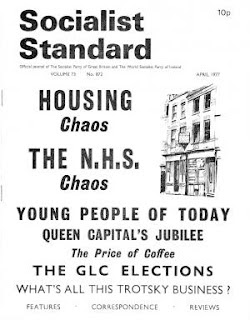
The NHS — nothing for something ? (1977)

From the April 1977 issue of the Socialist Standard

“The love or my life”, Barbara Castle called it, and her successors still try to tell British workers that they’re getting something for nothing.

But what are the facts? Dr. David Owen, until recently the Health Minister, says: “The NHS was launched on a fallacy. We were going to finance everything—cure the nation—and spending would drop. That fallacy has been exposed now we realise that no country, even if prepared to pay the taxes, can supply everything.”

Supply everything”! What does it supply?

On the “free” health service a specialist consultation for a patient requested by a general practitioner has to wait for anything up to 10 months. In some places an appointment for a child with recurrent tonsillitis to see the ear, nose and throat surgeon may take 4-5 months and then, if the surgeon thinks removal of the tonsils is indicated—the wait for operation is measured not in months but in years. A middle-aged woman may have to wait as long as seven years to receive her hysterectomy.

And most of the hospitals where the operations are done are ramshackle, overcrowded and out of date. Beds are close together, operating rooms have damp-stained ceilings and peeling walls. Furniture is battered and linen thread-bare. Only 41 of Britain’s 2300 hospitals are less than 30 years old.

The sport at Oldham General Hospital among patients is taking bets on the number of cockroaches crossing the floor in a given time span. One local medical officer says: “This hospital is so permeated with the filth of the ages that the only answer is to raze it.”

One feels there should be an energetic programme to build new hospitals, but the reverse is the case. New hospitals are not being completed and existing ones being closed down. John Pilger in the Daily Mirror (25th Jan. 1977) tells us of the coming closure of the Connaught and Metropolitan Hospitals as part of the Government’s public spending cuts. Both hospitals' secretaries say that closure will mean “unimaginable suffering” for ill patients who will have to be sent home. Quote: “Mr. Peter Richardson, secretary of the Connaught, a 121-bed community hospital, which closes on Monday said last night, 'To close down now, in the middle of winter, is madness. We have a “yellow alert” at this hospital right at the moment and that means the beginning of an emergency. Many of our 100 patients are the elderly with chest infections, such as bronchial pneumonia’.”

Also from John Pilger, the Daily Mirror (26th Jan. 1977) quotes the surgeon at the impoverished Northampton hospital who pleaded: “How can I allay the fears of a woman who has to wait weeks and weeks for a breast cancer operation?” And at the Hackney General Hospital the casualty department was being forced to turn away children. The Daily Mirror continues: “Northampton and Hackney are typical of a great many British hospitals which have been starved of funds for years and are now being called upon to make cuts which are impossible without incalculable suffering and—as the doctors have said—deaths.”

But “solutions” appear to be on the way—though not very pleasant ones for the working class. Apparently the time has come for them to pay (even more) for their “free” health service. A front page headline in Medical News, 19th Jan. 1977, announces: “£2 a Day Charges for Hospital Patients would raise £300 million.” Below we read: "BMA Council believes that the Royal Commission should consider approving hotel charges for hospital patients . . . Council is recommending daily charges for bed and board in hospital, and increases in prescription charges. It believes a flat rate weekly compulsory payment for health services to be paid into an independent NHS fund should also be looked at . . . Basically the Council was unanimous in feeling that a totally free NHS at the point of consumption led to the undervaluing of the health service. Charges would impose a more thoughtful attitude on the part of the public, and also among doctors, who sometimes have no idea what the treatment they prescribe is costing.” Says Medical News: “. . . the feeling was that quite serious illness could be treated at home by a GP, and the patient there had to pay for his accommodation and food, so there was no reason why the hospital patient should not do so.”

And on the front page of Medical News 26th Jan. 1977: "Doctors Warned to Monitor Prescribing Costs —or Else.” The article reads: “If doctors do not monitor their prescribing patterns in terms of both efficacy and cost more effectively, they may have controls imposed on them.

"This is the underlying message for doctors following a report into the work of the Prescription Pricing Authority (PPA) published last week.

“The main recommendation of the report is that the work of the PPA should be computerised to speed up the processing of prescriptions and also to provide a better flow of information on prescribing patterns and costs.”

Mr. Tricker told Medical News, amongst other things: “The report makes no recommendations on the control of prescribing, and I argue for self monitoring by the doctor. However, the report does raise the question of alternative forms of control by the state if doctors seem unable to control prescribing for themselves.” Various forms of controlling prescribing were considered. Two suggestions were the exclusion of certain drugs from free treatment under the NHS, or restricting doctors’ prescribing to the BNF (British National Formulary).

Another form of control would be to introduce a local drug expenditure based on the population of an area. Funds would be allocated by the DHSS. The budget could be monitored by the local medical and “local peer group interest could be brought to bear” on a doctor. (In other words—set general practitioners to compete with each other to supply the least and cheapest treatment.)

In Doctor (10th Feb. 1977), however, we read: “Mr Ennals (Social Services Secretary) was full of praise for the prescribing standards of GPS. They were unequalled in the world, with the cost of drugs per head of population being lower in this country than elsewhere in the EEC.

“ ‘But there may still be scope for further economy (in drug costs) without harm to patients,’ he added.” Thus we learn from the boasters of the best community health service in the world that although we’re doing it the cheapest—we might still do — “better?”!

And now there are new worries for those professing to have the welfare of the sick of Britain at heart. Quote: General Practitioner, 21st Jan. 1977: “Fears Mount on Doctor Surplus. The BMA is demanding an immediate inquiry into the threat of unemployment among doctors in the early 1980s. Fears that medical schools are producing too many graduates have been highlighted by the Hospital Junior Staffs Committee after a four year investigation. The BMA is to ask for an interim report on whether these fears are justified in its evidence to the Royal Commission. The juniors believe that unless medical school places are cut immediately by 1000 a year, there will soon be too few jobs for newly qualified doctors.”

And in Medical News, of 26th January, 1977, Cyril Clarke, the retiring president of the Royal College of Physicians, has urged Britain’s 26 medical schools to consider cutting back student intake to prevent the hardship of an unemployed “bulge” later.

“The situation, he said, could not wait for the Royal Commission. It was far too urgent.”

“We must not run into a school teacher situation,” said Sir Cyril. “We should not bank on too much NHS growth.”

So, while patients wait for months for appointments, years for operations and queue up for hours in outpatients’ departments to see junior doctors who are elsewhere and working 80 hours a week, the powers that be are at pains to decrease medical manpower. Tragically—like other unenlightened workers—some junior doctors think that this is a “solution”. They fear the threat more help from an increased number of colleagues would make to their industrial bargaining power. There is, of course, and will be for a long time to come, a dreadful shortage of doctors in real terms. Apart from the dearth in existing premises there is a desperate need for them to man many vital hospitals. The trouble is that those hospitals are either not being built, or not being completed or being closed down.

The situation is similar with trained nursing sisters. They find themselves redundant whilst their colleagues desperately try to cope with endless lines of patients.

It is a “teacher situation”. Students rallied to the call for more teachers to reduce the numbers in school classes. Result—most of them out of work and still we have overcrowded classes.

And it’s all because people aren’t working hard enough, isn’t it. Mr. Callaghan? They’re not getting their backs into it and paying their way. Why don’t you leave it to the Tories to tell the working class that the trouble is they don’t like work? They’ve had (a bit) more practice at it than you have!

All this rottenness doesn’t have to plague us. There are enough men and women who want, and have the ability to be—good doctors, nurses, teachers, hospital and school-builders and organizers, to make mankind healthy, happy and secure. Only the capitalist system, which the vast majority of workers support, maintains need amidst potential plenty in every sphere of human life. Why not vote that system out of existence?
R. B. Gill

What’s all this Trotsky business ? (1977)

From the April 1977 issue of the Socialist Standard 

A professional revolutionary called Bronstein adopted the then fashionable idea of a nom de guerre (Ulianov became Lenin; Dugashvili, Stalin) and became the Trotsky who is now having such a mysterious rise to fame thirty years after his death at the hands of a thug employed by his former comrade Stalin. He must at least have had a sense of humour for he took his new name from his Tsarist gaoler at the beginning of this century. And before we finish with it, the new name did not quite succeed in rubbing out the old one. When he fell foul of Stalin, the latter used to see to it that '“Bronstein” used to appear in brackets after “Trotsky”. Thus, without laying himself open to the charge of anti-semitism, Stalin was able to inform ignorant readers of Pravda that his opponent’s real name was obviously Jewish. (The Trotskyists in turn used to refer to “that dog Dugashvili”. Much good it did them. The Bolsheviks inherited the anti-semitism of the Tsars. And cherish it to this day.)

At the time of the abortive 1905 revolution, Trotsky was an opponent of Lenin. In due course he changed his mind and by the time of the 1917 revolution was Lenin’s chief supporter in the seizure of power. Not of course from the Tsar. That job had been done six months before by risings in St. Petersburg and Moscow while Lenin was in Zurich (he not only had no hand in the overthrow of the Tsar; he did not believe it when they told him). The Bolsheviks overthrew Kerensky who stupidly tried to keep up the slaughter in the war with Germany. Trotsky himself never made any special mark while Lenin lived except as his faithful henchman. The only episode he stamped with his own brand was the massacre of the Red Sailors at Kronstadt — the very sailors who had enabled Lenin to smash Kerensky in the Winter Palace but had the audacity to ask: “What about some freedom and democracy now we have overthrown the Tsarist tyranny?” In opposing the modern Trotskyists, a Labour Minister called Mrs. Williams has dug up the Kronstadt story. She forgot to mention (or didn’t know) that when the anarchist Goldman tried to stir up the Labour Party about the massacre shortly after it took place, her party — the thuggish Bevin and the pacific Lansbury — turned their backs on her.

After Lenin’s death, Trotsky and Stalin fought for the crown. As to what the quarrel was about, all the pundits used to write incomprehensible twaddle about revolution in one country, permanent revolution, etc. etc. ad nauseam. The Bolshevik Stalin murdered his rival gangster in the same way that the Nazi Hitler murdered his rival Roehm in the same grisly era. And is there any real point in retelling the story now? Hardly. It is merely that when one wonders what all the Trotskyist splinter groups are doing in the current recrudescence, it is as well to see who the original Trotsky was. And then we might know the explanation of the current Trotsky epidemic? Quite the contrary. We merely know that Trotsky was just another Leninist opportunist and had no special theory to contribute to present-day thought whatever. That he twisted and turned like any Stalinist, right to the end. And that the .imbeciles who now proclaim themselves his posthumous followers (and would cheerfully murder the other Trotskyists who do likewise) have no more connection with Trotsky than they have with Socialism. They would be horrified to hear it but Stalin and Trotsky were just Tweedledumski and Tweedledeeski.

So who are the Trots? A number of groups (some a bit bigger than the Socialist Party, some a bit smaller) who seem to hate each other’s guts as much as they hate the Communists and Maoists. There was a hilarious piece in the Observer (16th Jan.) describing a meeting in Friends’ House at which Gerry Healy, of the Workers’ Revolutionary Party, was denounced, in his presence, for writing a book actually accusing the leaders of the American Socialist Workers’ Party (the babble of names of all these Trotsky splinters is quite bewildering) of a crime. What crime? Why, nothing less than being accomplices in the murder of the old villain himself way back in 1940!

As the police haven’t bothered to arrest anyone and as the victims of the alleged libel don’t seem to have sued, either, one assumes that this is all some idiot game in which these fools — having nothing to contribute to Socialism — re-enact the feuds in Moscow in the ’20s. Tariq Ali was in the chair on behalf of the International Marxists (who are neither international nor Marxist) and play-acted a silly drama in which a gang of young asses marched in front of Healy so Ali couldn’t see him from the floor and the chairman then took a motion (carried? You bet!) refusing to hear the enemy. And these are the types who join in parades with banners demanding “Keep the fascists out.” What on earth do they think they are themselves? The meeting had brought over another of their stars from Belgium, Ernst Mandel, complaining that Healy was rocking the boat just when they were “getting accepted as a genuine force in the working class movement”. Were they now? Somehow one hadn’t realized it.

Phrase-mongers of the world unite. You really all stand for the same thing. Reform of capitalism. However much some of them prattle about Russia being state-socialist (but Trotsky insisted it was worth defending every acre with working-class blood right to the end), they all stand for “involvement in the workers’ day-to-day struggles” and similar claptrap. And not only is it difficult to detect the difference between the various warring groups and tendencies; it is quite impossible to see where they differ from the older gangs of capitalist reformers masquerading as socialists — the Communist Party and the Labour Party. A Guardian ignoramus called John Cunningham attempted to define the various splinters (4th Feb.) but left us groping in the dark — for which the poor devil could perhaps be excused. What was, though, quite inexcusable was that he had the nerve to state that the Trots were adopting “entryism” — more phrases — into the Labour Party even though they did not hold with Labour’s Constitution of which “the Marxist part” was Clause Four — “the common ownership of the means of production”. Now that’s Marxist right enough. But only the SPGB has ever advocated it and even the Guardian creep must know that Clause Four refers to the means of production and exchange. The last phrase is the give-away. What the devil would you want with means of exchange if all was socially owned? What these fools refuse to see is that the epitome of Clause Four has long been achieved in Russia. Which even Trots will now admit is state-capitalist and has not the remotest connection with Socialism.

Only one thing is certain. In a few years, all these groups will have joined those of times past in “the dustbin of history” (favourite phrase of all these? lefties). New insects will emerge to take their place in lousing up the working class. Large or small, the only Socialist Party will still be there. Hasten the day when the workers will start to see the wood for the trees.
L. E. Weidberg

50 Years Ago: Revolution and Violence (1977)

The 50 Years Ago column from the April 1977 issue of the Socialist Standard

When we say that Socialism means revolution and that we are revolutionaries, experience leads us to expect that we shall be misunderstood unless we take care to make our meaning plain. On the one side it will be assumed that we are advocating violence and anti-democratic methods, and on the other side, as we are frequently told by those who do advocate these things, our refusal to do the same stamps us as non-revolutionaries. What then do we mean by revolution?

* * *

We see that the workers are poor as a class because as a class they do not own the machinery of wealth production and distribution.

Nothing will serve to secure the desired end, except the abolition of the private ownership of these instruments. But private property is the corner-stone of the existing laws and the very foundation of capitalist society. So that in order to abolish private ownership, we, the workers, must obtain control of society. Revolution consists in using the power we shall then possess, for the purpose of destroying the present property rights and refashioning society on the basis of common ownership. As our aim, Socialism, can be accomplished only by this revolutionary change, we are revolutionaries and our method is revolution.

(From an unsigned editorial “What we Mean by Revolution”, Socialist Standard, April 1927.)

Which Arabs; Whose oil ? (1977)

From the April 1977 issue of the Socialist Standard 

A little snapshot can show more than a whole picture. In December London had its coldest day for quite a few years. Snow, sleet, a biting wind, all most unpleasant even to a well-wrapped-up northerner. In a shop doorway, huddling out of the snow and looking very miserable, was one of the numerous Arabs now seen in London. He was dressed suitably for the desert sands — thin cotton galabieh, ditto keffiah on his head, and almost bare brown feet in open sandals. That same day an article by Anthony McDermott (one of the Guardian Middle East experts) said that Abu Dhabi has the highest per capita income in the world yet most of its families are miserably poor. The poor creep was puzzled. Simple answer: A few Arab brothers own the oil. The bulk of the Arab brothers own the sand (perhaps not even that). No prizes which lot the poor devil in Baker St. belonged to. His chief was doubtless in a warm bed in the Dorchester (which belongs to Arabs). Could there be a lesson here for the Scottish working-class fools who are voting Scots Nats to secure “our oil”?
L. E. Weidberg

The Housing Mess (1977)

From the April 1977 issue of the Socialist Standard

“Every great city has one or more slums where the working-class is crowded together. The poverty often dwells in hidden alleys close to the palaces of the rich; but in general a separate territory has been assigned to it, where removed from the sight of the happier classes, it may struggle along as it can. These slums are pretty equally arranged in all the great towns of England, the worst houses in the worst quarter of the towns".

Engels wrote that passage in 1845 (The Condition of the Working-class in England. Progress Publishers, 1973, p. 86). One is struck by the thought that the passage could be written about the state of housing today. That is not to say that the housing conditions of the working class are exactly the same now as they were in the 19th century. Many of the appalling living conditions described by Engels in his book no longer exist; in particular the sanitation of most homes and the health regulations that now cover all dwellings and built-up areas have substantially removed some of the more obvious eye-sores that Engels so vividly described. On the other hand, as is well known, some of the actual houses that Engels refers to (in the Manchester and Salford areas for example) as being unfit for habitation in the early 1840s are still standing and still inhabited. So much for the progress of capitalism.

Capitalism has not even made a start on solving the problems of the homeless, or in solving the problems of the living conditions of many workers “lucky" enough to have a home at all. The reports in the capitalist press show that their system, capitalism, has not even scratched the surface of these problems.

In 1966 yet another charity was formed, this one called “Crisis at Christmas". The modest intention of this lot was to help homeless single people at Christmas; to provide these people with homes and food at a time when the capitalist sales ethic is at its fiercest usually matched in intensity by the weather. The intention of the charity was to be a short-term effort, clear up the particular problem and then concentrate on some of the charity’s other, more “long-term", aims. Ten years after its formation, the charity finds it has more work to do than ever before at the season of “goodwill" (meaning of course “good sales”). The society found that for Christmas 1976 the size of the problem had grown at a frightening pace since the charity’s formation. They estimated that there would be at least 8,000 men and women “sleeping rough” in London alone. According to Shelter the figures now show that “since 1970 the number of families becoming homeless in England had doubled." (The Times 1st Sept. 1976.)

Now let us look at the situation of those workers who do have a home. Sections of the working class are living in rented council and private accommodation that though “passed” by all standards of capitalism, in many cases is not where people would choose to live had they any say in the matter. The high-rise flats developments of course are one of the best illustrations of that situation. But there is a sizeable minority who are scarcely better off than the officially homeless. In England and Wales in 1975 1,200,000 homes were unfit according to the statutory definition. A further 1,800,000 homes “whilst not legally unfit, lacked one or more of the so-called ‘standard amenities’ which most people would accept as being basic needs for modern living" (The Times 8th June 1976). And The Times report goes on to point out that the standard of what is fit for habitation is still largely based on public health criteria of the early 1900s. The problem is particularly severe on old people. One person in every five aged over 80 has no inside lavatory and no fixed bath and 500,000 people over 65 have no hot water.

The problem of inadequate housing is not peculiar to English workers; it applies to members of the working class throughout the world. For example French workers have the same conditions to face: “Sixteen million people live in sub-standard housing in France, that is to say without the minimum modern conveniences of a bathroom or a shower and indoor lavatory. Half of these sub-standard homes are inhabited by people over 60.” (The Times 16th Jan. 1976.) Capitalism is a world system; it has world problems that require a world solution. But before getting on to that it is worth examining the housing surplus. It may seem strange to talk about a surplus when so many people are either homeless or living in unfit conditions. But as with other commodities of capitalism, there is an apparent shortage and an actual surplus. It is the dictates of the market that result in, for example, food going to waste whilst people starve. The same is true of housing.

The number of “fit" homes standing empty is probably difficult to estimate. One attempt was given by Arthur Latham (Labour MP for City of Westminster and Paddington) who said that the 1971 census showed “there were 790,000 empty flats and houses in the United Kingdom which were habitable dwellings" (The Times 7th May 1976). And he ought to know — according to the report of the Paddington Federation of Tenants’ and Residents’ Associations called “Empty Properties in Paddington" there were nearly 1,000 homes standing empty for over 18 months in one part of Latham’s constituency alone! (See The Times 7th June 1976.) Another estimate is that there are at least 57,000 homes empty in London. This figure was given by Mr. Tony Judge, chairman of the GLC housing management committee. (The Times 16th Sept. 1976.) The Nationwide Building Society’s survey on Housing published in April 1976 estimated that there was a “surplus" of 850,000 houses in the UK. The building society, ever anxious to look after its own, suggest that in view of the public preference for “owner occupation” (they mean of course "purchase on a mortgage”) there were too many local authorities doing their own development and that “it seems doubtful whether such a high rate of new local authority building is required”!

In the capitalist sense the building society are right — if people can’t pay for houses then there is no point in building them, no point that is for the capitalist class. Like all other contradictions of capitalism, the fact that there is a chronic housing plight does not mean the builders are busy with bricks and mortar. On the contrary: “House building activity fell sharply in October . . . Total starts in October were 21,5000, more than 8000 down on the previous month. Completions dropped by more than 4000 . . .  Discounting normal seasonal movements total starts in August to October were 11 per cent below those in August to October last year . . . Stocks of bricks rose during October from 408 million to 432 million.’ (The Times 1st Dec, 1976.)

Faced with this situation, there are two choices. The first is to try to do something about housing within the present economic system. If history teaches anything it ought to be that such a course is a waste of time. Even the capitalists’ own research programmes can tell you that. For example, commenting on a secret Department of the Environment report the Sunday Times said that the report shows “that new investment will not solve homelessness . . . the report recommends that instead of spending more money on housing, London’s new building programme should be cut as quickly as possible (22nd Aug, 1976). The Sunday Times comment ((apparently in all seriousness) is that the report shows that “the housing shortage in London is well on the way to solving itself’! No doubt just what every capitalist politician always dreamed of—you write a report, you pass it round a few government departments, you let it out to the press and hey presto the problem will vanish of itself! Or you could listen to a lunatic’s solution to the problem—this one from the Prime Minister of Canada. His solution to the environment problem, of which housing is a part, is simplicity itself. In his opening address to the United Nations Conference on Human Settlements 1976 (known as “HABITAT”) he gave as his answer: everybody “loving one another”! (The Times 1st June 1976.)

There are no prizes for guessing the second choice—Socialism. In brief, this means the taking over by the working class of all wealth (including houses) in society and from then on running society in the interests of all. When all wealth is owned in common it will mean that it is no longer possible for houses to stand empty whilst people are homeless. Homes will be built for use. And what is needed to achieve a society where it will be possible to solve the problems of the physical needs of all? Men and women ready to take the steps necessary to bring it about, fully aware of what the transformation of society requires. “For the production on a mass scale of this communist consciousness, and for the success of the cause itself, the alteration of men on a mass scale is necessary, an alteration which can only take place in a practical movement . . .” (Marx and Engels, The German Ideology; Collected Works Volume 5 p. 53, Lawrence and Wishart edn.). The instrument of that movement, the SPGB, is ready, it is now up to the reader to investigate further.
Ronnie Warrington

Michael Harrington quotes (1977)

From the April 1977 issue of the Socialist Standard

Count Bismarck was the first of the anti-socialist “socialists”. In 1878 he outlawed any organisation advocating socialism. In 1882 he was telling the Reichstag: “Many of the measures we have adopted are socialistic and we need more socialism in our state”. He had shrewdly understood that the socialists had mass appeal and was determined to use socialist slogans to fight socialism.
Socialism by M. Harrington (Bantam Books)


Man has socialised everything except himself. He has rationalized his work and nature and the very planet in every respect save one, and just as the socialists predicted more than a century ago, he is in conflict with an environment that he has brilliantly and thoughtlessly created. His genius threatens to overwhelm him.
Socialism by M. Harrington (Bantam Books)

A little knowledge (1977)

From the April 1977 issue of the Socialist Standard

Can you keep a secret? Sir Nigel Fisher, Conservative MP for Surbiton, has written a book on his Party’s leadership struggles and the Sunday Telegraph is serializing it. The extract in the 13th March edition described William Whitelaw as “an old and trusted friend” of Fisher’s. However, in describing the election of Mrs. Thatcher as Conservative-in-Chief, he remarks on Whitelaw’s candidature for the leadership in revealing terms:
Despite his many qualities of character, Whitelaw would have had weaknesses as a party leader. He knows nothing about economics. Some economists do not consider this a disadvantage, but it cannot be an asset in these days.
Which could suggest a slighting reference to previous Tory leaders and how much things have changed. But to be fair, they have all known enough. All of them could spot a profit from a loss, and similarly recognized to whom the profits belonged.

So They Say: People in Glass Houses (1977)

The So They Say Column from the April 1977 issue of the Socialist Standard

People in Glass Houses

When a leading authority on a subject makes a judgement, it is an important one. On February 28th Mr. Eric Heffer described the entire Conservative Party as hypocrites. He was taking part in a mutual exchange of hot air in Westminster Palace on the question of the British Leyland toolmakers’ strike.
It was hypocrisy for the Conservatives to say there should be higher incentives for the higher paid but when workers sought incentives they were accused of being disruptive.
Daily Telegraph. 1st March 77
This is a part of what is romantically referred to as the cut and thrust of debate, which in reality resembles nothing so much as the moronic lowing of cattle. It does not strike Labour MPs as odd that their own Minister for Industry, Mr. Kaufman, advances the argument that the Leyland strikers have brought the company into “danger of bleeding to death”, while two days later their Industry Secretary, Mr. Varley, was informing his cronies that “the effect on profits was critical.”

How is it possible for workers to bleed a company to death by withholding their labour-power? That is putting the cart before the horse. One certain effect a strike will have is to prevent the workers’ own life-blood being pumped in to emerge later as the profits so dearly sought by the Labour Party. Where has the accumulation of capital now vested in British Leyland come from, if not from the “bleeding” of surplus-value from previous generations of workers? That is the process which the Labour Party wishes to continue.


Marx, out of date ?

As Heffer pointed out, the Conservative backwoodsmen have emerged wanting to back it both ways by condemning Leyland workers on the one hand, while claiming that the “erosion of pay differentials” is to blame on the other. Mr. George Gardiner, Conservative MP for Reigate, added his tuppence worth in a Sunday Express article of March 13th. “There is nothing praiseworthy about suicide”, he decided in reference to the strike. With a little twisting and turning, two paragraphs further on he is commenting on the size of wage differentials between skilled and unskilled workers. On behalf of the toolmakers he asks: “Was all that early training worth it?” 

Aware of the fact that he has to produce something more “praiseworthy" than this, he goes on to argue that “squeezed differentials” have taken the edge off what he calls "our national competitive ability”. The Conservatives will change all that.

More powerful influences than Mr. Gardiner or his Party however will determine the levels of differentials, and the Labour government will be unable to keep the lid down for long as the laws applying to the value of labour-power begin to be felt. No doubt the Conservatives would be horrified to think that something which they are now promoting as a policy, was outlined by Karl Marx as one of capitalism’s economic laws, more than 100 years ago.
Upon the basis of the wages system the value of labouring power is settled like that of every other commodity; and as different kinds of labouring power have different values, or require different quantities of labour for their production, they must fetch different prices in the labour market.
Wages, Price and Profit, Chapter 7.
It is doubtful that the Conservatives will refer to this passage when proclaiming their “policy”, but then they would happily take the credit for restoring the law of gravity should the Labour Party try to ignore it.


More from Mr. Gardiner

Once warmed to his theme, the MP for Reigate is a hard man to stop. He gushes: “Let us not only recognise differentials, but positively welcome them.”
For virtue lies not in enforced equality, but inequality, provided it is founded on merit and not on privilege.
Sunday Express, 13th March 77 (His emphasis)
From a working-class point of view the above is pure humbug. The ownership and control of the world's resources, the means of life, rest in the hands of a privileged minority of men and women. They have taken the inequality which Mr. Gardiner sees as so desirable to its logical conclusion—they have left the members of the working class with nothing except the ability to work. If Mr. Gardiner seriously wishes to question the “virtue” of the situation, the first thing he must do is to leave the Conservative Party and look around him.

The News of the World of the same date published their “Wills of the Week” column—their equivalent of the last rites—and the gross value of tho three wills reported came to just under £l.5m. The three deceased must have indeed been meritorious workers by any standard to have accumulated an average of £500,000 each. The answer is that all the talk of merit is a carrot (or a stick) and applies only to members of the working class. The answer to workers’ problems does not revolve round the question of pay differentials within capitalism, but on a clear understanding of the need to abolish the wages system itself.
Higher productivity would help solve some of our problems, but it will only help employment if it is reflected in higher profitability. The union leaders can be forgiven for not knowing this, for it is a branch of economics outside the mainstream of thinking on which British economic management has been based.
Sunday Times, 13th March 77
And he has proved it all with the help of “coefficients of determination of a regression equation”, so it must be official. Union members previously labouring under the misapprehension that employers were in business primarily to provide employment will now see that there is something in it for the governors after all.


There's no fool  . . .

Now that Harold Wilson is trying to assume the mantle of “an elder statesman” he feels at liberty to speak with even more ambiguity than we had previously thought possible. Addressing the Financial Times conference on the future of Europe on 11th March, he discussed political problems in Britain.
The Communists presented no political problem apart from marches and demonstrations. Britain’s problems were on the one hand Fascists and the National Front, and on the other the various kinds of what were usually lumped together as Trotskyists, the International Socialists, the Workers Revolutionary party, the Socialist Party of Great Britain, and various others.
Daily Telegraph, 12th March 77
Wilson does not say that he is doing the lumping together, but as he is the only one in sight it is difficult to avoid the conclusion. However, be he as pure as the driven snow in the matter, we have some useful advice for him so that he may not compound the error. Read our Object and Declaration of Principles published on all our literature. They will appear unfamiliar at first and that is because they are Socialist principles. Pay especial note to principle number 7—that applies to the Labour Party and all the other non-Socialist organizations referred to.
Alan D'Arcy

From America: The Coffee ‘Rip-off’ and some facts of Life (1977)

From the April 1977 issue of the Socialist Standard

Permit me to add my two bits-plus worth to the brouhaha over skyrocketing coffee prices in America.

I worked in coffee warehouses where “working in coffee” can mean anything from “bull gang labour, unloading freight cars of 125-pound sacks of green coffee (two men per sack) to stacking cases of 1-pound tins of ground coffee (prior to the advent of fork-lifting machines) in five and/or seven tiers that reached above the rafters (until a tip that fire inspectors were on the way had bull gangs frantically tearing down the top layers).

In between these extremes were stints at loading empty cans on the track at the top of the packing process; and duty at the spout from which the packer keeps pace, like an “appendage of the machine,” with a steady flow of filled and hermetically sealed 1 lb. tins, pumping them with right foot into a carton held against the spout with left hand while the right hand is making ready another carton from the flattened-out pile beside you, then flipping the filled boxes on to a moving track where they are sealed and borne to waiting hands for stacking. All this time, one weather-eye is kept on the onrushing cans in order to pull dents off the line before they enter the spout, jam the machinery and interfere with production-time; while the other one takes note of the diminishing stock of flattened cartons against the time you dash for replacements, getting back to the post in time to keep the process moving. The “coffee nerves” one is supposed to develop from drinking too much of it are nothing as compared to the shakes one gets from packing it!

This sort of familiarity with coffee does not qualify one to explain the economics behind the $3.00 per-lb. —more or less—that coffee brings today at the supermarket. After all, in those times referred to, top grades of the roasted and ground beans retailed at about 40-cents per lb. while one could be served a cup of it, along with a couple of doughnuts, for a thin dime —when one could afford to spend the dime. After Pearl Harbour and the advent of food (and coffee) rationing, prices did advance although with some controls through a Government agency and the problem of getting enough coffee on the white market was considered by President F. D. Roosevelt. He (a non-coffee drinker) advised us to re-use the grounds from each batch, at least once, before discarding!

Why is coffee produced, in the first place? Are growers and processors motivated by the “consuming public’s” love affair with the brew? No question about it. That factor plays a part only in the sense that it enables them to produce profits. That is what any business is all about so coffee growers and processors should hardly care less if the “consuming public” were to lose its taste for the stuff providing some other popular use might be found for their commodity (perhaps it might serve as a land filler or as a fertilizer). And, given the free enterprise mode of production, how can one argue logically against such a principle? How can one, consistently, argue the case for the profit system yet organize and/or participate in boycotts against rising prices? “The consumer is being ripped-off!” they cream. And they call for volunteers for picket duty in a battle to force one group of industrialists to cease taking advantage of a situation that enables them to corner a larger-than-usual share of the profits. They forget that the first duty of an industry is to its owners, or stock-holders and that fat years afford opportunity to recoup from lean years.

Now this is not to turn a cold shoulder to the plight of those who can hardly, if at all, make ends meet as it is without more price-gouging by those who own and control coffee. But boycotts of such items are not organized, generally, by those who cannot afford the high prices. They are the brain children of those who delight in bragging about their large expenditures, trips abroad, etc. Most of us are too busy getting by without joining in such movements. Wage-working people do gripe about prices, search for bargains, frequently strike for higher pay, and even more frequently look to moonlighting to compensate for rising costs of their necessities. All of which does not mean that coffee tycoons, or any other variety, can continue to raise prices at will. There is that other Nemesis that thwarts such a hope—the competition among themselves for a larger share of the market that, willy nilly, eventually leads to a drop in prices.

It should be plain, then, that—like it or not—our system is operating normally, and taking advantage of opportunities to maximize profits is in harmony with sound economics. Would the outraged ones champion a totally different social system than any now existing anywhere, production solely for use rather than for sale on a market with view to profit? Don’t all speak at once!
Harry Morrison
(WSP, Boston)

From Sweden: Are there enough resources ? (1977)

From the April 1977 issue of the Socialist Standard

Are the earth’s supplies of energy, ores and other raw materials coming to an end? Is a real society of abundance only a dream, impossible to realize because there are not enough resources to do it?

A yes-answer to these questions is a common assertion against Socialism.

It comes from people who think that capitalism is quickly draining the earth of its supplies of oil, forests, ores, etc. As Socialism cannot be built on a rubbish-heap it is impossible to establish according to them.

Instead of Socialism — a real society of abundance with free access to all that is produced — these people often talk about a return to “a simpler life” (as if the working class has ever had anything else).

It is true that because of its profit motive capitalism is misusing the earth’s resources so as to give rise to the fear that, by nuclear war or continued massive pollution, it really destroys the potential for abundance which is necessary for the establishment of Socialism. But it has not done that yet and this possibility only underlines the urgent need for Socialism here and now.

When Socialists are told that Socialism is impossible because of lack of resources, we reply that there is no direct connection between capitalism’s consumption of various raw materials and the standard of liv-
ing of the majority. Socialism will abolish all the waste connected with capitalism: no labour, energy or raw materials will any longer be wasted on banks, armament production, parking meters and the thousands of other articles which are only needed in a commodity-producing society.

Socialism will also be economical with the earth’s resources by only producing what is best. Instead of cheap consumption articles which will soon wear out, it will produce durable articles which will last.

Still many critics are not satisfied. “In any case”, they say, “it can only postpone the time when the earth has been emptied of its resources.” And they generally seem to think that this postponement will not be very long. Sometimes they are even producing “evidence” for this in the form of statistics over the world’s supplies of various raw materials and how long they will last with various paces of consumption.

In reality no one knows how big the earth’s absolute supplies of different raw materials are. No such investigation has ever been made. What has been investigated are supplies and resources which capitalism needs. And that is something very different.
A
s the daily newspaper Dagens Nyheter some time ago pointed out in the headline to an article (13th December 1976): “Ore or not — a question of price”. In the article we learn:
Nobody knows exactly how big supplies of ore Sweden has — or the world as a whole for that matter . . . Ore only exists when it is profitable . . . When one has once established the economic definition the difficulty of measuring the supplies of ore in the world is realised. It varies with the price.
The article mentions that a ten per cent. increase of the world market price for a certain ore sometimes can double the supplies — which in reality were in existence all the time.

In the north of Sweden, five miles west of Kiruna, there is a place called Tjarrojaka. Here researches have been made during the last years and the supplies of copper ore have been estimated at ten million tons and the supplies of iron ore at 52 million tons. “These deposits would have been sensational in Bergslagen [in the middle of Swedenl”, Dagens Nyheter points out, “but in Norrbotten they are worthless”. This is because of the higher transportation costs which mean that they can not be used profitably — and therefore will not be mentioned in official statistics over ore supplies.

What is true of the ore is also true for most other raw materials and resources, oil, coal etc. This is the way capitalism counts and must count. It is a further argument for not worrying about lack of resources and instead setting about to work for the task of establishing Socialism.
Ake Spross

Letter: World language (1977)

Letter to the Editors from the April 1977 issue of the Socialist Standard

World language

I have been a reader of the Standard for many years now and agree wholeheartedly with the ideas contained therein. I would like to know if the Party is aware of the existence of the international language Esperanto and what views you might have about it.

On the assumption that Socialism must be established on a world-wide basis, surely Socialist understanding must also be spread on an equally cosmopolitan scale. I think that you will agree that the greatest barrier to international or perhaps “intercultural” working-class understanding must be the language barrier. This barrier is small to international capitalism, which merely adds the cost of employing professional translators to the final price of commodities. The working-class does not have such resources, so surely the Socialist message would spread much more quickly if a global means of communication were used.

Esperanto does not aim to replace natural languages, only supplement them as a second language for all. The adoption of one of the complicated national tongues for this purpose, e.g. English, would give tremendous prestige and advantage to that culture and create resentment on the part of others. Esperanto would protect minority cultures and put all communication on an equal footing. I feel that Esperanto would be a powerful weapon in the Socialist armoury.
W. Mountford
Stoke-on-Trent


Reply:
We wish it were true that languages constituted "the greatest barrier” tc Socialist understanding!

In fact you are presenting a somewhat unreal position. If (at the present time) we printed Socialist material in Esperanto, it would have not the wide international circulation that you imply but a relatively very small specialized one. To make it effective we should have to become propagandists for Esperanto to some extent; and in turn to concentrate Socialist propaganda on Esperantists — bearing in mind that the majority of them are not Socialists.

However, over the years the SPGB has had keen Esperantist members who believe in its usefulness as you do, while understanding the reasons why as a Party we cannot adopt a collective attitude (i.e. impose a commitment on our members as a whole) over it.
Editors.