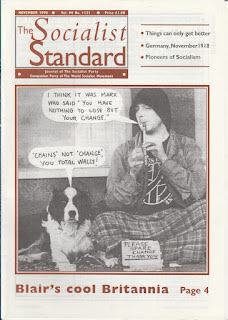
Showing posts with label November 1998. Show all posts

Tuesday, May 31, 2022

Voice From The Back: The culture of competition (1998)

The Voice From The Back Column from the November 1998 issue of the Socialist Standard

The culture of competition

Buy low. Sell high. That’s what we’re teaching our kids in school today. The Stock Market game has blasted its way into the classroom. Budding Buffets as young as eight can now learn what drives Wall Street—money and lots of it. “We can teach them that their main goal is to buy and sell stock,” says Ted Young, the game’s creator and maths teacher at Centralia Junior High School in Illinois. Students play the roles of 20 buyers, four brokers and a banker-policeman-tax collector. According to Young, the kids love the broker job as they get a kick out of seeing their friends profiting and their enemies losing. Stock prices are posted on computers and when the bell sounds, trading begins. “The kids will push and shove and run to get to make trades on hot stock,” says Young. “That’s when the police officer comes in. Tempers can flare. Kids get in fights.”


The culture of failure

In the business world, low survival rates are a serious issue. One in three firms fails before its third anniversary.


The culture of negligence

The shortage of information technology skills is reaching critical proportions. Despite large cash rewards there are more than 50,000 vacancies in the UK, forcing companies to look abroad for staff. The startling figures emerge from research by recruitment agency, Elan Computing, which has offices in Europe, the Pacific rim and the US. All the above are from Financial Mail on Sunday, 30 August.


The culture of expansion

Current [world] population trends are likely to put 700 million young people into the labour market in the next 10 years—more than the work force of the developed world in 1990. This could greatly increase developing countries’ wealth, but it will also expose them more to the effects of economic crises. The International Labour Organisation estimates that one billion jobs will be needed for these people and to cut existing unemployment. Guardian, 3 September.


The culture of poverty

Deprivation, unemployment and low literacy levels make Britain one of the most poverty-stricken countries in the West, a United Nations report said today. Britain was ranked just 14th—behind countries such as Germany, Japan and Australia in the Human Development Report poverty index. Across the globe, the gap between rich and poor was growing with one-fifth of the population consuming 86 percent of the world’s goods and services, the report said. And in Britain, more than a fifth of adults were considered functionally illiterate while 13.5 percent were living below the recognised level of the poverty line. Evening Mail, 9 September.


Force v force

British Transport Police has won the contract to keep law and order on the new £145 million Midland Metro tram system. The force faced stiff opposition from West Midlands Police for the job of policing the 12-mile route which will run from Wolverhampton to Birmingham. The West Midlands force believed it should get the job because it was better equipped in terms of infrastructure and manpower. But Metro bosses decided the job should go to British Transport Police, chiefly because of their long history of policing Britain’s railway network. Evening Mail, 9 September.


Another utopian

Yesterday saw a lull in the turbulence rocking the world’s financial markets. No one knows whether this is temporary or whether it heralds the end of the extraordinary bull market of the past decade. Either way it may prove to be the high water mark of international financial laissez faire. There is a growing realisation that something must be done to tame the free flight of short-term capital that has destabilised economies from Thailand a year ago to Russia now. Guardian, 3 September.


Profits v wages—as usual

“The strength of the pound is working against us in terms of profitability and it is well know we are looking for savings,” Mr Stephenson [director of design and engineering at Rover] said. “Times are tough and certain areas are having to make cutbacks, but because we cannot get all the skilled engineers we need I have taken the unprecedented step of asking those engineers we do have to work a couple of extra hours a week without pay. I am pleased to say that the response has been very positive—saving the company thousands of pounds in man hours per week.” Evening Mail, 5 September.


If I were a rich man

We all know that Bill Gates is the world’s richest man, valued at about $50bn (£31bn). But did you know that the United Nations says he alone could therefore afford the $40bn needed to achieve and maintain universal access to basic education and healthcare, safe water and basic sanitation? Do we need any more proof that capitalism has failed?  Back page, Computer Weekly, 17 September).

Editorial: Enter the Clowns – Stage Left (1998)

Editorial from the November 1998 issue of the Socialist Standard

As the Labour Party circus continues its UK tour in Blackpool it has been able to showcase old favourites not seen under the spotlights for years. First out – stumbling from the old performers entrance – comes the TUC pantomime horse, fresh from a run at the Tribune Theatre. Dazed and confused, it provides endless laughter as the front section tries to go in a completely different direction to the back, in the end falling over itself to please.

Cross-eyed and aimless, it is hampered in its attempt to find the New performers entrance by the clowns, who enter stage Left. Led by Mr Benn, the clowns (Red Ken, Northern Arthur, Tony Trot and Ted Trot) desperately try to climb on top of the pantomime horse, the better to steer it in their chosen direction. But the pantomime horse is so stubborn and confused it never listens to a word they say. “Demand the 35 hour week now!” yells, Arthur, reciting one of his favourite comedy lines – but all the pantomime horse does in response is a big comedy steaming mess in all the sawdust on the floor. How the children – who have never seen it before – laugh uproariously!

But the clowns – who have played to many packed audiences in the past – aren’t finished yet. Mr Benn and the boys rush out to the wings where they pick up big red fire buckets, full of water to throw at the horse so it might come to its senses. In the mad scramble to reach it first, they try to barge one another out of the way. Tony and Ted, now too old for such antics, stand and scream like maniacs at one another. How stark raving mad they appear to everyone – but harmless with it! By now Ken, who is nearer to the slumbering pantomime horse than the others, manages to throw his fire bucket full of water all over it, so as to wake it up. But the bucket is not full of water – it is full of confetti! At this point the other clowns hit Ken over the head with comedy mallets until the big red fire engine arrives and takes them all away, bells ringing and horn tooting.

The audience was delighted – for them it was a real trip down memory lane. So successful was the performance that it is going to be restaged next year and probably the year after that too, with some new clowns called Liz and Mark. The owners of the circus, Mr Blair and Mr Mandelson, said they were happy with how things turned out as it probably meant that profits would be up, all in all, especially for Mr Sainsbury who did the catering.

The only sad note was the man at the back who left disgruntled, saying that it was the same performance they had been trotting out years ago and that it hadn’t even been funny then.

Won’t – or can’t? (1998)

From the November 1998 issue of the Socialist Standard
Does the globalisation of capital mean that national governments are powerless to control capitalism or is it just that they don’t want to?
Now they tell us. When Siemens closed its semiconductors factory in North Tyneside Peter Mandelson, newly appointed as Trade and Industry Secretary, declared: “This is a product of global changes, which are completely outside our ability to control” (Soapbox, Sunday Sun, 16 August). A month later when Fujitsu announced the closure of its factory in his own constituency nearby, Blair “admitted that the Government could do little about the ‘twists and turns’ of world markets” (Times, 17 September).

For once, Mandelson is telling the truth. The government is powerless to change world market conditions. Far from governments being able to control economic conditions, it’s the other way round: governments have to tailor their policies to fit in with global economic conditions. As the moment these conditions are difficult in that competition is much fiercer than it was until the early 1970s when the world market was expanding much faster than has been since. Governments have had to take this into account and bow to world market pressures to keep costs down by cutting back on their social spending. They have had no choice. To paraphrase a mad woman who was a Prime Minister in Britain in the 1980s, you can’t buck the world market.

There are some who disagree with this—the anti-Labour Left, amongst whom are to be found some of the most incorrigible defenders of reformist political action. They think you can buck the world market. According to them, it’s just a question of political will and mass pressure

As Robin Clapp put it in an article entitled “Global Myths” in Militant’s theoretical journal:
“National governments do have the power to maintain welfare systems, vary taxes and interest rates and set economic priorities. The problem today is that capitalist governments don’t want to resist international capital, not that they are incapable of it” (Socialism Today, April 1996).
The view is echoed by the SWP. In a review, entitled “No Place Like Home”, of a book that challenged the extent and consequences of the globalisation of capital (Globalisation in Question by Paul Hirst and Grahame Thompson), Chris Harman argued that radical action within a national framework could still overcome world market pressures:
“Capital may be able to shrug off attempts by government to control it using the limited techniques of ‘Keynesianism’ and social democratic intervention. But it can be challenged successfully by those prepared to take much more radical action—the sort of action open only to those who base themselves on the mass mobilisation of its workers” (Socialist Review, May 1996).
Harman may have been talking about trade union struggles as well as about reformist movements to put pressure on governments but, contrary to what he implies, trade unions have even less power to “successfully challenge” world market forces than governments. Not only have there not been any reforms, as improvements for workers brought about by government action, since the early 1970s, but all the big trade union battles in recent years have been purely defensive. Indeed, many such battles-Wapping, the Miners, P&O cross-channel ferries, the Liverpool Dockers—have ended in defeat. We are not saying that workers should not engage in such defensive, rearguard actions—there is some room to stop conditions worsening as much as the bosses would like or try on—but they should be recognised as such, as precisely battles to stop things getting worse, retreats imposed by current world market conditions.

That’s more like it
However, there does not seem to be unanimity within these organisations as to whether, and to what extent, capitalism in it current depressed sate can offer reforms.

Tony Saunois, of the secretariat of Militant’s international body the “Committee for a Workers International”, has put a somewhat different position from Clapp:
“The influence of the world market currently determines the policies pursued in each country. No country has been able to escape its influence. It has been one factor which has prevented the implementation of reformist policies. This is likely to be the case in the short to medium term.”
And.
” . . . the decisive feature is the dominance of the world market. This has rendered the application of distinct and separate polices within national boundaries impossible for any length of time. This is especially the case for policies of a reformist or left reformist character”.
And, after giving the example of the failure of the Mitterand government in France in the early 1980s and of a left-wing coalition in Venezuela in the 1990s:
“These examples illustrate the domination of the world economy and show that the material basis which allowed capitalism to implement lasting reforms in the post Second World War decades no longer exists. Temporary concessions may be given by a government threatened with massive social explosions. However, they will rapidly be taken away again because of the limitations of the resources of capitalism” (The Future for Socialism, second printing, January 1997).
This is a position we can endorse, indeed have been putting forward ourselves.

Similarly in the SWP, Peter Green (who wrote a passable pamphlet for them on The World Crisis of the 1980s) in a letter to Socialist Review (June 1996):
“We are now in a world where all talk of national reformism is fantasy—which was not true in 1945 or 1914. International socialism really is the only hope for us all.”
If international (or, as we would prefer, world) socialism is the only hope for us all—as it is—then the logical conclusion is that what we should be doing is campaigning in favour of this, not to try to pressurise governments to “maintain welfare systems, vary taxes and interest rates and set economic priorities”.
Adam Buick

Letters: Super-nurses (1998)

Letters to the Editors from the November 1998 issue of the Socialist Standard

Super-nurses

Dear Editors,

Being a student nurse I had spent the day looking after nine seriously ill patients, together with a junior staff nurse and part-time nursing auxiliary. Most of the patients required help to perform the basic activities of living, some in the terminal stages of illness. Just dealing with the urinary and faecal incontinence was a full-time job,. With the best will in the world, we tried to get basic care completed and to a large degree we somehow managed, needing the ability to do three things at once. Or did we? Struggling to get basic care completed leaves no room for the so-called “holistic” approach required by the models of nursing. The gap between theory and practice is measured in light years.

After a mentally and physically exhausting day I arrive home to be told that Tony Blair is going to introduce the concept of the super nurse. The concept is flawed and ignores the real problems in the NHS. Nurses are not angels or super, just workers seeking meaningful work, doing a job that helps to care for people. a caring attitude that is exploited to get nurses to do as much as possible for as little as possible. The clinical grading system already means that a few nurses are paid higher rtes of pay than the average nurse and it is the higher grades that are now being made redundant at my present hospital, because the Hospital Trust is in the red. If any NHS Trusts can afford the super-nurse it will represent a desirable post for the few and help pit nurse against nurse in the competition of who can achieve the most unpaid overtime or least amount of sickness.

The UKCC code of conduct for nurses requires that they serve the interests of society, to do this nurses need socialism not super status.
M.T., 
Wessex

 
Nothing but the truth

Dear Editors,

Herewith is a short piece which I wrote when serving with the West Midlands Police in the early 80s. I have been prompted to send it to you as the result of reading the short story by Heather Ball in September’s issue of the Socialist Standard.

It was whilst serving with the police that I came to the conclusion that it is the values upon which society is based which creates world-wide dishonesty. The world revolves on dishonesty.

Before giving evidence at any judicial proceedings it is practice to take the Oath or make a sworn affirmation, thereby promising to tell the truth, the whole truth and nothing but the truth in the name of God, Allah or any other mystical omnipotence that you have been conditioned to have faith in. a sworn affirmation amounts to much the same thing except that the “almighty” is not brought into it.

Having completed this solemn and apparently sincere ritual all that remains to be done, so you might think, is to relate your evidence to the Court as honestly as you can recall . . . but, it doesn’t end there. Having given evidence the witness is then invariably subjected to a verbal flailing form a highly trained advocate with the sole purpose of proving that the witness has, wholly or in part, told anything but the truth. This so called cross-examination has the full backing of the Court and effectively reduces the value of the Oath/affirmation to something akin to the scribblings to be found in most public toilets.

Regardless of any promise to tell the truth the fact remains that the honesty of a witness is not enhanced one jot in the eyes of the Court by taking the Oath. If any value at all was placed on this ritual then there would be no need for the demeaning Court scenes where highly educated and articulate lawyers seek to prove that some hapless (though possibly truthful) witness is telling porkies.

If you or I should be so naïve as to believe that all witnesses, some witnesses or just a few witnesses tell the truth or, are expected to tell the truth, despite having taken the Oath/affirmation, then the procedure in our Courts confirm beyond all reasonable doubt that such a belief is just wishful thinking. So why take the Oath? It certainly doesn’t do anything to elicit the truth and what is more no one expects it to . . . and so the Oath/affirmation is without value and meaningless. Additionally it reduces any concept you might have of God to something less than a scab on a donkey’s ear and the holy scripture might just as well be a pile of second-hand comics.
John Phazey, 
Sutton Coldfield

 
Goldwater

Dear Editors,

Dave Alton (September Socialist Standard) was far too lenient to Barry Goldwater.

In the first place, the word “libertarian” is a gross misnomer for those who advocate capitalism without a welfare state or government intervention in the economy, and we should not use it uncritically. What they actually stand for is slavery—wage slavery. As Dave says, “there can be no liberty to defend until humanity is liberated from capitalism”.

Secondly, Dave claims that Goldwater’s opposition to welfare spending involved “detesting the concept of people becoming dependent upon the state”. Leaving aside the point that most capitalist who spout this stuff are more than happy to accept state subsidies for themselves when they’re available, the fact is that such campaigns are basically designed to cut taxes and so keep up profits. Goldwater of course wasn't opposed to workers being dependent on selling their labour power.
Paul Bennett, 
Manchester

"Will that be all, Sir" (1998)

From the November 1998 issue of the Socialist Standard


In Rude Health? (1998)

TV Review from the November 1998 issue of the Socialist Standard

Britain is a place of warm beer and sandwiches, lazy days on the village green watching cricket, a place of order and conformity. At least that s what John Major reckoned. But in doing so he reckoned without the stars of Rude Britannia (Channel 4,10pm, Thurs 15 October).These were some of Britain's rudest people who were counterposed to those who deplore the behaviour and openly hanker after a return to the rose-tinted past.

That Britain was ever the kind of place John Major thought it was is open to dispute — what is clearer is that whatever level standards of behaviour were in the past, there has been a serious decline since. When Major said he aimed to build a society “at ease with itself” he was stating a political intention he was never remotely going to be able to fulfil. And so it has turned out — if this programme is anything to go by Britain is a more competitive, selfish and inconsiderate society than it ever has been.

This was illustrated time after time via the filmed behaviour of those who just couldn't give a monkey’s about anybody but themselves. One or two of them were not only prepared to admit this when questioned, they were actually proud of it. One who showed no lack of remorse was the man who parked in the disabled parking spot at a supermarket when there were scores of other places free. When challenged about it by a disabled woman it turned out the gentleman in question was none other than an officer of Her Majesty's constabulary. His response was not to admit his culpability and mutter something about “being in a rush” as most probably would, but to insist that he had not violated any road traffic laws!

Happy days are here again
Then there was the guy in Accrington who went about his business with total disregard for everyone else, whether he was driving his car or just walking around the shopping precinct. His most revealing response to questions about his attitude was to comment that “I am too fast for Accrington”. In truth, here was a poor sap, convinced that he was among the movers and shakers of society, a child of Thatcher and son of Satan, who thought that the most effective way to exercise his muscle was to barge past old ladies in the high street and knock them over. Needless to say, the reality behind the image was revealing — a man in a poorly paid job with little self esteem who wanted to make himself appear bigger than he was. When asked by the interviewer “if you are too fast for Accrington, then why don’t you just leave?” he had no cocksure reply to utter, in fact no answer of any kind at all. To give an answer would have been to reveal that he did not live life to the Max. This was a man who, in reality, lived life in the bus lane.

While it would be wrong to assume that the kind of anti-social behaviour exhibited by individuals in this programme is already widespread as such, it is undoubtedly in the process of becoming so. That this should be the case is not surprising. John Major was doomed to failure in his attempt to halt the slide because he failed to recognise that, first and foremost, it is the market system itself which promotes such types of behaviour and engenders such anti-social attitudes. There is no compelling evidence to suggest that humans are born to be rude, aggressive and anti-social. On the contrary, it is human sociability which is the primary reason why our species has been the most successful on the planet—humans, unlike other animals, are generally able to plan and organise our affairs in a conscious manner, ensuring long-term stability. But the economic, social and political structures created by humans in various circumstances influence human behaviour in turn, and if social systems develop in a manner which promote competition and individualism (as say, a result of natural or artificial scarcity in relation to wants) then humans will adapt their behaviour and attitudes accordingly.

Any society — like the market system — which is based on division, competition and rampant individualism, and then sustained by the creation of generation gaps and the spread of atomised, isolated thinking and behaviour, is going to produce the sort of anti-social attitudes illustrated in Rude Britannia. So it is the ultimate irony for all the Colonel Blimps of this world that the system they admire so much — capitalism — is what has done so much to undermine many of the values they hold dear, values which arose in a different sort society to that which now exists.

But why should a rational thinker want to turn the clock back? The future could be far brighter than any rose-tinted view of the past could allow if the working class grasped the importance of collective action and the necessity of solidarity and class organisation. For the only way to overturn the “every man for himself” culture eating away at the heart of society is in the forging of a united struggle — a united struggle against the system which is currently pitting worker against worker in one of the shabbiest episodes it has yet conjured up in its extremely shabby history.
Dave Perrin

World View: Nothing new to report (1998)

From the November 1998 issue of the Socialist Standard

Two recently published reports make compelling reading for those who think capitalism is a fair and efficient system of global organisation and provide undeniable evidence, if ever it was needed, that the case for world socialism is as pressing now as it ever has been.

Coming within one month of each other, the UN Human Development Report 1998 and the Living Planet Report from the World Wide Fund for Nature, the New Economics Foundation and the World Monitoring Centre, paint anything but a picture of a world run on rational lines.

Launching the Living Planet Report on October 1st, Nick Mabey of the WWF announced that “time is running out for us to change the way we live if we are to leave further generations a living planet . . . we knew it was bad, but until we did this report we did not realise how bad”. (Guardian, 2 October).

The report he speaks of points out that since 1970, humans have destroyed more than 30 percent of the natural world, the UNHDR claiming that this has happened because of “consumption increasing six-fold in the last 20 years, doubling in the last 10”. (Guardian, 9 September).

Over-consumption lies at the heart of both reports, which are critical of the lip service paid by governments to the notion of sustainable development.

While the Living Planet Report points out that CO2 emissions have doubled since 1960, and to a level now exceeding the natural world’s ability to absorb them, the UNHDR reveals that the burning of fossil fuel has in fact quadrupled since 1950, with the wealthiest one-fifth of the world’s population accounting for 50 percent of this. The poorest one-fifth account for only 3 percent of CO2 emissions, yet countries like Bangladesh and Egypt pay the highest price for the global warming CO2 helps produce—rising sea levels with the loss of homes and livelihoods.

Both reports point out that for the first time one of the most serious problems that faces us is a depletion in the world’s fresh water reserves, with fresh water eco-systems declining at the rate of 6 percent per annum While 50 percent of all fresh water supplies are monopolised by humans, three-fifths of the developing world’s 4.4 billion population have no safe drinking water.

The reports find that wood and paper consumption have increased by two-thirds since 1960—with little or no sustainable management of forests—and that the marine catch has quadrupled in this period, with one-quarter of fish stocks now depleted and a further 44 percent fished at their biological level.

The UNHDR claims that global inequality increases apace with 20 percent of the world’s population consuming 86 percent of the earth’s natural resources. To emphasise this discrepancy, the report reveals that a child born in New York or London will consume, pollute or waste more in a lifetime than 50 children born in the developing world. Meanwhile, the Living Planet report says that the average American or Japanese consumes 10 times more of the earth’s resources than the average Bangladeshi. The UN report also lists the latest figures on world wealth distribution. The world’s wealthiest 225 people now have combined wealth equivalent to that of the poorest 47 percent of the global population, while the world’s three richest people have assets that exceed the combined GDP of the world’s 48 least developed countries.

It further estimates that “the additional cost of achieving and maintaining universal access to basic education for all, basic health care for all and adequate food…water…sanitation for all is roughly $40 bn per year…(a figure which is)…less than 4 percent of the wealth of the 3 richest”. (Guardian, 9 September).

As could have been anticipated, the reports’ suggested remedies to redress the above fall well within the category socialists term reformism, amounting to the same battle cries of the well-meaning, though less well informed, without visible results for decades.

It is perhaps a forgone conclusion that such statistics will not fair any better in the years ahead, and we may well wonder how long their compilers will juggle with them before they conclude capitalism can’t be tinkered with in our interests.

Instead of producing volumes of such statistics each year, which on the face of it are only of any use in the armoury of the socialist, wouldn’t it be wiser if the “experts” decided to work out how much better the world would be if we freed production from the artificial constraints of profit, and organised production in a rational and sustainable manner and to the benefit of all. Or would these same experts fear they would be labelled socialist and their reports taken less seriously?
John Bissett

World View: Repression—in exile (1998)

From the November 1998 issue of the Socialist Standard

The past couple of years have been a somewhat turbulent time for Tibetan refugee communities, Tibetan Buddhism in general, and for those who idealise the Dalai Lama. Far from fulfilling his fantasy status as some sort of “saintly” icon, the Dalai Lama has followed what can be seen as a political programme of repression not that dissimilar to that of the Chinese state, from which so many have fled.

In 1996 he announced a ban on the worship of a Buddhist deity called Dorje Shugden, declaring somewhat vaguely that he had discovered Shugden to be a “Chinese” spirit who was somehow physically threatening both his own life and the future of Tibet. He declared this ban not only in his capacity as a “spiritual leader”, but as head of a government-in-exile. For the Dalai Lama is the supreme head (unelected) of a state; albeit a state-in-waiting (Tibet) that is based in Dharamsala in northern India. It has a sizeable state machine; a parliament, cabinet, government departments, and most notably a Security Bureau. To fund this a tax is levied on all Tibetan refugees, non-payment of which results in official loss of “citizenship”. On the question of democracy, when the Vice President of the Tibetan parliament was asked if any political decision could conceivably be taken in opposition to the Dalai Lama he answered, “no, not possible”.

Those refusing to accept the ban on Shugden have accordingly been labelled as enemies of the state and Chinese agents and, in reference to Tibet’s provision at paper constitution, the government-in-exile has declared that, “concepts like democracy . . . are empty when it comes to the well-being of the Dalai Lama and the common cause of Tibet”. The lengths to which the Dalai Lama would be prepared to go to maintain his authority were hinted at in an interview in 1997 where he stated:
“If . . . there was only one learned Lama . . . alive, a person whose death would cause the whole of Tibet to lose all hope of keeping its Buddhist way of life, then it is conceivable that in order to protect that one person it might be justified for one or ten enemies to be eliminated . . .”
No prizes for guessing who and what is being referred to here then—and so much for peace and love.

The resulting “justified” actions taken against those refusing to comply with the deity ban have included the dismissal of all such dissidents from government employment and the report that the residents of at least one monastery were “persuaded” to sign forms in support of the ban by the presence of Indian state police. Some 300 cases of house arrest, destruction of personal property, and harassment by Dalai Lama supporters have been reported, including one case of a family being forced from their home by a large crowd, which petrol bombed and ransacked their house. In addition posters denouncing religious dissidents have become commonplace in Tibetan exile communities. These notices generally include the name, address and photo of the particular “enemy of the state” and the schools their children attend. It is little wonder that some have become refugees all over again.

The Dalai Lama recently helped promote the products of the Apple computer company under the advertising slogan “Think Different”, which is interesting when compared with an official statement of his that warns: “If you can think by yourselves it is good . . . it will not be good if we have to knock on your doors.”

Tibetans, both under Chinese rule and the rule of “their” government-in-exile, face a choice in common with the exploited majority everywhere: conformity imposed by gods and masters or the struggle for real freedom presented by socialists.
Ben Malcolm

Greasy Pole: Mad Tories and Englishmen (1998)

The Greasy Pole column from the November 1998 issue of the Socialist Standard

Wonder boy William Hague is off on his travels. His mission—to reassure the Tory faithful, still in a state of shock after the events of May 1997, that there is a flicker of life in the party, that it is not yet time to switch off the bleeping machine by the bedside and tip toe out of the room. It has not been the Tories in just this country, who have received this message from the Intensive Care Unit. None of them, it seems, wherever they are, will be safe from a visit from their floundering leader. Recently, for example, Hague went to see what the Tories in exile in Marbella think about him, the party and life in general.

Now Marbella has something of a reputation as a resort attractive to certain English people not just for the sun, the paella and the sangria but because it was preferable to stay there than to go back to England and help the police with their enquiries. Whether that has fostered an unusually abrasive view of the world, or whether it is too generous an exposure to gin and sunshine, it seems that Marbella harbours some especially mad and unpleasant supporters of our William. Some of them were chillingly free with their opinions to the Guardian last month. Scottish people are “tight bastards” who should be made to “pay their own taxes”. Criminals should be tied “to a post in the middle of Wembley before a match and (birched) in front of the crowd”. English is a place with “wogs pouring in” (during the early 1980s about 150,000 British people “poured” into Spain to settle there. A lot of them formed groups like Conservatives Abroad in Marbella).

Differences
The message Hague carried on his tour was that the Tories are now a listening party. The days when they surged on regardless—he says—of what anyone thought of them are over. Come and meet me. Tell me what you think. I will listen. There is, of course, no reason to suppose that he will be surprised to hear the opinions of the Marbella Tories because such views have been popular in the party—would regularly provoke a storm of applause at their conferences—for a long time. The interesting point, though, is why Hague has only recently become aware of the need to listen to what might be called the grass roots. What was he doing about governmental complacency when he was a minister? Why did it take a disastrous election result to persuade him that such things needed to change? The answers to these questions are too obvious to need spelling out here.

Of course one of Hague’s problems is to convince the people he is listening to that there is any real difference between the conservative and Labour parties. This has become especially difficult since Blair’s government carried on roughly where Major’s left off. Even symbolically the parties are coming to resemble each other more and more. At their conferences this year they both abandoned their traditional platform colour scheme in favour of multi-coloured shapes and panels (Labour’s to show that they are the party of modern technology, changed colour according to the speaker.) Hague announced that he was scrapping the party’s torch of liberty logo—perhaps cursing that Labour had already pinched the red rose of England. So alike are the two parties that Gordon Brown has accused Hague of repeatedly using the phrase “the British way” when Brown had already flogged it to death in a speech.

The Real World
Soon it may be so difficult to tell the two apart that we shall have to rely on things like Hague’s wife having fair hair while Cherie Blair’s hair is black. Like Hague having very little hair while Blair has enough to re-arrange the styling according to whether he is in tough-decision-making mode or “I’m a pretty straight guy” mode. But we may rely on it that the show battles—the mock-indignant press releases about the other’s tricks, the MPs braying and hooting at the knockabout of Prime Minister’s question time, the relentless denunciation of the other side’s incompetence, dishonesty and cynicism, will go on its meaningless way.

Meanwhile in the real world capitalism is bracing itself for another recession. In the Far East, South America and Russia the system is showing itself at its chaotic worst. In this country the immediate prospect is of a serious slump. The Governor of the Bank of England, Eddie George, has been warning that banks will be hard hit by huge losses from their investments in industries affected by the slump.

Somewhere else in the real world the statisticians at the Department of Social Security have reported that even before the effects of the approaching slump are felt, the condition of those in the severest poverty does not improve. In 1997 there were 24 percent of the population living below the official poverty line of less than half the average income. In the event of a slump the lot of these people will get worse and their numbers will swell as more and more workers fall deeper and deeper into poverty.

Powerless
We have already seen how Blair’s government—and before them how the governments of Thatcher and Major—react to this kind of situation. They do not inform us that capitalism is a system beyond human control, which inflicts the sufferings of poverty on its people as a matter of routine. Instead they care about things like the so-called dependency culture—which does not mean the ruling class depending on exploiting the rest of us to maintain their privileged position in society but a supposed addiction among unemployed workers to living on a starvation income.

They do not hark back to their many promises to control the economy, through a few meetings at Number Ten and the stroke of the Chancellor’s pen, so that poverty becomes a thing of the past. So they do not confess that they are powerless to do anything, in any real sense, about capitalism and are in fact reduced to floundering about in futile reactions to its procession of crises. They do not, in other words, tell us that to support them is a waste of our power to change society in a fundamental and permanent way and that we should immediately stop voting for them and instead trust in our own ability.

This is not the message Blair gives out and it was not passed on by Hague to those seriously deluded Tories in Marbella. On the Costa de Sol, as elsewhere, fantasy rules.
Ivan

The incompatibles (1998)

Pamphlet Review from the November 1998 issue of the Socialist Standard

Socialism and Religion. By F. A. Ridley. Rational Socialist League, 70 Chestnut Lane, Amersham. 40 pages.

This is a reprint, updated by the author before he died in 1994, of a pamphlet originally published in 1948.

On religion, it takes up a basically similar position to ours, derived from Marx: that religion is an expression of human alienation, of the fact that humans are not in control of their destiny but are the playthings of uncontrollable, impersonal economic and social forces and resort to religion to console themselves and to try to make sense of this. This is why, as Ridley puts it in a criticism of bourgeois non-political rationalists and freethinkers, “no amount of merely expository or destructive criticism—useful and necessary as such criticism is in itself—can finally destroy religion; only the coming of international socialism can do that, by abolishing the social antagonisms which necessitate its existence”.

On socialism, however, Ridley is not so clear. Since he was a member of the old Independent Labour Party (ILP) who hob-nobbed with Trotskyists this is not surprising and explains his reference to that contradiction in terms a “workers state” existing in socialism.

He mentions our 1910 pamphlet Socialism and Religion which he says relied too much on Herbert Spencer’s ghost theory of the origin of religion according to which the first gods represented the imagined spirits of dead heroes as they appeared in the dreams of their followers (fair enough). He also mentions a pamphlet, Christianity and Socialism, published by an SPGB member, Horace Jarvis, in the 1970s. This was published privately, partly because a pamphlet on religion was not considered by us to be a priority but also because it was more oriented towards textual criticism of the bible than a deeper Marxist analysis of the social and historical origins and role of the Christian religion. Even so, some Socialists have always liked that sort of thing. Jarvis, incidentally, before he joined the Socialist Party, had been a member of the Communist Party’s front organisation, the League of Atheists, but left the CP when they dissolved this body so as to be able to attract religious support for the Popular Front policy they adopted in the second half of the 1930s.
Adam Buick

Bourgeois revolutionaries (1998)

Book Review from the November 1998 issue of the Socialist Standard

The French Revolution. Edited by Gary Kates. Routledge, 1998

“Danton, Robespierre, Saint-Just, Napoleon, the heroes as well as the parties and the masses of the old French Revolution, performed the task of their time in Roman costume and with Roman phrases, the task of unchaining and setting up modern bourgeois society.” (Karl Marx, The Eighteenth Brumaire of Louis Bonaparte).

On the night of 4 August 1789 the newly triumphant French National Assembly issued a decree formally abolishing feudalism. The process of building a bourgeois (capitalist) society in France has been documented by the influential French academic historians Albert Mathiez (1874-1932), George Lefebvre (1874-1959) and Albert Soboul (1914-1982). They were also very public members of the French Communist Party, and in due course this provoked a “revisionist” challenge from liberal and conservative ideologists. This collection of essays provides further proof, if it were needed, that the study of history is not just about interpreting the past but part of a struggle for the sort of future people want.

For liberals, Alfred Cobban (1901-1968) argued that the revolution had an early constructive phase, but efforts to create a liberal capitalist constitution were overcome by violence. The conservative François Furet (1927-1997) emphasised the role of political ideas, especially those of Rousseau, upsetting the natural order of things. A central concern of these “revisionist” challenges has been what they saw as the dominance of Marxism in interpreting the French revolution and its relevance for the modern world. Marx drew attention (see quote above) to the way the French revolutionaries referred to ancient Rome, as a mask for their tawdry bourgeois objectives. It provided the revolutionaries with: “…the self-deceptions that they needed in order to conceal from themselves the bourgeois limitations of the content of their struggles and to keep their passion at the height of the great historical tragedy”.

The French Stalinist historians, following Lenin and the Bolsheviks, drew an explicit parallel between the French Jacobins and the Bolshevik revolution in 1917 Russia. In 1920 Albert Mathiez wrote:
“Jacobinism and Bolshevism are two dictatorships born of civil war and of war, two class dictatorships operating through the same means: terror, requisitioning and taxes; and having, in the last resort, the same goal: the transformation of society and not only of the Russian or French society, but of the universal society.”
The Jacobins under Robespierre’s leadership, and the Bolsheviks with Lenin’s leadership, acted in the belief that their small elites represented the real will of the people, even though they were not accountable to them. The French revolution, of course, was the classic bourgeois revolution. Robespierre and the Jacobins employed the means and objectives appropriate for such a revolution. The Russian revolution, as Matthiez unwittingly revealed, used the same methods for the same goal: a capitalist revolution. The Bolsheviks abolished feudalism and constructed a society based on wage labour and capital, but under state control. This, historically, is the bourgeois role of Bolshevism.
Lew Higgins

The Truman Show (1998)

Film Review from the November 1998 issue of the Socialist Standard

The Truman Show (Peter Weir, 1998)

Truman Burbank is a happily married insurance salesman living in Seahaven, an island town in middle America. A regular guy, you might think, leading an ordinary, uneventful life. He jabbers to himself in the bathroom mirror, his neighbours smile benignly at him as he goes off to work.

But the audience is soon made aware that all is not well with Truman, even before he realises it. A cutaway shows us that everything in his life is being dictated by an unseen director to actors through earpieces, while five thousand cameras track his every movement. Truman’s whole life is a television soap in which he is the only unknowing participant.

Truman’s world, really just a giant TV studio, literally starts to fall apart. A piece of lighting crashes at his feet. More poignantly his father, who as a child he had seen drown, re-appears as a dosser in the street, before being dragged away. He yearns for a girl—in fact an extra who broke out of the programme’s strict plan—who he once fell in love with, before she, too, is led away from him.

As he gradually realises the scale of his predicament, Truman’s unease turns to paranoia and then to righteous anger. The audience is torn between laughing at some really funny scenes (Truman is acted by Jim Carrey, hitherto best known as a zany comedian) and moving cameos of a manipulated man struggling to “get a life”.

The critics loved this film and so did I. They summed it up in various ways—a satire on television, a moving statement about the human condition, a plea for freedom, an off-beat studio confection, a black comedy. To some extent, it is all of those things. But for me the Daily Telegraph‘s critic’s judgment was surprisingly more profound: a “penetrating critique of contemporary society . . . This is a world entirely of artifice, in which everything is for sale”.

The Truman Show vividly illustrates and confirms everything Marx wrote about alienation, although he could not have foreseen the detailed forms it would take. Truman himself is forcibly separated from a truly human life and society in a particularly cruel way, being an unwanted child adopted by a corporation. But all the thousands of bit-part players, extras and studio workers are also exploited—they sell themselves to the “project”, in this case the profit-seeking televising of Seahaven. The megalomaniac director is a metaphor for the ruling class, ostensibly running the whole show but himself a highly-paid executive of some national if not multinational corporation.
Stan Parker

Monday, October 22, 2018

The Worker’s Mirage (1998)

From the November 1998 issue of the Socialist Standard
The dangling carrot ‘Henry’ must pursue,
Still out of reach, but never out of view,
With every step he thinks ‘Tis mine at last
But so did Henry’s father in the past,
A greater stride he thinks will win the prize,
But still the carrot dangles ‘fore his eyes,’
Tantalisingly, promising a chew,
Still out of reach, but never out of view. 
There is no need of blinders for this moke,
He only sees the carrot, not the joke,
There never was a heavier burdened mule,
There never was a more obstinate fool,
As age and toil combine to slow his pace,
Yet still the carrot stares him in the face,
Still goads him on, his efforts to renew,
Still out of reach, but never out of view. 
The whip or stick could never have obtained,
A greater service, as with muscles strained,
And clenched teeth that strive to make the bite,
He labour on each day, sometimes at night,
Until the eyes grow dim and slow the tread,
And chest supports the balding, drooping head,
The once proud prance becomes a shambling gait,
The tired torso begs to pause and wait. 
And so there comes a time when he no more,
May grunt and swear, and sweat from every pore,
But there are not green pastures for this ass,
In which his few remaining years may pass,
The carrot now forever, from his view,
A pittance of a pension is his due,
His life mis-spent, through chasing a mirage,
The dangling carrot known as ‘Living Wage’
James Boyle (3/1/62)

50 Years Ago: From an opponent . . . (1998)

The 50 Years Ago column from the November 1998 issue of the Socialist Standard

. . . we are more accustomed to receive curses than compliments. But compliments do sometimes come from unexpected quarters. The following is from the Daily Graphic, Wednesday, October 6th, page 2. It is contained in an article by “Candidus” entitled “‘Idealists’ who fear free speech”:-
  “The only Socialists who have been consistent in their attitude to Russia—and, for that matter, in their attitude to genuine Socialism—are the members of the Socialist Party of Great Britain, commonly known as the S.P.G.B. The ‘official’ Socialists are terrible snobs. They have a deep respect for size, so they sneer at the S.P.G.B. as the ‘Small Party of Good Boys.’ But, dialectically, the S.P.G.B. possess all the aces, not least in reference to Russia.
  “From the outset the S.P.G.B. detected the true nature of the 1917 Revolution and foresaw the consequences of it. They have just published a brochure entitled ‘Russia’ which is a collection of the articles on the Soviet Union that have appeared in their periodical from 1917 onwards.
  “I am far from sharing the S.P.G.B.’s political philosophy. I should, however, be less than fair if I did not bear testimony to the Party’s remarkable record of consistency and acumen, as manifested in this brochure. It is easy for me to respect an antagonist who is both honest and intelligent. I may add, as a final word, that the articles in the brochure are written in admirable English.”
[From Party News Briefs, Socialist Standard, November 1948]

Inhumanity of war (1998)

Book Review from the November 1998 issue of the Socialist Standard

The World Within War: American soldiers’ experience of combat in World War II by Gerald F. Linderman. The Free Press, New York 1998. £20.

Linderman’s book is a definitive exposé of the psychological trauma of combat on America’s young men. As such it is worthwhile reading just as a refresher course in the real effects of war in the raw. The loss of sense of time (the “infinite extension . . . of the living instant”), the erosion of the facility of logical thought and concentration, the inability to react to events, the loss of moral values and ultimately the will to live, which turned men into living robots with “Thousand-Yard stares”. It is also useful for its recounting of personal experiences of war’s brutalities and pathos. However all this is rather familiar “War is Hell” material. Where Linderman really excels is his contrast between the European theatre (“The War of Rules”) and the Pacific theatre (“War Unrestrained”) particularly in the field of taking prisoners.

In the war against the Germans a certain code of combat evolved to some degree independent of the wishes of the high command. For instance, orders from the US command prior to the D-Day landings that no prisoners were to be taken were generally disregarded. The general attitude of the US fighting soldier turned out to be “they were conscripts just like us” and faced with the massive superiority of the Allied armies the Feldgrau was often only too willing to give in. The US military machine saw advantages in this and rapidly re-evaluated its position: it was not in their interests to make surrender impossible as enemy troops would fight to the end causing heavy casualties. On the other hand neither high command wanted to make surrender too easy, too safe or too certain. When periodically prisoners were killed—through fear, callousness, anger or even envy—the culprits, even if brought to justice, were almost always exonerated. This attitude and the German’s response meant soldiers never surrendered unless forced to.

The war in the Pacific was something else altogether. The brutality of the US-Japan war is infamous. Everyone knows of the brutalities of the Japanese towards prisoners of war. Far from being an innate response (earlier wars against the West show the Japanese in a more favourable light) this attitude was a result of intense propaganda activity by the Tokyo government against the West. For this was a war of anger against the western powers conducted with fierce nationalist determination. If the Japanese took prisoners reluctantly and treated them inhumanely the US troops responded with gusto. The Japanese who found opportunity to surrender was a lucky man—for the Americans this became a war of extermination carried out with disgustingly racist terms (“they ain’t nothing but a bunch of monkeys”). The brutality of the war in the Pacific was unparalleled even on the Eastern Front. Civilians sheltering in fear in caves on Okinawa were killed by poison. The taking of body parts, ears, fingers, gold teeth from corpses or even live prisoners was common and taking a skull was almost de rigeur.

So what is the relevance of all this to socialists? Just this: all wars are anti-working class. Not just because of why they are fought but in the ways they are fought. War produces inhumanity. To assert to the contrary, as do many on the Left is to pander to the tastes of the capitalist history mongers with their glorification of war and their whitewashing of atrocities of their own armies.
Keith Scholey

In a Nutshell (1998)

From the November 1998 issue of the Socialist Standard
  1. The resources to produce what we need are owned by the rich 5 percent, while the remaining 95 percent of us do all the work.
  2. These two groups, or classes, are always going to be at loggerheads because of it.
  3. This dispute will only be settled when we 95 percent organise and abolish class ownership, and run a democratic system of communal ownership instead.
  4. When we do this, there will be no further oppression of any sort.
  5. But we must do it ourselves, without leaders.
  6. Since we can’t fight governments and armies, we must organise to take them over by political means and abolish them along with ownership by the rich.
  7. We must oppose any party which wants to keep or reform the present system, no matter how well intentioned.
  8. The World Socialist Movement calls upon all workers to organise to do this, in the interests of themselves, their children, and the future of the planet.

Thursday, January 4, 2018

Germany, November 1918 (1998)

From the November 1998 issue of the Socialist Standard
The German revolution of 80 years ago was the only ever nation-wide workers' revolt in an advanced capitalist society. It overthrew the Kaiser but not capitalism. It didn't and couldn't have done this as there was no majority for socialism amongst the workers.
Last Autumn saw the spectacle of Trotskyists and other assorted Leninists remembering the 80th Anniversary of the Russian revolution with great enthusiasm. The Trotskyist "Marxist" Party held a meeting for the occasion round my way. When asked by myself at a stall promoting the revolution meeting (with some very pretty looking flyers, it must be said) what exactly their platform was, their reply was "well, you know the Russian revolution?". I indicated that I was aware of its existence. "Well, we, er, well, we think it was a good thing". Great, nice platform, well thought out, mate. Likewise our local SWP enthusiast exhorted me to come to their big meeting on the Russian revolution and "see Tony Cliff before he dies", which struck me as insufficient incentive to attend what would doubtless have been a very tedious evening.
All of this inevitably led me into numerous dog-fights with these sort of people, about quite why the Russian revolution isn't the best thing that's ever happened, including one very nasty and terrifying encounter with a bloody-thirsty professional revolutionary from the SWP head office ("The Cheka were necessary, to stop counter-revolutionaries," she said, and I contemplated suicide, despairing over the condition of a human race that produced such a "socialist"). Inevitably, whenever I elucidated the crimes of the Bolsheviks, pointed out the many failings of the revolution, demonstrated how even Nice and Shiny Mr Lenin perpetrated the sorts of crimes they normally said only started with that Evil Mr Stalin, they had one last line of defence: "The Russian Revolution turned rotten because of invasion by umpteen foreign countries, and the failure of the German Revolution."
The point about invasion largely makes a mockery of their whole support for the victorious revolution, if in fact it wasn't victorious, and so can be dismissed. But their second point is worth a closer look. It is true that Lenin was probably predicating the success of his revolution upon a successful socialist revolution in Germany as well and hoping that it would spread world-wide from there. Fine and dandy, but all this changes Lenin from instead of being a dangerous man who thought he could lead the world to socialism, to a dangerous gambler who thought he could lead the world to socialism. Further, the proponents of such a thesis seem remarkably capable of over-looking the obvious conclusion to which this line of defence points—that Russia was really the side-show, an historical footnote, to the only ever attempted workers' revolution in an advanced capitalist state; and that all their celebrations of Russia and desire to follow its model are flawed, because Germany is the real case history that bears examination.
At the time of the first world war, Germany was the second biggest industrial economy in the world. This was despite having a full third of the population still living as feudal peasantry, and still retaining a quasi-feudal government under an autocratic hereditary ruler. It also had one of the largest workers' movements in Europe (despite socialism having been a criminalised creed for many years in Germany). The Social-Democratic Party of Germany (the SPD) had over a million members and some 4½ million voters, along with numerous papers, affiliated social groups, etc.
The SPD still talked of—and reckoned itself as—being a radical socialist party, though over the years running up to the war it drifted further and further towards outright reformism, partly because it had become so institutionalised. Running its own papers and allied with unions, it was very much a part of the fabric of society. Despite this, a small section of revolutionary socialists remained within the SPD, typified by Rosa Luxemburg, and who numbered some three to four thousand.
The true colours of the SPD were shown during the war, when nearly all of its members in the Reichstag openly backed the war, and the party spread propaganda to the effect that the war was necessary to stop the threat of tyranny from Russia. This slowly led to a split in the SPD, three ways, with the eventual formation of the Independent Social-Democratic Party (USPD) within the parliamentary party and then more slowly within the membership itself. The "far-left" contingent formed themselves into the Spartakusbund (Spartacist League) with Karl Leibknecht and Rosa Luxemburg as prominent members. However, they remained within the official ranks of the USPD.
By September 1918 it was clear that Germany had already lost the war. The most the ruling class could expect was to preserve their state more or less intact. They were desperate to avert a repetition of events in Russia and the massive upheaval there. The powerful generals in the army proposed a way of saving the German state by liberalising it and bringing some of the more obliging elements of the SPD into the government. These latter accepted and joined a government under Prince Max von Baden as Chancellor.
Workers' Councils
Under this regime events deteriorated. Long suffering workers began to vent their frustration at the grind and penury they faced after four years of draconian war-time restrictions. More and more workers and disenchanted soldiers and sailors began to strike and mutiny. By late October insurrection was spreading, as workers throughout the country rose up against the government. Beginning in the northern port of Kiel workers' councils began to be formed all across the country. By 5 November, Hamburg (one of the biggest cities in the country) became subject to control by a workers' council. By the 8th so had many of the great cities of Germany, Munich, Cologne, Frankfurt and even Berlin.
The outcome of the uprising was that the leader of the SPD, Erbert, took power, and his colleague Scheidemann unilaterally declared Germany a republic, in a bid to appease the rebels by ending the rule of the German aristocracy. The Kaiser went into exile. Whilst this part of the revolt was successful, it in fact merely finished the job begun by the revolutions of 1848, in establishing a fully bourgeois republic in Germany.
Very few of the German working class were revolutionary socialists. The vast majority of workers supported the SPD as a matter of course, including its general programme of the reform of capitalism. On the other hand, the revolutionary workers were tiny in number. When in February 1919 the Spartakusbund renounced its links with the USPD and formed a German Communist Party (KPD) it recognised this problem: "Socialism cannot be created by decrees; nor can it be established by any government. Socialism must be created by the masses themselves, by every proletarian". Their problem was that not enough proletarians wanted socialism. The November uprisings had been a reaction to hardship and tyranny, not a coherent wish to establish socialism. Contrary to what the SWP's Chris Harman writes in his book The Lost Revolution, in which he patronisingly claims that the workers were "confused" by the splits within the "socialist movement", what most workers wanted was for the SPD to end their hardship. The Spartacists recognised that the mass support needed to establish socialism was lacking and that socialism was not on the agenda at that time, and so they resolved to oppose the calling of a constituent assembly which they felt would help consolidate the German state and instead to try and make socialists within the workers' councils.
Some hot-headed elements of the German left (in the USPD and another group called the Socialist Shop-Stewards) were not satisfied with this reality, and 5 January 1919 mounted the misnamed Spartacist uprising ("Spartacist" within SPD circles had become was a catch-all for anyone vaguely disagreeing with the leadership, much as "Trot" has become in the modern Labour Party—the Spartacists, including Rosa Luxemburg, actually opposed an uprising, realising as they did that mass support for socialism just wasn't there). These elements led the workers of Berlin in a putsch to try and seize power, with the hope of it spreading nation-wide. It failed. Lacking any plan the workers who had followed the glorious revolutionaries stood around waiting to be told what to do, and when they were told it was a mish-mash of confused orders and muddle. On 11 January 1919 the SPD government sent in the troops, the notorious Freikorps, which very effectively crushed the abortive putsch. By 17 January both Karl Liebknecht and Rosa Luxemburg had been murdered by Freikorps troops, and Berlin was under government control once more.
Crushed by the state
This was a pattern that was to be repeated in many parts of the country, as any struggles and gains by the workers were brutally crushed by military might. The workers discovered too late the danger of following leaders, and, much as the Bolsheviks crushed all independent working class activity in Russia to establish their dominance, so too did the SPD in Germany to preserve the German capitalist state. The workers discovered to their cost the impossibility of fighting against a co-ordinated and well-armed state, and if little blood was spilt in the initial revolt much was spilt when it was put down.
The workers of Germany persistently followed their old leaders, believing these would solve their problems for them, and even bring about socialism, and for a while they believed the lip-service the SPD government gave to "socialisation" of industry. In the end, however, they had to learn the hard way the folly of following leaders. The German revolution shows, not as Chris Harman believes, that if the KPD had had more discipline (read had it enacted the Leninist principle of "democratic-centralism" and obedience to the leadership) it might have controlled events more and thus been able to lead the workers to successful revolution (on Russian lines). It was that where the working class does not have the resolve to establish socialism, it will not, and trying to make socialists in the heat of an ongoing quasi-civil war is almost impossible. No amount of leadership but only a majority of socialist-minded workers could have made the revolution in Germany. The bloody defeat of the putsch and the uprisings showed how violence, especially by a minority, is suicidal against an existing organised state. History shows it is not the state that gets "smashed" but the revolutionaries and many innocent workers too.
Pik Smeet

Wednesday, October 21, 2009

Pioneers of socialism (1998)

From the November 1998 issue of the Socialist Standard

The Socialist League, a breakaway from the Social Democratic Federation (SDF), which was established in the 1880s by William Morris, Eleanor Marx, Edward Aveling and other pioneering socialists, was remarkably close to the Socialist Party in its ideas and aims. However its confused position on parliament and the ballot box despite its correct opposition to campaigning for reforms led to it being overrun by anarchists and to the resignation of genuine socialists such as Morris.

The strategy of Morris and the others was the "making" of socialists who understood and wanted an end to capitalism and wanted the establishment of a socialist society. This ran counter to the object both of anarchists who simply wanted to destroy the state, and of those "socialists" who wanted to concentrate on building a large party with its roots in the trade unions which could somehow reform capitalism out of existence. Some fourteen years after the Socialist League was overrun by anarchists in 1890, the Socialist Party of Great Britain was founded. Like the League, it was a breakaway from the SDF but, while echoing the League's call for revolution and nothing less, addressed the issues which had led to the League's failure.

Revolution not reform
The Socialist League was founded in 1884 after the resignation of a number of socialists from the SDF which had taken the position of working gradually for socialism through the winning of reforms, so-called stepping stones to socialism. Disgruntled with the undemocratic nature of H.M. Hyndman's leadership and seeing the absurdity and inevitable failure of trying to change capitalism and its essential profit-making drive through legal changes, William Morris, Eleanor Marx, Edward Aveling, Belfort Bax and others established a separate body committed to socialism and nothing less. Morris wrote:
"The palliatives over which many worthy people are busying themselves now are useless because they are but unorganised partial revolts against a vast wide-spreading, grasping organisation which will, with the unconscious instinct of a plant, meet every attempt to bettering the conditions of the people with an attack on a fresh side."
The Manifesto of the Socialist League, drafted by Morris and Bax and adopted in 1885, stated firmly the stance of the League against reformism and for social revolution and nothing else:
"As to mere politics, Absolutism, Constitutionalism, Republicanism. All have been tried in our day and under our present system, and all have failed in dealing with the real evils of life.
Nor, on the other hand, will certain incomplete schemes of social reform now before the public solve the question.
Co-operation so-called—that is, competitive co-operation for profit—would merely increase the number of small joint-stock capitalists, under the mask of creating an aristocracy of labour, while it would intensify the severity of labour by its temptations to overwork.
Nationalisation of the land alone, which many earnest and sincere persons are now preaching, would be useless so long as labour was subject to the fleecing of surplus value inevitable under the Capitalist system.
No better solution would be that State Socialism, by whatever name it may be called, whose aim it would be to make concessions to the working class while leaving the present system of capital and wages in operation: no number of merely administrative changes; until the workers are in a possession of all political power, would make any real approach to Socialism.
The Socialist League therefore aims at the realisation of complete Revolutionary Socialism, and well knows that this can never happen in any one country without the help of the workers of all civilisation."
After a century and more of failed attempts at reforming capitalism, the position of Morris and the League has been proved correct, as has its position against what they called "state socialism" (more accurately described as state capitalism) which has only succeeded in dividing the working class and replacing the issue of class with the issue of supporting one capitalist "nation" against another.

The ballot box
The League, however, was opposed to the idea of achieving socialism via the ballot box and parliament. This was not on the grounds of wanting to lead the working class to revolution in the belief that a socialist majority could never exist, but on the grounds that campaigning for election to parliament inevitably meant advocating reforms of the present system. This mistaken conclusion was drawn due to the number of so-called socialists in this period who were turning away from social revolution and towards gradualism. Parliament, according to the League, was a capitalist institution which would only be strengthened by reformist policies and which would subvert a socialist party from a body which campaigned for social revolution to a corrupt body which would inevitably campaign for election on a reformist programme. Even so, Morris did envisage that, at some stage, socialists would enter parliament as rebels to dissolve capitalist power:
"I believe that the Socialists will certainly send members to Parliament when they are strong enough to do so; in itself I see no harm in that, so long as it is understood that they go there as rebels, and not as members of the governing body prepared to pass palliative measures to keep Society alive."
It was its opposition to the use of elections by connecting them to the policy of reformism which was the weak link in the League's armour. Opposition to parliament and elections led to the increasing membership of anarchists, who saw the problems of society not as connected to capitalism but to the institution of the state itself. They did not seek to remove capitalism (the disease) by making socialists but sought to destroy the state and authority (the symptom) by acts of violence. It was this section of the League which grew in strength and eventually displaced the genuine pioneer socialists who had established an organisation and produced literature which still remain an inspiration to socialists today. It has to be said, however, that many of these pioneer socialists were beginning to turn to gradualism themselves, as the working class seemingly turned to this course (but in reality only opting for small improvements now rather than any conscious socialist idea).

The Socialist League collapsed in the early 1890s with the departure of William Morris in 1890 (who formed the Hammersmith Socialist Society). After this its publication Commonweal, with the party in general, declined to an ignominious mess after control passed to the anarchists whose squabbles were an irrelevance to the working class.

Thus, the voice of socialism (despite the League's few inconsistencies) was lost until the formation of the Socialist Party of Great Britain in 1904 and its solving of the problems of earlier socialists. Formed after a group of socialists grew disillusioned with the reformist stance of the SDF (as the League pioneers had been twenty years earlier), the Socialist Party solved the problem of reform or revolution by a unique commitment to the use of the ballot box and the democratic sending of socialists to parliament with the sole aim of abolishing the profit system; a possible socialist minority in parliament being committed to opposition to all policies that would help prolong capitalism.

The Socialist Party has stood for socialism and nothing but ever since. A bastion of socialist consciousness in a political wilderness of capitalist party against capitalist party; free market or nationalisation, private ownership or state ownership, left or right, tweedledum or tweedledee. 

Capitalism is capitalism whichever mask it is attempting to wear and the Socialist Party is the only party to have stood for socialism throughout the twentieth century despite the diversions of Lenin, Keynesians and a host of others attempting to change capitalism without a socialist majority that understands and desires it. Capitalism's appearance may have changed in the last hundred years but no amount of tinkering can change the essential labour-fleecing and profit-seeking which makes it tick and which socialists understand must be removed before socialism can exist. Socialism remains as relevant for humanity today as it did then.
Colin Skelly