Showing posts with label Rural Poverty. Show all posts

Saturday, July 12, 2025

Family History and Beyond (2025)

Book Review from the July 2025 issue of the Socialist Standard

Remembering Peasants: a Personal History of a Vanished World. By Patrick Joyce. Penguin £10.99.

The author was ‘the London-born child of Irish rural immigrant parents’, and here he examines the history and current situation of peasants, concentrating not just on Ireland (where he discusses his own family history) but also Poland, and in addition with some attention to Italy. It is an eloquent and wide-ranging account, supported by a range of photographs, the earliest dating back to the late nineteenth century.

One chapter deals with the problem of defining who counts as a peasant, but there is no simple answer to this. Peasants are not necessarily serfs; they consume (part of) the products their work creates, with the family and its economy having a central role. They do not seek to maximise their income, and either owned the land they worked or had long-term tenancies. They may produce for the capitalist market, but the extent of this varies according to time and place. They live in ‘cultures of scarcity’, where prosperity for one person means another going without. Any money earned was not re-invested but kept at home or lent at very low interest rates. And ‘peasant societies are societies of the gift, not the commodity … What is given should be given freely: that which is given without expectation of return feeds the giver again and again.’ (The different tenses in this paragraph reflect those in the book.)

Religion often involved various traditional beliefs being incorporated into christian world-views, but ‘Religion usually had the law on its side, and so it also had the support of those who upheld the law, the landowners and state.’ There was a great deal of ‘everyday suffering’, and in some places it was the best of the crop that was surrendered in rent. Most years there would be ‘pre-harvest famine’ from spring onwards.

A powerful chapter deals with peasant revolts and rebellions. Peasants could feud with and even kill each other. There was a code of behaviour, which even the powerful had to recognise, and minor acts of revolt, such as quiet sabotage, could be used to get even. Sometimes this could escalate to violence and murder. In Ireland in 1882, for instance, a land agent was killed after many hundreds had been evicted and an estate converted to a place for fishing and wildlife shooting. There were larger peasant uprisings, such as the German Peasants War of 1524–5, the Romanian rebellion of 1907 and the Tambov Rebellion in Russia in 1920–1. The twentieth century indeed saw much violence inflicted on peasants: ‘These barbarities were foundational for the emergence of modern states.’ Most of those imprisoned in Soviet gulags were peasants.

Depending on the terminology used, peasants have now largely been replaced by small farmers, and globally over a billion people still do agricultural work, mostly in India and China. But whichever labels are employed, it is clear that peasant history was largely one of struggle, poverty and repression.
Paul Bennett

Saturday, December 7, 2024

From poverty to power (2008)

Book Review from the December 2008 issue of the Socialist Standard

How Active Citizens and Effective States can Change the World by Duncan Green (Oxfam Publishing 2008)

Duncan Green defines an effective state as one that “can guarantee security and the rule of law,” and has an effective strategy “to ensure inclusive economic growth”. Such a state should be accountable to citizens and able to guarantee their rights. Active citizens are linked to the state by a “combination of rights and obligations”: making use of these rights to improve their conditions.

He argues that it is the combination of poor men and women and their national governments that provide the main actors in the fight against poverty and inequality. Case studies are given to illustrate how even the poorest people have by their organised and persistent actions brought about beneficent change in their circumstances. Like the Chiquitanos people of Bolivia who after 12 years of “unremitting and often frustrating struggle” won legal title to the 1m-hectare indigenous territory of Monteverde.

He is aware that the scales are weighted against the poor in all areas. For example, research is dominated by the private sector: in agriculture 5 large multinational corporations spend $7.3bn per year on agricultural research on high value, high profit products while the staple foods of poor communities are “likely to be overlooked.” In biotechnology the picture is the same with GM crops being genetically engineered to meet the needs of large scale farms. There is no serious investment in the five most important semi-arid and tropical crops.

Half of the world’s population lives in the countryside and the majority of people in absolute poverty live in the rural areas. OECD (Organisation for Economic Co-operation and Development) sources are given for the claim that over the past 20 years aid donors and governments have effectively withdrawn from the countryside. Mention is made of the well known ‘structural development programmes’ which imposed a ‘radical free market’ on debtor countries.

Agricultural growth, Green argues, reduces poverty but is most effective when small farmers are able to capture a fair share of the benefits. Local farmers, he says, should be helped to improve the quality of their produce so that for example retail giants like McDonalds and Pizza Hut use local produce instead of importing produce from the USA. Here his ‘active’ citizens would be small farmers “organising their ability to negotiate a fair deal”. However when it comes to buying fertilizer or seeds, or selling produce or their labour, small producers are dominated by the large corporations. Small farmers are “de facto employees”.

In Green’s view efficient states should take the environment and the enhancement of the daily lives of the poor as prime considerations. Global governance (the “web of international institutions, laws regulations, and agreements”) could help, and the 8 main ways he lists include managing the global economy, redistributing wealth through aid or international taxation, averting health threats and avoiding war. However global governance fails to live up to its ideals. “The WTO is frozen, regional trade agreements are proliferating and introducing profoundly unfair trade and investment rules, the G8 is failing to keep its promises on aid…”, then there is the threat of climate change and “a looming financial crisis”.

The book is well sourced with a 24-page bibliography and three further pages listing background papers. There is much useful information covering more areas than can be dealt with in a review. However Duncan Green takes a moral stance whereas under capitalism the prime consideration cannot be the welfare of citizens active or otherwise, but sale and profit; this drives development (forget sustainable) – and can also inhibit it. And the state that in his view is supposed to facilitate change will only do so to the extent that the interests of the owning class are served.
Pat Deutz

Tuesday, November 5, 2024

Country Lives (2024)

Book Review from the October 2024 issue of the Socialist Standard

The Forgotten Girls: a Memoir of Friendship and Lost Promise in Rural America. By Monica Potts. Penguin £10.99.

The author was born and brought up in the small town of Clinton in Arkansas. Her book has two main themes: life, especially for women, in an isolated area, and the story of her friend Darci.

Like much of the rural US, Clinton has social and economic problems, made worse by the 2007–8 crash. Services such as schools and post offices are closing, industries are leaving, and poor white people – women, especially – are dying younger than a generation ago. Clinton is part of the Bible Belt, and evangelical churches are very powerful. There are high rates of sexual abuse and childhood trauma, and women in particular are discriminated against. ‘The church set girls up to be of service to everyone and in charge of nothing’ and ‘Women were held morally responsible for everything that happened in their families and communities. They were supposed to sacrifice everything for their children, even their own happiness and mental health.’ They find it hard to imagine a single life and are expected to do what their husbands tell them. There is a high rate of teenage births, and what sex education there is emphasises abstinence. The area is very conservative, is strongly anti-abortion and supports Trump.

Potts was, partly by chance, able to move away, attend college and become a journalist, though she later moved back to Clinton with her partner. Darci, however, was not so lucky. She lost her virginity at fourteen (to an eighteen-year-old); another local girl got married at fifteen, to a man nine years older. By the age of sixteen, Darci had a live-in boyfriend. She had some talent as a musician and played at music festivals, but drug-taking meant she missed so much attendance that she was unable to graduate from high school. She was emotionally and physically abused by partners, and had two children in her twenties. She stole smallish sums from an employer, but this eventually totalled $13,000, and she was sentenced to probation. Various jail spells followed drug charges and violating probation.

One of Potts’ cousins says to her: ‘Can you imagine waking up in your life, at thirty-five, and realising you have nothing?’ This aptly characterises the lives of Darci and people (not just women) like her: they are depressed, break the law in various ways, go to jail, are released, but then the cycle starts again. Poor white people are badly off, but feel that at least they are not black and at the bottom of the ‘rigid racial hierarchy’.

This is a vivid account of working-class life in some of the poorest parts of the US, and a reminder of how capitalism treats so many people in the ‘land of the free’.
Paul Bennett

Thursday, July 18, 2024

Editorial: The Sweets of Rusticity ! (1907)

Editorial from the March 1907 issue of the Socialist Standard

A recent enquiry into the housing conditions of a small Hertfordshire village, known as Chipperfield has apparently been greatly agitating the Daily News and our pro-stock exchange, anti-gambling, nonconformist contemporary is of course mightily shocked at the revelations which have been made as to the unhappy state in which the villagers,—or some of them—exist so far as their lodgement is concerned. Most of the houses in which the agriculturist (the backbone of England’s greatness—see Tariff Reform Handbook) has his abode, have no sanitary conveniences ; many of them are in bad repair (in one case it is alleged that the happy tenant would go to bed on wet nights with an umbrella up !) and there is the usual scarcity with its inevitable overcrowding and comparatively high rents.

Excepting, perhaps, the somewhat novel feature of an umbrella protected bedroom, these are not unusual features of village life. Few villages indeed can boast of being free from all of them. They are just complementary to the private ownership of the land and housing accommodation, and there is no adequate and final remedy apart from the complete abolition of such private ownership and the extirpation of the capitalist and land-owning class. Conceivably the local authority could erect sanitary and well constructed houses even under present conditions, but as the obsession peculiar to local authorities is comprised in the necessity for showing a profit on any work of this character they may undertake, and as the great labour statesman at the head of the Local Government department has expressed his strong disapproval of any suggestion of increased indebtedness (and thereby earned the “well done good and faithful servant” of his capitalist paymasters) it is hardly conceivable, under present conditions, that the local authority would let any house erected by them at a rental within the possibilities of the agriculturist’s attenuated purse.

What generally happens is that houses are erected ostensibly for those in want of them, and let to those for whom they are not supposed to be intended, because these last only are in a position to pay the rental demanded. That is to say that in practice the Housing of the Working Classes Act is, like most other capitalist “working-class” Acts—a fraud.

The agriculturists of Chipperfield and elsewhere will therefore—unless it suggests itself as it very well may to the local authority or local landowner as good business to lose a little on the swings in order to get it back on the round-abouts—have to continue pigging together until such time as better housing accommodation is thrown to them as a sop to stay their conscious progress toward that Socialism which is the only sure cure for housing and other economic ills. Hopeless though it may seem, the agriculturist will have to organise himself in company with his town bred fellow for the overthrow of capitalist domination. There is no other way.

Sunday, June 30, 2024

Letter: The Wages of Agricultural Workers (1939)

Letter to the Editors from the June 1939 issue of the Socialist Standard

Shrewsbury.
April 22nd, 1939.

To The Editor,
The Socialist Standard

Dear Comrade,

As one who has been a District Organising Secretary for the National Union of Agricultural Workers for twenty-one years, and have served as a Workers’ representative (officially) on Agricultural Wages Committees covering thirteen counties, I can assure your contributor, T. R. V. Andrews, that your statement that, as many as twenty-five per cent. of all the 580,000 who work for wages are paid less than the minimum wage legally applicable to them, is more than correct. If your statement errs at all, it more of an understatement of the real actual position than an overstatement. My experience, and I have since 1924, when the present Agricultural Wages Board Act operated, recovered 1,000 pounds of underpayment per year myself on behalf of members of our Union. And if one takes into account the number of hours actually worked by the agricultural wage-workers, there are quite fifty per cent. of all the wage-workers who do not get ALL that is legally payable under the Board’s orders. And for every farmer prosecuted by the Ministry of Agriculture there are five more cases which the Ministry do not get hold of. And the Ministry, even in those cases where a prosecution takes place, do not recover more than one-half of the underpayments due in those particular cases. Remembering that the local courts are packed with landowner and farmer magistrates, the Ministry only prosecute in straightforward cases, and will not press underpayments of overtime at all.

It is quite true that wage-workers who are not members of their Union will not report underpayments because, in addition to losing their jobs, and being turned out of the tied cottages, they are boycotted by all farmers for fifty miles around. The farmers, as far as their wages-slaves are concerned, are 100 per cent. class-conscious.

All this proves that legislation is of no use unless it is applied. And no matter what legislation may be placed upon the Statute book, it is not worth the paper it is printed on unless those whom it should benefit have the power, through a Trade Union, to enforce its application. And whenever a “Socialist Government,” with a majority, establishes Socialism by legislation, it will require the most perfect Industrial Organisation of the wage-workers in the big key industries in order to give practical effect to that Socialist legislation. So that the wage-workers must not only organise themselves politically for Socialism but must consciously build up class-conscious Industrial Organisation also, that has as its object the taking over, in practice, of the Land, and all other means of Production and Distribution. That means Daniel De Leon’s “Organisation by Industry,” or Industrial Unionism.
Yours fraternally,
W. T. Fielding.


Reply:
[We are obliged to Mr. Fielding for his further information about the wages of agricultural workers, but we differ from the conclusion he draws in his last paragraph. The value of trade union organisation under capitalism as a weapon of defence against the employers is agreed, but after the workers have conquered the powers of Government it will be through their control of the machinery of Government, including the armed forces, that the workers will be enabled to bring to an end the capitalist ownership and control of the means of production and distribution.—Ed. Comm.]

[We have also received a letter from Mr. J. Gill, Editor of The Record, organ of the Transport & General Workers’ Union. Mr. Gill writes : “While it is difficult to say what percentage of farm workers are not being paid the legal minimum rate (it may be more than twenty-five per cent.) there is no doubt that some thousands are being underpaid.” Mr. Gill draws attention to the refusal of the Minister of Agriculture, in the House of Commons on February 13th, 1939, to appoint more inspectors. The Government has persistently taken up this attitude, though the existing number of inspectors “is totally inadequate to cover all the farms in England and Wales.”]

Thursday, October 26, 2023

Irish Odds and Ends (1957)

The Odds and Ends column from the October 1957 issue of the Socialist Standard

Writing in the Dublin Evening Press (19/8/57), Fr. Robert Nash, S.J., says that somebody showed him a leaflet recommending Catholics to pray for the Communists; the idea being that each Catholic should “adopt” a special Communist in order to convert him to the faith. He continues: “Who he or she is will be known to God. For this precise person we are invited to pray much, to do penance, to commend him or her constantly to Our Lady”

Many prominent Communists, like Douglas Hyde, he continues, have found their way into the Church; but for those converted, millions are still “blinded and hardened, goaded to an insane hatred of God and His Church.” But, says Fr. Nash, “Suppose you entered into a pact with Our Lord to devote your life to the conversion of one of these? ”

Yes, suppose every Communist was converted to the Catholic Church. What good would that do for humanity? How would it, for example, solve the terrible poverty of thousands of Irish workers? As we see it, it would only mean that the Communists were exchanging one set of wrong ideas and attitudes for another lot— those of the Catholic Church, an organisation equally dictatorial intolerant and dogmatic as the Communist Party.

The solution to the problems facing working people, in Ireland as elsewhere in this life—the only one we Socialists know of—will not be solved by joining or putting faith in either the Communist Party or the Catholic Church. Neither warrants working-class support.

* * *

Nationalised Industries compete in England

Nationalised concerns, like private ones, are run to make a profit—and to make as large a one as possible, even if this means one State concern having to wage war on another. And this is now happening in England.

Under the heading: “Shock for the British Post Office,” an Irish Independent (20/8/57) editorial comments:—
"A novel revolt against the Post Office has broken out amongst the nationalised industries in Britain. Two of the regional electricity boards have decided that the cost, under the new increased postal rates, of sending out bills to customers would be so high that the bills will be delivered by the board’s own employees. The campaign is still in the experimental stage; but there is no doubt that it can effect substantial economies. The North Western Electricity Board will save £10,000 a year by having 250,000 quarterly bills delivered by the meter-readers. One can only guess at what the London Electricity Board, which has begun to deliver accounts by hand to 1,300,000 customers, will save.”
And later in the editorial the writer says:—
"Trade Unions will be quick to realise that their members (in Eire) would be the first to suffer if a campaign of the kind in Britain were to spread to this country."
For our part, we hope that English meter-readers in the British Electrical Trades Union will have something to say about this move by the Electricity Board to save money by making them more work.

It is about time that workers everywhere—in Britain, Ireland, Russia and elsewhere—realised that Nationalisation is no use to them, whether they work for the nationalised concerns or not.

* * *

Economic decline in Eire

According to the Irish Statistical Survey for 1956, issued by the Central Statistics Office on August 21, 1957, and published in The Irish Press, there was a decline in the national income last year. The drop was three per cent. on the 1955 figure.

The total national income in 1955 was £462 million—last year it was £449 million. Profits from agriculture, forestry and fishing fell by £11½ million in 1956; other domestic profits declined by £2½ million. Industry’s percentage of the national income, at 25.2 per cent., showed little change since 1954.

Personal expenditure on consumer goods and services dropped 3 per cent. on the 1955 figure. During the year the number of cattle on the farms dropped by 1.2 per cent.; poultry by 3.2 per cent.; sheep increased by 3 per cent., and pigs by 10.3 per cent But industrial production declined during the year by 4 per cent.—this decline in industrial production was most pronounced in construction and repair of vehicles, in distilling, boat building and repairing, furniture, sugar and mineral waters.

The Survey states that the total labour force was down by 13,000. The direct drop in the numbers working was 19,000, with an increase of 6,000 unemployed. The decline was made up of 10,000 in agriculture, 4,000 in the manufacturing industries, and 4,000 in construction. Compared with 1951 the total at work is down by 59,000. Of course, many of these workers are now abroad, in England and elsewhere; but the annual percentage unemployed was 7.7 last year compared to 6.8 per cent, in 1955.

From this statistical survey it can be seen that the Irish economy, which is predominantly agricultural, is a capitalist one, and is not in very good shape. Life for the Irish worker, whether he works in industry or on the land, is indeed an insecure one.

* * *

Sinn Fein policy is futile

Speaking against the internment and the “jailing of Irishmen” by the authorities at Curragh, Mr. Seamus South “appealed to the people to join Sinn Fein, which, he said, was a lawfully constituted organisation . . . Their aim was the re-unification of Ireland as a thirty-two county republic and the re-establishment of an All-Ireland 'Parliament. They had been accused of wanting to create a civil war, but they did not want that” (Mr. South was speaking at a Sinn Fein meeting at Listowel, and was reported in The Kerryman (24/8/57).

Whether Sinn Fein achieved their aim of re-uniting Ireland and re-establishing an All-Ireland Parliament, they would not solve the problems facing the Irish people—the problems of poverty and general insecurity.

The mass of the people suffer from these problems because they own little or no property in the means of life. They are either propertyless industrial or farm workers—when they are not unemployed—or their farms are too small to enable them to make sufficient money to live a comfortable life.*

Only when Irish workers and poverty-stricken small farmers unite together to make the land and the other means of life the common property of all, together with the workers of other lands, will they be able to solve their problems. Emigration is not the solution—only Socialism is!

* * *

* Sixty per cent, of the farms are under thirty acres; and the recent survey, carried out by the Central Statistics Office, showed that the income level on the majority of these farms was too low to create incentives for young folk to stay on the land.
This factor is the main cause of our rural exodus.” —The Sunday Press, 25/8/57. Emphasis theirs.
Peter E. Newell,
Co. Kerry, Eire.

Wednesday, July 5, 2023

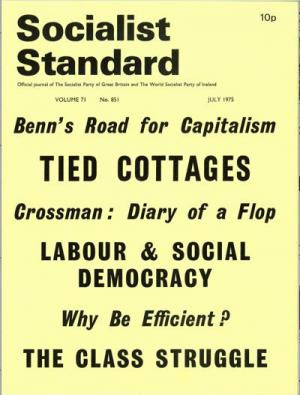
The Abolition of Tied Cottages (1975)

From the July 1975 issue of the Socialist Standard

The government has promised legislation in the near future to end the tied cottage system in farm employment. A report on it was published on 11th June by the Tavistock Institute of Human Relations, supported by the Minister of Agriculture. Last year the Shelter organization produced a report condemning the system.

The promise has a long history. Tied cottages have been a grievance of farm workers throughout the century, and their abolition was part of the Labour Party’s programme in the nineteen-twenties. In Sharpen the Sickle! The History of the Farm Workers’ Union, 1948 (pages 215-220) Reg Groves describes the expectations that the second Labour Government in 1929 would legislate on the lines of statements and pledges made; and the great bitterness when it failed to do so.

The number of farm workers is smaller today than ever before, of course. The total number was 1,591,300 in 1881 and 1,198,000 in 1931 (Astor and Rowntree, British Agriculture, 1939). In 1951 it had fallen to 882,000 and was only 352,000 by 1970, including seasonal and part-time workers (Agricultural Statistics, MAFF). Thus, it can be said of the tied cottage — as of many another social problem — that the reformers step in valiantly when the high tide has gone, forty or fifty years late.

Poverty the Problem
According to the Tavistock Institute report, about 90,000 farm workers live in tied cottages today. The official term is “service tenancy”, and it should be pointed out at once that agricultural tenancies of this kind are part of a much larger member covering various occupations and circumstances. The provision of a dwelling subject to remaining in a job applies to tenant licensees of public houses policemen, many shop workers, caretakers, country teachers, and others.

When the employment ceases so does the right to the dwelling. The worker may have bad health, or be sacked, or choose another job; in the end anyway he must retire; and in all these circumstances he can be and generally is told to go. Though a court order is required to evict him, there is no case he can present against it. The NUAAW reports about 300 farm-cottage evictions a year, but these are the cases reported to it and the true number is estimated to be three times greater. If a worker dies, his widow and children may be evicted.

A large number of workers in service tenancies make early applications for council houses, and this is where reformers have always sought the remedy. In 1925 Noel Buxton, Minister of Agriculture in the first Labour Government and a former President of the farm workers’ union, wrote:
The tied cottage is an almost equally serious grievance suffered by the farm-worker. Adequate provision by local authority of cottages in or near villages is the solution best calculated to deal with this evil.
(The Book of the Labour Party, Vol. 2)
The deputy director of Shelter says the same thing in 1975: ‘“That is where the problem must be tackled — by ensuring that adequate housing is made available in the rural areas,’ he said,” (Guardian, 11th June.) This well-established “answer” contains its own implication that it is addressed to the wrong question. The tied cottage system is an effect, not the cause, of farm workers’ miserable situation. Adequate housing is available — see the property advertisements in any local paper, or Country Life; but poverty makes it inaccessible and makes them mendicants to employers and local councils (the same people, quite likely).

Past and Present
Despite its promises, the Labour Party in office was no more likely than any other government to abolish tied cottages in the past. In the nineteen-twenties farm workers’ wages fell from a national minimum of 46s. in 1920 to an average of about 28s. in 1924 and in 1938 were about 35s. Agriculture was depressed, with bankruptcies common and land going out of cultivation. According to sources quoted by Groves, one reason for farm wage cuts in 1923 was “a hope that a big upheaval might bring Government action to help farmers”.

Tied cottages (together with living-in by unmarried farm hands and domestics) helped keep wages down, and legislation which would have tended to raise them was therefore impossible. It can be added that the standard of accommodation was rock-bottom. Rural areas were almost universally without piped water, electricity or drainage, and the maintenance of cottages cost practically nothing.

The position today is much different. Farming is supported by subsidies; not only does it employ only a quarter of its pre-war numbers, but there is now a high proportion of skilled workers. The dissolution of small farms has meant a further reduction in the dwellings required, and in the last ten or fifteen years large numbers of cottages and farmhouses have been sold as private houses. In many cases they are certified as unfit for habitation, but this makes them eligible for the high-priced market in which they are renovated to become "period cottages" and "houses of character”.

A further consideration from the Government viewpoint is that maintaining evicted families in public institutions, as well as intensifying a grievance, is costly. This is the "practical" case urged by the reformers; since the families have to be housed by local authorities in the end, why not recognize that and do it in the beginning? Along with this goes the fact that farm wages are now rising. In the opinion of many farmers there is an imminent shortage of skilled labour and wages must rise higher. In that case, the farm operative may pay a council-house rent or have a mortgage like any other worker: the problems of the tied cottage are redundant.

Reform leading Where ?
At any rate, farmers are not strongly opposed to the idea of abolition. The Guardian report on 11th June said that 46 per cent. of them claimed tied cottages to be necessary; which, put the other way round, means that more than 50 per cent. apparently do not mind.

There is a special reason why many should not. Between 30 and 40 per cent. of farmers in Britain are tenants (figures given in Farming in Britain Today, J. G. S. and F. Donaldson, 1972) and are themselves required to move out on retirement or in difficulty. Though the majority would not have to fall back on council housing, legislation which protected them from the demands of takeovers, for instance, would be very acceptable.

One other motive which should not be overlooked is the Labour Party’s hopes of winning votes in rural constituencies which are mostly Conservative. Only about 30 per cent. of farm workers belong to the NUAAW and about 5 per cent. to the Transport and General Workers’ Union. This is largely due to the difficulty of organizing workers who are scattered over wide areas; but it also represents disappointment with the unions’ inability to extract the fulfilment of Labour promises in bygone years.

The tied cottage system as it has always existed is a crude example of what the working class gets from capitalism — cheap maintenance, and out on the scrap-heap after use. If an end to it is made, we shall have the familiar situation over reforms: a grievance remedied when it has diminished, not for humane reasons but to suit the needs of capitalism, and with other beneficiaries than those named.

Of course nobody would wish a system which permits summary evictions to continue. However, if the proposed legislation is to aim at farm cottages only, the facility for evictions from other service tenancies can still remain. Certainly farm workers will find that when bad old days have gone things will have altered less than they may have thought, and their basic position not at all. That will happen only when they and other workers decide to change to Socialism.
Robert Barltrop

Wednesday, April 12, 2023

Rural Poverty. (1905)

From the April 1905 issue of the Socialist Standard

The recently published transactions of the Sociological Society in a volume of “Sociological Papers” (Macmillan, 10s. 6d.) contain an interesting addition to the investigations of Booth and Rowntree which should prove useful to the Socialist propagandist. An investigation into the conditions of “Life in an English Agricultural Village,” by Mr. Harold H. Mann, discloses a condition of life among the rural proletariat that is sufficient of itself to condemn the proposals of certain superficial reformers to solve the unemployed problem by sending the unemployed “back to the land.” The 30.1 per cent. of the population of London on or below the “poverty line ” ; the 29.8 per cent. of the population of York at or below the standard of “physical efficiency” ; and the 34.3 per cent. of the population of this typical English agricultural village of Ridgmount in Bedford in a state of “primary poverty,” present a problem that surely merits the attention of everybody, and particularly requires the consideration of the working-class who have to do all the suffering as well as all the work.

The village is a purely agricultural one, and is chosen as being most typical of the surrounding country, and almost all the population are engaged in agricultural pursuits. The Duke of Bedford is the greatest landowner house-owner, and employer in the district. Mr. Mann finds after a careful consideration of the prices of commodities in the village, that the minimum required to maintain an average family of husband, wife and three children, is 18s 4d. per week. “‘Primary Poverty’ is here taken to be that poverty caused by an insufficiency of earnings, even when most economically applied, to provide for physical efficiency. ‘Secondary Poverty’ is here taken to be that due to an uneconomical application of earnings.” Having found the minimum necessary and investigated the actual income of each family in the population, the author submits in a table the results he is driven to, as follows : —
Total population                           407
Total Working-Class Population   390
Total Families                                   127
Total Working-Class families           104

                                                                    Pr.ct. of total Pr.ct. of working-class.
Families in Primary Poverty           40        31.5                    38.5
Population in Primary Poverty 160        34.3                    41.0 
“The conclusion to which we come from a consideration of the figures, after every allowance has been made for subsidiary sources of income, is that no less than 34.3 per cent, of the population of a typical agricultural village in Bedfordshire do not obtain the necessary amount of money to enable them to remain in physical health. This percentage rises to 41.0 when the working-class alone is considered.”
Following this comes another table showing the proportion living within 2s. and 6s. of the minimum, which I will repeat, as follows :—
                                                           Pr. ct. of Wage Earners Pr. ct. of Total Population
Persons below Primary Poverty Line 160               41.0                     34.3
Less than 2s. per wk above line         213               54.6                     45.6
Less than 6s. per wk above line         284               72.8                     60.8
When this 6s. is added to the minimum it is only 24s. 4d. per week for a man, his wife, and three children, and 72.8 per cent, of the workers are below that standard of living.

Following that statement comes an investigation into the causes of Primary poverty under six different heads, and the results are submitted in a comprehensive table, as follows :– –


A detailed consideration is then given of specimen cases under each of the above heads, and if a bald statement of the normal condition is not sufficient, I will quote a few detail cases. Under head No. 2 is a case of “an old couple, the man deaf and quite incapable. The woman works at lace-making and cannot earn much more than about 2d. per day.” The rest of the small income is due to parish relief.

The author explains the absence of unemployment at that period of the year at which the investigation took place : “If these figures had been obtained a month or two earlier (than October, 1903) they would probably have shown a considerable number out of work.”

Another case merits particular notice. “A spinster makes her living entirely by lace-making, and works 10 or 12 hours per day for an income of about 3s. 6d. per week. The guardians refuse poor relief as she is a middle-aged woman ; but heavy work is impossible to her and as her sight is failing it is not likely she will be able to keep up the present close work long.”

The total deficiency works out as follows : —
                                 Secs 1-2  Sec. 4   Secs 5-6 Total
Under 16                       14     13  56           83
16-25                         1       4    7           12
25-55                         7       6   23           36
Over 55 23 4 2 29
Secondary Poverty is necessarily more limited here than in the towns, and the following are the statistics :—
Persons in Secondary Poverty                     33
Families in Secondary Poverty                     10
Percentage of Working Class Population    9.0
Percentage of Total Population                    7.1
No. of Individuals per Family                            3.3
Of the ten families in Secondary poverty, five are given as due to “the drink habit and its associated vices” ; three to bad management at home, which bad management is given as “sometimes through the overwork of the head of the household in getting a living” ; in one case to uncertainty of work; and the remaining one to the wage-earner not working regularly. The total poverty, both Primary and Secondary, is summed up as follows :—


The wage earners not in poverty are classified as follows :—
Total numbers of persons            197
Total number of families                      54
Average size of families                   3.71
Average family earnings       23s. 7½d.
Average rent                             1s. 6½d.
Per cent. of population                   42.1
The author warns you not to forget that every penny earned by every member of the household is here counted, and cases of adult sons earning full money and living at home help to bring the average up. The next table shows that the number of young wage earners living with their parents and helping to swell the family income is an important factor, and their influence in keeping the family above the poverty line can be seen as follows :—
                   
                  Primary Poverty pr.ct.   Secondary Poverty pr.ct.    Not in Poverty pr.ct.
Under 16         51.9                                   30.3                          26.0
16-25                 7.5                                   15.2                          14.2
25-55                22.5                                   39.4                                35.5                        
Over 55                18.1                                   15.2                          23.4
showing that the relative position of the family with regard to the poverty line is largely influenced by the age of the children. So powerful, indeed is this factor of the help supplied by children’s wages, that without it “a vast proportion” of those at present over the line would be below it. Out of the 54 families of the workers over the poverty line only 40 would be above it if only the head of the family were earning wages, i.e., 25.9 per cent, of this group are dependent on the supplementary wage earners.

The trading and upper classes, we are told, are well over the poverty stage. Certainly we must expect that under Capitalism, the non-producers should be rich, and that the wealth-producer, the worker, should be poor !

The average weekly wage for the labourer, according to Mr. Mann’s investigations, is 13s. 7½d., and including extras from allotments, &c., is 14s. 4d. : while if foremen and others are included who earn considerably more than the labourers, the average only rises, including extras, to 14s. 11d., a sum considerably lower than that obtained by Mr. Wilson Fox for the Agricultural Commission.

He concludes with two caustic paragraphs, which I will quote in full:—
“Taking the actual figures obtained, it appears clear that a man earning the average rate of wages and the head of a household, must descend below the Primary poverty line so soon as he has two children, unless he is able to supplement his income by an allotment, by fattening and breeding pigs, or by other means. It is also clear that he will remain below the poverty line until the eldest child leaves school and begins to earn money, and that, even if he has no more than two children, his only chance to save will be in his later life when his children are grown up and are earning money, or have left home. This is the most favourable case : if there are more children the period of poverty is longer, and the chance of saving less. In any case, during life it is a continual round of poverty. During childhood, poverty conditions are almost inevitable. As a boy grows up there are a few years intermission till, as a young man, he has two children; then poverty again till these children grow up ; and finally, at best, a penurious old age, barely lifted above the poverty line.

“I do not wish to draw conclusions in the present paper, but one thing I must say. The cry of ‘back to the land’ has a curious commentary in the results I have obtained. As at present existing, the standard of life on the land is lower than in the cities, the chances of success are less and of poverty are greater, life is less interesting, and the likelihood of the workhouse as the place of residence in old age the greater. It is evident that the cry against the depopulation of the country and the concentration of population in the towns must remain little more than a parrot cry until something is done to raise the standard of life and hence the standard of wages in our purely agricultural districts —to increase the chances of success in life, to make life more interesting, and to bring about a more attractive old age than at present, when, under existing conditions, the workhouse is apt to loom too large on the horizon of the agricultural labourer.”
I must remind the reader that this condition obtains now, when the power of wealth-production is greater than ever before, and that the conditions depicted affect that class that alone produces the wealth and makes the land fruitful. So long as the land and capital remain in the hands of a separate class, whose interests are thereby antagonised to the interests of the wage-worker ; so long as the workers are forced to compete for a wage, the tendency will naturally be for that wage to fall to the lowest subsistence level. Wages, as wages, cannot be raised by any artificial means as the author appears to suggest, and the only remedy for the poverty problem in the country, as in the town, is the restoration of the worker to the land and to the tools necessary to wealth-production, and this will necessitate the abolition of the class-ownership of the means of living and the opening up of a new era for humanity by the establishment of the Socialist Republic.
Dick Kent

Thursday, July 14, 2022

Answers to Correspondents. (1928)

From the January 1928 issue of the Socialist Standard

F. R. Rimington (Leicester).—Your further reply to article by Jacomb will be dealt with in next issue.

F. S. Harvey (Wandsworth).—Your letter re “The Slave of the Farm” does not deal with the conditions in Canada, and is therefore hardly a criticism of the pamphlet. We note your reference to the hard conditions under which the “Australian serf” works for the farmer there, which is, however, in its main features, inevitable under private and class ownership.

Friday, June 10, 2022

The Problem of India (1941)

Book Review from the December 1941 issue of the Socialist Standard

Capitalism is no Sleeping Beauty. The apostles of the “inevitability of gradualness” have been pulverised by the crashing blows of events during the last decades. War—crisis—then war again; the false complacency of “improvers” and social reformers is now revealed in all its inadequacy, for like a series of terrific earthquakes, capitalism administers periodical shocks.

The backward countries are particularly affected. Already it is clear that the battleground of the present conflict is moving east. Africa and particularly Asia will bear much of the brunt of the world-war.

Again, the productive powers of the warring countries will be strained to their limits, no source of supply will be left untapped; think of these factors and then think of India.

The Problem of India,” a “Penguin Special,” is a book of some two hundred and fifty pages. The author, Doctor K. S. Shelvankar, an Indian student, presents his case exhaustively, efficiently and clearly. In his foreword he claims that it is not “pro-British and anti-Indian or vice-versa,” but that he is “pro the things that can bring food and freedom for the millions who are to-day deprived of them.” “Food and Freedom !” In his historical survey of pre-British India the author makes it quite clear that there was not much of the first and none of the other for the masses of peasants and handicraft workers. A multitude of oppressors and exploiters, princelings, landowners and middlemen, plus the inevitable crowd of religious parasites, the priesthood, had to be maintained according to their social status out of the products of the labouring masses. The system of agriculture was backward even when compared to the then feudal structure of Western Europe. This was due to a variety of reasons: Lower fertility owing to lack of irrigation, wasteful methods of tilling, little domestication of animals. It is not the purpose of this article to follow the author deeply into the historical development of India, for Socialists here the main question is the position of India under the rule of British capitalism.

However, Dr. Shelvankar’s investigation of India’s past is an impressive, though necessarily condensed, piece of work. Methodically he describes for us the whole structure of India as it was when the traders from the European continent came to barter and cheat the Indian population under the banner of Christianity. First the Portuguese, then the Dutch and the French and finally the British in the form of the East India Company. The British stayed.

At this time, during the 15th century, the country was under the rule of a Moslem dynasty, the Moguls, having been conquered by a series of attacks some four centuries previously. Victors and defeated were of different religion, the former were Mohammedans, the latter Hindus. The two faiths did not assimilate each other; both existed side by side and do so to the present.

The invasion made little or no difference to the economic life of the country; it merely deposed one ruling group and substituted another. Peasants toiled on the land, the craftsman worked on his job, but the surplus-value, politely called “tax,” went to the princes and priests of Islam instead of to the Brahmin caste.

The Indian feudal structure differed in important essentials from the system prevailing during the same period in Europe. This must be remembered in order to see why India did not develop into capitalism of its own accord, but had to have the capitalist virus injected into the body economic from without.

The Indian village community remained static. The handicraft worker stayed put, the victim of the peasant’s abysmal poverty; the towns remained the pleasure-grounds of the feudal rulers. Commerce was restricted to the needs of the thin upper crust, a mere by-product of an effete social system, as was the highly-skilled artisan labouring in the prince’s courtyards.

Into this paradise for capitalist exploitation came the British merchants and soldiers ready to assume the “white man’s burden” of gold. The Whig politician, Sheridan, described the East India Company as “wielding a truncheon with one hand and picking a pocket with the other.” The truncheon was soon replaced by the rifle and bloody battles throughout the country blazed the trail of British conquest. Then came the mutiny in 1857, the Company was wound up, and India came under the control of the Government, as the “brightest jewel in the British Crown.”

For more than eighty years India has been a Crown Colony. The British ruling class cannot therefore disown responsibility for the conditions now obtaining among the mass of the Indian people. It is not a pleasant thought. Out of a total population of 353 millions, and a working-mass totalling 154 millions, excluding children, about 66 per cent, are still employed on the land either as smallholders or labourers. Only 18 per cent. are employed in trade, transport and industry. There is a middle group composed of professional workers, officials, small business men, etc., numbering roughly 15 millions. Then comes the top layer of big landlords (princes, etc.), industrialists and others living on big private incomes.

The preponderance of agriculture is evident. It is not agriculture as we know it in the Western world. Large-scale farming is practically unknown except in products designed for export such as cotton, jute, linseed, tea and coffee. The production of food grown for home consumption, cereals, pulses, sugar, and so on, has been left to stagnate under a system of primitive small-holdings, the owners of which are burdened down by government tax and money-lenders. The standard of living among these peasants as well as the urban proletariat is so low as to be incomprehensible to our minds. To quote the author:
“Excluding the cultivators, most of whom, clinging to dwindling plots of land, are on the brink of insolvency and steeped in debt, we have sixty or seventy million agricultural and industrial workers holding on to dear life by the skin of their teeth. Very few of them—a fraction of 1 per cent. at the most—earn as much as 1s. or 1s. 6d. per day (i.e., between £12 and £18 a year); all the rest toil and sweat for a few pennies a day.”
How do they exist? Dr. Shelvankar tells us.
“The average village dwelling is a low, flimsy, crooked structure with mud walls, a mud floor and a thatched roof. It is windowless, airless and has no sanitation.”
The urban proletariat vegetate in hovels “with no windows, chimneys or fireplaces. There is neither light nor water supply, and, of course, no sanitary arrangements.”

Their diet is reminiscent of kept animals, only much smaller in quantity. The daily food of an industrial worker in the towns of Bombay or Madras consists of l¼ lb. of cereals and little else. The average consumption of milk per head in working-class households in Bombay “is less than ½oz. supplemented by .05oz. of melted butter.” Many of the peasants exist on an even poorer diet.

Is it any wonder that during the first thirty years of this century “Cholera has claimed 10¾ million victims, influenza 14 millions, plague 12½ millions and malaria 30 millions ” ?

And yet pacifists can only see the horrors of war !

What remedies can be applied to alleviate such distress? As was to be expected, the author of this book argues strongly that first of all India must be freed from British domination before any comprehensive policy of progressive amelioration can be put into effect.

The core of his case is, that by a deliberate policy of imperialist exploitation the development of industry has been stifled, whilst a mortal blow has been dealt to the old village communal system, adding the burden of alien exploitation to the existing native incubus. As a consequence the demand for working recruits to industry is not large enough to relieve the economic pressure on the over-populated small-holdings. He contends that the country has in the main been allocated the role of supplying to British capitalism the natural products so vital for an empire of industry and commerce, plus the provision of countless well-paid sinecures to members of that exclusive ruling-class “freemasonry,” the old school tie.

During and since the last war, however, there has been a marked rise in industrial output, particularly in textiles. It is certain that this industrial impetus will be intensified as a result of the present war. Therefore, even if it were the wish of the British ruling class to retard the growth of capitalism in India, the evolutionary process is not a thing that can be held back for ever.

That is the Socialist view, and it should be taken into account when we are dealing with nationalism in a colonial country. Further, it has yet to be shown that “national liberation” would prove to be something worth the effort and sacrifice for the hungry millions.

For as the author himself notes:
“The outstanding feature of Indian industry to-day is the degree to which ownership and control are concentrated within a comparatively narrow circle. ‘The same set of individuals’—rich merchants with a sprinkling of the more prosperous professional people—‘hold the bulk of the shares in all the cotton, jute and other concerns.’” (Page 155.)
We have still to be convinced that in matters of economic welfare or on any other questions the Indian masses could expect a better deal from their native exploiters.

Dr. Shelvankar seems to recognise the truth of this. He agrees that the handing over of the country to a native bourgeoisie, or worse still, the princes, would not improve the situation. In his view the only hope for India lies in the introduction of a “planned Socialist economy” for which national liberation would provide a stepping stone, a period of brief “transition.”

It is a view which has no basis except in the optimistic imagination of the author, who assumes that “liberation” would give the nascent Indian bourgoisie only a short lease of life. Quite the contrary. Success in the struggle for national freedom may have the effect of eliminating for a long time to come whatever influence (and it is very small indeed) the ideas of independent working-class action, not to speak of Socialism, has in India to-day. The very status of national independence presupposes a powerful native ruling-class secure in the support of a nationalist-minded population.

The author several times quotes Ireland in dealing with the agrarian problem. It is a pity he did not allow himself, and his readers, a glimpse at the virtual stagnation of the working-class movement in the Irish Free State at the present time. It is certain that this standstill is partly the result of the struggle for national independence which completely occupied the energies of the Irish workers.

Dr. Shelvankar wants his working-class compatriots to make the same mistake, but expects them almost immediately after to turn on the movement for which they have suffered and bled, throw over the nationalist illusions with which they have so long been nurtured, and proclaim their conversion to socialist ideas.

However desirable Mr. Shelvankar’s hopes may be, they are totally unrelated to the problems he is attempting to solve. Under present conditions in India, and with the standard of political consciousness prevailing among the majority of its inhabitants, the platform of national liberation can at best only lead to some form of native capitalism. This is clearly seen from the nature of the mass-movements India has so far produced. The Congress Party, though some of its leading spokesmen such as Nehru claim to the Socialists, is in fact no more than a movement of national liberation. This is implicitly recognised by the author himself when he deals with the growth of Indian industrialism during the last war. On page 176 he says: “These developments marked a critical transition in the nature of Indian capitalism. From being predominantly commercial in character, it was launching out into industrial production. But its real strength lay not so much in the economic resources at its command as in its affiliation with a political movement (the Congress Party) which was becoming a menace to imperialism.”

Later, in dealing with the record of Congress in office, in 1937, he has to admit that so far from justifying hopes of a working-class character, it showed even amity to British rule. As for the peasants, they received a rude shock when, in the province of Bihar, their champions entered into a pact with the landlords, whilst “the entire labour movement . . . denounced a Trades Disputes Bill designed to interfere with the right to strike,” which was the act of the Congress Government of Bombay (page 231).

But the chief force in India is still wielded by Ghandi. He is the real spokesman of the peasants, the bulk of the Indian people. For him the future of India lies in the past, a return to the primitive agricultural community; he is the idol of the masses, the illiterate, half-starving millions, who have not yet been pulled out of the primitive slough of religious fanaticism, and are left to the mercies of money-lenders and their agents. Not content with their “legal” whack, they take advantage of that illiteracy to double-cheat their prey.

The author’s sympathy for Ghandism is evident by the approval with which he quotes the policy of the peasant leagues, “which is nothing less than the abolition of landlordism and the cancellation of peasant debts and reorganisation on such a basis that exploitation in every form would be ended and ownership vested in the cultivator himself” (page 221).

This raises the question: What does Dr. Shelvankar mean by Socialism ? What kind of India does he visualise that would justify the term “planned Socialist economy”? For Socialists private ownership of land, as well as any other form of ownership in the means of life, is not compatible with Socialism at all. On the contrary, the small land-owner is a particularly reactionary obstacle to the achievement of Socialism. Dr. Shelvankar reveals his misconception of Socialism when he refers to Russia as a Socialist country, and gives the Soviet state-capitalist order as the example which India must follow.

In fact, the author, like many other left-wing Indian nationalists, completely disguises, perhaps even from himself, the real issues of the Indian problem. The vexed questions of religious and caste differences are fobbed off under the theory of the British policy of “divide and rule.” This may or may not be true. But that they are able to do so depends primarily on the low level of understanding, and particularly class-consciousness, which inevitably exists among the Indian masses to-day.

An important omission from the book is the total absence of any appraisal of the international issues of which the Indian problem is only a part. The wars in Spain and China have apparently taught Dr. Shelvankar nothing, but their lessons have not been lost on Socialists. Backward and smaller countries cannot assume a ”national independence” that does not exist in fact. Even Russia has had to face the bitter tragedy and humiliation consequent upon a balancing of capitalist world-power. The chances of an independent India are nil.

Socialists have, of course, to aim to break down all barriers, whether of nation, race or religion, which to-day divide the workers of the world according to the convenience and benefit of their exploiters. And let it be noted by cynics, pessimists and opponents of Socialism alike: The world to-day is more interdependent than ever before. The conflict raging at present will leave its mark in every corner of the globe. In India it will have far-reaching effects.

Socialists everywhere feel the deepest sympathy for the Indian masses in their struggles to raise their heads from under the yoke of poverty, of domination, alien and native. The problem of India is part of a world-problem; a world-wide movement for the achievement of Socialism is the only solution.
Sid Rubin

Friday, June 3, 2022

Pamphlets for sale. (1927)

From the October 1927 issue of the Socialist Standard

We have been fortunate in securing quantities of seven pamphlets published by the Socialist Party of Canada, and are offering them for sale at the rates set out below. There is, of course, no need to make special mention of the standard works of Marx and Engels. The pamphlet on the causes of modern war contains much useful information with copious references, and consists of articles which appeared serially in the Western Clarion (now defunct). “Slave of the Farm” describes and explains the hard and losing fight waged by the Canadian farmer against the organised financial and industrial Capitalists. It is a corrective to the fanciful tales of the Empire boosters and emigration touts.

Causes of Belief in God,” by Lafargue, has not been published in this country in pamphlet form, and will be new to most English readers. It is written with Lafargue’s accustomed brilliance.

The Socialist Party of Canada has now ceased to exist, and the pamphlets will not be reprinted in the present editions.

Those we have obtained represent the bulk of the remaining supply. They are excellently produced, of convenient size, and well worth the price asked. All but two (“Slave of the Farm” and “Economic Causes of War”) are in the uniform and attractive series known as the “Whitehead Library.” As the stock will soon be exhausted, you are urged to make early application.

“Wage-Labour and Capital” (Marx), – pages, 4d.
“Communist Manifesto” (Marx and Engels), 59 pages, 4d.
“Slave of the Farm” (A. Budden), 63 pages, 6d.
“Economic Causes of War” (P. T. Leckie), 132 pages, 6d.
“Causes of Belief in God” (Lafargue), 48 pages, 6d.
“Socialism—Utopian and Scientific” (Engels), 95 pages, 6d.
“Value, Price and Profit” (Marx), 78 pages, 6d.

Note.—Postage extra : ½d. per copy.

Blogger's Note:
The Socialist Party of Canada referred to in the notice was the Party which dissolved in 1925. The Socialist Party of Canada, which is affiliated to the World Socialist Movement, was founded in 1931. There is an overlap between the two organisations because the original Socialist Party of Canada had a significant impossibilist membership within it, and there was an overlap of members between both organisations.

Wednesday, April 27, 2022

Between the Lines: Primitive . . . (1989)

The Between the Lines column from the February 1989 issue of the Socialist Standard

Primitive . . .

Marx wrote about the increasing misery of the working class. By this he did not mean, as some who have tried to refute him have suggested, that wages would fall lower and lower, material conditions ever more harsh. Marx was right: the quality of living under capitalism becomes ever-more impoverished.

Country File (C4) provides a pleasant diversion on the bleakest of urban Sunday lunchtimes. It has features on farming and conservation and the world of animals: it reminds the viewer that, stuck with the noise and dirt of an artificial city, there is an environment beyond which is richer in what is natural and more in harmony with the senses. On 8 January it had a report about a growing social problem: rural violence committed by young frustrated workers in small country towns and villages — the children of the land whose daddies do not own the fields and whose futures are in the cities, where there is more chance of jobs. Others involved in recent acts of rural criminality are farm labourers whose jobs have been made more tedious by mechanisation and who are often paid below-poverty wages for making landowners rich. A police officer from Avon and Somerset spoke of how Saturday-night gangs were terrorising villages and vandalising beauty spots. There have even been reports in the press of the senseless slaughter of farm animals for fun.

No doubt there were irritated viewers in Devon or Yorkshire who switched on expecting to see how big turnips can be and how green fields can look in the right light. Such people would do well to ponder that life is becoming increasingly empty for vast numbers of young workers, squashed as they are between the obscenities of the bomb and the social mind of a world which is civilised only to degree that it offers hope when there is a likely profit attached.

The following evening World In Action (ITV, 8.30 pm) reported the results of a nationwide survey which revealed that women were more afraid of violent assault in the streets than death from cancer, being killed on the roads or nuclear war. Ninety per cent feared being attacked if they went out at night. Sixty-seven per cent said that they never go out at night alone. What an indictment of a so-called civilised society it is that the majority of women — the majority of the population — are too frightened to go out alone in the evening. This is the social-pay-off of the competitive society. The streets become a jungle where anyone with money, however old, frightened or disabled, is prey to the muggers. Women workers are right to be scared. Street assaults are frequent: more dangerous weapons are now used by the muggers (in imitation of our rulers who also like to sophisticate their murder instruments regularly); and most of us live in badly lit environments, which assist the fast-money attackers. The thief thieves because it is an easy way to make money. Ethics do not enter into it; he is a reflection of the economic motives of the more successful robbers in the City, whose activities are strictly legal.

It is not just that women are likely to be attacked, but that they feel threatened. Every walk in the dark streets feels like preparation for an attack. Young men are eight times more likely to be mugged than women, but this is a deceptive statistic: women are less likely to be mugged because so many are forced to seek refuge in their homes every night. They are under curfew. There is no way that a society which scares its inhabitants to that extent can ever be worthy of the description of “civilisation". The simple-minded blame the muggers, as if knife-carrying kids have chosen such a way of life as an alternative to the gentlemen's club. Socialists blame the profit system.


. . . and civilised

The same people that the profit system twists into muggers could, in different material circumstances, behave like the people of the Baka tribe, shown in three programmes by Channel Four called Baka — People Of The Rainforest. Modern society sneers at such primitive social relationships. The programmes allowed us to glimpse into the moneyless, wageless, stateless world of one of the few extant pre-property societies. Of course, the Baka are productively unsophisticated and have to work harder than they would need to do had they access to labour-saving technology. They are still innocently religious, regarding Nature as something above them and largely beyond control. It would be foolishly romantic — although very tempting — to depict primitive communism as The Way We Should Live. But what if we took all of the machinery of production which exists in modern Britain (where women are afraid to walk city streets and rural areas are echoing to the sound of furious working-class frustration) and combined it with the human relations of classless equality which characterise primitive communities? That is the prospect which world socialism holds before us now. We could have a society where people co-operate to produce the best that there can be to satisfy the needs of all; instead we have a society shown to us in a documentary by Clive James called Postcard From Chicago (11 January, BBC1, 9.30 pm) in which we were introduced to the gangs which inhabit the city's slum areas. These gangs — The People and The Folk — do not merely shout abuse at each other. They shoot — to kill.

Gang warfare, born of urban poverty, is a game that ends in murder. Often the killers and killed are in their mid-teens. Now. James is one of those "witty" types who likes to enchant the half-witted with empty aphorisms. It's seductive viewing, but a lot of tripe is squeezed into the maxims. For example, in watching workers making hamburgers in Chicago (note: you will always see James watching people work) he stated that “Marx had it all wrong”. There is no alienation; these descendants of Polish immigrants feel close to their work and are grateful to be close to food — unlike in Poland where they would have to queue for it. This self-evident rubbish is supposed to pass for serious social commentary. By the same reasoning. Rolls Royce car producers are not alienated from the luxury cars they produce — even though they may travel home from work in a second-hand Cortina. Clive James is, in fact, a virulent anti-socialist. That he is witty and entertaining makes him an all the more potent one.


Is Britain free?

Panorama (BBC1, 9.25 pm. 9 January) was all about the diminishing freedom which many of us perceive in Britain at the moment. The government, in the name of freedom, has made numerous moves to curtail trade union and civil freedoms which workers fought hard to win. But even without the much-discussed Thatcherite assault, a society without free access to goods and services can never be free. That conception of freedom was not once mentioned in the programme. It is as if the fullest extent of “freedom" can only ever mean a loosening of the chains. I fell asleep after ten minutes of the great debate about whether Britain is unfree, woke up to see Willie Whitelaw sounding silly and switched over to Minder (ITV), where one can see a far more vivid picture of phoney freedom and increasing misery under the capitalist social system.
Steve Coleman


Blogger's Note:
For some reason the February 1989 issue of the Socialist Standard misnamed 'Baka — People Of The Rainforest' as 'Baka — Children Of The Rain Forest'. I'm not sure what happened there. In 2012 the writer/director of the original documentary, Phil Agland, wrote and directed a follow up documentary entitled, 'Baka: A Cry from the Rainforest'. It can be viewed at the following link.

Saturday, April 2, 2022

Answers to Correspondents (1939)

Letters to the Editors from the April 1939 issue of the Socialist Standard

The Wages of Agricultural Workers

A correspondent writes as follows: —

Wickford,
Essex.

Dear Comrade,

In the January issue of the Socialist Standard you state that it has been estimated that as many as twenty-five per cent. of agricultural workers are being paid less than the minimum wage legally applicable to them. Will you please explain how this information was obtained and why it has not been used to enforce the law?
Yours fraternally,
T. R. V. Andrews.


Reply.
Minimum rates of wages are fixed in the various districts, and it is an offence under the Agricultural Wages Act to pay less than the minimum. But there is a great gap between specifying a wage and enforcing its payment. In 1937 the Minister of Agriculture instituted 83 prosecutions of farmers for non-payment of the minimum. The Courts imposed £314 10s. 0d, in fines and awarded. £2,020 as arrears of . wages to the workers concerned (see Reply by Minister of Agriculture, Hansard, February 21st, 1938). These few cases are, however, only those which came to light. The difficulty faced by the Ministry’s inspectors, and by the National Union of Agricultural Workers, always is that when agricultural workers are faced with the risk of losing their job, and perhaps being turned out of their cottage as well, they are most reluctant to disclose the fact that they are underpaid. Any estimate of the extent of underpayment is necessarily based on inadequate information. The figure 25 per cent. was given some years ago by a writer on agriculture, but the source of the information has for the moment been mislaid. The general problem, however, of workers who are underpaid; but will not risk taking action is well known to trade union organisers.
Ed. Comm.


Is the S.P.G B. afraid to criticise Trade Unionism

A correspondent, who gives no address because he is “on tramp,” asks an unusual question. His letter and our reply are given below : —

Dear Sir,

I have become a reader of the Socialist Standard, but I am told by a great many people that the S.P.G.B. are afraid to criticise Trade Unionism, because the Party would become unpopular., I do not know the S.P. view concerning this. I maintain that if Trade Unionism were universally adopted it could only result in failure because of the fact that wages are adjusted to the cost of living and vice-versa, therefore wages, however high, would not raise the standard of living. I fully admit that the Trade .Unions as they stand at present do benefit their members, but only at the expense of the community, as increased costs raise the cost of living. These facts prove the fallacy of Trade Unionism. If there is any truth in the statements made by some people as regards S.P.G.B. members all being staunch Trade Unionists, then the Party will have a hard job in trying to explain these facts away.
Yours truly,
J. B. Marshall.


Reply.
Our correspondent’s question is unusual, because a very frequent complaint made by critics of the S.P.G.B. has been that we are unduly critical of trade unionism if not actually hostile.

The truth is that the S.P.G.B. recognises the value of trade unionism in resisting the constant pressure of the capitalists on the workers’ standard of living, but. recognises, too, that trade unions are in the main concerned with the day-to-day struggle within capitalism and not with the task of overthrowing capitalism. This is necessarily the case because a trade union has to accept to its ranks all workers who are willing to join for its limited purposes. A trade union which restricted its membership to those who seek the overthrow of capitalism and the establishment of Socialism would—in present circumstances—be a very ineffective body, because it would be excluding a majority of the workers.

While supporting trade unionism, the S.P.G.B. need not, and does not, support or defend those speeches and actions of trade unions and their officials which are contrary to working class interests and Socialism.

Our correspondent is advised to read the Socialist Standard regularly. He will see the Socialist attitude to trade unions frequently explained and elaborated.

Our correspondent argues that trade unions are to be condemned because higher wages mean higher prices and are at the expense of the “community.” This is an error which has on occasion been used by the capitalists to dissuade workers from joining trade unions or taking part in strikes. The attitude of the employers is sufficient to show that they at least are under no such illusion. If employers thought that higher wages can simply be passed on in the form of higher prices they would not resist trade union demands. The employers know better. They know that higher wages are a direct cut into profits—hence their resistance to such demands.

Although wages are affected by changes in the cost of living, the relationship is not an automatic one. Workers have to struggle to raise wages when prices rise and have to struggle to prevent wages from falling when prices are stable or falling.

For an illuminating discussion of the economies of the problem our correspondent should read two pamphlets by Karl Marx, “Wage-Labour and Capital” and “Value, Price and Profit."
Ed. Comm.


Mr. Edgar Paul (Northiam).—We have your inquiry about class-consciousness, but are not quite sure what is your point. The more class-conscious the workers are the more inclined they are to reject open and disguised propaganda for capitalism and the more ready they are to put up intelligent resistance to capitalist pressure. It is quite true that workers with little understanding of Socialism will often put up a spirited defence against capitalist exploitation, but a defiant attitude alone will not suffice to get rid of capitalism.

Perhaps you will elaborate the point.
Ed. Comm.

Replies to many correspondents are unavoidably held over, owing to pressure on space.
Ed. Comm.