Showing posts with label Ted Kersley. Show all posts

Tuesday, October 14, 2025

Sunday, March 9, 2025

SPGB Meetings (1951)

Party News from the March 1951 issue of the Socialist Standard


Blogger's Note:
Sybil Morrison of the Peace Pledge Union was quite a well known pacifist and suffragette speaker and activist in her day.

Monday, November 20, 2023

SPGB Meetings (1956)

Party News from the November 1956 issue of the Socialist Standard


Blogger's Noted:
'R. Coster' was the Party name for Robert Barltrop during his first stint of membership of the SPGB. The ILPer debating Coster/Barltrop, Frank Maitland, was an interesting political figure. It's worth checking out his obituary from the Revolutionary History website.

Thursday, June 2, 2022

Debate: Socialism versus Religion (1957)

Party News from the June 1957 issue of the Socialist Standard

A debate was arranged under the above title between the Socialist Party, represented by Comrade Jarvis, and the Catholic Evidence Guild, represented by Mr. Barr. It took place at Head Office on Sunday, March 31st, with Comrade Kersley in the chair. It started promptly at 7.30 with all seats taken, and subsequently more people arrived and packed the hall. About half the audience were non-members.

Comrade Jarvis opened with a 20-minute speech, in which he said that it was agreed between the opponents that there were problems in the world waiting to be solved—the problem of war, poverty, hunger, misery, unemployment, crises, etc. It was the Socialist Party's view that these problems could only be solved by changing the social system from Capitalism to Socialism. His opponent, however, claimed that religion (or Catholicism) was the answer to the world's problems.

Comrade Jarvis then outlined the Party’s case as given in the pamphlet "The Socialist Party: Its Principles and Policy. He stated that there was no room for religion or any form of mysticism in our policy. Religion was defined as man's knowledge of God, or “ the mental faculty enabling men to comprehend the Infinite.” There can be no religion without God, although there can be religious ritual and paraphernalia without God. Religion consists of five things, and all the necessary emotional trimmings accompanying them. These are:— ,
  1. Belief in God or gods.
  2. Belief in Holy or Inspired writings (Bible, Koran, Zend Avesta).
  3. Belief in after Life.
  4. Belief in the Efficacy of Prayer.
  5. Belief in Miracles.
If God does not exist it would follow that the last four of these fundamentals of religion are of no consequence. (To this Mr. Barr nodded approvingly.) The existence of God could not be proved, maintained Comrade Jarvis. Belief in God had declined in proportion to the growth of education and freedom of speech, whilst in the centuries of Catholic domination, when no opposition was permitted, the majority believed in God. Atheism and materialism had therefore grown with increased knowledge. This debate could never have occurred in the heyday of Catholicism, with its ruthless tortures and death penalties for all who questioned its authority.

After dealing briefly with the usual arguments offered for the existence of God, Comrade Jarvis went on to state that the problem of evil in the world, the existence of wars, poverty, unemployment, crime, crises, etc., made it clear that no Supreme Being existed. Nor could it be claimed that evil, cruelty and barbarity are just man made, for barbarity exists among the animals. The cat plays with a mouse until it has been slowly tortured to death and the jungles are filled with ferocious beasts who live by tearing to pieces smaller and weaker animals. If God could make herbiverous animals why not make them all like that instead of creating carnivorous ones. Everywhere the law of the jungle dominated human life under capitalism.

Since the discovery of the laws of Evolution, it was possible to trace the evolution of the idea of God in primitive society, and now that we know the origin of the God idea, this cuts the ground from under the feet of the theist. “The heavens no longer proclaim the glory Of God, nor does the firmament show his handiwork.'’ God who could reveal himself at any moment has now to be searched for. The time has come to conduct God to the frontiers, thank him for his services, and ask him not to call again and trouble us with his diversions, as we wish to change the economic basis of society, and for this purpose do not need spirits, spooks or ghosts (whether holy or otherwise).

Comrade Jarvis finished by challenging Mr. Barr to prove the existence of God, for upon this his whole case must rest, since if no personal God existed, no value could come out of religion which could help the working class to solve the problems which confront them.

Mr. Barr opened by declaring that he had heard all this before—years ago—but that he obviously had too little time at his disposal to deal with all the questions raised. He stated that he had no intention of dealing with the political issues raised in the opener’s remarks, firstly because he accepted many of them, and secondly because even former Popes had similar views. He never criticised the party’s cause in any way. He then went on to try to prove the existence of God, and declared that it could be inferred from the existence of mind and of order in the universe. He referred again to the shortness of time, and said each part of the debate contained sufficient material for a whole debate. He ended by stating that these debates get nowhere, and he knew in advance that it would be the case.

In Comrade Jarvis’s second speech he commenced by saying that Mr. Barr should not have complained of shortness of time, because he had 20 minutes just the same as himself, and as he declined to deal with the political issues, he had the whole of his time to deal with religion and show that it had something to offer mankind to help to solve the world's problems. Mr. Barr, however, had one question to answer—the existence of God—for on that the whole case rests, since if no God can be proved to exist, the edifice of religion crumbles.

Instead of God creating man in his image, man had created his God or gods and always in his own image. He instanced that the gods of the African tribes were black, with short black curly hair, and the gods of the Eskimos were fat and covered with thick furs, etc. In his reply to this Mr. Barr said that Jarvis knew full well that these gods were man-made and false, and consequently had nothing to do with the debate. Jarvis replied by stating that he agreed that they were all false, and therefore it would appear that the only real difference between himself and Mr. Barr was that he believed in one god less than Mr. Barr did, which was a very small difference to argue about.

Comrade Jarvis then read from a number of Catholic pamphlets: "This is the aim which Our Predecessor urged as the necessary object of our efforts: the emancipation of foe proletariat.” (The Social Order, Pius XI).“ For towards the close of the nineteenth century new economic methods and a new expansion of industry had in most countries resulted in a growing division of the population into two classes. The first, small in numbers, enjoyed practically ail the advantages so plentifully Supplied by modern invention; the second class, comprising the immense multitude of working-men, was made up of those who, oppressed by dire poverty, struggled in vain to escape from the difficulties which encompassed them." Comrade Jarvis suggested that Pope Leo XIII (the author of this statement m Rerum Novarum, re-quoted in The Encyclical Quadragesima Anno of Pius XI), had been reading some, of the banned books, as this passage had a strange resemblance to the writings of Karl Man.

Another pamphlet quoted from was Cyril Clump’s A Catholic's Guide to Social and Political Action, which contains a collection of extracts from the writings of the Holy Fathers—who. by the way, are not supposed to be fathers.

After the first two speeches were made on each side, the debate was thrown open to the audience and a special appeal was made from the chair for Catholics or other opposition to take part in the discussion, but these were conspicuously absent. The debate concluded with the two participants winding up, in which Comrade Jarvis again requested proof of God’s existence, and Mr. Barr, who in the meantime had received a host of questions from the audience, again pleaded the impossibility owing to lack of time.
Horace Jarvis

Thursday, October 11, 2018

All My Own Work (1959)

The Marlborough Tapestries at Blenheim Palace.
From the October 1959 issue of the Socialist Standard

All this summer in the Diploma Gallery of the Royal Academy there have been exhibited 60 signed charming paintings by Sir Winston Churchill and like the pavement artist he can truly say "All my own work.”

There are landscapes, "bottle scapes," etc., interiors of Blenheim showing tapestries, depicting victories of his ancestor, the 1st Duke of Marlborough.

Looking at these brought to mind Southey’s poem “Battle of Blenheim" with its unanswered question "What good came of it at last"? For there are other kinds of items "signed W.S.C." not in any Exhibition. They range back right through two World Wars to the Boer War which was being waged as this century came in. What a ghastly painting it would make: all the millions of dead, blind, insane, widows and orphans doomed in the wars supported by the Marlborough line.

But look a little closer. While W.S.C. could truly sign his paintings “All my own work" his signatures given in Wartime are basically your signatures. You, the working class, who in your overwhelming majority at election times sign your voting slip for Capitalism under its labels Conservative, Liberal. Labour, etc.

Time is now upon you again to give the O.K. to your wage slavery, wars, H-bombs etc., or for you to strike a blow for the freedom and brotherhood of all mankind. You have time before then to become a worker for Socialism. Read and understand the simple facts of your class position: get in top gear as soon as you can. For you, the working class are the power that can rid the world of the vast horrors of capitalist civilisation.
Ted Kersley

Tuesday, January 16, 2018

Exhibition Review: Morris & Co (1961)

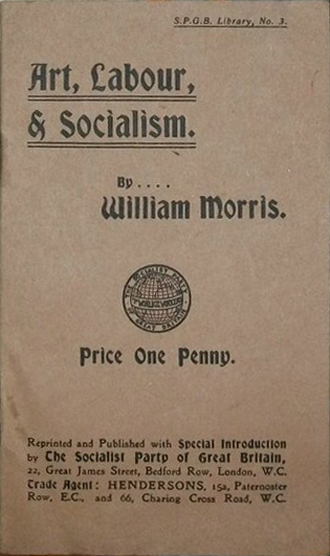
SPGB pamphlet from 1907.
Exhibition Review from the May 1961 issue of the Socialist Standard

At the Victoria and Albert Museum in April there was to be seen an Exhibition, Morris & Company 1861—1940. On show were specimens of textiles, tapestries, wall papers, etc., produced by the firm of which William Morris was chief partner and designer. These art and craft products are considered to be the most artistic of their period. But such fine work was not for the homes of the great multitude, as Exhibit 61 (an order book) quite clearly showed.

Looking at this exhibition there was nothing to indicate that for the last 13 years of Morris’ life be worked full speed in the Socialist movement of his day as shown in these words in his essay How I became a Socialist (1894). “But the consciousness of revolution stirring amidst our hateful society prevented me, luckier than many others of artistic perceptions, from crystallizing into a mere railer against ‘progress’ on the one hand, and on the other from wasting time and energy in any of the numerous schemes by which the quasi-artistic of the middle classes hope to make art grow when it has no longer any roots, and thus I became a practical Socialist.”

These words from the chief partner and designer of the Morris firm indicate that under capitalism “Art for the People” is just a phrase but that under Socialism where goods will be produced for use and not for profit Art will be a part of daily life and work in such ways as a free people living in a democratically owned and controlled society wish. 

Morris wrote a number of essays and gave lectures on Art and Socialism. Our pamphlet No. 3 Art, Labour & Socialism was a clear statement on the subject and it is possible that before long we may republish it, it having been out of print for many years now.
Ted Kersley

Friday, February 10, 2017

The Art Racket Fairy-Godmother (1957)

From the January 1957 issue of the Socialist Standard

No, fellow-worker, this does not concern you except in one important way. When you read in the Press £27.000 paid for a painting by Corot, £25,000 for one by Murillo, £2,300 for a copy of “Comrade” William Morris’s Kelmscott Chaucer, thousands of pounds for old silver, jewels, porcelain, etc., you may wonder what Fairy Godmother has visited the buyers. But would you believe it, you are the Fairy Godmother. It all comes from the profits you are bound to make for the Boss. Works of fine art and the fine dwellings to put them in are part of your contributions to His Imperial Majesty the Boss for the privilege of working your life out for wages. Maybe here and there, of all the thousands of works of art sold, a very small proportion go into public museums and galleries, and 90 per cent. of the time , these Galleries are open, you are at work doing the Fairy . Godma act and so your cultural uplift gets the go-bye. When next you go to the Public Library, look at the fine art journals such as The Connoisseur, etc., and you will see this is not just soap box oratory, for from cover to cover you will see works of art and craftsmanship for sale; charming things to solace the Captains of Industry while they wipe the sweat off their brows. Yes, it goes very well with roast pheasant and champagne! Not many crumbs of the sort fall to you from the Rich Man’s table. But be of good cheer for you have just had Christmas, with peace and goodwill to all men.

Now come along and make a New year’s resolution, to find out what is behind the art luxury rackets which run parallel with your lives of rush and insecurity. We can help you; read our case and get to work to make a world of Peace and Goodwill. Compliments of the season.
Ted Kersley

Thursday, March 17, 2016

A Peep into the Art World (1955)

From the June 1955 issue of the Socialist Standard

The Financial Times (27/4/55) has an article under the title "High Prices for Venetians"; dealing with the spectacular rise in prices of works of art sold in London Sale Rooms, instancing a painting by Canaletto £10,500, a pair of F. Guardi £9,000, one by Zuccarrelli £1,900, one by F. Post “View in Brazil 1661” £1,650, and a very fine copy of Audubon’s “Birds of America,” published 1827-1838, £9,200. These prices represent a ten to 20 times increase in the last 10 to 20 years. What a fine racket thinks the speculator, better than whiskey, or bomb making.

What is behind it, you may wonder. While one must remember the fall in the purchasing power of the pound, that is not the great part. The supply of such works of are as these mentioned above grows less each year, but the demand increases with the growth of immense fortunes in countries that did well in the last two world wars: the South American Republics, the Scandinavian countries, U.S.A., and also the great oil fortunes in Western Canada. The last are a great factor in the prices of Canadian paintings by Krieghof (painted 100 years ago) which sell at as much as £1,000 as against £100 in pre-war days.

S. America is coming up fast and it was Brazil that put on the San Paulo collection at the Tate Gallery last year. F. Post was one of the very few well trained artists to go to Brazil in the 17th century, so for buyers of S. American early art the choice is strictly limited; the £1,650 “View in Brazil” could be bought 20 years ago for £100 and the Audubon book for a tenth of the recent price.

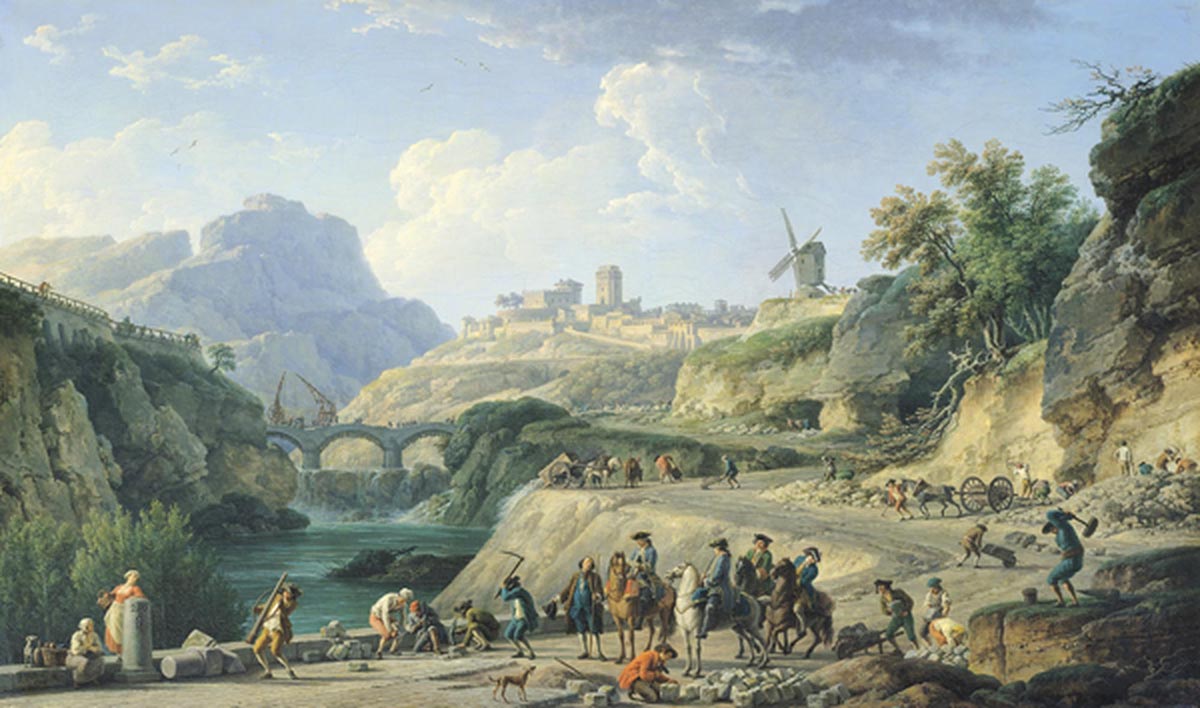
The present writer’s memory goes back to a day in January at the winter Royal Academy Show of 18 Century Art, to Exhibit 361, “Making a Road,” a painting by J. Vernet, signed and dated 1774. The picture shows a French Landscape by a river with a castle in the distance, a three-arched bridge being built in mid-distance by many workers with a high wooden crane. Up on the right is a windmill with two donkeys being loaded, beyond the bridge a group of men pulling a long waggon filled with huge blocks of stone, and all along the road dozens of men with hammers, picks, ramrods, chisels, etc., constructing the road. In the foreground are four horsemen. The first, splendidly dressed, is looking at a document that the ganger, hat in hand, has given to him, on the pommel of his saddle a brace of pistols. By his side another well dressed and pistoled gent sits with whip held erect in his hand and behind him two men, who look like guards. While admiring the picture another visitor approached and remarked: “Nice picture! Who owns these beautiful things? Who were they painted for?” This one, I replied, now belongs to The Louvre, but you will notice by the catalogue the great array of Lords, Baronets, etc., who own the bulk of this splendid exhibition. As to who this Vernet was painted for, perhaps for the pistoled gent or at least someone such as the owner of the distant castle. What you see there in the painting—well over 50 men working and two well armed gents not working but obviously of the class who own the means of production—sums up nicely who owned such works of art and who owns them now. There stands the master class whip and pistol in hand: the pistol you put and keep in their hands every, time you vote them into political-power and the whip of necessity that keeps you working for those who own the means whereby you live. The fine art trade, like the fine jewel trade, is patronised almost exclusively by that very small class who own the means of wealth production; while the vast bulk of the people get a trickle of chain store art and “ fine ” jewelry. It is up to the latter, the working class, to say yes or no to such a system. Look at the world you live in and get an understanding of Socialism, which will finish all the luxury racket and make possible a world in which art will cease to serve the ostentation and speculation of the wealthy and be a means of enjoyment for all.
Ted Kersley

Tuesday, September 1, 2015

Obituary: Nancy Kersley (1978)

Obituary from the August 1978 issue of the Socialist Standard

Old members will be sorry to hear of the death of Nancy Kersley, on June 19th, about two months before her 90th birthday. Although her activity was of a different kind from that of her late husband Ted, she was, in her quiet and unassuming way, deeply attached to the Party and its work. Comrades who knew them will remember how hospitable their home was, and how readily they were welcomed, with something, more often than not, to eat and drink. Her roots were in the working-class movement. Her father and her grandfather, going back to Chartist days, had both been active. Before the first world war she employed in the clothing trade, and, while still in her teens, became a Trade Union organiser. Nancy had been crippled for some time with arthritis — though no-one could have borne it with less complaint or more cheerfully — but her sight and hearing remained excellent, and her mental powers were unimpaired. Only a week before her death she was discussing an article in the Socialist Standard, every issue of which she looked forward to and read. Shortly before she died she said — uncharacteristically — that she felt very tired; a few days later the end came quite peacefully and without pain.
CD

Wednesday, December 31, 2014

Obituary: E. C. Kersley (1976)

Obituary from the May 1976 issue of the Socialist Standard

Ted Kersley died on March 18th after a short acute illness. He was in his 88th year. A number of members and ex-members of the party attended his funeral at Harlow cemetery on a grey and chilly afternoon, March 25th.

His career was remarkable. He had little formal education, and spent some of his early years in an orphanage. Before he was twelve years old he was at work, supplementing the meagre family income. A conscientious objector on Socialist grounds when war broke out in 1914, he was rejected and sent into the army. In France he owed his life to his wits, employment as a regimental cook, and a relative disregard for military obligations and procedure. After his discharge he became a dealer and "runner" in the art trade. A tribute to him and his achievement in this filed appeared in The Times of March 31st. Perhaps the most glowing acknowledgment of all those he was accorded must be that in the late Sir Arthur Elton's edition of Klingender's Art and the Industrial Revolution.

He joined the Party in 1910, and must therefore have been the oldest surviving member of that vintage. We do not remember him as the holder of long office, as a public speaker or writer — though no-one who heard them will forget his inimitable lectures on his chosen subject illustrated with original material. But there will be few of his time who do not remember him. He was always around — when something was to be done, to take the chair, to put up notices, at elections, at public meetings. In later years after an illness he lost his old energy, but his interest never wavered. He took a generous view of the Party's case — though he suffered no dilution or attrition — because he brought a many-sided attitude to it. Controversy never rankled with him, though he could be vehement in disagreement. One can say of Ted that the Party, its principles, its Marxism informed all his activities. Yet he was one of those for whom the party's views was not merely a statement touching capitalism, its cause and cure, but more profoundly on his life a philosophy and purpose. Many will recall the radio programme "The Art Trade Runner" which was widely regarded as a classic of broadcasting. In it, Ted insisted on declaring himself a lifelong revolutionary Socialist. The Times obituary contained no reference to his Socialism, showing that if some aspects of a man's life are recognizable by the Establishment others are not.

We share our regrets at his passing with Nancy his wife, who participated in the hard work and struggles of earlier days, and is still a member of the Party.
C.D.

Friday, October 3, 2014

The "University of the Working Class" (2004)

From the June 2004 issue of the Socialist Standard

Opponents of socialism have periodically attempted to undermine the plausibility of the socialist case by pointing out that some of the pioneers of the socialist movement were not people driven to become revolutionaries through an assessment of their own class interest.

Although this argument is of little real import, Engels, William Morris and even Marx have received this kind of treatment, being portrayed – rightly or wrongly – as having been brought up in ‘well-to do’ families with a privileged education to match.

This is not a charge that could ever seriously be laid at the door of the men and women who founded the Socialist Party of Great Britain. When the founder members broke away from the Social Democratic Federation in 1904 they were in most respects representative of the rank-and-file of that organisation. Unlike the SDF's figurehead, the wealthy old Etonian, Henry Hyndman, the founder members had  occupations and formal education typical of the working class of the time.  A large number were skilled manual workers, including the core of the Party's most prolific speakers and writers. Jack Fitzgerald, for instance, was a bricklayer who went on to teach others his trade, Jacomb was a printer who – up until the early 1920s – designed and laid-out the Socialist Standard , Watts was a wood carver, while Anderson was a house painter. There were others though, of whom T.A. (‘Tommy’) Jackson was the most notable example, who drifted from job to job and into and out of employment, something typically not unrelated to their uncompromising advocacy of Marxian socialism.

What made these revolutionaries extraordinary was not just their implacable opposition to the poverty and iniquity of capitalism but their attitude to knowledge and to critical analysis. They had the keenest of senses that knowledge was power – or at least potentially so. Having no university education they were largely self-taught, prime examples of what has sometimes been called the working class 'autodidactic' tradition.

Macintyre in his A Proletarian Science commented on how members of the SDF, SLP and SPGB were at the forefront of this tradition and of how – through engagement with classic texts on politics, economics, philosophy and anthropology – they searched for an understanding of the grim society around them:
“It is noticeable that the intellectual development of our working-class activists began as a process of individual discovery . . . And in which ever direction their interests lay, these autodidacts exhibited a characteristic intellectual tone: they were great respectors of fact and intellectual authority; earnest, even reverential, in their treatment of the text; and they brooked no short-cuts in the search for  knowledge. Alongside this deference to literary authority, one must put the fact that it remained their education, for they defined both the purpose and the boundaries of their intellectual exploration and the books they read assumed significance in this light.” (pp.70-71)
Not only did these autodidacts treat their own education with great seriousness and dedication, so, in the same manner, did they seek to transmit this knowledge to others. From the outset the Party spent much time in the training and education of its members, with classes on history, political philosophy and – above all – Marxian economics.

Indeed, Fitzgerald was to claim that a key element in his own expulsion from the SDF had been that he had organised economics classes that had been conducted by workingmen like himself rather than by the Federation's leadership. Fitzgerald was among a handful of early members who had attended classes on Marxian economics conducted by Marx's son-in-law, Edward Aveling, a man who had been part of an earlier ‘impossibilist’ revolt against the reformism of the SDF when the ill-fated Socialist League was founded in the 1880s. Attendance at such education classes and immersion in relevant texts was considered a vital part of the education of socialist activists, and we reproduce an example of a typical Party education syllabus after this article.

The autodidactic tradition was still visible in the SPGB long after its foundation. As the Party expanded over time so new waves of self-educated workers joined who honed their knowledge of society, together with their ability to dissect concepts and theories, in the Party's education classes. Some of these members were as good examples of the self-educated working class polymath that it is possible to find. Adolf Kohn, who was to become a mainstay of the Party as both speaker and writer until the Second World War, fed his thirst for knowledge (and that of other members) by setting up his own bookselling business, importing socialist classics from abroad that were otherwise unavailable to members, such as those published by the Charles H. Kerr company in Chicago.

Moses Baritz, from Manchester, a fearsome Party speaker and one of its most colourful characters, travelled across the world spreading the socialist message to other English-speaking countries in North America and the southern hemisphere, becoming a recognised expert on classical music, eventually broadcasting on BBC radio and writing for the Manchester Guardian.

Other autodidacts in the Party had their lifetime pursuit of knowledge immortalised by the capitalist press: Gilbert McClatchie (‘Gilmac’) had an impoverished early upbringing in Ireland before emigrating to Britain and taking a job as a book-keeper among other things, being best known for his knowledgeable historical and philosophical articles in the Socialist Standard and his writing of Party pamphlets; on his death he was recognised by the Times for his contribution to political thought. No less an autodidact was Ted Kersley, who spent part of his childhood in an orphanage and had little by way of any formal education, but became an expert art dealer, featuring in one of the finest radio broadcasts of its kind called “The Art Trade Runner”. He received the same accolade from the Times as Gilmac, though on this occasion his decades of activity as an SPGB propagandist went curiously unmentioned.

In most respects this autodidactic tradition was just as apparent among the large number of new members attracted to the Party in the ‘hungry thirties’, and then the period during and just after the Second World War, as it had been among the founder members. The ebullient tyros who joined the Party at this time were less likely to be in gainful employment than the Party's founders because of the effects of the depression, but their thirst for knowledge was no less. When not scratching around trying to eke out a living many spent their time productively elsewhere – in libraries, education classes or anywhere else that was warm, cheap and lent itself to mental stimulation. In writing of autodidact and one-time SPGB member Harold Walsby, the sociologist Peter Sheppard described this phenomenon well enough:
“Until about the middle of [the twentieth] century alternative arenas [to the universities] did exist, sometimes if perhaps briefly eclipsing the universities in brilliance. Probably the most enduring was that provided by the little nonconformist groups of the extreme Left - anarchists, dissident Marxists and others who were energetically active from about 1880 until the rise of the New Left in the 1950s, a movement that was, or soon became, firmly located in the universities. In the 1930s and 1940s, anti- Establishment politics was located in meeting-halls, in and around the outdoor speaking-grounds, and in cafes such as those of the side streets of Soho . . . A world in which brilliant, down-at-heel intellectuals and Bohemians mingled with prostitutes and petty crooks, and which fostered complex and passionate debate and nurtured polemical powers, [a climate which] sprang into being for a short but heady time”. (www.gwiep.net/site/pshwit.html)
Until the 1940s very few Party members had the opportunity to attend university (disparagingly described by some in the SPGB as capitalism’s “education factories”). Frank Evans, who had an economics degree and Hardy, who was something of a protégé of Professor Edwin Cannan at the London School of Economics before eventually becoming chief research officer for the Post Office workers’ union, were notable exceptions. A handful of members after the Second World War attended the London School of Economics and other Higher Education institutions – mainly as mature students – but from the 1960s and 70s onwards the situation began to change more noticeably. Technical progress under capitalism and the growth of productivity associated with it led to a decline in the number of unskilled and semi-skilled workers demanded by the system and a commensurate growth in the demand for workers with highly developed technical skills, such as engineers, scientists and researchers. Parallel with this went the growth of the administrative apparatus of capitalism – the civil service, local government, the health service and of course, the education system needed to produce such workers, all needing developed specialist talents but also the type of transferable skills supposedly provided by a university education.

The expansion of Higher Education necessitated by these developments led to a change in the composition of the Party’s members that was entirely reflective of the wider changes in capitalist society. Even then, those with a developed educational background have typically become socialists despite their formal education rather than because of it and many are those who claim to have learnt more of worth about society inside the SPGB than outside it.

Perhaps today, the specialisation that characterised the knowledge of earlier Party members is not as pronounced as it was in the days when the Party would wheel out a Fitzgerald, Hardy or Goldstein to lock horns with aspirant politicians or pious academics on the finer points of economic theory. Now, the knowledge of members is probably more eclectic than it was, the product of wider reading and some advancements in knowledge associated with the growth of disciplines like computer studies and
environmental science that were previously unheard of. But the underlying Marxist education of members has still been largely the product of the desire of individual men and women to make sense of the world around them, seeking out a holistic and coherent worldview which is absent from university curricula. In this, the Party, with its reliance on formal definitions, the application of logic, and its evaluation of world events over a century, still has an important part to play as a repository of knowledge, experience and analysis of capitalism. This is why, no doubt, more than one sage has commented that the SPGB has been “the university of the working class” in this respect, perhaps now – at least almost as much – as then.
DAP