Showing posts with label SPGB Newcastle Branch. Show all posts

Thursday, April 2, 2026

A Debate with the I.L.P. (1932)

Party News from the March 1932 issue of the Socialist Standard

H. Crooks, representing the Independent Labour Party

Edmund Howarth, representing the Socialist Party of Great Britain.

“Which Party Should the Workers Support: the l.LP.. or S.P.G.B.?” This proposition was debated at Newcastle-on-Tyne on Thursday, January 14th, 1932, 7.30 p.m., at 3, Higham Place.

Mr. J. Yarwood, Secretary of the Newcastle Trades Council, presided. The Chairman intimated that the conditions of debate were : each speaker 30 minutes, followed by a general discussion for half-an-hour, then a closing speech of 15 minutes for both speakers.

H. CROOKS, on behalf of the I.L.P., opened by stating that, unfortunately, at present the workers supported neither the I.L.P. nor S.P.G.B., but hoped that eventually the workers would support Socialism. He would confine the debate to the main issues. The I.L.P. was a workers’ party which believed that Socialism is not likely to be brought about by anything but a mass movement. No sudden transformation would be possible unless the workers realised their class position and subjection to the master class. To achieve Socialism, the workers must capture political power, national and local, and this must be the work of the workers themselves. He stated that the I.L.P. was the “midwife” of the Labour Party, and that he did not believe the Labour Party was ever Socialist, but only a workers’ party. He believed, however, that the Labour Party would take the right steps forward to reach a state of Socialism. As a member of the I.L.P. for 27 years, he believed that Socialism would now come very rapidly owing to recent development. His views as to the imminence of Socialism had often changed during the past few years ; his view of the approach of Socialism had never been static, but constantly changing. He accepted Marx’s principle of wage-labour and capital, and was convinced that the capitalist system would break down through the weight of contradictions in its own systern. Every Socialist was not bound to have read Marx, but must adopt the principles of Marx. Most of the I.L.P. members have the essential sincerity to achieve Socialism, although there had been unfortunate episodes in I.L.P. history through the Party not having been wisely led. Leaders such as MacDonald and Snowden had admittedly let them down. So long as the fight for Labour representation was necessary, Labour members had, unfortunately, shelved Socialism. The Labour Party had shown weakness when it first took office, but the I.L.P., although affiliated, opposed the Labour Party when it dropped Socialism. The aim of the I.L.P. was to convert the Labour Party to Socialism from inside; in fact, because of these activities, the I.L.P. was expecting to be thrown out of the Labour Party. The economic situation shows that the revolutionary period foretold by Marx is on us now. Capitalism is in its death throes. The workers’ part in this must be to organise politically. Capitalism may attempt to re-organise in order to stabilise itself, but he thought that the question of International Debts would stand in the way. Capitalists will not forego their debts ; it is nor capitalist mentality to do so. The workers’ standard of living will fall with the unemployed’s falling standard, but there was no fear that the I.L.P. would not try to maintain that standard as high as possible. The S.P.G.B. does not believe in Parliamentary representation or putting candidates before the electorate until thev are certain of a majority. This attitude was negative and not forcible enough to achieve Socialism. He could prove his assertion by figures. The I.L.P. has 30,000 members; the Communist Party 2,500; and the S.P G.B. about a quarter of that number. He would like to ask Howarth how long it will take the S.P.G.B. to get the support of the workers at this rate of progress? The workers should support the I.L.P. on its past record.

FIRST SPEECH FOR ‘THE S.P.G.B.

EDMUND HOWARTH, on behalf of the S.P.G.B., said that his opponent had merely stated his own views, and not necessarily those of the I.L.P. His opponent had contrived to give the impression that the I.L.P. accepted the. teachings of Marx. That was entirely false. He (Howarth) would read out the stated object of the I.L. P., which was,—
“. . . the establishment of the Socialist Commonwealth. The Socialist Commonwealth is that State of Society in which Land and Capital are communally owned, and the processes of production, distribution and exchange are social functions.”
The expression “communal ownership of capital” was self-contradictory. Capital is that part of wealth used to make a profit. Socialism meant the elimination of profit-making and profit-taking. The division of society into classes disappears under Socialism. The reference, to “exchange” was also an absurdity. The new form of Society would be concerned only with the production and distribution of material requirements. “Communal ownership of capital” was not Socialism, but a meaningless phrase. The I.L.P. definitely rejected the teachings of Marx, and their notion of common ownership included such futilities as Nationalisation, State Control, Municipalisation and Public Utility Corporations of the type sponsored by Mr. Morrison, the ex-Labour Minister of Transport. The sole object of the Socialist Party was the establishment of Socialism, that is, a system of society based upon the common ownership and democratic control of the means and instruments for producing and distributing wealth by and in the interests, of the whole community. The Socialist Party alone had a clear grasp of the principles of Socialism, and were able to correctly define it. The uselessness of Nationalisation to change the economic conditions of the workers was well exemplified in a paragraph appearing in “The Socialist Programme,” published by the I.L.P. in 1923. On page 24 it is stated that : —
“The present shareholders in mines and railways could receive State Mines or Railway Stock, based on a valuation, and bearing a fixed rate of interest.”
Under this magnificent scheme the capitalists continued to exist upon interest extracted from the wage-earners. The Post Office was often held up by I.L.P.’ers as an example of the benefits of State control, which they fondly imagine is a form of Socialism. The Daily Herald made the following significant admission respecting this nationalised institution.: —
(14th December, 1925).—”So far from being a charge on the community, the Post Office has, in thirteen years, 1912-13 to 1924-25, made a profit of 44 million, all of which has gone in the relief of taxation. Since 1914 there has been a decrease of more than 24,000 in staff, while much work has been added to the Post Office. This has resulted in speeding-up and over-work.”
Nationalisation changed the form, but not the substance of capitalist ownership, and was a measure that could be, and was, supported by various capitalist groups. We were told by the late Mr. John Wheatley, Labour ex-Minister of Health and a prominent member of the I.L.P., in a speech reported in the Daily Herald on November 20th, 1925, that : —
“It must be affected without making the capitalists poorer, or lowering their standard of life.”
His opponent had endeavoured to prove that the I.L.P. was something fundamentally different to the Labour Party. The I.L.P. was an affiliated body, and differed only in the number and kind of reforms advocated. The Living Wage proposals, Family Allowances, etc., would leave Capitalism intact and leave the social problem unsolved. That could only be solved by ending capitalism. The futility of the I.L.P. programme was asserted by Philip Snowden, who had been chairman of the I.L.P. for six years and had spent a good deal of his life in advocating the reform theories of the I.L.P. He wrote in Reynolds’, April 24th, 1927 : —
“The I.L.P. Programme does not enthuse me. It is neither Socialism nor a colourable imitation of it.”
The I.L.P. was a party of social reform engaged in the business of enlisting support for various fantastic schemes to catch votes from non-Socialists. The purpose of their “Socialism in Our Time” proposals was candidly admitted by the Acting Editor of Forward in the issue of July 7th, 1928. He wrote :—
“The I.L.P. is certainly not committed to advocating ‘the overthrow of the Capitalist system.’ Its ‘Socialism in our Time’ programme is a carefully reasoned out programme, which, as the I.L.P. states in its resolution, ‘aims at the immediate raising of the standard of life of the working classes and the transference of the key sources of power within Capitalism to the Community.’ That is a line of policy which does not mean ‘the overthrow of the capitalist system.’”
The reference to “Raising the immediate standard of life” of the workers was a phrase that could fit in well with the slogans of social reformers of all brands. Reference had been made to the 30,000 members which the I.L.P. claimed. It would he interesting it learn how many of these understood Socialism. The membership of the I.L.P. had seriously declined in recent years, whilst the membership of the Socialist Party was growing. The Socialist Party is concerned with making Socialists, not enrolling large numbers attracted by reform theories and ignorant of Socialism. The I.L.P. had a large number of M.P.’s, it is true, elected on a programme of reforms by non-Socialists and committed to the support of the Labour Party, which, in turn, was dependent on Liberal votes. Years ago, the I.L.P. made compacts with the Liberal Party at Leicester, Halifax and in other constituencies. At the last General Election the Labour Party exchanged their support for the support of Mr. Lloyd George and his section of the Liberal Party. The I.L.P., a short time ago, allowed Mr. H. N. Brailsford to advocate a definite alliance with the Liberal Party. The I.L.P. was not even united on the merits of the particular reforms to be held out to the workers as a bait for votes. All kinds of views and doctrines were expounded by the I.L.P., but not Socialism. In Gateshead, the Labour candidate, Ernest Bevin, at the last General Election issued a leaflet enjoining Liberals to vote Labour. During the War the I.L.P. allowed its members to vote war credits and to take office in the Liberal-Conservative-Labour Coalition Government. Prominent members of the I.L.P. appeared on recruiting platforms and assisted in the prosecution of the War. Mr. Keir Hardie wrote in the Merthyr Pioneer, November 27th, 1914: —
“I have never said or written anything to dissuade our young men from enlisting ; I know to well all there is at stake.”
Mr. Ramsay MacDonald contrived to give the appearance of opposing the War, but his attitude merely showed that he did not believe that “national interests” were at stake. On August 3rd, 1914, he said in the House of Commons :—
“I want to say to this House, and to say it without equivocation, if the Right Hon. Gentleman had come here to-day and told us that our country is in danger, I do not care what party he appealed to, or to what class he appealed, we would be with him and behind him. If this is so, we will vote him what money he wants. Yes, and we will go further. We will offer him ourselves if the country is in danger.”
The attitude of the Socialist Party to the War was clear and definite. We opposed it from the commencement and stated the Socialist position. We were the only party to remain steadfast to Socialist principles. The principles of the Socialist Party were erected upon the teachings of Marx, upon the basis of the Materialist View of History, the recognition of the class struggle, and the necessity for the enlightened and conscious aim of the workers to capture the political machinery for the institution of the Socialist Commonwealth. We had no reform programme, like the I.L.P., to deflect the workers from the need for emancipation, and had no use for leaders, good or bad. The I.L.P. by their activities sidetracked the workers by promises of tangible benefits now, which could not be obtained. They therefore showed their affinity to all the other parties of capitalism. It was a party helping to maintain capitalism, and therefore useless to the workers. The Socialist Party alone were concerned with the need for emancipation, and pointed the way to the ending of wage-slavery and exploitation in all its forms.

(At this point a general discussion of 30 minutes took place, in which members of both parties joined. Persons unattached to either party also spoke.)

A Debate with the I.L.P. [Continued] (1932)

Party News from the April 1932 issue of the Socialist Standard


LAST SPEECH FOR THE I.L.P.

Mr. CROOKS, in his closing speech, stated that he was delighted with the trend of the debate, and pleased with the fair way in which Howarth had put his case. There had been a complete absence of abuse, which he much appreciated. However, Howarth’s quotations from papers and periodicals had tried to indicate that the I.L.P. were a bad lot. He considered the actual difference between the principles of the I.L.P. and S.P.G.B. was small. The real difference was one of method, and in all ideas of method there is bound to be a disparity of opinion. Are you going to get Socialism by preaching, which is the only method of the S.P.G.B.? The S.P.G.B. certainly did not carry out its policy to run candidates. If they did get their candidates into the House of Commons, what would these members do? Sit with folded arms and not attempt to better the conditions of the workers at present? Education must be followed by practical work, and it is in practical work that men come into conflict. The I.L.P. will go forward and achieve Socialism in spite of the fact that they might sully orthodox Socialist principles. While you live by bread, you must not forget the bread. The revolutionary period is here, so all workers should support the I.L.P., which is a real practical force for Socialism, and not a negative force like the S.P.G.B.

LAST SPEECH FOR THE S.P.G.B.

HOWARTH, in winding up the debate, pointed out that the open discussion had shown that there were many misconceptions as to the object and principles of the Socialist Party. The terms of the debate had been dictated by the I.L.P., and he (Howarth) had protested that not sufficient time had been allowed to enable the speakers to state their cases adequately.

The notion that the Socialist Party refrained from putting candidates forward until they were certain of a majority was ridiculous. Candidates for municipal elections had been put up, and advantage had been taken of these elections to spread the knowledge of Socialism. It is true that we have not secured the election of candidates, but that is because there are not sufficient Socialists to elect them. No doubt our candidates would be successful if we ran on the same basis as the I.L.P. by promising immediate benefits. As Socialists, it was not our desire to secure office by false pretences. I.L.P. candidates were elected by pandering to the ignorance of the workers. I.L.P. members elected to public bodies are powerless to state the Socialist case. They have no mandate to do so, as they were elected by non-Socialist votes. The Socialist Party has no programme of social reform to dangle before the workers. The immediate need of the workers is emancipation. Palliation merely serves to keep capitalism in existence, and invariably fails to palliate. The complete failure of the Labour Government in Britain and also in Australia demonstrates the utter absurdity of expecting to get rid of the evils of capitalism without getting rid of the system from which these evils spring. The notion that members of the Socialist Party ignore the need for bread is fantastic. Members of the S.P.G.B. were forced to take part in the every-day struggle for bread. They did so as members of Trades Unions, but we never failed to point out that the workers are always at a disadvantage under capitalists. It was because we realised the need for bread and all the amenities of life that we realised the limitations of Trade Union action and pointed to the abolition of capitalism as the sole means of access to the means of life. The idea that a party can work for Socialism and Social Reform at the same time is entirely contrary to fact. The I.L.P.’s activities in the direction of social reform measures completely overshadows any interest in Socialism. Besides, if reform measures could give the workers security or substantially better their conditions, all interest in Socialism would be killed. The adoption of the entire Labour programme would leave capitalism intact, with all its corresponding defects. In spite of the enormous energy spent in promoting social reforms, more persons are cornpelled to seek parish relief than at any other time in history. The differences between the I.L.P. and the Socialist Party are not superficial, as suggested by Mr. Crooks, but fundamental. The I.L.P. chases the will-o’-the-wisp of social reform, while the Socialist Party opposes all sections of the master class. The I.L.P. imagine that Society is at this moment in a state of transition from capitalism to Socialism, and many of its proposals are put forward as transitory measures. The transition to Socialism can only commence after the capture of political power by the conscious efforts of the workers. That is the beginning of the transition stage. Reform measures merely strengthen the existing system and assist its smooth running. That is why the capitalist class support and institute reform measures. The terms of existence for the workers are dictated by the possessing class. The I.L.P. cannot alter that with all their practical measures. The Liberal and Conservative Parties could outdo the I.L.P. or Labour Party at the game of reform. The capitalists could safely adopt many items on the I.L.P. programme without endangering their social system. That is what they have done, and will do, to stave off the demand for a fundamental change. He (Howarth) submitted that sufficient had been said to encourage those present to undertake a full investigation of the Socialist Party’s case, and he would invite all to read the Party’s literature with a view to acquiring the requisite knowledge.

The usual vote of thanks to the Chairman terminated the proceedings.
C. S. Bates

Saturday, October 18, 2025

SPGB Meetings (1986)

Party News from the October 1986 issue of the Socialist Standard


Blogger's Note:
There were so many meetings advertised in the October 1986 Standard that I had to split the party news post into two. And I still didn't even get to include everyone listed in the label section. Apologies to Pieter Lawrence, Steve Coleman, Paul Bennett, West London Branch, Salford, Leeds, Manchester Branch . . . did I leave anyone out?

Friday, June 28, 2024

Euro-capitalism or world socialism (1989)

From the June 1989 issue of the Socialist Standard

June 15th 1989 is your opportunity to register your support for The Socialist Party candidate in the European elections. You may not have heard of The Socialist Party before so what is it?

We are a political party, separate from all others, Left, Right or Centre. We stand for the sole aim of establishing a world social system based upon human need instead of private or state profit. The Object and Declaration of Principles printed on the back of this manifesto were adopted by The Socialist Party at its formation in 1904. In other countries there are companion parties sharing the same object and principles and they too remain independent of all other political parties.

SO WHAT DO WE MEAN “EURO-CAPITALISM OR WORLD SOCIALISM?”

Capitalism is the social system which now exists in all countries of the world (including Russia, China, etc). Under this system the means of production and distribution (land, factories, offices, newspapers, etc) are owned by a minority, the capitalist class. All wealth is produced by us the majority working class, who sell our physical and mental energies to the capitalists in return for a price called a wage or salary. The object of production is primarily to produce profits for the capitalists (less than 5% of the population) by selling on the market goods and services created by us the workers. Not only do the capitalists live off the profits they obtain from exploiting the working class, but as a class, they go on accumulating wealth extracted from each generation of workers.

Food mountains and wine lakes exist throughout the EEC. Farmers are paid subsidies not to grow food and yet, at the same time, people throughout the world starve or go hungry.

The formation of the EEC in 1957 and the widely advertised removal of barriers to trade by 1992 are examples of capitalist production relating to new economic circumstances. This is what we mean by referring to the EEC as 'euro-capitalism'.

The other parties taking part in this election, such as the Labour Party or the Green Party are in effect telling you that capitalism can be reformed in our interests. This is untrue for, as long as capitalism exists, profits will come before needs. Some reforms are welcomed by some workers but no reform can abolish the fundamental contradiction between profit and need which is built into the present system. No matter whether promises to make capitalism run in the interests of the workers are made sincerely or by opportunist politicians they are bound to fail, for such a promise is like offering to run the slaughter house in the interests of the cattle!

SO WHAT IS THIS ALTERNATIVE OF SOCIALISM WHICH WE WISH TO ESTABLISH?

Socialism does not yet exist. When it is established it must be on a worldwide basis, as an alternative to the outdated system of world capitalism. In a socialist society there will be common ownership and democratic control of the Earth by its inhabitants. No minority class will be in a position to dictate to the majority that production must be geared to profit. There will be no owners in this classless society: everything will belong to everyone. Production will be solely for use, not for sale. The only questions society will need to ask about wealth production will be: what do people require, and can the needs be met? These questions will be answered on the basis of the resources available to meet such needs. Then, unlike now, modern technology and communications will be able to be used to their fullest extent. The basic socialist principle will be that people give according to their abilities and take according to their self-defined needs. Work will be on the basis of voluntary cooperation: the coercion of wage and salary work will be abolished. There will be no buying and selling and money will not be necessary, in a society of common ownership and free access. For the first time ever the people of the world will have common possession of the planet Earth.

HOW WILL SOCIALISM SOLVE THE PROBLEMS OF SOCIETY?

Capitalism with its constant drive to serve profit before need, throws up an endless stream of problems. Most workers in Britain feel insecure about their future: almost one in four families with children live below the poverty line: many old people live in dangerously cold conditions each winter and thousands die; millions of our fellow men and women are dying of starvation—tens of thousands of them each day. A society based on production for use will end those problems because the priority of socialist society will be the fullest possible satisfaction of needs. At the moment houses stand empty and thousands of building workers are unemployed; yet many people are homeless or inhabiting slums. At the moment food is destroyed and farmers are subsidised not to produce more; yet many millions are malnourished. At the moment hospital queues are growing longer and people are dying of curable illnesses: yet it is not “economically viable" to provide decent health treatment for all. In a socialist society nothing short of the best will be good enough for any human being.

The election of our candidate would not, in itself, bring about Socialism. It would be one step in the process of capturing political control in the interests of us, the working class of the world. It would give us a useful platform to put our ideas across on the world stage. If you agree with us, 

VOTE KILGALLON (Socialist Party of Great Britain), Tyne and Wear constituency.


Blogger's Note:
From the same issue of the Socialist Standard, see 'European Election Manifesto'.

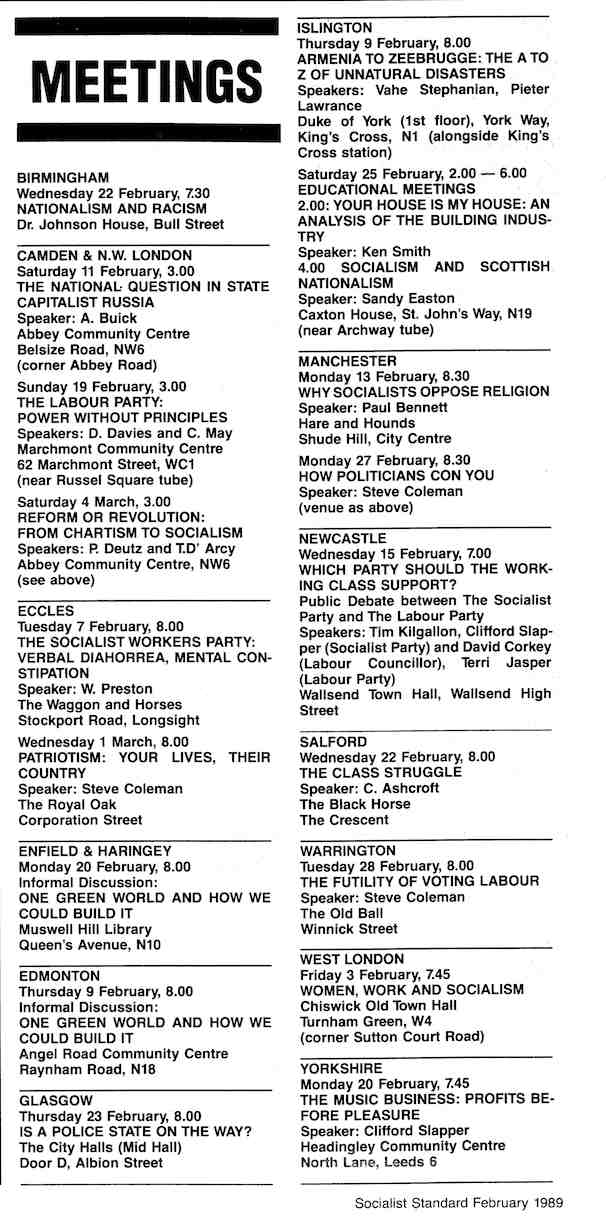
SPGB Meetings (1989)

Party News from the June 1989 issue of the Socialist Standard


Wednesday, December 27, 2023

Newcastle-on-Tyne and Gateshead (1932)

Party News from the December 1932 issue of the Socialist Standard

With a view to extending its activities to Gateshead, the Newcastle-on-Tyne branch has transferred its business meetings to the Gateshead district. The branch will henceforth be known as the Gateshead Branch.

A Class for the study of Marxian Economics is being formed, and non-members are specially invited. Full particulars may be obtained from the Secretary, Edmund Howarth, 95, Bewick Road, Gateshead.

Saturday, May 30, 2020

Socialist candidate 
in European Elections (1989)

Party News from the May 1989 issue of the Socialist Standard

The Socialist Party is planning to contest the Tyne and Wear constituency in the elections to the European Parliament that will be taking place on June 15.

Our candidate will be standing on an exclusively socialist programme against Alan Donnelly. Labour candidate who is replacing the sitting Labour MEP, Joyce Quinn. As the constituency covers 8 Westminster seats (Gateshead East. Houghton and Washington. Jarrow. Newcastle East, South Shields. Sunderland North. Sunderland South, and Tynebridge) over half-a-million voters in an area of Britain where this has never happened before will be offered the opportunity of expressing agreement with a socialist society based on common ownership and democratic control and the application of the principle "from each according to their abilities, to each according to their needs".

Further details, offers of help and money write to: Tom Oakley. 44 McCracken Drive. Wideopen. Newcastle-upon-Tyne NE13 6NG

Monday, April 27, 2020

Reluctant anarchists (1987)

Party News from the April 1987 issue of the Socialist Standard

In January our Newcastle Branch invited the local Anarcho-Syndicalist group to take part in one of a series of debates and forums, with a title on the lines of "Socialism or Anarcho-Syndicalism: How Can Workers Achieve Freedom?" The branch pointed out that as a democratic, leaderless socialist group they are committed to the free exchange of ideas with others who are interested in changing society. The invitation was sent after a member of the Syndicalists' editorial group had attended several of the Branch meetings, had taken part in lengthy discussions and claimed to share our aim of a classless, moneyless society based on common ownership.

This was how the Anarcho-Syndicalists replied:
Dear SPGB.
 
  I have been asked to inform you that the Syndicalist does not wish to take part in the type of public debate as you propose. While believing that public meetings are a major part in the growth of revolutionary ideas we do not, as anarcho-syndicalists, wish to take part in the political power struggle of the left vanguardist parties and have no intention, either now or in the future of participating in the type of political competition to see which theoretical and "politically correct" ideas will prevail under such circumstances. 
  We are however willing to discuss our ideas with any member, or any of your associates, that are interested in the ideas of anarcho-syndicalism on a personal level. If you would wish to further this conversation as we have stated please contact us at the above address. 
  Due to the short amount of time you gave for a reply this decision was reached at an Editorial Group meting and will be put to our Full Business Meeting in March. Though the decision will most certainly stand.
As our Newcastle group comments, the reply shows the Anarcho-Syndicalists' complete lack of willingness to be open about their political ideas in a forum of members of the working class. This lack no doubt leads to their undemocratic practices in decision making, as evidenced in the final paragraph of their letter. Notwithstanding, the Newcastle Branch will continue their propaganda work, including regular challenges to their opponents.

Wednesday, November 14, 2018

European elections (1989)

Party News from the August 1989 issue of the Socialist Standard

As announced in our June issue, our Newcastle Branch fielded a candidate in the Tyne and Wear constituency in the recent elections to the European Parliament. In view of the large size of the constituency, covering 8 parliamentary constituencies and including Gateshead. Sunderland and Jarrow as well as Newcastle, with a total electorate of over 500,000, the branch found that the election received enhanced media coverage so that a reasonable amount of publicity was achieved on local radio, in the local press and on local television. In addition, nearly 80,000 copies of the manifesto were delivered free by the Post Office

The result was Abstentionists 348,953; Labour 126,682; Tory 30,902; Green 18.107; SLD 6.101; Socialist 919.

Wednesday, May 9, 2018

Obituary: Pat Kilgallon (2018)

Obituary from the May 2018 issue of the Socialist Standard

We have to report the death of Pat Kilgallon at the age of 91 after a long and debilitating illness. Pat came from a family of political activists and trades unionists, her grandfather was the agent for the first ILP candidate in the North East who also refused to fight in the First World War. Pat joined the Newcastle Branch of the Socialist Party in April 1994, having left the Labour Party earlier in that year.

Pat came into contact with the Party in the early 1980s a time when she was a Labour councillor on North Tyneside Council and when she was also active in arranging food collections and other types of support for the families of striking miners. She was also part of the group of councillors that refused to set a budget in 1985. It was the failure of this and similar actions that began her realisation that capitalism could not be reformed and led to her journey towards joining the Socialist Party.

Her activity in the Party, especially in later years was hampered by her age and ill health, however she never missed an opportunity to put forward the socialist case to any that would listen and she had recently been involved in distributing union application forms to the un-unionised home carers who supported her to live in her own home.
T. K.

Wednesday, October 11, 2017

Monument of Confusion (1987)

From the July 1987 issue of the Socialist Standard

Every Saturday at the Earl Grey Monument in Newcastle city centre, a crowd of eager young paper sellers practically trip up innocent passers-by, in their efforts to unload their latest offerings of ''revolutionary" wisdom. A whole range of groups calling themselves "socialist" will bark at bored shoppers and brandish high in the air the papers which they each claim to be the only true word of Karl Marx.

Who are all of these groups, and what evidence is there that any of their papers are any more revolutionary than the local Evening Chronicle? Apart from the Socialist Standard there are three papers/parties in particular which may be spotted at the Monument. All three are Trotskyist groups. They owe their origins to post-war doubts on the left about continuing to support the Russian dictatorship. The Socialist Standard, in contrast, had exposed from the time of the Russian revolution itself the fact that Russia was — in Lenin 's own words — state capitalist, and that the Bolshevik model of revolution was bound to lead to dictatorship, because it was not based on democratic participation.

First, there is Militant, which is supposedly produced by the Militant Tendency, but is in fact produced by a manipulative sect called the Revolutionary Socialist League, so called because it is neither revolutionary nor socialist. The Militant idea of "socialism" can be found in their proposal to "nationalise the top 200 companies". Quite apart from the problem of what happens to the 201st, this is a blueprint for state capitalism. Miners, steel workers and others in nationalised industries know only too well that the priority is still profit rather than human needs, even if the profit goes to the state boss rather than the private boss. Like other groups on the left, Militant persists in the naive view that if only we could get the "right leaders", a Labour government could humanise capitalism.

The Next Step is the paper of the Revolutionary Communist Party and follows Lenin's false theory (taken from the English Liberal, Hobson, in 1916) that the world divides neatly into countries which are "imperialist" and those which are not. According to the dangerous assumption that the enemy of an enemy must be a friend (known in the jargon as "revolutionary defeatism") this means that British workers must support any "smaller" country which the British state happens to be at war with. So during the Falklands war in 1982, the RCP produced a pamphlet urging us to support Galtieri and his fascist-type junta; and during the crisis surrounding the bombing of Tripoli in 1986 they produced a leaflet stating "Britain backs Reagan; We back Gaddafi". No doubt the Libyan dictator was very pleased to hear about this.

The Socialist Workers' Party offer the Socialist Worker as the paper which has really got the capitalist system sussed. On closer inspection, however, it becomes clear that it is spreading confusion about what socialism is and how to get it. In giving examples of contradictions within the pages of Socialist Worker we are spoilt for choice, for there are dozens. In their issue of 11 May 1985. the following two statements both appear:
  1. "We believe a future Labour government will not act in the interests of the working class. On the contrary, it will act like every previous Labour government — in the interests of the bosses' class"
  2. "Our attitude is clear. We are for a Labour government".

This year the SWP is again urging workers to vote Labour. The way Socialist Worker tries to justify such a contradictory stance is by referring (politely, of course) to the supposed inability of workers to understand socialism. The self-appointed vanguard of the SWP realise the limitations of Labour government, but the idea of simply stating this to workers is apparently far too straight for them. Instead workers, presumably including SWP members themselves, have to be dragooned into electing yet another capitalist government. in order to "learn from their mistakes” — which the SWP has told them to make.

Why does the Socialist Party claim to be different from the other groups who peddle their wares at the "socialist" bazaar every Saturday?
• The Socialist Party has put a clear and consistent case for socialism at all times. Unlike all the other so-called "socialist" groups, we have never supported futile attempts to patch up the profit system. By its very nature the profit system will always put the profits of the few before the needs of the majority.
   Earl Grey's Monument itself was built in 1932 to mark "a century of civil peace" (!) and carries an inscription that "the people renew their gratitude to the author of the Great Reform Bill". This is ironic, as the groups who sell around it are still caught up in the same ridiculous attempt to reform capitalism in the interests of workers, with for example the SWP's "Right to Work" campaign or the recent RCP "demand"" for "a living wage”.
• The Socialist Party has never held up the Russian régime or any of the other state dictatorships as examples of "socialism". Socialism means a world-wide, democratic system of society. Productive resources would be owned in common and production would be for direct, free use — not profit or sale. There would be free access to wealth. Although the groups referred to above halfheartedly criticise present-day Russia, their idea of socialism is in fact a model for state dictatorship of the same kind. Take for example Socialist Worker, 6 September 1986, which says that in socialism there will be a militia "in charge of everyday law and order", that the party will form the government and that “there will not be complete universal suffrage'". The Socialist Party, in contrast, has always stated that socialism means the end of government and "law and order”, and the beginnings of people controlling their own lives democratically.
• Finally, The Socialist Party has never posed as a "vanguard" or leadership for workers to follow or be " organised"" by. We are simply a tool or vehicle to be used by workers wishing to take political action to end capitalism. Likewise, within The Socialist Party there is no leadership, no "instructions from the Central Committee" such as you will find in the Trotskyist groups. The movement for a democratic society must clearly be democratic itself, based on shared understanding and principles, rather than on leaders and their sheep. As socialist understanding spreads among workers, these self- appointed “revolutionary vanguards" will be seen increasingly as irrelevant to the struggle for socialism. Common ownership and democratic control of the world's resources will come about through a socialist majority, transforming society by democratic means. Only then can universal suffrage be, as Karl Marx put it a century ago, "transformed from the instrument of trickery which it has been up till now. into an instrument of emancipation" (1880 Programme of FPSWF).

The Socialist Party is an active and growing political force in the North East, and throughout the country. If you are interested in these ideas, why not send for a free sample of our literature?
Clifford Slapper

Tuesday, May 24, 2016

European Election Manifesto (1989)

From the June 1989 issue of the Socialist Standard

Following the elections of 1979 and 1984, this June sees the third direct election of the European Parliament. For those elections the Socialist Party issued statements under the title "Eurocapitalism or World Socialism?" The choice between a destructive system which served privileged interests and a sane society which served human needs was the important issue then. Tragically capitalism remains, to menace us all.

MILLIONS UNEMPLOYED
Millions remain unemployed. It is impossible to calculate the amount of useful wealth that could have been produced had not billions of workdays been lost because workers could not be employed for the profit of a few. What is certain is that in socialism all these workers in industry, transport, building and farming could have been co-operating to provide the things necessary for the wellbeing of the community: things like homes, hospitals, and useful goods of every kind. Instead men and women are being forced by the profit system into idleness, living on the dole alongside millions of pensioners existing on their meagre state hand-outs. Many remain homeless and despairing.

These are the bitter conditions of life endured by those at the lowest end of the scale of poverty. For those with a job trying to provide for themselves and their families, the purchase of a home means mortgaging their lives for years to come. Not just the need for a home but every necessity is subject to the ability to pay. For the majority life remains dominated by the relentless grind of wage-working and paying the food, gas, electricity, water and clothing bills, and repaying debts to banks and financial companies. As ever for workers, the market is an economic tyranny which breeds insecurity. Whether it is the 'common market' or not makes no difference.

ARMED CAMP
Forty years after the second World War, Europe is still an armed camp. Millions are producing the means of waging further war. In addition the competitive industrial system pollutes the Earth threatening all life.

The EEC was not set up to deal with the problems of poverty, insecurity and war. In 1979 we said that the Common Market was a "political and trading arrangement entered into by the various European States in order to further the interests of their capitalists". The last ten years has only confirmed the truth of this. In 1984 we pointed out that, in the overall interests of profit, the so-called European Community was paying farmers to destroy cattle, tear up orchards, plough back vegetables, dump fruit and restrict milk, meat and cereal production. Alongside this destruction of food, millions have died throughout the world from disease related to starvation or poverty. In Europe itself millions live below the official poverty line and would have benefited from this food. They did not have the money to buy it, so it was destroyed. The prices of commodities and the sanctity of profit come before human needs.

PAID NOT TO GROW
It is now intended by EEC governments that these policies should continue. In June 1988 it was announced that a so-called "set aside" scheme would come into force for the 1988-89 crop production year. Under this scheme annual payments of up to £200 per hectare are being offered to farmers who agree to take at least one fifth of their arable land out of production for the next five years. This imitates the policies of another major agricultural producer, the USA, which in 1983 took 82 million acres out of food production so as to protect the prices of food commodities.

The EEC will reach a new phase in 1992 when further trade barriers will be removed to establish the single market. This heralds a new freedom for investment and marketing to move across traditional European boundaries aimed at the maximum and most efficient exploitation of workers. The EEC can never achieve a genuine community of common interests. The basis of its operation is the class monopoly of the means of life by a privileged minority of capitalists. It may be a business community, but this leaves workers in the same exploited position where they must sell themselves for a wage or salary, when it is profitable for the capitalists to employ them, that is.

REPEATED FAILURES
When we examine the policies of the Labour, Conservative and other reformist parties, we find the same old glib promises put out over the years. These parties are depressing and irrelevant. They take no account of experience and offer nothing but repeated failure. These parties stand for running capitalism and their differences are minor compared to their common aim of running the profit system. Nor have the Communist Parties anything to offer except the state capitalism which even the Russian rulers now admit has failed. The Greens are right to denounce the degradation of the environment but in blaming this on "industrialism" and "bigness" they have yet to realise that this is inherent in capitalist competition.

At this time, towards the end of the 20th Century, when we look back on over 100 years of violence and misery in Europe, and when poised on the brink of further frightening dangers, it is obvious that a very different political approach must be taken. The time is long overdue for scrapping the entire system of capitalism. It is out of date. Its class interests and its priority of profits before human needs can no longer serve any useful purpose so far as the majority are concerned.

ABOLISH THE PROFIT SYSTEM
If we are to place the aim of European unity on a sound and practical basis then the idea that it can be realised under any system of Euro-capitalism must be abandoned. Nor can unity be established in Europe separate from the rest of the world. Unity can only stem from a common interest amongst all people to co-operate in the production and distribution of goods and services directly for need. This is only possible with the means of production owned and controlled by the whole world community.

There can be an important place for a European Assembly as one part of a system of world democratic administration. Socialism would need such bodies at local, regional and world levels and the task of adapting the European Parliament would be straightforward. However, democratic procedures mean nothing unless society has real powers to translate democratic decisions into action. In socialism this would come from the abolition of the uncontrolled and anti-social forces of the market and the disappearance of the profit motive.

PRODUCE FOR NEED
Socialism will remove all economic constraints on social action and will involve the abolition of not just the "Common Market" but all buying and selling. One of the myths of capitalism is that nothing can happen without the use of money. Part of this myth is that productive resources consist of money capital, but in the real world of production money never produced anything. Goods and services are produced by the mental and physical energies of men and women and it is only because goods are bought and sold that money is needed. Money is used under capitalism as part of the system of exploitation where workers receive as wages or salaries only a portion of the total wealth they produce. In reality, capital investment limits social action to what is profitable: with the abolition of the market the entire structure of production would be released to be used solely for the community's needs.

We must stress the urgency of promoting the growth of the socialist movement. This is the only practical activity which is being directed at the solution of social problems. Support for parties seeking to participate in the administration of capitalism through the European Parliament will prove as futile now as it did in 1979 and 1984. The constructive alternative is to help to build a world of common ownership, democratic control and production directly for human needs.

For the first time the Socialist Party will be putting forward a candidate for election to the European Parliament, in the Tyne and Wear constituency. Those in that area who want Socialism will be able to register this by voting for the Socialist Party candidate. Elsewhere they can do so by writing the words "World Socialism" across their ballot paper.

The Executive Committee
The Socialist Party of Great Britain
London, May 1989