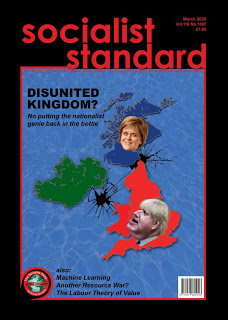
Showing posts with label Scottish Nationalism. Show all posts

Tuesday, June 3, 2025

Voice From The Back: Masters of deception (2002)

The Voice From The Back Column from the June 2002 issue of the Socialist Standard

Masters of deception

We are led to believe, by the media, that the men and women who make up the government are motivated by the highest moral standards of honesty and decency. So what are we to make of Robert Cooper, a senior British diplomat who wrote the following essay published by The Foreign Policy Centre and reported in the Observer (7 April)? “The postmodern world has to start to get used to double standards. Among ourselves, we operate on the basis of laws and open cooperative security. But, when dealing with old-fashioned states outside the postmodern world continent of Europe, we need to revert to the rougher methods of an earlier era – force, pre-emptive attack, deception, whatever is necessary to deal with those who still live in the nineteenth century world of every state for itself.”


State of the nation?

It is said that clear thinking leads to clear speaking. That clarity of thought is reflected in lucid communication. If that is so, what must the US President’s thought process be like? Here he is reported by Newsweek (22 April) as he tries to communicate something or other. Your guess is as good as ours as to what he is on about: “And so, in my State of the – my State of the Union – or state – my speech to the nation, whatever you want to call it, speech to the nation – I asked Americans to give 4,000 years – 4,000 hours over the next – the rest of your life – of service to America.” Eh?.


Arms and hypocrisy

The journalist Alex Bell recently gave an update on the British arms trade in the Herald (6 May): “One of those statistics that lodges in the mind and rarely gets revised is the one about Britain being the third largest exporter of arms in the world. Time to update it, as we’re the second largest. In the last twenty years our arms industry has grown by a factor of 10. According to the Institute for Strategic Studies, revenues from the arms trade were more than $5 billion in 2000, or twice as much as France and Germany combined. They were around $500m in the mid-1970s . . . Don’t forget that just as Tony Blair was trying to calm the border dispute in January between Pakistan and India, he was in Delhi trying to flog jets.” So what happened to that much vaunted “ethical foreign policy”?


The childhood destroyer

Capitalism has only one drive – make profits. In that ruthless drive the planet is poisoned by pollution, the rivers and lakes are turned into sewers and human life is stunted, broken and destroyed. Perhaps the greatest indictment of this Frankenstein society is the way it treats the old, the disabled and the most vulnerable group of all the world’s children: “One child in eight has to do work that could harm them physically or mentally, the UN labour agency claimed. Some 246 million children are in unacceptable forms of child labour, with 179 million in hazardous mining, fishing and construction, says the ILO, but 8.4 million children are caught up in slavery, trafficking, forced recruitment for battle, prostitution, and pornography.” Herald (7 May)


Tory braveheart

The Scottish Parliament over the years has illustrated that it can be just as silly as Westminster when dealing with social problems. In a country that has all the usual features of capitalism – poverty, drug addiction and homelessness all this backwoodsman Tory could proffer to the parliament’s deliberations was the following piece of nonsense: “A Tory MSP has lodged a motion in the Scottish Parliament, calling for William Wallace to be officially recognised as a “patriot” before the 700th anniversary of his death in August 1305. Phil Gallie, the Tory constitutional affairs spokesman, said the anniversary of Wallace’s death was an opportunity to ‘right wrong’.” Times (9 May)


God and mammon

According to a recent Church of Scotland report they are losing 17,000 punters a year and, unless this trend is dealt with, they could cease to exist by 2050. So concerned are they about the potential drop in income that the Moderator commissioned a journalist to produce a book entitled Outside Verdict; An Old Kirk in a New Scotland. The author proposes tithing members’ salaries and flogging off manses and overseas churches:. The book states: “There are too many people in the kirk who refuse to think of it as a business, who think that because this money is being used for God’s work, contemporary business practice need not apply.” Sunday Times (12 May). But isn’t it also the business of the Church to tell gullible workers on a Sunday morning not to thirst after the material things of this world, to be content with their lot and look for their reward in the next world?


Wednesday, November 22, 2023

Letters: Animal testing (2005)

Letters to the Editors from the November 2005 issue of the Socialist Standard

Animal testing

Dear Editors,

I am pleased to see you state [October issue] that the abolition of the savagery of capitalism will undoubtedly do its part to abolish all unnecessary suffering by non-human sentient creatures. Yet you say that the socialist approach to animal testing is pragmatic. What suffering is necessary? On what grounds? How many animal deaths equal one human life?

Animal testing is anything but scientific. Thalidomide tested safe on animals but when given to humans was a disaster. Drugs for arthritis were harmless to animals but proved to greatly increase heart attacks in people. Blue sky testing where animals are harmed and killed in the vague hope that something useful, and profitable, to humans is both daft and cruel.

I hope a socialist world would be more compassionate with people trying to live in harmony with the environment and animals rather than seeing them as assets to be exploited and plundered for the financial gain of vivisectionists and drug monopolies. Socialism should abolish these as well as the many other horrors of capitalism.

I am sure there are many people suffering from ailments capitalism can’t cure right now (I would be one) who would volunteer to try new drugs and thereby save animal lives while perhaps improving the quality of their own.
Terry Liddle, 
London, SE9

 
‘Health’ system

 Dear Editors,

I become annoyed when I hear of the increasing numbers of retired workers (hence unexploitable) who are being reminded by their GPs that their ailments are age-related and are told “what do you expect at your age?” instead of being offered proper care. Precious ‘health care’ is then devoted to those that capitalism is able to continue to exploit.

But can multi-million profiteers in drug companies be trusted to be more interested in population health than the profit to be made? Who is able to double-check their laboratory tests and results and how can study statistics be guaranteed not to have been exaggerated or distorted? With such vast wealth at stake would even a capitalist government really care about working-class health under such rewarding (for them) conditions? It has to be faced that no capitalist government assists the really needy – that task is left for charities to do and prop up a system that benefits only the wealthy ruling class.

If the health system is unable or unwilling to properly test and cure working-class patients then I personally believe being ignored and left to suffer or being officially kept alive to suffer is not good enough. The obvious third option of being allowed access and advice on how to quickly and efficiently terminate life should be made available.

The utter independence and freedom to choose the time and place of my own demise certainly appeals to me and is a right I am keen on exercising. If you can help out with attractive suggestions on how this can be accomplished it would be appreciated and I can depart – when the time comes – thumbing my nose at officialdom who have dictated in life what I can and cannot do. It would be a great way to go!
Ron Stone, 
Gelorup, Australia

 
Blinkered Nationalist

Why on earth are you standing in a Scottish seat? Smacks a little of imperialism to people up here. “Great Britain” is a state founded for empire — the centre colonising the island — it is outdated so anyone with the slightest knowledge of politics now sees “Great Britain” as outdated, hence supporting independence. You are the only party with “Britain” in the title apart from the BNP!
Anon, 
Livingston, Scotland

 
Reply: 
As far as we are concerned, “Great Britain” is merely a geographical name. And we were the only party standing in the Livingston by-election without “Scottish” on the ballot paper — that’s because we don’t stand for an independent Scotland any more than we stand for an independent “Great Britain” or even “Little England”. We stand for world socialism, a world community, without frontiers, where the resources of the Earth, industrial and natural, will have become the common heritage of all humanity.
Editors.

Sunday, April 17, 2022

Scots Nationalism - Part 2 (1975)

From the April 1975 issue of the Socialist Standard


Last month we traced the development of modern nationalism in Scotland up till the founding of the National Party of Scotland in 1928.

The incredible hotchpotch of ideas contained in the new organisation soon became a cause for alarm among the more sensible members and drove one, Lewis Spence, to complain that the party was
“… a maelstrom boiling and bubbling with the cross-currents of rival and frequently fantastic theories, schemes and. notions we have people who wanted all Scotland to speak the Gaelic…. some hark back to the hope of a sixteenth-century Scotland regained … still others a Jacobite restoration. A certain group sees in the expulsion of all the English and Irish in Scotland the country’s only chance of survival . All is hubbub, outcry, chaos. There is no plan,. Nothing approaching a serious, practical Scotsman-like policy in -either art or politics. (H. J. Hanham, Scottish Nationalism. p. 154)
Poor Spence, but he should have known. With the loss of interest in Home Rule of the Scottish ruling class and their political sidekicks, the nationalist cause had fallen into the hands of all sorts of cranks, literary and otherwise, who were more concerned with “culture” than economics or social matters. Certainly they had little idea of the history of the toilers’ conditions as could be seen by their constant harking back to a mythical time when “our people were prosperous and contented” before the Union.

Anyway, the party was established and membership was open to all. Tories and Liberals as well as Labourites flocked in and even Lord Beaverbrook showed interest. Inevitably, some of the more opportunist leaders wished to “broaden the base of the party” and after an internal battle the party merged with a Tory splinter group to become the Scottish National Party (SNP) in 1934. From then until the 1950s the party endured the usual Right versus Left squabbling and several splits occurred, the largest of which was the setting up of a rival organisation, the Scottish Convention, in the 1940s.

Today the SNP seems to have left the lunatic fringe behind and appears as a modern, mass political party using the techniques of public relations and advertising industries to give it a new slick image, and the Executive Suit has replaced the kilt as standard dress for the party candidates. Not only does the party have a large and youthful membership of 120,000 but they carry out their propaganda with a style and enthusiasm which leaves the older reformist parties gasping. At the October general election they all but demolished the Liberals, hammered the Tories, and promise it will be Labour’s turn next time.

So the SNP may be poised for victory within the foreseeable future. How have they produced this rags-to-riches transformation? Obviously, their case is an economic one. They have taken advantage of working class discontent over insecurity, unemployment, low living standards, low expectations, and all the other problems which capitalism brings to workers the world over in one degree or another. They were also helped by widespread disillusion with the two major parties and Labour and Tory supporters have deserted to the nationalists in their tens of thousands.

Basically, the SNP is just another reformist party angling for support on a programme of reforms and even styles itself on the Scandinavian social democrats. After their first breakthrough in l968 the party went into a serious decline which lasted until 1970. Then came the discovery of vast quantities of North Sea oil. Now they can outbid all the others by proposing that the wealth from this oil be divided among five million people only, instead of fifty million, and paint a picture of how, given self-government, oil revenues will provide a paradise in Scotland.

Predictably the nationalists claim that their first priority is to launch a “war on poverty” and the party’s manifesto, Scotland’s Future, gives some idea of how they intend to do this.

For example, pensionable couples are told their combined pension will amount to the national minimum wage which, at today’s level, will be £25, with a single pensioner getting £15. So after a lifetime of producing fortunes for the parasite class worn-out wage slaves are to be “rewarded” with this ! Other dramatic SNP proposals include spending an extra 10 per cent on education and on health services, and just what significant difference this will make to working class life is a mystery to us. The important thing to note is that these are merely promises, and politicians have always found these far easier to make than fulfil.

The writings and utterances of SNP spokesmen present a bewildering display of confusion and contradiction and it is difficult to say whether they are more naïve than dishonest. William Wolfe, the party Chairman, claims the class-struggle can be avoided by passing legislation which outlaws “undue concentration of wealth in a few hands”. We wonder if they mentioned this to the capitalist Sir Hugh Fraser when he joined their ranks last year?

The party repeats the hoary old lie “that it is a lack of communications between management and workers that causes industrial strife”. It could not, of course, have anything to do with a fundamental clash of interests like, for example, the workers wanting better wages and conditions and the management, on behalf of the owners, not willing to grant these.

Despite the SNP’s indignant denials the idea somehow persists in some minds that the party is “socialist”. William Wolfe in his book, Scotland Lives, writes that he wants to give
“….the Scottish people opportunities for their own enterprise and capital to be used in giving their fellow Scots employment.” (p. 43)
Obviously, by “the Scottish people” he means owners of capital like Sir Hugh Fraser. Perhaps the latter joined the SNP on reading this passage in Wolfe’s book?

Another leading member, Mrs. Margo MacDonald, was asked in an interview how she reacted to the suggestion that there’s no advantage in replacing English or American capitalists with Scottish capitalists. She replied
“Well there is, actually. In the strict material sense there is. The Scottish capitalists, while still making lots of money, will be creating jobs in Scotland. They will realise that there is a quicker return to be made by, for instance, refining all of the oil in Scotland. So we would be slightly better off. Of course I agree exploitation by Scots is just as immoral in the long run. (Glasgow News, 12th March 1974)
So there it is. For the Scottish capitalist, “lots of money” and a “quicker return”. For the worker, the promise that he will be “slightly better off”.

The nationalists have shown they are fast learners when it comes to political cynicism. They pretend to the workers that should independence come then all the oil revenues will automatically go into the Scottish exchequer and be used mainly for the benefit of the workers. They must know that the United Kingdom would get some of the revenue as part of any deal made over the granting of independence, and that the capitalist class in Scotland would insist that oil revenues be used to reduce the burden of taxation which rests on them.

Will the Labour government’s proposed Scottish Assembly, but still under Westminster, outflank the SNP? This is possible since it is doubtful if the electorate in Scotland want complete independence as various opinion polls have shown. However, as the Assembly will have no more success in abolishing capitalism’s problems than the SNP’s claim that only full independence can succeed, it will probably gain more support.

Should self-government eventually be established the SNP will discover that they cannot will or legislate away those problems of capitalism. No country in the world, no matter how independent or rich in resources, has yet succeeded in eliminating poverty, unemployment, insecurity, etc. For the working class there will be wages while they are working and pensions when they are too old or disabled. An ominous glimpse of what leading SNP members regard as “prosperity” can be gained from their repeated claim that “Scotland was the wealthiest nation in the world” (Wolfe p. 12) up till the end of the 1914-18 war. How the working class lived in those days does not seem to have even occurred to them.

The SNP see themselves as visionaries but they cannot see beyond the narrow confines of the nation-state, conceived in pre-medieval times and as outmoded as the clan system it replaced. It is the Socialist Party of Great Britain who are the true men and women of vision, who look forward to and struggle for a new world of common ownership and democratic control of society’s resources, and uncluttered with the frontiers and class divisions which go hand-in-hand with “the nation”.
Vic Vanni

Scots Nationalism (1975)

From the March 1975 issue of the Socialist Standard

The First of Two Articles

Nationalists believe that all classes in society should hold allegiance to “The Nation”. Socialists do not and point out how nations have always been the creation of a ruling group having nothing to do with working-class interests.

What is a nation? It is simply the people and the territory which have been appropriated by a class of robbers at some point in history. It has less to do with a common language, religion, race, culture, and all the other things which nationalists imagine or pretend are essential ingredients in the making of nations.

This is certainly true of Scotland and far from having a common history or anything else the population there are mainly the descendants of native Picts, invaders from Ireland (the original Scots), Western Europe and Scandinavia. After centuries of what were really tribal wars the whole land came under one king by the middle of the ninth century and the nation was born–by the coercion of the people and in the interests of a class of bandit chieftains.

Right up until the union of the Scottish and English parliaments in 1707 there were really two distinct nations in Scotland. The Highlanders  spoke Gaelic and had a culture (way of life) very different from that of the dialect-English speaking Lowlanders. Indeed
“In rural districts, the Scottish dialect or dialects was barely intelligible even to a Scot of another district” (James G. Kellas. Modern Scotland–the Nation Since 1870. p. 7)
So the nationalist idea of a once united Scotland is just a myth. Yet no one can deny that despite over two hundred years of Scotland’s incorporation within the United Kingdom most Scots feel themselves to be part of a separate nation. This can be explained by the fact that the Act of Union allowed Scotland to retain its own law, religion, and education system thus ensuring the continuation of national identity.

Why, then, has nationalism never been a strong political force until recently? The answer is that after 1707 the Scottish bourgeoisie, the only ones who could have provided a nationalist impetus, were far too busy building their fortunes through the Empire trade which had hitherto been denied them by the English Navigation Acts. Later on there was the industrial revolution and even greater opportunity to find wealth and contentment within the Union.

Even so, there were some malcontents and by the middle of the nineteenth century we find some bourgeois complaining
“that England was getting very much more out of the Union than was Scotland . . . that during the last few years public expenditure had been largely for the benefit of England . . . Naval expenditure was almost exclusively allocated to English dockyards, shipyards and arsenals. (H. J. Hanham. Scottish Nationalism, p. 76).
This discontent resulted in the founding of the National Association for the Vindication of Scottish Rights in 1853 and it was composed of Tory and Liberal notables plus some aristocrats. Although the Crimean war soon killed off the Association this didn’t prevent some Scottish propertied interests (the Tory Marquess of Bute among them) returning again and again to the theme that not enough time was devoted to Scottish business in the House of Commons, that public money (their taxes) was being spent unfairly, etc.

And as if to emphasize the propertied interests represented by nationalist ideas the Scottish Home Rule Association was formed in 1886, again comprising Tory and Liberal bigwigs but this time with a sprinkling of Labourites. Basically the SHRA represented those sections of the Scottish owning class who wanted more time spent on and more control over their affairs in a separate parliament in Scotland but still within the United Kingdom. The movement took its inspiration from the Irish bourgeoisie who were struggling to obtain Home Rule for themselves, and Gladstone’s support for this fanned the flames in Scotland.

Of course Home Rule met with opposition from other sections of the owning class who had different interests. Liberal business men who had trade links with Ireland feared any kind of Home Rule, Scottish or Irish, while Liberal MPs representing seats in west and central Scotland had to make sure they didn’t antagonize the Orange vote. The result was a split in the Liberal Party and the emergence of a group of Liberal-Unionists who allied themselves with the Tories against Home Rule.

Tories generally opposed Home Rule for the same reasons as did Liberals. Also the landowning section opposed it because they were outraged at Liberal plans for land reform, while the ambitious politicians were worried about how their career prospects would be affected since there wouldn’t be the same opportunity of landing plum jobs in “the government of Empire” if Scotland were to have its own parliament.

So although support for and opposition to Home Rule cut across party lines the growing band of nationalists usually supported the Liberals who had created the post of Secretary for Scotland and because the party in Scotland was committed to Home Rule. Various Bills for a Scottish parliament were submitted to Westminster until in 1913 one actually looked like succeeding but was cynically dropped by the Liberal government because of political complications over Ulster.

The emergence of independent Labour politics at the turn of the century meant that much working class support was drained from the Home Rule party, the Liberals. By the end of world war one the Liberals were completely shattered so Home Rule looked a lost cause to any Scottish capitalists who had been interested. In any case, as the division between the Liberals and Tories became more and more blurred the owning class had gradually been turning to the Tory Party, which had strong working class support, as the guardian of their class interests.

Nationalist now had to look elsewhere for support and they found it in the growing Labour Party and Trade Union movement in Scotland. John MacLean, plus James Maxton, Tom Johnston, and other prominent Labourites were ardent Home Rulers and they followed in Keir Hardie’s footsteps by pandering to nationalist sentiment in their writings and speeches. Indeed Scotland is currently plastered with a Scottish National Party poster which quotes one of Maxton’s contributions:
“I am convinced we can do more in five years in a self-governing Scotland than could have been done with 25 or 30 years of heart-breaking struggle in the British House of Commons.”
Today the Labour and Communist Parties, along with various “revolutionary” groups continue the reactionary work of spreading nationalist ideas among the working class.

However, the honeymoon with Labour was soon over and eventually it dawned on the nationalists that they could hope for nothing from the three major parties, none of which had even included Home Rule in their 1924 general election manifestos, so the warring groups swept their differences under the carpet and merged in 1928 to become the National Party of Scotland.

The presence of political nationalist ideas is an indication that some groups in society feel its real material interests are being frustrated by forces outside or even inside the nation. Of course the desire to achieve their aims is never expressed in terms of their own needs only. In order to enlist the necessary working class support such arguments as “justice”, “freedom”, and “the nation” are used to justify the real bone of contention and to give it an aura of sanctity. Next month we will continue to show why the workers in Scotland should oppose nationalism.
Vic Vanni

Saturday, August 1, 2020

Nationalist nonsense exposed (2000)

Book Review from the August 2000 issue of the Socialist Standard

The Origins of Scottish Nationhood by Neil Davidson. Pluto Press 2000.

This book’s thesis is that Scotland as a nation-state does not stretch back into the very deepest dawn of time and only came into existence with the advent of the Union with England, and the rise to dominance of a Scottish capitalist class. As such it presents a fundamental challenge, from a Marxian perspective, to the totems and myths of the Scottish nationalists and their intellectual cheerleaders.

Davidson gives a clear account of the way in which Scotland did not come to the same situation of having a national absolutist government that England did (starting with Henry VIII), and thus entered the union as the junior partner, creating most of the national institutions (law, education and Kirk) that are traditionally listed as the reasons for Scotland’s “continued national identity”. Further, he demonstrates that the real divide was within Scotland, between Lowlanders and Highlanders, as the lowlands developed an urbanised élite. The idea that Scotland was a colonial subaltern of England also comes under withering assault, as Davidson shows how Scotland was not just a willing partner, but also a major force in promoting the British empire; and how the experience of Empire further helped shape Scotland as a “national identity”.

As such the book serves a worthy enough purpose, and on one level it achieves most of its ends; however its assiduity and worthiness is undermined by a number of failings. The book has a disturbing tendency towards arguing by assertion: in a discussion of the Declaration of Arbroath, Davidson simply says that its authors had a different meaning when they used the word nation (i.e. as a people/race) from the meaning it has in modern discourse. Considering this point was so important to the book’s case, this constitutes a serious weakness.

Quite often the theoretical expositions fail to adequately express their own application. Davidson’s definition of a nation simply as an “imaginary community” does not capture any notion of the relationship between nation and class interests, nor of its relationship to power. Yet, in his historical analysis, he often refers to national consciousness almost entirely in terms of it being the consciousness of the rising Scottish capitalist class. At other times this concept of national identity being tied to élite consciousness becomes confused, as when he attempts to engage with the arguments of contemporary Nationalists and tries to disprove mass consciousness of nationhood.

The desire to engage with the Nationalists further leads Davidson to make some elementary errors in analysis—in assessing the core/periphery thesis regarding Scotland and England he ends up reifying these supposed imaginary communities in order to show how an aggregate Scotland compares strongly with an aggregate England, none of which takes into account the unevenness within both territorial units, and the core/periphery relationships of provinces to the metropoles within each. In engaging closely with the Nationalists’ nonsense he accepts their flawed presuppositions in order to disprove the conclusions they base upon them.

A central theoretical point of the book is to make a distinction between nationalism and national consciousness—the former being a politics based upon national aims/structures, the latter simply being the knowledge of a common nationality. This distinction seems weak, since any dominant form of consciousness must surely find expression in social being. Thus if people denote their consciousness of subjectivity in terms of nationhood, then, surely, their politics will necessarily be guided by such national consciousness.

None of this, however, stops the book being right at a basic level, rather, it merely makes it weak for use in polemical terms. It often makes excellent points that expose the nonsense nationalists talk, and it builds a very strong case about the historical origins of the birth of “the Scottish nation”. This book is useful, in the main then, as a part of a much wider reading of the subject.
Pik Smeet

Wednesday, May 27, 2020

Editorial: Nats whae hae (2007)

Editorial from the May 2007 issue of the Socialist Standard

Nationalism is anathema to socialists. Wage and salary workers have no country. We have more in common with people like ourselves in other countries than with the privileged owning class of the country where we happen to live and work.

The world-wide working class has a common interest, to end its exploitation and solve its problems, to join together to establish a world without frontiers in which the resources of the planet will have become the heritage of all, so that there can be production to meet needs and not for profit. One world, one people, where cultural differences will still be celebrated, but where we’ll all be citizens of the world.

It is clear, then, why socialists don’t take sides in the debate, aired in this month’s elections to the Scottish Parliament, about whether it is better for workers there to be ruled from Edinburgh (as the SNP says) or from London with a little help from Edinburgh (as say the British Nationalists of the Labour, Liberal and Tory parties).

The SNP argues that the problems facing workers in scotland are due to “Westminster rule”. If only there was an independent Scotland, they say, separate from the rest of Britain, then there would be full employment, higher wages, job security, better state benefits, a healthy health service and all the other things politicians promise at election times.

This view is echoed by the so called Scottish “Socialist” Party and Tommy Sheridan’s Solidarity (with Sheridan) Party. But it is patently absurd. This would be a purely political, not to say mere constitutional change which would leave the basic economic structure of society unchanged.

There would still be a privileged class owning and controlling the means of production with the rest having to work for them for a living. Just as now. Maybe the pillar boxes would be painted tartan but that would be about all.

An independent Scottish government would still have to operate within the constraints of the world capitalist system. It would still have to ensure that goods produced in Scotland were competitive on world markets and that capitalists investing in Scotland were allowed to make the same level of profits as they could in other  countries.

In other words, it would still be subject to the same economic pressures as the existing London-based government to promote profits and restrict wages and benefits. And as the government of Ireland, which broke away from the United Kingdom in 1922 and where things have never been any different. Not even the national state capitalism proposed by the SSP and Sheridan would make any difference. As in Cuba, exports would still have to be competitive and popular consumption restricted to achieve this.

Since it is this class-divided, profit motivated society that is the cause of the problems workers face in Scotland, as in England and in the rest of the world, so these problems will continue, regardless of whether Scotland separates from or remains part of the United Kingdom.

The SNP is promising a referendum in 2010. What an irrelevant waste of time and energy that would be, but it’s their alibi. If they get to form the regional government of Scotland their excuse for not delivering (as capitalism won’t let them) will be that their hands were tied and that their promises will only be able to be honoured after separation.

Our opposition to the SNP should not be interpreted as support for the Union or the Labour, Liberal or Tory parties that support it. We are just as opposed to them. A plague on both their houses is what we say. To adapt a slogan, “Neither London nor Edinburgh, but World Socialism”.

Wednesday, April 29, 2020

Arbroath 1320-1820: A History of Them and Us (2020)

From the April 2020 issue of the Socialist Standard

Tens of thousands of Scottish nationalists would have been parading through the streets of Arbroath this month in their kilts and tartan regalia, flourishing their Saltires and Lion Rampants flags, celebrating a 700–year old document. Far fewer will be commemorating another event which took place 500 years later, this April’s bicentennial of the Weavers Uprising (also known as the Radical War.)

One is a story of a letter to the Pope requesting his papal blessing for the privileges of Scottish nobles and their birthright to the subjugation of their tenants and peasants (the correct title of the Arbroath Declaration is “Letter of Barons of Scotland to Pope John XXII.)

The other story is one of the common-folk’s resistance to exploitation and a struggle against oppression.

Scottish barons
For historians, the 1820 rising of the weavers was a minor insignificant event in the annals of Scottish history but then, of course, the Declaration of Arbroath was swiftly forgotten too, and only resurrected for a propaganda purpose very different from the mistaken belief held by today’s nationalists that it was declaring the independence of the Scottish people. In 1680 Sir George Mackenzie publicised it, not as an expression of nationalism but as support for those who wished to curtail royal power.

Historian Neil Davidson takes the key passage to be:
  ‘Yet if he [Robert the Bruce] shall give up what he has begun, seeking to make us or our kingdom subject to the king of England or to the English, we would strive at once to drive him out as our enemy and a subverter of his own rights and ours, and we would make some other man who was able to defend us our king; for, as long as a hundred of us remain alive, we will never on any conditions be subjected to the lordship of the English. For we fight not [for] glory, nor riches, nor honours, but for freedom alone, which no good man gives up without his life’.
Its message is first directed at the English king, Edward II, informing him that it was pointless for him to attempt to depose Robert the Bruce with a more subservient king, since the remainder of the Scottish aristocracy would not cease its resistance. Secondly, it is also aimed at Robert the Bruce’s dubious past record; they would not accept his jeopardising their interests

The idea that the Arbroath Declaration challenged the Divine Right of Kings with the notion that the nation itself was foremost and the monarch merely its steward, is presented solely to justify Bruce usurping the rightful king John Balliol. The section of the Declaration reading:
  “if this prince [Bruce] shall leave these principles he hath so nobly pursued, and consent that we or our kingdom be subjected to the king or people of England, we will immediately endeavour to expel him, as our enemy and as the subverter both of his own and our rights, and we will make another king, who will defend our liberties.”
It should be read as a cautionary warning and a clear threat to Robert the Bruce himself.

Those medieval signatories to the 1320 Declaration were not leading any ‘liberation struggle’. In fact, John de Menteith, who turned William Wallace over to the English king, placed his seal upon the Declaration of Arbroath.

What did the the document actually mean? It was the ‘freedom’ of the Scottish barons that it was concerned with. The ‘people’ of Scotland were the nobles, the majority of whom at that time were still culturally Anglo-Norman, despite inter-marriage. None of the signatories held the view that the actual people of Scotland should have any say in any issue and they had no concept of popular sovereignty whatsoever

Weavers’ Revolt
If true ‘freedom-fighters’ are required then Scottish workers should look not to the winners and losers of aristocratic medieval family feuds over the throne of Scotland, but to those brave if foolhardy weavers who rose up five hundred years later in April 1820.

The  ‘Battle’ of Bonnymuir  took place on the 5 April, 1820. Thirty-two cavalrymen routed twenty-five, poorly armed, striking weavers. John Baird and Andrew Hardie, who came to be known as the ‘Radical Martyrs’, were sentenced to be hanged and beheaded (along with James Wilson who was later part of a riot that broke prisoners free at Greenock.)

Glasgow was at this time just a collection of small village communities with weaving being the main occupation. The handloom weavers enjoyed skilled status and worked to commission. They could choose their own hours of work if they were willing to forgo some proportion of their earnings. Given that these workers had free time many were able to read and would talk about what they had read, discussing the American and French revolutions. A slump in the economy after the Napoleonic Wars when pay and conditions deteriorated drastically resulted in workers, particularly weavers in Scotland, seeking reforms from an uncaring gentry-controlled government already in fear of revolution.

The ‘Committee of Organisation for Forming a Provisional Government’ put up placards on Saturday 1 April, calling for an immediate national strike. Many in central Scotland came out in support the following week.

The proclamation began:
  ’Friends and Countrymen! Rouse from that state in which we have sunk for so many years, we are at length compelled from the extremity of our sufferings, and the contempt heaped upon our petitions for redress, to assert our rights at the hazard of our lives.’ 
And, it called for a rising:
  ’To show the world that we are not that lawless, sanguinary rabble which our oppressors would persuade the higher circles we are, but a brave and generous people determined to be free.’
One group of strikers decided that attack was the best form of defence. With the purpose of acquiring weapons, about twenty-five weavers, led by Andrew Hardie and John Baird, marched on the Carron Iron Works near Falkirk to capture weaponry which was manufactured there. Tragically for that group, due to earlier underground societies like the United Scotsmen, government spies were active which meant the march on Carron was already known. The Army was given its own marching orders and when the two forces met  the radicals began firing. After a few volleys, the cavalry flanked the rebels and the inevitable end was swift. And so ended the ‘Battle’ of Bonnymuir.

On the day of his execution, Hardie’s words were:
  ’Yes, my countrymen, in a few minutes our blood shall be shed on this scaffold… for no other sin but seeking the legitimate rights of our ill-used and downtrodden beloved countrymen.’
An irate Sheriff ordered him to stop ‘such violent and improper language’. 

Hardie retorted:
  ’What we said to our countrymen, we intended to say no matter whether you granted us liberty or not. So we are now both done.’ 
1820 can be seen as the emergence of peoples’ power later to manifest itself in the Chartist Movement. The rising should be seen in the context of ordinary people from all over a growing industrial Scotland being inspired to overthrow the government in order to secure their rights and better working conditions.

We shall let the reader judge which historic event deserves to be remembered and celebrated.
ALJO

Thursday, March 5, 2020

Scottish Independence : Tartan Delusions (2020)

From the March 2020 issue of the Socialist Standard

On the 31 January the blue Euro-banner was hauled down at Westminster and the Union flag raised in its stead. In Edinburgh, though, the self-awarded gold stars flag was pointedly left fluttering in place next to the saltire.

The SNP are making a none too subtle point. The antidote to the referendum they don’t like is to be… another referendum. It would seem the political ‘logic’ is that the best way to counter leaving a union is to leave a union.

It is somewhat ironic that the clash between Holyrood and Westminster stems from a single shared source, nationalism, be it competing nationalisms. The cause is perceived sovereignty, as if Scotland, or England, or Britain can stand alone, or at least break away from a power portrayed as inhibiting its freedom.

However, what would the SNP do in short order should they achieve independence? Give it up to the EU of course. Similarly, should Britain shake off the last vestiges of EU influence, then treaties will be sought and signed with such as the USA.

Not only will the USA want untrammelled access to the NHS for its big pharma, for example, there will be a demand for any arrangements to be subject to America’s legal system. For the USA substitute any other major trading nation/bloc and something similar will apply.

This is what ‘independence’ means in a global capitalist world. Significant change cannot be achieved by a binary vote in a referendum. At best there is some reordering of the arrangements, but essentially, adjustments made, capitalism continues unhindered other than by its own contradictions.

The SNP has previously stated its intention of retaining the monarch as their country’s head of state, continuing the use of sterling and joining NATO. Presumably unaware of any contradiction, they also want to be rid of the Trident submarine bases.

Do they really think that if capitalism degenerates to the point where international warfare results in the use of nuclear weapons, the removal of Trident bases will somehow insulate Scotland from the consequences?

Should the SNP decide the monarch was not to be their head of state, then a president or some such would fulfil that function. Has being a republic lessened the grip of capitalism, with its extremes of war, inequality and crises, on the USA?

If Scotland was denied the use of sterling presumably that would mean embracing the euro with all its financial hazards and, more importantly, subservience to, not independence from, the European Union. If sterling is retained, then economic policy would, ultimately, continue to be determined in London.

The formation of Britain enabled the industrial revolution to create a dynamic economy in which Scots, Welsh and English played full parts. This also led to the formation of the working class with interests transcending those of constituent regional and national parts. Workers in Scotland faced the same exploitative capitalism as they did in England and Wales and expressed their voice through their own organisations, the trade unions.

And nothing has changed. Workers on any side of a border, wherever it is drawn, all face the same fundamental problem, capitalism. To exist, capitalism must exploit workers to make profit. Painting your face blue with crossed white stripes alters this not one iota.

Whatever the outcome of another referendum the people of Scotland will continue to live under a parliamentary system designed to preserve the interests of capitalism. If they have opted for ‘independence’ they will find ‘sovereignty’ surrendered to the EU.

The parliamentary system has evolved to serve the interests of capitalism, not democracy. It does not matter if a parliament is situated in London or Edinburgh, nor if its benches are upholstered in tartan and populated by nationalist MSPs, it will remain subservient to the needs and preservation of capitalism.

Referendums are designed to give apparently simple solutions to complex problems, they are the chosen way of despots and demagogues attempting to garner some semblance of popular support of their self-serving programmes.

The ballot box can indeed be part of the response of the working class to taking economic and political power away from the capitalist class. But this will have to be just one element of a much wider movement in which the working class consciously acts for itself.

No referendum can solve problems for the working class, not in Scotland, not in Britain via Brexit (or re-joining the EU at some point), not anywhere. There is no Tartan alternative to socialism.
Dave Alton

Wednesday, July 10, 2019

50 Years Ago: Scotch Mist (2019)

The 50 Years Ago column from the July 2019 issue of the Socialist Standard

In Scotland today it’s true that there is a struggle – as there is in England, Wales Ireland, or the rest of the world for that matter. But the struggle in Scotland is not, as the Scottish National Party would have us believe, the struggle for home rule, self-government, self-determination, or self anything. The struggle in Scotland, as in the rest of the world, is a class struggle: the struggle between the working class and the capitalist or owning class.

The SNP tell us, the workers, that independence from England and the control of our own purse strings will cure all our problems. What they do not seem to realise is that the problems they are going to try to solve are an integral part of the capitalist system, and history has shown beyond a shadow of a doubt that within this system there is no satisfactory solution to these problems apart from Socialism.

The SNP talk about Scottish culture and the Scottish way of life. But in what way is the life of a Scottish wage slave basically different from that of an English, an American, or for that matter a Russian wage slave? There is no basic difference in the way of life of the world’s working class because we all suffer from the same problems such as poverty and insecurity. Independence from England will not cure the poverty and insecurity of the Scottish workers, because there will still be the wage labour and capital relationship.

There is no truly independent country in the world, because international capitalism has made sure of this, and our own experience here in Britain, especially since 1964, should have brought it home to us. The past few years should have shown us just how independent Britain is, when foreign ‘bankers’ tell the British government how it must spend money, and how it must not spend money, in order to keep the international capitalist class happy.

(From the Socialist Standard, July 1969)

Friday, June 7, 2019

Scotch Mist (1969)

From the July 1969 issue of the Socialist Standard

In Scotland today it’s true that there is a struggle – as there is in England, Wales, Ireland, or rest of the world for that matter. But the struggle in Scotland is not, as the Scottish National Party would have us believe, the struggle for home rule, self-government, self-determination, or self anything. The struggle in Scotland, as in the rest of the world, is a class struggle: the struggle between the working class and the capitalist or owning class.

The SNP tell us, the workers, that independence from England and the control of our own purse strings will cure all our problems. What they do not seem to realise is that the problems they are going to try to solve are an integral part of the capitalist system, and history has shown beyond a shadow of a doubt that within this system there is no satisfactory solution to these problems apart from Socialism.

The SNP talk about the Scottish culture and the Scottish way of life. But in what way is the life of a Scottish wage slave basically different from that of an English, an American, or for that matter a Russian wage slave? There is no basic difference in the way of life of the world’s working class because we all suffer from the same problems such as poverty and insecurity. Independence from England will not cure the poverty and insecurity of the Scottish workers, because they will still be the wages labour and capital relationship.

There is no truly independent country in the world, because international capitalism has made sure of this, and our own experience here in Britain, especially since 1964, should have brought it home to us. The past few years should have shown us just how independent Britain is, when foreign “bankers” tell the British government how to spend money, and how it must not spend money, in order to keep the international capitalist class happy.

Class Struggle
Independence for Scotland therefore is a myth put about by the Scottish National Party, which further confuses the Scottish section of the working class and blinds them from the real struggle – the class struggle.

The outcome of the class struggle is the abolition of capitalism and an end to poverty, insecurity and the ever-present threat of war.

Socialism is a sane society, where the means of life will be owned in common by the whole of the world socialist community. By the means of life we mean the land, mines, factories, railways, and the like – in short, the means of production and distribution. In Socialism the rule of life will be : from each according to his or her ability, to each to according to his or her need. There will be no need for buying and selling, just a free world for a free people. It could be like that now, so why not do something about it ? The world is ours for the taking. So why not take it ?

WORKERS OF THE WORLD UNITE FOR SOCIALISM!
James Moir

Monday, April 8, 2019

Neither ‘Yes’ nor ‘No’ but World Socialism (2014)

From the September 2014 issue of the Socialist Standard

In March the Scottish nationalist website Bella Caledonia interviewed ‘veteran left-winger’ Tariq Ali after he called for a ‘Yes’ vote in this month’s referendum in Scotland. We disagree.

‘Scottish Labour politicians claim they speak for internationalism, and often accuse independence supporters of parochialism and petty nationalism. As an internationalist living in London, why are you supporting independence?’

This was first question put to Tariq Ali. It is true that the supporters of Scottish formal ‘independence’ (any meaningful economic independence is impossible in today’s interdependent world) are promoting ‘petty nationalism’ but, as Tariq Ali rightly replied, the Scottish Labour politicians opposed to it are not internationalists. They are British nationalists. But then he played on the ambiguity of the word ‘internationalist’ to argue that to be one didn’t mean you had to be anti-nationalist and so there was nothing incoherent about him supporting Scottish nationalism. This is indeed one meaning of the word – an internationalist as an inter-nationalist who stands for friendly relations between ‘nations’. In other words, someone who accepts the sense and legitimacy of nations, nationalism and the nation-state. It is because of this that we prefer to call ourselves ‘world’ rather than ‘international’ socialists. In our view, the nation-state is a capitalist political form and the nationalism they cultivate divides the world working class. Bella Caledonia took up this in one of their other questions:

‘A lot of socialists would deny that there is something particularly toxic about the British state, and would say that all capitalist states are bad.’

We are not sure whether a lot of people say that all capitalist states are bad, but that’s essentially our position. Tariq Ali conceded that ‘on one level, it can be said that the capitalist economy of these states is more or less the same’ but went on to argue that different states have different peculiarities. The British state, he said, needed ‘modernisation’ by which he meant that the monarchy and the House of Lords needed to be abolished. In fact the main reason why he supports Scottish independence seems to be because he feels that a breakaway by Scotland will help achieve this (the interview is headed ‘Dismantling the British State’). This is similar to the reason Marx gave in the 1860s and 70s for supporting Irish independence but that was 150 years ago and since then the British state has been ‘modernised’, ie the political power that the landed aristocracy wielded in Marx’s day has been broken and the state is now completely controlled by the capitalist class via universal suffrage. In any event, though socialists are interested in there being political democracy, we are not interested in making any capitalist state more efficient and fit for purpose. Tariq Ali finished his answer to this question with the jibe (and non-sequitur): ‘of course, you can argue that since capitalism is now dominant everywhere, then one shouldn’t do anything. But that would be a retreat into total passivity and fatalism.’ A more logical conclusion from accepting that capitalism is now dominant everywhere would be to work for its abolition everywhere, but that’s not Tariq Ali’s view. He wants to retreat into the futility of trying to reform capitalism everywhere, as he made clear in answer to this other question.

‘What’s your views on the Nordic model and other varieties of capitalism? Can Scotland draw on these ideas?’

To which Tariq Ali replied:
  ‘Well, we’re talking about a period in which the capitalist system has triumphed, and the ideas of socialism have suffered a huge defeat globally. So we’re living in a very strange transition period, which may well last until the end of the century. One shouldn’t exclude that. So one has to operate with what exists, and see how capital in its worst aspects can be regulated, how a state can be regulated that works for the benefit of working people.’
Tariq Ali used to be a ‘revolutionary’ Trotskyist, but he’s now an open reformist. Ironically, just like the Labour Party which he rightly has no time for, he argues that the only choice today is between different varieties of capitalism. Yes, a capitalism which spent more on better education, health, housing and other services would be nice – if you could get it. But you can’t, at least not permanently. The post-war Attlee Labour government, which he praises and urges an independent Scottish government to follow, did introduce some reforms which coincided with the general capitalist interest for an educated, healthy and productive (of profit) workforce. But capitalism cannot be ‘regulated’ to work ‘for the benefit of working people’. The priority under capitalism is profit and profit-making and all governments have to accept and abide by this, as the record of all governments including Labour has shown. Some of them set out to improve things for working people but all of them ended up having to give priority to profits even when this meant making things worse for working people by, for instance, holding down wages, worsening services and cutting benefits.

Bella Caledonia did not pose a specific question about what would happen to the standard of living of workers if Scotland broke away, but Tariq Ali himself did in answer to another question:
  ‘I remember when Tony Blair came on his last tour of Scotland, and he said, If you vote for independence, every family will lose £5,000 a year. Who dreamed up that figure?’
While it is true, as Tariq Ali went on to point out, that this is an arbitrary figure and meant to scare people into voting ‘No’, it is an argument that the ‘Yes’ campaign has to face and cannot simply dismiss out of hand. People could become worse off. This is what happened in Ireland when and after it got ‘independence’. Tariq Ali’s reply was that there’s no reason living standards should decline ‘if the economy is properly handled.’ This amounts to saying that at least people wouldn’t be worse off (of course claims that people would be better off are just the usual empty politicians’ promise). That may well be true but in that case what’s all the fuss about? If it’s not going to make any difference to living standards either way why bother taking sides in the referendum? Who needs to care about the result (apart from the Scottish nationalist politicians who would like to be able to strut on the international stage)? Some (such as these same politicians) will reply that that it’s not a sordid, material question but about ‘freedom’ and ‘dignity’. To which we reply: that’s just divisive, nationalist rhetoric. It does not deflect us, and should not deflect other workers in Scotland, from talking up the position ‘Neither Yes Nor No But World Socialism’ and writing this across their ballot paper.

Letter: Scotch Myth? (2014)

Letter to the Editors from the October 2014 issue of the Socialist Standard

Scotch Myth?

Dear Editors

Regrettably ‘Myths of Scottish Nationalism’ (Socialist Standard, August) ended on a low note as no matter how flawed nationalism is, it is not responsible for the prevailing opinion that the Covenanters were freedom fighters. It is a widely held view.

The current SNP would be strange bedfellows with a Covenanting movement, as according to Professor Alan MacInnes the Covenanters had a radical view of Britain that was federal and constitutional.

The article commented on the Battle of Bothwell Bridge, omitting that the majority of Covenanters there made public declaration that they wanted a free General Assembly and free Parliament. The monument to the battle, which was erected by public subscription, is quite clear that the Covenanters stood for Civil and Religious Liberty.

What resulted from the sacrifice and sufferings of so many ordinary Scots and others was not an inquisition but a democratic Church that was acceptable to the majority, a free Parliament and a Bill of Rights that gave us liberties and freedoms much in advance of the rest of Europe. These were the foundations on which our democracy has evolved. That Bill of Rights was a foundation stone for the evolution of our European Human Rights, which ensures liberty of expression and assembly for minority political and religious groups. Fortunately history shows that totalitarian systems are doomed to failure be it long or short term.

David Bryce, 
Hamilton.


Reply:
The purpose of the series was to demonstrate that a Scottish national history is invented and the image presented of the Covenanter movement is one such an example. The Covenanter Movement was not a unified movement and was riven by schisms, not unlike the current Islamic Movement but, for sure, the article was not making the claim that the SNP’s and its nationalism are the legitimate heirs to the Covenanters. It is possible to argue that the details of the 1707 Union fulfilled much of the Covenanter demands and ended any future of the Scottish Kirk being the base for radicalism, its low point, a call for the deportation of Irish catholic immigrants during the 1930s.

As the article acknowledged, there are many who argue that the Covenanters were progressive and revolutionary but by no means is it a universal endorsement, as you would seem to suggest. Gerard Cairns on the Scottish Republican Socialist Movement website, arguing from a ‘catholic gael’ perspective, could write:
  It may seem very Marxist to argue that the Covenanters were class warriors, a mass movement against an absolutist regime. That really would be an example of the mechanical Marxism which tries to hammer a square peg into a round hole. Can we really turn bigots into revolutionaries? …A movement from below led by pedagogues on high who wanted a monolithic Scotland and/or Britain based on Presbyterianism. Everything else was secondary. (LINK
  ‘Whereas, Allan Armstrong on the Republican Communist Network website, considers the Cameronian wing of the Covenanters as a proto-Red Army’ (LINK)
Alistair Livingston, however, writes more objectively of this period:
   'In Scotland Charles I managed to piss off both the nobility, who had gained huge chunks of church lands – by threatening to reclaim all previous ‘gifts’ of such lands, and the reformers, by trying to re-impose what they saw as the ‘corrupt’ religious practices of Catholicism on the Reformed church. The result was an unholy alliance between landowners who wanted to hang on to the huge tracts of church land they had got their paws on and the religious types who wanted a spiritual reformation of Christianity. This unholy alliance led to a Holy Covenant between the people of Scotland and God. (There were two Covenants – a National one and a Solemn one)… The belief held by some Muslims that a ‘Godly state’ can be created is not some weird un-British aberration – it was a belief strongly held by thousands of Brits – Scottish and English in the 17th century and created a bloody and violent civil war in which tens of thousands died.’ (LINK)

Monday, November 26, 2018

The Celtic myth (1970)

Book Reviews from the November 1970 issue of the Socialist Standard

Celtic Nationalism’, by Owen Dudley Edwards, Gwynfor Evans and Ioan Rhys, Hugh MacDiarmid. (Routledge and Kegan Paul. 45s.)
‘Scottish Nationalism’, by H. J. Hanham. (Faber and Faber)
‘Wales: A Nation Again!’ by P. Berresford Ellis. (Tandem Books. 5s.)

The nationalist argument, as propounded by Plaid Cymru in Wales and the SNP in Scotland, is quite simple ― and wrong. The people of Wales and Scotland, they say, suffer because they are misgoverned from England; what they need is an independent State of their own so that they could begin to solve their problems. In fact the problems faced by wage and salary workers in Wales and Scotland are basically the same as those in Britain or Ireland on any other country; they are caused by international capitalism and can only be cured by world Socialism. The setting up of “more frontiers in the world”, as the former Welsh nationalist MP Gwynfor Evans so frankly puts his aim, would be irrelevant and a waste of time.

Socialists reject allegiance to any State and regard themselves as citizens of the world. We accept the boundaries between States as they are (and as they may change) and work within them to win control of each State with a view to abolishing them all. Our aim is the establishment of a democratic world community without frontiers based on the common ownership of the world’s resources.

“Celtic nationalism” is a misleading phrase as the word Celtic, like Aryan, has no real meaning outside linguistics where six languages (Welsh, Irish and Scottish Gaelic, Breton and the extinct Manx and Cornish) form a distinct group labelled “Celtic”. What Ireland, Scotland and Wales share is that they are areas where now only a minority of the people speak a Celtic language. This, however, does not justify calling them “Celtic countries” or creating a mythology about “the Celtic nations” or, worse, about “the Celtic races” (a phrase which repeatedly occurs in Ellis’ book).

Of course people should be free to speak the language of their choice and, if they occupy a distinct area, to have social affairs discussed and administered in that language. The language question, however, is distinct from the so-called national question. Welsh-speakers have had a real grievance against the English-speaking administration; this to a certain extent and thanks to their protests has now been resolved and certainly would be in a Socialist world. These grievances have been misdirected by the partisans of a separate State in Wales in accordance with the old nationalist slogan “no language, no nation”. This is nonsense. Those who speak Welsh are just Welsh-speaking human beings, not members of some imaginary Welsh nation. Welsh-speaking Socialists have long recognised that they are Welsh-speaking world citizens.

Of these books, Ellis’ is a readable journalistic account from a nationalist viewpoint of Welsh nationalism; Hanham’s is a more scholarly history of Scottish nationalism; the three essays on nationalism in Ireland, Wales and Scotland are a deadly bore. MacDiarmid, the eccentric writer who stood as a Communist against Sir Alec Douglas Home in 1964, has filled his essay with large chunks from the Communist Party’s programme and makes the absurd suggestion that “the Labour Party’s betrayal of the Scottish cause is on the point of being effectively contested by the development under Communist leadership of a Scottish National Liberation Movement”. He should stick to poetry.

Home Rule as distinct from independence, i.e. a separate parliament subordinate to Westminster, was for a number of years the policy of the Scottish TUC and, in view of the current moves of the Communist-led Scottish Area of the NUM to revive this, it is interesting to note some of the views Hanham records as being expressed at the STUC in 1921 :
  “It was disgraceful they should be wasting time over a question like Home Rule. It was of no consequence to the working class”. 
  “While capitalism continued the workers would not be any better off even when Home Rule was in operation”.
Let us hope someone can be found to say the same at the next STUC conference.

Hanham unwittingly confirms the correctness of this view when he concludes by saying that the nearest parallel to an independent Scotland as envisaged by the SNP
  “is to be found in the old Colonial empire, where dominion status or independence simply meant a transfer of power to a new group of politicians, while the structure of state and society was but little changed.”
                                                                                                                              Adam Buick

Thursday, November 15, 2018

Silly season 
in Scotland (1989)

Jim Sillars winning the 1988 Glasgow Govan by-election.
From the June 1989 issue of the Socialist Standard

The political scene is really buzzing up in Scotland. The Labourites are in turmoil over the issue of Scottish independence while the Scottish National Party is split because of something called the Constitutional Convention. To add to the fun Militant is up to its old tricks and there is a brand new “socialist" party with the usual stale ideas.

After the last general election when the Tories won only 10 of the 72 seats in Scotland the SNP floated the idea that the anti-Tory forces should join in forming a convention of MP's, councillors, churchmen and trade unionists which would draw up a plan for Scottish self-government within the United Kingdom. This, it was argued, would gain Scotland some protection from unrepresentative Thatcherism.

Preliminary talks in January between the SNP, Labour and the SLD began amicably enough but then the SNP delegation suddenly walked out. They probably felt that, after their Govan by-election victory, the convention no longer had anything to offer them and they should go for outright "Independence Within Europe". This move outraged several prominent SNP members who condemned the leadership for having made a bad error of judgement. The Scots electorate, they said, is so desperate to be rid of Thatcher that they will not forgive the SNP for abandoning the convention.
Isobel Lindsay, a member of the executive, pointed to the immediate drop in SNP support in the opinion polls and added “perhaps even more important . . .  we are alienating Scotland's thinking classes . . .” (Glasgow Herald 7 February 1989). Lindsay is a university lecturer. In the end the walkout was backed by the party’s national council by a big majority but rumblings of discontent continue.

Labour’s Troubles
What about Labour's troubles? The party's neo-nationalist wing, which includes several MP's and leading trade unionists, is openly calling for Labour to lead a Scottish UDI from the United Kingdom should England vote the Tories in again. This revolt forced Neil Kinnock to declare his support for devolution at this year's Scottish Labour Party conference although he didn't even mention it last year, an omission which doubtless had nothing to do with the SNP's low standing in the polls at that time.

Almost obscured by these events is the formation of the Scottish Socialist Party, the latest breakaway from Labour. The new party has about 100 members and believes that the only way for Scots to get rid of Thatcherism is the creation of an independent “socialist" Scotland. Alex Wood, former Labour leader of Edinburgh District Council, and an SSP leading light, gives us his idea of what socialism means.
  He firmly believes the time is right for a socialist approach to Scottish life, such as public housing, free education and a national health service (Glasgow Herald 12 January 1989).
In case anyone is wondering why Wood bothered to leave the Labour Party he says it was because, among other things. Labour has rejected the socialist transformation of society. Since he also tells us that Labour was never a socialist party anyway then what else did he expect?

The SSP says that it will appeal to disenchanted nationalists and on cue they have been joined by Alan Clayton, a prominent SNP member. He denounced the SNP's withdrawal from the convention as "shameful" and told them the correct policy would have been to stay and fight from within it. Why he didn't stay and fight from within the SNP he didn’t say. The SSP will soon follow into oblivion its predecessor, the Scottish Labour Party, formed by Sillars in 1976 and died in 1980.

Mindless Militants
Meanwhile Militant's long-running efforts to take over the Labour Party in Scotland have produced results — all of them bad. Their tactic of flooding local Labour parties with recruits and then using them to deselect Labour MP's and councillors who don’t toe the Militant line has hit a snag. Why? Because the Labour Party will not sit back and let this happen. For example 158 applicants in Pollok have been refused membership and it is Militant members who are getting the push. Three have been expelled in Cumbernauld with more to follow in Livingston and Cathcart. More seriously for them 13 alleged Militant “supporters" in their Pollok stronghold have been suspended and expulsions are a certainty. To rub it in all their candidates for office in Leith were defeated.

These antics make us think of a no-contest between two grossly mismatched boxers. In this corner the Labour heavyweight, and in the other corner the Militant flyweight. No matter how many times the flyweight gets flattened he gets up and comes back for more. He's game but is he wise? Does Militant really think the Labour Party will let them take it over? And what would they do with it if they got it? Do they imagine that significant numbers of Labour voters would vote for Militant policies? Maybe they're just punch-drunk enough to say "yes".

In conclusion, will the present nationalist upsurge in Scotland collapse like the previous one in the 1970's? This is unlikely because of the Thatcher factor. Another Tory victory at the next election along with their continued rejection in Scotland will cause many Labour leaders, activists and supporters to decide that full independence is the only hope. Margaret Thatcher is a better propaganda weapon for the SNP than North Sea oil ever was.
Vic Vanni