Showing posts with label August 1998. Show all posts

Tuesday, August 5, 2025

Letter: Doom and gloom (1998)

Letter to the Editors from the August 1998 issue of the Socialist Standard

Doom and gloom

Dear Editors,

You have high ideals and good ideas and if these stood a chance of success I would willingly carry on supporting you. However I have come to the conclusion that the human race is a self-destructive organism and incapable of redemption.

It is all right talking about a moneyless, classless society, but try preaching your ideas to the Taliban eroding the freedoms of the people of Afghanistan; tell it to the Jews and Palestinians battling in the Holy-lands; tell it to the Muslim and Christian extremists and government forces butchering the peasants of Africa; tell it to the Christian bigots in Ireland murdering their neighbours; tell it to the ruling juntas in Burma and Nigeria slaughtering and jailing their political opponents; tell it to the thugs in Britain who murdered Stephen Lawrence and tell it to the racist police who could not be bothered to investigate the murder of a young black . . . is there any need to go on?

I’m afraid, my friends, the writing is on the walls of the war-torn villages of Yugoslavia and the Middle East; in the polluted fields and forests of our decaying planet, in the infertile deserts of once productive areas; in the over-fished and unsanitary oceans of the world. Sell your socialist ideas to the corporations and governments plundering the riches of the world, to the logging companies devastating our forests; to the oil and chemical companies spilling irreversible contamination into the atmosphere, soil, and oceans of a fragile ecosystem.

What other species over-breeds, fouIs its nest and slaughters its own and every other species around it? What other species is on an out of control spiral of self-destructive violence and wanton destruction? I see no way of halting this suicidal self-flagellation of our doomed species.

To my mind, your preaching of socialism to the world is in the same category as a doctor dabbing tea tree oil on a casualty who has just had a one-to-one with a combine harvester.

Call me a doom-dealer if you like, but if I were you I would substitute ego for idealism and call upon everyone to enjoy what they had today and forget about the future. Establish a definite scepticism – savour life today, for tomorrow is a dubious dimension.
Philip McCormac,
Hinckley, Leics
 

Reply: 
No, if that’s what you really believe, you tell women in Afghanistan yourself that they should enjoy what they have today and forget the future. You tell that as well to the Palestinians being shot at by Jewish settlers, innocent Israelis being bombed by Palestinian terrorists, those oppressed by the governments of Burma and Nigeria, the victims of racist violence in Britain, etc.

Having said this, we would agree that capitalism does appear to be descending into barbarism, at least outside those areas where your philosophy of “eat and be merry for tomorrow we die” has a superficial plausibility. But this is an argument for socialism not against it, making it even more urgent.

We should point out that, although concern for what capitalism is doing to our fellow human beings is partly what motivates us to want socialism, so does “ego”. We want socialism because it will improve our lives. We are not idealist do-gooders but have made the hard-nosed assessment that only through co-operation with other fellow humans can a better world be built.

We reject your suggestion because it wouldn’t improve our lives nor, we suspect, yours.
Editors.

Friday, May 27, 2022

Voice From The Back: Suicides rise as yen falls (1998)

The Voice From The Back Column from the August 1998 issue of the Socialist Standard

Suicides rise as yen falls

As the Japanese economy enters recession with record unemployment since the war, the Japanese National Police Agency reports that suicides related to economic failure leaped by 18 percent last year. “Among the 3,556 who took their lives were three business partners who committed suicide together in a Tokyo hotel because of debt” Guardian, 13 June.


Controlling lives

Workfare, and welfare reform in general, offer a way to “break the culture of poverty and dependence” as Bill Clinton said during the 1992 presidential campaign. The idea is not merely to give those on welfare the dignity of earning their way. The hope is that once work is required, those not on welfare will avoid making the decisions – like having children out of wedlock – that might put them on welfare. New York Times, 5 May.


The alchemists

A fortnight ago, consultants acting for Monsanto, the biotechnology company whose recent merger will make it one of the largest corporations on earth, wrote to some of Africa’s most prominent academics and politicians, inviting them to sign a stirring public statement called “Let the Harvest Begin” . . . 

Monsanto’s suggestion that the continent’s freedom from famine depends upon its technologies would be hilarious if it were not so sinister. For Monsanto’s operations can now be numbered among the hungry continent’s greatest threats. The leading edge of Monsanto’s new work is not the production of food, but the production of feed; crops, in other words, grown not for humans but for animals. Last month the company announced a joint venture with the gigantic multinational grain merchant Cargill, to produce and market the seeds of genetically engineered fodder plants, particularly maize . . . Feed production is a growing component of Third World agriculture, supplying the ever-increasing consumption of meat, eggs and dairy produce in the First World. It is also one of the engines of African Famine, as land previously devoted to meeting local people’s necessities has been expropriated to supply the rich worlds luxuries … But this is the least of the ways in which Monsanto threatens Africa. Three months ago, American Delta and Pine Land Company patented a remarkable technology. Its “Terminator” gene ensures that the plants which contain it produce only sterile seeds: farmers planting these crops, in other words, will be forced to buy new stock every year. The new technology’s “primary targets” are, according to the original patent holders, “Second and Third World” countries. Four weeks ago, Monsanto bought the company… Monsanto, in other words, threatens to become the hunger merchant of the third millennium. Guardian, 4 June.


We all agree—don’t we

SAN DIEGO—A high-school sophomore who objects to reciting the Pledge of Allegiance is fighting for the right to sit quietly during the daily exercise in patriotism. “Until a few months ago, I stood and faced the flag with my hands over my heart and mechanically said the Pledge of Allegiance” Mary Kait Durkee said Friday. “But I thought about what the pledge actually meant and I disagreed with its message,” She said she doesn’t believe in God, thinks the US government is corrupt and that American society is too violent, so she shouldn’t have to show respect for a country that has so many problems. For the ensuing three weeks, Durkee sat silently in her seat during the pledge. On April 25, she was notified she had to serve four hours of detention and stand during the salute. Seattle Times, 3 I May.


With a whimper

With only 562 days to go until the millennium, fearful Americans are heading for the hills armed with the four Gs of survival – God, guns, gold and groceries . . Gary North, a Christian economist [!] and Y2K preacher, predicts martial law will be declared by 15 january 2000. “I think there will be a collapse of Western civilisation if the power grid goes down.” Observer, l4 june.


What took you so long?

Early this summer, I enjoyed a weekend at the Long Island home of a college friend – a highly intelligent and levelheaded Englishman whose career has taken him (by way of the upper echelons of the British Civil Service and a financial firm in the City of London) to a big Wall Street investment bank. There he has spent the last few years organizing stock issues and helping his firm milk the strongest market in living memory. Between dips in his pool, we discussed the economy and speculated about how long the current financial boom would last.To my surprise, he brought up Karl Marx. “The longer I spend on Wall Street, the more I am convinced that Marx was right” he said. I assumed he was joking. “There is a Nobel Prize waiting for the economist who resurrects Marx and puts it all together in a coherent model” he continued quite seriously. “I am absolutely convinced that Marx’s approach is the best way to look at capitalism.” New Yorker, October 1997.

The anti-imperialist delusion (1998)

From the August 1998 issue of the Socialist Standard
In the course of the 20th century socialism, as a word, came to be transformed from a doctrine and aim associated with the emancipation of the working class into a doctrine and aim associated with the coming to power of nationalist, anti—imperialist elites in the economically less developed parts of the world.
The starting point was the coming to power in Russia in 1917 of an elite which had inherited its ideology from the workers movement but which in practice used the state to develop Russia economically and turn it into a power that challenged the domination of the world by America, Britain and France. As such it provided an attractive model for modernizing elites in other countries suffering from economic backwardness and domination by the advanced industrial capitalist states of the West.

The trouble was that this elite continued to use the language and terminology of the workers movement with which it had once been associated. Thus they described their seizure of power as a “workers’ revolution” arid their regime as a “workers’ state”, the first breakthrough by the international workers movement which workers everywhere had a duty to support. And they described the accumulation of capital under the auspices of the state which they were carrying out, not as the state capitalism it was, but as “socialism”.

Marx, who had pointed out that when studying history you should not analyze social and political movements by what they said they were doing but by the material results of what they did, would have been the first to understand (if not to appreciate) how socialism, indeed how his own theories, had become the banner under which a quite different struggle was fought out.

The English Revolution of the 1640s was carried out under an ideology derived from the Old Testament. The French Revolution of the 1790s was carried out under one derived from Roman times. The Russian Revolution, which was the equivalent in Russia of these anti—feudal revolutions, was carried out under an ideology derived from the workers movement but it was no more an attempt to establish socialism than the English Revolution had been to establish the New Jerusalem or the French to revive the Roman Republic.

Although it was Mao who replaced the slogan “Workers of the World, Unite” by “Oppressed Peoples of the World, Unite”, the roots of this change of perspective go back to Lenin.

Lenin’s highest stage
In exile in Switzerland in the middle of the First World War Lenin wrote a pamphlet which he entitled Imperialism, the Highest Stage of Capitalism. In it he argued that, through a process which had been completed by the turn of the century, capitalism had changed its character. Industrial capital and bank capital had merged into finance capital, and competitive capitalism had given way to monopoly capitalism in which trusts, cartels and other monopolistic arrangements had come to dominate production. Faced with falling profits from investments at home, these monopolies were under economic pressure to export capital and invest it in the economically backward parts of the world where higher than normal profits could be made. Hence, Lenin went on, the struggle by the most advanced industrial countries to secure colonies where such “super-profits” could be made.

Lenin exaggerated both the degree to which capitalism had become monopolistic and the difference between the rate of profit at home compared with in the economically backward parts of the world. But it was the political implications of his theory that were to prove the more damaging to the workers movement.

When, after 1917, Lenin became the head of the Bolshevik regime in Russia the theory was expanded to argue that the imperialist countries were exploiting the whole population of the backward areas they controlled and that even a section of the working class in the imperialist countries benefited from the super—profits made from the imperialist exploitation of these countries in the form of social reforms and higher wages,

This was nonsense in terms of Marxian economics which does not measure the level of exploitation by how high or low wages are but by reference to the amount of surplus value produced as compared with the amount of wages paid, whether high or low. By this measure the workers of the advanced countries were more exploited than those of the colonies, despite their higher wages, because they produced more profits per worker.

Lenin’s expanded theory made the struggle in the world not one between an international working class and an international capitalist class, but between imperialist and anti-imperialist states. The international class struggle which socialism preached was replaced by a doctrine which preached an international struggle between states.

The Russian revolution itself was situated in an anti-imperialist context. The whole thrust of Marx’s own analysis of capitalism was that the workers movement would first triumph in the economically advanced parts of the world, not in a relatively backward economic area like Russia. Lenin explained away this contradiction by arguing that Marx had been describing the situation in the pre-imperialist stage of capitalism whereas, in the imperialist stage which had evolved after his death, the capitalist state had become so strong that the breakthrough would not take place in an advanced capitalist country but in the weakest imperialist state. Tsarist Russia had been the weakest link in the chain of imperialist countries and this explained why it was there that the first “workers revolution” had taken place.

This was tantamount to saying that the Russian revolution was the first “anti-imperialist” revolution, and in a sense it was. Russia was the first country to escape from the domination of the Western capitalist countries and to follow a path of economic development that depended on using the state to accumulate capital internally instead of relying on the export of capital from other countries.

In the early days of the Bolshevik regime, when Russia was faced with a civil war and outside intervention by the Western capitalist powers, Lenin realised that this was a card he could play to try to save his regime. Playing the anti-imperialist card meant appealing to the “toiling masses” of Asia not to establish socialism but to carry out their own anti-imperialist revolutions. The ‘super-exploited” countries were to be encouraged to seek independence as this would weaken the imperialist states, who were putting pressure on Bolshevik Russia.

This strategy was presented to the workers movement in the West as a way of provoking the socialist revolution in their countries. Deprived of their super-profits, the ruling class in the imperialist countries would no longer be able to bribe their workers with social reforms and higher wages; the workers would therefore turn away from reformism and embrace revolution.

After Lenin’s death in 1924, this strategy of building up an “anti-imperialist” front against the West was continued by his successors. Because it taught that all the people of a colonial or a dominated country had a common interest in obtaining independence, i.e. a state of their own, it was very attractive to nationalist ideologists and politicians in these countries.

They called on all the inhabitants of the country they sought to rule to unite behind them in a common struggle to achieve independence. As a result, in these countries “socialism” became associated with militant nationalism rather than with the working-class internationalism it had originally been. The political struggle there came to be seen as a struggle, not between the working class and the capitalist class, but as a struggle of all patriotic elements – workers, peasants and capitalists together – against a handful of traitorous, unpatriotic elements who would have sold out to foreign imperialists.

Whereas in Europe and North America, and parts of Latin America, socialism was a movement for the emancipation of the working class represented by various different currents in Asia and later in Africa and the rest of Latin America it was the name of a nationalist, revolutionary anti-imperialist movement. Marxism, in its original sense, has never really existed in many of these countries. What passed for Marxism was in fact Leninism and it appealed to revolutionary modernising intellectuals rather than to workers. It has only been towards the end of this century that groups of workers in these countries have come to realise that Leninism and its anti-imperialist ideology had nothing to do with real socialism. But the damage had been done. To millions of workers in these parts of the world socialism still means nationalism and state capitalism which some of them still they see as something positive rather than a barrier to the working-class co-operation across frontiers which is an essential condition for socialism.

Through the influence which state capitalist Russia used to have over a part of the workers movement in Western countries this is what it came to mean to many working class militants in these countries too. The Russian rulers used the Communist parties outside Russia as simple auxiliaries to their foreign policy which was based on the strategic interests of Russia as an up-and-corning (state) capitalist power. What was “progressive” was what coincided with Russia’s foreign policy’ interests.

During the 1950s Russia moved towards a policy of acceptance of the status quo with the West known as “peaceful coexistence”. The Chinese Leninists, who had come to power under Mao in 1949, perceived the interest of their state differently and sought to become the champion of “anti-imperialism” in place of Russia.

The splits that resulted in the world Communist movement were thus provoked, not as might superficially appear to be the case, by differences over what tactics the workers movement should pursue but over which so-called socialist country’s foreign policy – Russia’s or China’s – should be supported. This was not a dispute which concerned the working class interest at all, but was an argument between states in which workers were being asked to choose whose foreign policy pawns they wished to be.

Lenin’s theory of imperialism had contained the seeds of such a shameful outcome from the start as it made the most significant struggle at world level not the class struggle but the struggle between states, between so-called anti- imperialist and progressive states and so-called imperialist and reactionary states. This was a dangerous diversion from the class struggle and led to workers supporting the killing in wars of other workers in the interest of one or other state and its ruling class.
Adam Buick

What happened in history (1998)

From the August 1998 issue of the Socialist Standard
Socialists have long argued that an appreciation of history is a key to understanding the present and making the future.
The materialist conception of history is the essential tool for explaining social development, on the basis of society’s economic foundations. People have to live before they can make history, so the way in which production is organised—how food, clothing and so on are produced—must be of crucial importance. Implicit in these ideas is the view that the environment in which people live itself affects production and hence the economic bases of society, as Karl Marx once wrote:
“Men make their own history but not of their own free will; not under circumstances they themselves have chosen but under the given and inherited circumstances with which they are directly confronted.”
The circumstances that confront people include the geographical and ecological situation in which they live.

The important role that geography, climate and so on play in human history has recently been emphasised by Jared Diamond in Guns, Germs and Steel (Vintage £8.99), which bears the intriguing subtitle “A short history of everybody for the last I3,000 years”. Diamond is an interesting writer, and his previous book, The Rise and Fall of the Third Chimpanzee, was discussed in the Socialist Standard of May 1993. His aim here is to address the question of why different continents developed in such different ways. Why, for instance, did people from Europe conquer the Americas, rather than vice versa? Why did agriculture and industry not emerge among the Aborigines in Australia prior to Western occupation? His own one-sentence of his book is:
“History followed different courses for different peoples because of difference among peoples’ environments, not because of biological difference among peoples themselves.”
Racist explanations, along the lies that (say) Australian Aborigines or Native Americans were too unintelligent or uninventive to achieve any kind of social progress, are excluded. The solution lies rather in the different circumstances that confronted people in different locations.

According to Diamond, one very important factor in determining the manner and rate of historical development has been the availability of wild animals and plants that could be domesticated. Most wild plants are of no use to humans, and in fact only a relative handful of plants have been domesticated to become staples of human diet.The Fertile Crescent in the Near East had a number of suitable wild plants and a favourable climate, and so was able to lead the way in the development of food production. Australia, in contrast, had few usable plants and much drier climate. Equally, domesticable animals were not distributed evenly throughout the world, being far rarer in Australia, the Americas and sub-saharan Africa, so that Eurasia had much greater opportunity to domesticate horses for riding and oxen to pull ploughs.

Geographical reasons also made diffusion of crops easier in some areas than others. Australia and New Guinea were too isolated to benefit from discoveries made elsewhere. Africa and North and South America have a north-south axis, with vastly different climates in different areas, so it is hard for a crop grown in one region to spread to another part of the same continent. But Eurasia has a basically east-west axis which, despite many climatic contrasts, does make it possible for crops to diffuse, and with them many other aspects of social organisation. Plant domestication and the use of writing, for instance, were not invented or re-invented in Britain but imported after spreading gradually across Western Europe.

The development of agriculture enables higher and denser populations, and leads eventually to villages, cities, chiefs, states and technology. When a Spanish army conquered the Inca empire of Peru in 1532, it was the Spanish who had the guns, armour and horses that gave them an overwhelming military superiority, and also had the writing-system that made them far more knowledgeable. Another, perhaps less obvious, “advantage” of agriculture society is the boost it gives to infectious disease. The domestication of animals increases the likelihood of diseases spreading from animals to humans (as happened with smallpox, plague and cholera, among others). These diseases need a sizeable and dense population in order to sustain themselves, and so flourish best in cities. One result is that infected communities develop immunity, as people with resistant genes survive and pass them on to their descendants. But other continents developed neither the diseases nor the immunity, which explains the devastating consequences of Eurasian diseases in conquered parts of the world. According to Diamond, “Far more Native Americans died in bed from Eurasian germs than on the battlefield from European guns and swords.”

In very broad terms, the last few paragraphs give an idea of Diamond’s arguments, and also of the enormous scope of his book. As he says, most historians do not even ask the kinds of questions that he is attempting to answer. He does provide an invaluable complement to the account given by historical materialism of class society and how the class struggle impels society forward.

But it is disappointing that Diamond only mentions Marx only once, in passing, and more so that the role of class in history is consistently played down. He has a chapter on the origin of government and religion, in which appearance of a tribal chief is viewed as a means of limiting conflict as communities grew too large for everyone to know everyone else:
“With the rise of chiefdoms around 7,500 years ago, people had to learn, for the first time in history, how to encounter strangers regularly without attempting to kill them.”
The chief had a monopoly on the use of force, and could therefore prevent violence on the part of others. This harks back to the argument of his previous book, that people began living in groups as a means of defence against other humans. And it is just as unsatisfactory, since there is no reason to think that, left to themselves, people will go around murdering each other.

Economics and the development of capitalism play very little role in Diamond’s explanations: he discusses the technical progress that enabled the Spanish army to be in Peru, but does not examine why European powers wanted to expand into the New World in the first place. Economic factors such as trade rivalry and the expense of overland routes to the East are crucial here. The impact of the conquest of Americas on the rise of capitalism in Europe also needs to be told in socio-economic terms. Without such a perspective, Diamond’s work, impressive though it is, is telling only part of the story.
Paul Bennett

Some facts and figures (1998)

From the August 1998 issue of the Socialist Standard
“According to the calculations of renowned economists, the world economy grew six-fold and the production of wealth and services grew from less than five trillion to more than twenty-nine trillion dollars between 1950 and 1997. Why then is it still the case that each year, 12 million children under five years of age die—that is to say 33,000 per day—of whom the overwhelming majority could be saved?

Nowhere in the world, in no act of genocide, in no war, are so many people killed per minute, per hour and per day as those who are killed by hunger and poverty on our planet – 53 years after the creation of the United Nations.

The children who die and could be saved are almost 100 percent poor and of those who survive, we must ask why 500,000 are left blind every year for lack of a simple vitamin which costs less than a pack of cigarettes per year? Why are 200 million children under five years of age undernourished? Why are there 250 million children and adolescents working? Why do 110 million not attend primary school and 275 million fail to attend secondary school? Why do two million girls become prostitutes each year? Why in this world—which already produces almost 30 trillion dollars worth of goods and services per year— do one billion 300 million human beings live in absolute poverty, receiving less than a dollar a day – when there are those who receive more than a million dollars a day? Why do 800 million lack the most basic health services? Why is it that of the 50 million people who die each year in the world, whether adults or children 17 million — that is approximately 50,000 per day—die of infectious diseases which could almost all be cured—or, even better, be prevented—at a cost which is sometimes no more than one dollar per person?

How much is a human life worth? What is the cost to humanity of the unjust and intolerable order which prevails in the world? 585,000 women died during pregnancy or in childbirth in 1996, 99 percent of them in the Third World, 70,000 due to abortions carried out in poor conditions, 69,000 of them in Latin America, Africa and Asia? Apart from the huge differences in the quality of life between rich and poor countries, people in rich countries live an average of 12 years longer than people in poor countries. And even within some nations, the difference in life expectancy between the richest and poorest is between 20 and 35 years. It is really sad to think that just in the area of maternal and post-natal services, in spite of the efforts of the WHO and UNICEF over the last 50 years, the number of deaths from lack of medical services has been 600 million children and 25 million mothers who could have survived. That would have required a more rational and more just world.

In that same post-war period, in the area of military expenditure, 30 trillion dollars were spent. According to UN estimates, the cost of providing universal access to basic health care services would be 25 billion dollars per year—just three percent of the 800 billion dollars which are currently devoted to military expenditure—and this after the end of the Cold War.

There is no let up in arms sales, which have the sole purpose of killing, while the medicines which should be provided to save lives become increasingly expensive. The market in medicines in 1995 reached 280 billion dollars. The developed countries, with 14.6 percent of the world’s population—824 million inhabitants— consume 82 percent of the medicines. The rest of the world—4 billion 815 million people—consume only 18 percent.

Prices of medicines are prohibitive for the Third World, where only the privileged sectors can afford them, the control of patents and markets by the large transnational companies enables them to raise those prices as much as ten times above their production costs. Some of the latest antibiotics are priced at 50 times their production cost”— from a speech by President Castro of Cuba, to the World Health Organisation in Geneva on 14 May.

Russian capitalism in crisis (1998)

From the August 1998 issue of the Socialist Standard

Russia is in trouble; and its economy is in dead crisis. According to many commentators, the country is facing its biggest test since the collapse of communism. By the end of June, the Russian stock-market had dramatically fallen; and, at one point, the MT5O index of the top 50 companies was down 37 percent over the previous month. Yeltsin was forced to raise interest rates to 150 percent, in an attempt to stop speculators from transferring their roubles into American dollars.

Russia’s crisis is not unexpected; nor is it surprising considering the slump affecting Japan. Indonesia, Malaysia, Korea and other economies of the so-called Pacific Rim. That a weak economy such as that of Russia should be affected by the downturn to the east was inevitable. To state, as have socialists for decades, that capitalism is global, is no more than the bare truth.

The former Soviet Union, of which the Russian Federation was the central core, has indeed collapsed. The former border republics, such as the Baltic States, Belarus, Ukraine and Kazakhstan have all become independent or at least quasi-independent of Moscow; and, in the main, no longer supply Russia with many of its raw materials at less-than-cost. The so-called Commonwealth of the former Soviet Union is a farce. Russia is largely dependent on loans from the International Monetary Fund.

However, what collapsed was not communism (or socialism), but a Russian-dominated empire, misnamed the Union of Soviet Socialist Republics, ruled by a one-party dictatorship and an economy which was over 90 percent state-controlled and owned: a bureaucratic state capitalism in which a relatively small elite (the apparatchiks) creamed off the surplus wealth produced by the workers and peasants of the country. The Soviet empire, and economy, collapsed due to a number of factors: state-run capitalism in the Soviet Union was grossly inefficient and had outlived its usefulness; the Soviet state could no longer carry the weight of the cost of enormous military expenditure, and large sections of the population were no longer prepared to support, or even tacitly accept, a one party form of government. Moreover, nationalist movements in such areas a the Baltic states and Western Ukraine, had become increasingly bold an active.

The change has not, however, benefited the Russian working class or peasantry. Far from it. Throughout the existence of the Soviet Union, they had existed in poverty and degradation particularly during the first 50 years ~ the “primitive accumulation” of state capital; and, throughout the period a the collectivisation and “liquidation of the kulaks’, and the purges of the 1930s, together with the forced labour of the Gulag, life for the majority had been insecure and brutal.

But at least, throughout much of the Soviet era, Russian wage-slaves regularly received their monthly wages and although unemployment always existed to some extent throughout the Soviet period (but denied by so-called Communists), today many Russian workers, still creating surplus value for their new masters, have not been paid for months – “either because the company has no funds available or the have been allocated elsewhere. Last month coal-miners who had not been paid for up to 10 months blockaded the Trans-Siberian Railway” (Guardian, 16 June).

Other workers, including coal-miners in Southern Russia, have gone on strike, although this has been of little use to them: they still were not paid. The only way in which many unpaid workers have been able to exist is by growing food on small plots of land and gardens. Unemployment is rife, and the actual number unknown.

Not surprisingly, Russian society is dominated by corruption.At the top are the rich haute bourgeoisie, capitalists, of whom many were previously Soviet apparatchiks. Again, the Guardian:
“Many analysts believe they have played a significant part in Russia’s crisis. Far from stepping in to bale out the economy, they have been actively enjoying the collapse by trying to weaken the rouble. They then hoped to make huge financial rewards by selling oil and other goods for US dollars.”
Organised crime, run by local mafias, is also rife; and there is now an enormous black market, in which millions of Russians take part; but which, naturally, largely benefits the rich.

Taxes are the life-blood of the state; they provide the finance for both the administrative and repressive agencies (including the police and armed forces) with cash. However, the Russian government has, over the years since the collapse of the Soviet Union, failed to collect billions and billions of roubles in unpaid taxes, mainly due to corruption and inefficiency. In 1997, the Russian government collected just 50 percent of the taxes it was owed. Many—probably most—of the largest debtors are prominent capitalists who have done well out of Russia’s semi-privatisation (many large industrial complexes and companies are, in fact, still state-owned). Lukoil, possibly the largest of Russia’s oil companies, owes the state millions of dollars. Yeltsin has promised to reform the tax system. Not that that will make any difference to the poverty of the average Russian worker.

What of the future? The Russian economy may ultimately pick up; corruption may be tackled; most workers may even get paid their salaries on time, but whatever happens. whilst capitalism remains in any form, state or private, or some of each, the workers will still be exploited and repressed, and live in comparative poverty compared to their masters. Looking back to a nonexistent “communist” paradise in the former Soviet Union, as have a few mainly older workers, is as much a waste of time as looking forward to prosperity and security in a capitalist, “free-market” Russia.
Peter E. Newell

Greasy Pole: False identities (1998)

Richard Huggett: A Literal Democrat
The Greasy Pole column from the August 1998 issue of the Socialist Standard

The job of a Member of Parliament is to represent the interests and the opinions of their constituents. Obvious as that may seem it would not appeal to many New Labour MPs, whose allegiance is principally to the Whips and their directive pagers and their ever-driving ambition. This can—and does—lead to them supporting measures pushed through by the Blair government—like cuts in single parent benefit and tuition fees for students— which their constituents may not support. If they are criticised for this Blair’s MPs have an answer available. They are not just Members of Parliament, they are New Labour MPs; they were elected because people wanted them to implement the party’s programme and by doing that, whatever the cost, they are in fact representing their constituents.

This raises the question of how many voters actually need and consciously support a party’s election manifesto and whether what actually happens is that they vote for a party because they are fed up with the other bunch or they like the looks of one leader better than those of the other or they just feel like a change of government. For example the voters in May 1997 might have disappointed New Labour because they had a vague idea that Blair would ensure his government would be pure of the kind of sleaze practised by the Tories and would not have any truck with lobbyists like Derek Draper and Roger Liddle earning fat fees organising contacts with ministers Or they may have assumed that a Labour government would not attack the living standards of the poorest and weakest people. It also raises the question of what those ambition-crazed New Labour sycophants think about the bits of their election manifesto—like smaller class sizes and shorter NHS waiting lists—which might well have attracted voters but which remain unfulfilled promises.

Memory
The issue of whether MPs go to Westminster to represent their constituents or to be servile party hacks was supposed to be clarified in 1969, when the Representation of the People Act was amended to allow a candidate’s party to appear on the ballot paper Before that elections were conducted on the fictional basis that the candidates were independent of political parties and if elected would look after their electors. The problem with this, the big parties argued, was that it was confusing for the voters to have only a name to go on. What if the names were similar—if Labour’s candidate was called Johnson and the Tories’ Johnston? It was not unknown for people who had a grudge to create problems by standing for elections after changing their name to that of one of the other candidates.

If this was a problem it put in doubt all those confident assumptions about the voter consciously endorsing a party’s programme and sending their Member to the Commons with a mandate to implement it. Could it really happen, that people would conscientiously wade through all those manifestos but then, during the short journey from their home to the polling station, forget the name of the candidate of the party they wanted to support? Or, after all that mental exertion, would they overlook the need to jot down the name on a scrap of paper? In any case if lots of people whose memory was so faulty voted for Johnson when they really supported Johnston, isn’t it reasonable to assume that just as many would have erred in the opposite direction, so that any miscast votes would have pretty well levelled themselves out?

Names
The 1969 Act was supposed to have cleared up that problem, so that never again would anyone vote for a party by mistake and all the candidates could live happily ever after But it has not worked out like that because where before there was created confusion over people’s names there is now the same thing over the parties’ titles. In recent elections there have been candidates winning votes by standing for phantom parties like Real Conservative and Labour Change. Perhaps the most notable example was that of Richard Huggett, who stood as a Literal Democrat and as the Liberal Democrats fumed it cost them a seat in the last European elections because he got some 10,000 votes while their candidate was defeated by 800. (In a later parliamentary by-election Huggett’s cover was blown and he got only 59 votes.)

So angry are the Labour, Conservative and Liberal Democrat parties at what they say is the frustration of the people’s will that a new Bill is to be rushed through parliament, to do what the 1969 Act failed to do. It will cause no surprise that the minister behind this is none other than the restless jack Straw, who is sure that the parties” . . . will soon be protected from spoiler candidates, who use deliberately confusing descriptions on the ballot paper”. In itself this is a sensible measure in that it is an elementary democratic principle that candidates should not be able to deliberately mislead voters as to who they are. But what about candidates who deliberately mislead voters as to their ability to improve things?

Misleading
Why politicians like Straw confine themselves to clearing up confusions over misleading names when the big, important, immediate task in politics is to attack the parties’ deliberate misleading of people over the nature of capitalism and the impotence of the political parties to moderate or change it? Why should we get upset at the antics of people like Huggett when there is the massive, relentless, fraud of parties like New Labour assuring us that they can control capitalism so that it becomes something which it cannot be?

And this brings us to the final, essential point. When we consider the record of the Labour and Conservative parties and those like them; when we consider how they have failed, how capitalism remains a repressive, destructive, murdering society; how politicians conceal their failures with more lies, more evasions, more promises—when we consider all this we are brought to an encompassing question: Who, in their right minds, would want to be mistaken for them?
Ivan

Letter: Taxing problem (1998)

Letter to the Editors from the August 1998 issue of the Socialist Standard

Taxing problem

Dear Editors,

I’d like to point out what I think is a mistake in the Socialist Party’s thinking on tax – that workers don’t really pay tax because they can’t afford to, and that it’s always a tax on profits. The poll tax fell most heavily on the poorest people and was not passed on to capitalists in paying higher wages – certainly not for unwaged people. The workers pay a lot of tax in VAT on fuel, electrical goods, taxes on cigarettes and alcohol. The council tax is much more of a burden to poorer people too. It got left to anarchists and Leninists to oppose the poll tax and these people are not known for believing in fairness and justice.
Lynn Stewardson,
Nottingham  


Reply: 
Actually, we don’t deny that workers pay, in the sense of themselves handing over the money, some taxes. Our argument is that the burden of taxation does not fall in the end on the working class but on the propertied class and profits.

This is based on the assumption that in the medium term workers sell their ability to work at its cost of production (or what Marx called its value), i.e. at the cost of what they must buy to keep their skills up to scratch and also to raise a family to take their place on the labour market when they retire. It follows from this that any permanent increase in the workers’ cost of living, whether from taxes or from higher prices will be passed on to employers as higher money wages and salaries (On the other hand, any permanent decrease in their cost of living, as from rent control or from subsidies to food or transport, will end up being a subsidy to employers in the form of lower than otherwise money wages.)

Having said this, most taxes in Britain are not even paid by workers but are collected and paid by businesses. Obviously, this is the case with corporation tax. It is also the case with income tax on wages and salaries, which is deducted by employers from nominal wages under the PAYE system and never even get into the hands of bank accounts of employees (income tax, in fact, is mainly a means of ensuring that workers without families don’t get that part of wages meant for raising a family)

Perhaps less obviously, this also applies to VAT. It too falls on and is collected by businesses. As its name implies it is a tax on “value added” which, in capitalist economics, translates into a business’s wages bill plus its profits. As we have just seen, wages in the medium term represent the cost of production of labour power, so though the amount of VAT payable is calculated on the amount of “value added” in fact just like corporation tax it only comes out of profits. Firms can’t automatically increase their prices by the amount of the tax; they reduce their profits by it.

Excise duties on beer, spirits and tobacco are also paid out of their profits by the firms involved. Only in this case prices are raised. The government in effect creates an artificial monopoly position allowing monopoly prices to be charged – and then taxes away the monopoly profits for its own benefit. lnsofar as these goods, selling at their monopoly prices, enter into the general cost of living of the working class they are reflected in higher wage levels.

The taxes workers actually pay out of their own pockets are such things as car licences, TV licences and, if they are owner occupiers, council tax – but, once again, in so far as these enter into the general cost of living they are reflected in wage levels.

As regards the poll tax, the Thatcher government clearly made a major blunder in imposing a tax which had to be physically paid by every adult. Not only was this not cost-effective in capitalist terms (the extra costs of collecting it) but it led to resentment amongst those who had never paid such taxes and in many cases couldn’t afford to anyway. In the end a combination of non-payment, riots, demonstrations and the loss of votes in by-elections, caused the government to back down and restore something akin to the old system under which only owner-occupiers paid local taxes.

As to the unwaged, since they depend tor their income mainly on handouts from the state, taxing them does not make much sense from a capitalist point of view – its just takting back part of what’s been handed out, so why hand it out in the first place? This is why the government will he introducing so-called “tax credits”, under which what is to be paid as tax (if anything) is to be set against what is to be paid as benefit and only the difference paid. So, as with PAYE, the poor will never see the taxes they “pay”. Forcing the poor to physically pay a tax like the poll tax doesn’t make sense either as the level of income support (formerly supplementary benefit, formerly national assistance, formerly the poor law) is fixed as the minimum supportable level which in theory can’t be reduced further. If you try, you get riots even in small peaceful towns like Wells and Taunton. 
Editors. 

Thursday, May 26, 2022

Injustice and “the law” (1998)

Theatre Review from the August 1998 issue of the Socialist Standard

Nabokov’s Gloves (Hampstead Theatre.)

Employment is a central feature of most people’s lives, and its impact on behaviour has been widely documented by modern playwrights. In the last five years or so it is easy to remember Alan Ayckbourne's aspiring entrepreneur finding himself literally involved in murder in A Small Family Business; two young city types playing the money markets and thereby occasioning the collapse of the family firm in which their parents work in Serious Money; and Wesker's cook driven to uncontrollable violence as he succumbs to the pressures of life in The Kitchen. And now in Nabokov’s Gloves at the Hampstead Theatre, Peter Moffat shows how the lives of a handful of young barristers are affected by the practice of law.

Nick is a smooth-talking, conceited barrister whose great passions in life are football and pop songs. Both matter far more than his partner, his other relations and his work as a lawyer. But when he becomes fixated with a client his cosy, privileged life quickly collapses. Critics in the posh papers noted Nick’s constipated emotional life and other inadequacies supposedly characteristic of English males. I wouldn’t gainsay Nick’s retarded emotional development, but I would charge the practice of law as having much to do with many of his obvious deficiencies.

In Britain the legal process is like some elaborate game. It is a game which is concerned with winning rather than with justice; with the manipulation of juries and evidence rather than truth-telling: a game in which barristers who represent the interests of clients behave with what is seen as a praiseworthy inscrutability and detachment, even when they know that their clients are guilty as charged. Indeed far from “the law” being a virtuous activity, its practice and also the wellbeing of its practitioners must necessarily become compromised when winning is the order of the day. Justice, like truth and honesty, need and compassion, are inevitable victims of a system which puts winning first and everything else second.

All this is very clear in Peter Moffat’s revealing and engrossing play. If some of the critics choose to ignore the obvious, and to take refuge in clichés about “the weaknesses of the middle class English male” (whatever they are), that is their privilege. Moffat has fashioned an acerbic piece of drama which is played with great conviction by a talented cast, and which grips the audience from first to last. A play which shows the practice of law as a hollow sham, the basis of a privileged lifestyle for its practitioners; the whole sustained by double-dealing clerks intent on more business and thus more money for themselves and their professional (sic) colleagues. Far from the practice of law being a principled activity Moffat suggest that its amoral pragmatism damages both the emotional and moral wellbeing of all those caught up in its clutches. The tainted values which are required in order to succeed, serve only to undermine and tarnish the rest of lawyers’ lives.

But then we shouldn’t be surprised that in an unjust society those who serve the cause of supposed justice are also its inevitable victims. The nature of law in a class-divided society is essentially to serve the interests of the dominant, minority class. And there sure ain’t no justice in that.
Michael Gill

American imperialism (1998)

Book Review from the August 1998 issue of the Socialist Standard

Killing Hope: U.S. Military and CIA Interventions Since World War II by William Blum. Black Rose Books, Montreal, Canada. $19.99 (Canadian). £12.99 in UK, pp. 458. 1998

BIum hasn’t a clue as to what kind of society existed in the former Soviet Union, or eastern Europe. or what exists in China or Cuba today. And this is annoying to this socialist reader. Nevertheless, Killing Hope has much to recommend it, as a work of reference and an exposé of American policy in general, and the CIA in particular, since the end of World War II.

Blum’s account, and exposé, covers the entire world. He mentions that within days of the Japanese defeat in China they were being used by the Americans against Mao’s Red Army; how the U.S. influenced the Italian election of 1948; how they, together with Britain, supported the monarchists, and Nazi collaborators in Greece, even before the end of the war in Europe. Interference in the internal affairs of Albania, Germany, Cuba, most Latin American countries, Angola, Iraq, Libya, Afghanistan, and many more, are all detailed. Even the CIA’s involvement in the ousting of Gough Whitlam’s Labour government in Australia in 1975 is described in considerable detail – all in the interest of American capitalism, and its quest for world hegemony, which it has largely achieved. Truly a sordid business.

Blum’s account is particularly useful, because every important statement is reliably sourced.
Peter E. Newell

The Tree (1998)

A Short Story from the August 1998 issue of the Socialist Standard

Once upon a time there was a garden. In this garden was a tree. Once the tree had been useful and small plants had been able to grow tall in its shade. Now it had grown too large, too ugly and too dangerous. The owners of the garden, who were many, were unhappy. Complaints could often be heard against the effects of the tree; its leaves falling in the autumn created a messy nuisance and its great hulk blocked out the sun preventing small flowers from growing. Also the tree had thin spines on its trunk that often injured small children who happened to fall against it. Something had to be done. So the owners of the garden called in the gardeners.

The first gardener was a large man with a red face. He was old and dressed in a suit of heavy green tweed. The owners of the garden gathered round and he spoke to them; “This tree is very old,” he said, “it was planted by our ancestors many years ago. An excellent specimen of its type. It gives fine fruit year after year. Without it the garden would become a jungle rank with weeds. There is nothing wrong with this tree.” Now much that the first gardener said was true. It was true that the tree was old and that it was a very large and, at least from a distance, good looking tree, And it did produce fruit regularly each year. Yet the fruit, although large and tasty, was nutritionally worthless and went rotten easily. Further who could know what the garden would be like without the tree? Many of the owners remained doubtful of what the gardener had said. So they called in another one.

The second gardener was as different from the first as can he. He was young and good looking although his ears were rather too large. He was very enthusiastic and had a wide smile on his face. “I think I have the solution to all your worries,” he declared, “all that is needed is a few subtle alterations which I shall undertake for you.” The owners of the garden were quite happy and let the gardener get on with his “alterations”. These did not take long, and before dawn the next day these were complete. At first no—one could see very much different—the tree was still there and seemed no different. Yet on closer inspection things had changed. On each of the vicious thorns a tiny rubber ball had been placed and around the tree above head height nearly invisible nets had been erected to catch falling leaves. For a while this worked well. Children playing near the tree were safe from harm and there was no more mess from decaying leaves. Yet after a while things began to change. The rubber balls rotted in the wet weather arid eventually fell off. The nets tore in the high winds and finally were ripped away completely away. Before long things were as bad as before. The people were disheartened and called in a third gardener.

The next gardener was something different again. You could see from his piercing blue eyes and his spiky little beard that he meant business. The sunlight gleamed on the bald dome of his head, as he announced; “Comrades, drastic times call for drastic action. I know what must be done with this evil and appalling plant. We shall deal with it vigorously.” Although the man announced the formation of an “anti—tree movement” very few people were interested and he had failed to mention exactly what his plans were. That night be carried them out regardless and in the morning the owners of the garden were faced with the result. “Behold the People’s Tree”. This time there was no doubt that something major had been done. The tree had been painted a bright and shining pink, Its trunk had been shaved of the offending spikes and its branches drastically pruned. Some of the people were aghast at the new appearance of the tree for it was very offensive to look at and the surgery had caused it to give out a foul and possibly dangerous as well. Others were very happy for the new tree had none of the drawbacks of the old. Most, however, did not care one way or the other. Again for a while everything was fine, and everyone grew used to the appearance of the tree. Before long however the tree began to change back. Its thorns grew back but now twice as many, and overhead the branches multiplied. Soon it was worse than before for the tree had began to grow and was now undermining the foundations of the house where the owners lived. The owners of the garden despaired of gardeners and began to doubt that there was a solution to their problems.

Then one of the owners of the garden stood up. He was nothing special, of no particular height, neither old or young and undistinguished in appearance. “I think I know the problem and can think of the solution. The tree must go. We must dig it up, roots as well and dispose of it. But everyone must help to make a proper job of it.” The owners of the garden argued and debated but eventually they came to the conclusion that, yes, the tree must go. The people worked at the job for many a long hour, cutting and hacking away the branches, sawing down the great trunk, then digging out the roots and filling in the hole. Eventually the task was completed. Now the garden looked brighter than it ever had before, its flowers larger, the grass greener. And because it was no longer blighted by the existence of the tree everyone cared for it better. No-one missed the tree once it had gone.
Kaz.

Monday, October 22, 2018

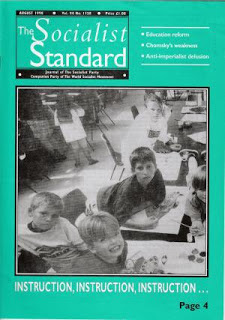
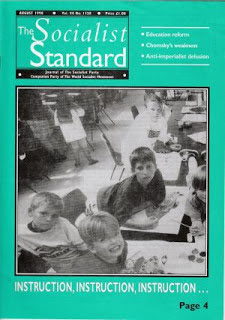
Instruction, instruction, instruction (1998)

From the August 1998 issue of the Socialist Standard
Why has education become the centre of Labour reformist politics? The Labour government believes that in a free-trade world dominated by vast multinational corporations a well-skilled economy has a better chance of attracting investment and business. It is adapting the education system to this end.
The Labour Party swept to power last year on the back of the tedious and mindless repetition of simple meaningless slogans, designed to appeal to all and sundry as the obvious thing to do. Behaving in the way of all leaders and treating the people with obvious contempt. The Blair hammered home his point “Education, Education, Education”, even to the extent of going to Russia and inflicting it on the workers there. The question arises, however, what exactly does this pointless piece of redundant sloganising really mean? Even The Blair does not know, calling forth committees to advise him on what the “Third Way” really is. Perhaps he needs some instruction from socialists to let him know what he’s up to.

The history of education is a long and tortuous one, of different classes struggling to define the "goods” of society’s intellectual wealth and who should have access to them. The problem was twofold, what to teach people (within the parameters of training for social roles, inculcation of specific cultural values, and regulating and controlling behaviour) and how to teach them (the practical implementation of these values). A singular example of this can be seen in the late 19th century when vocational skills were added to the curriculum of some schools for working types. Our masters chose to call that “instruction” rather than “education”, so as to exclude from the hallowed halls of education anything so dirty as the practical ability to work.

The wanna-be masters in the Labour Party conspicuously fail to address the first point, what to teach, going around talking about education as a simple matter of deciding how to best teach children an obvious and unquestioned curriculum, without looking too closely into it. The rhetoric of the Labour government is about how to “allocate resources” more effectively, to achieve more efficiency, to improve standards” of teaching. In short, all their bluster is about how they are going to teach, and not what they are going to teach. Content stays quietly on the side lines.

Central state control
To achieve this efficiency”, the Labour government has begun to implement what has been called a “central planning” system for education. Their Education Bill contained a host of Henry VIII clauses (parts of a bill that give direct discretionary executive authority to a Minister), giving the Secretary of State an enormous degree of control over the education system, and more than any predecessor, in what had previously been mostly a system of co-operation between central government and local educators. OFSTED (inherited from the Tory years, like most of the Labour plans— the government is the government is the government) continues to terrorise its way through schools, its panoptic gaze set to frighten the teachers into “improving’ their “standards”, a terror backed up by “naming and shaming” and the whole rhetoric of “failing schools” and “incompetent teachers”.

School league tables are meant to indicate how well a school is “performing”, but in fact help to instil “market discipline” as schools compete for pupils (and therefore funding: this factor is also strongly felt in the further education sector where cutbacks, bullying management and a mad scramble for pupils is wracking those who work there). The encouraged relationship of parents to schools is that of the marketplace. with parents as consumers, entering into a contract with the school that is itself (if it opts out) a self-run business. Here, quietly, the values of the market have been adopted, but Labour would just call it being “pragmatic”, and attack any opposition as ideologues or dogmatists.

Alongside this come the “Education Action Zones”, locally based cooperation between businesses and Local Education Authorities and the schools themselves. This produced the response of Don’t Let Labour Privatise Our Schools” from the Trotskyists of the “Marxist Party”, as usual for such types, missing the point entirely. EAZs are not about private companies trying to make a profit from schools; indeed, these will try and pass their participation off as largess. EAZs will provide more funding, to supposedly help kick-start schools in deprived areas, and improve their “standards” of teaching.They will be allowed to change the length of terms (in Middlesbrough, for example, it is proposed to change from a three to a four term system, and thus lose the long, and “socially disruptive”, summer holiday, in favour of a more spread-out system). Schools will get extra staff, be freed from national pay agreements (so that they can apply “flexible” salaries and conditions) and the national curriculum (so that they can concentrate on Literacy and Numeracy skills—the three Rs by a different name).

The EAZs represent a way for our masters to assert a more direct control, by-passing any awkward elected and potentially Bolshy local authorities, not for their own immediate profit, but so that the education system remains secure and run well by their standards and interests.

The content of the lessons is also of interest. Blunkett has already allowed all schools to cut time set aside for History, Geography and Art in their class rooms, in favour of a literacy hour. Added to the provisions for EAZs, this could mean that humanities and other more “ephemeral” subjects suffer, turning schools into places that simply churn out literate and useful workers, but who aren’t trained to think for themselves. Given that the action zones will occur in poor areas, this policy will reproduce a division in social role: the children of professional and better-paid workers will have access to a cultural and intellectual store that will be denied to poorer children, thus maintaining and reproducing a certain division of labour for the marketplace.

Naturally, the inculcation of social values will not be ignored, Labour ministers are discussing “Lessons in Citizenship” to replace the blatantly failing religious elements of the system. It doesn’t take much insight to see that the aim of such lessons will be to get people to accept the status quo and not to criticise the system (having undergone such lessons myself at school, as well as the whole Catholic rigmarole, I can testify to this). Here again, Labour’s rhetoric assumes an unchallenged system of ideas that merely need implementation.

Market driven
To achieve their marketplace system, Labour have had to retain, and in some cases implement themselves, ways of measuring the schools—teachers assessed, children tested regularly—all of them under tremendous pressure to achieve good results and pass the benchmark. This sort of thing has been tried before, the revised Standard Code for Education of 1862 for the Three Rs tests. Of course the obvious happened, and teachers simply began to coach the children to pass the exam, without bothering about them being able to think for themselves or understand the principles involved.

The whole process is openly driven by the employers’ need for a transparent benchmark of skill. The “continuing education” or training that the Labourites trumpet amounts to being able to engage in National Vocational Qualifications, which is a boring, unfulfilling, and at times patronising experience, which does not help the people undergoing it, and serves only to frustrate and punish those on the welfare forced to do such courses.

The marketplace drive for correctly skilled workers can be discerned in Labour’s approach to higher education, with tuition fees and the end of the grant.The Tories throughout their term of office “oversubscribed” to the higher education system, wanting to placate their “middle class” (salaried working class) constituency by assuring them that their children could go on to get a degree, but they tried to do this without increasing the funding for the system significantly (and by the dodge of simply renaming Polytechnics Universities).Whilst this was electorally necessary for the Tories, it produced a system that was turning out more workers of a particular sort than the market could bear, It also produced concerns over the loss of an “academic elite”, and a general lowering of standards. Such concerns came, of course, from the employers.The Labour Party had to do something to save the system, and their choice was tuition fees.

Today I read in New Statesman some idiot claiming to be a socialist and saying that it was the proper socialist thing to do to introduce tuition fees and stop subsidising middle class children going to university. This is typical of the hypocritical way in which New Labour is dealing with this issue, behind a smokescreen of deceit. Their tuition fees are meant to reduce intake, to streamline it, so that it fits better with the market’s needs (makes one so glad to be a desired commodity). Last October, when the Bill was launched, the mouthpiece of New Labour, the ever-wheedling and lick-spittle Guardian, announced how businesses were considering offering “golden handshakes” to graduates with the skills they need, by paying off their debts for them, thus guaranteeing that unless you have money, you can only get a degree if your qualifications fit market requirements. As with schools, universities must reflect the needs of the division of labour within capitalist society.

This is yet another example, if one be needed, of the way in which the marketplace frustrates rather than promotes self-improvement for the vast majority of people. The market is incompatible with any equitable sharing of society’s wealth of knowledge and culture. As it stands, what is called education merely reflects the society in which it exists, divisive, demanding, pressurising, merely an alienating system, a vast factory, for turning out workers tuned to our masters’ requirements.
Pik Smeet

50 Years Ago: Mr. Aneurin Bevan on Tory vermin (1998)

The 50 Years Ago column from the August 1998 issue of the Socialist Standard

In a speech at Manchester Mr. Bevan, Minister of Health, let himself go about the Tory Party. “They are lower than vermin,” he said. (Daily Mail, 5/5/48). For them he had “a deep burning hatred in his heart.”

It was not always so however. In 1940 when the Labour Party decided to enter into coalition with the Tory Parry under a Tory Prime Minister, Mr. Churchill, Mr. Bevan said:
“The Government have been in office for two weeks and like my hon. Friend the member for Llannelly . . . I felicitate them upon the way in which they have set about their task” (Hansard, 30th May, 1940.)
The Press naturally made much of Mr. Bevan’s abuse of the Tory Party but actually a more revealing passage in his speech was one that attracted no comment. He said that Churchill’s policy would mean “cinemas, mansions, hotels and theatres going up, but no houses for the poor.” (Daily Mail, 5/7/48.)

It is that last phrase that is significant. Mr. Bevan and the Labour Party charge the Tories with seeking to meet the needs of the rich. The Labour alternative is to try to help the poor by building comparatively low rented (and small) houses for them. It is only Socialists who seek the abolition of both rich and poor, of both the property-owning class and the propertyless working class.

[From “Notes by the Way”, Socialist Standard, August 1948]

What Socialism means (1998)

From the August 1998 issue of the Socialist Standard
Socialism means a world society based on production solely for use, not profit.
It will be a classless society, in which everyone will be able to participate democratically in decisions about the use of the world’s resources, each producing according to their ability and each taking from the common store according to their needs.

In such a society there can be no money
–or, more precisely, no need for money. Money is only needed when people possess and most do not.

Imagine that all the things you need are owned and held in common.
There is no need to buy food from anyone–it is common property. There are no rent or mortgages to pay because land and buildings belong to all of us. There is no need to buy anything from any other person because society has done away with the absurd division between the owning minority (the capitalists) and the non-owning majority (the workers).

In a socialist world monetary calculation won’t be necessary. 
The alternative to monetary calculation based on exchange-value is calculation based on use values. Decisions, apart from purely personal ones of preferences or interest, will be made after weighing the real advantages and disadvantages and real costs of alternatives in particular circumstances.

The ending of the profit system
will mean at the same time the ending of war, economic crises, unemployment, poverty and persecution–all of which are consequences of that system.

The revolutionary change that is needed
is not possible unless a majority of people understand and want it. We do not imagine all humankind’s problems can be solved at a stroke.

Reforms of the present system fail because making profits must always be given priority over meeting needs, so the problems keep on recurring and ever multiplying.
It will take time to eliminate hunger, malnutrition, disease and ignorance from the world. But the enormous liberation of mental and physical energies from the shackles of the profit system will ensure that real human progress is made.

Utopian Capitalist? (1998)

Book Review from the August 1998 issue of the Socialist Standard

Robert Owen and the Commencement of the Millennium by Edward Royle. Manchester University Press.

Robert Owen (1771—1858) is generally described as a philanthropist and utopian socialist. This book puts a question mark against the first claim and an even bigger one against the second. It also offers ample evidence that Owen, whatever else he presented himself as, was first and foremost a capitalist.

Royle concentrates on one of Owen’s later projects, the community built on a green-field site in Hampshire and known as Harmony. Before that, Owen had played an important part in the development of New Lanark, a community based on four large cotton mills along the banks of the Clyde. Although Owen had joined a group of doctors, scientists and writers who were concerned about the conditions of factory (especially child) labour, their concern was to ameliorate such conditions, not to abolish them.

Cotton spinning mills were driven by water power, so industrialists like Owen moved into the countryside where they built new villages centred on their factories. Labour had to he attracted to such places and looked after as a scarce commodity. Communities were created in the countryside because the factories needed them. The factory master was in much the same position as the landed squire. He owned the property and provided for the work and leisure of his people. His self-interest combined with any humanitarian feelings to ensure concern for his people’s welfare. As Owen wrote in his autobiography. his chief object at New Lanark was “To discover the means by which the condition of the poor and the working classes could he ameliorated, and with benefit to their employers.”

Royle gives a relatively brief account of Owen’s enterprise at New Harmony in America, the so-called land of freedom and opportunity. In 1824 Owen, having had disagreements and disappointments at New Lanark. was ready to make a new start. He heard that the Rappites of Harmonie in Indiana were looking for a buyer for their community. He bought in, but soon realised his mistake. Unlike the docile and co—operative wage-slaves at New Lanark, the poorest families at New Harmony were accustomed to work only a few months each year and then to spend the rest of their time “in doing nothing, in drinking and in talking politics, which tend to nothing”.

The author spends most of the rest of his book telling us about the Harmony community. The details make fascinating reading. Owen does not emerge smelling of roses. His ”business methods show the gentle philanthropist to have had the financial teeth of a shark”. In 1833 Owen announced the formation of the Grand National Union of the Productive Classes, but he was not looking to create the alternative society to capitalism. Rather he used the Union to prepare followers for the reorganisation of society in paternalistic communities. Despite his opposition to the conviction of the Tolpuddle martyrs in 1834, he was never reconciled to the class conflict which the trade union struggle brought.

Royle quotes one acerbic critic’s view of the Owenites’ mission as “the relief of the upper classes from the gout; the middle classes from the ledger fever; the working classes from poverty; and all from misery”. At Harmony the aspirations of working men and women were sacrificed to the demands of the profit system. Capitalism still held control, and the working people there remained its victims.
Stan Parker

Saturday, June 11, 2016

Minor distractions on the Road to Freedom (1998)

From the August 1998 issue of the Socialist Standard

Paris erupts. 'At last - Victory Is Ours! We beat the world' And Chirac was wearing the team scarf. Who cannot be proud to be French tonight. asks the ecstatic newsreader. Old woman on the corner of the Rue de Rivoli throws her hat in the air and thinks of next week's rent. Liberty? Fraternity? Equality? Maybe not. but We won the Cup. Let the world gloat.

Of course, we should have played Gazza. Two men in a pub relive a battle in which they fought valiantly with six-packs and a remote control.The BBC should have played the fat Italian opera singer. Having Faure's music as the theme tune could only encourage the French. Beckham's name is spat with contempt. He robbed us of elusive victory. Forgive what Thatcher did to the miners and Blair's grin of the youthful oppressor as he picks on the disabled and single mums, but who can think welt of national treachery cheered only by Scots and Posh Spice?

Why Did Ginger Spice Leave? The nation demands to know. Man at the Job Centre with three kids and no prospects reads the Sun with latest revelations of Spice News. Which one is your favourite Spice Girl, then? When did we last hear the gossip about Fifteen-Hours-A-Day-In-A-Bangkok-Shirt-Factory Spice? Ad exec sighs; the name has no ring to it. The kids need a role model. Look at Barbie Doll: always smiling. She can take it. Why can't everyone?

Bowler-hatted bigoted know-nothing no-surrender boys demand inviolable right to pester neighbours. It's tradition, see? So, No Surrender. Three kids burned to death in their home. It's tradition, see' Burning kids alive will soon be forgotten. but never the triumph of 1690.Were they waiting for the Big Match, these harmless, innocent. defenceless children, before the psychotic patriots extinguished their lives? Blair condemns, with limp sincerity.

But what about the stink in his back yard? Yes, you Tony—you with the permanent ad-man's smile. Did young Draper promise to fix it for a yankee capitalist in return for a well-stuffed envelope? Mandelson lets Draper take the rap. Blair lets Mandelson take the rap. Clinton insists that Tony would never mess. Tony declares that Bill would never take advantage of no~one. The girl was only in his room to get a saxophone lesson. It was all a horrible misunderstanding. Honest, guy. The People Must Be Told. Did Monica inhale? Had Dodi and Di done the business before that fateful journey? Is Big Mac better than a Burger King Whopper? And why are William Hague and Baroness Thatcher never seen in the same room? lt's an old trick. Will. You can't disguise it by wearing your baseball hat and bopping to reggae. You're an octogenarian n the body of a young man. What do you think about these alien abductions? They wish for little else in Wolverhampton.

Have you booked your ticket for the Greenwich Dome? Why, what's there? Dunno—but I'm definitely going. Where will you be on New Year's Eve 999? Drunk as a skunk in an East End boozer reliving 1966—Geoff Hurst, Harold Wilson. the Kray Twins. They was harmless boys—only wanted to look after their mum and torture people. Wonder how Gerry Adams treats his mum. Isn't the Queen Mum wonderful! Won't we weep like babies when she finatly comes to terms with nature. Old women in tower block (Bevan Court, by name) decide whether to open baked beans or put on the heater. The blood gets thinner when you're old. Unless it's blue. Queen Mum always has a spare coin for the meter. They have her girl's picture on, you know.

What about this Euro, then? Give up the Queen's head on our flyers? Never! Lining up at the cash machine will never be the same. Sorry. But Your Request Has Been Referred To Your Bank. Young William Hague will lead a national crusade to save our currency.We remember the blitz, Fritz. Britons never never never shall be. Gissa Job, guv.

Irritating pictures on the news of starving kids in Sudan. It's wrong—it's just not right to show that kind of thing when people are eating their dinner. Isn't life miserable enough without that? Pass the Prozac, pal. They look like humans. In your nightmares they look like your own children. The newsreader says—some of the images in this report may disturb some viewers. But most of the images won't. They'll leave you alone and let the mind rot in maladjusted tranquillity. It's called Normality.

After Winston Smith had come out from Room 101 he could see everything much more clearly. Distracting thoughts of freedom had been cleared from his head. News came on to the telescreen. France has won! Rejoice! But England should never have dropped Gazza.