Showing posts with label August 1930. Show all posts

Saturday, August 1, 2020

Parliament or Soviet. (1930)

From the August 1930 issue of the Socialist Standard

The Proletarian of America for July, 1930, publishes an article under the above title by John Keracher, which contains a covert attack on our principles and policy. Although our name is not mentioned, our Declaration of Principles is quoted.

The writer opposes our contention that the workers must capture power through parliament, but he carefully abstains from putting forward a course of action himself unless we are to take his blessing of the Paris Commune and the Russian Soviet as his idea of the future course of events.

The article contains alleged statements of Marx and Engels for which, significantly enough, no reference is given. Where, however, reference is given for quotations from Marx and Engels the context of these statements will not bear the interpretation Keracher tries to foist upon them. We will deal with these statements further on.

In a paragraph near the middle of the article Keracher ties himself in a knot and incidentally destroys his case. He writes:
  Then, again, the election of working-class representatives to the parliamentary bodies (local and national), gives the proletariat an opportunity through those representatives, to combat the representatives of Capitalism at close range. Those elected representatives of the workers can take advantage of their prominent position to combat and expose the nature of capitalist legislation , and to speak to the proletariat over the heads, as it were, of their political opponents. To "elect its own representatives in place of the capitalists" is also a means of hampering the capitalists in their "exclusive political sway"; of contesting every measure they bring forth in their own interests, and proposing measures in Parliament that would be a decided advantage to the workers, even while fully realising that the capitalist representatives, in the majority, will not permit their passage.
Good! And when the working class has a majority in Parliament cannot they seize the State power? But Mr. Keracher  is silent, wrapped in contemplation, with his gaze rivetted on Russia—which is thousands of miles away! Perhaps, in his simplicity, he thinks that when the working class have obtained a majority in Parliament  the representatives should disperse to the constituencies and start forming soviets. They certainly cannot start these organisations with any success before —  “the armed forces of the nation” will see to that!

In the effort to show the limitations of Parliament, Keracher, seeking for support from Marx, trots out the quotations we have dealt with over and over again in these columns, and, like other opponents, he omits the significant context. According to Keracher Marx wrote: “The working-class cannot simply lay hold of the ready-made State machinery and wield it for its own purposes.” The paragraph in The Paris Commune , however, which is the opening paragraph of Chapter 3, runs as follows:
  On the dawn of the18th of March, Paris rose to the thunder-burst of ‘Vive la Commune!’ What is the Commune—that sphinx so tantalising to the bourgeois mind? 
  "The Proletarians of Paris" said the Central Committee in its manifesto of the 18th of March, "amidst the failures and treasons of the ruling classes, have understood that the hour has struck for them to save the situation by taking into their own hands the direction of affairs…. They have understood that it is their imperious duty and absolute right to render themselves masters of their own destinies, by seizing upon the governmental power." But the working-class cannot simply lay hold of the ready-made State machinery, and wield it for its own purposes.”
From the above it will be seen that the phrase referred to the position after the workers had seized governmental power. This is the point our opponents always appear to overlook. The workers must, first of all, obtain control of power; once they have obtained supremacy in the State then they will, as Marx follows on by explaining, re-organise the administration of affairs to meet their needs. In his introduction Engels also makes this position clear: “From the outset the Commune had to recognise that the working class, having once obtained the supremacy in the State, could not work with the old machinery of government.” (Italics ours.)

Keracher, and others like him, are putting the cart before the horse. The quotation from Marx has no bearing upon parliamentary action in the way they seek to use it.

The comparison that is sought to be made between the Paris Commune and the Bolshevik Dictatorship is curious, as the Bolsheviks have done just the opposite to what was proposed by the Communards. The Communards proposed decentralisation of control whereas the Bolsheviks have established a rigid centralisation of control in the hands of a group inside the Russian Communist Party. The Communards made all posts elective and paid all officials the same pay as an ordinary workman. The Bolsheviks have established different grades of pay and the central group appoints the officials. Yet Keracher says:
  It [the political form of the future] must be a commune form, or Soviet form (the better known term since the Russian revolution). The Soviet government is the fully developed Commune; or, as Joseph Stalin expresses it, the Commune was "the Soviet in embryo."
This Russian Soviet that is alleged to be the shadow of our future we have repeatedly shown to be a state where frantic efforts are being made to build up a capitalist industry. We have so often given evidence of this that one illustration must suffice here. In Russia there is a large and growing class of capitalist investors drawing incomes from private trading and from investments in the co-operatives and the Russian State Loans. In 1927, the total share and reserve of capital in the Co-operatives amounted to ninety seven million pounds. In October, 1926, credits borrowed at home and abroad by the Co-operatives amounted to one hundred and eight million roubles. (Soviet Union Year Book, 1928, p.183 and 193). State Loans in Russia are used exclusively for financing industry, and by February, 1930, had reached nearly 300 million pounds. (Review of the Bank of Russian Trade, May, 1930). The interest on these loans averages about 10% What is the difference between this and Western capitalism?

Is this a lopping-off of the worst features of the State- as the Commune did?

Keracher attempts to wave aside a paragraph in our Declaration of Principles on the ground that it is opposed to the phrase from Marx, relating to the laying hold of the ready-made State machinery. After quoting the sixth paragraph in our Declaration of Principles he goes on to say: 
  Marx and Engels, whenever they wrote in relation to the State, took pains to point out that this is just the thing the working-class cannot do. The working-class cannot use "this machinery, including these forces", for the working-class "emancipation and the overthrow of privilege." When writing on the Commune, Marx tells with approval of ‘the suppression of the standing army, and the substitution for it of the armed people.’ In other words, it was not "this machinery, including these forces" that were to be wielded as an "agent of emancipation and the overthrow of privilege". The Parliamentary government was to be to be eliminated and replaced by the Commune form of government, with its ‘suppression of the standing army, and the substitution of the armed people.’ Marx eulogises the Commune because it "got rid of the standing army and police." These neo-Marxians are going "to use the machinery of government, including the armed forces of the nation" (the capitalist government and the standing army and the police) as the "agent of emancipation.’”
If “Marx and Engels wherever they wrote in relation to the State, took pains to point out that this is just” what “the working class cannot do”, it is surely strange that Keracher cannot produce a single quotation to support his view!

Instead he drags out one or two phrases which in their context have nothing to do with the point. We have already quoted the first paragraph of The Paris Commune. The following three paragraphs are devoted to a brief history of the growth of state power in France to the time of the Commune. Then comes the paragraph from which Keracher has torn pieces and fitted them to suit his argument. The paragraph runs as follows:
  Paris, the central seat of the old governmental power, and, at the same time, the social stronghold of the French working-class, had risen in arms against the attempt of Thiers and the Rurals to restore and perpetuate that old governmental power bequeathed to them by the Empire. Paris could resist only because, in consequence of the siege, it had got rid of the army and replaced it by a National Guard, the bulk of which consisted of working-men. This fact was now transformed into an institution. The first decree of the Commune, therefore, was the suppression of the standing army, and the substitution for it of the armed people.
It wasn’t a case of eliminating “parliamentary government”, but of resisting an attempt to restore an older form of government than the 3rd Empire. Also Marx was not referring to the general question of the suppression of the army, and his “eulogy” consisted of pointing out that as the army had been got rid of and was already replaced by armed workers, the first decree of the Commune very properly as a natural consequence was the “suppression of the standing army and the substitution for it of the armed people.” They took advantage of an accomplished fact.

In England and America, however, the army, etc., has not been got rid of, and the people are not armed. And in view of the powers of government through parliament, we would be interested to learn from him how he proposes getting rid of the army and arming the people.

This misapplied phrase of Marx, however, does not touch our position. Marx said, in effect, that you cannot carry on Socialism with capitalist governmental machinery; that you must transform the government of  one class by another into the administration of social affairs; that between the capitalist society and Socialist society lies a period of transformation during which one after another the political forms of to-day will disappear, but the worst features must be lopped off immediately the working class obtains supremacy in the State. This completely harmonises with the position laid down in our Declaration of Principles.

Mr. Keracher’s peculiar group gives no indication of the way they propose getting rid of the armed force now controlled by the capitalist and they hide their lameness in a cloud of phrases, like the following:
 The Proletarian Party continually labours to organise the workers as a class, to perform a political act, namely, the conquest of political power by the vast majority, and the organising of a State form, such as the Commune of Paris and the Soviet of Russia, with its proletarian dictatorship to coerce and expropriate all expropriators, and to ultimately develop a classless society of free people.
This means, in fact, the organising of another state within the capitalist state.

And we suppose that while all this is going on the capitalists and the force they control, “are just going to stand, hat in hand, and say, ‘Welcome, brothers. It’s all yours!’ ”
Gilmac.

Appeal For Funds. (1930)

From the August 1930 issue of the Socialist Standard

It is no new thing for us to appeal to our readers for donations to assist us in carrying on our work. To those who know the Party it is sufficient to say that our need at the present moment is more pressing than it has been for some considerable time. Our larger Head Office costs us more in rent and other expenses, and we have during the past few years been hit by the decision of the L.C.C. forbidding the sale of literature and the taking up of collections in the parks and commons.

For the benefit of new readers, we would explain that our members are working men and women, and it is no easy matter for them to find the money required for carrying on the Party’s propaganda, the money to print literature, hire halls, and so on. Our expenditure is kept to a minimum, and everything which can be done by the unpaid services of our members in their leisure hours is carried out in that way; the secretarial work, speaking at meetings, writing articles and pamphlets, and all the irksome tasks incidental to the work of the organisation.

Our readers cannot all help us directly by lending a hand in this way, but they can help by providing us with the funds without which even voluntary work cannot be carried on.

Please send your donations to the Treasurer at 42, Great Dover Street, S.E.l.

Corrections. (1930)

From the August 1930 issue of the Socialist Standard

In the Editorial in the July issue (column 2, page 168) a line which should have appeared as the eighth line from the top of the column was dropped so that it appeared as the third line in the paragraph below.

On page 167, line 12, the phrase "the natural source of supernatural phenomena" should have read "the natural source of supernatural seemings."

Edinburgh. (1930)

Party News from the August 1930 issue of the Socialist Standard

The Edinburgh Comrades are holding good meetings at the Mound several nights a week. A large part of the time is devoted to answering questions on Socialist policy, in view of the confusion spread here by the I.L.P. and Communist organisations, as well as direct action elements. The decline of Communists is seen in the poorly attended meetings conducted by them in this town, where once they had a large following.

Good sales of literature are being made, considering the uphill work of pushing scientific literature against the sensational and so-called practical rubbish which passes for working class education. All those interested in our work should attend our meetings.

"The Socialist." (1930)

Party News from the August 1930 issue of the Socialist Standard

It will not be news to our readers that “prosperity" in the U.S.A. has taken a wrong turning. We regret to have to announce that something has happened much more serious than the ruin of large numbers of gamblers on the New York Stock Exchange. The issue of "The Socialist” has had to be suspended temporarily. The following extract from a letter written by our New York comrades tells its own story :—
  Conditions here are much worse than you read in the papers. More than half our members are unemployed; others had to leave for other parts, crippling us almost mortally. At open-air meetings, where formerly we sold from 12 to 14 dollars’ worth of literature in an evening, we now do well to sell one and a-half dollars’ worth. The workers simply cannot afford to buy.
This is bad news, but not quite so bad as it might have been. “The Socialist" will not disappear. It will be printed, but at intervals which will be irregular for a time until conditions improve.

Readers in Great Britain who have paid their subscriptions through the S.P.G.B. will be supplied with the number of issues for which they have paid, unless we hear from them to the effect that they wish the unexpired part of the subscription returned.


The Forces Making For Socialism. (1930)

From the August 1930 issue of the Socialist Standard

In the June issue, we dealt with Shaw’s reference to Marx’s “dream” of International Socialism. We pointed out that “the very development of capitalism makes Socialism inevitable.” A Manchester correspondent says that our statement is incorrect.

In the original short paragraph we could not explain the full meaning of such a phrase. It has been explained in this journal often, but we will outline the basis of our position.

The economic development of the present economic system produces industrial efficiency and at the same time growing economic insecurity and unemployment. The concentration of wealth into the hands of relatively fewer owners increases the contrast between the workers and the employers. The anarchy of each firm producing as much as possible for the same market leads to continuous over-production under the highly organised producing system of to-day.

Contradictions such as increasing productive power along with increasing misery more and more affect the workers’ minds. When they escape from the confusing ideas of the reformers the workers will organise to take over the industries, etc., and end the discord between social production and private ownership. The working class will rescue society from the chaos which would ensue unless the fruits of industrial evolution were gathered up into a new system, consistent with economic tendencies.

Does our correspondent deny the inevitability of Socialism? If not, what makes Socialism inevitable but just the economic developments of the present system? The same development will drive more and more workers to seek a way out and, therefore, make them willing listeners to the propaganda of Socialism, until under the varying pressure of conditions the mass of the workers are compelled to accept the Socialist policy and organise to win political power to establish the new system.

Economic conditions, it is true, do not alone change class rule. The contest for supremacy is a struggle between classes. But the development of economic conditions drives the subject class to struggle to establish a new system.

The development of capitalism makes Socialism inevitable, because while the material conditions are ripening, the working class are being matured for their emancipation.
C.

Sunday, August 12, 2018

Notes by the Way: Laski's Error. (1930)

The Notes by the Way Column from the August 1930 issue of the Socialist Standard

Laski's Error.

Professor Harold Laski, writing in the current number of the Political Quarterly, refers to the “well-known” view of Marx and his followers that capitalism can only be overthrown by violent means.

This may be well-known to Professor Laski, but it is unknown to us, and was unknown to Marx. It is a pity that Professor Laski does not give the evidence for his extraordinary statement. When, about three years ago, his book on "Communism" was reviewed in these columns, attention was drawn to other mistaken views about Marx which are held by Laski, but although a copy was sent to him and acknowledged, he did not attempt to defend his statements. He continues to repeat them, still without evidence.

#    #    #    #

The American Socialist Party Gets Further Away From Socialism.

About a year ago the American Socialist Party, in its endeavour to become more popular, dropped from its constitution the mention of the class-struggle. It is now considering the advisability of dropping the word Socialist from its title and calling itself the "Independent Labour Party." We are sure that all Socialists, both here and in the U.S.A., will be quite enthusiastic about the idea. The American Socialist Party was never in any respect Socialist, and the proposed change of title would clear the way for our colleagues of the American Socialist Education Society to form a real Socialist Party.

#    #    #    #

The S.L.P. in Trouble.

The Australian S.L.P. has broken with and been repudiated by the parent body in America. The Australians claim that "the American S.L.P. has weakened from the Principles, Policies and Tactics advocated by Daniel De Leon.”

The trouble appears to have arisen largely out of the insertion in the American Weekly People of advertisements of books containing matter contrary to the S.L.P. position.

The whole controversy, as described in the Australian Revolutionary Socialist is, however, so clouded under a stream of personal abuse that it is a little difficult to tell what really is the matter. Anyhow, they are annoyed, and describe Peterson, of the American S.L.P. as a "demented being," the associate of "assassins," "slanderers," "larceny - mongers," "thieves," and "thugs."

Wednesday, June 13, 2018

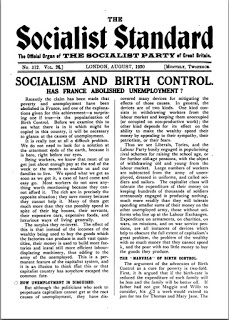
Socialism and Birth Control. (1930)

From the August 1930 issue of the Socialist Standard

Has France Abolished Unemployment?
Recently the claim has been made that poverty and unemployment have been abolished in France, and one of the explanations given for this achievement—a surprising one if true—is the popularisation of Birth Control. Before we examine this to see what there is in it which might be copied in this country, it will be necessary to glance at the causes of unemployment.

It is really not at all a difficult problem. We do not need to look for a solution at the uttermost ends of the earth, because it is here, right before our eyes.

Being workers, we know that most of us get just about enough pay at the end of the week or the month to enable us and our families to live. We spend what we get as soon as we get it, a case of hard come and easy go. Most workers do not save anything worth mentioning because they cannot afford it. The rich are in precisely the opposite situation; they save money because they cannot help it. Many of them get much more than they can possibly spend in spite of their big houses, their servants, their expensive cars, expensive foods, and luxurious ways of living generally.

The surplus they re-invest. The effect of this is that instead of the incomes of the wealthy being used to buy the goods which the factories can produce in such vast quantities, their money is used to build more factories and instal still more efficient labour-displacing machinery, thus adding to the army of the unemployed. This is a permanent feature of the capitalist system, and it is an illusion to think that this or that capitalist country has somehow escaped the common fate.

How Unemployment is Disguised.
But although the politicians who seek to perpetuate capitalism cannot get at the root causes of unemployment, they have discovered many devices for mitigating the effects of those causes. In general, the devices are of two kinds. One kind consists in withdrawing workers from the labour market and keeping them unoccupied (or occupied on non-productive work); the other kind depends for its effect on the ability to make the wealthy spend their money by appealing to their sympathy, their patriotism, or their fears.

Thus we see Liberals, Tories, and the Labour Party busily engaged in popularising rival schemes for raising the school age, or for further old-age pensions, with the object of withdrawing old and young from the labour market. Large numbers of workers are subtracted from the army of unemployed, dressed in uniforms, and called soldiers and sailors. The capitalist class will tolerate the expenditure of their money on keeping hundreds of thousands of soldiers strenuously engaged in producing nothing, much more readily than they will tolerate spending smaller sums of their money on the other unemployed army, those without uniforms who line up at the Labour Exchanges. Expenditure on armaments, on charities, on wars, on missions, and on war service pensions, are all instances of devices which help to obscure the full extent of capitalism’s great problem, the problem of the wealthy with so much money that they cannot spend it, and the poor with too little money to buy the goods they produce.

The "Marvels" of Birth Control.
The argument of the advocates of Birth Control as a cure for poverty is two-fold. First, it is argued that if the birth-rate is reduced the expenditure of each family will be less and the family will be better off. If father had not got Maggie and Willy to consider, his £3 a week would extend to jam for tea for Thomas and Mary Jane. The second argument is that if the population were smaller there would be no unemployed. Before considering the matter in detail, it is as well to notice that the second effect, if it takes place at all, cannot do so until 15 or more years have passed. Father is not replaced at his job by his son Thomas, aged 1, but may be replaced by him when he reaches the age of 15 or thereabouts.

But are either of the arguments correct? These advocates of Birth Control entirely overlook the way in which wages are fixed and the way in which unemployment is created. They forget that if the cost of living of working class families is decreased, no matter how, wages tend to fall correspondingly, so that a general reduction in the size of families would be wholly counteracted by a decline in the level of wages. If this is doubted it is only necessary to consider the way in which money wages rose between 1914 and 1920, and the speed with which they fell when prices declined. Civil Servants, railway men, local Government employees, and many others have had their wages directly related to the cost of living, but whether the reduction in wages takes place automatically or not, it invariably does take place for workers as a whole. They are unable to resist successfully the pressure which the employers can bring to bear.

If the average working class family becomes smaller, father and all the other fathers will find that their £3 has shrunk with the shrinking of their cost of living.

Birth Control and the Unemployed.
We are told that if the population were smaller and there were no unemployed, the workers could keep their wages up in spite of their lowered cost of living. But unemployment is not the result merely of there being a large population. The organisation of industry and its private ownership are the important factors. The constant introduction of more efficient machinery and methods displaces workers from employment. It is much more direct, more important, and more speedy than anything which could be done by Birth Control.

The restriction of the population is of no practical use for the purpose of lessening unemployment. An illustration of this exists in the United States. After the War the U.S.A. Government introduced a policy of restricting immigration. But in spite of the limiting of the numbers of immigrants, the introduction of labour-saving machinery has produced its millions of unemployed. Any attempt to raise wages immediately gives the employers an additional inducement to introduce such machinery. We see, therefore, that the standard of living of the workers is kept down by the joint effect of unemployed workers competing for jobs and of employers introducing labour-saving machinery. The restriction of the population, whether by birth control or any other means, is quite ineffective to safeguard the workers against this pressure.

The Position in France.
France, with a smaller population than this country, has a much larger number of workers withdrawn from production in some of the ways mentioned earlier in this article. Her army, navy, and gendarmerie number nearly 600,000. There were 1,500,000 Frenchmen killed in the war, and there are nearly another million disabled ex-service men capable of little in the way of productive work. In 1926 (the latest figures available) public assistance was given to more than 700,000 destitute persons. The number of aged poor registered for relief on 31st December, 1926, was 526,000. (See Statesman’s Year Book, 1930.) The French Government’s employees number about a million, which is much more than the number in the British Civil Service and local Government Service. A very large percentage of Civil Servants are, of course, engaged on non-productive work.

Actually, in spite of birth control, the total population of France is more than it was in 1911. In that year the population was 39,604,992; in 1928 it was estimated to be 41,020,000. (Statesman’s Year Book, 1930. Pages 849/851). This is due partly to a lower death rate, partly to the annexation of Alsace-Lorraine from Germany, and partly to the influx of workers from abroad. If we exclude Alsace-Lorraine (population about 1,800,000) the population of France is now some 600,000 less than it was in 1911. On the other hand, it has been pointed out by the French economist, Francis Delaisi (Daily Herald, 17th January, 1930), that the number of workers in France has been added to by 1,300,000 men and women who, before the war, were small property owners, but are now compelled to work for their living. They have been squeezed out of the ranks of the small capitalists.

Is There Unemployment in France?
It is true that at the present time the published figures of unemployment in France show only a few thousand, but it has to be remembered that the French Government does not keep records of unemployment for the whole of France. The published figures refer to Paris only. And it is a mistake to suppose that widespread unemployment is unknown in France. In March, 1921, there were 44,000 unemployed in Paris alone, while a year before the figure was 70,000. (See "Unemployment as an International Problem,” by J. Morgan Rees, M.A., 1926, Page 83.)

Another factor is the employment of foreigners. Hundreds of thousands of the low paid workers in French agriculture and industry are by nationality Poles, Italians, or Belgians. As soon as unemployment threatens to become serious, these people are sent back to their respective countries. It may be said that during periods of industrial depression the French unemployed will be found lining up at Mussolini’s Labour Exchanges.

Are French Workers Well Off?
One important fact is often forgotten. It is that unemployment is not the only or even the chief cause of poverty. In every country in the capitalist world we find that the larger part of the workers are poor in comparison with the employing class, and a very large percentage of them are permanently unable to secure more than the bare necessities of life.

There are, of course, differences between the rates of pay in different occupations and differences between the levels of pay in different countries, but it is nevertheless true that inside each country there is this contrast between the position of the workers and the position of their employers.

The absence from France of millions of unemployed workers competing for jobs has not enabled those in work to secure any appreciable improvement in their low standard of living; the competition of the machine is more than sufficient for the employer’s purpose. According to the International Labour Office the purchasing power of the French workers is about three-quarters of that of the German workers, and is only 58% of the purchasing power of the English workers. The comparisons made by the International Labour Office are not claimed to be absolutely complete, but they do suffice to indicate what is approximately the relationship between the workers' position in the two countries. So low is the standard of living that only a couple of months ago the Postal, Telegraph, and Telephone staffs in Paris came out on strike in order to try to force their employer to raise their wages to the pre-war level. (For the benefit of those who advocate Nationalisation, it may be remarked that the employer in this case is the French Government.)

An Industrial Revolution.
France since the war has been going through what amounts to an industrial revolution. Before the war France was predominantly agricultural, and the land was to a large extent worked by peasant proprietors, producing for their own use and for the home market. Owing to the acquisition of coal and iron and industrial areas from Germany, and owing to various changes in world trade and industry, France has rapidly developed as an industrial nation. This has been accomplished by a chronic decline of agriculture. The French correspondent of the “Economist” said in January, 1929, that the agricultural depression was rapidly approaching a critical stage. It is estimated that the cost of producing wheat in France can be met with a yield of 8 quintals per acre, but the actual average yield is only 6 quintals per acre. The area under wheat in 1913 was 16,250,000 acres. In 1927 it had fallen to 12,750,000 acres, or more than 20%, and it is still falling. France is faced with a steady decline of agriculture, and the abandonment of once profitable farms. (Economist, January 12th, 1929.)

But while many farms have been abandoned, the full effect of the slump is not shown.

If the production of coal or boots becomes unprofitable, the factory owner closes down and the workers become unemployed. But when a small farmer finds himself getting poorer, the final process of squeezing out may be deferred for years. He, and his family, work harder and longer, live on a lower scale, and postpone the final calamity while it is humanly possible.

“An Immense Economic Crisis."
A special factor has operated since, and as a consequence of the war. Reparations payments received from the German Government have been used to make good the enormous destruction wrought during the war, and to re-equip French industry. This has made work for French and foreign workers in France, and has meant a big sale for goods produced in various groups of French industries.

Now, however, that reconstruction work is finished, there is less demand for workers and less home demand for the products of French industries.

At the same time, the demand from abroad is also falling off.

In 1928 the French Government stabilised the currency on a gold basis. The way in which it was done had the result that for the time being the franc had a higher purchasing power inside France than outside. English or other foreign buyers could purchase more goods in France with 124 francs than they could buy abroad with although £1 could be changed into 124 francs. In other words, French prices were below world prices. The consequence was that until French prices rose, or foreign prices fell, French manufacturers were able to sell abroad more cheaply than their foreign competitors. Factories were working full-time and unemployment was reduced to a low figure.

But now that condition is passing. At the end of 1927 the price level of French products (compared with 1914) was below the price level of products imported into France. By April of this year the price level of foreign imports had fallen well below the level of French products. French manufacturers are losing their temporary advantage. Exports from France during the first 6 months of the year were appreciably below the value and quantity of exports during the first 6 months of 1929.

French industries cannot in the long run escape from the conditions which apply to industries elsewhere. English textiles are depressed; so are textiles in France. British coal exporters complain of foreign competition. French coal interests protest against the increasing imports. of cheap coal from Russia. Wine growers are being drowned financially in the enormous stocks of wine which they cannot sell. They are appealing to the Government to rescue them by increasing the soldier’s free daily ration of wine.

The newly appointed Minister for Finance states (Economist, July 5th) that “the country is faced with an immense economic crisis.”
Sooner or later it will be evident that Birth Control in France is just as ineffective as a cure for unemployment as are all the other schemes for saving capitalism from the evils which it produces.

Anti-Working Class Busybodies.
In conclusion, some comment appears to be called for on the impertinence of the busybodies who advocate such remedies for economic ills.

There are human problems for which birth control may provide the solution, just as there 'are good reasons why some people should avoid alcohol, why others should spend more time in the open air, and why most of us should have more leisure and use it profitably. What, in fact, happens under capitalism is that many workers cannot afford to marry or to have children; they are driven to alcohol or some other stimulant owing to the fatiguing and depressing conditions of their work and their lives; they are worked too long and too hard and have not the money or the time to cultivate, properly the occupations of people with more leisure.

We want the working class to resent this utterly unnecessary denial of opportunities for enjoyment and for making the most of their lives. The world is rich enough if the workers would but rid it of the out-of-date capitalist system. But we find our work for Socialism impeded by the muddle-headed enthusiasts who preach salvation through prohibition, birth control, industrial psychology, and what not. Nominally, they are actuated by pure sympathy for the workers, but invariably their remedies consist of ingenious methods of indirectly helping the employing class. The only reason they admit for doing anything or changing anything is to lower the employers’ costs of production. Our natural desire for sexual intercourse and for children is to be limited so that the employers may get cheaper labour; we must not “waste” our money on alcohol because without it we should be more efficient workers; we must keep out of cinemas and spend our week-ends in the parks and playing fields, which our kindly employers or the state provide for us; if we do we shall be fine and fresh on Monday morning. We must work reduced hours; but only if the industrial psychologists can show that it will pay the boss, and only reduced just to that precise point at which it pays most.

We are to be born, educated, married, rationed in children and alcohol, our whole lives carefully supervised, and finally we may expect to be killed in war, all for the sake of the employing class, and all conducted under a smoke-screen of propaganda carried on by the birth controllers, the family endowment advocates, the prohibitionists, and all the other mischievous people who do not grasp or who deliberately obscure the simple outlines of the one great social problem.
Edgar Hardcastle

Saturday, October 28, 2017

Lessons From Trotsky's Life Story: A Dictator Denounces Dictatorship (1930)

Book Review from the August 1930 issue of the Socialist Standard

The Great Man Moonshine.
Few men have been more idolised in modern times than Leon Trotsky; and few men have been more bitterly attacked. The publication of his own life story should therefore arouse extraordinary attention but Trotsky nowadays has gone out of fashion. His universal Bolshevik worshippers have taken the cue from Moscow and dubbed him counter-revolutionist, and the worldwide Press invective against him has declined since he was pushed off the Russian political stage. Newspapers nowadays are only interested in him so far as he can be used in their anti-Russian abuse. Those who hold to the unscientific great man theory and who conceived Trotsky to be almost a god—or a devil, will be in a hopeless quandary to explain how such a “great man” was undone.

The situation in Russia, like any other stage in social evolution, cannot be explained by the rise or decline of this or that leading figure. The war and the resulting effects in Russia supplied the conditions which pushed into the forefront obscure figures like Trotsky, editing a paper in a back street in New York, and Lenin penning little-known articles in a remote Swiss town. Trotsky’s incisive attack on the men who supplanted him is a complete answer to those who think that the great man makes the social situation instead of the social forces producing a human instrument limited and leavened by the conditions of his time.

That Lenin and Trotsky occupied so much space and claimed so much attention was not due to being “supermen" but was because backward social and economic Russia did not have the conditions under which many capable and experienced fighters could develop.

Trotsky’s own life story is a large book of over 500 pages and is written in a very readable, graphic style that holds interest to the end. While the early part is devoted to his childhood and youth the chief part is written as a justification for his attitude in Russia against the Communist Party leadership. The personal element in the book looms very large and most readers not acquainted with the interplay of men and forces in Russia will find it difficult to understand what were the actual differences between Trotsky and others in the Party. Trotsky’s story is too full—of Trotsky!

The Czarist Days.
His stormy struggle in Czarist Russia is a good illustration of the hardships and penalties of an agitator’s life when Church and Grand Duke held the fort. His early activity as a critic of Marxism and later as one of the members of the scattered Social Democratic Party in Russia is full of incident and interest, but space prevents it being referred to in detail here.

The secret meetings and secret organisation of Czarist days brought with it the agent provocateur or government spy, and thus Leon Trotsky, along with others, was arrested, and sent to Siberia. In prison he studied Marx’s Capital, Kautsky’s masterly reply to Bernstein and Plechanoff’s able writings, etc. Escaping from Siberia he came to London (1902) and there for the first time met Lenin who was also in exile, and working on the “Iskra,” a party paper smuggled into Russia. Trotsky, lecturing in the East End, was amazed at the stupid anti-Marxist arguments of men like Tchaikowsky, the Russian Liberal, and Tcherkesoff, the Russian Anarchist and war supporter. Trotsky also associated with Plechanoff and Vera Sassulitch at the early congresses of the Russian Party, and he indicates their varied ideas.

The attempted uprising, the general strike and ferment in Russia of 1905 took Trotsky back to Russia, where he met Krassin, the engineer, who was an active Bolshevik. The Party were then demanding a Constituent Assembly, the 8-hour day, better land distribution, etc. This was the period in which the St. Petersburg Soviet first achieved prominence, and in it Trotsky was very active.

The 1905 uprising was crushed by force, and Trotsky and the whole Soviet was arrested. Again in prison and transported to arctic Siberia, Trotsky once more escaped. Lenin fled to Finland.

In Exile.
Reaction sat heavy in Russia after 1905 and the activities of the Bolsheviks and Mensheviks had to be carried on in Continental exile up to 1917. The Russian Social Democratic Congress in London in 1907, at Dalston, was a milestone in their history. The Executive were unable to find funds for the continuance of the Congress and after visits to Hyndman and others, it was, I think, Joseph Fels, the Single Tax Soap Manufacturer, who lent them £3,000 for the purpose. Rosa Luxembourg, Maxim Gorky and other famous people visited the Congress, which was so mysteriously referred to in the London papers of the time. The split over questions of centralized Party control had already taken place and thus the famous titles of Menshevik (Minority) and Bolshevik (Majority) came into use. These two names acquired, however, many meanings in later years, as each section chopped and changed their attitudes on various points. 

The Second International.
After the Congress, Trotsky went to the so-called International Conference at Stuttgart, where he met Adler, Kautsky, Hilferding, Bernstein and similar popular figures in Social Democracy.

He criticises their ideas about Russia but says nothing of the essential point that these men, along with the mass of the delegates and parties at these International Congresses, were anything but Socialist. Reform and opportunism was their road to power. Lenin, Trotsky and the other Russian delegates had no objections then, as they accepted the reform position of these parties and only took up general opposition over the war attitude when 1914 came. But long before 1914, in taking our stand, national and international, the Socialist Party of Great Britain had refused to be a party to the anti-Socialist reform and political trading policy of these parties at home and abroad who used the Social Democratic label. Whilst Lenin and Trotsky and the Mensheviks were in alliance with the parties and leaders who were later denounced as “betrayers,” the Socialist Party had carried on the exposure for years, as the pages of our paper since 1904 show. Speaking of the Copenhagen International Congress (1910), Trotsky says : “ After all, I was not yet sure of the sort of amendment that must be made to the entire policy of the Social Democracy.” He states that he found out in 1914.

The World War.
When Trotsky reaches the 1914 period he was living in Vienna and was shocked at the "Capitulation of the German Social Democracy.” Had Trotsky overlooked their nationalism and ordinary liberal programme so similar to the general run of self-styled Socialist Parties—who all lined up for the World Carnage? Trotsky avoided internment by going to Switzerland which was to become the home of Lenin and most of the other Russian exiles during the War. Trotsky says Lenin thought the newspapers had faked the reports that German Social Democracy had voted for the War, for “Lenin’s faith in the German Social Democracy was still as strong as that.” (Page 204.) Trotsky met Karl Radek, in Switzerland, who differed from Trotsky’s view that a proletarian revolution would result from the War. Radek held that the productive forces were not sufficiently developed. This attitude surprised Trotsky.

After a brief stay in France, during which the Zimmerwald Anti-War Conference in Switzerland was arranged, Trotsky was ordered out of France and went to Spain, where the kindly hand of the French foreign office followed him and had him deported. He chose New York as his next haven, and here, after a brief sojourn of two months on the Russian paper, Novy Mir (New World), the news came of the fall of Czardom.

After Trotsky left for Russia and was detained in Canada by Lloyd George’s influence, a legend about him grew up in U.S.A. and amazing imaginary stories were told. Even Frank Harris, in Pearson's Magazine, had to get a story afoot and so he treated us to a romantic tale of how he had met Trotsky in New York and explained to him what must be done in Russia. Such is journalism.

Trotsky met Bucharin in New York, where we knew him as a member of the Left Wing Propaganda Group, whose shining light was Louis Fraina, the apostle of Force, who was accused by the Soviet Envoy of being a spy. In passing, I may add that Fraina was appointed the International Secretary of the Communist Party of America, and put on the Executive at Moscow.

Bucharin was then friendly to Trotsky, as neither was in power. The woman who was afterwards to become Soviet Minister of Welfare—Alexandra Kollontay—was also in New York. Trotsky complains that nothing was revolutionary enough for her—she took an ultra left stand against Trotsky and Lenin, we are told. This attitude towards Madame Kollontay indicates Trotsky’s judgment, as Madame Kollontay was the only Russian propagandist we heard in America who opposed the reform and opportunism so current there and who publicly stated that the Socialist Party of Great Britain took up the correct position. She, however, later incurred the displeasure of the Moscow machine and was transferred to Mexico in the diplomatic service.

Russia Under The Influence.
Trotsky arrived at Petrograd in May, 1917, and his story of the overthrow of the Provisional Government of Democratic Liberals and Mensheviks is told at some length, but a far clearer and fuller picture of the events is given in John Reed’s “Ten Days that Shook the World”—reviewed in these pages many years ago. The turning point in favour of the Bolsheviks was that the soldiers and sailors, sick of war and want, came over to their side. The Lenin-Trotsky element had won the majority in the Soviet by adopting their opponent’s—the Social Revolutionary Party’s—peasant platform.

Trotsky was sent to Brest-Litovsk as Commissar for Foreign Affairs and with Lenin’s consent signed the peace treaty with Germany. The harsh terms were accepted, Trotsky tells us in his “Peace Program,” because without the hourly-expected World Revolution, Russia was not in a position to fight over terms. When Chicherin, Petroff, Litvinoff and other Russians were released from English prisons and went to Russia in 1918 the Bolsheviks were able to re-arrange official positions and Trotsky was persuaded by Lenin to become War Minister. Trotsky knew nothing of military affairs. He says (300) : "Was I prepared to do military work? Of course not. I had not even had the benefit of service in the Czar’s army.” Yet Maxim Gorky and many others write as though Trotsky made the Red Army. The peace released crowds of trained Russian officers who had to live and were ready to serve the new Government. There was the trained rank and file coming home from the War and when Germany surrendered later to the Allies, German officers were obtained for use in the building of Russia’s army.

The Peace Terms.
Stalin has resurrected every difference that Trotsky had with Lenin over points of policy in order to charge Trotsky with being an anti-Leninist. The conflict of ideas about accepting peace terms between Lenin and others has been used by Stalin although Trotsky finally accepted Lenin’s point of view. But when the Bolsheviks were faced with crushing terms by Germany, Lenin said at first, 'Yes, we shall have to fight, though we have nothing to fight with.” (P. 332.) A few minutes later Lenin changed his mind and said that military action would be ruinous.

When French and English diplomats brought an offer from their Governments to assist the Bolsheviks to continue war against Germany, Lenin and Trotsky were favourable; Bucharin objected to an alliance with the Imperialists. The Central Committee of the Party—which held the reins of Government, supported Lenin and Trotsky. Trotsky quotes Lenin’s resolution from memory: ‘‘That Comrade Trotsky be authorized to accept the assistance of the brigands of French Imperialism against the German brigands.” (P. 333).

Russia, however, was in no position then to fight over conditions, so the peace terms were signed. 

War Communism.
The rest of the story of the Russian struggle has been often told. Trotsky recounts his personal part in it. The efforts to impose “War Communism” with the resulting collapse due to a hostile peasantry and backward industry; the conscription of labour with military discipline in the endeavour to stop the decline, and the free and easy manner of working; these and similar policies were tried in vain. "The working masses were more and more disinclined to submit to the ways of military rule.” (P. 397.) Trotsky argued that the trade unions must be made organs of the State, as there was no place for them under War Communism. Lenin took an opposite view.

Marx's Lesson.
The teaching of Marx, the materialist explanation of history was now brought home to the actors in the Russian drama.

The stage reached in material development determines the social system possible in a country. Laws and edicts cannot dodge the obstacles that stand in the way of the normal development of a country. Communism could not be carried out where the productive powers and methods belonged to the early stages of capitalism. Peasant Property dominated Russia. The ideas of the population arising from these conditions were not Socialist. Socialist ideas could only be bred from highly-developed conditions of production where associated labour and large-scale industry had prepared the mind for social change.

So the new Economic Policy of free trade in commodities was ushered in to save Russia. It is still the basis of economic life in Russia. The Premier of Soviet Russia, Rykov, admitted this in his official speech to the Moscow Soviet on March 9th, 1928:—
   All the talk to the effect that we are abolishing the New Economic Policy and introducing a system of requisitioning and the like is nothing but counter-revolutionary twaddle, which must be energetically opposed. The New Economic Policy underlies our entire economy and will remain so for a long historical period. The New Economic Policy permits of traffic in goods and the sufferance of Capitalism on condition that the State retains the right and the possibility of regulating trade from the standpoint of proletarian dictatorship ("International Press Correspondence," 29th March, 1928).
The admission that capitalism cannot be avoided in the evolution of Russia, proves the idiocy of those who hold up Russia as the Socialist example. Rykov’s reference to the State is misleading.

The material conditions of production are the determining factor and the State had to adopt the New Economic Policy because it could not avoid the economic obstacles in its path. No matter who wields the State power they cannot successfully legislate in conflict with the ideas flowing from the backward economic condition of a country. Peasant property made hash of all the Dictator’s decrees. Thus was the materialist conception of history proved true in Russia and the lesson Marx taught made plain.

Political parties, even dictatorships, cannot impose systems at their will; the method of production is the real dictator deciding what can be done.

After Lenin.
Trotsky traces Stalin’s opposition to him back to the days when Stalin was removed from positions by Trotsky’s orders as Minister of War. Trotsky’s long absence out in the country in charge of the Red Army gave Stalin an opportunity, according to Trotsky, to prejudice others against him and to curry favour with Lenin, who was fast becoming an invalid and nearly paralysed. The death of Lenin in January, 1924, was followed by Trotsky’s long illness. Very soon after recovery he was relieved of his post as War Minister, although Stalin says he was dismissed.

Lenin’s death coincided with growing opposition inside the Party to the rising influence of the Kulak or rich peasant. One “workers’ opposition,” led by Madame Kollontay, had long since been silenced but others took its place. Lenin’s wife was opposed to the party policy. She held that “Nep” was capitalism, but Stalin in one place says that such an idea is “ absurd.” (Stalin’s Leninism, p. 435.)

Trotsky's Position.
Trotsky held that Socialism could not come in one country alone, particularly Russia. The policy of the party, therefore, he claimed, should not be to work in harmony with the rich peasants and the Nepman but to promote the World Revolution. He objected to the growing bureaucracy in the party—he demanded more democracy—now that the “machine" was being used by others.

Stalin was secretary of the party and had built up an anti-Trotsky bloc or caucus. All the early writings and especially Trotsky’s story of 1905 and the October (1917) Revolt were used to fasten on him the title of anti-Leninist and liquidator of the Revolution. Trotsky attacked the Third International’s policy in Germany during the 1923 upsurge and also their attitude in backing the Nationalist Kuomintang in China with such terrible results for. the thousands of “Communist” victims. Stalin and Co; backed the General Council during the General Strike here in 1926 and thought that Purcell and Co. were with the workers. Trotsky demanded a break with the General Council and denounced Stalin and Co. as opportunists. He demanded the publication of Lenin’s last testament. This has never been done.

At the great Tenth Anniversary Demonstration in Moscow in 1927, the opposition carried their own banners inscribed with such demands as, “Let us Carry out Lenin’s Will,” "Against Bureaucracy,” etc.

Exile Again.
Soon afterwards, at the 15th Congress of the Party, the entire opposition was expelled and given over to the charge of the Bolshevik secret police, the Ogpu. Trotsky was taken to distant Turkestan and there, on the borders of China, carried on correspondence and kept in touch with his supporters. He was ordered to give up political activity under the penalty of being deported and, refusing, he was put out of Soviet territory and is now trying to persuade each Country in turn to give him a home.

Zinovief, the overlord of the Third International, and Karl Radek were busily occupied denouncing Trotsky, but they, along with Bucharin, Tomsky, Rakofsky, Kameneff, Krassin, Preobashevsky, etc., very soon took up the work of opposing Stalinism—and so right or left wings of the Party were formed. The very arguments of Trotsky became theirs and practically all of them from Rykov the Premier to Karl Radek were either expelled from their positions or membership, or made to recant. Zinovief joined with Trotsky but gave in at the last moment only to be once again accused.

Thus many of the leading Bolshevik figures were silenced. Only one political party is allowed to exist in Russia and every attempt at propaganda on the part of the opposition was crushed. Their press was confiscated and the heavy hand of the Military Tribunal descended upon those who sought to win support by speech or writing. So the Machine won.

What is the Lesson?
After narrating Trotsky’s story in outline it is necessary to draw attention to the lesson of the whole series of events. Neither Trotsky, nor Stalin (in the lengthy book written against the former) attempts to do so. In fact none of the many writers explain the cause of that long internal party struggle in Russia or its relation to Russian economic and political life. Trotsky merely attacks Stalin as though it is simply an individual matter.

The prominent Bolsheviks, who have so bitterly denounced the bureaucracy of present-day Russia and demanded wider democracy, have each and every one of them been to the fore in upholding terrorism and dictatorship. Whether in attacking Kautsky or in defending Bolshevik ideas they have gloried in smashing “democratic methods.” Trotsky’s “Defence of Terrorism” was the handbook of Bolshevism, and Karl Radek's “Proletarian Dictatorship and Terrorism” was the most outspoken message of minority rule the Communists issued.

Now, however, that they are suffering from their own methods being applied they bitterly complain.

The explanation of the policy pursued in Russia is in the economic situation there in 1917 and in the equally backward outlook of the population. Eighty-five per cent. were peasants, and in the towns industry was in a very undeveloped condition. Socialism, therefore, was not possible. Thus conditions paved the way for power to be seized by the Bolshevik minority (Communist Party). Stalin tells us that Lenin’s position was this :—
240,000 members of the Communist Party will certainly be able to govern the country in the interests of the poor and against the wealthy, seeing that they are in no way less competent than the 130,000 landowners who in former days governed the country in the interests of the wealthy and against the poor. (Leninism, p. 298.) 
The Bolsheviks therefore, even according to Lenin’s comparison, could only rule a country of 150 millions in the way the previous minority ruled them—by ignoring democratic methods and imposing their policy upon the majority. Capitalism and feudalism have a ruling class composed of a minority. A minority party can rule Russia but Socialism and even the building of a Socialist mass movement demands democratic methods.

A minority Bolshevik party kept power in Russia by yielding to the economic necessities of the country and by adopting a policy, therefore, to pacify the peasant. Hence arose the contradiction between their Socialist claims and statutes, and the actual capitalism they were building up. Socialism being impossible in Russia to-day, they had to develop Russia’s resources by going through a capitalist form of society. Stalin tells us that “the new economic policy permits of a free market, of capitalism, of wage labour.” (Leninism, p. 429.)

The work of spreading Bolshevik ideas could be carried on it is true. But in spite of living through the many years' rule of Bolshevism, out of 54 million adults among the peasantry, the number of members of the Communist Party is 136,000, or 0.37 of the adult rural population. (Stalin's Leninism, p. 298.)

The apostles of minority rule and the supporters of Dictatorship were faced then and are still faced with the question, who shall be the dictators? Once democracy is pushed aside and the masses do not have an open, free and full opportunity of coming to a decision; with all the information before them; with the chance of assembling and discussing; with the power to read and hear the various points; when these things are absent those concerned in a movement are simply the material upon which conspiracies and underhand methods can thrive. So in Russia the Bolshevik policy of Dictatorship has bred the inevitable contest for the dictators' positions.

Those who are acquainted with Communist Party organisation can well understand the part that "caucuses," “blocs" and similar machine methods played in the internal struggle in Russia where each follows a leader and strongly assails his opponents.

The lesson to be gathered from Trotsky's story, therefore, is the one taught by Socialists. That Socialism includes democracy and it can only be established when the majority understand it and decide to establish it. It cannot be imposed upon them by minorities, be they led by Trotsky, Stalin, Tomsky, Lenin, or some other leader.

Russia under Stalin or anybody else at present is compelled by necessity to carry on capitalism because it is not ripe for Socialism.
Adolph Kohn

Thursday, June 25, 2015

Editorial: Police Spies and the Communist Movement (1930)

Editorial from the August 1930 issue of the Socialist Standard

On March 6th the American Communists organised a demonstration in Union Square, New York City. The police were ordered to clear the streets on the ground that the Communists had not obtained a permit for a parade. Five Communist leaders were arrested and the crowd were beaten up by the police with great brutality.

That, of course, is a common story. There is, however, an additional feature of some interest. The Police Commissioner, Mr. Grover Whalen, declared on the following day that he had his agents inside the Communist Party keeping him informed as to all their plans and the movements of their leaders. He was greatly amused because the uniformed police, in order not to give away the spies to the Communists, cracked their heads along with the others. Mr. Whalen has also supplied to employers the names of workers who are members of the Communist Party.

We refer to this because it illustrates once more the danger to the workers of organisations which advocate violence, and attempt to carry on illegal activities in the absurd belief that they can do so in secret. Illegal activities result invariably in some unfortunate workers falling into the hands of the authorities and paying with imprisonment for the dangerous policies of their leaders. In this country during recent months there have been several heavy sentences on workers caught distributing inflammatory leaflets to soldiers. The Communist Party leads its unfortunate victims into trouble and can do nothing whatever to help them. Even if they succeeded in getting in touch with soldiers or sailors, it is almost certain that the latter would be discovered. It is exceedingly doubtful whether any of the so-called activities of the Communists are secret from the police. The only people who appear to be kept in the dark about the activities of their leaders, are the rank and file members of the Communist Parties.

A few years ago the American police were actually able to get one of their agents sent as a Communist delegate, to represent the American Communists at a Congress in Moscow.

The only sound line for the socialist movement in countries such as Great Britain and the U.S.A. is to organise on a basis which makes secrecy unnecessary. This rules out the Communist policy of street fighting, but that policy is one which is of no use to the workers. On the contrary, it has, in many countries, often been engineered by the authorities themselves, through their inside agents.