Showing posts with label November 1997. Show all posts

Sunday, November 24, 2019

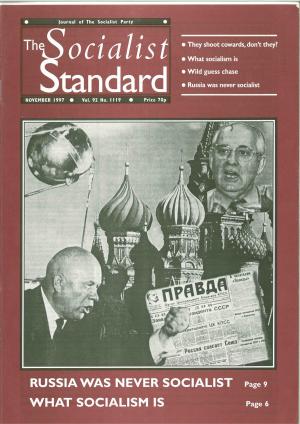
Russia Was Never Socialist – and Why (1997)

From the November 1997 issue of the Socialist Standard

What We Said Over The Years

1920

When we are told that Socialism has been obtained in Russia without the long, hard and tedious work of educating the mass of workers in Socialism we not only deny it but refer our critics to Lenin’s own confessions. His statements prove that even though a vigorous and small minority may be able to seize power for a time, they can only hold it by modifying their plans to suit the ignorant majority. The minority in power in an economically backward country are forced to adapt their programme to the undeveloped conditions and make continual concessions to the capitalist world around them. Offers to pay war debts to the Allies, to establish a Constituent Assembly, to compensate capitalists for losses, to cease propaganda in other countries, and to grant exploitation rights throughout Russia to the Western capitalists all show how far along the capitalist road they have had to travel and how badly they need the economic help of other countries. It shows above all that their loud and defiant challenge to the capitalist world has been silenced by their own internal and external weaknesses as we have so often predicted in these pages.

( . . .)

We have often stated that because of a large anti-Socialist peasantry and vast untrained population, Russia was a long way from Socialism. Lenin has now to admit this by saying: ‘Reality says that State Capitalism would be a step forward for us; if we were able to bring about State Capitalism in a short time it would be a victory for us. How could they be so blind as not to see that our enemy is the small capitalist, the small owner? How could they see the chief enemy in State Capitalism? In the transition from Capitalism to Socialism our chief enemy is the small bourgeoisie, with its economic customs, habits and positions’ (The Chief Tasks of Our Times, p. 11).

(. . .)

Here we have plain admissions of the unripeness of the great mass of Russian people for Socialism and the small scale of Russian production.

If we are to copy Bolshevik policy in other countries we should have to demand State Capitalism, which is not a step to Socialism in advanced capitalist countries. The fact remains, as Lenin is driven to confess, that we do not have to learn from Russia, but Russia has to learn from lands where large scale production is dominant.

(. . .)

That Socialism can only be reached through State Capitalism is untrue. Socialism depends upon large-scale production, whether organised by Trusts or Governments. State Capitalism may be the method used in Russia, but only because the Bolshevik Government find their theories of doing without capitalist development unworkable—hence they are forced to retreat along the capitalist road.

“A Socialist View of Bolshevist Policy”, Socialist Standard, July 1920.

* * * * *

We have always contended that the Bolsheviks could only maintain power by resorting to capitalist devices. History has shown us to be correct. The January 1920 Congress of Executive Communists in Russia abolished the power of workers’ control in factories and installed officials instructed by Moscow and given controlling influence. Their resolutions printed in most of the Labour papers and the Manchester Guardian here show how economic backwardness has produced industrial conscription with heavy penalties for unpunctuality, etc. The abolition of democracy in the army was decreed long ago, but now that the army is being converted by Trotsky into a labour army it means rule from the top with an iron hand.

Russia has agreed to repay foreign property-owners their losses and allied Governments their ‘debts’. This means continued exploitation of Russian workers to pay foreign exploiters. With all the enthusiasm of the Communists they find themselves faced with the actual conditions in Russia and the ignorance of the greater part of its population.

There is no easier road to Socialism than the education of the workers in Socialism and their organisation to establish it by democratic methods. Russia has to learn that.

“The Super-Opportunists. A Criticism of Bolshevist Policy”, Socialist Standard, August 1920.

* * * * *

1924

The Bolsheviks will probably remain in control for the simple reason that there is no one in Russia capable of taking their place. It will be a question largely as to whether they will be able to stand the strain, for the task is a heavy one, and they are by no means overcrowded with capable men. But this control will actually resolve itself into control for, and in the interests of, the Capitalists who are willing to take up the development of raw materials and industry in Russia. The New Economic Policy points the way.

“The Passing of Lenin”, Socialist Standard, March 1924.


* * * * *

1928

Trotsky presents a long list of remedies which serve only to confirm what we have always said as to the necessity for Russia to go through capitalism. Trotsky does not admit this in so many words. In fact, he vigorously denounces Stalin’s ‘capitalist tendencies’. But when we examine his programme we find that it is all based implicitly on the continuance of capitalism in Russia until such time as a developed capitalist industry and a Socialist revolution outside Russia make Socialism possible.

Most of his proposals might have been lifted out of the programme of any trade union in Germany or England: ‘Equal pay for equal work’, less overtime; more unemployment pay; no more Government faking of labour and industrial statistics; retail prices to be brought down to the world price level; no profiteering by capitalist middlemen; no increase in the rents of working class houses; every effort to be made to lower the cost of production in order to promote the growth of industry; more taxes on rich peasants; abolition of the State sale of Vodka, etc. A long programme of reforms, but no mention of the abolition of capitalist farming, capitalist trading and capitalist investment. Both Trotsky and Stalin draw up their programmes within the framework of state and private capitalism which prevails in Russia.

“Trotsky States His Case”, Socialist Standard, December 1928.


* * * * *

1930

The facts given in this Year-Book sufficiently illustrate how illusory the communist dreams have been. Like many pious hopes embodied in the official documents and constitutions of the rest of the capitalist world these phrases have no relation whatever to the actual facts. Russian capitalism, although administered by the Communist Party, reproduces almost down to the last detail the paraphernalia of the capitalist world as we know it here.

The lesson of this is the one we have tried to drive home for so many years, that it is not possible for a minority to impose Socialism upon a majority who are hostile or indifferent; nor is it possible to remedy backward economic development by means of fine-sounding but ineffective decrees, issued by dictators.

“Russia: Land of High Profits (review of Soviet Union Year-Book 1930), Socialist Standard, September 1930.


* * * * *

1934

As Russia has not established Socialism and is not doing so in spite of the repeated statements of Communists, it has to carry on its work and build up its industries on lines similar to normal capitalist countries; it must therefore enter into normal trade relations with the rest of the world, and it does so.

(. . .)

When, in 1924, the Bolsheviks decided to throw overboard the ‘world revolution’ (except as a mere phrase to give lip-service to) and to concentrate on building up the internal resources of the country on the plea that they were building up Socialism in a single country (a complete reversal of their former views), the Communists of the world, who take their policy from Moscow, have simply been used to help on this object.

The foreign policy of Russia is aimed at living more or less amicably with the rest of the capitalist world, and they can only do this because they are building as the capitalists do. Socialism is a system diametrically opposed to capitalism and impossible in a predominantly capitalist world. It is impossible in one country alone, owing to international economic interdependence. It is international not national.

The extravagant claims held out of the success of Socialism in Russia have one by one been proved by time to be groundless and Russia is rapidly approaching the stage of taking its place as a first-class capitalist power.

“Changing Russia”, Socialist Standard, September 1934.


* * * * *

1937

Russia is not a Socialist country—its low industrial productivity and the non-Socialist outlook of the vast majority of its population do not bring such a thing within the realms of present possibility. It is based on various forms of State capitalism. Goods are produced, not for use only, but for sale at a profit. Industry is carried on largely on lines familiar to us in the Post office and other State-capitalist organisations outside Russia. The Russian Government borrows from investors (mostly Russian citizens) hundreds of millions of pounds for investment in industry, and pays them a high rate of interest on their investments; this payment to the investors being the first charge on industry. Inside the industries there are the same kind of gradations of pay as in capitalist industry generally from the mass of workers on or about the bare subsistence level at the bottom up through numerous grades to the very favoured few at the top who can enjoy the most pleasant and interesting work and live on a high standard of comfort and luxury.

“The New Russian Constitution”, Socialist Standard, January 1937.


* * * * *

1943

Certainly Russia has its privileged section of the population and they will buy (because they can afford to do so) the bulk of the luxury articles which the average worker cannot afford. These privileged people are the party officials, technical experts, writers, doctors, lawyers, etc. Some of these people receive incomes a hundred times bigger than that of the average worker. With the legality of inheritance in force, accumulation of wealth is today bound to be taking place in Russia among the wealthy. They are the exploiters, and the Dean is wrong when he says (p. 282) ‘exploitation of man by man is entirely abolished’. They can obtain their big incomes only out of the wealth produced by the workers.

“Is Russia Socialist?” (review of The Socialist Sixth of the World by Hewlett Johnson, Dean of Canterbury), Socialist Standard, July 1943.


* * * * *

1948

The reader of these reprinted articles will have seen that the attitude of the SPGB has been consistent from the start of the Bolshevik regime. We said then as we say now, that it is impossible for Socialism to be imposed from above even if the minority who hold power genuinely have that as their object.

The articles are important also to help to combat the efforts of various political groups which seek to discredit the Socialist movement by holding up Russia as a proof of the impossibility of abolishing capitalism. It is not true that Marxian Socialists at first approved of the Bolshevik dictatorship and Bolshevik policy and only later discovered that Socialism would not be the outcome. As these articles prove, the SPGB foresaw from the first that the attempt must fail.

Nor is it correct that the failure in Russia has been the failure of the men in control—though dictatorship inevitably corrupts those who wield it—it has been the failure of the whole mistaken policy of the Bolsheviks. Had Lenin lived or Stalin died the result would not have been appreciably different.

Postscript to Russia Since 1917 pamphlet, 1948.


* * * * *

1963

The 1917 Revolution overthrew Tsarist Absolutism and allowed nascent capitalist industry to develop more freely and rapidly, but only at the expense of submitting the country to a more barbarous absolutism, the Stalinist regime. Now this absolutism has in its turn become a fetter on capitalist expansion and is being cast aside.

(. . .)

Russia now has the productive forces of a developed capitalist country yet still the political regime of a developing country. This contradiction shows itself in the disagreement between the liberal and conservative elements in Russia, in the campaign against police excesses, in the demand for more freedom of expression in poetry and art, in the Liberman controversy and in anti-Stalinism. Russian industry has developed to such a stage that political and other changes are required before it can develop further. Once liberalisation has triumphed in Russia, as it will, the capitalist character of Russian industry will have become more obvious. Russia will lose its attraction in ‘left-wing’ circles. History, by destroying the illusion that Russia is Socialist, will once again have done our work for us.

“Changing Russia”, Socialist Standard, August 1963.


* * * * *

1967

The social system in Russia can be described as capitalist since the essential features of capitalism predominate: class monopoly of the means of production, commodity production, wage-labour and capital accumulation. (. . .)

A class is made up of people who are in the same position with regard to the ownership and use of the means of wealth-production and distribution. One class has a monopoly over these means of production if the rest of society are allowed access to them only on terms imposed by the group in control. This monopoly does not have to be legally recognised though in fact, as in Britain, this is generally so. Here the privileged minority, the capitalist class, have titles backed by law to the wealth they own. In Russia the ownership of the privileged minority is generally not given formal legal backing, but, as in Britain, they maintain their monopoly through control over the machinery of government. They occupy the top posts in the party, government, industry and the armed forces. Their ownership of the means of production is not individual but collective: they own as a class. Historically this is not a new development as is shown by the position of the Catholic church in feudal times. The privileged class in Russia draw their ‘property income’ in the form of bloated salaries, bonuses, large monetary ‘prizes’ awarded by the government, and other perks attaching to the top posts.

from chapter “Capitalism in Russia” in pamphlet Russia 1917-1967, 1967.


* * * * *

1988

If it is implemented—and it remains to be seen whether or not this reform will suffer the fate of previous ones—perestroika will represent a fundamental change in the form of capitalism that has existed in Russia until now. It will represent a transition from centrally planned commodity-production and exchange to a more competitive system in which the competing units would be, as in the West, legally and economically autonomous enterprises. The economic laws of capitalism will come to operate in Russia through competition rather than through the State which (. . .) has proved to be an inadequate substitute.

“Where Is Russia Going,”, Socialist Standard, September 1988.


* * * * *

1990

It is the longer-term implications of the decision to abandon the Leninist principle of one-party dictatorship that could prove to be the most significant though, as this could herald a change in the way the means of production are monopolised in Russia with the ruling class there changing itself from a class of collective owners into a class of individual owners as in the West.

(. . .)

The transformation of the Russian ruling class from a collectively-owning state bureaucracy into a class of private capitalists with private property rights vested in them as individuals certainly won’t take the form of the present members of the nomenklatura abdicating and handing over their power and privileges to the small group of privately-owning capitalists who have always led a precarious existence on the margins of the Russian state-capitalist economy. Nor would it need to take the crude form of them simply dividing up the presently state-owned industries amongst themselves. It would be more likely to take the form of the Russian government gradually introducing more and more opportunities for private capitalist investment—which only those who have already accumulated wealth would be able to take advantage of. Most of these will inevitably be individual members of the nomenklatura as the group which for years has enjoyed bloated salaries, cash prizes and opportunities to speculate on the black market (. . .).

Gorbachev (. . .) realises that it is now no longer possible for the nomenklatura to rule in the old way and that some sort of flexibility is called for, if only to be able to push through perestroika without provoking a workers’ revolt. He probably isn’t consciously working towards ushering in a Russia where the nomenklatura has disappeared as such and has succeeded in converting itself into a class of Western-type privately-owning capitalists, but it is in this direction that his reforms can now be seen to be leading.

“Russia and Private Property”, Socialist Standard, April 1990.

What Socialism Is (1997)

From the November 1997 issue of the Socialist Standard
  Socialist society will be a classless, wageless, democratically-run society where goods are produced to satisfy human needs instead of being sold for profit. The administration of such a society will be decided by its citizens, basing their decisions on the needs of the community, available resources, and technology.
Capitalism fails to fulfil the already existing potential to satisfy human needs in two ways. First, it only provides goods and services if there is a market for them. Thus, houses stand empty while people are homeless, and food is destroyed and land taken out of food production while people starve. Second, trade and the circulation of money create many jobs which, although vital to the running of capitalism, would be unnecessary in a society where goods are produced solely to satisfy needs.

Banking, retailing, security services, prisons, courts, advertising and police forces are all sectors of employment which only have a role when goods are bought and sold. In addition, the need to secure markets, trade routes, and raw materials fosters industrial secrecy instead of sharing knowledge, hinders research in the scramble to make quick profits, and leads to pollution and dangerous working conditions.

Competition leads to squabbles over artificially created national boundaries. Nation states waste resources on maintaining armed forces and developing weapons of mass destruction which threaten the existence of the world. Competition between workers, especially in a dwindling job market during capitalism’s periodic slumps, leads to poverty, insecurity and xenophobia.

Even scientific advances which make work easier and less labour-intensive threaten workers’ livelihoods under capitalism as manufacturers cut their workforces to increase profits.

Worldwide co-operation
A socialist society will release the potential to satisfy human needs which the machine-age has made possible. And because it will not be limited by market forces or the need for secrecy it will be possible to co-operate on a worldwide scale for the first time. The overproduction which occurs when individual capitalists make as many goods as possible to take advantage of the market during a boom, leading to crises and slumps, will be avoided.

The systematic manufacture of shoddy goods, because that is all the poor can afford, will be a thing of the past. There will no longer be a need to artificially stimulate the market with badly made items that have to be replaced because they wear out quickly.

Housing can be planned to cater for the needs of the community instead of the present sprawl of suburban districts into green belts whilst dwellings remain empty and the rich reside in enormous houses whose main function is the flaunting of wealth and status.

Even a century ago the potential for abundance which machines had made possible enabled Peter Kropotkin to claim that if all the diversion of labour into bureaucratic and military activities were replaced by socially useful tasks then it would only be necessary to work five hours a day from the age of twenty or twenty-two to forty-five or fifty (The Conquest of Bread, 1892). Our lives could be so much more fulfilling if we had more time to enjoy our leisure instead of returning home exhausted after a hard day’s work making money for idle capitalists, only to become unemployed during a slump or expected to survive on a pittance in old age after a lifetime of wage-slavery.

Under capitalism, when new technology makes some types of work redundant, workers lose their livelihoods. But a socialist society will welcome the release of people from drudgery and, because they will no longer be wage-slaves, there will be a chance to retrain for other work which is satisfying and useful to the community. The days of spending forty years in one dreary job will be unnecessary. The citizens of a socialist community will be able to change occupations if they wish to. Of course, some people may not want to change occupations if they find the work interesting.

A society of co-operation will allow a free choice instead of the economically-driven decisions which are made now. Naturally, that doesn’t mean that we will be able to choose to be an airline pilot or a surgeon just because it seems an interesting thing to do. Skilled work will still need proper training. There will still be dirty jobs: emptying bedpans or working in the sewers will still be unpleasant, but it will not be necessary to spend all day let alone a lifetime working in those occupations. And because people will be working for the benefit of themselves and the community instead of merely to enrich a capitalist master there will be a greater willingness to co-operate and share work.

Earthquakes and volcanic eruptions will still occur: socialism will not be able to tame the forces of nature, but many people live in dangerous areas of the world today because they are refugees, either that or boundary disputes between rival nation states prevents people from moving to another area. Socialists do not adhere to the divisive views of nationalists; frontiers will disappear and there will be concern for everyone’s welfare, recognising our common humanity.

When the market is abolished
Poverty, pollution and unsafe working conditions are among the primary causes of ill-health and premature deaths for workers under capitalism. All of these causes can be eliminated when the market is abolished and we will be able to enjoy the life expectancy which is experienced by the wealthy today. But there will, inevitably, still be illness and premature death in a socialist society; there will still be congenital diseases, unrequited love, and misunderstanding between the generations. But the sick will be cared for without the price tag which condemns the old and the mentally ill to have to put up with substandard conditions under capitalism because they are not economically productive. And if there is misunderstanding in families at least it will be free of the corrosive effects of money worries which damage so many relationships today.

Socialism does not offer a panacea; there will still be problems to solve, but a democratically organised society where decisions are made by all the community, instead of being made by bosses and politicians only interested in running capitalism in the interests of the ruling class, can make decisions which benefit everyone.

The failure of capitalism to satisfy human needs is self-evident: poverty, starvation, pollution, wars, homelessness, economic crises and slumps are constant reminders of the disastrous effects of the market. Reforms, “free market” economics, Keynesian economics, and state capitalism have all been tried and have failed to solve the problems which the system creates.

A society of free access to goods and services will prevent the deprivation and social contradictions which prevail at the moment. Insecurity causes people to hoard their wealth and capitalism deliberately fosters a culture of conspicuous consumption—the guru Bhagwen Rajneesh owns 93 Rolls Royces. This obscene display of wealth occurs alongside the most desperate poverty. It is possible to grow enough food to feed the world’s population several times over if food production were organised properly and a worldwide community of socialists would be able to provide food to an area hit by a crop failure caused by adverse weather conditions.

Socialism is not a moral crusade, despite an awareness of the obvious immorality of capitalist economics, but a realisation that things need changing. When workers make the democratic decision to act in their own interests and put an end to exploitation then they can establish socialism and start to lead rewarding, fulfilling lives.
Carl Pinel

These Foolish Things: Capitalism divides (1997)

The Scavenger column from the November 1997 issue of the Socialist Standard

Capitalism divides

Social differences have grown in Israel over the last 20 years, but in few places are they as visible as at Mevasseret Zion. There are in fact two communities living on top of each other. One is the old village with attractive single-storey houses where the original Jewish immigrants live.The other is a new township of luxury red-roofed villas in which live some of the richest members of Israel's political and business elite . . . Israel vies with Ireland as one of the most inegalitarian of developed countries. The boom of the 1990s largely benefited the richest 20 percent. In last year’s general election this badly damaged the Israeli Labour party in the poorer towns and cities and helped Benjamin Netanyahu become Prime Minister. 
(Independent on Sunday, 20 July.)


That’s all right, then

[Gordon] Roddick asked [John Bird] to start the Big Issue, providing the initial funding of half a million, despite a feasibility study predicting that the magazine wouldn’t work. The circulation has grown from 30.000 to more than a million readers. There is now a separate Scottish edition and 10,000 authorised vendors across the country . . . John Bird has been awarded an MBE for his efforts and also been criticised for making a profit out of homelessness. The Big Issue, the argument goes, is a business. If the massive problem of the homeless was ever solved, there would be no need for the magazine. “Of course I make money from homelessness,” he admits. “I believe in enlightened self-interest. I have been good for the Big Issue and homeless people because I'm part of the crisis” 
(The Herald, 26 July.)


Neat!

Priests have no rights under employment law because they serve God and have no employer on earth, three Court of Appeal judges ruled yesterday. They dismissed an appeal by an Anglican curate, the Rev Dr Alex Coker, against an Employment Appeal Tribunal ruling barring him from taking his case of unfair dismissal before an industrial tribunal . . . The Bishop of Southwark, the Right Rev Roy Williamson, said: "I am delighted but not surprised at the judgement, confirming what we had always understood the law to state—that a curate is not an employee." 
(Guardian, 12 July.)


It’s not over

The story of the last 200 years has been one of a struggle between capital and labour. Capital won. It is gradually becoming the most powerful influence on our lives, above that of governments . . .  Mr Blair is jogging steadily, another few miles each morning, towards a new political settlement in Britain.This will entrench capitalism, reduce welfare, balance the budget. 
(Financial Times. 26 July.)


He could be right

“Our survival is only a question of 25, 50 or perhaps 100 years," the oceanographer [Jacques Cousteau] warns in The Man, the Octopus and the Orchid. "It is absurd and dangerous for those who live in prosperity to think that the world economy is a cycle and that its riches will circulate for ever. Unrenewable resources are being squandered. Waste is building up. Valuable goods are vanishing while rubbish thrives." M Cousteau, who won multiple honours for his scientific films and books from governments around the globe, attacks politicians, scientists and world leaders with particular venom. "They pocket the cash without looking ahead, writing cheques our descendants will pay for in the centuries to come. With their pesticides and pollution, their toxic discharges and the certainty of mutual destruction . . . the scientific experts have hidden the harsh reality: The will decide whether we live or die." 
(Times, 21 June.)

The Scavenger

New Branch (1997)

Party News from the November 1997 issue of the Socialist Standard

At its meeting on 13 October the St. Ives Group decided to form itself into the West Cornwall Branch of the Socialist Party. The branch will meet on the first Monday of each month at 8pm in the Western Hotel, Royal Square (next to the Royal Cinema), St Ives. Further details from Robin Cox, 1 The Square, Lanner, Redruth, Cornwall, TR16 6EQ.

Tuesday, September 4, 2018

Green backwoodsman (1997)

Book Review from the November 1997 issue of the Socialist Standard

To End Poverty: The Starvation of the Periphery by the Core by Richard Hunt. Alternative Green, 20 Upper Barr, Cowley Centre 0X4 3UX. 1997. £15.50.

To end poverty we need to know how it began. Because, according to Richard Hunt, poverty is a relatively recent phenomenon unknown to our "primitive" forbears and that by looking at the kind of society in which they lived, we can detect clues that can guide us to that goal.

Early hunter-gatherer groups represented what the anthropologist Marshall Sahlins called the "original affluent society". Their needs were easily met with little effort, permitting a surfeit of leisure. Wealth was more or less evenly shared on a communistic basis. Anti-social behaviour was minimised because in a small group everyone knew everyone else. Social hierarchies, as such, did not exist although a kind of "peck order" operated based on "respect and influence, not authority”.

Several thousand years ago this universal way of life came to an end although its remnants can still be found in remote corners of the world today. What chain of events brought this about? It is commonly thought that agriculture led to population growth, permanent settlements and the production of food surpluses to support an emerging elite. Hunt argues to the contrary that such developments predated—and necessitated—agriculture. Social hierarchy according to him began with hunter-gatherer society itself with an élite extracting plunder and tribute from the population. This in turn undermined traditional birth control mechanisms for limiting the population to what an area could support through hunting and gathering thus prompting the shift to agriculture. For agriculture was not willingly embraced: it involves more work and this, suggest Hunt, conflicts with the Law of Least Effort governing human actions.

Its an intriguing hypothesis but one that begs more questions than it answers—like what caused an élite to emerge within a hunter-gatherer society to begin with. Possibly, it was the increasing scarcity of game and fruit and it is significant, as Hunt points out, that one of the first areas where cultivation began was Mesopotamia which experienced drastic climate change at the end of the Ice Age when the rain belt moved northwards.

With the institutionalisation of social hierarchy, argues Hunt, the process of impoverishment began. This manifested itself spatially in the relationship between an urban core where power resided and the rural periphery from where food surpluses were extracted. Ancient civilisations didn't bother much with trade: "They just took the resources by force. But as the periphery receded it became difficult to muster sufficient physical military strength, so they had to resort to trade or blackmail or corruption." This established a pattern whereby the core rulers "supply arms, via traders, to periphery rulers to suppress their own people and extract crops to sell to the traders for use at the core". The growth of trade led to the introduction of money which enabled the rulers to switch from forcibly expropriating food surpluses to taxing their subjects to achieve the same end. It also led to the growth of industry in places like medieval Florence and Flanders where high labour costs provided a strong incentive for technological innovation.

It was in Britain, however, once itself a peripheral power, that the Industrial Revolution truly began thanks to a propitious combination of circumstances: mercantile capital from the slave trade, a growing landless population due to agricultural "improvements" and land enclosures, cheap food imports from its colonies. The products of British manufacturing were then exported abroad, decimating the less competitive traditional industries in those peripheral countries, all this being justified in terms of the Theory of Comparative Advantage which required them to specialise in providing the food and raw materials that a core country like Britain needed in return for its manufactures.

And that more-or-less set the scene for the kind of world we have today with an expanded core comprising north America, western Europe and Japan confronting a vast impoverished periphery that is the so-called Third World. Every step, argues Hunt, in this convoluted journey from our primitive past to our precarious present was imposed by an élite on its reluctant subjects—agriculture, trade, wage-labour, industrialisation—and, whenever circumstances undermined the power of the élite to impose its will on others, society has tended to regress, economically and technologically, again, in compliance with the Law of Least Effort.

So where do we go from here if we are to "end poverty"? For Hunt, "since government is the cause of poverty, we must end government". To achieve that he advocates three main methods: revolution on the periphery, the break-up of political units and cutting taxation (and hence the power of government). Unfortunately for him, it is a hopelessly foredoomed scenario.

By his own admission it flies in the face of capitalism’s globalising tendencies towards closer integration. This leads him (perversely for a "green anarchist") to support nationalistic movements such as in eastern Europe without appreciating the statist implications this entails. Furthermore, such newly "liberated" countries have not thrown off the yoke of Russian imperialism to escape the clutches of global capitalism: on the contrary they are falling over themselves to invite the multinationals to help "develop" their economies.

The basic flaw in Hunt's analysis is his obsessive preoccupation with scale. His reasoning seems to be thus: Hunter-gatherer societies were small-scale, therefore they lacked a social hierarchy: they were stateless societies. A state emerged because of the increasing scale of social organisation and that in turn created poverty. Therefore any tendency that appears to bring about a reduction in social scale (from international to national to local) ought to be encouraged for its effect will be the progressive alleviation of poverty. Once we have achieved a society of "autonomous, self-sufficient, armed villages", poverty will no longer exist, although Hunt does not tell us why they need to be armed or what is to stop some of them forming alliances to conquer and enslave the rest.

Socialists too want a more decentralised society, although the total autarky at the local level he proposes is neither feasible (given today's level of production and population numbers) nor even desirable. However, while he identifies government as the basic cause of the poverty he documents, we locate it today in an economic system that put the profits of the few before the needs of the many.

And that’s the whole problem with Hunt’s arguments. A society based upon class ownership of the means of production inevitably requires a state to administer it. Without ending the former, you cannot hope to end the latter. Nor, we must add, poverty itself.
Robin Cox

Friday, July 27, 2018

Wild Guess Chase (1997)

From the November 1997 issue of the Socialist Standard

Anyone who spends any time observing the erratic workings of capitalism will realise that it almost never lives up to the claims made for it. It is a social system supported by mythology. One myth—that it provides for everyone—is easy to debunk. You only have to look at the Third World, or even the poor sections of the West. Another—that its competitive motor always produces the best products—is also easy to debunk. Here one may point to the market success of theVHS video system over the superior Betamax. or again that of IBM/Intel computer chips over the vastly superior Apple/Risc chips.

But the biggest myth—that which keeps people voting for political parties to run capitalism—is that it is indeed possible to "run” capitalism. With no steering wheel, no brakes and no happy end in sight, capitalism is nevertheless not short of prospective "drivers" who will do and say anything for a chance to sit up front with the big hat on. Governments of the world govern by the myth of control. They persuade us that they can control market forces, but only until the next crisis, whereupon they blame market forces or foreigners, or both.

Evidence for the chaotic nature of capitalism is not scarce. Since the days of Adam Smith in the 18th century, economists have been trying in vain to find the right combination of knobs, levers, sliders, switches and buttons with which to control the monster reactor of the money and market system. Each would-be government has to claim that it has everything finally figured out. so that you will vote for them. If they admitted that they can’t control capitalism, nobody would bother electing these self-styled "market managers" at all.

Peter Day (In Business, BBC Radio 4, 8 August) presented the curious proposition that the present boom might actually continue forever—that is, without the presumed inevitable slump. The wishful thinking behind this daring notion tells you a lot about how much of economics is real theory, and how much is wild guesswork. Peter Schwartz of the Global Business Network points to the fact that where 50 years ago the ratio of measurable to unmeasurable growth was around 60/40, today it is the other way round. In other words. 60 percent of the modern US economy is “invisible" and cannot be measured.

This gives you some idea of how difficult the "experts” find it to measure growth in capitalism. Naturally, all policies and strategies for the future are based on these vague measurements, which should confirm us entirely in our lack of faith. The problem with new technology, says Schwartz, is that you have to wait for the society to learn to use and apply it. And you may have to wait some considerable time. Electricity was around for 40 years Henry Ford in Chicago realised that you could use it to revolutionise the factory, and as a consequence the growth rate for Chicago between 1900 and 1930 was 68 percent per annum, where previously it had been nil. In today's terms we have the silicon chip, but apart from a few geeks on the Internet, this technology has not yet come into its own. Beyond the telecommunications revolution stretches the even more awesome potential of nanotechnology—the building and application of molecular machinery. What the world will look like in 20 or 30 years from now is anyone’s guess, and what the world's economy will look like is also anyone's guess.

So the "experts" frankly don’t know. They can’t predict what the market will do. And they can't control it anyway. It is on this basis that they are suggesting a slumpless economy. In short, when nothing is predictable then anything is possible.

Makes you wonder why people bother listening to them, doesn’t it? In all the breathless excitement about the hi-tech future, those predicting “No end of a boom” are enthusiastically ignoring the past. They do not have the evidence of history on their side, and so are obliged to claim that today's economy is not like yesterday’s. Because telecommunications are exploding, and productivity relies on telecommunications, they reason that productivity will explode too. But in that case the demand also needs to grow, and although it will do for an unpredictable period, the time will come when demand slackens its pace (for instance because people only have so much to spend). Productive forces are never able to anticipate this, and always overshoot the mark, like a man walking over a cliff. It doesn’t matter what is being produced. If it is a commodity in capitalism, it relies on buyers. If there are no buyers, the ground disappears from under foot and production takes the long drop.

The most enduring if not endearing thing about capitalism and the market is that its supporters, fully recognising what has unfailingly happened in the past, always insist that this time it will be different. Allow us therefore our own little prediction, and you can hold us to it: No, it bloody well won't!
Paddy Shannon

Wednesday, January 18, 2017

50 Years Ago: From Comintern To Cominform (1997)

The 50 Years Ago column from the November 1997 issue of the Socialist Standard

The Communist Parties are merely the propaganda agents for Russian governmental policy. What they preach is not a consistent policy based on principle but a policy based on the day-to-day tactics of that Government in its fight against the other imperialist powers.

In home policy there is the same want of principle. They alternatively oppose the Labour Party, saying it is a capitalist party, and support it, saying it is a socialist party. In 1929 they described nationalisation as “State Capitalism” and the Labour Party as the “third Capitalist Party” (“Class Against Class,” p. 8), yet now pretend that nationalisation is socialism and ask the Labour Government “how is it that only one industry has been nationalised?” (Daily Worker, 13/10/47.) In 1939 they took the initiative in asking Mr. Churchill to form a National Government along with the Labour and the Liberal parties. When this was done they attacked the Labour Party for associating with Churchill! Then in 1941 when Russia was invaded they supported Churchill and now again discover that he has all along been and enemy of the workers.

The future Socialism depends on the growth of democratic, socialist organisations. The new Cominform, as well as the Communist parties that are at present not affiliated to it, are the enemies of both Socialism and Democracy.
(From editorial, Socialist Standard, November 1947)

Friday, September 16, 2016

Letters to the Editors: Money must go (1997)

Letters to the Editors from the November 1997 issue of the Socialist Standard

Money must go

Dear Editors,

I wish to thank you for your review (August) of my book The Universal Impediment, in particular because, despite having sent copies to many persons and organisations likely to be interested, I have received virtually no comment, favourable or otherwise. That perhaps is because it is difficult to imagine how society could function without money. You may have voiced the general reaction therefore when you said that the weakness of the book lies in how it could be achieved. I recognised the problem. Because we cannot visualise how something can be done we tend to assume that it can’t be done and therefore should not be attempted. That is why my suggestions were not intended as a blueprint but to point out that that which we create we can eliminate.

Again, if I do not call myself a socialist it is only because socialism itself has to move on. Just as 18th century capitalism became inappropriate in the nineteenth century, so 19th century socialism is no longer the complete answer to the problems of the twentieth. Social thinking cannot stand still. We progress only by returning to and questioning fundamentals.

But my main concern was that freedom and scarcity, the two essential features of my thesis— and of human satisfaction—were not mentioned.

Government of whatever sort, elected or not. must by definition, be dictatorial. As we have seen in Russia and elsewhere, a socialism that is imposed from above, whatever its merits, always defeats its objectives. Putting the means of production in the hands of the community is a meaningless concept if that community is itself dictatorial. Party politics, the exercise of power for years by one sector over the rest, is no exception.

As I explained, the money system justifies itself by maintaining the concept of scarcity, but today there need be no scarcity. Already, by genetic manipulation, we are able to produce enough food to feed the world. If we cannot yet duplicate all nature’s resources, we have the technology to create substitutes or alternatives to them to meet all our needs and wants, giving us a world of plenty, so that the money system—and its corollaries, power and government—become not just superfluous but a crippling impediment to production and distribution. No longer is it necessary to take from Peter to give to Paul, to fight over that which could freely and plentifully be made available to everyone.

Not only is the money system inefficient, wasteful and socially destructive, but it will corrupt any system in which it operates. This means that there can be no fundamental social advance while we retain a money system. Like all radical concepts, social organisation without money is difficult to envisage and therefore seems impossible, but we ignore the implications of refusing to do so at our peril.
Melvin Chapman,
Bath


And wages too

Dear Editors,

I would like to thank you for having reviewed Bread & Roses in your September issue, though I found myself in disagreement with a few points mentioned in the review concerning both the IWW historically and today.

The Industrial Workers of the World was founded in 1905 and was a very influential union for the first twenty years of its history. In fact, despite the attempts of the American State to crush it both during the First World War and at the time of the Russian Revolution, it continued expanding to reach a peak membership of 100,000 in 1923. The IWW began to decline in 1924 as a result of a split between those who wanted to build links with the Communist Party and those who were opposed to this.

I am not convinced that in 1907 the IWW came to be controlled by doctrinaire Anarcho-Syndicalists (the term was not then in use). The IWW refused to align itself with any political parties or ideologies because its role was to organise the workers of the world into one big union to "end the use of workers against each other anywhere—in the same plant, or in the same industry, or across oceans, in peace or war. either to cut each other’s pay or to kill each other’s kids". (Fred Thompson in the introduction Rebel Voices: An IWW Anthology.)

Experience had taught them that (i) parties and ideological groups were more interested in promoting their own philosophies and taking control of the union than in promoting industrial unionism, and (ii) that, as explained by your reviewer, the membership of the union would then not have had many more members than there were members of the Socialist Party.

It is our aim to unite all workers into an organisation committed to what we believe to be the basic principles which are vital to any successful labour movement, that is, solidarity, internal democracy. a commitment to changing things ourselves rather than relying upon leaders to change things for us, and having an ultimate aim, which for us means Industrial Democracy and the abolition of the wages system.

The IWW has always had a large influence both through it own activity and also in its influence on other unions. It is because of this that the IWW is worth promoting today. Currently the IWW is in the rise and has negotiating rights and a workplace presence in a large number of towns and cities across North America. It is true that the IWW is still essentially a propagandist group, but for a growing proportion of our members it is also a functioning union. To give just one example, there is a rapidly expanding Construction workers section, some of whose members recently brought 300 building workers out on strike in support of the United Parcel Service strikers.

Our union is also spreading again throughout the world, with increasing activity not just in places where the IWW has been active before like Britain and Australia, but also in Japan, Taiwan, Russia, the Ukraine, Germany, Austria, Colombia, Sweden and. most importantly, West Africa, where our office in Sierra Leone was looted by soldiers during the recent coup there.
Bill Runacre,
Reading.

The Green Fascists (1997)

The TV Review from the November 1997 issue of the Socialist Standard

In the wake of BBC 1's recent series on the Provisional IRA, Channel 4's Witness (15 October, 9PM) sent journalist Simon Sebag Montefiore on a mission to the island of Ireland to investigate the long-standing fascistic leanings of IRA/Sinn Fein. Montefiore had good reason to be the man chosen for this task—his family had been among the victims of possibly the last recorded pogrom in the British Isles when, as Jewish settlers, they had been among those hounded out of Limerick by Irish nationalists just after the turn of the century.

Montefiore's argument was that Sinn Fein, the Irish nationalists par excellence, have long exhibited pronounced streaks of both fascism and anti-semitism. His argument has much to support it. Even today former members of the Irish republican movement will testify to the way in which many Irish nationalists equate the northern Irish Protestants with the Jews, firstly because of the status as displaced ‘immigrants’ into a foreign land and secondly due to their supposedly advantageous social and economic position in relation to the indigenous population.

Sinn Fein has often cloaked its anti-semitism and quasi-fascism behind revolutionary sounding phrases about the creation of a harmonious socialist republican state, uncannily enough rather like the Nazis did. But the wider Irish nationalist movement of which it has usually been the most militant part has not always had such qualms. In the 1930s it was the ferociously anti-communist Catholic Mind which informed its readers that "the founders of communism were practically all Jews. This can scarcely be a mere coincidence . .  .” before going on to suggest that Marx. Engels and even Ricardo before them were all part of a Zionist plot. It was the same Irish nationalist movement which gave birth to the Blueshirts, provocatively modelled on the fascist Blackshirts and Nazi Brownshirts and which gave succour to them until it was no longer politically expedient to do so. And it was Fine Gael, long Ireland's second largest political party and the alternate party of government which claimed in its journal United Ireland that “it is a complete mistake to suppose that Italian fascism is merely a crude individual or party dictatorship . . .  it has gradually evolved a scheme of social and political organisation which is quite certain as time goes on to be adapted to the needs of every civilised country".

Poison of nationalism
All this was support for fascism and Nazism in word. IRA/Sinn Fein, as Montefiore demonstrated, went further-they showed their fascist leanings in deed as well. In 1940, when the UK ruling class was at its most vulnerable in its war against Hitler's expansionist state, the leaders of Sinn Fein brokered a deal with Hitler's representative von Ribbentrop. When Sinn Fein met with him in Germany he reportedly told them something they already knew—"Our cause is the same: the downfall of England." Montefiore suggested in this programme that the beginning of the IRA's mainland bombing campaign during the Second World War was inextricably linked with this deal, as was—more obviously still—their assistance of German intelligence and the Luftwaffe over the bombings of Belfast, the home of a key shipyard and of munitions factories employing thousands. Evidently, the precious lives of the hundreds of Catholics murdered in these raids must have meant a lot to them.

In exposing such facts Montefiore's rationale was that of a mainstream bourgeois journalist and historian, and quite possibly of a UK unionist as well. It was therefore unfortunate that he did not extend his analysis to take in some of the wider political implications arising from it. Particularly significant is the popular conception—not altogether unjustified—of the hardline loyalist political community as a bunch of fascists with well-known links to the British National Party, the National Front and Combat 18, as well as fascist groups in other countries. But the question which needs to be asked is: are the IRA/Sinn Fein any better, more politically coherent or more progressive? What Montefiore's programme showed, at least by implication, was that they are certainly not and further served to support the socialist argument that nationalism, in whatever its form and wherever it is found, is now a reactionary political ideology that is poisonous to both the minds and bodies of the working class.

And what was it, at a fundamental level, which finally persuaded an already semi-fascist Sinn Fein to engage in an alliance with Hitler? It was none other than the Leninist dogma used by the SWP, RCP, WRP and most of the other elitist ratbags on the British Left that the enemy of an enemy must be a friend. For Sinn Fein with Hitler in 1939-40 read the SWP with Saddam Hussein in 1989-90, the RCP and the Argentinian Junta in 1982.

Sinn Fein and the British Leninists have long been cosy bedfellows—can anyone be truly surprised when their minds have been infected by the same twisted elitist, nationalist nonsense? Is anyone still under the illusion that the elitist left-wing of capital and the elitist right-wing of capital have little in common? And can anyone mount any serious arguments against the logical, socialist position that the working class have no country, no nation states to die for and no interests at stake when nationalists the world over ally themselves with dictators and bomb and shoot their way to a ‘freedom’ that may give some nationalist leaders state power but which is entirely illusory for the bulk of the population—the working class of wage and salary slaves?
Dave Perrin

Socialist visionary (1997)

Book Review from the November 1997 issue of the Socialist Standard

In The Vision by Ian Tisdale. (Health Books for the Radical Association, 9 Seacliff, Vincent Road, Sheringham, Norfolk NR26 8BS. £1

This short pamphlet comes under the heading of dream-like depictions of alternative social systems the best-known of which is William Morris’s News From Nowhere. It consists of a vision of a socialist society, as seen by a space traveller from the near future, so it combines criticism of capitalism with a discussion of some aspects of socialism and ideas on how the change (The Transformation) came about.

The future society in the vision has no money and is based on common ownership, democratic control and ecological principles. A proper sense of community has been established, and cities have been made much smaller and the countryside revitalised, with people living in self-managing communities. The capture of political power was carried out through the Radical Party, the political outgrowth of informal discussion groups and support networks that disseminated the idea of a long-term solution to humanity's problems. In a nice touch, the members of these groups are known as The Possibilists, as they had devised a possible way of bringing a better society into existence. This is a deliberate play on the label "impossibilists". which has in the past sometimes been applied to Socialists on the grounds that advocating only socialism and not reforms is an impossible aim.

So there is a lot here that is useful and interesting in terms of capitalism, socialism and how to got from here to there. However, for a couple of reasons, the pamphlet is not as vivid or effective as it might have been. Firstly, the future socialist society is simply described to a group of time-travellers (and the reader), rather than being shown in any way to them and us. So the result is a rather abstract picture, with no concrete details. Secondly, the dreamer who has the vision (Dr Earner) is brought back to reality at the end in a flight over the earth, where he sees its degradation and poverty, but this depiction is so compressed as to be virtually unreadable, and is not a satisfactory way of getting ideas across.

Nevertheless, this is an unusual and thought-provoking little pamphlet which may help to spread socialist ideas.
Paul Bennett

Thursday, September 15, 2016

Greasy Pole: In the chair (1997)

The Greasy Pole column from the November 1997 issue of the Socialist Standard

Wonder Boy William Hague is determined to make some changes in the party into whose leadership he was suddenly catapulted after the events of 1 May. "The Conservative party that I lead", he wrote in the Sunday Times on 5 October, “will be broad where it was narrow, young where it was old. caring where it was arrogant". Well he would say that, wouldn’t he? After the drubbing they got at the polls the Tories can hardly pretend that all is well with them, that there is no need to change anything, that they need only wait a while and the voters will obediently go back to supporting the Party of Gentlemen, the Natural Party of Government or however else it is known.

In any case Hague’s zeal to reform the party is a back-handed way of blaming their defeat onto his predecessor who apparently allowed the Tories to get narrow, old and arrogant. There is a snag to those tactics however. Why did Hague keep his enthusiasm for changing the Conservative Party in check for so long? Why didn’t he go for modernising it before the election, when he was busily playing his part along with all the other leaders telling us what a wonderful party they were and how lucky we were to have the chance of returning them to power yet again? It is rather late now. after the votes have been counted, to tell us that "the electorate believed we were arrogant and out of touch . . we were divided among ourselves . . . they questioned motives and sometimes our competence”.

Chairmen
One of Hague’s first acts, in this great age of reform was to appoint a new chairman of the party. Now this is not a job which invariably brings success and widespread esteem in the party. In fact some of the people to have held it in recent times have been, by the cynical standards of politics, disastrous flops. There was Norman Tebbit, whose reputation as chief organiser at Tory Central Office was not exactly glowing and who spent much of his time in the job locked in dispute with his deputy. David Young. There was Selwyn Gummer, whose inadequacies were the subject of widespread complaint, including among the 1922 Committee. The Major era brought in Jeremy Hanley, who quickly became famous for his hilarious gaffes, like describing a huge punch-up among the audience at a boxing match as over-exuberance. Hanley was followed by Brian Mawhinney. who is a doctor although not one you would be comfortable to have operating on you. Mawhinney’s arrogance went with an overbearing, browbeating attitude to his staff and a monumental incompetence in dealing with—by which we mean explaining away—the many crises which afflicted the Major government. Of course when he did try to explain them away he did not help matters by smiling—if that was what it was—like a piranha who has not had a square meal for a while. Inextricably linked as he was to the Tory collapse in May. Mawhinney had to be prised away from the chairmanship. He is now Shadow Home Secretary—which has probably converted thousands of prisoners, prison governors and prison officers to ardent Labour voters. So who should replace him? Well Hague was intending to make his party younger, fresher, looking to a rosy future untainted by a wretched past. So he chose Cecil Parkinson.

Immaculate
"Cecil who?" may have been the reaction of many of the young people Hague is hoping to attract to the Tory party, when the news broke about the new chairman. Well this Cecil once seemed to be surging irresistibly towards the Tory leadership and to being Prime Minister. In his entire life Parkinson made not a single mistake, nor a mis-judgement, nor was he ever responsible for any mean or selfish or underhand behaviour. He was. simply, immaculate—or at least that is the impression he gives in his autobiography.

Even the town he grew up in— Carnforth in Lancashire—was "surrounded by beautiful countryside . . .  almost totally devoid of pretentiousness and jealousy".There is the small problem about the young Parkinson being an active member of the Labour Party League of Youth, an enthusiastic admirer of Stalinist Russia and, when he was doing his National Service, "virtually a pacifist”. But these are glossed over as surprising rather than damaging. In any case it turned out alright in the end because young Parkinson saw the error of his ways in time to shin up the greasy pole of Tory politics, almost to the very top.

His climb was, in fact, almost what is now called seamless. At school he excelled in his studies and as an athlete. He went to Cambridge, did well as an accountant and then in the take-over business. In 1970 he was elected to Parliament, where his rise was again predictably smooth. It became rather faster when Parkinson caught Thatcher’s attention, until in 1981 she appointed him (no nonsense about elections) party chairman with a place in the Cabinet. In the 1983 election, when the so-called Falklands factor was supposed to have won another spell of power for the Tories, Parkinson was at the height of his powers, with even better to come.

Affair 
Except that he had had an affair with his secretary Sara Keays, who was pregnant by him and who was expecting him to do something about his stated intention to divorce his wife and marry her. It all came out, in the most damaging way for Parkinson, when he tried to backpedal on his promise and Keays made it obvious that she would not take this lying down. (The affair gave her an opportunity to see how ruthless the party she supported and wanted to represent in Parliament, operates when it sees its facade of genteel integrity under threat.) Parkinson’s response to this was to pass over some money and turn his back on the matter. Keays is now hedged about by restrictions Parkinson has put in place. For example, it is not possible legally to publish anything about the condition or welfare of her— and Parkinson’s—child. Which may serve Parkinson’s interests and those of his party but does not fit in with his image as the clean, caring and responsible exemplar of Tory morality. Hague’s appointment of a sleazy has-been as his party chairman says a lot about the Tories and about the other parties of capitalism and about the system itself.
Ivan

Monday, May 9, 2016

Obituary: Phil Mellor (1997)

Obituary from the November 1997 issue of the Socialist Standard

Phil Mellor was 31 when he joined the Socialist Party of Great Britain in 1943. He remained an active member for the remaining 54 years of his life. Outgoing, ebullient, energetic, he never tired of questioning and challenging but always with the terrific sense of humour which, whether you agreed with him or not, endeared you to him and, if you were his friend, made him an important part of your life.

It was the SPGB's opposition to war during the second world slaughter which brought the Party to Phil's attention and made him apply for membership. He would tell you, however, how he already had the Socialist idea of a moneyless, wageless, frontierless world before he met the Socialist Party. His own experience of life and work had led him to the "one world” idea and nationalism in particular he saw as an evil monster that set people against one another when what they needed was to be brought together.

When the public meeting was more popular than it is now. he would make a point of attending opponents’ gatherings and putting to their speakers questions which were awkward to answer to say the least. He had specific questions for specific parties and one in particular that sticks in the memory is his asking a Welsh Nationalist candidate whether, in the event of Wales gaining its independence. Wales would have its own army, navy and air force.

But his interests were by no means all political. He had a great love and admiration for animals, which translated itself, especially after the death of his wife, into his keeping (or at least feeding) several cats. He also loved sport of all description, but as for everything else he never accepted the status quo passively and was always advocating thought-provoking ways in which various sports, football for example, could be improved to increase what he call the “skill factor”.

He never wearied of putting the Socialist ease, often with great vehemence, to all those he met. But he used to say that, though he’d like to see Socialism established in his lifetime, even if it wasn’t he’d still have benefited enormously from being a socialist. The understanding of how things worked had taught him, he said, to make sense of what happened in the world and therefore gave him an inner serenity. He knew that life was not just a random set of happenings over which no-one could ever have any control. He firmly believed, in other words, that the understanding socialism gave you enabled you to live a better and more balanced life within the confines of capitalism. Despite his age, his death in early July after a short illness was a shock to all of us. He had always been fit and seemed immortal. And Phil himself always said that he was “completely anti-death”. His passing has left a hole in our lives and in the lives of so many other people, both inside and outside the Socialist Party.
Swansea Branch.

Wednesday, January 13, 2016

Editorial: Do They Take Us For Fools? (1997)

Editorial from the November 1997 issue of the Socialist Standard

Gordon Brown got carried away at this year's Labour Party Conference. The Labour government’s aim, he orated, is a return to full employment. Before the election he had resisted all attempts to have such a commitment put into Labour's election manifesto, preferring some such vague and ultimately meaningless phrase as “the highest possible level of employment”.

In 1944 William Beveridge, the father of the Welfare State, defined full employment as 97 percent employment; the remaining 3 percent “would consist of a shifting body of short-term unemployed who could be maintained without hardship by unemployment insurance. There would be no long-term unemployment and there would always be more vacant jobs than idle men” (Full Employment in a Free Society).

As it happens, such levels were attained in the 1950s and 1960s, though you’ve got to be over 50 now to remember those days. The followers of Keynes believed that this was the result of their policy of state intervention to maintain demand. But this was an illusion: the adoption of Keynesian budgetary techniques just happened to coincide with a world market boom. When that boom came to an end in the early 1970s, and Keynesianism was put to the test, increased state spending was unable to keep the boom going.

Keynesianism died in Britain not at the hands of Thatcher but under Callaghan and his Chancellor Healey. As Callaghan was forced to admit at the 1976 Labour Conference: “We used to think that you could spend your way out of recession and increase employment by cutting taxes and boosting government spending. I tell you in all candour that that option no longer exists, and that insofar as it ever did exist, it only worked on each occasion since the war by injecting a bigger dose of inflation into the economy.’’

This is now the conventional wisdom, accepted just as much by Labour as by the Tories. Only the Lib Dems occasionally advocate increased state spending, only to be slapped down by Labour for being financially irresponsible.

So how does Gordon Brown expect full employment to be achieved? Since he rejects increased state spending, he is left with relying on what Beveridge called “the unplanned market economy” automatically self-adjusting itself to bring this about. Adam Smith called it the “invisible hand" and it is a measure of the extent to which Labour has abandoned all its earlier illusions that it now expects the workings of capitalism in its private enterprise version to deliver full employment, if only sometime before the middle of the next century.

Saturday, September 12, 2015

They Shoot Cowards, Don't They? (1997)

From the November 1997 issue of the Socialist Standard

Eighty years ago, some ten million lives were lost in World War One. Among these countless casualties was a small group of about three hundred and fifty who are not remembered each November when the dignitaries assemble at the Cenotaph and lay their patronising wreaths of poppies.

Recently, this select few have been in the news, and not for the first time; their deaths were, and still are, the subject of controversy. Readers of the Socialist Standard would no doubt consider the death of any human being in the pursuit of property and resources highly controversial. However, the reason the fate of this tiny proportion of those who died so long ago continues to be debated today is because they didn't die a "heroic" death at the hands of the enemy. They were shot by their own comrades.

To the uninitiated, or the naive, or just the logically-minded, this may come as a shock. Surely the job of an army is to slaughter marauding foreigners, not its own troops? Wrong. The job of an army is to do the state's dirty work, that is to plunder land, wealth and raw materials, as well as secure routes for international trade, or to prevent another state from doing same. This definition of any army's role does not preclude murder within the ranks. Granted, killing your own chaps doesn't sound like an efficient way to run an army, but the legally-sanctioned execution of comrades-in-arms during World War One was not only efficient, it was absolutely necessary.

Those who died by the bullets of their fellow troops were not ordinary soldiers, not normal men. They were of that rare perverted persuasion which knew fear and a sense of self-preservation. It may sound obtuse to suggest that a soldier who is afraid of going into battle is some sort of oddity, but that is precisely what the army wanted the average Tommy to think. If you suppose that fear probably comes as naturally to a soldier as brown paper bags to a Tory MP, you'd surely be right. But the army has a special term for people who respond rationally to this entirely natural emotion: they are known as "cowards".

The issue of those who were branded and shamed with this term during the First World War has come to the fore once again presumably because of the election of the new Labour government; there is apparently new hope for campaigners of obtaining pardons for their relatives. They have reiterated that there is evidence and expert opinion which now points to the likelihood that the majority of "cowards" were in fact suffering from some form of mental illness, and not in full command of their senses. It would seem more likely however that anyone who wishes to avoid almost certain death is in an absolutely sound state of mind.

Irrevocable punishment
The fact that advocates for these men are relying on the "shell shock" defence suggests one of two things. Either they genuinely believe that anyone in his or her right mind should willingly and dutifully have gone into battle in a war which took senseless carnage and breathtaking incompetence to new pinnacles; or they simply believe that this is the only chance of restoring the tarnished reputation of the family name. It's interesting that nobody seems to have questioned the morality of executing a man for refusing to endanger his own life; or recognising that he may have been averse to murdering his "enemies", who were terrified soldiers like himself, strangers against whom he had no grudge. That, surely, is justification in itself for laying down arms.

It seems astonishing now, in slightly more lenient times, that the government of the day could have permitted such summary and irrevocable punishment for its own servicemen, especially as the accused had no representation and no right of appeal. However, the practice has to be viewed in the light of the circumstances in which much of World War One was fought, particularly in the trenches. This essentially involved massing thousands of men and then sending them like lemmings towards the enemy lines, resulting in catastrophic casualties, often in order to gain just a few yards of ground, if any. Given that such behaviour, except to the seriously mentally unbalanced or the suicidal, naturally appeared to be utter lunacy, the politicians had to provide some incentive to persuade the potentially sceptical recruits to act like madmen. The principal methods of course were propaganda and flattery. After character defamation of the enemy, using easily understood terms such as "evil Bosch" or "filthy Hun", conscripts were told that it was their duty and privilege to rid the world of such despicable degenerates. Having preserved democracy and fair play, and saved England for all decent, God-fearing citizens, the troops would then be welcomed home as heroes and be forever intoxicated by the eternal gratitude of their countrymen.

Not surprisingly, it occurred to the top brass in the army that such shameless patronising might not wash with a few who cared to examine even cursorily their justification for mass slaughter of innocent human beings. And if only a few sceptics concluded that they were being duped, they might well persuade many others to lay down their arms and take up flower pressing instead. Therefore, an extra "incentive" was required, and this was where the ruthless efficiency of the military came into its own. It would have done no good to tell a dissenter that he was a naughty boy and to sit in the corner for the rest of the day; nor would there have been any point in threatening to send him to prison for life. After all, he would still have his life. No, the only way to ensure that insanity prevailed was to offer a Hobson's Choice: either go over the top and face almost certain death, or refuse and face certain death.

Madness of war
The fact that some three hundred or more soldiers, who were presumably aware of the penalties for cowardice, still refused to fight begs an important question. As the punishment was the ultimate penalty of death, and given that actually going into battle at least provided a chance of survival, doesn't it seem likely that these men were, as the campaigners claim, suffering from severe psychological trauma, be it shell-shock, or just the horror of seeing the gruesome demise of their comrades? In that case there would have been grounds for clemency, because these men were clearly not "cowards", but were deeply disturbed. Alas, such a distinction would have been irrelevant, because these unfortunate few had to be made examples to all the others of what happens to those who refuse to obey suicidal orders. Little surprise then that there was no right of appeal.

To some, war is heroic; to others, it is anathema. There is only one thing that can be said for certain about wars: they are never fought in the interest of those who die in them. Today, Britain has a professional volunteer army, and technical advances mean that modern warfare is a much more scientific affair. The Gulf War was a high profile example of how ever more sophisticated weapons are able to accurately target enemy weaknesses. Now there are no poorly trained conscripts, and no need for battalions of troops to go "over the top", and so there is no need for summary executions to enforce discipline. The naive and innocent victims of the firing squads of eighty years ago had the misfortune to be born into a very different stage of capitalism's destructive development, when daily casualties could wipe out entire regiments.

It's difficult to imagine what must have gone through the minds of those conscripts as they huddled in their cold, damp, dirty trenches, waiting for the order to ascend into no-man's-land with only a tin hat and a rifle for protection against a phalanx of machine guns and mortars. It was a different world then, not only in the way wars were fought, but also in the way minds were moulded. Many men were no doubt torn between the love for "their" country and the love for their families. Perhaps some thought of the men on the other side of the lines whom they would be required to massacre--men with the same fears and hopes, with families waiting anxiously at home; ordinary men, no different except that they just happened to be born under another flag. Perhaps some even entertained the idea that one day the world might be free of artificial economic divisions, when co-operation would replace conflict. Alas, such fanciful ideas were for future generations to enjoy. The soldiers of the Great War were unfortunate to live in an era when courage, however you defined it, equalled death.
Nick Brunskill