Wednesday, April 6, 2022

About ourselves (1989)

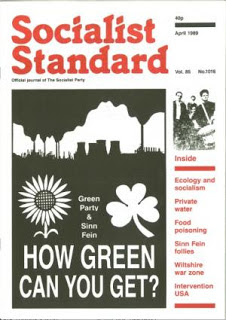
From the April 1989 issue of the Socialist Standard

What is the Socialist Party?

An independent political party which stands opposed to all others in this country, including the Labour and Communist parties. Our only links are with similar socialist parties in some other parts of the world.


What is your aim?

The replacement of the existing capitalist system of society by a new and different system we call socialism.


What is capitalism?

A system based on the ownership of the means of producing and distributing wealth (land, industry, railways, offices and the like) by a section only of society who thus form a privileged class. The others, who in return for a wage or salary produce wealth for sale with a view to profit, make up the producing or working class. In Britain less than five per cent of the population belong to the owning or capitalist class. Most people — those who work in offices as well as those who work in the factories — are in the working class.


What is socialism?

A democratic world community without frontiers based on the ownership of the means of producing and distributing wealth by society as a whole. Socialism will abolish classes and free all humanity from exploitation and oppression. The basis of socialism is this ownership of all the means of production by the whole community; control over their use will rest in the hands of the community through democratic institutions. Wealth will be produced not for sale or profit, but solely to satisfy human needs. This means the end of buying and selling and all the other financial and commercial institutions like money, prices, wages and banks. People will cooperate to produce an abundance of wealth from which they can take freely according to their needs.


Will everything belong to the State?

No. The State does not represent the whole community; it serves the interests only of those who own the means of production. State ownership or nationalisation is one of the ways in which this class controls industry. When the State takes over industries (like the railways and coalmines in Britain) it does so in their interests. State ownership leaves unchanged the class basis of society, the profit motive and the wages system, all of which socialism will abolish. Nationalisation is just State capitalism.


What system exists in Russia?

Russian society is part of world capitalist society. It shows all the essential features of capitalism: a class who control the means of production through their control of political power; another class forced to work for wages; production of goods for sale with a view to profit and the accumulation of capital out of profits. The same goes for countries like China. Cuba and Yugoslavia. They like Russia have State capitalism.


Do you want something like the kibbutzim in Israel?

Socialism can only be a world community without frontiers. It cannot be established in one country let alone on one farm. The kibbutzim do show that human beings can live without money and can work without wages, but their small scale means that what they can offer is very restricted so that young people are tending to leave them. In practice they have paved the way for the development of capitalism in Israel and some have themselves become capitalist institutions employing outside wage labour and producing for the market with a view to profit.


How do you advocate socialism should be established?

By the class of wage and salary earners, once a majority of them want and understand socialism, taking democratic political action to change the basis of society from the class to the common ownership of the means of production and distribution.


Why must there be a majority in favour of the change to socialism before it can be made?

Socialism, by its nature as a system involving voluntary co-operation, could only be kept going by those who really wanted it and knew what it involved. Any attempt to establish socialism without a majority first being in favour is bound to fail.


Do you repudiate undemocratic minority action to achieve socialism?

Most definitely. No leaders, however sincere or able, can lead a non-socialist working class to socialism. Leaders who take power while a majority do not understand socialism have no choice but to develop and administer capitalism, as has been shown in Russia and by the various labour governments in Britain. When a majority do want and understand socialism they have no need of leaders, but only to organise themselves democratically.


Why do you advocate political action to achieve socialism?

It is their control of the machinery of government that now allows the capitalist class to protect their privileged position as the owners of the means of production. In Britain it is parliament that makes the laws granting them property rights and it is the police and the Courts, and if need be the army, that enforce these laws. The socialist majority must win political power in order to remove the protection the government machine now gives to class ownership and to carry through the establishment of the common ownership of the means of production.


How do you advocate the socialist majority should win political power?

By using their votes to elect socialist delegates to Parliament and the local councils. A socialist victory in a democratically-run election would demonstrate to all that a majority were in favour of the change to socialism.


Why are you opposed to all other political parties?

All of them accept the capitalist system and believe that current social problems can be solved within its framework.


Why do you think that reforms of the capitalist system are not the solution? 

These problems are caused by the class ownership of the means of production which all reforms leave unchanged. The policy of trying to deal with social problems one by one by reforms of capitalism is futile, as this is to deal with effects and not the cause. We call this policy “reformism" and are opposed to it.


But surely you are not against all reforms? 

We are not opposed to reforms which may bring temporary relief to some workers, but we do not regard it as the task of a socialist party to propose reforms of capitalism. Were we to do this we could easily soon become just another reformist party. To avoid this danger we advocate socialism only.


Why have all the other parties failed? 

Basically because capitalism cannot be reformed so as to work in the interests of the class of wage and salary earners. It is a class system that can only work for those who own the means of production. Any party, be it Labour or Conservative, which takes power under capitalism is forced to run that system in the only way it can be and so is inevitably brought into conflict with the mass of people who work for a wage or salary. This has been proved time and again.


So it is not because the politicians are not determined enough or are incompetent or dishonest that they fail?

No. No matter how determined or able or sincere the members of a government may be they still could not make capitalism work for the good of all. The politicians fail because they have to accept the class system which causes the problems they are always promising to solve.


If you have read this set of principles and agree with some or all of them, contact the Socialist Party with your questions and ideas about what you can do to help speed the progress towards Socialism.

And not a drop to drink (1989)

From the April 1989 issue of the Socialist Standard

It takes a remarkable degree of disorganisation to create a problem of clean water supply in a country like Britain where it rains at least one day in three. The problem is not entirely new of course. Ever since the Tudors and increasingly since the industrial revolution the rivers and inshore waters have been used as open sewers.

In seventeenth century London the paths of disease could be traced on a map along the rivers of the capital — the Fleet, the Brent, the Lea. The rich were smart enough to live on the high ground — Hampstead, Stamford Hill. Dulwich, so that their sewage flowed down toward the poor at the bottom in Camden. Tottenham, Walworth and the streams that drained the valleys.

The problem had begun with the depopulation of the countryside by Enclosures. The dispossessed peasants flocked to the cities as they are now doing in the Third World, and the Plague of London of 1665-6 was an early consequence. The city's population exploded from the few tens of thousands it had been in the Middle Ages. It was no longer a real city with a corporate existence but just a huge aggregation of people without clean water or sewage. The cry of Gardee Loo! as the chamber pot was emptied out of the bedroom window into the street below was a commentary in sound of the sanitary arrangements. The peasant on the other hand would have had his thunderbox well away from the house, an earth or pit closet, placed downhill and as far away from the well as possible.

London in the eighteenth and early nineteenth centuries resembled Calcutta today (if they could be said to differ, London would come off worse). The situation got so bad that, after continual outbreaks of cholera and typhoid which infected Gladstone and Queen Victoria and killed Prince Albert, the government in 1858 ordered the piping of London for sewage and clean water supply. Waste was simply conveyed downstream and put into the river beyond the sniff of the capital.

Elsewhere in the country, rivers like the Clyde and the Mersey, the Humber and the Taff. which had teemed with fish and water-fowl, otters and crayfish, became stinking black ditches.

Market economy to blame
The reason for all this was identified by the economist A.C. Pigou as "externalities", that is, businesses shrugging off overheads in the form of unwanted waste products onto the rest of the population. It gives you a business edge to throw your rubbish over the fence, to let your filth run into the nearest stream rather than build a treatment plant. The same economic mechanism which rewards the drive for profit also rewards the drive to cut costs — at other people's expense. It is an inescapable consequence of the market economy.

There is no way the problems can be dealt with while goods and services are produced with a view to sale and profit. Tinkering with the problem will only shift the burden somewhere else.

Power stations and car exhausts produce acid rain which leaches out aluminium in the soil and into the streams and rivers from which it is piped into our taps and is strongly suspected as a major factor in Alzheimer's Disease. It is little comfort to discover that much of the power produced goes to provide us with junk mail, computers in banks, tanks and aircraft carriers for the next war.

Trichloroethylene and tetrachloroethylene, which are used for degreasing metal in Vauxhalls at Luton among other places, have got into the water table at levels high enough to disturb the experts because they are regarded by the World Health Organisation as a major cause of cancer. Many of these cars are destined for reps who will be sent out to sell soap powder, Mars bars and life insurance.

In the summer of 1988 a boy canoeing on the Warwickshire Avon found two dead herons on the river bank. He mentioned the fact casually to a young man who was a biologist interested in environmental matters. Examination showed that the birds had died of dieldrin poisoning (remember Seveso?), an insecticide banned everywhere in the developed world. The source was traced to a company in Coventry which cleaned drums for an American multinational in Avonmouth which manufactured the poison for export to the Third World (they are not allowed to produce it in the US). Dieldrin has since been found in Severn eels, up to eight hundred tons of which were annually exported to Holland and Germany. The Ministry of Agriculture found this out in the spring of 1988 but kept the finding secret. The facts were leaked to the Continentals and the imports were cancelled. More recently still the Gloucester Citizen carried the headline “Probe As Fish Quit Severn".

The only exception to the falling quality of water in the rivers was the much publicised cleaning-up of the Thames by improving the sewage works at Thurrock in recent years. Within a very short while some thirty species of fish were reported to have returned to the river and one wealthy optimist seeded the headwaters above Oxford with thousands of salmon fingerlings in the hope that when mature they would return to the river to spawn. There were reports three or four years later that salmon had been taken by anglers but since then trouble with sewage works along the river has brought the quality of the water down again.

The cleaning up of the Thames was little more than a public relations exercise and a bit of charity beginning at home for members of the ruling class obliged to spend time at Westminster. Elsewhere water quality continued to fall with nitrate pollution in East Anglia, cryptosporidium in Oxfordshire, and massive aluminium-sulphate poisoning of people in Cornwall.

Obsession with privatisation
In the middle of all this the Thatcher government is pressing on with privatising the water undertakings. How irrelevant this is can be seen from the fact that 20 per cent of the industry has always been in the hands of private firms. Neither they nor the majority of firms that are government owned have shown the slightest urge or ability to come to grips with pollution, but as we have tried to show above, they can't anyway. Like the rest of the economy, it is really out of control. Polluting the environment is profitable for Conservative investors and Left Wing bureaucrats can do little about it.

The vile water we have to drink will inevitably become even more expensive. At present only half of the fifty odd thousand employed in the industry actually do the productive work. Putting a meter on everybody's house will cost £1.5 billions in the aggregate and will require a new tier of non-productives to read the meters, send out bills, chase non-payers, prosecute those who make imaginative use of a piece of pipe and two hoseclips to bypass the meter . . .

In addition, the £7 billion it will cost to transfer the businesses from local bureaucrats to independent companies will have to be met by the consumers, plus the interest on same, which is set to increase from 5 per cent to 8 per cent annual return on capital on the whole package to make it attractive to owners of capital. Even then, it will only be a percentage point or two above the rate of inflation.

The latest news is that the EEC has turned down a request by Nicholas Ridley. Minister of the Environment (No kidding!) that his government be exempted from having to observe Commission standards for water purity. His argument was that when the new companies are set up, their being responsible for policing themselves will be our guarantee of pure water in the future. After all, if they don't come up with the goods we can all exercise the customer's prerogative and go without, can't we?
Ken Smith

. . . and the food's not too good, either (1989)

From the April 1989 issue of the Socialist Standard

The recent outbreaks of salmonella and listeriosis have focussed attention on the rising incidence of food poisoning in Britain in the last few years. There have also been outbreaks of food poisoning from other organisms; campylobacter has increased threefold and rotavirus has increased fivefold in the last eight years. Both of these organisms cause diarrhoea and vomiting, and the increase is probably due to “changes in agricultural practice or changes in the commercial preparation of food" (The Independent, 23 January 1989). These changes are the result of trying to make maximum profits regardless of the risk to consumers' health.

Salmonella
The Communicable Disease Report compiled by the Public Health Laboratory stated that there were 24,123 cases of salmonella enteriditis poisoning in 1988 and 12,533 cases of salmonella enteriditis phage type 4. Salmonella infections have doubled in the last two years and 80 to 90 per cent are found to be associated with chickens and eggs (Ibid.). It is significant that this dossier is not available to the public because the state in its role as facilitator of capital regards commercial secrecy as more important than providing the public with the knowledge to avoid the risks associated with food poisoning.

It was Edwina Currie's claim that most of the egg industry was infected with salmonella that alerted the public, and led to her losing her Junior Health Minister's post for offending the powerful agricultural lobby. Further evidence of the government’s concern to protect the egg industry's profits rather than public health was demonstrated by the much publicised leaked document received by Robin Cook, Labour Party health spokesman, which showed that representatives from the Department of Health had met with the egg producers and agreed not to issue a notice that “salmonella-poisoning at two hospitals appeared to have been caused by raw eggs. It was generally better if the announcement came from the company or trade body concerned" (Morning Star, 10 February 1989).

The use of antibiotics to help animals gain weight has resulted from the European Economic Community's ban on the use of hormones in meat, since 1 January 1988, because of the risk to human health. Previously, hormones fed to cattle increased profits by putting up to an extra 100 pounds of weight on a carcass. It is thought that antibiotics also help animals to gain weight, possibly by eliminating sub-clinical infections which prevent them from gaining their optimal weight (Self Health, 20 September 1988). But the widespread use of antibiotics has led to the evolution of drug-resistant strains of bacteria, and a study by two doctors at the US Center for Disease Control in Atlanta found that, compared with ordinary strains of salmonella, the death toll was 21 times higher in people infected, with resistant strains of salmonella.

A fund of £19 million was set aside by the British government to compensate the egg industry for loss of sales even though the sharp increase in salmonella poisoning has been caused by a blatant disregard for consumers' health in the way that poultry has been reared.

In fact egg sales fell by 10 to 15 per cent and only £482,000 compensation has been claimed by the egg industry (The Grocer, 21 January 1989). Of course there are no plans to compensate the relatives of those who have died or the thousands of people who have been made ill as a result of eating contaminated eggs.

Ironically, in these days when increasing numbers of people are more health-conscious of what they eat, free range eggs are more likely to cause salmonella infections according to Bill Reilly, chairman of the public health committee of the British Veterinary Association:
The big advantage of the battery system is that the egg is laid on the wire ann rolls away immediately. A free range hen may lay the egg anywhere, and faecal contamination is more likely. (British Medical Journal, 28 January 1989 )
Listeria
Listeriosis, although less common than salmonella, with 683 reported cases since 1986 and 39 deaths in 1986 and 1987 is potentially more dangerous and, because of the continuing increase in “cook-chill” methods of preparing food, likely to be seen more frequently in the future.

Listeriosis takes between five days and five weeks to develop and it is difficult to trace the source of infection. The symptoms of the disease can resemble influenza, and listeriosis may not be suspected. The disease is particularly associated with miscarriages and stillbirths, and may also cause meningitis and septicaemia in the elderly.

A study carried out by Richard Lacey, professor of clinical microbiology at Leeds University found that a quarter of a test sample of cook-chill meals bought from leading supermarkets contained the bacteria (The Grocer, 14 January 1989). But. in addition to the health risk to the public, there has been an increasing use of cook-chill methods in hospitals since its introduction in the National Health Service in 1980 and there are now 157,000 meals a day produced by 40 centres.

Hospital cooking
Birmingham's Dudley Road Hospital has one of the largest cook-chill operations in the NHS with £1.8 million purpose built food production centre (Nursing Times, 18 January 1989). The introduction of this centre led to the workforce being reduced by one-third as it took over the work previously carried out by 14 kitchen: an attractive proposition for a government intent on reducing NHS costs and creating the potential for commercial use in the future.

The centralisation of hospital catering and the construction of large district general hospitals during the last two decades has caused problems in delivering cooked food to hospital patients. The Institution of Environmental Health Officers' (Hospital and Therapeutic Kitchens Inspection Guidelines and Reporting Format, 1988, states:
The movement of prepared food within hospitals, often over considerable distances. can create many problems with temperature control. In order to be safe the internal temperature of any heated trolley or container should be raised to a minimum of 75 degrees Centigrade before any food is loaded. Food must never be allowed to fall below a temperature of 63 degrees Centigrade.
These guidelines, sensible though they may seem, are almost impossible to carry out, especially in the winter months in hospitals on large sites where food trolleys have to be transported outside to be delivered to separate ward blocks. And even when food is successfully kept hot, the prolonged "hot-holding" to which it is subjected impairs its nutritional value.

It is not surprising that some of the worst outbreaks of food poisoning during the last twenty years occurred in hospitals. It is an indictment of the quality of hospital food that some institutions looking after long-stay patients have had to provide vitamin supplements — especially vitamin C — to remedy the sub-clinical deficiencies caused by an institutional diet.

The majority of cases of food poisoning are not reported but non-attendance at work because of “diarrhoea and vomiting" has become more common in recent years. There has also been an unexplained increase in septicaemia in the elderly. The government's response has been to play down the risks and when this strategy failed John MacGregor, Minister of Agriculture, announced that there would be tough measures taken to ensure that food production is strictly monitored. But plans to extend cook-chill regulations, to make food storage safer in shops, have been suspended for 18 months because of differences between the Ministry of Agriculture and the Department of Health.

Profits before food safety
The government has announced cuts of £25 million in research grants which will lead to 2,000 redundancies in scientific posts and severely restrict future research into food poisoning. Although the government expects the food industry to conduct its own research it is unlikely that it would benefit the consumer: experience in the drug industry has shown that research has been solely to make larger profits and is frequently against the consumer's interests.

There is undoubtedly dissatisfaction with the role the Ministry of Agriculture has played in its responsibility for food safety. However, calls to make the Ministry of Health responsible instead will only marginally improve matters because the state's function is to ensure the smooth running of capitalism and not the well-being of workers unless production is threatened.

In theory there are laws to protect the consumer, but when Sunblest bakeries were recently fined £200 plus £50 costs for selling a mouldy cake it was revealed that they'd had 146 previous convictions since 1983 (The Messenger, 20 January 1989). It is also possible to buy reject and out of date food for less than half price at London markets (Today, 20 February 1989).

In recent weeks mercury has been found in Sainsbury's butter; mineral oils, used to glaze children's sweets, have been found to cause liver damage: and tea bags, milk cartons and coffee filters have been contaminated with dioxin which can cause genetic defects and liver damage. Additionally, despite the efforts of pressure groups the number of additives used in food continues to rise. The basic problem is that food, like any other commodity, is produced solely for profit. Only the abolition of capitalism can ensure that it is completely safe for people to eat.
Carl Pinel

War zone Wilts (1989)

From the April 1989 issue of the Socialist Standard

The Guardian of 3 February carried a report on the rejection of a petition presented to the European Parliament by the Wiltshire Villages Environmental Association. The petition had been the latest stage in a campaign lasting several years to prevent a now nearly completed village on Salisbury Plain from being used for its intended purpose. There had been an earlier, vain, attempt to obtain a public enquiry, using posters with unpleasantly nationalistic overtones in an effort to secure public support. The posters referred to the project as the “German Village" because of its intentional resemblance to villages in Germany and carried an emblem incorporating a German Second World War helmet.

The purpose of the site is revealed in the acronym given by the Guardian: FIBUA (Fighting in Built-up Areas). The 90 buildings being erected on a 30 acre site at a currently estimated cost of £15 million are not intended to provide housing for one single person. However, the purpose of the protest campaign, whatever a rational being might believe, is made clear in the same report:
The association does not question the need for the project but says its site, on the edge of Copehill Down, will cause serious disturbance.
Anyone living in the vicinity of Salisbury Plain will be able to sympathise with a complaint on the grounds of disturbance. In what is superficially a peaceful, rural area the noise and nuisance caused by military activity is already considerable without any further additions. The dominant sounds are usually those of gunfire, from automatic small-arms, mortars or a variety of heavy artillery. When major exercises are in operation, intensified gunfire is joined by the grinding of tanks, the whine and congestion of military convoys on the roads and the deafening intrusions of low-flying jet fighters, helicopters and Hercules transport aircraft by night and day. Indeed, there is a long-standing but hollow joke among those who live locally that the outbreak of another war would pass unnoticed here.

However, to protest about disturbance alone while explicitly not questioning its cause, is at best simply to plead for the nuisance to be imposed on others with less influence, or at worst just an exercise in futility. Even to have considered the reason given by the Ministry of Defence for the FIBUA village would have provided the members of the association with a pointer to the likely outcome of their campaign. It was ‘'needed" as a replacement or a supplement to the village of Imber, less than five miles distant as the shell flies (any self-respecting crow would long since have vacated the area).

Imber was a thriving and active farming village with about 150 inhabitants when it was compulsorily evacuated in 1943 to provide training facilities for the armed forces. The evacuees were led to believe, at the time, that they would be permitted to return when the Second World War ended. The formation of a protest group in 1945, when that understanding was proved to be unfounded, has had no effect whatsoever; the survivors are still awaiting their return to this day. It would now be difficult to honour that understanding since the few houses still standing are derelict, most having been demolished and replaced by gaunt barn-like shells. Almost as difficult, it must be said, as building the new FIBUA village.

The weakness of this protest movement lies not simply in its nationalism, nor in its acceptance of the waste involved, nor even in its neglect of the precedent shown by the case of Imber; it lies in its failure to question the need for the project. By adopting that position the members of the association have accepted the myth that the existence of the whole horrific war-machine is in the interests of ordinary working people. Furthermore, in protesting to governments, they have revealed a total misconception about the role of the state and its executive, the government.

In reality, the state and all its agencies, including the armed forces, have arisen in response to the requirements of business enterprises, of all kinds, and their owners. The interests of the overwhelming majority of us who do not come into that category are subordinate to those requirements and are considered or acted on only when the functions of business are threatened. Clearly, a protest over disturbance by the few who live close to practice killing-fields like Salisbury Plain poses no more threat to those functions than complaints by and on behalf of the homeless, the poor and the starving in their millions worldwide.

The only worthwhile movement must be one to end the very system which causes so much human suffering, whether from disturbance or from utter deprivation, and to replace it with a society which has the satisfaction of all human needs as its aim.
GM

Tuesday, April 5, 2022

Sinn Fein follies (1989)

From the April 1989 issue of the Socialist Standard

Although they would furiously deny any affinity with "Godless communism", Sinn Fein local councillors have developed a remarkable fondness for portraying themselves as latter day Peoples' Commissars, well versed in the theory and practice of revolutionary socialism. If, however, we ignore this self-delusion and examine the real views of the organisation (recently set down by its President. Gerry Adams, in Signposts to Independence and Socialism), it becomes clear that the Party is hopelessly and dangerously confused about the subject.

The main entry is the text of a speech delivered by him to an internal conference of Sinn Fein in 1986. This afforded Adams all the time and opportunity he needed to explain fully what his party means when it uses the term socialism, and for him to give us some idea what its implications would be. Instead, he contented himself with making only passing reference to what is supposed to underpin, in economic and social terms, the IRA's superficial "Brits Out" campaign.

This reticence of Adams to "come clean" isn't surprising. He himself admits that his party's "socialism" should be kept firmly under its hat, lest it offend the delicate dispositions of those “genuine republicans" who, while being able to stomach the wholesale slaughter of British and Irish workers in the name of Holy Ireland, are likely to develop political apoplexy should they detect that a victorious Sinn Fein might just interfere with the property rights of Irish capitalists.

Thus Adams warns:
. . . if the Republican Movement as a whole decides to style itself "Socialist Republican" this implies that there is no place in it for non-socialist republicans, or that non-socialist republicans are in some way second-rate, inferior or less genuine republicans.
He continues:
. . . if "socialism" is what is offered as the alternative, it cannot have the same popular appeal.
Elsewhere in the pamphlet Adams says of nationalism and socialism: "One without the other is useless — one without the other is impossible". Which renders all the above merely a euphemistic way of saying that Sinn Fein (being an open, principled and democratic party) should hide part of its views just in case those engaged in what it sees as useless and impossible work within the nationalist and republican movement should take umbrage. In short, Sinn Fein's much lauded "socialist principles" should be concealed and glossed over in favour of nationalist tactics.

In fact, Sinn Fein concealing their “socialism" is all to the good for it doesn't amount to anything and can only serve to confuse workers further on the subject. Behind the welter of nationalist claptrap, it is clear that they have merely fallen for the old sop of welfare state capitalism:
You must have your own government with the power to institute the political and economic policies which constitute socialism. Socialism is a definite system of society in which the main means of production, distribution and exchange are socially owned.
The only evidence Adams presents to support this baseless assertion is that this is the “classical sense of the term". In reply, we need only say there was once a "classical" proposition that the earth was flat.

In common with the rest of capitalism's half-baked Left-wing. Sinn Fein are utterly blind to the real problem. They see all evils only in the shape of private capitalism — the source of working class poverty is not to be found in the fact that we, as wage workers, are exploited by capital, but in the identity of capital's owners. Sinn Fein is concerned with the shadow of exploitation not its substance. Despite the wealth of evidence to the contrary, collected over the past century and more in every country in the world, they maintain that capital in the hands of the state performs the miraculous feat of transforming itself from the exploiter of wage labour into its servant!

At the present time large sections of industry in both the north and south of Ireland are nationalised. The Northern Ireland Electricity Service is in fact an excellent example of how Sinn Fein’s policies would work in their ideal state. Here is an industry that, unlike most state controlled concerns, actually pays its way (at the time of writing it is due to be privatised) and is highly profitable. Do the workers employed by the NIES really own any part of it? When their electric bills arrive in the post, do-they throw them in the bin safe in the knowledge that they don't have to pay for something which already belongs to them? What about those who don't work for the NIES? Is the fact that it is state owned beneficial to them?

Socialism in fact has nothing whatever to do with nationalisation, which is properly called state capitalism. Socialism is the complete negation of all forms of capitalism. It involves taking the means of production and distribution into common ownership and has no need for any means of exchange. As Marx put it as far back as 1875 in his Critique of the Gotha Programme:
Within the co-operative society based on common ownership of the means of production, the producers DO NOT EXCHANGE their products (our emphasis).
In a society based on state property, production can only take place with a view to supplying a market. The dictates of the market are the goods and services must be competitive and profitable. Competitiveness and profitability, however, are the very things which stand in the way of meeting people's needs.

It is not surprising to learn that Sinn Fein knows nothing about capitalism either. According to Adams, the Party is opposed to "big business", “multi-national investment" and "foreign interference". They see an end to these things as a necessary step towards their utopia in which the resources of Ireland
. . . are under Irish control and organised to bring maximum benefit to the people of a 32 county state in which Irish culture and the national identity are strong and confident.
The protestants of Northern Ireland are often derided, an rightly so, for their "wee Ulster" mentality. The ramblings of Gerry Adams in this pamphlet betray Sinn Fein for the "Little Irelan- ders" that they are.

Let's fantasise a moment and envisage Sinn Fein taking power in their united Irish state. What would they do about Ireland's foreign debt? Would they repudiate it on the grounds that Irish workers should not be expected to work in the interests of foreign money-lenders like the workers in "socialist Poland" currently do for western bankers? More to the point, could the self- proclaimed peoples' representatives in a Sinn Fein government repudiate the debt?

The idea is absurd! Ireland is not self-sufficient, nor will it ever be. Only a fool would suggest that a Sinn Fein government could simply repudiate all foreign debts and opt out of the world market. Unless Sinn Fein has an economic genius who has worked out a foolproof method of bartering in the world market, some of the produce of Ireland would have to be sold for capital with which to buy the produce of other countries

But there would be no markets in which to sell their goods. If Sinn Fein really thinks they are going to repudiate Ireland's debts to Germany, America, Japan, Britain, Holland and the rest, that they are going to nationalise foreign property in the shape of multi-national companies and then expect foreign governments to allow Irish goods in their markets, we repeat our assertion — Sinn Fein knows nothing about capitalism!

Sinn Fein's Socialist Republic of Ireland would be ostracised and ignored by international capitalism. So. where would the capital come from to buy the things Ireland couldn't produce itself? "We'll print it ourselves”, think the Little Irelanders, but as any economist knows, this is the sure road to real ruin. If a government resorts to the printing presses in order to buy itself out of trouble, the consequence can only be raging inflation. If a Sinn Fein government, in an effort to bolster its Mickey Mouse economy, were to circulate excess paper currency the effect would be as catastrophic as its ban on foreign investment.

As bad as things are now for workers in both the north and south of Ireland, the reality is that Sinn Fein's cure would be worse than the disease. Capitalism offers us little or nothing in the way of a decent life, but in Gerry Adams' Socialist Republic, we'd be lucky if we got our hands on a pair of matching socks — and only then, in exchange for a wheelbarrow full of Punts!

And to think, the IRA is blowing up children for this!

Britain? (1989)

From the April 1989 issue of the Socialist Standard

Britain?

"Interest rates on both savings deposits and loans will be raised from February 1... According to a spokesman for the central bank, this is the second time in five months that such rates have been increased, and the move is part of the national effort to curb inflation and brake economic growth. The spokesman said the higher interest rates should attract more deposits and reduce the threat of a spending spree "

No, China

(See Beijing Review, 1989. no. 6)

50 Years Ago: About Class (1989)

The 50 Years Ago column from the April 1989 issue of the Socialist Standard

Working Class! Capitalist Class! Middle Class! A plague on all your classes. I do not like to think of men and women in society as belonging to different classes.

I like to think of these people as individuals all doing their best to meet life's joys and anxieties with enthusiasm and determination.

A one-time Prime Minister of Great Britain, whose benevolent face and rotund figure are often the background for a pipe, became a little disturbed at such descriptive class titles and consoled himself and his hearers with sentiments similar to the above. How he abhors such marking off into sections of certain members of the human family! Nevertheless, I am sure that he knows to which class he belongs. Probably some evidence will be found on his railway ticket; on his particular suite in a luxury cruise; on his standing under his own pergola or chandelier; on the power of his effective demand upon the mass of commodities within society.

Now there are many who, like our one-time Prime Minister, give more evidence of sentimentality than sense when discussing society, when faced with the logical terminology which is forced upon them by the economic system which we know as Capitalism.

However, the march of events takes but little notice of a person's particular dislikes, and we are compelled to take notice of facts, not fancies. In society, as at present constituted. there are two distinct classes with interests diametrically opposed — Capitalist Class; Working Class.

(From an article Working Class, Socialist Standard April 1939.)

Letters: Reforms and Reformism (1989)

Letters to the Editors from the April 1989 issue of the Socialist Standard

Reforms and Reformism

Dear Editors,

I am unable to sympathise with your views on “reform" movements. I realise that reforming capitalism cannot alter the world considerably, and that the only way many of the world’s problems can be solved is through socialism. However, could reforms not produce a base from which establishing socialism is easier?

Could reforms not aid the plight of the homeless, the people suffering on NHS waiting lists or countless others? Would not a Labour government improve things in Thatcher's Britain?

I see how energy can be (and has been) wasted in efforts to reform society, when the only answer to many problems is socialism. But. do you oppose the use of the little energy it takes to vote for reformists. even if it means a choice between "the lesser of two evils"?
GS, 
Cumbria


Reply:
We can understand why people might want to use election time to register their rejection of Thatcher and all she stands for, but doing this by voting Labour (or any of the other non-Tory parties) is to assume that the problems people have had to suffer under Thatcher have resulted from the evil intentions of one woman and her ministers rather than being an inevitable consequence of the way the capitalist system works.

If Thatcher has clobbered wage and salary earners this has been because she is the prime minister of a government of capitalism and because any government of capitalism has no alternative but to preside over the operation of a system that can only work as a profit-making one in the interest of profit-makers and to the detriment of satisfying needs.

Those who remember the various Labour governments of the sixties and seventies can testify to the fact that the Labour Party in power behaved in basically the same way — they froze wages, they opposed strikes, they cut social benefits, they imposed health charges, they kept and developed nuclear weapons. The only difference was one of style: the Labour ministers clobbered the workers with reluctance (or so they said) rather than with relish like Mrs Thatcher, but the end result was the same. If in many respects the anti-working-class measures taken by capitalist government since 1979 have been harsher this has been because the economic depression has been deeper in this period.

So, no, a Labour government would not "improve things in Thatcher's Britain". It would merely represent a change of government personnel — a reshuffle of ministers — that would leave unchanged the capitalist system that is the real cause of problems such as housing, health, education, transport, pollution and the threat of war. After all, didn't Kinnock tell last year's Labour Party conference that a future Labour government would retain the market economy (that is, the capitalist economy) and to try to make it work better than the Tories. Making capitalism work, however, inevitably means putting profits before needs (as all previous Labour governments have done) and opposing trade union action — the only effective response workers can make to protect their interests under capitalism.

While some reforms might be able to alleviate, at least temporarily, problems facing some workers, they will never be able to solve any of the multifarious problems from .which workers suffer under capitalism. This is because reforms are aimed only at treating effects while leaving the cause (capitalism) unchanged, and as long as capitalism continues it will create problems for those who depend for a living on working for an employer for a wage or a salary. More accommodation might indeed be provided for some of the homeless but the housing crisis would remain. As our correspondent accepts, the only lasting solution lies in the establishment of socialism, the common ownership and democratic control of the means of production with production for use not profit and free access to consumer goods and services according to self-determined needs.

We cannot agree that reforms could “produce a base from which reforms of capitalism that have been sustained have been those which contributed to the more efficient operation of capitalism as a profitmaking system. Better schools to provide a better trained workforce; a national health service to patch up sick workers and send them back to work quicker; suburban rail or underground services to get workers to work more rapidly, and so on. In fact, capitalism, being a system that constantly changes as new profit opportunities open up (and old ones disappear), needs to be reformed all the time. In this sense bringing in reforms is part of the job of any capitalist government. So, a strong case can be made for saying that reforms are necessary to capitalism and help keep it going. Not that this is a reason for opposing them if they bring some marginal and temporary benefit to some workers, but it is a reason for rejecting the idea that reforms could somehow help towards the establishment of socialism.
Editors.


Interest rates 
and living standards

Dear Comrades,

In the February Socialist Standard it is stated that millions of workers will suffer a fall in their standard of living because of the rise in interest rates, including mortgage interest rates, and that since coming into office Mrs. Thatcher has hoped that home owners would “abandon traditional working-class demands for higher wages and salaries".

Such statements could encourage readers to accept the mistaken belief that working class standards of living are determined by movements of prices and interest rates. What governs working-class living standards is whether capitalism is in a phase of expansion and profitability, or the reverse, and the ability of the unions in a period of expansion and profitability to interrupt the flow of profits by strikes and thus get concessions from the employers.

With regard to the first statement, when interest rates rise lenders are as better off as borrowers are worse off. and among the lenders are those workers who have savings on deposit in building societies and banks.

More importantly, whatever Mrs. Canute Thatcher may have hoped, workers, whether home owners or not, have defied her orders and have gone on pressing large wage claims during the recent years in which production and profits have been rising fast. In such a period, as Marx pointed out, "wages rise generally and the working class actually get a larger share of the annual product intended for consumption”.

In every year since 1981 total wages and salaries have risen by more than the rise of prices on the official index (which includes mortgage interest and other housing costs). When production and profits slacken off and start to fall no doubt the working class will lose part of what they have gained, as happened in 1980 and 1981.
Tony Dobson for Camden Branch

Reply:
We were talking about effects in the very
 short term.

SPGB Meetings and Debates (1989)

Party News from the April 1989 issue of the Socialist Standard


Bird’s Eye View: Neither God nor state (2022)

The Bird’s Eye View Column from the April 2022 issue of the Socialist Standard 

Neither God nor state

The 1st of this month is Iranian Islamic Republic Day. According to Ramin Mazaheri (greanvillepost.com, 6 February), ‘…after 43 years Iran’s revolution has become entrenched in global political history as the most successful political revolution of our contemporary era’ (bit.ly/356Z1Ka). Apparently the vast majority of the 99 percent (98.2 percent) of the electorate) voted for the establishment of an Islamic republic. Those who realise they were taken for April Fools include imprisoned trade unionists. Tragically, over 43 years many thousands of our class have been executed, including minors, under a theocratic dictatorship where those convicted of adultery, alcohol consumption, blasphemy, burglary, homosexuality, pornography and prostitution, along with, of course, political dissidence, as well as many other ‘crimes’, can pay the ultimate price. We must not forget the state-sanctioned use of juveniles as troops during the mass slaughter that was the Iran-Iraq war, or the oppression of women. Add chronic corruption, obvious class division and we can say that only assorted fundamentalists see the revolution as successful. And the suffering grows:
‘Iran has returned 820,000 doses of coronavirus vaccines donated by Poland because they were manufactured in the United States… TV quoted Mohammad Hashemi, an official in the country’s Health Ministry, as saying that Poland donated about a million doses of the British-Swedish AstraZeneca vaccine to Iran. ‘But when the vaccines arrived in Iran, we found out that 820,000 doses of them which were imported from Poland were from the United States,” he said. Hashemi said “after coordination with the Polish ambassador to Iran, it was decided that the vaccines would be returned.” Iran’s Supreme Leader Ayatollah Ali Khamenei, who has final say on all state matters, in 2020 rejected any possibility of American or British vaccines entering the country, calling them “forbidden”‘ (whdh.com, 21 February).
Toll: more than 270,000 coronavirus-related deaths since the pandemic began.


Strange bedfellows

Fundamentalists are not limited to book-burning fakirs issuing fatuous yet often fatal fatwas. ‘…Republicans aren’t going to stop with abortion bans…’ (Cue ‘Handmaid’s Tale’: Michigan Republicans say 1965 Supreme Court decision legalizing birth control was wrong, alternet.org, 21 February). According to Planned Parenthood,
‘In 2006, Nicaragua enacted a complete abortion ban, including in cases of rape, incest, and when the life of the woman is at risk. Access to sexual and reproductive health information and services is seriously lacking, and the country now has the highest rate of teen pregnancy in Latin America.’
Recall, Ortega was returned to power in 2007 as the Catholic president of Nicaragua. He named his wife as Vice President and stated: ’This revolution – in which women have participated shoulder to shoulder – has opened the doors to the full participation of women in all spheres: political, social and economic (theweek.co.uk, 4 August, 2016) – nonsense only matched by that of another President Ronald Reagan, calling Nicaragua a beachhead of communism. Nicaragua is one of 24 countries in the world where abortion is totally illegal under any circumstances, including when the woman’s life or health is at risk. Maternal mortality is 98 per 100,000, 118th in the world. And leftist/nationalist fundamentalists claim that the empowerment of women in Nicaragua has been achieved.


Cannot see the wood for the trees

‘Conflict, climate change, and COVID-19 are having a clear impact on the global poor, in many cases having joint incidence upon those living in poverty, the World Bank’s report concludes’ (‘Inequality Kills One Person Every Four Seconds,’ipsnews.net, 14 February). The article’s conclusion echoes that of Dr. King, who focused famously on the ‘Triple Evils’ of poverty, racism and militarism, ie, symptoms rather than the underlying disease and one reason why Taylor Branch, the Pulitzer winning historian, could say of MLK that ‘all the issues that he raised toward the end of his life are as contemporary now as they were then’ (nytimes.com, 4 April 2018). Fundamentally idealistic, reformists eschew revolution in favour of another spin on the misery-go-round. Consider, capitalism causes the rivalries that lead to war in the modern world. Conflicts between states and within states can result from competition over markets, sources of raw materials, energy supplies, trade routes, exploitable populations and areas of strategic importance. ‘Russia’s president knows exactly what he wants, and it’s not eastern Ukraine. His interests are all about oil and gas and supply routes. The rest is smoke and mirrors’ (thedailybeast.com, 1 March 2015).

With regard to climate change, all enterprises and states seek to minimise costs and releasing greenhouse gases into the environment is a way of reducing monetary costs. Human and environmental needs always come second, if at all, in the profit system. Capitalism’s primary imperative is always to produce more and accumulate capital or otherwise lurch into economic crisis. ‘…companies are continuing to invest vast sums in exploration and new fields, which the IEA said last year could not be brought to fruition if the world was to limit global heating to 1.5C’ (theguardian.com, 11 February). Nearly six million deaths, twelve times that of the 1980-1988 Iran-Iraq war, due to Covid-19 have been confirmed worldwide. Given that the knowledge and resources exist to reduce the number of epidemics and minimise the possibility of them becoming pandemics, the vast majority of these deaths can be considered premature. Capitalism has eradicated rinderpest and smallpox, yet the driving force of capitalism is the pursuit of profit not health. According to March’s Scientific American, ‘Global billionaire wealth grew by $4.4 trillion between 2020 and 2021, and at the same time more than 100 million people fell below the poverty line’ (bit.ly/3BTn7nk). And ‘The poor, no matter where they live, will suffer the greatest lasting toll’ – until, that is, we organise as a class for the conquest of the earth and all its resources.

Workers have no country (2022)

From the April 2022 issue of the Socialist Standard

Out of the discontent of the Industrial Revolution arose the Chartist movement. The need for the whole working class to unite in one movement had come to the fore.

Many are aware of the International Working Men’s Association (the First International), in which Marx was an active participant. Few know of its precursor which most probably served as its prototype.

In the Communist Manifesto Marx and Engels stated that:
‘The working men have no country. We cannot take from them what they have not got.’
Three years before this, the Chartist campaigner George Julian Harney declared:
‘There is no foot of land, either in Britain or in the colonies, that you, the working class, can call your own.
‘All men are brethren’
In September 1845 the society of Fraternal Democrats was formed, adopting the motto, ‘All men are brethren.’ It was founded by some in the British Chartist movement such as Harney along with a variety of political refugees from across Europe.

Part of the Fraternal Democrats’ political platform declared:
‘We denounce all political and hereditary inequalities and distinctions of castes… that the earth with all its natural productions is the common property of all; we therefore denounce all infractions of this evidently just and natural law, as robbery and usurpation. We declare that the present state of society, which permits idlers and schemers to monopolise the fruits of the earth and the productions of industry, and compels the working classes to labour for inadequate rewards, and even condemns them to social slavery, destitution, and degradation, is essentially unjust.’
It also made a commitment to internationalism:
‘Convinced that national prejudices have been, in all ages, taken advantage of by the people’s oppressors to set them tearing the throats of each other, when they should have been working together for their common good, this society repudiates the term ‘Foreigner,’ no matter by, or to whom applied. Our moral creed is to receive our fellow men, without regard to ‘country,’ as members of one family, the human race; and citizens of one commonwealth – the world.’
In one of his addresses to the Fraternal Democrats, Harney explained:
‘Whatever national differences divide Poles, Russians, Prussians, Hungarians, and Italians, these national differences have not prevented the Russian, Austrian, and Prussian despots uniting together to maintain their tyranny; why, then, cannot countries unite for obtainment of their liberty? The cause of the people in all countries is the same – the cause of Labour, enslaved, and plundered… In each country the tyranny of the few and the slavery of the many are variously developed, but the principle in all is the same. In all countries the men who grow the wheat live on potatoes. The men who rear the cattle do not taste flesh-food. The men who cultivate the vine have only the dregs of its noble juice. The men who make clothing are in rags. The men who build the houses live in hovels. The men who create every necessary comfort and luxury are steeped in misery. Working men of all nations, are not your grievances, your wrongs, the same? Is not your good cause, then the same also? We may differ as to the means, or different circumstances may render different means necessary but the great end – the veritable emancipation of the human race – must be the one end and aim of all.’
He elaborated on his internationalist ideas in the journal, The Northern Star (June 19, 1847):
‘The people are beginning to understand that foreign as well as domestic questions do affect them; that a blow struck at Liberty on the Tagus is an injury to the friends of Freedom on the Thames; that the success of Republicanism in France would be the doom of Tyranny in every other land; and the triumph of England’s democratic Charter would be the salvation of the millions throughout Europe.’

‘But let the working men of Europe advance together and strike for their rights at one and the same time, and it will be seen – that every tyrannical government and usurping class will have enough to do at home without attempting to assist other oppressors.’
In 1848 when a British military intervention against France looked possible, the Fraternal Democrats issued a manifesto which said:
‘Working men of Great Britain and Ireland, ask yourselves the question: why should you arm and fight for the preservation of institutions in the privileges of which you have no share… why should you arm and fight for the protection of property which you can only regard as the accumulated plunder of the fruits of your labour? Let the privileged and the property owners fight their own battles.’
Harney also published a newspaper, The Red Republican, to educate his working-class readers about socialism. The journal of July 1850 explained:
’As regards the working men swamping all other classes the answer is simple – other classes have no right to exist. To prepare the way for the absolute supremacy of the working class preparatory to the abolition of the system of classes, is the mission of The Red Republican.’
In 1850 The Red Republican carried the first English translation of The Communist Manifesto, describing it as ‘The most revolutionary document ever given to the world’.

‘The poor have no country’
Another Chartist activist, Ernest Jones, wrote in The People’s Paper of 17 February, 1855:
‘Is there a poor and oppressed man in England? Is there a robbed and ruined artisan in France? Well, then, they appertain to one race, one country, one creed, one past, one present, and one future. The same with every nation, every colour, every section of the toiling world. Let them unite. The oppressors of humanity are united, even when they make war. They are united on one point, that of keeping the peoples in misery and subjection… Each democracy, singly, may not be strong enough to break its own yoke; but together they give a moral weight, an added strength, that nothing can resist. The alliance of peoples is the more vital now, because their disunion, the rekindling of national antipathies, can alone save tottering royalty from its doom. Kings and oligarchs are playing their last card: we can prevent their game. No movement of modern times has therefore been of such importance, as that international alliance about to be proclaimed…’
In yet another article in The People’s Paper (3 March, 1855), Ernest Jones declared:
‘Let none misunderstand the tenor of our meeting: we begin tonight no mere crusade against an aristocracy. We are not here to pull one tyranny down, only that another may live the stronger. We are against the tyranny of capital as well. The human race is divided between slaves and masters… Until labour commands capital, instead of capital commanding labour, I care not what political laws you make, what Republic or Monarchy you own – man is a slave.’
It reflected the view as later expressed by the First International:
‘…The poor have no country, in all lands, they suffer from the same evils, and they, therefore, realise that the barriers put up by the powers that be the more thoroughly to enslave the people must fall. It is the poor, above all the poor, who will realise the dream of the gentle Anacharsis de Cloots, the orator of the human race, who will bring into being the great federation of the peoples. So come, young people, and help us accomplish this lofty task of the nineteenth century…’ (To the Paris Students, To the Students and Young People of All Countries From the Workers of All Countries, 1866.)
The Fraternal Democrats, the Chartists and the International Workingmen’s Association disappeared but not their principles. The idea of working peoples’ international solidarity persisted.

Today, it is put forward by the World Socialist Movement.
ALJO

The Labour Party, the flag and the big stick (2022)

From the April 2022 issue of the Socialist Standard

‘Keir Starmer’s fondness for Union Jacks does not make him a nationalist, Labour frontbencher says’ (Independent, 16 February). So what, then, does it make him? According to the frontbencher concerned, Labour’s Shadow Welsh Secretary, an unknown called Jo Stevens, it made him a ‘patriot’. But what is the difference between a nationalist and a patriot? None, really. They are two different ways of referring to those who identify themselves with one particular state or would-be state.

In 1775, before the word ‘nationalist’ had been coined, Dr Johnson famously referred to patriotism as ‘the last refuge of a scoundrel.’ We don’t suppose Stevens meant that Starmer was a scoundrel. That would mean she was one too, since, as a member of Labour’s leadership team, she will endorse the current Labour Party fondness for draping themselves in the Union Jack to show it is as patriotic as any true-blue Tory.

At one time the Labour Party projected itself as the party of peace, of settling disputes between countries through the UN rather than military action. But that was a long time ago now, except that when he was Leader of the Labour Party Corbyn tried to revive it. Starmer now wants to distance himself as much as possible from this. He has been advised that it is a vote-loser and so contradicts the primary aim of the Labour Party which is to win elections so that the professional politicians who lead it can pursue their careers by becoming ministers of the Crown.

‘The party of NATO’
The lengths to which the Labour Party is prepared to go seem to have no limit. In an interview with the Times (9 February) Starmer declared: ‘we have always been the party of NATO’, a military alliance that has been involved in recent decades in a number of wars (Yugoslavia 1999, Libya 2011, Afghanistan 2001-2014). Actually, what he said is true. Labour can claim to be ‘the party of NATO’. It was the post-war Labour government that took Britain into NATO in 1949 and it was a Labour government that sent armed forces to bomb Yugoslavia – the last time, as the media has forgotten, that hospitals and fleeing refugees were bombed in Europe.

To show that Labour is ‘the party of NATO’ and supports its possible expansion into Ukraine, Starmer visited NATO’s headquarters in Brussels on 9 February. A month later he was in Estonia to visit British troops stationed there on the frontier with Russia. Clearly, he wanted to demonstrate that, as a prospective Prime Minister, he too can be bellicose when required.

Further, when the Labour Party’s youth section tweeted a criticism of his support for NATO expansion into Ukraine he blocked their Twitter account (Independent, 23 February). Similarly, when 11 Labour MPs signed a statement that criticised ‘NATO expansionism’ he threatened to withdraw the whip from them if they didn’t withdraw their signatures (they did) (Guardian, 24 February).

When in government, they were never really the ‘party of peace’. All the Labour governments there have been have supported maintaining and improving the military might of the British capitalist state. The decision to develop the British A-bomb was taken by the post-war Labour government. The Labour Party’s leaders, even when in opposition, opposed giving up the British Bomb as CND wanted.

In any event the United Nations, which the Labour Party once promoted as the way to avoid wars, is a talking shop that’s quite incapable of preventing wars occurring. Its Charter even condones war under certain circumstances. Article 51 stipulates that ‘Nothing in the present Charter shall impair the inherent right of individual or collective self-defence if an armed attack occurs against a Member of the United Nations’. The only effect of this has been that states wanting to go to war need to find a pretext to declare it defensive and therefore not ‘illegal’ under the UN Charter. This may well be why Russia is insisting that its action in Ukraine is not a war but only a ‘military operation’.

Capitalism breeds war
War, the threat of war, and preparations for war are built into the global capitalist system involving as it does economic competition both between capitalist enterprises and between capitalist states. Economic conflicts arise over sources of raw materials, trade routes, markets and investment outlets, and strategic points and areas to protect these.

Capitalist states resort to war only as a last resort when they consider their ‘vital interests’ to be at stake. Waging a war is expensive and interrupts profit-making. Normally states try to solve their differences by negotiations. In such negotiations might is right, so each state seeks to arm itself with the most destructive weapons it can afford. The pre-WW1 US President Theodore Roosevelt described the ideal foreign policy for a state as ‘speak softly and carry a big stick’. Aneurin Bevan, when Labour’s shadow Foreign Secretary, made the same point at the 1957 Labour Party Conference when he opposed Britain unilaterally giving up the Bomb on the grounds that he didn’t want ‘to go naked into the conference chamber’.

If, however, diplomacy fails, and a state considers its vital interest at stake, then only at that point will it go to war. Russia has decided to do so in a bid to expand its borders and also prevent missiles from a hostile military alliance being stationed on its frontier, just as America was prepared to do in 1962 for the same sort of reason. Under capitalism, and as long as it lasts, there will always be the threat of a war and, even in the absence of a war, a colossal waste of resources on maintaining a ‘big stick’ to wave about in negotiations over the inevitable conflicts of economic interest that are built into the global capitalist system.

Capitalism breeds war. The Labour Party supports capitalism, so it is logical that it supports wars and the policy of the big stick. Socialists, on the other hand, have always opposed capitalism and the wars it generates. And, of course, the Labour Party.
Adam Buick

Kharkov under bombardment (2022)

From the April 2022 issue of the Socialist Standard

Kharkov is Ukraine’s second city, with a population of 1.4 million. Being in the country’s northeast, just 25 miles from the Russian border, its northern and eastern districts soon came under heavy shelling. The website of the Kharkov anarchist group ‘Assembly’(assembly.org.ua) describes life in the city at the end of February and beginning of March.

By March 3 the daily output of goods and services in Kharkov had fallen by about half. Many factories had come to a standstill. Many stores had closed their doors. Some firms were still paying wages to their workers, but many were not. Tens of thousands had taken shelter underground in the thirty metro stations, with the ‘Heroes of Labour’ station alone accommodating over 2,000.

How did people behave in these dire circumstances?

There were many who exploited the situation for their own profit. The ‘Assembly’ website provides a blacklist of employers who used the threat of unemployment to cut wages, lengthen hours and impose harsher working conditions. Taxi drivers demanded extra payment over and above the fixed tariffs. Thieves had a field day.

However, there were also many who volunteered to help others. Some voluntary efforts were initiated by the city administration. On February 28, for example, the mayor visited a bakery, where he called for volunteer drivers. But there was also a wide range of grassroots initiatives.

Oleg and Yulia Koval lived in Northern Saltivka, a residential district whose location on the northeastern edge of the city exposed it to especially heavy bombardment. They could have just got out and saved themselves. That would have been the ‘sensible’ thing to do. But instead they stayed on in order to help fellow residents evacuate, ferrying them to the railway station and supplying them with food and medicine. One day Oleg returned from a shopping trip to see that their home was now a pile of rubble. In the rubble he found his wife’s body. He resolved to continue the work in honour of her memory.

The ’Assembly’ website displays several photos of volunteers transporting, preparing or cooking food for free distribution or giving food away on the street or inside metro stations (where volunteers also set up public toilets). A man from the countryside with two boxes full of apples, handing them out to passersby. Packages of chicken, ground meat and liver being distributed from the back of a truck in the vicinity of Kharkov airport. Kitchen workers at the ‘Mafia’ Restaurant cooking meals for children’s hospitals and the military.

And advertising posters that inform the public what goods a firm has to give out, inviting would-be recipients to call so-and-so. Thus, ‘Mr. Bourbon Coffee’ café can provide 100—150 litres of distilled water a day. And there are also volunteers who bring food and medicine to people unable to leave home.

Unfortunately, the website does not explain how all this production and distribution for use – the commentators call it ‘disaster communism’ – came about. Did the owners of the firms involved give their consent? Or had the workers taken control after the owners fled the country?

A few of the photos on the website reveal a less inspiring aspect of life in besieged Kharkov. One shows a man tied to a lamppost and with the word marodyor scrawled across his face. Others show men lying half-naked on the ground, tied up in rather uncomfortable postures and with the same word painted on their backs.

We are not told exactly what these men had done to deserve such humiliation and discomfort or who had imposed their punishment on them. Marodyor can mean looter, marauder or – more colloquially – profiteer. It is unlikely that it means ‘looter’ because public opinion in Kharkov does not condemn theft or looting as such. Indeed, we are told that an elderly woman who shoplifted food right in front of a surveillance camera became ‘heroine of the day’. It was alright to steal food if you were hungry. And it was alright to loot from abandoned stores or street kiosks in order to distribute the stuff freely to others. Otherwise, after all, it would only have gone to waste. Presumably looting became unacceptable when conducted with a view to selling the loot and making a profit out of it.

The experience of Kharkov under bombardment confirms the conclusions drawn by writers who have investigated the social impact of other disasters – for instance, Rebecca Solnit in her book A Paradise Built in Hell: The Extraordinary Communities That Arise in Disaster (Penguin Books, 2010). Disaster sometimes brings out the worst in people, but very often it brings out the best – a greatly enhanced willingness to cooperate and help others. ‘Human nature’ is not an insuperable obstacle to socialism. On the contrary, socialism is the natural way of life of our species.
Stefan

Proper Gander: The Media as Intermediary (2022)

The Proper Gander Column from the April 2022 issue of the Socialist Standard
 

While the current tensions between ‘East’ and ‘West’ are in many ways a return to those of the Cold War years, one difference between then and now is that our awareness of events comes through countless more media outlets than in the last century. Alongside TV news on multiple channels and print journalism we have all the footage, testimony and opinions spread online, especially through social media. In theory, this gives us a wide pool of information in which we can swim around to find the truth as it rises to the surface. In practice, we have to wade through a swamp of biased and incomplete narratives too murky to reveal a clear picture.

The main TV news channels in the UK – BBC News, Sky News and Al Jazeera – have been largely similar to each other in how they have reported on the invasion of Ukraine, each focusing on the effects of the bombing, including the vast numbers of people displaced, alongside the pronouncements of governments and analysts. The BBC has probably devoted more time than the other channels to how the war is affecting people, including those interviewed while struggling to live under attack from Russian forces. Coverage of the relief effort for refugees has been prominent, maybe to try and counterbalance the distressing accounts of the devastation with something more positive about people’s willingness to help those in need. GB News has taken a characteristically conservative perspective, with little emphasis on the refugees’ plight, and pundits such as Dan Wootton applauding Boris Johnson’s handling of the crisis.

Having a near-consensus in the mainstream media doesn’t mean that it is comprehensive. TV news channels have examined economic aspects of the war only to the extent of the impact of sanctions on Russia or whether a side effect will be further increases to energy prices in the UK and Europe. Economic factors behind the situation aren’t generally discussed, such as the dilemma Ukraine was in over whether to develop trade links with the EU or Russia, alongside those with China. In recent years, the UK’s mainstream TV news programmes haven’t reported much on events in Eastern Europe, making the invasion of Ukraine appear more unexpected than it should have been. The Russian state’s annexation of Crimea in 2014 received media attention in the UK at the time, unlike the contemporaneous takeover of the government and police in the Donetsk and Luhansk regions by pro-Russian separatist forces. And neither issue has been covered much in the intervening years, when attention instead went to Brexit and then the pandemic. Nor has NATO’s expansion eastwards been critiqued, and there haven’t been comparisons drawn between the Russian army’s attacks on hospitals and homes and NATO’s bombing of civilians in Yugoslavia during the Kosovo War in 1999. The impression given is that Putin’s decision to invade Ukraine was a sudden event, prompted only by him finally deciding to show his true colours. The lack of recognition of NATO’s actions as contributory factors helps to simplify the mainstream media’s narrative.

UK news channels have been consistent in presenting the war in a conveniently black and white way. It is difficult to imagine them being at all critical of Volodymyr Zelensky’s actions or giving prominence to any allegations of wrongdoing by the Ukrainian army, which includes the far-right Azov regiment. In fact, not much at all has been reported about how they are fighting the war. Russia Today, on the other hand, was keen to depict Ukraine as the sole aggressor, following the narrative of its owner, the Russian state. Before its broadcast in the UK ended, RT’s emphasis was firmly on reports of Ukrainian forces bombing ‘the two Donbass republics’ as it called them, echoing the Russian state’s view that Donetsk and Luhansk have separated from Ukraine, where they are officially defined as ‘temporarily occupied territories’. These reports included allegations that the Ukrainian army has been using phosphorus in weapons, banned by the UN. RT’s policy was to promote the Russian state’s description of a ‘special military operation’ to ‘demilitarise and denazify’ Ukraine, with words such as ‘war’ and ‘invasion’ forbidden. Ironically, one of RT’s slogans has been ‘truth over narrative’. Regulator Ofcom investigated whether the channel was breaching its rules about ‘due impartiality’, according to which some political bias is allowed provided that alternative views are mentioned. Consequently, RT’s licence to broadcast in the UK was revoked on 18 March, although the EU had already pulled the plug on the channel on 2nd March, cutting its stream to the UK. Restricting RT limits access to different opinions (albeit ones heavily biased in favour of Putin’s brutal regime) from which people can make their own judgements. The Kremlin’s crackdown on independent journalism and dissenting voices within Russia is doing the same in a more extreme way.

The mainstream media in capitalism is never going to give us the full story, especially during a war. It doesn’t have the full story to give: any state is bound to curb what information about its strategies the media has access to. Each media outlet selects what to use from the material it obtains and explains events according to its own ethos, creating a narrative which news bulletins disguise under the pretence of objectivity. The language which the media uses also shapes our interpretation. While it is easy to see through the term ‘special military operation’, other expressions are more subtle in how they frame events. For instance, journalists use phrases like ‘Russia invading’ or ‘Ukraine negotiating’, as do many people. It’s recognised that this is just shorthand for the army or government rather than meaning Russia or Ukraine as a whole, but the wording lazily conflates the state with the people under it. This distracts from the reality that the war is between states, not the peoples of Russia and Ukraine who are both pawns and victims. Despite any slant given by the media, footage of families grieving or missiles hitting tower blocks speaks for itself.
Mike Foster