Wednesday, April 22, 2009

It’s election time again (2009)

The Socialist Party's Election Address for the forthcoming European Elections, which was cut and pasted from the SPGB election blog, Vaux Populi

It’s election time again
Every few years groups of professional politicians compete for your vote to win themselves a comfortable position, this time in the European Parliament. All of the other parties and candidates offer only minor changes to the present system. That is why whichever candidate or party wins there is no significant change to the way things are. Promises are made and broken, targets are set and not reached, statistics are selected and spun.

All politicians assume that capitalism is the only game in town, although they may criticise features of its unacceptable face, such as greedy bankers, or the worst of its excesses, such as unwinnable wars. They defend a society in which we, the majority of the population, must sell our capacity to work to the tiny handful who own most of the wealth. They defend a society in which jobs are offered only if there is a profit to be made.

Real socialism
The Socialist Party urges a truly democratic society in which people take all the decisions that affect them. This means a society without rich and poor, without owners and workers, without governments and governed, a society without leaders and led.

In such a society people would cooperate to use all the world’s natural and industrial resources in their own interests. They would free production from the artificial restraint of profit and establish a system of society in which each person has free access to the benefits of civilisation. Socialist society would consequently mean the end of buying, selling and exchange, an end to borders and frontiers, an end to organised violence and coercion, waste, want and war.

What you can do
You can vote for candidates who will work within the capitalist system and help keep it going. Or you can use your vote to show you want to overturn it and end the problems it causes once and for all.

When enough of us join together, determined to end inequality and deprivation, we can transform elections into a means of doing away with a society of minority rule in favour of a society of real democracy and social equality.

If you agree with the idea of a society of common and democratic ownership where no one is left behind and things are produced because they are needed, and not to make a profit for some capitalist corporation, and are prepared to join with us to achieve this then vote for the SOCIALIST PARTY list.

Weekly Bulletin of The Socialist Party of Great Britain (92)

Dear Friends,
Welcome to the 92nd of our weekly bulletins to keep you informed of changes at Socialist Party of Great Britain @ MySpace.

We now have 1480 friends!

Recent blogs:
  • What is to be done?
  • Never say oil
  • Financial wizards or great pretenders?
  • Quote for the week:

    The grabbing hands

    Grab all they can
    All for themselves, after all

    It's a competitive world

    Everything counts in large amounts


    Depeche Mode, Everything Counts (1983)
    Continuing luck with your MySpace adventures!
    Robert and Piers
    Socialist Party of Great Britain

    Capitalism’s reserve army of labour (2009)

    From the April 2009 issue of the Socialist Standard


    When Ramsay MacDonald’s second Labour government came to power in 1929, unemployment had been at a steady 10 percent of the working population for several years, around 1 million. Within a year, the effect of the Great Depression was to send unemployment rocketing to 2.5 million, causing the collapse of that second Labour attempt to reform capitalism.

    MacDonald held steadfastly to classical economic views. He frowned on the dole as a cause of indolence and unemployment, and believed that equilibrium in the jobs market could be found. That is, full employment will come if barriers to wages finding their “natural” level are removed. He was, thus, content to agree to the May Report which included cutting the dole to those two and a half million, in order to balance the government’s budget. That was the move that caused his government to collapse, and for MacDonald to go down in Labour Party history as the great traitor, as he jumped ship to form the National Government.

    Manifestly, this did not work, and unemployment remained steadfastly high. Dole or low dole, workers were simply unable to find jobs because the capitalists of the time held steadfastly to their principle of “no profit, no employment”. Their mistake had been to cling to the myth, exploded by Karl Marx more than 60 years before, that full employment is the normal state of capitalism, and unemployment the exception.

    Entirely to the contrary, Marx demonstrated that not only was a pool of unemployed workers the norm under capitalism, it was in fact intrinsic and essential to the workings of the wages system for there to be such a pool. He referred to it was the “industrial reserve army”. For Marx, the relative size of this reserve had a direct effect on the level of wages – as it increased, wages shrank, and vice versa. The upward limit of wages was the point at which they began to unduly impact on profitability. High wages would lead employers to either discover labour-saving processes, or simply lay off staff and cut back operations.

    This indicates how the industrial reserve army works both ways. Economic historians attribute the rise of the United States as an economic and industrial power house to the relative scarcity of skilled labour in the nineteenth century (exacerbated by the fact that workers could strike out to find frontier land, rather than accept unemployment). This compelled American capitalists to improve the intensive exploitation of their capital in order to be able to effectively use the labour resources to hand. That is, that capital has an incentive in not letting the reserve army get too large.

    Another feature of Marx’ theory was that the unemployment is not a function of population. That is, it is not simply growth in the number of mouths to feed that causes unemployment, but that it is a wholly determined variable based on the state of the investment of capital. As more capital is brought into play, so too is more labour. Unemployment is a relative phenomena based simply on the ratio of employees to those seeking work. This can clearly be seen in UK statistics. In 1900 the population was around 38 million, and unemployment stood at around 5 percent, at the end of the Twentieth Century the population was close to 60 million, and unemployment was still only around 5 percent, its changes do not track population growth..

    People can be taken out of this reserve army. For example, in the 1960’s Harold Wilson’s Labour government had to seriously debate whether the country could afford to raise the school leaving age to 16, drawing all those young workers out of the labour force at a time of nearly full employment. Nowadays, under the current Labour administration, they have a policy of keeping at least half of school leavers in full time education until they are 21. Many commentators have noted that incapacity benefit has become prevalent in areas of large stagnant unemployment over the years. That, and the dole, allow some sections of the workforce to become economically inactive, and thus no longer contributing to the labour pool and the reserve army.

    Interestingly, the latest figures from the Office for National Statistics in the UK suggests that as times become more straightened, these economically inactive people are entering the labour market. At the same time, underemployment has grown. People are working fewer hours (and thus making less money) in order to retain some sort of employment. Although they are not unemployed, they are part of the reserve army, in as much as many of them would, if they could, convert to full time work if it was available.

    The latest figures, for January, show that unemployment in Britain has now passed the 2 million mark. Although in absolute terms those numbers are similar to the level of unemployment that destroyed MacDonald, because the total and working populations have increased it is not yet as drastic. Those figures, though, only represent a return to the levels of the late 1990’s. Indeed, in the Thatcher years, figures of nearly three and a half million were seen (and that resulted in collective bargaining by riot in some particularly hard hit areas). It should also be noted, though, that national figures vary regionally, and poor areas, like inner city London, the North East and Glasgow, say, already had higher than national average unemployment, and are likely to be more swiftly affected by the current rises than elseplace.

    One new aspect of the current round of unemployment is the role of EU migrant labour. As a highly mobile workforce with little by way of invested roots, it may well soak up some of the costs while leaving the resident workforce of the UK less hard hit, although the figures above seem to indicate, so far, otherwise. Indeed, British citizens are emigrating less, and this off-sets any trend. In the days of the Empire, one way of regulating the reserve army of labour was emigration, and it seems the EU fulfils a similar role today. That said, unemployment is unevan across the EU, and is itself growing.
    Pik Smeet

    Wednesday, April 8, 2009

    Weekly Bulletin of The Socialist Party of Great Britain (91)

    Dear Friends,

    Welcome to the 91st of our weekly bulletins to keep you informed of changes at Socialist Party of Great Britain @ MySpace.

    We now have 1480 friends!

    Recent blogs:
  • All You Need is Money?
  • Council tax or free access?
  • The Tolpuddle Martyrs
  • Quote for the week:
    Man is the only animal that deals in that atrocity of atrocities, War. He is the only one that gathers his brethren about him and goes forth in cold blood and calm pulse to exterminate his kind. He is the only animal that for sordid wages will march out ... and help to slaughter strangers of his own species who have done him no harm and with whom he has no quarrel ... and in the intervals between campaigns he washes the blood off his hands and works for "the universal brotherhood of man" - with his mouth. Mark Twain
    Continuing luck with your MySpace adventures!


    Robert and Piers
    Socialist Party of Great Britain

    Tuesday, April 7, 2009

    Socialist Party debate: 'Should capitalism have a future?'

    PUBLIC DEBATE
    Thursday 23 April, 7.30

    SHOULD CAPITALISM HAVE A FUTURE?

    Yes: John Meadowcroft (Author of 'The Ethics of the Market')
    No: Richard Headicar (Socialist Party)

    Brockway Room, Conway Hall,
    Red Lion Square, London WC1

    Thursday, April 2, 2009

    Northern Ireland: a return to violence? (2009)

    From the April 2009 issue of the Socialist Standard


    Two British soldiers shot dead at Masserene Barracks in Northern Ireland, and a policeman shot dead in Craigavon, by dissident Republicans who want to re-draw the present political frontiers. Instead of dividing the six counties from the rest of Ireland, the frontier (they demand) should be moved and instead divide Ireland from the somewhat larger island to the east, containing the capitalist entity known as Great Britain. But socialists do not want to re-draw any frontiers: they want to abolish frontiers. Frontiers are entirely artificial boundaries, whether by land or sea. All a frontier does is to mark out one bit of the Earth’s surface where one ruling class has power from the next bit of the Earth’s surface where another ruling class has power. Since socialism would put an end to the ruling class of every state, frontiers would cease to have any meaning, and would therefore cease to exist.

    No violence, no death or injury, will bring socialism any closer. Socialism will be brought about when the great majority of the world’s people want it to be brought about. We want to change people’s ideas. Violence will not make people into Socialists. Banging a cudgel down on someone’s head is not going to alter the ideas inside that head, at least in any worthwhile way. Rational discussion will finally make Socialists. We believe that by considered argument we can show how co-operation and mutual assistance will achieve what we all want to achieve – a peaceful, harmonious, and contented existence. Violence we leave to others.

    People who support a capitalist state, people who support a capitalist party, are led remorselessly into supporting violence. But it is interesting how often politicians and journalists who steadfastly support violence when it comes from what they think is “their own” side, nevertheless quickly explode with anger when it comes from someone else. One columnist on the Times, David Aaronovitch, champions Israel against the Palestinians; he therefore has had to write torrents of words trying to show that the deaths of well over a thousand men women and children in Gaza, killed by Israeli bullets and bombs, are excusable, because it is only in retaliation for the Israeli civilians killed the rockets fired by Palestinian militias. He also supported the invasion of Iraq by the Americans and the British. So he has had to write more floods of words defending the deaths of some hundreds of thousands of Iraqis, as well as many British and American soldiers, because all that was merely a by-product of getting rid of Saddam Hussein, a brutal dictator who was hostile to the Americans. (Let’s not mention all those brutal dictators friendly to the Americans, who the Americans have propped up.) It’s hard to say how many Iraqis have died, of course. As the American general who led the attack on Iraq said about Iraqi casualties, “We don’t do body counts” (though American casualties were reported with great care). But the lowest figure that the most dedicated warmonger has come up with is 100,000. Other people have said the number of violent deaths since the invasion is 600,000 – some contend that the true figure is a million. And that is not counting all the other hundreds of thousands of Iraqi civilians who have been injured, but have survived, all the maimed and the handicapped, all those who will never walk again, all those who will never see again. The boy whose whole family was killed, and both of whose arms were blown off by a bomb, was still alive, so did not himself add to the total of deaths. Never mind! If you support one capitalist state against the other capitalist states, supporting violence is what you have to do: and that is what this columnist has had to do.

    After writing reams of comment justifying the deaths, the injuries, and the destruction in Gaza and in Iraq, and no doubt having felt very uncomfortable having been forced, by his political beliefs, to do it, he has leapt with avidity on the deaths of the two British soldiers in Northern Ireland. (He wrote his column before the death of the Craigavon policeman.) Now, at last, he obviously feels, he can be on the side of the angels (Times, 10 March). The two deaths are “terrorism”, and a return to “the ‘armed struggle’ ” which is only “a euphemism for strolling up behind someone and blasting their brains out all over their children”. He poured scorn on the idea that any “grievance” that “springs from real social and political conditions” can ever justify such “an act of terror”. The suggestion that the shooting might be revenge for the recent re-introduction into Northern Ireland of “army intelligence” operators, or perhaps “spies” as some might call them, led to an eruption of anger on the columnist’s part. “Rubbish. Really, absolute rubbish.” This action merely shows that “violent republicanism is back in a new, potent, death-dealing guise”, a “return to killing in Ulster”. This is merely “the first atrocity in a desired new cycle of attacks, arrests, martyrdoms . . . and crying children”. Those supporting the killing are merely “unattractive men with bald heads and pallid skin”, who “imagine themselves to be Wolfe Tone or James Connolly reborn”, or else “middle-aged matrons, brought up in the purple of Republicanism, but now with roots showing through the dye”. Any supposed “grievance comes second. The desire to hate and kill comes first, and then grubs around in the shit for its excuse.” Strange to think that in 1798 Wolfe Tone, and in 1916 James Connolly, would have been the target for similar attacks by writers in the respectable newspapers, though perhaps this writer has broken new ground with his scatological language, and his fevered imaginings about the supposed physical unattractiveness of his opponents.

    The shootings at Masserene Barracks and at Craigavon were indefensible, the deaths were indefensible, the motive (the redrawing of capitalism’s frontiers) was indefensible. But how a man can write many pages justifying the deaths of half a million or more, and then work himself up into a rage of furious indignation over the deaths of two, defies any rational explanation. People who oppose all violence, all killing, are at least being consistent: but people who support capitalism, who support this or that capitalist state, will find that they are defending violence, and defending killing, whether they want to or not. So they cannot help sounding hypocritical when they then jump over the fence and try to denounce violence.
    Alwyn Edgar

    Editorial: What is socialism? (2009)

    Editorial from the April 2009 issue of the Socialist Standard


    This may come as a surprise to regular readers of the Socialist Standard, but apparently “we are all socialists now”. A claim made (incorrectly) on various occasions during the last century has resurfaced.

    On both sides of the Atlantic, western-style capitalism has supposedly succumbed to a socialism of sorts. UK Prime Minister Gordon Brown is a socialist again according to some in the media, and not only the new US President Obama, but also some of the final regulatory activities of the Bush administration have been deemed in some quarters as “socialist”.

    The Socialist Standard and the World Socialist Movement have however decided not to shut up shop in triumph at this speedy success. This use of the term socialism to describe a few mild amendments to capitalism is of course just lazy thinking and sloppy journalism. It is also partially the legacy of a century of supposed revolutionaries and radicals – from V I Lenin to K Livingstone – who have viewed state control of productive resources as somehow a part of a genuine revolutionary project, and who have in the process served to confuse the case for socialism as a genuine alternative to capitalism.

    The “socialism” being referred to relates then, to nothing more than the fact that governments in North America and Europe have bailed out the banks and are in the process of doing the same for the car industry and various other struggling sectors of the economy.

    This attempt to position socialism as a mere version of capitalism – rather than a fundamental alternative to it – defuses it. This is why we strongly argue that these terms should be used accurately. World socialists argue – and have done consistently for over 100 years – that nationalisation of sectors of the economy (e.g. manufacturing, mining, oil and gas extraction, power distribution, transport), or “socialisation” as its termed in the US, is a measure used to differing degrees by every capitalist economy in the world.

    Indeed, far from somehow being in some sort of contradiction with capitalism, government ownership is in reality an absolutely essential aspect of capitalism in all regions around the world. Some parts of the economy are simply too central, too important to all the other parts of the economy, for their survival to be left to chance or the vagaries of the market.

    For example, during the First World War, many pubs located close to munitions factories were nationalised. This wasn’t an example of early government concern with the binge-drinking menace that is currently preoccupying politicians, but was undertaken in order to enable the watering-down of the beer and other means of controlling consumption by workers in these factories, thereby minimising the risks of accidents with serious consequences for this critical industry in time of war. Left to its own devices, the market system would bite off its own (invisible) hand and happily unleash drunk workers into explosives factories.

    For world socialists, socialism means a moneyless, wageless, classless and stateless society. Socialism is not just a “nice idea”, nor a change of name. It doesn’t refer to tinkering on the margins of the profit motive, but – in contrast to the phoney ideological debate over “nationalisation” – represents a genuine alternative to capitalism.

    Wednesday, April 1, 2009

    Weekly Bulletin of The Socialist Party of Great Britain (90)

    Dear Friends,

    Welcome to the 90th of our weekly bulletins to keep you informed of changes at Socialist Party of Great Britain @ MySpace.

    We now have 1472 friends!

    Recent blogs:
  • Boom, boom, Brown
  • The death of ideas?
  • Threats and threats
  • Quote for the week:
    "Money is a new form of slavery, and distinguishable from the old simply by the fact that it is impersonal - that there is no human relation between master and slave." Leo Tolstoy, What shall We Do Then? 1886
    Continuing luck with your MySpace adventures!

    Robert and Piers
    Socialist Party of Great Britain

    Monday, March 30, 2009

    Guess who’s not getting that rose garden??? (2009)

    From the World Socialist Party of the United States website

    You would have to search long and hard to find someone who was better at sticking it to the working class than The Economist. It has perfected one of the most truly remarkable posturing acts in the annals of propaganda. When times are good, its contempt for working-class aspirations borders on the domineering, despite the fact that the working class not only runs capitalism from top to bottom but also compliantly does its bit to legitimate the system during elections.

    When times are bad, however, The Economist sings a different tune. It trades its contempt in for what might be called “regrettable realism,” a syrupy pietism that sighs for the misfortunes of the poor working class while giving no quarter in the chronic warfare that goes on between labor and capital:
    [America’s] flexible labour market has shed 4.4m[illion] jobs since the downturn began in December 2007, including more than 600,000 in each of the past three months … An American who loses his job today has less of a chance of finding another one than at any time since records began half a century ago. That is especially worrying when the finances of many households have come to depend on two full incomes … In the emerging world … the World Bank expects some 53m people to fall below the level of extreme poverty this year. (The Economist, “The Jobs Crisis,” March 14-20, 2009)
    Asserting that “unemployment rates in many European countries are below America’s … because their more rigid labour markets adjust more slowly to falling demand,” the writer goes on to concede that capital’s taking such a large share of the profits for so many years has ultimately provoked a swing of the pendulum back in the direction of energetic intervention. Apparently this was not a question of “flexible” capital markets.

    The dismal solution to the “jobs crisis”? Give the capitalist class greater freedom to hire and fire — flexible labor markets. Playing god was never so much fun:
    That will mean abolishing job-subsidy programmes, taking away protected workers’ privileges and making it easier for businesses to restructure by laying people off. Countries such as Japan, with two-tier workforces in which an army of temporary workers with few protections toil alongside mollycoddled folk with many, will need to narrow that disparity by making the latter easier to fire.
    Well, they never promised us a rose garden … or (ahem) did they? No matter. It’s all about destroying jobs, the more easily to create new ones, you see. When you think that anyone from this rat’s nest of élitists might have been in our shoes but for an accident of birth (or fluke of the marketplace), you begin to realize how deeply ingrained is their sense of innate superiority. It just goes with the turf. Anyone who gets up there simply goes mad with power.

    The writer signs off with the robot equivalent of a salt tear:
    However well governments design their policies, unemployment is going to rise sharply, for some time. At best it will blight millions of lives for years.The politicians’ task is to make sure the misery is not measured in decades.
    Not with a bang but a whimper
    What are we to make of this Depression-proof recession, then? After the Century of Liberalism promised us the world in return for our free time, our compliance and our votes (liberté, fraternité, égalité), the Corporate Millennium rises up to remind us that capital is not after all bound by its own promises. It can take away what it gives us, with no questions asked (or, in all too many cases, not even allowed). It will continue to undermine the best intentions of reformers, who, although they can ride the profit-tiger, can never tame it. The Great Captains will deliberate in their Central Committee; perhaps they will, like Leonid Brezhnev, thank us for the Big Harvest. But keep your hands off their stash! For they are no longer in such a generous mood.

    In the context of the century to come, with its threat of unprecedented natural disasters (which capital is by its very nature reluctant to pay for), this is much worse than cold comfort. It is an implied death warrant for the unlucky suckers who just happen to be in the wrong place when a panicky mob of profit-makers goes berserk. For in a global economy under continuous assault from Mother Nature and her gang of elemental forces, those who drop into the shadows will be at high risk of also dropping out of sight.

    Capital has no pity for its human progenitors. It has gotten us to cut ourselves off from our own source of real abundance and creature-feeling, the human community, and when in due course it has had its falling out with us, it will shoot humanity in the back as soon as look at it. The virtues of being down on bended knee no longer seem obvious. Getting back to the Garden never looked so good.

    Let us rise.
    Roel

    Inflation Monster (2009)

    Book Review from the March 2009 issue of the Socialist Standard


    The Origin of Financial Crises. George Cooper. (2008. Harriman House)

    Even though this book isn’t written by a Marxist but by someone taking much of his inspiration from Keynes, it is for the most part well worth reading as an explanation of asset price bubbles. It is also, at root, a good attack on ‘efficient markets hypothesis’ – the view that prices accurately reflect all known information at any one point in time and that markets are efficient allocators of resources.

    Few conventional writers on economics come to the same conclusions as Marx without mentioning him or otherwise being aware of him, though Cooper seemingly manages it on two counts: his analysis of the causes of asset price bubbles, and his analysis of the cause of inflation and the role it plays within capitalism.

    While he uses language more loosely sometimes than he might, talking freely about ‘credit creation’ when it is clear that what he means by this is the constant recycling of deposits into loans by the banking system rather than the creation of credit out of thin air, his explanation of asset price bubbles is sound. Essentially he takes the view that the process of the circulation of capital in the market economy is aided by the extension of credit and that this inherently gives rise to the possibility of financial dislocation and crisis (as did Marx, even if Marx argued that this possibility only became a reality when a crisis of overproduction for particular markets took place in the real economy).

    Though it is something of a generalisation, Cooper contends that the tendency of markets for commodities to respond to rising prices through falling demand is not matched by the behaviour of markets for financial assets, which have a tendency to generate increased demand when prices rise (being typically intended for investment not consumption). This process can act in reverse, because when prices for commodities fall demand then generally increases, but when asset prices fall, demand for them falls too, as in the current financial crisis.

    This is partly because much of the credit extended to purchase the assets has been granted by the banks against underlying collateral that is losing its nominal value. In this sense, there is no supposedly efficient pricing mechanism to reallocate resources – merely self-feeding panic as falling asset prices lead to enforced asset sales, and then further price declines caused by this lead to yet more asset sales as a consequence: ‘the process of collateralised lending generates one of the key destabilising forces in financial markets. Borrowers whose assets have already fallen in value may not have additional collateral to hand, and the bank’s decision to sell their collateral, into what is by definition a falling market, may simply exacerbate the borrowers’ and the bank’s losses.’ (p.100). This is essentially what has been happening during the credit crunch.

    His analysis of what he calls the ‘inflation monster’ also largely hits the mark. While he does not overtly use a labour theory of value, he traces the origins of money through the establishment of gold as a recognised standard and store of value, and then considers the development of gold depository certificates and paper money as a consequence of this. He argues that with the expansion and contraction of money and credit during trade cycles, prices rise in booms and then fall in slumps but there can be no permanent tendency towards inflation while money is convertible into gold.

    When convertibility into gold is suspended then the inflation monster can (and has been) unleashed by governments and central bankers: ‘The new currency regime, without a gold exchange rate, is known as fiat money. The movement from a currency backed by gold to one with no fixed gold price represented a momentous shift in our financial architecture . . . Governments had now awarded themselves the right to create their own money without any corresponding liability; since there was no longer a promise to convert the printed money into gold, there was no longer a liability associated with printing that money’ (p.69). In other words, governments could inject excess purchasing power into the system, in the form of an over-issue of inconvertible paper currency, that would only serve to push up prices.

    Cooper identifies the collapse of the Bretton Woods international trading system in 1971 when the dollar was no longer pegged to gold as the definitive moment here, though in truth full convertibility had been suspended long before this in the US and all other advanced economies (in Britain it was as early as 1931 and by the time of the collapse of Bretton Woods in 1971 only around 1 per cent of the currency issue in the UK had even a nominal gold backing).

    He argues that an excess issue of inconvertible paper currency can be directly used to finance government expenditure, as he thinks is about to happen now. He also makes the point – as have we – that there is a sense that governments prefer rising prices to falling prices partly on the grounds that it can increase their net tax-take, and perhaps because industrial unrest is more likely when workers have to resist falling wages than when they have what are generally rising nominal (if not real) wages under inflationary conditions. This partly presupposes that governments recognise a causal link between an excess note issue and rising prices, which is a moot point – though he also includes an interesting quote from Ben Bernanke, before he became chairman of the US Federal Reserve, which illustrates that there is certainly recognition of a linkage of sorts (even if they might view it as just one cause of inflation alongside others).

    The tentative recommendations that Cooper makes later in the book for dealing with capitalism’s financial crises need not detain us too long, though it is interesting to note that the inability of mainstream economics to adequately account for the current crisis is again leading others towards the type of analysis that has all too rarely been seen, in recent decades, outside the pages of the Socialist Standard.
    DAP

    Wednesday, March 25, 2009

    Weekly Bulletin of The Socialist Party of Great Britain (89)

    Dear Friends,

    Welcome to the 89th of our weekly bulletins to keep you informed of changes at Socialist Party of Great Britain @ MySpace.

    We now have 1466 friends!

    Recent blogs:
  • The trouble with culture
  • Back to no work
  • So that's what's wrong with socialism!
  • Quote for the week:
    War is a quarrel between two thieves too cowardly to fight their own battle; therefore they take boys from one village and another village, stick them into uniforms, equip them with guns, and let them loose like wild beasts against each other. Thomas Carlyle, as quoted by Emma Goldman in her essay Patriotism: A Menace to Liberty, 1911.
    Continuing luck with your MySpace adventures!

    Robert and Piers
    Socialist Party of Great Britain

    Tuesday, March 17, 2009

    Material World: Opium Wars, old and new (2009)

    The Material World column from the March 2009 issue of the Socialist Standard


    The phrase “opium wars” usually refers to the British military assaults of 1839-42 and 1856-60 that forced the Chinese emperor to allow British merchants to sell his subjects opium. The opium was grown in India, where the tax revenue from its sale maintained the colonial administration.

    In 1839, imperial commissioner Lin Zexu wrote to Queen Victoria: “By what right do the barbarians use the poisonous drug to injure the Chinese people? Although they may not intend to do us harm, in coveting profit to an extreme they have no regard for injuring others. Let us ask, where is your conscience?”

    He never received an answer.

    Poisoning “their own people”

    Not only the Chinese suffered at the hands of the profit-coveting barbarians, who derived equal satisfaction from poisoning “their own people.” Britain imported 200,000 pounds of opium from India in 1840. It was consumed, quite legally, mostly mixed with alcohol in a flavoured concoction called laudanum, as an all-purpose painkiller, tranquilliser and sleeping potion. Society ladies used it to acquire the then-fashionable pallid complexion associated with tuberculosis, while the neglected and undernourished babies of the working class were dosed with it to keep them quiet while their mothers toiled long hours in the mills.

    Nowadays trading in opium is illegal. That, of course, does not prevent its large-scale production, sale and consumption, mostly as heroin. It merely raises prices and makes the business even more lucrative, though some “drug lords” perhaps envy the respectability enjoyed by their Victorian predecessors – and by pushers of currently legal poisons.

    Opium and Afghanistan

    At present the global centre of opium production is Afghanistan (accounting for 93 percent of opiates sold worldwide in 2007). To be more precise, production is concentrated in three border zones of Afghanistan: in the northeast, supplying the post-Soviet region through Tajikistan; in the west, for export through Iran; and above all in the south, for export through Pakistan. Sales within the country have also grown rapidly.

    Afghanistan’s annual earnings from opium exports are estimated at $4 billion. This is some 15 times larger than earnings from all legal exports combined (nuts, wool, cotton, carpets, etc.). Thus opium has greater dominance over the Afghan economy than oil, for instance, has over the economies of most oil-exporting states. The farmers who grow the poppies get about a quarter of the money, $1 billion. The rest goes to traffickers and to the politicians, officials and military commanders who control the territory and protect the traffic (where they do not organize it directly).

    As we know, Afghanistan and adjoining areas of northwest Pakistan are at war. This is Obama’s favourite war, so we can expect it to intensify. On one side: the US and NATO, their client regime under President Hamid Karzai in Kabul, their allies in Pakistan’s governing elite. On the other side: the Taliban and their Islamist allies in Pakistan. In between, fluctuating in their allegiance (depending on who pays more): the local bosses or “warlords.”

    What is the relationship between the war and the opium trade?

    First of all, the predominance of opium in the Afghan economy is largely a product of prolonged warfare. The many years of war disrupted long-established patterns of food production and distribution. Unlike food crops, poppies do not require much tending and so are better suited to unpredictable and chaotic conditions.

    A new opium war

    All players, except possibly the US and NATO, are closely involved in the opium trade. This applies equally to the Taliban, the warlords, and the regimes in Kabul and Islamabad. One of the biggest traffickers, for example, is Karzai’s brother. All, to varying degrees, are financially dependent on opium. Pakistan receives US aid and has other sources of revenue, but it too depends on opium money: the trucks that carry supplies over the border for NATO forces in Afghanistan return loaded with opium.

    Thus to a large extent opium funds the war. It pays for weapons and hires fighters. And, in turn, the fighting is not only for control over territory, but also and especially for the control over opium production and exports that goes with territorial control. As in Congo, war is simultaneously a means and an end in the struggle to control a valuable resource – metallic ores in Congo, opium in Afghanistan. If Congo is a “mobile war”, then Afghanistan, to some extent at least, is a new opium war.

    Opium and the US role

    The role of opium in US policy regarding Afghanistan is more difficult to assess. The illegal status of the trade prevents opium interests fromexerting open influence on the US government, although secret influence – through links between politicians, officials and illegal business (“organized crime”) – may be significant. However, the US market in illegal drugs is supplied primarily from other parts of the Americas, not from Afghanistan.

    Officially, the US government conducts a “counternarcotics strategy” in Afghanistan. Farmers have been offered assistance in switching from poppies to wheat. In practice, even if the intentions behind such programs are genuine and even if they were to be adequately financed, the conditions of war and the reliance of US allies on opium money would still militate against their success. It may be worth noting that the CIA, which has traditionally been quite willing to cooperate with foreign drug interests (for so long as they served its purposes) and even sell drugs itself to raise additional funds, plays no part in anti-opium measures.
    Stefan

    Thursday, March 12, 2009

    Food Business (2009)

    Book Review from the March 2009 issue of the Socialist Standard


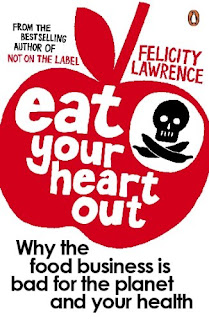
    Eat Your Heart Out. Felicity Lawrence. Penguin. £8.99.

    Following on from Not on the Label, this is another book by Felicity Lawrence that exposes much that’s wrong with the food we eat and the way it’s produced and, therefore, much that’s wrong with capitalism as a way of running the world.

    Lawrence describes conventional farming as ‘a system for turning oil into food’. There is simply more profit in industrial food production than in plain healthy food like fruit and veg. Consequently consumers’ food choices are manipulated, so that we ‘want’ what the food industry sells at the biggest profit and we buy what we have been persuaded to buy. This is mainly achieved by advertising, but also by more insidious means: adding massive amounts of sugar to baby food gets babies, and therefore children and adults, hooked on sweetness.

    Let’s take a couple of case studies. Processed cereals, for instance, represent ‘a triumph of marketing’. And agricultural subsidies from government help to keep companies’ costs down and profits up. The nutritious part of cornflakes is deliberately removed because it gets in the way of a long shelf life. As a result of this and the addition of sugar, breakfast cereals fatten you up but provide little by way of nutrition. Since relatively few countries eat much cereal, there is plenty of scope for global expansion, with Kellogg’s targeting a potential 1.5 billion new customers, and prepared to spend massively to attract them.

    The globalised pork and bacon industry has based its enormous profits on two elements: factory farming with little or no regard to the environmental impact, and low wages mostly paid to migrant workers. The farmers who contract to raise pigs for the processing companies make just enough to get by, and the buildings they invest in are likely to put them in debt to the bank. Meanwhile the big corporations enjoy enormous profits with relatively little capital investment.

    As the cereal example shows, food produced with an eye to profit is not good for you, and may be positively dangerous. Sugar, for instance, has been described as being as harmful and addictive as tobacco. The evidence is not conclusive, but arguably the extent of cardiovascular diseases in developed countries is in part due to an imbalance of fatty acids (too much omega-6, not enough omega-3). Cancers, too, are in part caused by our diet. Soya is seen as a miracle health food, but it is in fact a key ingredient in the fried and oiled junk food market.

    Lawrence has provided a graphic description of profit-driven food production. We can’t agree with her claim that what’s needed is ‘a fairer distribution of the profits’, since that would leave the profit motive intact. But we have more sympathy with her conclusion that it’s necessary to examine ‘the power structures that control food supply’, as long as this goes along with overturning the structure of all production and distribution.
    Paul Bennett

    Wednesday, March 11, 2009

    Helicopter Ben and the money supply (2009)

    From the March 2009 issue of the Socialist Standard
    Governments now call it “quantitative easing”. It used to be simply called inflating the currency. And it’s now official policy.
    In the 1930s Keynes suggested burying banknotes and then paying people to dig them up. Ben Bernanke, current chairman of the US Federal Reserve, is said to have come up with a modern version:
    “The most radical option is to send the newly-minted money directly to the US Government. It could then be handed out to citizens via tax relief. This form of monetary expansion would be equivalent to printing money and dropping it from helicopters for people to pick up – a graphically extreme proposal that earned the Fed chairman, Ben Bernanke, his nickname of Helicopter Ben” (Times, 18 December).
    The present crisis is confirming some of the truths of Marxian economics. First, that banks cannot “create credit” out of nothing. Second, that the rise in the general price level, popularly but inaccurately called “inflation”, is caused by the government’s bank, the central bank, issuing more currency than the economy requires for its various transactions such as buying things, settling debts and paying taxes.

    Inflation, which up to now politicians have been telling us is the main economic problem to avoid, is now being seen as one supposed way out of the deepening depression. After years of propaganda blaming inflation on wage increases, they now want the general price level to rise, and know how to bring this about – not by raising wages of course but by the government over-issuing the currency by printing more and more of it.

    Seven years ago, when he was still only a governor of the New York Federal Reserve Bank, Bernanke explained how, by overissuing a paper currency that was not convertible on demand into a pre-fixed amount of gold, governments could create “positive inflation”:
    “[U]nder a fiat (that is, paper) money system, a government (in practice, the central bank in cooperation with other agencies) should always be able to generate increased nominal spending and inflation, even when the short-term nominal interest rate is at zero. ( . . .) US dollars have value only to the extent that they are strictly limited in supply. But the US government has a technology, called a printing press (or, today, its electronic equivalent), that allows it to produce as many U.S. dollars as it wishes at essentially no cost. By increasing the number of US dollars in circulation, or even by credibly threatening to do so, the US government can also reduce the value of a dollar in terms of goods and services, which is equivalent to raising the prices in dollars of those goods and services. We conclude that, under a paper-money system, a determined government can always generate higher spending and hence positive inflation." (Talk “Deflation : Making Sure It Doesn’t Happen Here”, 21 November 2002 at (http://www.federalreserve.gov/boarddocs/speeches/)
    What Bernanke describes here is simply inflating the currency, even though it’s now being called “quantitative easing”. Marx had already explained this 150 years ago in his A Critique of Political Economy, where he discussed what would happen if a government overissued what Bernanke calls “fiat money”:
    “Let us assume that £14 million is the amount of gold required for the circulation of commodities and that the State throws 210 million notes each called £1 into circulation: these 210 million would then stand for total of gold worth £14 million. The effect would be the same as if the notes issued by the State were to represent a metal whose value was one-fifteenth that of gold or that each note was intended to represent one-fifteenth of the previous weight of gold. This would have changed nothing but the nomenclature of the standard of prices, which is of course purely conventional, quite irrespective of whether it is brought about directly by a change in the monetary standard or indirectly by an increase in the number of paper notes issued in accordance with a new lower standard. As the name pound-sterling would now indicate one-fifteenth of the previous quantity of gold, all commodity-prices would be fifteen times higher and 210 million pound notes would now be indeed just as necessary as 14 million had previously been. The decrease in the quantity of gold which each individual token of value represented would be proportional to the increased aggregate value of these tokens. The rise in prices would be merely a reaction of the process of circulation, which forcibly placed the token of value on a par with the quantity of gold which they are supposed to replace in the sphere of circulation.”
    This artificial bloating of monetary demand is what inflation, strictly speaking, means. Governments now want to consciously use this process to exert an upward pressure on the general price level to try to stop it falling as it would otherwise tend to in a deep recession. It might be thought, in view of all the publicity put out by supermarkets and chain stores about how they have all slashed prices more than their rivals, that falling prices would be a good thing. But this is not how the government sees it. They think that this would make the current depression worse, as they want to encourage people to spend whereas, with falling prices, people might postpone spending in the hope of prices falling even further.

    Inflating the currency to try to stop money prices from falling is now the official policy of both the government and the Bank of England. That this is what is happening is being openly admitted. For instance, the financial journalist, Anatole Kaletsky, wrote in the Times (18 December) that “today the threat is deflation, not inflation” so that “central banks are right to flood the world economy with newly printed money – so long as they know when to stop”, conceding that “a central bank that prints money to finance large-scale government spending is, in theory, moving into territory occupied by Zimbabwe and Weimar Germany”.

    In a previous article (15 December) he had attempted a more sophisticated analysis, introducing the concepts of “monetary base” and “money multiplier”. He gave the definition of the first as:
    “banknotes issued by the Bank of England plus coins from the Royal Mint plus private bankers’ deposits at the Bank of England and therefore available at any time for conversion into banknotes with literally zero risk”.
    This is rather more than the currency as it includes deposits from banks at the Bank of England, which do not circulate and so do not have an effect on the general price level. Nevertheless, the currency makes up over half of this “base money”.

    According to Kaletsky, this figure is currently around £100 billion. He then introduces what he calls “broad money” defined as “all private sector bank and building society deposits, money market funds and so on”. Reverting to the language of before the credit crunch when it was thought that banks would never have any problem to lend money, Kaletsky refers to this “broad money” as being “created by private banks”. This is highly misleading in that what the banks lend out has not been “created” by them but is the result of them acquiring other people’s money in one way or another. It reflects what banks do, which is to recycle the purchasing power of those who don’t want to use it immediately. He does, however, admit that “the moment there is an iota of doubt, bank deposits cease to be true money, as demonstrated by the queues outside Northern Rock last year”.

    Whether it is “true” money or not (and Marxists would say that it is not) the figure for “broad money” is some £1,900 billion. So, in Britain, the “money multiplier” is 19. Kaletsky notes that in other countries it is much less. In Japan it is 11, in the Eurozone 7.5 and in the US 5.3. He says that this means that Britain can safely afford to issue more “base money” and suggests a doubling to a further £100 billion, so reducing the “money multiplier” to about 10.

    If all of this additional “base money” were to be in the form of notes and coin this would amount to a massive inflation of the currency, bringing it way above what the economy needs for its transactions (especially as, in a depression, the number of these will fall). Kaletsky envisages this to a certain extent as he mentions the Bank of England buying government bonds or even providing money directly to the government to spend, both of which would involve printing more currency .

    In fact. facilitating the buying of government bonds with new money has been the way that successive governments have, intentionally or not, inflated the currency in Britain since 1940 and why the general price level has risen continuously since then. Kaletsky explained in his 18 December article how this worked in the US. The Federal Reserve Bank, as the central bank, will buy government bonds and
    “will pay for them simply by making electronic transfers into the bank accounts of the people or institutions selling. For every $1 million worth of assets bought, the Fed will transfer $1 million of new money into private bank accounts. This ‘money’ will come literally out of nowhere. It will simply be an electronic blip on the Fed's computer. Because electronic deposits at the Fed are the ultimate form of legal tender in the US system, the result will be that the US economy has $1 million more money.”
    When these banks draw on the extra amount in their accounts extra currency is brought into circulation which, if it more than is required by the economy (as it has been), leads to the rise in general price level popularly called inflation.

    Kaletsky had already explained in a previous article (11 December) where the money to try to spend a way out of the depression was likely to come from:
    “For the next year or two, the money for the British fiscal stimulus will come from the Bank of England's printing works in Dedham. In the case of the far bigger job-creation schemes and industry bailouts planned by Barack Obama, the money will come from the Washington and Fort Worth facilities of the US Bureau of Engraving and Printing, an institution rejoicing in the most succinctly descriptive internet address I have encountered: www.moneyfactory.gov.”
    Burying bank notes and digging them up again. Dropping them from helicopters for people to pick up. In fact even using printed coloured pieces of paper to have access to what you need. These are crackpot ideas compared with the simple socialist proposition to produce things for use not for sale at a profit, so ending the need to use money at all.
    Adam Buick

    Weekly Bulletin of The Socialist Party of Great Britain (88)

    Dear Friends,

    Welcome to the 88th of our weekly bulletins to keep you informed of changes at Socialist Party of Great Britain @ MySpace.

    We now have 1461 friends!

    Recent blogs:
  • Is capitalism crumbling?
  • The real dirty work
  • Trade unionist extraordinary


  • Quote for the week:
    "Capitalism subordinates men to machines instead of using machines to liberate men from the burden of mechanical and repetitive work. it subordinates all social activities to the imperatives of an incessant drive for individual enrichment in terms of money, instead of gearing social life to the development of rich individualities and their social relations." Ernest Mandel, from the Introduction to Marx Capital vol. 1.


    Continuing luck with your MySpace adventures!

    Robert and Piers
    Socialist Party of Great Britain