Friday, January 30, 2015

No Man's Land. (1917)

From the May 1917 issue of the Socialist Standard

Grey, desolate, and bare of shrub or tree,
Deep-holed and scarred by many a giant blow;
A grave yard breath of rank mortality
Hovers around in restless ebb and flow;
Dim shapes the colour of the earth they cumber
Lie motionless and silent, writhe and moan;
Dismembered limbs, mixed with war's other lumber,
Weirdly entwined, across the waste are strewn.
Such is this "No Man's Land." The light of day
Brings in its train horrors no tongue can tell,
Sights, scents and sounds that all the senses stun;
And when night falls the will to rend and slay
Creeps from its lair the hideous list to swell
Of bodies rotting in the morrow's sun.
F. J. Webb

Theatre Review: 'England Arise' (2015)

Theatre Review from the January 2015 issue of the Socialist Standard

England Arise!

Written by Mick Martin. Directed by Jude Wright. Performed by “Bent Architect.”

CAST, Doncaster. 

One of the delights of the Art Scene in a town well away from a city is that you can appreciate a play without any of the distractions of celebrity culture on or off the stage.  The play is what you get – pure and unvarnished.

This visit is the anniversary of the opening of Doncaster’s new theatre CAST.  Something significant is happening in this part of South Yorkshire and the theatre is beginning to grow audiences in a town where Art and Drama is often thought to be ’Not for people like us’.  This is due in no small measure to CAST’s Kully Thiarai’s varied and imaginative programming. This is coupled, as in this production, with a mission to challenge the audiences.

This magnificent production, was challengingly programmed in Armistice week, a time of conflicting emotions, even for socialists. 

The play immediately avoids the trap of most agit-prop theatre, that of being strident with a developed hectoring tone directed at the audience.  The cast, like in a Peter Brook play, have limited scenery and props.  They use their acting skills which includes movement and musical ability.

The political and emotional lessons evolve through a well balanced script. The story is set in the run up to the Great War, and features two young men and two young women of the Clarion Socialist Sunday School in Huddersfield.  The play illustrates their artistic and revolutionary activities. The play is inspired by the book. Comrades in Conscience by Cyril Pearce.  It also draws on Jill Liddington’s  Rebel Girls.  Set in Huddersfield, it uses first hand source material.

We are introduced to the Players by the Company.  This draws us immediately into the drama. The emergence of the key element of Conscientious Objection emerges slowly and powerfully through the story line. This comprises the programme of plays, love affairs and all those elements that make up young people’s lives everywhere. This gives greater potency to the inherent political messages that are conveyed. They flow from the story and do not develop into a harangue.

The sheer joy of living is disrupted and perverted by changing attitudes to the war by the establishment .Volunteerism is no longer sufficient to fulfil the growing demands of this costly and brutal conflict. This impacts on all the four young people featured in this drama, the men being tortured in solitary confinement.

The following is also part of this tableau and impacts on the cast: the suffragette movement with its contradictions and splits,  the compromises that political life demands of marriage, parental criticism, and, disappointingly the solace former revolutionaries find within bourgeois political parties.

No easy answers are provided by the play.  However we as the audience are left to examine the dilemmas faced by these brave young revolutionaries.  As we leave the theatre we need to examine what the lessons are for us to learn and influence our lives and the socialist future.

The important thing is to see this play – this is real theatre and not Shaftesbury Avenue shenanigans.
John Wheeler

Thursday, January 29, 2015

Was Marx a Monetarist? (1983)

From the January 1983 issue of the Socialist Standard
Margaret Thatcher, and other supporters of the Monetarist doctrine of Professor Milton Friedman, must have been surprised and even alarmed to hear that Marx was a fellow Monetarist. In a recent interview, Friedman said: “Let me inform you that among my fellow Monetarists were Karl Marx and leaders of Communist China” (Observer, 26 September). Thatcher need have no fear. There is not a word of truth in the Professor’s statement as it affects Marx.
Friedman’s reason for his belief about Marx was given in his definition of Monetarism:
“Monetarism, he explained, was a new name for the Quantity Theory of Money which dealt with the relationships between the quantity of money and economic variables such as price level, interest rates and unemployment.”
Friedman is saying that Marx’s money theory was the same as the quantity theory of money, and that Monetarism is merely a new name for it. Friedman is wrong on all counts. Marx’s money theory was an application of his labour theory of value, which the quantity theorists and the Monetarists both reject. Marx did not share the belief of the Monetarists that unemployment and its rise to peak levels in depressions arises out of an inflationary monetary policy and could be avoided by a different policy.
And Friedman’s Monetarism is not a new name for Marx’s money theory, or for the quantity theory, but a new name for a quite different theory, the “Bank-deposit Theory of Prices”, which holds that the price level is determined by the rise and fall of bank deposits. Both Marx and the quantity theorists were completely opposed to it. The principal thing that Marx and the quantity theorists had in common, and which differentiates them from the Monetarists, is that by “money” they meant only the notes and coins in circulation, the currency.
For Friedman and other Monetarists, as for the bank-deposit theorists, “money” includes, along with the relatively small amount of currency, the much larger amount of bank deposits. Professor Edwin Cannan, in his book Modern Currency and the Regulation of its Value, published in 1931, had a chapter entitled “The Bank-deposit Theory of Prices”. Cannan’s description of that theory showed it to be exactly the same as the theory now advanced by Friedman under the name Monetarism. Cannan was of course opposed to it.
Marx and the quantity theorists made it quite clear that by “money”, in connection with prices, they meant only the currency. In Capital vol. 1 (Kerr edition, p.143), Marx dealt with inflation in terms of the “‘bits of paper”, put into circulation by the state, “on which their various denominations, say £1, £2, £5 etc. are printed”. Nothing about bank deposits being the factor determining the price level.
The economist, Professor Alfred Marshall, in his Money, Credit & Commerce (Macmillan, 1904) stated the quantity theory as “the relation between the volume of currency and the level of prices”. Professor Cannan did the same. Cannan is of special interest because not only did he show the fallacy of the bank-deposit theory now advocated by Friedman, but also put in a plea for the retention of the distinctive word “currency” and not allow it to be displaced by the word “money”. He warned of the confusion that would be created if his plea went unheeded. Friedman’s mistaken belief that Marx was a Monetarist illustrates Cannan’s point.
What the Monetarists mean by “money” or “money supply” they obtain from the figures published each month in the official journal Financial Statistics, which, however, adds to the confusion by compiling not one figure, but six different figures, ranging at present from £36,124m up to £143,154m. They all consist predominantly of bank deposits except that the top one also includes “shares and deposits with Building Societies”. The figures differ because they include different categories of bank deposits. Fifty years ago Cannan foretold what would happen. Once they had started by including bank “sight deposits”, withdrawable on demand, they would, he said, be unable to find good reason for excluding the “time deposits” (withdrawable only on giving notice, usually seven days), of the commercial banks and savings banks, and would probably end up by throwing in the Building Societies. too which is what they have done. 
The Monetarists disagreed among themselves about which of the six sets of “money” figures is the appropriate one. The only thing the Monetarists are agreed about is a rejection, as the relevant factor, of the currency figures used by Marx and the quantity theorists. (The present currency circulation is £10,741m.) Friedman is not the only one to get into a muddle by confusing “currency” with bank deposits.
The editor of the Times (23 September 1976) quoted the economist Jevons as having defined the quantity theory in terms of “an expansion of the currency”. Returning to the subject later on (7 April 1977) he again quoted Jevons, but this time he altered the word “currency” to “money supply”, by which he, the editor, meant predominantly bank deposits. It was not what Jevons said or intended.
The confusion of the Monetarists extends to giving a new meaning to the simple phrase “printing money”. To Marx, Marshall and Cannan it meant “printing notes”; as no doubt it still does to most people. But when Denis Healey, as Chancellor of the Exchequer in the Callaghan Labour Government, said that the government “are not printing money now”, and was asked to reconcile it with the fact that the Bank of England was busily engaged in printing and putting into circulation hundreds of millions of pounds of additional notes, the Treasury, on his behalf, explained that “printing money does not mean printing notes . . . but issuing Treasury Bills to the banks” (that is, government borrowing from the banks).
This had its farcical aspect. Two years after Healey made his speech, the Prime Minister, James Callaghan, talking on the same topic, said that the government were not going “to get more bank notes printed”. Apparently Callaghan could not believe that “printing money” meant something different from what most people thought it meant. Nobody had told him that his Monetarist advisers had given it a new meaning.
The question has to be considered whether the Monetarist bank-deposit theory is valid. Does the price level rise and fall with the total of bank deposits? Many examples could be given to show that it is not valid. Between 1878 (the first year for which figures of total bank deposits are available) and 1914, bank deposits increased by 119 per cent. Prices did not rise at all, but fell by seven per cent. And in 1931, Cannan in his book Modern Currency pointed out that at that time  “prices continued to wax and wane with currencies and to exhibit towards the variation of bank deposits complete indifference” (p.95).
Another question concerns the relationship between the total currency in circulation and the total of bank deposits. If the two kept in line, rising and falling together and by the same percentage, it might be argued that it does not matter whether guidance is looked for in changes in the volume of currency or in changes in the amount of bank deposits. But there is not such co-relationship. Between 1970 and 1975 Sterling deposits in the banks in- creased by 120 per cent but the currency in circulation increased by only 80 per cent. (If bank deposits in currencies other than Sterling are included the discrepancy was wider still).
Since the Callaghan government, six years ago, adopted the Monetarist policy continued by Thatcher they have operated in the belief that “by controlling the money supply”, that is bank deposits, they could control the rise of prices. But which of the several different sets of figures should they use? If all the six moved together, and by the same percentage, any one would be as good as any other. But they do not keep in line with each other. They change by different percentages and at times some are rising while others are falling. The one generally favoured by British governments has been Sterling M3 which consists predominantly of bank deposits in Sterling (excluding deposits in British banks in other currencies). But in practice the governments found that they could not control it. Repeatedly they would announce the limits within which they planned to keep the “money supply”, only to find their planned limits exceeded. The American government had the same experience.
The Chancellor of the Exchequer, Geoffrey Howe, admitted this at the Lord Mayor’s dinner. He spoke of the Government’s anxiety “when it focused on Sterling M3 which promptly nearly went out of control” (Financial Times, 22 October). So he said he had favoured not concentrating on only one of the six but looking at all of them. But he also admitted that “occasionally all the money measures together did not give a clear message of what was happening” (Times 22 October).
The truth is that the monetarists cannot make up their minds what exactly they mean by “money supply”, and they cannot control it. And even if they could, that would not give them control of the price level. Underlying Monetarist doctrine there is still another fundamental conflict between Monetarism and Marx’s money theory and Cannan’s quantity theory. For Marx and Cannan bank deposits are sums of money lent to banks by depositors. They held the same view as that of the banker Walter Leaf in his book Banking (1926,  p.102):
“The banks can lend no more than they can borrow—in fact not nearly so much. If anyone in the deposit banking system can be called a ‘creator of credit’ it is the depositor: for the banks are strictly limited in their lending operations by the amount which the depositor thinks fit to leave with them.”
Opposed to this is a theory described by Cannon as “the mystical school of banking theorists”, which holds that the bulk of bank deposits are “created” by the banks themselves. One of the believers in the “mystical” theory was Major Douglas, founder of the Social Credit Movement, with his statement that the banks can “create unfold wealth by the stroke of a pen”.
Another “mystic” is Professor Friedman. In the book Free to Choose, written jointly with his wife, dealing with inflation, they considered who are and who are not “the culprits”.
“None of the alleged culprits possess a printing press on which it can turn out those piece of paper we carry in our pockets; none can legally authorise a book-keeper to make entries in ledgers that are the equivalent of those pieces of paper.”
In view of the belief of the Keynesians and the Monetarists that they are in opposite camps it is relevant to recall that Keynes also was a “mystic”. Like the Monetarists he urged abandonment of the policy of directly controlling the amount of money, and was responsible for drafting the statement in the 1931 Report of the Committee on Finance and Industry that “the bulk of deposits arise out of the action of the banks themselves.”
The Monetarist policy of the governments in the past six years has been based on the idea that, through money market operations, the government can control the amount of bank deposits alleged to be “created” by making “entries in ledgers”. If this is a fallacy, as it is, how is it that the Thatcher government can claim some success in reducing the rate at which prices are rising?
In the first place comparison should be made with the performance of the Lloyd George government in the twenties. They not only halted inflation but, within months, there was an actual fall of prices. The government’s advisers at the time were not Monetarists, and the government halted inflation by curtailing the note issue. The present government, like the Callaghan government, has maintained an excess note issue, vainly hoping to reduce inflation by the impossible idea of “controlling” bank deposits.
That prices are now rising less rapidly is due to the depression. As Marx showed, prices rise in a boom and fall in a depression quite apart from the currency factor. The difference between the twenties and now is that, at that time, two factors (curtailment of the note issue, and the depression) were both affecting the price level in the same direction, downwards. This time they are working in opposite directions. Government policy is pushing prices up while the depression is operating to make the rise of prices less than it would otherwise be.
One last word. Marx, unlike the Monetarists and unlike at least some of the quantity theorists, never supposed that getting rid of inflation would solve workers’ problems.
Edgar Hardcastle

Letter From Europe: France: from failure to fiasco (1983)

The Letter From Europe Column from the June 1983 issue of the Socialist Standard

When Edmond Maire, Secretary of the CFDT trade union federation, emerged from a meeting with President Mitterand on 31 January he announced that a further round of austerity was inevitable. The government was horrified as this was not the sort of information it wanted publicising in the run-up to the local council elections in March. The Prime Minister, Pierre Mauroy, came on television to deny that any such austerity plan existed; the worst of the crisis was over, he assured viewers, and in any event he had no intention of going down in history as the Prime Minister who devalued the franc three times.

Subsequent events proved him to be either a fool or a liar, or both. On Monday 21 March, a week after the local elections (in which the government parties in the end did not do as badly as had been expected) the French franc was devalued for the third time since May 1981. Mauroy duly resigned . . . only to accept renomination as Prime Minister the next day. On the Wednesday Mitterand himself appeared on television, waving his arms about like General De Gaulle and amidst strains of the Marseillaise, to shout, "Buy French" and "Vive la Patrie!" On the Friday the supposedly non-existent austerity package was unveiled: an increase in taxes and public charges (telephone, gas, electricity, railways), a forced loan, tough exchange controls, with the declared aim of cutting internal consumption as a way of reducing France's balance of payments deficit.

The four-month wage freeze imposed after the second devaluation of the French franc in June last year already represented a failure of the PS/PCV government's policy of trying to spend its way out of the crisis. Marx once remarked that, although a government could not end a period of stagnation by the monetary policy it pursued, it could make matters worse. The question must now be posed as to whether the French government's obstinacy in not cutting its spending financed by the printing press has not in fact done this.

At the beginning of the year the government had been feeling satisfied with itself: the unemployment figures had been stable for a few months at "only" 2 million and the target of an "inflation rate" of "only" 10 per cent in 1982 had been achieved. The trouble was that although the "inflation rate" had fallen in France—reflecting the deepening of the world economic crisis rather than anything the government itself had done—it had fallen even further among France's economic competitors in Germany, Britain and other Common Market countries.

The lower fall in France reflected the fact that the government there had been having more recourse to the printing press to finance its spending than had the other countries. Part of this newly-printed money had gone to disguise the real level of unemployment by financing bogus training schemes, early retirement and above all by paying firms, especially the nationalised industries, not to sack workers whose continued employment was no longer justified in profit-making terms.

The economic forces of capitalism have now demanded an end to this policy and that the priorities of profit-making be respected. Unless it wishes to be confronted with a fourth devaluation the PS/PC government is going to have to obey this injunction. Unemployment, which had been kept down artificially by government subsidies, can now be expected to rise in the course of 1983 to its real level.

When this happens the inability of reformist policies to end, or even reduce or slow down, unemployment in a slump will be evident for all to see including, we would hope, those who might be tempted by the Labour Party's recent promise to reduce unemployment in Britain by over 2 million in five years. The French PS was making similar promises before it came to power.

The new government formed by the liar-fool Mauroy after the devaluation of 21 March contained a number of changes. Two ministers (one of them J. P. Chevènement, leader of "leftwing" of the PS) resigned, but those of the French Communist Party who also favour protectionism remained and the leader of the Parti Socialiste Unifié, Hugette Bouchardeau, came into the government as a junior Minister in charge of the environment.

The PSU—a sort of French ILP—was formed in 1960 with the aim of creating "a new socialist force different from communism and social-democracy". Claiming to be a "revolutionary party" it declared its aim to be "to liberate the working class from capitalist exploitation". After the events of May 1968 in France the PSU, under its then leader Michel Rocard (who jumped over to the PS bandwagon in 1974 and is now French Minister of Agriculture after having been Minister of Planning in the previous Mauroy government), earned a certain notoriety with its campaign for autogestion (translated into English as "workers control") and its criticism of the PCF as not being "revolutionary" enough or as being no longer "revolutionary" at all. Needless to say this provided an ideal hunting ground for Trotskyist and Maoist elements who regularly bored their way in and out of the PSU.

Rocard was the PSU's candidate in the 1969 Presidential elections and got 816,471 votes (3.61 per cent), the highest score that has ever been obtained by a candidate of the "extreme left" (as the PSU was then classified). The fame of the PSU and Rocard even spread to Britain where the trendy lefties of the "Bertrand Russell Peace Foundation" published a lengthy interview with him as a pamphlet Michel Rocard Speaks (Spokesman Offprints No. 13). In this interview, dating from 1971, Rocard kept on talking about being a "revolutionary" committed to "workers control:. But in fact he never understood the first thing about socialism.

In a book published in France in 1972 Questions à L'Etat Socialiste (whose title already betrayed his ignorance of socialism since a "socialist state" is a contradiction in terms) Rocard attacked as a "tenacious myth" the view that money would disappear in socialism. In this he was typical of the other members of the PSU who were committed not to socialism but to some impossible "workers control" of the wages-prices-profits system.

The PSU today is only a shadow of what it was in the immediate post-1968 period. The Trotskyists and Maoists have left. Rocard and the other careerists have joined the PS. All that remains is a confused bunch of feminists, regionalists, ecologists and ban-the-bombers. Now their leader too has joined the PS/PC government, with the approval of the party it must be added. The PSU too will now be playing, alongside the two other false "socialist" parties in France, a direct part in imposing austerity on the working class they once professed to free from capitalist exploitation.

Actually, the PSU itself summed up rather neatly what it will now be doing, in a leaflet issued to support Hugette Bouchardeau when she was a candidate (against Mitterand) in the 1981 presidential elections (where she finished last of the ten candidates, with 312,391 votes, a miserable 1.1 per cent:
For us socialism must involve real social changes and not be limited to a "more democratic" management of the crisis: with regard to the type of growth, energy, foreign policy, defence, institutions, the PS only proposes adjustments and small changes to the policies pursued by Giscard.
We have added the italics, not that we can see how the anti-working class policy pursued by the present PS/PC/PSU government is any more "democratic" than that pursued formerly by Giscard.
Adam Buick

Are You a Wage Slave? (2010)

From the May 2010 issue of the Socialist Standard

Surely having to work for a wage or a salary is a modern form of slavery?

We socialists like to refer to wage labour as “wage slavery” and call workers “wage-slaves”. Non-socialists may assume that we use these expressions as figures of speech, for rhetorical effect. No, we use them literally. They reflect our view of capitalist society.

Socialists use the word “slavery” in a broad sense, to encompass both chattel slavery and wage slavery as alternative ways of exploiting labour. We are aware of the differences between them, but we also want to draw attention to their common purpose. Capitalist language conceals this common purpose by equating chattel slavery with slavery as such and by conflating wage labour with free labour. Socialists regard labour as free only where the labourers themselves individually or collectively own and control the means by which they labour (land, tools, machinery, etc.).

Why chattel slavery was abandoned
The connection between chattel slavery and wage slavery as alternative modes of exploitation is visible in the debates within the British and American ruling class that led up to the abolition of chattel slavery. While religious abolitionists condemned slave-holding as a moral sin, the clinching argument against chattel slavery was that it was no longer the most effective way of exploiting the labouring population. It was abandoned because it was impeding economic and especially industrial development – that is, the accumulation of capital.

The legal, social and political status of wage-slaves is superior to that of chattel slaves. However, when we compare their position in the labour process itself, we see that here the difference between them is not a fundamental one. They are all compelled to obey the orders of the “boss” who owns the instruments of production with which they work or who represents those who own them. In a small enterprise the boss may convey his orders directly, while in a large enterprise orders are passed down through a managerial hierarchy. But in all cases it is ultimately the boss who decides what to produce and how to produce it. The products of the labour of the (chattel or wage) slaves do not belong to them. Nor, indeed, does their own activity.    
   
The secret abode
An obvious difference between chattel slavery and wage slavery is that as a chattel slave you are enslaved – totally subjected to another’s will – at every moment from birth to death, in every aspect of your life. As a wage-slave, you are enslaved only at those times when your labour power is at the disposal of your employer. At other times, in other aspects of your life – as a consumer, a voter, a family member, a gardener perhaps – you enjoy a certain measure of freedom, respect and social equality.  

Thus, the wage-slave has some scope for self-development and self-realisation that is denied the chattel slave. Limited scope, to be sure, for the wage-slave must regularly return to the cramped world of wage labour, which spread its influence over the rest of life like a pestilential mist.   

As a result of this split, capital confronts the worker in schizophrenic style, like Robert Louis Stevenson’s Dr. Jekyll and Mr. Hyde. The same person whom capital sedulously flatters and courts as a consumer and voter is helplessly exposed to harassment, bullying, yells and insults at the place of employment.

Capitalist ideologists focus on the “public” spheres of life in which people are relative social equals and do their best to ignore what happens inside the “private” sphere of wage slavery. Thus, economists analyse the exchange of resources among “market actors”, while political scientists talk about relations between the state and an imaginary classless community of citizens that they call “civil society”. Even children’s television programmes display the same bias. For instance, most of the human characters in Sesame Street earn their living through small individual and family businesses (a corner store, a fix-it shop, a dance studio, a veterinarian clinic, etc.).

So there is a wide gap between superficial appearances and deep reality. The servitude of the wage worker is not visible on the surface of capitalist society; to witness it the investigator must enter “the secret abode of production, on the threshold of which stands: ‘no admittance except on business’” (Marx, Capital).

Who is the master?
It may be objected that wage workers are not slaves because they have the legal right to leave a particular employer, even if in practice they may be reluctant to use that right out of fear of not finding another job.

All that this proves, however, is that the wage worker is not the slave of any particular employer. According to Marx, the owner of the wage-slave is not the individual capitalist but the capitalist class – “capital as a whole”. Yes, you can leave one employer, but only in order to look for a new one. What you cannot do, lacking as you do all other access to the means of life, is escape from the thrall of employers as a class – that is, cease to be a wage-slave.

Is wage slavery worse?
Some have argued that – at least in the absence of an effective social security “safety net” – wage slavery is even worse than chattel slavery. As the chattel slave is valuable property his master has an interest in preserving his life and strength, while the wage-slave is always at risk of being thrown out of employment and left to starve.

Actually, the severity with which the chattel slave is treated depends on just how valuable he is. Where chattel slaves were in abundant supply and therefore quite cheap – as in San Domingo, where a slave rebellion in 1791 led to the abolition of chattel slavery and the establishment of the state of Haiti (C.L.R. James, The Black Jacobins) – they were commonly worked, whipped, or otherwise tortured to death. How the wage-slave is treated similarly depends on the availability of replacements. For instance, capitalists in China see no reason why they should protect young peasant workers in shoe factories from exposure to toxic chemicals in the glue, because plenty of teenage girls are constantly arriving from the countryside to replace those who fall too sick to work (Anita Chan, China’s Workers Under Assault: The Exploitation of Labor in a Globalizing Economy, M.E. Sharpe 2001).
  
Intermediate forms
As alternative modes of exploitation, chattel slavery and wage slavery are not separated by a Chinese Wall. Under conditions unfavourable for the working class, wage slavery can easily degenerate into an intermediate form that more closely resembles chattel slavery.

It is common for desperately poor people in underdeveloped countries to be induced to sign a labour contract (which, being illiterate, they cannot read) by lies about the atrocious conditions that await them. By the time they discover the truth it is too late: they are forcibly prevented from running away. Such, for example, is the plight of the half million or more Haitian migrants who toil on plantations in the Dominican Republic (see http://www.batayouvriye.org/English/Positions1/dr.html).

Comparable but more formalized was the system of indentured labour that prevailed in colonial America in the 17th and 18th centuries and was gradually displaced by black chattel slavery. In exchange for passage across the Atlantic, poor Europeans undertook to serve a master for a set number of years (typically seven). Some survived their temporary servitude, others did not.

Slavery and violence
The word “slavery” conjures up the image of the cruel overseer on a plantation in the Caribbean or the old American South, wielding a whip over the heads of his helpless victims. The lash is rightly regarded as a symbol of chattel slavery.

Yet here again no Chinese Wall separates one mode of exploitation from another. The lash has also been widely used against indentured labourers and certain categories of wage-slaves. Only in 1915, for instance, was a law passed in the United States (the La Follette Act) to prohibit the whipping of seamen. Even after that a sailor could still be placed in irons or put on reduced rations for disobeying orders.

Children in the textile mills of 19th-century Britain were hit with leather straps for not working hard enough. In China, abolition of corporal punishment was one of the demands made by Anyuan coal miners in the strike of 1923. As Anita Chan shows in her book, it is in widespread use again today in factories owned by Taiwanese and Korean capitalists.

Even in the developed countries, many people are bullied and tormented at work, usually by a person standing above them in the hierarchy. Some are driven to suicide. Many suffer serious physical or sexual assault. On one of many websites devoted to this problem (www.worktrauma.org) we find the story of a bookkeeper at a power tool company whom a manager kicked in the buttocks with such force that she was lifted off her heels, causing severe back injury as well as shock. While I was at Brown University, a laboratory assistant was raped in the lab by her supervisor.

Such acts of violence against employees are no longer sanctioned by law, but they happen all the time. The victim is sometimes able to win some compensation, but criminal charges are rarely made against the perpetrator.

It doesn’t apply to me
If you are fortunately situated, you may feel that my argument doesn’t apply to you. Your boss or manager treats you well, you do not suffer insult or assault, you are satisfied with your working conditions, and the work itself may even give you satisfaction. You at least are not a wage-slave.

Or so you imagine. Some chattel slaves – in particular, the personal servants of kind masters and mistresses – also had the good fortune to be treated well. But they had no guarantee that their good fortune would continue. They might be sold to or inherited by a cruel new master following the old master’s death, departure or bankruptcy. You too may suddenly find yourself with a nasty new boss or manager. The matter is out of your hands, precisely because you are only a wage-slave.

If you are a technical specialist, a scientist or analyst of some kind, you may even say: “What sort of slave can I be? I am not ordered about all the time. On the contrary. I was hired for my expertise and I am expected to think for myself, solve problems and offer suggestions. True, I can’t make important decisions by myself, but my bosses are always willing to listen to me. And they are always polite to me.”

You are deluding yourself. I know because I have been in a similar situation and deluded myself. Your bosses listen to you before they come to a decision. Once they make a decision, they expect you to accept it. But suppose you once forget yourself (which means – forget your place) and continue to argue against a decision that has already been made. Then you are in for a rude shock!

What makes your delusion possible is that you have grown accustomed to analyse problems from your employer’s point of view. You are every bit as alienated from your own thinking as the assembly line worker is from his or her physical movements. And if a process that you think up is patented, do you imagine that the patent will belong to you?
Stefan

Wednesday, January 28, 2015

Man and the Natural World (1987)

Book Review from the October 1987 issue of the Socialist Standard

Keith Thomas: Man and the Natural World: Changing Attitudes in England 1500-1800 (Penguin, 1984)

In his book Keith Thomas surveys the changing view of nature in England between 1500 and 1800. He uses a wide variety of contemporary sources to show what people thought about the landscape and its flora and fauna. He makes the point that whereas:
Nowadays one cannot open a newspaper without encountering some impassioned debate about culling grey seals or cutting down trees in Hampton Court or saving an endangered species of wild animal.
Only a few hundred years ago the idea that human cultivation was something to be resisted rather than encouraged would have been unintelligible.

What was it that altered the way people view the natural world? The author's answer is that although the intellectual potential for concern for the natural world had always existed, the attitude only flourished with changes in the way society organised its production. Talking about the emergence of the animal rights movement, Thomas says:
the triumph of the new attitude was closely linked to the growth of towns and the emergence of an industrial order in which animals became increasingly marginal to the processes of production.
Similarly, the growth of towns led to a new longing for the countryside and the progress of cultivation fostered a taste for weeds, mountains and unsubdued nature. Even then, the concern did not extend to the point where actual human well-being was threatened (for example, butchers whose livelihood depended on slaughtering animals did not share the new compassion) which goes a long way towards explaining why even today when many people are concerned about animal welfare, river pollution and rainforest depletion and so, the problems still persist.

The world's resources are not owned by everybody. They are owned by a small minority who use nature to produce goods to be sold in order to make profits. Production for profit means that costs must be kept as low as possible. In this atmosphere the cheapest methods of production must be used and the cheapest methods are rarely those which have a minimal impact on nature. (Take battery farming for instance, which is a direct outcome of the search for higher profits).

As long as production is carried on for making profits and not for needs the same problems of pollution, resource depletion and species extinction will remain. But the message of Keith Thomas' book is that peoples' ideas and outlooks can and do change and the fact that more and more people are becoming concerned about the way the environment is abused is encouraging. But campaigning for new laws and more conservation areas is not the answer. We need to get rid of a society where a small minority can manipulate nature for their own ends and replace it with one where we all have a real say in how nature is used.
John Morgan

The beauty myth (1993)

From the July 1993 issue of the Socialist Standard

"Stay young and beautiful/If you want to be loved" runs the old song. Naomi Wolf's The Beauty Myth is, among other things, a book about the way women and men are manipulated by a system based on property and profit. She covers in depth the various manifestations of an imposed and unpredictable beauty ideal for women—at work, in the media, in health and most importantly as a hugely inappropriate low self-esteem felt by, probably, a majority of women.

Women have traditionally been seen to be vain, that is, overly concerned with their appearance. What has not been recognized is the extent to which this "vanity" is in fact a manifestation of a feeling of personal inadequacy. Women feel inadequate to the task of matching the latest fashionable ideal of "beauty", the achievement of which, alone, can make them feel acceptable—to their lovers, the world at large and to themselves.

This ideal has varied from the voluptuous Rubenesque-type figure to the anorexic "Twiggy" of the '60s and '70s. Whatever it is at any one time it can never be achieved by most women, since all women vary in size, shape and appearance.

Naomi Wolf puts the problem down to two phenomena—one is the power relation between men and women and the other is the demand of commerce. Women's lack of self-esteem serves any desire men may have to control women's lives, since someone with low self-esteem is more manipulable than someone who is confident. It also serves the demands of commerce, since the sale of beauty products and plastic surgery is dependent upon women feeling they are nor beautiful enough as they are.


Property relationship
Any desire on the part of men to control women's lives needs to be regarded seriously as it is a threat to the possibility of democracy and equality between all people and hence represents a serious obstacle to the achievement of socialism. From a young age, males are taught that in order to be "masculine", that is, in order to feel adequate, they must dominate women, or at the very least, appear to.

Keeping someone's self-esteem low is the one way of maintaining dominance and the impossible demands of the beauty myth serve this purpose well. The wish to dominate women is very much tied up with property. It is likely that, with the emergence of property society, women came to be regarded as men's property alongside land, animals, slaves and so on. One of the main features of a piece of property is that it (she) is under the owner's (his) control.

The property basis of relations between men and women is constantly under threat, since women are on the whole strong and intelligent human beings whom men often feel inclined to genuinely love and respect. The lengths to which societies have gone to keep women under control, are quite extraordinary—clitoradectomy, foot-binding, malnutrition, enforced childbearing, institutionalized wife-beating, death by stoning . . . the list is endless. The demands of "beauty" represent just one, primarily psychological, means of control.

The other thread of the problem is peculiar to late 20th century capitalism; the requirement of business to make money has led to the development of highly advanced psychological manipulative techniques. The beauty ideal is being thoroughly exploited in this respect.

Naomi Wolf has this to say on the subject of ageing in women:
When grey and white reflect in her hair  . . . you could call it silver or moonlight  . . . she is darker, stronger, looser, tougher, sexier. The maturing of a woman who has continued to grow is a beautiful thing to behold.
The point of this passage is to show the extent to which we are usually manipulated into seeing the ageing process in a negative way. Men and women alike are conditioned to see "beauty" and hence "loveability" in a woman within the framework of an ideal which involves looking "young" and "slim". The extent to which women will go, and in some cases are expected to go, to try and fit this ideal, is frightening.

Commercial pressures
Cosmetic surgery in the USA is commonplace and is being commercially pushed in Europe. Cosmetic surgery involves a good deal of pain and actual damage to the human body. It has occasionally been fatal. It affects the physical health of the person undergoing it adversely. "If your ad revenue or your seven figure salary or your privileged sexual status depend on it, it [ageing in women] is an operable condition".

One of women's main enemies in this respect is ironically also one of women's best friends—the women's magazine. These days filled with articles and comment on interesting contemporary topics, the women's magazine unfortunately also reinforces that impossible, undermining expectation of beauty so thoroughly described by Naomi Wolf.

The main reason for this is 20th century capitalist commercial practice.

The magazines are dependent for revenue upon advertizing and the editorial content of the magazines must reflect this. A magazine which does not push "beauty" is threatened with loss of revenue from advertizing. Cosmetic surgery is the latest ghastly trend in this scenario.

This exemplifies capitalism's ultimate double bind—that, in order to meet people's needs, it must first be ruthless to them, since a business, or "going concern", must put money-making before all else in order to ensure its continued existence. And without its continued existence it cannot meet any human needs at all.

Naomi Wolf's proposed solution is another wave of feminism. Like the trades union movement, the feminist movements of this century have been useful in fighting for improved conditions within the framework of capitalism. However, as with trade unionism, feminism's successes are always under threat of sabotage or outright reversal. The real solution to women's oppression lies within a framework of a completely different economic system, one not based on property and the pursuit of profit.
Nicky Snell

The Passing of Mao (1976)

From the October 1976 issue of the Socialist Standard

The death of Mao Tse-Tung has been anticipated for many years in speculations over who would be his successor. Now it has happened and drawn world-wide attention to China. Ostensibly the interest is in the passing of a celebrated national leader; practically, it is in whether there will be changes of policy and how they will affect China's relationship with the rest of the world.

The history of China since 1949 closely resembles that of Russia thirty years before. The Communist revolutions in both countries were the taking of political power so that capitalism could develop and the entry to the modern world be made. Like Lenin, Mao provided a figurehead, and as with Lenin a version of Marxism was put out in his name to create a social vision to gain mass support for modernization. The projection of Mao's personality has been carried much further than Lenin's; but behind this cultivated charisma has stood a ruling class strongly conscious of its economic aims.

The phrase for China in these conditions is "Mao's China", implying that his personal and political qualities have been the chief factor. The effect of this "great man" view of history is to make it dependent on the emergence of outstanding individuals; but the opposite is true. Individuals are given opportunities by crises and the pressure of new developments, and these make them "great". But for the 1939-45 war Churchill would have remained any unpopular minor statesman. Napoleon was the product of post-revolution conditions in France. The rise of Mussolini and Hitler was primarily the result of the failure of social-democracy in Europe and the effects of the 1929 depression on Germany. In some circumstances history appears almost to go looking for some nonentity or a lunatic to elevate into a "great man".

Of course the day-to-day behaviour of individuals, once they have political power, produces effects of its own. But what makes them "great" is precisely that their ambitions and whims are not incompatible with the wider requirements of the time. The shifts and innovations in Chinese policy under Mao have had a plain coherence in aiming at the achievement of world power status as quickly as possible. Like Russia in the nineteen-twenties, China in the 'sixties had to put every effort into increasing agricultural production and speeding-up capital accumulation. The slogans and mystical dicta of Mao provided a sanctified image of the methods necessary to reach these goals.

The "power struggle" expected after Mao's death is a feature of one-party states. In nations with the traditional structure of parliamentary democracy the struggles for political power are among parties with electoral programmes. Where this does not exist, the conflicts are among small groups and the individuals they nominate. This reinforces the idea of personalities triumphing through strength, though in practice they may be only puppets. In both cases, what are they struggling for? Political power means control of the state machinery which administers capitalism.

We know that whoever wins the American election is charged with doing his best for capitalism in the United States. The same is true of whatever political change takes place in China. The new figureheads, and whoever may depose them, will inevitably claim that they are the true heirs and interpreters of Mao. However, if Mao's doctrines do not suit the future development of China they can be revised and even rejected. The Chinese leadership twenty-five years ago were wholehearted Stalinists. The split was not simply a political one, but a realization that Stalin;s own bending of Marx's theories and Lenin's viewpoints were not applicable to the situation in China.

As was the case with Russia, the leaders of other countries have realized what they are dealing with in China—a capitalist state differing from their own only in scale. In a China Quarterly essay reproduced in  China Under Mao (1966) Benjamin Schwartz remarked: "Among many Americans there is in fact the latent assumption that a fully modernised society will look exactly like the United States with all its social and cultural specificities." The reactions to Mao's death were particularly interesting since in the last five years the Chinese government has become amiable to the west. Thus, on television in Britain Edward Heath spoke about his meeting with Mao: a Conservative leader singing the praises of a Communist one. The American President said Mao "had the vision and imagination to open the doors to the United States". The obvious interest of the western nations is in whether Mao's successors will carry on this policy with its economic and military potentialities; while the Russian leaders hope for a change advantageous in the same way to them.

It is, of course, a tragedy that these developments of capitalism have taken place in the name of Marxism. Marx's vision of "human society" has provided an attractive wrapping for power-seekers, and his unique analysis of the capitalist system has been used in the so-called Communist countries as a guide to exploitation. However, workers all over the world have the opportunity to find out for themselves what Marx wrote and meant—most of all, that capitalism in whatever guise cannot be run in their interests.
Robert Barltrop

Edward Upward and the British Communist Party (1988)

From the February 1988 issue of the Socialist Standard

Edward Upward is the pseudonym of Allan Chalmers. He was born in Romford in 1903, educated at Repton School and Corpus Christi College, Cambridge where he obtained a degree in history and English. After a life-time of public school teaching Upward retired to the Isle of Wight, where he still lives.

Upward occupies a minor, but interesting, place in British literature; although his literary career has spanned almost fifty years his output is small, consisting of just six novels. His early writing, however, augmented by contributions to New Country, New Writing and Left Review.

Upward belonged to the group of literary intellectuals who were attracted to the British Communist Party in the 1930s. The group included the poets W. H. Auden, Cecil Day Lewis, Stephen Spender, Louis MacNeice and the novelist Christopher Isherwood, a close friend of Upward's at Cambridge. Upward influenced Auden, Spender and Isherwood, in their early years as writers, particularly during their flirtation with Communism. He wrote the trilogy The Spiral Ascent which, for all its faults, provides a remarkable document of Communist Party membership in the 1930s and 1940s. Unlike the "fellow-travellers" Auden and Isherwood, who defected to America, and Spender who accepted a knighthood, Upward has clung, almost tenaciously, to the Leninist dogma of his youth. And in 1986, at the age of 83 he produced a book of short stories, The Night Walk with the same heavy-handed dogmatism which marred his early works.

The Spiral Ascent consists of In the Thirties (1962), The Rotten Elements (1969) and No Home But the Struggle (1977) which traces the career of Alan Sebrill, a publci schoolmaster, who joins the Communist Party in the 1930s and remains a member for sixteen years, finally resigning because of the revisionist policy of the British Communist Party. Sebrill retires to the Isle of Wight and involvement with CND movement in the final book.

Sebrill's arguments with Aldershaw, another schoolmaster, provides an interesting insight into Communist Party members' ideas. Aldershaw asserts that Marx's conviction that advanced capitalism would provide the conditions for socialism to replace it was mistaken because the Russian revolution took place in an economically backward country. In reply Sebrill makes the same mistake in failing to appreciate that the Russian revolution was a coup d'etat which replaced serfdom with state capitalism and states that capitalism had to be broken at its weakest point. When Aldershaw says: "Tyranny has often been violently overthrown, but it has never yet developed gradually into liberty. Dictatorship of whatever kind is an absolute evil." Sebrill replies: " . . . I don't agree that all dictatorships are equally bad. It depends upon what or whom they are directed against."

When Sebrill applies for membership of the Communist Party he is asked why he wants to join. He wants to say that "the independence of the middle class was being increasingly undermined and would soon cease to exist and that the only hope for members of his class was to go over to the side of the workers against the monopoly capitalists". However, he feels that this sounds too abstract and talks about the dishonesty which he, as a teacher, is compelled to practice to keep his job.

Thus, Upward portrays his misconception of class. Sebrill's "middle class" ideas are considered too abstract for the workers in the branch yet the fact that he has to be dishonest to hold on to a job that he cannot afford to lose demonstrates his working class status.

In the second volume we find Sebrill married to Elsie, another Party member. A considerable portion of the book is devoted to their struggle to accommodate the frequently changing policies of the Communist Party in the late 1940s. Clearly, they are dismayed by the Party's support for conscription and its enthusiasm for nationalisation. After agonising over the theoretical correctness of Party policy and trying to justify the somersaults of the Party line they conclude: "Perhaps there's nothing wrong with the Party's policy at all." Eventually, after being accused of "international factionalism" by the Party hierarchy and further disenchantment with the Party's revisionist line they resign.

Upward's confusion over class interest; his complete misunderstanding of the way that Lenin's state capitalist views opposed Marx's ideas of a democratic, moneyless society makes it doubtful if he has any understanding of socialism at all. Like Upward, socialists wish to end capitalism but this will not be achieved by a dictatorial vanguard suppressing political opponents, undercover workers or leaders, but by workers understanding, wanting and working for socialism.

Old age has not dimmed Upward's vision as The Night Walk clearly shows. At times his attempts at self-vindication are uncomfortably strained, but occasionally a story provides a glimpse of his ability. In The Procession a painter watches his own funeral: the death of the painter he could have been, and The Poet Who Died expresses grief for an old friend who abandoned poetry for politics. In both of these stories Upward could, perhaps unwittingly, have been writing about himself.
Carl Pinel

Further Reading:
Socialist Standard May 1980: Literary lefties in the 1930s


Tuesday, January 27, 2015

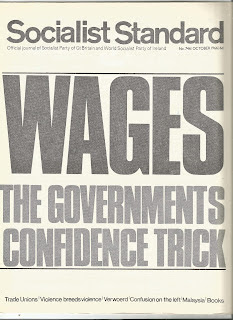
Violence breeds violence (1966)

From the October 1966 issue of the Socialist Standard

No single incident could capture the absurd tragedy of Capitalist society more than the recent killing of three London policemen in Braybrook Street, Shepherds Bush. In one moment was expressed all its frustration, waste, violence and inequalities. To an onlooker whose mind was not steeped in the attitudes of propertied society, the whole event would have been quite incomprehensible if not completely lunatic. First of all there was sudden death in the streets of the city, cruel and vindictive murder, the instant production of a litter of corpses. This was followed swiftly by the most intense police enquiries that produced the oddest of spectacles, for example, 75 tall uniformed men in a long line, on hands and knees fingering through the grass for little metal objects. Later there came the ugly aftermath of hundreds of grim-faced detectives, revolver in hand, staggering through the foliage of Epping Forest, hunting for a man. What was their mission? If need be to kill him, but at least to lock him for the rest of his life. Here undoubtedly was waste, frustration and violence; and the background of it all was formed by the inequalities of capitalist society.

It was a tragedy; killings always are, and so are the reprisals of the state taken in the name of so-called law and order. But the added tragedy of the whole affair will be the little that society will learn from it. The hang 'em and flog 'em brigade will have an outing, but in the meantime, important questions will probably remain unanswered.

Unless we are educated otherwise, it is an almost automatic response to entirely blame some individual for crimes. It is a response which follows from the prejudices of a fragmented individualistic society. It follows also from the religious idea that during their lives men make a conscious decision to become either good or evil. It also serves as a convenient scapegoat, which divests ourselves of personal involvement, to find some individual upon whom we can heap all guilt.

If our explanation of the incident stops at finding three men guilty and we satisfy ourselves that our duty has been done by applying a suitable punishment, then we shall be back where we were before the killings occurred, except, of course, that three policemen will be dead and other men will probably spend the rest of their lives in prison. We shall not only have done nothing to prevent this kind of violence occurring, but by failing to face up to all the factors involved, we ensure that it will happen again. When it comes to those acts of violence that meet with disapproval, where does the responsibility begin and where does it end? It is not just that capitalism has no consistent basis from which it can condemn violence; it is a society that constantly generates violence. Furthermore there can be no escaping the fact the code of honesty and the sanctity of private property expresses the material interests of men who have got everything—wealth, power and privilege. Thus the attempt to uphold morality under capitalism breaks up into cynicism.

It is not uncommon for an environment that is completely sterile of human warmth and love to produce psychopathic individuals with an acute tendency to violence. Some individuals whose abandonment dates from birth, never have the opportunity to learn by experience that all human relationships should exist at some level of mutual regard and affection. Hence their responses to other human beings are completely numbed. Such persons usually have suffered the worst ravages of an inhospitable background of ignorance, poverty and emotional insecurity.

It is not yet known if it is this kind of individual involved in the Braybrook Street killings. Whether it is or not, society does little to help such people. Apart from maintaining at its almost degenerate extreme the kind of conditions that produce such psychopaths, Capitalism presents them with a bewildering set of hypocritical and contradictory values. They are set a very fine dividing line between violence which is socially approved and violence which is penalised. It must be remembered that one of the suspects was trained in the jungle warfare and skilled as a sniper in the Malayan campaign against guerillas, a campaign where the torture of prisoners was common procedure.

A glance at the photograph in The Guardian of the Gorbals tenement where another of the suspects was arrested revealed instantly the vile and ugly surroundings which is presumably supposed to bring out the best in people. This in a society which glamourises wealth and comfort and gives people little opportunity to fight their way out of the prison of such poverty, short of crime.

We are not confronted then by a conflict of good men and bad men. We are not concerned with men who at one point in time, faced with the choice of either leading useful lives or becoming violent criminals, made a conscious decision to become anti-social. No individual exists in a social vacuum. His attitudes and actions must always be related to the whole social background, and the history of an individual's personal circumstances.

Socialists do not excuse all anti-social human actions on grounds of "the system", but we hope that we add to our condemnation a knowledge of all the existing social forces at work to produce given results. This is necessary because without it, condemnation is negative and without purpose. In a sense, there is a curious anti-ethical unity between the violent killer and those who condemn him out of hand. It is all very well to go round with the collection box for the widows' fund, but sympathy and a burning sense of outrage is made redundant when it is accompanied by a shallow hatred for the killer or demands for the return of hanging and flogging. All we are left with is continued violence at one moment disapproved and then inverted to become upheld. In the long run it feeds off itself.

The useful lesson is that capitalism basically through its inherent privilege and underprivilege and its inability to generate a sincere human relationships produces on the one hand crime and violence and on the other its repressive counterpart—Borstals, prisons, etc. The sufferings and misery of men in prisons year in and year out in defence of property interests is no less repugnant to Socialists than the actions of violent criminals.

The plain fact is that capitalism cannot work without prisons, and that some men will remain sufficiently undeterred by their horror to engage in crime, violent or otherwise.
Pieter Lawrence

The Question. (1911)

From the March 1911 issue of the Socialist Standard

What is a Labour man? He who has sold
His class and their Cause in the shambles of Gold,
For pelf, and a place in the council of Greed,
Weaving snares for those dupes Want and Ignorance breed,
Where the offspring of Toil, from the cot to the grave,
Are consigned to the mart of the modern wage-slave. 
Here "organised Labour" support and applaud
The Thugs of all progress, Cant, Falsehood and Fraud;
And, like autumn leaves borne on the blast of the storm,
They are whirled in the vortex of futile reform.
Against the class currents they struggle in vain,
Till they sink, where no trace of their efforts remain. 
When Knowledge imparts to the people her power.
Slavish fear shall depart from their hearts in that hour;
And thrusting aside tyrant forms of the past,
Revolution shall crown them with glory at last.
The Labour pest, hurled from its seat of ill-fame,
Shall be hailed a political relic of shame.
Then time in its fulness will give Freedom birth,
When the Socialist era shall gladden the earth.
F. G. Thompson.

Remembering the Past (2004)

From the May 2004 issue of the Socialist Standard
  Next month will be the centenary of the formation of the Socialist Party of Great Britain in 1904. To mark this, the Socialist Standard will be expanded to 48 pages (the price will remain the same), with articles about the activities of the Socialist Party over the decades and how others have seen these as well as on our specific contributions to the development of socialist theory. In anticipation, we publish below some of the contributions we have received.
Glasgow Branch

To say times were hard when Glasgow branch was formed in 1924 would be a serious understatement. The branch consisted of working men, only some of whom had jobs, and money was so scarce that in the early days branch meetings were sometimes held in the open because members couldn’t afford to rent a hall.

If funds were lacking then energy and commitment were not, so members threw themselves into making the party known in the city. John Higgins, the first branch secretary, was particularly effective at this and his meetings Glasgow Green gave many Glaswegians their first introduction to the party’s case.

To branch members knowledge meant everything and they were determined to have as much of it as they could, so classes on Marxist theory, logic, etc, were an essential feature, but the main activity was always indoor and, especially, outdoor meetings. Glasgow branch always had a reputation for having first-class speakers and even our opponents, whatever else they thought of us, conceded that.

Two outstanding examples of this were Alex Shaw and Tony Mulheron. Shaw was an old-time street corner orator with an ability to have his audiences in stitches – his lampooning of some of Glasgow’s left-wing folk heroes, especially the “Red Clydesiders”, was hilarious. Mulheron, by contrast, was in his element on the indoor platform. Tony was extremely articulate and had a witty, flamboyant speaking style that could turn even the driest-sounding theoretical subject into an entertainment.

During the war activities were stepped up. Ever more meetings were held and new, younger speakers came forward. The wartime scene was brightened by visits from London speakers taking a break from the Blitz and, later on, doodlebugs and V2 rockets.

After “peace” was declared the momentum was maintained and the branch’s biggest ever audiences attended meetings at the St. Andrew’s Halls and the Cosmo cinema. Membership increased and the branch even acquired its own premises. In 1949 a second branch was formed in the city and this lasted until 1961.

In the late 1950s an influx of younger members revitalised activities, and in the 1960s candidates were fielded in three parliamentary and five municipal elections. More outdoor speaking stances were opened and there were public debates aplenty with Labourites, Leninists and others.

Added to all this was a winter programme of Sunday evening indoor meetings which ran from October to April and continued for many years. This meant that members had to wrack their brains to come up with titles for around 30 meetings every winter!

Today the old propaganda methods, which were the branch’s strength, are all but finished. People will no longer come to indoor meetings or stop and listen to those held outdoors, and this means that the branch has had to adapt to the new situation. Now we organize day schools, discussion groups, hand out leaflets at demos, provide speakers and other assistance for party activities elsewhere in the country etc.

Glasgow branch has for eighty years played its part in the party’s activities. Its members have, in the past, given generously of their time, effort and abilities, and today’s members, despite very different and difficult conditions, strive to maintain this record.
 V.V.

Memories of Camberwell Branch

At the end of World War II and a landslide victory for the Labour Party, there was a greater public interest in politics. The Communist Party had a large number of members as a result of pro-Russia sentiment at the end of the war. During this period the Camberwell Branch was formed with about a dozen members. A decent room was hired from the Labour Party in Camberwell. The local MP Freda Corbett used to enter the room apologising for disturbing the meeting. She was unaware of the fact that we were not the Labour Party. When the SPGB contested Paddington North in 1945, realising we were not the Labour Party we were given notice to quit.

The branch held meetings on Sundays at East Street, Walworth market place. These took place at 12 o’clock midday. The local stall-holders regarded our arrival with suspicion and puzzlement. They could not figure out what was in it for us. However, when we sold Party literature and took collections they considered we were getting the proceeds.

The meetings were successful. Only one meeting could be held at a time because of Home Office regulations. The Communist Party who, locally, had many more members were competing with us for the pitch and on one or two occasions they succeeded. The Camberwell Branch forced a vote to get to the meeting site earlier in order to “book the pitch”. This resulted in us getting there at one o’clock in the morning, so the pitch could be occupied. The Communist Party stopped competing and disappeared from East Street for many months.

A handful of dedicated socialists saw off an organisation with several hundred local members. The Communist Party today is virtually non-existent . . . The Socialist Party is still alive.
T.L.

Sweden

Since the beginning of the 1970s there have been socialists in Sweden, sharing the ideas of the World Socialist Movement. For a number of years some of them produced a journal, Världssocialism (World Socialism). Many of the articles in it were translations from the Socialist Standard.

After several years of informal work with Världssocialism and other socialist activities a handful of socialists living in Uppsala and Stockholm decided to organise themselves formally as Världssocialistiska Gruppen (the World Socialist Group). At its first meeting in Uppsala on Saturday 20 January 1979 the group adopted a slightly modified version of the Object and Declaration of Principles of the Companion Parties of Socialism. The modifications had to do with the fact that the Group was not a political party, but had as its object to work for the formation of a Socialist Party in Sweden.

The work of the Group centred on the production of a series of pamphlets called Världssocialistiska häften. The first of these booklets was a translation of the SPGB-pamphlet Questions of the Day. Other issues of Världssocialistiska häften dealt with Soviet state capitalism, capitalism and war, Marxism 100 years after Marx´ death, and how life is in capitalism and can be in socialism.

Most of the members and a few sympathizers were in their twenties when the group was formed. After a few years, as some of them established families or got jobs in other places -- and one or two lost interest in socialism altogether - it became increasingly difficult to maintain organised activities. During the past ten years or so Världssocialistiska Gruppen, although not formally dissolved, has not carried out any organised activities. Individual members read the Socialist Standard and sometimes see each other.

Hopefully there are people in Sweden who in the not too distant future will find that they agree with the object and principles of the World Socialist Movement and then take action in order to reawaken the group. To achieve its object, the establishment of a Socialist Party in Sweden, will be a tiny task compared with bringing about the object of such a party.
Ã…ke Spross, Uppsala, Sweden

Socialist jailed in Sweden - "Times" uninterested (1973)

From the February 1973 issue of the Socialist Standard

We publish below a copy of a letter sent to the Editor of The Times but not published.
Sir,

Presumably it was the unexpectedness of the suggestion in the Freedom House study that civil rights are at risk in Sweden that led you to headline (2/1/73) this aspect of Peter Strafford's report from New York. It comes as no surprise to us. At this very moment our comrade Ake Spross, who shares our stand against all war whether classed as national defence or imperialist aggression, is in prison for refusing to join the army of a country much publicised as a haven for G.I.'s objections to their government's current war. His incarceration may be less harsh in other countries but the very efficiency of Swedish state-capitalism will ensure that upon release employment prospects in his chosen field will be considerably diminished.  Sweden as a refuge evidently does not extend to the Socialist objectors to service in her own forces.
Yours truly,
K. Knight,

2 January 1973                                                                                           General Secretary
Socialist Party of Great Britain

Someone else's fantasy (1987)

Film Review from the December 1987 issue of the Socialist Standard

Rita, Sue and Bob Too! generated considerable local interest in Bradford where I saw the film. It was, after all, written by local dramatist Andrea Dunbar and set in and around Bradford's own Buttershaw estate. What I had expected was cinema vérité along the lines of Letter to Brezhnev - a witty, honest, warts-and-all look at working-class life in Kirkby. The two films do share some common features: both are concerned with two girls, loud-mouthed and looking for escape. In Letter to Brezhnev it was the kind of escape that comes when work ends and "life" begins; getting dressed up, night-clubbing and, ultimately, for one of them, "romance" with a Russian sailor and the irony of "escape" to a country that, according to western propaganda, most people want to escape from.

Rita and Sue (Siobhan Finneran and Michelle Holmes), by contrast, are schoolgirls seeking to escape from the deprived conditions of a rundown estate where they are variously subjected to drunken fatehrs, family violence and dismantled motorcycles in the kitchen (the contemporary equivalent of the "coal in the bath: stereotype of working-class life?). Their escape, at first, consists in little more than baby-sitting in a posh house where they can not only enjoy the home comforts on offer but get paid for it as well.

However the baby-sitting quickly degenerates into an excuse for indulging someone else's fantasy (or so it seems) of the over-sexed older man and two insatiable under-aged girls. He is Bob (George Costigan) whose children Rita and Sue mind while he is out with his wife. While driving the girls home he makes a detour to take in a quick one (or, in this case, two) on the way. This sexual encounter is, we are supposed to believe, such an ecstatic experience for all concerned that the girls throw caution to the wind and take every opportunity to take turns at being first. If this sounds like the kind of sexual fantasy peddled by soft-porn newspapers, then Bob's wife is presented in equally hackneyed form as the reason for his peccadiloes—hysterical, uptight and disinterested in sex.

She discovers that hubby is screwing the babysitters, takes the kids and leaves him. Bob promptly installs Rita (or was it Sue)) who is by now pregnant, as his new housekeeper in the matrimonial home. At this point the story becomes as rapid as Bob's couplings. Sue, furious at what she sees as her best mate's betrayal, takes up with a romantically inclined Pakistani and quickly moves into an unromantic back-to-back with him and his sister's family. Rita has a miscarriage and Sue visits her in hospital. Bob gives her a lift home. They are seen by the Pakistani boyfriend who becomes jealous and violent. Sue kicks him in the balls and leaves him to return to the ménage à trois with Bob and Sue, in what we are supposed to see as a happy ending.

The film purports to be "progressive" although it's difficult to see why. It uses a number of pernicious stereotypes of working-class people—drunken, amoral, depraved—while at the same time the only too real squalor, deprivation and poverty of life at the bottom of the heap is portrayed as something that can be escaped from through sex. Now, it may well be the case that for some people some of the time, sex is a refuge from the harsh reality of capitalism. It is certainly "sold" to us in that way. But the depiction of sex in this film, while depressingly realistic, no doubt (we were treated to an extended lecture on condoms which would probably qualify as an AIDS commercial), was not an answer but very much part of the problem.
Janie Percy-Smith