Thursday, March 17, 2016

A Peep into the Art World (1955)

From the June 1955 issue of the Socialist Standard

The Financial Times (27/4/55) has an article under the title "High Prices for Venetians"; dealing with the spectacular rise in prices of works of art sold in London Sale Rooms, instancing a painting by Canaletto £10,500, a pair of F. Guardi £9,000, one by Zuccarrelli £1,900, one by F. Post “View in Brazil 1661” £1,650, and a very fine copy of Audubon’s “Birds of America,” published 1827-1838, £9,200. These prices represent a ten to 20 times increase in the last 10 to 20 years. What a fine racket thinks the speculator, better than whiskey, or bomb making.

What is behind it, you may wonder. While one must remember the fall in the purchasing power of the pound, that is not the great part. The supply of such works of are as these mentioned above grows less each year, but the demand increases with the growth of immense fortunes in countries that did well in the last two world wars: the South American Republics, the Scandinavian countries, U.S.A., and also the great oil fortunes in Western Canada. The last are a great factor in the prices of Canadian paintings by Krieghof (painted 100 years ago) which sell at as much as £1,000 as against £100 in pre-war days.

S. America is coming up fast and it was Brazil that put on the San Paulo collection at the Tate Gallery last year. F. Post was one of the very few well trained artists to go to Brazil in the 17th century, so for buyers of S. American early art the choice is strictly limited; the £1,650 “View in Brazil” could be bought 20 years ago for £100 and the Audubon book for a tenth of the recent price.

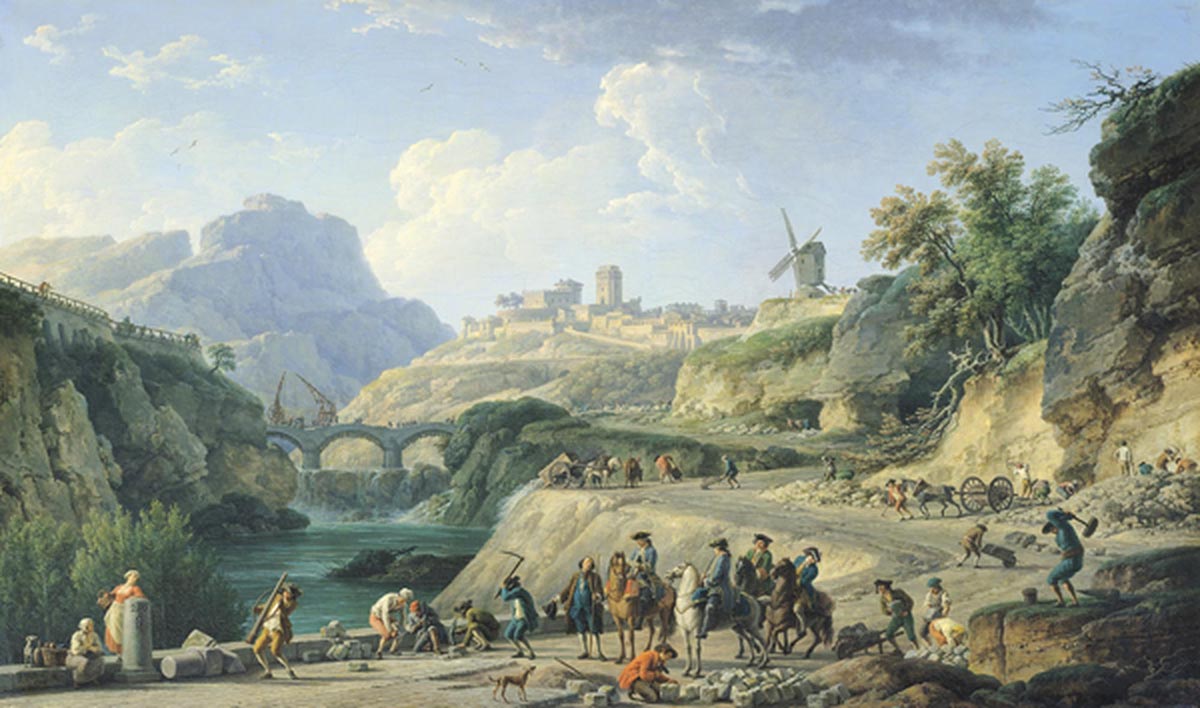
The present writer’s memory goes back to a day in January at the winter Royal Academy Show of 18 Century Art, to Exhibit 361, “Making a Road,” a painting by J. Vernet, signed and dated 1774. The picture shows a French Landscape by a river with a castle in the distance, a three-arched bridge being built in mid-distance by many workers with a high wooden crane. Up on the right is a windmill with two donkeys being loaded, beyond the bridge a group of men pulling a long waggon filled with huge blocks of stone, and all along the road dozens of men with hammers, picks, ramrods, chisels, etc., constructing the road. In the foreground are four horsemen. The first, splendidly dressed, is looking at a document that the ganger, hat in hand, has given to him, on the pommel of his saddle a brace of pistols. By his side another well dressed and pistoled gent sits with whip held erect in his hand and behind him two men, who look like guards. While admiring the picture another visitor approached and remarked: “Nice picture! Who owns these beautiful things? Who were they painted for?” This one, I replied, now belongs to The Louvre, but you will notice by the catalogue the great array of Lords, Baronets, etc., who own the bulk of this splendid exhibition. As to who this Vernet was painted for, perhaps for the pistoled gent or at least someone such as the owner of the distant castle. What you see there in the painting—well over 50 men working and two well armed gents not working but obviously of the class who own the means of production—sums up nicely who owned such works of art and who owns them now. There stands the master class whip and pistol in hand: the pistol you put and keep in their hands every, time you vote them into political-power and the whip of necessity that keeps you working for those who own the means whereby you live. The fine art trade, like the fine jewel trade, is patronised almost exclusively by that very small class who own the means of wealth production; while the vast bulk of the people get a trickle of chain store art and “ fine ” jewelry. It is up to the latter, the working class, to say yes or no to such a system. Look at the world you live in and get an understanding of Socialism, which will finish all the luxury racket and make possible a world in which art will cease to serve the ostentation and speculation of the wealthy and be a means of enjoyment for all.
Ted Kersley

Future of work and leisure (1993)

From the June 1993 issue of the Socialist Standard

One of the worst features of capitalism is the way it separates our lives into periods of paid work and paid-for leisure. Too often we speak of work as if it were only paid work, and it is easy to regard leisure as only entertainment we have to pay for. But even within capitalism there is much work that isn’t done for money and much leisure that doesn’t have a price tag. With socialism, work and leisure will not only be free from financial calculation but also the dividing line between the two will be much less than it is today.

Work done for money is really a distorted and alienating form of work. Employment means going to work because an employer expects to make a profit from buying your labour and selling what you produce. You may do something useful like growing food or building homes—or useless like guarding property or harmful like making weapons. I'he chances are you won’t like the job, although you may like the work, especially if it is creative or to do with people. You won’t like the job because it is done to someone else’s orders, in conditions that are usually less than ideal, and for longer than you would wish.

Even in capitalist society some men and women speak very warmly of their work. Helping people, teaching them, giving them services they appreciate, are all sources of work satisfaction, even enjoyment. These kinds of work will continue in socialist society and be extended to more people for more of the time. What will disappear will be work done only to make someone or some institution a profit. or to service the money system in some way (there are millions of such “jobs").

It may seem fanciful to say that we can play at our work. Some work is not easily associated with play: the kind that has to be done. “Who will do the dirty work?” is a cry that often goes up from those who cannot imagine anyone working except for money. But people do perform essential tasks quite happily without payment if they do so co-operatively and without a sense of being exploited. And they can gain deep feelings of pleasure and creativity from such work, from doing or producing something useful. Psychologists call this a sense of “flow", of immersing yourself in what you do. of losing any desire to watch the clock.

Tainted by money
Leisure in capitalist society is subject to market forces. Margaret Thatcher once announced. talking of the tourist industry, that there is money to be gained from other people's leisure. The providers may be commercial or "public". Both types rely on consumers paying either at the point of consumption or by taxes or licences. Most of this is casual leisure: you buy a ticket or press a button and you are duly "entertained".

There is, however, another kind of leisure on which the market has little or no effect. To distinguish it from capitalist entertainment it may be called serious leisure (which doesn't mean humourless leisure). It takes three main forms: amateur activities, hobbies and volunteering. Amateurs do the same things as professionals. but without payment. Perhaps they are musicians, or scientists of some kind. Hobbyists are like amateurs but without a professional equivalent. They could be collectors or model builders or enthusiasts of any one of a thousand hobbies. Then there are volunteers: people who spend some of their free time helping others in some way. Again there are very many different ways of volunteering.

Capitalism not only artificially separates work from leisure; it also opposes them. Paid workers have been known to say “Roll on five o’clock, lets get out of this place and start living", or something similar. Its a tragic waste of precious life. Leisure, too, is tainted by the money system. Millions of punters band together every week to make a tiny few (sometimes only one) of their own number very rich through the football pools. Follow-up studies of the big winners are not encouraging about their happiness. You can, of course, buy a good time without gambling, but you are usually expected to be a passive consumer rather than an active participant.

With socialism there will be enormous scope for bringing work and leisure closer together and making them both worthwhile parts of a whole life. Work will be organized democratically, not financially. It will be in direct response to need and not in the interest of profit-seeking. It will as far as possible be freely chosen. Leisure won’t be an “industry”—it will be that part of life in which things are done for their own sake and not in the service of something else. People will find it increasingly difficult to distinguish between what is work and what is leisure. In other words, why shouldn’t we have fun at our work and be serious about at least some of our leisure?
Stan Parker

Editorial: "Socialism" Everywhere. (1936)

Editorial from the March 1936 issue of the Socialist Standard

Years ago, Socialist propagandists used to point out to the reformists that their work of popularising old-age pensions, unemployment insurance, etc., would only end up with the openly capitalist parties dishing them by adopting the proposals for themselves and getting the credit. To clinch the matter, Socialists added that a time would come when the capitalists would steal the word “ Socialism ” itself and use it to gain a further lease of life for capitalism. Events have faithfully followed this anticipation. If what they say were really true, the workers’ difficulty to-day would be to find some spot where Socialism isn’t. First, there are Russia’s 170 millions supposed to be living under Socialism. Now Germany, with its “National Socialist Party” in the saddle, has just been officially declared to be Socialist. The Berlin correspondent of the Economist (February 1st) writes as follows: “ ... it is affirmed that Socialism is under way (indeed, this week it is officially stated to have already replaced capitalism).” Then the three Scandinavian countries, with their Labour Parties in power, are described as "Socialist” in the English Labour Press, along with New Zealand and Western Australia. At home we have the old-fashioned section of the Labour Party still insisting that the Post Office is Socialism, while the new gang (Mr. Morrison) calls the Transport Board “socialisation,” and tells us that we have a Socialist London County Council. Where the Government is not controlled by a Party calling itself Socialist, it often has one or more leaders who were Labour Party stalwarts, e.g., MacDonald and Thomas, Mr. Lyons the Austrian Premier, and Mussolini and several of his colleagues.

Only knowledge of Socialist principles will make the workers proof against being misled by capitalist and Labour Party misrepresentation.

Russia's capitalists (1985)

Book Review from the November 1985 issue of the Socialist Standard

What is the nature of the ruling class in Russia? Who are they and what is the basis of their power and wealth? Obviously, the answers to these questions cannot be found by simply comparing the Russian rulers with the capitalist class in the west. For example, no one in Russia has legal title to any of the factories, mines, mills, transport and communications systems, and to underline this there is an absence of shareholding and stock exchanges. Nevertheless, there is a social class there whose members live privileged lives in comparison with the vast majority of Russian people. Indeed, the higher ranks of this class enjoy luxurious lifestyles and have an army of servants to look after their every comfort.

How can all this be in a supposedly “socialist" society and how does this privileged class get its wealth if not from legal ownership? These questions, and many more, are dealt with by a dissident Russian scholar, Michael Voslensky, in his book Nomenklatura - Anatomy of the Soviet Ruling Class, published by The Bodley Head (£12.95). This book was first published in German but the English edition has been brought right up to date to include the periods in office of both Andropov and Chernenko.

Nomenklatura is a Latin word meaning an index of names. A more meaningful definition is contained in Structures of the Party, a manual of the Communist Party of the Soviet Union:
The Nomenklatura is a list of the highest positions, the candidates for these positions are examined by the various party committees, recommended and confirmed. These Nomenklatura party committee members can be relieved of their positions only by authorisation of their committees. Persons elevated to the Nomenklatura are those in key positions (p 2).
Anyone admitted to this magic circle is issued with a document confirming his or her exalted status and membership is virtually guaranteed for life.

Voslensky, who now lives in the west, was himself an important figure in Russia and writes with insight about his subject. He identifies the Nomenklatura as the secretaries and heads of departments and divisions of the Communist Party, Komsomol (communist youth) and trade unions; the central committees of those organisations at both national level and in the various republics; the heads of state administration and their deputies at national and republic levels plus a host of representatives of the state security services, the armed forces, the KGB, the diplomatic services, education, science, industry and agriculture. According to Voslensky the Nomenklatura totals about 750,000 and together with their families at around 3 million, or 1½ per cent of the population. So it is only those who have reached a certain rung on the Communist Party ladder who can become members, and even the international fame and personal wealth of such as writers, artists and film stars do not gain them admission.

Even if we could not put our finger on the exact point in the Communist Party set-up where someone becomes a member of the Nomenklatura, this need not concern us any more than what is the exact amount of capital someone in Britain must have invested before becoming a member of the capitalist class - is it £100,000 or £1 million? The undeniable fact is that despite any grey areas there is a capitalist class in this country which, because of its legal ownership, monopolises the means of production and distribution. Similarly there is a class in Russia, the Nomenklatura, which, because of its monopoly of political power, does exactly the same there.

Voslensky argues that the Nomenklatura are in fact the collective owning class in Russia. He points out that ownership does not have to be by individuals with legal title and cites the nationalised industries in the west where the state undertakes their management on behalf of the national capitalist class. If those industries show a profit then the capitalists will get their “dividend” in the form of tax cuts or of not having to pay tax increases to finance them. At the very least they will get industries which, even if not profitable, they can use to service the enterprises they themselves own. The capitalists in this case own not as individuals but collectively, as a class.

And collective ownership exists not only in nationalised industries. The Roman Catholic church owns vast wealth in property, investments, art treasures, etc, but no individuals, not even the Pope, have legal title to any of it. This wealth is owned collectively by the church hierarchy who use it to protect and extend their power and influence and, incidentally, to live very well, but none of them could, for instance, sell St Peter’s. Any such decision would have to be taken collectively because that is the basis of their ownership.

It is the same with the Nomenklatura. They own as a class and the state manages the production of wealth on their behalf. Their pay-out comes in the form of inflated salaries, the free use of luxury apartments, Black Sea villas, country houses (dachas), more or less free food, free use of cars and many other perks. Also, many of them are allotted more than one official post and receive a separate salary for each. This may not compare with the huge incomes of some western capitalists but, what the Nomenklatura get is a fortune to the average Russian.

Of course the top ranking members of this class do have incomes on the scale of western capitalists. How else can we view the disclosure that a district committee first secretary paid 192,000 roubles (about 160 years’ pay for the average Russian worker) into his wife’s bank account? Moreover, they have an open account at the state bank which allows them to draw out any money they require. Even western capitalists cannot do that. Those at the very top have no need to touch their salaries as everyone at this level simply lives at the state's expense. Stalin’s daughter, Svetlana, recalled how her father never touched his wages: “The drawers of his desk . . . were full of these sealed envelopes" (p 231). And yet the Nomenklatura denies its own existence as a class of exploiters and try to pass themselves off as “workers”.

This personal wealth is only a fraction of the surplus value which the Nomenklatura robs from the Russian workers. The entire state apparatus which keeps them in power is financed from this source. The armed forces, the arms industry and the spy and espionage systems which are used to protect their interests from the threat of their international rivals, the massive police force, prisons, labour camps, courts, militia, phony trade unions, all of which are employed in keeping the workers in line, are paid for from the proceeds of this robbery.

One significant similarity the Nomenklatura has with the capitalist class in the west is that it endeavours to hand on its privileges to its children. Although it is true that membership is not hereditary in any legal sense, in a practical sense it may as well be. Voslensky gives several examples of how the children of the Nomenklatura are as good as guaranteed important, well paid positions irrespective of their personal abilities and concludes that although entry to the Nomenklatura can be obtained by ordinary careerists, "... the chance of entering it by that route are becoming more and more restricted, while the royal road of birth is more and more frequently used” (p 102).

The most important difference between the Russian rulers and the western capitalists is explained by Voslensky.
What matters to the Nomenklatura is not property but power. The bourgeoisie is a class of power owners and is the ruling class as a consequence of that. With the Nomenklatura it is the other way around; it is the ruling class and that makes it the property owning class. Capitalist magnates share their wealth with no one, but gladly share power with professional politicians. Nomenklaturists take care not to share the slightest degree of power with anyone. The head of a department in the Central Committee apparatus never objects to an academician’s or a writer’s having more money or worldly goods than he, but he will never allow either to disobey his orders, (p 72)
So, in the west it is money which is paramount. In Russia what counts is power of which privilege is the proof. This explains why the Nomenklatura apparently have no wish to actually own a dacha. What is more prized is having a state-owned dacha made available to them. That is a sign that they have really arrived, and to actually own a dacha is considered to be bad form.

On occasion Voslensky reveals a sound grasp of the theories of Karl Marx. For example, he approvingly quotes an old Bolshevik ruefully explaining to him, as a schoolboy, why Russia was not ripe for the socialist revolution.
You and your friends, Misha, would like to be airmen or arctic explorers, but with the best will in the world it is impossible because you are still children, and you can no more skip your age than I, unfortunately, can become a schoolboy again. It is not we who determine the various stages of our life, it is those various stages that determine us. And that is true not only of individual human beings, it also applies to human beings in general, to human society. Could Russia or any other country at the same stage of social development, by a mere act of will take a single leap that would put it ahead of the most advanced countries? Marx said it could not and it was obvious (p 15).
He denounces Leninism as not Marxist at all but merely “. . . a strategy and tactics for the seizure of power decked out in Marxist slogans” (p 289) and goes on to pour scorn on the idea that the Nomenklatura are Marxists - "Marx would have turned away in disgust from the system they have established” (p 290).

Voslensky’s own conception of socialist/ communist would seem to be the same as our own, for he says
I believe the idea of a classless communist society as a free association of producers of material and intellectual goods to be a fine one (p 347).
Against this he shows some weakness on Marx’s theory of surplus value, confusing surplus labour - which is present in any society - with surplus value, which is produced under the specific conditions of capitalism’s commodity production. He also shows a certain naiveness in stating that government ministers in the west "live on their pay, just like other people”, and that their wives do the cooking and housework themselves (p 178)!

We can easily forgive Voslensky’s slips. By throwing more light on Russia’s rulers and by highlighting the class divided nature of Russian society together with its repressive state, his valuable book is surely one more nail in the coffin of the idea that socialism or communism exists in that tortured land.
Vic Vanni

Politics: Syndicalism and the General Strike (Part II) (1975)

From the February 1975 issue of the Socialist Standard

Part 1 of this article can be read here.

In order to illustrate the power of the General Strike, the syndicalist Roller in his pamphlet The Social General Strike gives examples which point instead to the power in the hands of the state. He instances the General Strike which started in Alcoy, Spain, in 1874 where: “The accomplishment of the reconstruction, however, was prevented by the troops, which were sent by the government to reconquer the city." (Page 26; italics ours.) Next, the eight-hours movement in America, which culminated in the Haymarket tragedy in May 1886; here again the Government showed its teeth and the labour movement suffered. Referring to another general strike, at Barcelona in 1902, he concludes with the fatuous remark: “The comrades of Barcelona finally were defeated, nevertheless they proved the invincibility of the General Strike.”

Before leaving Roller we will give one more illustration of the influence on his outlook of anarchist ideas which, incidentally, are still propagated by the superficial and the impatient.
It is an indisputed fact that a brave deed, be it one of a single individual, or of an energetic enthusiastic minority, arouses thousands from their slumber, and with one thrilling shock turns them desperate fighters for the good cause, while ten years of theoretic agitation could not tear them away from their apathetic condition. 
This was implicit in it Blanquism and propaganda by deed. It is another way of saying: “The time for theory has passed, the day for action has come.” All action is based on theory, but when the theories are out of tune with the facts as in the case of the syndicalists, the action is likely to lead to disaster.

The syndicalists were also opposed to democracy. A. D. Lewis in Syndicalism and the General Strike quotes Emile Pouget’s views as follows:
Syndicalism and democracy are the two opposite poles which exclude and neutralize each other . . . This is because democracy is a social superfluity, a parasitic and external excrescence, while Syndicalism is a logical manifestation of the growth of life.
Another syndicalist work, Syndicalism and Revolution, says:
It is better to have an active group who know how to carry the masses and turn them in the right direction by their words and actions.
Sorel also makes bitter attacks on democracy. In fact all minority groups have always claimed to be acting for the mass of the people, whether the latter recognize it or not. The only movement in the interests of the great majority that can ever be successful is one they understand, desire, and freely and willingly work for.

In time, the CGT began to lean more towards political action and reform policies. After bitter experiences, belief in the General Strike lost its strength and the influence of ideas of sabotage and violence declined; until the movement paralleled that of the English trade unions that had absorbed numerous craft unions into a comparatively few large organizations. Then, after the first World War, the propaganda of Bolshevism gave new life to the old futile ideas.

The European syndicalist movement received considerable impetus from developments in America that culminated in the formation of the Industrial Workers of the World. The leaders of the radical movement in America, both political and industrial, were misled into believing that this movement was going to sweep all before it; they therefore wanted to get in and influence it with their particular ideas. Hence, like the old International, it was a hotch-potch of conflicting ideas and soon fell to pieces from internal quarrels.

The closed-shop attitude of the American Federation of Labour was stirring up revolt among unskilled workers and those organized in the Western Federation of Miners, the American Labour Union, and the American Railway Union. The AF of L’s policy of collective bargaining and separate contracts led to one union scabbing on another; the leaders of the AF of L acted on the principle that there was a harmony of interest between employers and employed, and they urged that the strike should be replaced by a mutual contract. High initiation fees (up to £100) and high membership dues closed the unions to almost all but the highly- paid skilled workers, who were a peculiarly American product. The masses of poorly paid men, women and children, as well as black workers, were practically ignored by the AF of L and had little chance of rising out of their depressed condition.

In January 1905 a few prominent trade unionists, some of whom were members of the Socialist Labor Party and the Socialist Party of America, decided to call a conference to set on foot an industrial union, based upon the class struggle, that would include all workers, skilled and unskilled, white and coloured, on an equal basis. The conference in June and July 1905 produced the Industrial Workers of the World. It was attended by anarchists, advocates of the General Strike, and advocates of political action; the result was a programme that endeavoured to meet these conflicting views. The futility of this compromise programme soon became evident, and after a few years the anti-political elements captured the movement. It was reduced to a few thousand members and, after the 1914-18 war, most of what was left was swallowed in the Communist movement.

At the founding conference of the IWW the General Strike was scarcely mentioned: the only two to do so were the anarchists Klemensic and Lucy Parsons. The latter referred to it in an emotional moment when speaking of the Haymarket affair and the execution of her husband. It may be mentioned that she, like many other delegates, had been carrying on a prolonged and unselfish struggle against the terrible conditions suffered by the workers.

The most controversial proposal adopted by the conference was that the workers must struggle to “take and hold that which they produce by their labour through an economic organization of the working class without affiliation with any political party”. The most persistent and acomplished defender of this standpoint was Daniel De Leon. His standpoint can be summarized as follows. Both political and economic organization are necessary, but the latter is more important because only it can “take and hold”. If the workers take political power out of the hands of the capitalists, the latter still retain their economic power. Political power is a reflex of economic power, and the former cannot reach fruition until the latter exists: the economic power of the workers can only be obtained through industrial unionism which organizes industry on a plan that gives the workers control.

In laying down this position De Leon made an astonishing statement. He repeated it a few days later, in more detail, in a speech which was published by the SLP in 1919 under the title Socialist Reconstruction of Society.
In no country, outside of the United States, is this theory applicable; in no country, outside of the United States, is the theory rational. It is irrational and. therefore, inapplicable in all other countries, with the possible exception of Great Britain and the rest of the English speaking world, because no country but the United States has reached the stage of full-orbed Capitalism—economic, political, and social—that the United States has attained. In other words, no other country is ripe for the execution of Marxian revolutionary tactics . . .
Later on, history played its little joke. The Bolsheviks put forward the above argument but based it on exactly opposite grounds—that it was because Russia was a backward country that circumstances made it the country where the Marxian theory of “tactics” (as defined by them) was first applicable!

According to De Leon, the political organization is not capable of organizing production. “Shoemaking, bricklaying, miners, railroad men” and the like were jumbled together in each parliamentary district. Only the organization based on industries is capable of industrial control, and therefore “taking and holding”: “Where the General Executive Board of the Industrial Workers of the World will sit there will be the nation’s capital.” (Socialist Reconstruction of Society.) How the workers are to get control of industry without first getting control of political power De Leon nowhere explains; he makes the nebulous argument that the socialist ballot is the emblem of right but is useless unless backed by industrial might to enforce it. The serpent of reform raises its head in his argument that, while the political movement must make a clean sweep, the industrial one can take over production gradually, a little at a time.

De Leon’s defence of industrial unionism sounds curious when taken in conjunction with an entirely different contention which he argued in two of his most popular lectures:
Obviously, independent, class-conscious political action is the head of Labour’s lance. Useful as any other weapon may be, that weapon is the determining factor. Entrenched in the public powers, the Capitalist Class command the field. None but the political weapon can dislodge the usurpers and enthrone the Working Class; that is to say, emancipate the workers and rear the Socialist Republic.
(Two Pages from Roman History, Edinburgh, 1908.) 
De Leon is an instance of the contradictory positions into which those are led who set out to build large followings by compromise, instead of waiting upon the growth of the workers’ knowledge. His difficulties were partly due to his treatment of the industrial and political movements as two absolute entities. He overlooked the fact that when the workers are sufficiently class-conscious to capture the political machinery for the purpose of introducing Socialism, the same people are in the industrial organizations and will have used their knowledge to bring these organizations to a similar state of development.

The total number of workers represented at the 1905 conference was nearly 50,000, but the main voting strength came from the Western Federation of Miners and the American Labour Union. There were a number of delegates representing small unions, and a number representing only themselves. The form of organization adopted for the IWW was “Thirteen industrial divisions subdivided into industrial unions of closely kindred industries”. A chart was subsequently published in a pamphlet by Trautmann, One Big Union, which gave a picture of the proposed constitution. Its final working-out deprived the ordinary members of real power. Delegates were appointed to committees, which in turn appointed delegates to higher committees, and so on in the fashion later adopted by the Russian Soviet constitution; ultimately, the officials of the Central Board were those wielding controlling authority.

There was a general subservience to the leadership idea, and the confused attitudes were expressed in a statement by a committee, which defined the co-operative commonwealth as
a system of society in which there shall be neither exploiter nor exploited, and in which he who contributes to the well-being of society shall receive the equivalent of the full product of his labour.
This attitude had been pulverized by Marx in the Critique of the Gotha Programme. According to it, those who produced most received most and those who produced nothing—the sick, crippled and aged, and children—received nothing! Also there would be no provision for future production. Behind the statement, however, lurks the syndicalist attitude—the mines for the miners, the factories for the factory workers, etc.

The IWW, like the syndicalist movement in general, was an attempt to force the pace without regard to, and in spite of, the backwardness of the workers. Failing to realize the significance of the phrase that the emancipation of the working class must be the work of the working class itself, they set on foot leadership movements that failed to achieve their avowed objects just because of the workers’ backwardness. Even the methods they advocate for developing working-class consciousness are such that they fail in their purpose and only breed confusion. A common argument was mentioned by Trautmann in his One Big Union pamphlet:
Equipped with the power of an industrial organization, with the knowledge gained in the everyday struggle against the oppressors, they will successfully strive for a higher standard of life-conditions, within this system, and they can master things and forces so that they will reach the final goal of their efforts—complete industrial emancipation.
As the industrial union movement claimed to be out for the overthrow of the system but as, at the same time, it professed to be able to fight the workers’ battle for better conditions more successfully, it would draw into its ranks those who agreed with its object and also those who thought it offered a better medium for gaining improvements in conditions. If the movement attracted a large number of workers, the first group would of necessity be very small, while the second would be so large that it would swamp the organization and turn it into a pure and simple trade-union movement.

But the chance of large bodies of workers deserting established unions for small organizations that can show no evidence of power, which is an immediate question for them, is poor. The IWW anticipated getting round this by striving to organize the unskilled workers who were excluded from the established unions; but these were just the workers who stood least chance of stopping the wheels of industry, and who also were not greatly attracted by the object and the grandiose scheme of organization. Although the IWW had some success at first and caused some employers a pain, it never reached threatening proportions and therefore could not offer the workers the alleged experience in the day-to-day struggle that was to clear their heads. (In fact the concentration on day-to-day struggles has usually the opposite effect.)

Syndicalism as a movement has a number of objectionable features from the working-class point of view. Its principal weapon the General Strike, if it could be as successful as its advocates hoped, would only result in social disaster. Its vision of the future is mixed, envisaging either groups of autonomous communities or a society split into self-contained industries. Its propaganda drives it to include violence. And violence kills free discussion, attracts the worst elements, breeds disunity, invites repression, and plays to the emotion rather than to the intelligence; it develops fear instead of conviction and encourages mutual distrust; it encourages the worship of leaders and endows them with an inordinate amount of power. Finally, syndicalism, by ignoring the source of state power and its effect, is incapable of enabling the workers to achieve their emancipation from capitalism and establish Socialism.
Gilmac.

The Red capitalist class (1969)

From the November 1969 issue of the Socialist Standard

Any thoughtful person must have realised that opposition to Mao in China over recent years has not been confined to the proverbial ‘handful of top people in authority taking the capitalist road’. A recent issue of the weekly journal of the Union of Soviet Writers carried a letter from a schoolboy in Peking who wrote that ". . . the eyes of a majority of the youth are open. Many no longer believe in Mao Tse-tung. But there are still quite a number who do believe in him and who do not understand that he is the cause of all the difficulties of China.” This sort of comment comes as no surprise to socialists. Even in the current world situation where the vast majority of people (in China as elsewhere) look upon capitalism as the only practicable method of running society, it is inevitable that sizeable groups of working men and women should come into conflict with the capitalist class in every country. Although socialist ideas are as yet nowhere widely spread, socialists do not minimise the importance of workers’ movements in different parts of the world striking out a line independently of the ruling class, even though their policies may still be hemmed in by reformist illusions about capitalism. For, quite apart from any other considerations, it is a historical fact that all the World Socialist Parties organised so far have developed from similar groups of workers who were first engaged in attempts to reform capitalism and then through this activity became convinced that only independent revolutionary socialist parties could offer an effective solution to working class problems.

In China the Maoist representatives of the capitalist class have long been engaged in spurious polemics with their rivals in the Soviet Union and other countries such as Yugoslavia, emphasising that these can not be socialist since a ‘privileged bourgeois stratum’ exists there. It is hardly surprising, then, that numbers of workers in China who have been fed a staple diet of these sorts of comments in the editorials of the People’s Daily and Red Flag should quite naturally apply a similar analysis to China itself and decide that “a red capitalist class” is in power rather than the official myth that it is the workers themselves who rule. A good example of this tendency is a document produced by a group based on Hunan (Mao’s home province) called Sheng-wu-lien which has been released by the Survey of China Mainland Press series and is also available (in a shortened version) in a recent issue of International Socialism.

Sheng-wu-lien seems to look upon the Communist takeover from the Kuomintang in 1949 as the final phase in China’s capitalist revolution which cleared the way for the forced development of a capitalist economy. This means that (in contra-distinction to Mao’s confused notions) they recognise that the class struggle is rooted in the methods of production in operation in contemporary China, since “the development of new productive forces in China today has brought in conflict the class that represents the new productive forces and the decaying class that represents the production relations which impede the progress of history.” This “decaying class” Sheng-wu-lien normally refers to as the “class of Red capitalists” whose “special privileges and high salaries” are “built on the basis of the oppression and exploitation of the broad masses of the people”.

Although the general level of this analysis is obviously head and shoulders above any other material from China which has become generally available, such comments as these are not by themselves that impressive. After all, one might argue that they go no further than the normal tradition of Communist mudslinging (as between Russia and Yugoslavia in the past) of calling people ‘capitalist’ because you don’t like their politics. What makes the Sheng-wu-lien document significant, however, is their explanation of why the capitalist class first gained power in China and have since been able to consolidate their position through episodes such as the ‘Cultural Revolution’. The reason they give is exactly the one the Socialist Party of Great Britain has always maintained —that because the Chinese peasants and workers do not yet understand what socialism entails they therefore can not be equipped to overthrow the capitalist system. Thus: “The development of the wisdom of the masses had not yet attained the degree at which it would be possible to reform (sic.) society. As a result, the fruit of revolution was in the final analysis taken by the capitalist class.’’ and “Thus it may be seen that the revolution lacked depth and remained at a low stage of development. The degree of maturity of the political thought of the revolutionary people, was in conformity with this low level revolution . . ." Certainly, this method of focusing attention on the non-socialist ideas predominating among the working class is emphatically not in the tradition of any of the varieties of bolshevism (stalinist, trotskyist or maoist) and as such represents something of a breakthrough.

As might be expected, Sheng-wu-lien's principal weakness lies in what they see as the alternative to Mao’s brand of state capitalism. What they call for is a “People’s Commune of China', roughly based on the model of the Paris Commune of 1871. Its main feature would be to replace the capitalist class with ’cadres with true proletarian authority naturally produced by the revolutionary people in the struggle to overthrow this decaying class. These cadres are members of the commune. They have no special privileges. Economically they get the same treatment as the masses in general. They may be dismissed or changed at any time in accordance with the demands of the masses." The utopian character of this programme is obvious. A ’People’s Commune of China* would stand no more chance of surviving than the Paris Commune did. Socialism can be nothing less than world wide. But also it must be noted that Marx thought the Commune important because it indicated how workers could take over the existing state machinery and convert it from an oppressive bureaucratic structure into a democratic instrument for achieving socialism. By its very nature it could only be a highly transitional form, rapidly giving way to the free society of socialism which needs no state apparatus—no matter how democratic. So to try to use the Commune as a blueprint for some type of stable social system is to turn marxism on its head—and thus, in this respect, repeat the errors of bolshevism.

It is also worth mentioning that the demand for a ’People’s Commune of China’ is not very original either. The Communist Party under Mao has been brutally efficient in its work (still progressing, of course) of converting China’s millions of unorganised peasants into a mass working class which can be manipulated to create surplus value for the capitalists. Recent sources estimate that more than 25 million people were exterminated during the decade up till 1965, that another 30 millions were displaced and that tens of thousands of detainees are held in concentration camps in the Sinkiang deserts and elsewhere. (Alain Jacob in Le Monde, 28/8/69). Certainly, if the experiences of Russian workers and peasants under Lenin, Stalin and their successors are anything to go by, these figures seem perfectly plausible and yet periodically this bloody reality has been masked by opportunist demands for ’real democracy’ on the lines of the Paris Commune by Mao and his associates. For example, Ch’en Po-ta (a leader of the Cultural Revolution Group under the CCP Central Committee) announced in a talk at Peking University in 1966:,
You must pay attention to the public’s being broadly represented in elections, and you must be able to hear different kinds of opinion. The teachers and office workers should have their own representatives. These representatives are not elected for life. They may be removed any time they are found to be incompetent. The masses may remove them and replace them with other persons through re-election.
According to reports, this “suggestion for a system of representative committees modeled on the principles of the Paris Commune of 1871 . . . met with enormous enthusiasm.” (Monthly Review, July-August 1969). Obviously, then, Sheng-wu-lien's policy of establishing a ’People’s Commune of China’ represents little more than uncritically taking over some of the rhetorical demands of the most ruthless spokesmen of the Chinese capitalist class.

Interestingly enough, Ch’en Po-ta was reported to be one of the speakers at a mass rally of around 100,000 people in Changsha (the Hunanese capital) in January 1968 which denounced Sheng-wu-lien. Also speaking were Chou En-lai (described by Sheng-wu-lien as “at present the general representative of China’s Red capitalist class”), Chiang Ch’ing (Mao’s wife) and K'ang Sheng (a permanent member of the CCP politburo). Clearly, if Sheng-wu-lien is influential enough to warrant this sort of attack by some of the most powerful representatives of the ruling class in China, it could mean that the policies it stands for are echoed by a substantial number of workers. But the important point to stress is that if a sizeable body of workers in China have reached the level of political consciousness represented by Sheng-wu-lien, there is every reason to hope that a number of others will have elaborated a more solid analysis of world capitalism and armed themselves with an understanding of the need not for a ’People’s Commune of China’ but for a world socialist community based on common ownership and democratic control of the means of production. The World Socialist Parties have always insisted that the world wide problems of capitalism will lead workers quite independently of ourselves to grasp the need for a rationally organised society where mankind as a whole can plan production without being hampered by class or national limitations. To those workers arriving at these conclusions we want to extend the hand of socialist fraternity. And above all we want to work with them as comrades in the struggle to establish a socialist world. Workers of the World Unite!
John Crump


Letters: Jimmy Hill (2016)

Letters to the Editors from the March 2016 issue of the Socialist Standard

Jimmy Hill

Dear Editors

The obituary on Jimmy Hill (February Socialist Standard) failed to mention his role as consultant and mediator of a ‘rebel tour’ to apartheid South Africa to play football in 1982. There was also omission of his defence of football manager Ron Atkinson’s use of the word ‘nigger’ in an off-air  2004 television transmission for football.

I am also very surprised that we devoted so much space to the death of David Bowie.

Joel Thompson

************************************************************

David Bowie

Dear Editors

I was surprised as a socialist to read the rather effusive article on David Bowie in the February Socialist Standard, (‘David Bowie: Ground-Breaking Artist’) when many readers would, I believe, regard him as the hyped-up product of that epitome of brash capitalism; the pop music industry.

Rather than being a genius as the article tends to imply, I would venture to suggest that a more realistic reading of the situation would be that his greatest talent was in recognising his limited ability and boosting his career by wearing outrageous clothes, adopting weird personas and making controversial statements to appeal both to the young and those who see profundity where none exists.

An example of the latter was his claim to be gay/bi-sexual at a time when later admitted that this claim was a lie and not unconnected with the promotion of Ziggy Stardust, the androgynous character he was then adopting for his stage shows.

It's difficult, therefore, not to reach the conclusion that, rather than being concerned with the plight of the LBGT community, his greater concern, as with other similar statements and stunts, was for self-publicity, his image and greater record sales.

Richard Layton

Reply: 
This might be what some are saying down at the pub but it’s surely simplistic and unfair to assume that all pop artists are mere talentless self-publicists. Bowie at least wrote his own music which the writer, a musician himself, judged had merit. In view of the large number who liked him he must have said something that echoed how they felt under capitalism?  – Editors

************************************************************

Myriam Namazie

Dear Editors

The article 'From No Platform to Safe Spaces' (February) concluded that suppressing free expression at universities 'must be opposed and exposed just as much as the Leninist ‘no-platformers’'. It is probably worth then pointing out to readers that the militant atheist and ex-Muslim Maryam Namazie works for the Central Committee of the Worker-Communist Party of Iran (WPI) as editor of its journal. While critical of the Soviet Union the WPI nevertheless operates as a vanguard with a cadre and 'rank-and-file' reprinting works by Lenin.

Their figurehead Mansoor Hekmat wrote 'If it is a question of a real assessment of Lenin, of the truth of his views and his practice from the viewpoint of Marxism, of his contribution to the revolutionary thought and practice of the working class, and so on, of course I am a Leninist. In my view Lenin was a genuine Marxist with an essentially correct understanding of this outlook, and a worthy leader of the socialist movement of the world working class.' (http://wpiran.org/english/?p=299)

On 'safe spaces' policies, definitions might vary. While it might be undesirable for applying too broadly, a space free from prejudice, discrimination or harassment voluntarily agreed to by freely assembling workers might be achieved (even inadvertently) by the Socialist Party practice of meeting with chairpersons and having editors publish the Socialist Standard.

Jon D. White

Reply: 
We are not aware that, even though it regards itself as a Leninist vanguard, the Worker-Communist Party of Iran advocates ‘no platform’. Not all Leninists do, to their credit. If it does then Namazie would be a hypocrite, but even if she were she should be free to express that view. Even no-platformers should be allowed a platform. That’s the point. – Editors

************************************************************         

Paul Mattick

Dear Editors

Stefan's review of Gary Roth's book on Paul Mattick (February Socialist Standard) is interesting and thought-provoking. There is, however, one otherwise minor point I think it would be useful to bring out. The World Socialist Party of the U.S. did not 'originate' from the Socialist Party of Michigan, as stated in the review.

The Workers' Socialist Party was the direct result of collaboration between disaffected Detroit members of the SP of A and SPGB 'slackers' Adolph Kohn and Moses Baritz, on the run from the British wartime authorities. These members, drawing on Kohn's input, resigned as a body from the SP of A, which would not allow the breakaways to use its registered trademark as the Socialist Party of the United States. So they dodged the issue by adding the qualifier 'Workers' to the name.

The emergence of the Proletarian Party, on the other hand, was the outcome of mounting conflicts within the SP of A's Michigan affiliate: between the faction grouped around John Keracher, who promoted a radical policy of no reforms of capitalism, and members who had no trouble selling the national office on Keracher's heretical radicalism. The national organization finally 'expelled' the Michigan troublemakers by excluding them from its reorganized state affiliate.

The new Proletarian Party, under Keracher's leadership, held views that were generally regarded by the WSP as nearly identical to its own  – except for the PP's passionate endorsement of the Bolshevik Revolution. It is true there was a longstanding relationship between the Proletarian Party and the Workers' Socialist Party/Socialist Education Society. But it was a debating interest centered mainly around the latter's infatuation with 'the Russian bug,' as WSP members referred to it. The PP often derisively referred to the WSP as 'revolutionary tea drinkers.'

It is in any event somewhat misleading to describe both organizations unqualifiedly as having a common origin in the Socialist Party of Michigan.

Ron Elbert, 
Boston, USA

Wednesday, March 16, 2016

The Misplacing of Marx (1956)

From the November 1956 issue of the Socialist Standard

The ruling class, through its defenders, have tried many methods over the years to kill the influence of his work, but, like a ghost, Marx continues to haunt them. In the early years he was ignored, but the penetration, power and pungency of his outlook compelled opponents to take notice of him. Then followed bitter attacks upon him and his views, but social development took the point out of these attacks and revealed the ignorance and malevolence of the attackers.

Since then Marx and his work has been approached from different angles, in the endeavour to remove the sting. He has been patronised on the plea that he was quite an energetic and fruitful thinker, but, alas, his theories were all wrong! That what he said was perhaps justified in his day, but times have changed. That his criticism of Capitalism was searching and true in his day, but Capitalism has completely changed since then. And so on. But it was no good. In spite of the claims that his theories were all wrong, and that no reputable economist or historian accepted them, time has shown that Capitalism is still fundamentally the same old Capitalism, and quotations from his writings reveal that his criticisms, his theories, and his conclusions are as applicable today as they were when they were written long ago.

In an editorial in The Times Literary Supplement (21st September, 1956) there is another approach to the work of Marx. He has become respectable, but the sting has been removed.

The editorial is concerned with a new book on Marx by T. B. Bottomore and M. Maximilien Rabel. The editorial tells us:
“The purpose of the editors is to exhibit Marx as, first and foremost, not a philosopher or an economist, but a student of society, and to show how much in the modem development of social theories is due to the impetus derived from Marx.”
The editorial then claims that Hegel was the root of Marxism: “Had Saint-Simon never written a line, the broad outlines of Marxism might still have been the same: without Hegel Marxism could not have existed.” This sweeping statement is nonsense; it ignores the fact that all past thinkers and practical movements played important parts in what ultimately became the Marxian outlook. The philosophers, from Aristotle to Feuerbach; the pre-French Revolutionary writers who were lumped 
together as the Encyclopaedists; economists from Sir Wm. Petty to Ricardo, including Benjamin Franklin; and finally the Utopian Socialists, whose influence, in spite of the editorial, may have been the most important in shaping the direction of Marx’s outlook.

The editorial then goes on:
“Once this reservation [relating to Hegel's influence] is made, however, the case for Marx's influence on the development of sociological thinking is overwhelmingly made out.”
This is a clever way of putting it; not that he was right in his outlook, but that be had a great influence in the development of modern thinking—but they refrain from enlightening us on the subject of modern thinking.

The real kick, however, is contained in the last few lines of the editorial:
"And it is possible to pay tribute to Marx's role in the formation of modern social theory without necessarily subscribing to all his conclusions. Few of the leading sociologists of the last fifty years have in fact been Marxists. But the study of society would not have attained the stature, or assumed the form, which it has reached to-day without the many-sided insights which Marx brought to it.”
There we have it! He was not a bad old chap; did a lot of good work in his time, but, of course, we have progressed far beyond him now! Thus he can be safely canonised and forgotten.

But the devil of it is "He’s dead, but be won’t lie down! ”
Gilmac.

Lost Illusion (1949)

Book Review from the August 1949 issue of the Socialist Standard

"Lost Illusion,” by Freda Utley (Allen & Unwin,  237 pages, 10s. 6d.), tells of her conversion to the  Communist Party in 1926, of her marriage to a Russian and her life in Russia for many years, of her disillusionment and eventually of the arrest without charge or public trial of her husband. Except that she received a postcard in 1937 from a Siberian concentration camp she has never heard from him since his arrest and all her efforts to get information from the Russian authorities have produced no result whatever. She says that she refrained from publishing the story all these years lest it should harm him, but she assumes now that he must be dead, or, if still alive, that he no longer has any chance of release whether she publishes the facts or maintains silence.

Those whose interest in the book is in this tragic personal story will probably be well satisfied and will doubtless accept the tribute to her sincerity paid by her friend of many years Bertrand Russell, who contributes, an Introduction. If, however, they have the curiosity to wonder what led the authoress through her various political enthusiasms they may well be puzzled, as indeed she is herself. She writes: “ Looking back on that distant time, I now wonder, did I really believe it? 1 suppose I did, or I should never have thrown up my job in the capitalist world and gone off with my husband to take part, as we thought, in the construction of Socialism.” (p. 17). Elsewhere (p. 11) she quotes what Bertrand Russell said to her when she was toying with the idea that it was all Stalin’s fault and that perhaps Lenin or Trotsky would have changed things. All Russell said was: “ Will you never learn and stop being romantic about politics?” The truth appears to be that in spite of having had what among the rich would be called a good education, and in spite of her economic and political studies, her changes of political faith have never been much more than violent emotional reactions against whatever unpleasant facts forced themselves on her attention. So when she came up against the sordid cruelty of British capitalism in the General Strike she suddenly had a vision that strange, faraway Russia, with its Communist Government, was different and must therefore be noble and beautiful. It is not clear from the book exactly where Freda Utley’s present political sympathies lie but we do know that it is the fate of many who approach politics in this emotional way to end up as cynical upholders of things as they are.

Socialists who read “Lost Illusion” will be interested in Freda Utley’s many first-hand examples of the inequalities of wealth, the class distinctions and snobbery, the callous attitude of the ruling clique towards the workers and peasants, and the brazen way the outward forms of democratic methods embodied in the Constitution are ignored in practice. Above all. Socialists will notice her description of Russia as a form of State Capitalism:
“The Russian workers, like the peasants have no say at all as regards the disposal of the wealth created by their labour. The Communist Party, although not in theory the ‘owner’ of the means of production, appropriates to itself or for its own purposes the profit and benefits derived from the labour of the rest of the population. One can call the system state capitalism with the Bolshevik Party drawing the dividends.” (P.184.)
By itself this may appear to indicate that Freda Utley has a clear insight into the nature of capitalism and Socialism. In fact she seems to have reached a correct form of words by accident, for there is nothing in the book to show that she understands what Socialism and capitalism are and much to show that she does not. Nowhere does she say what exactly she understands by Capitalism and Socialism and she repeatedly uses terms in a way that betrays lack of understanding. On page one we are told that Russia in 1927 “ might be called semi-Socialist,” and we learn that some time earlier she was “ active ... in the Socialist movement" but what she means by the latter is that she was a member of the Labour Party. As such, as also when she was in the I.L.P., she was supporting the movement to establish State capitalism in Britain, which makes her criticism of “State capitalist ” Russia somewhat mystifying. If in her eyes the difference is that Russia is now a dictatorship it is pertinent to remind her that so it was in the early days of her admiration for it. And when we are asked to note that in State Capitalist Russia since 1935 “the salaries of high officials have been anything from ten to thirty times as high as the wage of a worker of average qualifications” (p.191) it is relevant to point out that exactly the same inequality prevails in British State capitalism under [a] Labour government. There is just such a gulf between a railway porter’s £5 a week and the £8,500 a year paid to heads of some State Boards.

Quite late in the book (p.183) she is still calling the Russian government “Stalin’s Socialist government,” yet she complains (p.175) because the idea still persists in western countries that Russia is a “Socialist state.” She forgets that she was one of those who in the Labour Party and I.L.P. and later in the Communist Party spent years building up the illusion that State Capitalism is Socialism. If at the beginning she had seriously studied the problem and had asked herself whether the working class could be emancipated within capitalism, she would have realised that emancipation requires common ownership and democratic control of the means of production and distribution, that this cannot be achieved until the majority become Socialists, and that it involves the ending of property incomes, the wages system and production for sale and profit. Had she done this she would not have contributed to the perpetuation of forms of capitalism by backing the Labour Party and Communist Party. Incidentally she would have escaped the painful experience of going to Russia only to be disillusioned by what she found there. She would have known from the outset that Socialism did not exist in Russia and was not being built up there any more than it is being built up in Britain today.
Edgar Hardcastle

Power in society (1983)

From the February 1983 issue of the Socialist Standard

The concept of power is a confused one. Whether we're thinking about political and social institutions, or individual relationships, power means to have some dominance or control. Capitalism, a system based on production for profit, works in the interests of a minority — those who own and control the means of life. Workers vote into parliamentary power, political parties pledged to the continuation of capitalism — parties which operate against their interests. As long as the workers allow this situation to persist, a conflict will exist between “us and them”, the majority and the minority, the producers and those who own, the powerless and the powerful. To resolve this conflict we have to understand what power really means and what it could mean. We have to challenge the whole ideology of present social arrangements.

There are two essentially different uses of the word power. The first is the typical way in which we experience power in capitalism; the power which other people exert over us. Because workers believe that the present system is the only way of organising society — that it has always existed and must therefore continue to exist — they go on allowing others to control our lives. Small wonder. From childhood to old age, we see and fit into the social arrangements of the society we are born into. We experience the authority structure of capitalism, at first through the family, with its extended period of “childhood" and legal powerlessness. Later through schooling, through churches, through employment, the newspapers, television and so on, we come to accept the view that some people are “better" than others, that we need "leaders", that hierarchies are inevitable and that left to our own devices, the workers would create chaos.

This indoctrination imbues us with a belief in our own weakness, in our inability to decide for ourselves. We learn to aspire only to a “normal” lifestyle and a mentality fragmented by the crippling contradictions between what we feel ourselves to be and how capitalism compels us to behave. As we grow up in this society, our hopes and expectations are progressively impoverished. Children, for example, are constantly learning, constantly active in response to the world they find around them. Contrast this with what we all learn in school. Education exists to train us for our function in the larger world, beyond the school and family, for an adulthood where our behaviour fits the requirements of capitalism.

In classrooms children learn to sit still, to “do as they’re told — or else” (and the punishment system of the school mirrors in miniature the punishment system of the wider society, with its “detention” and centres for the “maladjusted”). Ultimately, children learn that if what they want to do conflicts with how the teacher — the person with power over them — expects them to behave, they cannot beat the system. There are only two choices: either to respect and conform to the superiority of those who control them, or to channel their nonconformity and disrespect into a negative form — rebellion and disruption. Whatever else children learn at school, they are forced into the habits of passivity and powerlessness, to external regulation and imposed definitions of their capacities and aptitudes. They learn to be one of the crowd or risk the cruelly isolating behaviour of other children. From schooling and elsewhere we are all then coerced into an evaluative, limited and impoverished sense or view of ourselves and our needs. The opportunity does not exist for young people to continue the way they started out, with a “natural" and integrated active approach to their environment.

Capitalism creates disintegrated individuals and a disintegrated society; one which lives out of harmony with its people's material needs. In this society constraints are invariably imposed on us — we are governed, not self-governing. Is it surprising then that power has become a word with wholly negative connotations? In capitalism, power means oppression.

In sharp contrast is the original derivation of the word — the French verb “pouvoir” meaning “to be able". So power means also an "inherent quality in something" — whatever that something can do. It means an active property — a physical strength, energy itself residing in the material nature of an organ or mechanism. In this sense power is simply the ability to “affect” — the power of a herb or a drug to affect a body, the power of the press to affect opinions, the power of a film to affect our emotions, or the power of an argument to affect our ideas.

If we look at power and society in this context, we can see how that society functions. Physically we need certain things to sustain life — we need food, warmth, shelter, we need to reproduce ourselves and we need to achieve some sort of integration with other parts of the natural world. People are part of the natural world; it is therefore inseparable from our existence that we should be active; our activities are the means by which we express our abilities, our capacities, our human powers. It is these powers and activities which create wealth. Workers produce the food, the energy, the building materials; we operate the transport networks that distribute them.

In other words it is our labour which sustains life on this planet. It is in us. the people who work and produce useful wealth, that the power in society actually resides. Paradoxically, the workers who produce all that is useful at present don’t engage in this activity for themselves: the owners live parasitically on our backs, we are giving them sustenance by our labour and the quality of that sustenance is far higher than we'll get in this system. “Human power” — the human ability to be active and to be effective — could be used by us, the majority of people who are producing wealth anyway, in our own interests. It is precisely this consciousness of our own nature and our own class interest and our own needs which capitalism attempts to drum out of us. The dominant ideas of any age are those produced by and in support of the status quo — the interest of the controlling powerful class. The development of an education system with the characteristics already outlined, is necessary to train us to accept a social system which is at odds with our perceptions of our own natures. We have to be taught to submit to control from beyond ourselves — it is necessary that we go on believing in our inabilities and weaknesses.

There is another contradiction in the belief that we who produce wealth cannot do it for ourselves. This theory has it that we’d be driven by insatiable urges to kill and maim and rob: that we’d create chaos in the world. There is an irrational belief that we need money and markets, prisons and property, to prevent this happening. The agonising irony of this belief lies in the fact that it is capitalism itself which creates such behaviour. Wars fought in the interests of the capitalist class cause workers to murder each other. Theft is a concept valid only through the existence of private property. As for chaos: what could be more chaotic and irrational than an economic system where people starve to death while glib politicians speak of “overproduction" and pay farmers not to produce food? It is impossible to imagine how a world community, conscious of its needs and producing directly in response to them, could fail to function better than that. Still, it seems their propaganda has usurped our rationality — we go on denying the evidence of our senses.

Under capitalism virtually our only experience of the use of our abilities is in the sense that our capacities are regulated by others. We have no experience of how to use our abilities and powers for ourselves in our working lives. This has repercussions in personal relationships, simply because we are alienated from our abilities: we sell them weekly-and monthly, they don’t seem to be ours. Much is talked about power in relationships — about gratuitous acts of cruelty and violence, about sadism and masochism. Most of this behaviour can be traced back to our attitudes towards two particular forms of learnt behaviour: dominance and submission.

Why is such behaviour typical under capitalism? The fundamental cause lies in the opposed class interests, which requires that one class dominates and the other submits. Associated with this are the values we have had bred into us: our belief in the need for leaders and authority, our acceptance of the evaluative definition of ourselves by others (so that status can be awarded accordingly), and the attitude we have acquired of constantly assessing ourselves in comparison with fellow workers to decide who is “better” and who “worse”. Attitudes like these ensure that domination and submission continue: they ensure we use our “powers” against ourselves. We do not recognise that our interests as a class coincide. We spend our energies fighting among ourselves, men against women, blacks against whites, salaried against waged employees, young against old. The competition for artificially scarce resources encourages this class divided, mutually hostile attitude.

Because of all this our daily existence is made up of frustrating experiences, of contradictions and tensions in our working and personal lives. A sense of frustration usually has one of two effects, both destructive: it may be expressed outwards in angry and aggressive exhibitions, or inwards, causing stress illness, withdrawal and depression. The only positive way of resolving this frustration is to recognise it for what it is. Frustration is a sense of powerlessness, an inability to express what we feel to be our energies and powers. Frustration is synonymous with a feeling of “lack".

Under capitalism we are controlled externally, we are not in control of our own lives, and we lack a material existence in line with our needs. This situation will only change once we become conscious, as a class, of our power. Our weakness is a myth. Human beings are active and thoughtful; already the working class runs society from top to bottom. What we urgently need to do is create a society in which these abilities can be used productively. Socialist democracy means that we express our own sense of what we need, that we control our lives directly, develop our powers and use them for ourselves. Socialists rehabilitate the idea of “power”, to act on that frustration to end it.
Chira Lovat

Tuesday, March 15, 2016

Party News: Election Activity (2016)

Party News from the March 2016 issue of the Socialist Standard

The Socialist Party will be standing in the 5 May elections to the Welsh Assembly and the Greater London Assembly. In London we will be contesting 3 of the 14 super-constituencies and in Wales Swansea West.

In all, over a million electors will have the chance to vote for a socialist society based on the common ownership and democratic control of the means of production with distribution on the basis of ‘from each according to ability, to each according to need’, and against present-day, capitalist society of minority class ownership and production for profit which all the other candidates will be standing for in one form or another.

The election campaigns are being organised locally. If you want to help out at street stalls and/or in distributing leaflets door-to-door or at stations  contact the local branch (see page 8 for details).

London North East: North London branch.

London South West: West London branch.

Lambeth & Southwark: Head Office.

Swansea West: Swansea branch.

Monday, March 14, 2016

Proper Gander: The Golden Swill Bucket Awards (2016)

The Proper Gander column from the March 2016 issue of the Socialist Standard
‘Advertising is the rattling of a stick inside a swill bucket’ wrote George Orwell in Keep The Aspidistra Flying. In the seventy years since then, advertisers have found ever-more sophisticated sticks and swill buckets to grab our attention. The slogans which Orwell satirised look twee compared with today’s barrage of commercials jumping out at us from websites, billboards, newspapers, magazines, and at fifteen minute intervals during the dross we watch on telly. From the girl in the Flake advert to the Go Compare opera singer, TV commercials remain the most striking, even in our world of targeted online ads. However annoying, manipulative or offensive the rattling is, what’s important is how much it gets noticed and talked about. They say there’s no such thing as bad publicity, so even a mention in the Socialist Standard might count as a small win for the ad agencies. In honour of this, Proper Gander presents the Golden Swill Bucket Awards for excellence in TV advertising.
The award for Most Rose-Tinted Depiction Of Driving is a tie between the ads for the Peugeot 208, the Infiniti Q30, the Mercedes Benz A-Class, and no doubt a load of other top-end cars. They glide silently through empty, shiny city streets, driven by the kind of attractive, confident businessperson we’re supposed to aspire to be. But if you fork out the £20,000+ for one, you’ll still end up stressed out in the same motorway traffic jams and suburban rat-runs as anyone in a clapped-out second-hand Ford KA.
Bisto Best gravy granules win the award for the Most Brazen Attempt To Manipulate Good Intentions. Their ‘Together Project’ campaign is an appeal for us to invite a lonely elderly neighbour round for a Sunday roast dinner (as long as it involves gravy). Yes, that’s a nice thing to do, but we could have a beef with Bisto’s implied emotional blackmail. Why should we put any stock into what a gravy company tells us?
The award for Most Crass Celebrity Endorsement goes to John Cleese for lowering himself to collaborate with Specsavers. For years, their adverts’ myopia-based misunderstandings have been desperately trying to make the phrase ‘should’ve gone to Specsavers’ part of the national lexicon. Having apparently run out of their own ideas, they’ve now turned to regurgitating other people’s. So they’ve decided to taint the memory of that scene in Fawlty Towers when Basil attacks his car with a branch by remaking it with Cleese as a short-sighted older version mistakenly whacking a police car instead of his own. The policemen inside are surprisingly nonchalant, whereas in real life Basil would have been tasered and restrained before falling down the stairs on his way to the cells.
The award for Most Depressing Visual Metaphor goes to Experian credit checking. A pretend-couple falling onto a settee laughing isn’t the most original scene to include in an advert, but the Experian couple’s laughter seems a bit deranged considering that they’re cuddling an upholstered number representing their credit rating. Having your life’s worth reduced to some digits isn’t made more palatable by making them out of stripy fabric.
The award for Most Blatant Use Of Spin goes to the government, who paint themselves as saviours of the working class in their commercial for the National Living Wage. Parliament doesn’t usually promote its law-changes on the gogglebox. We didn’t see their decision to bomb Syria advertised with a glossy campaign showing Tornado jets zooming towards their targets, apart from the latest RAF recruitment drive. The National Living Wage advert’s ‘step up’ slogan is illustrated by cleaners and waitresses walking up stairs, telling us that from April, the minimum wage rises by 50p to £7.20 an hour for workers aged over 25. Rebranding the minimum wage as the ‘living wage’ is presumably intended to side-step claims by the Living Wage Foundation that £7.85 an hour is the lowest for an ‘acceptable standard of living’. And cuts to child and working tax credits will undo some of the increase in income for many of those paid at the new minimum. However the minimum wage is calculated and advertised, it still just represents a rate at which we get exploited. It’s more like getting stepped on than a step up.
Our final award goes to First Direct bank for the Most Self-Consciously Wacky Campaign. Banking has suffered an image problem since sky-high bonuses and bail-outs hit the headlines. So what better way to rebrand a bank than with a monochrome CGI duck-billed platypus with a northern accent? This platypus – apparently called ‘Barry’ – hangs out with beat-boxing sparrows and shops in second-hand record stores while he’s eulogising First Direct bank. Barry likes ‘things a bit off-beat’, although considering how hard he’s trying to be hip, he could have thought of something more outré to promote than financial services.
Mike Foster