Saturday, May 21, 2016

Between the Lines: Is Russia Socialist? (1989)

The Between the Lines column from the July 1989 issue of the Socialist Standard

Is Russia Socialist? 

Take a Russian journalist, a British one. a couple of Russian dissidents (one of whom spent fifteen years in a psychiatric hospital for wanting to be free of the state dictatorship), a Labour MP (who used to be a Stalinist) and a Stalinist who still is a Stalinist, and put them in a studio for three hours. Let them talk. Now, whoever put the vodka there to make the setting complete was not amongst the most far-thinking persons to be found working for Channel Four. After two and a half hours of After Dark (midnight. 3 June. C4) Denis Healey and Vladimir Bukovsky were like two empty bottles of undiluted alcohol waiting to get completely smashed.

Intoxication aside (and who is to say that it did not benefit the forthrightness of the discussion?). this was a TV debate which should have taken place fifty years ago and saved everybody a lot of wasted time since. The Russian state-capitalist dictatorship was put on trial and found guilty. Its crime is that an arrogant, centralised bureaucratic elite has dominated a population of unfree and exploited wage slaves, and done so in the fraudulent name of socialism. While Stalinists have had the audacity to sit in the West talking about the liberated citizens of Eastern Europe, "the liberated citizens" have been living as wage slaves, too frightened to complain or combine in case they are arrested for crimes against the state. Will glasnost change anything? To expect tyrants to democratise themselves is a fantasy. Despite the great optimism exhibited by the British contributors towards Gorbachev's reforms, the Russian guests were less impressed. Political dictatorships don't die, less still do they commit suicide: they must be destroyed. The fate of the brave young workers of China was showing that as the programme was being broadcast.

After three hours of fascinating and often penetrating live talk about the nature of life under the Russian Empire and the possibilities of change, not one contributor adequately addressed the question of whether all of this misery was actually socialism. Healey, the ex-Stalinist. said that it wasn't and Doyle, the current Stalinist, said that it was. but neither explained why. If only there had been a socialist present to expose the state capitalist nature of the Russian regime and to point out how Leninist statism inevitably creates such dictatorships over the working class. Instead, we had to be content with the satisfying sight of seeing Bukovsky telling Healey to shut his mouth. Pour that man another vodka—with my compliments.


Laughing at people

Ruby Wax did a documentary about Russia a few months ago. It was around the same time that she did the programme about the ridiculously empty people to be found lounging their lives away on the beaches of Miami In fact, most of what Ruby Wax has ever had to say has been about the stupidity of rather pathetic characters who are trotted before the camera to make us laugh.

Her new series, Wax On Wheels (10.30 pm. C4). is of this sort: Ruby tours round Britain looking for weirdo workers to tell their life stories in three and a quarter minutes while Wax makes faces at them. She has talked to a football hooligan and a whore and a man who lives in a hovel in Scotland so that he can find spiritual meaning—or something. The show works on the basis of the assumption that everyone wants to be on the telly, even if it's only to be set up for public ridicule. It is a horrible reflection of the alienated lives which so many workers lead that the assumption is probably true: to be seen clapping in the audience of Wogan is probably the ambition of more than a few workers—to be allowed to speak is a luxury to be bought at any human cost. So. rather tasteless TV producers have no shortage of willing victims to choose from when they are going for easy laughs.

In fairness, Ruby Wax is a witty executioner of personalities. But the fashion for this kind of insult-TV is growing, and in general the insulters are neither witty nor decent. On ITV there is a show in which workers are invited on to reveal their secret desires. One man wanted to drive a Rolls Royce. His dream came true, with a chauffeur's hat to wear, just in case he ran away with himself. A woman came on who wanted to have a bath in champagne with a rugby team. After her there came a woman whose secret desire was to be chained to a railway track. I switched off at that point.

No doubt there are long waiting lists of human targets pleading for the chance to be allowed on the box to be ridiculed. The ones who don't make it on to this show might stand a chance on Cilia Black's Blind Date where the proles are invited to line up to be abused by a TV-engineered "partner'' of the opposite sex. At 1 a.m. on Saturday mornings ITV has reached the nadir of humiliation-TV with an uncouth lout called James Whale whose principal talent seems to be the kind of abuse which would make the average fifth former seem like Oscar Wilde by comparison. Three weeks ago he had on a man from the Lord's Day Observance Society. As one watched the man undergoing his three minute ridicule session (three minutes is about the full life span of the average TV abuse slot) it became clear that, however outdated and absurd the ideas of this man are—and they are—, that is no excuse to insult him in public for having the honesty to stand up for them.

The notion that TV has a right to make fools out of people with something serious to say. or to expose as fools those people who have little or no control over their lives, is yet another part of the capitalist culture which regards workers are affable and exploitable dummies, to be milked for money and then mocked for fun. A few hundred years ago they had public hangings where you could laugh at the misfortunes of the luckless wage slave. But with Japanese game shows and Jeremy Beadle, who needs to go out of the house for a good old laugh?
Steve Coleman

Austrian Democracy (1956)

From the January 1956 issue of the Socialist Standard

In their political innocence or inexperience, a number of workers in a Vienna automobile factory left the “Socialist" - party - controlled Trade Union as a protest against the Union’s passive attitude to various grievances including a 50 per cent, increase of the city’s tramway and bus fares. Others distributed leaflets calling upon fellow-workers to join another union—with the result that the factory owners, supported by the "Socialist” trade union, sacked the malcontents. Is Vienna in Russia? No, but your confusion is pardonable for the reason that the city is called "red” Vienna, and that such things as victimising people for expressing opposite political views are thought to be typical only for countries behind the iron curtain. Let us further enlighten you and say that if such persecution does not happen here on a larger scale, it is because among the 100,000 State employees and workers of the huge “red” Vienna's municipal enterprises there are few innocent or foolhardy enough to risk their jobs, i.e., the only share of the country’s wealth that Capitalism has left them after centuries of struggle and technical progress. The mass of the workers at the Post-Office, on the State railways and other nationalized industries, on the municipal tramways and buses, in the electricity and gas works and the rest of the huge municipal profit-making concerns know that the much vaunted freedom of speech, of criticism and democracy, does not go so far as to allow open criticism of the State’s exploiting system to pass with impunity. Even though that punishment is not as severe as in "right to work’’—Russia where malcontents and those guilty of “subversive activity” are deported to forced labour camps, workers in our "free world” are wary of jeopardizing their jobs.

Let us hope that the victims, having probably been cured of their error of accepting the shadow for the substance of democracy, will now also have learned that, as far as the workers are concerned, the rest of the wordy professions of equality, freedom of association, independence and social justice are little more than illusions, deceit and fraud. .

As was only to be expected, the incidents at the automobile factory, while embarrassing to the Socialist Party., were a welcome opportunity to their opponents, who are not slow to make political capital out of it. The Federal Chancellor, whose party dealt that crushing blow to Austrian social democracy in 1934, now poses as the Lord Protector of democracy. He declined to attend the opening session of the Trade Union Congress that happened to be sitting in Vienna, "until this matter has been satisfactorily cleared up, until justice is done to the victims, and democracy restored ”!

As against this nauseating show of hypocrisy, another incident glaringly portrays the real attitude of governments towards the working class. It arose over the handling of affairs in connection with the execution of the State Treaty after the end of the Russian control over hundreds of large and small industrial enterprises. As is now common knowledge, the return of part of these Concerns was made subject to a payment of 150 million dollars to Russia in addition to a whole series of other heavy concessions (see SOCIALIST STANDARD for July 1955). With so much talk of Austria re-entering at last into possession of her patrimony (Austria for the Austrians, you know), and the ofher usual platitudes and patriotic tunes, the illusion is ever fostered that the country belongs to the people—all evidence to the contrary, as an for example their continued poverty—notwithstanding. In reality, the Concerns which had been seized as war-booty (German property) were owned by a bunch of international Capitalist investors. The American, British. Dutch interests in the Austrian oil fields and other industries are notorious, while the others are less widely known. Certainly not a particle of any of these sources of wealth belongs to the workers employed therein, and it must be a matter of perfect indifference to them whether the shareholders are Austrian or foreigners. Indeed, it would be hard for any foreign exploiter to beat German and Austrian Capitalists’ talents for organizing the extraction of surplus-value, i.e., profit, from other people’s labour.

Yet, a delegation of workers from the Austrian Fiat Automobile Works could be induced by labour leaders to go to the Finance-Ministry and demand the cancellation of a meeting of shareholders which was to formally sanction the re-transfer of the Italian Fiat’s 51 per cent, holding. Since the workers are generally acquiescing in a small clique owning and controlling all the means and instruments of wealth production and distribution, why— you may ask—should, they single out this particular Concern for their protestations? What difference would it make to them if the Fiat Works were even to renounce all their rights and titles to the factory in favour of Austria, i.e., the Austrian Capitalist State?

Of course it would make no difference to the slaves producing the goods, but the Austrian CAPITALISTS who have to pay 4,000 million Austrian Schillings to Russia for relinquishing their control over these Concerns, now fear that their money will all be “thrown out of the window." "What happens today with Austro-Fiat," the Arbeiter-Zeitung laments, “can to-morrow happen with dozens of other enterprises." In the end, they say, “ it would come to this that of all the German property for which 4 we * must pay 4,000 million to Russia, nothing is left to the Republic.** 44 We may only pay, but do not get anything for it.”

So the workers were mobilized, i.e., misused for and misled into some action (there was also a short strike) on behalf of their masters. How State employees fare under Capitalism, the railway, postal and all other workers know only too well. And as there can be no question of the Italian Fiat owners handing over to the WORKERS, it is clear that their position could not alter even one iota under any other transfer of property rights.

But, as already said, some of the workers having been persuaded that their interests were at stake, a delegation went to see the Finance Ministry to demand the cancellation of the shareholders' meeting. The reply of the State Secretary (a political rival of the S.P.) was not only a sharp refusal of the workers’ demand, but he added defiantly that he would do everything he could to ensure the holding of the meeting. He pointed out that the shares were rightly in the hands of the Italian Fiat group and that they could decide what was to be done. (The meeting has since been held.) At the same time the State Secretary bluntly told the workers’ delegates "to mind their own business.” Socialists will not be accused of holding briefs for Capitalists or their henchmen, but we must agree with this one, advising the workers to mind their own business. Their business is, of course, not to assist Capitalist cliques in fighting out their quarrels with one another, whether in State chancellories or on the battlefields, but to organize and vote for the removal of Capitalism and its managers, administrators and labour leaders, from the face of the earth.

Of the few freedoms that have not yet become mere illusions, the Right to Vote is the most important. With dependency on the employing class (private or State) for your means of livelihood, there can be no real democracy for you. Yet it is still enough, at least in the Western world, to lay the evil ghost that is haunting humanity, to exorcise the demon capital, to oust it from its nefarious rule, and to lay the foundations for a sane order of things: Socialism, whenever the people are ready and wish to . have it.

The working-class hold the overwhelming majority of the votes, and there can be no question of sacking or otherwise victimizing you for casting your vote AGAINST the continuation of the present barbaric system, and FOR revolutionary Socialism. By such action you can at the same time help your brothers behind the iron curtain to rid themselves from the Bolshevik octopus and nightmare.

Therefore, when you are again asked to vote, remember it is the most important thing in your lives! Only, to cast an intelligent vote, presupposes UNDERSTANDING of the functioning of the decrepit system under which you live—knowledge that will almost automatically introduce you to Socialism and answer the questions and doubts which may assail you, concerning its practicability. To disseminate and impart that essential knowledge, is the purpose of the S.P.G.B. and companion parties. Year in, year out, their members, pamphlets and periodicals, do their best to spread the message of Socialism.

Perusing some former editions of the SOCIALIST STANDARD, this writer chanced upon a Comrade’s "Christmas Carol" in last December’s issue, ending with the words with which I wish to end my to-day’s message:

"Understand . . . understand . . . understand”!
Rudolf Frank

Not people's power (1989)

From the June 1989 issue of the Socialist Standard

A correspondent in The Philippines analyses the situation there three years after the coming to power of President Corazon Aquino.

A demonstration organized by the trade union organization KMU (Kilusang Mayo Uno, or First of May Movement) took place in Manila on March 30. Only a few hundred people turned up and so the march to Malacanang Palace, where President Aquino lives, was cancelled. Instead a rally was held in front of the Senate Building which was the assembly point and, later, at the offices of DOLE (Department of Labor and Employment) located nearby.

There were a few reporters present but no account of the demonstration was published in the next day's papers. If the demonstration had been violent maybe it would have been reported, but there was no violence at all. Nor were there any police around except for two soldiers at the entrance to the Senate Building. The demonstrators were trade unionists who had been shot at and whose fellow workers had been hurt or killed on picket lines. This should make those who believe that people are violent by nature think again.

Most of the demonstrators were workers from M.Greenfield Inc and Golden Taxicab Co in Manila. They were protesting against violence inflicted on trade unionists all over the country. They were also protesting against Senator Herrera's Bill. This Bill retains the anti-labor laws of the Marcos dictatorship. but also adds new ones. Strikes against "the national interest'' are to be forbidden. Picketed workplaces will be allowed to operate. Illegal strikers can be imprisoned for up to three years. Senator Herrera is the Secretary-General of the Trade Union Congress of the Philippines (TUCP). The TUCP is a right-wing trade union organization set up during the Marcos dictatorship. It competes with the left- wing KMU for trade union recruits.

It is ironic that the KMU is attacking the "US-backed Aquino government" now because the KMU was one of several left-wing organizations that supported the Aquino coup against the Marcos dictatorship in February 1986. Since then the government has governed.

In November 1986 the KMU chairman Rolando Olalia was murdered. In January 1987, 19 people demonstrating for land reform were shot dead at Mendiola Bridge on the way to the presidential palace. Six of them were KMU members. In September 1987, the Secretary-General of the leftist umbrella group BAYAN (Bagong Alyansang Makabayan. or New Patriotic Federation), Lean Alejandro, was ambushed and killed. In 1988 President Aquino created the Citizens Armed Force Geographical Units (CAFGU). which are armed civilian reservists recruited to fight New People's Army (NPA) guerrillas and sympathisers. They are popularly known as local vigilante death squads. The NPA is the armed wing of the illegal Communist Party of the Philippines which is fighting to establish a state-capitalist regime in this country. Most of the cause-oriented groups, left-wing political parties, and trade unions affiliated to the KMU are labelled as "Communist infiltrated” by the military.

Task Force Detainees of the Philippines (TFDP). a church-based torture documentation group, claims that at least 12,120 persons have been victims of military action from March 1986 (Aquino's first month in power) to June 1988. Of these, 507 were “salvaged" (private political killings by right-wing soldiers, police or civilians). 149 kidnapped, 137 massacred, and 11,327 arrested and detained without trial. All of the organizations mentioned above which now are strong opponents of the Aquino government were strong supporters of Aquino during the February 1986 coup. Chrispin Beltran, the new KMU Chairman, was quoted as saying; “We say this is an undeclared state of martial law with a liberal facade”. 

It is not surprising that most people ignored the call to demonstrate on March 30. The experience of the last three years has made most people disillusioned and apathetic. Exploitation cannot be removed by changing a leader. Exploitation will end when we stop giving power to leaders and instead use our power for ourselves. Let us create a world-wide society where the production and distribution of the things we want are democratically controlled by us all. Let us not be well governed. Let us govern ourselves well.
Kaibigan

The causes of xenophobia (2001)

From the May 2001 issue of the Socialist Standard

Africans living in other countries which are not their countries of origin are grimly accustomed to invectives like "fucking foreigner"; "parasite"; "alien"; "refugee", etc. But it appears matters have been getting out of hand in recent years. Xenophobia is on the rise, making nonsense of the catchy phrase "Africa for the Africans".

In sub-Saharan Africa this phenomenon raised its ugly head with the overthrow of Kwame Nkrumah, Ghana's first president who was quite continental, nay internationalist in outlook. In 1969/70 the government of K.A. Busia (which replaced the Nkrumah regime after a short period of military rule) came up with the infamous and disgraceful Aliens Compliance Order which saw the brutal and compulsory expulsion of "aliens" mostly from Nigeria and Upper Volta (now Burkina Faso). In the early 1980s, Nigeria followed suit (and more brutally) by burning alive hundreds of Ghanaians in Nigeria in an attempt to flush them out as "aliens". Today it is the same story in the Republic of South Africa. And quite recently, Malians were given a similar treatment in the wake of the struggle for political leadership between Laurent Gbagbo and Alasan Watara in the Côte d'Ivoire. This prompted President Abdoulie Wade of Senegal to make the rather myopic remark that racism in the Côte d'Ivoire dwarfed that found in Europe. He obviously intentionally forgot to mention the deep hatred and inhuman treatment meted out by his stone-cold immigration officers to anglophone West Africans entering or passing through Senegal. A few months ago people in Gadhafi's Libya took up arms against African immigrants, exiling quite a large number to the "next world", all in the name of this issue of "fucking foreigners". And yet Gadhafi, after having accused his brothers in the Arab League of being sell-outs to America, is busy trying to organise a Union of African States to replace the toothless bulldog, that the Organisation of African Unity has become! Interesting, isn't it?

The unfounded truth
The reasons for these internecine expulsions and violence are almost always the same in each country. "Patriotic" citizens are quick to assert, nationalistically, that the "aliens" have come to take over their country, their resources, their jobs, their culture, and what have you.

In Ghana the raison d'être of the Aliens Compliance Order of the Progress Party was to have Ghanaians control business which the authorities claimed had been dominated by "aliens" (most of whom actually were farm labourers in the cocoa plantations). In the Côte d'Ivoire, though the xenophobic pogrom was purely political, Ivoriens attacked and looted the shops of "foreigners". In the Libyan case, and in Gambia where a few months ago bars and public houses belonging to "aliens" were vandalised, the reason was that the "aliens" were encouraging immoral and un-Islamic practices in their countries.

However the reality is that all over Africa the business, hotel and tourist industries which are the breeding grounds for alcoholism and prostitution (male and female) are mostly controlled by non-Africans. Big business is the exclusive domain of American, European and African businessmen who reap all the profits and repatriate them leaving Africa worse off. Yet they are never touched, nay, never seen.

Therefore, though the grievances of the masses may be related to economic factors, it is unreasonable to blame it on their fellow poor. This is especially so considering the fact that most "aliens" are engaged in lowly jobs which "citizens" may consider below their standard. Most non-citizens are engaged in such menial jobs as carpentry, masonry, shoe-repairing, cleaning drains and sweeping streets and markets. Those in what may be considered as decent jobs are the teachers, and no one has illusions as to the economic clout of a group who are consoled by the words that their reward is in heaven.

The real situation
As already hinted above, xenophobia cannot be divorced from the economic life of the masses. But how the one influences the other is what most people fail to understand. This can be explained from a two-dimensional plane: official policy and mass reaction.

In the first place it is important to understand that society today is divided into the rich and the poor. The rich, who are few, own the means of production and distribution of wealth whilst the poor, who are the majority, own nothing except their ability to work. Again, every political party is owned and controlled by the rich who contribute money to it which is used to canvass the support of the poor masses. Thus a party in power is in reality the executive committee of the rich people behind it. Such a party therefore rules in the interests of the owners. All its policies are consequently aimed at the welfare of the rich. Now, since there will arise a conflict of interest between the rich owners and their poor followers, the ruling party or government will have to spend huge chunks of the country's money on arms, maintenance of the army, the police, prisons, etc to hold down the masses so that the rich can make their profits without hindrance. In the process basic necessities such as food, shelter, healthcare, education are underfunded. The little that is provided can only be afforded by the rich. The result, undoubtedly, is discontent, alienation and disobedience among the masses.

In order to ward off unrest various tactics are employed by governments. One of them is creating divisions among the suffering masses by, for instance, blaming foreigners and whipping up nationalistic feelings. This diverts attention from misrule and mismanagement. Secondly, and in response to the official lies, the masses who are hungry, sick and illiterate are taken in by the government's ploy. Now, since a hungry man is an angry man and since anger is emotional and overpowers reason, the least provocation can result in violence-often misdirected. Such violence can be vented against fellow citizens usually manifested in riots and civil wars. The violence is also invariably be turned loose on the "aliens". This is the real cause of xenophobia-the rich pitting the poor against the poor. In fact wealthy "aliens" are not usually affected.

What is to be done?
In the past when Africa did not have artificial boundaries such as there are today, wars and hatred were not as rife. Therefore it appears that dismantling the boundaries, drawn up by non-Africans, would minimise violence. But will that abolish xenophobia? No. As has been noted above, it is the problem of "the haves and have-nots" which is central to war, violence and hatred. Thus the real solution will be to eliminate the present situation of a minority owning the means of production and distribution of wealth whilst the majority owning nothing, have to work for the few. In other words money, buying and selling, commodities and the like must be done away with. Humanity must commonly own the means of production and must have free and equal access to the produce. Under such circumstances there will be no want and consequently no war and hatred.

But this type of system can only be possible when people make efforts to understand it. When they understand and want it, they can organise to usher it in.
Suhuyini

Is Stalin a Fabian? A Priority Claim by Bernard Shaw (1946)

From the February 1946 issue of the Socialist Standard

Bernard Shaw, in his 90th year, has been trying to console himself for a mis-spent life, by affecting to see in Soviet Russia the theories of Fabianisin in operation. To understand fully what is meant by that special brand of “socialism" a knowledge of the period in which it originated, together with the working-class organisations and their leaders that were engaged in the general struggle for notoriety, would be useful.

The necessity for this background, however, is obviated by Shaw himself in his article (Sunday Express, 30.12.45) in which he repeats, for his readers' benefit, the main articles of the Fabian faith. The most important is: Government by Experts, as is fully indicated in the following quotation :—
"What new discovery had Russia made, and what lesson learnt from all this? Simply that, as all great publicists from Aristotle to de Quincey have seen, there are the two basic incomes in civilised society, one for directed soldiers and peasants, mechanics and labourers who can do only what they are told to do with materials supplied, and the other for business directors, inventors, mathematicians, philosophers, financiers, artists and rulers"
The idea of “business directors, financiers and rulers” being necessary under Socialism is more than a little cock-eyed coming from an alleged authority on Socialism, more especially as, with a few others, he started the Fabian Society some sixty years ago with the declared purpose of popularising Socialism. But there it is: "The road to hell is often paved with good intentions." On the road, too, are many shoddy counterfeits. Here's one:—
“Stalin declared for collective farming and Socialism in a single country to begin with, and at once became, without knowing it, the Arch-Fabian of Europe.”
The Fabians talked about Socialism as if it were something which was to be inflicted on the people from above. And they got themselves talked about for a time, which, perhaps was more important, for them. They were lost sight of and forgotten by most people, but now Shaw has discovered that their work had borne fruit, in far-off Russia, a country so backward that 25 years ago 90 per cent. of the people could neither read nor write. But since then, what a change! Education has even reached the stage where the people understand Fabianism, and Hewlett Johnson will have to change the title of his book from "the Socialist Sixth" to the Fabian Sixth: a title that might not be quite so misleading, as there are many people who, having heard about the Fabians, never connect them with Socialism. Lenin seemed to be one of them, for Shaw writes: —
"Webb and myself, formerly pitied by Lenin as 'good men fallen among Fabians,' remained the staunchest champions of Soviet Russia in the west. And in spite of all the surprises and delusions, we believe that Fabian Russia will pull through yet, and that as she has made all the mistakes foe us, we should take care not to make them all over again, which is the worst peril at present threatening us."
It must be already apparent that the British Labour Government is modelled on the Fabian plan, according to Shaw, who cannot permit Laski to be undisputed advisor. Hence his warning of the perils ahead.

Not the least of the perils hinted at are the trade unions and their demands: "Trade unionism in Russia has annexed the State: In England it is still fighting the State." But we are left in doubt whether in Shaw's view the trade unions, here should be permitted to go on fighting, or whether the State should allow itself to be "annexed." A further quotation from Shaw’s article is a flat contradiction of the last one, and a lurid description of Fabianism at work in Russia: —
"What do we find when we visit Russia or read the reports of travellers and witnesses? No freedom at all, everything State controlled. British liberties stamped out as treasonable, and the nearest thing to a British Parliament barely allowed to ventilate grievances for weeks at intervals of years. The strike, the only weapon of the proletariat, banned as conspiracies. Trade unions pressed into the State service, and not tolerated in any independent form. Division of society into rich and poor, manual workers wages varying in the proportion of 10 to 1, those of the brain workers 200 to 1, and the poorer workers with less cash in their pockets than in those of Capitalist England or America."
And that is Russia, after the revolution that was to have ushered in Socialism with the "catastrophic program of Capitalism on Monday, revolution on Tuesday and Socialism in full swing on Wednesday." Thus Shaw jeers at those who say : A new era for humanity will dawn on the day that the organised working-class gains control of the State by a majority vote. There is only one conclusion to be drawn from Shaw's picture of Russian conditions: That Fabianism with its central idea of government by experts leads to dictatorship.

Because nobody to-day denies that Russia is a dictatorship, Shaw in his decrepit nineties has unwittingly slain the creation for which he was partly responsible in his thirties. To his press fans he says " I have two more years to live."

Two years in which to acquire a rational outlook on social problems, to recognise the failure of the Fabian way, and achieve a knowledge of Socialism. Can he do it in the time? As one of his characters would have said, "Not bloody likely." There is just as good a chance that Stalin and Co., or any other Labour caucus, having once achieved power, will voluntarily relinquish that power before they are compelled to do so by the working-class consciously organised for Socialism.
F. Foan

Friday, May 20, 2016

From Russia with profit (1989)

From the May 1989 issue of the Socialist Standard

Under the heading “Soviet Millionaire' in free-market fight", the Daily Telegraph (24 March) gave prominence in their foreign news to the Russian capitalist, Viktor Aksyutich. The newspaper did so on the grounds that he promised to sponsor "free-market candidates" in his country, to fight what he described as "conservative members" of the Russian ruling-class who are currently trying to cling to the state-capitalist monopoly of large-scale production and distribution and its resulting benefits.

Another reason for media interest is that Aksyutich is a director of a co-operative in Moscow, one of the consequences of the current reforms there, which has in eleven months of operation created capital of £2.5 million pounds. Indeed, the diversity of this co-operative's business operations is quite interesting since it includes cement, timber, computers, theatre groups, video shops, religious publications and management schools.

After Aksyutich's meeting with Alan Clark, Minister of Trade, to discuss joint capitalist ventures and current de-regulation in Russia which makes his kind of business operation legal, he told assembled journalists that he is under no illusion as to who are the "real enemy” to his company's future, naming it as the Russian Communist Party itself.

And like all fractional disputes within a ruling-class or the power struggle emanating between those on the periphery of political power and those wielding it for their own purposes, Aksyutich, and those like him who want political representation as a means to articulate their propertied interests, are now committed "to use our financial muscle to sponsor candidates for future elections". So in a manner reminiscent of Pirandello's Six Characters in Search of an Author, Aksyutich and other "closet capitalists", as the Telegraph called them, must search for a political party. Glasnost and Perestroika are seen as instruments in this process.

Workers in Russia should pay close attention to this struggle for political power and the representation demanded by new legal forms of private business, no matter what they are called, and learn from history to have nothing to do with it. Glasnost and Perestroika are structural reforms within Russian capitalism and have nothing to do with the interests of the Russian working-class. Private capitalism, whether co-operative or corporate on the one hand, or state capitalism on the other, all exploit workers within the degradation and servility of the wages system. Instead, workers in Russia, and those elsewhere in the world should, where possible, organise politically in their own socialist parties and rapidly push the class struggle to its final conclusion with the abolition of world capitalism itself and its replacement with Socialism.
Richard Lloyd

A Chinese capitalist (1989)

From the May 1989 issue of the Socialist Standard

Chinese state capitalism is permitting an ever-growing role to private companies which employ workers and compete for sales with state businesses and each other. There are now over two hundred thousand private entrepreneurs, as they are called, running such companies. A recent issue of Beijing Review (1989. no.9) carried an article by one such employer, Zhang Baoning, containing an account of how he gave up his job in a state-owned factory, became a self-employed printer and then was able to hire employees and set up his own factory and shops. But let Zhang speak for himself:
   Although I have succeeded in business in the past few years, I have never felt relaxed I've always wanted to develop, but have also always worried that the government would change its policy towards private enterprises and label me a "capitalist". However, this fear was finally removed by the Party's decision at its 13th National Congress in 1987 that China needs a multi-ownership economic structure with public ownership predominant at the primary stage of socialism. Therefore, the development of individual businesses and the private economy was to be encouraged . . .
   At present. I have to pay 11 kinds of taxes and duties, such as business tax, income tax, and taxes for education, construction, real estate, land use as well as industrial and commercial consolidated duties.
   To be frank. I am taxed too much . . .
   As everyone knows, relations between a Chinese boss and his employees are delicate in China. For a while they get along quite well, and then suddenly a dispute erupts. Accustomed to the old way of "eating from the same big pot" regardless of how hard they worked, some of my employees lacked a sense of responsibility and tended to take things easy . . .
   However, my employees and I treat each other as equals. I am always ready to discuss problems with any of them Sometimes we shout at each other, but mainly we remain on good terms
    I offer my employees the same fringe benefits as workers enjoy in state-owned enterprises, such as food and housing subsidies, welfare insurance, various leaves and recreational amenities. In addition, they can come and go any time they like.
   However, we don't always see eye to eye, especially over income distribution They think I must have made big money by exploiting them. They never feel satisfied even though they are much better paid than their counterparts in state-owned factories. I am going to try out the joint-stock system with my workforce with dividends distributed according to the stock they hold.
Whatever the Chinese government may or may not call him, Zhang clearly is a capitalist, even if a small-scale one by Western standards. He has the same concerns as capitalists everywhere: taxes, government policies, and of course those fractious workers. Who now will say that China is a different kind of social system?
Paul Bennett

Letters to the Editors: The Real World (1990)

Letters to the Editors from the April 1990 issue of the Socialist Standard

The real world

Dear Editors.

As a reader of the Socialist Standard for several years now and interested in your analysis of the capitalist system and its replacement by Common Ownership, I am left wondering at times if it is not some wonderful dream that captivates us all from one time to another when we become so depressed at our horrible grey surroundings that we need some escapist illusion to take our minds away from it all. However, be that as it may, I would now like to comment on aspects of the SPGB’s case:

You heavily criticise the Left Wing' stating that it's just another part of capitalism, but surely these elements which exist, no matter how negative, unruly and disorganised they are most of the time, are also a necessary part of material reality. They are also surely every radical youth's first introduction to political rebellion—where they see themselves as dangerous 'revolutionaries'—and, no matter how crazy you think they are, they exist as part of the opposition to a terrible exploitative system.

Come on, let's be realistic. When I was 18 back in the mid-sixties and ‘raring to go' I didn't run to the good old SPGB. I investigated the 'Socialist Labour League', the International Socialists, the IMG. All right, no way did they hold the same credentials as yourselves in consistency in their adherence to the ideas of Marx and Engels—but they have adopted some of the radical notions of these two major revolutionaries who also believed in a quick demise of the system. You can rail against the Left's romanticism and their political confusion but I repeat they are a necessary part of reality.

You say that the 'Socialist Workers Party' should fight to establish socialism instead of campaigning for the 'Right to Work'—or against the Poll Tax or whatever other issue is thrown up by capitalism—but wouldn’t it be completely extraordinary if workers didn't campaign and vent their anger against varying detrimental aspects of the system?

You say that real socialists do not get involved in such futile ‘goings on', yet these are real people in a real capitalist world acting out of despair and frustration—can you really imagine a strong-minded worker getting so angry about what is happening that he rushes to join the Socialist Party of Great Britain to sort things out once and for all!

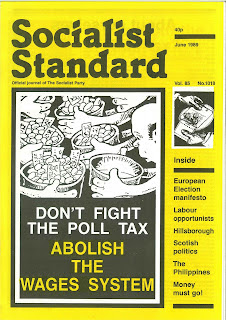
You are talking about workers with no patience who want quick solutions which are being offered by various sects on the 'Left' and I agree if they follow these ratbags up the blind alley they will become even more disillusioned and apathetic, but what do the Socialist Party offer in its place? Do you seriously expect workers to abandon their ‘Right to Work' signs and 'Maggie Out' demands for the placards of the Socialist Party who would have us marching through the city streets with 'Abolish the Wages System' written on them!

Come on SPGB. come into the real world—capitalism will end one day; other systems will evolve in line with conflicts, confusions and contradictions, and whether future systems are based on common ownership, exploitation, state dictatorship, or something as yet unconceived will be determined by humankind's expediency at crucial stages—not by a small clique who forever professes to be more Socialist Than Thou' without advancing the cause of positive human progress one whit!

Paul Cash
Sheffield


REPLY:
The "left wing" are not a "part of the opposition" to capitalism. On the contrary they advocate merely a variation to its form (that is the state capitalist one) in which the wages system, buying and selling, police, armies and so on will continue to exist. They peddle the illusion that it is in our class interest. Do not be fooled by their use of the words “socialism” and “communism" or by their use of Marxist terminology. The test to use is a simple one—will the successful outcome of their policies result in the abolition of class exploitation and its replacement by a world-wide system of common ownership of the means of life with production for use and free access by all to the wealth produced?

Clearly the political organisations you mention do not work for this end as an immediate practical possibility. Indeed at election times they urge the working class to vote for the Labour Party. Nothing could be more dangerous and futile because, as they themselves admit, the Labour Party is a reformist and capitalist organisation committed to running the system of production for profit.

Agreed that many sincere and well meaning people "vent their anger" with the system by actively taking part in "left wing" activity. We are unclear why you consider this exercise in futility "necessary". It will not remove the cause of working class misery, rather it will confuse the issue which workers everywhere should have always before them—capitalism or socialism?

Confusion gives rise to frustration and often to apathy which is a barrier to the democratic class conscious political action which must be undertaken if we are to liberate ourselves. Changes in society don't just happen, they are the result of human activity in pursuit of class interest. This is how the change from capitalism to socialism will come about, and it will take a lot of patient hard work to build a socialist majority because there are no short cuts. We do expect workers to give up their support for organisations which simply tinker with the problems of class society. Sticking plaster solutions must be abandoned if we are to free ourselves by taking control of the state and its armed forces, using them to take into common ownership under democratic control the whole of the means of wealth production and distribution. Until that time comes (and it cannot come quickly enough) capitalism and its horrendous problems will continue to afflict the useful majority in society.
EDITORS


South Africa
Now that the Communist Party of South Africa has been unbanned, it is possible to discuss its mistaken policies openly in South Africa. We reprint below a letter published in the Johannesburg "Star" on 26 February.

In the article "Alone is my joy—after 40 years" [The Star, February 8), Joe Openshaw states: "After 1948 I ceased being an active communist but continued to have faith in the economic arguments propagated in ‘Das Kapital’ and in Marxism".

And he concludes: "The upheavals in the Soviet Union and in the communist bloc have shaken me, but joining the Communist Party seemed a good idea at the time. My conviction still is that socialism could work if not perverted".

The last point, "the perversion' of socialism”, has been the central deception of the Bolsheviks from before 1917: and their followers, as well as their mainstream opponents and detractors, have "gone along with" the distortions of Marxism, to support the introduction and development of state capitalism in Russia and elsewhere. The Leninists "adapted” Marxism to suit their programmes after the overthrow of Tsarist feudalism.

Joe, your "faith” in Das Kapital and Marxism is very sad, in view of the obvious fact that you have never understood either of these. Das Kapital defines capitalism as a system of commodity production based upon wage-labour and capital, whose purpose is the realisation of the surplus- value wrung from the working class and contained in all commodities. This system prevails in Russia and in all modern countries in this world.

Finally, Marxism does not propose or support minority and/or insurrectionary action for/by/on behalf of the world's working class, but insists on the need for the democratic self-conscious, political act of the said class—when sufficiently enlightened—to replace commodity production by production solely for use, freely and willingly, based on the new relationship of common ownership and control of social production by the whole of society; not by the state, which will no longer function.
Alec Hart 
Johannesburg

Letters to the Editors: East Europe (1990)

Letters to the Editors from the March 1990 issue of the Socialist Standard

East Europe

Dear Editors,

I suppose it is true to say that most people who write to journals and newspapers do so to disagree with something in those publications.

I write, however, to praise your February 1990 issue (“Welcome to the West—East Europe Special"). Clearly. you demonstrate that it is not socialism that has failed in the Soviet Union and eastern and central Europe but various forms of dictatorial state and semi-state capitalism. Nevertheless, as you correctly point out, the so-called revolutionary upheavals in these countries are only the beginning.

In the immediate future, despite a partial democratisation of social structures, the socio-economic condition of the workers may well deteriorate. It should also be stressed that the “alternative" (so-called "free market" capitalism) is no alternative at all. at least for the majority of workers and peasants. They will remain slaves— with, perhaps, slightly looser chains; that is all.

Furthermore, increasing "freedom" of expression in the Soviet Union also has its ugly aspects. Racism and nationalism are rampant. And even groups claiming to be socialist and anti-Leninist are. inevitably I suppose, very muddled. For example, in Ukraine, a social-democratic organisation has been formed which claims to be based upon the ideas of Marx, Engels, Plekhanov, Martov and Dan, yet it adds a list of reforms to its socialist objective!

The workers of the disintegrating Russian Empire, like workers elsewhere, still have a long way to go before they achieve a largely harmonious and free society.
Peter E. Newell
Colchester, Essex.


Dear Comrades.

Events in Eastern Europe have now reached the stage when it ought to be obvious to the most myopic that the SPGB has been correct all along in its analysis of the so-called “Communist" countries.

I would like to pay a tribute to the outstanding theoretical clarity which enabled our members in those early days to make the correct diagnosis, and to cling on under tremendous pressure for so many years until at last the truth came out. as it had to.

Being able to latch on to this ready-made "case" against Russia, etc at any early stage of my political awakening has, I am sure, saved me from a lot of unpleasant confusion and disillusionment.
E. C. Edge
Preston


Manila, 7 December 1989

Dear Editors.

On December 1, 1989, thousands of soldiers belonging to an underground military organization called RAM (Reform the Armed Forced Movement) captured several military bases in the Philippines, including Villamor Air Base, the Headquarters of the Air Force. Their aim was to overthrow President Aquino's government and replace it with a civilian/military coalition government. When the RAM forces threatened to destroy Malacanang Palace, where President Aquino was trapped, the USA sent jet fighters to Manila from one of their military bases in this country. Although no shots were fired by the American planes, the rebel aircraft were scared off. Having lost air superiority, the rebels were quickly defeated. Some rebels managed to hold on to their positions in the financial district of Makati until today. December 7, 1989, when they finally surrendered.

As of today. 79 people have died, and 43 of them were civilians who were hit by stray bullets, rockets, and bombs from both sides. Although some civilians were killed at home, many were killed while being entertained by the violence. These were mostly young men on the fringes of the urban battlefield, who cheered the soldiers on. The RAM forces were called "Anejo" (after Anejo Rhum, a popular basketball team). The government forces were called "San Miguel" (after San Miguel Beer. Anejo's rival). In my neighbourhood, people stared at the sky, some even stood on rooftops, and watched the "air show". A helicopter turned slowly above, then rushed forward firing rockets at rebel tanks a few miles away. I heard on the radio afterward that the helicopter missed and hit a row of houses instead. Most of us fled our homes at 5AM when soldiers started firing at each other near our street, but later in the day we all went back and watched the “air show" again. Violence can be fascinating when you are separated from it by miles, a TV screen, or an arcade game, but up close it is terrifying.

The soldiers had nasty experiences. One soldier destroyed an Armoured Personnel Carrier only to discover later that his elder brother was inside. Once, government jets bombed government troops approaching Manila to reinforce a military base under attack by RAM forces. Many of the soldiers shooting at each other would have enjoyed each other's company under different circumstances.

Hardly anyone cared who won or lost. The radio was full of people pleading for an end to the fighting, not for the victory of one side or the other. Many people knew that their lives would not be different regardless of who took power. The coup of February 1986 that brought Aquino to power disillusioned many people.

The coup is nearly over. At the time of writing, rebel soldiers still control an air base near Cebu City, a few hundred miles south of Manila, but are surrounded by government troops. People are beginning to ask what caused the coup, and how to prevent another one from happening. This was the sixth and most violent coup so far in the 3 years of the Aquino government. Many newspapers blame graft and corruption in government, the politicization of the military that occurred during the Marcos dictatorship, the increasing poverty of the people, and many other symptoms of an arrangement that most people accept because they do not know any better. This arrangement, called capitalism, is one where a minority controls the world. When minority leadership is replaced by shared leadership, where all actively participate in the making of decisions, wars will end. Most people do not want to kill or be killed, but want power to control what goes on around them. Poverty will end, because our lack of control of the means of producing the things we need causes it. Maybe people will begin to enjoy their lives, instead of distracting themselves in order to forget their problems. In a socialist world, violence will no longer be entertainment, but an ugly perversion.
Kaibigan
Philippines


Dear Editors.
As a new reader of the Standard I was most surprised by Steve Coleman's reference to Nazism in the December issue, namely, “Why the hell couldn't the Nazis have caught Julie Andrews and those monstrously sugary kids and contributed one humane deed to history?".

I am sure Steve Coleman needs no reminder of the fate of Jewish children too young to work in the Nazi Concentration Camps—an immediate gassing or dispatch to the experimental blocks.

The precepts of Nazism were founded on national and racial hatred and its manifestations are not a subject for frivolity. I would find such remarks offensive in any publication—to read them in the Standard is particularly disappointing.
Sharon Bendelman 
Edgware, Middlesex.


REPLY:
We agree that the remark was distasteful and should never have appeared. 
EDITORS


The Carmarthen Election (1957)

From the April 1957 issue of the Socialist Standard

This election, coming after previous Government defeats in other parts of the country was considered to be of extreme importance to the Labour Party. They, accordingly, went into action with everything they had. Their campaign, carefully planned, began with a softening up process—a constant hail of propaganda by local leaders. This was followed by the sending down of the heavy artillery, Attlee, Bevan and the ex-Labour Minister of Agriculture (Carmarthenshire being predominantly agricultural it was absolutely necessary to get the farmers vote).

Attlee came, bleated in the usual Attlee manner, and went; Bevan (the chief “star”) arrived and, as is usual with “ star turns ” prices of admission were raised. For the privilege of listening to a man, who among other things created such a mighty fuss about “the bob on the bottle,” many were induced to pay a bob to listen to a lot of wind. There is in this instance something to be said for paying a shilling for getting rid of it!

Megan (pardon us, Lady Megan!) captured the seat by virtue of the poor quality of the opposition and (such is the glamour of a title) by being the daughter of Lloyd George and a Lady. Poor little “Jenny,” the Welsh Nationalist, despite a decidedly more attractive appearance, could only manage to increase her vote by a few thousand. Her policy proving more attractive to students, “intellectuals” and younger people generally. .

The Liberal, fighting what was formerly a Liberal seat, lost undoubtedly because, bad as is the Liberal case, his manner of putting it over was profoundly worse. The general comment regarding him was “ dim personoliaeth ” (no personality).

Nevertheless the campaign was not without its humour. Some students created quite an innovation by walking into one of Megan’s meetings, completely silent. They sat throughout the meeting—completely silent and walked out in file at the end—completely silent—all the while with their jackets on inside out

The Nationalist candidate, speaking in one of the many rural villages, wound up (so we are told) by stating that Wales required three immediate changes, whereupon a wag shouted “ Yes, my gel—two wings and a centre!”

The election was indeed lively, and humorous. The candidates were called upon to speak mostly in Welsh, Lady Megan not quite being able to disguise a certain “ Mayfair ” accent despite speaking in her native tongue. The Liberal and Labour candidates were both in opposition to their respective party’s policy in regard to the demand for a Welsh Parliament. Whilst the Welsh Nationalist probably lost much support from the chapels, and Pacifist Nonconformity generally by declaring support for Welsh Armed Forces!

On the whole one can say. as in other elections, it would have made no difference if each had said each others “piece” and the lot had got in.
"Socialaidd."

Review: "Wake Up, England!" (1910)

Book Review from the September 1910 issue of the Socialist Standard

"Wake Up, England! Being the Story of John Bull—Socialist.” by Edward Prince (St. Stephen's Press)

This is a stupid book — a clumsy book. It is addressed more particularly to anti-Socialists, and, in the guise of a badly written tale, endeavours to convey some idea of the state of things thirty years after the Revolution. The author would certainly have succeeded better had Nature, endowed him with a brain, but there, as the volume is directed to those equally lacking in intelligence, no great harm will be done.

But to get on with the ganglionic perturbation under notice. The chief character is a doctor, a man whose mental calibre may be estimated quite as highly as the author’s, when it is known that although he worked and voted for Socialism and lived for thirty years after its advent, at the end of that period he knows nothing about it. The “hero” of the book, John Bull, is a weak, phthisical boy, a manifest importation from capitalism, with bad eyes, a morose, taciturn disposition, a longing to be alone, and a hatred of his kind. He attempts to murder a man who runs off with his wife, and finishes up by drowning himself. Another “great” character, with a longing for the “good old times,” is William Sykes, who did a “night’s work" in the days of capitalism and came out of prison after the establishment of the new order. With this single exception, and that attended with disaster, Bill Sykes had never done a stroke of work in his life, and his misguided father, just before quitting this vale of tears, reproached him with being a tramp, and left him 10s. a week and a cottage so that toil and Bill Sykes should for ever remain estranged. Bill, by waging a kind of guerrilla warfare with the “ fishals” succeeds in living as a parasite upon his fellows, a fact which seems to afford our author immense satisfaction.

The officials, by the way, are most carious creatures—weird composites of all that is most petty and tyrannical in the vilest of capitalist shop-foremen, the most parsimonious of poor-law guardians, and the most stupid of police inspectors. By everyone hated and despised, the author is compelled to invent an impossibility to account for their retention of office. He calls it “being responsible for a majority.” Exactly how it works is not apparent to those devoid of the eye of faith. It may be clear to the author, but his secret is safe, anyway.

In brief, this bile-producing ‘‘work” is a very bad rehash of the “break-up of-family-life,” “Socialism — means — Atheism, therefore — bad,” “Socialism-means-death to-incentive” tags: silly statements, as we all know, with which Methuselah whiled away his childhood. After perusing this colossal tome the inhabitants of Frying Pan Ally and Paradise Place will number themselves with the happiest of mortals. The free and independent citizen who is fifteen weeks in arrear with the rent, and finds himself and his family kicked out in the rain, will still be able to gaze into the smiling, sunny faces of his emaciated family and congratulate himself on the preservation of his family life, his immortal soul, and his incentive —especially his incentive. He can still say as the sole drops off his only boot and he gets run in for being without visible means, “thank Gawd it aint Sosherlism, anyhow ! ”

The present writer is glad he hasn't got it on his conscience that he paid for the copy he has read.
Wilfred.

Thursday, May 19, 2016

Between the Lines: When TV told the truth (1990)

The Between the Lines column from the February 1990 issue of the Socialist Standard

When TV told the truth

Anyone who has argued with reporters at a British TV station will have seen the apologetic and compromised embarrassment which is proof of their collaboration with deceit. Yes, they will admit that TV is biased and the bias is usually against workers who dare to take on their capitalist masters. It is true, they confess uneasily, that the NUJ has discovered that MI5 vets the files of all senior "news" reporters. It is true also that there are bans on some reports. These bans may be public They are more often the result of internal semi-secret memoranda and directives. If you work for the British media you have to learn to censor yourself in case you tell unwanted truths. It is true, journalists will tell you in whispered outrage, that the government threatens the BBC with cutting its funding if it does not adequately toe the line—and with the laughably labelled "independent" TV companies fighting like mad for advertising revenue they too must be careful not to offend major moneyed interests. So if you have a concern for telling the truth (and such concern is no qualification for employment in the BBC or ITN machines) it is hard to be a journalist. Reporters are workers too; they need to work in order to get the salary to pay the mortgage to keep on living to keep on working. Many wage slaves have to do dirty work; distorting truth for mass consumption is one of the dirtiest kinds.

There are moments in history when the dirty workers decide to come clean. Such was the case last December in Rumania. The dictator, Sir Nicolae Ceausescu (the knighthood was given by one unelected Head of State to another) was aware of the importance of TV. Since the mid 1980s Rumania TV broadcast for three hours daily mainly to convey "news" of the dictator's good deeds, the healthy state of the (crumbling) economy and to play "patriotic" music. When the workers came out on to the streets to overthrow the dictatorship the TV crews had to decide which side they were on. One ungenerous observation is that they backed the right side in the battle, but some of them were doubtlessly motivated by a consciousness that now was the moment of truth: to continue telling lies when so many workers were seeing through them was pointless The reporters in the Rumanian media put their futures on the line and went with the workers. In solidarity with the bravery of the TV presenters the workers defended the TV station. The Ceaucescu loyalists knew that winning control of the mass media was the most important victory they could achieve. These days the means of communications are more important than how many bullets you have.

The support given by Rumanian TV to the rebellion there supports three points which the Socialist Party has long made about the nature of social change. Firstly, it shows that the ideas of the majority determine whether change can happen or not. However more militarily competent the enemy might be, if workers possess the machinery of ideas they are a long way on the road to victory. Secondly, it does not follow that state-indoctrinated dupes can never change. How often have we been told that soldiers are not part of the working class and are brain-washed to turn against any workers' uprising? Such is the dogma of the Leninist left. In Rumania not only the much-indoctrinated soldiers but also the university-conditioned TV employees went to the side of their own class, the workers. Thirdly, the success of what happened in Rumania owes much to TV and radio reports of successful workers' struggles in other East European countries. In Czechoslovakia it was TV film of the brutally suppressed 17 November demonstration in Wenceslas Square that spurred Czech workers to join the struggle. Similarly it was Hungarian TV reports picked up on Rumanian TV sets which alerted Rumanian workers to the legalised murders committed by state police m Timisoara. The claim that world socialism will not emerge simultaneously seems less credible than ever in this age of TV images which know no borders.

On a recent ITN news broadcast there was a five-second shot of motorists passing ambulance stations and sounding their horns in solidarity with the striking workers. The vast majority of British people support these caring workers. At the moment it is the strikers' enemies who own and control the means of communications and the sound of a few car hooters does not drown out the noise of the official "news" reports. That might change but now we know it can change.
Steve Coleman

Capitalism causes housing problems (1990)

From the January 1990 issue of the Socialist Standard

In 1969, in the suburbs of North West London, property developers built a block of flats which was regarded at the time as a model to which all future working-class housing was to be built. The idea was sold to local councils who subsequently erected similar flats all over the country.

Some thirty years later, out of the original twenty flats twelve are now empty and have been for over three years while the remaining eight have occupants living in conditions bordering on squalor. They have now become Show Flats to capitalism's inability to meet human needs and to the reformists of the time who erroneously believed that capitalism could do this. Up and down the country there are similar examples of such recently-built slum housing. There is a certain irony too since at the time the then Labour Minister of Housing and Local government, Richard Crossman. wrote:
I am getting used to being shown the most magnificent plans in the council offices and then feeling a sense of anti-climax when I walk outside and see the actual buildings going up. (Town Planning Institute Journal. LI, 1965).
Quite—and Crossman, the developers and subsequent ministers did not have to live in them either. Workers get housing which befits their subordinate class position within society. It is only the capitalist class who get the housing that meets their needs and they do so through their class ownership and control of the means of life. They did so in the 1960s and they do so today.

Workers living in squalid post-war slums are more fortunate than some others in our class. At least they have a roof over their heads, albeit one often needing an umbrella. Some twenty miles away from the suburbs of Harrow, near the South Bank in central London literally scores of homeless workers, of both sexes, are forced to live in the open air because they simply do not have enough money to rent even slum accommodation.

In an article called Freaks. Misfits and People Like Us in July 1987 (the situation has got worse since then) the Architectural Journal gave statistics on how workers became homeless. Not surprisingly, these showed that this derived from the insecurity and unpredictability associated with the class position of workers under capitalism: the majority of homeless became so because parents, friends or relatives were no longer able to accommodate them: next came the breakdown of relationships with partners, loss of home due to mortgage arrears, loss of a service tenancy, eviction from council homes for rent arrears, and eviction from private dwellings for rent arrears or for redevelopment by the owners of the property. It is important to note too that the number of homeless began to rise sharply from 1978 onwards, under a Labour government, thereby refuting Labour's current claim that homelessness is the fault of the present Tory administration—of that 'evil and uncaring woman'. Mrs Thatcher—rather than a result of capitalism itself.

Under capitalism houses are produced as commodities to be bought and sold for a profit. The developer is compelled by competition to struggle for profit—a struggle against competitors who if more successful might drive him into bankruptcy, a Hobbesean 'war of each against all' in a market, which for many developers is often nasty, brutal and short. The housing needs of workers are not his problem. In this profit struggle the diverse needs of society can never be met.

It is easy to bemoan the predicament many workers find themselves in over housing. But, under capitalism, as workers what better can we expect? We are born into a class system in which we are propertyless and can only exist by selling our labour-power to an employer. We get the housing corresponding to that class position.

If we want to end the conditions we exist under we will not do so by misguidedly placing faith in politicians nor through subscribing to charities. What is required is class consciousness and democratic political action. Until then houses will leak and fall into disrepair and the homeless will eke out a precarious existence between the current celebration of capitalism’s decadence at the Andy Warhol exhibition and the pimps and muggers lurking in the streets around Charing Cross station.
Richard Lloyd

Socialist Economics: 4. Do Machines Produce Surplus Value? (1974)

From the April 1974 issue of the Socialist Standard

Socialist Economics Series

Historically the function of the capitalist system of production was to replace the previous mode of production prevailing within Feudal society by the more efficient capitalist mode of production. This involved the amalgamation of small fragmented and even individual means of production into a social force. Capitalism socialized the means of production. All the productive forces which were capable of being developed were developed. The capitalist could ensure the presence of large numbers of wageworkers in any one place co-operating with each other within the process of production, with a view to cutting down the time expended in the process.

Even on the basis of simple manual labour, it is a fact that 20 men working in unison can perform tasks that 40 men working individually could never do. The secret is that the 20 men are operating socially, or in concert, as a productive force; a force almost as old as mankind. The sub-division of labour is accelerated as each process becomes repetitious and broken down so that a number of operations can happen at the same time. It is quite obvious that a productive force based on even a high sub-division of manual labour was inadequate so long as it continued to rely on mainly manually operated tools. There were limits as to how many men you could get into a factory or one place, and there were also limits to the amount of time you could work the labourer without his health deteriorating. This productivity of labour could only be increased by the introduction of machinery. The motive force for this machinery was, in the first instance, provided by men or animals, but eventually by water, steam, gas and electricity, in that order.

It should always be borne in mind that the natural forces in social labour, i.e. sub-division of labour and co-operation, cost the capitalist nothing; likewise with the physical forces, water and steam. It is true that physical forces have to be harnessed in order to be exploited. This involves costly power-generating stations, hydro machinery, etc., but the cost of these is recovered over the period of their operation. Capital, therefore, has not only inherited the earth, but the natural physical forces so far discovered, and perhaps some at present undiscovered.

The gigantic means of production existing today bear little resemblance to the industrial scene when Marx made his analysis of machinery, manufacture, and the position of the working class in relation to the development of these technical productive forces. Automation, computers, nuclear energy, are certainly new, but the basic Marxist theory on machinery embracing these new developments is as true today, and of equal application, as it was in 1860. Today, capitalists and their economic advisers will go to great lengths to stress that most of the profit created by modern industry is due mainly to the increasing mass of constant capital vested in plant and machinery.

This appears on the surface to be the case, but Socialists do not take things at their face value. We fully agree with Marx that machines do not produce surplus value, and consequently profit, even if whole areas of production were based entirely on automated processes involving little direct labour participation. The reason why machinery, however highly developed does not produce surplus value is not difficult to understand. Machinery is an extension of the labour process which is carried on mechanically.

Machines are, in effect, social tools created by the man for the sole purpose of replacing human labour-power, and cutting down the time expended by human labour. The productiveness of machinery is measured by the labour it replaces. It is a fact that there are quite a number of processes which can only be done by machines, but all complicated processes have evolved from a sub-division of simple labour, and therefore the fact that simple labour has been intensified to the point of the scientific skill needed to produce and operate a machine to replace that simple labour, in no way alters the basis for calculating the productiveness of a machine.

No matter how complicated machines become, even to the point of the capitalist’s wildest dreams — the push-button society — they are still produced and maintained by men. Being a product of labour, a machine like every other commodity contains value in addition to its use-value. That value is determined by the amount of socially necessary labour required to produce the machine. During the productive process, the machine wears out, and has to be replaced in the course of time. It follows then that the machine cannot pass on any more value than that which is contained within it in the first place. The machine is used in the production of commodities, and it gradually by stages, perhaps over years or decades, comes to the end of its working life. But during its working life it has added value to the particular commodity for which it was designed. Each of the commodities, therefore, has consumed part of the value of the machine, and consequently the machine has transferred its value to the products.

Suppose, for example, a machine cost £10,000, and would operate efficiently for 10 years, and at the end of the period would require to be replaced. The capitalist owner of the machine would therefore add £1,000 to the value of the products produced annually, representing 1/10th of the value of the machine. In this way the capitalist ensures that he can replace that portion of his capital vested in the machine. Any depreciation of value of machinery, however complicated, is always compensated by the amount returned to the capitalist by way of the value added to the commodity.

Value, in the form of capital, lives on — it has the gift of eternal life. Not only do the workers produce surplus value at the point of production, but they also preserve existing value. It is the phenomenon of the social relation of value that whilst it owes its origin to the social relation of human labour it has an independent existence, working through its own anarchistic economic laws; consequently it is no longer under the control of the society which gave rise to it.

If we consider the productive process as a whole, with computers, electronic devices, and highly developed machinery, there can be no doubt that these have added greatly to production. It appears that any increase in profit, apart from cutting wages, can only be derived by introducing machinery. This is true, but the profit, or surplus value, cannot come from an inanimate object. The technical foundations of modern industry are built on machinery. This machinery has been created by men under the capitalist mode of production and distribution; the incentive to its invention and introduction has always been the profit motive. If a machine is to replace labour it must perform its operation in less time than that required by human labour — it is no good otherwise.

Any substitution for labour, including the substitution of natural force for human force, is an extension of the labour process carried on by the working class. It is not disputed that machinery is a means to the production of surplus value, but this surplus value is produced by the people who make and operate the machines. The production of the worker working with machinery is increased tremendously, but the workers are paid not for what they produce but for what they sell, their labour-power. It follows, therefore, that the introduction of machinery serves only to increase the rate of exploitation; that is, the difference between what the worker produces and what he receives in the form of wages.

Each fresh introduction of machinery  into the working process is always done with a view to cutting down the amount paid in wages, by reducing the number of wage workers. Capitalists find the machine a useful ally in the struggle over wages.

Most of the industrial processes today could not, as they are, serve the needs of a Socialist society. Existing technology would provide the basis for developing socially acceptable industrial processes, free from noise, dirt, and non-injurious to life and limb. At the moment, the plain fact is that scientific progress in the development of machinery, as in all things, serves capital and not man.
Jim D'Arcy