Wednesday, March 11, 2020

The Budget: rearranging the furniture (2001)

From the March 2001 issue of the Socialist Standard

Politicians are sometimes conscious liars—often proudly so. Indeed, that’s their job, to persuade people to support them regardless of their merits rather than because of them, and to justify the actions that the economy demands they make. Politicians confront journalists, grinning from ear-to-ear, knowing their interlocutor knows that they are lying, as they dance through the empty ritual of the media interview. This very fact makes it difficult to estimate what politicians are going to do, and means that they can only be fully understood in retrospect.

This applies especially to the spinmeisters of the Labour Party, who had gone out of their way prior to the election to disguise their intentions under a barrage of rhetoric. With Labour now close to completing its first four-year term, it is possible to look back and examine their period in government by what they have actually done while in office.

The issue of taxation dominates contemporary political debate, with each party competing to be the Party of Low Taxation, whilst simultaneously offering voters higher public services. Tories allege the tax burden has risen, Labour states that tax rates have been cut, endless streams of statistics are hurled viscously in either direction, with illumination being no-one’s goal. In the meantime leftists bleat and demand that Labour “tax the rich and make them pay”. On top of all that, the immense complexity of the taxation system, coupled with intricate shifts in the economy and in methods of presentation, makes it a struggle to try to accurately find out what is really happening.

It has become orthodoxy among Labourites that they lost the 1992 election because of their image of being a tax-raising party, scaring away the affluent workers known as “Middle England”. As a part of their image make-over campaign, and their half-truthful manifesto, they pledged themselves to lower income tax when elected. In the manner of political debate, this allowed their speakers to state that they were going to lower taxes (that is, income tax) even as and when they were going about raising the overall tax burden. Whenever challenged by the Tories, they simply pointed out that the Tories raised taxes 22 times during their period in power.

Taxing problem
Labour have so far succeeded in reducing the starting rate of income tax down to 10 percent. The logic for this is that whilst benefiting the poorest workers, it also cuts taxes for almost everyone else, including the most well-off (since cutting the basic rate lowers the tax paid on that band by all tax payers). Also, as the bulk of income tax nominally falls upon the mid-range of the income scale, reducing the starting rate allows for the appearance of cutting tax for all, without actually costing the government much money. At the same time the state has raked in sizeable sums by ending the IR-35 tax exemption upon self-employed contractors, who though technically selling only their labour power as employees, are able to register as small companies and gain tax benefits.

Reducing the starting rate also has the advantage of tying in with Labour’s employment strategy. Since workers are selling their labour power for a market-defined rate, and will not work for less then that rate, it must be their take-home pay that decides their willingness to work. If their take home pay is lowered, say by taxes, this translates into upwards wage pressures, which ultimately means that the burden for any increase in taxation will fall upon the employers. Conversely, if tax rates are cut, it makes it cheaper to actually employ people, and so cutting the starting rate of tax allows more people to move from unemployment to low paid jobs which can be made profitable.

Labour tied this concept in with their benefits policy, by introducing “The Working Families Tax Credit” (which, they passed off as a tax cut) whereby tax is rebated to low-paid workers, instead of paying them directly in the form of benefits. Whilst this does not affect the overall level of their income, it structures it so that dependence is upon gaining employment rather than claiming state benefits. Essentially, it is using the taxation system as a means of social control to work within the wages system, and to apply labour discipline to the workforce. Thus they can present it as a double coup both of cutting taxes, and also cutting the size of the welfare budget; all by simply rearranging the furniture. Thus, employers are able to exploit cheap labour, without having as great a tax burden to pay.

This reduction in the taxation upon exploiting labour is also reflected in their aim of reducing Corporation Tax as well. The aim is clearly to cut taxes upon production, and so promote investment into those areas. For a long time capital investment in the UK has been problematically low, and the government has sought to ease the burden upon investment via the taxation system. It is in this context that, when they imposed the Climate Change Levy, Labour were keen to point out that it did not represent an additional tax burden, due to offsetting decreases in employer contributions to National Insurance.

Tax farming
The shift from taxation directly on the point production to indirect taxation on consumption has been slowly going on since 1979. The Tories in their final budget observed how nearly half of all taxation came from indirect sources, mostly VAT. Labour has continued this trend, particularly through ever-increasing duties levied on fuel and tobacco.

There are limits, though, to the extent to which a government can exploit a monopoly or oligopoly to levy duties. If businesses are able to pass on the tax increase to the consumer in the form of higher prices this can cause problems. In some circumstances, if the price of a product rises alternative products are sought and demand is choked off. But since both tobacco and fuel, for example, are in their own ways essential with few if any substitute goods available, the result of any price increases caused by tax rises is that black markets and resentment grow up (as the state capitalist regimes in the former Soviet bloc found out). Recently the government has had to increase the amount of money spent on enforcing tobacco excise duty, which has eaten in considerably to its taxation gains. Likewise, the fuel increases resulted in last year’s national blockade and protests. Despite the tantalising promises of politically safe revenue for governments, there are limits to the amounts that can be levied through excise duties.

The reality of the government’s position is that the state is effectively a tax-farming business, and like other businesses, it is entirely subject to the ebbs and flows of the market. It can only raise so much taxation, from any given source and the economy as a whole, as the state of the market will bear. Given that the surplus value siphoned off via taxation is surplus value that cannot be re-invested for capital accumulation by the private sector, taxation represents a restriction upon the capitalist class. Hence, historically, high taxation has been seen as anathema by the capitalists, and much like the small-holder truckers they have organised politically to fight taxation. The amount of tax revenue the state can garner is entirely circumscribed by the needs of profitability.

State spending cannot add to the total of demand in the economy, all it can do is actuate demand, and guide it to overcome consumption problems (e.g. such as sustaining the reserve army of labour). In an economy without nationalised units of production—such as we now have—the best it can do is simply help circulate goods. Capital can tolerate the lost potential valorisation in times of plenty, but when accumulation and profitability slow, it begins to resent the resources lost to unproductive expenditure. Given that taxation has risen from about 9 percent of GDP at the beginning of the century to nearly 40 percent now, a figure that both Labour and Tories seem unable to reduce, it is clear that taxation is becoming too burdensome upon capital.

Labour’s reliance on windfall taxation can be seen in this context. Rather than increase current and general spending which the state will have to sustain in perpetuity, Gordon Brown has chosen to spend large sums on special projects, such as the “New Deal for the Unemployed”, by grabbing the £3 billion “Windfall Levy” from the recently-privatised utilities: a targeted tax which did not affect capital in general, and which did not represent an ongoing drain of surplus value. Likewise, the Chancellor benefited enormously from the sale of the mobile phone frequency licences—a cool £21 billion which can conveniently be accounted as taxation spread throughout the duration of the licence, whilst still being liquidity in the state’s hands.

War chest
Brown’s careful application of taxation, as well as some luck with the economy which has been at the high point of the business cycle, has left the government with a budget surplus, the infamous war chest. Although some money is likely to be spent to create the appearance of a give-away in the March budget, the statements of the government seem to suggest that this surplus will be held to hedge against the next downturn in the economy.

This would be consistent with the government’s whole strategy. Their taxation policies have largely been the usual fare from left of centre social democrats since they all abandoned overt Keynesian practices. What little effect its minor tinkering and readjustments of poverty have, it is always entirely within the scope and allowance of the ongoing workings of the market, and entirely devoid of any capacity to control the economy at a macro level.

Like a ragged, has-been stage magician, the government must keep on performing its budgetary tricks to give the appearance of doing something—anything—to keep hold of some sort of interest in its audience. Taxes go up, go down, and are moved from place to place in a blinding game of find the lady. Underneath it all is a watered-down version of an old illusion—the illusion that the state can control the economy, can direct its course, by playing around with its tax structure. That the act remains the same, time after time, will not stop the show, since the has-beens refuse to stop. They need booing from the stage.
Pik Smeet

50 Years Ago: Socialism on the state? (2001)

The 50 Years Ago column from the March 2001 issue of the Socialist Standard

We are not concerned with discussing the relative merits of state or private ownership in any particular industry, or in general. The basic features of capitalism remain the same in either case—the relation of buyer of labour power to seller, with the propertyless and poverty condition of the latter.

Those workers who expected a better deal from the state than from private employers have been, and are being sadly disillusioned. In rejecting claims for pay increases for railway workers Mr. W. P. Allen for the Railway Executive, recently told a Court of Inquiry “It is possible that far too many of those in our employ expect far too much from nationalisation far too quickly.” (The Star, 8.1.51).

As time goes by it is becoming increasingly clear that the interests of the majority of people cannot be served by any group of leaders who profess to be “on their side” any better than those who avowedly rule them. As Gordon Rattray Taylor puts it, “workers in nationalised industries are slowly waking up to the fact that they have only changed one kind of master for another.” (Are Workers Human?, p.18).

To those who voted Labour last time in the belief that state ownership holds out a solution, or even a step towards it, of their problems we say—profit from your mistake. The only prerequisite to a good life is your understanding its highest expression—a socialist world.

(From article by S. R. Parker, Socialist Standard, March 1951)

Indian Earthquake: Did it really kill? (2001)

From the March 2001 issue of the Socialist Standard

In January, a 42-day long Indian religious festival began at Allahabad, 500 miles east of New Delhi. The Kumbh Mela attracted over 70 million Hindu pilgrims and believers, the largest gathering of humanity in history. Around one million “holy” men trekked from their remote hideaways in caves, forests and walled ashrams to be there, some revealing acts of devotion which along with the more traditional maintaining of absolute silence and sleeping on beds of nails, has included hanging upside down over smouldering fires, sitting under pots of dripping water, standing on one leg for years, staring at the sun for long periods, keeping arms permanently raised until they atrophied and in pursuit of total celibacy, having their penises enclosed in cages or fitted atop with iron rings. Such penances apparently bestow special powers, as demonstrated at the festival by the pulling along of heavy vehicles by sacred John Thomases. On one day, 24 January, over 30 million Hindu followers plunged joyously into the River Ganges to gain salvation, immortality and miraculously wash away their sins and diseases. According to the stars, this particular day had been determined to be the festival’s most auspicious time. And how did the Hindu gods respond to this immense display of spiritual faith, devotion and self-punishment with its high point of a mass dip in “sanctifying” waters where devotees prayed for “Mother Ganges” to bless them? With a 7.9 Richter earthquake just 48 hours later devastating Gujarat and killing over 30,000 people.

According to a Naga priest “bathing in the Ganges will accelerate the road to illumination”, so one might expect that following this disaster, a great many people will now stop believing in ridiculous fairy tales about divine nectar of immortality having spilled from a Kumbh (pitcher) into the confluence of three rivers (one invisible!) and thereafter becoming active every 12 years. Dedication and respect by humankind should go towards humankind, not any supernatural being or phenomenon which even if it did exist, manifestly has no inclination or ability whatsoever to prevent death, disease, poverty, hunger, exploitation, wars and numerous other everyday troubles. If thought of as an earthquake from god, and conveying a message, then it would be loud and clear: if the living want to go on living and be free of such horrors and suffering, they should forget all about religion, and act to look after themselves. Something applying as much to India’s Muslim minority who were soon praying to Mecca amidst the quake’s dead, dying and devastation, as it does to the Hindu majority.

If people let others deceive and persuade them into giving priority to belief in an almighty being, life after death and acceptance that loss of life and suffering from natural forces, conflicts, authoritarian control, hard work and the like are the will of god, then those religious leaders and governments claiming to be god’s Earthly assistants possess immense power, freedom to exploit and abuse that power and immunity for social failings. Such extreme influence, class privileges and infallibility explains why religion has existed for thousands of years and continues into the twenty-first century. But if those seeking to brainwash and manipulate us—and young impressionable minds especially—are rejected, and people instead give priority to looking after themselves and their needs collectively through socialism, then we prevent religious leaders from ruling and ruining our lives, along with political, military or any other type of would-be chiefs.

Reality
The reality with earthquakes is they kill only if we let them. They are inevitable, but death is not. It is collapsing buildings that take lives, not tremors in the ground. Throughout the animal kingdom, creatures have adapted to survive in their surroundings, but in our environment, where earthquakes are a fact of life, though nature challenges us to do something to protect ourselves, capitalism compels us to surrender safety to monetary profits and savings. No matter how severe earthquakes are, if buildings were properly built in the first place, then the vast majority of people would survive. This does not happen under capitalism, particularly in poorer countries, since the unavoidable pressure to make and save money affects what does, or more importantly, does not happen. There are pressures to build quickly and slapdashly to meet housing needs by landless labourers forced by poverty to find work in urban areas; inferior materials and construction methods are used in accordance with market forces, with poor people getting poorly-built homes; building inspectors are persuaded by politicians or back-handers to ignore breaches of rules so that businesses get the cheap employees they want and workers get hovels they can afford; landowners lobby governments, hand over party “donations” or resort to simple bribery to have new housing built on their land, even if it is unsuitable or downright dangerous; Mafia groups will drive away more legitimate building constructors. With, moneyless, socialism all such potentially lethal activity is avoided. Human needs and safety come second to nothing.

Even in rich countries like America, money can degrade safety. Multi-storey housing and office premises reach high into the sky despite earthquake risks because maximum profit comes from maximum exploitation of available ground. That means tall buildings crammed with residents or employees of capitalism’s banks, insurers, law firms etc, but high casualties if a major quake brings them down. But even where structures are well-built and designed to withstand quakes, it is usually because owners have decided that far more money would be lost than saved should damage arise from poor construction work or non-adherence to building codes. It might be said that the Japanese earthquake at Kobe in 1995 was an example of economic failure in weighing up money saved to potential losses. At $100bn, it was the most expensive “natural” disaster ever with 6,400 lives lost and 300,000 people made homeless. However, if the cost for achieving maximum safety and structural endurance had been $500bn, then Japanese capitalists acted “correctly”, and the dead were a “price worth paying”. The point is that where residents or workers find they have better survival prospects in better buildings; with capitalism, it is often more incidental than intentional.

Though seismologists don’t know precisely where or when earthquakes may strike, general areas of risk are identifiable. In a socialist society, how we respond to this information would be very different. There would be far greater freedom for those in danger to move to safer areas—action under capitalism that can involve huge financial losses from writing off unsafe homes, shifting businesses to where workers then live, adapting that region’s infrastructure to aid in exploiting the new workforce etc. And those who, for whatever reason, chose to reside in seismic zones, they would then have access to the best buildings capable of withstanding the most powerful of quakes. Although Japanese and Californian architects have designed “active buildings”, some on top of massive rubber shock absorbers or with computerised counterbalancing systems that identify and counteract seismic shocks, what’s the likelihood of such sophisticated technology being used under capitalism on multi-storey dwellings in poverty-stricken areas for workers on subsistence wages? And whereas with capitalism it is nuclear submarines, military satellites, stealth bombers, tanks and the like which get “properly” designed and rigorously tested beforehand to prevent any failures when they’re built in bulk, with socialism such diligence would then be applied to endangered homes and workplaces. Using superior designs, building methods and materials, there is no reason why populated areas should suffer any loss of life or major disruption after experiencing very powerful quakes.

Avoidable catastrophes
In a united socialist world, people would be able to move in large numbers if necessary to completely different regions of the world without any of today’s “them” and “us” animosity and violence created by capitalist exclusive assets, property rights and market-supporting politicians, as witnessed world-wide in places like Northern Ireland, the West Bank, Kosovo, Rwanda etc etc. Not forgetting India’s own continuing divisive caste system with “untouchables” lowest down, ranked as society’s toilet cleaners, 8,000 of whom were employed as “turd pickers” at the Kumbh Mela festival. India’s divisive internal Hindu-Muslim tensions which left thousands dead in riots when Hindu zealots destroyed an ancient mosque in Ayodhya in 1992, and which may soon erupt into further bloody confrontation if a planned new Hindu temple gets built there. And the on-off divisive dispute with Pakistan over Kashmir, a struggle that could claim many times the 26 January death toll in less than the short while the earthquake lasted, thanks to both sides’ possession of nuclear weapons.

We have access to more comprehensive information and news coverage about world disasters than any previous generation of humans, and yet it appears that people don’t feel driven to bring about an end to such catastrophes. Some may be moved to send money to charities or hand over old clothes and blankets, while others are assumed to have compassion fatigue. So why no sizeable political activity for real progress? It seems our society has been influenced to believe that nothing can be done. That big death tolls from quakes, famines, droughts, conflicts etc are inevitable. What efforts do schools and the media make to change this, by explaining both capitalism’s culpability and socialism’s solutions? If people don’t understand, then all there will be are yet more generations of children brainwashed on how to obtain “suitable” employment and use money, and endless TV reports of global tragedies, quickly downgraded by ratings concerns for the next show-biz marriage break-up or rich person’s demise. Brief public interest at best, or channel-changing “Not-another-disaster. There’s-nothing-I-can-do-is-there” indifference at worst. Of course, that suits capitalists and politicians just fine, but it’s only a matter of time before those far-away populations that we feel incapable of helping now will themselves one day be shrugging their shoulders while watching pictures of immense death, destruction and suffering in our part of the capitalist world. A major disaster is heading our way, and the only way to stop it is through widespread realisation that human needs can and must be prioritised, and collective political action for the social change that brings that about.
Max Hess

World View: The politics of poverty in Zambia (2001)

From the March 2001 issue of the Socialist Standard

We are approaching the 2001 presidential and general elections and the political situation remains tense. Unemployment, poverty and the lack of viable education and health care has bred outright social discontent and resentment throughout Zambia.

President Frederick Chiluba’s MMD government is still in power and commands majority support in Parliament. The opposition parties remain weak and unable to capture a national consensus, because political allegiance in Zambia is determined by linguistic and tribal affiliations. Thus many of the opposition parties are little known in other provinces or areas. The only notable opposition parties are the UNIP, the Republican Party and the National Party for Democratic Development.

UNIP, after the retirement of Kenneth Kaunda from active politics, is embroiled in a leadership fiasco and stands a slim chance to command a large following. UNIP has a strong regional support in the Eastern province. The Republican Party, led by the local tycoon and former MMD party stalwart, Ben Muria, has a large following in the Copperbelt and Wapula provinces. The National Party for Democratic Development is led by former LONRHO group chairman in Zambia, Anderson Mazoka. This party has managed to scoop a number of parliamentary seats, mainly in the Southern and Western provinces. Its regional base is the Southern province.

An analysis of Zambia’s political scene reveals that the opposition parties have come to concentrate their election campaigns in the Copperbelt Province, especially in Kitwe. This is because historically this province has come to play a dominant role in Zambia’s domestic politics. The mining town of Kitwe is the hub of the copperbelt, inhabited by a vocal and politically aligned working class population. In this semi-industrial and mining town political consciousness and social discontent seem to be expressed more than anywhere else on the copperbelt.

The demise of the copper-mining giant ZCCM has had a marked impact on the commercial and industrial sector in Zambia. Economic development of any kind in Zambia depends upon the export potential of Zambia’s mono-copper-mining sector. Thus the privatisation of the copper mining industry has entailed the loss of revenue to the government. There has occurred a startling decline in overall commercial and industrial production in the copper belt mining towns.

The working class on the copper belt have been subjected to untold misery. The public sector has shed its labour force while those who have remained in active employment receive salaries in arrears and work under shoddy conditions. Privatisation of the public and commercial sector has led to widespread unemployment in Zambia. The surrendering of city council housing units to people paying rent to themselves has deprived the city council of revenue and thus led to a decline in community welfare.

The sale of the council houses was a presidential directive and thus political. But the future consequences were not taken into consideration; nor could these consequences be corrected by the government. Urban cities have been turned into villages overnight, characterised by social poverty, child malnutrition and squalor. This voluntary creation of slum townships is a new development in Zambia and has led to the frantic manoeuvres of President Chiluba to retain a large following.

The city townships have been turned in havens of social poverty. Because those who have purchased council houses cannot go back to rural areas when they retire, this tends to have a marked pressure on land in urban areas. Most of the retrenched working class population remain restricted in the townships, where they engage in household commercial activities of one kind or another. The unpaved roads, unlit streets and unmaintained water and sewage systems means that life in these townships remains hard and unbearable.

In an economy characterised by endemic social poverty and unemployment the MMD government is concentrating on handing out hefty amounts of money through well-timed presidential donations to needy members of society. But this is a naked political campaign gimmick which has brought rebuke upon the MMD government and tarnished the charismatic status of President Chiluba. Recently in Kitwe’s Mindolo township a Catholic priest turned down the presidential donation of K10,000,000 from the MMD Member of Parliament for Nkana constituency. It was an incident that shocked and which had never happened before.

Because the MMD government is heavily funded by mining investors like the Anglo-American Corporation, the opposition political fraternity stands a little chance to compete with the MMD in terms of campaign expenditure. Nor does anyone need to be told what purpose the colossal sums of money realised from the sale of privatised para-statal firms has been used for. If the MMD government is unable to find funds for expenditure on education and health, from where does the president get the money he hands out in donations? The widely publicised calls for a third term of office for President Chiluba are merely designed to create an image of his popularity and thus win the confidence of the overseas private investors, since, legislatively, Chiluba cannot stand for a third presidential term.

In its political composition the MMD government retains its linguistic and provincial allegiances as a party of the Wapula province. Linguistic and provincial allegiances determine the strength and popularity of every political party in Zambia. Thus tribalism acts as an impediment to multi-party politics in Zambia, and political domination comes to depend upon the entrenched historical pattern of linguistic and cultural complexities. Political consciousness is more pronounced among the relatively educated and working class in urban areas, more so than among the backward and static rural traditional societies.

Because the MMD is the ruling party, the large following it can command must be attributed more to curiosity than to sympathetic support as such. A large number of people flock to MMD political rallies just to have a glimpse of President Chiluba. But every politically conscious Zambian is aware that the MMD government has disastrously failed to resuscitate Zambia’s ailing economy.
Kephas Mulenga
Zambia

The biggest rogue (2001)

Book Review from the March 2001 issue of the Socialist Standard

Rogue States: The Rule of Force in World Affairs. By Noam Chomsky, Pluto Press, 2000.

Over the years, Chomsky has been described in various ways: as “the medic trying to cure a national endemic of selective amnesia”; as “the most dangerous man in the US”; as “the little boy who told the emperor he was naked” and, more recently by the New York Times, as “an exploder of received truths”. In this, his latest book, we find Chomsky very much living up to this long-standing reputation.

It is often said that if you’ve read one Chomsky book, you’ve read them all, which is perhaps true in so far as he is a relentless critic of US foreign and domestic policy, sinking his teeth deeper into the same old foe like a vengeful rottweiler with each new publication. Rogue States is no departure from the norm—it’s Chomsky doing what he does best.

Through skilful analysis of internal documents combined with historical context, a meticulous scrutiny of the activities of the US State Dept and a thorough gleaning of the quality broadsheets both sides of the pond, Chomsky again sets himself the task of gauging the US and its allies by the standards they use as justification for the interference in the lives of others.

The Balkans, East Timor and Colombia come in for close scrutiny in separate chapters which reveal the extent of US collusion in the ongoing misery there. In Kosovo, observes Chomsky, the US “has chosen a course of action that undermines—perhaps destroys—promising democratic development”. The Clinton regime’s praise for Colombia as “leading democracy” is stringently challenged by Chomsky. Citing Colombia’s human rights record as one of the worst in the world, Chomsky provides ample proof that the Clinton/Blair doctrine of “new humanism”—the self-styled “historic mission of bringing justice and freedom to the suffering people of the world”—is a total sham. Colombia, notorious for its state terror, produces 300,000 refugees and 3,000 deaths per year at the hands of its security forces, yet is presently the biggest recipient of US military aid in Latin America. The same favoured nation status is reserved for Turkey, whose security forces, in their persecution of the Kurdish people, have destroyed 3,500 villages and created three million refugees. Meanwhile, the US is keen to promote the redeeming qualities of resource-rich Indonesia ahead of the political fate of East Timor at the hands of the former.

Chomsky further reveals the US to be wholly contemptuous and dismissive of UN resolutions and the United Nations Declaration of Human Rights it helped to bring into existence and to be severely lacking in any credible justification for its policies beyond its own borders. In the regard, Chomsky further highlights the US passion for free trade, pointing to the developing countries compelled not only to accept US cigarettes and other drugs and commodities but also to advertise them under threat of trade sanctions.

Sanctions and indeed debt “is a very powerful weapon of control” says Chomsky, with half the world subject to US unilateral sanctions, a cruel form of economic coercion condemned repeatedly by the UN. In a chapter on the paranoiac US relationship with Cuba, Chomsky reminds us that Cuba has suffered 40 years of embargoes—the longest in history, and in spite of two-thirds of the US population opposing the sanctions and in breach of WTO rules, all of which is dismissed with the defence that Cuba is a threat to US national security.

Though this can at times be a hard-going book for the uninitiated, the mountains of information make it an indispensable reference work and guide to the methods the powerful use to further their own interests to the detriment of so many. It is moreover an invaluable tool for deciphering the rhetoric the powerful use to rationalise their excesses.
John Bissett


Monday, March 9, 2020

Correspondence : What is our attitude toward the Communist Party? (1921)

Letter to the Editors from the July 1921 issue of the Socialist Standard

Mr. Mosley, of Gedling, Nottinghamshire, writes appreciatively of the "S.S." and asks some questions. He says he could ask more. We invite him to send them along. Our editorial staff work under certain difficulties, but all questions are considered and dealt with as soon as circumstances permit.

Oar correspondent's chief question is: What is the S.P.G.B.'s official attitude toward the recently formed Communist Party of Great Britain? The answer is: One of opposition. The reasons are as follows :

The Socialist shows that the master class are able to maintain and continue their rule in society because they control political power. The centre of this power is Parliament. Here the laws are made and the forces (Army, Navy, Police, etc.) are authorised and supported for the purpose of enforcing those laws, the wishes of the master class. This political power is placed in the masters' hands by the workers, as the latter possess the majority of the votes. At every election the candidates depend upon receiving a certain number of votes in every area before being elected. Except for two or three special constituencies the workers have the majority of votes in every area. Hence the necessity for the masters to obtain these votes either for themselves or for their agents, at each election.

Once in control of political power the masters can crush any attempted use of force by the workers, whether such attempt be through economic organisations or secret societies.

The only solution in line with the facts of life around us is for the workers to use the franchise to obtain political power for the purpose of achieving their emancipation. Equally clear is it that, until a majority of the workers understand their slave position and desire to alter it, they will allow the masters to continue to rule by voting them into control of political power. Hence the stupidity of fancying that an "intelligent minority" can carry through a revolution.

At the moment of writing the Communist Party have not published a constitution of their own, but as they are affiliated to the Third (Communist) International, obviously they accept the conditions laid down for joining that body. Among those conditions are the following:
  4. A persistent and systematic propaganda is necessary in the Army where Communist groups should be formed in every military unit. Wherever, owing to repressive legislation, agitation becomes legally impossible, it is necessary to conduct such agitation illegally. Refusal to carry on, or to participate in such work, should be considered a treason to the revolutionary cause and incompatible with affiliations to the Third International.
Apart from the fact that it is impossible to organise the working class secretly, there is no country in the world that allows of the formation of such groups in their fighting forces. Hence the above conditions are ordered to be applied in all countries quite irrespective of the conditions prevailing there, and of the means of propaganda that may be available in any of them. In backward countries, countries of low economic and political development, such methods may be useful, but that is a point to be settled by the people in those conditions. In countries where there is an easy, simple, safe means of seizing full power ready the hands of the workers (i.e., the franchise)—and this exists in all fully developed capitalist countries—to adopt the methods of the Third International is not only idiotic, but suicidal. Therefore all Socialists must be opposed to organisations that preach such futile methods in the latter countries.

Another reason for our opposition is that Socialism means the social ownership of the means of life. Hence the majority of society must not only be convinced of the necessity for Socialism before it can be established, but they must keep control in their own hands if social ownership is to continue. The Third International lays down a system of rule by oligarchy, for in Clause 12 of the "Conditions" it says:
  In the acute period of civil war the Communist Party will be able fully to discharge its duty only if it is thoroughly well organised, if it possesses an iron discipline, and if its executive enjoys the confidence of the party members, who are to endow the Executive with full power and authority.” (Italics ours.)
This is exactly the claim of all the misleaders of the working class, from the Tory politician to the Labour leader. "Trust us," they say, "we will look after you." To give "complete power and authority" to any individual or group is to give them something they can and may sell to the enemy. The only safeguard the working class has in its fight for emancipation is to keep control and power in its own hands. Executive committees, organisers, officials, etc., paid or unpaid, must all be servants of the working class, taking their instructions from, and carrying out their orders under the control of, that class.

The policy and method of Communist Party being thus shown to be in direct contradiction
t to Socialist policy and methods, the Socialist organisation must be in opposition to the Communist
 Party.
Ed. Com.

The “Plebs” Again (1923)

From the May 1923 issue of the Socialist Standard

Our exposure of the ignorance of the “Plebs” magazine editor on currency questions has driven that individual to various shuffles, as each attempted excuse has been shown up.

In the February issue of the “Plebs,” our article in the December issue of the Socialist Standard is referred to, but not a single attempt is made to deal with the facts of that article.

While carefully avoiding our proof that prices had risen before any alteration of the currency had taken place—which one fact completely disproves all the rubbish about “inflation raising prices”—he tries to misrepresent our case by, saying in reference to our figures :—”Therefore, it is argued there was no inflation of currency relative to prices.”

As the “Plebs” had stated that “inflation of currency had raised prices,” and as we proved that prices had risen first (thus knocking their whole case to pieces), it is easy to see how they are driven to misrepresentation in the attempt to hide the collapse of their case.

More ! Despite our repeated exposure of the falseness of their claim that “inflation had raised prices,” they repeat the same lie in their attempt at a definition of inflation. Their statement is that inflation “simply means an expansion in the volume of currency leading to a rise in prices,” and the editor adds, “And the figures in the Socialist Standard merely go to show this.”

As our figures proved exactly the opposite, the statement shows the contempt the editor of the “Plebs” has for his readers when he can write such a brazen lie. 

Not only so, but his so-called definition smashes his own case. Our figures proved that the rise in prices preceded the expansion of the currency. Therefore, the expansion did not lead to a rise in prices; and, therefore, there was no “inflation,” according to the “Plebs'” own attempted definition . In other words, the “Plebs” has given up its whole case.

Once again, an endeavour is made to save a plank from the wreck by stating that the Socialist Standard is wrong about convertibility, as “There was only nominal convertibility.” We quoted the Act of Parliament. The “Plebs” dare not touch that point. The matter, however, is placed beyond all dispute and cavil by certain facts.

Thus, to take an illustration, in 1919 a couple of private individuals drew out 110,000 sovereigns, weighing more than 18 cwt., from the Bank of England, in exchange for Treasury Notes (see Daily News, 28/2/1920).

If the changing of Treasury Notes into sovereigns to the extent of nearly a ton is only “nominal” convertibility, it would be interesting to know what is “real” convertibility !

There the matter may rest. Not one of the facts, figures, or arguments of the Socialist Standard on this question has been met or touched by those who, either from ignorance or fraud, have supported the capitalist lie about “inflation raising prices.”
Jack Fitzgerald

Friday, March 6, 2020

Wood for the Trees: The Art of Cynicism (2020)

The Wood for the Trees Column from the March 2020 issue of the Socialist Standard

Those who might be unaware of it can be confidently assured that we live in a ‘Golden Age of Rock Music’. The music of bands like: Disturbed, Ghost, Godsmack, Rammstein, Epica, Kamelot, Nightwish and Band-Maid represent my evidence for this. The last two bands have released new singles that have rekindled the old debate between the cynical and the hopeful. Some see Nightwish’s Noise and Band-Maid’s The Dragon Cries as merely profiting on the environmentalist zeitgeist whereas others hope that these tunes represent the political integrity of the respective bands and will help create political change. Obviously these videos and the music that they promote are extremely costly and can only be made within the capitalist context because they represent a commodity that will, for the investors, sell at a profit. However this fact, beloved of the cynics who choose to believe that nothing will ever change, does not exclude the possibility that the nature of that commodity might itself become subversive of the system which helped create it. Change, for good or ill, is inevitable and we can ask what role music and the arts play within our culture’s restless history.

Nightwish have a long track record of using their music to communicate a political perspective. It is only recently that this Finnish band, courtesy of the internet, has started reaching a global mass audience. They have become commercially powerful enough to only create the music that they want to make rather than bow to the commercial pressures incarnated by studio execs, producers and owners of record companies. The Japanese Band-Maid, although very popular with the rock cognoscenti online have not reached a similar stage of commercial ‘independence’. Their single The Dragon Cries is their first overtly political song but because it was produced in the USA and is sung in English some suspect it of cynically exploiting the environmental and political concerns of its intended youthful listeners. What is beyond dispute is the quality of musicianship that produces the aesthetic catharsis so essential to great rock music (or any art form). Another possible avenue for a cynical critique is the appearance of the band. They wear doll-like house maid uniforms which emphasize the extreme feminine quality of many young Japanese women. Again whether this is purely a commercial decision to attract male audiences or whether it represents an intriguing antithesis to the macho posing and costumes of the traditional purveyors of heavy rock music is debatable. If we like a band we feel the need to defend it against criticism, whether justifiable or not, but is it necessary or important to do so?

Art, as with all concepts, is full of dialectical contradictions; it can serve the powerful or it can subvert their power. It can also, if it’s any good, contradict the intentions of the artist through the interpretation of its audience. Born in the USA by Bruce Springsteen became, famously, an anthem for patriots despite the composer’s opposite intentions. In his effort to communicate with a global audience Bob Marley, according to some, sold his soul to Island Records. Art seems quickly to become independent once it leaves its creators hands. We use the word zeitgeist to emphasise this phenomenon in an attempt to understand why some art becomes iconic whilst other art, despite being of equal aesthetic quality, drifts into historical obscurity. Of course without the artist, recording technology, capital investment, the internet etc. we wouldn’t have any art to discuss but although the motivation, inspiration and integrity of those concerned in its creation is intriguing it is not the most decisive factor in the political and historical fate of any work of art.

In America the music of Jimi Hendrix, Marvin Gaye, The Doors and Creedence Clearwater Revival all fed the anti-Vietnam War zeitgeist that helped to end the conflict. The music of James Brown, Gil Scott Heron, War, the Temptations and Harold Melvin all strengthened the Civil Rights movement in the US. Not that this represented the cause of any political improvement but it would be foolish to deny that it helped create a cultural background for change. Perhaps the reason that we see such a flourishing of rock music is because of another surge of political discontent? Another irony is that many of these bands no longer come from rock’s birthplace (the USA) and oppose its economic and cultural imperialism. The German band Rammstein have said that they will never use English in their lyrics for this reason. Ironically seventy years on from the end of the Second World War we see a young band from Germany’s old axis ally Japan having to make the decision of whether to confront (like Rammstein) the contemporary icon of capitalism and its destructive values or try to subvert it – that is if they do indeed possess the political integrity one might wish them to have. It has always been challenging to believe that those with extraordinary talent might have no moral integrity or political good will and would sell themselves to the highest bidder but, to misquote the lyrics of another great rock band, ‘we’ve all been fooled before’.
Wez.

Editorial: Russia: Revolution and after. (1905)

Editorial from the February 1905 issue of the Socialist Standard

The entry of Russia into the stage of machine production and international commercial inter-communication made it essential that there should be a limitation of the aristocracy which had hitherto dominated that empire. To engage in competition for foreign and neutral markets with other commercial countries rendered it necessary that the press should be removed from the censorship of the ruling class, so that the widest publicity should be given to matters concerning commerce; that education should become more general, so that the worker might become a more efficient machine minder; that freedom of contract should be exhibited in all trade relations between merchants and manufacturers, so as to secure equality of competition.

With an autocracy interfering in all matters, private or public, these freedoms desired by the middle-class could not be secured, so that it was but a question of time how soon the growing middle-class would seek to secure political power for itself. This could only be obtained by the establishment of a constitutional government, either of the republican or of the monarchical form.

Against this desire the autocracy exercised all its powers. The knout, the mines, Siberia – these were some of the powers they used, and used mercilessly. As a result the agitation of the middle-class was driven below the surface. Secret societies, Nihilists societies were but the expression of the objects of the middle-class. True! they sometimes had the support of working men, but it was nevertheless a middle-class movement. The members were mainly from the commercial class, the professions, the students at the universities. These formed the centre of the movement. Any support they received from the landed aristocracy, or from the uneducated working masses, was of minor import.

At the same time that this movement was going on, taxation in Russia was excessive. The autocracy, knowing that its only hope for the maintenance of its stability was imperial aggrandisement, carried on wars against the weak and incoherent races of Asia, built railways at immense cost for the furtherance of those warlike designs. The ruling class, financially corrupt, and financially bankrupt, carrying on their schemes with borrowed money, found it necessary to levy heavy taxes to pay such portion of the interest of such borrowed money as was not itself paid with the borrowed money.

The result was great distress among many of the trading sections of the community, and among many of the members of the agricultural communes. The Mir, instead of being a commune carried on for the benefit of its members, was maintained as a machine for facilitating the collecting of taxes.

The distress was greatly augmented by the war with Japan, and recently hardly a week has passed without hearing of men mutilating themselves to prevent their being taken as soldiers, of wholesale emigration from Russia, of murders of governors of towns and provinces.

The working-class, too, – that class which has to carry on the battles of its masters – began to manifest signs of unrest. Strike has followed strike in all parts of Russia. The desires expressed have been for economic and political reform on the part of the workers, for political reform on the part of the middle-class.

In order to gain those desires a large number of the discontented wished to make a peaceful demonstration before the Winter Palace at St. Petersburg. These were no revolutionists! They did not belong to Socialist Societies, nor did they believe in Socialist principles! They were but unlettered working men with middle-class leaders, who believed that the Czar – the father of his people – had but to learn of their wrongs to redress them.

Poor misguided workers! Foolish you, to believe that you could gain redress except from among yourselves. A ruling class whose interests are opposed unto yours will do nothing for YOU. You must emancipate yourselves.

This lesson taught the workers in many countries, had yet to be learnt by the Russian working-class. They had not sufficiently learnt that in other countries the military was a weapon used to quell strikes. Men and women shot down in Milan and Turin during the grain riots, when Leiter tried to corner the world’s supply of wheat; men struck down in the recent general strike in Italy; innocent men shot down in Featherstone; gunboats sent to Hull during the dock strike, and to Grimsby, and soldiers to Penrhyn during the strike there; martial law declared in Colorado; men tortured to death in the Monjuich Prison at Barcelona; Pinkertons used to shoot down the strikers at the steel works of Carnegie at Homestead; strikers bludgeoned in the streets of Rosario. Everywhere the same civilised methods have been used, and will be used, when the workers strive to endanger the stability of commercial society by securing a greater quantity of the products of their own labour for their own consumption.

Now this lesson is being taught in autocratic Russia, as it has been taught in Monarchical England and Republican France. Hundreds of men, women and children have been butchered in the streets of St. Petersburg. In other centres, too, a like answer has been given to the demands of the workers. The class struggle manifests itself clearly, and what will be the result in Russia? We fear that the result will be but the victory of the middle-class. The Constitutionalists in Russia in 1905 will, like the Liberals in England in 1831, and the French middle-class in 1789, 1830, and 1848, use the working-class for their own ends, and then throw them over. The Russian worker is, we fear, too illiterate to understand clearly his own class interest, and will, therefore, need years of education before he takes his place with the vanguard of the international working-class revolution.

We think the result will be the disruption of the Russian empire into middle-class republics. Although to-day the revolutionaries in Finland will join with those in Poland, or Lithuania, and in the other Russian provinces in the same way as middle-class and working-class will combine in opposition to the ruling class, yet no sooner will they have achieved their victory, and desire to carry on the constructive work of government then all the disharmony of jarring interests will be manifested. Then, too, one section of the vast empire will be found more advanced than another, and agreement will be obtained only by separation.

Be this as it may, it is for the Russian Socialist, as for the Socialist everywhere, to recognise that it is for him to carry on his propaganda. He must use every phase of the movement for the furtherance of his ideal, always remembering that neither the rule of the Zemstovs, nor of any other middle-class government, will mean emancipation for him from his economic bondage. His hope must be in propagating his principles, in making capital out of every mistake of his enemies, in organising the workers to seize hold of the reigns of government, in teaching them how best to use that government when they have it in their possession.

Whether this should be now, or should be later, they should clearly recognise that the best wishes of the international Socialist movement is with them, for the victory of the Socialist movement in Russia will be a victory for it everywhere, and would lend fresh hopes, and give fresh incentive to their comrades throughout the world. The interests of the workers of all countries are the same – the establishment of the Socialist Republic.

Physical Deterioration and Education. (1905)

From the February 1905 issue of the Socialist Standard

It is frequently asserted by patrons of monopoly that the educating of the masses has been a dismal failure. The snob-employer says it resentfully when dismissing some audacious demand for wage increase, the patrician superciliously when some hireling makes him aware of the rights of men. The cleric contemplating his empty conventicle likewise laments the disastrous results of education. Each and all ascribe the lamentable condition of revolt to the dangerousness of a little learning. Viewed with capitalist eyes, if Education evokes class-consciousness it is indeed anathema, but to the Socialist the murmur of the master is a message of hope.

Is, or is not, compulsory education a waste of public funds?

Under existing conditions a vast amount of expenditure receives no ultimate return whatever. Statistics of five years back proved that 75% of the lowest class who had passed through all the standards of school had great difficulty to write legibly and read unstumblingly when the age of thirty was attained. Only this last week in discussion with an enthusiast on education who has much practical experience in slum schools and is quite anti-socialistic, the following valuable admission was made: "Nothing can be done to obtain happier results unless the surroundings of the pupils are materially altered."

This current year in one of the poorer schools an inspector contrasted the work done by children of eleven with the studies easily understood by his young daughter of nine. The elder— offspring of the picker-up of a precarious, hand-to-mouth existence—lagged far behind the junior whose childhood was unharassed by trade fluctuations. If it be true that "Where Care lodges, Sleep will not lie" verily it is daily proven that study and worry have no dealings one with another. How is it conceivable that the horrors of the home can be superseded by the joys of knowledge ? For instance, our little ones come to morning session mainly breakfast-less, certainly lacking a nourishing meal after a night of unrefreshing repose: children and adults alike occupy one bed in the vitiated atmosphere of the one room constituting their "home" situated in some airless slum—Short's Gardens, Lamb's Conduit Passage, Betterton Street, alleys in the New Cut and Canning Town. One child in the Third Standard three weeks ago awoke to find her mother dead by her side. Such shocks as these are not conducive to alertness of apprehension or retention of facts.

Again, compare the average age of scholars in higher grade and very poor schools. It is two years behind in the latter case; and then, too, the middle-class school displays no such divisions as are found in the less favoured one. Here the pupils are classified thus—An intelligent majority, who, by dint of incessant drudgery will be capable of passing up one standard every twelve months, then the obviously dull, who will be tutored in same class two or more years,— sometimes when the age-limit of fourteen is reached the child is still in the Second Standard, —thirdly, those most pathetic specimens, pupils passed on from our defective centres. Very few people have any idea of the vast expense of these little citizens to the nation !

Although the Code of Instruction is supposed to be compiled for all schools under Government there is a significant clause in it to the effect that all regulations shall be enforced "as far as circumstances will permit." After arduous attempts to adopt the full curriculum the exemption has over and over again had to be claimed, owing to the total inability of the learners to grasp more than the merest rudiments. Inspectors will discourage the ambitions of a freshly installed head-teacher who places before them for their approval a most comprehensive syllabus. One who has just retired after many years service said that it was a sheer impossibility and absurdity to seek to compel such stunted capacities to comprehend anything which required concentration of thought.

Various illustrations can be cited of teachers who have believed not these reports, but, with a faith in their own powers beautiful to behold, have made a brave fight to establish more advanced subjects,—several of such disillusioned ones are personally known to the penner,—who after strenuous struggles have abandoned the position : beating the air is a singularly disheartening process. Even in lessons such as Drill when acumen is not demanded the body-conquering is noticeable. In every class there are children too weak to take muscular exercise, and many of the others are utterly wearied by half-an-hour's training.

In conclusion, we admit the failure but do not attribute it to the causes so frequently assigned, but to the dwarfing due to semi-starvation. Reforming the methods employed, altering the requirements, or any reform whatever will be futile : the sound, healthy body and teachable mind cannot be the lot of the youth of the nation under Capitalsm.
Kate Hawkins

Thursday, March 5, 2020

Marx in Soho (2020)

Book Review from the March 2020 issue of the Socialist Standard

“Marx in Soho – A Play on History” Howard Zinn. South End Press $12

Witty, imaginative, to the point, with the ability to stir the emotions from frustration and anger to amusement, hilarity even, this was originally conceived as a traditional play which Zinn later reworked into this monologue. Zinn read Das Kapital (Volume I at least) before the age of twenty and was excited to recognize ‘certain core truths’ about the value of labour, surplus value and the division of the classes, i.e. labour was the source of all value; labour produced a value beyond its meagre wages; surplus value went into the pockets of the capitalist class.

The play was written at the time when the collapse of the Soviet Union brought on much gloating from the media and politicians because ‘ot only was “the enemy” gone, but the ideas of Marxism were discredited.’ Zinn wanted to show ‘that Marx’s critique of capitalism remains fundamentally true in our time.’ The opening of the play has Marx, having been granted an hour to return to Earth to defend his stance of a century and a half earlier, arriving in the wrong Soho – New York, not London – to point out the relevancy of his writing to today’s working population (the audience). Zinn states that the major events are historically accurate but that there is some literary licence regarding his meetings with Bakunin and the relationships within his own family (especially with Jenny and Eleanor) and although most of the dialogue is invented he uses Marx’s own words liberally.

This is a refreshingly different approach to bringing the fundamental ideas of Marx home, stressing, by using humour, just how relevant the principles of Das Kapital still are. ‘Did I not say 150 years ago that capitalism would enormously increase the wealth of society but that this wealth would be concentrated in fewer and fewer hands?—(reads from newspaper)—“Giant merger of Chemical Bank and Chase Manhattan Bank. 12,000 workers will lose jobs—Stocks rise.” And they say my ideas are dead.’

Commonly held confusions about communism and socialism are laid bare here with Marx becoming angrier as he looks back at Stalin’s legacy. He barks out ‘Socialism is not supposed to reproduce the stupidities of capitalism.’ Industry, war, national borders, prisons, the Paris Commune, education, all subjects are covered with relevant jibes at the situation since his time.

Marx’s anger builds as he remonstrates at the slowness of succeeding generations to accept and act on what he foretold but, realizing that he only has limited time to get his message across at this, his second coming, he mellows somewhat, reiterates the basic premises and leaves us with hope for the future – if we get off our arses!

This book is fun and will serve both to rekindle and enliven the tired socialist spirit and to encourage and further motivate active participation by armchair socialists.
Janet Surman

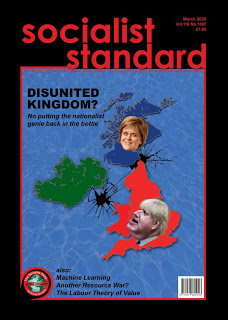
Scottish Independence : Tartan Delusions (2020)

From the March 2020 issue of the Socialist Standard

On the 31 January the blue Euro-banner was hauled down at Westminster and the Union flag raised in its stead. In Edinburgh, though, the self-awarded gold stars flag was pointedly left fluttering in place next to the saltire.

The SNP are making a none too subtle point. The antidote to the referendum they don’t like is to be… another referendum. It would seem the political ‘logic’ is that the best way to counter leaving a union is to leave a union.

It is somewhat ironic that the clash between Holyrood and Westminster stems from a single shared source, nationalism, be it competing nationalisms. The cause is perceived sovereignty, as if Scotland, or England, or Britain can stand alone, or at least break away from a power portrayed as inhibiting its freedom.

However, what would the SNP do in short order should they achieve independence? Give it up to the EU of course. Similarly, should Britain shake off the last vestiges of EU influence, then treaties will be sought and signed with such as the USA.

Not only will the USA want untrammelled access to the NHS for its big pharma, for example, there will be a demand for any arrangements to be subject to America’s legal system. For the USA substitute any other major trading nation/bloc and something similar will apply.

This is what ‘independence’ means in a global capitalist world. Significant change cannot be achieved by a binary vote in a referendum. At best there is some reordering of the arrangements, but essentially, adjustments made, capitalism continues unhindered other than by its own contradictions.

The SNP has previously stated its intention of retaining the monarch as their country’s head of state, continuing the use of sterling and joining NATO. Presumably unaware of any contradiction, they also want to be rid of the Trident submarine bases.

Do they really think that if capitalism degenerates to the point where international warfare results in the use of nuclear weapons, the removal of Trident bases will somehow insulate Scotland from the consequences?

Should the SNP decide the monarch was not to be their head of state, then a president or some such would fulfil that function. Has being a republic lessened the grip of capitalism, with its extremes of war, inequality and crises, on the USA?

If Scotland was denied the use of sterling presumably that would mean embracing the euro with all its financial hazards and, more importantly, subservience to, not independence from, the European Union. If sterling is retained, then economic policy would, ultimately, continue to be determined in London.

The formation of Britain enabled the industrial revolution to create a dynamic economy in which Scots, Welsh and English played full parts. This also led to the formation of the working class with interests transcending those of constituent regional and national parts. Workers in Scotland faced the same exploitative capitalism as they did in England and Wales and expressed their voice through their own organisations, the trade unions.

And nothing has changed. Workers on any side of a border, wherever it is drawn, all face the same fundamental problem, capitalism. To exist, capitalism must exploit workers to make profit. Painting your face blue with crossed white stripes alters this not one iota.

Whatever the outcome of another referendum the people of Scotland will continue to live under a parliamentary system designed to preserve the interests of capitalism. If they have opted for ‘independence’ they will find ‘sovereignty’ surrendered to the EU.

The parliamentary system has evolved to serve the interests of capitalism, not democracy. It does not matter if a parliament is situated in London or Edinburgh, nor if its benches are upholstered in tartan and populated by nationalist MSPs, it will remain subservient to the needs and preservation of capitalism.

Referendums are designed to give apparently simple solutions to complex problems, they are the chosen way of despots and demagogues attempting to garner some semblance of popular support of their self-serving programmes.

The ballot box can indeed be part of the response of the working class to taking economic and political power away from the capitalist class. But this will have to be just one element of a much wider movement in which the working class consciously acts for itself.

No referendum can solve problems for the working class, not in Scotland, not in Britain via Brexit (or re-joining the EU at some point), not anywhere. There is no Tartan alternative to socialism.
Dave Alton

The Irish Election: Sinn Fein Resurgence (2020)

From the March 2020 issue of the Socialist Standard

What about Ireland?

Sinn Féin, recycled from being the political wing of one of the physical-force Irish republican groups into a left-wing reformist party, did surprisingly well in the elections in Ireland last month. They got the most first-preference votes (24.5 percent) and ended up with 37 of the 160 seats in the Dáil. The result was in effect a tie between them and each of the two other rather absurdly named traditional Irish political parties, Fine Gael (‘Tribe of the Gaels’), the party of the outgoing Prime Minister, Leo Varadkar, and Fianna Fáil (‘Soldiers of Destiny’), founded by Republican hard-liner De Valera, which got 35 and 37 seats respectively.

When the original Sinn Féin was founded in 1905 it was an Irish nationalist party (‘We Ourselves’) catering for small-scale Irish capitalists eager to break away from the rest of the UK so as to be able to erect tariffs to protect them from the competition of bigger British capitalists. Its first leader, Arthur Griffith, proclaimed that, if an Irish capitalist firm was being undercut by an English competitor, ‘it is the first duty of the Irish nation to accord protection to that Irish manufacturer’ and that ‘under the Sinn Féin policy… no possibility would be left… for a syndicate of unscrupulous English capitalists to crush out the home manufacturer and the home trader’ (Arthur Griffith, The Sinn Féin Policy, 1907).

This was the policy that the De Valera Fianna Fáil government that came to power in 1932 began to implement, involving a tariff war between Britain and Ireland.

Now it’s a different story. In a 2019 policy document, Ownership Matters, Sinn Féin states that it wants ‘an economy that works for workers’ (mind you, don’t they all, given that workers make up the vast majority of electors?). After citing figures for wealth inequality and poverty in Ireland, SF went on:
  ‘Sinn Féin believes that this wealth inequality is a result of our economy being detrimentally ‘short-termist’ in its outlook – with private firms, through financial intermediaries, weighing near-term profit outcomes too heavily at the expense of longer-term sustainability. This has become the hegemonic strategy for private enterprise. The reality is that ownership shapes purpose. If we allow our economy to be owned and controlled by a small group of elites whose objective is that of profit, then that will be the purpose of our economy. If, however, we agree as a society that our preference is to establish an economy based upon productivity, sustainability and equality then ownership of our economy must be equitably spread across society’.
Then came the punch line: ‘This new economy can be achieved through alternative models of business ownership. Sinn Féin believes that the Worker Co-operative Model offers an exciting and innovative alternative.’ Not to be achieved in one go, but, in the words of a slogan the document coins, ‘Own the Change: Building Economic Democracy One Worker Co-op at a Time’.

Those who voted SF are unlikely to have voted for this, but merely so that something should be done about growing inequality and poverty. However, it does illustrate the illusions of SF’s policy makers. They criticise traditional private enterprises for concentrating on short-term profits, but if worker co-ops are to compete against them with any chance of surviving they, too, would have to pursue the same economic objective of profit. They would have to make profits as they would be operating within the context of a capitalist economy, which is based on competitive profit-seeking.

The capitalist economy

The capitalist economy – which SF would leave unchanged while launching ‘one worker co-op at a time’ – is based on separate enterprises competing to meet paying demand in their sphere of activity. The weapon used in this struggle is to produce more cheaply than your rivals but, to do this, you must re-invest the major part of the profits you make in machinery and other ways that reduce the cost per unit produced. The first enterprise to adopt some cheaper production method reaps extra profits, but this encourages, in fact obliges those that can, to follow suit and the price of the product falls, with the innovator’s profits falling back to normal. If an enterprise were to distribute all the profits it made to its owners for them to spend on their consumption, then its cost of production would not fall and its products would become uncompetitive; eventually it would go under and its owners would lose their money. Very few private enterprises are that short-termist.

The point is that the same pressure to give priority to profit-making and re-investing most of it applies whatever the legal form and internal structure of the enterprise. A worker co-op would have to operate on the same basis. Internally it might be more democratic and less hierarchical but the decisions that have to be taken, whoever takes them, will have to be the same. And of course a worker co-op can also go under, with the workers losing not only their jobs but their savings too. Some succeed but those that do end up behaving like any other business enterprise, even employing non-members as wage-workers.

In any event, given the nature of Irish politics, SF will never govern on its own but only as part of a coalition. Its openly pro-capitalist partners may well indulge it by allowing it to fund setting up a worker co-op or two but that will be as far as it goes. And if the experience of those set up by Tony Benn in Britain when he was minister of industry in the 1970s is anything to go by, their chances of succeeding wouldn’t be that high; all those he patronised eventually folded.

Up the Border?

Sinn Féin still stands for a 32-county Irish Republic – as did, at one time, the more fiercely named Fianna Fáil party – but this has come into prominence, not as a result of SF’s election successes north and south of the Border but as a fall-out from Brexit. Which is rather ironic in itself since Sinn Féin, as an isolationist nationalist party, opposed Ireland joining the EU and urged a No vote in all the referendums to amend and extend the EU’s powers.

People in Northern Ireland voted 56 to 44 percent in favour of Remaining in the EU and the EU insisted – and Boris Johnson acquiesced – that the political border on the island should not become an economic border again. It never was until De Valera and Fianna Fáil came to power in the ‘Free State’ as it then was and pursued a policy of independent capitalist development before they eventually gave up and signed the Anglo-Irish Free Trade Agreement in 1965. In 1973 Ireland and Britain joined the European Economic Community(as the EU was then called and still essentially is) together.

So, the north and south of Ireland will continue to have frictionless trade. As with the EU itself, there are those who think that a single market will be a prelude to a single political entity, especially as in the case of Ireland the Good Friday Agreement provides for a referendum on uniting with the Republic to be held if it is judged that a majority might favour this. But this does not necessarily follow, as the co-existence in Ireland for years of the political border with the economic unity of the single market and customs union showed. Even if a majority were to favour political unity, holding a referendum would risk igniting ‘the Border’ as a burning – and completely irrelevant and dangerously divisive — issue again, with a significant minority likely to be fiercely opposed to it, even to the extent of taking up arms. It would be better from all points of view to let sleeping dogs lie.

But even if it did happen without re-igniting political violence, it wouldn’t make much difference to the life of ordinary people. Capitalism would remain, and they would remain excluded from ownership and control of the means of life and so obliged to work for a wage or salary for those who own and control them. The pillar boxes in the North might be painted green – or maybe the settlement would allow them to remain red – but that would be all.
Adam Buick