Friday, April 15, 2022

Capitalism ‘bad’, socialism ‘good’ (2021)

Frank Luntz with sadness in his eyes.
From the August 2021 issue of the Socialist Standard

At the beginning of July two openly pro-capitalist think tanks – the Tory-leaning Centre for Policy Studies (CPS) and the free-marketeer Institute for Economic Affairs (IEA) – published the results of polls they had carried out on people’s opinion of capitalism. Both indicated that many people don’t think much of it.

The one for the CPS was compiled by US pollster, Frank Luntz:
‘ …Dr Frank Luntz is testing public opinion in Britain to find an alternative to ‘capitalism’, after 170 years of use, because he fears it is becoming a bad word ( … ) Capitalism itself is already a “bad word” in the US and is fast becoming so in the UK too. “It’s one of the key things I am trying to figure out: Does this country need an alternative to the word capitalism? I think it does”’ (Sunday Telegraph, 19 June).
In the event, he didn’t come up with an alternative, merely noting that ‘voters are almost as fed up with business as with politicians – presenting a huge challenge for supporters of capitalism and enterprise’. Those polled were asked to choose from a list four ‘words and phrases they thought of first when thinking about British companies’. The two most chosen were ‘Profits before People’ (47 percent) and ‘They put shareholders first, not ordinary people’ (44 percent). It is not clear why Luntz felt that these factually correct and easily verifiable statements represent a challenge to supporters of capitalism. Normally, its supporters are prepared to defend both as the best way of organising the production and distribution of wealth.

While the CPS poll was concerned with people’s attitude to ‘capitalism’ the IEA one was more concerned with their attitude to ‘socialism’. A representative sample of those aged between 16 and 34 were presented with a number of statements and asked whether they agreed with them or not, without the option of ‘don’t know’. 67 percent said ‘they would like to live in a socialist economic system’ and 75 percent agreed that ‘socialism is a good idea, but it has failed in the past because it has been badly done’. 78 percent blamed ‘capitalism for Britain’s housing crisis’ and 75 percent agreed ‘that climate change is a specifically capitalist problem’.

What are we to make of these results? Opinion polls are worth what they are worth and as Tory Lord Finklestein pointed out in his comments on the CPS one, ‘You can’t just ask consumers, and indeed voters, what motivates them, and trust what you get back’ (Times, 7 July). Those questioned are only being asked to give a fleeting opinion that commits them to nothing. And the questions can be framed to get the answer the pollster wants.

In these two particular polls, ‘capitalism’ was not defined. The tacit assumption of those who drew up the questionnaires (though not necessarily of those who answered the questions) was that capitalism meant production for profit by private capitalist enterprises. Capitalism is certainly a system of production for profit – in fact, the ‘Profit System’ might be the alternative name for it that Luntz is looking for – but ‘private enterprise’ is only one form of this. Capitalism can also take the form of state enterprises producing for the market with a view to profit. In both cases, the profit arises from the unpaid, surplus labour of the wage workers who are employed, whether by a private or a state enterprise, to produce what is to be sold.

The IEA didn’t define ‘socialism’ either, but the question about socialism ‘having failed in the past’ indicates that they think it is what existed in Russia – or, their current favourite, Venezuela. The concept of state capitalism is ruled out, even though the author of its report, Kristian Niemietz, had referred, in a previous report, to this concept and specifically to us:
‘… There are exceptions to this, such as the Socialist Party of Great Britain. They are not, and as far as I know, never were, apologists of Soviet-style socialism, which they describe as ‘state capitalism’. They are among the few socialists who have at least some idea of what they mean by ‘real’ socialism. They use that term to describe a hypothetical system in which working-class people own and control the economy’s productive resources directly, not via the state; a system in which public ownership is not mediated through a government bureaucracy’ (iea.org.uk/has-real-socialism-never-been-tried/).
Once again, it cannot be assumed that those who answered the question meant the same as those who asked it. Had the question been ‘Would you like to live in an economic system where all industries are state-owned?’ the result would have been very different. On the other hand, had the question been ‘Would you like to live in a system where the means of production are commonly owned and democratically controlled and the principle of from each according to ability, to each according to need applied?’ the result could well have been the same. But this wouldn’t mean that those answering ‘yes’ thought that such a system was achievable, only that it was desirable.

In an 80-page booklet analysing the results, Left Turn Ahead? Surveying attitudes of young people towards capitalism and socialism, Niemietz was more realistic as to what this meant:
‘The rejection of capitalism may never have huge real-world consequences. “We should ditch capitalism, and try a socialist alternative” may well be the political equivalent of “One day, I will learn a foreign language, run a marathon, and write a novel”. It may be an idea that is popular as an abstract aspiration, but less so as a concrete action plan’ (p.17).
Unfortunately, this is fair comment.

However, there will be some significance that, amongst younger people today, capitalism has become a ‘bad word’:
‘Young people associate “socialism” predominantly with positive terms, such as “workers”, “public”, “equal” and “fair”. (…) Capitalism, meanwhile, is predominantly associated with terms such as “exploitative”, “unfair”, “the rich” and “corporations”’ (p.7)
That can’t be a bad thing.
Adam Buick

The Beef Chain: A useful investigation (2021)

From the August 2021 issue of the Socialist Standard
‘Cattle ranches are destroying the rainforest enabled by giant beef companies while their US, EU (and UK) international financiers made flawed assessments.’
Above is a statement on the destruction and deforestation of large parts of the Amazon, both legal and illegal, taken from a lengthy 2020 investigation by Global Witness entitled Banks, Beef and the Brazilian Amazon (tinyurl.com/4y3bmcd6). It covers all aspects along the supply chain from cattle ranchers, beef traders, international financiers, supermarkets, fast-food chains and the governments which regulate them.

The numbers are staggering, whether those of cattle on ranches, size of forest cleared or the increased speed of the devastation in recent years. The investigation finished at the end of 2020 when there were approximately 390,000 beef ranches in Brazil, 40 percent of them in the Amazon. About 70 percent of cleared land in the Amazon is populated by cattle, and there are more cows than people in the country. Starting with ranches the chain continues with the beef dealers, including three Brazilian giants, which mostly control the slaughterhouses and sell on the beef. These three beef companies slaughtered more than 18 million cattle in 2017, equivalent to 40 percent of Amazon beef. These same multi-billion-dollar beef companies sell 64 percent of the total Brazilian beef exports to the EU, US and China. Next in the chain come the intermediaries who finance all aspects. These are the banks and big finance companies: the World Bank, Blackrock, ING, Barclays, Morgan Stanley, Santander, Deutsche Bank, BHP Paris, HSBC. Nearing the end of the chain retailers and fast-food outlets include Walmart, Carrefour, Nestle, Burger King, Sainsburys, Subway and McDonalds.

Beef production in Brazil is the number one cause of deforestation emissions across Latin America. According to the World Resources Institute more than 20 million hectares of Brazil’s Amazon primary tropical forest were lost between 2002-2018. Year on year forest fires driven by deforestation increasingly devastate more of the Amazon, all for the sake of profit while the planet shows all the signs of being out of control. In the years 2005-2013, before Bolsonaro became president, state interventions helped to bring about a 70 percent drop in Amazon deforestation. Bolsonaro, as president, has attacked safeguards and agencies protecting the Amazon and the situation has now become critical. Ranches fall into one of several categories depending on the age of the cattle. First are the ranches for breeding, from which the animals are moved on to rearing ranches and then to fattening ranches. When the time comes for slaughter they are moved once again, this time to the traders’ slaughterhouse facilities.

All traders are obliged to have no-deforestation pledges and to monitor the supply chain of beef to check both non-compliance with forest destruction laws and human rights abuses. Whilst the numbers are staggering a few of the examples mentioned here give some idea of the scale of this whole beef production topic. One of the three biggest beef traders briefly mentioned above, Marfrig, describes itself as the world’s second largest beef producer with a work force of over 30,000 employees. Gross profit in 2019 – over $1 billion. Marfrig claims to have met the Greenpeace agreement regarding protection of the Amazon rainforest and no illegal deforestation nor any human rights abuses for the previous five years. Another of the ‘big three’, JBS, had audits carried out by the DNV-GL company on behalf of Greenpeace and the ParĂ¡ state prosecutor. The auditor’s Code of Conduct states that it must avoid ‘any combination of roles and services that could be perceived as representing a threat to the impartiality and independence of its services. We do not classify, certify or verify our own work.’ Their audits for the Greenpeace agreement claimed that JBS’s cattle purchases were 99.99 percent compliant (2016) – but its audits for the ParĂ¡ prosecutor’s agreement the same year showed almost 20 percent of JBS’s purchases were not compliant.

Similar improper situations occurred with banks claiming to be compliant with laws and agreements relating to illegal deforestation. Such examples as a leaked document seen by Global Witness from HSBC to the JBS company heavily criticising them for giving no clear information or statement regarding the sources of cattle and for having ‘no vision, action plan, timeline, technology or solution.’ Then, in the same document, HSBC recommends that investors buy shares in JBS. Other examples reveal complicity in human rights abuses of workers and those forced from their land by threats and even murder. Some perpetrators have received heavy fines or prison terms, but most escape punishment.

The top ten countries importing from the three biggest beef suppliers include China 34.4 percent, EU 10.9 percent, Russia 6.65 percent, US 3.51 percent and UK 2.89 percent. The major retailers listed earlier tend to sign up to various treaties such as threatening to boycott produce if further land grabbing or deforestation continues but when contacted by Global Research with questions on progress or results there is often no reply.

If we look at the position of consumers, those at the end of the chain, in this case buyers of beef from Brazil and particularly from the Amazon, this report suggests that most will only have information from those they are buying from, that is supermarkets and fast-food chains. They will know where the beef was sourced but will be unaware of the various steps in the chain. If they were aware of, for instance, the global banks and their investors, plus the multinational beef traders funded by these banks, perhaps they would have second thoughts about their purchases. Over years many consumers have become aware of the harm done in other countries by the pension fund they are personally linked to and have protested to stop it. Many indigenous people in regions of the Amazon have been forced from their traditional lands, have been threatened and even killed for protesting, and continue to suffer threats and violence while trying to protect the forests which are their home.

Regarding the final section of the report which is related to what should be done, as is to be expected it is very detailed but also filled with unreal expectations of capitalism. All is tied up with law, the responsibility of traders, auditors, banks, financial actors, importers, supermarkets, federal environmental prosecutors and the Brazilian government. Having said this the PDF is well worth reading for the sheer amount of detail it offers on any and all of these important aspects, facts and figures, plus some mention of the loss of and risk to the many varied and endangered life forms, a topic from which too many are distant or ill informed. Diagrams and photographs give some added understanding of the enormity of the problem.

This global system of capitalism which thrusts separate countries into constant competition with other nations and forces many smaller states into positions of subservience to the more powerful is absolutely the opposite of what is urgently required if the planet is to remain a safe place for all life. Surely no one can be ignorant of the fact that we are one world and that all areas affect and are affected by others, whether as the result of mining for fossil fuels on land or in the sea, from emissions of global trade practices or, as we have here, massive destruction of the lungs of the world in order to raise more beef for sale on the world market.
Janet Surman

Tuesday, April 12, 2022

War on the Wage Front (1957)

From the April 1957 issue of the Socialist Standard

Is  the Time Opportune?
Along with the shipbuilding workers who came out on strike on 16 March, millions of workers in the engineering, building, railway and other industries have claims awaiting settlement. The newspapers and politicians urge the workers to be moderate and to submit their case to arbitration and they profess to be shocked that a trade union official, Mr. Hill of the Boilermakers, should say "No arbitration. We are going to fight" and that Sir William Grant chairman of the Engineering and Allied Employers, West of England Association, should declare:—“This time we do not want government interference. That is quite positive. We want to fight it out ourselves. We have got to stand firm and prove to these fellows that things are not done so easily." (Daily Mail, 13, March, 1957.)

In the same quarters tears are shed because there should be a hold-up of industry “just now,” the idea being that strikes are all very well in the past or in the future but not (as the Daily Mail puts it) “just as Britain is coming out of the Suez squeeze and the gold reserves are climbing up again." This is humbug and is a line of argument that should be totally ignored by workers considering strike action. If at any time conditions are relatively favourable for workers to strike be sure the Government and the employers and the Press will find reasons why it should not take place then. But workers with long memories will recall the many times past when they have been lulled into delaying action while the employers prepared for battle. It happened in 1922 with the engineers in a dispute over an overtime agreement. Negotiations broke down in April, 1921, but the employers waited seven months before they delivered their ultimatum that led eventually to a weeks long lock-out—they were waiting for the heavy unemployment to undermine the resistance of the workers and to deplete the funds of the Unions through payment of unemployment benefit.

Are the Employers Bluffing?
The present engineering dispute is being fought against a background that is very different from the lock-out of 1922, and the difference is not that, because of the so-called “Welfare State,” the wages war has changed its nature or that arbitration has made strikes unnecessary. The difference lies in the state of industry and of unemployment, the factors that workers do need to study closely. Strikes are not won by bull-headed bravery; the employers, with the Government behind them, if they regard an issue as vital, cannot be starved into submission, and in a long-drawn-out battle of that kind are bound to win. But if trade is good and employers do not want to have profitable production interfered with their first blunt refusal to make an offer will prove to be bluff. That may well be the situation now and short sharp strike actions may be successful.. A few months ago with motor car and ancillary plants on short time many employers may have contemplated a show-down over wage claims but with the motor trade recovering and engineering and shipbuilding profits and exports on a high level it is more likely that employers generally will be prepared to pay a wage-increase rather than have plant shut down and contracts interrupted.

The Daily Mail in a leading article (13/3/57) has admitted that “there is little question that the shipbuilders could afford higher wages . . ." They were doubtful about some engineering firms but it is rather surprising that they should have gone so far as this.

The Labour Party and Strikes
Labour spokesmen have attacked the Tory Government for their handling of wage disputes and in particular have blamed the Government for allowing the cost of living to rise. But no one should be deceived into thinking that things were any different when the Labour Government was in power. In 1948 there was also an engineering wage claim, which likewise the employers turned down. The engineers then too threatened strike action and their case was based on the rise of the cost of living and the general inadequacy of pay. But far from the Labour Government giving them encouragement, this was the time of the “wage-freeze” policy and the workers were being told that they should not ask for more pay although prices were rising.

But the engineering workers persisted and their threat to strike brought results, for a court of inquiry specially appointed by the government recommended a wage increase, though it did so with the explanation that it was only because of “particular circumstances" in the engineering claim and was not to be a precedent for other workers and so upset the Labour Government's “wage freeze" policy. It did in fact open the way for other workers to claim.

Don’t worry about the Germans and the Japs
The workers who demand more pay and threaten to strike are being told, as they always are on such occasions, that British export prices will be pushed up and foreign manufacturers will capture all the markets. The obvious working class reaction to this factor ought always to be that of strengthening international trade union organisation so that workers in all countries can act together on wage claims, this time some sort of all-round movement is in being for wages are rising fairly generally in Europe, U.S.A. and elsewhere. In Germany it is the engineering and shipbuilding workers who are leading the way and Japanese workers also are striking:—
“In Germany, organised labour is growing steadily more militant; Its appetite has been whetted by the success of the 16 week strike of engineering and shipyard workers over sickness payments and annual holidays, and similar claims are expected from other branches of the Metal Workers Union. In Japan, this year's labour troubles look like being worse than last year's. . (Financial Times 14/3/57).
Nonsense abort Nationalisation
Some engineering and building workers are deceiving themselves with the notion that the long-term way out of their wages difficulties and the threat of short-time or unemployment when sales fall off, is to press for nationalisation of their industries. They should think again and drop this nonsense. Nationalisation has solved no problem for the working class and they have before their eyes a striking example in the railways. The railwaymen are among the worst paid industries. They have just rejected a miserly offer of a three per cent. increase and appealed to arbitration for more. And at that arbitration on 26 February of this year the spokesman of the Transport Commission, opposing the claim, gave the same reason as does every group of employers, “the duty" of the Commission to resist the claim on the ground of their financial difficulties, the fact that they are making a loss instead of a profit (Daily Telegraph, 27 February, 1957).

Nationalisation is not deserving of working class support and to raise the issue in relation to a wage claim is worse than useless.

But that is not to say that workers should go on year after year imagining that there is no other way except to strike for higher pay when trade is good and go down fighting when trade is bad. The way is open whenever a socialist working class wants to use it. It is to take democratic political action to get rid of capitalism and establish socialism in its place. Then there will be the certainty, through the ending of the destruction and waste of capitalism, of bringing about a vast increase in the production of useful things and no propertied class to stand in the way of that so much promised and never arriving "higher standard of living.”

The suicidal action of the workers every few years at general elections is of far greater and more lasting importance than the strikes for higher wages that occur in between. At elections the working class places in power the Tory or Labour politicians who use their office to keep in being the social system which makes the workers a propertyless class producing wealth and profits for the capitalist minority. Given this situation, with the government in the background safeguarding the position of the propertied class, the industrial struggle over wages and conditions of work can go its up and down way indefinitely without ever settling anything. Socialism is the only way to end it and open up a new horizon for society.
Edgar Hardcastle

New Pamphlet (1957)

Party News from the April 1957 issue of the Socialist Standard

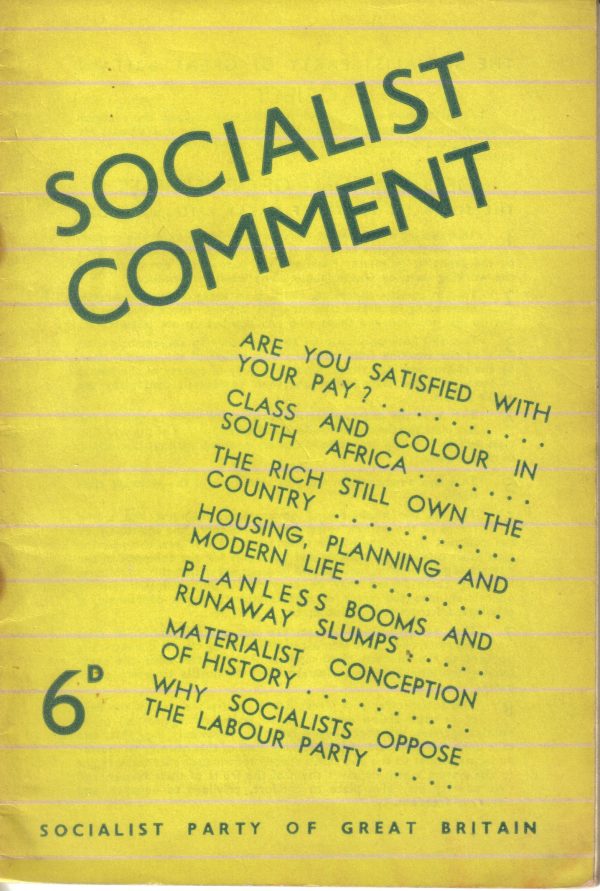
A pamphlet Socialist Comment, is now on sale (40 pages, 6d., post free 8d.) It contains seven articles reprinted from issues of the Socialist Standard during the past year or two. It deals with the colour problem in South Africa; why Socialists oppose the Labour Party; Housing; boom and slump; the ownership of property; and the workers’ ideas about their pay.

Hints on Civil Defence (1957)

From the April 1957 issue of the Socialist Standard

What are you doing about Civil Defence? Busy sealing your windows with sticky paper, learning how to bandage a cut finger, and how to dig grandma out of the rubble? If so, we’ve got news for you. Hiroshima and Nagasaki are ancient history—civil defence methods being taught today are likely to be as effective against future nuclear weapons as stone-age implements would be against tanks.

And what authority have we for taking this rather pessimistic view? None other than Mr. Val Peterson, who is the Federal Administrator of Civil Defence in the United States. His department was set up in 1951, and his conclusions are, therefore, by no means hasty speculation, but the outcome of six years' study of a subject vital to American government policy. According to an article by Mr. Alistair Cooke in the Manchester Guardian (20/2/57) “He (Mr. Peterson) has refused to admit that any plan of civilian defence no matter how grandiose in conception or how faithfully executed, can cope with the destructive power of modern weapons, any more than a teacup can bale out a sinking liner.”

Tut! Tut! We trust that the appropriate authorities over here will give the lie to this defeatist philosophy, even though it comes from such an expert as Mr. Peterson.

Mr. Peterson is pretty gloomy about the protective value of air-raid shelters, even if there will be enough of them left for us poor workers after the needs of service chiefs, cabinet ministers, captains of industry, etc., have been met. To quote Mr. Cooke again: “Mr. Peterson said that if the whole 170 million Americans had air-raid shelters, at least 50 per cent of them would die in a surprise enemy attack.” In the final analysis, he said: “There is no such thing as a nation being prepared for a thermo-nuclear war.”

In an emergency Mr. Peterson’s office would be responsible for dispersing the American government, evacuating the cities, and commandeering transport, utilities, and hospitals. But would we have any warning that an emergency existed before the first hydrogen missiles began to fall like the gentle dew from heaven?

However given three hours’ notice Mr. Peterson thinks that about half the population of the inland cities in the United States could possibly be saved by totally evacuating them. But where could the population of the inland cities of Britain go? There just are not the wide open spaces here as in the U.S., and one or two strategically placed hydrogen bombs. . . but there, it does not do to be too morbid. Unfortunately, according to Mr. Peterson, the inhabitants of coastal cities in the U.S. would not fare so well as the inlanders because of unheralded atomic shellings by submarines suddenly popping up out of the sea: we will suppress any remarks about British seaside resorts in case the good mayors of Brighton and Margate blame us for any decreased attendance of holiday-makers this Summer.

The interest in Soviet air power is misplaced, according to the New York Herald-Tribune (also quoted in Mr. Cooke’s article), because long-range submarines could be used as launching platforms for nuclear missiles having ranges up to 5,000 miles; the great industrial centres deep in the heart of the U.S. “ are within range of this potential terror streaking out of the Atlantic, the Pacific, and the Gulf of Mexico.” Submarines streaking out of the North Sea (long or short range) could deal very effectively with the closely concentrated industrial centres in Britain.

So it looks as though we must abandon the sticky paper those nice shiny tin helmets, etc., and take to the hills. But wait a minute, that awkward Mr. Peterson has objections to that idea as well. To quote Mr. Cooke: “Mr. Peterson thought that, even to rescue half the population, the United States would have to start at once plans for housing most of its city populations underground in the mountain ranges of the East and West. He piled on the misery by warning the committee that even such drastic plans foresaw only an attack by hydrogen weapons. Within a year or two, by 1966 at the latest, he was convinced that the inter-continental ballistic missile, with an atomic or hydrogen warhead, would be the prime weapon. When that was perfected, he said, the Government's recommended plans for evacuation would be 'out the window.' ”

But the worst is yet to come! Mr. Cooke’s stimulating (but rather gloomy article) ends by quoting the New York Journal-American, which has revealed that U.S. military scientists are working on an inter-continental missile with an “anti-matter” warhead that “would make the hydrogen bomb look like a fire cracker.” According to Mr. Cooke “one gramme of 'anti-matter' could trigger a weapon as powerful as the Hiroshima bomb; and the expert guess is that a portable warhead could ’conceivably blow the Soviet Union off the map.' ”

Our rulers tell us that we must have the latest (and therefore most devastating) nuclear weapons because they are “deterrents” to potential aggressors; it is never Britain which is the potential aggressor, but always “the other side.” Of course, the governments of the United States, Russia, France, Germany, etc., are busy telling their own workers the self same story. No government wants war, and yet all are preparing for it.

Socialists know that war is the final arbiter in the bitter struggle between rival capitalist groups. So long as capitalism remains, the threat of war with or without thermo nuclear weapons is ever present, casting a dark and dreadful shadow over the happiness and peace of mind of millions of human beings.

The only effective civil defence measure would be the rapid growth of Socialist knowledge among the workers of the world, so that capitalism may be replaced by socialism, and international rivalry abolished.

One final hint: read our pamphlet The Socialist Party and War (price 1/-). which contains a detailed socialist analysis of the cause of wars: there is more practical advice and cause of optimism contained within its 100 pages than in all the mass of civil defence literature published by governments which at the same time are planning more efficient means of destruction.
Michael La Touche

The Irish Elections (1957)

From the April 1957 issue of the Socialist Standard

"The main problem now confronting the people is to discover by what defect in our system it has come about that the nation, while never better equipped in knowledge and machinery to produce all its needs, is forced to see so much of that knowledge wasted and the machinery lying idle, while thousands of willing workers are unemployed and in need of the necessaries of life."

Thus spoke Senator James Hickey, Chairman, at the Irish Labour Party’s annual conference in Athlone, less than a year ago. At the time, Labour was the second largest party in a Coalition Government, which had been pledged to discover and remedy this defect along with all the other problems of the Irish working-class, who had elected them. They failed to do this and as a consequence. must now try to fill the opposition benches, with depleted ranks, while the task of administering Irish capitalism passes to Mr. De Valera and his colleagues in the Fianna Fail party Speaking at an earlier Labour Party conference, shortly after being elected to power, Mr. B. Corish (A Labour Minister) said: "Workers could look forward to the day when the spectre of emigration would have become a bad memory . . . it remained one of the fundamental aims of the Labour Party to see that every person who was willing to work would find decent employment in his own country.” (Dublin Evening Mail, 30/9/49). Yet, in a statement issued on the 26th January of this year, explaining why he could no longer support the Government, Mr. S. McBride, ex-Minister for External Affairs pointed out that the unemployment figure was now 100,000 and that in the five year period 1951-6, over 200,000 people had been forced to emigrate. So much for Labour Party promises. In Dublin, where unemployment is most acute, the unemployed put up a candidate of their own and succeeded in capturing a seat at the expense of the party who claimed to have the solution to their problems! Work hard, they were told, and prosperity is yours. “If our national income becomes stagnant, if we refuse to work hard and produce more, social security becomes merely a delusion and a deception, said John Costello, the Prime Minister, in 1948, but the man who was Minister for Social Welfare (plus the portfolio of Deputy Prime Minister), Wm. Norton (Leader of the Labour Party) had told the workers ten years before, that “Under our' present social system, greater productivity means a lower wage for the worker and higher profits for the owner of industry.” (Labour News, Dublin, 29/1 /38). Though Costello could claim in the Dail (20/7/49) that the 1948 volume of production for all industries was 28% above the 1938 volume and the United Nations Statistical Bulletin issued on 6 November, 1947, included Eire among the countries showing monthly production averages higher than 1937, the International Labour Office in its cost of living findings for February, 1947, picked out Eire for special mention among four countries where “real wages have actually dropped below 1937 levels.” Little wonder that the tide has again turned in favour of “ Dev.”

If however the working class of Ireland believe that their problems can be solved by Fianna Fail, they are in for a rude awakening; for the record of that party is a record of service to the only class which can be served under capitalism—the capitalist class. It was they who introduced the most repressive anti-working class legislation in the history of the State. The Wages (Standstill) Order, the Trade Union Bill, the Industrial Relations Bill (which set up the now notorious Labour Court), all measures designed to hinder the efficacy of trade-union action, in the interest of Irish employers. After sixteen years of Fianna Fail rule, the Medical Superintendent of the Dublin Fever Hospital stated that: “Until the Dublin wage-earners and their wives and children were decently housed and fed, more beds in sanatoria and tuberculosis hospitals would be needed.” (Irish Independent, 24/6/49). That was Fianna Fail before; may we expect a change now? The answer is an unqualified “ NO ” and to prove that he is consistent in his concern for the class he represents, Mr. De Valera’s first statement after his election success was— yes, you guessed it—a clarion call for harder work! “One great, combined and sustained effort and the task will be done.” (Irish Times, 8/3/57). And the “task?” To put a very shaky native capitalist class back on its feet again, while Irish workers continue to live in poverty and go to Mass on Sundays.

There is, however, one bright spot in this otherwise murky picture; the tiny (as yet) Socialist Party in Ireland, continues, with the limited means at its disposal, to point out to Irish workers the message of Socialism, that until the machinery referred to in the first paragraph is commonly held by ALL, it will continue to lie idle, however willing a non-owning class may be to use it. This wonderful world can be OURS when enough of us really want it AND KNOW HOW TO GET IT.
F.

Party News Briefs (1957)

Party News from the April 1957 issue of the Socialist Standard

Annual Conference is being held once again at Conway Hall, Red Lion Square, London, on Friday. Saturday and Sunday, April 19th, 20th, and 21st, commencing 11a.m. (Sat. 2.30 p.m.) Every effort is being made to ensure that a good delegation is present to discuss the work of the Party during the past year. Apart from work to be done and plans for future Party activity discussed, members have a good opportunity of meeting Comrades from the Provinces and other London Branches and making Conference a social venue. A dance and social will be held on the Saturday evening; a good dance band has been engaged and it now rests with Comrades and friends to enjoy themselves at this annual Party event.

#    #    #    #

Lewisham Branch has organised a series of four meetings to make known in greater detail the “Socialist View on Four Burning Issues,” the plan for a European Common Market; the South African Racial Problem; the Rent Bill and the Cost of Living. Not a week goes by but that these issues the subject matter of thousands of words, both printed and spoken through Press and Radio. These meetings will set those problems in their true perspective, evaluating carefully the interests at stake, and stating plainly what action is necessary to bring about a lasting solution. Although the meetings do not commence until May, the Branch Organiser and Branch members are anxious that members should know well in advance in order that they may advertise the meetings among their friends.

#    #    #    #

Comrade T. P. Gibbs. We regret to learn that this Comrade from Tottenham Branch died at the end of January. Comrade Gibbs had been an active member of the Branch until his death, having joined the Party in 1908. He was always relied upon to undertake any Branch work that was within his powers, helping to build up and maintain the regular sales of the Socialist Standard. He was also the Dues Secretary of the Branch.

#    #    #    #

Comrade R. C. Walker, of Vancouver, Canada, is recovering from a serious illness and is at present unable to supply his Vancouver contacts with Party Literature. We understand that other Comrades are being contacted to carry on this work and meanwhile we wish Comrade Walker a very speedy recovery to good health.

#    #    #    #

At the time of going to press, the Wood Green and Hornsey Branch were discussing the question of contesting the Hornsey bye-election. In any case a publicity drive is under way in the area. Members, especially speakers, living near enough to help, should call at the branch on Thursday evening or contact the Wood Green and Hornsey Organiser at Head Office on Tuesday evenings.

Members are urged to give the fullest possible support to this campaign as from this activity we hope to build an organisation to co-ordinate North London publicity that will make our aims familiar throughout this area.

#    #    #    #

Sunday Evening Film Shows at Head Office. The last two meetings of this season are being held. The Organisers report that the series has been most successful and they look forward to “ bigger and better ” shows next Autumn. The meetings have been well attended and good discussions have taken place after the showing of the films.
Phyllis Howard

Odds and Ends: Wicked Materialists? (1957)

The Odds and Ends column from the April 1957 issue of the Socialist Standard

Wicked Materialists?

Speaking recently (News Chronicle, 22/2/57), as chairman of the Church Assembly, Dr. Fisher, the Archbishop of Canterbury, said: “On so many bodies I belong to, really the business is ruined by these constant discussions about salaries, stipends, and superannuations, and all the rest. . . . I have come to the conclusion that it is an insidious form of pure materialism. It is a disease running through the community.”

Poor Dr. Fisher! He seems so upset at those wicked materialists, i.e. parsons, with average pay, £650 a year: and, of course, all those railwayman, clerks, dockers and the like, who all seem so materialistic in their desire for a better life—in this world. But then our dear Archbishop need not worry himself unduly about his own material well-being. He only receives £7,500 a year as Archbishop of Canterbury.


£400 for a Slave

Fairly recently King Saud of Saudi Arabia visited “the land of the free’’—the United States of America, where he was fĂªted by President Eisenhower, and other American politicians. Little is known of his country except that there is sand—and more important—oil, in Saudi Arabia. But a recent United Nations report (News Chronicle, 22/2/57) gives us some idea just how “free” and democratic King Saud’s oil-soaked land is. According to the report Saudi Arabia has 450,000 slaves— just 20% of the population. Prices on the Jeddah slave market were said to be between £200 and £400 for a girl under 15; £150 for a man under 40 and £40 for an old woman.

Like Christian Archbishops who also live quite well, Moslem Kings, such as King Saud, do not condemn slavery—chattel slavery in Arabia, and wage-slavery in Britain 1


Human Nature ?

A most startling recent discover was a tribe of Honest Men! It goes without saying that they were not found in Christian lands. They were found in the jungles of Venezuela by Prof. Tenton, an ethnologist. He reports that these uncivilised people never lie, never make war, never kill and never rob.

They have no politicians, no advertisers, no crooks, and are so used to each other’s honesty that they have no locks and keys, no monetary systems and don’t even wear clothes.

All that remains is to protect these Maora Indians from the Christian missionaries, with their civilising influences.” (Freethinker, 14/12/56).


Women in Antiquity

"Women In Antiquity" by Charles Seltman (PAN Books, price 2/6d.), is quite an interesting and provocative little book, although the author has a number of axes to grind. Much of what he has written of women “in antiquity” will be challenged. For example, in his first chapter on Palaeolithic and Neolithic society he sees a situation where from 20 to 50 people live “comfortably” in a cave owned by the biggest male. And, further, after dealing with the activities of the women (such as scavenging for nuts, roots and fruit), he writes:—
“When one tries to imagine the structure of such a cave-family, one can think of two possibilities : firstly, the senior male (whose property the cave was) might have a series of wives from the oldest at twenty-four to the youngest at twelve, among whom there would inevitably exist a kind of harem-like jealousy productive of much unhappiness; secondly, the whole cave-family group may have lived in what zoologists call a 'clone,' in which the women were shared in common by the men." (p. 14.)
Of course, all of this, is purely speculative, and in contradiction to the findings of other anthropologists, who often see an absence of jealousy in primitive communities and who write not of a dominant male but of sexual equality—"sexual communism”—and “group marriage” during this early period of pre-history. Seltman’s ideas on this period seem to be much akin to those of Freud with his dominant father, the jealous sons and the “Primal Horde.” Still, in the main our author is on the side of the women! He generally sees the position of women “in antiquity” as a favourable one compared to their position m some countries today. And he has little sympathy for the Church’s views on women and sexual relations in general. 


“Freedom's Foe—The Vatican"

This book is by a "free-thinking” protestant, and is a counter-blast to Catholic Action. In the main it reiterates the views put forward in greater detail by Avro Manhattan in The Catholic Church Against The Twentieth Century.

Adrian Pigott, the author of Freedom's Foe, deals with the Catholic Church’s alleged former collaboration with Fascism and Nazism, with the “evils of priest craft," the misdeeds of some of the Popes, the "cruelty of the Catholic Church," the extreme poverty to be found in some Catholic countries such as Spain and Ireland (he tells us that “Protestant countries have little discontent or poverty .. ."!!) and the activities of the Church in Britain and the United States.

No doubt many of his criticisms are valid—but what can the Protestant critics of Catholicism, such as our author, offer the working class of Britain and elsewhere? The Church of England, of whom Marx once said, that it would rather give up its Thirty-nine Articles of Faith than give up one thirty-ninth of its property? Neither Protestants nor Catholics, Moslems or Buddhists, have a solution to the problems confronting ordinary people. Only Socialism has an answer to those problems. All the same this little book is worth l/6d.

Freedom's Foe—The Vatican, is published by the Wickliffe Press, Fleet Street.


Are you Fed-up ?

Do you dislike the Foreman or the Chief Clerk? And when you get home from work at night, do you feel tired, frustrated and fed-up?,

Do you find life worrying, insecure and purposeless?

Do you find it a job to "make ends meet" to save enough money for a holiday, or a new suit?

Do you get fed up with the threat of war with the promises of the politicians?

Do you? Well, then, isn’t it about time you did something about it. No!—don’t take ". . .'s ” little liver pills, or "H. . .’s" just before you go to bed, because, ten-to-one, whilst this present system of society remains you will fed much the same the next day. So why not get to grips with society itself ? Begin to study the world m which you live. And when you understand it, your position in it, the causes of the problems that worry you, and make you insecure, join with others who know about our present system—capitalism—and with them help to change it to a society free from insecurity, poverty, the threat of war; to establish a Socialist wood—a classless, moneyless system of society. Why not start now?
Peter E. Newell.

Letters: The Profits of Building Societies (1957)

Letter to the Editors from the April 1957 issue of the Socialist Standard

The Profits of Building Societies

A reader (M. H., Monmouthshire), asks about the profits of building societies:—

"The Marxian Socialist position is that Rent, Profit and Interest is derived from Surplus Value. In toe case of Building Societies, however, the Interest paid to their shareholders is obtained directly from the extra monies, over and above the cash purchase price of the property, paid in by the buyer from his wages or salary. How then can it be said that Building Society Profits and Interests are derived from Surplus Value."

Reply:
The answer is that the three items, interest on borrowed money, rent and profits, all come out of surplus value and all surplus value arises out of the exploitation of the workers, the wages they receive being less than the value their labour adds during the production of commodities.

If the individual Capitalist worked entirely on his own capital, owned his own land and did his own wholesaling and retailing he would not have to share the surplus value with the landlord, the banker, the merchant. As he cannot in any event realise the surplus value in the commodities he owns until they have been sold it often suits him to make use of these other agencies, in which case they receive a return on their capital more or less proportionate to the size of their capital; and what they receive is in fact part of the surplus value created in production.

The building society is an intermediary between the builders of houses who want to sell them, not let them, and house buyers who cannot afford to put down the purchase price. The building society makes it possible for the builder to sell his property and get paid at once, and for this the builder gives up to the building society some of the surplus value created in toe building industry. The owners of houses that are not new can also sell with the aid of a building society.
Editorial Committee


Slow Progress of the Socialist Movement

A reader (M. H., Monmouthshire), asks the following:-

If the S.P.G.B. concept of Socialism and Socialist organisation is the correct one and is thus the view which will eventually have to be embraced by workers in all countries, if they are to achieve Socialism, how is it that no other country in the world can show an organisation based on the same Socialist principles as the S.P.G.B.? The questioner is aware of the existence of the "Companion Parties" but notes that these flourish in English speaking areas only, and at best these bodies seem to be no more than tiny discussion groups adhering to the S.P.G.B.

Reply:
It is not easy to understand what exactly our correspondent is driving at. Socialism can only be achieved by the organised political action of a Socialist working class and the factors making for the growth of the Socialist movement operate in all countries. But nobody has ever suggested that all conditions (economic, political, climatic and geographical) are identical in all countries and therefore the growth of Socialist parties must be at identically the same rate everywhere. These present variations are of little importance, and as the Socialist movement grows stronger they will probably decrease since the numerically stronger sections of the international Socialist movement could help the others to overcome some of the difficulties.

Our companion parties are not “tiny discussion groups," but political organisations carrying on propaganda for Socialism and based upon the same principles as the S.P.G.B.


The Socialist Labor Party of America

A correspondent (M. H., Monmouthshire), who is a seaman just back from U.S.A. notes the S.P.G.B. view in an article in the November Socialist Standard that the American workers had no interests at stake in the recent Presidential and other elections and asks:—

Why does this article ignore the existence of a Presidential Candidate put forward by the Socialist Labor Party of America? Since this candidate, together with the other candidates put forward by "the S.L.P. stood for a programme free from social reforms and one which called for the abolition of the wages system and its replacement by a society based on common ownership of the means of living, such a society to be inaugurated by the democratic method and by a class-conscious proletariat, what advice would the S.P.G.B. have given to American workers who felt that their votes should have gone to the S.L.P.?

Reply: 
The article did not refer to any but the Democratic and Republican candidates, for the reason that it was based on reports in the English Press which did not give information about the candidates of small organisations.

Our correspondent gives his version of what the S.L.P. candidates stood for in such terms that the reader of his question may conclude that here were candidates fighting an election on S.P.G.B. principles. With due respect for our correspondent's choice of words in which to describe the S.L.P. platform we, knowing the past activities of the S.L.P., do not suppose for one moment that it really was identical with the S.P.G.B. position. We await from our correspondent (or anyone else who can help) copies of S.L.P. election literature from which this can be verified.

In the meantime may we point out that the S.P.G.B. does not “give advice" to workers how to vote. Those who are Socialists will know how to vote and those who are not Socialist could only vote for a Socialist by mistake and we naturally would do our best to prevent that mistake being made.
Editorial Committee.

The Economics of Rent Control (1957)

From the April 1957 issue of the Socialist Standard

The Socialist’s task is to preach Socialism and work to bring a Socialist society into being. This involves understanding and explaining the nature of the present social system; that it is a class-divided system in which the workers, in their own interest, need to struggle on the wages field and to take any favourable opportunity to press for higher wages.

Social reformers, including the members of the Labour Party disregard (or explicitly reject) the class- struggle. They see instead a world in which, as they suppose, it is possible bit by bit to gain benefits for the workers and thus progress towards a new social system. It is a deceptively plausible argument; but it rests all the time on a great illusion. The argument runs like this, "Would it not be a good thing if on top of his wages the worker with children received children's allowances? And if his wages remained the same and food prices were reduced by Government subsidies? And if his wages remained the same and his rent were reduced by rent restriction and housing subsidies?" It looks good, too good. It is too good to be true. The catch in it is the assumption that these “benefits" are added to wages and that wages can look after themselves. In truth the reforms mentioned, along with others of the same kind, have had the effect of undermining and weakening the working-class struggle for higher wages—and they were designs for that purpose.

Advocates of children’s allowances urged their adoption to avoid a general raising of wages; incidentally setting the married against the single workers. Food subsidies under the war time Coalition and under the 1945 Labour Government were used to manipulate the cost of living index in order to mask the real rise in the cost of living and fob off wage claims. And rent control was devised for for purpose of discouraging foe workers from fighting for higher wages at a time when low unemployment gave them a favourable opportunity to do so. It, too, has divided the workers paying restricted rents from the others, in high rented houses.

The final answer to the whole argument of the reformists is the fact that it was the Labour Government (following foe example of Tories and Liberals before them) that pursued the policy of the “wage-freeze," thus knocking the bottom out of their own case. They demanded of the workers that, in face of a rising cost of living, they should be content with “social services" in place of wage increases: and asked employers not to give higher wages.

The late Sir Stafford Cripps, Chancellor of the Exchequer in foe Labour Government, defined this policy in a speech in the House of Commons on 27 September. 1949, when dealing with the White Paper on "wage restraint" issued foe previous year:—
"The White Paper must . . . be observed strictly, and it is only in the exceptional and genuine cases where some wage survives which, together with all the subsidies and social services, is insufficient to provide a family a minimum standard of living, that there can be any possible excuse for going forward for an increase" (our italics).
The occasion of the speech was the devaluation of the pound, which Sir Stafford had denied for months that he intended to enact but which he had just announced. He knew that this would raise the cost of living still further but again he warned the workers that they must not expect wages to rise:—
“Especially and specifically there can, in our view, be no justification for any section of the workers trying to recoup themselves for any rise in the cost of living due to the altered exchange rate."
So the reformists who promised social reforms and low rents and prices to be a form of wage increase, ended up by asking the workers to put up with higher prices and a wage freeze!

The Curious History of Rent Control
Anyone who judges the present dispute over rents merely by what Labour Party leaders say about the Tory bill to free large numbers of houses from control and to raise the rents of those still under control will gain the impression that it is a clear issue between Tories, who are against low rents, and Labourites, who favour them. Yet the history of rent restriction shows that this does not fit the facts. It was a Tory Government that reimposed rent restriction when the war broke out in 1939 and a Tory Minister of Health, Mr. W. H. Long, in a Coalition Government, who started it all in 1915. What has to be explained therefore is why the Tories who began it, later on wanted to wipe it out. The explanation is really quite a simple one. The Tories (and Liberals) introduced it in 1915 and again in 1939 to deal with a particular problem arising out of war and when that emergency was over and new conditions arose they saw no point in keeping it in existence. What the MacMillan Government is doing now, through its new legislation, is, though on a restricted scale, what the Tory Government wanted to do in 1923. In that year the Onslow Committee, set up by the Government, recommended that rent control be entirely abolished and rents left to the free play of supply and demand. It was to be carried out in three stages so that by June, 1925, the last vestige of the war-time legislation would have been removed and landlords would be legally entitled to get what rents they could, as had been the situation before 1915. But this was so unpopular that the Government got cold feet and decided to make minor relaxations only so a large proportion of working class houses still had controlled rents when, in 1939 (again because of war) rents were pegged at their existing level.

Parallel with legally restricted rents was the policy of Government subsidies to enable new houses to be built and let at rents below the amount required to cover the full cost. This, too, was not a Labour Party invention but was started in 1919 by the Liberal-Tory Coalition Government. Recently the Tories sharply reduced the amount of subsidies and Mr. Butler, who was then Chancellor of the Exchequer, announced that the intention was to abolish these Government subsidies entirely (House of Commons, 26 October, 1955).

Why the war-time Governments Restricted Rents
As soon as the war broke out in 1914 the building of new houses was curtailed, and later on brought almost to a standstill, because men and materials were wanted for the armies and munition making. The result was that rents began to rise along with the rise in toe prices of food and clothing and other necessities. As there was little unemployment and a great shortage of skilled workers, the members of trade unions began to press for higher wages. The Government (and the employers) wanted to prevent the workers, especially the skilled men who were very favourably placed, from taking advantage of the labour shortage by striking. The Government appealed to their patriotism, with the help of Labour leaders; promised to keep the cost of living down; and took the drastic step of making it illegal for landlords to raise rents above the 1914 level. At the same time they fixed maximum wages for many workers. This policy of “wage restraint” succeeded almost beyond expectation and throughout the war wage rates, particularly those of engineering craftsmen, were kept far behind the steady rise of the cost of living. The following comment was published in the Labour Year Book, 1919 (published by the T.U.C., Labour Party and Labour Research Department):—
“By the spring of 1915 the skilled engineers would have been able, if they had acted without consideration for the national position, to demand a monopoly price for their labour—a situation which had not occurred in this century since the Black Death of 1381. And just as the government of that day had met the situation by a statute fixing the maximum price that must be paid for labour, so in 191$ the government passed the Munitions Act, which had substantially the same effect. Compulsory arbitration and the Leaving Certificate clauses combined to prevent the engineer from getting better terms for his labour by withdrawing that labour, either collectively or individually” (p. 235).
The article in the Labour Year Book went on to point out that at the end of 1916 engineers wage rates were only 20% above the 1914 level. By the same date the cost of living had risen by 65%. And just after the end of toe war (in January. 1919), while all industrial wage-rates had, on average, risen to about 100% above the level of 1914, the cost of living had gone up by 120% in spite of the freezing of rents at the 1914 level.

This policy was followed again in the second world war though the true picture was obscured by the falsity of the Govemment's cost of living index. On a real estimate of the rise of the cost of living during the war large numbers of skilled craftsmen (as well as most clerical workers) had increases of wage rates below the increase of prices. “Wage restraint” was continued after the war by the Labour Government and Mr. Richard Crossman, Labour M.P. and member of the Executive of the Labour Party, afterwards admitted how restricted rents and other factors were used by the Labour Government to keep wages down.
“The fact is that, ever since 194$, the British trade unionist could have enjoyed a far higher wage packet if his leaders had followed the American example and extorted the highest possible price for labour on a free market.

“ Instead of doing so, however, they exercised extreme wage restraint. This they justified by pointing out to the worker the benefits he enjoyed under the Welfare State—food prices kept artificially low by food subsidies: rents kent artificially low by housing subsidies; rent restriction; and, in addition, the Health Service “ (Daily Mirror, 15/11/55).
Rent Control not a Working Class Issue
In 1915 the Labour Party supported toe Govemmenfs decision to peg rents at the 1914 level and the Labour Executive in its report to their annual conference in 1916. claimed that “assuredly this Bill was a very big step against certain class interests.” The implication was— and every Labour Party supporter firmly believes it still— that a victory had been gained by the working class against, the Capitalist class. It was nothing of the kind. It was a measure for the safeguarding of capitalism taken at the expense of one section of the propertied class, the landlords. It was not a victory for the working class though then, and since, it may seem to have been in the interests of those individuals who happen to live in a house with controlled rent. It was intended as a means of dissuading the workers as a whole from pressing for the higher wages they could have got, and in this it succeeded.

Not only is this shown by what happened to wages and the cost of living in Britain during the two world wars and under the 1945 Labour Government, but it was demonstrated also by experience in continental countries, including Austria and Germany.

Low Rents, Low Wages, High Profits
The effect of rent restriction on workers' wages was inquired into more than once between the wars by the International Labour Office. One of their reports was The Workers Standard of Life in countries with Depreciated Currencies. (ILO, Geneva, 1925). Dealing with Vienna it showed that, because the Government had prevented rents from rising,
“the item of expenditure on rent in working class budgets was reduced to practically nothing in July, 1923, it was barely 1 per cent, of the total expenditure of a working-class family, whereas before the war it might be estimated at about 20 per cent. The change, however, directly benefited certain classes of workers only. But this applied only to unskilled wage earners in a few industries. Most of the workers were in the same position as those of Germany; they had practically no liabilities under the heading of rent, but the corresponding amount was not included in their wages. The actual gain was thus nil."(p. 97).
The Report went on to say that the real gainers were the employers, because they were able to reduce wages to the full extent of the missing item, expenditure on rent. 

Of course the losers were the landlord section of the propertied class.

Tory and Labour both now favour Higher Rents
Though the landlords had to put up with the sacrifice of their interests during the two wars they naturally used all the influence they had to set rid of rent restriction and thus restore the value of their investments when war ended. A number of factors helped them, including the remorseless economic law of capitalism that if there is no profit there is no production. If investors cannot get something like the normal rate of profit on house property they don't invest money in house-building or in repairs. So both the Tories and the Labour Party are agreed that the mere perpetuation of rent restriction is not wanted and must go. In 1923 the Labour Party members on the Onslow Committee recommended that rents should be reduced below the level then permitted under the Acts but no Labour Party spokesman advocates this now. Their main new proposal is that all rent-controlled houses occupied by a tenant be taken over by local authorities, repaired and improved and, as the Labour Party frankly admits, “there will inevitably be some increase in rent." (Labour Party “Talking Points,” No. 15, 1956).

The Tories on the other hand intend to free a large number of houses and raise the permitted rent in others, with the certainty that many rents will go up and the promise that some of the existing very high decontrolled rents will come down. In their view the private landlords, sure of a higher return, will look after the condition of the houses. Both parties agree that the present situation, with a great number of slums, and other hundreds of thousands of houses deteriorating fast into a slumdom, cannot go on.

The Wages Front in 1923 and 1957
The Tories wanted to get rid of rent control in 1923 because it had served its war-time purpose of discouraging wage increases and because by 1923 there were so many unemployed that the trade unions were not in a position to win wage-claims by strikes. They dropped the plan then because it was unpopular and they needed workers votes in elections.

In the past few years the situation has been different from that of 1923. There has been little unemployment and the Tories tried to carry on after 1951 the Labour Government's policy of wage restraint, but with increasing lack of success.

Whereas under the Labour Government from 1945 to 1951 wage-rates lagged behind the rising cost of living, since the Tories came in in 1951 a more aggressive attitude on the part of the workers has played its part in causing wage-rates to rise faster than the cost of living index.

In these changed circumstances the policy of “wage-restraint” by persuasion from above is on its way out, and with it goes any remaining belief by the Government and the employers that it is worth their while keeping widespread rent control in being as a means of discouraging wage claims. Far too many workers are already in decontrolled houses (including the high rented Council houses) or furnished apartments, for the workers as a whole to be as much influenced in that direction as they used to be.

It may be asked what, in face of this situation, is the Socialist Party's policy for the rent and housing problem. ( The answer can be brief. The workers' housing problem will not be solved while Capitalism remains. It is as old as capitalism—the first legislation to solve it was over 100 years ago—and it will last as long as Capitalism, whether the Government be Tory or Labour. It is just a part of the problem of working class poverty, for which neither of those parties has any solution whatever.
Edgar Hardcastle


50 Years Ago: Mr, Dooley on Capital and Labour (1957)

The 50 Years Ago column from the April 1957 issue of the Socialist Standard

At Christmas time Capital gathered together his happy family around him an' in th' prisince iv th’ ladies iv th' neighbourhood gave thim a short oration. “Me brave la-ads,” said be, “we've had a good year (cheers). I have made a millyon dollars (sensation). I attribute this to me supeeryer skill, aided by ye’r arnest efforts at th' bench an' at th' forge (sobs). Ye have done so well that we wont need so many iv ye as we did (long and continyous cheerin'). Those iv us who can do two men's wurruk will remain, an' if possible do four. Our other faithful servants” he says, “can come back in th' spring ” he says “if alive” he says. An’ th' bold arty sans tossed their paper caps in th' air an' give three cheers f'r Capital.

They wurruked till ol' age crept on thim, an' thin retired to live on th' wish-bones an' kind wurruds they had accumylated.

Mr. Dooley in "Capital & Labour.

From the April 1907 issue of the Socialist Standard

Monday, April 11, 2022

The NHS — nothing for something ? (1977)

From the April 1977 issue of the Socialist Standard

“The love or my life”, Barbara Castle called it, and her successors still try to tell British workers that they’re getting something for nothing.

But what are the facts? Dr. David Owen, until recently the Health Minister, says: “The NHS was launched on a fallacy. We were going to finance everything—cure the nation—and spending would drop. That fallacy has been exposed now we realise that no country, even if prepared to pay the taxes, can supply everything.”

Supply everything”! What does it supply?

On the “free” health service a specialist consultation for a patient requested by a general practitioner has to wait for anything up to 10 months. In some places an appointment for a child with recurrent tonsillitis to see the ear, nose and throat surgeon may take 4-5 months and then, if the surgeon thinks removal of the tonsils is indicated—the wait for operation is measured not in months but in years. A middle-aged woman may have to wait as long as seven years to receive her hysterectomy.

And most of the hospitals where the operations are done are ramshackle, overcrowded and out of date. Beds are close together, operating rooms have damp-stained ceilings and peeling walls. Furniture is battered and linen thread-bare. Only 41 of Britain’s 2300 hospitals are less than 30 years old.

The sport at Oldham General Hospital among patients is taking bets on the number of cockroaches crossing the floor in a given time span. One local medical officer says: “This hospital is so permeated with the filth of the ages that the only answer is to raze it.”

One feels there should be an energetic programme to build new hospitals, but the reverse is the case. New hospitals are not being completed and existing ones being closed down. John Pilger in the Daily Mirror (25th Jan. 1977) tells us of the coming closure of the Connaught and Metropolitan Hospitals as part of the Government’s public spending cuts. Both hospitals' secretaries say that closure will mean “unimaginable suffering” for ill patients who will have to be sent home. Quote: “Mr. Peter Richardson, secretary of the Connaught, a 121-bed community hospital, which closes on Monday said last night, 'To close down now, in the middle of winter, is madness. We have a “yellow alert” at this hospital right at the moment and that means the beginning of an emergency. Many of our 100 patients are the elderly with chest infections, such as bronchial pneumonia’.”

Also from John Pilger, the Daily Mirror (26th Jan. 1977) quotes the surgeon at the impoverished Northampton hospital who pleaded: “How can I allay the fears of a woman who has to wait weeks and weeks for a breast cancer operation?” And at the Hackney General Hospital the casualty department was being forced to turn away children. The Daily Mirror continues: “Northampton and Hackney are typical of a great many British hospitals which have been starved of funds for years and are now being called upon to make cuts which are impossible without incalculable suffering and—as the doctors have said—deaths.”

But “solutions” appear to be on the way—though not very pleasant ones for the working class. Apparently the time has come for them to pay (even more) for their “free” health service. A front page headline in Medical News, 19th Jan. 1977, announces: “£2 a Day Charges for Hospital Patients would raise £300 million.” Below we read: "BMA Council believes that the Royal Commission should consider approving hotel charges for hospital patients . . . Council is recommending daily charges for bed and board in hospital, and increases in prescription charges. It believes a flat rate weekly compulsory payment for health services to be paid into an independent NHS fund should also be looked at . . . Basically the Council was unanimous in feeling that a totally free NHS at the point of consumption led to the undervaluing of the health service. Charges would impose a more thoughtful attitude on the part of the public, and also among doctors, who sometimes have no idea what the treatment they prescribe is costing.” Says Medical News: “. . . the feeling was that quite serious illness could be treated at home by a GP, and the patient there had to pay for his accommodation and food, so there was no reason why the hospital patient should not do so.”

And on the front page of Medical News 26th Jan. 1977: "Doctors Warned to Monitor Prescribing Costs —or Else.” The article reads: “If doctors do not monitor their prescribing patterns in terms of both efficacy and cost more effectively, they may have controls imposed on them.

"This is the underlying message for doctors following a report into the work of the Prescription Pricing Authority (PPA) published last week.

“The main recommendation of the report is that the work of the PPA should be computerised to speed up the processing of prescriptions and also to provide a better flow of information on prescribing patterns and costs.”

Mr. Tricker told Medical News, amongst other things: “The report makes no recommendations on the control of prescribing, and I argue for self monitoring by the doctor. However, the report does raise the question of alternative forms of control by the state if doctors seem unable to control prescribing for themselves.” Various forms of controlling prescribing were considered. Two suggestions were the exclusion of certain drugs from free treatment under the NHS, or restricting doctors’ prescribing to the BNF (British National Formulary).

Another form of control would be to introduce a local drug expenditure based on the population of an area. Funds would be allocated by the DHSS. The budget could be monitored by the local medical and “local peer group interest could be brought to bear” on a doctor. (In other words—set general practitioners to compete with each other to supply the least and cheapest treatment.)

In Doctor (10th Feb. 1977), however, we read: “Mr Ennals (Social Services Secretary) was full of praise for the prescribing standards of GPS. They were unequalled in the world, with the cost of drugs per head of population being lower in this country than elsewhere in the EEC.

“ ‘But there may still be scope for further economy (in drug costs) without harm to patients,’ he added.” Thus we learn from the boasters of the best community health service in the world that although we’re doing it the cheapest—we might still do — “better?”!

And now there are new worries for those professing to have the welfare of the sick of Britain at heart. Quote: General Practitioner, 21st Jan. 1977: “Fears Mount on Doctor Surplus. The BMA is demanding an immediate inquiry into the threat of unemployment among doctors in the early 1980s. Fears that medical schools are producing too many graduates have been highlighted by the Hospital Junior Staffs Committee after a four year investigation. The BMA is to ask for an interim report on whether these fears are justified in its evidence to the Royal Commission. The juniors believe that unless medical school places are cut immediately by 1000 a year, there will soon be too few jobs for newly qualified doctors.”

And in Medical News, of 26th January, 1977, Cyril Clarke, the retiring president of the Royal College of Physicians, has urged Britain’s 26 medical schools to consider cutting back student intake to prevent the hardship of an unemployed “bulge” later.

“The situation, he said, could not wait for the Royal Commission. It was far too urgent.”

“We must not run into a school teacher situation,” said Sir Cyril. “We should not bank on too much NHS growth.”

So, while patients wait for months for appointments, years for operations and queue up for hours in outpatients’ departments to see junior doctors who are elsewhere and working 80 hours a week, the powers that be are at pains to decrease medical manpower. Tragically—like other unenlightened workers—some junior doctors think that this is a “solution”. They fear the threat more help from an increased number of colleagues would make to their industrial bargaining power. There is, of course, and will be for a long time to come, a dreadful shortage of doctors in real terms. Apart from the dearth in existing premises there is a desperate need for them to man many vital hospitals. The trouble is that those hospitals are either not being built, or not being completed or being closed down.

The situation is similar with trained nursing sisters. They find themselves redundant whilst their colleagues desperately try to cope with endless lines of patients.

It is a “teacher situation”. Students rallied to the call for more teachers to reduce the numbers in school classes. Result—most of them out of work and still we have overcrowded classes.

And it’s all because people aren’t working hard enough, isn’t it. Mr. Callaghan? They’re not getting their backs into it and paying their way. Why don’t you leave it to the Tories to tell the working class that the trouble is they don’t like work? They’ve had (a bit) more practice at it than you have!

All this rottenness doesn’t have to plague us. There are enough men and women who want, and have the ability to be—good doctors, nurses, teachers, hospital and school-builders and organizers, to make mankind healthy, happy and secure. Only the capitalist system, which the vast majority of workers support, maintains need amidst potential plenty in every sphere of human life. Why not vote that system out of existence?
R. B. Gill

What’s all this Trotsky business ? (1977)

From the April 1977 issue of the Socialist Standard 

A professional revolutionary called Bronstein adopted the then fashionable idea of a nom de guerre (Ulianov became Lenin; Dugashvili, Stalin) and became the Trotsky who is now having such a mysterious rise to fame thirty years after his death at the hands of a thug employed by his former comrade Stalin. He must at least have had a sense of humour for he took his new name from his Tsarist gaoler at the beginning of this century. And before we finish with it, the new name did not quite succeed in rubbing out the old one. When he fell foul of Stalin, the latter used to see to it that '“Bronstein” used to appear in brackets after “Trotsky”. Thus, without laying himself open to the charge of anti-semitism, Stalin was able to inform ignorant readers of Pravda that his opponent’s real name was obviously Jewish. (The Trotskyists in turn used to refer to “that dog Dugashvili”. Much good it did them. The Bolsheviks inherited the anti-semitism of the Tsars. And cherish it to this day.)

At the time of the abortive 1905 revolution, Trotsky was an opponent of Lenin. In due course he changed his mind and by the time of the 1917 revolution was Lenin’s chief supporter in the seizure of power. Not of course from the Tsar. That job had been done six months before by risings in St. Petersburg and Moscow while Lenin was in Zurich (he not only had no hand in the overthrow of the Tsar; he did not believe it when they told him). The Bolsheviks overthrew Kerensky who stupidly tried to keep up the slaughter in the war with Germany. Trotsky himself never made any special mark while Lenin lived except as his faithful henchman. The only episode he stamped with his own brand was the massacre of the Red Sailors at Kronstadt — the very sailors who had enabled Lenin to smash Kerensky in the Winter Palace but had the audacity to ask: “What about some freedom and democracy now we have overthrown the Tsarist tyranny?” In opposing the modern Trotskyists, a Labour Minister called Mrs. Williams has dug up the Kronstadt story. She forgot to mention (or didn’t know) that when the anarchist Goldman tried to stir up the Labour Party about the massacre shortly after it took place, her party — the thuggish Bevin and the pacific Lansbury — turned their backs on her.

After Lenin’s death, Trotsky and Stalin fought for the crown. As to what the quarrel was about, all the pundits used to write incomprehensible twaddle about revolution in one country, permanent revolution, etc. etc. ad nauseam. The Bolshevik Stalin murdered his rival gangster in the same way that the Nazi Hitler murdered his rival Roehm in the same grisly era. And is there any real point in retelling the story now? Hardly. It is merely that when one wonders what all the Trotskyist splinter groups are doing in the current recrudescence, it is as well to see who the original Trotsky was. And then we might know the explanation of the current Trotsky epidemic? Quite the contrary. We merely know that Trotsky was just another Leninist opportunist and had no special theory to contribute to present-day thought whatever. That he twisted and turned like any Stalinist, right to the end. And that the .imbeciles who now proclaim themselves his posthumous followers (and would cheerfully murder the other Trotskyists who do likewise) have no more connection with Trotsky than they have with Socialism. They would be horrified to hear it but Stalin and Trotsky were just Tweedledumski and Tweedledeeski.

So who are the Trots? A number of groups (some a bit bigger than the Socialist Party, some a bit smaller) who seem to hate each other’s guts as much as they hate the Communists and Maoists. There was a hilarious piece in the Observer (16th Jan.) describing a meeting in Friends’ House at which Gerry Healy, of the Workers’ Revolutionary Party, was denounced, in his presence, for writing a book actually accusing the leaders of the American Socialist Workers’ Party (the babble of names of all these Trotsky splinters is quite bewildering) of a crime. What crime? Why, nothing less than being accomplices in the murder of the old villain himself way back in 1940!

As the police haven’t bothered to arrest anyone and as the victims of the alleged libel don’t seem to have sued, either, one assumes that this is all some idiot game in which these fools — having nothing to contribute to Socialism — re-enact the feuds in Moscow in the ’20s. Tariq Ali was in the chair on behalf of the International Marxists (who are neither international nor Marxist) and play-acted a silly drama in which a gang of young asses marched in front of Healy so Ali couldn’t see him from the floor and the chairman then took a motion (carried? You bet!) refusing to hear the enemy. And these are the types who join in parades with banners demanding “Keep the fascists out.” What on earth do they think they are themselves? The meeting had brought over another of their stars from Belgium, Ernst Mandel, complaining that Healy was rocking the boat just when they were “getting accepted as a genuine force in the working class movement”. Were they now? Somehow one hadn’t realized it.

Phrase-mongers of the world unite. You really all stand for the same thing. Reform of capitalism. However much some of them prattle about Russia being state-socialist (but Trotsky insisted it was worth defending every acre with working-class blood right to the end), they all stand for “involvement in the workers’ day-to-day struggles” and similar claptrap. And not only is it difficult to detect the difference between the various warring groups and tendencies; it is quite impossible to see where they differ from the older gangs of capitalist reformers masquerading as socialists — the Communist Party and the Labour Party. A Guardian ignoramus called John Cunningham attempted to define the various splinters (4th Feb.) but left us groping in the dark — for which the poor devil could perhaps be excused. What was, though, quite inexcusable was that he had the nerve to state that the Trots were adopting “entryism” — more phrases — into the Labour Party even though they did not hold with Labour’s Constitution of which “the Marxist part” was Clause Four — “the common ownership of the means of production”. Now that’s Marxist right enough. But only the SPGB has ever advocated it and even the Guardian creep must know that Clause Four refers to the means of production and exchange. The last phrase is the give-away. What the devil would you want with means of exchange if all was socially owned? What these fools refuse to see is that the epitome of Clause Four has long been achieved in Russia. Which even Trots will now admit is state-capitalist and has not the remotest connection with Socialism.

Only one thing is certain. In a few years, all these groups will have joined those of times past in “the dustbin of history” (favourite phrase of all these? lefties). New insects will emerge to take their place in lousing up the working class. Large or small, the only Socialist Party will still be there. Hasten the day when the workers will start to see the wood for the trees.
L. E. Weidberg