Saturday, April 16, 2022

Climate on collision course (2021)

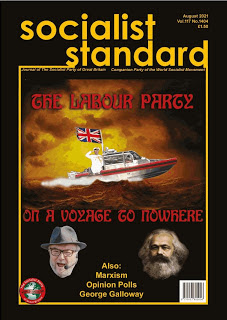
From the August 2021 issue of the Socialist Standard

Infinite growth on a finite planet? That’s a car crash! Problem is, capitalism can’t ditch infinite growth.

Why not? A capitalist business needs to make a profit in a competitive market. This means investing in the latest tech and machinery. If it doesn’t keep up with business rivals, it will go bust. So it needs to take that profit and turn it into more capital to reinvest in future production, future ‘needs’ and future markets. More and more capital, more and more tech, more and more stuff, on and on. Infinite growth is not just about bosses being greedy, it’s the iron logic that capitalism is built on.

Grow, or go under. But as we’re discovering, the price for this growth is environmental destruction.

CAPITALISM CAN’T DITCH INFINITE GROWTH, BUT WE CAN DITCH CAPITALISM.

Think about it. The buying and selling system is old and obsolete. We don’t need it. We have the global tech and know-how to create a cooperative, post-scarcity global system where there’s no buying and selling because everything is free.

Don’t destroy the planet, upgrade it, and solve most social problems at a stroke.


Blogger's Note:
I'm not sure but this looks like the text of a short leaflet.

See also from the same issue of the Socialist Standard, 'Countdown to COP26 - Part 1'.

Cooking the Books: Something for Nothing (2021)

The Cooking the Books column from the August 2021 issue of the Socialist Standard

‘Large private equity firms have been targeting UK supermarkets, which they view as undervalued and attractive due to their large property portfolios’ (BBC, 5 July). That’s why three different sets of these vulture capitalists were circling Morrisons. It was certainly not because they want to enter the grocery business. Like the BBC says, they wanted the land on which Morrisons’ supermarkets and warehouses are situated which they calculated could be put to a more money-spinning use.

It is not so much commercial profits that they are after as ground rent. Ground rent (not to be confused with house rent, which is a price) is a pure property income that accrues to the owner of land simply because they monopolise a portion of the Earth’s surface. It enables them to extract an income from the industrial or commercial capitalist they let use the land; the better the location and the higher the demand for its use the higher the rent they can extract.

In Volume III of Capital Marx pointed out that one feature of ground rent was ‘the palpable and complete passiveness of the owner, whose sole activity consists (especially in mines) in exploiting the progress of social development, toward which he contributes nothing and for which he risks nothing, unlike the industrial capitalist’ (Chapter 46). At the end of the previous chapter he had described it as ‘something for nothing’.

However, if they are clever, the ground landlord can increase their income from rent if they are prepared to invest some money to make their land more desirable by building houses or shops on it. In addition to bringing them a return on their capital this will increase their ground rent. This is what the aristocratic landowners who own large parts of central London have done. The Cadogan Estate, for instance, which reported recently:
‘Earl Cadogan and his family have controlled about 93 acres of Chelsea and Kensington for 300 years … Retail property accounts for about half of Cadogan’s rental income. A third comes from residential and remainder is offices’ (Times, 1 July).
Their rental income will be partly a return on their investment in the buildings but most will be ground rent (like with houses prices, where most of the price is not for the building but for the land on which it is built).

The vulture capitalists circling Morrisons wanted to get in on this act. They wanted to acquire the supermarket as it ‘owns the freehold of 85 percent of its 497 sites’ (Guardian, 5 July) and to use some of this land to erect different buildings that would bring them more income.

This kind of thing went on in Marx’s day too. Marx quotes the evidence of a London builder to a parliamentary committee in 1857:
‘The builder makes very little profit out of the buildings themselves; he makes the principal part of the profit out of the improved ground rents. Perhaps he takes a piece of ground, and agrees to give £300 a year for it; by laying it out with care, and putting certain descriptions of buildings upon it, he may succeed in making £400 or £450 a year out of it, and his profit would be the increased ground rent of £100 or £150 a year, rather than the profit of the buildings at which …in many instances, he scarcely looks at at all’.
Since the vulture capitalists would be the freeholder (rather than leaseholder as in this case) the whole £400-450 would go to them, as it does to the Earl of Cadogan, Duke of Westminster and Howard de Walden families and other parasites on parasites that ground landlords are.

What is Marxism? (2021)

From the August 2021 issue of the Socialist Standard

Marx himself did not call his theories of history, society and the capitalist economy ‘Marxism’. That would have been arrogant and, besides, to attribute the views he developed to the mind of some uniquely great individual would be contrary to his own theory that social conditions gave rise to ideas that were relevant to the social circumstances and problems of the time. If Marx had never lived, ‘Marxist’ ideas would still have arisen.

Nevertheless, after his death those who agreed with his theories began to call themselves ‘Marxists,’ despite this originally being a term of abuse coined by his opponents, and to call the body of his work ‘Marxism’: the materialist conception of history, with technology and class struggles as the driving forces; his analysis of the economic workings of capitalism as a mechanism of uncontrollable capital accumulation that proceeded in fits and starts; and his insistence on the need for the wage working class to win control of political power in order to establish a communist (or, the same thing, a socialist) society based on the common ownership of productive resources and production to directly meet people’s needs rather than for sale with a view to profit.

Marx himself would no doubt have favoured an impersonal description such as ‘communist theory’ or ‘the theory of revolutionary socialism’. But ‘Marxism’ is the term that, historically, revolutionary socialists have inherited even though it is also a term that others have appropriated or been wrongly identified with, in particular the ‘Leninism’ that evolved in primitively capitalist Russia as the theory of state-led capitalist development in countries with a weak private capitalist class .

Marx foremost a socialist
An important aspect of Marx’s view that academics, even those who claim to be Marxists, tend to overlook, in fact often deliberately play down so that they can treat his views as merely academic, is that he identified himself with an already existing movement to see a communist (or, in later usage, a socialist) society established. As he wrote in the conclusion of his main published work Capital, this society was to be based on ‘cooperation and the possession in the common of the land and of the means of production’ (chapter 32 on ‘The Historical Tendency of Capitalist Accumulation’). He further described it, in some 1875 notes on the programme then adopted by German Social Democrats, as a ‘cooperative society based on the common ownership of the means of production’ where ‘the material conditions of production are the co-operative property of the workers themselves’.

At the present stage in the evolution of human society and technology, a world society in which the Earth’s natural and industrial resources are the common heritage of all humanity is the only framework within which the problems currently facing humanity in general and the wage working class in particular can be rationally tackled and permanently overcome.

This is the next stage in human social evolution, the material basis for which has developed under capitalism, as indicated by such current terms as ‘world market’, ‘world trade’, ‘world wars’, ‘globalisation’ and ‘global warming’. A single worldwide network of productive units already exists, but the ownership and control of these is in the hands of only a small part of humanity, either directly as rich individuals or indirectly via corporations and states. Instead of this network being co-ordinated to produce what the world’s population needs, it is used to produce items of wealth for sale by private and state enterprises, competing to make profits.

Marx in his day
Today, and for the past hundred or so years, this has been an immediate possibility whereas this was not the case in Marx’s day, in the middle of the nineteenth century. Then, capitalism was still in its ascendancy and had yet to fully build up the material basis for a world socialist society. Marx himself recognised this and it led him to take the long view and support what he judged would speed up the development of capitalism, its political forms as well as its spread as an economic system. For instance, he supported the Franco-British-Turkish side in the Crimean War, the North in the American Civil War, independence for Poland as a buffer between Tsarist Russia and the rest of Europe, and independence for Ireland to strengthen the hand of Britain’s industrial capitalists against the ruling landed aristocracy.

This is one source of the distortion of Marx’s view into one that supports the development of capitalism even after this was no longer necessary. Not all went as far as the so-called ‘legal Marxists’ in Tsarist Russia who openly favoured capitalist development by private capitalists, but it was an aspect of Social Democracy and Bolshevism which, both in their ways, favoured – and in practice advanced – the development of capitalism, generally in the form of a state capitalism (state organised production for sale with a view to making a monetary surplus), which they imagined, and even defined, as ‘socialism’. However, state or government ownership is not the same as the common or cooperative ownership envisaged by the movement Marx was engaged in.

Marx supported the further development of capitalism in his day in order to hasten the creation of the material basis for world socialism. Once this had been achieved, towards the end of the nineteenth century, the logic of this position no longer applied. There was no longer a case for those who wanted socialism to support the further development of capitalism; they could now work directly for the immediate establishment of world socialism. The tragedy of the twentieth century was that so few took this position.

This underlines that Marxism is not what Marx did, but his general approach to economic and social development.

Materialist conception of society
Marx’s analysis of society, as set out in the well-known Preface to his A Contribution to the Critique of Political Economy, has, following Engels, traditionally been called ‘the materialist conception of history’ but it also applies to existing capitalist society and its transformation into world socialist society. It was called ‘materialist’ to distinguish it from the openly ‘idealist’ theories of history that were prevalent at the time, in particular that of Hegel who saw human history as the unfolding of some abstract Idea, though this was also the view of other Christians.

Marx was essentially making the point that the basis of any human society was the way in which its members were organised to satisfy their material needs, to produce the food, clothes and shelter that they needed to stay alive, together with the technology and infrastructure used to do this. As a particular system of production changed, so did all the other ways of social living.

Marx’s materialism was not a denial of the role of ideas. On the contrary, ‘Man makes his own history,’ with humans motivated to act by the ideas they held, even if these arose from the social circumstances in which they found themselves, including, in class-divided societies, the different social circumstances of different classes with regard to production. The driving force of history was struggle between classes, in which a newly arising class championing a new way of organising production challenged an entrenched ruling class that wanted to preserve an established way from which it benefitted.

This view is still valid as a general approach to the study of the past but, more importantly, is of practical relevance for the change from a world capitalist to a world socialist society since it implies that this change of society too will be the result of a class struggle. This will be the last class struggle in history in fact, between the minority class that monopolises the world’s productive resources and the excluded majority. World socialism is going to have to be the outcome of the excluded, majority class pursuing its material interest to establish a society in which the satisfaction of its material needs, indeed those of all humans, will be the direct aim.

Marxian economics
As to Marx’s analysis of the way the capitalist economy works – his ‘critique of political economy’ as he subtitled Capital—this has been confirmed time and again. Marxian economics has proved a better tool for explaining how capitalism works than any other economy theory.

Marx analysed capitalism as a system based on what his first English translator called ‘the self-expansion of value’, value being the basis of the economic exchange value that products of labour acquired through being produced for sale on a market, a concept Marx inherited and refined from the classical political economists Adam Smith and David Ricardo.

When the producers’ ability to work – translated as ‘labour power’ – also became an item for sale due to their being separated from the ownership of land or instruments of production, they produced a value greater than the value of their labour-power, a ‘surplus value’ or, in its monetary form, profits. It was through their work that pre-existing value ‘expanded’, with the production and accumulation of surplus value becoming the driving force of the economic system that Marx called ‘the capitalist mode of production.’

For Marx, this was not a choice by the owners of means and instruments of production but an imperative imposed on them by the competitive struggle for profits that they were engaged in with each other; they were not free agents but cogs in the mechanism of capital accumulation. This competitive struggle for surplus value gave rise to economic laws which acted on economic agents as if they were laws of nature that humans could not change. This has proved to be the case even for governments, which have also had to submit to these economic forces, despite the much-increased role in economic affairs that they have assumed since Marx’s day.

So, capitalism is an uncontrollable, impersonal system of capital accumulation out of surplus value. This, Marx analysed, is not a smooth process. The trend is upward but in fits and starts, with periods of expansion ending in a crisis and a period of reduced production during which the conditions are created for a resumption of the upward trend, which will eventually be stalled by another crisis and slump, and so on in an ever-repeating cycle of booms and slumps. No government, no type of political regime, has ever found a permanent solution to this. The capitalist economic system is simply not amenable to human control. For so long as capitalism lasts Marxian economics will have a future in demonstrating this.

The lesson here is that capitalism cannot be reformed to work for the benefit of all, and certainly not for that of the excluded majority, the exploitation of whose labour to produce surplus value is the basis of the whole system. However, capitalism will not collapse economically of its own accord. It will move uncontrollably from boom to slump and back until the excluded majority organise consciously to put an end to it and move on to the next stage of human social evolution of a united world society based on the common ownership of the planet’s productive resources.
Adam Buick

Material World: Stolen Children (2021)

The Material World column from the August 2021 issue of the Socialist Standard
Article 2 of the UN Genocide Convention defines genocide to include: ‘…e) Forcibly transferring children of the group to another group.’
As early as Australia’s Victorian Aboriginal Protection Act of 1869, legislation allowed the removal of Aboriginal people of mixed descent to force them to assimilate into white society. Up to the 1970s, in Australia, thousands of ‘mixed-race’ children were stolen from their mothers by welfare officials. The children were given to institutions as cheap or slave labour, and many were abused. Described as ‘breeding out the colour’, the policy was known as assimilation. In 1997 a landmark report, Bringing Them Home, disclosed that as many 50,000 children and their mothers had endured ‘the humiliation, the degradation and sheer brutality of the act of forced separation… the product of the deliberate, calculated policies of the state’. The report called this ‘genocide’.

The violence against indigenous peoples around the world is truly shocking. It has been a story of stolen lands and of stolen children.

From the nineteenth century until the 1970s, more than 150,000 indigenous children were forced to attend state-funded Christian boarding schools in an effort to assimilate them into Canadian society. And it was justified by the settler-colonialists as humanitarian and for the child’s own good. Far from being protected, indigenous children were regularly victims of abuse. Indigenous children were taken from their families, often by force. They were housed in crowded, state-funded, church-run facilities, where they were abused and forbidden from speaking their languages or participating in any form of cultural practice or activity, and forced to adopt new names and identities. Many of these children were informed that their families had either given them up or had died. To increase the success of removal policies, the authorities would often send the children vast distances from their families and friends.

The system’s purpose: ‘To kill the Indian in the child’. Children in native residential schools were wards of the federal government and consequently came under the responsibility of various religious communities. ‘The use of the word school is a misnomer,’ said Cindy Blackstock, a professor at Montreal’s McGill University and the executive director of the First Nations Child and Family Caring Society. ‘They were prison camps.’ (tinyurl.com/ychmpdxs)

Intimidation and fear were the teaching tools used to ensure children could not practise their customs and traditions, cutting off any bond to their history.

Conditions were consistently horrendous and distressing, leaving emotional scars on most. Thousands of children taken to the ’schools’ died of disease and other causes. We are only now discovering that many were buried in unmarked graves, to be forgotten as easily as they were neglected.

The Canadian Federal government formally apologised for the policy and abuses in 2008 which its Truth and Reconciliation Commission called ‘cultural genocide.’

The churches also apologised for their roles in the abuse. Nearly three-quarters of the 130 residential schools were run by churches. One, the Missionary Oblates of Mary Immaculate which ran the Kamloops Indian Residential School from 1890 until 1969, apologised for what it called the cultural and religious ‘imperialism’ that motivated residential schools, the disruption of families and communities that resulted, and instances of physical and sexual abuse that occurred. At the time, it made no mention of the 215 unmarked graves found at the site, and now admit that they are unable to explain their official records of only 50 deceased children. So it appears to any reasonable observer that the true death rates were being covered up.

Indian Boarding Schools had also been established in the United States with the objective of ‘civilising’ Native American children. The current US Interior Secretary, Deb Haaland, has directed her department to ‘uncover the truth about the loss of human life and the lasting consequences’ of the ‘dark history’ of these institutions.

The Catholic Church, to hide its complicity in the abuse that took place in its institutions, approved of a state law in South Dakota designed to halt survivors from seeking legal retribution from the Catholic authorities, so shielding the Church from any responsibility or accountability (tinyurl.com/y3ccu5fw).

Today, similar policies very much reminiscent of the residential school systems persist but the language is couched in euphemisms. The children are still being ‘taken into care’ for their own ‘welfare’ and ‘protection’.

In 2016, 7 percent of children across Canada were aboriginal, but they accounted for nearly half of all the foster children in the country. In the province of Manitoba, 10,000 of the 11,000 children in care are indigenous and are taken from their homes for reasons such as poverty, bad housing or lack of wholesome food. Capitalist Christian ‘family values’ would rather break up families than fix the problem of deprivation and the underfunding of social services to the indigenous communities.

Even in the UK, we have witnessed the ‘abduction’ of kids due to the prejudice against those deemed different from ‘us’. From 2009 to 2018, the number of Roma children in care in England has risen by 933 percent, a figure disproportionate when compared with other ethnic groups.

Socialists have been accused of standing for uniformity but the advocate of assimilation, intent upon eradicating the lingering traces of pre-capitalist culture, has been and always will be the ruling class, striving for homogenous consumers with a few pockets of indigenous peoples retained as curiosities for the tourist trade. Socialism is not about one-size-fits-all. Communities and cultures will co-exist, in a global cooperative commonwealth that celebrates both diversity and unity
ALJO

Where is Labour going? (2021)

From the August 2021 issue of the Socialist Standard
 

Batley and Spen, a constituency in West Yorkshire, had a by-election on the first of July. There were a number of surprises – most notably, that the seat was held by Labour. The election was taken to be something of a judgment on the Labour Party as a whole, with polling suggesting that it would be a 6 percent lead for the Conservatives (Survation, 18 June). Losing Batley and Spen would have been a particularly painful blow for Labour, as it was the constituency of Jo Cox, the Labour MP who was murdered in 2016 by a neo-fascist, Thomas Mair. Her sister, Kim Leadbeater, won the seat this year by 323 votes (a lead of 0.85 percent of the vote, having won about 35 percent overall). The seat had been Tracy Brabin’s, a Labour and Co-op MP, since the by-election following Cox’s death. Her leads were 16.7 percent (55.5 percent overall) in the 2017 general election, and 8.7 percent (42.7 percent overall) in 2019. While Labour’s holding the seat was unexpected, considering how narrow the victory was, and how the seat has often historically been Labour’s more strongly, this is by no means a turning-of-the-tides.

Workerism
One of the other surprises was that almost 22 percent of the vote went to George Galloway’s ‘Workers Party’, which he describes as ‘the working-class patriotic alternative to fake woke anti-British ‘Labour’’ (Telegraph & Argus, 12 May). The party’s Deputy Leader, Joti Brar, is vice-chair of the CPGB-ML. Whoever they represent it is not the workers. Their website announces that they are a ‘socialist organisation’, but also that they ‘defend the achievements of the USSR, China, Cuba etc’, and that the party ‘believes in the importance of a planned economy, in the directing role of the state. Free-market fundamentalism has gutted Britain of its industries (…) castrating our society and adversely destabilising proud working-class traditions, culture and way of life.’

One would be hard-pressed to find a better example of what one-time leader of the Italian Communist Party Bordiga derided as ‘the typically opportunist conception of the labourist or workerist party to whom all those individuals who are proletarian in terms of their social condition are admitted by right’, to say nothing of the alarming fetishisation of oppressive state-capitalist regimes, past and present.

Socialism’s goal is not to preserve ‘working-class traditions, culture, and way of life’ – on the contrary, in an important sense, it is to abolish those things. We demand the elimination of class, not the extension of the proletarian way of life to the whole of society. Indeed, isn’t it dissatisfaction with the proletarian way of life that gives motivation to socialist sentiment in the first place?

Panic
At any rate, the result was astonishing. Galloway took himself to be ‘standing against Keir Starmer’, and that 22 percent backed the Workers Party, placing it third overall, can reasonably be read as an indictment of the Labour Party as it stands. Indeed, perhaps the only reason Labour didn’t lose is sheer luck. The week before the election, the news broke of then Health Secretary Matt Hancock’s affair and breach of the social-distancing rules he himself set out. This and the Conservative Party’s reaction (or lack thereof) did not reflect well on them, and presumably led to a drop in Tory turnout on the day of the vote. Keir Starmer’s declaration that ‘This by-election is a turning point (…) Labour’s back, and the promise of a better future is back too’ (Guardian, 2 June) is certainly too quick. Indeed, comparing leads over the years, it is not a turning point at all. It is a continuation of the dwindling of victory margins Labour has seen.

Indeed, some of the party’s campaigning tactics showed signs of panic and desperation. Leaflets were distributed showing PM Boris Johnson with the Indian PM Narendra Modi, of the radically Hindu nationalist BJP. This was to appeal to the Muslim vote, especially given continuing human rights abuses in Kashmir, a region disputed by India and Pakistan for generations. The frantic appeal to votes led to some internal division within the party, with Labour Friends of India requesting withdrawal of the leaflets. The vote still remained divided: Kim Leadbeater was heckled and intimidated after being questioned about her stance on LGBT rights, Palestine, and Kashmir (Guardian, 27 June). One man who chased her said he was acting on behalf of Muslim parents concerned about LGBT-inclusive education. Across given demographics, then, Labour has not won many hearts.

Lucky
The victory will, of course, still be welcomed by the Labour party. But it is not a victory that they can take much comfort in. Indeed, looking at it as anything but an immense stroke of luck is probably mistaken. The signs point to a need for change in the Labour Party, if they want to win again – and that change, contrary to what Starmer has suggested, has not already taken place. George Galloway’s Workers Party is an important surprise in the election – Labour would be remiss to not take some note. Handing over 22 percent of the vote to a rival left-leaning party is not a concession they are in any position to make.

Labour’s position is somewhat precarious now, with no signs of a forthcoming reversal in fortunes. The reason they won seems to have as much to do with the Conservatives’ blunders than their own successes. Starmer’s jubilation had better be a mere façade if Labour is to return to serious positions of power in parliament. He writes that ‘Batley and Spen was an important win – in the most difficult of circumstances. But it is only the start.’ Even this might go too far. Perhaps it isn’t the start, but a mere confirmation that Labour is going nowhere fast.
M. P. Shah

George Galloway: would-be Populist Leader (2021)

From the August 2021 issue of the Socialist Standard

On the day the results of the recent Batley and Spen by-election were announced a Labour Party supporter responded to a comment about the meagre majority achieved. He was insistent that the 323-vote margin would have been 8,000+ higher had it not been for the appearance of George Galloway for the Workers Party of Britain.

From a purely psephological point of view the Galloway performance was remarkable for a representative of a small, leftish party. Nearly 22 percent of the vote secured a comfortable third place, a good 7,000 votes ahead of the Liberal Democrat, 5,000 or so behind the winner.

So perhaps the disgruntled Labour supporter had a point, except, of course, there is a large presumption involved. There is no way of determining whether an absence of Galloway and his new party would have resulted in in his 8,000 votes defaulting to Labour. Indeed, the experience of the previous by-election in Hartlepool suggests the Conservative candidate might have been a beneficiary too, especially given Galloway’s pro-Brexit stance.

There is a strong suggestion that Galloway profited from an alienated Muslim vote who may have perceived themselves as being tainted by Labour’s broad brush anti-Semitism accusations levelled at almost any anti-Zionist or pro-Palestinian. It must be galling for a community more often the target of racism to feel themselves viewed as racists by the party they traditionally supported.

There is surely little doubt that the impressive vote was for Galloway personally rather than being an ideological breakthrough by the Workers Party of Britain. He has a background of championing anti-Zionism and favouring Islamic causes. There have even been suggestions that he converted from Roman Catholicism to Islam, although he has denied this.

The Workers Party of Britain appears to be a left-wing manifestation of that recent political phenomenon, populism. On its website the Party states it is a response to a need following the defeat of Corbynism. It believes:
  • The importance of a planned economy directing the role of the state.
  • Free-market fundamentalism has gutted British industry, castrated society and destabilised the working class.
  • The state should guide economic life.
  • The working class needs to be united on shared class interests to struggle for socialism.
  • Countries that have tried to build the socialist new world include the USSR, China, Cuba et al.
  • Brexit is a positive move to secure Britain’s independence to pursue fiscal and monetary policies and take key utilities and transport into public ownership.
There is ‘A ten-point programme for workers’ promoted on the Party’s website that sits easily with left-Labour aspirations. It has garnered the support of the Communist Party of Great Britain (Marxist-Leninist), which situates itself in the tradition of Stalinism and Maoism. Indeed, Galloway’s deputy leader Joti Brar is from a family closely associated with the CPGB (ML). For the Workers Party of Britain the problem is free-market capitalism, the solution… state capitalism.

Galloway has been here before of course. In 2005 he did even better, winning the Bethnal Green and Bow constituency for Respect, a political grouping backed on that occasion by the Socialist Workers Party. A parting of the ways quickly followed and it would seem he has moved from the neo-Trotskyist camp to the neo-Stalinist one. Either way, the prospects for democracy would be dim should such a grouping ever succeed.

Is it a party at all, or a Galloway supporters’ club? It seems highly unlikely that some John or Joan Smith standing for the Workers Party of Britain in Batley and Spen would have garnered anything close to 8,000 votes and their performances elsewhere have been derisory.

Personality politics blurs the line between those who’d style themselves left or right wing. Thus George Galloway was quite sanguine about sharing a platform at a Brexit rally with Nigel Farage. The public moment being far more crucial than principles.

The charismatic leader, or a leader who thinks himself charismatic, becomes all important. A previous attempt to displace Labour as the party of the working class in Yorkshire was the now less than marginal Socialist Labour Party led by Arthur Scargill who tried to politically exploit the prominence he gained from the 1984/85 miners’ strike. Indeed, the CPGB (M-L) was a split from it.

What these parties have in common is being political cul-de-sacs. Setting aside implications of serious democratic deficit in its politics, should the Workers Party actually succeed in displacing the Labour Party nothing much would change for the working class.

With Galloway as prime minister implementing his 10-point plan the workers would still be working for wages that represent only a portion of the value their labour power creates. After all, ‘socialism with Chinese characteristics’ has successfully created numerous billionaires while the working masses most definitely do not have control of the means of production and distribution.

In other words, the Workers Party in power would replace capitalism with capitalism, and a less successful version of capitalism if some the models quoted on the Party’s website are anything to go by.

The Batley and Spen by-election is a demonstration that there are no answers to the problems created by capitalism for the working class in any of the parties on offer, major or minor, left wing or right wing.

Kim Leadbeater MP made the usual platitudinous vague promises to serve all the community, bring people together and further local interests. Had the Tory won he would have spouted an almost identical speech. Similarly, the LibDem. Galloway would undoubtedly have been more vocally belligerent, but it would have amounted to the same.

This is because community divisions, Brexit, economic decline and the plethora of other problems are rooted in capitalism. The dreadful murder of Kim Leadbeater’s sister Jo Cox, the then sitting MP, was an extreme example of politics under capitalism. It is a system wasteful of human lives that is immune to political point scoring.

The Labour Party supporter decrying George Galloway for undermining the Leadbeater vote remains politically blind, as presently all too many are. There are no short cuts, no inspired leaders, no previous models to draw on. Only a majority recognition of the need for a system of common ownership of economic means, moneyless and cooperative – socialism – can address those problems people have in common, even as they seem to be divided.

Until popular delusions can be effectively dispersed the people of Batley and Spen and everywhere else in the world will continue to labour for the pecuniary benefit of the capitalist few.
Dave Alton

Friday, April 15, 2022

Capitalism ‘bad’, socialism ‘good’ (2021)

Frank Luntz with sadness in his eyes.
From the August 2021 issue of the Socialist Standard

At the beginning of July two openly pro-capitalist think tanks – the Tory-leaning Centre for Policy Studies (CPS) and the free-marketeer Institute for Economic Affairs (IEA) – published the results of polls they had carried out on people’s opinion of capitalism. Both indicated that many people don’t think much of it.

The one for the CPS was compiled by US pollster, Frank Luntz:
‘ …Dr Frank Luntz is testing public opinion in Britain to find an alternative to ‘capitalism’, after 170 years of use, because he fears it is becoming a bad word ( … ) Capitalism itself is already a “bad word” in the US and is fast becoming so in the UK too. “It’s one of the key things I am trying to figure out: Does this country need an alternative to the word capitalism? I think it does”’ (Sunday Telegraph, 19 June).
In the event, he didn’t come up with an alternative, merely noting that ‘voters are almost as fed up with business as with politicians – presenting a huge challenge for supporters of capitalism and enterprise’. Those polled were asked to choose from a list four ‘words and phrases they thought of first when thinking about British companies’. The two most chosen were ‘Profits before People’ (47 percent) and ‘They put shareholders first, not ordinary people’ (44 percent). It is not clear why Luntz felt that these factually correct and easily verifiable statements represent a challenge to supporters of capitalism. Normally, its supporters are prepared to defend both as the best way of organising the production and distribution of wealth.

While the CPS poll was concerned with people’s attitude to ‘capitalism’ the IEA one was more concerned with their attitude to ‘socialism’. A representative sample of those aged between 16 and 34 were presented with a number of statements and asked whether they agreed with them or not, without the option of ‘don’t know’. 67 percent said ‘they would like to live in a socialist economic system’ and 75 percent agreed that ‘socialism is a good idea, but it has failed in the past because it has been badly done’. 78 percent blamed ‘capitalism for Britain’s housing crisis’ and 75 percent agreed ‘that climate change is a specifically capitalist problem’.

What are we to make of these results? Opinion polls are worth what they are worth and as Tory Lord Finklestein pointed out in his comments on the CPS one, ‘You can’t just ask consumers, and indeed voters, what motivates them, and trust what you get back’ (Times, 7 July). Those questioned are only being asked to give a fleeting opinion that commits them to nothing. And the questions can be framed to get the answer the pollster wants.

In these two particular polls, ‘capitalism’ was not defined. The tacit assumption of those who drew up the questionnaires (though not necessarily of those who answered the questions) was that capitalism meant production for profit by private capitalist enterprises. Capitalism is certainly a system of production for profit – in fact, the ‘Profit System’ might be the alternative name for it that Luntz is looking for – but ‘private enterprise’ is only one form of this. Capitalism can also take the form of state enterprises producing for the market with a view to profit. In both cases, the profit arises from the unpaid, surplus labour of the wage workers who are employed, whether by a private or a state enterprise, to produce what is to be sold.

The IEA didn’t define ‘socialism’ either, but the question about socialism ‘having failed in the past’ indicates that they think it is what existed in Russia – or, their current favourite, Venezuela. The concept of state capitalism is ruled out, even though the author of its report, Kristian Niemietz, had referred, in a previous report, to this concept and specifically to us:
‘… There are exceptions to this, such as the Socialist Party of Great Britain. They are not, and as far as I know, never were, apologists of Soviet-style socialism, which they describe as ‘state capitalism’. They are among the few socialists who have at least some idea of what they mean by ‘real’ socialism. They use that term to describe a hypothetical system in which working-class people own and control the economy’s productive resources directly, not via the state; a system in which public ownership is not mediated through a government bureaucracy’ (iea.org.uk/has-real-socialism-never-been-tried/).
Once again, it cannot be assumed that those who answered the question meant the same as those who asked it. Had the question been ‘Would you like to live in an economic system where all industries are state-owned?’ the result would have been very different. On the other hand, had the question been ‘Would you like to live in a system where the means of production are commonly owned and democratically controlled and the principle of from each according to ability, to each according to need applied?’ the result could well have been the same. But this wouldn’t mean that those answering ‘yes’ thought that such a system was achievable, only that it was desirable.

In an 80-page booklet analysing the results, Left Turn Ahead? Surveying attitudes of young people towards capitalism and socialism, Niemietz was more realistic as to what this meant:
‘The rejection of capitalism may never have huge real-world consequences. “We should ditch capitalism, and try a socialist alternative” may well be the political equivalent of “One day, I will learn a foreign language, run a marathon, and write a novel”. It may be an idea that is popular as an abstract aspiration, but less so as a concrete action plan’ (p.17).
Unfortunately, this is fair comment.

However, there will be some significance that, amongst younger people today, capitalism has become a ‘bad word’:
‘Young people associate “socialism” predominantly with positive terms, such as “workers”, “public”, “equal” and “fair”. (…) Capitalism, meanwhile, is predominantly associated with terms such as “exploitative”, “unfair”, “the rich” and “corporations”’ (p.7)
That can’t be a bad thing.
Adam Buick

The Beef Chain: A useful investigation (2021)

From the August 2021 issue of the Socialist Standard
‘Cattle ranches are destroying the rainforest enabled by giant beef companies while their US, EU (and UK) international financiers made flawed assessments.’
Above is a statement on the destruction and deforestation of large parts of the Amazon, both legal and illegal, taken from a lengthy 2020 investigation by Global Witness entitled Banks, Beef and the Brazilian Amazon (tinyurl.com/4y3bmcd6). It covers all aspects along the supply chain from cattle ranchers, beef traders, international financiers, supermarkets, fast-food chains and the governments which regulate them.

The numbers are staggering, whether those of cattle on ranches, size of forest cleared or the increased speed of the devastation in recent years. The investigation finished at the end of 2020 when there were approximately 390,000 beef ranches in Brazil, 40 percent of them in the Amazon. About 70 percent of cleared land in the Amazon is populated by cattle, and there are more cows than people in the country. Starting with ranches the chain continues with the beef dealers, including three Brazilian giants, which mostly control the slaughterhouses and sell on the beef. These three beef companies slaughtered more than 18 million cattle in 2017, equivalent to 40 percent of Amazon beef. These same multi-billion-dollar beef companies sell 64 percent of the total Brazilian beef exports to the EU, US and China. Next in the chain come the intermediaries who finance all aspects. These are the banks and big finance companies: the World Bank, Blackrock, ING, Barclays, Morgan Stanley, Santander, Deutsche Bank, BHP Paris, HSBC. Nearing the end of the chain retailers and fast-food outlets include Walmart, Carrefour, Nestle, Burger King, Sainsburys, Subway and McDonalds.

Beef production in Brazil is the number one cause of deforestation emissions across Latin America. According to the World Resources Institute more than 20 million hectares of Brazil’s Amazon primary tropical forest were lost between 2002-2018. Year on year forest fires driven by deforestation increasingly devastate more of the Amazon, all for the sake of profit while the planet shows all the signs of being out of control. In the years 2005-2013, before Bolsonaro became president, state interventions helped to bring about a 70 percent drop in Amazon deforestation. Bolsonaro, as president, has attacked safeguards and agencies protecting the Amazon and the situation has now become critical. Ranches fall into one of several categories depending on the age of the cattle. First are the ranches for breeding, from which the animals are moved on to rearing ranches and then to fattening ranches. When the time comes for slaughter they are moved once again, this time to the traders’ slaughterhouse facilities.

All traders are obliged to have no-deforestation pledges and to monitor the supply chain of beef to check both non-compliance with forest destruction laws and human rights abuses. Whilst the numbers are staggering a few of the examples mentioned here give some idea of the scale of this whole beef production topic. One of the three biggest beef traders briefly mentioned above, Marfrig, describes itself as the world’s second largest beef producer with a work force of over 30,000 employees. Gross profit in 2019 – over $1 billion. Marfrig claims to have met the Greenpeace agreement regarding protection of the Amazon rainforest and no illegal deforestation nor any human rights abuses for the previous five years. Another of the ‘big three’, JBS, had audits carried out by the DNV-GL company on behalf of Greenpeace and the Pará state prosecutor. The auditor’s Code of Conduct states that it must avoid ‘any combination of roles and services that could be perceived as representing a threat to the impartiality and independence of its services. We do not classify, certify or verify our own work.’ Their audits for the Greenpeace agreement claimed that JBS’s cattle purchases were 99.99 percent compliant (2016) – but its audits for the Pará prosecutor’s agreement the same year showed almost 20 percent of JBS’s purchases were not compliant.

Similar improper situations occurred with banks claiming to be compliant with laws and agreements relating to illegal deforestation. Such examples as a leaked document seen by Global Witness from HSBC to the JBS company heavily criticising them for giving no clear information or statement regarding the sources of cattle and for having ‘no vision, action plan, timeline, technology or solution.’ Then, in the same document, HSBC recommends that investors buy shares in JBS. Other examples reveal complicity in human rights abuses of workers and those forced from their land by threats and even murder. Some perpetrators have received heavy fines or prison terms, but most escape punishment.

The top ten countries importing from the three biggest beef suppliers include China 34.4 percent, EU 10.9 percent, Russia 6.65 percent, US 3.51 percent and UK 2.89 percent. The major retailers listed earlier tend to sign up to various treaties such as threatening to boycott produce if further land grabbing or deforestation continues but when contacted by Global Research with questions on progress or results there is often no reply.

If we look at the position of consumers, those at the end of the chain, in this case buyers of beef from Brazil and particularly from the Amazon, this report suggests that most will only have information from those they are buying from, that is supermarkets and fast-food chains. They will know where the beef was sourced but will be unaware of the various steps in the chain. If they were aware of, for instance, the global banks and their investors, plus the multinational beef traders funded by these banks, perhaps they would have second thoughts about their purchases. Over years many consumers have become aware of the harm done in other countries by the pension fund they are personally linked to and have protested to stop it. Many indigenous people in regions of the Amazon have been forced from their traditional lands, have been threatened and even killed for protesting, and continue to suffer threats and violence while trying to protect the forests which are their home.

Regarding the final section of the report which is related to what should be done, as is to be expected it is very detailed but also filled with unreal expectations of capitalism. All is tied up with law, the responsibility of traders, auditors, banks, financial actors, importers, supermarkets, federal environmental prosecutors and the Brazilian government. Having said this the PDF is well worth reading for the sheer amount of detail it offers on any and all of these important aspects, facts and figures, plus some mention of the loss of and risk to the many varied and endangered life forms, a topic from which too many are distant or ill informed. Diagrams and photographs give some added understanding of the enormity of the problem.

This global system of capitalism which thrusts separate countries into constant competition with other nations and forces many smaller states into positions of subservience to the more powerful is absolutely the opposite of what is urgently required if the planet is to remain a safe place for all life. Surely no one can be ignorant of the fact that we are one world and that all areas affect and are affected by others, whether as the result of mining for fossil fuels on land or in the sea, from emissions of global trade practices or, as we have here, massive destruction of the lungs of the world in order to raise more beef for sale on the world market.
Janet Surman

Tuesday, April 12, 2022

War on the Wage Front (1957)

From the April 1957 issue of the Socialist Standard

Is  the Time Opportune?
Along with the shipbuilding workers who came out on strike on 16 March, millions of workers in the engineering, building, railway and other industries have claims awaiting settlement. The newspapers and politicians urge the workers to be moderate and to submit their case to arbitration and they profess to be shocked that a trade union official, Mr. Hill of the Boilermakers, should say "No arbitration. We are going to fight" and that Sir William Grant chairman of the Engineering and Allied Employers, West of England Association, should declare:—“This time we do not want government interference. That is quite positive. We want to fight it out ourselves. We have got to stand firm and prove to these fellows that things are not done so easily." (Daily Mail, 13, March, 1957.)

In the same quarters tears are shed because there should be a hold-up of industry “just now,” the idea being that strikes are all very well in the past or in the future but not (as the Daily Mail puts it) “just as Britain is coming out of the Suez squeeze and the gold reserves are climbing up again." This is humbug and is a line of argument that should be totally ignored by workers considering strike action. If at any time conditions are relatively favourable for workers to strike be sure the Government and the employers and the Press will find reasons why it should not take place then. But workers with long memories will recall the many times past when they have been lulled into delaying action while the employers prepared for battle. It happened in 1922 with the engineers in a dispute over an overtime agreement. Negotiations broke down in April, 1921, but the employers waited seven months before they delivered their ultimatum that led eventually to a weeks long lock-out—they were waiting for the heavy unemployment to undermine the resistance of the workers and to deplete the funds of the Unions through payment of unemployment benefit.

Are the Employers Bluffing?
The present engineering dispute is being fought against a background that is very different from the lock-out of 1922, and the difference is not that, because of the so-called “Welfare State,” the wages war has changed its nature or that arbitration has made strikes unnecessary. The difference lies in the state of industry and of unemployment, the factors that workers do need to study closely. Strikes are not won by bull-headed bravery; the employers, with the Government behind them, if they regard an issue as vital, cannot be starved into submission, and in a long-drawn-out battle of that kind are bound to win. But if trade is good and employers do not want to have profitable production interfered with their first blunt refusal to make an offer will prove to be bluff. That may well be the situation now and short sharp strike actions may be successful.. A few months ago with motor car and ancillary plants on short time many employers may have contemplated a show-down over wage claims but with the motor trade recovering and engineering and shipbuilding profits and exports on a high level it is more likely that employers generally will be prepared to pay a wage-increase rather than have plant shut down and contracts interrupted.

The Daily Mail in a leading article (13/3/57) has admitted that “there is little question that the shipbuilders could afford higher wages . . ." They were doubtful about some engineering firms but it is rather surprising that they should have gone so far as this.

The Labour Party and Strikes
Labour spokesmen have attacked the Tory Government for their handling of wage disputes and in particular have blamed the Government for allowing the cost of living to rise. But no one should be deceived into thinking that things were any different when the Labour Government was in power. In 1948 there was also an engineering wage claim, which likewise the employers turned down. The engineers then too threatened strike action and their case was based on the rise of the cost of living and the general inadequacy of pay. But far from the Labour Government giving them encouragement, this was the time of the “wage-freeze” policy and the workers were being told that they should not ask for more pay although prices were rising.

But the engineering workers persisted and their threat to strike brought results, for a court of inquiry specially appointed by the government recommended a wage increase, though it did so with the explanation that it was only because of “particular circumstances" in the engineering claim and was not to be a precedent for other workers and so upset the Labour Government's “wage freeze" policy. It did in fact open the way for other workers to claim.

Don’t worry about the Germans and the Japs
The workers who demand more pay and threaten to strike are being told, as they always are on such occasions, that British export prices will be pushed up and foreign manufacturers will capture all the markets. The obvious working class reaction to this factor ought always to be that of strengthening international trade union organisation so that workers in all countries can act together on wage claims, this time some sort of all-round movement is in being for wages are rising fairly generally in Europe, U.S.A. and elsewhere. In Germany it is the engineering and shipbuilding workers who are leading the way and Japanese workers also are striking:—
“In Germany, organised labour is growing steadily more militant; Its appetite has been whetted by the success of the 16 week strike of engineering and shipyard workers over sickness payments and annual holidays, and similar claims are expected from other branches of the Metal Workers Union. In Japan, this year's labour troubles look like being worse than last year's. . (Financial Times 14/3/57).
Nonsense abort Nationalisation
Some engineering and building workers are deceiving themselves with the notion that the long-term way out of their wages difficulties and the threat of short-time or unemployment when sales fall off, is to press for nationalisation of their industries. They should think again and drop this nonsense. Nationalisation has solved no problem for the working class and they have before their eyes a striking example in the railways. The railwaymen are among the worst paid industries. They have just rejected a miserly offer of a three per cent. increase and appealed to arbitration for more. And at that arbitration on 26 February of this year the spokesman of the Transport Commission, opposing the claim, gave the same reason as does every group of employers, “the duty" of the Commission to resist the claim on the ground of their financial difficulties, the fact that they are making a loss instead of a profit (Daily Telegraph, 27 February, 1957).

Nationalisation is not deserving of working class support and to raise the issue in relation to a wage claim is worse than useless.

But that is not to say that workers should go on year after year imagining that there is no other way except to strike for higher pay when trade is good and go down fighting when trade is bad. The way is open whenever a socialist working class wants to use it. It is to take democratic political action to get rid of capitalism and establish socialism in its place. Then there will be the certainty, through the ending of the destruction and waste of capitalism, of bringing about a vast increase in the production of useful things and no propertied class to stand in the way of that so much promised and never arriving "higher standard of living.”

The suicidal action of the workers every few years at general elections is of far greater and more lasting importance than the strikes for higher wages that occur in between. At elections the working class places in power the Tory or Labour politicians who use their office to keep in being the social system which makes the workers a propertyless class producing wealth and profits for the capitalist minority. Given this situation, with the government in the background safeguarding the position of the propertied class, the industrial struggle over wages and conditions of work can go its up and down way indefinitely without ever settling anything. Socialism is the only way to end it and open up a new horizon for society.
Edgar Hardcastle

New Pamphlet (1957)

Party News from the April 1957 issue of the Socialist Standard

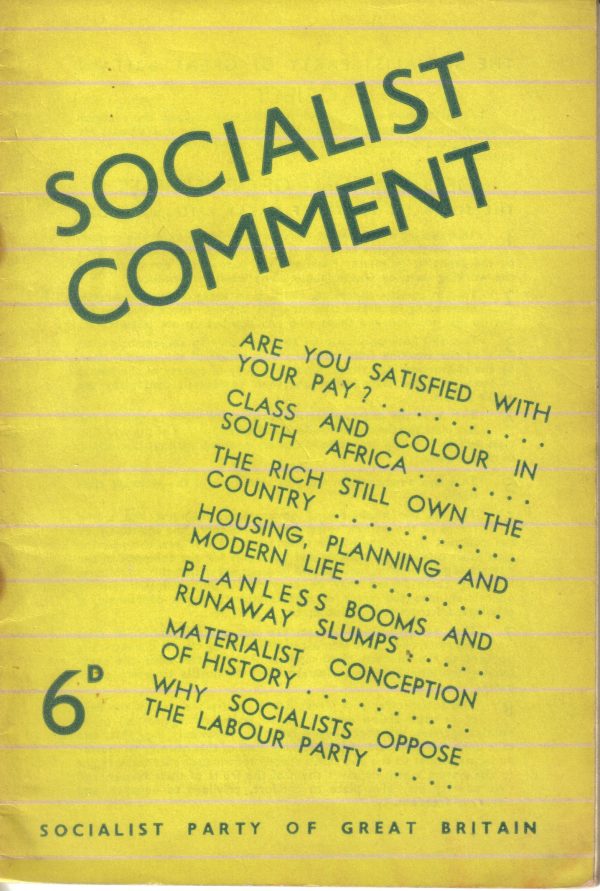
A pamphlet Socialist Comment, is now on sale (40 pages, 6d., post free 8d.) It contains seven articles reprinted from issues of the Socialist Standard during the past year or two. It deals with the colour problem in South Africa; why Socialists oppose the Labour Party; Housing; boom and slump; the ownership of property; and the workers’ ideas about their pay.

Hints on Civil Defence (1957)

From the April 1957 issue of the Socialist Standard

What are you doing about Civil Defence? Busy sealing your windows with sticky paper, learning how to bandage a cut finger, and how to dig grandma out of the rubble? If so, we’ve got news for you. Hiroshima and Nagasaki are ancient history—civil defence methods being taught today are likely to be as effective against future nuclear weapons as stone-age implements would be against tanks.

And what authority have we for taking this rather pessimistic view? None other than Mr. Val Peterson, who is the Federal Administrator of Civil Defence in the United States. His department was set up in 1951, and his conclusions are, therefore, by no means hasty speculation, but the outcome of six years' study of a subject vital to American government policy. According to an article by Mr. Alistair Cooke in the Manchester Guardian (20/2/57) “He (Mr. Peterson) has refused to admit that any plan of civilian defence no matter how grandiose in conception or how faithfully executed, can cope with the destructive power of modern weapons, any more than a teacup can bale out a sinking liner.”

Tut! Tut! We trust that the appropriate authorities over here will give the lie to this defeatist philosophy, even though it comes from such an expert as Mr. Peterson.

Mr. Peterson is pretty gloomy about the protective value of air-raid shelters, even if there will be enough of them left for us poor workers after the needs of service chiefs, cabinet ministers, captains of industry, etc., have been met. To quote Mr. Cooke again: “Mr. Peterson said that if the whole 170 million Americans had air-raid shelters, at least 50 per cent of them would die in a surprise enemy attack.” In the final analysis, he said: “There is no such thing as a nation being prepared for a thermo-nuclear war.”

In an emergency Mr. Peterson’s office would be responsible for dispersing the American government, evacuating the cities, and commandeering transport, utilities, and hospitals. But would we have any warning that an emergency existed before the first hydrogen missiles began to fall like the gentle dew from heaven?

However given three hours’ notice Mr. Peterson thinks that about half the population of the inland cities in the United States could possibly be saved by totally evacuating them. But where could the population of the inland cities of Britain go? There just are not the wide open spaces here as in the U.S., and one or two strategically placed hydrogen bombs. . . but there, it does not do to be too morbid. Unfortunately, according to Mr. Peterson, the inhabitants of coastal cities in the U.S. would not fare so well as the inlanders because of unheralded atomic shellings by submarines suddenly popping up out of the sea: we will suppress any remarks about British seaside resorts in case the good mayors of Brighton and Margate blame us for any decreased attendance of holiday-makers this Summer.

The interest in Soviet air power is misplaced, according to the New York Herald-Tribune (also quoted in Mr. Cooke’s article), because long-range submarines could be used as launching platforms for nuclear missiles having ranges up to 5,000 miles; the great industrial centres deep in the heart of the U.S. “ are within range of this potential terror streaking out of the Atlantic, the Pacific, and the Gulf of Mexico.” Submarines streaking out of the North Sea (long or short range) could deal very effectively with the closely concentrated industrial centres in Britain.

So it looks as though we must abandon the sticky paper those nice shiny tin helmets, etc., and take to the hills. But wait a minute, that awkward Mr. Peterson has objections to that idea as well. To quote Mr. Cooke: “Mr. Peterson thought that, even to rescue half the population, the United States would have to start at once plans for housing most of its city populations underground in the mountain ranges of the East and West. He piled on the misery by warning the committee that even such drastic plans foresaw only an attack by hydrogen weapons. Within a year or two, by 1966 at the latest, he was convinced that the inter-continental ballistic missile, with an atomic or hydrogen warhead, would be the prime weapon. When that was perfected, he said, the Government's recommended plans for evacuation would be 'out the window.' ”

But the worst is yet to come! Mr. Cooke’s stimulating (but rather gloomy article) ends by quoting the New York Journal-American, which has revealed that U.S. military scientists are working on an inter-continental missile with an “anti-matter” warhead that “would make the hydrogen bomb look like a fire cracker.” According to Mr. Cooke “one gramme of 'anti-matter' could trigger a weapon as powerful as the Hiroshima bomb; and the expert guess is that a portable warhead could ’conceivably blow the Soviet Union off the map.' ”

Our rulers tell us that we must have the latest (and therefore most devastating) nuclear weapons because they are “deterrents” to potential aggressors; it is never Britain which is the potential aggressor, but always “the other side.” Of course, the governments of the United States, Russia, France, Germany, etc., are busy telling their own workers the self same story. No government wants war, and yet all are preparing for it.

Socialists know that war is the final arbiter in the bitter struggle between rival capitalist groups. So long as capitalism remains, the threat of war with or without thermo nuclear weapons is ever present, casting a dark and dreadful shadow over the happiness and peace of mind of millions of human beings.

The only effective civil defence measure would be the rapid growth of Socialist knowledge among the workers of the world, so that capitalism may be replaced by socialism, and international rivalry abolished.

One final hint: read our pamphlet The Socialist Party and War (price 1/-). which contains a detailed socialist analysis of the cause of wars: there is more practical advice and cause of optimism contained within its 100 pages than in all the mass of civil defence literature published by governments which at the same time are planning more efficient means of destruction.
Michael La Touche

The Irish Elections (1957)

From the April 1957 issue of the Socialist Standard

"The main problem now confronting the people is to discover by what defect in our system it has come about that the nation, while never better equipped in knowledge and machinery to produce all its needs, is forced to see so much of that knowledge wasted and the machinery lying idle, while thousands of willing workers are unemployed and in need of the necessaries of life."

Thus spoke Senator James Hickey, Chairman, at the Irish Labour Party’s annual conference in Athlone, less than a year ago. At the time, Labour was the second largest party in a Coalition Government, which had been pledged to discover and remedy this defect along with all the other problems of the Irish working-class, who had elected them. They failed to do this and as a consequence. must now try to fill the opposition benches, with depleted ranks, while the task of administering Irish capitalism passes to Mr. De Valera and his colleagues in the Fianna Fail party Speaking at an earlier Labour Party conference, shortly after being elected to power, Mr. B. Corish (A Labour Minister) said: "Workers could look forward to the day when the spectre of emigration would have become a bad memory . . . it remained one of the fundamental aims of the Labour Party to see that every person who was willing to work would find decent employment in his own country.” (Dublin Evening Mail, 30/9/49). Yet, in a statement issued on the 26th January of this year, explaining why he could no longer support the Government, Mr. S. McBride, ex-Minister for External Affairs pointed out that the unemployment figure was now 100,000 and that in the five year period 1951-6, over 200,000 people had been forced to emigrate. So much for Labour Party promises. In Dublin, where unemployment is most acute, the unemployed put up a candidate of their own and succeeded in capturing a seat at the expense of the party who claimed to have the solution to their problems! Work hard, they were told, and prosperity is yours. “If our national income becomes stagnant, if we refuse to work hard and produce more, social security becomes merely a delusion and a deception, said John Costello, the Prime Minister, in 1948, but the man who was Minister for Social Welfare (plus the portfolio of Deputy Prime Minister), Wm. Norton (Leader of the Labour Party) had told the workers ten years before, that “Under our' present social system, greater productivity means a lower wage for the worker and higher profits for the owner of industry.” (Labour News, Dublin, 29/1 /38). Though Costello could claim in the Dail (20/7/49) that the 1948 volume of production for all industries was 28% above the 1938 volume and the United Nations Statistical Bulletin issued on 6 November, 1947, included Eire among the countries showing monthly production averages higher than 1937, the International Labour Office in its cost of living findings for February, 1947, picked out Eire for special mention among four countries where “real wages have actually dropped below 1937 levels.” Little wonder that the tide has again turned in favour of “ Dev.”

If however the working class of Ireland believe that their problems can be solved by Fianna Fail, they are in for a rude awakening; for the record of that party is a record of service to the only class which can be served under capitalism—the capitalist class. It was they who introduced the most repressive anti-working class legislation in the history of the State. The Wages (Standstill) Order, the Trade Union Bill, the Industrial Relations Bill (which set up the now notorious Labour Court), all measures designed to hinder the efficacy of trade-union action, in the interest of Irish employers. After sixteen years of Fianna Fail rule, the Medical Superintendent of the Dublin Fever Hospital stated that: “Until the Dublin wage-earners and their wives and children were decently housed and fed, more beds in sanatoria and tuberculosis hospitals would be needed.” (Irish Independent, 24/6/49). That was Fianna Fail before; may we expect a change now? The answer is an unqualified “ NO ” and to prove that he is consistent in his concern for the class he represents, Mr. De Valera’s first statement after his election success was— yes, you guessed it—a clarion call for harder work! “One great, combined and sustained effort and the task will be done.” (Irish Times, 8/3/57). And the “task?” To put a very shaky native capitalist class back on its feet again, while Irish workers continue to live in poverty and go to Mass on Sundays.

There is, however, one bright spot in this otherwise murky picture; the tiny (as yet) Socialist Party in Ireland, continues, with the limited means at its disposal, to point out to Irish workers the message of Socialism, that until the machinery referred to in the first paragraph is commonly held by ALL, it will continue to lie idle, however willing a non-owning class may be to use it. This wonderful world can be OURS when enough of us really want it AND KNOW HOW TO GET IT.
F.

Party News Briefs (1957)

Party News from the April 1957 issue of the Socialist Standard

Annual Conference is being held once again at Conway Hall, Red Lion Square, London, on Friday. Saturday and Sunday, April 19th, 20th, and 21st, commencing 11a.m. (Sat. 2.30 p.m.) Every effort is being made to ensure that a good delegation is present to discuss the work of the Party during the past year. Apart from work to be done and plans for future Party activity discussed, members have a good opportunity of meeting Comrades from the Provinces and other London Branches and making Conference a social venue. A dance and social will be held on the Saturday evening; a good dance band has been engaged and it now rests with Comrades and friends to enjoy themselves at this annual Party event.

#    #    #    #

Lewisham Branch has organised a series of four meetings to make known in greater detail the “Socialist View on Four Burning Issues,” the plan for a European Common Market; the South African Racial Problem; the Rent Bill and the Cost of Living. Not a week goes by but that these issues the subject matter of thousands of words, both printed and spoken through Press and Radio. These meetings will set those problems in their true perspective, evaluating carefully the interests at stake, and stating plainly what action is necessary to bring about a lasting solution. Although the meetings do not commence until May, the Branch Organiser and Branch members are anxious that members should know well in advance in order that they may advertise the meetings among their friends.

#    #    #    #

Comrade T. P. Gibbs. We regret to learn that this Comrade from Tottenham Branch died at the end of January. Comrade Gibbs had been an active member of the Branch until his death, having joined the Party in 1908. He was always relied upon to undertake any Branch work that was within his powers, helping to build up and maintain the regular sales of the Socialist Standard. He was also the Dues Secretary of the Branch.

#    #    #    #

Comrade R. C. Walker, of Vancouver, Canada, is recovering from a serious illness and is at present unable to supply his Vancouver contacts with Party Literature. We understand that other Comrades are being contacted to carry on this work and meanwhile we wish Comrade Walker a very speedy recovery to good health.

#    #    #    #

At the time of going to press, the Wood Green and Hornsey Branch were discussing the question of contesting the Hornsey bye-election. In any case a publicity drive is under way in the area. Members, especially speakers, living near enough to help, should call at the branch on Thursday evening or contact the Wood Green and Hornsey Organiser at Head Office on Tuesday evenings.

Members are urged to give the fullest possible support to this campaign as from this activity we hope to build an organisation to co-ordinate North London publicity that will make our aims familiar throughout this area.

#    #    #    #

Sunday Evening Film Shows at Head Office. The last two meetings of this season are being held. The Organisers report that the series has been most successful and they look forward to “ bigger and better ” shows next Autumn. The meetings have been well attended and good discussions have taken place after the showing of the films.
Phyllis Howard

Odds and Ends: Wicked Materialists? (1957)

The Odds and Ends column from the April 1957 issue of the Socialist Standard

Wicked Materialists?

Speaking recently (News Chronicle, 22/2/57), as chairman of the Church Assembly, Dr. Fisher, the Archbishop of Canterbury, said: “On so many bodies I belong to, really the business is ruined by these constant discussions about salaries, stipends, and superannuations, and all the rest. . . . I have come to the conclusion that it is an insidious form of pure materialism. It is a disease running through the community.”

Poor Dr. Fisher! He seems so upset at those wicked materialists, i.e. parsons, with average pay, £650 a year: and, of course, all those railwayman, clerks, dockers and the like, who all seem so materialistic in their desire for a better life—in this world. But then our dear Archbishop need not worry himself unduly about his own material well-being. He only receives £7,500 a year as Archbishop of Canterbury.


£400 for a Slave

Fairly recently King Saud of Saudi Arabia visited “the land of the free’’—the United States of America, where he was fêted by President Eisenhower, and other American politicians. Little is known of his country except that there is sand—and more important—oil, in Saudi Arabia. But a recent United Nations report (News Chronicle, 22/2/57) gives us some idea just how “free” and democratic King Saud’s oil-soaked land is. According to the report Saudi Arabia has 450,000 slaves— just 20% of the population. Prices on the Jeddah slave market were said to be between £200 and £400 for a girl under 15; £150 for a man under 40 and £40 for an old woman.

Like Christian Archbishops who also live quite well, Moslem Kings, such as King Saud, do not condemn slavery—chattel slavery in Arabia, and wage-slavery in Britain 1


Human Nature ?

A most startling recent discover was a tribe of Honest Men! It goes without saying that they were not found in Christian lands. They were found in the jungles of Venezuela by Prof. Tenton, an ethnologist. He reports that these uncivilised people never lie, never make war, never kill and never rob.

They have no politicians, no advertisers, no crooks, and are so used to each other’s honesty that they have no locks and keys, no monetary systems and don’t even wear clothes.

All that remains is to protect these Maora Indians from the Christian missionaries, with their civilising influences.” (Freethinker, 14/12/56).


Women in Antiquity

"Women In Antiquity" by Charles Seltman (PAN Books, price 2/6d.), is quite an interesting and provocative little book, although the author has a number of axes to grind. Much of what he has written of women “in antiquity” will be challenged. For example, in his first chapter on Palaeolithic and Neolithic society he sees a situation where from 20 to 50 people live “comfortably” in a cave owned by the biggest male. And, further, after dealing with the activities of the women (such as scavenging for nuts, roots and fruit), he writes:—
“When one tries to imagine the structure of such a cave-family, one can think of two possibilities : firstly, the senior male (whose property the cave was) might have a series of wives from the oldest at twenty-four to the youngest at twelve, among whom there would inevitably exist a kind of harem-like jealousy productive of much unhappiness; secondly, the whole cave-family group may have lived in what zoologists call a 'clone,' in which the women were shared in common by the men." (p. 14.)
Of course, all of this, is purely speculative, and in contradiction to the findings of other anthropologists, who often see an absence of jealousy in primitive communities and who write not of a dominant male but of sexual equality—"sexual communism”—and “group marriage” during this early period of pre-history. Seltman’s ideas on this period seem to be much akin to those of Freud with his dominant father, the jealous sons and the “Primal Horde.” Still, in the main our author is on the side of the women! He generally sees the position of women “in antiquity” as a favourable one compared to their position m some countries today. And he has little sympathy for the Church’s views on women and sexual relations in general. 


“Freedom's Foe—The Vatican"

This book is by a "free-thinking” protestant, and is a counter-blast to Catholic Action. In the main it reiterates the views put forward in greater detail by Avro Manhattan in The Catholic Church Against The Twentieth Century.

Adrian Pigott, the author of Freedom's Foe, deals with the Catholic Church’s alleged former collaboration with Fascism and Nazism, with the “evils of priest craft," the misdeeds of some of the Popes, the "cruelty of the Catholic Church," the extreme poverty to be found in some Catholic countries such as Spain and Ireland (he tells us that “Protestant countries have little discontent or poverty .. ."!!) and the activities of the Church in Britain and the United States.

No doubt many of his criticisms are valid—but what can the Protestant critics of Catholicism, such as our author, offer the working class of Britain and elsewhere? The Church of England, of whom Marx once said, that it would rather give up its Thirty-nine Articles of Faith than give up one thirty-ninth of its property? Neither Protestants nor Catholics, Moslems or Buddhists, have a solution to the problems confronting ordinary people. Only Socialism has an answer to those problems. All the same this little book is worth l/6d.

Freedom's Foe—The Vatican, is published by the Wickliffe Press, Fleet Street.


Are you Fed-up ?

Do you dislike the Foreman or the Chief Clerk? And when you get home from work at night, do you feel tired, frustrated and fed-up?,

Do you find life worrying, insecure and purposeless?

Do you find it a job to "make ends meet" to save enough money for a holiday, or a new suit?

Do you get fed up with the threat of war with the promises of the politicians?

Do you? Well, then, isn’t it about time you did something about it. No!—don’t take ". . .'s ” little liver pills, or "H. . .’s" just before you go to bed, because, ten-to-one, whilst this present system of society remains you will fed much the same the next day. So why not get to grips with society itself ? Begin to study the world m which you live. And when you understand it, your position in it, the causes of the problems that worry you, and make you insecure, join with others who know about our present system—capitalism—and with them help to change it to a society free from insecurity, poverty, the threat of war; to establish a Socialist wood—a classless, moneyless system of society. Why not start now?
Peter E. Newell.