Sunday, May 8, 2022

50 Years Ago: The Age of Oil (1963)

The 50 Years Ago column from the February 1963 issue of the Socialist Standard

The oil age is coming. Year books, financial journals, the sharks of Throgmorton Street, together with the rest of the interested, “far seeing" exploiters and worshippers of the golden calf, are eagerly discussing the possibilities of oil as a motive force, and how much more profit they can grab by its use.

It behoves the working class to consider the question also, because it is they who are going to suffer, as usual, from what would be a boon and a blessing to all were the toilers sufficiently enlightened and determined to make it such.

The Diesel engine has already proved itself capable of propelling ocean-going steamers, and will doubtless be in general use in the near future. Look at this: “ The engine room staff of the Selandia consists of eight men and two boys. No firemen required. No boilers needed. No loading with bunker coal for the voyage”.

How our masters must rub their hands with delight when they think of the saving of wages, extra cargo space, cheaper ships, and many other advantages. How the thoughtful fireman must curse when his job disappears, and the boilermaker when he reads: “No boilers required”. How joyous the coal-porter must feel when, instead of fifty men employed in coaling a ship, he sees the engineer turn on the oil cock and fill his tanks in a few hours! Oh! the unspeakable happiness of the lightermen and railwaymen at the thought of not having to transport any more dirty coal to the docks! What joy dwells in the heart of the miner as he thinks of the near future when oil competes fiercely with coal, and thousands of him are saved the trouble of squabbling over the “abnormal places”, having gained the displaced wage-slave's normal place—the gutter.

From the Socialist Standard
, February 1913

A Conservative’s view of Russia (1963)

From the February 1963 issue of the Socialist Standard
" 'Under God and the Tsar' ran the old saying, 'all men are equal'. In Imperial Russia there was no old-established aristocracy, no bourgeoisie, nothing in short that you could call a proper ruling class. The same was even true under Stalin. But now, forty years on, under Stalin’s successors, a ruling class is fast emerging—a class of capable, ambitious men and women who are ready, indeed determined, to play their proper part in affairs and to have their proper share of the rewards. Such, in England, one imagines, must have been the behaviour of the new upstart aristocracy under the Tudors, and again two or three hundred years later of the suddenly enriched scions of the Industrial Revolution.

“With Victorian England in particular there are many parallels to be drawn. There is the same rapid industrialization with all its attendant sacrifices, human and otherwise, the same sudden economic expansion. the same emergence of a new, confident. self-assertive class, the same earnestness, the same will to power, the same belief in progress, the same sense of their country’s imperial destiny, the same agreeable, absolute certainty that they are right. It is even possible to carry the parallel further. Like their Victorian counterparts the new Soviet aristocracy are priggish, prudish, inclined to be pompous, rigidly attached to their own vested interests and rigidly conservative in their ideas and in their profound reverence for the Establishment in all its manifestations. Even their tastes are the same: they like pictures and statues that are easily comprehensible. They like rich solid food and rich solid ornate decorations and furnishings.

“But, the reader will say, are not these worthy people all Communist? Do they not all believe in world revolution? Of course they do. They are Communists just as the Victorians were Christians. They attend Communist Party meetings and lectures in Marxism-Leninism at regular intervals in exactly the same way as the Victorians attended Church on Sunday. They believe in world revolution just as implicitly as the Victorians believed in the Second Coming. And they apply the principles of Marxism in their private lives to just the same extent as the Victorians applied the principles of the Sermon on the Mount in theirs. Neither more nor less.”

(Taken from Back to Bokhara by Fitzroy MacLean, Four Square Books 3/6. Sir Fitzroy MacLean, Conservative M.P. for Bute and North Ayrshire, formerly in the Diplomatic Service, including service in Moscow, revisited Russia in 1958. This short book is his very readable description and interpretation of the changes he found).

Semi-enlightened Bishop (1963)

From the February 1963 issue of the Socialist Standard

It is not often that Socialists can quote, even with a degree of approval, the comments of prelates. Usually their function is to tell us that this is the best of all possible worlds and, in between, to bless various weapons as being on the side of God and Good (as against the weapons of the Godless, Evil, and the Other Side). However, the Bishop of Pontefract, reported in The Guardian of 9th January, has recently made some thoughtful and thought-provoking remarks on our present social system.

He thinks that wild-cat strikes, gambling, drinking and various other symptoms of a lower moral condition are the result of feelings of helplessness and boredom, the reaction to the increasingly impersonal administration of affairs of State and industry. He accuses leaders of Church and State of failing to give a satisfying purpose for living. Citing centre-less new housing estates, the rat-race of examinations and status symbol degrees, the Bomb, and the increasing number of suicides, he comes to the conclusion, not very epoch-making we must admit, that there is something wrong with society if it imposes this kind of strain on people. The remarks were mainly concerned with the unhappy lot of industrial workers, but we know that their once more fortunate fellow workers in offices are subject to the same strain and problems and are no less bored as office routine becomes more and more broken down into one-function fragments.

After his comments on the ills of present society, the Bishop lapses into the woolly conclusions that worship of the Golden Calf is responsible for all this misery and that while poverty is heH, the hunt for money diminishes compassion and mercy.

It would, of course, be too much to expect a Bishop to draw a really solid conclusion from his views, but perhaps we can do this for him. Substituting for “the Golden Calf,” the “Profit Motive” or production for profit, not for use, and using this as our yardstick when looking at all that is anti-social going on around us today, we see that preaching and hand-wringing will get us nowhere, just as it has got all would-be reformers nowhere. 

Only a complete change in the basis of society can abolish the very material Hell that capitalism has brought us to. It may be too much to expect of the Bishop, but when his flock begin to work for a new social system on earth rather than pie in the sky, and all the flocks throughout the world do the same, Man will at last achieve a world worthy of his skill and intelligence.
S. Goodman

The Working Class (1963)

From the February 1963 issue of the Socialist Standard

In these days when in many parts of the world the working class is in the process of becoming a fully-fledged section of society, it is well to review the class nature of capitalism and note some of the lessons.

As the very existence of the class struggle is widely denied even in the Labour movement itself, we had best begin by defining, or rather explaining, our terms.

The term “working-class” is used by many people who have never seriously considered what it means. Some, like the so-called Communist party, use it to mean industrial and manual workers. They do not think of doctors, teachers, scientists, authors and other “professional” people, as members of the working-class. What is even more tragic is that most people in these groups do not appreciate their class position. What in fact determines class is not the kind of work that is engaged in, but the fact of having to work at all.

From this it will be seen that the teacher or the doctor is in the same basic position as the bricklayer or road sweeper. The question is not “Do you wear a white shirt or oily overalls,” but “Have you any means of livelihood apart, from working.” If the office, bank, school, or laboratory you work in does not belong to you and if rent, interest or profit does not come your way, you can call your wage a salary till the cows come home, but you are a member of the working-class.

The fact that the factories, offices, and the whole apparatus for producing and distributing wealth belong to a parasite minority is not the invention of the wicked socialist imagination. The reverse is the case. The Socialist is a product of class society, but a very special product with a unique purpose.

Many notions have been advanced as to what history and society are all about, but to understand society as a living changing social structure, it is necessary to look to the breaking up of men into antagonistic classes, and to the process of exploitation. All of the institutions of state, law, administration and all private wealth and privilege throughout written history up to present times, rest upon a surplus of wealth being created by a class of toilers and appropriated by a class of non-working owners. The material interests of each class of owners have been, and remain, completely opposed to the interests of the property-less mass they exploit.

The state as the executive committee of the ruling class is the seat of political power. The institutions of wealth and privilege are legalised and enforced through this political power. The way to ownership of the means of production lies, for workers and capitalists alike, through political power.

On the question of material interests it can be seen why Karl Marx is so feared, hated and abused by the capitalist class.
The bourgeois relations of production are the last antagonistic form of the social process of production—antagonistic not in the sense of individual antagonism, but of one arising from conditions surrounding the life of individuals in society; at the same time the productive forces developing in the womb of bourgeois society create the material conditions for the solution of that antagonism.
(Critique of Political Economy)
To get rid of the antagonistic relations of production means, getting rid of capitalism. This is what it meant to Marx and Engels, and this is what it means to the Socialist Party of Great Britain. How could the head-fixing experts of T.V., radio, press, pulpit, treat Marx fairly when Marxism says the system of wage-labour, profits and privilege must go? Yet, the idea of abolishing wages, and producing for use, must be grasped by the working class before the terrible problems with which the world is faced, are to be removed. The present system of production for profit is a brake on any rational progress.

Most workers are so accustomed to working for wages that to talk of a world without wages is frightening to them. What they fail to realise is that when the factories, mines, railways, etc., belong to all mankind in common, the fruits of our labour will be freely available without having to meet the demand of the price tag. Wages, far from being a blessing which we could not do without, represent the debasement of humanity and the divorce of the producers from the means of production.

The wage system takes away from the workers what they produce, and creates a situation in which money becomes the sole end of human endeavour. The worker is reduced to a creature who seeks a wage packet. What he makes, how he makes it, and what becomes of it, is of no importance to him. The fact that a great deal of wealth today is shoddy and inferior is hardly noticed. If he could get more wages digging holes and filling them in again he would be counted silly not to take the job. The capitalist, on the other hand, has no interest in being the owner of thousands of washing-machines or pairs of shoes. His only interest in production is to get as much profit out of it as possible. If one line fails he will try another. Socialism will restore the use motive to everything that is produced. People will then have a direct interest and say in what is produced and how the process is conducted.

The working class have trodden many false paths and taken up many unsound ideas in the course of their history. When sections of organised workers engage in sound action by striking for improved wages or conditions, they receive the almost unanimous condemnation of the Press. This should indicate to them that such action is in their interest. Industrial action on its own is however very limited and has its best chance of success in boom time when the employers need us most. At best, a strike can win the day on a wage issue, but the capitalists still remain in their privileged position as owners of the means of production.

The trade unions have long been subject to much misuse by careerists and job hunters, also on the other hand, many sincere workers have devoted themselves to the task of winning concessions through trade union action. The real strength of trade unions rests on the growing class-consciousness of their members. If the workers understand their class interest they would be able to struggle much more effectively and could not be duped by the double talk of their leaders. The whole record of leadership has been  a very painful one for the working class. Many workers in the “Communist” and Labour Parties, despite disillusionment in the past, still waste their efforts looking for the right leaders. Against all past experience, the idea persists that leaders can do something about the effects of capitalism. In fact, the situation produces and controls the leaders—not the other way around.

Leadership involves the acceptance of an “enlightened” few by an ignorant mass. It is essentially a sheep and dog relationship, except that in this case the dogs do not know where they are going either. Perhaps one of the most famous of all leaders was Lenin, who held:
. . . that the Soviet Socialist Democracy is in no way inconsistent with the rule and dictatorship of one person; that the will of a class is at times best realised by a dictator, who sometimes will accomplish more by himself and is frequently more needed.
For our part we have always argued that the workers must think for themselves and can only take sound action when they understand the society they live in.

The reformist parties are lost before they start, partly because of the ignorance of their adherents and partly because their policies involve them in retaining capitalism while trying to lighten the problems of that system. In this the parties of the so-called “ left” share the fate of the so-called “ right.” The record of their activities reveals some strange alliances and compromises. Liberals have helped the Labour Party; Tories have been helped by “Communists”; the Liberal, Labour, Conservative and “Communist” parties have worked together in war time. Nazis and “Communists ” have made pacts of peace and friendship and all of them are prepared at aU times to promise anything that will win votes. All this seems strange until it is realised that the economic dictates of Capitalism, control them all. What is strange is that despite their black records the working class continue to support them.

All of these things, leadership, reformism and political ignorance, interlock and form a sinister pattern. Inevitably political parties which do not seek support to abolish capitalism find themselves immersed in its sordidness. Hypocrisy becomes their stock in trade. They ail support war.

They all have to talk the language of nationalism, and stimulate and appeal to nationalist feelings. In this country this means they must all be very British and concerned with the good of the nation. The idea has to be continually sold lo the workers that they have a national identity and that their interests are at one with the ruling class. Those African and Far Eastern countries which are new to the capitalist fold have been quick to learn from the example of their older rivals.

While Socialists work for an end to national divisions and the introduction of a world community democratically administered and co-operating to produce wealth for the free use of all, Lenin wanted the proletariat to "decisively and actively support the National movements for the liberation of oppressed and dependent nations."

This cry of “National Independence" is still echoed by various dupes of capitalism today, including the “Communist" Party. It has found fruit in the coming lo power of home-grown oppressors with the workers being used as a bulwark against their own class interest.

In making this very brief survey many things to which workers devoted their energies, have been left out in order to pay attention to the main points which have a direct bearing on working class activities today. What turn events will take next depends on how rapidly the workers of the world can learn from their experience and the lessons of the past. One thing is certain, for as long as Capitalism continues, poverty, insecurity and wars will remain our constant nightmare.

In 1905 the Manifesto of the Socialist Party of Great Britain was first published. On page 25 of the sixth edition, it said:
“In all human actions material interests rule, and therefore the dominant class can only be concerned in upholding wage slavery and increasing their power over the workers. The working class, on the other hand, are driven by their material interest, to struggle for the possession of the means of living. To the working class history has committed the mission of transforming society from capitalism to Socialism. A glance over past history shows that every class that emancipated itself had to commence with the capture of the political machinery, that is, with the power of government. It is therefore, necessary for the workers to organise a political party having for its object the capture of political power.

This political party of the workers can only be a Socialist party, because Socialism alone is based on the facts of working class existence.”
Harry Baldwin

The Science of Revolution. (1927)

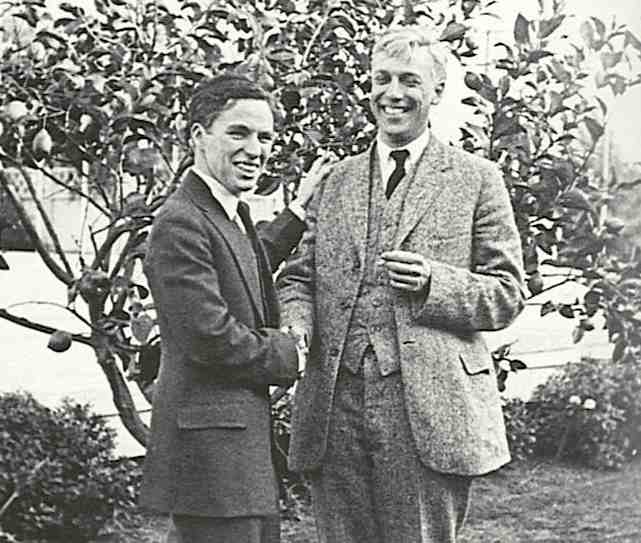
Charlie Chaplin and Max Eastman in Hollywood 1919. 
Book Review from the June 1927 issue of the Socialist Standard

A crimson-covered volume of some two hundred and odd pages has come to hand possessing the above ambitious title. The author, Max Eastman, poses as something of a psychologist of the analytical type, having apparently imbibed Freud in large doses. Thus fortified, he trains his critical guns upon what he regards as the tottering fabric of the Marxian philosophy, or as he terms it, “dialectic materialism” ; which procedure, he would have us believe, is animated by nothing more than a friendly desire to rid Marxism of a paralysing encumbrance, and to convert it, at last, into a real practical science.

The effect is somewhat bewildering, to say the least of it, and the present scribe, afflicted with a mere working-class education, candidly confesses his inability to make any practical head or tail of the involved argumentation in which Mr. Eastman indulges. In his first chapter on “The Function of Thinking,” he drills into the reader the idea that “Thought is purposive,” yet at the end of the book the said reader is left guessing as to just what purpose the author considers himself to have served.

There is not a single criticism of Marx that is new in the whole volume, and nothing is added, even by way of suggestion or example, to our knowledge of the social revolution. All that the author attempts is to shake the confidence of the Marxist in the reality and objective basis of his conclusions. Economic knowledge is derided and belittled, and a simple faith in our own desires and will is offered as a substitute. All this, of course, the author would have us lay at the door of psychology.

According to Mr. Eastman, Marx’s conception of history as a process based upon economic development, was merely a “rationalisation” of his desire for a revolution. We are asked to believe that in the “ideological” and “metaphysical” pages of “Capital,” Marx satisfied the mystic yearnings of his soul by philosophical communion with an “Economic God” of his own invention.

The present writer is not, of course, in a position to divulge what subtle “complex” dominates Mr. Eastman’s mind, but it appears to be one which leads him, for some obscure reason, into hostility against any form of abstract thought as applied to history and economics. He would throw overboard both metaphysics and dialectics and confine himself to the common-sense methods of practical investigation. Yet in the realm of biology he accepts Darwin and in psychology he accepts Freud.

He appears to be unable to see that both of these investigators are compelled to use the dialectical method whenever they generalise their conclusions, and leave for the nonce the realm of particular facts.

Darwin was forced to connect the evolution of organisms with changes in the earth’s crust. Are we therefore entitled to suggest that he was merely “rationalising” a subconscious hostility to the Book of Genesis? Marx, we are told, does not explain the practical variations in prices, etc., by his theory of value. Neither did Darwin attempt to explain the variations which occur in every succeeding generation. He looked for the law of survival and found it—horror of horrors, Mr. Eastman—in the material conditions of existence which alone could determine what were “favourable” variations, regardless of the will and desire of unfavourable ones.

In the sphere of psychological theory, Freud elaborates the conception of a conflict between the conscious and the unconscious mental processes. This he attributes to the existence of a censorship which represses the thoughts and feelings incompatible with civilised behaviour. Obviously, as Freud himself admits, this censorship is nothing but the reflection in the individual mind of the social conventions necessarily arising from a given stage of economic development. The professed object of psychoanalysts is to resolve the conflict, i.e., to bring the buried “wish” into harmony with reality, and what is this, Mr. Eastman, but the essence of dialectics?

It matters not to what realm of investigation we turn, the same law holds good, that a thing is and moves, and has its being only in relation to that which is not itself. So-called realists like our author may wriggle this way and that, but the only practical way of escape from the barren waste of metaphysics is the dialectical materialism which they affect to despise.

This is obvious whenever a scientist leaves his own realm and pronounces as with pontifical authority upon some subject of general interest of which his knowledge may easily be less than that of the average man. Men like Crookes and Lodge, for example, exhibit all the vices of the metaphysician when dealing with the subject of spiritism, while the number of Anti-Socialist professors has not been counted.

Marx’s “metaphysics” were attacked and the attacks answered by him in his own preface to “Capital” long before Mr. Eastman was heard of. Economic forces being social in character, cannot be dealt with in the same way as chemical compounds. Acids and microscopes are useless when we want to analyse a commodity.

Only the force of abstraction can help us. Abandon that force, and a science of economics becomes impossible, and we are left a prey to every Utopian fantasy liable to be misled by any will-o’-the-wisp “reform,” whether proposed by the professional politician or the crack-brained “rebel.”

Mr. Eastman endeavours to maintain that an idea cannot at one and the same time be a “reflex” of conditions, expressing some class interest, and also have objective validity. He holds that the Marxian “ideology” is thus no more scientific than the “ideologies” of the capitalist class, which it attempts to replace. In other words, Marx only saw what he wanted to see and described the result as “science !” This line of argument leads us to the conclusion that a truth ceases to be such if we want to make use of it. Thus, mechanics are no more scientific than magicians, since they simply express in their theories a “rationalised” form of their desire to control the universe.

For sheer puerility, some of the self-styled “psychologists” would be hard to beat, but as Engels has it, “The proof of the pudding lies in the eating, and human action had solved the problem long before human ingenuity had invented it.”

The soundness of Marx’s economic view is evidenced by facts which become daily more obvious, e.g., the concentration of capital and the intensification of exploitation, and of the consequent class-struggle. Mr. Eastman affects to regard these facts as immaterial to the main issue. “Look at Russia !” he exclaims. “Never mind about whether the triumph of the proletariat is inevitable ! Suffice that it is possible.” Yet in a very few pages further on he has to lament the appalling growth of bureaucracy in Russia !

Lenin, of course, comes in for eulogy in comparison with poor old Marx.

We have the “brilliant social revolutionary engineer” held up to admiration in comparison with the “foggy old metaphysician.”

The Bolshevik upheaval proved Marx wrong according to Mr. Eastman. Had it succeeded in its alleged object, we might agree with him, but all the evidence of its failure surely proves that Marx was right, and that social and political forms cannot be forced upon countries where the backward economic conditions make them premature.

Throughout the book the author negligently confuses historical materialism with “economic determinism,” and blind fatalism. He follows innumerable bourgeois “critics” of Marx in attributing contradictions to his thought which do not exist, and generally re-hashes all the stale metaphysical dualism in the guise of psychology. It is difficult, however, to believe that Professor Freud would recognise many of his “disciples” who appear anxious to show themselves off as “Jacks” in all and sundry branches of inquiry and “masters” of none.

As for dialectics, this method of reasoning will no doubt survive the attempts on the part of the “Communists” to drag it in as a support for their alternate criticism and support of Labour leaders; but this is a practical question of working-class politics here and now, which appears to be beneath the notice of such a “practical scientist” as Mr. Eastman.
Eric Boden

Blogger's Note:
The full title of Max Eastman's book was 'Marx and Lenin: The Science of Revolution'.

Incentive—yesterday and to-day. (1927)

From the June 1927 issue of the Socialist Standard

A few thousand years ago, before the world had become thoroughly civilised, young men and old men lived on a Spartan diet, and worked arduously in order that they might become pre-eminent in games, in the arts and in warfare. Their sole recompense, apart from that personal feeling of satisfaction, was the approbation of their fellows expressed in the form of a crown of bay leaves or some similar token of public appreciation.

Since those healthy times, the unhealthy influence of Commerce has cankered the sources of action and the Daily Press periodically provides us with the sordid details of boxers who will only box if thousands of pounds is guaranteed to them; tennis players, golfers and all the rest who make a like proviso. We are even told that England cannot hear the best singers and musicians often because sufficient cash is not forthcoming. The old slogans “Art for Art’s sake” and “Art for Life’s sake,” are rapidly being transformed into the miserable howl of “Art for Money’s sake.”

It has become usual, with a self-satisfied feeling of genius unrecognised (particularly among the so-called “Intellectuals”) to blame that mysterious entity the “Public” for this state of affairs. It were better to observe the source of the trouble, which lies in a social organisation that compels people to think of income before work. Fortunately for us, though unfortunately for themselves, there are still plenty of people who place joy in the work of their hands and brains before income, but, in many cases, this healthy attitude brings a direful end, as the records of penury and suicide, and of the workhouses and lunatic asylums abundantly prove.

What, from the point of view of incentive, can be more sordid than the following extract from the “Daily News,” of April 18th, 1927 :—
“Gertrude Ederle, the New York girl who swam the English Channel, is complaining that the fortune she was promised is not reaching her.

Critics of her management point out that excitement in America was allowed to cool while her father carried her off to Germany to “swank” to his old compatriots, and that when she returned, and New York itself went wild about her, her advisers’ ideas grew so inflated that they frightened good money away.

The facts are that in the six months of last year in which she had her great record to capitalise “Trudy” Ederle got nothing out of it but a nine weeks’ music-hall contract. All the customary “by-products” of sporting success which are exploited here were neglected.

It is true that for her music-hall performance Miss Ederle still receives £1,200 a week. But she has been explaining how the money goes before she touches it. Here is her balance sheet:
             A Week
Her lawyer, Dudley Malone ……                     £200
Her father …………………………….                     £200
Agent for her act ……………………                     £120
Publicity agent ………………………..                     £35
Manager…………………………………..                   £40
Two girl divers ………………………..                   £100
Man setting up tank………………….                    £20
This leaves £485 a week, from which Miss Ederle herself pays the fares, travelling expenses of seven people and charges for the water used in the tank on the stage, probably £60 a week at least, leaving out of her £1,200 about £400 for herself.

Mr. Malone draws his percentage because he lent her £500 for expenses. Her father, who is. a successful pork butcher, draws his percentage because he advanced £300 of his own and £200 of the girl’s own savings from her swimming prizes.”
Is not this a fitting commentary on a society that judges nearly everything by £ s. d., and allows the views and the power of the money bugs to dry up nearly all the springs of healthy human activity ?

The cynical, the pessimistic, the gloomy-minded, and the supporters of the present rotten foundation of society, observing these facts, are apt to jump to the conclusion that nothing good can or will be done to-day without having money and “position” held up as a prize to provide incentive for the courageous and the skilful. It would not be matter for wonder if this idea were true, when one considers the tremendous obstacles that confront those who choose to ignore, up to, and even beyond, the verge of starvation, the commercial side of what they do, and prefer rather to follow the calling they love, asking as recompense only joy in the work they do and appreciation from their fellows.

A careful examination of the facts, however, is rewarded by the gratifying information, so full of hope for the future, that the bulk of the important things done to-day, in every direction, for the benefit of humanity, are not done with the object of securing either place or pelf, and often foreshadow to the doer social loss, poverty and misery. Of such things are the great industrial discoveries, the great works in literature and other forms of art, and the expeditions to the untrodden places of the earth.

There is one side to the problem that is apt to be missed by many well-meaning people. People of an imaginative and energetic temperament must find some outlet for their energies or perish. This fact is at the root of much of the activity that, on the surface, appears suicidal to the unobservant.

Apart from the fields of activity mentioned above, the different forms of sport provide myriad illustrations for the readiness of men and women to undergo arduous training purely for pleasure, or for the approbation of their fellows. When the social organisation has been cleared of the cankerous influence of private ownership in the means of production, with the limitations such a state of affairs imposes upon human activity, everybody will be free to exert their capacities to the full in whatever way they like best, with the only condition that such activity shall not be to the hurt of the rest of the people.
Gilmac.

The Onward March of Capitalism. (1927)

From the June 1927 issue of the Socialist Standard

To show the degrading effect of capitalist production on the modern wage-worker, Paul Lafargue uses this comparison.
“Look at the noble savage whom the missionaries of trade and the traders of religion have not yet corrupted with Christianity, syphilis and the dogma of work, and then look at our miserable slaves of machines.” —The Right to be Lazy (p. 10).
To justify this statement, we need only compare the general conditions of the workers to-day with the following description that Lewis Morgan gives of the American Indian :—
“All the members of an Iroquois gens were personally free, and they were bound to defend each other’s freedom; they were equal in privileges and in personal rights, the sachem and chiefs claiming no superiority; and they were a brotherhood bound together by the ties of kin. Liberty, equality, and fraternity, though never formulated, were cardinal principles of the gens. These facts are material, because the gens was the unit of a social and governmental system, the foundation upon which Indian society was organised. A structure composed of such units would of necessity bear the impress of their character, for as the unit so the compound. It serves to explain that sense of independence and personal dignity universally an attribute of Indian character.” (Ancient Society, pp. 85-6.)
Such was the state of man in this form of society, before modern civilisation played its part. And the curse it has been to these people is evident from the following item of news that appeared in the “Daily News,” 7/3/1927 :—
“The Red Indians, confined to reservations in various parts of the United States, even as near the east coast as New York State itself, are dying by thousands, abused and neglected.

Mr. Robert E. Callahan, a writer on western life, has just spent a year surveying the 22 principal Indian reservations. He declared that on some reservations he found the Indians killing their pet dogs and their horses to keep themselves alive”
And further, we are told that :—
“Judges appointed by the agents have been known to throw Indians into gaol for resenting an agent’s treatment of them. An Indian named Kill Thunder was chained by one of these men, who was judge, gaoler, and prosecutor all in one, for visiting a friend without the agent’s permission.

There are estimated to be 340,000 Indians left in America. Mr. Callahan says 225,000 of them have been reduced to the most miserable conditions of existence, and that unless some drastic changes are made the Red Indians within a few years will be extinct.”
So we see that the capitalist method of wiping out, what is to them, an odious comparison, between the Barbarian and the wage-slave, is to reduce the former to a state of poverty and subjection, parallel to that suffered by the latter.

Exploitation by the capitalist class, together with the evils that flow from it, spreads like a plague, and to escape from its vile influence is out of the question.

In drawing up the manifesto of the Communist Party (1847) Marx and Engels dealt with this point :

On page 10, they say :—
“The need of a constantly expanding market for its products chases the bourgeoisie over the whole surface of the globe. It must nestle everywhere, settle everywhere, establish connexions everywhere. ”
And further, on the same page, we read :
“It compels all nations on pain of extinction to adopt the bourgeoisie mode of production; it compels them to introduce what it calls civilisation into their midst, i.e., to become bourgeois themselves. In one word, it creates a world after its own image.”
Events since this was written have demonstrated the truth of the assertions made. The most recent example, on the one hand, is China, whose development has been accelerated through its exploitation by the Western Powers. And an effort is now being made by the property-owning class in China, to rid itself of that influence, and secure the full benefits from the exploitation of the workers of that country.

On the other hand, there is the American Indians, who, not having reached the preceding stage in historical development to capitalist society, is unable to adopt that form of production, and consequently must suffer the penalty of extinction.

A nation or class can only establish that form of society which has been made possible by conditions which have developed within the prevailing system. And the chief factor which determines the character of a society; and the direction or form which the new system will take, is the way in which the wealth of that society is produced, and the form of ownership or distribution.

The introduction of capitalism, necessitated, not only that the production of goods for sale should be developed, together with the merchant and his capital, but also the presence of a body of producers that could be profitably utilised as wage-workers.

The backward nature of the vast populations of Russia and China, accounts to a great extent for the slow development of these countries. And the fact that they are, in spite of this handicap, following in the direction of the more advanced countries, speaks volumes for the penetrating powers of the capitalist method of production. But had the social system of these countries been in a more primitive state, their fate would have been that of America and the Colonies, which were developed by the modern emigrant wage-worker. And the original inhabitants, who were not slaughtered by the invading force, pushed in the background, and used later as chattel slaves or exterminated in compounds, provided by the “benevolent” Christian capitalists, because they could not profitably use them in the modern method of production.

As the establishment of capitalism was made possible by conditions that developer in feudalism, so in turn have the conditions been developed in the present system that makes the next social change both possible and necessary.

The growth of social production within the present system, supplies the foundation of the society that is to take its place, and makes the change to Socialism possible. The private ownership by a non-producing section of the socially produced wealth implies on the other hand a propertyless producing class, whose interest dictates the need for that change; a change that awaits the understanding by this class; that to secure the benefits their social productive powers justify, they must end the private ownership in the means of life, and establish a system of society in which the wealth that is socially produced, shall be socially owned.

And by taking advantage of the political conditions that have grown up with the system, they will secure control of the machinery of state, and with command of this force, accomplish the social change which their class interest dictates.
Ted Lake

Editorial: The Socialist Party and the Labour Party. A comparison. (1927)

Editorial from the June 1927 issue of the Socialist Standard

We are often told by supporters of the Labour Party that we are out of touch with the workers. That we do not participate in or encourage them in their daily struggles on the industrial field, nor support them in their efforts to gain legislative reforms.

To test the truth of this, it is necessary to examine the nature and constitution of the two parties : The Socialist Party of Great Britain and the Labour Party. The first is composed of working men and women who have realised the slave position of their class, and are organising on carefully defined principles with a definite object clearly stated. The principles and objects are logically evolved from ascertained facts patent to everyone, but so clearly worded that they cannot be misunderstood. As it is a condition of membership that the worker shall understand and endorse the principles, every member is in a position to participate intelligently in a movement that is really democratic. In other words, the members control the activities of the party.

The Labour Party is the opposite of this in character and constitution. True, it is composed mainly of working-class men and women; but few of them understand how completely they are enslaved by the wages system ; or the necessity for its abolition. Beyond the understood practice of electing leaders to Parliament, and the non-Socialist objects of nationalising industries, nothing is clearly defined. This lack of principles and socialist objective, permits a wide freedom of action to ambitious schemers for power. The result is confusion, not only in the minds of the rank and file, but also among the leaders themselves.

Every question that is dragged to the front in Parliament and Press is responsible for differences among the Labour leaders. Right and Left Wings, and sometimes a centre as well, take up different attitudes, neither of which is in accord with an analysis of the case from the working-class viewpoint.

This confusion, as can readily be seen, is due to the absence of any clearly-defined basis, outlining the position and objective of the organisation.

The lack of unity among the leaders, however, does not prevent them from lecturing the workers on the need for unity among themselves. The contradictory and useless reforms advocated from time to time by innumerable leaders, and would-be leaders, form the basis of Labour action—a foundation of shifting sands on which the workers are exhorted to erect and maintain a united organisation.

Contrast this confusion with the attitude of the Socialist Party. Questions that agitate the public are always analysed from the standpoint that the workers are a slave-class—that there can be no identity of interests between them and the class that owns the means of life and enslaves them. If the questions involve capitalist interests only, we refuse to take up sides, but always point out their unimportance for the worker. The clearly-defined position laid down in the Party’s principles enables every member to analyse any question prominently before the public, or any reform advocated by politicians.

The Labour Party encourages the workers to struggle for reforms within the present system. The Socialist Party tells the workers that capitalism is the capitalists’ own system, and if the latter want it to last, it is their business to patch it up. Obviously they will endeavour to make working-class conditions more endurable in proportion as a genuine working-class party develops and threatens their system.

How far the leaders of the Labour Party are out of touch with the workers can easily be seen by a study of their activities in Parliament. Most of the debates in which they take part have no bearing on working-class conditions, and are not of the slightest interest to the workers. Parliament for the leaders is merely a hunting-ground for prominence and positions.

The pamphlets and periodicals of the Labour Party have never explained Socialism to the workers. “The New Leader,” the official organ of the I.L.P., is a mixture of sentimentalism, hero-worship and quite orthodox comments on current capitalist politics. Its tone is of the intellectuals. Insignificant ideas magnified by ostentatious phraseology constitute one of its chief assets—its fantastic ideas of reform, and its ultra dignified philosophy on social questions carry no message which the average worker can understand; it would indeed be surprising if he could.

The current number of the “New Leader” (13/5/27), page 7, contains an article typical of many, in its use of high-sounding, but almost meaningless phrases. Statement number one is as follows :—
“Socialism is a dynamic force, too great to be confined in one mould of organisation, and too vital for us to see its ultimate effects.”
How enlightening this must be to the worker who is trying to understand Socialism; but how puzzled the same reader will be when he reads, a little lower :—
“Family endowment is fundamental Socialism, and without it I doubt whether any industrial order can produce a Socialist Commonwealth ; but family endowment may take more forms than one.”
But the reader who imagines that Socialism will end class struggles, will be more confused still when he reads :—
“Our trade unions must not be weaker in a commonwealth ; they must be stronger and more dignified.”
The same reader’s confusion must end in despair when he reads the concluding paragraph :—
“I have crowded a big picture on a small canvas, and perhaps have raised more questions than can easily be answered; but I am sure that we must look forward, not to any final form of social organisation, but to a progressive and developing social organism.”
In other words, capitalism will continue, with occasional, but gentle modifications calculated not to disturb the ruling class or their agents.

In the same number of the “New Leader” is an article entitled “The Psychology of Socialism and Crime,” in which the following passage occurs :—
“Millions in our days suffer from the sense of inferiority. They are largely unconscious of it because the sense of inferiority is so painful that, whenever it is excited, the mind instantly imagines some kind of superiority, in order to compensate for it. That hides it from the sufferer himself : and to others also it often gives the opposite impression, as it puts him all the more upon his dignity. In fact, he is likely to appear uppish and conceited, precisely because his soul is falling to pieces with diffidence, and the despair of ever being anyone’s equal.”
By the manner in which the I.L.P. leaders endeavour to hide the poverty of their ideas under pompous phraseology, they must be badly afflicted with the “inferiority complex.”

“Inflation” once more. (1927)

Letter to the Editors from the June 1927 issue of the Socialist Standard

To the Editor, Socialist Standard.

Dear Sir,

It was not my intention to again encroach on your space, but the last few lines of your reply to my letter in May issue of “S.S.” invites, with your kind permission, a further contribution from me.

You introduce an innuendo which is uncalled for by implying that those who differ from you as to whether the currency of this country was inflated or not from 1914 to 1925 are “misleaders of the workers.”

You admit the possibility of credit-inflation, but object apparently to the term currency-inflation. On that point I am in agreement with you, and consider it would add to clarity if temporary movements of the price-level were studied from the angle of credit manipulation, and currency, as an effect, relegated to its rightful subordinate position.

Is it not, however, rather a play with words, and a waste of time, to differ greatly from those who insist on using that term, especially when we consider the mass of material available to justify their point of view?

For instance, credit necessitates a legal-tender currency backing, and 15 per cent. cash, to liabilities, is generally considered more than ample. When war broke out, metal was replaced by paper as legal tender. Bank obligations could now be met in currency notes to any amount, and so accommodating was the British Treasury in this respect, that provision was made for the supply of legal tender currency straight from the printing press to the banks up to 20 per cent. of their total liabilities. Currency notes could be loaned to banks at the bank rate of interest, or alternatively bought outright by the transfer of securities, Treasury Bills, etc. The method by which Treasury Bills were acquired by the banks, and which in turn enabled them so easily to become possessed of legal tender on which ultimately a mountain of credit was based, needs no labouring here.

Consequently, it is maintained, the Government’s action in so freely granting legal tender facilities invited and made possible credit inflation.

Hence, currency inflation was the primary cause of high prices.

That undue inflation of credit was responsible, to an extent, for the high prices that obtained during the war period, and after, goes without saying.

The Cunliffe Committee admitted inflation, and demonstrated how it had been brought about.

The heavy buying of gold on the open market and its exportation, mainly on American account, may have been a factor in forcing it to a premium, i.e., appreciation of the metal may have been unaccompanied by a corresponding depreciation of the paper currency.

Unfortunately for those who hold to that point of view, too insistently, the premium persisted right up to the return to the gold standard in 1925; and as late as 1922 it still required nearly £1 10s. in currency notes to purchase the gold contained in one sovereign. If that was not inflation, then, words have no meaning.

That inflation was not the sole reason for the high price-level previous to the reversion to the gold standard, as compared with the pre-war period, is made clear by the fact that now, with no suspicion of inflation, prices still remain considerably above the 1914 level.

That is due to one thing, and one thing only : a fall in the value of gold, and not as stated by many of the Labour Party, to the conscious action of trusts and combines.

Your stricture on my statement re “newly-mined gold,” warrants more attention than it is possible to give it on this occasion. Suffice to say, that the axioms “socially necessary” and “cost of reproduction,” have for me a significance, and one feels that they should be treated as something- more than mere empty phrases to conjure with.

I am, Sir, Yours faithfully,
William Nicholls.


Our Reply to Mr. Nicholls.
Despite all his previous admissions and evasions, Mr. Nicholls still struggles to maintain his lost cause of “Inflation.” In the present letter he stresses two points.

One is that our charge against the Labour Party, the Plebs League, Bernard Shaw, etc., of being misleaders of the working-class when they supported the lie that high prices were due to “inflation of the currency,” is “uncalled for.” The only defence of their position Mr. Nicholls can bring forward is to ask us to consider “the mass of material available to justify their point of view.” Out of this “mass of material,” wherever it may be, Mr. Nicholls takes one piece—the introduction of the currency note—and elaborates on the technical points connected with this introduction. This forms his second point. Yet he has only to turn to the December, 1926, issue of the Socialist Standard, which was the starting point of his controversy, to find his whole elaborate case and his deduction— “Hence, currency inflation was the primary cause of high prices”—completely smashed by one simple fact. We will quote this fact from page 63 of our December issue :—
“War was declared on Germany by Great Britain on Sunday night in the fateful August of 1914. On Monday morning people rushed to buy up supplies and prices began to rise at once, before any inflation could take place. As a matter of fact the new currency notes were not issued till some little time after. Prices continued to rise and more currency was, therefore, required to circulate the goods. All through the war the rises in prices preceded the increases in currency. In fact, as shown by the Cunliffe Committee, the total increase in prices was greater than the total increase in currency. These facts prove beyond dispute that no ‘inflation’ of the currency had taken place.”
It is a pity that as, according to Mr. Nicholls, the Cunliffe Committee had “demonstrated” how the inflation had been brought about, he did not quote this “demonstration.” It would certainly be interesting to see how they tried to do it.

That the fall in the value of gold is not the “only” thing that maintains high prices has been shown in certain investigations and reports; a glaring instance being that of the Light Castings Trust, who deliberately raised prices afresh when the subsidy was given to builders of working-class houses.

Unless the “new-mined gold” has been produced by some new method, or discovery, that materially lowers the value of that gold, the existing available gold will, obviously, be taken into account with it.
Editorial. Committee.

‘Psychic Science’. (1927)

Letter to the Editors from the June 1927 issue of the Socialist Standard

95a North View Road, N.8.

You have not accurately read my letter which you print in the May “S.S.” I wrote that Flammarion had not said that the claims of Spiritists are unfounded. Will you quote a passage in which he does say such claims are unfounded? What you allege to be Flammarion’s position, would not— even if true, which it is not—controvert my guarded statement. But I think you are confusing Flammarion with Professor Richet, because Flammarion says :—
“The occurrences cited prove that there is no death. . . . These phenomena convince us also that the soul manifests itself after death.” (After Death, by Camille Flammarion.)
With regard to “Great Men,” I would point out that, in all subjects, we rely on specialists, experts and authorities. For example, the name of the great Marx appears on nearly every page of the “S.S.”

Your remark to the effect that children are better acquainted with inductive logic than Sir William Crookes and Sir Oliver Lodge is certainly original ! ! !
Geo. T. Foster.


Our Reply to Mr. Foster.
Mr. Foster’s position is that of a man who, having stepped into a bog, finds himself sinking further in the mud at each attempt to struggle out.

The statement in his first letter was a loose general one—namely, that Flammarion, etc., “do not say that the claims of spiritualists are baseless, but rather the contrary.”

What are the claims of spiritualists?

As Mr. Foster has not “guarded” his statement by any limitation or qualification, the only meaning left is “all the claims of spiritualists.” That Mr. Foster wished the reader to understand his statement in this sense is shown by his linking Flammarion’s name with Sir Oliver Lodge, Sir William Crookes and Sir William Barrett—all avowed spiritualists. That Flammarion believes in life after death does not make him a spiritualist. Millions of people who hold this belief are bitter opponents of spiritists and spiritism.

Flammarion is not a spiritist. He rejects many of their claims, particularly in reference to mediums. Numerous quotations could be given to prove this, but the following will establish our point : —
“But all mediums, men and women, have to be watched. During a period of more than forty years I believe that I have received at my home nearly all of them, men and women of divers nationalities and from every quarter of the globe. One may lay it down as a principle that all professional mediums cheat. But they do not always cheat ; and they possess real, undeniable, psychic powers.

“Their case is nearly that of the hysterical folk under observation at the Salpétrière or elsewhere. I have seen some of them outwit with their profound craft not only Dr. Charcot, but especially Dr. Luys, and all the physicians who make a study of their case.” (Mysterious Psychic Forces, pp. 3 and 4.)
Thus, according to Flammarion, these mediums are “nearly” lunatics !

Another example can be taken from the book Mr. Foster quotes. After describing the type of conversation purported to be given by spirits at séances, and gently jeering at the spiritists who believe this sort of thing, he says :—
“If this is what is called being a spiritist we can say we are not spiritists.” (After Death, p. 344.)
As an example of the sloppiness of Mr. Foster’s methods, we may point out that he does not give the page from which he has taken the quotation from After Death. The reader who is not acquainted with this work will naturally think that as the quotation is inside one set of quotation marks, it all comes from one paragraph. This is not so. The first phrase, from which a clause has been omitted, is taken from page 346, while the second phrase is taken from page 348.

A child can see that his reference to “specialists, experts and authorities” does not touch our exposure of the emptiness of the case of those who rely on the names of “Great Men” to take the place of evidence. As pointed out in our previous reply, it is a matter of evidence—not names. “Specialists, experts and authorities” are those who have made discoveries in, or special studies of, the subject in which they are “expert.” The real “experts” on mediums, and séances are the first-class conjurers, like Maskelyne and Devant, and their views are well known. Neither Lodge, Crookes, Barrett, nor Flammarion, are even amateurs at conjuring, and their words on these matters are worth no more, if as much as, the ordinary man in the street.

The statement in Mr. Foster’s last paragraph is “certainly original.” So “original” in fact, that it has never appeared in the Socialist Standard before, either from myself or anybody else.
Jack Fitzgerald

Saturday, May 7, 2022

New York. (1927)

From the June 1927 issue of the Socialist Standard

Readers and sympathisers in New York are invited to communicate with the Socialist Educational Society at 557, Amboy Street, Brooklyn, New York.

Does capitalism reward inventive genius? (1927)

From the June 1927 issue of the Socialist Standard

The recent celebrations held in Lancashire to commemorate the memory of Samuel Crompton, a Bolton weaver and inventor, who died 100 years ago, call to mind a question often asked of the Socialist. How about the inventor under Socialism?

Ironical as it may seem, it is such inquiry that throws a lurid light upon the treatment that Capitalism has meted out to genius and ability. When this is understood, the position of all under Socialism will present no difficulty. We do not claim that exceptional ability can exist apart from the social conditions which give it birth. We propose to show that it is those who can exploit such ability to-day who reap the reward which the labour of others makes possible. Without the discoveries in the remote past of such now apparently simple things as the wheel, the lever, the ratchet, all the machinery of to-day would be unthinkable. Without the skill and dexterity of the workers, past and present, all the inventive genius ever born would have remained sterile. The cotton industry of to-day is one to which a number of fundamental inventions have been applied during the last century. Their application, with its operatives, has increased its productivity far beyond the effective demands of the world’s markets, but under the present system these operatives live in poverty and suffer years of short-time working through their very productivity. What insanity ! And what of those who did so much to make such output possible. One of these was John Kay, inventor of the “Fly Shuttle,” one of the most important inventions made toward the improvement of the loom. He was a man of whom it was said he invented “everything.” But his ideas were shamelessly stolen, and he died in poverty and obscurity somewhere in France. Another, James Hargreaves, saw a spinning wheel overturned which caused him to reflect upon certain improvements. He invented a machine as a result of which 20 to 30 spindles could be attended by one person. He died in Nottingham Workhouse. Richard Arkwright invented the water-frame. He appears to be one of the few who gained financial reward, yet, strange he is one about whom there are doubts as to his originality. He was assisted by Kay, who declared “the water-frame was no device of Arkwright’s,” but of another obscure individual. Whether this was true or not he, like others, had to contest his patent rights, and had at one time as many as nine law-suits going. Samuel Crompton invented the “mule,” a combination of Hargreaves spinning jenny and Arkwright’s water-frame, which, with Watts’ steam-engine revolutionised the cotton industry. He was a man of gentle and sensitive nature, made a violin, taught himself to play, and earned eighteen-pence a night in a Bolton theatre while working in his spare time on his invention. His machine was such that any mechanic who saw its finished condition could carry away its leading features ; crowds gathered round his house, and he was often afraid to go out lest it was stolen. A few months, he says,
“Reduced me to the cruel necessity of destroying my machine altogether, or giving it up to the public. To destroy it I could not think of, to give up that for which I had laboured so long was cruel. I had no patent, nor the means of purchasing one. In preference to destroying it I gave it to the public.” (National Dictionary of Biographies, Vol. XIII.)
For using his invention, 80 firms and independent manufacturers gave him a document possessing no legal validity, in which they agreed to pay him certain sums. As a result, he received the handsome reward of £67. Sir Robert Peel offered him a partnership, but he declined. Like so many of his type, he possessed little business acumen. Making fortunes possible for others, he reaped little or no pecuniary reward himself, and died in poverty, embittered with his experiences. A like fate has awaited in the past composers, artists, scientists, poets, writers, public performers, etc. It is the Capitalist reward and fitting tribute to a rotten system. Mankind will ever crave to approbation of his fellow-man. When, with the coming of Socialism, security and a full life is made possible for all, those who show exceptional ability will not need to give of their talent to serve the profit of the idle few, but will add to the comfort of the whole race —whose best interests will be identical with their own.
W. E. MacHaffie

The budget, taxes and prices. (1927)

From the June 1927 issue of the Socialist Standard

In the April “Socialist Standard,” we showed briefly that the wages the Workers receive represent only the sum total of the prices of the things required to reproduce them. They cannot, because of that reason, contribute toward the growing expenditure of Capitalist bureaucracy. Though the Press always tells the worker that “he pays,” that is to conceal the truth that the great bulk of their product forms the subsequent wealth of their masters. The introduction of the Budget provided an opportunity to unearth this mouldy illusion. This is how it reads :—
“The broad truth remains that taxes on commodities tend as by a law of nature to be passed on to the consumers.” (Daily Chronicle, 18/4/27.)
Even upon the basis of their own reasoning, this would not be much consolation to our masters, who, by a Capitalist law of surplus value, consume nine-tenths of labour’s product. The statement is really made to hide this ugly fact by the veiled inference that the Workers loom large as consumers. The Budget, in money terms, has risen from 194 million in 1914 to 825 million in the present year, and if this expenditure can be shifted on to other shoulders by the wealth-owners, why the howls that went up from the “business” men of the day? In the “Westminster Gazette,” 5/4/27, bold headlines informed us that “Industry warns the Chancellor,” and of “Trade Leaders’ anger.” Sir Hugh Bell, director (on paper) of a dozen large concerns, bemoaned that :
“Really the country is bankrupt. It will not mend until public expenditure is lowered, taxes reduced and the costs of industry diminished ” —Ibid.
What becomes now of passing on taxes “as by a law of nature” ? But enough, this tripe is only for the workers. In “Business Organisation” (April), is an article by H. A. Silverman, B.A., addressed to “those who maintain high income-tax is prejudicial to the interests of industry and trade.” Those interested in profits get, of course, the facts, though it seems absurd to doubt that they don’t already know them. For those who are only the human raw material in producing those profits any old bunkum will do. Compare this with the statement quoted from the “Chronicle ” :
“… to increase the price is to risk a serious contraction of the market. . . Where competition prevails the seller will hesitate to add the equivalent of the tax to his prices lest his rivals should continue to charge the old price and so capture the market.”—Ibid.
Though prices of commodities are determined at the time of sale by supply and demand, they are ultimately governed by their value, and it is this value that the up-to-date Capitalist is always trying to reduce in order to lower his prices and thus increase his market. The falsity of the raising prices, argument is often a deadly weapon used against the workers when endeavouring to secure wage increases in order to maintain their standard of living. It is argued that such increases will be passed on to them as consumers. A little reflection will show that argument false, for why should the sellers of commodities wait upon such increases? Were they previously taking a lower price than they could have charged? The advice given to the traders supports our contention, they tell them,
“and this is the crux of the matter, that they are, as a rule, already charging the highest prices consistent with maximum profits . . . The case of the “benevolent Monopolist who has been deliberately and consciously charging less than his strict financial interests would permit, but under the stress of income tax is compelled to raise his prices, is so rare that we may disregard the effects on the general position.”— Ibid.
All the ups and downs of prices matter little to the workers in the long run. To understand the cause of poverty they must realise that it is as producers and not consumers that they are kept poor. It is to production that they must look if they would understand how the great thieving trick is done.
W. E. MacHaffie

Editorial: The Socialist View of the Trade Union Bill. (1927)

Editorial from the May 1927 issue of the Socialist Standard

The Government, to please the “Die-hards” in the Conservative Party and the more unthinking of its supporters generally, has chosen this moment to produce a Bill containing very drastic amendments of the law as it affects the trade unions. The chief provision may be summarised as follows :—

Certain sympathetic strikes and strikes for non-trade union purposes are to be declared illegal. Picketing is to be restricted. Civil Servants and unions are to be cut off from contact with outside trade unions and political parties, and local authorities are to be forbidden to give preference to trade unionists in their employ. Lastly, the member of a union who wishes to contribute to the political fund must individually express his desire to do so, instead of, as now, the onus being on the non-contributor to express his unwillingness.

Whatever the future may bring forth, the immediate effect has been to stir the officials of the trade unions to a frenzy of denunciation. It is said by many, and believed, that this is a deliberate and calculated endeavour to smash trade unionism ; and to cripple the finances of the Labour Party. Believing this, the labour leaders who feel their jobs in danger will doubtless fight with more genuine enthusiasm than they displayed last year, for instance, in the attempted General Strike.

If, however, we consider the matter calmly, it is obvious that the Government’s action is not capable of so simple an explanation. Hotheads there may be in the Conservative ranks, but the big industrial and financial capitalists whose interests the Government represents, would never want trade unionism smashed, however much they may desire the removal of certain—for them —unpleasant features. The trade unions have become an integral part of the industrial and administrative machinery of Capitalism, and the fear that the proposed legislation may be pushed too far by the Tory “Diehards” has quickly induced many Conservative newspapers as well as the bulk of the Liberal press to issue a call for a less provocative attitude on the part of the Government. Both the “Daily News” (April 19th) and the Conservative “Observer” (April 17th) have particularly stressed the opposition which is being displayed to the Bill by influential employers. They can see something which should be obvious. The employing class and their Government are quite strong enough to deal with any strike, sectional or general, without altering the law. Legal changes will not increase the power of the ruling class, and will needlessly exasperate the workers. The number of strikes will not be diminished, and they may well be accompanied by an increased bitterness which may endanger Capitalist property. Votes will be lost to Conservative candidates, and the only important gains will be to the lawyers, who will net big fees by assisting the Courts to understand what the Bill means. The Bill will certainly hamper the trade unions in various ways, and will please some very vociferous Conservative supportersv but as the employers generally will probably, on balance, reap no advantage, it seems fairly certain that the Government has no intention of pushing it through as it stands, or alternatively, they do not intend to enforce it too rigidly when it has been passed. It is possible, as has been suggested, that the Bill’s purpose is to distract attention from the Government’s activities in China.

Of one thing we can be certain. If the workers ever feel moved again to come out on strike as in May last year, a mere declaration of the illegality of their action will not prevent them.

On the question of the Political Levy, our position has often been stated. As we oppose the Labour Party, and do not believe that it will or can solve the major problems of the working-class, we do not want to contribute to Political Funds to finance the Labour Party through the trade unions, and we are not perturbed at this proposed alteration in the law. Members of the Socialist Party habitually decline to contribute and will continue to do so. Furthermore, we are convinced that it would be better for the trade unions if they confined themselves to definitely trade union objects. They must necessarily accept to membership Liberals, Conservatives, Labour Party supporters and Socialists, as well as people with no political allegiance. They would increase their fighting strength if they dropped their support of one Party, and thus removed a cause of apathy and disloyalty among all those who have other or no political views. The trade unions would then become more effective in struggling against the effects of Capitalism. When the workers become Socialist, they will organise politically to establish Socialism. Neither for that purpose nor in the present task of resisting the encroachments of the employers is anything gained by supporting the Labour Party.

The fact that this Bill should have provoked a more bitter political fight than we have seen for years, is itself an adequate condemnation of the Labour Party’s policy. Had that party ever made Socialism the issue, it would have found itself engaged in an unceasing death-struggle with the parties defending Capitalism. Because its aim is not Socialism, but merely the reform of Capitalism, its fights have all been sham fights; it has been an honoured member of coalition governments (as during the War), and was placed in office in 1924 by Liberal votes to do specific pieces of Capitalist work. What a commentary on a political party that the first serious battle of its existence occurs because of an attack on the funds which pay the salaries and election expenses of its politicians !

Letter: Is the franchise a fraud? (1927)

Letter to the Editors from the May 1927 issue of the Socialist Standard

Below we print a letter from a correspondent. The points contained in it are dealt with in our reply which follows. For convenience we have numbered the different sections of the letter.

To the Editorial Committee :

(1) While as yet my investigations are incomplete, I have established the fact that a person can exercise two Parliamentary votes provided that he or she possesses property in two divisions or holds a University degree or rank in the army or navy.

(2) Evidence points in the direction that the privilege goes beyond two votes, taking into consideration the multiplicity of the headings which qualify the capitalist class to exercise the vote and the many disqualifications that attend that of the working class, it is exceedingly doubtful if a candidate could be returned in any division to whom the Capitalist Class seriously objected. The object of this letter is to make the above public knowledge, as I have found that the common impression is that we have a franchise based upon one man one vote. The issue at stake vitally affects working class representation, and I am raising the question for discussion.

(3) I forgot to add that a person may vote by proxy, another revelation. These things make our Electoral system smell. Just imagine to yourself a large concern with multiple shops, etc., and the chance to put in votes for each one by proxy, provided that they are in separate divisions. A handful of Directors with their dependents, could exercise thousands of votes under such circumstances.

4) I know one local instance of a family in Leicester who qualify in the three Leicester divisions for twelve votes. Now I see the reason for the Redistribution Act of 1918.

F. L. Rimington

—————–

Our correspondent has raised again a matter which has been dealt with in these columns before. It is important, not because of any so-called “democratic principle” it involves, but because of its bearing on the question of the use of the vote in order to obtain working class political control. There are anomalies in the existing franchise, but we are not concerned with them as such. We are not busybodies nobly searching for “injustices” to put right. We want Socialism and are interested in the franchise as a means to that end. If the anomalies prevent or materially hinder the workers in gaining power, then it is necessary to expose them and work for their removal. If, on the other hand, the anomalies have no practical importance, it is contrary to working class interests to waste time on them and divert valuable energy which might more profitably be given to Socialist propaganda.

(1) Taking Mr. Rimington’s first paragraph, we find that his information is not quite correct. The position is that a man, 21 years of age, may be registered as a voter on three grounds (a) 6 months’ residence in a constituency whether as householder or lodger ; (b) 6 months’ occupation of business premises or land of which the annual value is not less than £10; (c) possession of a university degree.

A woman of 30 may be registered (a) by virtue of her husband’s qualification; or (b) by 6 months’ residence as a householder; or (c) by 6 months’ occupation of a shop or workroom or other business premises of not less than £5 annual value ; or (d) by possession of a university qualification.

In a general election a man may vote in two, but not more than two constituencies. If he is registered in more than two constituencies he may vote in all of them in bye-elections. A woman can only have two votes in a general election, if one of them is a university vote. In bye-elections she can vote wherever registered. Rank in the army or navy does not give two votes. It enables the voter, however, to vote once only by post as an “absent voter.”

(2) Mr. Rimington says that “evidence points in the direction that the privilege goes beyond two votes …” This is true only of bye-elections, as shown above. He speaks of the “many disqualifications that attend . . . the working class,” but does not specify these many disqualifications, or show their importance. As will be illustrated below, the overwhelming majority of the workers are, in fact, not disqualified from voting. His further surmise that a candidate could be prevented from being returned as a result of these “disqualifications” is incompatible with the facts. This also is dealt with below.

(3) Mr. Rimington evidently misunderstands the proxy vote. Only those persons may vote by proxy who (a) are already on the absent voters’ list and (b) make a statement in the prescribed form that they will be at sea or out of the United Kingdom at the time of the election. The proxy must be named in the statement. The provisions for the absent voter and for proxy voting enable seamen and other persons whose work compels them to be away from home, to register their votes. Mr. Rimington’s hypothesis of “the handful of directors and their dependents” is nonsense. The proxy would enable a director, if he had two votes, to use both of them in a general election, but, as he could vote twice in any event, the position is not changed by that special provision for absent voters.

(4) Mr. Rimington instances a family who qualify for 12 votes in the three Leicester divisions. Unfortunately he does not say how many members there are in the family, but, as I have already pointed out, each could only vote at most twice in a general election, and at most three times in the unlikely event of three successive bye-elections in the three divisions.

Let us now examine the actual figures and see what these anomalies amount to.

In 1921 the number of males of 21 and over in England and Wales was approximately 10,500,000, and the number of females of 30 and over was 9,500,000. (See statistical abstract of Board of Trade, 69th number, 1926. Page 244). This gives a total of roughly 20,000,000 persons entitled to qualify in respect of age. To obtain a similar figure for 1925 it is necessary to add l/40th, which represents the approximate estimated increase in population during the interval. (See Registrar General’s Statistical Review, 1925. Page 80.) The total for 1925 is then 20,500,000.

In 1925, the total number of voters registered in England and Wales, excluding university voters and voters with the business premises qualification, was 18,898,409. Thus we find that including inmates of prisons, lunatic asylums, workhouses, etc., and those persons omitted from the voters’ list, and those who fail to qualify for any other reason, only a little over 1,500,000 persons out of the 20,500,000 of qualifying age are not registered as voters. The bulk are women who fail to qualify as householders. This disposes of the greater part of Mr. Rimington’s case.

We next come to the question of university votes and business premises votes. The total of men registered for business premises qualification in 1925 was only 217,509 for the whole of England and Wales (Registrar General Statistical Review, Page 81), and the number of university voters, men and women, only 51,357.

Our correspondent mentioned the three Leicester Divisions. Out of a total for the three of 120,596 voters, there are only 1,995 men registered on the business premises qualification (Page 86).

We have thus shown that the anomalies are of quite negligible effect. Only in a handful of exceptional areas like the City of London, is the business premises vote considerable. (22,769 out of 43,891).

We now come to the much more important question of the distribution of votes between members of the capitalist class and the working class respectively.

The population of voting age amounts to 20,500,000. How many of these are members of the capitalist class? It is impossible to obtain any very precise estimate, but an approximate idea can be obtained in a slightly roundabout way.

In “Fabian Tract,” number 5 (13th Edition, 1926. Page 18), it is estimated that the proportion of the population with incomes over £250 per annum, together with their dependents, amounts to about 13 ⅓ per cent. of the whole population. (This estimate is adapted and brought up to date from that made by Chiozza Money in “Riches and Poverty.”)

It is true that below the £250 line are many shopkeepers and small property owners, but against these may be set many persons in the better paid technical and managerial positions, who earn more than £250, but are none the less members of the working class, in that they must sell their services to an employer and are wholly or mainly dependent on their earnings.

Let us further assume, in order to be on the safe side, that all members of the capitalist class of voting age are actually registered, and that all of the persons of voting age without votes are workers.

13⅓ per cent. of 20,500,000 gives us 2,730,000, add to 2,730,000 capitalist voters, 270,000 business premises and university votes. This gives us approximately 3,000,000 capitalist votes in England and Wales, out of the total of 19,167,275 on the voters’ list in 1925. We find then that there are more than 16,000,000 working class votes to 3,000,000 capitalist votes in England and Wales. We can afford to make ample allowance for any possible margin of error in the assumptions on which we have worked, and yet be certain that the working class have an overwhelming majority of the votes in this country. They are not prevented from registering their wishes by electoral anomalies. When they want Socialism they can vote for it. If at present defenders of capitalism are returned it is due only to the fact that the mass of the workers want capitalism and either vote for capitalist candidates or do not use their votes at all.

In these circumstances, there is no need to waste time on red-herrings like the demand for proportional representation, or the abolition of electoral anomalies. The work of getting Socialism is impeded only by the lack of Socialists, not by the existence of a handful of double votes.

It is interesting to notice in passing that the present Government has pledged itself to give the vote to women of 21 and to remove the chief barriers which at present debar many women over 30 from possessing votes. It is estimated that the proposed measure will add 5,000,000 women voters to the electoral register of Great Britain and Northern Ireland. (Note that the calculations given earlier in this article refer to England and Wales only.) Of these 5,000,000 it is stated that about 2,000,000 will be women of 30 and over at present unable to qualify. The great majority of the 5,000,000 will be members of the working class, although, of course, they may be expected, like their brothers and husbands, to vote for some form of capitalism.
Edgar Hardcastle