Showing posts with label June 1989. Show all posts

Saturday, June 29, 2024

Sting in the Tail: Perm x from No. 11 (1989)

The Sting in the Tail column from the June 1989 issue of the Socialist Standard

Perm x from No. 11

It has recently been reported that the Chancellor of the Exchequer is a keen football pools investor.

We can only hope that he is a little bit more gifted in his pools forecasting efforts than in his budget forecasts.

For example in his budget of 1988 he confidently forecast that the inflation rate over the coming year would be 4 per cent and that the balance of payments deficit would be £4 billion.

In fact the inflation rate has turned out to be double his forecast and the balance of payments was more than treble his forecast.

Mr. Lawson received a terrible drubbing from his critics so his latest forecast is a little less confident. According to The Independent (11 April):
But Mr. Lawson was less certain of his predictions that the current account deficit would remain at £14.5 billion. The forecast, he said was "a genuine best guess" but "we Just simply don't know" whether It would be achieved.
In Mr. Lawson's defence it can be argued that the vagaries of form of Fulham or Partick Thistle are models of consistency compared to the unpredictability of the capitalist market place.


Libertarian?

Here's an interesting little publication from the Libertarian Alliance: Brian Micklethwait on Why I Support The Contras.
When it comes to fighting Communism, the most important rule is: win . . . it may well, for example, be unwise for the Contras to get caught torturing people, on the grounds that this hurts their support In Congress. But the answer is not for the Contras to surrender: It is for them to fight smarter and not get caught torturing people. If they can fight successfully without torturing people at all, then they should do that as well.

In Sickness and Health

In an attempt to generate funds the Mid-Glamorgan Health Authority has come up with a nice little earner.

According to a report in The Independent 11 April:
After shopping mails and one-armed bandits, contraception machines and the sale of puzzles and games to placate patients during the long wait in casualty, the NHS Is about to add another wheeze to the ranks of Its schemes for generating extra income — the car salesman.
Health is just another commodity Inside capitalism. If you have the money you can afford the £1,000 per night London Clinic, If not you can take your chance In the queue at some under-funded public hospital.


Red Sales in the Smart Set

Andrei Fyodorov lives in Moscow and his ambition is to become an old fashioned capitalist. He is all for the freedom of market forces, and is a real Russian Thatcherite. 

At present he is merely the manager of Moscow's first co-operative restaurant but he is about to branch into sales of computers and imported liquor. He also has a joint venture with Spanish businessmen to open a Spanish restaurant in Moscow and a Russian one in Barcelona.

His answer to complaints that his prices are too high is that he is in a monopoly situation and, like a good free marketeer, will charge whatever he can get away with.

Yet he is not a happy man, for although his workers have some shares in the business they don't work any harder than the ones he knew when he managed a state-controlled hotel.

But Fyodorov is no fool. He recognises that Russia is a long way from becoming a western-style economy because the workers cannot throw off overnight the anti free market history of the last 70 years.

He explains in The Guardian:
Millions of people in this country are against the market. They're afraid of prices going up. They fear inflation. They're against private enterprise because it’s a violation of socialism. Yet we don’t know what socialism is. It certainly doesn't exist here.
As we said, Andrei Is no fool.

Fyodorov and his like are as yet an insignificant force in Russia, but unless the die-hard central planners within Russia's ruling class manage to topple the dominant Gorbachev faction then these would-be capitalists will surely grow in wealth and seek a share in political power.


Holiday Planning

Last year the package holiday operators drew up their brochures for 1989. Thomson's, the biggest operator with 40 per cent of the market, estimated that the market would grow by 10 per cent but now find that It has SHRUNK by 10 per cent.

So Thomson's and its subsidiaries have cancelled around one million of their advertised holidays and some trade estimates put the number of cancellations by all the operators at two million, about 16 per cent of the total market.

Why did this happen? Well, the mild winter means that people don't have the same determination to "get some sun” when the holidays come round, and the big increase in interest rates for mortgages and personal borrowing ensures that many people will simply be unable to afford a holiday.

What it adds up to is that the anarchy of the market has triumphed once again. When the brochures were drawn up interest rates were much lower and the consumer spending spree was in full swing. Also, no one could forecast with any certainty what kind of winter we would be getting. True, the operators have their "experts" who try to take these and other factors into account but really, all they can do is make a guess and then hope.

But now that they've cancelled all those bedrooms in Spain, Yugoslavia, Greece, etc., what if we get a cold wet June or people make a late decision to get away after all? They will be clamouring for a holiday in the sun but the operators will be unable to supply them.

What was that about the perfectability of the market?

Friday, June 28, 2024

About ourselves (1989)

From the June 1989 issue of the Socialist Standard

What is the Socialist Party?
An independent political party which stands opposed to all others in this country, including the Labour and Communist parties. Our only links are with similar socialist parties in some other parts of the world.

What is your aim?
The replacement of the existing capitalist system of society by a new and different system we call socialism.

What is capitalism?
A system based on the ownership of the means of producing and distributing wealth (land, industry, railways, offices and the like) by a section only of society who thus form a privileged class. The others, who in return for a wage or salary produce wealth for sale with a view to profit, make up the producing or working class. In Britain less than five per cent of the population belong to the owning or capitalist class. Most people — those who work in offices as well as those who work in the factories — are in the working class.

What is socialism?
A democratic world community without frontiers based on the ownership of the means of producing and distributing wealth by society as a whole. Socialism will abolish classes and free all humanity from exploitation and oppression. The basis of socialism is this ownership of all the means of production by the whole community; control over their use will rest in the hands of the community through democratic institutions. Wealth will be produced not for sale or profit, but solely to satisfy human needs. This means the end of buying and selling and all the other financial and commercial institutions like money, prices, wages and banks. People will co-operate to produce an abundance of wealth from which they can take freely according to their needs.

Will everything belong to the State?
No. The State does not represent the whole community; it serves the interests only of those who own the means of production. State ownership or nationalisation is one of the ways in which this class controls industry. When the State takes over industries (like the railways and coalmines in Britain) it does so in their interests. State ownership leaves unchanged the class basis of society, the profit motive and the wages system, all of which socialism will abolish. Nationalisation is just State capitalism.

What system exists in Russia?
Russian society is part of world capitalist society. It shows all the essential features of capitalism: a class who control the means of production through their control of political power: another class forced to work for wages: production of goods for sale with a view to profit and the accumulation of capital out of profits. The same goes for countries like China, Cuba and Yugoslavia. They like Russia have State capitalism.

Do you want something like the kibbutzim in Israel?
Socialism can only be a world community without frontiers. It cannot be established in one country let alone on one farm. The kibbutzim do show that human beings can live without money and can work without wages, but their small scale means that what they can offer is very restricted so that young people are tending to leave them. In practice they have paved the way for the development of capitalism in Israel and some have themselves become capitalist institutions employing outside wage labour and producing for the market with a view to profit.

How do you advocate socialism should be established?
By the class of wage and salary earners, once a majority of them want and understand socialism, taking democratic political action to change the basis of society from the class to the common ownership of the means of production and distribution.

Why must there be a majority in favour of the change to socialism before it can be made?
Socialism, by its nature as a system involving voluntary co-operation, could only be kept going by those who really wanted it and knew what it involved. Any attempt to establish socialism without a majority first being in favour is bound to fail.

Do you repudiate undemocratic minority action to achieve socialism?
Most definitely. No leaders, however sincere or able, can lead a non-socialist working class to socialism. Leaders who take power while a majority do not understand socialism have no choice but to develop and administer capitalism, as has been shown in Russia and by the various labour governments in Britain. When a majority do want and understand socialism they have no need of leaders, but only to organise themselves democratically.

Why do you advocate political action to achieve socialism?
It is their control of the machinery of government that now allows the capitalist class to protect their privileged position as the owners of the means of production. In Britain it is parliament that makes the laws granting them property rights and it is the police and the Courts, and if need be the army, that enforce these laws. The socialist majority must win political power in order to remove the protection the government machine now gives to class ownership and to carry through the establishment of the common ownership of the means of production.

How do you advocate the socialist majority should win political power?
By using their votes to elect socialist delegates to Parliament and the local councils. A socialist victory in a democratically-run election would demonstrate to all that a majority were in favour of the change to socialism.

Why are you opposed to all other political parties?
All of them accept the capitalist system and believe that current social problems can be solved within its framework.

Why do you think that reforms of the capitalist system are not the solution?
These problems are caused by the class ownership of the means of production which all reforms leave unchanged. The policy of trying to deal with social problems one by one by reforms of capitalism is futile, as this is to deal with effects and not the cause. We call this policy "reformism" and are opposed to it.

But surely you are not against all reforms?
We are not opposed to reforms which may bring temporary relief to some workers, but we do not regard it as the task of a socialist party to propose reforms of capitalism. Were we to do this we could easily soon become just another reformist party. To avoid this danger we advocate socialism only.

Why have all the other parties failed?
Basically because capitalism cannot be reformed so as to work in the interests of the class of wage and salary earners. It is a class system that can only work for those who own the means of production. Any party, be it Labour or Conservative, which takes power under capitalism is forced to run that system in the only way it can be and so is inevitably brought into conflict with the mass of people who work for a wage or salary. This has been proved time and again.

So it is not because the politicians are not determined enough or are incompetent or dishonest that they fail?
No. No matter how determined or able or sincere the members of a government may be they still could not make capitalism work for the good of all. The politicians fail because they have to accept the class system which causes the problems they are always promising to solve.

If you agree with these views or have any questions, please write to us or come along to one of our meetings

Passing Show (1989)

From the June 1989 issue of the Socialist Standard

Jockeying for position
Had he been a footballer, John Prescott would have been right under the moon about the Shadow Cabinet reshuffle last November. Perhaps as punishment for standing against Roy Hattersley for the deputy leadership, he lost his job as Energy spokesman and was instead put to shadowing the Ministry of Transport, which was not highly rated as fertile ground for a sprouting political ambition.

It did not help his case that Prescott, who looks and sounds like a bulldog about to savage an imprudent burglar, promised to be more aggressive in the conduct of the meaningless parliamentary sparring and larking which is called opposition to the government. The other hopefuls in Labour's seething ranks are more discreet than to make such criticisms of their leader. There is the eminently sober duo of John Smith and Gordon Brown, who would like to organise the financial affairs of British capitalism as Chancellor of the Exchequer. There is boyish, articulate Tony Blair, who has Prescott's old job as shadow Energy minister and who is a formidable TV performer — which means that he is precociously skilful at evading difficult questions while making the most of any similar evasion by an uncomfortable opponent. There is smooth Michael Meacher, who first made his name by discovering the amazing fact that however capitalism may be reformed there remain millions who suffer from the direr pressures of poverty. Meacher recently angered Labour's top brass by speaking out for the legalising of sympathetic strikes and secondary picketing, just as if the winter of discontent had never been and just as if his party is not now desperately trying to obscure its trade union connection.

These burgeoning ambitions are feeding off Labour's inability to seduce the voters away from what seems a chronic addiction to the Thatcher way of running British capitalism. Labour's policy review may be the beginning of Kinnock's last stand, a desperate attempt to make the Labour Party resemble the Tories so closely that the voting public won't know which one to vote for — or won't care — and so may end up. in their utter confusion, by electing another Labour government. According to another aspirant leader, Bryan Gould, the policy review ". . . will, we hope show that Labour is ready to take up the reins of government in the 1990's”. But if the review doesn't have that effect, if it fails to attract the votes so that Labour suffers yet another emphatic electoral defeat, Kinnock may be forced to disappear from the scene, to swap reminiscences with Michael Foot.

The reason is that the Labour Party is dedicated to winning political power over British capitalism. This is not so trite and obvious a statement as it may seem, for there are plenty of Labour supporters who are sustained by the delusion that their party is still based on the principles of socialism, that it aims to bring about a fundamental change in social relationships and will continue to advocate that change whether it is popular or not. The truth is that Labour will promise almost any reform, almost any policy, which will attract votes. It will try to exploit any issue when it thinks that this will gain it some support and it will shy away from any issue which is likely to lose it votes. If necessary it will perform the sort of policy U-turn to impress Ted Heath (for example Bryan Gould writes: “We are clear that the market and the private sector have an enormously important and valuable role to play in any modern industrial society . . .").

That is why Labour is going through yet another policy re-appraisal and why the party leadership begins to look like a steeplechase when the horses are coming to the last fence and the run in to the winning post.

Prescott's luck
And that brings us back to John Prescott and his job as transport spokesman. When he was reshuffled the media were still juggling with the most recent exposure, by the capsize of the Herald of Free Enterprise and the fire at Kings Cross, of the fact that capitalism's priority has to be profit before safety. This is perfectly apparent to anyone with any insight into what happens in the world, and why it happens, but insight and clarity are things which the media are not noted for.

Since then a series of outrages, misnamed accidents, have provided Prescott with one opportunity after another to boost his public image. At one stage it seemed as if no day was complete unless it included Prescott on our TV screen, snarling and snapping and posing as the outraged guardian of the travelling public. Slack security, after the Lockerbie crash, was exposed by a series of journalists and other pranksters wangling their way on to aircraft. Botched production standards and inadequate maintenance caused the Boeing 737 to come down on the M1. The Clapham rail crash came about because electricians were being overworked to the point of exhaustion The only way we could put all this to rights was . . . to get bulldoggish Mr Prescott in charge at the Ministry of Transport, or better still at Number Ten.

Channon's pure genius
A rather different person is the target of many of Prescott’s barbs. Paul Channon is an extremely wealthy member of the Guinness family. He sits for the Southend constituency which is regarded as more or less the electoral property of his family; it was previously held by his father who was one of capitalism's mega-parasites and who didn't seem to care who knew it. Channon cannot match Prescott for being bulldoggish: he looks more like a mournful turtle with a complexion which often signals an over-indulgence in the beverage on which the family fortunes are based. Or perhaps he spends too much time in the sun; he owns a place in the West Indian paradise island of Mustique. where only the super-rich can afford to enjoy the silver sands, the turquoise sea and the temperature held steady in the eighties.

It was to Mustique that Channon sped, just after the Lockerbie crash, excusing himself by saying that he wanted to spend Christmas with his family like everyone else — which did not. of course, include the people killed in the crash and their families. Since then the Guardian has revealed his contemptuous treatment of a couple whose son was killed at Lockerbie, an incident which hints that Channon has a view of society which, as a Tory politician, he would do better not to make so obvious.

Channon’s wealth originates from the labour of the workers employed by the Guinness company. It comes from their unpaid labour time, from the wealth they produce which is surplus to what they receive for the sale of their ability to work. This is called (although so unpleasant a word probably never sullies the lips of a member of the Guinness clan) exploitation. The exploited people in society — the working class — are the majority: they are the non-parasites, the useful, productive people. Yet they do not have, nor are they expected to desire, any real say in how society is run, in how significant decisions are taken. It is assumed that they will accept their lot — their poverty, repression, their needlessly truncated lives — without complaint or question. If they should die in one of capitalism's "accidents”, in a capsized ferry or a train trapped by a faulty signal — why. they are sacrifices to the god of profit and that, after all the hypocrisy about their deaths, should be satisfaction enough for them.

If that is degrading — well, so is this social system. Capitalism is kept going by working class sacrifice. It churns out the wealth of people like Channon and it boosts the ambitions of those like Prescott. Perhaps sacrifice is the wrong word; perhaps suicide would be better.
Ivan.

Euro-capitalism or world socialism (1989)

From the June 1989 issue of the Socialist Standard

June 15th 1989 is your opportunity to register your support for The Socialist Party candidate in the European elections. You may not have heard of The Socialist Party before so what is it?

We are a political party, separate from all others, Left, Right or Centre. We stand for the sole aim of establishing a world social system based upon human need instead of private or state profit. The Object and Declaration of Principles printed on the back of this manifesto were adopted by The Socialist Party at its formation in 1904. In other countries there are companion parties sharing the same object and principles and they too remain independent of all other political parties.

SO WHAT DO WE MEAN “EURO-CAPITALISM OR WORLD SOCIALISM?”

Capitalism is the social system which now exists in all countries of the world (including Russia, China, etc). Under this system the means of production and distribution (land, factories, offices, newspapers, etc) are owned by a minority, the capitalist class. All wealth is produced by us the majority working class, who sell our physical and mental energies to the capitalists in return for a price called a wage or salary. The object of production is primarily to produce profits for the capitalists (less than 5% of the population) by selling on the market goods and services created by us the workers. Not only do the capitalists live off the profits they obtain from exploiting the working class, but as a class, they go on accumulating wealth extracted from each generation of workers.

Food mountains and wine lakes exist throughout the EEC. Farmers are paid subsidies not to grow food and yet, at the same time, people throughout the world starve or go hungry.

The formation of the EEC in 1957 and the widely advertised removal of barriers to trade by 1992 are examples of capitalist production relating to new economic circumstances. This is what we mean by referring to the EEC as 'euro-capitalism'.

The other parties taking part in this election, such as the Labour Party or the Green Party are in effect telling you that capitalism can be reformed in our interests. This is untrue for, as long as capitalism exists, profits will come before needs. Some reforms are welcomed by some workers but no reform can abolish the fundamental contradiction between profit and need which is built into the present system. No matter whether promises to make capitalism run in the interests of the workers are made sincerely or by opportunist politicians they are bound to fail, for such a promise is like offering to run the slaughter house in the interests of the cattle!

SO WHAT IS THIS ALTERNATIVE OF SOCIALISM WHICH WE WISH TO ESTABLISH?

Socialism does not yet exist. When it is established it must be on a worldwide basis, as an alternative to the outdated system of world capitalism. In a socialist society there will be common ownership and democratic control of the Earth by its inhabitants. No minority class will be in a position to dictate to the majority that production must be geared to profit. There will be no owners in this classless society: everything will belong to everyone. Production will be solely for use, not for sale. The only questions society will need to ask about wealth production will be: what do people require, and can the needs be met? These questions will be answered on the basis of the resources available to meet such needs. Then, unlike now, modern technology and communications will be able to be used to their fullest extent. The basic socialist principle will be that people give according to their abilities and take according to their self-defined needs. Work will be on the basis of voluntary cooperation: the coercion of wage and salary work will be abolished. There will be no buying and selling and money will not be necessary, in a society of common ownership and free access. For the first time ever the people of the world will have common possession of the planet Earth.

HOW WILL SOCIALISM SOLVE THE PROBLEMS OF SOCIETY?

Capitalism with its constant drive to serve profit before need, throws up an endless stream of problems. Most workers in Britain feel insecure about their future: almost one in four families with children live below the poverty line: many old people live in dangerously cold conditions each winter and thousands die; millions of our fellow men and women are dying of starvation—tens of thousands of them each day. A society based on production for use will end those problems because the priority of socialist society will be the fullest possible satisfaction of needs. At the moment houses stand empty and thousands of building workers are unemployed; yet many people are homeless or inhabiting slums. At the moment food is destroyed and farmers are subsidised not to produce more; yet many millions are malnourished. At the moment hospital queues are growing longer and people are dying of curable illnesses: yet it is not “economically viable" to provide decent health treatment for all. In a socialist society nothing short of the best will be good enough for any human being.

The election of our candidate would not, in itself, bring about Socialism. It would be one step in the process of capturing political control in the interests of us, the working class of the world. It would give us a useful platform to put our ideas across on the world stage. If you agree with us, 

VOTE KILGALLON (Socialist Party of Great Britain), Tyne and Wear constituency.


Blogger's Note:
From the same issue of the Socialist Standard, see 'European Election Manifesto'.

Brave new world (1989)

From the June 1989 issue of the Socialist Standard

The 4 January 1941 Special Issue of Picture Post was devoted to A PLAN FOR BRITAIN, looking ahead to the post-war world. It was a wide-ranging review, covering work, social services, urban development, housing, farming, education, health and leisure. Forty-eight years on it is interesting to compare what was envisaged with reality.

The introduction is a letter written to Picture Post by a Welsh worker who had left the land to become a miner.
So, one day in late autumn, when the unwanted apples were killing the grass in the orchard, I went eighty miles away to work in the mines. That night, in my new home. I found that apples were dear and scarce. The people would hardly believe that I had seen them left to rot.
Equally he found that coal, which was scarce and expensive in the country, held no value where it was mined even though nearby out-of-work miners were picking over disused tips in the hope of finding bits of coal among the rubble. He ended his letter:
Between the dear coal and the cheap cutting. the scarce apples and those that rot. I think I can see the peace aim I would like to achieve. It is security — security against war and exploitation, by man or by country. And what I ask for ourselves should be granted to the whole world.
Amen to that; as good a definition of socialism as we have heard!

WORK FOR ALL lists a number of aims (including lower Income Tax, state control and state managed investments, and a job for every able-bodied man) and outlines a "national plan" related to an "international plan”. Thomas Baiogh calls for planning control and stimulated demand to ensure full employment (in spite of the role women played in industry in the First and Second World War, he specifies only jobs for men!). He warns against a post-war boom which would “create big profits for a few and high wages for a minority of workers”, saying that "there must be no return to what used to be called 'normal' — that is, complete freedom for the speculator to make high profits". Towards the end he says:
If we are to make a success of such a system it would have to be based on practical international understanding . . . It is obvious that such planning is not possible while maintaining the traditional concepts of sovereignty. They will have to go.
What Professor Baiogh failed to grasp is that while capitalism exists the need to generate profit and the ongoing fight for markets between competing factions, nationally and internationally, will prevent the achievement of even his limited aims. The situation has not changed from that outlined by the unemployed Welsh miner.

The next two articles dealt with social security and urban planning. Most of us at some time have experienced first hand the continuous honing down of the former, and we did not need the heir to the throne to point out the hideous character of much urban development and the inadequacies of high rise and other working class housing, which turns into slums a decade after it has been built. A warning against crystal-qazing is in the pictures of hospitals, factories and housing estates then held to be desirable, which few would not condemn today.

PLAN THE HOME. Here Elizabeth Denby, described as a "housing consultant whose chief interest is planning working class homes”, puts her view of the desirable future. The first thing which strikes you is that conditions shown in a miserable slum picture of 1941 can still be found in many parts of town and country, despite innumerable promises by Labour and Tory politicians to solve “The Housing Problem" during the intervening decades. The "planned kitchen" and “spacious, sunlit, cheery" living room pictured would today be described as hopelessly outmoded and spartan, but the aim that “hot water should be immediately available at any time of day or night, at every bath, sink and basin in the house" is still, in 1989, wishful thinking for many who cannot even boast a bath, never mind constant hot water.

A PLAN FOR EDUCATION has a topical ring. The aim set out by A.D. Lindsay is to give equal learning opportunities to all children and eliminate the elitist privileges of the rich; making education from primary school to university available to all on the basis of ability rather than cash. (Incidentally, here again the writer refers only to boys, which is strange because even though Balliol, at which he was Master, did not admit women, quite a few were nevertheless going to university and had been doing so for many years.) Mr. Baker's proposals show how far we have (not!) progressed towards achieving even the very limited aims of Professor Lindsay. The need is still to train the workforce for the tasks they will be required to perform; if there has been any change at all, it is that today’s Tory government is more open about that than was the wartime Coalition of 1941.

HEALTH FOR ALL and A REAL MEDICAL SERVICE. The picture of the crowded outpatients' waiting room in a hospital is familiar; only the clothes look a bit old- fashioned. Another showing a patient getting special preventative treatment is captioned “This is out of reach of most people, who must wait for serious illness to receive attention". Forecasts of immediate free explorative X-rays, dental treatment and chiropody are especially ironic today, when not only are waiting lists growing ever longer but both examination and treatment have again become fee-charging in the case of the latter two.

The final article, WHEN WORK IS OVER deals with how we shall be spending our leisure time. Compared to the "exotic” cruises, foreign and far-away places we want (and pay for) during our two or three weeks off the chain, their expectations were indeed modest. Would J. B. Priestley say today, as he did in Picture Post, “Nor can I agree with those theorists who believe that this . . . silly style of amusement is something deliberately imposed upon the masses by wicked capitalists". While we agree with him that creative activity is a satisfying use of leisure time, his view that woman needs more leisure time than a man to enable her to "cultivate all the small graces of living and making herself and her domestic surroundings look more attractive" is quaint, to say the least, on two counts. It is not only the idea of the “little home-maker", but the notion that housework is leisure!

At the end of the Special Issue, Picture Post asked readers for their views on the PLAN FOR BRITAIN. Although too late for publication (Picture Post was long ago laid to rest) we give them now. This is not with the benefit of hindsight, but in the certain knowledge that our comrades would have said the same thing in 1941.

However good the intention, while society is ruled by the profit motive, it cannot be made to run for the benefit of the majority, the workers. Capitalism cannot be reformed to any significant degree. The only alternative is to replace it with socialism. We will then achieve not just a Better Britain but a Better World.
Eva Goodman

Socialism on tape (1989)

 From the June 1989 issue of the Socialist Standard


Blogger's Note:
From the list above the following recordings are available on the SPGB website:

50 Years Ago: Fascism & Democracy 
in Germany (1989)

The 50 Years Ago column from the June 1989 issue of the Socialist Standard

The constitution of the German "Weimar" Republic — already doomed before Hitler took power — was formally one of the most democratic in the world. Nevertheless, so miserable had the existence of wide masses of the German people become, that in the last free election held in Germany a majority of the electorate voted for the abolition of democracy. For in spite of the concern for democracy which is expressed by the Communists nowadays, at the time of that election both National Socialists and German Communists were united in their hatred of what they called “bourgeois democracy". For the Communists to assert at this time of the day that the downfall of German democracy was due to the refusal of the German Social Democrats to form a united front is nothing less than sheer effrontery; they wouldn't have touched the then "social fascists" (as they described the Social-Democrats) with a barge pole. The chief difference between the followers of the Communists and Nazis was that they chose different vehicles through which to express their hatred of democracy. Lacking an understanding of their social position, disgusted by the antics and ineptitudes of self-styled socialists, the mass of the German people found the source of the grievances not in the capitalist nature of the social system, but in the democratic form in which it was administered.

[From an article "Fascism and Democracy". Socialist Standard, June 1939.]

SPGB Meetings (1989)

Party News from the June 1989 issue of the Socialist Standard


Thursday, November 15, 2018

Silly season 
in Scotland (1989)

Jim Sillars winning the 1988 Glasgow Govan by-election.
From the June 1989 issue of the Socialist Standard

The political scene is really buzzing up in Scotland. The Labourites are in turmoil over the issue of Scottish independence while the Scottish National Party is split because of something called the Constitutional Convention. To add to the fun Militant is up to its old tricks and there is a brand new “socialist" party with the usual stale ideas.

After the last general election when the Tories won only 10 of the 72 seats in Scotland the SNP floated the idea that the anti-Tory forces should join in forming a convention of MP's, councillors, churchmen and trade unionists which would draw up a plan for Scottish self-government within the United Kingdom. This, it was argued, would gain Scotland some protection from unrepresentative Thatcherism.

Preliminary talks in January between the SNP, Labour and the SLD began amicably enough but then the SNP delegation suddenly walked out. They probably felt that, after their Govan by-election victory, the convention no longer had anything to offer them and they should go for outright "Independence Within Europe". This move outraged several prominent SNP members who condemned the leadership for having made a bad error of judgement. The Scots electorate, they said, is so desperate to be rid of Thatcher that they will not forgive the SNP for abandoning the convention.
Isobel Lindsay, a member of the executive, pointed to the immediate drop in SNP support in the opinion polls and added “perhaps even more important . . .  we are alienating Scotland's thinking classes . . .” (Glasgow Herald 7 February 1989). Lindsay is a university lecturer. In the end the walkout was backed by the party’s national council by a big majority but rumblings of discontent continue.

Labour’s Troubles
What about Labour's troubles? The party's neo-nationalist wing, which includes several MP's and leading trade unionists, is openly calling for Labour to lead a Scottish UDI from the United Kingdom should England vote the Tories in again. This revolt forced Neil Kinnock to declare his support for devolution at this year's Scottish Labour Party conference although he didn't even mention it last year, an omission which doubtless had nothing to do with the SNP's low standing in the polls at that time.

Almost obscured by these events is the formation of the Scottish Socialist Party, the latest breakaway from Labour. The new party has about 100 members and believes that the only way for Scots to get rid of Thatcherism is the creation of an independent “socialist" Scotland. Alex Wood, former Labour leader of Edinburgh District Council, and an SSP leading light, gives us his idea of what socialism means.
  He firmly believes the time is right for a socialist approach to Scottish life, such as public housing, free education and a national health service (Glasgow Herald 12 January 1989).
In case anyone is wondering why Wood bothered to leave the Labour Party he says it was because, among other things. Labour has rejected the socialist transformation of society. Since he also tells us that Labour was never a socialist party anyway then what else did he expect?

The SSP says that it will appeal to disenchanted nationalists and on cue they have been joined by Alan Clayton, a prominent SNP member. He denounced the SNP's withdrawal from the convention as "shameful" and told them the correct policy would have been to stay and fight from within it. Why he didn't stay and fight from within the SNP he didn’t say. The SSP will soon follow into oblivion its predecessor, the Scottish Labour Party, formed by Sillars in 1976 and died in 1980.

Mindless Militants
Meanwhile Militant's long-running efforts to take over the Labour Party in Scotland have produced results — all of them bad. Their tactic of flooding local Labour parties with recruits and then using them to deselect Labour MP's and councillors who don’t toe the Militant line has hit a snag. Why? Because the Labour Party will not sit back and let this happen. For example 158 applicants in Pollok have been refused membership and it is Militant members who are getting the push. Three have been expelled in Cumbernauld with more to follow in Livingston and Cathcart. More seriously for them 13 alleged Militant “supporters" in their Pollok stronghold have been suspended and expulsions are a certainty. To rub it in all their candidates for office in Leith were defeated.

These antics make us think of a no-contest between two grossly mismatched boxers. In this corner the Labour heavyweight, and in the other corner the Militant flyweight. No matter how many times the flyweight gets flattened he gets up and comes back for more. He's game but is he wise? Does Militant really think the Labour Party will let them take it over? And what would they do with it if they got it? Do they imagine that significant numbers of Labour voters would vote for Militant policies? Maybe they're just punch-drunk enough to say "yes".

In conclusion, will the present nationalist upsurge in Scotland collapse like the previous one in the 1970's? This is unlikely because of the Thatcher factor. Another Tory victory at the next election along with their continued rejection in Scotland will cause many Labour leaders, activists and supporters to decide that full independence is the only hope. Margaret Thatcher is a better propaganda weapon for the SNP than North Sea oil ever was.
Vic Vanni

Economics lesson (1989)

Cartoon from the original article.
A Short Story from the June 1989 issue of the Socialist Standard

Some people think that teachers can exert powerful control over student minds, and that consequently the only proper path for a teacher to take is that of middle-of- the-road banality. Well, my students are safe from me. Even if I wanted to turn them into agents of corruption I’d never be able to get their attention for long enough. All the debates I've organised at my training centre prove that any opinion is valid except the teacher's. I'm a different age, have a different status and occupy the opposite trench in the daily action of the classroom. So there's nothing I can say to them, and they have nothing to say to me. That’s ‘education’.

All the more surprising then, what happened last week in class. It was in Economics. I’m always careful not to feed them a line they can use against me later, but sometimes you just get the urge to tell it like it is, come straight out with it, especially in a class whose remarks about blacks would send a scarlet blush through the Ku Klux Klan and who think Margaret Thatcher is a pinko. I was saying that Keynes had one approach to inflation and Friedman had the opposite, and that both approaches had long histories of being tried, sometimes simultaneously, on both sides of the Atlantic. Someone asked "Did they ever work?" and I said "No. of course not". They looked at me and I could see them thinking "That's stupid". I changed the subject. I said, the way to beat inflation is to buy property or valuables to get rid of your cash and wait for things to calm down, and when you reconvert into cash your savings will have risen with inflation, if not higher. Of course. I added, it only works for rich people who can afford to tie up their savings in long-term investments, whereas ordinary people can’t wait (I'm allowed to say that — it's in the syllabus).

Then up comes this voice saying "Don’t wages go up then?" It's the lad at the back with the 'attitude problem'. Well, I was going to say yes but somebody else said “ Course they do", so I thought Oh yeah? so I said no. The way you do. No, you see, I said following the syllabus, prices go up steadily because the producer is covering rising costs, but the value of the wage they’re paying workers is going down all the time, and the longer producers can hold their own against the unions the cheaper their labour becomes so the more profit they make. Anyway I've dealt with inflation so I move on.

A Bit of Discovery Learning
Only he's talking again. He's saying "They always get everything their own way", or something like that. I wait, pen in the air, thinking either shut up or criticise but do it right whichever. But he’s not bothering with me, he's talking to the rest of the class, saying “Snot Fair" and “Snot Right That” and then somebody else nods and says "I reckon everyone should have the same”.

I was a bit startled at first but also intrigued. Alright, I thought, why not, a bit of discovery learning, let's see if they can be bothered to debunk this old chestnut by themselves. And bugger me, the lad with the attitude came straight back with "Give 'em ten years they'd be right back where they started, rich and poor”. I was impressed, so I didn't interfere. Somebody said why, so he said it was because if everyone has the same, some would get lucky and get rich and the rest would get unlucky and end up working for them. They had a real ding-dong then, a few of them trundling out the tale that it wasn't luck it was all hard work, and I was starting to get bored after all, having decided it was all a ruse so they didn't have to write anything before lunch, and then it happened.

You've got to understand who you're dealing with here. This is a bunch of pleasantly maladjusted 'youths' who hate economics (or whatever it is they are being force-fed at the time), despise their parents while echoing their every sentiment and think that giving me a hard time is taking on the establishment. I don't expect very much, I grind through the lessons and I'm condescending but this is all the right and proper order of things and they would give me a worse time still if I was 'nice'. Educationalists regard this as unwholesome cynicism, by the way.

“We Should Get Rid of Money”
And then the lad with the attitude says:"l think we should just get rid of money altogether." It goes quiet. It's just occurred to him suddenly so he says it. And I stare at him, astonished. He doesn't know anything about socialist theory and its long embattled pedigree, and he's not a genius — not in my class anyway. He's a sixteen-year old adding two and two and making four, and there's nothing strange about that. But considering the quantum jump you have to make outside everything you know and have always known in a money-system. there really is something rather awe-inspiring about it. I didn't work it all out for myself when I was younger — I was told about the idea of abolishing money by other people and by books, and that was hard enough to swallow.

So this sixteen-year old in my class who knows sod all about economics has just reinvented the Socialist case. Perhaps the fact that I’m amazed just proves that I’m getting very jaded, but when he puts it like that, everyone can see that it's an obvious solution to the problems of market inequality and poverty that we've been talking about in the lesson. After a pause, some of the others say “Yeah, why not?" and an argument starts up.

Well, I'm outside the syllabus now but stuff it, I'm sure I read somewhere teachers are supposed to encourage original thought and besides this is too good to miss. I just sat back and folded my arms and scowled like I didn't really approve but would grant them some leeway and in front of me the class had the sort of political debate which you wish Socialist Party meetings were always like. Being a cynic myself, I correctly guessed that if I tried to pooh-pooh the whole notion with the odd cold-water objection they would keep at it all morning. So I played my establishment part like a trouper and didn't let on I was enjoying every minute of it.

What impressed me as they argued was the range of topics they were obliged to cover just from that one simple remark. Almost immediately they established that if there was no money there could be no wages, which was fine because then people could volunteer to do jobs they liked and were good at and work would be fun and not a drag, and everything people needed could be made or built or grown that way and then given free to whoever wanted it. (Not a word about the ‘human nature is evil’ myth.) Then someone noted that money and property were the same thing in a way, which must mean that there couldn’t be any such thing as robbery or muggings any more, although you'd still get rapes and murders presumably (what for, I thought, since we're all having such a good time? but I didn't push my luck with that one, in case I found out something about my students I'd rather not know).

What the Government Can Do
Someone else (they were all at it now) said he thought the government wouldn’t allow it, but the lad with the attitude replied after some thought that the government could just fuck off couldn't it, which put it fairly succinctly.

His friend was shaking his head, uncertain about this property business, because if you abolished property, what happened to trade? The reply came that ‘we' wouldn't trade with foreigners anyway, because they’d want money and we wouldn't have any. Some people agreed that Britain could be a self-sufficient propertyless state, but it didn't seem likely that the world’s millionaires would just sit there and let us steal a whole country off them. They'd only have to bomb the oil-rigs . . . They decided that a moneyless state wouldn’t last a year so it would have to be worldwide or not at all.

They probably would have gone on longer than they did but even sedition stops at lunchtime, and they piled out, having successfully avoided any ‘real work' that morning. I sat there for a while, thinking. There were a lot of things they'd left out, of course, and a lot more that was confused, but they had the basic socialist case right there. They had worked it out, spontaneously, in less time than it takes me to mark their homework. And they'd done a damn sight better job than on the homework too. Well, it cheered me up no end. I'm not a loony, I thought, my students have just proved it. And they also proved what the Socialist Party always said — the system itself throws up these ideas, whether or not there's a socialist party around to pester everyone.

Next week, of course, I daresay they will have forgotten they ever had this conversation. But it doesn't half make me feel better, just the same. If you start getting the idea you and your small organisation are the only game in town, it can be an awfully depressing feeling.
Paddy Shannon

Letter: What is fascism? (1989)

Letter to the Editors from the June 1989 issue of the Socialist Standard

Dear Editors,

Can you please supply a fascist's definition of the term "fascist? I have heard it used perjoratively and as an insult in this country by young people, but when I asked them what it meant they were not able to give a clear explanation.
Ted Hicks, 
Christchurch, New Zealand.


Reply:
Don't worry, it’s the same in this country too, but there are not many people around these days who would call themselves fascists. Originally, the term (derived from an Italian word meaning bundle and organised band) referred to the followers of Mussolini, who was dictator of Italy from 1922 to 1945. Mussolini denounced parliamentary democracy and liberal individualism and preached the need for a strong state ruled by a single political party ("a party which governs a nation in an absolute and total way", as he put it) and the subordination of the individual to the state ("the individual only exists in so far as he is part of the state and remains subordinated to the necessities of the state").

Mussolini had his admirers and imitators in other countries. Mosley in Britain called his party the British Union of Fascists and the term came to be used generally of those holding similar anti-democratic political views, including Hitler and the Nazis. In short, fascism was a dangerous and openly anti-democratic, anti-working class doctrine. Someone who favours a one-party, totalitarian dictatorship is perhaps the best definition that can be given of a fascist.

The word was devalued when used as a general term of abuse applied to all their opponents by supporters of the Stalin regime in state capitalist Russia which, being itself a one-party totalitarian dictatorship, was badly placed to pose as 'anti-fascist". In fact the Stalin regime came to be labelled by some of its opponents, not entirely inaccurately, as “red fascist".

Nowadays, fascist is used of anyone holding racist views or exhibiting authoritarian attitudes, even though most such people would reject being so described. As we said, nobody's a fascist now!
Editors

Sunday, November 5, 2017

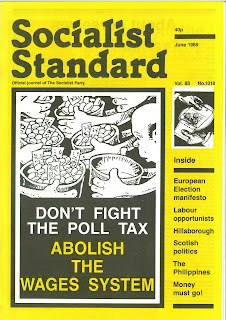
Editorial: What about the Poll Tax? (1989)

Editorial from the June 1989 issue of the Socialist Standard

People are already paying the Poll Tax in Scotland while in England and Wales council officials have begun the task of drawing up the register of those liable to pay the tax (nearly everybody) in preparation for its extension south of the border in April next year. The registration forms have been dropping through peoples letter boxes since the end of May.

All the opposition parties are against the Poll Tax and. urged on by left-wing chants of "Fight the Tax, Smash the Tax", a campaign of civil disobedience (refusal to register, then refusal to pay) has been launched to try to prevent its implementation. The claim is that the tax is unfair because, compared with the old system of rates, the rich will pay less and the poor will pay more.

"The rich pay less, the poor pay more", says a leaflet put out by the Camden Stop the Tax Campaign in London. “93% of inner London residents will pay more in Poll Tax than they do in Rates, while millionaires in Hampstead will pay much less". The Poll Tax "redistributes income from the poorer members of the community to the richer members", adds a claimants group from Merseyside, describing this as "Robin Hood’s philosophy in reverse".

The rich owners of big houses and mansions certainly will be paying less, and this was no doubt a deliberate intention of the present government which has never disguised the fact that it is a government of the rich by the rich for the rich. But it by no means follows that what these rich property owners will no longer be paying will have to come out of the pockets of ordinary wage and salary workers, as the anti-Poll Tax campaigners suggest.

Despite the appearances, taxes are not a burden that falls on wage and salary workers. On average, over time, we receive as wages enough to keep ourselves fit to work in the trade or profession in which we have been trained and are working. It is around a level sufficient to cover the expenses involved in this that market forces, helped on by trade union action, will tend to establish wage rates.

This means that if any extra charge is imposed on workers it will tend to be passed on. through the operation of market forces again aided by trade union action, to employers of labour. This was once clearly understood even if it has become obscured today. As David Ricardo, who was an MP and a capitalist, wrote as long ago as 1819 in his Principles of Political Economy and Taxation: "Taxes on wages will raise wages, and therefore will diminish the rate of profits of stock . . .  A tax on wages is wholly a tax on profits, a tax on necessaries is partly a tax on profits, and partly a tax on rich consumers. The ultimate effects which will result from such taxes then, are precisely the same as those which will result from a direct tax on profits".

In so far as the Poll Tax is a tax paid by wage and salary workers it will tend to be passed on to employers. But the speed at which this happens will depend on how determined workers are in fighting the wages struggle. So the way to "fight the Poll Tax" is to press on with the trade union struggle for higher wages and salaries.

The arguments which take place about taxes are about which section of the rich, propertied class should bear the tax burden: employers of labour, landlords or people living on interest. The Poll Tax certainly does shift the burden of local taxation off the shoulders of rich people with big houses, but it shifts this burden not on to us workers but, in the form of higher wage bills and lower profits, on to those who directly employ us. Yes, smash the tax, employers might say. but why should we pull their chestnuts out of the fire?

To pay or not to pay? There is not really any serious choice here as the law has been very cleverly framed so that everybody is going to pay in the end. even if out of deductions from their wages or out of the proceeds of the sale of their furniture. In any event even if the campaign of civil disobedience was successful and the Poll Tax abolished, this would make no essential difference to living standards. In the highly unlikely event of it being abolished and replaced by nothing else, this would exert a downward pressure on wages. In practice, however, the Poll Tax would be replaced by some other local tax (the Labour Party is talking about "a modern property tax and a local income tax”) just as it is replacing the rates and which would also be incorporated into the workers' cost of living.

We are not saying that workers should never defy the law. There are occasions when they should, as over being conscripted into the armed forces to kill fellow workers in some other country or over laws banning trade unions and strikes, but the Poll Tax does not fall into this category. The Poll Tax is not a working class or socialist issue. As Socialists we are not prepared to get involved in arguments about local, or for that matter any other, taxes, as we know from our understanding of the economics of capitalism that taxes, even if they are paid by workers, are not a burden that ultimately falls on them.

Tuesday, May 24, 2016

European Election Manifesto (1989)

From the June 1989 issue of the Socialist Standard

Following the elections of 1979 and 1984, this June sees the third direct election of the European Parliament. For those elections the Socialist Party issued statements under the title "Eurocapitalism or World Socialism?" The choice between a destructive system which served privileged interests and a sane society which served human needs was the important issue then. Tragically capitalism remains, to menace us all.

MILLIONS UNEMPLOYED
Millions remain unemployed. It is impossible to calculate the amount of useful wealth that could have been produced had not billions of workdays been lost because workers could not be employed for the profit of a few. What is certain is that in socialism all these workers in industry, transport, building and farming could have been co-operating to provide the things necessary for the wellbeing of the community: things like homes, hospitals, and useful goods of every kind. Instead men and women are being forced by the profit system into idleness, living on the dole alongside millions of pensioners existing on their meagre state hand-outs. Many remain homeless and despairing.

These are the bitter conditions of life endured by those at the lowest end of the scale of poverty. For those with a job trying to provide for themselves and their families, the purchase of a home means mortgaging their lives for years to come. Not just the need for a home but every necessity is subject to the ability to pay. For the majority life remains dominated by the relentless grind of wage-working and paying the food, gas, electricity, water and clothing bills, and repaying debts to banks and financial companies. As ever for workers, the market is an economic tyranny which breeds insecurity. Whether it is the 'common market' or not makes no difference.

ARMED CAMP
Forty years after the second World War, Europe is still an armed camp. Millions are producing the means of waging further war. In addition the competitive industrial system pollutes the Earth threatening all life.

The EEC was not set up to deal with the problems of poverty, insecurity and war. In 1979 we said that the Common Market was a "political and trading arrangement entered into by the various European States in order to further the interests of their capitalists". The last ten years has only confirmed the truth of this. In 1984 we pointed out that, in the overall interests of profit, the so-called European Community was paying farmers to destroy cattle, tear up orchards, plough back vegetables, dump fruit and restrict milk, meat and cereal production. Alongside this destruction of food, millions have died throughout the world from disease related to starvation or poverty. In Europe itself millions live below the official poverty line and would have benefited from this food. They did not have the money to buy it, so it was destroyed. The prices of commodities and the sanctity of profit come before human needs.

PAID NOT TO GROW
It is now intended by EEC governments that these policies should continue. In June 1988 it was announced that a so-called "set aside" scheme would come into force for the 1988-89 crop production year. Under this scheme annual payments of up to £200 per hectare are being offered to farmers who agree to take at least one fifth of their arable land out of production for the next five years. This imitates the policies of another major agricultural producer, the USA, which in 1983 took 82 million acres out of food production so as to protect the prices of food commodities.

The EEC will reach a new phase in 1992 when further trade barriers will be removed to establish the single market. This heralds a new freedom for investment and marketing to move across traditional European boundaries aimed at the maximum and most efficient exploitation of workers. The EEC can never achieve a genuine community of common interests. The basis of its operation is the class monopoly of the means of life by a privileged minority of capitalists. It may be a business community, but this leaves workers in the same exploited position where they must sell themselves for a wage or salary, when it is profitable for the capitalists to employ them, that is.

REPEATED FAILURES
When we examine the policies of the Labour, Conservative and other reformist parties, we find the same old glib promises put out over the years. These parties are depressing and irrelevant. They take no account of experience and offer nothing but repeated failure. These parties stand for running capitalism and their differences are minor compared to their common aim of running the profit system. Nor have the Communist Parties anything to offer except the state capitalism which even the Russian rulers now admit has failed. The Greens are right to denounce the degradation of the environment but in blaming this on "industrialism" and "bigness" they have yet to realise that this is inherent in capitalist competition.

At this time, towards the end of the 20th Century, when we look back on over 100 years of violence and misery in Europe, and when poised on the brink of further frightening dangers, it is obvious that a very different political approach must be taken. The time is long overdue for scrapping the entire system of capitalism. It is out of date. Its class interests and its priority of profits before human needs can no longer serve any useful purpose so far as the majority are concerned.

ABOLISH THE PROFIT SYSTEM
If we are to place the aim of European unity on a sound and practical basis then the idea that it can be realised under any system of Euro-capitalism must be abandoned. Nor can unity be established in Europe separate from the rest of the world. Unity can only stem from a common interest amongst all people to co-operate in the production and distribution of goods and services directly for need. This is only possible with the means of production owned and controlled by the whole world community.

There can be an important place for a European Assembly as one part of a system of world democratic administration. Socialism would need such bodies at local, regional and world levels and the task of adapting the European Parliament would be straightforward. However, democratic procedures mean nothing unless society has real powers to translate democratic decisions into action. In socialism this would come from the abolition of the uncontrolled and anti-social forces of the market and the disappearance of the profit motive.

PRODUCE FOR NEED
Socialism will remove all economic constraints on social action and will involve the abolition of not just the "Common Market" but all buying and selling. One of the myths of capitalism is that nothing can happen without the use of money. Part of this myth is that productive resources consist of money capital, but in the real world of production money never produced anything. Goods and services are produced by the mental and physical energies of men and women and it is only because goods are bought and sold that money is needed. Money is used under capitalism as part of the system of exploitation where workers receive as wages or salaries only a portion of the total wealth they produce. In reality, capital investment limits social action to what is profitable: with the abolition of the market the entire structure of production would be released to be used solely for the community's needs.

We must stress the urgency of promoting the growth of the socialist movement. This is the only practical activity which is being directed at the solution of social problems. Support for parties seeking to participate in the administration of capitalism through the European Parliament will prove as futile now as it did in 1979 and 1984. The constructive alternative is to help to build a world of common ownership, democratic control and production directly for human needs.

For the first time the Socialist Party will be putting forward a candidate for election to the European Parliament, in the Tyne and Wear constituency. Those in that area who want Socialism will be able to register this by voting for the Socialist Party candidate. Elsewhere they can do so by writing the words "World Socialism" across their ballot paper.

The Executive Committee
The Socialist Party of Great Britain
London, May 1989

Saturday, May 21, 2016

Not people's power (1989)

From the June 1989 issue of the Socialist Standard

A correspondent in The Philippines analyses the situation there three years after the coming to power of President Corazon Aquino.

A demonstration organized by the trade union organization KMU (Kilusang Mayo Uno, or First of May Movement) took place in Manila on March 30. Only a few hundred people turned up and so the march to Malacanang Palace, where President Aquino lives, was cancelled. Instead a rally was held in front of the Senate Building which was the assembly point and, later, at the offices of DOLE (Department of Labor and Employment) located nearby.

There were a few reporters present but no account of the demonstration was published in the next day's papers. If the demonstration had been violent maybe it would have been reported, but there was no violence at all. Nor were there any police around except for two soldiers at the entrance to the Senate Building. The demonstrators were trade unionists who had been shot at and whose fellow workers had been hurt or killed on picket lines. This should make those who believe that people are violent by nature think again.

Most of the demonstrators were workers from M.Greenfield Inc and Golden Taxicab Co in Manila. They were protesting against violence inflicted on trade unionists all over the country. They were also protesting against Senator Herrera's Bill. This Bill retains the anti-labor laws of the Marcos dictatorship. but also adds new ones. Strikes against "the national interest'' are to be forbidden. Picketed workplaces will be allowed to operate. Illegal strikers can be imprisoned for up to three years. Senator Herrera is the Secretary-General of the Trade Union Congress of the Philippines (TUCP). The TUCP is a right-wing trade union organization set up during the Marcos dictatorship. It competes with the left- wing KMU for trade union recruits.

It is ironic that the KMU is attacking the "US-backed Aquino government" now because the KMU was one of several left-wing organizations that supported the Aquino coup against the Marcos dictatorship in February 1986. Since then the government has governed.

In November 1986 the KMU chairman Rolando Olalia was murdered. In January 1987, 19 people demonstrating for land reform were shot dead at Mendiola Bridge on the way to the presidential palace. Six of them were KMU members. In September 1987, the Secretary-General of the leftist umbrella group BAYAN (Bagong Alyansang Makabayan. or New Patriotic Federation), Lean Alejandro, was ambushed and killed. In 1988 President Aquino created the Citizens Armed Force Geographical Units (CAFGU). which are armed civilian reservists recruited to fight New People's Army (NPA) guerrillas and sympathisers. They are popularly known as local vigilante death squads. The NPA is the armed wing of the illegal Communist Party of the Philippines which is fighting to establish a state-capitalist regime in this country. Most of the cause-oriented groups, left-wing political parties, and trade unions affiliated to the KMU are labelled as "Communist infiltrated” by the military.

Task Force Detainees of the Philippines (TFDP). a church-based torture documentation group, claims that at least 12,120 persons have been victims of military action from March 1986 (Aquino's first month in power) to June 1988. Of these, 507 were “salvaged" (private political killings by right-wing soldiers, police or civilians). 149 kidnapped, 137 massacred, and 11,327 arrested and detained without trial. All of the organizations mentioned above which now are strong opponents of the Aquino government were strong supporters of Aquino during the February 1986 coup. Chrispin Beltran, the new KMU Chairman, was quoted as saying; “We say this is an undeclared state of martial law with a liberal facade”. 

It is not surprising that most people ignored the call to demonstrate on March 30. The experience of the last three years has made most people disillusioned and apathetic. Exploitation cannot be removed by changing a leader. Exploitation will end when we stop giving power to leaders and instead use our power for ourselves. Let us create a world-wide society where the production and distribution of the things we want are democratically controlled by us all. Let us not be well governed. Let us govern ourselves well.
Kaibigan

Tuesday, September 8, 2015

The Hillsborough disaster (1989)

From the June 1989 issue of the Socialist Standard

In treating such events as the Hillsborough disaster, a degree of circumspection is called for. Even the Labour Party has been reticent about scoring political points despite the fact that Dennis Howell can quite correctly claim to have warned of the danger of perimeter fencing ever since its introduction. It is equally valid to point out that forgetting or ignoring what happened on that Saturday is not an option for concerned, thinking humans.

Collecting the Cash
The tragedy (for in its inevitability it was a tragedy in the dramatic as well as the popular sense) has united far more than the people of one city as it involved Liverpool, the most successful British club of recent times. So among the dead and injured were workers from many parts of the country. Those still alive know where they stand in the list of priorities, as every line. of enquiry into the causes of the catastrophe shows that the comfort and safety of the ordinary spectator came plumb last. Among the fans there may be many who understand why comfort is low on the list of priorities; a rudimentary grasp of profit maximisation would tell them that providing high quality facilities for those who pay what they can afford, regardless of the facilities available, makes bad business sense. What many didn't realise was that the same principle applies to safety. It may seem facile to point it out, but the fact that it is a commonplace should not detract from the relevance of the commercial priority of collecting the cash. The huge gates which were fatally opened at the thirteenth hour contrast starkly with the turnstiles which represent the most cost-effective way of making sure everyone coughs up.

Other priorities were less obvious: the allocation of tickets in open disregard of requirements was done not for the benefit of Nottingham Forest supporters but for that of the police, who did not want the bother of directing groups of people around the stadium. The perimeter fencing had emergency access not for desperate people to get out but primarily for the police and stewards to get in. The medical facilities were more suited to a studio theatre than a massive open-air stadium.

In this disaster, as at Bradford, the authorities are in the uncomfortable position of having no hooligans to blame. Although The Sun in its egregious fashion was pretty quick to make unsubstantiated and irrelevant accusations, the general observation was that crowd violence was not a factor. In fact the hooligan problem and the attempts to deal with it have always been red herrings as far as stadium facilities are concerned. Leaving aside the fact that most "football" violence occurs outside the ground, the idea that it is contained by creating conditions inimical to all but those who are handy in a ruck has always been more absurd than paradoxical. Similarly nobody has explained why they think people who are prepared to indulge in flagrant anti-social behaviour in full view of the police will baulk at using a forged, stolen or borrowed identity card if that scheme comes into operation.

Naked Incompetence
As usual on these occasions the experts and leaders stand naked in their incompetence, highlighted in the aftermath by the contrast with the improvisation of ordinary people. As those in the stand were pulling desperate fellow spectators from the chaos of the terrace the police were driving others back into it. As the authorities were wondering why there weren't enough stretchers the fans were commandeering the advertising hoardings. As the mourning of those who had every right to be very angry went ahead in a touchingly dignified manner, the press were publishing pictures of people in their death agony with scant concern for any offence which might be caused.

Never fear, though, the prima donnas were not slow to get in on the act and show their "concern". Thatcher turned up in Sheffield on Sunday, which was probably a wise move because had she turned up in Liverpool one doubts even the formidable Merseyside Police could have guaranteed her safety. Charles and Di popped into the hospital for want of something better to do. Liverpool FC donated £100,000 immediately to the relief fund, that sum being approximately one twentieth of what it paid for the exclusive right to make a profit from the footballing skills of Ian Rush. And, of course, Religion PLC. was there: socialists do not doubt the sincerity of the priests' sympathy, but it is plain that some explanation has to be given as to why the all-loving god let this happen to people who fill the collection plates.

Sane Society
Many socialists would argue that there is no place for competitive sport in a sane society. The present writer does not subscribe to that view, but it is clear that no sane society would in any imaginable circumstances put 50,000 people one by one through what amount to rat traps in order to verify their right to access to an area from which there is no escape in time of crisis, and all for the benefit of a tiny minority with whom they have next to nothing in common.

The late Bill Shankly is reputed to have said "Some people say I regard football as a matter of life and death. That's nonsense—it's far more important than that". Shankly's obsession with sport is legendary but we must now wonder if, had he witnessed the Hillsborough disaster, he would have rephrased that particular witticism.
JFU