Tuesday, April 20, 2021

Capitalism and the Internet (3) (2000)

From the March 2000 issue of the Socialist Standard

Link to Part 2
Despite a clear tendency towards enlightening social relations, the Internet does not promise to give revolutionaries their socialist society on a plate. In fact, it offers us the parallel “disinformation revolution” as well. Unlike misinformation, disinformation is deliberate.

 Although mass propaganda can be expected to decrease quantitatively, customised propaganda may increase qualitatively. Propaganda and spin could become more, not less, powerful, as mass media gives way to “mess media” and a proliferation of micro-channels, micro-markets and perhaps micro-cultures makes the targeting of disinformation against selected individuals more feasible. It’s as if the ultimate dream of the free-marketeers is of six billion separate Earths, a doppelganger for each of us, and consensus or revolution impossible in any of them. But humans aren’t so easy to control, nor communication so easy to stop. The right-wing utopians forget about our critical faculties and our propensity to gossip amongst ourselves:

The hypnotic spell of years of television and its intense public relations is broken as people learn to deconstruct and recombine the images intended to persuade them. The result is that the population at large gains the freedom to re-examine previously accepted policies and prejudices” (Rushkoff, Cyberia, p.55-6).

Micro-propaganda just isn’t going to cut it unless we collectively agree to brick up our windows and doors and never go out. Realistically, the ideology of capitalism will not be able to rely on permanent, large-scale disinformation. The best it can expect is to muddy the waters.
The danger of participation is that there are . . . thousands of potentially critical eyes watching every entry. A faulty fact will be challenged, a lie will be uncovered, plagiarism will be discovered. Cyberspace is a truth serum (Rushkoff, p.18).
Monocultural studies 
As global monoculture advances upon us in the real world of Wal-Mart and McDonalds, cyberspace , in contradistinction, is going the opposite way by reinventing diversity. There is a double irony at work. First, the right-wing free marketeers parade their hypocritical “cult of the individual” as a justification for a sociopathic mentality of self-centred consumerism, while at the same time making every effort to destroy cultures and reduce individuals to a grinding uniformity of alienated clones. Second, their own system is producing an atomised multicultural cybersociety which may yet undo their work. Where capitalism tried to keep us apart while making us the same, cyber-capitalism will have the effect of bringing us all together while making us different.

Trouble at’ McMill 
Yet if this view of capitalism’s future seems to have a rosy tint, it’s probably a bloodstain. There is likely to be a ferocious and global scramble for the ever-decreasing number of real jobs in the hi-tech labour market. The “digerati” may get excited about their hi-tech utopias but the future looks grim for workers. The former proletariat may become the future sophisticated “cognitariat” (Toffler), but they are going to be mostly underemployed part-timers battling each other for short contracts. Meanwhile the rest of the population will presumably be fighting for work in leisure malls, call centres and other dispiriting and low-paid McJobs. And when things get really bad, workers tend to wake up from the American Dream and smell a rat. Carl Davidson, editor of Cy Rev, a “Journal of Cybernetic Revolution, Sustainable Socialism & Radical Democracy”, sounds a warning:
 In 1992 the size of the world labor force was something like 1.76 billion people; by 2025, if current trends stay more or less what they are, the world labor force is going to be 3.1 billion people. That means every year for the next thirty years the world economy needs to create 38 to 40 million new jobs. And it’s got to do that at a time when the main technological trend is going in the opposite direction of net job liquidation” (http://www.eff.org/pub/Publications/E-journals/CyRev).
What then of free-market philosophy, this wonderful doctrine from two centuries ago which thinks capitalism would work fine and dandy if the stupid politicians would just go away? Free-market capitalists think the poor don’t matter and will obligingly roll over and die, but when the first riots start, these same capitalists will remember pretty quick what they were paying the state for in the first place. Civil unrest may be most cheaply staved off by bread and circuses, and excuses, as it once was in ancient Rome, but for these angry modern workers the bread will have to be good and the circuses had better be terrific, since the excuses, as usual, will be lousy.

Virtual Unreality 
Of course, the entertainment will be awesome, if nasty, after capitalism’s tastes. Frighteningly convincing graphics and sensory experiences will create seamless mirages, a virtual unreality that might forever close the door to political change. Certainly it is curious to note that technology has brought the “circus” ever closer, from arena to stage to screen to TV to PC monitor. Ultimately we will watch our little mirages on “drop-down” corneal displays, a final triumph of the circus as it climbs right inside our heads. Better still, with full-body virtual reality, the viewer gets to climb right into the ring. But for all that, the charade, however mindbending, has to stop sometime. Circuses pall, just ask any overworked clown. Humans will never really lose sight of the distinction between real and virtual, unless they can be made to forget that they are rational animals. Besides, so much of their reality is patently bullshit that nothing short of mass lobotomy could disguise it.

Credo Greedo
And bullshit is what lies at the heart of capitalist ideology. Even capitalists themselves believe it. On Page One of every school economics textbook it says that resources are limited but wants are unlimited. As wants are satisfied, new wants always appear. Now if this were true, socialism would be impossible. Relying on this anti-human and quite unsubstantiated prejudice the capitalists, knowing the extremely short shelf-life of information commodities, expect to be able to produce new commodities indefinitely, to replace old ones that have become free or nearly so. Yet here is their mistake, for wants are not infinite. As more things become free (for example, MS Explorer, Netscape, Winzip, Apache, Acrobat, Linux and a thousand other useful programs) they expect us to keep paying for upgrades, assuming we will always want more, but we won’t. Instead, we will reach a satisfaction threshold. And then, we’ll just start expecting everything else to be free too. And why not? With modern robotised manufacturing, costs are falling in all sectors of commodity production. If they cost next to nothing to produce, why should we pay at all? Kevin Kelly, founder editor of Wired, doesn’t see a problem for capitalism in this, and argues that businesses should give their products away for free, in order to reap later returns:
Ubiquity drives increasing returns in the network economy. The question becomes: what is the most cost-effective way to achieve ubiquity? And the answer is: give things away. Make them free (New Rules for the New Economy, Fourth Estate, 1998).
One can only hope that all capitalists, convinced of our insatiable natures, are daft enough to follow Kelly’s advice, and indeed many companies are doing just this, and not just with software, (free mobile phones, free calls, free satellite decoders). Even if this loss-leader strategy just makes a loss, it plants another expectation in the public mind, and subtly undermines its own creators. Things can be free. There is such a thing as enough. Abundance does exist.

It may be that the sacred cows of capitalism and property society will be sent to the slaughterhouse one by one. Even that feared and revered symbol of ultimate power, the coin, may lose its lustre, its relevance reduced to a meaningless abstraction. Where once we bartered real things like sheep or sacks of salt, then paid with iron bars, gold ingots or copper coins, then latterly with decorated scraps of paper, now we will be held to ransom by mere electronic digits. The case for abolishing digits may not seem so far fetched in the future when nobody handles real cash anymore and the fetishised idol no longer has even a visible face.

The Socialist Virus
As well as the notion of insatiable greed, the ideology of capitalism also rests on the notion of natural inequality, the cult of the leader and of the expert. The better educated workers become, the more this cult suffers. As contempt for our politicians rides as high as voting figures sink low, the idea that we must rely on the unique expertise of superior individuals is beginning already to look decidedly comical. But in the wired network consciousness, where “no-one is as smart as everyone” (Kelly, p.14) the expert and the leader may become positively antiquated concepts. The days may be dying when the “ignorant masses” can be led, misled and mystified by some “social elite” who know better. Instead, the wired world may experience a new renaissance of democratised creative thinking, as good ideas begin to spread through the ports and wires of a billion terminals, the electronic synapses of a revolution: “You don’t attack the monster. You infect him, like a virus.” (Rushkoff, p142). And small ideas can grow big in cyberspace, as Kelly, in a backhanded paraphrase of William Morris, makes clear:
 The network economy has set into motion the power of hobby tribes and informed peers . . . The law of increasing returns can feed a small interest into a mid-sized interest. Whereas once there was a lone fanatic for every notion, now there is a devoted website for every fanatic notion; soon there can be 10,000 fellow enthusiasts for every fascination (Kelly, p.105).
Internet disinformation
Yet disinformation remains for the time being the best weapon against workers. When the truth can no longer hide in the dark, the logical thing is to dazzle us with data. It doesn’t even have to be false data, just so long as it’s irrelevant and it wastes precious time. And as the Nobel economist Herbert Simon points out: “What information consumes is rather obvious. It consumes the attention of its recipients. Hence a wealth of knowledge creates a poverty of attention.” (Kelly, p.59). The grim truth is that this crude strategy will probably work, for a while at least. According to the Critical Art Ensemble, who may be perhaps thinking primarily in the short term, the vast majority of Internet users will be passive consumers, rather than active participants:
They will be playing computer games, watching interactive TV, and shopping in virtual malls. The stratified distribution of education will act as the guardian of the virtual border between the passive and the active user, and prevent those populations participating in multi-directional interactivity from increasing in any significant numbers (Alinta Thornton, Ch.5, http://www.wr.com.au/democracy/thesis1).
If this sounds depressing, one has to remember that it is a conservative estimation of human behaviour as it is now, schooled into a passive consumption of goods, news, ideas and entertainment. If there is one key hallmark of pre-internet mass society it is probably this conditioned passivity. Our pre-internet generation cannot in all fairness be expected to adapt thoroughly to such a major cultural innovation, and will certainly fail to exploit its real long-term potential. A second-generation wired society is likely to be very different, more individualistic yet better integrated, more critical and proactive, and with higher expectations. The longer capitalism lasts, the more bolshie the workers are likely to become.

For now, like everything else in capitalism, any attempt at disinformation overload will work only partially and unreliably, if it works at all, and cannot depend on any conscious or systematic conspiracy by the owning class. Conversely, we as workers have no free ticket to easy victory through the Internet. When all is said and done, it is an instrument only, an “enabling technology”. The printed word didn’t liberate us either, but it made a huge difference, and so will this, if we learn how to use it properly. With the means of knowledge—the key to the means of production—now out of the private bag and in the public domain, it is fair to say that the working class has never been in a stronger position to take control of its own future.

Revolutions are made by people, not machines, people working together, people in communities. Much is made of supposed “online communities”, but it is precisely in the real physical world of community, rather than its ersatz virtual counterparts, that the revolutionary potential of the Internet may be storing up its greatest surprise.
Paddy Shannon

(Next month, in the concluding article, we examine the Internet and Community.)

The internet and capitalism (4) (2000)

From the April 2000 issue of the Socialist Standard

Link to Part 3
In this concluding article in our series on the impact of the Internet we examine its possible effect on community.
Anyone who comes from a small village knows that one can get too much community. The close and frequently closed communities of feudalism were suffocating, parochial worlds with narrow horizons and narrow minds, a sink of intellectual inertia and ritual. Yet though the club wasn’t inspiring, one’s membership at least was not in doubt. Alienation from other humans was unknown.

One hundred years ago in Britain, urban workers lived together, worked together, went to school, got drunk, went on holiday or strike together, and were buried together. In such a milieu, an idea could take hold, and then spread. People were influenced by each other, they had common ground, they thought as a group, and they were not afraid to talk.

Today, after fifty years of the Welfare State and worker mobility, nobody seems to know or care who lives next-door. Friends are scattered and remote. Isolation is normal, experience and consciousness are private, discrete and discreet. Life is a claustrophobic micro-universe containing a TV and a closed front door. Unfamiliarity breeds contempt as our greatest desire is for the drunks and the drug addicts, the bores and the Christians to leave us alone. We don’t have community because we don’t want community.

Contrary to the claims of the Internet fraternity who see something new and exciting about “virtual communities”, we in the West have already been living in virtual communities for years. Virtual, because we have been remote workers, remote from our community, remote, one might say, from ourselves, stuck in motorway madness chasing remote jobs, going on ever more remote holidays, or slumped exhausted on the sofa with—you guessed it—the remote control. And when we’re at work, in spare moments, we gossip with people we barely know about people who don’t even exist.

Soft soap and schadenfreude 
Nowhere is the virtual community more realised than in the TV soap, the ultimate cry for help from an alienated society. Now the pundits talk sickeningly about “virtual e-soaps” where the viewer—you— can give these “people” advice. The soap characters are one-dimensional caricatures whose only purpose is to provide a cathartic release for workers after a hard day’s slog. It is simply an exercise in schadenfreude, that delight in other people’s problems so essential to those whose own problems could scarcely get any worse.

Yet nobody ever stops to consider that, quite apart from the characters, there is an even greater peculiarity about the soaps which is manifestly out of touch with reality. In Marxian terms, it is their economic base. None of the characters works away from the area. In fact, most if not all of them are sole traders, in other words, artisans. You get the publican, the tea-shop owner, the local entrepreneur, the corner-shop owner, the market-stall owner, the garage owner, and so on and so forth. Each works for himself or herself. Each owns his or her own means of production. Comfortingly, each has an income which we can guess is in rough parity with the other characters’ incomes. One or two of them employ people as staff, or more correctly as apprentices, but these are always locals too, with ambitions one day to start their own local business or to inherit the present one.

It is obvious that this improbable scenario is devised purely in order to allow the creation of a local community. Clearly it would not be possible for an Eastenders character to work in Brighton or Oxford but still appear regularly in the show. And community is very important in the soaps, because it provides the dynamic for drama but also because it provides vicarious relationships for real people to “relate to”.

Back in the 19th century a very popular reformist programme was that of Proudhon, a programme which in essence involved a society of artisans. Proudhon was very concerned at the tendency of employers to exploit employees, and thought that if society was made up of artisans then no such exploitation would take place, each worker would own their own means of production, and would sell their products at the market rate, since the market is an unbiased process of checks and counters, this would tend to balance incomes and prices and provide an equitable system of commodity production and sale, but without the massive problems of class division and exploitation.

There are people today who still believe this, Marx’s efforts to debunk it notwithstanding. The soaps encourage this belief. They provide an apparently working and stable model of an artisan economy, upon which is mounted a community-based superstructure which, despite being populated largely by cartoon characters, is fiercely attractive to the community-starved worker. The fact that this economy is fiction is overlooked. The focus of the plots is always kept away from the underlying economy, and while protagonists frequently experience exaggerated personal problems the artisan economy their community relies on remains perpetually in the background, innocuous and unchallenged. Markets do not change. Economic conflicts do not arise. Nobody goes bust. The plot-writers do not wish to present themselves with insoluble dilemmas – if they allow a character to lose their livelihood, they must either drop them from the soap or find them some other plausible occupation within the narrow confines of the community. It is in general easier for the writers not to let this situation arise. One insidious consequence is that people are always the focus of problems, while their economic circumstances are never seen to be the source of any conflict or difficulty.

Artisan production did exist in the late feudal era, when commodity production was in its infancy, but it was very rapidly overtaken by modern capitalism. As a model of commodity production, the artisan society becomes very quickly unstable in reality. To believe in a form of capitalism based on sole traders is to believe a fairy tale or, indeed, a soap opera. It is essentially a step backwards in time, a reversion to an earlier form. People want to believe in an artisan society (many idealistic left-wingers call this “socialism”, and it is intrinsic in much of the thinking of Greens) because in reality they want their communities back, and see this as a way to get it.

Doing your homework 
And yet, bizarrely, it is just possible, despite this, that history might repeat itself. The real revolution of the Internet isn’t online, it’s offline, in the world of the “homeworker”. If global destruction does not intervene beforehand, a new form of hi-tech artisanal society might indeed appear in the West. As production becomes computerised and the Internet pervades the workplace, more and more people are going to find it feasible to work from home, or from “hot-desks”, or from their portable “teledesk”. Due to the difficulty of defining “homeworking”, estimates for home-workers vary in the US from 10 to 15 million workers, or about 14% of the labour force, up from 4 million in 1990 (Bureau of Labor Statistics, quoted in American Demographics, July 1999: www.demographics.com). In Britain there are about 1 million home or teleworkers, and an estimated “52 percent of the working population will be homeworking by the year 2010” (Teleworking Survey: Link). That this has not happened faster or sooner can be ascribed simply to traditional business structures: “The barriers to teleworking tend to be managerial rather than technological. Traditional attitudes need to be chipped away at to make it happen.”

Community?
In addition, the casualisation of work contracts means that the main working pattern of the future may be freelance. Operating from home, many workers may find themselves doing not one but several different jobs for different companies, not as employees but as sub-contractors. They will in effect become sole traders, online artisans plying their wares and skills in a virtual marketplace. Although surveys show that homeworking is the most desired option by hi-tech workers (Washington Post, February 11, 1999) it is the capitalist class who stand to gain most, by saving on wages, costs and overheads, and by eroding worker’s rights:
  Behind the technological part of the information highway is the business community’s attempt to use the new information and communications technology to shift power from governments and the nation state to multinational corporations, from the public to the private sector, from small business to big business, from a unionized to non-unionized environment, from citizens to consumers, and from group rights to individual rights (Unions and the Information Highway: http://www.ofl-fto.on.ca/ftp/ppaper5.txt).
Even though homeworking would save a Londoner on average 10 working weeks per year in travel time (Home Office Partnership: http://www.hop.co.uk/) the chances are the worker won’t gain the full benefit:
the current wisdom is that up to half the commuting hours saved by telecommuting employees may be given directly back to the company as additional work hours. The Gartner Group estimates that telecommuting improves employee productivity by 10 percent to 40 percent (American Demographics).
Yet the home-working revolution is likely to bring some fundamental advantages which no amount of capitalist exploitation can outweigh:
 The community will benefit in the longer term as larger numbers of home workers abandon the peak-hour rush. There will be fewer cars on the road, less air pollution and traffic congestion, fewer health and work-induced stress problems and more community participation (International Journal of Career Management Conference, August 1995: http://www.mcb.co.uk/liblink/ijcm)
From the Tudors to telecentres 
But then there arises a new social dilemma for which people will have to devise a new solution. The isolation and domestic interruptions which working from home imply and which are cited by many workers as problematic may result in the development of a new kind of working environment, the work or telecentre. Just as the artisans of the Tudor age began to find it convenient and cheaper, as well as more sociable, to band together under one roof in order to share tools, materials and heating, so online workers of the future may find it desirable to band together under one local roof.

The result may be that local people will once again be able to work together locally. That they will all be working for different companies in different parts of the world hardly matters. The implications for the rebirth of local communities are obvious. The car culture evaporates and motorways empty of commuters as workers walk the five minutes to their local telecentre, greet their friends and neighbours, sign on to their individual company, and discuss politics and local affairs in their lunch and tea-breaks. In addition, the non-gender specific nature of teleworking means a sea-change in the realm of sexual politics and childcare, as homelife and working life converge in the local community matrix and gender becomes less significant than at any time since the agricultural revolution.

The social, cultural, political and environmental consequences of such a change in western working patterns are hard to overstate. But the class war won’t go away, indeed it may intensify. If unions presently fear the atomisation of an isolated homeworking labour force, the communalisation of working may change for the better the means by which workers organise in defence of their pay and conditions. Unions, previously based first on individual trades and latterly on individual companies, may in the future find individual telecentres the locus of organisation. This would cut across the traditional corporate divisions as workers from various sectors of industry, commerce, finance and other services band together to defend themselves. As capitalism becomes global, workers will need to globalise their strategies of defence, and one way to do this would be to network between these local centres.

Déja vu
But in yet another twist, as capital becomes ever less dependant on geographical considerations, companies may find it expedient to invade these local telecentres and take them over, lock stock and barrel. The way to do this would be to buy into the management of these centres, the capitalist bodies which administer everything from catering to arbitration, and then gradually take over the role of central employer, accountant and contractor.

Nevertheless, even in this worst case scenario, workers would have achieved, or rather re-achieved, the community which they lost in the period after the Second World War. The significance of this should not be underestimated. Community is essential to socialism, indeed community and communism are really the same word. A society with a strong sense of community is a society which can communicate the idea of a socialist revolution, and can bring it about. Far from representing some terminal retreat into virtual reality, the Internet may finally precipitate a wholesale flight out of one. If the future online world leads, not to a society of isolated electronic cave-dwellers, but to a new flowering of community working and activity, and to an explosion of communication, the prospects for social revolution cease to look unlikely, and begin to look possible, and even probable.
Paddy Shannon

Monday, April 19, 2021

Points for Propagandists: Mr. Lloyd George sums up. (1929)

From the July 1929 issue of the Socialist Standard

Mr. Lloyd George sums up. 

In an address to the Liberal M.P.’s, delivered at the National Liberal Club on June 13th (See “Manchester Guardian,” June 14th, 1929), Mr. Lloyd George gave his view on the position of the Labour Government. Apart from the obvious incorrectness of his statement that the Labour Party is pledged to destroy Capitalism, his summing up is worth noting.
 We shall await with considerable interest the forthcoming declarations of Ministerial policy, but we must declare that as far as lies in our power the mandate of the Government ends when it fails to pursue a Liberal policy.
 
 The very hour the Ministry decides to become a Socialist Administration its career ends, for it has no authority from the nation to embark upon Socialistic experiments. It could only then be kept in power by Tory votes or Tory indulgence. It will be an interesting Parliament, but there will be no more edifying spectacle than that of a Socialist Government engaged in strengthening and perpetuating the economic system their party is pledged to destroy and fortifying that system in the most effective way by carrying through a series of reforms that will remove the evils of that system — a truly Liberal performance. (Cheers.) 
It only needs to be pointed out that their own past experience ought to have convinced the Liberals, as Mr. Lloyd George himself has admitted, that evils multiply under Capitalism faster than the reforms which are intended to palliate them. The condition of the workers in 1914, after many years of Liberal reforms, was not anything to cheer about.


The I.L.P. in Parliament

The “New Leader,” of June 14th, tells us that, including 37 Labour M.P.’s whose candidature the I.L.P. financed, “over 200 of the members of the Parliamentary party belong to the I.L.P.” This is more than 70 per cent., which represents a higher percentage than in the last Parliament, or in the 1924 Parliament. Its significance lies in the fact that it makes the I.L.P. fully responsible for every action and policy of the present Labour Government. The selection of the officials of the Parliamentary Labour Party including its leader Mr. MacDonald, the policies of that body, and all the measures supported by the Labour Party in the House, can be brought home to the I.L.P., since its members are in the clear majority and can by their votes elect what officials they like and pursue what policy they like.

The same was true in 1924, but by some subtle reasoning the I.L.P. officially tried and still tries to repudiate responsibility for the acts of its members who constitute the majority of the Parlia­mentary Labour Party.

In actual fact, if the I.L.P. tried to control the actions of its members in Parliament it would find itself completely unable to do so. Since every single one of them owes his or her election to Labour votes and the backing of the Labour Party and the Trade Unions, the Labour Party is in a position, if it wishes, to compel the I.L.P. M.P.’s to do its bidding and in a conflict of policies to repudiate their own I.L.P. programme and Conference decisions. While claiming that its object is Socialism, the I.L.P. has been built up by recruiting members on non-Socialist issues, and by securing the election of its members to Parliament on non-Socialist programmes supported by non-Socialist votes and financed by money from non-Socialist trade unionists and others. Outwardly an imposing and powerful body, it is in fact utterly impotent to support a Socialist policy or to carry on Socialist propaganda.


A Case in Point

This has been very clearly illustrated by the I.L.P. Conference decision on War-credits. At the 1929 Conference (reported in the “New Leader,” April 5th) a resolution was passed, after a short dis­cussion, by 160 to 125, “instructing all I.L.P. M.P.’s to vote again War-credits.”

Mr. Shinwell, M.P. (who is not only a member of the I.L.P. but is also financed by them at elections), promptly protested and declared that whatever Conference might decide he would act just how his electors pleased.
  I say, quite frankly, as an I.L.P. member, I will take any decision that requires to be taken from my constituency and not from this Conference.
The officials of the I.L.P. knew quite well that other M.P.’s would follow Shinwell’s example, for the simple reason that to carry out Conference instructions would lose them Labour Party support and consequently their seats. When someone challenged Mr. Maxton to show courage, he replied :—
  If I were to come to you at the next Conference and tell you that there were only half-a-dozen I.L.P. M.P.s left, and that they were out of the General Labour Movement, would you call that courage or folly? —(“Daily Herald,” April 3rd.)
A way out was therefore soon found. As soon as Mr. Maxton and others indicated the difficulty which would certainly arise if the I.L.P. tried to compel its members to abide by its policy, the Standing Orders Committee recommended, and Conference agreed, that the Chairman (Mr. Maxton) be given, “discretionary powers in applying today’s decision,” The sequel is amusing and instructive.

Mr. Shinwell has been made Financial Secretary of the War Office in the Labour Government. Other I.L.P. Members of Parliament may be expected to take this lesson to heart.


Communists not a working-class party.

We have often pointed out that the principles and policies of the Communist Parties are not in line with the interests of the working class. Mr. Saklatvala, writing a May Day message in the “Sunday Worker“ (April 28th), put this beyond question. He wrote:—
  But we must remember on our platforms that our slogan is now no longer merely “Proletarians of all countries, unite!” but “Proletarians and oppressed peoples of all countries, unite !”
  Not only textile workers in Bombay and Cal­cutta, miners in India and China, and steel smelters in Bengal, but millions of oppressed peasants in India, China, Egypt, and the African colonies are now with us in our fight against the common enemies of imperialism and reformist Labour.
Behind that innocent-looking but conveniently ambiguous word, “peoples,” the Communists carry on their anti-working class campaign in support of the Indian, Egyptian, Irish and other Capitalist nationalists. Those struggles are struggles between sections of the Capitalist class and victory either way is of no gain to the workers. The Indian workers will learn, as the Irish have learned, that Capitalism administered by native Capitalists is not essentially different from Capitalism administered by Britishers.


Capitalism in Russia

It is one of the delusions of the I.L.P. that Capitalism ceases to be Capitalism where it is administered by people calling themselves ”Labour.” An equally pathetic delusion is held by the British Communists with regard to Russia. A correspondent, writing to the “Sunday Worker“ (June 9th), held this common but mistaken view. He argued that the wages system in Russia cannot be called “Wage-slavery” because the terms of employment are “dictated by the workers’ government.” It is true enough that the Bolsheviks would like to abolish Capitalism if conditions allowed, but conditions do not allow. What they have been able to do is to foster the growth of State Capitalism and limit the growth of private Capitalism, thus following the example of Australia. But from the worker’s point of view the difference is little. Capitalism is based on the exploitation of the workers, whatever form that exploitation may take. In Russia there is a new and rapidly growing Capitalist class drawing property incomes from private trading, and from invest­ments in the Co-operatives and the Russian State Loans.

In the Co-operatives the total share and reserve capital amounted in 1927 to £97 million. (See Soviet Union Year Book, 1928—P. 183.) While in October, 1926, Credits borrowed at home and abroad by the Co-operatives amounted to 108 million Roubles. (Ibid—P. i93.) The rate of interest is not given.

But the most important form of Russian Capitalism is the new National Debt.

Since 1925, State loans in Russia have been used exclusively for financing in­dustry. (See Soviet Union Year Book— P. 391.) Between October, 1925, and February 1st, 1929, the total debt grew from 367 million Roubles to 1,983 million Roubles, or nearly £200 million. (See Review of the Bank of Russian Trade a Soviet Bank publication, May, 1929.)

The interest rates on these loans vary from 5 per cent. to 12 per cent., and must average not less than 10 per cent.

In addition, there is a “floating debt,” whose amount is unspecified.

The land in Russia is privately worked for private profit, and the new Capitalist class of investors have first claim on the proceeds of the State factories, railways, etc. Russia has the usual features of Capitalism. Not only are the means of production privately owned but inequality also exists, as it is bound to. Hence the introduction by the Soviet Government of a graduated Income Tax, Excess Profits Tax and Inheritance duties.

When the writer in the “Sunday Worker” states that in Russia the terms of employment are dictated by the Workers’ Government, he forgets that conditions compel the Government to make those terms such as will permit the Capitalist system to function and develop.
Edgar Hardcastle

The Capitalist System: How It Works. (1929)

From the July 1929 issue of the Socialist Standard

The following is taken from the “Daily Telegraph” (Wednesday, May 22nd). It tells its own story. The italics are ours :—
From Our Own Correspondent.

NEW YORK, Tuesday.

The owners of America’s surplus wheat crop, it is estimated, to-day will have to face a loss of more than £11,000,000 unless the price of the commodity rises substantially before the new crop is harvested.

Two big crops in succession have left the world “gorged” with wheat, and with the prospects of another full crop this year the price has fallen until it threatens to break through the four shillings a bushel level.

The world’s carry-over of wheat at the beginning of the new marketing year on July 1 is expected to be 350,000,000 bushels, or about double the amount on hand last year. The major portion of this amount is in the hands of middlemen, who will bear the brunt of the reduced prices. But the large carry-over is likely to continue to have a depressing influence upon the grain market. In that case it will be difficult for the American farmer to dispose of his new crop at a fair profit.

The only hope, apparently, is for a poor harvest, and of this there are no indications at present.

Socialist Brevities: A Life on the Ocean Wave-Under Capitalism. (1929)

From the July 1929 issue of the Socialist Standard

A Life on the Ocean Wave-Under Capitalism.

I am afraid that, like many other people, no doubt, my conception of sailors has been coloured by the familiar picture which adorns Mr. Angus Watson’s sardine tins. I have never doubted that our sailors were boys of the bull-dog, and not the whippet breed. But this conviction has been sadly shaken by the following news item, which appeared in the “Daily News” (11/1/29) :
  Sharp criticism of the seaman’s working con­ditions is being expressed by Mr. Ernest Bevin, general secretary of the Transport Workers’ Union, and the officials of the Marine Section of that body.

These conditions, it is alleged, are responsible for the highest death-rate of any class of workers.

In this week’s issue of the “Seafarers’ Record,” published by the Union, a comparison is made between the air space of the living and sleeping quarters of sailors, and that of work-house inmates and convicts.

The legal minimum allotment of space to the sailor is 120 cubic feet, but it is stated that the locker and fittings deprive the occupant of 32 cubic feet, giving only 88 feet net.

The space given to a workhouse inmate is 400 cubic feet, and to a convict 800 feet.

Mr. Bevin contends that official figures—showing death-rates much more serious than among miners—do not indicate the full difference, as many sailors leave the ships when they are ill, work for a time in some shore job associated with shipping and dock work, and are not necessarily classed as mariners when they die from the illness contracted at sea.

Mr. James Henson, who contributes an article on the subject, quotes an official statement that seamen’s mortality exceeds the average by 48.8 per cent., while the death rate from accident is 430 per cent. higher.

Mr. Henson adds that for every 112 miners who die of tuberculosis there are 221 deaths of sailors from the same cause.

It is stated that on many ships the bunks are occupied by relays of men, and that the air is constantly foul. Liability to tuberculosis is attributed mainly to this condition.

Tribute is paid to one or two British ship­ owners who have greatly improved the sailor’s accommodation in ships built since the war. But it is alleged that the British standard is much below the average of American, Dutch, Scandinavian, and some other foreign vessels.

The Transport Workers’ Union intends to start a vigorous campaign.
It would appear that when our sailors are not “going down to the sea in ships,” they are going down to the tubercular ward of the Infirmary in an ambulance !


Some “Independence” !

The “Daily News” for February 15th contains a contribution to the Sex Equality Debate by Mrs. Eva M. Hubback, who is prominent in the National Union of Societies for Equal Citizenship. Among the feminist arguments put forward we get this gem :—
  The married women of to-day, therefore, except for the comparatively few with estates and incomes of their own, are entirely dependent on (a) their husband’s power; (b) his will to maintain them adequately. What is the result? It is that her income and the sum she has to satisfy the needs of her children are measured —not as in any other profession by her ability, and by the requirements of her job—but by her husband’s ability and employment, or lack of it.

Nowhere is there any other profession where rewards are in this way totally divorced from either services or needs.

Thus a first-rate mother with half a dozen children, whose husband is a labourer and perhaps unemployed at that, will be engaged in the hopeless task of making bricks without straw, and of trying to carry on her home making and child-rearing duties on a totally inadequate income.
And the proposed remedy? Now look serious, the remedy is :—
That a wife should be given a share in her husband’s income.
!!! Let us hope that when the wife gets a share of what is left over after the unemployment pay has been divided amongst eight persons, she will not expend her stupendous portion at night clubs, but will put it by so as to be able to leave the price of a packet of woodbines to her progeny.
Sarcastigator.

Letters: Rates and Taxes. (1929)

Letters to the Editors from the July 1929 issue of the Socialist Standard

Rates and Taxes.

Battersea, S.W.11.
June 6th, 1929.

Sir,

I have recently been reading a leaflet issued by the S.P.G.B., entitled, “Rates and Taxes: do they fall on the working class?” Which states that the working class is unaffected by taxes, since they pay none.

Am I not right in assuming that the tax on wages is a tax, and that the working class does pay it?

I shall be pleased if you can explain this to me; or give me the Socialist Party of Great Britain’s views on the matter.

I believe the tax on wages was instituted during the War, and as the Leaflet is a reprint of an article that appeared in the “Socialist Standard” of March, 1912, the question was not dealt with.
I am, yours faithfully,
W. A. Devine.


Our Reply.
Our correspondent has misunderstood the case put forward in the Leaflet to which he refers.

In the first place, we do not deny that a few workers pay Income Tax. (The number is, however, very small.) A single man does not pay Income Tax until his earnings exceed £162 a year, or £3 2s. 4d. per week. A married man without children does not pay tax until his earnings exceed £270 or £5 3s. 10d. per week. The total number of persons paying tax in Great Britain and N. Ireland is only 2,150,000. See Constitutional Year Book—P. 389).

What we are concerned with is a different question altogether, and the only one of importance. That question is: “Would the workers be better off if taxes were lower, and worse off if taxes were higher?” And the answer to both parts of the question is No!

If prices fall through the abolition of taxes on various articles, such as tea, sugar, etc., wages fall also; and the workers are no better off. When prices rise wages follow, even if somewhat tardily.

The workers, speaking broadly, receive as wages enough to buy the necessaries of life for themselves and their families. If prices fall and living becomes cheaper, wages fall, too. Taxes, so far as they affect the workers at all, are part of their cost of living. An increase in these taxes will result in employers having to pay higher wages. A decrease in these taxes, which cheapens the worker’s cost of living, leads to lower wages, and benefits the employers only. The question of taxation is not one which affects the workers. Our correspondent is referred to the October, 1928, issue, where the matter was dealt with.
Editorial Committee.


On Educating the Workers.

To the Editorial Committee,

Gentlemen,

Your much reiterated assertion that Socialism can only be brought into being by an intelligent and class-conscious working class, becomes more seemingly apparent as time passes. It is also very obvious that the progress of a clear understanding of their position by 
the working class is slow and infinitesimal in proportion to the rapid and relentless development and extension of Capitalism, which must reach its apex. What then? Must the workers endure an indefinite period of suffering whilst a small body of Socialists blandly continue that almost
 impossible task—education? Do you really believe that the workers as a class will ever accept your position? What credulity ! And optimism ! Incurable, too, from my experience of your party. The larger portion of the working class are steeped in superstition and bigotry of every kind, which will take centuries of education to remove. So far, among contemporary parties, you are unimportant. I assume, however, that the teaching of Socialism as taught by the S.P.G.B., will some day be more generally accepted. You will then find that you will be compelled—in order to further develop and achieve your purpose—to exploit and appeal to the emotions of the workers, religious and otherwise. In short, secure the acquiescence of the majority for your programme by any means possible.
Yours sincerely,
H. Watts. 
S.E.18.


Our Reply.
It is difficult to understand exactly what our correspondent’s criticisms are. Having told us that the task of educating the workers is “almost impossible,” and that we are incurable optimists for believing it to be possible, he goes on to say, “I assume, however, that the teaching of Socialism, as taught by the S.P.G.B., will some day be more generally accepted.”

It seems, therefore, that Mr. Watts really agrees with us that we shall succeed in making our views “more generally accepted.”

He then makes another unsupported and contradictory assertion. Having conceded that our views will become “more generally accepted,” he makes the unexplained assumption that the methods which have been successful in making our position “more generally accepted” will fail to help us “to further develop.” We can only ask him why it will be impossible for us to spread Socialist knowledge when we have grown larger and stronger, particularly as he agrees that we shall have succeeded in growing stronger by that means.

Mr. Watts’ suggestion as to an alternative method is again self-contradictory. He says that we shall have to “appeal to the emotions of the workers, religious and otherwise,” in order to secure “the acquiescence of the majority” for our programme. What Mr. Watts fails to see is that no amount of “appeals to emotions, religious or otherwise,” would ever win support for our programme. The Declaration of Principles of the Socialist Party has no attraction whatever for the person who can still be reached by emotional appeals. Such persons will continue to support the parties whose programmes suit their lack of knowledge.

Mr. Watts tells us that the larger portion of the working class are steeped in “superstition and bigotry of every kind.” Does he then really imagine that Socialism could be successfully carried on by such people, supposing (an unwarrantable supposition) that by appeals to their emotions they had been won away from supporting Capitalist parties?

Mr. Watts himself illustrates the need for Socialist knowledge, when he talks of Capitalism reaching its “apex.” Even if it were true that Capitalism could be left to itself and at a certain point would collapse, there would still be need of an organised Socialist working class to tackle the work of building up Socialism. In fact, however, this theory of collapse is a piece of anti-Socialist doctrine, repudiated by Marx and Socialists generally. Capitalism will remain in being just so long as the majority accept it. And so long as the workers accept Capitalism they will have to go on suffering under it. While they accept Capitalism no minority can save them from the consequences of Capitalism.

If Mr. Watts thinks he knows a way in which a minority can lead a non-Socialist working class into Socialism, perhaps he will tell us what it is.
Editorial Committee.

The Meaning of Disarmament. (1929)

From the July 1929 issue of the Socialist Standard

Among the numerous claims and promises made by the various parties in the recent election those relating to peace and disarmament held a prominent place. During the last War, representatives of the Liberal, Labour and Tory parties held office in coalition and assumed responsibility for making the machinery of warfare as efficient as possible. They now have just sufficient contempt for the memories and intelligence of their supporters to ask them to trust them to see that there is no more war.

The emptiness of their claims and promises, however, is enhanced by recent developments in the art of warfare. The aeroplane and the chemical factory threaten to render all previous weapons obsolete. In the issue of “International Conciliation” for March, 1929 (Carnegie Endowment, 44, Portland St., Worcs., Mass., U.S.A.), sufficient evidence is provided to show that even the wholesale scrapping of armies and navies, as hitherto under­ stood, along with tanks, battleships and other special forms of armament, would still leave in the hands of the master-class means of destruction more deadly than any yet developed. This particular issue is entitled, “Chemical Warfare—its Possibilities and Probabilities,” and treats the whole subject historically and scientifically with a minimum of sentiment and an entire absence of sensationalism. The authorities for statements made are, in the main, responsible chemical and military experts, with no obvious axe to grind in scaring the populations of the world at large.

Chemical methods of attack and defence are not in themselves new. Stink bombs were used in the Middle Ages and were apparently such terrible things that an Austrian chemist suggested that “Christians should only use them against Turks and unbelievers.” Even the Greeks used pots of pitch and sulphur for smoking out their enemies. Modern science and the development of Capitalist industry have, however, increased the effectiveness of this arm beyond recognition. In fact, it is (iironically enough) upon the basis of the tragic experiences of the workers engaged in the mining and chemical industries that the knowledge of the war-time value of certain gases has been established; and it was the advanced state of these industries in Germany (not some peculiar Hunnishness) which enabled and impelled the German military command to use this knowledge. Needless to add that, in spite of Hague Conventions, the Allies were not slow in imitation.

It is this close relationship between chemical warfare and normal peace-time industry, coupled with the slight distinc­tion between a commercial aeroplane and one adapted to military requirements, which reduces all talk of disarmament under Capitalism to sheer childish prattle. According to Brigadier-General Lord Thomson, Air Minister in the British Government:—
  “The next war will be fought in the air, it will consist of aeroplane raids above the great cities, and the primary attack will be against civilians, including women and children.
  Against these incendiary, explosive and poison gas bombs will be used. No defence that has as yet been devised will prevent the death of thousands of persons in any city thus attacked, and the organised life of any great metropolitan centre would be brought to a standstill for days and weeks.“ (p. 130.)
The High Cost of Killing.
During December, 1928, Dr. Hilton Ira Jones announced, in Chicago, the discovery of a new poison more deadly than any heretofore known, called cacodylisacyanide.
 “War, he said, will never again be fought with shot and shell. It is so much cheaper to destroy life wholesale with this new gas. It may be manufactured at the rate of thousands of tons a day, and it costs much less than powder and cannon—yet it will destroy armies more quickly and effectively. “ (p. 140.)
In face of these developments, the workers may well ask themselves what safeguards they possess from the potential horrors of another war. So far, none of the Governments have proposed the abolition of chemical factories and aeroplanes, and judging by past experiences, their scraps of paper hold good only so long as it suits the convenience of the contracting parties to observe their provisions.

The author of the pamphlet goes so far as to make the statement on page 125, that, “Statesmen will always be powerless unless the people are awakened.” She has not yet grasped the simple fact that the reverse is true, i.e., that the power of “statesmen” rests upon the political ignorance and passivity of the major portion of the “people,” the working class.

Warfare is in fact the supreme expression of the power of the modern State, and only when the workers conquer that power can they hope to put an end to warfare.

It is just here, at the crucial point, that the pamphlet fails. The author appreciates and emphasises the fact that technical disarmament is impossible in any complete sense, e.g., “the very fundamentals of our civilisation—coal, salt, air, etc., can produce poison gases” (p. 181), but can only suggest “the peaceful settlement of international disputes” (p. 189). She never attempts to deal with the causes of these disputes, or show how they are capable of peaceful settlement.

Modern states exist because of the conflict of interests in modern society. This conflict is due to the capitalist ownership of the economic resources of society. The international capitalist class is divided into competing groups endeavouring to secure control of the raw materials, trade routes and markets of the world. The most powerful of these groups use the machinery of the various States as weapons in the struggle. Two factors enable them to do this : their control of the States in question, backed up by the unconscious political support of the workers in the various countries.

It is not only in conflict with each other, however, that the capitalist groups are pre­pared to use lethal weapons. In all these conflicts they sacrifice the lives of the workers, and it is against the workers in the last resort that the modern States are armed.

The workers are a propertyless class, and constitute a standing menace to the security of property.

The State is the guardian of the interests of property against the producers.

Among the “peace-time” uses of poison gases the author mentions the following : “Tear gases, such as chloracetophenone, can be used on mobs, escaping jailbirds and other trouble-stirring individuals” (p. 180), thus clearly recognising that it is against its own subjects, as well as against external enemies, that the State needs arms.

The solution of the conflict lies not with an amorphous “people” but with a working-class, organised to emancipate itself, internationally. In the place of capitalism, with its economic chaos and political strife, it will establish a social order based upon the common ownership of the means of life and their democratic control in the interests of a class-less community.
Eric Boden

Sunday, April 18, 2021

Dead left and rotten right (1993)

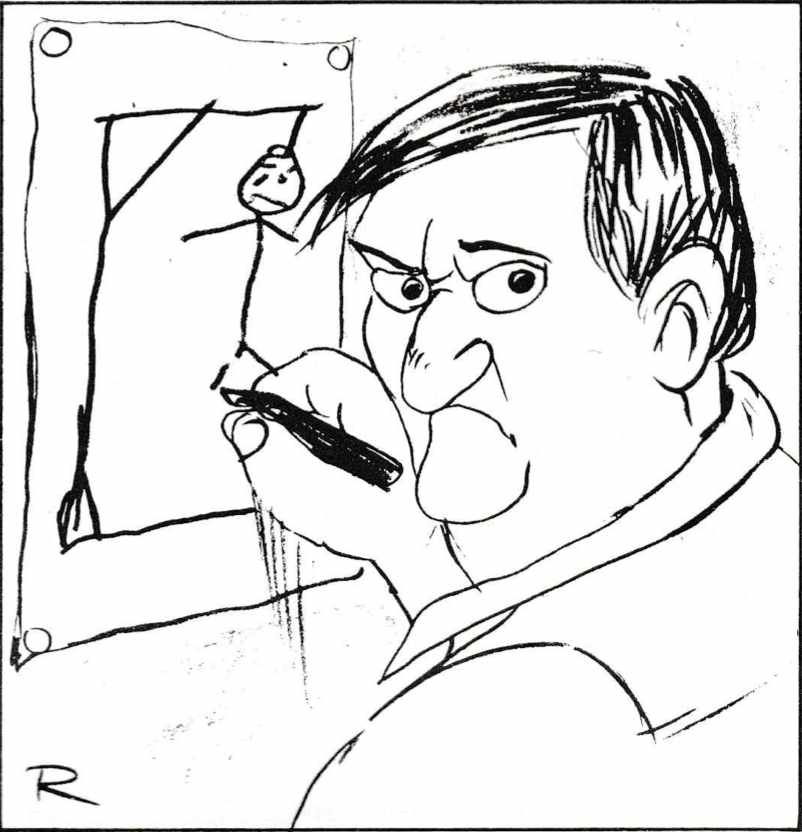
Cartoon by George Meddemmen.
From the April 1993 issue of the Socialist Standard

Rarely have the political defenders of the profit system looked less savoury. The Left is all but dead, buried beneath the rubble of the Berlin Wall, the most despicable side of which they had spent their histories celebrating or apologising for in the name of socialism. The Right survives, grotesquely repeating the excesses of its past in its more extreme forms, but, more generally, diminished to the corrupt post-Thatcherite ethos of the Bingo Hall.

The Left seeks to persuade us—and itself—that it is not really dead, but lying down. Like the unemployed actor who was never much good, the Labour Left and the other impotent radicals within the capitalist parties insist that they are merely "resting". But this is not true. All that is left of the Left is Tony Benn, destined to become a patronised elder statesman of a lost cause: Dennis Skinner, a parliamentary court jester; countless leftist sects of diminishing proportions selling meaningless newspapers mainly to each other; and Tony Cliff doing the Trotskyist music-hall circuit with increasingly implausible, incredible and embarrassing Lenin impersonations intended to inspire amongst the highly-impressionable the conviction that a British Bolshevik revolution is going to be the denouement of the Major chapter in history.

Of course, the remaining leftist believers will not give up—they will simply become less and less relevant, even to radically-minded workers, until the day will come, not far from now, when to read the works of Lenin will be as socially eccentric as is the study of Ron Hubbard's scientological madness now.

Irrelevant
Perhaps the most spectacular example of leftists doing what doesn’t come naturally and facing up to the historical truth is that of the Communist Party of Great Britain which simply dissolved itself in disgrace. The charmless cult members of the SWP or the RCP can be expected to enter into no such collaboration with historical reality.

The membership of the Labour Party is now more than ever made up of people who owe their jobs to Labour local authorities. The days when schoolboys in Barnsley or Leith rushed to the library to study the writings of the old reformers and then, flushed with the belief that the future was theirs to take (gradually, of course), threw themselves into the Labour Party, are long, long gone. Which schoolboy or girl of the 1990s would study the sterile thoughts of a plain John Smith or a presidential Tony Blair? And if they did they would be more likely to blush with embarrassment than perspire with enthusiasm. The nearest that Labour comes to exciting anyone are the wisecracks of Dennis Skinner. But if one-liners made a revolution Ben Elton would be head of the Fifth International.

If the Left has perished, the Right is a shadow of its former self. There was once a time when the British political right had about it a kind of political dignity; its leading lights were personally harmless old twits like Macmillan. Home and even Heath. It was possible to march in the streets against what Rab Butler or Willie Whitelaw stood for, but few felt motivated to march against them. They were only doing the traditional job of the keepers of the capitalist system, and both upbringing and temperament allowed them to perform it with what what now looks like an almost quaint aristocratic remoteness.

Bingo hall ethos
The Thatcher years changed all that. Too much has been written about those ghastly times for it to be worth saying more here, but the enduring memory is that of aggressive audacity. They not only robbed workers blind, but robbed blind workers, their faces straight as they lied, their hands bloodstained as they celebrated the freedom of the jungle.

Now that capitalism is in this deep crisis which has cast to the litter bins the Eighties’ manifestoes of a property-owning democracy, the remaining advocates of the Right are characterised chiefly by the non-erasable tattoo of the estate agent: they are a shifty, witless lot. From the odious Kenneth Clarke to the wimpish Major to the lamentable Lamont to the hateful Michael Howard, the spectacle is one of anaemic Thatcherites. Of course, socialists are never slow to stress that we are against the system and not its upholders as people, but when the upholders come to resemble so closely the image of the system it becomes almost impossible to distinguish between the body and the scabs.

The most manifest rottenness of the modem Right comes not from the ranks of the party of Maastricht, but from their supporters in the press. The smarmy Andrew Neil, editor of the Sunday Times, is the perfect political figure in this age of intellectual emptiness: a man with no loyalty or principle. only an unstoppable commitment to profit. The Murdochian assault upon the monarchy is not a concession to workers' distaste for unearned privilege, but the spiteful vengeance of the plebeian estate agent against those who have greater attachments to culture than to commerce.

Andrew Neil and his ilk object to snobbery because snobs quite rightly look down upon them. Richard Littlejohn, a Sun columnist with his own three-hour daily phone-in show on London local radio, epitomises the victory of semi-literate vulgarity over anything vaguely resembling the pursuit of knowledge. In the world of Littlejohn, just like the world of little John who became an accidental Prime Minister, there are only "good blokes" (mainly the English), "loony lefties” (anyone who is not a right-wing lout) and "scum” (the criminal legions whose growth is all because the government won’t listen to the Sun and give them all "a good flogging”).

More misery
Rarely more explicitly was all of this plain to see than in the political reactions to the James Bulger tragedy. The dying Left raised itself from its life-support machine to publish banal explanations about unemployment, Tory policies and the need for more social workers. (It is not that these points are all wrong, but why can the Left never dare to extend its vision beyond the blinkered world-view of economic determinism?) Devoid of a cogent radical voice, the Labour leaders simply endeavoured to outdo the Right in calling for more law and order. The sight of Tony Blair as a red-rosed cop was not pretty. Meanwhile, Clarke, the Home Secretary, spewed loutishly about "vicious little thugs” and the tabloids delighted in their favourite pastime of calling everybody "scum" (which is what in fact they seem to think that most of their readers are).

Marx spoke of capitalism becoming increasingly more miserable. He was right—it has. Its defenders have become more miserable too. They are intellectual degenerates. Just as popular culture has climbed into the pit of tasteless baseness with the cult of the new Madonna, so the politics of the deviant mind now prevails.

To enter the ranks of the Leninist left is less a wrong than an act of necrophily; to jump into bed politically with the modern Right is to flirt with the intellect, but not the body, of the tabloid-made Samantha Foxes. If there is any light out there in the hateful capitalist world it comes from the thousands—maybe millions—who know that there is something wrong and cannot believe that there is nothing better than what is on offer. They will understand what this article has been about.
Steve Coleman

Youth crime- what’s to blame? (1993)

From the April 1993 issue of the Socialist Standard
  We’re talking about the possible abduction and murder of a two-year old boy. And even in the shock and bewilderment we can’t be left alone. We must endure the media ghouls, the politicians and the self-styled experts on human misbehaviour telling us why it happened and how seriously social order is in peril and that we should trust them to put things to rights.
   We must put up with John Major, forgetting that he promised to be the architect of a “nation at ease with itself’, advising us to understand criminals less and condemn them more. We must swallow hard Rees Mogg’s censure that juvenile crime has its roots in a failure to say our prayers. When we knew what had happened to James Bulger there was an orgy of self-questioning, of doubt and condemnation. But the ghouls and the MPs and the experts were absolutely certain that none of these could refer to them. They were blameless.
The killing of James Bulger was a grisly climax to a developing campaign about youth crime. What with the “joy riders" on the bleak estates of Oxford, Liverpool and Newcastle and the persistent burglars who are too young to be legally locked away there was a popular fear that we were about to submerge beneath a tidal wave of teenage thieves and thugs. So the media bellowed out indignation. on behalf of Mr and Mrs Average Briton. The behaviour experts earned a few pounds by writing articles explaining it all as the effect of lax parents and provocative TV programmes and video games. And the politicians all acted like parliamentary thugs in the hope that thereby they could thieve a bagful of votes.

Competitive
At a time of understandably high emotion it may be difficult to cling to reality but it won’t go away. The popular conception about high levels of crime is often a matter of fashion. At one time Teddy Boys were in fashion; soon they were succeeded by the Mods and Rockers. More recently it was the football hooligans; then the “joy riders". But fashions can be decided by all manner of subjective—and delusional—influences. It can develop its own momentum— which is why the popular press falls over itself to colour and glamourise crime.

Meanwhile, throughout the spasms of modish hysteria, there have been quiet, persistent voices pointing out that the teens are the peak years for getting into trouble with the law and that this may be saying something important about what we really think of this social system. If capitalism can’t assure young people, with their vigour and optimism and lack of inhibition, of a stable future there must be something seriously wrong with it.

Rather than admit the unpleasant realities of the society they try to run, the politicians have been engaged in a sordid competition to bid up the stakes in the Law and Order game. Home Secretary Kenneth Clarke had some unpleasant things to say about young offenders while he promised to set up a series of secure establishments to lock them away. John Major declared a crusade against crime—as if it can be fought—with himself, presumably, on a white charger at its head. Desperate at the prospect of the Tories picking up all the votes on the issue, Labour's Tony Blair showed that he is no slouch at the business, calling on the government to be “tough on crime, tough on the causes of crime”.

Harsher
None of the ministers drew attention to the inconvenient fact that the youngsters now coming before the courts—including the two boys charged with murdering James Bulger—have spent most, if not all, of their lives under Conservative government.The Tory party have allowed it to be thought that they alone can be trusted to deal with—in other words, to be tough on— crime.

In their sillier moments they have come close to claiming to be able to wipe it out altogether. But what does it say for them and for their policies that after 14 years of power they are in a panic because the problem is worse than ever and are saying that harsher responses are necessary? After all, if their policies had succeeded we might now be expecting courts to feel able to be more lenient about the few minor offences before them.

And what is to be said about those harsher measures? None of them are new. They have all been tried before and they have all failed before; in fact their only perceptible effect has been to stimulate crime. The provision of secure accommodation for young offenders does not have an encouraging history; the most recent version—the Approved Schools—were often colleges of criminal education, where children quickly learned that to survive they had to be devious or obsequious or violent. They learned to burgle houses, pick pockets, steal cars more efficiently.

And in several infamous examples those children were subject, not to the training in citizenship which Clarke huffs and puffs about but to deliberate abuse, physical and sexual. It was often summed up by the professional criminal, once ruthless but new more reflective, who would say that, for him, Approved School was where it all began.

Conscription
The same can be said about the Borstals, sentences to which were officially called “training". And the same, but even more so, can be said about the Detention Centres, whose “short, sharp shock" regime was so rapturously greeted by the punitive neurotics of the Tory Party.

The policy of the Detention Centres was based on the assumption that by bullying and repressing youngsters who had often been subjected to that kind of treatment all their lives anyway, it was possible to persuade them not to bully and repress others. They were doomed to failure although after being abandoned in the 1970s they were briefly revived by an embattled Willie Whitelaw before being quietly allowed to expire.

So what else is on offer, to repress, discipline or "treat" the young criminal? Well, there has been the predictable demand to bring back conscription, often from men who are stupid enough to be able to filter out the truth of their own memories of National Service. Conscription, they declare over their beer in the local British Legion, would instil respect for authority, discipline, order, cleanliness, short hair and sharply pressed trousers . . .

Leaving aside the fact that the armed forces are not famous for decorous, considerate and law-abiding behaviour, we should bear in mind that when peace-time conscription operated in this country it was often said to be responsible for crime. The post-war crime wave was widely explained as the response of school leavers, knowing that in a few years they would be forced into a mindless existence of square bashing and spit and polish, lacking any ambition other than to be the best burglar in the street.

If there is any evidence about cause and effect of crime it clearly contradicts the theory that harsh punishment persuades people to be law-abiding. Perhaps that has something to do with the fact that capitalist society has a selective policy on what is lawful and what is not. Some theft and violence is not only allowed but actually esteemed and rewarded—as any investor should know, as any soldier should know. In such a social system it has to be expected that people will be confused about what is legal and what is outlawed—what is “right" and what is “wrong”.

In the sacred name of profit capitalism murders millions of people every year, in its wars, its famines, through its unnecessary disease. None of this is illegal. Meanwhile, the leaders of this historical horror concentrate on trying the impossible—making the system work without its inevitable problems.

Crime cannot be abolished, any more than the problems which capitalism must produce can be abolished—unless something is done about changing the basis of society. Through the hysteria generated by the death of poor little James Bulger, that is a central fact which must not be lost sight of.
Ivan

Who abuses who? (1993)

Book Review from the April 1993 issue of the Socialist Standard

Suffer the Little Children by Dr D.H.S Read. Medical Institute for Research into Children Cruelty, Step Rock House, St Andrews, Fife, Scotland, KY16 9AT. £15.00.

On a cold morning in February 1991 police and social workers invaded the Isles of Orkney. These pre-dawn raids, unlike those carried out by the Vikings over 1000 years earlier, though similar in that the perpetrators had the element of surprise, were carefully planned and synchronized.

Seven homes were forcibly entered and searched, and 9 children aged between 8 and 15 years were removed in a matter of minutes. For those who were to live through the following nightmare it might have seemed as if history was repeating itself. Not only was there the Viking analogy, but the events resembled in many ways the witch-hunts of the 16th and 17th centuries that also visited the islands. Indeed, witchcraft, or rather the satanic abuse of children, was what the parents and friends of the 9 children were alleged to have perpetrated.

Dr Reid’s book is a careful study of what followed in the Orkney Child Abuse Scandal, revealing much that was suppressed by child care “experts” and the media. Many pages are given over to what an advert for the book describes as “how social workers—police— the medical profession and the law courts combine to destroy innocent families in child abuse allegations”.

The recent industry in child abuse allegations is traced back to the late 1960s when:
 under the benevolent torpitude or turpitude of a Labour government, which forgot that it should protect the weak against the strong, and not the other way around, the public bureaucracies in Britain developed a life and momentum of their own. The bosses in local government, in the health service, social services and other publicly funded bodies, decided that it was time that their powers were increase.
The Social Work (Scotland) Act 1968 and the Childrens and Young Persons Act 1969 greatly increased the powers of social workers to take children into care “on the flimsiest of grounds”.The result being that there has been in excess of 50 inquiries into child abuse disasters since 1970. There was only one such inquiry before this date.

Among the hundreds of sources Dr Reid uses is an article from the Daily Telegraph Magazine of 11 January 1991:
What organisation does the following, the Stasi before 1990 or the social work child care system today in Britain?
  1. Takes people into custody without warning at any time of the day or night.
  2. Opens, copies and even confiscates their post. Denies them rights.
  3. Keeps surveillance of more than 4 million people.
  4. Has a network of informers.
  5. Depends on loyalty to the system, from self-interest. And is a State within a State.
  6. Is expanding at a phenomenal rate at vast cost.
  7. Has no statutory provision governing or constraining some of its powers, apart from guidelines.
  8. Threatens those who disagree with it.
  9. Ruins many lives.
  10. Says, when things go wrong: "What could I have done differently?”.
“The answer”, says Dr Reid, “is both”. And much evidence is presented to corroborate the parallel.

The book goes on to reveal one of the great contradictions when it comes to child law, which is basically that in spite of so much legislation on the subject, the child has in fact few, if any, legal rights once in the custody of the social services.

A child taken into care by social workers is compared with a criminal in police custody. Whereas the prisoner has the right to remain silent, the right to legal representation, access to a telephone, uncensored mail and contact with family, the child has no rights.

Social workers have become very dependent on “Disclosure Sessions”, so much so that the entire case for the social services in the Orkney Child Abuse Scandal rested on “evidence” extracted at them. “Disclosure Sessions", as Dr Reid points out more than once, “involve constant repeated interviews with children in which suggestions are made to children by social workers or others until the child agrees with the professional worker . . . a form of intellectual rape”.

It does not matter that the child may not have been abused, nor that the parent alleged to have committed the act may be by now suicidal. The skilled social worker will, without fail, extract evidence of abuse, and “how much more might a child agree to errors and fantasies when suddenly wrenched from his or her home environment and told that he or she will not be allowed home until he or she agrees to the story told by the inquisitor”.

There are those who maintain that children always tell the truth and cannot be made to tell lies. Dr Reid shatters this argument with plain fact. The Birmingham Six and the Guildford Four, men not children, confessed to crimes they did not commit. If the well-known television presenter Stuart Hall can “admit within ten minutes of a police interview to a theft he had not carried out then we cannot expect a child to be more resistant to manipulation”.

And so the book continues. Not a stone is left unturned and no body connected with the State-established Child Abuse industry escapes criticism. That the book ends with pointers as to how to reform the system along the lines of the “Dutch model”, and does not consider the capitalist social system we are conditioned to live in, does not distract from its excellence.
John Bissett

Market leader (1993)

From the April 1993 issue of the Socialist Standard

Has it ever appeared to you that in this revered “democracy" of ours, despite the efforts of successive governments over the decades, the politicians who claim to have the solutions to the country's problems are just fumbling in the dark? Has it occurred to you that no matter what supposedly new schemes the power-brokers dream up and sell us like a new brand of detergent, the social and economic ills which afflict our lives seem to remain with a tenacity rivalled only by Jeremy Beadle's attempts to embarrass the entire population before his retirement?

If your answer to these questions is yes, then rest assured that you are not the first to have serious doubts about the merits of our so-called democratic system of government. It is not uncommon to find yourself exasperated at the fact that nothing really changes, regardless of which band of political incompetents has lately deceived the electorate into handing over its decision-making power.

After all, haven’t we been consistently assured that eventually abhorrences such as poverty, inequality and war will become merely topics for the history books? And yet we still find the politicians continuing to grapple with the problems which our grandparents hoped would have long been consigned to memory by the time their grandchildren had reached maturity. Not an unreasonable aspiration when you consider what an intelligent and co-operative species human beings can be.

Disturbing reality
The disturbing reality is that here we are, seven years shy of the milleniuni. on the brink of what many a science fiction writer has dreamed would be a fantastic age of unity, enlightenment and space travel, and human existence continues to breed conflict and despair. How could this have been allowed to happen, when in most parts of the developed world, we the people have the power to select the representatives ostensibly best able to tackle the corrosive features of our society?

Surprisingly, the answer to this question is terrifyingly elementary. The truth is that no democratically-elected representative anywhere in the world, no matter how well-intentioned or altruistic he or she may be, has any real power to improve the lot of the majority of people, the working class. Many idealists have boldly entered the world of politics with commendable notions about changing society for the better or serving their fellow men, but on becoming elected they discover that their plans are foiled by an uniquely ascendant and irresistible governor—the market.

Let there be no delusions; everything related to the daily running of a national or local economy, whether it be production of food, social services. health care or employment. is dominated by the intransigent demands of the market system. Despite the fact that the world is now capable of producing more than enough food, clothing and shelter to serve the needs of all its inhabitants, and technology has provided the potential for a quality of life for all unimaginable a century ago. the politician finds at every turn in the economic labyrinth yet another barrier erected by the market. Nevertheless the market, though possessed of absolute authority over our lives, never has to face election by the people it governs. It is a dictator of the most pervasive nature, without integrity or conscience.

The evidence for this contention is not difficult to find; you need only to switch on the radio or television or pick up todays paper. There we see and hear stories of miners losing their jobs while there are still vast reserves of coal left underground; we hear of hospitals turning away patients because their budgets have been exhausted before the end of the financial year; we hear the prime minister blaming lack of “demand" in the economy for the rising numbers of unemployed. and yet there are millions in need and millions idle who are prepared to produce the goods to meet those needs.

Although passionate believers in the democratic principle. socialists refuse to give their votes in an election to any candidate other than another socialist. Even the so-called socialists of the British Labour Party are merely attempting to ameliorate the capitalist system by endeavouring to reform some of its more objectionable attributes. You will never hear a Labour politician advocate the complete overthrow of capitalism. Socialists maintain that (unless of course there is a genuine Socialist candidate) workers have no real choice when confronted by a ballot paper: whoever they vote for on election day. the result is the same—government by the market.

Beyond the market
As the worst recession since the 1930s drags on, an encouraging phenomenon has germinated in several parts of the country, started by small groups of workers disillusioned with the money exchange system. Necessitated by the severely limited budgets of the unemployed and low-paid. small bartering networks have been set up with their own currencies in order to allow the exchange of goods and services without the use of cash. Although these “local exchange trading schemes" are in essence just another form of exchange and therefore not an alternative to the market system. they do demonstrate that some workers are now questioning the ethos of the capitalist system and are attempting to exercise some control over their own lives:
  Dr Michael Hodges, lecturer in international affairs at the London School of Economics, sees the proliferation of such schemes as the result of a loss of faith in governments to control the global economy (Observer, 17 January).
While socialists do not advocate the idea of bartering as an alternative to the market system. we are nevertheless interested in examples of workers coming to understand that they are capable of organizing their own community rather than subjecting themselves to the ineptitude of incompetent politicians. It proves that we are not isolated in our refusal to accept that the prevailing economic system is immutable.

In a rationally organized society there could not be the mind-boggling anomalies of the sort that are endemic under capitalism, such as millions starving to death while food is stockpiled because it can't be sold at a profit, or ever-increasing numbers of homeless people while construction workers are forced into idleness; there would not be a waste of vast resources on weapons research and manufacture while the infirm suffer for want of rudimentary medicines and health care. In a sane world there would be no market to dictate that only those with “purchasing power" may have access to what they need, because there would be free access to goods and services for all.

We have it in our power to conceive a new order in which all people have real control over their own lives, the power to forge a true democracy where wealth is shared amongst the population of equals and not monopolized by a privileged minority. When the day comes in which the majority of workers decide that enough is enough, that the oppression of the wealth-producers has prevailed for long enough, then and only then will the market system face the scrutiny of the masses in the greatest “election" in history.
On that day it won't be the vacuous grin of the latest Tory or Labour prime minister which greets us on our television screens, nor the platitudes of the newest president or chancellor. When socialism is finally established there will be a worldwide awakening to the dawn of a consciousness which will transport humanity from the desolate age of disillusionment and insecurity to a new era of unity and understanding.
Nick Brunskill