Wednesday, March 25, 2009

Weekly Bulletin of The Socialist Party of Great Britain (89)

Dear Friends,

Welcome to the 89th of our weekly bulletins to keep you informed of changes at Socialist Party of Great Britain @ MySpace.

We now have 1466 friends!

Recent blogs:
  • The trouble with culture
  • Back to no work
  • So that's what's wrong with socialism!
  • Quote for the week:
    War is a quarrel between two thieves too cowardly to fight their own battle; therefore they take boys from one village and another village, stick them into uniforms, equip them with guns, and let them loose like wild beasts against each other. Thomas Carlyle, as quoted by Emma Goldman in her essay Patriotism: A Menace to Liberty, 1911.
    Continuing luck with your MySpace adventures!

    Robert and Piers
    Socialist Party of Great Britain

    Tuesday, March 17, 2009

    Material World: Opium Wars, old and new (2009)

    The Material World column from the March 2009 issue of the Socialist Standard


    The phrase “opium wars” usually refers to the British military assaults of 1839-42 and 1856-60 that forced the Chinese emperor to allow British merchants to sell his subjects opium. The opium was grown in India, where the tax revenue from its sale maintained the colonial administration.

    In 1839, imperial commissioner Lin Zexu wrote to Queen Victoria: “By what right do the barbarians use the poisonous drug to injure the Chinese people? Although they may not intend to do us harm, in coveting profit to an extreme they have no regard for injuring others. Let us ask, where is your conscience?”

    He never received an answer.

    Poisoning “their own people”

    Not only the Chinese suffered at the hands of the profit-coveting barbarians, who derived equal satisfaction from poisoning “their own people.” Britain imported 200,000 pounds of opium from India in 1840. It was consumed, quite legally, mostly mixed with alcohol in a flavoured concoction called laudanum, as an all-purpose painkiller, tranquilliser and sleeping potion. Society ladies used it to acquire the then-fashionable pallid complexion associated with tuberculosis, while the neglected and undernourished babies of the working class were dosed with it to keep them quiet while their mothers toiled long hours in the mills.

    Nowadays trading in opium is illegal. That, of course, does not prevent its large-scale production, sale and consumption, mostly as heroin. It merely raises prices and makes the business even more lucrative, though some “drug lords” perhaps envy the respectability enjoyed by their Victorian predecessors – and by pushers of currently legal poisons.

    Opium and Afghanistan

    At present the global centre of opium production is Afghanistan (accounting for 93 percent of opiates sold worldwide in 2007). To be more precise, production is concentrated in three border zones of Afghanistan: in the northeast, supplying the post-Soviet region through Tajikistan; in the west, for export through Iran; and above all in the south, for export through Pakistan. Sales within the country have also grown rapidly.

    Afghanistan’s annual earnings from opium exports are estimated at $4 billion. This is some 15 times larger than earnings from all legal exports combined (nuts, wool, cotton, carpets, etc.). Thus opium has greater dominance over the Afghan economy than oil, for instance, has over the economies of most oil-exporting states. The farmers who grow the poppies get about a quarter of the money, $1 billion. The rest goes to traffickers and to the politicians, officials and military commanders who control the territory and protect the traffic (where they do not organize it directly).

    As we know, Afghanistan and adjoining areas of northwest Pakistan are at war. This is Obama’s favourite war, so we can expect it to intensify. On one side: the US and NATO, their client regime under President Hamid Karzai in Kabul, their allies in Pakistan’s governing elite. On the other side: the Taliban and their Islamist allies in Pakistan. In between, fluctuating in their allegiance (depending on who pays more): the local bosses or “warlords.”

    What is the relationship between the war and the opium trade?

    First of all, the predominance of opium in the Afghan economy is largely a product of prolonged warfare. The many years of war disrupted long-established patterns of food production and distribution. Unlike food crops, poppies do not require much tending and so are better suited to unpredictable and chaotic conditions.

    A new opium war

    All players, except possibly the US and NATO, are closely involved in the opium trade. This applies equally to the Taliban, the warlords, and the regimes in Kabul and Islamabad. One of the biggest traffickers, for example, is Karzai’s brother. All, to varying degrees, are financially dependent on opium. Pakistan receives US aid and has other sources of revenue, but it too depends on opium money: the trucks that carry supplies over the border for NATO forces in Afghanistan return loaded with opium.

    Thus to a large extent opium funds the war. It pays for weapons and hires fighters. And, in turn, the fighting is not only for control over territory, but also and especially for the control over opium production and exports that goes with territorial control. As in Congo, war is simultaneously a means and an end in the struggle to control a valuable resource – metallic ores in Congo, opium in Afghanistan. If Congo is a “mobile war”, then Afghanistan, to some extent at least, is a new opium war.

    Opium and the US role

    The role of opium in US policy regarding Afghanistan is more difficult to assess. The illegal status of the trade prevents opium interests fromexerting open influence on the US government, although secret influence – through links between politicians, officials and illegal business (“organized crime”) – may be significant. However, the US market in illegal drugs is supplied primarily from other parts of the Americas, not from Afghanistan.

    Officially, the US government conducts a “counternarcotics strategy” in Afghanistan. Farmers have been offered assistance in switching from poppies to wheat. In practice, even if the intentions behind such programs are genuine and even if they were to be adequately financed, the conditions of war and the reliance of US allies on opium money would still militate against their success. It may be worth noting that the CIA, which has traditionally been quite willing to cooperate with foreign drug interests (for so long as they served its purposes) and even sell drugs itself to raise additional funds, plays no part in anti-opium measures.
    Stefan

    Thursday, March 12, 2009

    Food Business (2009)

    Book Review from the March 2009 issue of the Socialist Standard


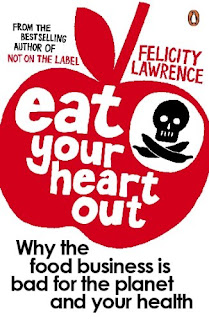
    Eat Your Heart Out. Felicity Lawrence. Penguin. £8.99.

    Following on from Not on the Label, this is another book by Felicity Lawrence that exposes much that’s wrong with the food we eat and the way it’s produced and, therefore, much that’s wrong with capitalism as a way of running the world.

    Lawrence describes conventional farming as ‘a system for turning oil into food’. There is simply more profit in industrial food production than in plain healthy food like fruit and veg. Consequently consumers’ food choices are manipulated, so that we ‘want’ what the food industry sells at the biggest profit and we buy what we have been persuaded to buy. This is mainly achieved by advertising, but also by more insidious means: adding massive amounts of sugar to baby food gets babies, and therefore children and adults, hooked on sweetness.

    Let’s take a couple of case studies. Processed cereals, for instance, represent ‘a triumph of marketing’. And agricultural subsidies from government help to keep companies’ costs down and profits up. The nutritious part of cornflakes is deliberately removed because it gets in the way of a long shelf life. As a result of this and the addition of sugar, breakfast cereals fatten you up but provide little by way of nutrition. Since relatively few countries eat much cereal, there is plenty of scope for global expansion, with Kellogg’s targeting a potential 1.5 billion new customers, and prepared to spend massively to attract them.

    The globalised pork and bacon industry has based its enormous profits on two elements: factory farming with little or no regard to the environmental impact, and low wages mostly paid to migrant workers. The farmers who contract to raise pigs for the processing companies make just enough to get by, and the buildings they invest in are likely to put them in debt to the bank. Meanwhile the big corporations enjoy enormous profits with relatively little capital investment.

    As the cereal example shows, food produced with an eye to profit is not good for you, and may be positively dangerous. Sugar, for instance, has been described as being as harmful and addictive as tobacco. The evidence is not conclusive, but arguably the extent of cardiovascular diseases in developed countries is in part due to an imbalance of fatty acids (too much omega-6, not enough omega-3). Cancers, too, are in part caused by our diet. Soya is seen as a miracle health food, but it is in fact a key ingredient in the fried and oiled junk food market.

    Lawrence has provided a graphic description of profit-driven food production. We can’t agree with her claim that what’s needed is ‘a fairer distribution of the profits’, since that would leave the profit motive intact. But we have more sympathy with her conclusion that it’s necessary to examine ‘the power structures that control food supply’, as long as this goes along with overturning the structure of all production and distribution.
    Paul Bennett

    Wednesday, March 11, 2009

    Helicopter Ben and the money supply (2009)

    From the March 2009 issue of the Socialist Standard
    Governments now call it “quantitative easing”. It used to be simply called inflating the currency. And it’s now official policy.
    In the 1930s Keynes suggested burying banknotes and then paying people to dig them up. Ben Bernanke, current chairman of the US Federal Reserve, is said to have come up with a modern version:
    “The most radical option is to send the newly-minted money directly to the US Government. It could then be handed out to citizens via tax relief. This form of monetary expansion would be equivalent to printing money and dropping it from helicopters for people to pick up – a graphically extreme proposal that earned the Fed chairman, Ben Bernanke, his nickname of Helicopter Ben” (Times, 18 December).
    The present crisis is confirming some of the truths of Marxian economics. First, that banks cannot “create credit” out of nothing. Second, that the rise in the general price level, popularly but inaccurately called “inflation”, is caused by the government’s bank, the central bank, issuing more currency than the economy requires for its various transactions such as buying things, settling debts and paying taxes.

    Inflation, which up to now politicians have been telling us is the main economic problem to avoid, is now being seen as one supposed way out of the deepening depression. After years of propaganda blaming inflation on wage increases, they now want the general price level to rise, and know how to bring this about – not by raising wages of course but by the government over-issuing the currency by printing more and more of it.

    Seven years ago, when he was still only a governor of the New York Federal Reserve Bank, Bernanke explained how, by overissuing a paper currency that was not convertible on demand into a pre-fixed amount of gold, governments could create “positive inflation”:
    “[U]nder a fiat (that is, paper) money system, a government (in practice, the central bank in cooperation with other agencies) should always be able to generate increased nominal spending and inflation, even when the short-term nominal interest rate is at zero. ( . . .) US dollars have value only to the extent that they are strictly limited in supply. But the US government has a technology, called a printing press (or, today, its electronic equivalent), that allows it to produce as many U.S. dollars as it wishes at essentially no cost. By increasing the number of US dollars in circulation, or even by credibly threatening to do so, the US government can also reduce the value of a dollar in terms of goods and services, which is equivalent to raising the prices in dollars of those goods and services. We conclude that, under a paper-money system, a determined government can always generate higher spending and hence positive inflation." (Talk “Deflation : Making Sure It Doesn’t Happen Here”, 21 November 2002 at (http://www.federalreserve.gov/boarddocs/speeches/)
    What Bernanke describes here is simply inflating the currency, even though it’s now being called “quantitative easing”. Marx had already explained this 150 years ago in his A Critique of Political Economy, where he discussed what would happen if a government overissued what Bernanke calls “fiat money”:
    “Let us assume that £14 million is the amount of gold required for the circulation of commodities and that the State throws 210 million notes each called £1 into circulation: these 210 million would then stand for total of gold worth £14 million. The effect would be the same as if the notes issued by the State were to represent a metal whose value was one-fifteenth that of gold or that each note was intended to represent one-fifteenth of the previous weight of gold. This would have changed nothing but the nomenclature of the standard of prices, which is of course purely conventional, quite irrespective of whether it is brought about directly by a change in the monetary standard or indirectly by an increase in the number of paper notes issued in accordance with a new lower standard. As the name pound-sterling would now indicate one-fifteenth of the previous quantity of gold, all commodity-prices would be fifteen times higher and 210 million pound notes would now be indeed just as necessary as 14 million had previously been. The decrease in the quantity of gold which each individual token of value represented would be proportional to the increased aggregate value of these tokens. The rise in prices would be merely a reaction of the process of circulation, which forcibly placed the token of value on a par with the quantity of gold which they are supposed to replace in the sphere of circulation.”
    This artificial bloating of monetary demand is what inflation, strictly speaking, means. Governments now want to consciously use this process to exert an upward pressure on the general price level to try to stop it falling as it would otherwise tend to in a deep recession. It might be thought, in view of all the publicity put out by supermarkets and chain stores about how they have all slashed prices more than their rivals, that falling prices would be a good thing. But this is not how the government sees it. They think that this would make the current depression worse, as they want to encourage people to spend whereas, with falling prices, people might postpone spending in the hope of prices falling even further.

    Inflating the currency to try to stop money prices from falling is now the official policy of both the government and the Bank of England. That this is what is happening is being openly admitted. For instance, the financial journalist, Anatole Kaletsky, wrote in the Times (18 December) that “today the threat is deflation, not inflation” so that “central banks are right to flood the world economy with newly printed money – so long as they know when to stop”, conceding that “a central bank that prints money to finance large-scale government spending is, in theory, moving into territory occupied by Zimbabwe and Weimar Germany”.

    In a previous article (15 December) he had attempted a more sophisticated analysis, introducing the concepts of “monetary base” and “money multiplier”. He gave the definition of the first as:
    “banknotes issued by the Bank of England plus coins from the Royal Mint plus private bankers’ deposits at the Bank of England and therefore available at any time for conversion into banknotes with literally zero risk”.
    This is rather more than the currency as it includes deposits from banks at the Bank of England, which do not circulate and so do not have an effect on the general price level. Nevertheless, the currency makes up over half of this “base money”.

    According to Kaletsky, this figure is currently around £100 billion. He then introduces what he calls “broad money” defined as “all private sector bank and building society deposits, money market funds and so on”. Reverting to the language of before the credit crunch when it was thought that banks would never have any problem to lend money, Kaletsky refers to this “broad money” as being “created by private banks”. This is highly misleading in that what the banks lend out has not been “created” by them but is the result of them acquiring other people’s money in one way or another. It reflects what banks do, which is to recycle the purchasing power of those who don’t want to use it immediately. He does, however, admit that “the moment there is an iota of doubt, bank deposits cease to be true money, as demonstrated by the queues outside Northern Rock last year”.

    Whether it is “true” money or not (and Marxists would say that it is not) the figure for “broad money” is some £1,900 billion. So, in Britain, the “money multiplier” is 19. Kaletsky notes that in other countries it is much less. In Japan it is 11, in the Eurozone 7.5 and in the US 5.3. He says that this means that Britain can safely afford to issue more “base money” and suggests a doubling to a further £100 billion, so reducing the “money multiplier” to about 10.

    If all of this additional “base money” were to be in the form of notes and coin this would amount to a massive inflation of the currency, bringing it way above what the economy needs for its transactions (especially as, in a depression, the number of these will fall). Kaletsky envisages this to a certain extent as he mentions the Bank of England buying government bonds or even providing money directly to the government to spend, both of which would involve printing more currency .

    In fact. facilitating the buying of government bonds with new money has been the way that successive governments have, intentionally or not, inflated the currency in Britain since 1940 and why the general price level has risen continuously since then. Kaletsky explained in his 18 December article how this worked in the US. The Federal Reserve Bank, as the central bank, will buy government bonds and
    “will pay for them simply by making electronic transfers into the bank accounts of the people or institutions selling. For every $1 million worth of assets bought, the Fed will transfer $1 million of new money into private bank accounts. This ‘money’ will come literally out of nowhere. It will simply be an electronic blip on the Fed's computer. Because electronic deposits at the Fed are the ultimate form of legal tender in the US system, the result will be that the US economy has $1 million more money.”
    When these banks draw on the extra amount in their accounts extra currency is brought into circulation which, if it more than is required by the economy (as it has been), leads to the rise in general price level popularly called inflation.

    Kaletsky had already explained in a previous article (11 December) where the money to try to spend a way out of the depression was likely to come from:
    “For the next year or two, the money for the British fiscal stimulus will come from the Bank of England's printing works in Dedham. In the case of the far bigger job-creation schemes and industry bailouts planned by Barack Obama, the money will come from the Washington and Fort Worth facilities of the US Bureau of Engraving and Printing, an institution rejoicing in the most succinctly descriptive internet address I have encountered: www.moneyfactory.gov.”
    Burying bank notes and digging them up again. Dropping them from helicopters for people to pick up. In fact even using printed coloured pieces of paper to have access to what you need. These are crackpot ideas compared with the simple socialist proposition to produce things for use not for sale at a profit, so ending the need to use money at all.
    Adam Buick

    Weekly Bulletin of The Socialist Party of Great Britain (88)

    Dear Friends,

    Welcome to the 88th of our weekly bulletins to keep you informed of changes at Socialist Party of Great Britain @ MySpace.

    We now have 1461 friends!

    Recent blogs:
  • Is capitalism crumbling?
  • The real dirty work
  • Trade unionist extraordinary


  • Quote for the week:
    "Capitalism subordinates men to machines instead of using machines to liberate men from the burden of mechanical and repetitive work. it subordinates all social activities to the imperatives of an incessant drive for individual enrichment in terms of money, instead of gearing social life to the development of rich individualities and their social relations." Ernest Mandel, from the Introduction to Marx Capital vol. 1.


    Continuing luck with your MySpace adventures!

    Robert and Piers
    Socialist Party of Great Britain

    Uncles


    Originally posted on the Socialism Or Your Money Back blog

    When I was a very little girl my family had a benefactor called Uncle. At the time I thought he was a relation of ours. In those days it was considered to be impolite for children to call adult friends and neighbours by their first name; it would have to be Auntie Betty or Uncle Fred even when they were no relation to you whatsoever. But my parents were rather unconventional and so dispensed with this silly tradition. So I thought this Uncle must be a real uncle even though I had never met him.

    What was bewildering for me was listening to my parents discussing him. Mum would say "I'll take your suit down to Uncle's on Monday and get it back in time for the weekend." Dad wouldn't be likely to wear his best suit for work. He had a working uniform of dark blue denim with WBC (Woolwich Borough Council) etched on the back of the jacket. His suit was worn at weekends only. Uncle paid my mother for the loan of the suit, and sometimes she would let Uncle borrow my eldest brother's suit as well. This led to a terrible quarrel in our house. Alex, my elder brother, had a new girlfriend he was constantly trying to impress. Whenever he brought her to the house my younger brother and I would mouth the word "Yuk" to one another; they were forever kissing each other and we thought they were sloppy. Anyway, the row was over the fact that Mum had taken Alex's suit to Uncle's and had failed, for some reason, to get it back in time for the weekend when the beloved girlfriend was due to visit. They all shouted at each other for hours and Dad told him to get out if he didn't like it. He said very angrily, "It's to put food on the table." It was an ugly scene.

    I spent an inordinate amount of time trying to imagine this Uncle of mine. Why would he need to pay Mum for the loan of Dad's rather tatty suit? And what would he want with Alex's suit too? I even asked a couple of the kids at school if their dads and brothers had uncles who borrowed their clothes and, looking mystified, they shook their heads. One girl told me, "My dad hasn't got a suit."

    Then the day came when I was to meet Uncle. I had been away from school with a head cold and as Mum refused to leave me alone in the house when she went out, we both got on a tram to town. Mum carried with her one of those battered, cardboard suitcases, the only kind poor people could afford in those days, and a woman who got on the tram at the same time asked me, "Going on your holidays, are you?" I told her, "No, we're going to Uncle's, aren't we Mum?" Later Mum glared at me saying, "Must you show me up like that?" All my life I've felt sorry for children. They are seldom given any examples of how to be truthful, and adults have so much more practice in lying. Wasn't it Shakespeare who said, "Out of the mouths of babes and of sucklings"? Well, something like that.

    In town I trotted alongside my mother excited at the prospect of meeting Uncle at last. We turned into an alleyway and there stood a small building with three brass balls over the top of the door. Inside it was dim and dusty and there was a counter like ordinary shops have. A man appeared suddenly from a door behind the counter and Mum opened the case and took out the suit. He looked the suit over and then gave her some money and a ticket. I watched this transaction with great interest. Some uncle—the man ignored me! I had a real uncle who used to pat me on the head and say, "You're a little beauty, just like your mother," and sometimes he would give me a packet of sweets and tell me not to talk so much.

    This man was not my uncle. He wasn't pleasant to my mother, nor she to him. She resented him. Well, who wouldn't resent a man who took your husband's suit, laid it on a dusty old shelf somewhere, lent you money and charged you interest on it?

    Mum picked up the empty case and we traipsed back through the town and caught a tram home. My mind teemed with questions, none of which I could give a name to and something warned me against trying to voice any of them. That day, young as I was, I saw the rudiments of capitalism—that every action must involve money, that nothing, absolutely nothing, can exist without exploitation to make the system work. Of course I didn't really understand that at the time, but I peered out at the world, short-sighted though I was, and suspected that it was a very strange place indeed. And so it is. I waited for the adults to discover my myopia and recommend spectacles. When at last I got them the world came into sharper focus and my mind reeled at the absurdity of it all, that humans arrange affairs in such a way as to create chaos. Uncle's was a tiny part of the personal experience which shaped me into the person I am today and into being a socialist. That experience was invaluable I think.
    Heather Ball


    A Socialist Life by Heather Ball

    A collection of sort stories by Socialist Standard writer Heather Ball. Many readers liked her distinctive writing style, finding it full of charm, warmth, humanity and humour.

    Sadly, Heather died before she could complete her writing project. This collection, published by the Socialist Party, presents the case for Socialism on the basis of individual, everyday experience. £3.75 From Socialist Party 52 Clapham High Street, London SW4 7UN.

    Greasy Pole: Brand Obama (2009)

    The Greasy Pole column from the March 2009 issue of the Socialist Standard

    Is there – can there be – a connection between Barack Obama and two West London Labour MPs?
    Obama has just moved into the White House at the head of the most powerful nation, controlling a military, diplomatic and economic force so huge as to be able to invade, distort and destroy the lives of the majority of the world’s people. Against that the two MPs – Andrew Slaughter and Virendra Sharma – are notably low-key. Their constituencies – Ealing Acton Shepherds Bush and Ealing Southall – are unremarkable for their grime, chaos and disorder. The MPs held minor posts as Parliamentary Private Secretaries – Slaughter at the Foreign Office and Sharma at the Home Office – but their resignation from these provoked hardly a murmur of interest. The reason they jumped off the lowest levels of the Greasy Pole was their objection to the government’s plans, in betrayal of a succession of pledges, to further develop Heathrow Airport, specifically by laying down a third runway. In Sharma’s case this was something of an aberration, for he was not an active MP – apart from slavishly voting for the government line. If they had not already done so, Slaughter and Sharma might have learned something from this experience about the essential ruthlessness of politics, in the heat of which all promises and “principles” are devoured.

    Glamour
    That is something of which Obama is fully aware, which explains why his drive to the Presidency, from its inception through its planning to its execution was, for its single-minded cynicism, such an historically prime example of it. He and his team touted for votes on the single word Change, which was compliantly accepted as an intention to simply get rid of George Bush and as much as possible of his policies, his supporters, his command style. It was made to sound so easy. But it was hardly enough to stimulate the kind of response – the blind devotion to the concept that one man could by himself wipe out the tragedies which had plagued so many lives for all those years. Such was the degree of hysteria that it obscured the fact that in 2004 a similarly psychotic process had ensured George Bush’s triumphant return to the White House. But there was more to Obama than a promise for he is the kind of politician who trades on a spurious glamour. On that score, in terms of their respective political chicanery, McCain was shrunken and exhausted, with nothing to offer in combat. Obama’s lissom confidence and the support acting of his wife and children composed a portrait of the ideal American family. And in a Presidential election there are few things more seductive: “It was like a scene from a Hollywood movie” blabbered the Observer describing Obama and his wife dancing at one of the inaugural balls “(which) created images of fashion and celebrity to rival anything that emerged from JFK’s vaunted ‘Camelot’”. And in case we have not seen enough of them for a while, an invitingly smiling Mrs. Obama appeared all over the cover of the next issue of US Vogue.

    Heathrow
    But the passion which greeted the emergence of the brand Obama should have had more than a tinge of fear – which brings us back to our two London Labour MPs. At the last general election Slaughter had a majority halfway between five and six thousand, after a swing of 7.54 percent to the Tories. To complicate matters for him his predecessor in the seat was Clive Soley, once a probation officer notable as an assertive lefty in the union and, from 1997 to 2001, chair of the Parliamentary Labour Party. He left the Commons at the 2005 election, allowing himself to be created Baron Soley of Hammersmith and, to the dismay and anger of many of his admirers, become Campaign Director of Future Heathrow, which pushes unremittingly for the airport’s future to be one of expansion. Living in Acton under the flight path, Soley admits that “..when I’m in my garden I have to raise my voice” but he thinks all who suffer in this way should bear it gladly for the greater profitability of British capitalism. Any embarrassment this causes Slaughter with his contrary views on Heathrow expansion are not to be dwelled upon.

    Virendra Sharma won a by-election in Ealing Southall in July 2007, after the death of the sitting MP Piara Khabra (who also had an unenviable record as an inactive representative of his electorate) with a majority of 5070. Southall has a reputation as a strong Labour seat (in 1997 with a majority for Khabra of over 21,000). But since the last election the boundaries of both Sharma’s and Slaughter’s Ealing seats have been redrawn, the effect of which is uncertain. After ten years in power Labour is seen as outworn and sterile; many of their MPs must dream of a leader to inject some of the Obama appeal which, shallow and spurious though it is, promises to bring in the votes. But there is nobody in the Labour Party to compare in that way to the new US President. If leaders like Brown, Darling, Straw and Harman have any appeal to desperate, bewildered voters it is unlikely to be as seductive as Obama’s. So Labour – including the likes of Slaughter and Sharma – are in trouble, being forced to face the reality that their time of deceiving enough voters to put them into power is probably coming to an end.

    Obama’s War
    It did not take long for the true Obama style of government, behind the media drivel, to assert itself. Only days after he had taken office, two American drone craft killed 22 people in Pakistan and it was announced that Obama had approved the transfer of 30,000 US troops to Afghanistan – later raised to 60,000. The war there will go on and many people will die in the interests of the minority owning class. So if Obama’s election does have an effect on British politics, influencing the manner in which the parties here present their pleas to be allowed to run British capitalism, we can be sure that it will have nothing to do with human interests, with bettering our lives. That would be taking glamour too far.
    Ivan

    John Pilger's 'Palestine is the issue'

    John Pilger's 'Palestine is the issue'


    The next in the fortnightly series of films and talks at the Socialist Party's Head Office, 52 Clapham High Street, London SW4 will take place this Saturday, 14 March, at 6pm.

    It's "Palestine is the Issue", a film by John Pilger on the long-running Israel-Palestine conflict.

    It will be followed by a discussion and a presentation of the socialist case against nationalism in all its forms and for a world without frontiers in which the resources of the Earth will belong to the people of the world.

    Everybody is welcome and admission is free. The nearest tube is Clapham North on the Northern Line.

    The Real Dirty Work (2009)

    From the March 2009 issue of the Socialist Standard


    ‘Who will do the dirty work?’ is a question that socialists often hear, whether from inveterate opponents or those who have just come across the socialist case. The questioner usually has in mind jobs such as collecting the bins, sweeping the streets or working in the sewers. The reason why people ask about this kind of work is that it is clearly useful, indeed essential: without collection of rubbish, for instance, towns and villages would soon disappear under a pile of filth and rats.

    The standard answer to the ‘dirty work’ question is to say that a socialist society would try to automate such work, or make it less unpleasant, or organise a rota or call for volunteers. Since there will be no employment or jobs in socialism, certainly nobody will be condemned to do such work forty hours a week for years on end. Charles Fourier once suggested that children, who love dirt, should be the ones to do the dirty work. That will probably not be acceptable as a solution, but it at least illustrates one of the possibilities.

    However, there is another way of approaching the question: to ask what work truly counts as dirty. For cleaning toilets and removing industrial waste may not be very nice, but there is other work which is dirty in the very real sense of being anti-human, concerned with damaging people rather than helping and benefitting them. This is work which will not be needed in socialism, where all human activity will take place to satisfy people’s needs.

    The armed forces, for instance, exist to defend the interests of the ruling class of whichever country they serve. To do this, their members must be prepared to kill, injure, maim and torture, under the orders of their commanding officers. Spies, secret agents and government assassins have essentially the same professional mission. And soldiers don’t just kill: they also die in the interests of a class of parasites. Learning to be a good soldier, sailor or airman/woman involves unquestioning acceptance of orders and soul-destroying drills intended to inculcate discipline and obedience. The humanity of soldiers and their victims are both dismembered by war and the training that prepares for war.

    Those who work in arms factories, designing and building the weapons that soldiers use are doing another kind of dirty work. Making guns, bullets, missiles and bombs means making ways of killing and maiming other human beings. Socialist society will know no wars or armed forces, so using and making these weapons — probably the dirtiest work that can be conceived of — will simply not take place.

    Other dirty work involves depriving workers of their homes, cars or whatever if they cannot pay for them. Bailiffs are deliberately concerned to prevent people from meeting their needs for accommodation and so on, including the most basic needs of all. Sadly, the poverty that drives workers to labour for a wage can lead them to take jobs that cause them to act in a thoroughly nasty and inhuman way to their fellow workers.

    Many would no doubt include employment in slaughterhouses as another example of dirty work: killing animals, often in appallingly unhygienic conditions, so that people can eat meat. Much other employment is numbingly routine, repetitive and boring, perhaps taking minutes to learn and yet forming the basis for a lifetime of labour. This is anti-human too: it reduces people to mere appendages of a machine (whether lathe or computer) and robs them of their freedom and creativity. Human work should if possible be interesting, varied and fulfilling, and such routine work is none of these. William Morris wrote an essay with the significant title ‘Useful work versus useless toil’, and boring unhuman labour is definitely toil.

    We have not even mentioned work that is part and parcel of the money system, from banking to insurance, from shops to accountancy. This cannot be compared to killing in the armed forces, but it is not about meeting human need, not about producing useful goods and services (food, homes, clothes, health care, transport, leisure activities). It is essentially useless work rather than intrinsically anti-human (though of course it can be just as boring as anything mentioned in the previous paragraph). Work which produces genuinely useful things is bound to be more satisfying than work which is pointless or just produces luxuries for the idle rich.

    It should also be emphasised that, in describing some work as dirty and anti-human, we are not attacking those workers who are forced to do these jobs. They are exploited like all other workers, and their interests lie equally in ending capitalism and establishing socialism. No member of the Socialist Party is allowed to join the armed forces, since we are not prepared to kill and be killed for ‘queen and country’, but we do not regard soldiers, bailiffs and so on as enemies of the working class.

    So if sceptics ask you about dirty work in socialism, get them to reflect on what really counts as dirty work. Under capitalism, much work is not just useless and wasted but actually designed to be anti-human and to kill and damage people. This is the true dirty work, just the kind of degrading labour that will not be necessary in a socialist society.
    Paul Bennett

    Saturday, March 7, 2009

    Weekly Bulletin of The Socialist Party of Great Britain (87)

    Dear Friends,

    Welcome to the 87th of our weekly bulletins to keep you informed of changes at Socialist Party of Great Britain @ MySpace.

    We now have 1457 friends!

    Recent blogs:
  • Child benefits?
  • Marketing the suicide seed
  • 'It's Later Than You Think'
  • Quote for the week:

    "Then 'twixt lips of loved and lover solemn thoughts of us shall rise;
    We who once were fools and dreamers then shall be the great and wise;
    There amidst the world new builded shall our earthly deeds abide,
    Though our names be all forgotten and the tale of how we died.


    William Morris, All For The Cause, Chants for Socialists, 1894
    Continuing luck with your MySpace adventures!

    Robert and Piers
    Socialist Party of Great Britain

    Sunday, March 1, 2009

    Editorial: It’s capitalism that’s to blame (2009)

    Editorial from the March 2009 issue of the Socialist Standard


    In the space of a few months bankers and the rest of the financial sector have gone from being the self-styled "masters of the universe" to little more than "Scumbag Millionaires" in the words of the tabloids. Even social workers, teachers and imams are getting a better press these days.

    On both sides of the Atlantic, bankers are being hounded by journalists and interrogated by politicians in televised show trials. They're having to hand back the private jet and cancel the company team building event at Florida. (Realising it might look bad to take the private jet, Bank of America’s CEO slummed it on a train for 8 hours travelling to Washington to give testimony at the Senate hearing). Not all executives take well to the sackcloth and ashes: Eric Daniels, Chief Executive of LloydsTSB, tried to claim his £1 million was a "modest salary".

    The blame game is in full swing with politicians, bankers and regulators all trying to place responsibility with someone else. And every so often of course, the working class are dragged into this and accused of starting the problem by daring to imagine that they could lead the lives of the class above them that have been trailed endlessly over the years in the media, so ending up over-stretching themselves to accept all those mortgages and other loans.

    The current stand-off between the banks and the government exposes one of the hidden features of the market system. While the government has provided the banks with mind-bogglingly large sums of financial support, they still seem reluctant to lend. (There is even a joke doing the rounds. Apparently Gordon Brown has told the police that they should now turn a blind eye when they see a bank robbery. The reason? - he's realised that given the current stand-off between the banks and the government, it’s probably the quickest way to get some money into circulation).

    But of course, while capitalism may be going through interesting times at the moment, that does not mean that the fundamental rules of capitalism are not holding. In fact we are going through such apparent upheavals in order to maintain an orderly and even conveyor belt of profit to the capitalist class. Recession is a natural part of the life-cycle of capitalism.

    Economists may be confused, and financial modellers may be bamboozled, but capitalism is actually acting true to form. The fundamental requirement is for investment to deliver a return commensurate with the risk. The banks don't see many parts of the economy where they can confidently see a return on their investment, so they are refusing to lend. For the 5 percent of the world's population who don't need to work but instead live off their monopoly and the profit generated by others (or its close relations, rent and – with particular relevance to the banking sector – interest), this may be a period of uncertainty. But it’s all in a good cause, ensuring the maintenance of a healthy profit stream into the future.

    There will be many innocent by-standers caught in the cross-fire of this latest in the long list of economic crises of the market system, but ultimately it’s an issue for the capitalist class. Workers shouldn't waste their time trying to sort out this mess, or to try and better regulate it. Instead its high time we posted notice on an economic system that creates chaos and is, by its nature always in crisis.

    Saturday, February 28, 2009

    THIS JUST IN! Word of the Day (2009)

    From the World Socialist Party of the United States MySpace page.
    [Articles in this series will feast on random juicy statements about capitalism reported in the media.]
    Erin McKean, a lexicographer writing in the Boston Globe, gives us a dictionary tour of today’s corporate capitalism and its private jargon that lights up a few interesting dark alleys. “The Word” of the day is “bonus” (as in “Bonus reduced”). For example:
    …major financial institutions continued to pay massive bonuses to executives despite losing even more massive amounts of money. Last year Merrill Lynch essentially collapsed, but still paid almost 700 executives cash bonuses of more than $1 million each. (Boston Globe, 2/22/09)
    Probably little folks like us just don’t understand how hard it is to run a complicated system like capitalism. We of course tend to weigh quantities against each other the way our parents and teachers taught us to do and draw the simplistic conclusion that someone is getting away with wasting a lot of precious money. Especially since the funds for these bonuses come from (among other sources) laying off millions and millions of workers around the world for the sake of making business more “cost-effective.”

    But how are we ever going to manage cracking open a nice, warm fuzzy economics text again without laughing a blue streak, once we’ve learned that “unscrupulous executives may also engage in vest fleecing when they accelerate the vesting of their stock options, or they may get their companies to agree to imputed years of service, where their 10 or 15 years of employment are counted as 25 or even 40 years to bump up their pension payouts.”

    Imputed years of service? Bump up their pension payouts? When was the last time you “bumped up your pension payouts” to get a cushier deal? And if you got away with inflating your years of service, did anyone (the IRS, maybe) come around wanting to know where all that nice money came from? Workers who still have real pensions should count themselves lucky, as corporate pensions are second only to the Big Black Lies told by CheneyBush during their Power Trip days.

    Well, hold on! says a voice from the back. The hard work of oversight and supervision is well paid because it’s money well spent. Keeping profits from sagging isn’t for sissies. Some very special executives are so highly thought of, in fact, that they “are offered what is called a gross-up, where tax payments are made by the company (and thus borne by the shareholders) on behalf of those high-paid executives” (ibid).

    What is a golden coffin? Don’t ask! But just imagine your skimpy little paycheck surviving you…

    While it is true that even the Congress now sees such practices as abusive, the abuses don’t seem to cross the wage and salary line somehow. If they could, the uproar from the Top would be quite deafening. We knew all along, to be sure, that the rules work differently for “executives” than they do for everyone else. Now we understand too that the rules governing capital apply only to feeders at the trough of surplus value; ordinary (“little”) people Need Not Apply.

    When you hear someone who dismisses all this as par for the course turn around and argue that common ownership and democratic control of the instruments for producing wealth by and for the whole community will never work because human nature is too weak to support it, you know you are listening to an ideologue who wants to sell you on the virtues of capitalism. Demonizing human nature is one of the time-honored tricks inherited from the past masters of civilization to justify their respective class rules, ever since humans first began planting seeds in the ground.

    What do we learn from this? In societies that have Tops and Bottoms, the Top is usually made up of swindlers, liars and self-servers, protected by governments whose job is to limit the excesses of their pocket-lining. It is time for a society that has no Bottom, and therefore no Top.

    - ROEL

    Thursday, February 26, 2009

    The Story of Stuff

    The next in the fortnightly series of films and talks at the Socialist Party's Head Office, 52 Clapham High Street, London SW4 will take place this Saturday, 28 February, at 6pm.

    It will be a showing of a short, 20-minute film "The Story of Stuff". Afterwards Pat Deutz will open a discussion on how to organise the production and distribution of "stuff" directly for use without markets or money instead of, as a present, for sale on a market with a view to profit.

    Everybody is welcome and admission is free. The nearest tube is Clapham North on the Northern Line.

    Tuesday, February 24, 2009

    Pieces Together (2009)

    The Pieces Together column from the February 2009 issue of the Socialist Standard


    SIGN ON OR STARVE

    Sgt. Ryan Nyhus spent 14 months patrolling the deadly streets of Baghdad, where five members of his platoon were shot and one died. As bad as that was, he would rather go back there than take his chances in this brutal job market. Nyhus re-enlisted last Wednesday, and in so doing joined the growing ranks of those choosing to stay in the U.S. military because of the bleak economy. "In the Army, you're always guaranteed a steady paycheck and a job," said the 21-year-old Nyhus. "Deploying's something that's going to happen. That's a fact of life in the Army — a fact of life in the infantry." In 2008, as the stock market cratered and the housing market collapsed, more young members of the Army, Air Force and Navy decided to re-up. (Yahoo News, 2 December)


    BEGGING FOR WORK

    "Paul Nawrocki says he's beyond the point where he cares about humiliation. That's why he weekly takes a 90-minute train ride to New York, where he walks the streets wearing a sandwich board that advertises his plight: The former toy-industry executive needs a job. "Almost homeless," reads the sign. "Looking for employment. Very experienced operations and administration manager." Wearing a suit and tie under the sign, Nawrocki -- who was in the toy industry 36 years before being laid off in February -- stands on Manhattan corners for hours, hoping to pass resumes to interested passers-by." (CNN.com, 6 December)


    HALLELUAH IT'S A SLUMP

    "The sudden crush of worshipers packing the small evangelical Shelter Rock Church in Manhasset, N.Y. — a Long Island hamlet of yacht clubs and hedge fund managers — forced the pastor to set up an overflow room with closed-circuit TV and 100 folding chairs, which have been filled for six Sundays straight. In Seattle, the Mars Hill Church, one of the fastest-growing evangelical churches in the country, grew to 7,000 members this fall, up 1,000 in a year. At the Life Christian Church in West Orange, N.J., prayer requests have doubled — almost all of them aimed at getting or keeping jobs. Like evangelical churches around the country, the three churches have enjoyed steady growth over the last decade. But since September, pastors nationwide say they have seen such a burst of new interest that they find themselves contending with powerful conflicting emotions — deep empathy and quiet excitement — as they re-encounter an old piece of religious lore: Bad times are good for evangelical churches." (New York Times, 14 December)


    ANOTHER LABOUR FAILURE

    "Social deprivation, child poverty and long-term reliance on benefits in parts of Britain are not alleviated or are increasing a decade after Labour pledged reforms to tackle them, a report shows. Many of the poorest households are not being reached by government initiatives to tackle deprivation, with most key measures now making no progress. Of the 56 poverty indicators tracked by the Joseph Rowntree Foundation, including the number of children in low-income families, young adults unemployed and children excluded from school, three quarters have stalled or are getting worse." (London Times, 8 December).

    Monday, February 23, 2009

    Class versus class (1982)

    From the July 1982 issue of the Socialist Standard. 

    With all the jingoistic talk about our masters' imperial battles it is easy to ignore the fact that there is a social war going on which will never cease as long as society is divided into two antagonistic classes. The class war turns humans into competing enemies and transforms society into a battlefield.

    Under capitalism the means of wealth production and distribution are monopolised by a class which is legally entitled to defend its ownership and control by means of violent force. The facts of class possession are beyond dispute: in Britain, for example, the richest ten per cent of the population owns more of the accumulated wealth than the poorer ninety per cent put together. A society which is so fundamentally unequal can never be genuinely democratic.

    The relationship between the two classes - capital and wage labour - is that of exploiter and exploited, robber and robbed. To understand this, one must consider the common source of wages and profits. It is sometimes claimed that workers should be grateful to their employers for giving them wages. It is implied that employment is a gift provided by the capitalists so as to support the workers. In fact, the opposite is the case: wages are the hallmark of legalised robbery; profits are a gift provided by the workers so as to support the capitalists. This closely-guarded secret may sound strange to workers ignorant of their own exploited position, but a little investigation into capitalist production soon demonstrates the truth of it.

    The capitalists own and control the technology, means of production and resources which enable humanity to survive. In some countries they own them privately; in others they do so through their executive committee, the state. They are only in this privileged position because a majority of people allow thern to be. In Britain, workers regularly go to the polIs and vote for representatives of the system of class monopoly.

    The majority of people are not capitalists: they possess very littie except their ability to work: labour power. So the workers possess mental and physical energies, but lack the ownership and control of the productive machinery; the capitalists have the productive machinery, but they need human labour to run it for them. The obvious conclusion must be for the two sides to form a "partnership ": the workers are employed to produce, but not possess and the capitalists are permitted to possess, but not produce.

    A partnership between Haves and Have-Nots is bound to be an unequal one and this is the case under capitalism. The relationship of wage labour and capital is not that of equal partners, but of user and used. The capitalist employs - uses - the worker's labour power at a price which is called a wage or salary. When labour power is purchased it is the capitalist's to use for a period of time. Labour power is a commodity in that, like baked beans and electric toasters, it is produced for sale on the market. Why does the capitalist buy labour power? It is not that he or she feels sorry for propertyless workers and wants to give them money. Capitalists only pay workers to produce wealth if there is a likelihood that the value of the wealth produced will be greater than the wage or salary paid to the wealth producers. In short, unless workers create surplus value they are of no use to the capitalists.

    Surplus value is that proportion of wealth produced by a worker which is over and above the reproduction of his own wage or salary (variable capital) plus the cost of machinery and raw materials, used during production (constant capital). So if a worker is paid £100 a week he must produce wealth which reproduces the value of £100, reproduces the cost of machinery and materials used, and in addition he must create a surplus which provides unearned income for the idle owner of capital. If a worker earning £100 only reproduces wealth to the value of £100 plus the cost of machinery and materials used, but not any surplus value, he or she will be considered unproductive.

    The objective of capitalist production is the creation of surplus value. Out of surplus value comes rent, interest and profit. In short, profits arise from unpaid labour of the working class. This is not simply a case of a few fraud capitalists robbing a few gullible workers; legalised exploitation is as necessary the capitalist system as illegal robbery is to mugging - just as one cannot have a successful mugger who does not hit his victims over the head and rob them, so one cannot have a successful capitalist who does not exploit workers.

    Many workers thank the capitalists for exploiting them; they think that being exploited is the greatest piece of luck that could happen to them. Some misguided workers, who call themselves socialists, but are in fact the most backward of social thinkers, actually organise processions demanding the right to be exploited. Yet despite the political acquiescence of the working class to its own inferior status, there are frequent and inevitable battles between the two classes. This struggle is inevitable because of the fundamental antagonisrn of interests between those who receive wages and those who receive profits. At its most primitive level the class struggle is a series of minor battles between sections of the two cIasses over the rate of exploitation, or how much of the wealth prooduced shall go to the workers as wages and how much will go to the capitalists as profits. Because the capitalist class own the productive and distributive machinery they always have the upper hand in these battles over the conditions of exploitation. Trade unions are a feature of this defensive struggle by workers to obtain a few more precious crumbs from the capitalist-owned, worker-baked cake. The class war never ceases under capitalism because there can never be a reconciliation of interests between capitalists and workers.

    Victory in the class war can only be won by the exploited class, consciously, politically and democratically defeating the exploiting class. The workers must have no sympathy for the professed needs of the capitalists: they are our class enemies, they possess what we want and every effort must be made to take it from them. The political objective of socialists is to dispossess the capitalist class of its ownership and control of the means of life. Once we have done that society will be able to produce wealth for use rather than for profit. Socialists will not waste time engaging in diversionary and ultimately utopian attempts to reform the capitalist system. The revolutionary task is to end the system, not to amend it, for until the wages system has been abolished the majority of humankind will continue to be exploited.
    Steve Coleman