Showing posts with label 70 Years Anniversary Issue. Show all posts

Thursday, June 26, 2025

70 Years of the S.P.G.B. and the Socialist Standard (1974)

Party News from the June 1974 issue of the Socialist Standard


Blogger's Note:
Both the May and the June 1974 issues of the Socialist Standard carried details of an exhibition that was to be held at Head Office in June of that year marking the history of both the Socialist Standard itself and of the SPGB.

We are lucky enough that a slide show of the exhibition and a recording of a narration by Edgar Hardcastle ('H.' in the Socialist Standard) was preserved, and it has been uploaded onto YouTube by 'DJW' on his excellent YouTube channel, The Monument.

Embedded below is the video of that slideshow with 'Hardy's' narration. Obviously, it would have been wonderful if there had been actual close-ups of the individual photographs, leaflets, journals and pamphlets from the exhibition but that wasn't to be. We will enjoy what we have. According to Hardy's narration, there were over 400 visitors during the course of the week, and there was a write up of the exhibition in The Guardian. I'll have to see if I can find that Guardian piece. If I locate it, I'll post it on the blog.


Sunday, June 22, 2025

Photographs and illustrations from the 70th anniversary issue of the Socialist Standard (1974)

From the June 1974 issue of the Socialist Standard

Blogger's Note:
This special 70th anniversary issue of the Socialist Standard carried a number of historical photographs within its pages. Some of the photographs tied in with specific articles, but a number appeared as standalone images illustrating aspects of the history of the SPGB. I thought it best to place all the images in one separate post. For certain images that tie in with a text, I've provided a link to the article where they originally appeared.


The handbill below was issued by the Watford Branch of the SPGB in 1905. This image appeared within Robert Barltrop's article, "Seventy Years for Socialism".


#    #    #    #

The undated photograph below is of the party headquarters in Great Dover Street, which was located in the Southwark area of South East London. This was the party's head office from 1929 until it was hit by a bomb - and partially destroyed - in 1941.

'Gilmac' mentions Great Dover Street in his September 1954 article, "Our Many Head Offices":
In 1927 Fitzgerald, with the aid of map and compass, succeeded in proving to a majority of the E.C. members that the Elephant and Castle was really in the centre of London. Anyhow we moved over near there to 42, Great Dover Street. We took an old house with three floors and a basement. One of the members made fittings for keeping the S.S. and literature in proper order in one basement room. The other basement room ( a very small one) had tables and chairs, and a stove on which a woman member cooked for those who wanted a meal. The smoke and heat in the little place was stifling, and getting out when one had finished was a problem.

The ground floor front room was used for selling literature and packing. There was a small shop front in which literature was displayed. The first floor consisted of one good sized room in which meetings were held as well as an occasional social—when the place shook as if it was about to collapse. E.C. meetings were also held in this room. Here we had some interesting discussions on the Spanish Revolt and at the beginning of the last war. In the room above lectures were given on many subjects during the winter months.
I know 'Gilmac' mentions 1927 in the excerpt above but Great Dover Street is first listed in the Standard as the Party's Head Office in its June 1929 issue.

I've always wondered if the young woman front and centre in the photograph was May Otway. I guess I'll never know.


#    #    #    #

The text accompanying the photograph below from the Standard was 'Conference photograph, 1928. at Fairfax Hall. Harringay, where Party Conferences were held from 1910 to 1936.' 

There's a strong chance that the bald man holding the board at the bottom centre of the photograph was Ted Kersley.


#    #    #    #

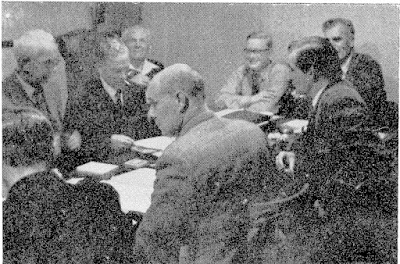
The text accompanying this photograph was 'No leaders: The Executive Committee in session, 1956.' It was part of the article "This is Socialism !'" I believe the younger man with the darker hair in the right of the photograph was Robert Barltrop, and the older, bald man to his left was Harry Young. ('Horatio')


#    #    #    #

Clifford Groves contested the Paddington North constituency for the SPGB at the 1945 General Election. He also stood in the same seat in the 1946 by-election. The July 1945 issue of the Standard carries the Party's election manifesto.


#    #    #    #

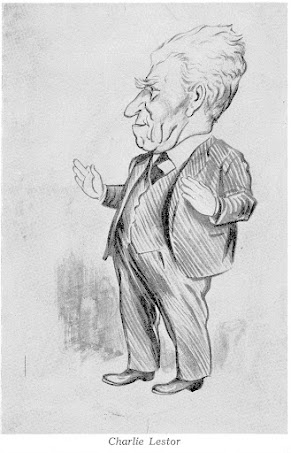
Both the photograph of Jack Fitzgerald and the cartoon caricature of Charlie Lestor were part of the "Some Members" article. I'm guessing that Robert Barltrop drew the image of Lestor.


#    #    #    #

The Metropolitan Theatre was located in Edgware Road, and was used on many occasions in the 1940s and early 1950s when the SPGB were contesting parliamentary seats in Paddington, but also when the Party held mass rallies. By all accounts these mass meetings had upwards of two thousand people in attendance. This photograph accompanied the "Early Election Campaigns" article.


#    #    #    #

No name for speaker on the platform. This photograph illustrated the "On the Platform" article.


#    #    #    #

Sadly, no names are listed but members of Walthamstow Branch in the late 1920s included, amongst others, Mr and Mrs Francis Brooks, Maurice Cole, Thomas Davis, C. Elliott, A. J. Godfrey, A. McDermott, May Otway, L. Otway, Jane Robinson, Frederick Wellavise, J. Wilkinson, S. E. Williams, Byron Young and Percy Young.

Surely May Otway is in this photograph? I know I keep mentioning her but she was one of my favourite Socialist Standard writers in the interwar years.


#    #    #    #


So, here's the conundrum: The June 1974 Socialist Standard states that the Conference photo below dates from 1950 but when it was included in the June 2004 Socialist Standard, the text said the photo was from the 1951 Annual Conference. I demand a recount.

As a point of interest, the September 2004 issue of the Socialist Standard carried a letter from Richard Botterill, identifying two of the delegates from Dartford Branch in the photo. (Spoiler alert: one of them was his dad.)


With regards to the June 2004 Standard already mentioned above, that was also a special anniversary issue  and it also carries a number of photographs relating to the history of the SPGB. I recommend you check it out. It serves as an excellent companion to the June 1974 issue.

Saturday, June 21, 2025

Seventy Years for Socialism (1974)

From the June 1974 issue of the Socialist Standard

The Socialist Party of Great Britain was founded in June, 1904. Those who formed it had been members of H. M. Hyndman's Social Democratic Federation, and to understand all that animated them it is necessary to look first at that organization and why it failed.

The SDF was the first party to exist in Britain in the name of Marxian Socialism. That is not to overlook the old International Workingmen's Association in which Marx himself had been a principal; however, it was an association and not a political party as such, its aim to foster and stablilize revolutionary thought. The Federation was alienated from Marx, and in other respects its start in 1881 was unfortunate. Almost inevitably, it drew strong but immensely varied support. The membership contained the conflicting outlooks of freethinkers, single-taxers (Progress and Poverty was published only the year before), militant working-men, well-to-do radicals—and William Morris.

Hyndman's concern with Marxian economics did not extend widely among his supporters. Shaw's biographer, Hesketh Pearson, relates how the young G.B.S. attended the Democratic Federation, was told that without reading Capital he had no right to discuss, went to the British Museum and read it in French, and returned to find that he and Hyndman were the only ones who had done so. But when the Federation joined with the Labour Emancipation League its liberal-radical support dropped away sharply.

The new programme aimed at "The Establishment of a Free Condition of Society, with Equal Social Rights for All, and the Complete Emancipation of Labour", and simultaneously a series of "measures called for to palliate the evils of our existing society . . . for immediate adoption". It was from this point that considerations of expediency were posed, more and more often, against those of Socialism. For the new society automatically became the long-term, deferred, objective and "something for now" the effective one not only in propaganda but in tactics too; the Federation became prepared to ally itself anywhere, anyhow, for its temporary ends.

The hard core of revolutionary socialists remained in the SDF, but by the end of the century a serious division of aims was plain. With the growth of the ILP and the formation in 1900 of the Labour Representation Committee, Hyndman and the other leaders were eager for broadening the Federation's outlook to include all "sympathizers who were against social injustice". The report in the Labour Annual of the 1897 SDF Conference referred to "an informal conference . . . between several members of the SDF and the ILP, and certain recommendations for amalgamation drawn up for submission to the two Executives".

By 1902 a small, determined body of dissidents was pressing for a return to the fundamentals of Socialism, to independent political action based on class-consciousness and the excision of reformism. They were quickly dubbed "Impossibilists", but they put their case strongly in the correspondence columns of Justice. There were two main groups, in London and in Scotland. The Scottish faction, with James Connolly at its head, broke away by itself in 1903 to form the Socialist Labour Party in imitation of the American party of the same name.

Despite being thus let down, the Londoners continued their campaign within the SDF. The controversy was brought to its crisis at the 1904 Conference at Burnley. The Executive sought and obtained summary expulsions and the power to deal with more Impossibilists in this way. Plans to manipulate the Conference leaked out. A post-conference meeting to discuss the expulsions was held at Shoreditch Town Hall, and the critics now formed a Protest Committee and issued a leaflet setting forth fully their disagreements with SDF policy.

The statement was signed by 88 members and ex-members, and demanded a political party pledged to Socialism alone. The class struggle must be the guiding principle, and compromise — either by alliance or by seeking the reform of capitalism — rejected unconditionally. And no less important was the re-framing of the organization itself to keep control out of the hands of elites and cliques and vest it in the entire membership.

Within the SDF the cause was lost, and only more expulsions followed. On 15th May a meeting of the Protest Committee's supporters took place at Battersea, and the decision was made. A new party should be formed, entirely independent, based on clear-cut principles and devoted to the establishment of Socialism. A "Provisional Committee" was charged with making arrangement for its formal inception. On Sunday afternoon, 12th June 1904, the Inaugural Meeting  was held in the Printers' Hall, Bartlett's Passage, off Fetter Lane, Fleet Street.

The Standard and the Platform
A hundred and forty-two people gave in their names at the meeting in 1904. Three names were afterwards found to have been false. The last of the hundred and thirty-nine founders, Tom King, died — still a member — in 1971. Of the others, a few were to become notables in movements to which they now vowed hostility: Hicks a Labour Minister, McEntee a Lord, T. A. Jackson an eminence grise of the Communist Party, Jack Kent the Conservative Mayor of Acton.

The Object and Declaration of Principles drawn up by the Provisional Committee and adopted by the Inaugural Meeting have never been altered. Nor has their status been that of a “historic document” preserved but not pursued; today as in 1904 they are the Party’s directing force. Their intention was to define capitalism and what Socialists must do, for as long as capitalism lasted. It was understood too that propaganda for Socialism must depend first and foremost on the knowledge and exposition of Marxian economics. The working class must be shown the mechanics of exploitation from which the only release was the abolition of capitalism.

The Party had no money and no premises. The Provisional Committee had met in one another’s houses (several times, in a bedroom), and for the first Executive Committee meetings Hans Neumann arranged a room on alternate Saturdays at the old Communist Club in Charlotte Street, off Tottenham Court Road. While a committee went into ways and means for a Party newspaper, a makeshift list of acceptable pamphlets was published — Marx, Engels, Morris, Kautsky, Aveling, one or two others and Liebknecht’s No Compromise !

The Socialist Standard first came out in September, 1904. The printer and the only advertiser (advertisements were afterwards stopped) was A. E. Jacomb. He had a little printing-shop in Stratford under the name “Jacomb Brothers”, and as a member he was determined that no-one but he should print the Socialist Standard. The estimate of £7.10s.6d. for 3,000 copies was made simply by undercutting all the other estimates. Jacomb never sent in his bill, and from time to time the Executive Committee was obliged to set up sub-committees to discover or assess how much was owed to him.

Apart from publications, the backbone of propaganda was outdoor addresses — indeed, except for occasional meetings in hired halls, they were the only means available. In 1904 the sects and parties vied with one another in the streets and parks, and the Socialist Party flung itself enthusiastically into the fray. There were several organizations with such names as the Anti-Socialist Union, the Liberty and Property Defence League, and the Middle Class Defence Organisation, called “the societies whose purpose it is to combat Socialism”. In a short time, with twenty speakers holding forty or fifty meetings a week, the Party’s reputation grew out of proportion to its size. It demanded, and had, to be noticed.

Trade Unions and Religion
One of the major questions for the Party at its foundation was that of the trade unions. The LRC was in existence, to become the Labour Party in 1906. Ideas of syndicalism, embraced by the other Impossibilists who formed the SLP, were in the air. In 1906 a clumsy attempt to reconcile the Party with the SLP led — albeit indirectly — to “the Islington dispute” in which a whole Branch was expelled (one of them was the Party secretary Con Lehane, who later became a leader of Irish nationalism).

After a series of meetings and discussions, the Party’s attitude was formulated by the Easter Conference of 1905. Its decision ran:
 Whereas the Trade Unions, while being essentially economic organizations, are nevertheless taking political action either to safeguard their economic existence or for ether purposes, and
 Whereas any basis of working-class political action other than that laid down in the Declaration of Principles of the Socialist Party of Great Britain must lead the workers into the bog of confusion and disappointment, be it therefore
  Resolved that this Conference of the Socialist Party of Great Britain recommends that all members of the Party be instructed to actively oppose all action of the Unions that is not based on the Principles of this Party.
This attitude was amplified in the Party’s first pamphlet Manifesto, published in June 1905. The economic function of the unions was recognized and “any action on their part upon sound lines should be heartily supported”; their participation in “practical politics” under Labour leaders was “criminal folly”. This has remained the Party’s standpoint, and it has been justified again and again over seventy years.

With great social issues in the air the Party had many public debates with Conservative, Liberal and Labour politicians. It was constantly under pressure to support reform demands for “special cases” — women’s (and men’s) suffrage, education, pensions. In 1910 new ground was broken with the publication of Socialism and Religion. In it, the Party unequivocally declared itself to be against religion and unaccepting of the principle “Religion is a private affair”. Socialism and Religion was a best-seller among political pamphlets for nearly twenty years, while churchmen and capitalist politicians held it up as living proof of the terrors of Socialism.

It was revealed that the Party would accept no-one with a religious belief in its ranks. In fact from the beginning all applicants for membership were questioned, and this has always remained the practice — no casual enrolments for numbers’ sake, but convinced Socialists only. Likewise in election campaigns (the Party first contested municipal elections in 1906) every effort has been made to repel impulsive votes and secure only firmly Socialist ones. It can be added too that from an early stage speakers for the Party have been subject to a rigorous test in economics, history and political theory; it has been reflected in a high reputation for SPGB speakers.

The first headquarters rented for the Party’s exclusive use, after a series of meeting-rooms, were at 10 Sandland Street, Bedford Row, in 1909: two rooms above a corner junk-shop, which were left for a place in Grays Inn Road in 1912. The membership slowly crept up to about 200 by the outbreak of war in 1914. The hammering-out of policies in the first ten years had its price, and the memory of the SDF made for an extra sensitivity: members were often too readily convinced that a decision of which they disapproved was the first step to compromise and confusion. However, in 1914 the Party was tested — and not found wanting.

War and Revolution
On the outbreak of war the Socialist Party published on the front of the Standard its uncompromising statement “declaring that no interests are at stake justifying the shedding of a single drop of working-class blood”, and ending:
  Having no quarrel with the working class of any country, we extend to our fellow workers of all lands the expression of our goodwill and Socialist fraternity, and pledge ourselves to work for the overthrow of capitalism and the triumph of Socialism.
No other organization took such a stand. With a few exceptions, the labour leaders zealously supported the war and gave their services to recruiting — Hyndman and co. included. Individual members of the ILP were pacifists but the party leader, Keir Hardie, declared for “the national interest” and recruitment.

Plans had to be shelved (it had been intended to have a member employed full-time speaking and organizing); but this was the lesser inconvenience. The major ones were the disruption of meetings and the victimization of members, and the Party decided in January 1915 to close down meetings before there was more serious trouble under the Defence of the Realm regulations. The Socialist Standard continued to come out, but public libraries refused to have it and the War Office forbade its being sent abroad.

The membership was dispersed. Many went to prison as conscientious objectors, others joined the “flying corps” — the brotherhood of men on the run. One or two made for Ireland, and Adolph Kohn and Moses Baritz for America. Kohn lay low, sending occasional articles to the Standard, but Baritz was incapable of self-effacement and was imprisoned as an agitator when America entered the war. The Party administration was carried on largely by women members; but all kept in touch as best they could and there were even surreptitious reunions. When the war ended, much of the building of the ten years after 1904 had been shattered. Money and offices were gone. The Party knew as never before that it stood alone, and as the errant members reassembled there was a sense not of defeat but of fresh vigour and resolve.

The war had contained one other remarkable vindication of the Socialist case. The Russian Revolution took place in 1917. The Party had a slight, sympathetic contact with the Bolsheviks. In March 1915 the Socialist Standard had on its front page a statement headed A Russian Challenge in which the Russian party condemned the war and the “monstrous crime against Socialism” of the labour leaders who had entered war governments. Every left-wing paper refused to publish this declaration before it was received by the SPGB; ironically, the same “left” was soon to adulate the Bolsheviks in power while the Socialist Party made a critical analysis with a different conclusion.

From the outset, the Party maintained that Socialism had not been established in Russia. The formation of the Communist Party in 1920 was only a return to old and futile theories: assorted radicals and the rumps of the BSP (the former SDF) and SLP embracing the armed insurrection and conspiracy prescribed by the Third International. It took forty years for savants to discover that the Bolsheviks had transformed a vast backward country into a highly centralized capitalist state. The Socialist Party said so, against all other voices, from 1917 onward.

Times of Crisis
Having no illusions of over-toppling capitalism by coups or confrontations, the Party was not disillusioned by the failures of Labour governments, the outcome of the General Strike, or the perfidy of Ramsay MacDonald. The hardest blows it had to bear in the nineteen-twenties were the early deaths, within four years of each other, of two men who meant much to it: Alex Anderson and Jack Fitzgerald. Anderson was a magnificent orator, Fitzgerald was outstanding as theorist, debater and writer. Both were working men. In any of capitalism’s big battalions they would have been national celebrities but they gave their lives to Socialism instead. Had they not died prematurely their lives and influence would have continued up to and after the second world war. Yet the loss proved the soundness of the Party’s repudiation of leadership; because it depended on no special person, the work went on unaltered.

The strongest political delusion of the ’twenties and the Depression years was the belief that the capitalist system was about to break down. (It was not new: Hyndman had been a perpetual prophet of collapse.) All the left shared it, urging that a militant push or two would bring the allegedly crumbling structure down in ruins. The Socialist Party analyzed the theory and showed its fallacies in a pamphlet called Why Capitalism Will Not Collapse. Mistaken ideas are usually exciting ones but that does not make them less damaging in the end. We were right; the others were not only wrong but, as so often, disillusioned.

As from 1904, the Party showed a small but steady growth. In the mid-thirties its membership was about 350, with a huge activity for its size. Outdoor meetings were prolific and lectures numerous, and there were frequent public debates with well-known politicians — Harold Macmillan, Michael Stewart, Barbara Wootton and many others. In 1929 the Party moved to headquarters at Great Dover Street, Southwark, where it remained until the building was bombed in 1941. Plans were made for what it had always been sought to do, the putting up of a Socialist parliamentary candidate for the first time.

As well as depression, unemployment and hunger-marches, the nineteen-thirties were the years of the rise of Nazism and the Spanish Civil War. Fresh questions were posed to the Party about whether we should fight “for democracy”, or to demolish a foreign government which was persecuting Jews. On the other hand, the fear of a war with terrifying new weapons — in particular, the use of the aeroplane — was so intense that we were also urged to forgo our independence and join with organizations which hoped to prevent it.

Inevitably there were controversies on these matters in the Party, and a few members were lost; but our independence was not given up for any alliance, or reason found for proposing to support another war of capitalism. The questions which to many people then were over-riding and exceptional have been answered by subsequent history. What is noteworthy in retrospect is that the loudest clamour to “defend democracy” and fight dictatorship came from the Communists — whose own favoured regime in Russia had now become as tyrannical as any in the world.

Another War, and Hard Labour
In the 1939-45 war hysteria was not widespread as in 1914-18; the common working-class feeling was of having been led into it by governments which were cynical or incompetent, or both. Conditions for opponents of the war were less severe, though that is not to say they were comfortable. After some initial difficulties the Party was able to hold regular propaganda meetings indoors and outdoors. The only department which was hamstrung was literature. The Government’s Defence Regulations introduced in May 1940 were directed specifically against printed matter, and the Party decided — wisely, as was shown by what happened to other publications — to with-hold from sale its 1936 pamphlet War and the Working Class and to refrain from anti-war material in the Socialist Standard.

Nevertheless, a policy of vigorous opposition to the war was laid down and pursued. At the same time, the Party made itself more difficult to join: applicants had to have two sponsors and were questioned even more carefully. The reason was that at such a time numbers of people who were not Socialists would have joined the Party for its anti-war policy. The harm in admitting one or two vague well-meaning people might seem small, but enough of them would drown the Socialist object in other intentions. We had to see that it did not happen.

As the war progressed the Party had to deal also with the plans and promises for a brave new capitalist world when it was over: Federal Union, now forgotten, and the Beveridge Plan which outlined welfare legislation — pamphlets were published and meetings and debates held on both. When Russia became Britain’s ally and was depicted for war propaganda purposes as a holy land of freedom, the Socialist attitude to Russia had to be stated fresh. (One result was that in 1943 the Communists’ Daily Worker named the venue of the Party Conference and hinted that loyal Britons could do worse than smash up the proceedings.)

The end of the war in 1945 brought the long- awaited parliamentary candidature, and the result of the General Election was the Labour Party in power with a majority of 180 seats. The Labour promise was of a new order severed from the miseries of the past, made in the name of “socialism”. The Socialist Party knew this to be a muddled misnomer for a mixture of ill-conceived reforms and attempts to apply Keynesian economic theory, but it knew also the immense damage done and about to be done.

Unable to control capitalism, the Labour Party conveyed to millions that Socialism was a mess. While everything the SPGB had said about reform, nationalization and “economic planning” was borne out, disenchantment over them redounded against the Socialist movement.

Nevertheless, activity remained at a high level. In 1948 the Labour Government, abandoning promises of plenty, told the population to tighten its belts with posters crying “We Work or Want”. The Socialist Party matched them with its own posters nationwide stating the facts of capitalism: We SOMETIMES
Work, We ALWAYS Want”. The membership rose to 1,000 in 1947 and 1,100 in 1948. Another pamphlet in a fresh field, The Racial Problem, was published. The Party’s headquarters at this time were at Rugby Chambers, Holborn, and in 1951 it left there for the present head office at Clapham.

Yet within a short time unforeseen and unprecedented difficulties appeared. As the Party approached its fiftieth year the meetings which throughout that time had been its life-blood vanished almost into thin air, through a conjunction of social circumstances. The swift spread of television, nailing three quarters of the population to their armchairs every night; the regulation of shop hours, clearing busy streets after six o’clock; the growth of traffic, making it impossible to assemble round platforms at road junctions and street corners — these and other factors meant that suddenly audiences were no longer to be had, in or out of doors.

Other problems resulted. The sale of the Socialist Standard had always been largely a by-product of meetings. Now, forced into dependence on the printed world, simultaneously the main avenue for distributing it was closed. For several years a few Branches — Ealing, Islington, Hackney, Camberwell — sustained the circulation by door-to-door selling in the London area. The situation also drew attention to the shutting-out of minorities from the mass media: Socialism could not have its voice heard in television, the newspapers, the so-called “means of communication”.

From CND to the Seventies
The political movement which arose while the Party coped with changed circumstances was one claiming to be apolitical, the Campaign for Nuclear Disarmament. As before the war, Socialists were urged that the importance of the subject relegated everything else: the survival of mankind was at stake. The reply could only be that the problem was war itself, not its weapons, and in turn the economic system in which the danger of war is always latent. Moreover, it had been possible for seers a generation before (H. G. Wells, for instance) to envisage the world devastated with pre-nuclear weapons. Indeed, CND disintegrated as its supporters realized a single issue could not be isolated from the rest of society’s causes and effects — which was what the Socialist Party said at the beginning.

It was argued, in other fields, that capitalism had changed. The full employment which had lasted since the war, the absence of a major depression, the possession by working people of cars and cocktail cabinets, were seen by many as evidence that the old problems had gone. In a few more years they reasserted themselves, however. The Party has never failed to consider and analyze whatever proposals and theories are advanced, but has never found reason to alter its case that capitalism is incapable of favouring the world’s population and that only Socialism will end the problems.

In fact the scene now resembles the pre-war one. There are unemployment, widespread poverty and industrial discontent, and capitalism — everywhere else besides in Britain — lurching from crisis to crisis beyond control. As an inevitable accompaniment, left-wing groups call for militancy and bring out again the theories with which their predecessors fell down: direct action, infiltration of the Labour Party, the collapse of capitalism.

Seventy years with an object unattained may look like failure. We claim success in many ways. First and foremost, the Socialist Party is alive and well. That surely merits attention. During our lifetime innumerable people and organizations have been going to show us quicker ways to Socialism, or render it unnecessary by reforms. Where are they now ? Extinct, or negligible.

At various times in seventy years the Party could surely have made a splash and gained a bigger membership by becoming Russophile, or whipping-up industrial agitation, or advocating attractive reforms. By not doing these we have irritated many people; but we are still here because we have not been wrong. There is a sad side to that question, too. Most of those who wanted our support for immediate campaigns have said they agreed with us but could not wait for Socialism — yet if they had come in with us instead of wasting efforts elsewhere, we should have had Socialism long ago.

So the work for Socialism goes on. As always, we have our problems. We still need avenues for distribution of the Socialist Standard. For every member we have several sympathizers — if only they would make the effort and join! We always need money. But the enthusiasm and optimism of our several hundred members are as bright and keen as were those of the founders in 1904. We do not think of ourselves as carrying on an old struggle, because it is a new one all the time. If the Socialist Party had not existed for the past seventy years, it would be necessary to start it today.
Robert Barltrop

Sunday, June 8, 2025

Socialism's deadly foes (1974)

From the June 1974 issue of the Socialist Standard

It used to be an axiom of Party speakers that if the Labour Party did not exist the capitalist class would have to invent it. The same is true of the so-called Communist Party, though in a different historical context.

The Labour Party throughout its vile and bloody history has stood ever ready to serve British capitalism, as government, loyal opposition, and in coalition with Tories and Liberals. Bloody history? Yes. Did they not support and help organize the slaughter of millions of workers in two world wars? Did they not endorse the atom-bombing of Hiroshima and Nagasaki? Were they not the government when the Korean war started in 1950? Did they not support and aid the American butchery in Vietnam? All this is viciously anti-working class. Yet these are only some major crimes that spring to mind. The catalogue is a long one.

While their cloth-capped pacifist Keir Hardie was playing recruiting-sergeant during World War I, the SPGB was opposing the war and propounding Socialism. While one-time conscientious-objector Herbert Morrison was in the Churchill War Cabinet during World War II, the SPGB was arguing the common interest of the world’s workers.

The post-war Labour government started Harwell and the development of nuclear weapons in this country. They fostered the lunatic justification: “They’ve got them — so we must have them”. It was Aneurin Bevan, the darling of the mutton-headed left, who did not want to go “naked” to the world’s conference chambers. “Negotiation from strength” meant being “clad” in nuclear armoury. They hold the distinction of being the first government in this country to carry on conscription in peacetime.

They used troops to break strikes. Their Attorney-General (now Lord Shawcross) prosecuted dockers in April 1951. Seven dockers had been charged under the Conditions of Employment and National Arbitration Order. Shawcross is recorded in Keesing’s Contemporary Archives (May-June 1951) giving a warning to strikers generally that, if there were no trade dispute involved, a strike which was calculated to cause a breach of contract, or so interfere with the course of justice, or affect the policy or interests of the state, “might constitute a grave criminal offence”. Bevan then had the job Foot now holds as Minister of Labour (members of NALGO please note).

At every election since the war, including 1945, the Communist Party has worked for the return of Labour governments, supported Labour candidates and urged workers to vote Labour. They are equally guilty. It is manifestly absurd to work for the return of Labour governments and then disclaim responsibility for what those governments do.

The guilt of the “Communist” Party goes deeper than supporting the Labour Party. As mouth-piece of Soviet state capitalism they too support wars. They supported the atom-bombing of Japan. They applauded the development of the atomic bomb in Russia because it broke the American monopoly, saying it “will encourage peace-loving people everywhere” (Daily Worker, 24 September 1949). Two years later when the British bomb was announced they called it: “A cowards’ weapon, designed for the unrestrained massacre of the civilian population” (Daily Worker 18 February 1952).

After Russia was attacked in 1941, nobody was more in favour of fighting for capitalism in World War II. They even supported the return of Tory candidates in by-elections to better prosecute the war. For more than 50 years they have slavishly followed Russian foreign policy; even stooping to support Stalin’s pact with Hitler, calling it a “victory for peace and socialism” (Daily Worker 23 August 1939).

They also supported the wars in Korea and Vietnam though, being motivated by the interests of Russian capitalism, they were on the other side to their Labour buddies in these two bloodbaths.

Flash back
How did all this come to be? How can it happen that these two parties which use Socialist-sounding phrases and (in the case of the Labour Party with the support of millions of workers) come to be buried in the dirty business of maintaining capitalism? The answers are to be found in fundamentally wrong assumptions right from their beginnings. It is a long story and from the standpoint of working-class interests and Socialism a sad and futile story.

The Labour Party in 1906 and the “Communist” Party in 1920 embarked upon the day-to-day struggle to do “something now”. The former being a native product of British capitalism in the quest for reforms, the latter taking its cue from their masters in the Kremlin. They are both the heirs to the fallacy of the old Social Democrats that Socialism can be an ultimate objective, while “in the meantime” they build a movement to seek votes on the basis of a list of reforms.

The false assumption behind this idea is that the working class cannot understand Socialism; they have to be baited by reforms. Above all, workers cannot consciously organize and free themselves, they must have leaders. So the trap is set. The trap is capitalism and the quarry is reformist.

Starting out on the wrong foot and facing the wrong way all subsequent developments were inevitable. Instead of being stepping-stones, reforms became the only attainable ends. Their spurious socialism is reforms and nationalization. As if to rub salt into the wounds of mockery, they used to say they were in a hurry and could not wait for the SPGB and workers’ understanding.

Given a working class who are overwhelmingly non-socialist, the Labourites and Communists have to appeal to the same politically ignorant electorate as the avowedly capitalist parties. If you play their game, “you” must have a policy for everything they have a policy for. To get votes you must do what they do. No use talking about the abolition of the wages system, common ownership and production solely for use. Talk about pensions and housing. Make promises. Outbid the Tories and Liberals. Sound plausible. Promote leaders. Be British. Be concerned about the nation and British interests. Their game is running capitalism. To sound plausible means you must convince millions of workers that you can run capitalism better than they can. Though all your policies pre-suppose the continuation of capitalism, you must foster the illusion of attacking the system and being indignant.

How many times during the seventy years of the Socialist Party of Great Britain have we been asked : “Where have you got? What have you achieved?” While the clamour for popular demands has become a way of life the voice of Socialism has remained small. In fact, the two things go together. The massive proportions of the one presuppose the relative smallness of the other. The point is that for all their mass appeal the Labour Party and the CP have solved not a single problem.

Despite many years of Labour government, capitalism is still here. They are a living demonstration of the futility of reformism. There has been continuous legislation of reforms concerning every aspect of capitalism. The only argument advanced has been that the reforms were necessary to solve problems. History is littered with the wreckage of their useless enactments.

Look where you will, there have been no solutions. Health and welfare, Act piled upon Act while the chaos gets worse. The wages struggles of doctors, nurses and welfare workers run parallel with the continuing poverty of the workers who need health and welfare services. Instead of ending poverty, the chief function is to administer it.

Pensions? Despite all the reforms, wretchedness and misery continue to the accompaniment of sentimental slush from the hypocrites in government getting £16,000 per year who think £10 per week is enough for one and £16 enough for two old workers.

Education. Another sorry story. While newspapers carry headlines about “class-room jungles” the reform-mongers reach for their bottomless bucket to start another round of bailing-out operations.

Rents and mortgages make the bitterest mockery of all. Nothing screams more loudly the irrelevance of reformism. From the first Housing Act in 1851, every government has been going to solve the housing problem.

The post-war Labour government was finally going to banish it in five years. In 1948 Aneurin Bevan promised : “When the next election occurs there will be no housing problem in Great Britain for the British working class”. (Hansard 14 July 1948). They were going to clear away the slums. Now, nearly thirty years later, the present Labour government blandly informs us the slums are here to stay. A report by the National Economic Development Office calling for the clearance of 380,000 slums was rejected as being against the policy of both this government and the last one. The Daily Mirror (11 April 1974) which supported the return of the Labour government quotes a spokesman for the Department of the Environment as saying: “Demolition is a dirty word now. Renovation is the best thing for slum areas”. By their own criterion of “something now” they are abysmal failures.

They were going to abolish the House of Lords and tax the rich out of existence. The rich and the Lords are still on our backs and the party which in 1945 used the catch-phrase “Fair shares for all” is still talking nonsense about “fairness” in a society that rests upon legal robbery.

Nationalization was to be the way to run industry and transport as public services not for profits. Millions of workers were kidded to regard nationalization as the answer to social problems in general and to maldistribution in particular. This was how the Labour Party was able to exploit the misguided loyalties of the workers. The economics of capitalism made short work of their silly schemes.

The bitterness and disillusionment that followed did more than give the Tories thirteen years in power. It caused many workers to regard Socialism as a failure and to become suspicious of politics generally. The fact is that the policies of the Labour Party are conceived for the running of capitalism, not its abolition. They are ignorant of or indifferent to what Socialism means. When this is coupled with the cynical quest for power by the shabby upstarts who lead this blind mass it is easy to understand how damaging to the cause of Socialism the whole futile exercise has been.

The Tories have been able to poke fun at the founderings of the Labour Party and, by misrepresentation, to discredit Socialism. In the same way they are able to point to the tyranny of capitalist Russia. Socialism suffers on the one hand because of the distortion of those who control the mass-media, and on the other hand because the great majority of the working class have so far accepted those falsehoods.

Our main indictment of the Bolsheviks is not that from 1917 they have built up capitalism in Russia. Given the historical conditions of the time — industrial backwardness, a largely illiterate peasant population and a working class outside Russia not yet ready for Socialism — capitalism was the only possible outcome. This is what the SPGB said at the time. The fact that they have passed off a million outrages as Socialism — this is our indictment. They have twisted Marxism into its opposite for more than half a century. Marxism demands the abolition of the wages-system, so the political frauds in the Kremlin invent “socialist wages”. Marx saw the state as a product and instrument of class society, so the Leninists invented a contradiction in terms called the “workers’ state”. Marx wanted a conscious majority of the working class (see The Communist Manifesto) to gain control of political power for the purpose of ending class society, so the Bolsheviks called their minority seizure of power “the dictatorship of the proletariat”.

Their brutal hierarchy is worthy of comparison with the medieval Papacy. Their terrorist secret police. The purge trials and slaughters of their own comrades. Their deals with Hitler and later with Churchill. Their vast military machine. The use of military might to crush workers’ risings in Hungary, Poland and Czechoslovakia. Their stockpiles of nuclear weapons. Their commodity production and rivalry with western capitalists for world markets and investments, all carried on to the accompaniment of propaganda calling it Socialism.

These are just headings under which their deeds may be listed. The reality in human suffering is incalculable. Can there be any wonder that the progress of Socialist understanding has been slow?

For a generation they worshipped Stalin and his “greatness” while millions lived in fear of his secret police. All criticism was brutally crushed. New crimes were invented to cover any rivals for power. To be denounced as a Trotskyist or a Titoist meant that you were an enemy of the state. (Those who were shot were spared years of degradation as political prisoners.) During this period meetings of the Socialist Party of Great Britain were disrupted by members of the Communist Party who would tolerate no criticism of their Soviet Fatherland. Three years after Stalin’s death some of those who had served him denounced him, and the faithful were thrown into confusion.

It is impossible to estimate the harm all this has done to the spread of Socialist ideas. At every meeting someone asks “What about Russia?” We have to waste time debunking myths before we can expound the positive Socialist case of the SPGB.

Understanding as we do the realities of capitalism, we know that our fellow-workers in this country, as in Russia and throughout the world, are confronting similar problems. We are as confident as ever that the world’s workers will come to reject the spurious palliatives of Labourites and “Communists” and will achieve their own emancipation by establishing Socialism. Working to this end has always been the sole commitment of the SPGB. There could be no task more worthwhile.
Harry Baldwin

This is Socialism ! (1974)

From the June 1974 issue of the Socialist Standard

It is a common occurrence at an SPGB meeting for a member of the audience to say: “Look, you may be right about capitalism, but what exactly will Socialism be like?” The SPGBer will preface his reply by pointing out that he can give no specific blueprint of Socialism. The questioner may jeer in greater or lesser degrees at such an admission and turn to leave the meeting. He cannot wait for Socialism: Socialism then must wait for him. And it does.

The man or woman who is prepared to listen will realize that such a question asks the Socialist to reveal some clairvoyant abilities far beyond those required even to predict what Capitalism will be like next week. The astrologers earn a lucrative living in this way, and yet our member is asked to predict further ahead — and for free! We can only speak in general terms, but it can at least be seen that our predictions relating to capitalism are being constantly proved accurate. This is not because we have mysterious contacts with another world. It is because we have analyzed the way in which this world works.

To make any sort of predictions about Socialism it is necessary to recognize how it is to be introduced. We maintain that once the members of the working class internationally recognize that capitalism is at root a system of society organized and run by themselves, yet which creates problems in direct opposition to their interests, they will recognize that a social system, like any other system, is capable of change. That change will result from their own coordinated efforts and they will take political action to organize a system of society which will operate in their own interests — Socialism.

“Ah now”, says the patient listener, “who does all this co-ordinating of effort and organizing? Surely a leader of some kind?” We refer him to the structure of the SPGB itself. Socialists are aware that each man has a variety of abilities, each in differing proportions, and these may be applied to a variety of work. A considerable control of hand movement is required by both the surgeon and the watch-maker, but it is obvious which one would be chosen to remove an appendix. Similarly, a leader is one who decides for others which path they will take, and then proceeds to lead them up that path. We have no leaders in the SPGB.

Our organizers are those who have some ability to arrange the wishes of members into a cohesive effort to achieve an aim. They are delegated for their abilities in this respect. Should one choose to ignore the wishes of members, he is replaced by another delegate and is left with no-one to organize. This is the way in which a Socialist working class will appoint representatives. And once Socialism has been established, it seems likely that this will be the way adopted in choosing those who will carry out such forms of administration as will exist.

As the supply of goods and services will be freely available to all, it will be necessary for representatives to ensure that a balance is struck between those articles which are required, and those produced. These representatives may meet in local, regional and interregional assemblies, but unlike the awesome meetings of (alleged) mental giants to be witnessed daily in the Houses of Parliament, Socialist delegates will meet with one object in common — the satisfaction of human needs.

Bodies similar to the present-day Egg or Milk Marketing Boards may be of use to Socialists in coordinating the supply of eggs and milk to those areas in which they are needed. It is worth noting that this year the Egg Marketing Board has failed disastrously to arrange the production of eggs. It has managed to creative a massive surplus. Socialists will not be worried by such calamities!

The search for profit which today determines the level of production will be removed, and the incentive for production will become the welfare of all members of society. The disbanding of the armed forces, financial and legal institutions and so on, will mean that many millions of men and women will be free to perform work which is necessary to society. Assuming that some members of Socialist society would choose to carry out work of a similar nature to what they perform today, the scientist engaged in germ-warfare techniques can be of use in research to combat disease. The accountant useful in collating statistics — to gauge social requirements. The Company Rep. as a long distance lorry driver (although it is debatable that the internal combustion engine will be used for power). Bishops and capitalist politicians could further enrich the acting profession. The possibilities are endless.

The condition and location of houses and workplaces would be designed for the maximum of comfort and safety. No longer would the old cry go up: “It’s a good idea, but we can’t afford it.” Machinery will be employed, particularly in work which is dangerous. Men and women will recognize labour, not as an undesirable chore, but as an interesting, satisfying and necessary event. It is likely that less time will be spent engaged in work, and every individual will be free to decide the nature and duration of his or her activity, and to pursue other interests as fully as they wish. The possibilities in life will truly be unfettered.

“Ah. But will anyone work?” A reasonable question? Hardly. It implies a derisive conception of the working man’s mentality. It implies that those who have consciously organized to bring Socialism into being have, in fact, been deliberately false, each one relying on the fact that the other will perform the necessary work while fully intending to perform none himself. We do not accept that the working class is, or that the Socialist working class will be, false to its beliefs. History has shown that no-one has suffered shabbier treatment at the hands of the ruling class than workers, and yet they are willing, even proud, to enter suicidal battlefields on behalf of their masters in time of war. It is not lack of conviction which perpetuates these sacrifices, it is a surfeit of conviction — in Capitalism.
Alan D'Arcy

Our Comrade Overseas (1974)

From the June 1974 issue of the Socialist Standard

Over the years since the formation of the SPGB, parties with the same Object and Declaration of Principles as ourselves have been established in other parts of the world. We have close contact with these parties in our efforts to put to the working class the necessity for world common ownership and free access. Like the SPGB our companion parties are small, but they are keeping to the fore the aim which can transform the world from its present crisis-ridden state. The contradiction between great wealth and the possibility of production in abundance on one hand, and mass deprivation on the other, grows more startling daily. These contradictions will one day throw up Socialist consciousness in the minds of the working class, like a world-wide volcano.

For this consciousness to arise, the working class will have to drop its adherence to reformist movements which come forward with their bankrupt promises to slay the dragon of capitalism, bit by bit. Capitalism must either be abolished by the deliberate action of workers, or it will remain. It cannot be reformed to work in the interests of the majority. It is up to the working class to free itself from the degradations of capitalism and establish Socialism. The function of the SPGB and its companion parties is to explain to the working class what capitalism is, what Socialism will be, and how workers themselves are the instruments for effecting the transformation. As Engels put it in his Socialism: Utopian and Scientific
“To thoroughly comprehend the historical conditions and thus the very nature of this act, to impart to the now oppressed proletarian class a full knowledge of the conditions and of the meaning of the momentous act it is called upon to accomplish, this is the task of the theoretical expression of the proletarian movement, scientific Socialism.”
Below is a brief history and guide to our companion parties.

Socialist Party of Canada

The party’s origins go back to 1905, shortly after the inception of the SPGB. However it was a false start. The party, whilst containing Socialists, also attracted a large group of social reformers and its relationship with the SPGB had to be severed. The Russian Revolution exploded the apparent unity of the party, and the few remaining members only managed to struggle on until 1926. However, in 1931 another group of Socialists got together and formed the present party based on the uncompromising demand for immediate world Socialism. In 1933 the party started the journal The Western Socialist. Because of pressure by the wartime government in October 1939 the Western was handed over to the WSP of the US, who have since published it on behalf of both parties. The party is now working overtime in its efforts to spread Socialist understanding in North America. In 1970, having acquired an old offset press, the branch in Victoria started to publish its own leaflets, and their own journal Fulcrum now appears regularly. Recently the French-speaking area of Quebec has been subjected to a battery of Socialist propaganda. The results have been encouraging. In 1973 Socialisme Mondial first appeared; written in French, it is now available in France and Belgium as well as Canada.


World Socialist Party of the United States

The party was founded in Detroit in 1916 and then called, “The Workers’ Socialist Party of the United States”. The party was helped into existence by two members of the SPGB, Moses Baritz and Adolph Kohn, on the run from the British government’s war machine; their energy and drive forced those Socialists in the Detroit area to break away from the Socialist Party of America to form a party based on the Socialist platform only. Because of wartime conditions and the great distances between American cities they reverted to being a “Socialist Education Society” and continued — doing valuable work — in this form until they could re-start the WSP on a solid basis.

In 1929 their first publication appeared, and the present-day WSP was founded on 8th September 1930, with headquarters in New York. It was not until 1939 that a party journal was established on a firm footing. This was the Western Socialist, which the party took over from the Socialist Party of Canada. It is still going strong today. In the 1940s the party’s name was changed to its present name to avoid confusion with one of the numerous Trotskyist organizations in the USA. The party’s main activity now is publishing and distributing The Western Socialist (it goes to libraries and colleges throughout the US), and regular radio and occasional television broadcasts.


Socialist Party of New Zealand

The party was founded in 1930, although prior to that date there had been considerable Socialist propaganda in the country. In 1919 the party’s forefathers, The New Zealand Marxian Association, invited Moses Baritz to the country to do a series of talks. Baritz took the movement over there by storm; in a series of devastating lectures Baritz put the whole pseudo-socialist and pro-Russia movement to flight. Baritz was deported for his pains, but he had given the Socialist movement in New Zealand a great fillip. In 1934 the party’s first journal was produced which ran for five issues, and again in 1944 another journal came out which lasted four years. Now the party’s journal Socialist Viewpoint comes out bi-monthly. The party’s activity apart from Viewpoint is now concentrated round elections. In 1972 the party entered its first candidate in the New Zealand general elections, and intends to contest the 1975 general elections with, it is hoped, at least two candidates.


Socialist Party of Australia

The party was founded in 1928. However, a considerable amount of Socialist activity had taken place before then. Several seamen who had contact with the SPGB were active in Australia. Bill Casey and Barney Kelly, who were among those sailors and others propounding the Socialist analysis after the first World War in Australia, were sent to the Red Trade Union International in Moscow (in about 1921) as delegates of the seamen’s union. On their return the seamen’s journal refused to publish their report because it pointed out that what had taken place in Russia in 1917 was not a Socialist revolution. Moses Baritz (he seemed to get everywhere) also showed up in Australia in the early 1920’s like a Socialist tornado. By the time the party was formed, there was a certain amount of experience of activity to go on. Shortly after the party’s formation, members began to distribute the Socialist Standard. The Labour government of the day demonstrated its commitment to democracy by banning it for some time. In recent years it has been a struggle for the party to keep going. Vast distances between individual members make concerted party action difficult. However, the party distributes companion party journals and issues and distributes leaflets wherever possible. Individual members, as with members of all the Socialist parties, do all they can to put forward the Socialist case.


Bund Demokratischer Sozialisten of Austria

The party was formed in 1959. It emerged out of a loosely-knit group that had previously been operating in Vienna. Almost immediately the party began publishing a stencilled paper then called Das Freie Wort. In 1966 it officially adopted the SPGB Object and Declaration of Principles; now, as Internationales Freies Wort the paper is well established on a quarterly basis. A major influence on the Bund was Rudolf Frank. He had come under the spell of what he called “the SPGB university” prior to 1914 and his enormous experience helped greatly. Until his death, he played a large part in the writing and editing of the party’s publications. As well as distributing their paper, the party has good contacts with youth organizations and tries to spread Socialist understanding in every area possible.


World Socialist Party of Ireland

Formed in 1959, the party had an active and healthy existence until the recent outbreak of violence in north and south Ireland. The branches in Belfast and Dublin which had been doing stirring work distributing the socialist standard and generally pricking the political balloons of the apologists for capitalism, a task begun years earlier by Mick Cullen, (a thorn in the side of all anti-Socialists), have largely gone quiet since the start of the recent troubles. Socialists can only hope that the “normality” of British capitalism’s conditions will soon return to Ireland, to allow our comrades there the chance to take up again the cudgels of Socialism.


Socialist Group in Jamaica
The group was formed in the early 1960s almost entirely as a result of the pioneering efforts of a comrade who had been living in England for some time and having come into contact with the party’s Birmingham branch became a Socialist. When he returned to his home in Jamaica he devoted himself to spreading Socialist understanding. After a considerable struggle, the group managed to obtain a duplicating machine. Their journal Socialist Review now appears whenever possible, and is a credit to the devoted band of Socialists over there. 
Ronnie Warrington

The Working Class since 1904 (1974)

From the June 1974 issue of the Socialist Standard

Why have seventy years of struggling against poverty, unemployment, insecurity and bad housing been a colossal waste of time as far as the working class is concerned? It is because such struggles have been directed along the lines of social reform and trade unionism. The elephant of social reform has given birth to the mouse of organized poverty. The trade unions are more conservative and muddled than ever. They have now become integrated with the capitalist system, with their investments in stocks and shares, and loans to local authorities. Their central body, the TUC, is nothing less than an extension of the Labour Party.

The mistakes made by the movement could not have come about through a shortage of political parties and movements claiming to represent their interests. In 1904 we had the Fabian Society; the ILP, the SDF, the Democratic Labour League (William Morris and Belford Bax), and the Labour Representation Committee, in addition to the SPGB. The Fabian Society, the oldest political organization in this country, really laid the basis in 1885 for the reform policies subsequently pursued by the Labour Party and its satellites. The principle of gradualism preached by Sidney Webb, H. G. Wells and others was based on the theory that whilst on the continent of Europe political struggles became violent affairs sometimes leading to bloody revolutions, the Britisher, whose temperament was different, could legislate his problems away piecemeal. The ostensible reasonableness of this proposition perhaps had an appeal but events have subsequently shown that capitalism creates problems faster than legislative measures introduced to combat them.

One of the proposals in the present Labour Government’s programme, the nationalization of land, was advocated in 1880 by sections of the Liberal Party. The experiment of nationalization, with the dazzling prospects presented by the Fabian Society in the 1880s, has turned sour. Nationalization of the coal and steel industries, the railways, road transport, gas & electrical undertakings, has merely altered the form of capitalist administration, but has done and could do. nothing to abate the class struggle in those industries. Strikes are on a bigger scale within those industries than ever before.

There is a tendency to believe that social reforms gained over the years in various fields (for example in housing, health, education and pensions) once having been granted are so much water under the bridge, and the reform movement can look for fresh fields to conquer. We would say in general that once a certain standard of living has been attained historically the workers will take this as their natural right and fight to keep or improve it. But this applies only to the wages struggle. The reforms introduced by the capitalists over the years can be taken away, or alternatively can be charged to the worker, and are in fact gradually being charged. For example, the government subsidies which were a basic part of local authority housing during the last fifty years are being removed under the Housing Finance Act, with the result that rents will rise to compensate for the loss of the subsidies. This is reform in reverse. The Labour Party’s concept of non-contributory pensions has also moved in reverse. All pensions are now contributory, and are becoming more so. The much vaunted “free” National Health Service is introducing charges over a whole range of its services. Government expenditure on universities is being cut back, and there are signs that eventually only those who are able to pay for a university education will receive one, as was the case in 1904. Should the capitalist class decide to turn students’ grants, meagre as they are, into repayable loans, there is nothing militant student action can do about it.

The struggle for reforms of any description is not part of the class struggle. Conversely, any struggle to prevent reformist legislation being repealed is not part of the class struggle. You cannot defeat the capitalist class by creating a mass of non-Socialist reform-hungry workers.

The problem of unemployment has persisted, apart from the two periods during 1914-18 (World War I) and 1939-47 (World War II and after). The percentage of unemployed has ranged between 2.5 per cent, in 1900; 7.8 per cent, in 1908; 10 per cent, in 1929-30 (3 million), the highest recorded figure. The figure for 1904— i.e. 6.0 per cent — represented 1,131,000 unemployed (London & Cambridge Economic Service estimate 1904). The number of workers (employed and unemployed) in 1904 was between 15-16 million, including 5,300,000 women nearly 2 million of whom were domestic servants (London & Cambridge Economic Service estimate 1904) The number of unemployed (registered) in March 1974 was approx. 600,000 out of a total labour force of 23,581,000, of whom 14,500,000 are male and 9 million female. A figure of 1 million has been forecast for 1974 (Sunday Times 21/4/74. London Business School estimate).

The problem has not gone away, and it has come as a nasty shock to numbers of young workers, and some not so young, who suddenly found themselves redundant at all levels of employment. This is capitalism. and unemployment is an organic part of its operation. When we consider the unemployed demonstrations and hunger marches of the thirties, the agitation for full employment by all political parties except the SPGB, we are entitled to say they have led nowhere.

Perhaps a more live issue in the shape of housing is occupying workers’ minds at the moment. There was no housing shortage in 1904, even of working class houses — the problem was rent. In 1974 approx. 8 million people own their own houses and no longer have to pay rent but mortgage interest. Given the choice, many workers would prefer to rent rather than have the constant worry of paying off the mortgage, which incontestably is considerably higher than average rents. The accolade of the property-owning democracy has descended upon them, and consequently their worries have increased. This is not social progress. The Shelter organization estimates that approx, three million people live in slums and substandard accommodation, in addition to the thousands who are homeless. We are told there is a housing shortage — and there is. High rents, high mortgage rates. The standard of housing has risen since 1904 — all we need are the houses to go with it.

On the industrial front the workers have gained a little more — statistically. It is not always possible to make accurate comparisons over a period of seventy years because there are so many changing factors. The luxuries of 1904 have become the necessities of today. The motor car and the telephone, to give two examples, are indispensable to the livelihood of hundreds of thousands of workers. Many regard them as liabilities. Entertainment no longer entertains, and it is now a social custom for workers to expect to be literally saturated by TV on every possible subject in which they have little interest. Social habits have changed considerably, and not always for the better.

The trade unions (mainly skilled workers) in the early stages of the working-class movement were withdrawn from politics except when legislation affecting their interests was proposed. Then they lobbied individual members of Parliament, mainly Liberals. Then, as now, the trade unions were only concerned in the interest of their members, although they paid lip-service to the idea of international working class solidarity. Marx deprecated their “conservatism”. The formation of the Labour Representation Committee (later the Labour Party) in 1900, was to bring the Trade Unions into politics. Up to 1918 it was a condition of membership of the Labour Party that you held a TU card.

In 1904 there was a total of 1,211 Unions with a total membership of 1,901,674 (HMSO Abstract of Labour Statistics, p.193). Of these, 212 unions were affiliated to the TUC with a total membership of 1,422,518 (TUC Report 1971, p.698) out of a labour force of 15-16 million. At the moment there are about 11 million trade unionists; about 10 million in the TUC out of a total labour force of 23½ million. The great majority of the smaller unions are not, nor ever have been, affiliated to the TUC. This means that there are three times the number of workers in trade unions today compared with 1904. Wages varied over a wide range, as today, and it is not possible to give a true average. Skilled building workers (carpenters, bricklayers, masons) received 10½d. per hour (1904) in London (Abstract of Labour Statistics 1912, p.7l) for a working week of 50 hours. The basic wage today of a skilled building worker is £25 for a 40-hour week, plus a bonus of £2 (approx. 11 times that of 1904). These are the official figures, but skilled building workers’ earnings are about £40 per week.

The price-level estimate allowing for inflation in 1974 is given as 10 times that of 1904 (London & Cambridge Economic Service). On this basis, building workers' wages have moved ahead of prices. The same is true of engineering workers (fitters, London 1904 — £2 per week of 54 hours; 1974 basic £25 per week of 40 hours. Same source). Skilled fitters earn much more than this with bonus, piecework, overtime, etc. (AEU). Agricultural workers were the lowest paid of any section of the working class. Average wage in 1907 was 17s.6d. per week, excluding perquisites (How the Labourer lives — Rowntree). Today the basic wage is £21.80 plus housing at low rent or nil rent (National Union of Agricultural Workers). Railwaymen in 1904 (excluding clerical grades, etc.) earned 25s.7d. per week (London & Cambridge Economic Service). Basic wage today for the lowest grade is £21.80 per week of 41 hours. Railwaymen (National Union of Railwaymen) obviously earn much more than this.

The same story could be repeated throughout industry, and it is not part of the Socialist case to show that worsening conditions will produce the spur to social revolution. The struggle to maintain living standards has to be waged constantly, and unfortunately has come to be regarded as an end in itself. Relating one era to a former era in order to show progress is an old trick of capitalism. They cannot logically defend the system, but try to show that it works statistically. Half a loaf is better than none, or for that matter, than one slice of bread. But one loaf is better still, and so we go on with these trite and nonsensical equations so dearly beloved of reformers and their tame economists. The point is that we shall not be too interested in the statistics of poverty and wealth, but rather in changing the social basis of private ownership upon which these statistics are based.

As an agent of revolution, the trade union movement has played no part, neither has it any part to play. Its function cannot be developed to include a revolutionary Socialist policy because the unions are open to everybody, Socialist and non-Socialist alike. Socialism cannot be established by non-Socialists. Trade unions, however militant on the wages front, are born of capitalism. It is inevitable that as creatures of capitalism they follow the fashion; they become respectable, that is they actually participate in helping the capitalist class to run industry. Co-operation does not end there. They subsidize the pro-capitalist Labour Party, paying the very people whose job it is to maintain the basis of working-class exploitation. If the SPGB could have relied on the same degree of help from them over the years as that given to our class enemies, there is no doubt that the Socialist movement would be stronger in influence and membership today. We welcome any assistance from trade unions, but on our terms.

To summarize these few aspects of working-class history, we would say that so much time has been wasted. So many permutations of failed policies — not new lamps for old but old lamps refurbished. Lord Shinwell. a very muddled counsellor in his day, summed up the success of his own Party — “It seemed to be that nothing we have done in politics had brought about any fundamental change. Thousands of people still live on the poverty line. Although some of the poor are more affluent there has been no fundamental change. The disparity between the rich and the poor remains. This is in spite of all our pronouncements and all our resolutions at conferences. They have not made any difference at all”. (The Times 19th June 1973 — “Why things never get any better”). Lord Shinwell has certainly come late to realization, if he has come at all. We condemned their policies at the time, and we are not speaking with the benefit of hindsight.

In 1904 we were told that 90 per cent, of the wealth was owned by 10 per cent, of the population. The SPGB’s case does not depend on the degree of wealth ownership. We propose to abolish the rich not tax them — we propose to abolish the poor not subsidize them. We propose a classless society. The working-class movement can thank the SPGB that Socialism is still an issue; that the body of thought represented in Socialist ideas has not been shown to be wrong or inapplicable to the present situations. The basic cause of poverty in 1904 was due to the fact that the means of production themselves were not owned or controlled by those in society who operated them. That condition still obtains. The problem is the same, the remedy is the same — Socialism. Only when the working class in the majority understand and implement the policies of the SPGB will they be able to say politics is not a waste of time after all.
Jim D'Arcy