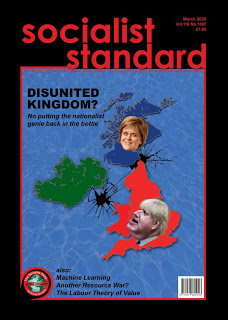
Showing posts with label Scottish National Party. Show all posts

Tuesday, April 1, 2025

50 Years Ago: Scots Nationalism (2025)

The 50 Years Ago column from the April 2025 issue of the Socialist Standard 

Today the SNP seems to have left the lunatic fringe behind and appears as a modern, mass political party using the techniques of public relations and advertising industries to give it a new slick image, and the Executive Suit has replaced the kilt as standard dress for the party candidates. Not only does the party have a large and youthful membership of 120,000 but they carry out their propaganda with a style and enthusiasm which leaves the older reformist parties gasping. At the October general election they all but demolished the Liberals, hammered the Tories, and promise it will be Labour’s turn next time. (…)

The nationalists have shown they are fast learners when it comes to political cynicism. They pretend to the workers that should independence come then all the oil revenues will automatically go into the Scottish exchequer and be used mainly for the benefit of the workers. They must know that the United Kingdom would get some of the revenue as part of any deal made over the granting of independence, and that the capitalist class in Scotland would insist that oil revenues be used to reduce the burden of taxation which rests on them.

Will the Labour government’s proposed Scottish Assembly, but still under Westminster, outflank the SNP? This is possible since it is doubtful if the electorate in Scotland want complete independence as various opinion polls have shown. However, as the Assembly will have no more success in abolishing capitalism’s problems than the SNP’s claim that only full independence can succeed, it will probably gain more support.

Should self-government eventually be established the SNP will discover that they cannot will or legislate away those problems of capitalism. No country in the world, no matter how independent or rich in resources, has yet succeeded in eliminating poverty, unemployment, insecurity, etc. For the working class there will be wages while they are working and pensions when they are too old or disabled.

[From the article 'Scots Nationalism - Part 2', from the Socialist Standard, April 1975.]

Thursday, September 1, 2022

Nationalism: deadly enemy of socialism (2022)

From the September 2022 issue of the Socialist Standard

To many workers nationalism, like some other prejudices, is just another weird idea left over from the past. However, too many others still identify with countries and nations. Nationalism therefore still plays a large part in keeping workers divided.

Some try to make a distinction between patriotism and nationalism: with patriots identifying with their own imagined country without harbouring any ill-will towards people of other countries and nationalists who, as well as having special affection for their own imagined country, are also more xenophobic.

These concepts are so entangled that it makes no sense trying to disentangle them: it is the unsound nature of these notions which bothers us.

To the nationalists, whether Scottish or English, British, German, Russian, Chinese, American or whatever, the concept of the nation is a very important matter. For some it is the most important matter. Nationalists adhere to the strange notion that the nation, or nation-state, is an entity to which we should have automatic allegiance.

But why should we have such allegiance? And what exactly is a nation, and in whose interests does a nation-state operate?

Until the eighteenth century local feeling was much more important than national feeling. The pre- eighteenth-century community-spirit sense of nationality considered a nation to be composed of people living in a particular area with a common language, culture and history; but not necessarily ruled by the same state.

During the eighteenth century some new countries and nations were created. Great Britain, for example was a nation-state created by a merger between England & Scotland in 1707. This was not a ‘hostile takeover’ of Scotland by England, but a deal done between the ruling class of England and their counterparts in Scotland. Needless to say neither the working class in England nor the workers in Scotland were consulted.

Certain gentlemen in what was then the North American colonies became rather disgruntled over trade and taxation and their lack of representation in the British parliament. These grievances between the gentleman rulers on either side of the Atlantic eventually led to the American War of Independence. The British gentlemen on the American side of the ocean foreswore their allegiance to the King and declared independence from Great Britain. In their Declaration of Independence in 1776 they called the new country the United States of America.

The French Revolution in 1789 and its aftermath gave impetus to the further development of liberalism and nationalism throughout Europe and by the nineteenth century nationalism had become more important and much more assertive than the hitherto existing sense of nationality.

The new nationalism intertwined with liberalism was really part of the ideology of the rising bourgeoisie.

Eastern Europe was relatively backward but north-west Europe had reached an advanced stage of industrial and trade development. Industrialisation and increased commercial development spread from west to east along with the political ideas of the rising bourgeoisie.

The new nationalism was essentially the idea that the nation, whatever it was conceived to be, is the most important unit of organisation in society and should therefore be equivalent to the state: it was the concept of the nation-state.

Nationalism and liberalism posed a threat to the cohesion of states like the Habsburg Empire which contained Germans, Hungarians, Italians, Czechs, Poles, Croats and Serbs within its boundaries. On the other hand, new states could be established if the idea of nationalism captured the minds of Germans and Italians whose nations were both divided into various separate states. So, sometimes nationalism united territories into new countries and sometimes it tended to disrupt and divide existing countries.

In 1861 Italy went from being a ‘geographical expression’ to unification. There was at that time a number of competing notions about what a united Germany might be. The so-called Holy Roman Empire had been dissolved in 1806 leaving a collection of petty states which organised themselves during the course of the 19th century into a number of configurations and confederations which eventually led to unification in 1871.

The old absolutist system of government was diametrically opposed to the needs of a developing and dynamic capitalist economy and it was this antagonism of interests which gave rise to the attack by the middle class against absolutism and the feudal rights of the aristocracy.

Liberalism required the unity, inherent in nationalism, of nationhood in society to ensure the satisfactory operation of a liberal constitution. So bourgeois liberals promoted nationalism to further their own ends. But the acquiescence at least of workers and peasants was essential in achieving national unity and independence.

To maintain national cohesion, nationalist ideology is required. Various paraphernalia like flags and national songs/anthems are used to help indoctrinate the subjects of a nation with the myths and fantasies of nationhood. History books with a twisted account of how the nation arose and how it has done great things are also very useful.

A measure of how successful this indoctrination is can be seen at international sports events, where the participants go into a trance-like state as they sing the national anthems of what they have been trained to believe are ‘their’ countries and many are overcome with emotion.

‘Scots Wha Hæ’
The Braveheart Legend today owes much to the eighteenth century romanticised view of the Wars for Scottish Independence of the late thirteenth and early fourteenth century, which culminated in the Battle of Bannockburn in June 1314.

These wars were really struggles amongst the aristocracy, who had lands in both England and Scotland, for political power commensurate with their landholdings and their own perceived greatness.

The song Scots Wha Hæ, by Robert Burns, was ostensibly based on Robert Bruce’s speech to his troops before the Battle of Bannockburn, but Burns was influenced just as much by contemporary struggles in Europe and elsewhere when he wrote this song. He also knew that to openly write such a song about the ‘radical’ struggles of his own time, whether in Britain or abroad, could expose him to prosecution for sedition.

In more recent times the rise of the SNP as a political force results largely from the perceived failures of decades of Labour and Tory governments. It could be said, particularly from the 1970s onwards, that the misanthropic projects of Labour and Tory governments led to growing support for nationalist parties in Scotland and Wales.

To the Scottish National Party the nation is the most important thing. The essence of its argument is that the interests of the ‘people of Scotland’, whoever they might be, can be served best by a government in Edinburgh rather than one in London.

They claim nowadays that nationality can be defined in such a way as to include everyone who lives in Scotland. A bit like the USA, where you can become an American or a hyphenated one for a generation or two; or perhaps forever.

It sounds much ‘nicer’ than some of the more virulent and nasty types of nationalism. But unfortunately, many of the SNP’s supporters continue to be the more old-fashioned and nasty type of nationalist.

Change of rulers
Since the collapse of the British Empire after World War II, many nations have gained independence from British rule. None of this has led to any lasting benefit to the workers in these countries. As in the rest of the world the populations of these countries are divided into employers and their wage-slaves.

So, although the nation-state may be a convenient vehicle by means of which a local (national) capitalist class can exploit the workers within its boundaries, it brings no benefit to the workers.

Nationality is therefore something imposed upon the worker. In fact, the workers of the world have no country and therefore should not have any allegiance to this or any other country. Instead of worrying about the interests of the country or the nation to which they belong, their allegiance should be to their own class interests.

Our use of the possessive pronoun with respect to the employers and their wage-slaves was no accident: the countries are theirs – ie, the capitalists – as are we their wage-slaves. But the countries are not ours! We do not own enough of this or any other country to fill a flower pot.

Instead of worrying about the interests of the country to which they belong and its independence or lack thereof, workers should seek independence for themselves: independence from the tyranny of capital and silly flag-waving nations. Nationalism – like sexism, racism, and religious superstition – is anathema to socialists. We can have nothing but antipathy to it. It is totally incompatible with working class interests and the struggle for socialism.

The Scottish National Party argues that social problems in Scotland are caused by London government and that with an independent government in Edinburgh a start could be made in solving these problems.

The Socialist Party argument is that social problems in Scotland are not caused by government from England but, as elsewhere, by capitalism. Re-arranging frontiers or constructing a new state is no more a solution to working class problems than electing a new government of capitalism or changing the Prime Minister.

Such political changes, are irrelevant to the working class, since they leave the economic basis of society – the class monopoly of the means of production – unchanged; and it is precisely this that is the root cause of their problems.

Against all nationalisms
The Socialist Party opposes Scottish nationalism just as it does British nationalism which, of course, is supported by the Tories, Labour and the Liberals. We are opposed to all nationalism and insist that the solution to our problems lies in the establishment of socialism throughout the world.

The First Minister of Scotland, Nicola Sturgeon, has recently proposed holding another referendum on whether or not Scotland should remain part of the United Kingdom. She claims that she has a mandate to conduct one. The SNP together with the Scottish Greens, who have turned tartan in the last few years, constitute a pro-independence majority in Holyrood. Although this majority of nearly 56 percent in the Scottish Parliament is based on only 49.2 percent of the popular vote, it is a greater ‘mandate’ than Boris Johnson’s 43.6 percent of the popular vote which gave him 365 seats out of 650 in the House of Commons and control of the British state.

The question of whether or not the Scottish Parliament has the authority to conduct a referendum has been referred to the Supreme Court. Should the Supreme Court rule that the matter is reserved to the authority of Westminster and if whoever replaces Johnson still refuses to grant Sturgeon permission to conduct a referendum, the SNP will fight the next UK general election solely on one issue: separation. This would, they say, be a de facto referendum on independence.

Therefore the proposed referendum in October 2023 or the next general election in 2024, like past elections, gives us a ‘choice’: vote yes, get capitalism; vote no, get capitalism! It is like being asked if migraine is better than diarrhoea. Capitalism offers us innumerable such ‘choices’, in an attempt to pretend we are being consulted.

To borrow some of Burns’s words: ‘Now is the day, and now is the hour’, but not for supporting some madcap scheme to create a new nation, or restore an old one. It is time to get up off our knees and face the future: not a fairy-tale future promised by politicians but the future that we will make. Not Scotland for the Scottish, England for the English, Wales for the Welsh, or any other nationalist fantasy world.

A long time ago in the aftermath of a bloody war we claimed the world for the workers and called upon you, our fellow workers, to fight for socialism. Over a hundred years later our claim and demand is the same. By overthrowing capitalism and taking the world for the workers, we will have one world for one people. To do anything else is, just like the proposed referendum, an exercise in futility.
John Cumming

Wednesday, August 24, 2022

The Myth of Scotland's Oil (1973)

From the August 1973 issue of the Socialist Standard

If the victory of the Dundee by-election was regarded as a triumph by the Labour Party, the Scottish National Party must also have been elated by the large number of votes secured by their candidate who ran a close second. This would suggest that the Nats are making a comeback after a period in the doldrums following the party’s zenith in 1968, after Winifred Ewing’s election at Hamilton, when membership was claimed to be in excess of 90,000 with some 500 branches. At present members total some 60,000, with branches around 440.

Why the revival? Undoubtedly the rejuvenating shot in the arm came in the form of North Sea oil. The recent successes of the oil consortiums couldn’t have happened at a better time for the SNP, for two reasons. First—and this is the kernel of the Nationalist argument — the SNP have always asserted that the problems confronting Scotland resulted from the channelling of Scottish revenue directly into the coffers of the “English government’’ thereby preventing the Scottish worker from deriving any benefit from it (despite the obvious fact that his English counterpart doesn’t do too well either!). The advent of the Nats’ new sacred cow, oil, greatly strengthens this argument and has the added bonus of promising such offshoot titbits as rig-building, construction and service industries.

Second, the Nats had previously conceded (surprisingly) that in the early days of home-rule the standard of living would actually be lowered. The wealth they claim oil would bring to an independent Scotland allows them to discard this vote-loser, and the result is that many workers who were previously sceptical of home-rule are now expressing concern over “Scottish Oil” which goes, according to the SNP poster, “To London with Love”.

Who owns North Sea Oil ?
The territorial control of the world’s continental shelf areas was settled by the United Nations Continental Shelf Convention of 1958 when, by an agreement binding after 1969, countries bordering any particular section of continental shelf were given sovereign rights to explore and exploit the natural resources of the shelf. The North Sea continental shelf has since been divided up between Norway, Germany, Denmark, Holland and Britain. The first British round of licences for oil exploration was granted in 1964, several more having been made since, the latest in March 1972. By the end of 1972 at least six commercial-sized oil fields had been discovered in the Scottish sector together with other recent strikes (whose potential is still being assessed). They are:
  • Forties Field which was the first and one of the biggest. Discovered by British Petroleum about a hundred miles east of Aberdeen. Eventual peak production will be in excess of 400,000 barrels per day (20 million tons per year).
  • Montrose Field discovered about 30 miles south-east of the Forties Field by Amoco and thought to be capable of producing 100,000 barrels per day.
  • Auk Field being brought by Shell into production at a rate of 40,000 barrels/day.
  • Argyll Field is reckoned by Hamilton’s to be possibly in the 200,000 barrels/day range.
  • Brent Field has Shell/Esso anticipating an eventual rate of over 300,000 barrels/day.
  • Beryl Field Mobil are looking for a possible 300,000 barrels/day here.
The Face of Prosperity
Under London rule, argue the Nationalists in a new pamphlet The Reality of Scotland’s Oil by Nicholas Dekker, only 9 per cent of the taxes and royalties from this oil will go to Scotland. Under home-rule, however, the Nats claim that by 1980 (assuming that it will take five years to develop an oilfield in the North Sea) new fields discovered during 1973, 1974 and 1975 could bring production up to 150 million tons per year with an estimated gross value of £2,250 million, of which something like £1,400 million or over per annum could tumble into a Scottish exchequer. Coupled with an assumed 50 per cent of “Scottish participation” (investment of capital) in production and of 40 per cent or 60 per cent in ancillary costs (based on above figures), total potential worth to a Scottish economy would be 85 per cent or 90 per cent of gross value—£1,900 million to £2,000 [million] per annum.

This money can, insist the SNP, “be used to secure for all time, prosperity, security, and a satisfying life style for all the people of Scotland”. Among the many promises (play it again, Sam!) would be vastly improved provision for the old, the sick and needy, and the wiping out of the chronic housing problem. Thus armed, the SNP are preparing to contest every Scottish scat at the next General Election.

. . . and its Reverse
Socialists constantly expose the fallacy of home-rule, pointing as examples to other self-governed countries such as Libya, Venezuela, Russia, and even America, where workers derive little if any benefit from oil produced locally. Indeed the opposite can result as is the case in Aberdeen where the oil boom has resulted in a property price-spiral far surpassing anything in Scotland (in fact reaching parity with English property prices) with such bizarre examples as the two-apartment tenement flat which fetched a price of over £4,000!

Equally unsound is the argument that the oil industry must inevitably produce an increase in the number of jobs available. For it could also mean a drop in the demand for other fuels, notably coal, with redundancies in those industries and their offshoots. Not only that, but many of the “new” jobs will, if the SNP have their way, simply have been taken from workers already doing them in England, so it’s a case of robbing Peter to pay Jock, a situation which in no way benefits the workers as a class.

Who Benefits ?
Perhaps the biggest fallacy of all is the Nats’ vision of the anticipated wealth from oil being used exclusively to provide a heaven on earth for Scottish workers. Of course, as the Nats themselves admit, the oil companies will have to have it made worth their while if they are to put up the “vast sums of risk capital to finance search and exploration” and so will the “private and semi-private Scottish capital” they talk about. Also, the cost of government, including the armies of civil servants which any modern capitalist nation must have to administer its affairs, will have to be paid for, and obviously no government can afford to neglect to defend such a valuable property as its oil fields so it will have to provide for defence either independently or through NATO. So, one way and another, there can be little left with which to fulfil the grandiose promises being made. We can confidently assert that the benefit of oil in Scotland will go, as elsewhere in the world, to the owners and the most that Scottish workers can expect from the oil boom is . . . work and wages!

Finally, it’s worth considering that if the North Sea does produce a supply of oil of any significance in relation to world fuel supplies, and bearing in mind the recent panic measures taken by President Nixon, the scramble for oil could become intensified (rapidly expanding Japan, already using 50,000 million gallons a year, estimates treble consumption by the 1980’s). And as trade war sometimes develops into armed war, the tragic result could be that workers living in Scotland could well find themselves, like those in Iceland, being called upon to take up arms to defend “their” oil.
A. McNeill

Wednesday, August 17, 2022

50 Years Ago: The Scottish National Party (1989)

The 50 Years Ago column from the August 1989 issue of the Socialist Standard 

In their leaflet "Crisis!'' the Scottish National Party bemoan the extent to which work has been transferred from Scotland to English soil by the railway companies, and the number of factories which have been closed in the former country as compared with the latter. It may not be out of place to remind them that English capitalists do not hesitate to close works in Lancashire and open others in India and China, when it proves profitable, and no British Government has shown either ability or willingness to interfere with this process. Capitalists are not primarily concerned with geographical boundaries or the nationality of the people whom they exploit.

On the other hand, the Scottish nation, whether independent or united with England, is divided into classes, as is society elsewhere. It is this division which accounts for the existence of the evils from which the Scottish workers suffer. English rule did not account for the fact that the depopulation of the Scottish Highlands led to the congestion in its industrial slums. The Scottish chieftains themselves turned out their own clansmen in order to make way. first for sheep and later for deer, in order to fill their own pockets. The notorious Duchess of Sutherland, for example, had 15,000 people hunted out in the six years 1814-1820, and called in British soldiers to enforce the eviction. The political union merely facilitated the development of capitalist robbery with violence.

[From an article "A Scottish Red Herring", Socialist Standard, August 1939.]

Sunday, August 7, 2022

The Passing Political Show: Vacancy for a Caretaker (2022)

 
From the August 2022 issue of the Socialist Standard

Vacancy for a Caretaker 

So Boris Johnson was finally forced to resign. Luck ran out for this ‘likeable rogue’ who was twice elected Mayor of Labour-dominated London, who delivered Brexit for the dodgy financiers who funded the Vote Leave campaign, and who won over dozens of Labour strongholds in the North and the Midlands to the Tories. In the end his lying, his attempts to protect his cronies in trouble, his partying while the rest of us were locked down, turned him into a ‘despicable rogue’ – and an electoral liability for the Tories, which of course is why most of his MPs turned on him.

What was it that attracted many members of the working class to this privileged (Eton and Bullingdon Club) member of the ruling class ?

As most members of the capitalist class were opposed to the UK leaving the EU, to win the referendum on UK membership he had to adopt a populist pose, presenting the campaign for Brexit as a struggle of ordinary people to take back control, not just from the Eurocrats of Brussels but also in opposition to the London-based British Establishment. With some jingoistic beating of drums and waving of flags, it worked. He successfully plotted to overthrow and replace Theresa May as Prime Minister, and fought and won the 2019 general election under the slogan ‘Get Brexit Done’. He appointed a Vote Leave cabinet rather than a traditional Tory one, and only got Brexit ‘done’ by signing a protocol on Northern Ireland that he had no intention of honouring and which may yet lead to a trade war with the EU.

His flagship policy was the populist one of ‘levelling up’ the standard of living of Brexit voters in the North and Midlands to that supposedly enjoyed by everyone in London and the South East but that was just the usual, worthless politician’s promise. When a shortage of HGV drivers developed, partly due to Brexit, and their wages rose, he said that a high-wage economy had been one of the aims of Brexit. When later, however, the rise in the cost of living led other workers to demand – and strike – to get higher wages, he opposed this. Just as any government of capitalism, including a Labour one, has to, because all governments have to accept that the capitalist system runs on profits and that profits therefore have to be given priority over wages.

This is why the personality – whether good or bad – of those presiding over the operation of capitalism doesn’t matter. No leader, even if they were a saint (which Johnson certainly isn’t) can make capitalism work for those obliged to work for wages. It is a profit-making system that can only run, and be run, in the interest of the profit-takers. It is this that limits what governments can do. When it comes to the way the economy works, governments are in office but not in power, they are caretakers for capitalism.

This is why workers shouldn’t place their trust in leaders, shouldn’t hand over their responsibility to act for themselves to others who promise to do something for them, as unfortunately most repeatedly do at election times. Leaders can’t do anything for us. It’s the system that must be changed, not those who make up the government. Johnson will be replaced by someone else but it won’t make any difference to our everyday life. Conventional politics is ‘a tale told by an idiot, full of sound and fury, signifying nothing’. It’s time we got together democratically, without leaders, to put an end to the class system with production for profit that is the cause of the problems we face and which the politicians falsely claim to be able to solve.


How irrelevant can you get?

In June Nicola Sturgeon announced that the devolved administration in Scotland was asking the UK Supreme Court if it would be legal for them to organise a referendum on Scottish independence in October 2023, nine years after the last one.

Since the SNP is not even pretending to propose a change in the economic basis of society, where the means of life are monopolised by a minority and used to make goods and provide services for sale with a view to profit, we can conclude that their case is that capitalism administered by a government in Edinburgh would be better than capitalism administered from London.

It is hard to imagine a proposition, made by a party with some degree of electoral support, that is so easy to refute. Since capitalism is the cause of the problems that wage-workers and their dependants face, the SNP’s proposed change to the political superstructure of society is not going to make any difference from a working class point of view. The problems faced by those obliged to sell their mental and physical energies for a living will continue under a separate Scottish state whose government will be no more able to solve them than the Westminster government has been.

It can’t even be argued that a separate Scottish state would enhance the limited political democracy that exists (and is desirable) under capitalism. Both Britain and Scotland are established constitutional democracies. It is not like a colony seeking independence. In colonies ruled from abroad the struggle for political independence was waged by a native capitalist class with a view to obtaining its own state. In Scotland there is no such class demanding this. The demand for an independent state is put forward just by some politicians and intellectuals. It is irrelevant even from a capitalist point of view.

The struggle to achieve a separate Scottish state only encourages nationalist illusions and prejudices, further dividing the working class. Even the campaign for a referendum, let alone a referendum campaign itself, has this divisive effect.

It is by no means certain that there will be a referendum. The law says that it can’t take place without the approval of the UK state. It is difficult to see how the Supreme Court could over-rule this. Maybe that is what the SNP is banking on. There has to be a British general election before 2024 and a refusal to give permission to hold a referendum could be a useful issue for the SNP to rally its voters.

If, somehow, the referendum does take place it remains to be seen if a majority will again vote to stay with the devil they know or take a leap in the dark. Socialists won’t be opting for either.

Sunday, April 17, 2022

Scots Nationalism - Part 2 (1975)

From the April 1975 issue of the Socialist Standard


Last month we traced the development of modern nationalism in Scotland up till the founding of the National Party of Scotland in 1928.

The incredible hotchpotch of ideas contained in the new organisation soon became a cause for alarm among the more sensible members and drove one, Lewis Spence, to complain that the party was
“… a maelstrom boiling and bubbling with the cross-currents of rival and frequently fantastic theories, schemes and. notions we have people who wanted all Scotland to speak the Gaelic…. some hark back to the hope of a sixteenth-century Scotland regained … still others a Jacobite restoration. A certain group sees in the expulsion of all the English and Irish in Scotland the country’s only chance of survival . All is hubbub, outcry, chaos. There is no plan,. Nothing approaching a serious, practical Scotsman-like policy in -either art or politics. (H. J. Hanham, Scottish Nationalism. p. 154)
Poor Spence, but he should have known. With the loss of interest in Home Rule of the Scottish ruling class and their political sidekicks, the nationalist cause had fallen into the hands of all sorts of cranks, literary and otherwise, who were more concerned with “culture” than economics or social matters. Certainly they had little idea of the history of the toilers’ conditions as could be seen by their constant harking back to a mythical time when “our people were prosperous and contented” before the Union.

Anyway, the party was established and membership was open to all. Tories and Liberals as well as Labourites flocked in and even Lord Beaverbrook showed interest. Inevitably, some of the more opportunist leaders wished to “broaden the base of the party” and after an internal battle the party merged with a Tory splinter group to become the Scottish National Party (SNP) in 1934. From then until the 1950s the party endured the usual Right versus Left squabbling and several splits occurred, the largest of which was the setting up of a rival organisation, the Scottish Convention, in the 1940s.

Today the SNP seems to have left the lunatic fringe behind and appears as a modern, mass political party using the techniques of public relations and advertising industries to give it a new slick image, and the Executive Suit has replaced the kilt as standard dress for the party candidates. Not only does the party have a large and youthful membership of 120,000 but they carry out their propaganda with a style and enthusiasm which leaves the older reformist parties gasping. At the October general election they all but demolished the Liberals, hammered the Tories, and promise it will be Labour’s turn next time.

So the SNP may be poised for victory within the foreseeable future. How have they produced this rags-to-riches transformation? Obviously, their case is an economic one. They have taken advantage of working class discontent over insecurity, unemployment, low living standards, low expectations, and all the other problems which capitalism brings to workers the world over in one degree or another. They were also helped by widespread disillusion with the two major parties and Labour and Tory supporters have deserted to the nationalists in their tens of thousands.

Basically, the SNP is just another reformist party angling for support on a programme of reforms and even styles itself on the Scandinavian social democrats. After their first breakthrough in l968 the party went into a serious decline which lasted until 1970. Then came the discovery of vast quantities of North Sea oil. Now they can outbid all the others by proposing that the wealth from this oil be divided among five million people only, instead of fifty million, and paint a picture of how, given self-government, oil revenues will provide a paradise in Scotland.

Predictably the nationalists claim that their first priority is to launch a “war on poverty” and the party’s manifesto, Scotland’s Future, gives some idea of how they intend to do this.

For example, pensionable couples are told their combined pension will amount to the national minimum wage which, at today’s level, will be £25, with a single pensioner getting £15. So after a lifetime of producing fortunes for the parasite class worn-out wage slaves are to be “rewarded” with this ! Other dramatic SNP proposals include spending an extra 10 per cent on education and on health services, and just what significant difference this will make to working class life is a mystery to us. The important thing to note is that these are merely promises, and politicians have always found these far easier to make than fulfil.

The writings and utterances of SNP spokesmen present a bewildering display of confusion and contradiction and it is difficult to say whether they are more naïve than dishonest. William Wolfe, the party Chairman, claims the class-struggle can be avoided by passing legislation which outlaws “undue concentration of wealth in a few hands”. We wonder if they mentioned this to the capitalist Sir Hugh Fraser when he joined their ranks last year?

The party repeats the hoary old lie “that it is a lack of communications between management and workers that causes industrial strife”. It could not, of course, have anything to do with a fundamental clash of interests like, for example, the workers wanting better wages and conditions and the management, on behalf of the owners, not willing to grant these.

Despite the SNP’s indignant denials the idea somehow persists in some minds that the party is “socialist”. William Wolfe in his book, Scotland Lives, writes that he wants to give
“….the Scottish people opportunities for their own enterprise and capital to be used in giving their fellow Scots employment.” (p. 43)
Obviously, by “the Scottish people” he means owners of capital like Sir Hugh Fraser. Perhaps the latter joined the SNP on reading this passage in Wolfe’s book?

Another leading member, Mrs. Margo MacDonald, was asked in an interview how she reacted to the suggestion that there’s no advantage in replacing English or American capitalists with Scottish capitalists. She replied
“Well there is, actually. In the strict material sense there is. The Scottish capitalists, while still making lots of money, will be creating jobs in Scotland. They will realise that there is a quicker return to be made by, for instance, refining all of the oil in Scotland. So we would be slightly better off. Of course I agree exploitation by Scots is just as immoral in the long run. (Glasgow News, 12th March 1974)
So there it is. For the Scottish capitalist, “lots of money” and a “quicker return”. For the worker, the promise that he will be “slightly better off”.

The nationalists have shown they are fast learners when it comes to political cynicism. They pretend to the workers that should independence come then all the oil revenues will automatically go into the Scottish exchequer and be used mainly for the benefit of the workers. They must know that the United Kingdom would get some of the revenue as part of any deal made over the granting of independence, and that the capitalist class in Scotland would insist that oil revenues be used to reduce the burden of taxation which rests on them.

Will the Labour government’s proposed Scottish Assembly, but still under Westminster, outflank the SNP? This is possible since it is doubtful if the electorate in Scotland want complete independence as various opinion polls have shown. However, as the Assembly will have no more success in abolishing capitalism’s problems than the SNP’s claim that only full independence can succeed, it will probably gain more support.

Should self-government eventually be established the SNP will discover that they cannot will or legislate away those problems of capitalism. No country in the world, no matter how independent or rich in resources, has yet succeeded in eliminating poverty, unemployment, insecurity, etc. For the working class there will be wages while they are working and pensions when they are too old or disabled. An ominous glimpse of what leading SNP members regard as “prosperity” can be gained from their repeated claim that “Scotland was the wealthiest nation in the world” (Wolfe p. 12) up till the end of the 1914-18 war. How the working class lived in those days does not seem to have even occurred to them.

The SNP see themselves as visionaries but they cannot see beyond the narrow confines of the nation-state, conceived in pre-medieval times and as outmoded as the clan system it replaced. It is the Socialist Party of Great Britain who are the true men and women of vision, who look forward to and struggle for a new world of common ownership and democratic control of society’s resources, and uncluttered with the frontiers and class divisions which go hand-in-hand with “the nation”.
Vic Vanni

Friday, September 4, 2020

The Referendum – Where We Stand (1997)

From the September 1997 issue of the Socialist Standard

A Parliament for Scotland? An Assembly for Wales? Unable to agree among themselves and afraid to go ahead without popular support–last time they put this to a referendum their proposals were thrown out–our rulers have decided to ask us our opinion on the matter.

We should be flattered, but don’t be fooled. These proposals are part of a smokescreen to disguise the fact that the Labour Party cannot deliver, and no longer wants to deliver, social reforms aimed at shifting wealth and power from the privileged few to working people.

Labour has always accepted the profit system. They used to believe they could humanise it by social reform legislation. Not any longer. Bitter experience has taught them that where reforms and profits come into conflict, it is reforms that have to give way. The last Labour government under Callaghan ended up applying this and Blair had promised to do the same even before he became Prime Minister.

The Labour Party fully accepts now that priority has to be given to profits and no longer promises more spending on social reforms. But, to distinguish itself from the Tories, Labour still wants to retain a reforming image. But how? By finding reforms which don’t come into conflict with profits. Constitutional reforms fill the bill perfectly. They don’t interfere with profit-making. They don’t cost more money. And they give rise to an illusion of change.

It is in this light that the Labour government’s proposals for a Scottish Parliament and a Welsh Assembly should be seen, along with their proposals for turning the House of Lords into a huge non-elected quango and for elected mayors and other such gimmicks. But it’s all completely irrelevant as far as ordinary people are concerned.

Constitutional reform is of no benefit or relevance to us. It leaves our lives and the problems the profit system causes completely unchanged. Exploitation through the wages system continues. Unemployment continues. A crumbling health service, a chaotic transport system, a polluted environment, failing schools, rising crime and drug addiction and the general breakdown of society all continue. As far as solving these problems is concerned, constitutional reform is just a useless irrelevancy.

Deficient Democrats

Naturally, Labour wraps its irrelevant, constitutional reforms up in democratic rhetoric. Elected assemblies in Edinburgh and Cardiff, we are told, would be an extension of democracy, bringing power nearer to the people, so how can Socialists not be in favour of this?

Yes, Socialists are in favour of democracy, and socialism will be a fully democratic society, but full democracy is not possible under capitalism. Supporters of capitalism who talk about “democracy” always mean only political democracy since economic democracy–where people would democratically run the places where they work–is out of the question under capitalism, based as it is on these workplaces being owned and controlled by and for the benefit of a privileged minority.

You can have the most democratic constitution imaginable but this won’t make any difference to the fact that profits have to come before meeting needs under capitalism. The people’s will to have their needs met properly is frustrated all the time by the operation of the economic laws of the capitalist system which no political structure, however democratic, can control.

It is not imperfections in the political decision-making process that’s the problem but the profit system and its economic laws. And the answer is not democratic reform of capitalism’s political structure but the replacement of capitalism by socialism.

As a society based on common instead of class ownership of the means of production, socialism will fulfil the first condition for a genuine democracy. Because it will be a classless society without a privileged wealthy class everyone can have a genuinely equal say in the way things are run. Some will not be more equal than others, as they are under capitalism, because they own more wealth. Socialism will be a society where the laws of profit no longer operate since common ownership and democratic control will allow people to produce to meet their needs instead of for the profit of a few as today.

The argument about elected Scottish and Welsh assemblies bringing power nearer to the people might have something in it if, even within the limited context of mere political democracy, the proposed assemblies were going to have some real powers.
But they are not.

All their money is to come from the central government, and the only “power” they will have will be to rearrange slightly how the limited amount of funds they will be given is to be spent. In other words, they will have no more power than existing borough and county councils.

They will be part of the administrative arm of central government and their members will be no more than elected civil servants spending central government money. All that would happen would be the introduction of another layer of elected bureaucrats. Another trough for the professional politicians to get their snouts into perhaps, but ofno significance to ordinary people.

If our rulers want to reform the machinery of capitalist government in this way, that’s up to them. But spare us the pretence that it’s some great extension of democracy.

Nasty Nationalists

Also urging a “yes” vote are the Nationalists of the SNP and Plaid Cymru. They see the sham parliament with token powers that is on offer as a step towards their goal of an independent parliament with full powers to impose taxes and make laws.

This argument for voting “yes” cuts no ice with Socialists either. We are not nationalists–in fact we are implacably opposed to nationalism in whatever form it rears its ugly head–and we see the establishment of an independent Scotland or Wales as yet another irrelevant, constitutional reform. One of the last things the world needs at the moment is more states, with their own armed forces and divisive nationalist ideologies.

Nationalism is based on the illusion that all people who live in a particular geographical area have a common interest, against people in other areas. Hence the supposed need for a separate state and a separate government to defend this separate interest.

This flies in the face of the facts. All over the world, in all geographical areas, the population is divided into two basic classes, those who own the productive resources and those who don’t and have to work for those who do, and whose interests are antagonistic.

The non-owning class have a common interest, not with the owning class who live in the same area, but with people like themselves wherever they live. The interests of workers who live in Scotland and Wales are not opposed to the interests of those who live in England–or France or Germany or Russia or Japan or anywhere else in the world.

Nationalists like the SNP and Plaid Cymru who preach the opposite are spreading a divisive poison amongst people who Socialists say should unite to establish a frontierless world community, based on the world’s resources becoming the common heritage of all humanity, as the only framework within which the social problems which workers wherever they live face today. This is why Socialists and Nationalists are implacably opposed to each other.

We are working in opposite directions. Us to unite workers. Them to divide them. So, insofar as the proposed assemblies in Scotland and Wales are a sop to nationalism–as to a certain extent they are–that would be more a reason for voting “no” than for voting “yes”.

Useless Unionists

So, what about voting “no”? It’s tempting. After all, Socialists don’t want constitutional reform (we want socialism) and a “no” vote would be a repudiation of the divisive doctrines of the narrow-minded Scots and Welsh Nats. But in the end the point at issue–a mere constitutional reform which will leave profit-making, exploitation, unemployment and all the other social problems quite untouched–is so irrelevant that it is not worth taking sides.

In addition, those leading the campaign for a “no” vote–various business people and the Tory rump–are conservatives in both senses of the term. They want to leave things as they are. They don’t want to change anything. We don’t see any point in diverting our energies to changing the constitution but we certainly want things to change. We want people to change the economic and social basis of society and establish socialism in place of capitalism. So we’ve nothing in common with them.

They fear that the proposed change will be the first step on a slippery slope leading to the break-up of the United Kingdom. Maybe, though this is not the opinion of Labour and the Liberals who are also Unionists. The leading “no” campaigners, too, are nationalists. Not of course Scottish or Welsh Nationalists, but British Nationalists, since that is what the Unionists are, spreading the poison that it is all the people in the British Isles who have a common interest against people everywhere else. But Socialists are just as much opposed to British Nationalism as we are to Scottish or Welsh or any other nationalism.

Just because we are not prepared to back the efforts of Scottish and Welsh Nationalists to break away from the United Kingdom–and vigorously oppose their efforts to split the trade union movement–does not mean that we are Unionists. We don’t support the Union. We just put up with it while we get on with our work of convincing people to reject world capitalism in favour of world socialism.

Vote for Socialism

So we shan’t be voting “yes” or “no”. We shall, however, be voting. We’ll be going to the polling station and, since they are not giving us this option on the voting paper, we’ll be writing the word “SOCIALISM” or “SOSIALAETH” across it.

If you want socialism, we urge you to do the same, as a way of registering your support for world socialism and your rejection both of separatist Welsh and Scottish nationalism and of unionist British nationalism.

This article is also available in leaflet form. Readers in Scotland and Wales wanting copies to distribute should write to: 52 Clapham High St, London SW4 7UN.

Wednesday, May 27, 2020

Editorial: Nats whae hae (2007)

Editorial from the May 2007 issue of the Socialist Standard

Nationalism is anathema to socialists. Wage and salary workers have no country. We have more in common with people like ourselves in other countries than with the privileged owning class of the country where we happen to live and work.

The world-wide working class has a common interest, to end its exploitation and solve its problems, to join together to establish a world without frontiers in which the resources of the planet will have become the heritage of all, so that there can be production to meet needs and not for profit. One world, one people, where cultural differences will still be celebrated, but where we’ll all be citizens of the world.

It is clear, then, why socialists don’t take sides in the debate, aired in this month’s elections to the Scottish Parliament, about whether it is better for workers there to be ruled from Edinburgh (as the SNP says) or from London with a little help from Edinburgh (as say the British Nationalists of the Labour, Liberal and Tory parties).

The SNP argues that the problems facing workers in scotland are due to “Westminster rule”. If only there was an independent Scotland, they say, separate from the rest of Britain, then there would be full employment, higher wages, job security, better state benefits, a healthy health service and all the other things politicians promise at election times.

This view is echoed by the so called Scottish “Socialist” Party and Tommy Sheridan’s Solidarity (with Sheridan) Party. But it is patently absurd. This would be a purely political, not to say mere constitutional change which would leave the basic economic structure of society unchanged.

There would still be a privileged class owning and controlling the means of production with the rest having to work for them for a living. Just as now. Maybe the pillar boxes would be painted tartan but that would be about all.

An independent Scottish government would still have to operate within the constraints of the world capitalist system. It would still have to ensure that goods produced in Scotland were competitive on world markets and that capitalists investing in Scotland were allowed to make the same level of profits as they could in other  countries.

In other words, it would still be subject to the same economic pressures as the existing London-based government to promote profits and restrict wages and benefits. And as the government of Ireland, which broke away from the United Kingdom in 1922 and where things have never been any different. Not even the national state capitalism proposed by the SSP and Sheridan would make any difference. As in Cuba, exports would still have to be competitive and popular consumption restricted to achieve this.

Since it is this class-divided, profit motivated society that is the cause of the problems workers face in Scotland, as in England and in the rest of the world, so these problems will continue, regardless of whether Scotland separates from or remains part of the United Kingdom.

The SNP is promising a referendum in 2010. What an irrelevant waste of time and energy that would be, but it’s their alibi. If they get to form the regional government of Scotland their excuse for not delivering (as capitalism won’t let them) will be that their hands were tied and that their promises will only be able to be honoured after separation.

Our opposition to the SNP should not be interpreted as support for the Union or the Labour, Liberal or Tory parties that support it. We are just as opposed to them. A plague on both their houses is what we say. To adapt a slogan, “Neither London nor Edinburgh, but World Socialism”.

Thursday, March 5, 2020

Scottish Independence : Tartan Delusions (2020)

From the March 2020 issue of the Socialist Standard

On the 31 January the blue Euro-banner was hauled down at Westminster and the Union flag raised in its stead. In Edinburgh, though, the self-awarded gold stars flag was pointedly left fluttering in place next to the saltire.

The SNP are making a none too subtle point. The antidote to the referendum they don’t like is to be… another referendum. It would seem the political ‘logic’ is that the best way to counter leaving a union is to leave a union.

It is somewhat ironic that the clash between Holyrood and Westminster stems from a single shared source, nationalism, be it competing nationalisms. The cause is perceived sovereignty, as if Scotland, or England, or Britain can stand alone, or at least break away from a power portrayed as inhibiting its freedom.

However, what would the SNP do in short order should they achieve independence? Give it up to the EU of course. Similarly, should Britain shake off the last vestiges of EU influence, then treaties will be sought and signed with such as the USA.

Not only will the USA want untrammelled access to the NHS for its big pharma, for example, there will be a demand for any arrangements to be subject to America’s legal system. For the USA substitute any other major trading nation/bloc and something similar will apply.

This is what ‘independence’ means in a global capitalist world. Significant change cannot be achieved by a binary vote in a referendum. At best there is some reordering of the arrangements, but essentially, adjustments made, capitalism continues unhindered other than by its own contradictions.

The SNP has previously stated its intention of retaining the monarch as their country’s head of state, continuing the use of sterling and joining NATO. Presumably unaware of any contradiction, they also want to be rid of the Trident submarine bases.

Do they really think that if capitalism degenerates to the point where international warfare results in the use of nuclear weapons, the removal of Trident bases will somehow insulate Scotland from the consequences?

Should the SNP decide the monarch was not to be their head of state, then a president or some such would fulfil that function. Has being a republic lessened the grip of capitalism, with its extremes of war, inequality and crises, on the USA?

If Scotland was denied the use of sterling presumably that would mean embracing the euro with all its financial hazards and, more importantly, subservience to, not independence from, the European Union. If sterling is retained, then economic policy would, ultimately, continue to be determined in London.

The formation of Britain enabled the industrial revolution to create a dynamic economy in which Scots, Welsh and English played full parts. This also led to the formation of the working class with interests transcending those of constituent regional and national parts. Workers in Scotland faced the same exploitative capitalism as they did in England and Wales and expressed their voice through their own organisations, the trade unions.

And nothing has changed. Workers on any side of a border, wherever it is drawn, all face the same fundamental problem, capitalism. To exist, capitalism must exploit workers to make profit. Painting your face blue with crossed white stripes alters this not one iota.

Whatever the outcome of another referendum the people of Scotland will continue to live under a parliamentary system designed to preserve the interests of capitalism. If they have opted for ‘independence’ they will find ‘sovereignty’ surrendered to the EU.

The parliamentary system has evolved to serve the interests of capitalism, not democracy. It does not matter if a parliament is situated in London or Edinburgh, nor if its benches are upholstered in tartan and populated by nationalist MSPs, it will remain subservient to the needs and preservation of capitalism.

Referendums are designed to give apparently simple solutions to complex problems, they are the chosen way of despots and demagogues attempting to garner some semblance of popular support of their self-serving programmes.

The ballot box can indeed be part of the response of the working class to taking economic and political power away from the capitalist class. But this will have to be just one element of a much wider movement in which the working class consciously acts for itself.

No referendum can solve problems for the working class, not in Scotland, not in Britain via Brexit (or re-joining the EU at some point), not anywhere. There is no Tartan alternative to socialism.
Dave Alton

Wednesday, March 4, 2020

Editorial: Towards a Disunited Kingdom (2020)

Editorial from the March 2020 issue of the Socialist Standard

The turmoil of the Brexit process has exacerbated the fissures within the UK, which threaten to tear it apart. The Scottish National Party leader, Nicola Sturgeon, seized on the fact that the majority of Scottish voters opted to remain in the EU, and is demanding a second Independence referendum. The border between the North of Ireland and the Irish Republic which appeared to be invisible since the Good Friday agreement became a stumbling block in the Brexit negotiations. Sinn Fein wasted no time in pressing for a border poll which they hope will lead to the reunification of Ireland.

The spectre of Scottish independence is nothing new. Scottish workers were badly affected by the economic downturns of the 1970s and 1980s which hit the traditional industries (shipbuilding, coal, steel) particularly hard. Many workers were also dissatisfied with Labour governments. North Sea oil seemed to promise higher living standards. In these circumstances the SNP was able to position itself as the workers’ party. With the establishment of the Scottish Parliament in 1999, the then Labour government thought they had seen off the nationalist threat. However, in the wake of the 2008 financial crisis, many workers turned away from the mainstream capitalist parties. In Scotland, this helped the SNP to secure a majority in the 2011 elections for the Scottish Parliament and a landslide in the 2015 General Election.

The Irish border has been in contention since 1921. However, with the repression of the Civil Rights movement in the North of Ireland in the late 1960s, Irish republicanism experienced an upsurge of support. In the 1980s Sinn Féin was able to capitalise on the outrage that the British government’s response to the hunger strikes elicited in Catholic working-class areas. It also managed to gain a foothold by providing welfare services to Catholic workers. With the peace process and the IRA laying down its weapons, Sinn Féin was able to reinvent itself as a workers’ party.

In last December’s general election, the SNP increased its seats in Scotland, whereas the pro-Brexit Conservative Party prevailed in England and Wales. In Northern Ireland, for the first time, Nationalists won more seats than Unionists. Sinn Féin has made a significant breakthrough in last month’s general election in the Irish Republic.

It must be noted that the electoral successes of the SNP and Sinn Féin do not always reflect support for their respective aims of an independent Scotland and a united Ireland, but more often a deep dissatisfaction with the political status quo. Nevertheless, these parties will use their increased leverage to push for their aims.

Do the working class have any interest in whether or not the United Kingdom remains intact? Or should they, as the Left urges them to, support an independent Scotland and a united Ireland? We say no on both accounts as, wherever the boundaries are drawn, workers will still be subject to the vagaries of the global market system and will continue to experience problems such as unemployment and low wages. Workers will need to organise for a socialist society which will abolish borders rather than rearrange them.

Thursday, December 19, 2019

Courting Popularity (2019)

From the December 2019 issue of the Socialist Standard

POPULIST! This is the political vogue word of the moment, a pejorative term presently in common use especially in the media. President Trump, the Brexit vote, both are cited examples of what is being cast as a growing tendency.

Yet the word has a more honourable past. Originally, it referred to members of the US People’s Party, founded in 1891. It had a social agenda, championing public ownership of public services and graduated income tax.

It was a manifestation in the USA of the then emerging social democratic trend represented in Britain by the Labour Representation Committee and the Independent Labour Party, leading to the founding of the Labour Party.

This social democratic tendency was a working-class response to capitalism in the same way as – and emerging from – trade unions. An attempt to seek radical ways of reforming capitalism to favour the majority, to use democracy to improve the lot of working people.

The subsequent history of social democrats being elected to government has demonstrated that such populism, however heartfelt and well intentioned, is no match for the power of capitalism. Reforms conceded can be all too easily clawed back when the profit motive demands it.

However, while socialists must continue, as they did in the 1890s-1900s, to point out that reformism is a doomed strategy, being a populist was not deserving of the opprobrium associated with the word today. Indeed, the basic populist principle was advocating the right and ability of the common people to govern themselves.

Indeed, replace the phrase ‘common people’ with working class and there is the essential element of socialism, the working class acting politically for itself.

So what has happened to turn populism into a reactionary tendency? The problem lies not in any particular manifesto, but in the actual principle of courting popular support. This is denial of the working class acting for itself.

Instead, it relies on the ‘common people’ playing a passive role, even encourages such passivity. Political programmes, radical or otherwise, are concocted by parties standing apart from the people they purport to represent. There may indeed be working people involved in that party, but it is a small self-selected group presuming to know what’s best for the masses.

The aim is to elicit widespread support for a pre-formed programme exclusive of popular input. The only role for the electorate is to vote for it and trust the party will act on their behalf. In this sense, all parties putting themselves forward for election are populist.

A current example is the Scottish Nationalist Party seizing on the EU referendum vote in Scotland running counter to the overall British vote. Popular discontent is to be exploited for the sectional interests of the SNP, turning the voters’ gaze away from rather more pressing economic and social problems to which the SNP do not have answers.

Other parties in Scotland, seeing an opportunity to raise their profiles, tail along behind the SNP, hoping to gain some popular kudos, or pose a contrary British nationalism. This is where the populist motivation is problematic. Whatever its intent, it serves the political interests of capitalism by limiting the political interests of the working class.

Issues become binary: for or against independence, leaving or staying in the EU, Labour or Conservative and so on and on … And the only role for the working class, the electorate, is to choose one of the other. Proportional representation or transferable vote systems are merely variations on this essentially passive process.

Parties will even compromise their own programmes to court popular support, as the Liberal Democrats and The Green Party are presently doing as a ‘Remainer’ coalition. What none of the Westminster parties are doing, or can do for that matter, is to engage with the one fundamental issue: in or out of the EU the problem(s) of capitalism continue unaddressed.

A true working class populism must involve the working class organising itself through its own political institutions to determine how its best interests can be served. Democracy requires the popular acceptance of responsibility for playing an active part.

Otherwise it’s merely grumbling about, yet voting for, selected performers strutting about the parliamentary stage in ‘Westminster’s Got Talent’, a popular show for the moment – until those merely watching in the audience realise they could take the stage for themselves.
Dave Alton

Wednesday, July 10, 2019

50 Years Ago: Scotch Mist (2019)

The 50 Years Ago column from the July 2019 issue of the Socialist Standard

In Scotland today it’s true that there is a struggle – as there is in England, Wales Ireland, or the rest of the world for that matter. But the struggle in Scotland is not, as the Scottish National Party would have us believe, the struggle for home rule, self-government, self-determination, or self anything. The struggle in Scotland, as in the rest of the world, is a class struggle: the struggle between the working class and the capitalist or owning class.

The SNP tell us, the workers, that independence from England and the control of our own purse strings will cure all our problems. What they do not seem to realise is that the problems they are going to try to solve are an integral part of the capitalist system, and history has shown beyond a shadow of a doubt that within this system there is no satisfactory solution to these problems apart from Socialism.

The SNP talk about Scottish culture and the Scottish way of life. But in what way is the life of a Scottish wage slave basically different from that of an English, an American, or for that matter a Russian wage slave? There is no basic difference in the way of life of the world’s working class because we all suffer from the same problems such as poverty and insecurity. Independence from England will not cure the poverty and insecurity of the Scottish workers, because there will still be the wage labour and capital relationship.

There is no truly independent country in the world, because international capitalism has made sure of this, and our own experience here in Britain, especially since 1964, should have brought it home to us. The past few years should have shown us just how independent Britain is, when foreign ‘bankers’ tell the British government how it must spend money, and how it must not spend money, in order to keep the international capitalist class happy.

(From the Socialist Standard, July 1969)

Friday, June 7, 2019

Scotch Mist (1969)

From the July 1969 issue of the Socialist Standard

In Scotland today it’s true that there is a struggle – as there is in England, Wales, Ireland, or rest of the world for that matter. But the struggle in Scotland is not, as the Scottish National Party would have us believe, the struggle for home rule, self-government, self-determination, or self anything. The struggle in Scotland, as in the rest of the world, is a class struggle: the struggle between the working class and the capitalist or owning class.

The SNP tell us, the workers, that independence from England and the control of our own purse strings will cure all our problems. What they do not seem to realise is that the problems they are going to try to solve are an integral part of the capitalist system, and history has shown beyond a shadow of a doubt that within this system there is no satisfactory solution to these problems apart from Socialism.

The SNP talk about the Scottish culture and the Scottish way of life. But in what way is the life of a Scottish wage slave basically different from that of an English, an American, or for that matter a Russian wage slave? There is no basic difference in the way of life of the world’s working class because we all suffer from the same problems such as poverty and insecurity. Independence from England will not cure the poverty and insecurity of the Scottish workers, because they will still be the wages labour and capital relationship.

There is no truly independent country in the world, because international capitalism has made sure of this, and our own experience here in Britain, especially since 1964, should have brought it home to us. The past few years should have shown us just how independent Britain is, when foreign “bankers” tell the British government how to spend money, and how it must not spend money, in order to keep the international capitalist class happy.

Class Struggle
Independence for Scotland therefore is a myth put about by the Scottish National Party, which further confuses the Scottish section of the working class and blinds them from the real struggle – the class struggle.

The outcome of the class struggle is the abolition of capitalism and an end to poverty, insecurity and the ever-present threat of war.

Socialism is a sane society, where the means of life will be owned in common by the whole of the world socialist community. By the means of life we mean the land, mines, factories, railways, and the like – in short, the means of production and distribution. In Socialism the rule of life will be : from each according to his or her ability, to each to according to his or her need. There will be no need for buying and selling, just a free world for a free people. It could be like that now, so why not do something about it ? The world is ours for the taking. So why not take it ?

WORKERS OF THE WORLD UNITE FOR SOCIALISM!
James Moir

Wednesday, May 15, 2019

Sting in the Tail: What's Up Doc? (1992)

The Sting in the Tail column from the November 1992 issue of the Socialist Standard

What's Up Doc?

In the Observer Magazine (27 Sept.) under the headline Poverty Makes You Sick, a doctor John Collie wrote:
  There is one piece of health advice which is more effective than all the others. One guaranteed way to live longer, grow taller, avoid chronic illness, have healthier children, increase your quality of life and minimise your risk of premature death. The secret is: be rich — because all the major health indicators are directly related to income. People living in poverty are not simply 'less comfortable' than everyone else — they have shorter lives, sicker children and babies which are more likely to die in infancy.
So there you have it, fellow workers; stop whingeing, just get rich.


Dying For A Job

Here is some heartening news for those workers who are still managing to hold on to a job.
  Losing your job increases your chances of dying, according to new evidence. Data from the British Regional Heart Study, which has spent 10 years studying people from 253 British towns, shows that unemployment kills.
  "We have found that men we were screening who were unemployed at any time over a five-year period were more than one-and-a-half times as likely to die in the next five years as men in continuous employment" said Dr Joan Morris, lecturer in medical statistics at St Thomas's Hospital, London.
The Observer (27 September)
For those of us still with a job it is not all sunshine however.
  Stress at work is an important reason why people take time off sick, according to Dr Paul Oldershaw, head of health sciences at the Health and Safety Executive. "A 1990 Labour Force Survey suggests a national picture of around 110,000 people who regard themselves as victims of stress and depression caused by work, and 200,000 who regard themselves as having a problem made worse by their work."
Got the picture then? Out of work and facing hellish poverty problems you are more likely to snuff it; in work and you are driven nutty by the stress of it all. Aint it time we got shot of this crazy society?


Dead-End Path

The capture of Abimael Guzman, the leader of the Maoist Sendero Luminosa guerillas by Peru's security forces hit the headlines recently.

Sendero Luminosa (Shining Path) aim to do in Peru what Mao did in China — to sweep away the ruling class by armed force, and they have for years waged a ruthless and bloody war against the police, military, judiciary, politicians of both left and right and even villagers who do not toe the Maoist line.

So the old Maoist illusions live on in Peru. Sendero Luminoso imagine that the poverty of the peasants and workers can be ended by toppling Peru's rulers, but should they win power they will find, as Mao’s successors in China have found, that capitalism is a worldwide system and they must become part of it even against their own wishes.


Mixed-Up Mike

Film star Michael Caine's comments on political and social matters are a strange mixture of sense and nonsense.

A dyed-in-the-wool Tory, Caine is forever on about his working class roots but could still complain in a TV interview about council tenants having cars and, even worse, lockups to put them in when he couldn't find a parking place where he lived in Mayfair for his Rolls Royce!

That’s only some of the nonsense but he can make sense too. For example, he recognises that the Labour Party isn't socialist and just look at this comment on religion:
  I'm born of a Catholic father and a Protestant mother. I was educated in a Jewish school and I'm married to a Moslem. None of these religions has made a mark on me because I see the cant and hypocrisy In them. Each one teaches prejudice.
Dally Express (23 September)

The Dirty Work

Anyone who wants to know who will do the dirty work in socialism such as farming, should have seen a recent TV programme on the government’s "Set Aside” policy. This amounts to farmers being given money to set aside some of their land, that is grow nothing on it because of glutted food markets.

We have dealt many times in this journal with the madness of a social system where this can happen while millions starve, but there were for us some very encouraging views expressed by some of the farmers on Set Aside. They "hated” it: they didn’t want the money but wanted to use the land usefully and saw their role as being primarily one of growing things. Above all they wanted to stay on the land because they loved the life.

In socialism farming, like any other job, will be done by people who wish to do it and there looks like being no shortage of those.


A Useless Unity

Following their humiliation at the general election the Scottish National Party met in sombre mood at their conference in Perth last month.

Like any other reformist party the SNP is a loose coalition with the various strands of opinion all pulling in different directions.

There were "social democrats" ranged against pure-and-simple nationalists, supporters of the multiparty "Scotland United" movement versus go-it-alone hardliners, nationalises clashing with "regulators" CNDers opposed by "defence realists", and so on.

There were, however, two things on which unity was total; the complete acceptance of capitalism and a blind belief, despite all the evidence, in their ability to tame It.