Showing posts with label August 1925. Show all posts

Saturday, February 5, 2022

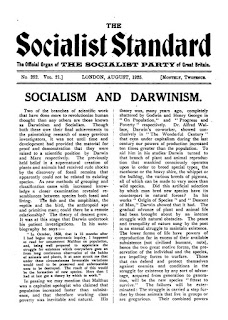
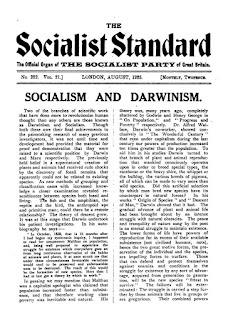
Socialism and Darwinism. (1925)

From the August 1925 issue of the Socialist Standard

Two of the branches of scientific work that have done more to revolutionise human thought than any others are those known as Darwinism and Socialism. Though both these owe their final achievements to the painstaking research of many previous investigators, it was not until time and development had provided the material for proof and demonstration that they were raised to a scientific position by Darwin and Marx respectively. The previously held belief in a supernatural creation of plants and animals had received rude shocks by the discovery of fossil remains that apparently could not be related to existing species. As new methods of grouping and classification came with increased knowledge a closer examination revealed resemblances between species both fossil and living. The fish and the amphibian, the reptile and the bird, the anthropoid ape and primitive man; could there be a remote relationship? The theory of descent grew. It was at this stage that Darwin undertook his patient investigations. In his autobiography he says:—
“In October, 1838, that is 15 months after I had begun my systematic inquiry, I happened to read for amusement Malthus on population, and, being well prepared to appreciate the struggle for existence which everywhere goes on from long continuous observation of the habits of animals and plants, it at once struck me that under these circumstances favourable variations would tend to be preserved and unfavourable ones to be destroyed. The result of this would be the formation of new species. Here then I had at last got a theory by which to work.”
In passing we may mention that Malthus was a capitalist apologist who claimed that population increased faster than subsistence, and that therefore working class poverty was inevitable and natural. His theory was, many years ago, completely shattered by Godwin and Henry George in “On Population,” and “Progress and Poverty” respectively. Dr. Alfred Wallace, Darwin’s co-worker, showed conclusively in “The Wonderful Century” that even under capitalism during the last century our powers of production increased ten times greater than the population. To aid him in his studies Darwin turned to that branch of plant and animal reproduction that mankind consciously operates upon in order to breed special types, the racehorse or the heavy shire, the whippet or the bulldog, the various breeds of pigeons, all of which can be made to vary more than wild species. Did this artificial selection by which man bred new species have its counterpart in natural forces? In his works “Origin of Species” and “Descent of Man,” Darwin showed that it had. The gradual advance of plant and animal life had been brought about by an intense struggle with natural obstacles. The peace and tranquility of nature sung by the poet is an eternal struggle to maintain existence. The lower forms of life have powers of reproduction far in excess of their available subsistence (not civilised humans, note), hence the two great motive forces, the preservation of the individual and the species, are impelling forces to warfare. Those that can defend and protect themselves against enemies and conditions in the struggle for existence by any sort of advantage, acquired from generation to generation, will be the new species “fittest to survive.” The failures will be exterminated : The struggle is carried a step further by those animals that live in groups or are gregarious. Their combined powers give them a new strength of protection both for themselves and their young. Bearing in mind the immense periods of time taken for development in nature’s working it will become more clear how such groups developed social feelings, instincts and advantages, that enabled them to struggle successfully right up to the man-like apes, our progenitors in the line of development.

The final step that enables man to emerge from the animal kingdom is the making and use of tools. He acquires the first rudiments of speech and becomes “primitive man.” Space only permits of a brief mention of the proofs of the correctness of Darwin’s theory. Man within his body contains many rudimentary parts only explicable on the basis of his lowly origin. The physical and mental differences of living races of men are greater than those between the lowest men and the highest apes, and a study of embryology shows that the human embryo recapitulates the whole history of the evolution of the species, the last form left behind being that of the anthropoid ape.

What organs are to the animal world, tools are to mankind. These man-made tools in conjunction with other discoveries give him a great advantage in the struggle for the food supply over the animals, he is indeed able to dominate them and later domesticate them. Struggle at this stage does not cease, it merely takes a different form, those groups or tribes of men who possess better tools and weapons compete more successfully in the conflict and struggle now takes place between tribe and tribe. Further development in tools and methods of production makes the preservation of those captured in conflict desirable, a surplus can be produced, slavery begins :

All history says Marx “is the history of class struggles ” (i.e., since the break up of the tribes) and thus he supplies the key :
“In every epoch the prevailing mode of social production and exchange, and the social organisation necessarily following from it, form the basis upon which is built up, and from which alone can be explained, the political and intellectual history of that epoch.” (Communist Manifesto).
As with Darwin and Wallace in the domain of natural history, so with Marx and Engels in the materialistic conception of history. Marx shows that with changed economic conditions, come new social classes, new ideas, new interests. The subject class that has sought to possess tools or means of livelihood has always fought for political supremacy. Every class struggle must be a political struggle. The decline of the Roman Empire, the French Revolution, the vast changes within capitalism including the growing conscious discontent of the workers, can only be explained by Marx’s theory.

The handicraft worker had a mentality different from the city proletariat of to-day, the conditions had not developed the Socialist who is a product of the modern slave system of social production : What then is the struggle that is paramount to the Socialist? It is the Class struggle, it is the struggle between the producers, and the non-producers who possess and control the means of life, between the wage workers and the Capitalists. To remove poverty and degradation the workers must wage that struggle consciously for the establishment of a higher order of society in which class distinctions will be abolished and all can enjoy the comfort and leisure modern means make possible. The decadent parasites of Capital will be no match for a majority organised for Socialism. It will indeed be “the survival of the fittest.”
W. E. MacHaffie

Letter: Is the Socialist Attitude towards Religion Sound? (1925)

Letter to the Editors from the August 1925 issue of the Socialist Standard

A Criticism by Mr. Archie McArthur and our Reply. 

Being on the Thames Embankment last May Day, I bought a copy of a pamphlet on “Socialism and Religion,” issued by the Socialist Party of Great Britain. If my memory serves me right, I encountered this same pamphlet some fourteen years ago in Winnipeg. The manifesto, for such it is, bases upon materialism. I submit that it is a mistake for Socialists any longer to found their propaganda upon such a questionable doctrine. To do so is but to invite attack and inevitable discomfiture.

Fifty years ago—which was an age of triumphant Science—it was widely believed that in matter and motion there had at last been placed in man’s hands the key to the interpretation of the universe and all its contents, including man himself. Fifty years ago that was ; but time in the interval has wrought many changes. Science, now wiser and less confident, recognises its limitations and confines itself to a description of things as they appear to us, being silent about them as in their ultimate nature they are. Materialism is no longer regarded as a truth of science.

Neither is materialism an established truth of philosophy. It amounts to no more than a philosophic speculation; and it is endorsed to-day by few thinkers of repute. The main reason for this, briefly expressed, is that the theory cannot reach its starting-point. Thought itself bars the way. You can never get to a position beyond thought where you are face to face with matter per se—where you have matter pure and simple—and then show thought evolving from it. Matter in its primordial form—the atom with its electrons—is always matter with an element of thought already present in it. Anyone who grasps the significance of this statement will at once see how precarious a basis materialism is for Socialism.

Materialism is in truth a philosophic issue, which must be settled upon philosophic principles. No apparent value of it for propaganda can avail against a position established in opposition to it—finally, as I think, and irrevocably—far from “the tumult and the shouting,” in the quiet and remote chambers of the thinkers.

Socialism—in essence the view that as production is now social, so also ought to be distribution, and that this can be secured only through the collective ownership and control of industry with its materials and implements—Socialism is strictly an ethico-economic doctrine, which may be held on various grounds. It is that which constitutes its strength and makes it a possible world-polity. The Socialist world of the future—infinitely rich it will be in human types and their contributions to the common stock—is not to be for a handful of doctrinaires, but for all the world’s inhabitants, whatever their opinions on matters irrelevant. The facts upon which the “materialist conception of history” founds, when not coloured and falsified beforehand by the “conception” itself, are susceptible of another and, as many think, a sounder and more inspiring interpretation ; and there is no warrant for using it as a test of orthodoxy. To discard the theory would detract nothing from the achievement of Marx. His genius and industry it was that brought the facts to light and forced them upon the attention of the world.

I speak of the “materialist conception” not without some acquaintance with it. Eighteen years ago I came to grips with it when a student under Morris Hillquit, the well-known Marxian and Internationalist, at the Rand School, New York, in the first year of its existence. Hillquit, I remember, was careful to exclude the “materialist conception” from his definition of Socialism. Socialism would do well, like science, to learn its limitations and refrain from dogmatising about the ultimate nature of reality, whether it is material or spiritual. Not as an enemy of the cause do I write, but as an old and deeply interested friend. I was one of the original members of the Independent Labour Party thirty-two years ago and, before that, was on the executive of the old Scottish Labour Party. Looking back over the past generation, I deeply regret the way in which Socialists have, unwarrantably and without profit to themselves, undermined morality and religion.

As to morality, there is the phrase “the morality of Socialism.” But how much, on a materialistic basis, does this come to? It comes to no more than self-interest. That is why the healthy moral consciousness revolts against it. Self-interest is not necessarily selfishness. Selfishness can exist only in one whose deeper nature it is not to be selfish. It is a quite legitimate element in the moral life. That the working-class itself has been so long blind to its own true self-interest has indeed been its bane. All the same, mere self-interest is not morality, and to proceed upon it would be no ethical advance upon capitalism.

The fatal objection thus to materialistic Socialism is, strange to say, that it is individualistic. It conceives of men as isolated units, each seeking ends that are purely his own, or at any rate ends that are only accidentally united with those of his fellows. Upon such a basis society would be impossible.

However imperfect society at present is, it expresses a principle qualitatively different from self-interest and incommensurably higher. That principle is the idea of the common good. The idea of the common good it is round which ethical controversy has moved throughout the ages—its nature and how it can be justified. It can be justified, as the greatest thinkers have taught and as I myself am profoundly convinced, only on the ground that there is in man a universal and non-material element which lifts him above a merely individual existence and makes him potentially one with his fellows and with the universe. It is, not a life of prudential calculation, but the ever richer and wider realisation of the common good thus conceived—our happy and ennobling privilege, our sacred duty even to the point of self-sacrifice—it is this that constitutes morality. And morality Socialists, by their alliance with materialism and its resulting determinism, have done much to weaken.

As to religion, I could say much, out of a full heart, of the damage done to it by Socialists, but space forbids. Theologically I belong myself to the extreme left, and when Socialists seek wisely to destroy the socially hurtful superstitions that still survive in outworn creeds, I am naturally with them. But religion itself—the apprehension with mind and heart of the Divine Perfection as He gradually unfolds Himself in the universe and in human life—that is another matter. It cannot be destroyed ; it is eternal.

For myself I glory in religion. It is, in this closing stage of my life, what it has been since first in far away years I got at my beloved mother’s knee my earliest glimpse of its secret and acquaintance with its power—it is life’s chief good.


Reply to Mr. McArthur.
The pamphlet under consideration traces religion from its origin, in savage fear and inexperience, to its modern forms; bringing forward a multitude of facts and reliable authorities in support of the view set forth. Our opponent makes no attempt to touch this historical statement, so that it evidently stands as a correct record, as far as he is concerned. His criticism consists in the main of a series of unsupported assertions ; these I will deal with as fully as space will allow. The pamphlet further points out the use to which religion has been put as an aid to the different ruling classes. This also our critic leaves severely alone.

He opens up with the assertion that materialism is an outworn philosophy which science has outgrown, and further on he says that materialism is endorsed by few thinkers of repute.

Let us hear what a “scientist” has to say in the matter :—
“This procedure has to be adopted not merely within the limits that are popularly assigned to the term science, but also in the realm of what is popularly termed philosophy. As a matter of fact there is no fundamental distinction between the two. Science is not the mere collection of facts. It has indeed to give a great part of its time to the ascertainment of facts, using all the resources of modern technique to secure accuracy in so doing; but the facts once ascertained are merely its raw material. Once they are obtained the real task of science begins—to find out exactly how the facts fit together in that wonderful edifice that we call the universe of nature. The working hypotheses of science are the provisional sketches of particular little bits of the edifice; in their final form and pieced together they would form the complete theory of nature.”— Professor J. Graham Kerr, “Manchester Guardian Weekly.” 29th February, 1924.
Here we have a scientist giving the opposite to our opponent’s contention. But, this apart, how can science achieve anything except by materialistic methods, whether scientists are conscious of the fact or not? Science can only deal with things, whether those things be tables or thoughts, and things exist. If they exist, then that fact itself demonstrates their material nature. Would our opponent suggest that a thought consists of nothing? If so, then let him get in touch with the woman who wears her brain out thinking how she can make ends meet. She will tell him that thinking is a tiring process in which much energy is used up and that food is required to replace this energy.

This brings me to his next assertion, that matter in its primordial form is always matter with an element of thought. (One is reminded of the mysterious attributes of capital !) He helps this assertion out by the previous contention that we can never get to a position beyond thought where we are face to face with matter pure and simple. And later he proves we cannot go beyond thought by doing so himself—and finding the “thing in itself” !

Does our opponent contend that “the atom with its electrons” thinks and consciously combines into stones and half bricks, and that during times of trouble these half bricks consciously fling themselves at our heads. If he does hold this view, then he rules out the cloud-pusher and divine scene-shifter. The brain is a combination of atoms and the brain thinks; feet are a like combination and they dance; snow is such a combination and it melts ; trees are such a combination and they sprout; which is the more wonderful? and which is non-material?

It is the material nature of thinking that is apparently denied. Perhaps an illustration will make the position clearer.

If an object be held up to a mirror a reflection appears. This reflection and reflecting process is just as material as the object reflected. The brain is like such a mirror, obtaining its images through the senses, but it is a living one that sorts out, combines and stores up images. The correctness of the sense perceptions and thought process is demonstrated by future action. For instance, you walk round a moving motor-bus, not under it. The living activity of the brain is just as material a process as walking, or cycling, or thundering, and no more wonderful.

The primordial form of matter contains in the embryo the volcano, dancing girls, the whirlwind, trees, growth, smoking, and so forth, each of which material manifestation is every bit as wonderful as the “element of thought.” Things only exist in their relation to each other. The brain learns of objects by their material manifestations, whether these manifestations take on a physical or a mental form. If our opponent is only going to call touchable things material, then the sound of thunder must be included in his mystical world. We can’t touch thunder, but we can hear it; we can’t touch thoughts, but we can feel them. All phenomena have the same general nature ; they exist and can be made the subject of scientific investigation. There is nothing mystical about thinking, briefly it is the faculty of deriving the general out of the particular, abstract conceptions out of concrete things—a material operation of the brain.

He next asserts that the facts of the materialist conception of history admit of another interpretation, but as he does not give any other interpretation, the statement is a waste of paper. Anyone who is not blinded by illusion must be able to see that all authoritative history is now written from the standpoint of the materialist concept. As epoch after epoch gets a more complete treatment so the economic roots of social development are made clearer and clearer. In the course of history, morality and religion are demonstrated to be changeable things. The moral and religious ideas prevailing at a given period are those favouring the maintenance of the method of production and distribution of that time. As production develops and new classes rise to supremacy the moral and religious ideas that hinder their development are discarded and new ones substituted. History, since the break-up of tribal communism, has been the record of the struggle of different classes for control of the productive forces and the wealth produced. These classes have arisen out of the economic soil and have pursued economic ends. As this point has been dealt with over and over again in these columns and as our opponent has deprived me of the opportunity of grappling with the alternative that he is keeping up his sleeve, there is no occasion to go further into the question at the moment.

The aim of the Socialist is to get all to work harmoniously together on a basis of equality, as only by doing so can each develop himself to the fullest degree and enjoy the best of life—”Man is a social animal.” This idea is no non-material element, it is the heritage of the herd. Hence the assertion that “materialist Socialism” is “individualistic” is foolish and futile.

Our opponent is blind to the practical facts of life and has lost his way in the maze of metaphysics and thus, instead of seeing the principle of the individualistic pursuit of profit and the robbery of the wage worker that faces him at every turn, has discovered somewhere in the byways a vague abstraction, the “principle of the common good.” In its essence he has again got hold of the wrong end of the stick—society should exist for the benefit of man and not man for the benefit of society.

Finally, in the oppression of one class by another, the control of the means of production by the few idlers and the enslavement and impoverishment of the many toilers, he sees “the Divine Perfection” gradually unfolding himself (he knows it is a “he”!). This is a slavist view as it involves resignation and, in the light of previous remarks, a denial of the class struggle. Hence, if the workers would be free they must throw off these religious shackles, and struggle until their class conquers economic freedom in order that the groans of the hungry, the cries of the outcasts, and the whines of the religious, shall alike take their places in the annals of the past. I have retrained, as far as possible, from touching upon points and arguments that are already fully dealt with in the pamphlet that is the subject of attack.
Gilmac.
New Publications. (1925)

Party News from the August 1925 issue of the Socialist Standard

Our readers will readily appreciate the hard struggle an organisation like the S.P.G.B. has to raise the necessary funds to continue the publication of new pamphlets on Socialism. Since the object of the S.P.G.B. is the establishment of Socialism and nothing less, unlike other Political Parties—Capitalist and pseudo-labour—we are not likely to receive any assistance from benevolent or vote catching millionaires. No, we are dependent upon you—our members and sympathisers—the Working Class. Fresh literature, which will supply the Working Class with much needed Socialist education, is constantly needed, and the S.P.G.B. is trying to fill the bill though necessarily handicapped by lack of funds. However, in response to the great demand, we have just reprinted the second edition of “Socialism and Religion” and this admirable pamphlet is now on sale (see advert, in another column). The MS. of another pamphlet, one that is long overdue, is now ready. The title will be “Socialism,” and it is a comprehensive brochure of 48 pages, covering every phase of the Socialist position and is the official statement of the Party, of the case for Socialism. We are only held up for want of cash to pay for printing, and we address this appeal to all those who desire the propagation of Socialism to continue. It rests entirely with you whether or not we shall be able to publish this new pamphlet during the coming propaganda season and we urge all to put their shoulder to the wheel to make this possible. Send along your donation—no matter how small—to the Publications Fund Committee, 17, Mount Pleasant, W.C.1.


Friday, February 4, 2022

Spooks again (1925)

From the August 1925 issue of the Socialist Standard

The Chairman (name not given) of the recent Annual Conference at Colwyn Bay of the United Postal Workers’ Union, is, we are pleased to observe, not too old to learn. Like ourselves he had noticed the patent emptiness of Mr. Baldwin’s appeal for a truce in industry. Well, one need not he an intellectual giant to see that. How many times is it necessary to repeat, “all great minds think alike.” The Chairman goes one better than that. He is a living exponent of the new truth, “all great men talk alike,” for, by what can only be a coincidence his remarks read like a condensation of our April Article on “Mr. Baldwin’s Utopia.” Whole phrases read exactly the same, and in others, words almost appear to have been transposed or altered. It is remarkable. What a case for the Psychical Research Society. Here is an authentic case of thought-transference extending even to continuous strings of the same words. We are amazed. Of course had the Chairman been actually quoting from the Socialist Standard, he would have had the elementary decency to have said so : that goes without saying. We would not deny elementary decency to any member of the Labour Party. Too often it is their only possession. We would not rob them of their all. No ! It is a clear case of psychic transference. We commend it to Lodge, Doyle, Bradley and Co.
AMEN RA.

Editorial: The Socialist View of the Situation in China. (1925)

Editorial from the August 1924 issue of the Socialist Standard

The present disturbances in those of China occupied by foreign settlements may be said to have had their immediate origin in a strike which took place in February last. Chinese workers employed in Japanese textile factories in Shanghai protested against the ill-treatment of a girl who was seriously injured by a Japanese foreman. Her offence was that she was found asleep after a twelve-hour night shift. The strikers demanded that fines and personal violence of this kind be abolished, and a 10 per cent, increase of their wages. The strike appears to have been unsuccessful, but even so the employers failed to keep the terms of settlement.

In May this and many long-standing grievances led to a general strike movement in Shanghai, and feeling was quickly inflamed by the death of a striker at the hands of a Japanese factory official. On May 30th a number of Chinese students paraded in protest after having been forbidden to do so by the police. Some students were arrested and the remainder demanded their release. Shanghai police in the charge of a British inspector were then ordered by him to “shoot to kill” only 10 seconds after he had announced his intention to the few bystanders who were near enough to hear his words. The result was that 6 were killed and 40 wounded. Within 6 days the victims in the ensuing riots numbered 70 dead and 300 wounded —all Chinese.

The movement rapidly spread to Hong Kong, Canton and other industrial and commercial centres, being added to and made more complex by the race hatred of British, French, Japanese and other foreigners who have at different times occupied Chinese territory and maintained their occupation by force, in spite of the opposition of Chinese governments. It has been easy enough to induce the strikers to believe that their enemy is the “foreigner,” because the majority of the factories happen to be foreign owned. There is actually, of course, no question of the Chinese exploiter being any less brutal in his treatment of his employees than are his alien rivals. The abominable conditions which prevail in the foreign mills—as bad as those common in this country in the early days of the factory system—are equalled, if not surpassed, by those in Chinese establishments in and outside the foreign settlements.

The foreign settlers, backed by their respective governments, are thus threatened by two quite different but at present associated movements—by their Chinese employes, who want better conditions, and by the propertied and educated Chinese, who burn with hatred of the foreign invaders and demand independence. They resent their position of political and social inferiority and (most intolerable of all the burdens a would-be ruling class can be made to bear) they have had to suffer the indignity of seeing the proceeds of the exploitation of Chinese workers pocketed by European and Japanese capitalists. The first principle of patriotism in China, as elsewhere, is that robbery, like charity, should begin—and end—at home.

For their part the foreigners are by no means more than superficially united. Great Britain arrived early and obtained the best ports and most extensive spheres of interest, and now in consequence has to face the hardly disguised hostility of the late arrivals who seek to gain commercial and financial advantage by other means than those adopted by Great Britain. Thus Russia and U.S.A. both go out of their way to pose as friends of China. Russia has already relinquished all special privileges in China, and America chooses this moment to announce that it foregoes the last instalments of the Boxer indemnity. American missionaries supported the policy of their Government by giving evidence on behalf of the arrested Chinese students, while British and others were defending and glorifyingf the brutality of the British controlled police.

As for the disturbances, we are familiar enough with the customary violent and hypocritical attitude of the European ruling classes towards their workers not to be surprised at the use of similar methods in Shanghai. All the blame was as a matter of course laid on the Chinese students and “agitators,” but little by little evidence has accumulated which badly damages the pretensions of the guardians of “law and order.”

In the demonstration the only casualties were Chinese; two out of three doctors stated at the trial that the wounds were nearly all in the back, which would be inexplicable if the crowd had been attacking the police; the third doctor said, “I am not sure whether the bullets were shot from the back or the front.” (Daily Herald, July 21st.) The judges found “that there was no violence or indication of violence, that most of the arrests took place before the shooting. …” The students were all acquitted. The Commission appointed by the diplomatic body blamed the police and recommended the dismissal of those responsible (Daily Herald, 22nd July). This finding has been overlooked or suppressed by most of the Press.

The recent movement is, however, only a symptom of a change which coming over China—the change from a static peasant system to an aggressive and progressive capitalism.
“China is passing through the first phases of the industrial revolution. … In the seven years from 1915 the number of spindles rose from one to two millions.”—” Manchester Guardian,” 19th June, 1925.
A propertyless industrial working class is massing and slowly learning to organise against vile factory conditions and low wages. Whether they will or no they are being brought into dependence on world capitalism, and they will in time take their part in the struggle for the overthrow of that system.

Unfortunately this critical phase finds them overwhelmed with interested parties offering them bad advice, anxious to divert them into various blind alleys.

The Chinese capitalists, the Communists and the Labour Party are all “friends” of the Chinese worker. If the Chinese workers are led to support the Chinese capitalist independence movement, experience will soon teach them that nationality means nothing whatever to the workers ; their lot will be no degree better if and when their exploiters are all Chinese.

The Communists’ willingness to deceive other people is only equalled by the ability to deceive themselves. They disregard the fact that at present only a small fraction of China is industrialised, they slur over the Capitalist aims of the independence movement and urge the workers to support anti-working class political groups to fight issues of no moment except to Chinese capitalists.

What they cannot or do not wish to see is plainly visible to others. The Chinese representative in London of the “Sin Po” (Batavia) writes as follows in “Foreign Affairs” (July, 1925):
“China, a land of conservatism and tradition, of peasant proprietorship, is the worst imaginable ground for the sowing of Marxian ideas. China being so vast, it is not surprising that in certain parts of the country the extreme Left wing of the Kuomintang is Communist ; but the body of the organisation is bourgeois and capitalistic with the mediaeval capitalism (“distributism”) of Mr. G. K. Chesterton. Let not Europeans be deceived by their newspapers: the present trouble in China, in so far as it is political, is a manifestation of nationalism in which merchants and bourgeois join with workers and students to resist foreign exploitation.”
The British Labour Party and Trades Union Congress have passed resolutions of sympathy protesting their solidarity with the Chinese workers. How little their socialist understanding and how little the value of their sympathy is shown by the fact that on 25th May the General Council sent a deputation to the President of the Board of Trade
“To protest against the continued employment of Chinese and cheap Asiatic labour on British steamers. The deputation asked the Government to introduce a Bill to make illegal such employment west of the Suez Canal.”—” Daily Herald,” 26th May.
The industrial workers of China are few at present. They should organise and work to defend their class interests on the economic field against capitalists irrespective of nationality, and prepare for the future when conditions will have been prepared making working class emancipation possible through Socialism.

The coming of socialism. (1925)

From the August 1925 issue of the Socialist Standard

A critic exposed.
After the Socialist has demolished in argument the case for capitalism his opponent falls back on one stock defence. He asks for a description of Socialistic society, and when he is informed that all that can be said about it with certainty is that it will be a society in which the means of production and distribution will be communally owned, and democratically controlled, in which production will be for use and not for profit, he cries, “There you are. You’ve got nothing constructive to offer. Your policy is wholly destructive, and your remedies vague and nebulous.” And that allegation comforts him and provides him with a justification for supporting capitalism which in argument he has had to admit cannot itself be justified. It is an old cry, but because it is being raised continuously it is worth while dealing with it.

The latest person to give prominence to it is Mr. Ramsay Muir. As Editor of the “Weekly Westminster” he has published a supplement entitled “The Socialist Case Examined,” in which he finishes up by flattening out the Socialist with ten questions, of which the first is, “How will the Socialist State be organised?” The other nine questions are equally terrifying, and show Mr. Muir’s journalistic skill in dodging the point at issue. Really Mr. Muir is not our pigeon; he does not attack responsible Socialism but the pink Liberalism of the MacDonalds, the Guild Socialism of G. D. H. Cole and the I.L.P. We will, however, remove those ten feathers from his tail (ten feathers of which he must be very proud, for he flourishes them twice, although that may be merely a trick of the journalist) because we can thereby deal with two birds with one stone. In passing it might be mentioned that Mr. Muir shows a greater knowledge of Socialism than the I.L.P’ers, etc., whom he attacks, and than he cares to admit. He points out, as we have never ceased to point out, that Socialism “does not mean a belief in using the power of the community for the purpose of protecting the weak, improving the condition of the poor and laying public burdens upon those who can best bear them,” and that it is foolish to think that legislation such as the Insurance Acts are Socialistic. He lays his finger on another weak point in the I.L.P. creed, when he points out that equal distribution of wealth, which the I.L.P., etc., seeks to bring about by inheritance taxes and capital levies, etc., would be useless at the present time, and is of only secondary importance. The main charge made by Socialists against Capitalism is that it fails to deliver the goods. The contradictions inherent in the system which is based on individual ownership and social productions prevent goods being produced in the quantities they might be. The system acts as a “fetter on production,” and it is because of that that we condemn it.

The question of distribution is only of secondary importance as compared with that of removing those fetters on production. Capitalism maintains an army of unemployed at both ends of society, under it many workers are employed unproductively, it presents the spectacle of equipment standing idle while those who could use it starve, it reveals man putting checks on the bounty of nature and restricting the production of rubber, tea, etc. It should be apparent then, even to a Radical Liberal, that anything that removes these evils will increase the wealth of the community. As they are inherent in capitalism they can only be ended by abolishing the system. To tinker about with the spanner of Manchester will do nothing, some of the “knocking” may be silenced but the car will still refuse to go. It is a new car that is wanted, and it won’t be found in the green Liberalism of the Wee Frees, or the delicate shell pink “Socialism” of the I.L.P. It can only be the product of the class conscious desire of the workers themselves.

It is not worth while dealing with the few weak defences Mr. Muir puts up for Capitalism, they are old and outworn, and should have been pensioned off long ago. But before proceeding to spoil his lovely tail we would like to pause to tender him our sympathy. He obviously found it very difficult to discover what the I.L.P. really stood for, to find some meaning in the contradictory statements of their various spokesmen. We appreciate his difficulty. We also have sought to discover what the I.L.P. stands for and have failed to do so. Of course we have always known what it did not stand for—Socialism. And now to reveal the Parson’s Nose.

The first and most important question is the first, “How will the Socialist State (!) be organised?” Strange as it may appear at first sight, no fuller answer can be given to this question than that indicated at the beginning of this article. Incidentally no fuller answer is necessary. If a defender of Capitalism were asked to say how the Capitalist system is organised all he could say if he were honest would be that the means of production and distribution are privately owned and that production is carried on by a propertyless class in exchange for wages under permission from the owning class who control production and draw profits from industry. That is the base on which the present superstructure is raised, but the buildings are many and various. Municipal tramways, monopolies like Coats, private family concerns like Hugo Stinnes & Co., vertical combinations like Harland and Wolff, horizontal combinations as in the German and French potash industries, public undertakings like the Post Office all differ from one another in detail, and yet are all capitalistic in that they are based on one thing—the existence of a propertyless wage earning class. If, therefore, it is impossible to say how industry is organised under Capitalism without writing a book, it is not surprising that more details cannot be given of industrial and social organisation under Socialism. Any attempt at prophesying is foolish, for the co-operative commonwealth would obviously be a very different thing if it came in 1925 from what it would be if it came in 2025. Its form will depend upon the stage reached in industrial development and technique whea the revolution takes place. Moreover Socialism is not a matter of crystal gazing, Socialists are not prophets of the future but interpreters of past history. Socialism is a theory which claims to explain past history as a series of class struggles, and more than that it does not seek to do. And as Socialism will be brought about by the united efforts of the workers, it is impossible for any one Socialist, or any body of Socialists now existing, to interpret what exactly all the workers of the future will want, and it is not only the Socialist who admits his inability to foretell the details of the future. Mr. Stanley Baldwin recently dealt in the House of Commons with the evolution of industry within the present system, and even in those much narrower limits he confessed that he could not prophesy.
“I have just tried to put . . . my conviction that we are moving forward rapidly from an old state of industry into a newer, and the question is : What is that newer going to be ? No man, of course, can say what form evolution is taking.” (“Hansard,” 6th March.)
Socialism will be prepared by the development of Capitalism and the form of its society will therefore be evolved in the womb of Capitalism. It is only “middle class” thinkers like the Webbs who are so impressed with their own intellects that they think that they can super-impose some organisation from without, and that the child of their imagination will be cheerfully adopted by the whole working class.

The third question raised is, “Can Socialism increase our national income?” and to that an answer has already been given. Then comes the gem of the collection. Mr. Muir wants to know if Socialism would cure unemployment. If he had considered what unemployment is, and if he had not found it advisable to change his ground in the course of the argument (so that although he starts off by accepting expropriation as an essential of Socialism, he finishes up by assuming that compensation would be paid to property owners) he would have refrained from this foolishness. Unemployment is inability to sell one’s labour power, and therefore only exists as a concomitant of wage slavery. Socialism, by ending wage slavery, will therefore cure unemployment, and what is more important it is only Socialism that will cure it. In this is also contained a reply to the seventh question, “How would Socialism deal with Labour disputes?”

The question “How would Socialism affect our Foreign Trade?” is a queer one in the mouth of a Liberal. Mr. Muir fears for our safety if we have a revolution, as we depend for our foodstuffs on importation from abroad. Tariff Reformers have been pointing out this danger which exists under Capitalism, and clamouring for Imperial Preferences, etc , for two decades, and Mr. Muir has scoffed at them and waxed eloquent in and out of Parliament about “sinister self interest.” Has Manchester’s armoury so few weapons in it that it has to borrow Birmingham’s blunderbuss?

The last four questions can be left, they do not touch the case for Socialism, but are directed against the policies of the Labour Party and the I.L.P. The second question is equally beside the point. “How would Socialism raise the necessary capital?” asks Mr. Muir. If cards like these are the trumps in the Liberal hand then one is almost sorry for those who have to play the hand out. Capital—an instrument of exploitation, will cease with Capitalism. Under Socialism provision will only have to be made for the supplying of the necessary equipment to carry on production, the providing of that equipment will be a charge on industry.

But all these are old cries, and it is amusing to find them in the mouth of a leader of “rejuvenated Liberalism.” The surprising thing is that they continue to deceive the workers.
W. J. R.

Economics and ideas. Their influence on political institutions (part 5) (1925)

From the August 1925 issue of the Socialist Standard

(Continued from last month).

Ideas and the Wages System.

We have now seen how the bourgeoisie established a form of government peculiarly suited to their needs, based upon the “rights of property” and in which the propertied class ruled directly through chosen representatives under their control. The further developments of the bourgeois state, however, in which it tends more and more towards universal suffrage cannot be understood without considering a factor of the greatest significance—the mental outlook of the working class under the present system.

The modern proletariat is the counterpart of the chattel-slaves of Ancient Civilisation and the serfs of the Middle Ages. In economic function there is little or no distinction between these forms of exploitation. As economic relations, however, they have distinct differences which among other things determine the respective attitudes in the three systems, of the exploited class towards the social order that enslaves them. The slave’s attitude may be generally summed up as “ineffective opposition,” that of the serf as “passive acquiescence,” whilst that of the modern wage-worker is the apparently extraordinary one of “active support.”

It is often declared that this attitude of the mass of the workers under capitalism is the result of capitalist propaganda. The truth is, of course, that it results from the conditions of society as a whole—propaganda forms a part of these conditions, but its seed cannot take deep root and flourish, except it falls on fertile soil.

Let us contrast the historic modes of exploitation, paying especial attention to the peculiarities of the wages-system. The chattel-slave, the serf and the wage-worker are all compelled to labour and to surrender all the wealth they produce, except on the average that required for their own maintenance at the customary standard of living. Here, however, the resemblance ends for the social machinery whereby the exploitation is effected differs in each case. The kind of pressure used is different—with chattel-slavery it is naked force, the fear of the lash or torture; with serfdom it consists largely of the overwhelming power of custom and tradition, whilst with wage-slavery it is “economic need”—the fear of starvation.

Under chattel-slavery and serfdom the workers were an openly subjected class having a definitely inferior legal “status.” The chattel-slave had no legal rights, the serf had only those of the serf “status.” Moreover, between the subjected and the dominant classes there were usually definite barriers of culture and often of race, language and religion. All these facts combined to make the class separation a fixed one and to prevent any interchange between the classes. The facts of slavery and exploitation were clear and undeniable. No slave or serf could make any mistake about it—if he did give way to the illusion that he was a free-man—he was promptly and painfully reminded of his true position.

The condition of the wage-slave is very different. His is not a personal servitude. He and his fellows are subjected as a class solely by being excluded from the essential instruments and materials of production. Between he and the capitalist there is no difference in legal status, no essential cultural distinction and none of race or religion. There is but one essential mark of distinction between the classes—the ownership of capital.

Now this talisman “capital” that divides exploiter from exploited has two important characteristics that make it unique as a class barrier and produce social and intellectual results that were impossible and inconceivable in previous slave systems. First, capital—the “giver of power”—is not a factor inherent in and inseparable from its possessor, but is something external and accessory to the individual that can be acquired, transmitted from person to person, and can be lost. Secondly, it is a quantitative thing. In practice it implies sufficient money to carry on profit making. Now, two sums of money can differ only in quantity. A quantitative change can, however, produce a qualitative difference, and the exploited wage-worker possessing a small sum of money has only to perform a multiplication sum to “see” himself a capitalist, and has only to make that imaginary increase a fact to become one in reality, and achieve, the distinction of living without working by the exploitation of his erstwhile fellows.

By the very nature of the class-barrier under capitalism it is possible to surmount it—and in both directions. A member of the exploited class may become one of the exploiters and one of the leisured may be “dropped” into the ranks of the toilers. However exceptional in the nature of things such interchanges necessarily must be, they can happen, do happen, and may even occur overnight without the knowledge of the individual and from causes altogether outside his control.

Such economic relations by their very nature deny the ancient traditional belief, inseparable from the older systems, that classes are based upon inalienable class rights and distinctions and that social status is a divinely ordained thing and unalterable, whilst just as obviously they must tend to promote the view that all men have equal “natural rights,” a dogma that to-day is almost universally accepted and is the basis of bourgeois political philosophy.

Furthermore, with the rise of capitalism and the extinction of the village and family as productive groups, the workers became isolated units individually contracting for employment. This and the further facts that under capitalism a person’s welfare depends upon the amount of wealth he can acquire, and that workers as well as capitalist must engage in a competitive struggle to obtain such wealth or increase it, necessarily breeds the attitude of “individualism”—”each for himself.” Now when the idea of equal social rights merges with that of individualism the outcome inevitably is the raising to a moral ideal of “liberty”—liberty to “make the best of circumstances,” to “get what one can,” to do what one wills with one’s own—limited only by the equal rights and liberty of other men. “The law of right social relationships” is “that—Every man has freedom to do all that he wills, provided he infringes not the equal freedom of any other man,” says Spencer, the supreme theorist of bourgeois individualism, in his “Social Statics.”

These ideas are, of course, precisely those of the revolutionary philosophers of the eighteenth century who attacked feudal rights and absolutism. What was new in the nineteenth century was that ideas of “equal rights” and “freedom” began to infect and take deep root in the heads of the workers and that they used them not to attack the dead-horse of feudalism, but against the legal and political inferiorities under which they laboured in the youthful capitalist state. Eventually they achieved the removal of these disabilities, and thus of the contradiction between the facts of the political system and the political ideas necessarily flowing from the relations of economic life.

The workers demand the franchise.
In the early years of the new factory-system—when the hand workers were dying out, when the machines were new and appeared as devilish instruments of death, when the workers, men, women and children, were forced from field and home into the new factories to grind out their lives for the new lords of industry—there was no shadow of pretence at equal rights for rich and poor. To the cultured upper-classes the restless, stirring workers were a dangerous mob, a horde of barbarians in the heart of a civilisation, a “swinish multitude,” as Burke in an outspoken moment called them. The industrial masters candidly regarded and spoke of their labourers as beings inferior to themselves, fit only for a life of labour. In them the idea of “status” lived on in a caricatured form and, transferred now to the economic field, “directive genius” was its alleged basis in place of ancestral prestige and “blue-blood.”

The savage rebellion of the tortured workers again and again broke out in violent rebellion that filled the ruling class with the fear of general insurrection. This fear was intensified to panic by the “Jacobinism” of the French Revolution. Military were taken from the old garrison towns and distributed over the industrial areas. Pitt himself clearly stated, in the Commons, February 22nd, 1793 :
 “The circumstances of the country, coupled with the general state of affairs, rendered it advisable to provide barracks in other parts of the kingdom. A spirit had appeared in some of the manufacturing towns which made it necessary that troops should be kept near them ” (Hammond’s “Town Labourer,” p. 84).
Every political and legal device was used to suppress all signs of revolt amongst the “lower orders.”
  “The Law, set in force by every kind of trickery, including the use of unscrupulous characters as spies, was administered with a brutality that stamped the working classes as a population amenable to no influence but that of terror ” (p. 75).
   “The magistrates and their clerks recognised no limit to their power over the freedom and the movements of working men. The Vagrancy Laws seemed to supersede the entire charter of an Englishman’s liberties. They were used to put into prison any man or woman of the working class who seemed to the magistrates an inconvenient or disturbing character. They offered the easiest and most expeditious way of proceeding against anyone who tried to collect money for the families of locked-out workmen or to disseminate literature that the magistrates thought undesirable.”
    “A parson magistrate wrote to the Home Office in 1817 to say that he had seized two men who were distributing Cobbett’s pamphlets and had them well flogged at the whipping-post under the Vagrancy Laws ” (p. 72, “Town Labourer”).

R.W Housley

Tuesday, August 14, 2018

Asked and Answered. (1925)

Letters to the Editors from the August 1925 issue of the Socialist Standard
J. G. (Belfast) asks five questions on our policy. We give question and answer below:
1. Q. What is meant by political action? —A. Political action is that action taken to use or control the institutions of government, local and national.

2 Q. Is Parliamentary action a phase of political action?—A. Parliament is the central institution of national government, and action taken to use or control Parliament is therefore political action.

3. Q. Is the ballot the Marxian method of capturing the political state?—A. As the central machine of the political state is Parliament and the ballot gives the workers an opportunity of electing a majority, the use of the ballot by a Socialist working class is the means under present conditions for the capture of the State. This policy is | based on Marx’s teachings and is in harmony with the necessities of the situation.

4. Q. Do we advocate political organisation to the exclusion of industrial organisation?—A. No; our party manifesto points out that economic organisation is necessary under capitalism.

5. Q. Trade unions not being class conscious at present, would our party assist them in their struggles against the masters —A. Yes. When they act for the workers’ welfare Socialists support their actions, but point out the limits of all trade union action. The function of Socialists being to make Socialists and assist to establish Socialism, the Socialist Party therefore points the lesson to all trade unionists that only Socialism can secure to the producer real and permanent improvement in his conditions. The work of a Socialist Party is to teach Socialism and organise those who agree with it.
Editorial Committee

Saturday, November 4, 2017

Lansbury's Weekly. (1925)

From the August 1925 issue of the Socialist Standard

The object of this publication is "to present news in such fashion as will make 'Socialists of our readers.” Those who know Lansbury’s career of manoeuvre for place and position by the use of emotional muckraking, will not expect anything of a Socialist nature from that quarter. A perusal of this literary mixture will confirm expectations. Page 1 (20.6.25) is devoted to "Problems of Real Life,” with solutions by one "Martha.” It is difficult to describe its piffle :—‘‘Here is a woman in love with her daughter’s husband. What should I do?” she says. “Martha" advises some “real hard work” and the "atmosphere of a dozen howling babies.” Mrs. A., who has “labour principles,” six children and a policeman husband who is a “rank conservative,” possibly as rank as the “labour principles.” “Martha” settles this problem with the true Lansbury flavour. “Mrs. A.,” she says, is a “heroine,” she ought to “live spiritually ” and “resist not evil.”

Much of the other rubbish, even its Labour items are the merest surface skimming, inferior to the ordinary Labour Magazine. The unemployed are advised to march out with banners to agitate “until work, honest, decent work, is found for those capable of working” : not “all” capable, of course, only the workers. The Capitalists are asked to give them the whip hand by the removal of unemployment and thus abandon their privileged position in society.

But Lansbury knows better, he merely plays upon the Workers’ weakness, their insane love of work. In columns of egotistical slobber he gives his experiences among parsons and high-brow labour women. He “felt a thrill of real joy that it has been my good fortune to be a soldier in our Socialist Army.” What lying impudence from one whose party and himself have done more to besmirch and hinder the cause of Socialism than the Anti-Socialist Union. Of the crowds he addresses Lansbury writes: “I don’t suppose any of these . . . could pass an examination in Marxian economics; they are ignorant of these and the 'Materialist Conception of History,’ as are most of those who write and talk so glibly about these so-called eternal verities.” We have supplied the evidence from time to time that without this ignorance Lansbury and his tribe could not command a following. Neither will Lansbury receive the patronage of his "rich friends ” nor the Labour Party receive Capitalist financial support unless they endeavour to perpetuate such ignorance. In this journal are other items all equally puerile. "As God sees it,” childish cartoons, quack adverts, and a rebel song. People who claim that this material will make Socialists are either liars or fools. Nevertheless it is what we expect from one who for years has flourished upon Working Class credulity with a mixture of sentimental slosh and political trickery.
W. E. MacHaffie

Saturday, May 6, 2017

The Problem of Problems. (1925)

Book Review from the August 1925 issue of the Socialist Standard

"Problems of the Labour Movement,” by P. Braun, price 2d.—The Labour Monthly, 162, Buckingham Palace Road, S.W.

Problems of the Labour Movement. What an imposing title for a booklet. And what an imposition upon the person who parts with his “tuppence” under the impression that he will learn something about the problems. For, throughout the 16 pages of this booklet, which includes a preface by Mr. A. J. Cook, of the Miners’ Federation, the problems confronting the workers are not even stated.

To tell us that there are eleven hundred trade unions in England, and to lament the disorganised state of the workers, both nationally and internationally, is not very helpful.

Unity, Unity, Unity, is the keynote of Mr. Braun’s attempt at outlining a policy for working class action. But one is compelled to exclaim, Words, Words, Words.

John Stuart Mill once pointed out that he who proclaims himself a champion of Liberty generally gained the sympathy of his hearers before he commenced to argue a word of his case. And there is a good deal of truth in this, judging by a type of mind not altogether uncommon in the Labour movement. The words “Unity, Solidarity, Freedom,” etc., among many “Labourist” and “Communist” ranters bring as much consolation as the blessed word “Mesopotamia” is supposed to have brought to the mind of a certain old lady.

All the talk in the world about “Unity” is so much clap-trap, unless it is dearly stated what the workers are to unite for. Even then, as our common experience shows, the plans outlined for unity, are more or less worthless. Not that Mr. Braun outlines any plan, he prefers to leave this as severely alone as the problems he set out to state.

Despite this adverse criticism of the Labour Party, he tells us that “the trade unions must organise an influence on the policy of that party,” and among other things, they are “to try to cleanse the Labour Party of lords, bankers, and merchants.”

What a revolutionary proposal! Why does not Mr. Braun go the whole hog and advise the trade unions to write to John Bull about it?

As though the average trade unionist in his present state of political and economic ignorance of his class position could make any fundamental difference on the policy of the Labour Party. Whilst, as far as the lords, bankers, and merchants are concerned, cleanse the Labour Party of these people and that organisation remains what it has always been, a hindrance to working-class emancipation. Or, as Mr. Braun sees it, “a pathway towards rank and career,” even though it be guided by those Mr. Braun styles as “the Left Elements.”

Let Mr. Braun and all those who talk so glibly about “Unity” take note that, as the fundamental problem confronting the workers is how to get rid of their exploitation and poverty, the basis for the organisation of the workers, must be the ending of capitalism and the establishment of Socialism. But this means Socialist education, something more than opposition to the trickery of MacDonald, Thomas and Co. Given an intelligent working class, bent upon the removal of the real cause of their troubles, and Capitalism, let alone the MacDonald’s, and the Thomas’s, could not exist. The Socialist Party insists that the first step to unite the working class is to teach the workers that Socialism is their only real hope.
Robert Reynolds