Showing posts with label Sus Laws. Show all posts

Sunday, March 27, 2022

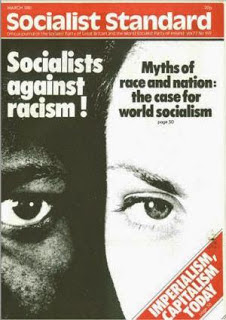
Myths of race and nation (1981)

From the March 1981 issue of the Socialist Standard

An English bus-driver has more in common with a German mechanic than with the Duke of Devonshire. A French accountant shares more experiences with a Russian wages clerk than with Giscard D’Estaing. Across the world there is a mass of people who speak hundreds of different languages and eat a great variety of foods, but who all have one common bond: they own no substantial property and so are forced to work for a living.

As you read this, millions of people are being born into families of workers. They may end up as teachers, miners, dockers, pianists. Of one thing we can be sure. They will be forced to sell their ability to work for a lifetime, simply in order to live. And then, every so often, are born exceptions to this rule—the children of the few families whose names are written over all the stocks and shares, who own the farms, mines and offices. Families of financiers, international business empires, barons of industry. From birth they will be given the best that the world’s workers can produce. They will be taught not how to go looking for jobs, but how to while away their leisure hours in self-indulgent pursuits.

There is a clear class division in present-day society. In capitalism, the world is divided into competing ‘nations’, with a state machine to defend property within each region. The British state, now run by a Tory government, uses armed force to protect private and state property from the indigenous population and from the incursions of foreign powers. Each state, including those of the Warsaw Pact, defends the interests of the small, privileged minority who have power within its boundaries. It is the essentially competitive nature of capitalism which divides the world into rival national blocs.

At the time of writing, the British government is pushing its Nationality Bill through Parliament. If passed, it will create six categories of citizen, only one of which will have the “right to live’’ in Britain. Unemployed workers demonstrating for the “right to work’’ have seen how, in the profit system, there is no such thing. Now workers who have come thousands of miles in the desperate search for employment may find that, if the government does not want them, they don’t even have a right to live. Wage and salary earners are ruthlessly monitored and moved around to where there might be a chance to profit from their work. There is no stability or security.

Workers are endlessly urged to support “the nation”. But we have no stake in Britain; it is just where we happen to sell ourselves. Parties ranging from the Communist Party to the National Front have supported import controls and “British jobs for British workers”. What they are really after is British votes for British politicians. The workers' interest is international. If “British" workers refuse to buy “Japanese" cars, then fellow workers from Japan might lose their jobs. The working class is a global class which owes no allegiance to any nation states. The capitalists themselves invest in whatever country is most profitable for them. Nowadays, one item often includes parts made in ten different countries. This is the background to the question of race and nation.

Recently there has been an increase in violent attacks motivated by racialism. Asians have been stabbed and assaulted with iron bars on housing estates in Islington, where unemployment is more than ten per cent (Guardian, 8/12/80). In 1978, Bethnal Green and Stepney Trades Council documented nearly one hundred such attacks. There has also been racialist violence across Europe, including the bombing of a Paris synagogue last October. It is no coincidence that this is happening at a time of recession and high unemployment. With austerity getting sharper, people turn to look for scapegoats and government, opposition Parties and the Press accept and even encourage this.

The main reason for the decline in National Front support over the last couple of years is the stealing of their political clothes by the Conservative Party. In 1978, Margaret Thatcher announced that Britain was in danger of being swamped by an “alien culture” and that to allay people’s fears, a Conservative government would take steps to prevent further immigration. This was just a piece of opportunist vote-catching, playing on the worst prejudices. Thatcher must have know that in 1977 only 70,000 immigrants had entered Britain, while 200,000 people had emigrated.

The Press encourage racism with headlines like “Asians jump the Housing Queue” (Daily Mail 5/4/76) and “Powell Warning of Erosion of Britain by ‘Alien Wedges’” (Times 10/4/76). The Labour Party, too, has been quick to jump on the bandwaggon. Roy Hattersley has condemned the Nationalist Bill as “racially and sexually discriminatory”. Has he forgotten his speech of 23 March 1965 in defence of the Immigration Act, when he said: “We must impose a test to analyse which immigrants are most likely to be assimilated to our national life".

Our national life? Does Hattersley mean Ascot? Eton College? Workers don’t have a national life. Despite promises to repeal the Immigration Act of the previous Conservative government, in 1965 the Labour government zealously renewed the restrictive measures. Their Home Secretary, Frank Soskice, told the House of Commons, “The government are firmly convinced that an effective control is indispensable". The number of “work vouchers" was even reduced. Bias against negroes and Asians wishing to enter this country continued, as it does to this day. In 1978 Roy Jenkins wrote of “cultural diversity in an atmosphere of mutual tolerance” (Brent Civic Review), but in 1978 he had spoken of the need for “a strict limit on the amount and rate of inward immigration for settlement" (House of Commons 5/7/76).

In 1968, Labour passed their Commonwealth Immigrants Act, an even more overtly racist legislation, which removed the right of entry to Britain from black UK passport holders. The Tories’ 1971 Immigration Act divided British subjects into “patrials”—UK passport holders born here or with parents or grandparents born here—and “non-patrials” who are not permitted to enter without vouchers, of which as few as 2,032 were issued in 1977, The Labour government’s Green Paper on Nationality in 1977 again urged even tighter control. Families from the “New Commonwealth” wishing to join a relation in Britain are brutally stopped. Bone X-rays and virginity tests have been carried out at Heathrow to check age or “marital status”.

In the 1840s, nearly three quarters of a million Irishmen were brought over to build railways and canals in England. In the 1880s refugee Jews and Ukranians supplemented the labour force. Sometimes the flow of labour is actually stimulated through recruitment, at other times it is subject to political controls. After the Second World War, destruction of human life and of machinery stimulated a boom in which the British government recruited workers from the West Indies (1951), then India (1955), and Pakistan (1957). France encouraged migrant workers to come from its ex-colonies of Algeria and Tunisia, and workers flowed into Germany from Turkey and Yugoslavia.

Successive anti-immigration legislation in Britain has aimed to move towards the more flexible and, for the workers concerned, more painful method of short-term migrant contract labour without citizenship, which has been used in France and Germany. Immigrant workers have always been given the hardest jobs and lowest pay, but recently cheap labour has increasingly been provided by European migrant workers. This “gastarbeiter” contract labour costs less in terms of housing, education and social services than a more permanent immigrant workforce, so that is the direction in which capitalism moves. But since the onset of recession in 1974, both France and Germany have introduced cash incentives to encourage the migrants to return “home”.

The racialist attacks on immigrants have no scientific basis at all. The human species has basically uniform physical features and mental potentialities. In that sense there is no race division but only one human stock of homo sapiens. There is no such thing as the British race. National frontiers are arbitrary lines set up by property society and different people within each nation may have a variety of cultural and historical backgrounds. There is no more reason for being preoccupied about whether someone is “black” than for persistently demanding to know the colour of someone’s eyes. In any case, the definition of skin colour is arbitrary. For example, in the USA people of Asian Indian origin are classified as “whites”.

In the days of the slave trade and the growth of the British Empire, racial theories were developed to try to justify the slavery and colonialism as a necessary “civilising mission” of “inferior races”. Lord Leverhulme said at a dinner in honour of the Governor of Nigeria: “The organising ability is the particular trait and characteristic of the white man”. And now blacks whose parents were actually recruited to work in England in the 1950s, and who are often the most exploited and harshly treated section of the working class, are blamed for the economic problems of the system. Workers of all colours are exploited by employers of all colours, but it is black workers who are picked on by racialists, never black (and white) employers. Albert Levy of the Anti-Racialist Movement in France has correctly said that
Fascist groups are useful to the authorities because they turn attention away from genuine struggles by accusing foreigners or Jews of being responsible for all our troubles, as in the 1930s.
but when these groups begin themselves to pose a threat to governing parties, their policies are simply taken over. As a result of major parties taking up the call for immigration control, European neo-fascist groups have found it harder to “rely on racist propaganda and agitation against immigrant workers in order to win popular support” (Guardian 6/10/80).

For the capitalist class, racial strife is seen as a danger threatening the smooth integration and exploitation of highly mobile labour. For example, H. F. Oppenheimer (who amongst other trifles owns a few South African gold mines) has actually put advertisements in newspapers proclaiming “Racial discrimination and Free Enterprise are incompatible” and complaining that he needs more trained and skilled blacks as well as whites if he is going to get the most out of the population who work for him. On the other hand, employers are always ready to use racism to divide and weaken working-class organisation. At the Dunlop strike in Germany in 1967, which involved Turkish migrant workers, a director referred to “members of an alien Mediterranean horde” in the hope of dividing the workforce. Discrimination against immigrants is used to lower wages by isolating sections of the working class.

In trying to blame black immigrants for the problems of capitalism, racialists use several myths.

Population
If this country seems overcrowded, it is because people are concentrated heavily in a few cities, so as not to get in the way of people like the Duke of Buccleuch, who owns more than 250,000 acres of England. If everyone living in Britain were spread evenly over the land, there would be more than an acre for every man, woman and child. The United Nations Food and Agriculture organisation has proved that the earth is capable of feeding and housing several times the present world population. From 1968 to 1977 over half a million more people left than entered Britain. (Office of Population Census and Surveys).

Jobs
In the effort to blame blacks for social problems, two contradictory myths have been made up. On one hand, they are depicted as unemployed “scroungers” and at the same time, they are supposed to be “stealing” jobs from white workers. It is impossible to blame immigration for unemployment. The areas of highest unemployment, such as Scotland and Northern Ireland, are the areas of lowest immigration. During the mass unemployment of the 1930s, there was hardly any large scale immigration at all. Unemployment is a world-wide problem. It is produced by an international recession of capitalism. Blacks are discriminated against in jobs, housing and education. From 1974 to 1977 unemployment increased by about 130 per cent, while unemployment among black workers under 25 years old shot up by 450 per cent (Central Statistical Office).

Housing
In Britain today there are 100,000 homeless families, 600,000 unoccupied houses and no shortage of bricks, wood or labour. There is a “housing shortage” because of the artificial laws of property and profit. Immigrants suffer as a result of this fact, they do not cause it. They are made to wait longer for worse housing. For example, in 1974. 18 per cent of people in Britain did not have the exclusive use of bath, hot water and inside toilet. Among Pakistanis and Bangladeshis, the figure was 57 per cent. Seven per cent of private tenants on council waiting lists wait for three or more years. Among West Indians’ applications the figure was 19 per cent (PEP Survey).

Crime
Racists claim that black immigrants are responsible for a large proportion of violent crime. They are encouraged in this view by police officers like Commander Randall of P Division Metropolitan Police, who described young immigrants as “lazy, vicious little criminals” and David McNee, Police Commissioner for London, whose incredible message to young blacks is “Keep off the streets and you won’t get into trouble”. The figures they produce to support their racial discrimination are distorted in two ways. Firstly, they are based on arrests, not convictions. The “SUS” law has until now allowed police to indulge their prejudices by arresting the people they decide are behaving suspiciously. And even now the Bill to repeal “SUS” contains an escape clause allowing the arrest of people suspected of intending to steal cars. Secondly, immigrants are concentrated in inner city areas where the increased crowding and deprivation causes a desperate frustration which has always given rise to more violent crime.

Neo-Nazi groups like the British Movement have only a minute following, but there is a disturbing tendency now for people to react quite casually to stories of vicious racialist attacks. The only effective way of opposing the mythology of race and nation is in discussion and debate. To prevent the National Front from meeting or broadcasting their views, would be to use the same anti-democratic tactics which they use. A most ridiculous statement of this anti-democratic, tit-for-tat reaction which is so common on the Left, is in a Big Flame pamphlet on racism and fascism, which asks: “Why should we allow ‘free speech’ to those who would take it from us? ”

Of course, if Asians in London’s East End, for example, are intimidated and violently threatened by the National Front marching through the streets, they live in, we could hardly deprecate their attempts to physically defend themselves. We also realise that it is not possible to organise a public debate with the skinhead shock-troopers of the British Movement “Leader Guard”, hired to protect their leader, Michael McLaughlin. But we can constantly expose the false racist ideas which exist in the Conservative and Labour Parties as well as the British Movement and the National Front.

The “Leader Guard” is just the tip of the iceberg, representing an extreme form of the desperation, frustration and racial violence which appears throughout society. Last November, the British Movement marched through London and a group called East London Workers Against Racism attended to physically attack them. The police use this sort of response as an excuse for clamping down even harder; some of the East London Workers Against Racism ended up in prison and now they are campaigning to collect money for bail. But the British Movement remains intact and, more important, so does the social system which continues to give rise to nationalism and racism.
Clifford Slapper

Thursday, August 25, 2016

The SUS Vagrancy Act (1980)

From the August 1980 issue of the Socialist Standard

Recently there has been a series of wrathful protests by various black-community pressure groups and capitalism’s left-wingers about the police abuse of the so-called “Sus” charge. “Sus” is the offence under s.4 of the Vagrancy Act 1824 which provides for the arrest and punishment of “suspected persons” who “frequent or loiter in” a public place “with intent to commit an arrestable offence”, usually an alleged intention to steal.

Several features of this charge make it particularly susceptible to police abuse: “loiter” can refer to any presence except a direct expeditious passage through the place in question; it only requires two policemen to testify (on a book of archaic anecdotes from the Middle East) that they saw the accused “acting suspiciously” on two occasions which need only be minutes apart—first establishes the alleged offender as a “suspected person” the second constitutes his offence; conveniently for the police the accused has no right to trial by jury. Most of capitalism’s exasperated reformers and apologists were even more indignant to learn from Home Office statistics that 42 per cent of those arrested under this charge were “coloured” although this pigmentation-group only accounts for about 3 per cent of the population.

Somewhere in England a man is arrested and incarcerated by a blue-hatted member of his own species for being suspected of intending to take some food from a market stall and . . .  eat it. The hand-cuffs snap shut in the shadows cast by Europe’s huge food mountains. This fleeting moment typifies a social system fraught with contradictions: poverty alongside prosperity, prisons alongside palaces. Modern capitalism has produced tension between human development and political restraint: a man with a twenty-function, battery-operated, liquid-crystal display watch on one wrist and a handcuff on the other, linking him to a policeman leading him to a cell. The digital wrist watch evidences a level of technological advancement and, because it is produced in a factory, our capacity to provide for social needs. Our technology and productive capacity is, however, manifestly NOT being used to maximise the health and welfare of humanity. This global system with its motto of “no ’profit, no production” draws reins on the existing manufactural potential. This tension was explained by Karl Marx:
At a certain stage of their development, the material forces of production in society come into conflict with the existing relations of production or—what is but a legal expression for the same thing—with the property relations, within which they had been at work before. From forms of development of the forces of production these relations turn into fetters. (A Contribution to the Critique of Political Economy, Preface)
For capitalism to continue the notion of property must stand unassailed, but as the system works on minority ownership of the means of life (the land, factories, mills, mines and offices) a factory owner or state will need more than scrolled title deeds to defend a use of the factory which serves the interest of the owner at the expense of the non-owning working class. As the interests of the owner and the non-owner are necessarily at loggerheads — the non-owner is given a wage or salary which has to be worth less than what he has produced in order for the owner to make a profit — capitalism requires constant enforcement of its property ideology. With the advent of industrial production in the early nineteenth century an increasingly comprehensive force was required to maintain the private ownership of society’s means of production.

Since the days of the Bow Street Runners, organised by Henry Fielding after his appointment as a magistrate in 1749, the principal function of the police has been the protection of property. From the cradle we are fed the idea, often in unwritten, unspoken axioms, that the protection of property is in the best interests of everyone. Yet, while for a member of the working class “property” relates to such things as an inquest at school when a pair of plimsolls goes missing; savings he must declare as a supplicant at the Social Security Office, or the semi-detached house for which his mortgage demands a lifetime of payment, “property” for a member of the capitalist class means the enforceable right to use his land, factory or office for optimum profit irrespective of human need.

Every time an arrest is made on “sus”, a number of points should be apparent. First, that the daily enforcement of the laws of ownership in the arena of personal chattels in cases of pickpocketing, shoplifting or mugging is remote from the real focal point of property: the fact that the property of some is society’s means of life. Second, that “crimes" which at first sight have no connection with property—like crimes of violence—are an upshoot of this society which aches with splendour amidst squalor, glorified butchery in war, the shackle of institutionalised monogamy and where, perhaps anaesthetised with alcohol or drugs, sporadic violence is wrought by many of those ditched by capitalism’s competitive chaos.

If the Vagrancy Act which affords the “sus” charge were to be repealed tomorrow, what would be the result? It would be of scant relief to the hundreds of people, mostly black youths, who were likely to be seized by the police every week while the Act was in force. Capitalism would continue as normal. The need for the Accounts Book to always aim for profit would keep nigh on two million people unemployed, and racism would continue to simmer as scapegoats are sought. Blame would still be cast on the “coloured immigrant” despite the fact that areas most blighted with unemployment like Glasgow and Belfast house virtually no such “immigrants”. Coloured people would still find employment harder to obtain than “whites”, would still be left to do about the most anyone can, with no work and the dole-pittance—loiter; would still be bullied by the police who would then resort to a whole range of Statutes and common law precedents to authorise street searches and arrests. Wage-slave policemen eager for promotion or simply to taste the “action” glamourised in recruitment commercials would still abuse their powers.

Policemen with softer truncheons, or reduced powers, will solve no working class problem. While the idea of property reigns the police will remain to protect the minority ownership of the means of life and to maintain the morality and discipline in the working class which is necessary if the majority is to abide the system which offers them employment, unemployment and sometimes conscription while dividends, rents and profits are pushed through the letter-boxes of the capitalist class.
Gary Jay

Wednesday, April 20, 2016

The Old Bill's new Bill (1985)

From the July 1985 issue of the Socialist Standard

Tough law and order policies are a great vote catcher for politicians, who whip up fears among workers that crime and violence are on the increase and then use those same fears to justify increased powers for the police, the building of more prisons and more expenditure on sophisticated technology with which to control and monitor workers' lives.

The Police and Criminal Evidence Act. 1984 will come into effect in January 1986 and is the product of this kind of thinking. This legislation will give the police a whole range of new powers, or rather it will legalise what has long been police practice although officially proscribed. Sir David McNee, former Metropolitan police commissioner. said when giving evidence to the Royal Commission on Criminal Procedure: "Many police officers have, early in their careers, learned to use methods bordering on trickery or stealth in their investigations". Translated into plain English this means that many policemen broke the law in the course of their duties. The new police bill will mean that they can continue with their old practices but do so within the law.

Road blocks
The Act euphemistically refers to police road-blocks as "road-checks" and empowers the police to set up random checks for up to seven days (although this can be extended without limit) if a senior officer thinks that a serious crime has been, or is likely to be. committed in a particular area. Given that “serious crimes" are fairly routine occurrences in most towns and cities there is no reason why the police should not be able to set up road blocks on a more or less permanent basis in such areas.

During the recent miners’ strike, police road blocks were set up, not to prevent crime (although they were justified in the High Court as preventing likely breaches of the peace) but to obstruct the freedom of movement of trade unionists. They were also used to collect intelligence about strikers. their movements and activities which was undoubtedly added to the already large store of information held on the Police National Computer. There is no reason to suppose that once the police have formal powers to set up such road blocks they will be any more scrupulous in their use of them.

Stop and search
Remember the old "sus" laws that were used routinely to harass young black people in the inner cities? Those laws were repealed but under the Act the police will have new powers to stop and search people and vehicles if they have "reasonable grounds for suspicion" that a person is carrying stolen goods, house-breaking tools, offensive weapons or articles used to carry out a theft or steal a car. "Offensive weapons" may include such everyday items as umbrellas, keys, credit cards and combs. And what constitutes "reasonable grounds for suspicion"? Why, the policeman's own perception of what is reasonable! The only safeguard offered to the public is that the police are obliged to give a reason for the stop and to record it as soon as is practicable. But, if they think a person might be too stupid to understand the reason then it need not be given.

If you are young, black, unemployed or homeless then you may very well fit the policeman s stereotype of a criminal and the police will have full powers to harass you in the streets by stopping you, asking you questions, and even searching you.

Entry and search of premises
Under the Act the police will be permitted to enter any premises, including people's homes, without a warrant, and using force if they have "reasonable belief" that in doing so they will find a person who has committed an arrestable offence or who is suspected of having committed a breach of the peace or any number of other offences. In addition, if the police obtain a magistrate's warrant (and they are rarely refused) they will be empowered to enter any building to look for evidence of a "serious arrestable offence".

These new powers are so sweeping that the police will now. quite lawfully, be able to go on "fishing expeditions" for evidence in anyone’s home, place of work or any other building and be able to use "reasonable force" in order to gain entry.

Arrests
The police can arrest people without a warrant if they are "reasonably suspected" of having committed a "serious arrestable offence" or an "arrestable offence". The serious offence category covers not only crimes such as murder, rape, arson, and firearms and explosives offences, but also offences deemed to be threats to the security of the state or public order. It also covers any offence which involves serious financial loss to anyone. This includes all sorts of petty thefts since serious financial loss is defined as "serious for the person who suffers it". If the police suspect you of having committed any such serious offence they can detain you at a police station for up to four days subject to a magistrate's review.

If a policeman suspects that any offence has been committed, no matter how trivial, then a person may be arrested without warrant if certain conditions apply: if the person does not give the police their name and address, or if the police believe that the details given are false; if it is believed that the person might harm themselves or someone else, damage property, obstruct the highway or cause an affront to public decency. If you are arrested under these circumstances the police can hold you at a police station without charge for up to 24 hours.

Detention
After 24 hours the arrested person must either be charged or released. If, however, a person has been arrested for a "serious offence" then they must be brought before a magistrate after 24 hours and only at this point will they be able to talk to a lawyer. The magistrate only has to be satisfied that the person is suspected of a "serious offence", that it is necessary that they be detained in order to secure or preserve evidence and that the investigation is being carried out diligently and swiftly, for the police to be allowed to detain a suspect for a further period of up to four days.

Research into the effects of detention in police custody, including that carried out by the Royal Commission on Criminal Procedure. shows that after a very short time most people, kept in isolation in a police cell and subjected to interrogation (not to mention the threats and physical and verbal abuse which frequently occur), are unable to keep silent regardless of their guilt or innocence. For this reason the Royal Commission concluded that no confession made by a person in this way could ever be regarded as purely "voluntary". And yet such confessions and other evidence obtained in a similar manner will be admissible in court. Is this really so far removed from the "confessions" that are extracted from dissidents by the totalitarian regimes of Russia and Eastern Europe, whose abuses are so regularly deplored by the so-called liberal regimes of the West?

The Act also empowers the police to carry out body searches, including strip searches by a constable of the same sex as the suspected person. "Intimate" body searches will also be permitted, again by force if necessary, despite objections by the British Medical Association that there was a risk of injury. Fingerprints may also be forcibly taken from a detained person if a criminal offence is suspected.

All these measures are justified by the claim that the police need new powers to deal with the rising tide of crime and uphold the rule of law. There is an underlying assumption that given the right laws and a strong police force, together with the appropriate (tough) sanctions, crime can be eradicated or at least reduced to a minimum.

This analysis totally fails to look at the kinds of crime most widely committed and the motives behind them.

Despite the popular impression gained from the media and politicians most crime is not violent but rather consists of minor property offences. Criminals are much more likely to be shop-lifters than murderers or rapists. Such crimes must be seen in the context of a society which defends the acquisition of property so long as people play the game according to the rules. So, for example, it is quite lawful for the capitalist class systematically to rob the working class of the fruits of its labour through the form of exploitation called employment. Indeed, the greater the wealth that can be extracted from the workers the greater the praise and rewards. But if workers break the rules and try to grab a small slice of the cake by helping themselves from shops or banks, then they will feel the full force of the state against them.

A good example of the way in which workers are criminalised in this way occurred during the miners' strike. Many strikers were attempting to heat their homes using coal "picked" (at great personal risk) from slag heaps. This low quality coal had been mined by them and was of little use to the Coal Board, and yet many miners were prosecuted and charged with the theft of Coal Board property. To add further insult to injury a number of miners convicted of this type of "theft" were then sacked.

Class law
Besides the institution of private property itself, one cannot ignore the kinds of anti-social behaviour which capitalism induces through the ethic which places personal gain above that of the community. Is it any wonder that the ruthless and competitive quest for personal wealth is carried over to other areas of life?
Capitalism needs a police force to protect its central institution of private property and look after the interests of the owning class in a more general sense, for example to suppress certain kinds of dissent, justified on the grounds that certain acts constitute a threat to Public Order or National Security. (The recently published Government White Paper on Public Order Law represents a move in the direction of much tighter controls on the freedom of assembly.) The liberal values of impartial justice and the rule of law are mere rhetoric when governments, acting on behalf of the capitalist class, can constantly increase police powers to harass and control workers' lives still further. The "civil rights" of the working class, at best only tenuous, look set to suffer still further erosion.

What is needed is not to make the police more accountable, or to fight this particular piece of legislation or that police practice, but to challenge the whole basis of a society which gives rise to crime and the need for prisons and police forces.
Janie Percy-Smith

Friday, July 24, 2015

Brixton explodes (1981)

From the June 1981 issue of the Socialist Standard

After the riots, the deluge. As the fires died in Brixton, the smouldering passions there were doused in words hosed out from all kinds of social and political analysts. Most of them claimed dolefully that they had been expecting just such a thing to happen for a long time; all of them were alert with theories about the causes, and thereby with suggestions to stop it happening again.

One who did not offer any analysis was the very man in the whole of Britain who might be expected to know more about civil disorder than anyone else—Home Secretary William Whitelaw. But apparently he had so little idea about what happened and why that he had to set up an enquiry to tell him. In charge of the enquiry is Lord Justice Scarman, who did similar jobs on the Red Lion Square confrontation in 1974 and Grunwick in 1977 and who, if he doesn't get a rest from it soon, may come to think that open air life in London is about as peaceful as the North Bank at Highbury when Spurs are playing there.

The analysis of the Brixton riots covered a pretty wide field. On the one hand there was the Labour leader of Lambeth Council, Ted Knight, whose role in the affairs of London becomes daily more obscure as people begin to wonder whether he is a councillor or a comedian. Knight declared (Guardian, 16/4/81):
We went to see the commander of the police tonight to demand that he withdraw his men. He won't do it.
And he then went on to advise:
... a future Labour government must dismantle the Metropolitan Police and replace it with a new force "responsible and answerable to the working class people".
Knight is one of those "practical socialists" who, while not actually being delirious, suffer from these dreams in which the police don't have to be a coercive, property protective force but can assert the minority privileges of capitalism in the interests of the unprivileged majority , This is a common sort of delusion among "practical socialists", who deceive themselves that capitalism doesn't have to be capitalism—and Knight's problem is that when he talks like this he is not joking.

On the other hand there was the reaction of Margaret Thatcher—and nobody is in any doubt by now about her role in capitalism's affairs. There was no surprise when Thatcher resisted the invitation to agree that pressures like racial discrimination and unemployment could have influenced the riots. And in between Knight and Thatcher there were the senseless trendies and liberals, like the teachers who tried to get the NUT Annual Conference to debate an emergency motion which called for the restoration of government grants for housing, education and social services.

One thing all these analyses hold in common is the notion that basically there is nothing wrong with capitalism. They all agree that the priority is not to abolish the system but to patch it up; any conflict between them is over how much patching up is needed, and where, and whether it can be afforded right now. The most visionary among them misconstrue Brixton as the result of malignant government policies and harsh police methods; the least visionary misinterpret the riots as .the malignant response to a benevolent, natural order of things.

From this it is clear that capitalism is OK; Whitelaw would hardly have chosen anyone who was likely to say differently. The Home Secretary is a tirelessly courteous man who resembles a friendly sea lion but that should deceive nobody. His plump, fatherly demeanour hides an iron determination to do as capitalism requires, at whatever cost to an undoubtedly kindly disposition.

How then should an enquiry into Brixton proceed? Well first there is the character of the place and the question of whether this is unique or even unusual. Brixton is not one of the world's beauty spots. Arterial roads suck in heavy traffic; there is the prison of grim infamy and, near the Town Hall, there is Rushcroft Road, where the fascists once jammed the streets with their malignant prejudices. The area was largely an Edwardian development and it has streets of substantial villas of that period, now run down and multi-occupied by the more depressed strata of workers. A study of the southern part of Lambeth in 1976 found 18 per cent of the housing in poor condition and 42 per cent of the people there in shared accommodation. These statistics represent workers whose deprivation is such that they must concentrate where the rents are lowest, even if that also means where the walls are damp, where the rats run and the floors are rotten. For these workers, survival takes a desperate toll; they are capitalism's social misfits or its unemployable—single parent families, weary pensioners and, inevitably, immigrants.

Like many parts of London, Brixton has immigration written into its history and by no means all the immigrants have come from what is evasively called the New Commonwealth. But it did receive the first imported workers from the West Indies in the early fifties, and they have stayed, raised families and are easily identified by other, similarly desperate workers venting their frustrations on the most accessible scapegoat. 

So, Brixton has become famous for tension as well as for its seedy buildings and its street crime. The Metropolitan Police say that Lambeth ranks second in their entire area for violent crime: in 1980 they recorded 2859 cases. In 1975 a police report stated that 80 percent of muggings—quick, violent, usually small scale street robberies—were committed by young blacks and that 85 per of the victims were whites. These figures were triumphantly used by racist organisations like the National Front, would not be anxious to emphasise inherently subjective element involved in any criminal statistics. Workers who were already in a panic at the decline in the fabric of the area might have concluded that they were surrounded by black thugs, that 80 per cent of the black youngsters were muggers. But the same report said that only 4 per cent of youngsters were involved in street crime, suggesting that the overwhelming majority of them keep to the law. 

Brixton's street crime gave it a deserved reputation for being about the most intensively policed part of London. It regularly returned the highest figures, outside the West End; for arrests for Sus, the offence which ropes people in not for actually committing a crime but for a couple of policemen think that they are contemplating one. Brixton has also had unusually frequent attention from the Special Patrol Group, which stopped thousands of people in the streets for spot checks and arrested hundreds of them. The police justified these tactics by a sharp fall in reported street but in the process, to some extent, they replaced the muggers' violence with their own. Contact with the SPG is not a tranquilising experience. Brixton bubbled like a volcano; the police tried even harder to hold the top down but in the end it had to blow up.

The riots were seen by many workers as authentication of the doom laden prophecies which have emanated from Enoch Powell, beginning with his infamous 1968 Birmingham speech in which he foresaw "the River Tiber foaming with much blood". Perhaps Powell feels that his reputation for rigourously logical thinking has been sustained. But there were others who also foretold the trouble which can be expected from crowding a specially depressed population into a decayed area and subjecting it to pressures such as racial discrimination, chronic poverty and state violence. Powell's contribution—if it can be described as such—is to blame the riots, and indeed much of the conditions in which the riots happened, onto the skin colour of the rioters. The famous logician Powell is here indulging in the fallacy of a self-fulfilling prophecy, which may be comfortable for him and which may appeal to the more ignorant and prejudiced among the working class but which is not logical or reasonable .

Even Scarman will probably be aware that Brixton is not unique, either now or in the past. In 19th century Britain, for example, the appetite for labour stimulated by the Industrial Revolution drew masses of Irish workers to this country. They came mainly to escape from the appalling famines in Ireland; with only their working abilities to sell for their living they came looking for employment, cramming into towns like Liverpool, Manchester and Glasgow. By 1851 they made up nearly 3 per cent of the population and, doing mainly unskilled work in textiles and building, they were in competition with equally desperate English workers for jobs and housing.

These were the roots of the discrimination which was practised against the immigrants, with "No Irish" signs up at .the windows and 'employers keeping English and Irish workers apart to avoid trouble at work. Even so there were riots and battles over many years, as one group of degraded workers fought with another over who should be exploited and repressed at one particular place and time. By the end of the century the Irish had become largely absorbed but they had been replaced as the butt of popular prejudice by the Jews, with an Enoch Powell—Tory MP Major Evans-Gordon—rousing mob ignorance for his own political advantage.

Then, as now, deluded workers were avoiding the reality that problems like slums, unemployment, poverty and competition for jobs cannot be laid at the door of an immigrant work force. Capitalism both creates the demand for that work force to be mobile and the urban concentrations in which it must try to survive. For capitalism works by the production of profit, which means by the exploitation of the majority of its people. For capitalism, profitable is beautiful: cheap is beautiful; so often slums are beautiful; conflict is beautiful; ugliness is beautiful. Brixton is beautiful.

And all of this, in 1981, can come into focus on the streets of some urban desert, when a black youngster is stopped by a policeman whose uniform gleams with the authority of one whose job is to protect the minority rights and privileges of the capitalist class which is responsible for the desert. If that same policeman also represents working class prejudices he may treat the youngster to some racist insults. If the focus becomes sharper, like the rays of the sun, there can be a conflagration in which those youngsters might feel that in some undefined way they are getting some of their own back as they riot and burn and loot.

And in that too there was an irony, in Brixton, because as a working class area, the shops specialise in the tawdry rubbish which is all that impoverished workers can afford. The looters were not getting their own back; in what they thought of as their freedom to take what they liked they were in fact affirming their own degradation. .

The conclusion of this enquiry then is that Brixton is not unique in either time or place. There have been many other, similar, riots in many parts of the world and there will be many more for as long as capitalism continues to exploit and repress the majority in the sordid interests of the minority. Here are the roots of Brixton's agony; they will not be approached by any official enquiry no matter how rigorous. The workers of Lambeth, of London and of the world are in a crisis which it is in their own power to end and they should need no judge to tell them what is wrong with society.
Ivan