Showing posts with label December 1973. Show all posts

Saturday, December 7, 2024

Nationalization—a Professor’s Misconceptions (1973)

From the December 1973 issue of the Socialist Standard

One of the problems in expounding Socialism is the persistent myth of “clever” men whose endorsement of other views is impressive to many people. Eminent scientists have followed the zig-zag Communist line; philosophers and mathematicians are found to be Catholics, racists or advocates of capital punishment. The common sentiment is that these opinions are given authority by learned men’s holding them, because someone with all those letters after his name cannot be a fool.

Can he not? In fact the opposite is true remarkably often. To the degree that a person has specialized in some field, his ignorance of others can be so acute as to take away the sense of his specialist knowledge. A classic example is that of Sir James Jeans, the most eminent astronomer of his time, who held religious beliefs so crude as to be comical. The “clever” are not exempt from fear, petulance or prejudice, or the propensity for putting material interests first. Harold Nicolson’s diaries show how a scholarly man’s thoughts may go when he wants a peerage, or under pressure from people round him. The whole idea of learned men who are superiors to the rest of us is a fallacy, a meritocracy-version of “God made them high and lowly, and ordered their estate”.

Higher Authority
In the October issue of The Freethinker, Professor Antony Flew lays down the law about Socialism. To give the background first, the September issue had an article by Professor Flew on the currently-fashionable Karl Popper. This was criticized in a letter by R. W. Morrell, who wrote:
Professor Flew seems to labour under the impression that nationalization has something to do with socialism, and that the criterion by which to judge the political colour of a party is its attitude to the issue. As a self-declared Popperian, he dislikes ‘sweeping’ social change; but is nationalization really ‘social change’, sweeping or other wise?
Professor Flew’s reply is as follows:
Mr. Morrell says: ‘Professor Flew seems to labour under the impression that nationalization has something to do with socialism . . .’ Yes, so I do. So clearly did those who wrote clause IV into the constitution of the British Labour Party. So clearly do all the Communist Parties, who make the implementation of Clause IV a first step after seizing power. So clearly do those who are now dominant in the Labour Party, and who disagree only on precisely how massive an extension of public ownership to propose in their next election programme.

If Mr. Morrell wishes to use the word ‘socialism’ in such a way that nationalization is not a necessary condition of socialism, that, indeed, it has nothing to do with it at all, then the very least he should have done was to indicate what sort of glory he wants to make the word refer to. It is hard to be condemned for not following Mr. Morrell’s eccentric usage when he does not even tell us what it is.
What has to be noted is how the conviction of learned authority works. Every “expert” believes there are other, higher experts — presumably, at the end, a supreme expert before whom nobody may speak. Professor Flew does not consider answering the point. Instead, he refers to the authority of the Labour Party’s Clause IV, the Communist Parties, and “those now dominant in the Labour Party”; to say anything different from them is mere “eccentric usage”. However, there is a much greater eccentricity in his own approach. In the September issue he attacked Marx and “socialism”. Yet Marx’s writings make abundantly clear what Socialism is, and that it is not nationalization. Are we to understand that the learned Professor criticizes what he has not read?

Where's this Better World ?
Professor Flew does speak of concern to “change the world for the better”. It is possible to look at nationalization in that light, without recourse to its economics. People get their definitions of Socialism wrong, but all associate it — however vaguely — with equality, freedom and production for social needs instead of profit. One ought first of all to ask if nationalization achieves any of those things, as a means to judge whether it has “something to do with socialism”.

On that basis, the policies of the Communist Parties can be dismissed immediately. In their model state, Russia, almost all industry is nationalized; personal and political freedom are minimal, the working class has a very poor standard of living and privileged sections have the fat of the land. Some industry was nationalized also in Nazi Germany, and that did not “change the world for the better”.

In this country, the same questions can be asked about the well-established models of nationalization: the Post Office, the railways, the coal industry, the .electricity and gas undertakings. Are workers better-off and more secure in these concerns? On the contrary, all pay poor wages and in recent years have got rid of large numbers of employees. An item in The Guardian on 27th September said:
At a recent Cabinet meeting, according to Field, Ministers were discussing the effects of Stage Three, and the low paid. Somebody asked who exactly were the low paid; nobody round the table knew. Lord Rothschild’s Think Tank was asked to find out, and present a paper on it within two or three days. Among other things that Rothschild came up with was the (fairly well worn) conclusion that it was the Government which was, directly or indirectly, the largest single employer of low paid workers.
Nor is there any benefit to the workers as “consumers”. Each enterprise is bound, as much as it would be in private hands, to compete in the market and try to make a profit. The prices of the commodities produced reflect the general level of prices. Is not Professor Flew ever curious as to why this “socialism” is indistinguishable from capitalism?

Control and Compensation
The purpose of nationalization and the public utility corporations is not to abolish or weaken capitalism but get it to function better as a whole. The last words have to be stressed, because they explain the arguments which take place over any project for State control. Generally, an industry is nationalized when its efficiency is vital to the rest of capitalism, and private groups either are an obstruction in themselves or cannot handle the costs of necessary developments. So far from seeing it as a threat, capitalists are always prepared to consider nationalization so long as their interests — that is, their property incomes — are acceptably arranged-for. What the capitalist loses is control, but not ownership.

Thus, every nationalization scheme includes “compensation”, the exchange of direct shareholdings for State bonds or the securities of whatever corporation is set up. This was done in the post-war Labour government’s nationalizations, and its necessity was reaffirmed in a Labour Party statement Industry and Society in 1957:
It may be that public participation in a private firm can be secured through State investment in it. Where public ownership is extended, full and fair compensation will of course be paid.
Of the present proposals by “those now dominant in the Labour Party”, the Fabian Society has published a pamphlet on housing nationalization called The End of the Private Landlord. The suggested financial arrangements are:
Instead of the standard practice of compensation at market rates, the group proposes the issue of irredeemable but marketable stock whereby landlords would receive the equivalent of a fair rent minus some deduction for management and repairs.
(“Guardian”, 10th September)
This would reproduce what happened in the nationalization of the railways in 1947, where the shareholders were relieved of huge capital expenditures they would have had to make to attain the “fair” level agreed in the compensation terms.

Ownership and Equality
But where do these incomes arise, to be paid to people who — it is said — have ceased to own? They can be provided only from the exploitation of the working class and the production of surplus-value. Nothing, in fact, is altered. The capitalist may have been removed from direct participation in industry and commerce, but he remains the effective owner in that they are conducted as before for profit and interest: which go to him. Professor Flew refers to “those who wrote Clause IV into the constitution of the British Labour Party”. They were more aware of what they were doing than he is. The 1918 statement Labour and the New Social Order spoke of “the progressive elimination from the control of industry of the private capitalist” (our emphasis); nothing about eliminating ownership.

So nationalization has nothing to do with Socialism, but is one form of capitalism. Reformers, attracted by inaccurate phrases like “public ownership”, have seen in it a means of obtaining more equitable distribution under capitalism. How unlucky they have been is shown by facts repeatedly given by Labour spokesmen, when they are in opposition. On 27th September Michael Meacher wrote in The Guardian:
. . . four out of every five households have less than the average income, and only one-fifth have more, largely because in the richest 1 per cent there are some exceedingly rich individuals. If we were as tall as our incomes, they would be 10 miles high whilst most people would be dwarfs.
And in September Lord Shinwell, asked in a television interview what had been achieved in his seventy years as a Labour politician, said: Nothing. There were still the rich and still the poor — just the same.

Socialism, unlike those Professor Flew cites as authorities on it, is concerned first and foremost with ownership, simply because that is the foundation and changing-point of every social system. Capitalism exists on the basis of private or limited ownership of the means of living. From that, all the apparently ineradicable problems of our present world arise. Socialists know, however, that they can be eradicated: by establishing common ownership as the basis of society. The obstruction to it is ignorance — including what a 19th-century essayist called “the ignorance of the learned”.
Robert Barltrop

Friday, December 6, 2024

On the Spot at Con-Mech (1973)

From the December 1973 issue of the Socialist Standard

Nor entirely satisfied with the mass media’s reporting on the Con-Mech dispute, I went along to find out for myself. As I arrived outside the Sheerwater factory, I saw a group of four or five men on the pavement. Among them I recognised Lindsey Greig, who is one of the two shop stewards. He is 21. A graduate of Warwick University, he joined Con-Mech this summer. From the company’s point of view he is a “trouble maker” and had “spent much of his working time soliciting membership for the AUEW”. The other shop steward, Ron Connor, an ex-miner from Co. Durham, has experience of trade union membership, but is also young.

Con-Mech is a small factory-cum-office on Sheerwater GLC estate outside Woking, Surrey. The Group make bread slicers and parts for bulldozers and other earth-moving machinery. According to a circular issued by Mr. Robert Dilley, the company’s chairman, on September 28th, there are 67 people employed of which he claims 51 are “eligible to join a Union” — any union. I asked him over the phone if this figure included staff workers, typists, etc., but he emphatically denied this. However the workers and the AUEW who have checked the branch’s books, assert that the total number of shopfloor workers eligible to join the AUEW was only 31. Indeed I would think that this is the correct figure, as Dilley’s 51 could only have got in with dangerous overcrowding. It is a small factory.

Before September 19th the union had only four members, of whom Ron Connor was one. At the branch meeting 22 Con-Mech workers including Greig became union members. Next day the union members elected Greig and Connor as their shop stewards and decided to apply for a meeting between the District Secretary Geoff Hardy (a member of the Communist Party) and the Company to discuss recognition, etc. The shop stewards’ account of how this application was met is indicative of the employer’s attitude:
Our first discussion with the Management was brief and to the point. We were told that under no circumstances would they afford recognition, and that the two elected Shop Stewards could “pick up their cards” on the way out. (Undated leaflet issued in the name of Ron Connor as Secretary of the Strike Committee.)
It seems that on every point at issue there are two different and mutually contradictory stories. How many shop-floor workers were eligible for the AUEW? Dilley says 51, the union only 31. How many came out on strike? Dilley says only 20, the union 26. How many are still out on strike now (Oct. 26)? Dilley says only 9 — the rest, he says, are either back at work or else have collected their cards and got jobs elsewhere. But the union say they are paying strike pay to 16 men on their books. Were the shop stewards sacked? Not according to Dilley, but it is hard to see why, immediately after their interview with him, there was a mass walkout and decision "to withdraw labour until such time as not only the two stewards were reinstated, but the Company conceded recognition”.

On September 28 Dilley took the case to the National Industrial Relations Court under Sir John Donaldson on the grounds that the strike constituted an "unfair” industrial practice because there had been no seven days’ notice. At which stage the question ceases to be a relatively simple one of an industrial stoppage over a recognition issue, but becomes bedevilled by the AUEW’s stoic masochism and boycott of the NIRC (surely they could have countered Dilley by putting their case on reinstatement of the shop stewards and recognition?), but also by the Labour and TUC opposition to the Industrial Relations Act and NIRC.

At which point I’ll get back to those pavement pickets. Their main motive for being out was nothing to do with the Industrial Relations Act and party political matters. What they wanted was union recognition, not as an end in itself, but as a means to an end, a means of compelling management to do something about unsatisfactory conditions. I was told of safety hazards on some of the machines, of poor ventilation, of the shopfloor being cluttered and dirty. I heard that rates of pay were arbitrarily and unfairly fixed — the longer you stayed the less you got in relation to blokes who had just come in on "outside” rates of pay. For instance, Lindsey Greig, a young newcomer, got a lot more than an older, better and more experienced worker.

Another factor was the high speed arrival and departure of shopfloor workers. There would be seven or eight new ones every Monday, and of these hardly a couple would still be in the place on Friday. There was a tendency to take young workers, including students, and there was a high proportion of immigrant workers — Italians and Pakistanis came to nearly half the workforce. In the event, the Pakistanis have mostly stuck with the union so far, but the Italians went back in.

In the absence of a union, inexperienced, young or immigrant workers are least likely to be aware of safety hazards in operating the machines, and in case of accident are unlikely to be aware of their legal rights on compensation; also they might not be in a position to press any claim. Is this why Dilley is so opposed to recognition of the union? Is he afraid that someone might report him for empty firebuckets? Or get him to modify some of his plant, e.g. the monstrous machine outside in his backyard which chops up metal into different lengths and which the operator can only switch on or off when inside the building? Or to give up some of his old-fashioned habits, like sacking people at the drop of a hat?

The first sentence of Dilley’s circular of September 28th claims: “For twenty-five years the employees and the management have enjoyed excellent labour relations.” The men totally disagree, and they point out that last November there was a stoppage lasting several hours over pay and conditions, which ended when another director conceded a pay increase. In the next sentence, we read: “the conditions of employment have always been superior to those laid down by any Union”. The proof of the pudding is in the eating: there would be little cause for men to stay out on strike with only £6 strike pay for weeks on end and still remain resolved to force union recognition if conditions were as "superior” as Dilley alleges. The men however know very well how badly their conditions and rates of pay compare with other factories in the area, whose workers are solidly supporting them (e.g. in such practical ways as laying on hot tea twice a day, or getting statements photo-copied for the pickets to hand out, not to mention helping out with picket duty).

The employer seems an awful ass, dogmatic and intransigent, characteristically the type who has been using NIRC. The Union leaders seemed at times to have had a stronger eye on making party policy propaganda for the Labour Party than with the immediate interests of their members on strike. But the strikers themselves have shown commendable solidarity and stamina — qualities which, added to socialist understanding, will overthrow capitalism and establish Socialism.
Charmian Skelton


Blogger's Note:
By the look of this obituary for Lindsay Greig from 2015, he would have been a member of the International Socialists group (now known as the SWP) at the time of the dispute. In fact, the strike at Con-Mech is mentioned in the obituary.

So They Say: Light the Blue Paper and Retire (1973)

The So They Say Column from the December 1973 issue of the Socialist Standard

Light the Blue Paper and Retire

When war broke out in the Middle East, the leaders of the Great Powers all spoke of “deep regret”. Newspapermen enlarged on the horror and futility of it. In the Sunday Mirror on 15th October Jon Akass wrote:
A pity, really, that technology is not yet up to bringing the smell of war to our living-rooms, because that would finally remove whatever romance is left in human combat . . . The best that Israel can hope for is that the Syrian army will be eliminated and the Egyptian army in Sinai routed. And perhaps another year or two of peace. It will not be enough for the price that will have been paid in blood.
It was as if sons of a good home had been caught housebreaking, to their parents’ grief. But on 16th October The Guardian gave an account of the military background.
The Israeli air force was then [in 1967] predominantly French until De Gaulle placed his embargo on the Mirages. President Johnson supplied the first Skyhawks and Phantoms to Israel in 1968 but the bulk of the $1,000 millions of arms sales to Israel since the June, 1967 war was made by the Nixon Administration.

. . . [The Soviets] arms shipments were designed to enable Egypt and Syria to do exactly what they have done in the last nine days, which is to defend themselves against Israeli air power while making limited incursions into occupied territory.
So the sorrowful parents are shown as a Fagin family — teaching the art, supplying the tools, and then lamenting the consequences. Capitalism calls this hypocrisy “diplomacy”.


Lord God of Property

Talking of hypocrisy, the Church of England springs to mind. Its finances were reviewed in the Business section of The Observer on 4th October, with two writers advising how the Church Commissioners’ “£600 million-plus assets” might produce a higher income. Their chief criticism was of the Commissioners’ unadventurousness in holding on to house-property with a relatively low return:
Margaretta Terrace, SW3, provides a good example. This street contains about 40 houses, with an average rent of around £1,000 a year: as the houses are worth a minimum of £40,000—and probably much more—the ‘true’ yield is thus only 2.5 per cent.
Their suggestion was to sell, and to require a down payment of £5,000:
The balance of the consideration would take the form of a 25 or 30-year mortgage: and, at the current mortgage rate of 11 per cent, the Commissioners would receive £154,000 a year.

Eye of a Good-Sized Needle

The Church Commissioners have had this sort of advice before and — no doubt for equally sound business reasons — chosen not to follow it. But an interesting question is raised here. “The current mortgage rate of 11 per cent” has taken on the status of a social problem in recent months. Its rise to that figure was a financial vicious circle: to get more money to lend, the building societies had to offer higher rates to investors, which meant charging a higher rate to borrowers.

But the Church Commissioners do not have that problem. Selling the houses in question, they would not be advancing money but simply taking deferred payments. Using the Observer calculations, if they charged a mortgage rate of only 6 per cent, they would receive £84,000 a year from those houses — which is still more than twice as much as they are said to be getting now in rents. The Commissioners would not only do what the writers want them to do, i.e. make more money; they would be Giving a Christian lead to the Nation, etc.

Is it likely that they will? No. It will not enter the Commissioners’ heads, any more than it did the Observer writers’. As the Good Book says: “Where a man’s treasure is, there shall his heart also be.”


Beggars Cannot be Choosers

And talking of borrowing money. Newspapers have given a good deal of publicity to the Consumer Credit Bill published on 2nd November. It is designed to check “abuses” in hire-purchase, moneylending, second mortgages, and so on. The provision which was asked for most persistently is the one requiring that borrowers shall be told clearly what they are letting themselves in for:
Borrowers required to put up their homes as security for loans and those who obtain loans by mail order will have to be informed of their right to back out before finally signing the loan agreement; and all borrowers will have to be given a copy of every agreement they sign.
(Observer, 4th November)
The Observer writer on "Family Finance”, Paul Wilson, thinks this is inadequate:
Why not lay down a formula by which loan interest rates are calculated, so that all advertised rates are comparable? Why not define what constitutes an extortionate rate of interest, so consumers will know when they have cause for complaint?
This talk is as fatuous as the Bill itself. People go to moneylenders and second-mortgage companies when they have no alternative, and therefore no choice but to accept the terms whatever they are. Can you imagine a loan company’s client, with creditors breathing down his neck, exercising his “right to back out”? Every rate of interest is extortionate. The only way to end problems like this is to get ride of capitalism and, with it, money.


What Makes Great Men ?

People, particularly those who think themselves mentally superior, are often reluctant to accept our contention that intelligence is a social concept. The acclaimed genius of one set of circumstances can be the blithering idiot of another: it depends what society is looking for.

There is an example in the balance at present. Harold Bate is a retired engineer who runs a car on methane gas made from pig and chicken manure. He has done it for seventeen years, and has occasionally appeared in newspapers and on TV as a comical curiosity. Now, suddenly, it is being taken seriously and he has had to take production to a Walsall firm. The Sunday Express on 4th November reported his growth:
“At the moment I am receiving around 150 orders a day from the US and Canada. They are coming in shoals from all sorts of sources—even oil companies. Two major American oil companies—I agreed at their request not to name them—have already used my conversion kit to convert a fleet of oil delivery tankers to run on gas."
Is Harold Bate a genius or a crank? We have yet to learn. What will decide is the world fuel situation. If there is a world shortage of oil, he may well go down with Edison and Stephenson and his story be told to every schoolchild. If it doesn’t happen, he will have been nobody of note.


Gaiété Mancunienne
The magazine calls her Marie-Helena. a model born in Lyons and now living in Paris. But Paula, on a commerce course at school, lives with her parents in a council house at Wythenshawe, Manchester.
(News of the World, 14th October)
The magazine is Men Only. The cream-bun fantasies it sells cannot be set in Manchester or anywhere else the readers may actually live. How sad.
Robert Barltrop

Leaders and led (1973)

From the December 1973 issue of the Socialist Standard
Chong Tse, a great Chinese sage of ancient days (over 2,000 years ago) said that as long as we have great leaders, just so long will we have great masses of followers, which means that some people will be in subjection. Equality was the ideal. Let all men think for themselves. The law, said he, does not prevent crime. In fact all law was a crime in itself for all law was the law of the strong thief who guarded his theft with it. This was the law of the leaders. 
From a pamphlet China and the Social Revolution by Kiang Kang Hu, National Secretary of the Socialist Party of China. Published in San Francisco, 1910.

Blogger's Note: 
This pamphlet  by Kiang Kang Hu was reviewed in the September 1914 issue of the Socialist Standard.

Recent books on trade unions (1973)

Book Reviews from the December 1973 issue of the Socialist Standard

Strike at Pilkingtons by Tony Lane and Kenneth Roberts. Fontana. 50p.
Ford Strike by John Matthews. Panther. 40p.
Trade Unions ed. by W. E. J. McCarthy Penguin, 60p 
Marxism and the Sociology of Trade Unionism by Richard Hyman. Pluto Press.
Strikes by Richard Hyman. Fontana. 50p.
The New Militants by Paul Ferris. Penguin. 25p.

The increased trade union militancy of recent years has brought a rash of books on the subject. Of these listed above the one by Paul Ferris is a short and very readable journalistic account of meetings with various union leaders such as Scanlon, Jones and Daly.

The first two books describe two particular strikes, the unofficial seven-week strike at Pilkington glass works in St. Helens in 1970 and the official strike at Fords in 1971. Of the two Lane and Roberts’ is by far the better. Matthews sees only four parties involved: the unions, the rank and file, the employers and the government. In other words, he uncritically accepts the shop stewards’ claims that they represent the ‘rank and file’; indeed that they are the rank and file. In fact, however, though at times they may more faithfully represent the ordinary worker than the official union they too are just as much a minority leadership group. They are no more the rank and file than are the full-time union officials, but are essentially one of two rival groups seeking the leadership and support of the rank and file. This is fully recognised by Lane and Roberts.

The men at Pilkingtons were members of the General and Municipal Workers Union, one of the most bureaucratic and conservative unions. In April 1970 the men went on spontaneous unofficial strike, ostensibly over a wage miscalculation. The union told them to go back to work, but the strikers’ demands soon escalated to a claim, for a £10 wage increase. The union did in fact manage to get them a £3 increase (a sign of how it had failed in its job over the years of course). This wasn’t enough for the strikers, at least for some of them. A Rank and File Strike Committee (RFSC) kept the strike going in face of the opposition of the GMWU.

Lane and Roberts paint a sympathetic picture of the members of this Committee: they weren’t seasoned militants but ordinary workers who suddenly found themselves in the unexpected role of strike leaders. But the two authors don’t let this sympathy cloud their judgement. They recognised that after the union had negotiated the £3 increase a majority of the men, a small majority, but still a majority, wanted to return to work. Why then did the strike continue for another four weeks? Because, argue Lane and Roberts, those who wanted to continue the strike were better organised and led by the RFSC.

The GMWU would have been the natural organiser and leader of those who wanted to return to work, but it had been completely discredited by its role at the beginning of the strike. It was widely held to have let down its members. They, it was felt, had been paying dues to the union as a kind of insurance for just such a situation as happened at the beginning of the strike. “Something went wrong” but, instead of the union supporting its members, it told them to go back to work. The members, understandably felt betrayed; in fact they were betrayed. Hence the RSFC emerged as an alternative organisation which the workers turned to.

In the end the superior resources and skill of the GMWU leaders led to the defeat of the amateurs of the RFSC. The men went back to work for £3 a week extra, though with a pledge of no victimisation. The RSFC then made the mistake of organising a rival Glass and General Workers Union. This provided the GMWU with an excuse to deal with them. With the help of Pilkingtons the Glass Workers union was crushed and most of its members lost their jobs.

The Pilkingtons' strike, as can be seen, raised many issues of trade union tactics—democracy, strike ballots, unofficial committees, breakaway unions—all of which are intelligently discussed by Lane and Roberts. In fact it is an excellent book and essential reading for those who want to understand trade unionism, its uses and limitations.

Trade Unions
, edited by W. E. J. McCarthy, is a collection of readings for management students, but it still contains material of interest to Socialists. The picture emerges of trade unions as bureaucratic organisations trying to defend the wages and working conditions of their members. "The aim of the union”, says one author, “is to primarily to benefit the group of workers concerned, rather than the workers as a whole or society as a whole”. Writes another, “Most unions seem to have come into being originally as defensive organisations to preserve a standard already enjoyed”. Both views we ourselves have often made. The unionization of an industry is estimated to have had a once-for-all effect of raising wages by 10 to 15 per cent, but thereafter to have maintained them at the same level. This would fit in with Marx’s view that at best all unions could do was to ensure that their members got paid the value of their labour power and that without unions employers would drive wages down below this level. The 10 to 15 per cent would presumably be the measure of the extent to which this had happened.

Marx’s views on unions, together with those of Lenin, Trotsky and Michels, is the subject of one of Hyman’s books. Apart from the conclusion—Hyman is a member of IS and seems to favour creeping ‘workers management of production’—this is a useful book which discusses the various different and contradictory (employers need unions to discipline and regulate their work force) roles played by the unions. Hyman’s book on strikes, however, is not so good. The obscure sociological jargon and hundreds of references make it difficult reading. Nevertheless, if you wade through it you’ll get a more accurate picture of strikes than you get in the press or on television.

None of these books state the attitude of the Socialist Party of Great Britain on trade unionism (though they do provide evidence to confirm its correctness): trade unions are essentially only defensive organisations whose actions should be supported insofar as they perform this job of defending working class living standards, but whose other activities in support of capitalism—co-operating with employers or governments or reformist parties—should be opposed along with any manifestations of the narrow sectionalism to which they are inevitably prone.
Adam Buick

50 Years Ago: The Profit-Sharing Snare (1973)

The 50 Years Ago column from the December 1973 issue of the Socialist Standard

When we have pointed out that profit-sharing and bonus schemes introduced by so-called good employers were merely means to increase profit, effect economies, and attempts to subdue the growing unrest of the workers, we have been accused of being impossibilists, carping critics, or agitators actuated by malice. From time to time we have dealt with the boasted benevolence of the Levers’, the Cadburys, and the various co-partners, and now we have further confirmation of the correctness of our case from the profit-sharing proposals of Lloyds Bank, Ltd. Discussing these proposals, Mr. J. W. Beaumont Pease, the Chairman of Lloyds, said (Daily Chronicle), October 22, 1923;
  “The directors firmly believed the scheme would improve relations between employer and employed and would be all for the good of the shareholders, the directors and the staff.”
To improve relations means, of course, to anticipate the stifling of future discontent, and the recent organisation of bank clerks may have helped the directors toward their latest decision. Further we read:
  “The scheme was not likely to diminish the amount of profit available for the shareholders’ dividend, and it was quite possible it would not cost the bank anything. There was, Mr. Pease added, no question of the loyalty of the staff, but the scheme would increase the zeal with which they worked for the bank, and it would materially increase the profit. . . .With the large number employed, these economies in the aggregate would mean much.”

[From an unsigned article in the Socialist Standard, December 1923.]

SPGB Meetings (1973)

Party News from the December 1973 issue of the Socialist Standard


Wednesday, December 5, 2018

Marx’s Conception of Socialism (1973)

From the December 1973 issue of the Socialist Standard

Marx usually referred to the society he aimed to see established by the working class as “communist society”. Precisely because he believed that “communist society” would be the outcome of the struggle and movement of the working class against its capitalist conditions of existence, Marx always refused to give any detailed picture of what he expected it to be like: that was something for the working class to work out for itself. Nevertheless scattered throughout his writings, published and unpublished, are references to what he believed would have to be the basic features of the new society the working class would establish in place of capitalism.

Voluntary Association

It must be emphasised that nowhere did Marx distinguish between “socialist society” and “communist society”. As far as he, and Engels, were concerned these two words meant the same, being alternative names for the society they thought the working class would establish in place of capitalism, a practice which will be followed in this article. As a matter of fact besides communist Marx employed four other words to describe future society: associated, socialised, collective and co-operative. All these words convey a similar meaning and bring out the contrast with capitalist society where not only the ownership and control of production but life generally is private, isolated and atomized. Of these the word Marx used most frequently — almost more frequently than communist — was association. Marx wrote of future society as “an association which will exclude classes and their antagonism” (PP, p. 197) and as “an association, in which the free development of each is the condition for the free development of all” (CM, p. 82). In Volume III of Capital Marx writes three or four times of production in future society being controlled by the “associated producers” (pp. 428, 430-1 and 800). Association was a word used in working class circles in England to mean a voluntary union of workers to overcome the effects of competition. This was Marx’s sense too: in future society the producers would voluntarily co-operate to further their own common interest; they would cease to be “the working class” and become a classless community.

No Coercive State

In these circumstances the State as an instrument of political rule over people would have no place. Such a social organ of coercion was, in Marx’s view, only needed in class-divided societies as an instrument of class rule and to contain class struggles. As he put it, in socialist society “there will be no more political power properly so-called since political power is precisely the official expression of antagonism in civil society” (PP, p. 197) and “the public power will lose its political character. Political power, properly so called, is merely the organised power of one class for oppressing another” (CM, p. 81).

Socialist society would indeed need a central administration but this would not be a “State” or “government” in that it would not have at its disposal any means of coercing people, but would be concerned purely with administering social affairs under democratic control. Marx endorsed the proposal of Saint Simon and other early critics of capitalism for “the conversion of the functions of the State into a mere superintendence of production” (CM, p. 98), and also declared that “freedom consists in converting the state from an organ superimposed upon society into one completely subordinate to it” (CGP, p. 32). In other words, once Socialism had been established and classes abolished, the coercive and undemocratic features of the State machine would have been removed, leaving only purely administrative functions mainly in the field of the planning and organization of production.

Common Ownership

Natural resources and the man-made instruments of production would be held in common: Marx speaks of “a community of free individuals, carrying on their work with the means of production in common” (Vol. I, p. 78) and, in his Critique of the Gotha Programme, of “the co-operative society based on the common ownership of the means of production” (p. 22) and of “the material conditions of production” being “the cooperative property of the workers themselves” (p. 25). It is significant that Marx never defined communist society in terms of the ownership and control of the means of production by the State, but rather in terms of ownership and control by a voluntary association of the producers themselves. He did not equate what is now called “nationalisation” with Socialism.

Planned Production

Another feature of communist society, in Marx’s view, would be consciously planned production. He writes of a society “in which producers regulate their production according to a preconceived plan” (Vol. Ill, p. 256) and of “production by freely associated men . . . consciously regulated by them in accordance with a settled plan” (Vol. I, p. 80).

Conscious planning, conscious control over the material conditions of life, was for Marx clearly the essence of Socialism. In the 1840’s, when he used to express himself philosophically, Marx was continually emphasising this point. This was what he meant when he said that real history would not begin till Socialism had been established; human beings were not behaving as human beings so long as they were controlled by blind historical and economic forces, ultimately of their own creation but unrecognized as such; Socialism would allow men to consciously regulate their relationship with Nature; only such a consciously planned society was a truly human society, a society compatible with human nature.

But Marx’s approach to planning in Socialism was not just philosophical. It was practical too. He was well aware that to regulate “production according to a preconceived plan” would be a huge organizational task. Indeed, that it would be, if you like, the economic problem of Socialism. Matching production with social wants would in the first instance be a huge statistical exercise. Marx emphasised that for this sort of reason “book-keeping” would be more necessary in Socialism than under capitalism — not that he envisages the books in socialist society being kept in money. Socialist society, he felt, would use some direct measure of labour-time for its statistics and planning (Vol. Ill, pp. 184 and 830). Calculations would have to be made of how much labour-time would be needed to produce particular items of wealth; the real social (as opposed to monetary market) demand for the various items of wealth would also have to be calculated; and all the figures put together to construct a definite plan for the allocation of resources and labour to the various different branches of production.

In a number of places Marx compares how capitalism and Socialism would tackle the same problems, for instance a long-term project which would not bear fruit in the form of finished products for some years but which in the meantime would have to be allocated labour and resources. Under capitalism, said Marx, this creates monetary problems and upsets; but in Socialism it is only a question of “preconceived” planning, of making allowances for this beforehand (Vol. II, pp. 315 and 358). Similarly with miscalculations, say overproducing: under capitalism (where overproduction means in relation to market demand) this causes a crisis and a drop in production; in Socialism (where overproduction would be in relation to real social demand) there would be no problem: it could be corrected in the next plan (Vol. II, pp. 468-9).

In his Critique of the Gotha Programme (p. 22) and in Volume III of Capital (p. 854) Marx lists the various major uses to which the social product would have to be put in a socialist society:

  1. Replacing the means of production  (raw materials, wear and tear of machinery, etc.) used up in producing the social product.
  2. Expanding the means of production so as to be able to produce a larger social product.
  3. A small surplus as a reserve to provide against accidents and natural disasters (and planning miscalculations, we might add).
  4. The individual consumption of the actual producers.
  5. The individual consumption of those unable to work: the young, the old, the sick.
  6. Social consumption: schools, hospitals, parks, libraries, etc.
  7. Social administration not connected with production.
This is obvious of course but it is as well to spell it out so as to show that Marx did discuss some of the practical problems of totally planned production.

Abolition of the Market

Socialist society, as Marx repeatedly made clear, would be a non-market society, with all that that implied: no money, no buying and selling, no wages, etc. In fact it was his view that proper planning and the market are incompatible: either production is regulated by a conscious previously worked-out plan or it is regulated, directly or indirectly, by the market. When Marx talked about men under capitalism being dominated by blind forces, which were in the end their own creations, it was precisely blind market forces he mainly had in mind. For him capitalism was essentially a market economy in which the allocation of labour and resources to the various branches of production was determined by what he called “the law of value”.

Although production under capitalism was not consciously controlled, it was not completely anarchic: some sort of order was imposed by the fact that goods exchanged in definite proportions, related both to the amount of socially necessary labour-time spent in producing them and to the average rate of profit on invested capital. Under capitalism it was the averaging of the rate of profit on the capital invested in the different branches that regulated production. But this was an unplanned hit-and-miss process which was only accurate in the long run; in the short run it led to alternating periods of boom and slump, labour shortage and mass unemployment, high profits and low profits. The assertion by society of conscious control over production, and the allocation of resources to the various branches of production in accordance with a previously settled plan, necessarily meant for Marx the disappearance not only of production for profit, but also of the whole mechanism of the market (including the labour market, and so of the wages system), of production for the market (“commodity-production”), of buying and selling (“exchange”) and of money.

The Communist Manifesto specifically speaks of “the Communistic abolition of buying and selling” (p. 72) and of the abolition not only of capital (wealth used to produce other wealth with a view to profit) but of wage labour too (p. 73). In Volume I Marx speaks of “directly associated labour, a form of production that is entirely inconsistent with the production of commodities . . .” (p. 94) and in Volume II of things being different “if production were collective and no longer possessed the form of commodity production . . .” (p. 451). Also, in Volume II, Marx in comparing how Socialism and capitalism would deal with a particular problem twice says there would be no money to complicate matters in socialist society: “If we conceive society as being not capitalistic but communistic, there will be no money-capital at all in the first place . . .” (p. 315) and “in the case of socialized production the money-capital is eliminated” (p. 358). In other words, in Socialism it is solely a question of planning and organisation. Marx also advised trade unionists to adopt the revolutionary watchword “Abolition of the Wages System” (VPP, p. 78) and, in his Critique of the Gotha Programme, stated “within the co-operative society based on the common ownership of the means of production, the producers do not exchange their products” (pp. 22-3) for the simple reason that their work would then be social not individual and applied as part of a definite plan. What they produce belongs to them collectively, i.e. to society, as soon as it is produced; socialist society then allocates, again in accordance with a plan, the social product to various previously-agreed uses.

Distribution of Consumer Goods

One of these uses must be individual consumption. How did Marx think this would be organised? Here again Marx took a realistic view. Eventually, he said, the principle “from each according to his ability, to each according to his needs” would apply (CGP, p. 24). In other words, there would be no social restrictions on individual consumption, every member of society being free to take from the common stock of consumer goods according to their individual need. But Marx knew that this presupposed a higher level of productivity than prevailed in his day (he was writing in 1875). In the meantime, while the productive forces were being expanded, individual consumption would unavoidably have to be restricted. How? Marx made the simple point that how wealth would be allocated for individual consumption in communist society would depend on what and how much there was to allocate: “The mode of this distribution will vary with the productive organisation of the community, and the degree of historical development attained by the producers” (Vol. I, p. 78).

This was another obvious point, but on three or four occasions Marx went further and referred to a specific method of regulating distribution: by “labour-time vouchers”. The basic idea of such a system is that each producer would be given a certificate recording how much time he had spent at work; this would entitle him to draw from the common store of wealth set aside for individual consumption an equivalent amount of consumer goods, likewise measured in labour-time. This, as Marx himself recognised, was only one of many possible systems Socialist society could democratically agree on for allocating wealth for individual consumption in the temporary conditions of relative scarcity here assumed — realistically for 1875 — to exist. As long as the total number of vouchers issued matched the total amount of wealth set aside for individual consumption, society could adopt any criteria it chose for deciding how many vouchers particular individuals, or groups of individuals, should have; this need bear no relationship at all to how many hours an individual may or may not have worked. Similarly, the “pseudo-prices” given to particular goods to be distributed need bear no relation to the amount of labour-time spent on producing them. Marx himself described some of the defects of the labour-time voucher system, but also made the point that any voucher system of allocating goods for individual consumption would surfer from anomalies, being forced on socialist society by the not-yet-developed-enough productive forces in what he called “the first phase of communist society”.

When Marx mentions labour-time vouchers in Capital he always made it quite clear that he was only assuming such a system as an example: “merely for the sake of a parallel with the production of commodities” (Vol I, p. 78) or that the producers “may, for all it matters, …” (Vol. II, p. 358) receive labour-time vouchers. He also emphasised that these vouchers would not be money in its proper sense: “Owen’s ‘labour-money’ … is no more ‘money’ than a ticket to the theatre” (Vol. I, p. 94) and “these vouchers are not money. They do not circulate” (Vol. II, p.358). (See also his discussion of so called “labour-money” in The Critique of Political Economy, pp. 83-6.)

Marx’s point here is that the vouchers would merely be pieces of paper entitling people to take such and such an amount of consumer goods; they would not be tokens for gold like today’s paper money; once handed over they would be cancelled and so could not circulate. Besides, they would be issued as part of the overall plan for the production and distribution of wealth. Finally, we repeat, any voucher system, whether on a labour-time or some other basis, was seen by Marx only as a temporary measure while the productive forces were developed as rapidly as possible to the level where they would permit socialist society to go over to free access according to individual need.

This is why this is now only an academic problem. The further development of the forces of production since Marx’s day has meant that the system he always said was the final aim of Socialism — free access to consumer goods according to individual need — could now be introduced almost immediately Socialism was established. The problem Marx envisaged labour-time vouchers as a possible solution to no longer really exists.

Conclusion

We have seen, then, that Marx held that future communist society would be a classless community, without any coercive State machine, based on the common ownership of the means of production, with planning to serve human welfare completely replacing production for profit, the market economy, money and the wages system — even in the early stages when it might not prove possible to implement the principle “from each according to his ability, to each according to his need”, which, however, always remained for Marx the aim. Marx, and Engels, never drew any distinction between “socialist” and “communist” society, using these (and other) terms interchangeably. He did, however, believe that this society would only be established after a “period of … revolutionary transformation” (CGP, p. 32) of a number of years duration during which the working class would be using its control of political power to dispossess the capitalists and bring all the means of production under democratic social control — but, here again, the further development of the productive forces since Marx’s day means that the socialist revolution can now be carried through very quickly with no need for any lengthy period between the capture of political power by the working class and the establishment of socialism.
Adam Buick


References:

CGP.  Critique of the Gotha Programme. Marx-Engels, Selected Works, Vol II Moscow, 1958.

CM.  Communist Manifesto, Moscow, 1954.

PP.  Poverty of Philosophy, Moscow, 1956.

Vol I.   Capital, Vol I, Moscow, 1961.

Vol. II. Capital, Vol II, Moscow, 1957.

Vol III. Capital, Vol III, Moscow, 1959.

VPP. Wages, Price and Profit, Peking, 1969.

Critique of Political Economy, Lawrence and Wishart, 1971.

Friday, September 14, 2018

An inflation cat out of the bag (1973)

From the December 1973 issue of the Socialist Standard

Richard Crossman, Minister of Health in the last Labour Government, for years a member of the National Executive, has been elected as Labour MP at every General Election since 1945. At each of these elections he was committed by the party’s Election programme to fight inflation. At the last General Election, 1970, a section of the Labour programme was headed "Fighting Inflation", and his leader, Harold Wilson, puts at the forefront of his attacks on the Heath Government that it has failed to keep prices from rising and that only a Labour government will do this. In short, that inflation is a deadly sin and they are against it.

But Crossman writes a regular column in The Times, and his article on 12th September had this:
  If we are going to avoid devaluation and heavy unemployment we must be prepared to accept a rate of inflation which would have been considered intolerable a few years ago.
Strange to relate, before this declaration that the next Labour government must have inflation, Crossman had quoted Wilson’s charge that the Tory Government 
 is borrowing or printing money this year on a scale greater than at any time in our history whether in war or peace
and had expressed his approval of Wilson’s plan for "halting inflation".

In a House of Commons debate some years ago an MP referred to inflation as one of the things they all favoured but preferred not to tell the electors.

It seems that Crossman is living up to his reputation in his party as an incorrigible dropper of bricks.
Edgar Hardcastle


Thursday, September 7, 2017

Some Implications of Socialism (1973)

From the December 1973 issue of the Socialist Standard

The Socialist Party of Great Britain holds that it is not the task of the Party to draw up blue-prints of future society, Socialism. In expounding the case for Socialism we stick to what is warranted by the evidence of contemporary experience, what is in line with history, and that which flows logically, from Socialist assumptions.

Those who recognize that existing society — capitalism — cannot solve the major social problems of the world, but on the contrary is the cause of those problems, will agree that from the standpoint of human interests capitalism is obsolete. It has long since developed modern technology and industry to a level where a world of abundance and free access is possible. Capitalism is incapable of using these resources for the satisfaction of human needs, because of its private and state-property relationships.

It follows that the only fundamental way of changing society is by ending private/state property relationships and establishing common ownership of the means of production, so that human instead of property relationships can develop. Any policy or party programme which goes no further than tinkering with the effects of capitalism, while leaving the system essentially intact, is therefore useless.

In referring to Socialism as a “world of abundance” we are not trying to foster the illusion of a press-button world where everything endlessly gushes forth for the asking. We are well aware that at whatever stage Socialism is established, there will be a world-wide aftermath of slums and general ugliness in almost every aspect of society. The task of rationally redirecting productive resources, to create an entirely different world environment, will be a vast one. Abundance must therefore be understood as developing with Socialism, not as an automatic hey-presto. With the elimination of all the wasteful and destructive activities of capitalism, immense resources both in human and industrial terms will be available for useful production. When the sole commitment of all resources is the satisfaction of human needs, all the evidence shows that a continuous ample supply of food, clothing and shelter is possible.

It is obvious that when Socialism is established, a great many things familiar to us today will vanish from the face of the earth. Conversely, a great many things unfamiliar to us today will become commonplace parts of life throughout the world. We could in this sense represent an understanding of Socialist ideas as a series of negative and positive propositions.

The first negative can only be the end of class-society and private-property relationships. The positive pole is classless society and human relationships. When wealth is no longer “an immense accumulation of commodities” the people who produce wealth (all the goods and services of society) will themselves be free from the degrading need to sell their own working abilities as a commodity. Socialism necessarily means the abolition of the wages system.

Today nothing could be more familiar to our lives than the various usages of the word “market”. To imagine a world where there would be no market of any kind, no sense in which the term would be relevant, is a good way to grasp the fundamental nature of the change involved with the establishment of Socialism. Despite the fact that most workers still get bogged down with their bosses’ interests and believe “we” must export to live, and that the world market and the “Common” Market somehow concern them, the irony remains that the working class exports nothing and owns no country, and their only “market” is the labour market where they mortgage their lives for wages.

The world of common-ownership will have no trade, either in goods or people. The negation of commercial activity and the struggle for trade will mean, as a matter of course, that those institutions and social practices which coexist with buying and selling will disappear. These include banking and all monetary transactions, investments of all kinds, barter and exchange in any form, customs and excise, tariffs, industrial espionage, and the waste of human and natural resources that all these things involve. In Socialism, every job that is done will be a necessary part of the total social effort. Production will have no other purpose than the welfare of the entire community. Free access follows logically from common ownership, as the only rational way to distribute the things people need.

Given modern industry operated on the basis of class ownership, wealth will be produced for sale and profit. Poverty and social insecurity will blight the lives of the class of employees, and riches will accumulate in the hands of the few. Given the market economy and the profit motive, there will be legal property barriers between the producers and the products. There will be an antagonism of interests between those who produce but do not possess, and those who possess but do not produce. The State will constitute the coercive political machine of the dominant class, because class society needs a political force to maintain the privileges of private property, to fashion a legal code conducive to its continued dominance, and to resist the encroachments of rivals both from within and outside the national framework.

Nationality is itself a development of capitalism. Militarism and war are inseparable from capitalism and can only be understood against the background of commercial rivalry. Socialism will have no State apparatus, no frontiers and no military machine.

We are sometimes asked “who will carry on the work of administration?”. This question only arises because workers are conditioned to equate the existing political power structure with administration, and to believe therefore that whoever carries out organizational or administrative work in Socialism will become a new set of rulers. The fact is that those who wield political power are not at all engaged in administration. Today, the purely administrative tasks of carrying out what has been legislated are performed by ordinary members of the working class, employees, who have no political power.

When the various kinds of social needs, for example food, clothing, shelter, health, education, transport and communication, are stripped of the commercial imprint of capitalism and freed from the bureaucratic dead-hand of power-politics, there will only remain the purely practical aspects of catering for the needs of people. For instance, if we regard postal services as a major part of communication in society, then all the monetary aspects of its operation under capitalism, are only so many obstacles.

Postage stamps hinder delivery of letters and parcels. Coin-boxes obstruct access to the telephone. The keeping of accounts and sending out of bills is a waste of human effort, time and resources. The pathetic queues at the counters on Monday mornings, when the old and infirm are reminded of their poverty, are there because of capitalism. Visualize a postal service where, having dispensed with capitalism, only communication is left. The administrative work involved in planning an efficient communications service will be just one necessary part of the over-all job. In every other sphere the same will apply. Those who organize and administer will occupy a place no more or less important than any other. Neither does it follow that there will be a permanent group who only do one kind of work; this idea projects into Socialism the stinted existence of most workers under capitalism. Socialism will mean diversity, the widest development of the many-sided potential of human beings. To clinch the point it only remains to say that the conscious, democratic majority who will get rid of class society and social privilege will not be willing to allow a new elite to climb upon their backs. It is the apathy and acquiescence of the world’s working class that enables the misery of capitalism to continue.

The anti-human contradictions of capitalism can no longer be hidden or defended even by those who seek to preserve it. The systematic destruction of masses of food while millions starve (in the wealthiest as well as the less developed countries), the condemned lives of millions who rot in squalid slums all over the world, while a few waxed fat on that wretchedness: such anomalies cannot be soothed away by reforms, they can only be abolished by revolution.

The abandonment of reformism will be paralleled by the growth of understanding of the need for revolutionary change. Political power will be wrested from the hirelings of the capitalist class, through the enlightened use of the ballot box. This, too, is only logical. Capitalist politicians only get into power because workers vote for them. The rule of one class over another can only be ended by a democratic majority using the vote to gain control of the political machine. The act of making the means of production common property will end all class divisions. The understanding and unity of the world’s working class must come before a Socialist transformation of society is possible. If you think capitalism is slow at producing “its own gravediggers”, we could do with your help.
Harry Baldwin

Thursday, July 7, 2016

Why War? (1973)

From the December 1973 issue of the Socialist Standard

Ask that ubiquitous, approachable fellow the Man In the Street about the reasons for war and the chances are that his reply will be one of many variations on the same theme. He will probably say that wars are caused by greed, or belligerence, or power-lust, or simply by mistakes. The common theme is that wars are fought for ideological reasons and that with better people, or better ideas, or better leaders, they need not happen.

This does no more than lead us to the next question: what is responsible for the people, the ideas, the leaders, the mistakes? The 1914-18 war, for example, can hardly be called a surprise or a mistake because Europe had been preparing for it, openly and directly, for about forty years, and under all sorts of leaders.

In the late 19th and early 20th centuries Germany was an expanding competitor to the established powers of Europe, who had already grabbed most of the markets and raw material sources known in the world. Germany could expand in only one way — by force. That was the background to the arms race and the militarism of the early 20th century and to the great war which followed. The war of 1939-45 was a continuation of this same process, with the Nazis expressing the frenzied ambitions of the German ruling class.

The “peace” conferences after 1945 did not settle any disputes; they merely adjudicated and compromised between a multitude of opposing interests and so carved up the world that the stage was set — as it was in Indo-China and Korea — for the wars of the future.

There could really have been no other result. The world today — capitalist society — is based on the class ownership of the means of producing wealth. The world is divided into states and power blocs, the ruling classes of which are forced to dispute over access to markets, raw material fields, communications and so on.

That is why so many world powers stand guard over the oil of the Middle East, why the Suez Canal is so sensitive a spot in world affairs, why the Russians and Chinese fought over the industry and communications around Vladivostock.

As long as capitalism lasts there will be a conflict of interests; in other words, war is caused by capitalism and cannot be avoided under that social system. The tragedy of this is that the Man In the Street has no reason to go to war; his interests are not involved. Yet he is the one who does the fighting.

He does this because he can see no alternative, which brings us back to his replies to our original question. In fact, Socialism will abolish war because it will bring a community of interests; it will be a society without frontiers, without nations, without classes, without conflict.
Ivan

Monday, May 30, 2016

Trotskyism Rehashed (1973)

Book Review from the December 1973 issue of the Socialist Standard

Tariq Ali, a leading member of the so-called International Marxist Group writes in his book The Coming British Revolution that the socialist revolution will be produced by the long dreamt-of big slump and not working-class understanding. Indeed he categorically states that the working class is incapable of ever developing a socialist consciousness on its own and must have “leaders” (guess who) to do their thinking for them. Apparently the need for workers to recognise the leaders now is crucial since British capitalism is already on the brink of collapse and only needs one more good push. And not only will the Trots provide the workers with political direction during the revolution but will also throw in the direction of military operations for good measure!

Obviously that’s a piece of romantic nonsense as Trotskyists know little or nothing of such matters, but such extravagant flights of fancy enable us to see the appeal Trotskyism can have for some youngsters by conjuring up a vision of themselves as latter-day Lenins dramatically leading the masses into world-shattering action. However, if past behaviour is anything to go by such a revolution is doomed to be an awful flop as Ali, Robin Blackburn and co. would be unable to resist the urge to get themselves arrested after five minutes.

Ali wants to see the Labour Party back in office on the grounds that it will finally (again!) disgrace itself in the eyes of the workers and so drive many of the disillusioned into the ranks of the Trots. This is what they always hope for from a period of Labour government and it should be obvious to them by now that they are on a loser. What is much more likely to happen is that disillusioned, politically ignorant workers will be driven into supporting, say, the Liberals or even Enoch Powell. So here is a blatant disregard of what has gone before, and a knowledge of Marxism must include the recognition of history’s lessons in order to avoid repeating mistakes.

And while we’re on the subject of Marxism, Ali correctly attacks anti-dialectical methods of thinking and points out that it is wrong for Trotskyists to parrot what Lenin said in 1919 or 1920 since the circumstances will be very different today. But this is exactly what they always do, especially in connection with Marx. IMG’ers are forever backing up their claim that socialists should support Irish nationalism and the various nationalist movements in the Third World by quoting what Marx said on the subject back in the middle of the 19th century (see Socialist Standard December 1972).

The point is that Marx and Engels found themselves in a very different historical situation from the one we live in today. They supported the emergent bourgeoisie of Europe in its struggle with feudal reaction because at that time the two forces were pretty evenly balanced and it was just possible that reaction could crush or at least hold back the progressive force which the bourgeoisie then represented. By the turn of the century the victory of the bourgeoisie was all but complete. All over Europe they had vanquished feudal remnants and unified dozens of tiny states into large capitalist nations.

To the founders of the Socialist Party of Great Britain in 1904 it was clear that the victorious bourgeoisie needed no help from them and had in any case, having fulfilled their historic task in increasing the productive forces, now become in turn the reaction. The task of Marxists from then on was to point this out at all times and to concentrate on propagating the case for the next stage in social development, the establishment of a worldwide production-for-use society. In dealing with the basic principles of the Marxist case (the materialist conception of history and the class struggle) Marx and Engels correctly stated in the preface to the 1872 German edition of The Communist Manifesto that
The practical application of the principles will depend, as the manifesto itself states, everywhere and at all times, on the historical conditions for the time being existing . . . 
It is we who apply these principles within the context of the present day and not the followers of Lenin and Trotsky.

Like Trotskyists everywhere Ali sees revolution round every corner. He even thinks that the 1945 Labour government introduced the National Health Service only to stave off revolution and goes on to argue that the capitalists can no longer afford to buy-off the workers with more such reforms. Of course as even Ali should know the NHS was introduced in order to save the capitalists money by ensuring that workers didn’t spend the part of wages required to pay for medical attention on other things by having it deducted from their wages and paid into a central fund. And the most likely reason why the capitalists don’t produce other such reforms is that they can’t think of any worth their while. Perhaps Ali and other leftists could help them out by suggesting a few? Anyway, the capitalists are not under any great pressure from the workers to require buying them off.

So Ali in 1973 is as wrong about Britain in 1945 as Trotsky was in 1935. Then the man Ali describes as “a perceptive observer of the British political scene” was writing that the revolution was about to break out in Britain only a few months before the Tories were returned to power with a massive majority. Some “perceptive observer”.

Ali thinks that “large areas of the world have liberated themselves from the tyranny of the world capitalist market”. Where is this true? Russia? China? Cuba? Actually the first two are entering the world markets just as fast as they can and are busy negotiating with Nixon and other western political and business leaders to accelerate the process. And Cuba is only kept going at all by the “aid” given by Russia and China for reasons of strategy and propaganda alone.

Predictably the usual lip-service is paid to the idea that socialism means “To each according to his needs. From each according to his ability”. But is this concept any nearer realisation in Russia where Ali claims a “new set of property relations” have been established? Does the working class still not have to work for wages there? Of course Trotskyists always identify capitalism and exploitation with western-style ownership of bonds, stocks, shares, etc.; in fact capitalism as it had developed in Marx’s own lifetime under peculiarly western conditions. That the Russian form of state capitalism developed out of a different historical background with capital accumulation carried out by a dictatorial political party — the Bolsheviks — instead of private entrepreneurs has escaped them. They imagine that the capital-wage labour relationship must develop in the same way everywhere despite vastly different historical circumstances and so provide us with one more example of their ignorance of the Marxist method.
Vic Vanni

Wednesday, February 26, 2014

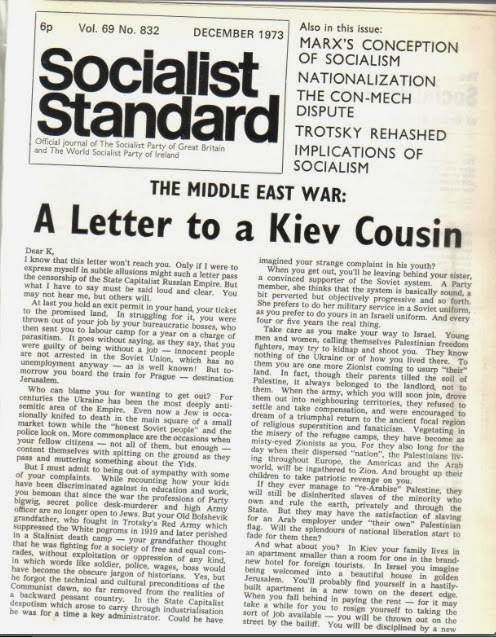
The Middle East War: A Letter to a Kiev Cousin (1973)

From the December 1973 issue of the Socialist Standard

Dear K,

I know that this letter won't reach you. Only if I were to express myself in subtle allusions might such a letter pass the censorship of the State Capitalist Russian Empire. But what I have to say must be said loud and clear. You may not hear me, but others will.

At last you hold an exit permit in your hand, your ticket to the promised land. In struggling for it, you were thrown out of your job by your bureaucratic bosses, who then sent you to labour camp for a year on a charge of parasitism. It goes without saying, as they say, that you were guilty of being without a job — innocent people are not arrested in the Soviet Union, which has no unemployment anyway — as is well known! But tomorrow you board the train for Prague — destination Jerusalem.

Who can blame you for wanting to get out? For centuries the Ukraine has been the most deeply anti-semitic area of the Empire. Even now a Jew is occasionally knifed to death in the main square of a small market town while the "honest Soviet people" and the police look on. More commonplace are the occasions when your fellow citizens — not all of them, but enough — content themselves with spitting on the ground as they pass and muttering something about the Yids.

But I must admit to being out of sympathy with some of your complaints. While recounting how your kids have been discriminated against in education and work, you bemoan that since the war the professions of Party bigwig, secret police desk-murderer and high Army officer are no longer open to Jews. But your Old Bolshevik grandfather, who fought in Trotsky's Red Army which suppressed the White pogroms in 1919 and later perished in a Stalinist death camp — your grandfather thought that he was fighting for a society of free and equal comrades, without exploitation or oppression of any kind, in which words like soldier, police, wages, boss would have become the obscure jargon of historians. Yes, but he forgot the technical and cultural preconditions of the Communist dawn, so far removed from the realities of a backward peasant country. In the State Capitalist despotism which arose to carry through industrialisation he was for a time a key administrator. Could he have imagined your strange complaint in his youth?

When you get out, you'll be leaving behind your sister, a convinced supporter of the Soviet system. A Party member, she thinks that the system is basically sound, a bit perverted but objectively progressive and so forth. She prefers to do her military service in a Soviet uniform, as you prefer to do yours in an Israeli uniform. And every four or five years the real thing.

Take care as you make your way to Israel. Young men and women, calling themselves Palestinian freedom fighters, may try to kidnap and shoot you. They know nothing of the Ukraine or of how you lived there. To them you are one more Zionist coming to usurp "their" land. In fact, though their parents tilled the soil of Palestine, it always belonged to the landlord, not to them. When the army, which you will soon join, drove them out into neighbouring territories, they refused to settle and take compensation, and were encouraged to dream of a triumphal return to the ancient focal region of religious superstition and fanaticism. Vegetating in the misery of the refugee camps, they have become as misty-eyed Zionists as you. For they also long for the day when their dispersed "nation", the Palestinians living throughout Europe, the Americas and the Arab world, will be ingathered to Zion. And brought up their children to take patriotic revenge on you.

If they ever manage to "re-Arabise" Palestine, they will still be disinherited slaves of the minority who own and rule the earth, privately and through the State. But they may have the satisfaction of slaving for an Arab employer under "their own" Palestinian flag. Will the splendours of national liberation start to fade for them then?

And what about you? In Kiev your family lives in an apartment smaller than a room for one in the brand-new hotel for foreign tourists. In Israel you imagine being welcomed into a beautiful house in golden Jerusalem. You'll probably find yourself in a hastily-built apartment in a new town on the desert edge. When you fall behind in paying the rent — for it may take a while for you to resign yourself to taking the sort of job available — you will be thrown out on the street by the bailiff. You will be disciplined by a new boss, preached to by new politicians, led to the slaughter by new generals. Your freedom will consist in the bailiff, boss, politician and general being Jewish. You will no longer be suspected of disloyalty, unless you "act against the Jewish nation" — but you will learn to shun others as alien.

You know that the fourth major Middle East war, the worst yet, is in progress as I write. It began as I set out on a week's coach tour of Italy. The idyllic Isle of Capri used to be an exclusive resort of the capitalist class — a small fortune (tens of thousands) is still required as a condition of residence, but recently they have let in a few package tourists. The group I was in was among the first to be granted this honour.

A few hundred miles across the Mediterranean I knew that relatives of mine on one side, and friends on both sides, were killing one another on the blazing hot sand, strewn with metal wreckage and human carrion. I'm boycotting newspapers until the end of the war, but headlines are written on the news-stands which I can't help seeing. Like "human wave attacks". Think what that means.

In my mind the war means mainly the Sinai front. This is the front I've heard people speak of. Three Cairo students I knew at university are there — if not already dead. With one I never discussed politics. The second was cynical. The third (in private) sympathised with Israel. He had an extensive knowledge of Jewish history, told me that Egyptian soldiers taken prisoner by the Israelis were so impressed by their treatment that they refused to fight them again. My Israeli friends, those still alive, are in that minority which sympathises more or less openly with the Arabs. From them I have heard stories of Israeli torture prisons, of Israelis who have openly boasted how they blew up Iraqi synagogues in order to stampede the oriental Jews into Israel. Then there's the persecution of Copts and dissidents in Egypt, the Nazis working there . . .

Recently a young drifter in Libya, unable to hold down a job, concerned with the plight of the Libyan Jews, wanting to show the Israelis that not all Arabs want to throw them into the sea, hijacked a plane and took it on a personal peace mission to Tel Aviv, where he is now safely in prison — thinking what? Ghaddafi and Golda Meir were for once in agreement in diagnosing him insane. They should know. And the furore in Israel over two elite paratroopers who, sensitive to the position of Arabs inside Israel, spied for Syria! These people reverse the usual illusion, and make of the "enemy" country their ideal homeland. They have resisted the conditioning to which their fellows succumb. As their experience broadens, we can hope they will reach a more Socialist position — a plague on both your houses!

Back on Capri. A fellow traveller — mild-mannered and chivalrous, the perfect English gentleman — comes up: "You're Jewish, aren't you? Is the war going well? I hope your side is winning."

"I don't. Since when do wars go well? Whoever wins, my side loses."

This reply confused him. It took him several seconds to close his mouth. This same man, in a conversation about pollution, commented within earshot of coloured fellow tourists — "On the subject of pollution, what shall we do with our coloured friends who are polluting the country?" Perhaps he was considering gas chambers. But he was very embarrassed when challenged. There's hope for Socialism yet.

Arriving back in England, the driver of the bus taking us from the airport to the terminal treated his passengers to an analysis of world affairs. Passing through a Jewish area he commented: "All these Israelis have gone to fight their war. I hope they win it soon, or we're bound to get dragged into it. And they can stay there, as far as I'm concerned." Perhaps my astonishment was the product of a sheltered life?

There is no need for me to expose the mythical and unscientific nature of nationalist ideologies in the Middle East. The Jewish Zionists debunk the Arab Palestinian "Zionists" with excellent scholarly analysis, and vice versa. Literature available from the Al Fatah office, Zionist bodies and so on.

Until the hold of nationalist and racist poison on the minds of the world's workers is destroyed, it will not be possible to live the full and satisfying life of Socialism. Stand up for yourself as a human being and fight for the only worthwhile end — the achievement of a free humanity. And when you come to Western Europe, why not stay rather than go on to Israel? Corpses in the sand cannot, among other things, work for the Socialist revolution.

Yours,
STEFEN.