Showing posts with label Alfred Russel Wallace. Show all posts

Friday, November 10, 2023

Darwin’s Origin of Species (2006)

Book Review from the November 2006 issue of the Socialist Standard

Darwin’s Origin of Species by Janet Browne. (Atlantic Books, 2006)

In a New York Times poll in November 2004, 55 percent of respondents agreed that God had created human beings in their present form. Clearly the Darwinian revolution has some way to go. Darwin’s revolutionary work was first published in November 1859 with the full title: On the Origin of Species by Means of Natural Selection, or the Preservation of Favoured Races in the Struggle for Life. And yet the theory of evolution could have been known under a different name. In the previous year the naturalist Alfred Russel Wallace had sent Darwin an essay in which he set out the theory of evolution by natural selection. Darwin’s friends hurriedly arranged for both works to be published at the same time, so the theory should really be known as the Wallace-Darwin theory, if not the Wallace theory of evolution. In any event, Wallace and Darwin became good friends and Wallace collaborated with Darwin in his research and helped in the revised editions of Origin of Species.

Origin of Species went through six editions during Darwin’s lifetime and he made many corrections and alterations. In the fifth edition (1869), at Wallace’s suggestion, Darwin first introduced the notorious phrase “survival of the fittest.” Wallace had taken this phrase from the writings of Herbert Spencer, a well known atheist and supporter of capitalism in late nineteenth century Britain. Spencer’s ideas would became known as “Social Darwinism” and he maintained that society was an organism exactly the same as a biological organism. From his perspective he argued against the building of lighthouses around the British coastline because, so he claimed, shipwrecks were “nature’s” (i.e. capitalism’s) way of sorting out the fit from the unfit. Darwin had never taken any of Spencer’s ideas on social evolution seriously and the phrase “survival of the fittest” is at odds with Darwin’s own ideas about natural selection by adaptation.

Browne ends her account of Wallace by saying that he went on to become a “utopian socialist.” In fact he became a supporter of utopian capitalism. He advocated land nationalisation and was an enthusiast for Edward Bellamy’s state capitalist vision of the future in his novel Looking Backward (1888). When Darwin died in April 1882 aged seventy-three, Origin of Species had truly become one of the “Books That Shook The World,” the publisher’s title for this series of biographies which includes Marx’s Das Kapital (see the review in the October Socialist Standard). There is a slight link between the two books. Marx thought very highly of Origin of Species and sent Darwin a presentation copy of Das Kapital. But he did not, as sometimes claimed, offer to dedicate Das Kapital to Darwin. Rather it was Marx’s son-in-law, Edward Aveling, who offered to dedicate one of his books to Darwin. Darwin never read Das Kapital and he rejected Aveling’s offer.
Lew Higgins

Saturday, February 5, 2022

Socialism and Darwinism. (1925)

From the August 1925 issue of the Socialist Standard

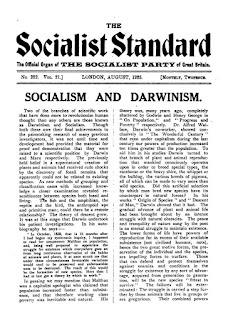
Two of the branches of scientific work that have done more to revolutionise human thought than any others are those known as Darwinism and Socialism. Though both these owe their final achievements to the painstaking research of many previous investigators, it was not until time and development had provided the material for proof and demonstration that they were raised to a scientific position by Darwin and Marx respectively. The previously held belief in a supernatural creation of plants and animals had received rude shocks by the discovery of fossil remains that apparently could not be related to existing species. As new methods of grouping and classification came with increased knowledge a closer examination revealed resemblances between species both fossil and living. The fish and the amphibian, the reptile and the bird, the anthropoid ape and primitive man; could there be a remote relationship? The theory of descent grew. It was at this stage that Darwin undertook his patient investigations. In his autobiography he says:—
“In October, 1838, that is 15 months after I had begun my systematic inquiry, I happened to read for amusement Malthus on population, and, being well prepared to appreciate the struggle for existence which everywhere goes on from long continuous observation of the habits of animals and plants, it at once struck me that under these circumstances favourable variations would tend to be preserved and unfavourable ones to be destroyed. The result of this would be the formation of new species. Here then I had at last got a theory by which to work.”
In passing we may mention that Malthus was a capitalist apologist who claimed that population increased faster than subsistence, and that therefore working class poverty was inevitable and natural. His theory was, many years ago, completely shattered by Godwin and Henry George in “On Population,” and “Progress and Poverty” respectively. Dr. Alfred Wallace, Darwin’s co-worker, showed conclusively in “The Wonderful Century” that even under capitalism during the last century our powers of production increased ten times greater than the population. To aid him in his studies Darwin turned to that branch of plant and animal reproduction that mankind consciously operates upon in order to breed special types, the racehorse or the heavy shire, the whippet or the bulldog, the various breeds of pigeons, all of which can be made to vary more than wild species. Did this artificial selection by which man bred new species have its counterpart in natural forces? In his works “Origin of Species” and “Descent of Man,” Darwin showed that it had. The gradual advance of plant and animal life had been brought about by an intense struggle with natural obstacles. The peace and tranquility of nature sung by the poet is an eternal struggle to maintain existence. The lower forms of life have powers of reproduction far in excess of their available subsistence (not civilised humans, note), hence the two great motive forces, the preservation of the individual and the species, are impelling forces to warfare. Those that can defend and protect themselves against enemies and conditions in the struggle for existence by any sort of advantage, acquired from generation to generation, will be the new species “fittest to survive.” The failures will be exterminated : The struggle is carried a step further by those animals that live in groups or are gregarious. Their combined powers give them a new strength of protection both for themselves and their young. Bearing in mind the immense periods of time taken for development in nature’s working it will become more clear how such groups developed social feelings, instincts and advantages, that enabled them to struggle successfully right up to the man-like apes, our progenitors in the line of development.

The final step that enables man to emerge from the animal kingdom is the making and use of tools. He acquires the first rudiments of speech and becomes “primitive man.” Space only permits of a brief mention of the proofs of the correctness of Darwin’s theory. Man within his body contains many rudimentary parts only explicable on the basis of his lowly origin. The physical and mental differences of living races of men are greater than those between the lowest men and the highest apes, and a study of embryology shows that the human embryo recapitulates the whole history of the evolution of the species, the last form left behind being that of the anthropoid ape.

What organs are to the animal world, tools are to mankind. These man-made tools in conjunction with other discoveries give him a great advantage in the struggle for the food supply over the animals, he is indeed able to dominate them and later domesticate them. Struggle at this stage does not cease, it merely takes a different form, those groups or tribes of men who possess better tools and weapons compete more successfully in the conflict and struggle now takes place between tribe and tribe. Further development in tools and methods of production makes the preservation of those captured in conflict desirable, a surplus can be produced, slavery begins :

All history says Marx “is the history of class struggles ” (i.e., since the break up of the tribes) and thus he supplies the key :
“In every epoch the prevailing mode of social production and exchange, and the social organisation necessarily following from it, form the basis upon which is built up, and from which alone can be explained, the political and intellectual history of that epoch.” (Communist Manifesto).
As with Darwin and Wallace in the domain of natural history, so with Marx and Engels in the materialistic conception of history. Marx shows that with changed economic conditions, come new social classes, new ideas, new interests. The subject class that has sought to possess tools or means of livelihood has always fought for political supremacy. Every class struggle must be a political struggle. The decline of the Roman Empire, the French Revolution, the vast changes within capitalism including the growing conscious discontent of the workers, can only be explained by Marx’s theory.

The handicraft worker had a mentality different from the city proletariat of to-day, the conditions had not developed the Socialist who is a product of the modern slave system of social production : What then is the struggle that is paramount to the Socialist? It is the Class struggle, it is the struggle between the producers, and the non-producers who possess and control the means of life, between the wage workers and the Capitalists. To remove poverty and degradation the workers must wage that struggle consciously for the establishment of a higher order of society in which class distinctions will be abolished and all can enjoy the comfort and leisure modern means make possible. The decadent parasites of Capital will be no match for a majority organised for Socialism. It will indeed be “the survival of the fittest.”
W. E. MacHaffie

Saturday, April 10, 2021

Who gets it?

From the May 1923 issue of the Socialist Standard
 Hence it has happened that the development of steam navigation, of railroads and telegraphs, of mechanical and chemical science, and the growth of the population, while enormously increasing productive power and the amount of material products—that is, of real wealth—at least ten times faster than the growth of the population, has given that enormous increase almost wholly to one class, comprising the landlords and capitalists, leaving the actual producers of it—the industrial workers and inventors—little, if any, better off than before.Professor Alfred Russel Wallace.

Thursday, October 11, 2018

Charles Darwin. His Life and Work (1959)

From the November 1959 issue of the Socialist Standard

Charles Darwin was born 150 years ago, on the 12th February, 1809. There was little in his early life to suggest its subsequent course. He was the son of a prosperous and popular general practitioner in the town of Shrewsbury, and was sent with his brother to a Shrewsbury school. There his headmaster was Dr. Butler, father of the well-known author of Erewhon, Samuel Butler. In later years Samuel Butler conceived a bitter personal antipathy to Darwin, and wrote a series of books, articles and pamphlets opposing his theory and charging its author with personal culpability.

Darwin's father was an able practical psychologist before Sigmund Freud was born. Charles (the son) has described him in detail in the Autobiography (Autobiography of Charles Darwin, now published with all the deletions included by his granddaughter, Nora Barlow, Collins 1958) he wrote for his children. His father weighed 24 stone, and was quite a public character in the town. His treatment of his patients was most successful. "He told me that they always began by complaining in a vague manner about their health, and by practice he soon guessed what was really the matter. He then suggested that they had been suffering in their minds, and now they would pour out their troubles, and he heard nothing more about the body."

The father wanted his sons to follow medicine, so to Edinburgh they both went. Charles has described the incredible dullness of the lectures at Edinburgh which, he said, "were something fearful to remember." After being bored to tears by the lectures, Darwin junior attended two operations in the theatre, "two very bad ones, the second of a child . . . but I rushed away before they were completed. Nor did I ever attend again."

After two years at Edinburgh University, Darwin senior realised that his son had no wish to become a Doctor of Medicine. He therefore persuaded him to go to Cambridge to study Divinity and become a clergyman. "Considering how fiercely I have been attacked by the orthodox it seems ludicrous that I once intended to be a clergyman. (Page 57.)

At Cambridge, Darwin attended the lectures of John Henslow, the botanist who was to give him one of the main interests of his life, Natural History. "No pursuit at Cambridge was followed with nearly so much eagerness or gave me so much pleasure as collecting beetles."

The second great influence was Chas. Lyell's Principles of Geology, in which is set forth a logical sequence of explanation of changes in the Earth's crust.

Henslow was a great influence in more ways than one because it was through Henslow, Darwin finally volunteered to accompany H.M.S. "Beagle." "The voyage of the 'Beagle' has been by far the most important event in my life and has determined my whole career" (page 76). The story of that voyage is still one of the best travel books ever written.

While collecting and classifying specimens of the South American coast, Darwin was forcibly struck by the similarity of giant, almost archaic, forms of life and their small European counterparts, giant lizards, huge turtles, prehistoric-looking armoured reptiles, giant bats, and the like, and the fossil record. Assiduously mastering Lyell's method in geology, he made records of coral deposits and drafted his paper, which explained the rise of the coral reefs by the gradual subsidence of the sea-bed.

Returning to England two years later he took several years to sort his records, finally publishing The Voyage of the Beagle while attending London Scientific Society meetings and residing in Gower Street. Although unusually strong as a young man, he now showed signs of ill-health. After returning to London, he married his cousin, Emma Wedgewood, of the pottery family of Etruria.

"Divine Revelations"
Darwin's own grandfather, Erasmus, was a quite outstanding and noteworthy thinker, actively following scientific progress, and composing a poem, Zoonomia, in which the idea of the evolution, or gradual development of various species, was expressed on purely conjectural grounds. Charles himself, in reading it, was quite unimpressed, although Samuel Butler almost accused him of plagiarising it.

Erasmus probably owed a good deal to Lamarck, the French 18th century naturalist, who was the Lysenko of the great French Revolution of '93, and whose book, Philosophie Zoologique, was a daring exposition of evolutionary change due to adaptation.

In 1839, Darwin was already assailed with doubts of Divine revelation :
  But I had gradually come by this time to see that the Old Testament, from its manifestly false history of the world, with the Tower of Babel, the rainbow as a sign, etc., etc., and from its attributing to God the feelings of a revengeful tyrant, was no more to be trusted than the sacred books of the Hindus, or the beliefs of any barbarian.
  The question then continually rose before my mind and would not be banished—is it credible that if God were now to make a revelation to the Hindus would he permit it to be connected with the belief in Vishnu Sara, etc., as Christianity is connected with the Old Testament? This appeared to me utterly incredible.
  By further reflecting that the clearest evidence would be requisite to make any sane man believe in the miracles by which Christianity is supported—that the more we know of the fixed laws of Nature the more incredible do miracles become—that the men at that time were ignorant and credulous to a degree almost incomprehensible by us—that the Gospels cannot be proved to have been written simultaneously with the events—that they differ in many important details, far too important, as it seemed to me, to be admitted as the usual inaccuracies of eyewitnesses—by such reflections as these, which I give as not having the least novelty or value, but as they influenced me, I gradually came to disbelieve in Christianity as a divine revelation.
Some time later, in July, 1837, Darwin had already started his first notebook on the Origin of Species.
  Everyone who believes, as I do, that all the corporeal and mental organs (excepting those which are neither advantageous or disadvantageous to them) of all beings have been developed through natural selection, or the survival of the fittest, will admit that these organs have been formed so that their possessors may compete successfully with other beings, and thus increase in number. (Page 89.)
In September, 1842, Darwin decided to move out of London and finally settled at Down, just outside Bromley in Kent. In this house the world-shaking masterpieces, Origin of Species and The Descent of Man were composed.
  In October, 1838, that is, fifteen months after I had begun my systematic enquiry, I happened to read for amusement, Malthus on population and, being well-prepared to appreciate the struggle for existence that goes on everywhere from long continued observation of the habits of animals and plants, it at once struck me that under these circumstances, favourable variations would tend to be preserved and unfavourable ones to be destroyed. The result of this would be the formation of new species.
  Here, then, I had at last got a theory by which to work. (Page 120.)
After planning to work for several years on this theory by collection of evidence, Darwin received a letter containing an Essay On the Tendency of Varieties to depart indefinitely from the original type, from a remarkable naturalist, Alfred Russell Wallace, then in Malaya, which "contained exactly the same theory as mine." Under these circumstances the two scientists agreed to submit their papers to the Linnean Society together.

Origin of Species
The Origin of Species was published in November, 1859, and the fat was in the fire. The first edition of 1,250 was sold out on the day of publication—and the storm broke. Few writers have experienced the flood of abuse, attacks and onslaughts which its author now encountered. Its reception was a mixed one. On the one hand, the Church and the parsons foamed at the mouth, on the other, the more enlightened spokesmen of the growing capitalist class were not slow to seize on the "survival of the fittest" and use it to justify unscrupulous exploitation. Didn't Darwin, the great scientist, say, it was those best fitted who survived ?— and therefore the richest were "the fittest"—and so on. His fellow scientists were equally divided. These arguments were being used by Labour Party writers, like Ramsay MacDonald, 50 years later in Socialism and Society, etc.

No mention of Darwin's work is really complete without reference to T. H. Huxley, the brilliant Science teacher at the Royal College, who assumed the rĂ´le of Darwin's gladiator. He it was who sought out the enemy, and attacked and destroyed him. His popular lectures at the Working Men's Colleges were attended and enjoyed by. among others, Marx and Engels.

It should nevertheless be said that outside their special subject of Biology, neither man had any original contribution to make. Huxley remained a fairly orthodox Liberal and supporter of British foreign policy all his days.

In his imperturbable loyalty to scientific fact and forthright espousal of the result of his researches, come what may, Darwin ranks with Galileo or Marx. He could equalliy with Marx have written as conclusion to the preface of h book, "Pursue your course and let the people talk." While the battle raged, he sat, or rather, lay down, and went on collecting facts. What Marx did for the domam of Economics, Darwin undoubtedly did for Biology. Both men found their subjects in a mess, like an old battlefield littered with the rubbish of exploded notions, and the corpses of false theories strewn about.

The Origin of Species, like Capital, was a gigantic broom, sweeping away the accumulated junk and placing the whole subject on a firm and logical footing. In the subsequent discoveries of Mendel and the whole science of Genetics is its direct result. This evidence of the evolution of Life, due to environmental causes is obviously of paramount importance to the Marxian theory of the Evolution of Society.

Darwin's theory is not entirely flawless—the chief difficulty being the impossibility of actually proving permanent mutations, which he was the first to see. Also "the fittest" need not be confined to the individual members of a species, as Kropotkin and others have shown.

When all this has been said, Charles Darwin will nevertheless forever hold his place as the great pioneer, whose indefatigable energy supplied the evidence which became the signpost to the scientific study of Life.

His was the torpedo which sank Noah's Ark.
Horatio.

Monday, December 16, 2013

Pathfinders: Alfred the Great (2013)

The Pathfinders column from the December 2013 issue of the Socialist Standard

“You would, if you’d had my leisure, have done the work just as well, perhaps better, than I have done it.’ The speaker, famously modest and generous in sharing credit, was Charles Darwin. The addressee was Alfred Russel Wallace, the co-discoverer of evolution by natural selection, described by David Attenborough as ‘the most admirable character in the history of science’, and the centenary of whose death has been the recent subject of public fanfare.

Darwin was not exaggerating, at least on the subject of leisure, because the story of evolution, with him on one side of the world collecting specimens in the Americas, and Wallace on the other side, doing the same in Malaysia, is in part a story of Victorian class privilege. While Darwin, propertied, educated, part of the respectable scientific in-crowd, had no trouble funding his leisurely Beagle voyage, Wallace faced nothing but struggle. Lacking social status, money or a university degree, Wallace left school at 14 to become an apprentice surveyor, educated himself through local libraries, travelled the railways with his brother by third-class open cattle truck, and lodged in low-rent digs so damp and dirty that his brother died of pneumonia. It was perhaps no surprise that Wallace became interested in social reform, went to meetings organised by followers of Robert Owen, read the works of Edward Bellamy and William Morris and considered himself a socialist.

It was at one of these social reform meetings that he met a kindred spirit, a hosiery apprentice by the name of Henry Walter Bates, an equally passionate autodidact who had left school at 12. Both had developed a keen interest in naturalism and in particular entomology. Both had read Malthus on population, Hutton and Lyell on geology, and Darwin on the Voyage of the Beagle (1839). Bates at just 18 had already had a paper on beetles published in the scientific journal Zoologist. What excited them most was the pressing question of the day in naturalist circles, which was the precise mechanism behind the transmutation of species. The debate over this was fierce, and due in large part to the activities of a Scottish journalist recovering from a psychiatric illness, one Robert Chambers, who in 1844 published anonymously a book entitled Vestiges of the History of Creation. This book attempted to bring together various partial theories of evolution into an overall coherent narrative, at the same time attacking Lamarckism and outraging religious conventions by locating the agents of change in purely mechanical processes, in so doing relegating the role of God to first cause. Chambers’ fear of being ‘outed’ as an evolutionist contextualises Darwin’s own fear and hesitation in publishing his own work, but Chambers needn’t have worried. Scientifically speaking the book might have been amateurish and speculative, with a lack of any solid research data, but commercially it was a sensation, quickly becoming an international bestseller and so respectable that Prince Albert read portions of it every day for the intellectual edification of Queen Victoria.

Being both self-made men still on the make, and burning to contribute to this debate, Wallace and Bates hit upon the wheeze of borrowing money to go to the Amazon to collect specimens. The motive was, as Wallace put it in 1847, ‘to gather facts towards solving the problem of the origin of species’, but there was a hard-headed business angle too. Naturalism was not just a popular intellectual topic in drawing rooms. Victorian gentlemen with private incomes had a mania for collecting exotica of all descriptions, and would pay handsomely for novel species that would drive their peers insane with envy. To Wallace and Bates, the Amazon was if not a get-rich-quick scheme then certainly a sustainable self-funding project. They managed to wring the money out of a commercial agent and set off for Brazil, where they worked indefatigably at building up prize collections, ruining their health in the process. Wallace went home after four years with his entire collection in order to secure further finance, but lost everything when his ship caught fire. Distraught, penniless, all his labours for nothing, he swore never to go to sea again. Bates meanwhile stayed in the Amazon and later became celebrated for his pioneering work on mimicry, bringing home after 11 years (by separate ships) nearly 15,000 species of which 8,000 were new to science.

For Wallace it might have ended there, but never is a long time and just a year later curiosity got the better of caution and he once again fought to get money for another expedition. This time he went to Borneo and New Guinea, where he lived with head-hunters and suffered miserably from malaria. The motive was his reading of Vestiges, which proposed that humans were descended from an ancestor of the orang-utan found in Malaysia. His agent repeatedly told him to stop wasting time with such speculative nonsense, and keep the lucrative specimens coming. But Wallace couldn’t let it go. His conviction grew through his studies that the process of ‘transmutation’ was entirely automatic, triggered by nothing more complicated than relative fitness for survival in the face of competition of species. His agent wouldn’t listen, so Wallace decided to write to somebody who would. His letter dropped on Darwin’s doormat like an atom bomb, with results that are too famous to need repeating.

Why is this interesting for a socialist? Not especially because Wallace himself was a socialist, because he wasn’t, at least not in the sense we mean. He’d never heard of Marx or Engels, never entertained the notion of abolishing capitalism rather than palliating its effects, and in later years became closely associated with John Stuart Mill’s land nationalisation movement, a futile attempt to turn the clock back by reversing the dispossessions of the Great Enclosures Act. Nor is it especially remarkable that the story of Darwin and Wallace was a story of class differences, as the history of science is full of such tales.

What is significant about Wallace is that he was in a sense a living refutation of another popular idea that was circulating in his lifetime, and which continues to influence class ideologies into the modern day, to wit, the Great Man Theory of History. In his book On Heroes, Hero-Worship and the Heroic in History, Thomas Carlyle stated baldly that ‘the history of the world is but the biography of great men’. Simply put, there was no underlying pattern to history, no progression, no process, merely a succession of influential human drivers. Had Napoleon, for example, died in infancy, there would have been no empire, no retreat from Moscow, no Waterloo. The theory played well among respectable academics like Hegel, Kierkegaard and Nietzsche and anyone who wished to emphasise the primacy of human will over natural forces, an essential component in the white colonialist intellectual justification for conquest and subjugation. Against this view stood Marx who argued that humans could choose to act but not in conditions of their own making, and that these conditions were driven by material processes that it was possible to comprehend scientifically. In short, great men did not make history, history made great men.

One dazzling illustration is the story of Alfred Russel Wallace. It shows that when the world was ready for the ideas of evolution, it did not all ultimately depend on Darwin. In the same way, when the world is ready for the ideas of socialist revolution, it will not all ultimately depend on us.

Tuesday, June 22, 2010

Darwin on human evolution (2010)

From the June 2010 issue of the Socialist Standard
150 years ago in June the famous confrontation over evolution took place between Bishop Wilberforce and TH Huxley. We begin a three-part series where we look at Darwin’s theory of human evolution and the reaction of Marx and Engels to it.
The Origin of Species (1859) was, arguably, the most shattering book of the 19th century, and Darwin’s most famous book. It was not, of course, his only book, nor was it the one in which he dealt with the evolution of the human species, even though it sparked off the “Man’s place in nature” debate. In fact, it took Darwin just over 11 years to publish his first book on the human species, The Descent of Man, and Selection in Relation to Sex (1871). Yet it did not have the same social impact as The Origin, and it is unlikely that the same celebratory hoopla will accompany its 150th anniversary in 2021.

Unlike The Origin, there is no evidence that either Marx or Engels bought a copy or even read The Descent, as there are no references to it in their collected works. However, the fact that Engels continued to discuss Darwin and Darwinian literature, especially in the context of German socialism, most importantly in Anti-DĂ¼hring (1878), and wrote the uncompleted The Role of Labour in the Transition from Ape to Man in 1876 (he broke off the work in order to write Anti-DĂ¼hring, which makes extensive references to Darwin), shows that he kept up an interest in at least some of Darwin’s later writings.

Darwin on Human Descent

The Descent of Man, and Selection in Relation to Sex was published on the 24 February 1871, in two large volumes, at around 700 pages in length, and selling at 24 shillings (The Origin cost 15 shillings). The first print run was of 2,500 copies (compared to 1,250 for The Origin), increasing to 4,500 by the end of March, and 7,500 by the end of the year.

The Descent was the first of Darwin’s works to deal with the human species, and was followed in 1872 by The Expression of Emotions in Man and Animals. Originally, Darwin had planned to discuss emotions in The Descent, but, as with much of his work, the material on it just piled up and required a separate volume. The only other published work dealing with humans was A Biographical Sketch of an Infant. This was published in Mind, the first psychology journal, and was based on observations of his first child, his son William (affectionately called Doddy) carried out 37 years earlier.

This latter fact shows that Darwin had from the beginning included human beings in the scheme for his big book on Natural Selection (The Origin was only an abstract of this proposed big book) and it would not be something he needed to think anew for The Descent. In 1839 he had written:
"Looking at Man, as a Naturalist would any other Mammiferous animal, it may be concluded that he has parental, conjugal and social instincts, and perhaps others. The history of every race of man shows this, if we judge him by his habits, as another animal. These instincts consist of a feeling of love (& sympathy) or benevolence to the object in question. Without regarding their origin, we see in other animals they consist in such active sympathy that the individual forgets itself & aids & defends & acts for others at his own expense." (cited in White and Griffin Darwin: A Life in Science, 1995, p.248)
Publish and Be Damned!
The application of natural selection to the human species would be the linchpin in the argument against critics, and it is likely that, as with other criticisms he rehearsed before the publication of The Origin, he would be aware that any failure to meet his critics would be fatal to the future of the concept of natural selection as a naturalistic explanation. So rather than being a late issue in the debate, Darwin saw it as being a necessary foundation from the very beginning of his studies.

Nevertheless, Darwin was famously reluctant to include the human species in The Origin. Even in 1857 (22 December), he wrote to Alfred Russel Wallace about his reluctance to write about human evolution:
"You ask whether I shall discuss Man; I think I shall avoid the whole subject, as so surrounded with prejudices, though I fully admit that it is the highest and most interesting problem for the naturalist."
In The Origin, he famously wrote that the application of natural selection to human kind would be possible only in the far future:
"In the distant future I see open fields for far more important researchers.... Light will be thrown on the origin of man and his history.” (Darwin On the Origin of Species, 1859; Penguin edition, 1968, p. 458)
But although he didn’t discuss the human species, everybody knew he did. His readers were from the very beginning eager to jump the species gap. It was the human implications of natural selection that they were keen to discuss. Whilst it took Darwin until 1871, by which time the heat of the controversy had cooled somewhat, to publish his views on human evolution in the two volume The Descent, others were not so reticent.

Unwilling or unable to defend his position, or the all too obvious implications of it, in the bear-pit of public debate, Darwin left it to his bulldog, Thomas Henry Huxley, to defend the theory from religious onslaught. Barely six months after the publication of The Origin, the famous British Association debate between Huxley and Bishop Samuel (Soapy Sam) Willberforce took place in Oxford on 30 June, 1860. It was here that Huxley brilliantly replied to Willberforce’s snide query as to whether Huxley was descended from an ape on his father’s side or his mother’s side, by retorting that he would rather have an ape for a grandfather than a man who misused his gifts to obscure scientific discussion by rhetoric and religious prejudice.

By the time Darwin came to publish The Descent, a number of others had already dealt with the issue of human origins: Huxley, Haeckel, Lubbock, Galton, Wallace, Tyndall, and Bagehot. But the Master had not spoken and the public were keen for him to make his pronouncements and settle the matter. Darwin dreaded this expectation. It is not improbable to think that he was glad that others has spoken first (and perhaps too hastily and without adequate evidence), but at least they had taken the first mad hail of flak. By now, some of the heat had been taken out of the battle, and there might be less anger directed his way. However, he knew he was going to be on the receiving end of some fury. As he wrote in a letter to St George Mivart, "Whenever I publish my book I can see that I shall meet with universal disapprobation, if not execution."And at Christmas 1870 he told Batholemew Sullivan that The Descent “would disgust you & many others.” But after 11 years he was ready to show the world his views on the human species. However, even the political climate seemed against him. Radicals and agitators were causing problems and Darwin feared he might be depicted as a black-caped anarchist.

Darwin’s fear of all hell breaking loose on him was not confirmed. To his relieved surprise, the reviews were muted. It seemed that the other Darwinians had successfully shifted the reading public towards acceptance of the evolution of the human species.

What he included in The Descent was to some degree conditioned by what his supporters had written earlier. In particular, unlike Huxley, who had dealt only with human physiological evolution, Darwin wanted to discuss the origins of some of the mental and moral faculties of humans in terms of natural selection. This was necessary as a riposte to what Wallace, especially, had said in his articles of 1864 and 1870. Wallace had come to the conclusion that whilst natural selection could account for human bodily development, it could not do so for human mental development and the brain. To explain human mental development, Wallace resorted to the idea that humans were endowed with mind by an unseen spiritual power. Such a position was anathema to Darwin and he had written to Wallace saying that he feared that he might have murdered their child (that is, natural selection). It was, therefore, essential for Darwin to show that natural selection could account for human intellectual and moral features, without the resort to some ineffable “unseen spirit.”

Wallace did in fact have a good enough reason to believe that the human mind had raised humans above all other animals, ensuring that they were not subject to the Malthusian hell that would later frighten and disgust Huxley in his lectures on Evolution and Ethics (1893). For Wallace it was the human ability to create objects that would compensate for any natural weaknesses in dealing with the struggle for existence. In some respects, this difference is similar to that recognised by Marx and Engels, but they dealt with it materialistically rather than by an idealistic unseen spirit. (while Wallace became a believer in spiritualism).
Ed Blewitt
Next month: Marx’s criticism of the ideology of “Darwinism”.