Showing posts with label Children's Books. Show all posts

Saturday, August 27, 2022

Fairy Tales (2020)

Book Review from the August 2020 issue of the Socialist Standard

The Castle of Truth and Other Revolutionary Tales. By Hermynia Zur Mühlen. Edited and Translated by Jack Zipes for the series, Oddly Modern Fairy Tales. Princeton University Press, 2020.

Hermynia Zur Mühlen, born into the Austrian upper class in 1883, earned the sobriquet ‘The Red Countess’ by rebelling against her upbringing and embracing a left-wing outlook. She did, however, marry an Estonian/German baron and tried to convert his estates into a cooperative enterprise under the control of the workers. The project failed, but illustrates her acceptance, common amongst many left-wingers, that socialism is something brought to the workers.

A member of the German Communist Party, Zur Mühlen began to reflect on how children’s literature could change their socialisation. In 1921, her first book of radical fairy tales, What Little Peter’s Friends Told Him, was published. Many more followed, including the one that lends itself to the title of this collection, The Castle of Truth.

The first impression on reading these tales is the didactic nature of them. The rich are greedy and careless of the lives of their workers. Meanwhile, those workers are portrayed as being too dumb to see how they are being done down.

In The Carriage Horse (1924), militant unionism is expressed through the eponymous horse coming among the exploited farm horses and organising them to strike for better fodder. The strike is undermined by dumb oxen who take on the tasks of the horses, until they agree to stop doing so, but only through the threat of violence. The horses win their fodder rise, but remain essentially in the same situation they were at the beginning. The oxen remain dumb.

This theme runs through the stories. Even when a worker acquires the wherewithal to become a capitalist in Ali, the Carpet Weaver (1923), he quickly transforms into rapacious employer. The bloated plutocrat beloved of Bolshevik posters was an obvious model.

Another element becomes apparent when Ali gains that wherewithal through a good deed supernaturally rewarded. His eventual comeuppance also comes via the ‘Good Spirit’ who will return at some unspecified future point to judge all exploiters.

Although Zur Mühlen was a lapsed Catholic, perhaps, as is often claimed, Catholicism is never entirely set aside. Come the 1950s she was a lapsed communist, having parted company with the KPD during the rising Stalinism of the 1930s. She turned back to religion, if not Catholicism, which perhaps provides an alternative understanding of her tales.

Zur Mühlen does deal with a variety of political issues: the absence of concern for workers’ wellbeing (The Coals, 1921), critical thinking (Why, 1922), ideological myopia (The Glasses, 1923), technology (The Servant, 1923), nationalism (The Troublemakers, 1923), persistence of radical ideas (The Castle of Truth, 1924), religion (The Fence, 1924) and others exploring similar themes.

Twenty years later Zur Mühlen was writing in a more traditional mode of fairy tale. The Crown of the King of Domnonee (1944) involves an innocent younger prince betrayed by malevolent elder siblings that all resolves to a happy, royal, ending. The Story of the Wise Judge (1944) revolves around a poor but wise young woman who solves a number of riddles to prosper. The radical tropes have largely disappeared.

The politics of the 1920s stories are those of idealised Bolshevism, liberation being brought to the working class by the enlightened, or a reformed, more benign capitalism. Society is still one in which money plays a crucial part, just more fairly. There is no sense that capitalism, state or moderated, remains capitalism.

These tales, illustrated by George Grosz, John Heartfield, Heinrich Vogeler and Karl Holtz in the spare pen and ink style of the 1920s, were written for children. It is difficult to see the appeal in them for the young who would have to be old enough to appreciate the language and concepts, making them too old to be interested in fairy tales. A story read to two children aged 7 and 9, voracious readers both, did not make it to the end. Different times maybe, but were children more receptive a century ago?

That this collection comes from the Princeton University Press declares its academic interest. This it has in abundance for the insights it gives into Communist political thinking of the time, the identification of state capitalism with Soviet Communism and the issues outlined above. It sits within the ‘Oddly Modern Fairy Tales’ series edited by Jack Zipes, who has done a commendable job of translating Zur Mühlen’s tales.

If you are looking for a collection of fairy tales for children, this is not it. Should your interest be in the literary expression of political and historical ideas, then it is.
Dave Alton

Saturday, June 18, 2022

Correspondence: Evolution and Revolution. (1907)

Letter to the Editors from the June 1907 issue of the Socialist Standard
We do not hold ourselves responsible for opinions expressed by correspondents.
[To the Editor of the Socialist Standard].

Evolution and Revolution.

Dear Comrade,—On Sunday evening last I heard a member of the I.L.P. refer to himself as an Evolutionary Socialist. At the moment he was leading up to the statement that the revolutionist position was not in harmony with the law of evolution. A revolutionist who was present, claimed that he also was an Evolutionary Socialist, and that evolution was the same thing as revolution.

As each man was an able exponent of his particular school of thought, and as I, at almost every Socialist meeting I attend, am brought face to face with differences, all primarily hinging upon this subject, I am more convinced than ever that the relative value of the terms, evolution and revolution, is not even approximately apprehended by those who use them most. I, therefore, ask your permission to be again allowed to express in the Standard my views on the subject.

All Socialists contend that revolution is part and parcel of the evolutionary process, the meaning of their contention being that revolution is part and parcel of the evolutionary process it eventually supercedes. Here they become involved in a glaring absurdity, and in consequence great confusion arises.

Revolution being regarded as part and parcel of the evolutionary process in which he is interested, the Evolutionary Socialist believes that the former can be grafted on to the latter a bit at a time. If the above premiss were correct, the reasoning would be sound, for if the two terms mean the same thing, the one would merge into the other by a gradual and regular process, like a boy evolving to manhood ; the boy being always the potential man.

The Revolutionary Socialist believes that revolution must be applied at one set time, and he is right; but he does not appear to know how he is right or where he is right, and so long as he holds the aforesaid premiss to be true, he never will know.

Now let us to the subject.

On examination we find that the law of evolution is universal. Every single thing in nature, whether organic or inorganic, whether it be a substance or a quality, evolves ; but each evolves from its own specific base, so representing a distinct phase of the law which governs it.

Revolution is no exception to this rule; it evolves, but that does not constitute it an integral part of evolution any more than growth makes an animal, a plant or a planet a integral part of it. The law is superior to each.

Revolutions in Society are the effect, like all other effects, of a dual causation—in this case, social conditions on the one hand, man on the other. Man evolves under one phase of the law of evolution, his social conditions under another. The interaction of these two phases stands as the positive and negative causes to a third, which we distinguish by the word revolution.

Revolutions, then, are the result of two opposing forces, one not evolving from the other, but each growing from a separate base within Society. One of these forces is now evolving as an established fact from a set social foundation ; the other, though itself subject to the common law of evolution, yet represents a different and hostile phase of that law ; and again, to distinguish it from the phase at present in active and practical operation, we call it revolution.

The recognition of the class struggle clearly demonstrates the truth of the foregoing. The evolutionary phase in actual social operation is represented by the capitalist class, the evolutionary phase, which is still a theory—revolution— is represented by the working class. Each of these phases of evolution has its base in an opposing interest, and each, therefore, must be in hostility to the other. That the conflict of these two forces will finally lead to harmony of interest in Society, does not prove that the working-class interest has evolved from the capitalist interest—the capitalist system—for, from the outset, they have been in deadly antagonism, and therefore must have evolved from different bases.

All changes in Society are brought about by the interaction of man and his environment. The social conditions prompt man’s thought, the thought evolves as a theory until the idea stands clothed in its palpable, material form. This embodiment stands in turn as the stimulating impulse to further advance.

Similarly, the theory of Socialism, prompted and sustained by social conditions, is evolving—not with revolution as its objective, for it already stands as revolution in the process of evolution—but towards its final consummation ; the day when the theory will have become the established fact.

The revolutionary forces at work within capitalist society must eventually evolve to the point of upheaval. The result will be the downfall of capitalism and the consequent exhaustion of the forces which have destroyed it. Having accomplished its mission, revolution disappears and the new system starts to grow, not from a revolutionary base, but from an evolutionary base. That is to say, the antagonistic phases of evolution having performed their functions, die out, and there arises from the expended energies of both a new form of evolution—a new species, as it were.

Socialism, then, will not have evolved from capitalism, nor from the revolutionary forces now at work against capitalism, but it will start a new and distinct form of evolution, which has been produced by the meeting and mutual destruction of the two hostile forces. A new base has been established which can be changed only by another revolution.

This creation of a new evolutionary base is the function of revolution in the evolutionary process, whether in Society or in the broad domain of nature. Revolution grows slowly but acts quickly. When fully developed, and only then, it grapples with its enemy, conquers, and in the effort, dies.

Nothing else is a revolution in the Socialist sense. A Social Revolution means a revolution in the social base, not a change in the upper structure; and such a revolution has never occurred since private ownership in the means of life was dropped in its adamantine setting ages ago.

And now, having, as I hope, made fairly clear the view I hold of the vital difference between the two evolutionary forces under discussion, I should like to lay down a few general propositions in regard thereto.

Nothing in nature evolves to a base; everything evolves from a base, and must for ever go on evolving from that base unless it is changed or destroyed by revolution, this force being a counter phase of the general evolutionary process, and one which has evolved from a base hostile to the one it displaces.

It is a law of nature that like evolves like ; that is, anything which evolves from another thing must of necessity perpetuate the basic characteristics of the thing from which it evolved. Socialism will have none of the basic characteristics of capitalism ; therefore, it is unscientific to contend that it will evolve from capitalism.

No system of society can evolve from another system of society unless they both grow from the same base. To change the base requires the aid of revolution. In producing the change, revolution not only destroys that which it opposes, but itself also ; a new form of evolution springing as an effect from the juxtaposition and destruction of the two causes.

The revolution which the Evolutionary Socialists claim to be their objective may be brought nearer a bit at a time, but that bit at a time must consist of the education of individual members of the working class. That is, they must try to hasten the evolution of the revolutionary forces, not waste their time trying to palliate the phase of evolution to which they are opposed. That stands upon its own base and can look after itself. It can and will evolve the necessary palliatives and reforms when conditions are ripe, and not before. To ripen conditions, help along the revolutionary principle ; the opposing conditions ripen fast enough.

To aim chunks of so-called revolution at capitalism and expect to see it fall, is about as wise a proceeding as trying to measure the moon for a suit of clothes. The problem of the Socialist is how to make revolutionists, not how to evolve capitalism into Socialism. That, I again assert, can never be done while the word retains its present meaning, and to the best of my ability I am prepared to defend that assertion against anyone who cares to dispute it. I should most heartily welcome the attention of an evolutionary Socialist.
Yours fraternally,
H. Philpott Wright.


Blogger's Note:
It may just be a coincidence but 'H. Philpott Wright' was the pen-name of the English children's author J. Weedon Birch. Little is known of Birch outside of the fact that he was an author and publisher, and that some biographers of Charles Hamilton ('Frank Richards') have noted that Wright had a character by the name of 'Billy Bunter' in the pages of a boys paper, The Vanguard, a year before Richards' much more famous 'Billy Bunter' appeared in the pages of the boys weekly 'The Magnet'.  The screen grab below is from the 1970 book, 'The Men Behind Boys' Fiction', by Lofts and Adley:


Of course, it may all just be a strange coincidence but as I've already jumped down this particular rabbit hole, I'm contractually obliged to post a link to George Orwell's famous 1939 essay about Boys' Weeklies.

Wednesday, May 25, 2022

The Not So Different World of Harry Potter (2011)

From the August 2011 issue of the Socialist Standard
The last Harry Potter film based on the books by JK Rowling was premiered last month.
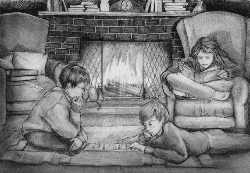
In many ways the world described in the Harry Potter books is vastly different from ours. A world of magic, wizards and witches, flying household objects, time travel. Yet despite all this we also find many similarities, especially in regards to their economic system. They, like us, have a money/wages based society.
 
It is not clear why wizards/witches would need a monetary economy given the fact that there is no scarcity, as they possess the powers to create almost anything with the wave of a wand. One could reply to this point with a question of one’s own of course: given the fact that we Muggles have the technology to produce what we need and more ourselves, why do we continue to rely on a system of (mostly artificial) scarcity?
 
One of the main differences is that while all witches and wizards own their own wands (and therefore in a sense their own means of production), in Muggle society the means of production are owned by a minority of the population, leaving the majority forced to sell their labour-power, in exchange for a wage or a salary, to this minority. It follows then that in order to utilise the non-magical technology available to us we first have to reclaim it from the minority who possess it. 
 
Given the fact that wizards and witches have the ability to sustain themselves already available to them, why do they, like so many characters in the books continue to work for a wage or a salary? If it’s simply out of a love for the job or because of a recognition that the work they do is needed for their own and the common good, then why not get rid of the financial incentive all together and allow them to work on a voluntary basis? Yet we don’t see this, all we see is numerous examples of witches and wizards forced to go without the things they need. 
 
An example would be the Weasley family. On numerous occasions in the books we find this family unable to afford the most basic of items. There is, for example, the moment on the Hogwarts express when Ron Weasley is unable to buy food (beginning of the first book I believe) and is forced into the degrading rigmarole of Harry insisting upon buying it for him. 
 
What about the time he is unable to buy a replacement wand and therefore loses a duel to the financially superior Lucian Malfoy? Indeed an impartial observer using only the Weasleys as a case study could assume that poverty and lack of basic necessities was a problem affecting all in the wizarding world. However, further examination shows this not to be the case. As mentioned previously, we have the Malfoys; a very rich family who have more than they could ever want or need.
 
Incidentally why do the Weasleys seem constantly ashamed of their poverty? Their father (Arthur Weasley) is a highly industrious man and their mother (Mollie) has singlehandedly raised seven children, surely if there is to be any shame in their situation it is to be shouldered by wizarding society as a whole?
 
It is not made clear in exactly how the Malfoys are so incredibly wealthy. The vast majority of people in Muggle society who can boast such wealth have only achieved it through extracting the surplus value from the labour of those they employ, did the Malfoys exploit their wealth through similar means, or are they simply a relic of feudalism like today’s aristocracy? 
 
It is true that in one of the books Hermione started a campaign to free house elves from chattel slavery, but there doesn’t seem to have been a movement to abolish wage-slavery.
 
There is also the issue of religion. It cannot go unnoticed that in the magical world of Harry Potter they celebrate Christmas. Yet given the fact that so many witches and wizards were tortured and killed in the name of Christianity (those that couldn’t employ the fire-resisting charm at least) why would they want to celebrate the birth of its founder? One can only assume that our fellow Muggles who go about expounding the supposed word of Christ have made a serious mistake; in actual fact Jesus Christ was not the Son of God but a highly advanced wizard, capable of charms that allowed him to walk on water, cure lepers, and revitalise the dead! “No spell can bring back the dead Harry, I trust you know that,” says Dumbledore in The Goblet of Fire; “Unless you’re Jesus!” should have been Harry’s reply.
Johnny Mercer

Monday, March 25, 2019

Materialism for children (2019)

Book Review from the March 2019 issue of the Socialist Standard

‘Everything Is Connected’. By Jason Gruhl (Illustrations by Ignasi Font. Shambhala, 2019. Hardback £12.99)

As a materialist I am thrilled to see this publication of a book for children, impressing them with the importance of openness to all life and the truth that all life is connected and all living beings part of a rich kaleidoscope. As Carl Sagan pointed out, we are all star stuff.

The publishers regularly make available works from a Buddhist perspective, and if Buddhists generally dislike what they think of as materialism, it is because the word is associated mostly with the mechanism and reductionism of traditional post-Christian western thought. Materialists, in fact, should oppose such reductionism, and be consistent – embracing the liberating realisation that all of us are the universe, that nothing is separate or outside of it, and that our atoms have made up trillions of living beings before us, and will make up trillions after us. All organisms are relatives, and the atoms that were once part of a T-Rex or a blue whale are now part of you!

For socialists too, the universe as here presented for children can help us show that physical reality can be more beautiful and wondrous than myths, and truth more colourful and resplendent than fiction.
A. W.

Saturday, September 1, 2018

No happy ending here (1995)

Book Review from the September 1995 issue of the Socialist Standard

The Little Black Fish by Behrang (published by the Iranian Community Centre, Holloway Road. London. 1995.)

Samad Behrangi, known in his native Iran as Behrang, was a teacher who wrote stories which would make children think beyond the narrow confines of the slave mentality. In 1967, aged only 31, he was drowned (by Savak agents, so we hear), but his stories live on. To be able to show in the simple terms accessible to children the importance of thinking critically and struggling against oppression is surely one of the highest arts. The Little Black Fish is a beautiful tale of a fish’s search for life beyond the brook in which it lives. The other fish say that there can be nothing worth seeing beyond the brook and, anyway, no good can come of exploring the unknown. With mixed sadness and allegorical poignancy this story shows what can happen when resistance overcomes complacency. No happy ending here, but then, why tell lies to children?
Steve Coleman


Saturday, September 17, 2016

Children's fiction (1986)

Book Review from the October 1986 issue of the Socialist Standard

The Stove Haunting. Bel Mooney (Methuen, price £6.95).

Bel Mooney is a journalist, and The Stove Haunting is her second novel written for children It is what is known as "time-slip fiction": an 11-year-old boy from the twentieth century finds himself, through the medium of an old kitchen stove, entering the mind and body of an eleven-year-old kitchen boy of the nineteenth.

"The year." says the blurb, "is 1835, and the countryside is in a state of unrest; through his friend George. Daniel becomes involved in the plans of the local farm workers to improve their miserable wages by forming a Friendly Society — a union. But the laws forbid such 'treason' and soon Daniel must try to save his friends from the most terrifying fate of all.”

Judged from the purely literary viewpoint, the book is competent without ever really rising above an acceptable level of mediocrity. Judged from the social viewpoint, it presents its story of deprivation and injustice vividly enough; but "absorbing insight", as claimed in the blurb? It is not impossible, even in a children's book, to lead one's readers towards an understanding of how deprivation and injustice come about towards an understanding of how society functions. This book makes no attempt to do that.

It is all too easy, too superficially attractive, to conjure up the miseries of the past — to arouse the young readers' compassion for the poor and ill-treated, their wrath at the unfairness of "those times But the "unfairness" of those times is still with us. whereas all too often (not always: the children's book world is changing) the impression is given that these wrongs have been righted, that we no longer have the rich and powerful, the masters, the rulers, controlling the lives of the rest of us, the masses.

In 1835 the workers were fighting to establish the right to form unions: in 1986. as far as the child reading the book is concerned, this is a battle which has long since been won. A wrong has been righted and there is an end of it. But of course, in essence, nothing has changed: the relationship between the rulers and the ruled remains as it ever was save that now. terrifyingly, with the rapid advance of technology, those in command have even more power over the rest of us than they had before; and at the same time as they have more control over us. the people, they have less control over the things the bombs, the nuclear reactors, the chemicals — which technology has created and which threaten us all.

It has now become essential that we mature sufficiently to organise ourselves on a co-operative and democratic — socialist — basis, world-wide, before the precipitous onward rush of technology, with this competitive, power-structured society, fatally outstrips us. And in this regard, any writer for children who chooses to illustrate the social wrongs of the past without linking them to those of the present is falling down badly on a common duty to humanity.

I don't doubt that children will enjoy The Stove Haunting — will empathise with the downtrodden poor, wax indignant at the wicked rich; but they will almost certainly be left with the comfortable feeling that "it is not like that now". And never at any point will they be induced to question the present structure of society or consider the urgent, desperate, need for radical change in the way we organise ourselves.
John Usher

Thursday, June 18, 2015

Rosa Luxemburg (1991)

Book Review from the June 1991 issue of the Socialist Standard

Rosa Luxemburg. By Wendy Forrest. (Hamish Hamilton. £6.99)

New on the shelves of the children's section in the local public library, one of a series "In Her Own Time", is this book on Rosa Luxemburg. Contrary to the perceived correct behaviour for women of her time, Luxemburg did not wait at home for a husband and children to look after, but campaigned for socialism, was imprisoned and finally murdered. The book is a breath of sanity among the usual mind-bending and cobwebbed Never Never Land found on children's bookshelves. It is especially encouraging to see children introduced to Luxemburg's definition of the cause of war, so relevant today: "The fight against militarism cannot be separated from the socialist class war as a whole . . . Wars between capitalist states are as a rule the result of their rivalry for world markets . . . Wars are therefore inherent in the nature of capitalism; they will only cease when capitalism is abolished".
Eva Goodman