Showing posts with label Democracy versus Dictatorship. Show all posts

Wednesday, April 1, 2026

Letter: Our attitude on Hungary (1957)

Letter to the Editors from the February 1957 issue of the Socialist Standard

Our attitude on Hungary

Salford, 7,

December 18, 1956.

Dear Comrades,

I think the Party’s attitude on this subject needs further elucidation. In this month’s S.S. it is considered that the revolt is not worth the shedding of a drop of working-class blood.

This seems to conflict with previous statements that the Hungarian workers were trying to improve their miserable condition. In my view it also differs from the position on the first Russian revolution recently quoted in “50 years ago.” There it was stated that the workers and Capitalists have a short way to travel together. But not in Hungary!

In any case it needs to be made clear what the workers are supposed to do under a Communist dictatorship. It won’t be smashed without the shedding of working class blood; and there won’t be any Socialism or even propaganda for Socialism till it is smashed.

It has often been said that the Capitalists will never let themselves be ousted but if defeated on the Parliamentary field would form a dictatorship. I should have thought the original success of the Hungarians against their own national dictatorship (before overwhelming Russian intervention) was a good case for the Party in that respect. I think it also might have been mentioned that the working class, even those who had been schooled only on “Communism,” showed that objective conditions still prevailed over ’phoney propaganda.

In general I did feel the S.S. was less than generous to the heroic effort which wrested power, “with bare hands” from a police state.
Yours truly,
L. E. Weidberg.

Having said the above, may I add that the general excellence of the articles in the S.S. over the years is not unappreciated by one who has left the work to others.


Reply
The article in the December S.S. to which the critic refers made it clear that, whilst expressing sympathy with the victims of the “Communist” savagery, the Hungarian revolt was fundamentally a movement in favour of Hungarian Capitalist rule, and therefore was not worth the shedding of a drop of working class blood. One reason for this is that the removal of Russian Capitalist oppression is no guarantee that Hungarian Capitalist rule would be any better in the long run.

We have learnt from experience during the last 50 years. We were urged to support the Russian armed rising against the Czarist Police State 40 years ago. The result of that rising has been the establishment of one of the most savage and oppressive police states in the history of the world. We were urged to support the German rising about the same time and the result was another form of police state equally savage. Austria and China have had similar experiences.

However much we may desire to see freedom of expression where it is denied, armed uprising is not the way to accomplish it. Once guns enter into the dispute then guns continue to be be arbiters in internal clashes of ideas afterwards, until either economic development or organised working class action compels the powers that rule to make concessions. That has been the lesson repeatedly driven home, but not wholly appreciated, during toe last 100 years of working class activity. However much we may desire to make progress there is no quicker way than this organised working class action to clear the road to working class emancipation.

Thus, although we appreciate the courage of those who were prepared to make the ultimate sacrifice rather than continue to suffer Russian domination, it is our duty as Socialists to tell the bitter truth. Firstly, that it was not a rising aimed at bringing toe workers freedom; secondly, that armed uprisings may bring a change of rulers but will not bring freedom from class rule; thirdly, that the success of toe uprising would not necessarily have put an end to the police state.

It is not true that there cannot be any Socialist propaganda until a “Communist” dictatorship is smashed. The critic himself suggests that there can be Socialist propaganda when he writes that “the working class, even those who had been schooled on 'Communism' showed that objective conditions still prevailed over phoney propaganda” The revolt was not a bolt out of toe blue. It had been discussed and organised. There is, and has been. Socialist propaganda in all “Communist” and other police states.

It is worth while bearing in mind that, according to the information so far available the peaceful agitation of the Hungarian workers by stopping work has accomplished more, at far less cost in human life, than the armed uprising did. Thus, it certainly appears that the sounder attitude for the Hungarian workers would have been to stick to that method from the beginning in order to accomplish the limited objectives they were after. Sooner than see the whole social fabric collapse into confusion the rulers would have conceded some at least of their demands. However, once an armed revolt was embarked upon bloody conflict was inevitable, with savage reprisals and the use of Russian armed might; and now the atmosphere is still there for further savage reprisals.

Another advantage strike action alone would have achieved would be this. Attacks on peaceful strikers by the police, the militia, and the army, would have made the savagery of the Russian overlords more obvious to the world of Labour. The Russian rulers would not then be able to pat forward the pretence that they were quelling an armed rising against the government.

We are surprised at the last paragraph of the critic’s letter. Over and over again we have expressed our admiration for the courage and devotion of those who took part in the rising; we have, however, been truthful in regretting that it was not done in a better cause, the freedom from all oppression. To be generous without being truthful is to invite cheap praise. We have done our best to be helpful to the working class cause by pointing out realities in order to minimise, as far as possible, useless heroism in the future. We are also mindful of the bitter fact that the victims of today are so often the oppressors of tomorrow.

The revolt did not, as our critic puts it “wrest power, ‘with bare hands,’ from a police state.” The repressive action from outside was a foregone conclusion, and the power remains where it was. Furthermore, the action was not taken “with bare hands.” A portion of the Hungarian army took part in it and arms were in the the hands of the revolters.

Finally, let us consider the reference to the extract from the Socialist Standard of “Fifty Years Ago” that appeared in the November number. It concerns the attitude of the Socialist movement in a country where there is a revolt against a particular form of repression. We would urge the critic to look at the whole extract again in order to get a clear picture of what the writer was driving at. We would particularly urge him to take note of the following selections from the extract:—
“Hence, in the other nations of Western Europe a straight fight is possible between the proletariat and the capitalist ruling class, whilst in Russia the rising capitalist class has yet its emancipation from autocracy to accomplish: so that, in contrast with practically the whole of civilised nations, the working class and the capitalist class in Russia have, in the abolition of Tzardom's tyranny, a step to go together. This historical circumstance, which is at once the strength and weakness of the Russian movement, distinguishes it from that of all capitalist countries." . . .

“ Let us then do all in our power to help our Socialist comrades in Russia in the hope that they will not be deceived as to the outcome of the present upheaval: in the hope. also, that they will sternly keep their separate identity, and distinct aim. so that the Russian bourgeoise State of tomorrow may find a militant class-organisation of Socialist workers leading the final struggle against the Capitalist class, whose defeat must herald the Triumph of Humanity."
It will be seen from the above that the struggle in Russia 50 years ago was to get rid of the semi-feudal barriers, and the Socialist movement there was urged to keep their independence and their Socialist policy. As far as Capitalist Hungary is concerned that is still the attitude for the Socialist to take. Socialists there, just as under autocratic Russia in days gone by, should stand by their Socialist objective and do what propaganda they can under existing conditions, just as, for instance, an Austrian comrade of ours did under the Nazi and Russian occupations.
Editorial Committee.

Tuesday, December 2, 2025

The struggle in South Africa (1986)

From the November 1986 issue of the Socialist Standard

South Africa is the fourth most populous country in Africa, after Nigeria, Egypt and Ethiopia, but it is by far the richest in terms of wealth produced and capital accumulated. Although representing only four per cent of the land area of the African continent and only seven per cent of its population, it has been estimated that South Africa has 30 per cent of its income, 43 per cent of its mining production, 87 per cent of coal production, 75 per cent of steel production, 57 per cent of electricity production, 56 per cent of rail traffic, and 50 per cent of its motor vehicles and telephones. South Africa, then, is by far the most developed capitalist country in Africa. Its economy is based on the export of minerals (gold, platinum, chromium, diamonds) whose earnings have permitted the development of sizeable manufacturing and service sectors.

The special feature about South Africa is of course what for want of a better term will have to be referred to as the "racial" breakdown of its population. Of its 26 million people, some 18 million (70 per cent) are of African origin, a little under five million (18-19 per cent) of European descent, the remaining three million or so being made up of about three-quarters of a million Indians and of people of mixed European. Asian and African descent.

Everyone in South Africa is by law classified into one of four “groups": European, Bantu, Coloured and Asian. The first group is also officially described as "Whites" and the others (as on park benches) as "Non-Whites". These, it must be emphasised, are the official legal classifications. They are not biologically-defined, but politically-defined groups, even though an individual's biological features and ancestry are used in this political definition. These classifications are absurd even on their own terms. For instance, some "Non-Whites" are whiter than some "Whites", while some "Europeans" are just as much of mixed origin as are those classified as "Coloureds": however their ancestors were able to pass as Whites sufficiently long ago to escape the race classifiers’ investigations. Further, Bantu (like Aryan) is a linguistic not a biological classification and, besides, is completely rejected as contemptuous by those so classified

Needless to say, "Non-White" too is also rejected as being the equivalent of "non-existent". Some political activists and groups in South Africa use the term "Black" as a substitute for — indeed as a reply to — "Non-White", thus including the Africans, the Coloureds and the Indians in a single group facing the Whites. Others, however, use "Black" to mean just the Africans. This can obviously lead to confusion, especially as in British usage the terms "Coloured" and "Black” are synonyms.

This whole discussion of so-called racial classifications shows that, in the end, no term is completely neutral, all are more or less political as the term used indicates the group or groups of human beings that the user thinks should unite (or be separated). In this game, then, the only terms that are acceptable to socialists are such terms as human race, citizens of the world, world working class and workers of the world.

Your racial classification in South Africa is important as it determines where you can live (and where you can’t) and. until very recently, who you could marry and who you could have sexual relations with (and with whom you couldn't). It also determines whether you are a first, a second or a third class citizen. For in South Africa there are, legally and not just factually, three classes of citizenship.

The first class is composed of those who have full political rights, the same for instance as those nearly everybody has in Britain and in particular the right to elect the members of the national law-making body. Such full political rights are enjoyed only by the Whites — by only one in six — less than 20 per cent — of the population.

The second class, constituted as recently as 1984, is made up of the Coloureds and the Indians who were allowed that year to elect their own members of the national parliament who have a limited (very limited in fact) role in the law-making process. This limited role was recognised by the overwhelming majority of Coloureds and Indians who boycotted the elections — there was a turnout of only about 20 per cent — seeing participation as an acceptance of their second-class status.

The third class is composed of the African majority — representing 70 per cent of the population — who are without any political rights whatsoever at national level. Some do have a vote at local level, while others (some four million) can, on paper, vote for the parliaments of the so-called Bantustans like the Transkei. In fact these latter are not regarded as being South African citizens at all, let alone third-class ones.

Apartheid — which is merely the Africaans for segregation — originally had a much more ambitious project than maintaining White political supremacy by denying the other groups full citizenship rights. As laid down by the National Party which has held power in South Africa without interruption since 1948, it wanted to prevent the Africans from becoming permanently established in the "White" towns and to allow them to be there only temporarily as migrant labourers (and. of course, domestic servants). But what apartheid, as embodied in rigid laws which the National Party government enacted after coming to power in 1948 sought to keep apart, the development of capitalism brought together. Over the years a permanent African urban working class, employed at all levels in manufacturing and service industries and not just in mining, has come into being. In fact since 1975 the majority of urban dwellers have been Africans.

The National Party governments have had to recognise this and to make concession after concession to the economic facts: Africans have been permitted to form trade unions and have taken strike action, the notorious pass laws are soon to be abolished, while other reforms have granted urban Africans property and even municipal voting rights in the towns. Only two of the original pillars of apartheid now remain — the Group Areas Acts laying down residential segregation (and reserving 85 per cent of the land area for the Whites) and the discriminatory political structure — but this latter too is now beginning to totter.

South Africa's present political structure where your say in the political decision-making process depends on your racial classification and which completely excludes 70 per cent of the population is so anachronistic that it is universally — and rightly — condemned, especially since political power is now being brutally used to impose the government’s authority on the unwilling majority. Even the capitalists and Thatcher condemn it. There is no reason to challenge their sincerity here since the South African system is anachronistic even from a capitalist point of view. Historically capitalism has sought to reduce all relations and differences between people to one: economic, to whether you are rich or poor, employer or employee, capitalist or worker. It didn't demolish feudal relations based on birth and legally-defined estates to see such distinctions re-introduced as racially-based citizenship classes.

Basically, capitalism wants a political structure which protects and enforces the property rights of the owning class and which ensures political stability within which the extraction of surplus value from the working class can proceed undisturbed by extraneous. non-economic considerations. Although both theory and practice have shown that political democracy is the ideal capitalist political form, this is not something that the ruling class anywhere has ever spontaneously applied nor, when faced with the choice between political stability and political democracy, will a capitalist class automatically prefer the latter. Historical experience (Nazi Germany. Fascist Italy, Franco Spain. Greece under the Colonels for example) shows that they will sacrifice political democracy and embrace dictatorship, at least for a temporary period, if this is the price of securing a stable political regime.

So political democracy has generally had to be forced on capitalism by popular pressure, in particular from the working class. Workers were right to press for political democracy since this provides the best framework both for the propagation and spread of socialist ideas and for the peaceful establishment of socialism. Since political democracy does not exist in South Africa, workers, besides becoming socialists, need to struggle for its establishment there too.

Over 50 per cent of the population of South Africa now live in the towns and, as indicated, since 1975 over 50 per cent of this urban population — which is overwhelmingly working class — wage and salary earners — has been African, a percentage which is growing all the time. This African and Coloured urban wage and salary working class majority, representing an even greater percentage of factory workers, could bring enormous political pressure to bear on the government to move towards granting them the same political rights now enjoyed exclusively by White workers. In fact the South African capitalist class has already got the message and has also been putting pressure on the Botha government to move in this direction.

Of course it is not going to be easy. People are going to be thrown into jail. People are going to be beaten up. And people are going to be killed by the "security" forces. Indeed, all these things are happening at this very moment. Sooner or later, however, the South African government is going to have to retreat as it did over economic apartheid and to move more and more towards political democracy. But the struggle should not stop there. Political democracy is not an end in itself — it leaves working class exploitation intact and working class problems unresolved — but merely as a means to the end of socialism. This more important struggle will still need to go on.
Adam Buick

Friday, November 7, 2025

Letter: Social Insanity (1984)

Letter to the Editors from the December 1984 issue of the Socialist Standard

Social Insanity

Dear Editors,

I should like to bring to the attention of your readers a double question, about the so-called “balance of terror". I am hoping to encourage some debate on this, having already tried without great success to obtain some response from the so-called “intellectual elite" on this matter. What difference is there between the "totalitarian" political regimes where the voice of reason is automatically stifled, and the so-called liberal regimes, where the free voice of irrationality overwhelmingly stifles, in practice, the voice of reason? Don't these two types of regime suffer from the same malady, which we might call a kind of politico-military paranoia? With regard to the future of humanity, these rival oligarchies show themselves to be accomplices caught up in one demented course, based on a barbaric strategy: "If you want peace, prepare for a universal holocaust”.
Maximilien Rubel
Paris

Reply:
We endorse fully the suggestion that the governments of both West and East are engaged in a kind of madness, or irrationality which threatens to end in a nuclear war which would probably wipe out a large percentage of the human race. We would add two important points. Firstly, the "madness" of leaders and governments to which our correspondent refers cannot be considered in isolation from the rest of the population. Their power is ultimately a reflection of the failure of the working class to assert its interests; their ability to inflict “paranoia" and the hatreds of nationalism and warfare on the rest of us arises directly out of our acquiescence. Secondly, weapons proliferate not for their own sake, but in order to fight wars, and wars in their turn do not take place in isolation from social forces. The cause of war in the modern world is the competition between rival capitalist power blocs, including Russia and China as well as the more openly capitalist countries. They compete over markets, trade routes and raw materials: all sources of profit for the propertied minority within each state. These issues need not concern the working class majority, who are merely used as cannon fodder.

The only way to end the madness of preparing for a universal holocaust is to prepare for a universal revolution. This revolution must democratically replace the profit system with the common ownership of the world's resources. For this, we need a majority of socialists, and the present growth of the socialist movement must be actively encouraged by all who seek to remove the threat of war from the face of the earth.
Editors.

Monday, July 28, 2025

The Reaction in Europe and the S.P.G.B. (1934)

From the July 1934 issue of the Socialist Standard

Observers of political events since 1918 cannot fail to have noticed the change that has come over the general tone and attitude of the various so- called “left” elements among the workers. For the first few years after the war these elements were jubilantly proclaiming the imminence of the end of the present social order upon the strength of a few beggarly political and other reforms on the Continent. Because sections of the ruling-class lost their grip of things in the defeated countries (giving way to others who were prepared to provide safety-valves for working class discontent and place certain belated limits on their exploitation) we were asked to believe that our masters were at the end of their tether and would be surrendering the earth in a few short years.

Now we are asked to believe a very different story by these self-same elements. In their eyes now there are no limits to the powers of the master-class to impose what is commonly termed Fascism and to interfere with the general development of the working-class. Why? Because, forsooth, these reforms are being filched from the workers within a few years of being won. To crown all, instead of realising the futility of reform policies, these elements proclaim ever more loudly the need for still bigger and better reforms.

What is the attitude of the S.P.G.B. towards this change of front on the part of such bodies as the Communist Party and I.L.P. ? Briefly, it is to maintain unchanged our hostility to these bodies and to demonstrate that the capitalist system remains essentially unchanged, in spite of the manifold forms assumed by the different national States which uphold it.

Having had experience of partial suppression during the War, we are far from holding that it is a matter of indifference to the workers whether they are allowed political expression or not. The Socialist movement, which is the supreme expression of their needs, cannot arrive at maturity under conditions of political reaction. In Engels' phrase, the Socialist movement needs elbow-room.

Experience shows, however, that reform organisations, no matter how numerous their members and supporters may be, cannot guarantee to the workers these essential political conditions of development. So far from their being able to check reaction their inability when they become the Government to solve the economic problem, has provided reaction with its greatest political stimulus. Helpless before the economic blizzard, they are equally helpless in the face of its political reflexion.

The progress of scientific organisation under capitalism results in the weeding out of the smaller capitalists and, as a result, anti-scientific notions, such as Fascism, readily find acceptance among such groups during a period of economic depression.

Socialism alone can free the productive forces from restrictions imposed upon them by different sections of the capitalist class. In the meantime, these sections strive each to impose the amount and kind of restriction suited to its own interest. The small capitalists, faced with impending bankruptcy, strive to hamper the large-scale concerns, but neither Hitler nor Mussolini has discovered how to save these obsolete little “captains of industry." The big fish continue to swallow up the little fish.

Every national State, no matter how it may describe itself, endeavours to utilise science to the maximum degree in perfecting its instruments of aggression and defence. Hence, for this reason, if for no other, it encourages the development of large-scale industry, which alone can provide these instruments. This applies equally to Bolshevist Russia, Fascist Italy and Nazi Germany—and to Britain, whether under “Labour” or "National” Governments. Large-scale industry progresses, in its turn, upon the ruins of small-scale industry.

This results in the development of the working-class, i.e., in the increase of its numbers, and in the growth of its organisation upon the industrial field. The intensity and scope of the class-struggle increase simultaneously.

The “dictators," Fascist and Bolshevist alike, attempt to repress this struggle by suppressing all political parties save one. The result is that discontented elements find their way into the one legal party, and are a constant menace to its unity. The “Dictator” preserves his authority over the different factions among his followers by avoiding going too far in any one direction. Hitler and Mussolini, Stalin and Pilsudski owe their positions to compromise just as surely as does Ramsay MacDonald, or any other Parliamentary politician.

In Britain, however, the capitalist class has long ago learned how to sink its internal struggles in critical moments, as a result of its more advanced economic development. It finds its solution, not in dictatorships, but in Coalitions or “National” Governments. The essential compromise is achieved by less violent means.

Under such conditions Fascists, so-called, are as little likely as Communists to become anything more than a thorn in the side of some larger party. Just as the Communists imported Russian jargon, but were utterly unable to bring over Russian conditions along with it, so the British Fascists will find that the novelty of teaching their political grandmothers to suck eggs will soon wear off. It is not necessary to credit Baldwin and Company with supernatural sagacity in order to anticipate that they will always be at least one move ahead of Sir Oswald Mosley.

The followers of this volatile politician may conceivably eclipse the Communists and I.L.P., but Socialists need not get excited about that. If the workers are still in the dark as to the direction to take, these latter bodies must accept a large measure of responsibility. They have induced the workers to support policies for which there was no chance of success. Disillusionment and apathy have, therefore, provided the material from which Mosley may build up a temporary alternative movement.

The S.P.G.B. is not a party of prophets, but whatever the immediate future may hold, we see no reason to deviate from the policy consistently pursued by us for thirty years. Just as we refused to be duped by Moscow, so we decline to be scared by what is happening in other Continental centres.

We realise that the master-class of this country possess means of intimidation as formidable as any that exist. We also realise that they control them through the support which they receive from the non-Socialist members of our class. By all means in our power, therefore, we strive to make Socialists.
Eric Boden

Blogger's Note:
See also the editorial, 'Reason or Violence', from this month's Socialist Standard.

Wednesday, September 4, 2024

Capitalism—the real enemy: The case of Germany (1977)

From the September 1977 issue of the Socialist Standard
“Fascism is not an alternative to the capitalist
 system, but a way of running it”
The word “fascism” is one of the most loosely used terms in the political vocabulary. To call every other opponent a fascist, as the more hysterical elements of the left often do, is to reduce a term of political description to the level of political insult. Socialists do not oppose fascist parties, like the National Front, specially because they are fascist. We oppose them for their support of capitalism.

Fascism is not an alternative to the capitalist system, but a way of running it. When it seems inexpedient for the working class to have whatever exists in freedom of speech, assembly, press, and trades unions, and if the working class can be persuaded to support a regime which withdraws these rights (which a non-Socialist working class can), then capitalism is run along fascist rather than liberal lines. The working class can only positively defend democracy by organizing for Socialism.

That fascism is a part of capitalism, governed by the profit system as much as “bourgeois democracy” is can be seen by the events which took place in Germany under the Nazis. Like most groups which see themselves as being revolutionary the German National Socialist (Nazi) Party did not stand on an original platform. Indeed, at the outset they hardly stood for any programme at all, but for the negative policy of anti-semitism and the revival of Prussian greatness.

The dissatisfaction exploited by the Nazis related to the particular post-war problems of German capitalism. It was a non-competitive, highly concentrated, high-priced industrial economy; the political influence of the rural landowners was disproportionate to their size; there had been a high birthrate before 1914 with the resulting problem of an expanding working class demanding more and more from the developing German industries; and there was a large “middle class” of small businessmen with no political expression. The crisis produced by the first World War made matters even worse. The monarchy collapsed in 1918, leaving political instability; demobilized soldiers returned from the war feeling bitter and angry; a flood of east European refugees entered the country, many of them Jews; the liquidation of war credits meant that millions who had previously seen themselves as members of the “middle class” were thrown into extreme poverty; there was the additional frustration of an imbalance between the numbers of men and women. These problems are not new to capitalism in a crisis, and crises are an integral part of the capitalist system.

The Nazis were able to direct their political propaganda towards certain sections of the working class. Small shopkeepers, for instance, were easily attracted. Between 1882 and 1907 the number of small shopkeepers grew, but after 1907 they faced fierce competition from new department stores, some of which were owned by Jewish immigrants. The Nazis, because of their anti-semitism (and, to some extent, a leftist opposition to “big business”) exploited this discontent. White-collar workers, small farmers, and students were further groups to which the Nazis had a special appeal. Then, as now, the fascists realised that they would get nowhere without the support of the working class. The Nazis won it; the modern fascists may not.

Two things must be remembered about the rise to power of the Nazis. One is that without the support of the majority of workers it could not have happened. Capitalist government, be it fascist or liberal, could not be imposed upon a working class which does not want capitalism. Had the German workers been united for Socialism, then nothing could possibly have stood in their way. The second is that the Nazis had the support of important sections of the capitalist class.

When they came to power, what was more significant than the atrocities committed by the new tyrants (which are of interest to historians who like to see the past in terms of a battle between “goodies” and “baddies”) was their inability to offer the working class anything new.

They had promised to create a strong central authority to safeguard law and order (a cry of the British Tories). The Nazis succeeded in strengthening the rule of the state by uniting the party with the government: Hitler became not only total leader of the National Socialists, but complete leader of all Germany. The Enabling Act of March 1933 made the Reichstag powerless and invested full political power in the Chancellor. Adolf Hitler. A law of July 1933 outlawed all other political parties, and a law of January 1934 enabled the Nazis to change the Weimar constitution at will. The German army was taken over by the party, which was clearly satisfactory for the military as fascism meant a growing arms budget, evident diplomatic strength, popular support for militarism, compulsory conscription and, of course, a greater political role for the military.

Economically, the Nazi policies were consistent with the needs of the strongest section of the capitalist class. This was to cause division within the party. The business interests had financed the Nazis as an alternative to the power of the unions or, worse still, Bolshevism. On the other hand, there was a powerful left wing of the National Socialist Party, led by Strasser and Muchow, which preferred to stress the “socialism” of the Nazi Party, by which they meant nationalization.

For all their talk about destroying “big business” the Nazis failed to change the face of German capitalism, even refusing to close down Jewish department stores because they needed the taxes they were receiving from them. Income distribution did not alter under the Nazis and wages fell between 1934 and 1940, while the average net income of the better-off sections who paid tax rose by 46 per cent. As usual under capitalism the rich got richer while the poor stayed poor.

Essentially, fascism created no major changes in German society except, of course, for certain minorities, such as the Jews, the Catholics, and the dissidents. But these were a minority. For the majority it was work as usual; exploitation as usual. As Schoenbaum states:
In 1939 the cities were larger, not smaller; the concentration of capital greater than before; the rural population reduced, not increased; women not at the fireside but in the office and the factory; the inequality of property and income distribution more, not less conspicuous; industry’s share of the gross national product up and agriculture down, while agricultural labour had it relatively good and small business increasingly bad.
In September 1934 at Nuremberg Hitler declared:
The revolution has achieved without exception all that was expected of it . . . in the next thousand years there will be no new revolution in Germany.
Hitler was speaking of a change in the circumstances of German capitalism, not a social revolution. The former happens all the time—leaders come and they go—but the latter means a fundamental change in social relationships. The Socialist Standard of June 1939 clearly explained the Socialist attitude to fascism and democracy:
Democracy for the working class can only be consolidated and extended to the extent that the working class adopts a socialist standpoint. To renounce Socialism so that democracy may be defended means ultimately the renunciation of both Socialism and democracy. It cannot be emphasised too much that the struggle for democracy is bound up with the struggle for Socialism and not the struggle for Socialism bound up with the struggle for democracy.
Steve Coleman

Saturday, June 29, 2024

Fascism and Democracy (1939)

From the June 1939 issue of the Socialist Standard

"A spectre is haunting Europe—the spectre of Communism.” Thus Marx and Engels in the opening sentence of the world-famous “Communist Manifesto.” Ninety years later, however, it is another ; spectre that is haunting the minds of our anti-fascists: the spectre of Fascism.

In an article of this scope it is impossible to go into the social origin and content of Fascism. In the main, it is the concrete, practical differences; between the fascist and democratic forms of political administration that interest the working class. Under Fascism, the traditional forms of working class political and economic organisations are denied the right of legal existence. Freedom of speech, assembly, and the Press, is severely curtailed and made to conform to the needs of a single political party that has, for the time being, secured a monopoly in the administration of the state machine. Under Democracy, the workers are allowed to form their own political and economic organisations and within limits, freedom of speech, of assembly, and of the press is permitted as well as the possibility of the electorate choosing between contending political parties.

Now, unlike many people intoxicated with a newly-found love for democracy, the Socialist Party of Great Britain has always insisted on the democratic nature of Socialism, and on the value that the widest possible discussion of conflicting political views has for the working class. When we refuse to unite with non-socialist organisations for the purpose of defending democracy, it is most certainly not because we in any way minimise or underestimate the importance of democracy for the working class or the socialist movement. It is simply because we are convinced that democracy cannot be defended in such a manner.

And as proof of this contention, the working class has a rich experience from which to draw. The policy of the “lesser evil,” that is, a policy of concessions to, and compromise with, non-fascist parties and elements of capitalism which was pursued and justified by the Social Democratic Party of Germany on the grounds that such a policy was dictated by the necessity of defeating Hitler Fascism : the more recent experience of the same policy operated under a different name, that is, the “popular front” in France, both point to the same lesson. Namely, provided the “Fascist Menace” is real, and not the invention of hysterical and panic-stricken “intellectuals,” the formation of a bloc of non-socialist anti-fascists does not impede the advance of Fascism, but if anything, serves to expedite its progress. In order to make this point quite clear, it is necessary that we should understand the nature of democracy, and its usefulness to the working class. Democracy, in itself, cannot solve a single problem of the working class. Unemployment, poverty, insecurity, and other evil effects of capitalism remain, no matter whether the form of its political administration be democratic or dictatorial. Freedom to cry working class misery from the house-tops will not, in itself, abolish that misery. Democracy is a weapon, potentially invaluable, it is true; but like every other weapon, it can be used either for self-preservation or for self-destruction. And the painful fact is that in Germany—and the same process is going on in France to-day, and may be going on here tomorrow—the working class, lacking in an understanding of how to use the democratic weapon in its own interests, chose to commit political suicide with it instead.

The constitution of the German “Weimar” Republic—already doomed before Hitler took power—was formally one of the most democratic in the world. Nevertheless, so miserable had the existence of wide masses of the German people become, that in the last free election held in Germany a majority of the electorate voted for the abolition of democracy. For in spite of the concern for democracy which is expressed by the Communists nowadays, at the time of that election both National Socialists and German Communists were united in their hatred of what they called “bourgeois democracy.” For the Communists to assert at this time of the day that the downfall of German democracy was due to the refusal of the German Social Democrats to form a united front is nothing less than sheer effrontery; they wouldn’t have touched the then “social fascists” (as they described the Social-Democrats) with a barge pole. The chief difference between the followers of the Communists and Nazis was that they chose different vehicles through which to express their hatred of democracy. Lacking an understanding of their social position, disgusted by the antics and ineptitudes of self-styled socialists, the mass of the German people found the source of the grievances not in the capitalist nature of the social system, but in the democratic form in which it was administered. Hence, in their uninformed despair, they fell an easy prey to astute and unscrupulous demagogues, who never failed to reinforce the belief that democracy was the cause of social distress.

Fascism does not exist in the blue of the heavens like every other social phenomenon, it is related to, and has its origin in, a social background. And that background is the very democratic capitalism that “popular-fronters” and other exponents of working class compromise with capitalism, would have us defend. That capitalism inevitably gives rise to working class problems has already been mentioned; but with equal inevitability it also gives rise to problems of a specifically capitalist nature, such as maintaining the profitability of production; securing new, and retaining old markets; the necessity of forging “national unity” when faced with war with rival capitalist groups, etc. And it is precisely in an attempt to solve these problems that the ruling class has recourse to Fascism. That these problems can be permanently solved is precluded by the nature of the capitalist system itself; but that will not prevent the capitalists from making the attempt. Fascism, then, is a political form best adapted to meet the needs of certain contemporary capitalist states.

As long as the working class supports capitalism and capitalist policies, it will, in the long run, ultimately give its support to that policy best calculated to meet the political and economic needs of capitalism—even though that policy may be fascist.

Democracy for the working class can only be consolidated and extended to the extent that the working class adopts a socialist standpoint. To renounce Socialism so that democracy may be defended, means ultimately the renunciation of both Socialism and democracy. It cannot be emphasised too much, that the struggle for democracy is bound up with the struggle for Socialism, and not the struggle for Socialism bound up with the struggle for democracy.
Arthur Mertons

Friday, June 28, 2024

50 Years Ago: Fascism & Democracy 
in Germany (1989)

The 50 Years Ago column from the June 1989 issue of the Socialist Standard

The constitution of the German "Weimar" Republic — already doomed before Hitler took power — was formally one of the most democratic in the world. Nevertheless, so miserable had the existence of wide masses of the German people become, that in the last free election held in Germany a majority of the electorate voted for the abolition of democracy. For in spite of the concern for democracy which is expressed by the Communists nowadays, at the time of that election both National Socialists and German Communists were united in their hatred of what they called “bourgeois democracy". For the Communists to assert at this time of the day that the downfall of German democracy was due to the refusal of the German Social Democrats to form a united front is nothing less than sheer effrontery; they wouldn't have touched the then "social fascists" (as they described the Social-Democrats) with a barge pole. The chief difference between the followers of the Communists and Nazis was that they chose different vehicles through which to express their hatred of democracy. Lacking an understanding of their social position, disgusted by the antics and ineptitudes of self-styled socialists, the mass of the German people found the source of the grievances not in the capitalist nature of the social system, but in the democratic form in which it was administered.

[From an article "Fascism and Democracy". Socialist Standard, June 1939.]

Tuesday, November 14, 2023

Political Ideas and Class Interests: A Glance at Argentina (1944)

From the November 1944 issue of the Socialist Standard

Marx wrote a century ago that all history, since the rise of class divided society, has been a history of class struggles. Constitutions have been made and unmade, kings dethroned and executed, treaties and alliances have been sworn (and broken), wars and civil wars have been fought, all involving the interests of rival classes; though the class interest at stake has always been half-hidden under the slogans phrased in terms of supposedly universal truths and philosophies.

Though modern capitalist writers are constantly having the real nature of the struggles forced on their attention, they usually abhor admitting it. When Liberals and Tories fight elections they are ready enough to accuse each other of having sinister designs against the workers, but neither—for obvious reasons—will admit that it fights to further the interest of its own section of the propertied class. So with wars, each of which has its appropriate collection of abstract aims and justifications—democracy, freedom of the seas, national independence, self-determination, rule of law, the just rights of superior races, etc., etc. On the Allied side in this war pride of place has been given to the idea of overthrowing dictatorship, and to suit this view politicians and the Press have studiously refrained from harping on the fact that a large number of the Allied countries are themselves dictatorships.

This expedient lack of candour has not, of course, been applied so rigorously to neutral countries. So when Russia made its treaty with Germany in August, 1939, it was permissible to refer to Russia as a dictatorship. “If war comes,” said the Daily Express (August 26th, 1939), “the issue will be clearer. The democracies will be ranged against totalitarian States.” Naturally that candour lapsed again when Russia became an Ally and is now customarily described as a democracy.

Later in the war most of the South American Republics, many of them dictatorships, gave support to the Allied side, with, however, the notable exception of Argentina, which has been much criticised for showing no enthusiasm. Criticism has been levelled against the near-Fascist dictatorship in that country, and the unilluminating explanation that has contented the capitalist press has been that the Argentine Government is anti-Ally because its own ideas are against democracy, and it therefore “sympathises” with Nazi Germany. Such an “explanation” is obviously inadequate. If sympathies and abstract ideals were a real guide to international alignments, half the history of all the Powers would be utterly incomprehensible, since they have all of them waged wars in the past in alliances which contained Christian Powers on opposite sides, Christian and non-Christian Powers on the same side, democratic powers and dictatorships, kingdoms and republics, white and yellow peoples all in seemingly inexplicable groupings. Let us, however, look further at Argentina.

The first curious fact to notice is that democratic U.S.A. and democratic Great Britain are at loggerheads over the attitude to be adopted towards Argentina. Roosevelt’s Government—in the name of democracy—wants stronger action against this South American Republic which is out of step, but the British Government holds aloof and wants to continue its existing trading relationships. The Economist (August 5th, 1944), putting the British capitalist point of view, admits that something else enters into the question besides abstract ideals, that something else being “British long-term trading interests.” “For decades,” says the Economist, “Argentina has been one of the main suppliers of cheap food for Britain’s industrial population. In return, it has been a valuable market for British goods, and a fertile ground for British capital—to the great benefit of both Countries.”

The article goes on to remark rather acidly that “In British eyes, American policy in Argentina is suspected of being moved less by the desire to defeat Hitler than by the desire to extend the influence of Washington from the northern half of South America to Cape Horn—in short, by a doubtless beneficent but none the less real imperialism.”

Then the writer quotes the President of the American Import-Export Bank, who admitted that when U.S.A. interests lend money to South American borrowers, the U.S.A. insists “that all machinery and materials not available in the country of the borrower shall be purchased or leased in the United States, and that such machinery and materials shall be transported in American ships.”

This is a usual procedure when capitalism lends abroad, and has its counterpart in a British-Argentine agreement of 1935, which forced Argentina “to discriminate against American goods.”

In short, Britain and U.S.A. are both moved by the capitalist necessity of finding markets and favourable areas for investment of capital.

Further light is thrown on the situation by a candid letter from an American correspondent, Isobel Fisk, in the Economist for September 23rd, 1944.

She largely admits the charge of imperialism against the U.S. Government, but urges that on a long view Britain and U.S.A. should act together because if they don’t it will be worse for both of them. Her case, in brief, is this : Argentina has been almost entirely an agrarian country producing wheat, meat, etc., for export, and importing machinery and other manufactured goods from Britain. This has suited both the British industrialists and investors and the Argentine landowning class, the latter having fought “tooth and nail” against efforts by rival Argentine interests to build up manufacturing industry in that country. (According to the Statesmen’s Year Book, 1940, there were in the whole country only 36 factories employing more than l,000 workers, in a population which totals 13,000,000.)

The rival Argentine interests are those behind the present dictatorship of President Farrell. They want to build up industry and end Argentina’s dependency on the British market. Their argument, in the words of Colonel Labarca, a member of the Argentine Government, is that “in the twentieth century all countries are trying to process their own raw materials; they know, that they can obtain very low prices by direct sale; they know that, on the other hand, when industrialised they will manufacture a wide variety of products and will utilise by-products, which will give work to their labourers. . . . Everybody now knows that a country has either the economy of a colony or of a world power, and that only the countries which are capable of elaborating what nature places within their reach are worthy of preserving their independence. . …”

The issue, then, in Argentina is not just one of democracy and dictatorship, but whether the landowners or the growing industrialists shall dominate, and the latter are prepared to use dictatorship and armed force to impose their will.

Miss Fisk, though the words she uses are that British and American interests should join together to try “to put down this American brand of Fascism which has sprung up in Buenos Aires,” makes no attempt to conceal the real issue. If Colonel Farrell and his fellow-Fascists succeed, “British investments,” she says, are “in mortal danger.” and “the system by which Britain bought Argentine meat and sold manufactures is doomed to go.”

The Economist, however, doubts whether an attempt to coerce Argentina now would be practicable, and is not prepared to support such a policy if the outcome is to be that of enabling American capital to get control there. Rather the Economist would prefer to wait till the end of the war in the evident hope that the changed situation then will put back the state of affairs that existed in 1939, with the landowners in power and British investments and exports safeguarded not only against Farrell’s group but also against U.S.A. interests. So much for the proclaimed concern of the British and American Governments with the establishment of democracy and overthrow of dictatorship.

There is another class interest that neither the Economist nor Miss Fisk takes into account, the world-wide interest of the working class. We are not concerned to prop up one or the other propertied class in Argentina, nor to try to safeguard British investments, or to make an open door for the products and investments of U.S.A. capitalists. The paramount interest of the working class inside and outside Argentina is to destroy the capitalist system and institute Socialism. Then there will be no problems of markets and investments to solve, and no country will have to face the choice between being a colony or a world power — all will be Socialist.
Edgar Hardcastle

Tuesday, September 19, 2023

Should We Fight for Democracy? (1938)

From the September 1938 issue of the Socialist Standard

How often have we had to deal with the accusation that we do not change our policy to suit the needs of the moment? There has always been some burning topic, some pressing problem, which our opponents have told us demands immediate attention and for which we should abandon our insistence on Socialist propaganda for the time being.

The abolition of the House of Lords, unemployed agitation, the abolition of the Means Test, all have had their turn and have faded out to give place to fresh “immediate problems." Surely, the fact that these “ immediate problems" still remain unsolved should have convinced our opponents that we state the truth when we say that only Socialism can provide the solution to the strife and trouble of the world to-day ?

Experience seems to be a slow teacher, for, so far from having learnt, our opponents seem to have forgotten even those elementary lessons which capitalism taught with so much brutality and severity during the slaughter years of 1914-1918.

1914—and To-Day
The slogans which lured millions of British, French, and other workers on the Allies' side, to their doom, were: “Save poor little Belgium," “Smash Kaiserism," “ Make the world safe for democracy."

On the opposite side men were marching to the motto: “Destroy Russian barbarism," "Down with Perfidious Albion!" etc. To-day, when the reverberations of these slogans and the sound of the guns which gave them practical effect have hardly ceased, we are told that once again democracy is in danger and some political parties assure us it may be necessary to defend what they are pleased to call “our liberties" with our lives.

“ Aggression ” or “Defence" 
One of the main arguments advanced to-day is that the world is divided into two sets of countries, one composed of those nations who are quite satisfied with what they possess and harbour no designs of “aggression," and the others, the “have-nots," the dissatisfied, who aim to steal territories wherever they can.

Quite apart from the fact that this theory ignores completely the means whereby some nations became "haves" and others “ have nots," there is, from the Socialist point of view, a more fundamental error. It lies in the assumption that nations are homogeneous communities composed of people who all have a share in the country of their birth and habitation. This, of course, is not true. Countries and their resources, whether big or small, with or without colonial possessions, do not belong to the people as a whole; they are the property of a small section, a wealthy minority. The bulk of the people in all countries are without property in the real sense of the word, and they depend upon the wealthy class to give them work or doles in order to live. This simple, elementary fact would appear to be unknown to all excepting Socialists, and consequently left out of account in all their speculations. Once accept the Socialist analysis of the capitalist world and its division into property-owners and property-less, the phrases “aggression” and “defence” can have a meaning only to those who own property. For it is clear, then, that the loss or gain of territory cannot affect those people who do not own it.

What, then, is left in the argument of the recruiting agents—and, remember, their ranks now include even those erstwhile rabid opponents of British Imperialism, the Communists—that in countries like Britain and France, a freedom of expression is allowed, the rights of people to express their political opinions by means of speech and vote, and that this freedom would be at stake were this country, for instance, involved in a war with Germany, a country where democracy has been crushed, free speech abolished, and voting has become a farce.

Do Socialists Value Democracy
It is necessary here to define our attitude towards the differences that exist between the “ Democracies ” and the Fascist countries, differences we have never denied but to which we have always applied a Socialist perspective. This Party knows the value of free speech. It appreciates fully the advantages and utility of the vote. In principle and practice we have always shown our appreciation of these “rights,” won, let it be understood, only as a consequence of working-class struggle against a ruling class that approaches these questions, not from the point of view of an abstract principle of human rights, but mainly on the grounds of expediency.

In the past we have consistently defended free speech and the vote against people many of whom pose to-day as the foremost champions of democracy. But we deny that the interests of democracy anywhere can be defended or promoted by a war; in fact, we deny that the question of democracy can ever be the real issue over which a war will be fought.

Why Wars are Fought
As we have explained, the divisions of the world’s population is into those who own it and those who merely exist on it, by permission of the owners; an explanation that cuts rights across national boundaries. When it is further understood that political power, the power that controls the armed forces, is in the hands of the owning class or those who represent their interests, the issue becomes crystal clear.

For it is obvious that a class which in every country cares nothing for the people whom it exploits, and keeps them in poverty-stricken oppression, will only use its armed forces, upon which it lavishes so much wealth, when its interests (i.e., property) are threatened. Until then, capitalist politicians may declare their abhorrence of the methods used in “ less civilised ” countries, but the capitalists they represent will continue to deal indiscriminately with the objects of their horror.

So the United States has sent Germany thousands of tons of aerial bombs, Russia has supplied Germany with ferro-manganese, an indispensable war material, and France sends thousands of tons of iron ore to Germany.

The latter, by way of returning the compliment, presumably, in turn, has supplied China with considerable quantities of arms.

In Capitalist Peace or War, Profit is Paramount
Many people seriously believe that if Britain were defeated by Germany in a war, Hitler would impose Fascism on this country, presumably by a military occupation. They show little understanding of how Fascist movements came into existence, nor of the mass-backing necessary to help them to power. Political oppression cannot be imposed upon a people against their will; and military occupation, even if it were practical or intended, which is very doubtful, could not have the effect of making Britain a Fascist country. On the other hand, those who argue that Germany's defeat would result in the downfall of Hitler cannot be certain that his downfall would not be followed eventually by another dictatorship. Remember the downfall of the Kaiser!

One thing is certain. The moment war breaks out democracy will be abolished in all countries participating, and we would, in effect, be defending one Dictatorship against another.

Limitations of Capitalist Democracy
The above only shows the fallacy of treating the advantages of free speech and the vote as an end in themselves, instead of understanding the position of the workers under capitalism and using the weapons of democracy for the purpose of overthrowing the class and system which make a mockery of the words “ Freedom ” and “ Democracy.” Of what value is free speech if we do not utilise it to make workers conscious of their interests—what benefit the vote if the workers are content to use it only to vote one capitalist government out and another in? That way is certain to discredit the democratic method, to disillusion workers who expect their problems solved under capitalism. For poverty cannot be talked away by “ Capitalist Democracy "—it can only be removed by Socialism.
Sid Rubin

Sunday, September 17, 2023

Politics of Apathy (2007)

Book Review from the September 2007 issue of the Socialist Standard

Why We Hate Politics. Colin Hay. Polity Press.

Colin Hay is a Professor of Political Analysis and has produced a book typical of the academic genre – tightly argued and well referenced if somewhat dense, and at times, abstract. His main focus is that politics is ‘an increasingly dirty word’ and he sets out to examine why.

In fairness, some of the information he presents is rather good, especially in the earlier chapters where he looks at trends in political participation within the major developed states of the world, identifying and seeking to explain declines in voter turnout, falling membership of political parties and prevalent attitudes towards democracy and participation as sampled in opinion polls. He notes that somewhat paradoxically, just as traditional political participation has declined in recent decades, so have attitudes towards democracy as a form of running society improved, with less anti-democratic sentiment than in earlier times. This seems to be because while parliamentary democracy may not be perfect, any known, established alternatives to it (e.g. dictatorship from the far left or right) have proved to be even less attractive propositions.

While just over three-quarters of people in Britain consider democracy to be the ‘best form of government’ this means – rather worryingly – that nearly a quarter would prefer something else (e.g. dictatorship), but this is one of the highest levels of anti-democratic sentiment still existing in the Western world, in distinction to the Scandinavian countries, Germany and Japan, for instance, where pro-democracy sentiments are almost universal.

Rather like a bourgeois economist, Hay examines contemporary attitudes towards politics and political participation in terms of demand and supply. He argues that most writers examining this problem have focused principally on the demand side of this equation, in that they have been content to analyse the declining ‘demand for political goods’ amongst the electorate as manifested in voter turnout, political party membership and so on. When turnout declines the blame is apportioned to the voters, not the purveyors of political goods and services like the politicians and spin-doctors, who seem content to market themselves as competing branded versions of essentially the same product.

He argues that this issue of political supply – and the problems associated with it – has largely been ignored. The supply side essentially constitutes ‘changes in the content of the appeals that the parties make to potential voters’ and ‘changes in the capacity of national-level governments to deliver genuine political choice to voters’. Interestingly, unwitting support for this ‘supply-side’ view of political decline comes from the politicians themselves, who seem increasingly keen to abdicate responsibility for the running of society and for the political choices involved in this. In this respect, Hay’s piece de resistance is a quote from Blair’s old lieutenant, former Secretary of State for Constitutional Affairs, Lord Falconer:
‘What governs our approach is a clear desire to place power where it should be: increasingly not with politicians, but with those best fitted in different ways to deploy it. Interest rates are not set by politicians in the Treasury, but by the Bank of England. Minimum wages are not determined by the Department of Trade and Industry, but by the Low Pay Commission . . . this depoliticisation of key decision-making is a vital element in bringing power closer to the people.’
While Hay seems to imply that this is a dereliction of duty by politicians that has led to even more cynicism from the public, it is just as much an admission of their practical failure to create worthwhile change or improvement through active intervention. After all, if there’s little or nothing you can do, then why not (under the guise of being ‘democratic’) effectively hand over the supposed ‘powers’ concerned to someone else? Then they can, at least, take any blame that is due from a weary and sceptical public.
Dave Perrin

Wednesday, April 12, 2023

Socialism and Violence. (1930)

From the April 1930 issue of the Socialist Standard

An interesting question has been put to in by a reader; a question we have dealt with repeatedly during the past 25 years. He says, quite correctly, that we ”advocate getting to power by means of the vote and condemn the use of physical forced”. He asks what are our grounds for condemn the use of force : “Is it because you believe it to be morally wrong, or do you condemn it because you realise it to be futile ?”

Let us first deal with the question of morals. Any reader of the Socialist Standard who stops to compare our articles with those in the propaganda papers of other organizations must have been struck by the complete absence of articles based upon the accepted moral principles of present capitalist society. That absence is not accidental but deliberate and follows naturally from our Socialist view of economics and politics. Our approach to the problems of life is a scientific one based so far as is possible upon observed facts and verifiable general statements. We know what we want; we want something which is practicable and possible; and our methods are determined by the aim we have in view and the material watch is available for getting there. We have no need ourselves to gloss over our aims and actions with a “moral” justification based upon our opponent’s beliefs and prejudices. We are satisfied that nothing is to be gained in the long run by trying to get support for Socialism by appealing to the moral sentiments of people who do not understand and accept Socialism.

To get Socialism the working class must gain power, that is the control of the machinery of government. Our correspondent will perhaps be surprised to learn that we do not condemn the use of force. On the contrary we seek control of the machinery of government which (in the words of our Declaration of Principles) includes “the argued forces of the nation.” It is because the control of the armed forces of the nation is so important that we wish to control them. The vote is the method of attaining control of the machinery of government in the developed capitalist countries. The policy of bringing the unarmed workers out on to the streets against the armed forces controlled by the capitalist state is not condemned by us as a less effective method of gaining political control; we condemn it because it is not a method of gaining political control at all. It is just dangerous silliness (except when it is deliberately engineered by the ruling powers themselves).

Suppose the capitalists abolished the vote
Then our correspondent puts a further question. He asks if it has never occurred to us that the capitalists might one day abolish the vote.

In reply we must point out that the possibility of such action is a further reason for following the policy laid down by the Socialist Party. When the Socialists have shown, by means of the vote, that they are within short reach of becoming the majority, the abolition of the vote by the capitalists would do infinite harm, not to us, but to them.

For the “Constitutionalists” and “Democrats,” as the capitalist parties always boast of being, to destroy those two strong planks in their propaganda platform, would enormously weaken their hold on the allegiance of those workers still not convinced of the soundness of the Socialist case. A party which abandoned the claim to represent the majority would be committing political suicide. The capitalists (including the self-styled dictators, Mussolini and the rest) tenaciously cling to the forms of democracy and constitutionalism because (apart from other reasons) they realise their propaganda value, even if our correspondent does not. It would be absurd for the working class to weaken their own position by adopting unconstitutional methods when those methods brought no gain whatever.

But the more important point has been missed by our correspondent. He has not asked himself what would happen next after the abolition of the vote. He has not realised that the capitalist class have to do something else besides govern the working class—they have to administer the capitalist system. The workings of capitalist trade and finance, the production and distribution of wealth, the elaborate machinery for educating the workers and for adjusting the thousand and one social frictions incidental to capitalism, all of this complex, enormous, and growing machinery, has necessitated the system of representative government. No other means has yet been devised which will give the stability which is indispensable to the smooth running of capitalism. Our correspondent writes of “dictatorship” replacing the vote, as if it were a simple operation bringing no consequences of importance. So far is this from being true that none of the “dictators” in various European countries have been able to do any such thing. Rather they have extended the number of voters.

It has also to be remembered that capitalists are human beings, most of them more interested in living than in dying heroically for the sake of a theory. A few of the hotheads may prefer to wreck society, including themselves, rather than give way to the Socialist majority; but will their own capitalist friends back them up? Most capitalists will prefer to accept Socialism’ rather than stand by a minority who might wish to attempt the task of running capitalism without representative machinery, and against the organised majority. They might think it fine to fight (and starve) in the last ditch in defence of capitalism, but more pleasant, if less heroic, to go on living. Further, our correspondent must have overlooked the fact that by that time the armed forces—drawn from working class homes—would be mainly sympathetic to the Socialist viewpoint. Given the abandonment of democratic methods by the Government of the day after the Socialist Party had at an election received a majority of the votes, the armed forces would no longer be a dependable instrument for the capitalist minority, and would, in fact, help, not hinder, the majority in their endeavours to secure control of the machinery of Government. But that eventuality—the armed forces helping the Socialist working class to gain control—is quite different from the Communist Party policy of a minority fighting the armed forces.

The situation under those hypothetical conditions is widely different from the situation now. Socialists are now in a small minority ; the ruling class is backed by the majority, including the majority of the workers; the capitalist state is in full control of disciplined armed forces, and the members of these forces are not yet affected by Socialist ideas.

Physical force against the armed forces is lunacy. Those who advocate it never tell us how they propose to get arms and equipment, tanks, battle planes, cruisers, poison gas plant, etc., and how they are going to train their forces to use such things. They do not tell us because, when faced with those questions, they know that there is no answer.

In conclusion, let us put the whole matter in proper perspective by pointing out that the really important and difficult problem is not the problem of action after the working class have been won over to Socialism, but the present problem of winning them over. Even if there were an alternative method of gaining control of the political machinery, it would be useless for the purpose of running society on a Socialist basis if the working class did not want and understand Socialism.
Editorial Committee.

Saturday, May 28, 2022

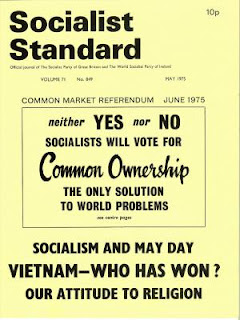
State Capitalism is not Socialism (1975)

From the May 1975 issue of the Socialist Standard

The pages of the Socialist Standard have always pointed out the differences between the various competing capitalist states. These differences fall into two main categories.

The first concerns the amount of democracy permitted to the workers. The UK, certain parts of Western Europe and the United States are examples of countries where the expression of an opinion contrary to the interest of the ruling class does not mean persecution. It would be misguided to over-emphasise this point: the freedoms that are available come down to the bourgeois right of freedom of contract. That means the freedom of the capitalist to exploit the workers. The worker has the freedom to be short of the essentials of life, to be exploited.

In addition in the countries where freedom of expression does exist, it is strictly limited. There is no right to hold public meetings in the streets, or anywhere else for that matter. Nonetheless, the freedom of expression that prevails in the UK and some other countries is of some value to the working class. It is easier to put the Socialist case in London than in Budapest or Peking.

Whilst the first difference between the various political systems is therefore of some interest to the working class, the other main difference is not. This concerns state control, or nationalization as opposed to private enterprise. As far as the workers are concerned, exploitation by individual capitalists is just as bad as exploitation by a monolithic state organisation. Even Bukharin and Preobrazhensky were able to see this in 1919. Referring to the fact that under state capitalism all enterprises come under the dominance of the state they said:
State capitalism, centralising all those organisations, converting them all into the instruments of a single united organisation, contributes immensely to the power of capital. Bourgeois dictatorship attains its climax in State Capitalism . . . State capitalism uniting and organising the bourgeoisie increasing the power of capitalism has, of course greatly weakened the working class. (The ABC of Communism, Pelican edition p. 164).
Despite years of hard effort by the Socialist Party, two myths remain. The first is that state capitalism or some form of nationalization is of benefit to the workers. The second is that those countries that have a high degree of state control have in fact introduced Socialism or are at least in the process of doing so. Both these delusions are held by various sections of the political "left” despite the mass of evidence against them.

Take Russia first. The reality of state capitalism with all that it implies was made plain by Alexander Shelepin the former head of the Russian secret police when he was over here in March and April of this year as the guest of the TUC. The Guardian reported him as saying that the Russian unions were struggling to increase their living standards and to participate both in a share of the profits from industry and in industrial management (2nd April 1975). The next day The Sun reported him boasting that "Things were getting better every year. Wages were being increased.” Presumably in this workers’ paradise wages were previously "lower”.

The existence of wages is the hallmark of capitalism. Capitalism implies a certain relationship between people, depending on whether they own capital or merely the ability to work. The workers in selling themselves day after day to the capitalist enrich not themselves but the owners of capital whose wealth their work increases.

But despite the frantic action of the so-called communist parties throughout the world, the illusion that Russia is anything but a brutal fascist dictatorship, red-raw capitalism, is now held by very few. Instead, tragically people looking for hope from elsewhere (instead of working things out for themselves) have turned to China. Information on China is limited; nonetheless the papers are full of examples, for those prepared to see them, that what is going on in China is the build-up of a form of state capitalism. For instance, The Guardian reported Mao’s argument that there is an acute danger of capitalism reappearing just as he says that it has done in the Soviet Union. Mao is supposed to be urging the workers to keep up the struggle for Socialism (3rd April). If Socialism has been established why struggle to achieve it? If capitalism has been abolished how does it reappear?

The arguments go deeper. There are two fundamental conditions for the establishment of Socialism (which must be a world-wide event). The first is the technology capable of production in abundance. This patently was not possible in Russia in 1917 or in China in 1949. The second is the desire of the working class, based on knowledge and understanding, to establish and run a social system where all wealth is owned in common by the whole of mankind, where production takes place for use, and where all that is made by man, is freely available to man. This condition never existed in Russia or China and as yet exists nowhere in the world. But the measure of the political awareness of the working class, is their level of understanding of Socialism. Without Socialist knowledge, Socialism is no more possible than walking on water. Those that claim they are introducing Socialism for the working class (or have introduced it) are hoodwinking humanity.
Ronnie Warrington

Sunday, May 1, 2022

Ukraine: Good Against Evil . . . Or More Complicated Than That? (2022)

From the April 2022 issue of the Socialist Standard

The war in Ukraine has led to much sympathy and solidarity from people across Europe and beyond. And in a way, this is both understandable and heart-warming. Few want to see innocent people bombed out of their homes and turned into refugees, fleeing mass killing. The assistance people have been prepared to give Ukrainian refugees has been a testament to the basic solidarity and mutual support socialists have always said we are capable of as human beings.

The media have largely portrayed this war as a battle of good against evil. Socialists know that wars in modern capitalist society are never quite that simple. Sometimes the motivations for war are transparently economic (eg the Gulf Wars), while at other times there is a complex geo-political element, with states manoeuvring for political advantage and seeking to extend or defend their spheres of influence (the Falklands War was closer to this).

The Ukraine situation is complicated and most people (including us) did not expect armed conflict to actually break out. The ‘good versus evil’ scenario that is the dominant narrative doesn’t quite fit and as usual other factors are at play.

Democracy?
Over time, political democracy, imperfect though it always is within capitalism, has emerged as the dominant and favoured way for the ruling classes of nation states to manage their affairs. This has come about for a number of reasons – some because of political pressure from the working class wanting a say in how society is organised and run (e.g. the Chartists in Britain in the nineteenth century), but also because the owning class is rarely united. It is typically a mass of competing interests, not just between states but within them as well. Financial capital (such as the banks) often has different interests to industrial capital for example, and political democracy is a good way of the state arbitrating between competing interests.

Many states though take years to develop this type of democratic practice and culture as they have little by way of a tradition in it. Indeed, since the Second World War, while numerous states have gravitated towards elements of political democracy across much of the world, some have done it much more successfully than others. This is the story of many of the states that either emerged or reinvented themselves after the collapse of the old Soviet Union in the early 1990s, including both Russia and Ukraine. Both have elements of capitalist political democracy but in an obviously deformed way, and the type of political corruption that tends to exist at the fringes of more mature capitalist states like those in Western Europe, North America, etc tends to be more entwined with the state apparatus at a deep and fundamental level. Their past authoritarian cultures have had a lasting impact.

The think-tank Transparency International (not above controversy itself) produces an annual Corruptions Perceptions Index which ranks countries according to general perceptions of corruption and theft in their state machinery and operations. In 2021 Russia ranked a lowly 136th out of 180 listed states. Interestingly, Ukraine was little better at 122nd in the world as graft, corruption and client-politics there are legion. This manages to put both Russia and Ukraine even lower than dictatorships such as Cuba (64th) and China (66th).

Most politics in Ukraine is dominated by ethnic and nationalist considerations, with what could be described as the right/left political spectrum associated with more mature democratic states barely in existence. This situation is blurred slightly by the fact that Ukraine currently has a government led by a president (Zelenskyy) and party (Servant of the People) that have an orientation that is at least broadly aligned with some conventional notions of Western parliamentary democracy, including aspirations towards membership of the European Union.

Russia on the other hand has more obviously still struggled to shake off decades of authoritarian control and culture and is run by what appears to be an ever-smaller clique led by President Putin, an elected dictatorship in all but name. Checks and balances on authoritarian actions and adventures are low and Putin has long hankered after recreating what some would refer to as the old Soviet Union without much of the associated Leninist politics. It could be seen even more easily as a recreation of Tsarist Russia, an empire which also included most of what is now Ukraine and parts of many other Eastern European states.

Whenever Putin sees an opportunity to embark on a military adventure in pursuit of this goal he has a tendency to move fast, with few if any challenging voices around him in the Russian hierarchy. The usual manoeuvrings and diplomacy around these situations by other states effectively become cast as an excuse to do what he most likely wants to do anyway (as with NATO expansion into the East). This then – at least in theory – strengthens his internal and external position as the leader of an empire trying to regain its ‘rightful’ position among the nations. This worldview has been exacerbated by longstanding grievances, both related to Russia’s historic standing and defeat in the Cold War, and also personal slights such as when his mooted interest in Russia itself joining NATO over two decades ago was rebuffed by both Bill Clinton and George W Bush.

Economic interests
In addition, Russia has its own clear economic interests too. As such, in 1994 it sought to set up its own trading bloc which came to full fruition in 2011 when seven other countries agreed to join it in a free trade area. These were Belarus, Kazakhstan, Kyrgyzstan, Tajikistan, Armenia, Moldova and Ukraine. But the orientation of Ukraine along with many other Eastern European states towards the EU led it to sign a ‘Deep and Comprehensive Free Trade Agreement’ in January 2016. Since then, Russia has suspended its free trade agreement with Ukraine and Ukraine retaliated by passing trade restrictions on Russia.

Russia has long created issues for the West that it has struggled to resolve. Doing deals with the oligarchs while watching Putin help rip up various geo-political agreements made in the 1990s after the fall of the Soviet Bloc has created a certain cognitive dissonance, but until recently it was the money that largely won out. Since the collapse of the USSR in 1991, the oligarchs who stripped the state of many of its assets for a massive profit have found a welcome home for the most part, particularly in the UK. The debutant balls that take place in Mayfair each summer are no longer arranged for Sloane Rangers but for the sons and daughters of the Russian elite. Many of the top FTSE 350 resources companies quoted on the London Stock Exchange are Russian – such as Evraz, Polymetal International and Petropavlovsk. The oligarchs and their families who own football clubs and newspapers had become ever more integrated into Western capital and it is hardly surprising, as they have qualities, connections and money admired by the elites in the West.

According to The Economist, 41.3 percent of Russia’s exports come to the European Union and the UK, while 34.5 percent of its imports originate from the EU and UK. The massive sanctions that have now been imposed as a result of the war in Ukraine will hit this considerably and it is clearly something the West would not have otherwise countenanced.

Arguably, the move to expand both the EU and NATO to the East have ‘provoked the Russian bear’, but it is a bear they have been prepared to happily play with for quite some time. This too despite the Russian invasions of Chechnya (1995), Georgia (2008) and Crimea (2014). And many on the political left have been closet apologists for Putin on the grounds that an enemy of an enemy must be a friend, irrespective of the discrimination and human rights abuses of the Putin regime and the fact that most of them would most likely end up in prison there just for promoting the views they have.

Murky business
So, one way or the other the war in Ukraine has interrupted business as usual, as wars tend to do. The previous Russian invasions of adjacent territory were not welcomed by the West but not proactively resisted either. Ukraine is too big, too close and the situation now perhaps too grotesque in some aspects for them to turn the other cheek completely. They will not wish to get involved militarily (at least not in an active sense) as that might provoke an even worse escalation, so the retaliation will be economic in essence, building on Ukraine’s own sanctions against Russia since 2016.

It is a mess, but the sort of mess capitalism delivers all too frequently. Socialists have sympathy with the oppressed and those struggling for basic democratic rights everywhere but don’t take sides in conflicts between elites. We know all too well that the victors soon become the oppressors (as happened in Russia itself post-USSR). To put it bluntly, we are on the side of both the Ukrainian people getting bombed out of their homes and the Russian soldiers getting murdered in battle because of the imperial fantasies of the leader who ordered them there.
DAP