Party News from the January 1948 issue of the Socialist Standard
Showing posts with label Charles Lestor. Show all posts
Sunday, January 11, 2026
Monday, November 17, 2025
The Passing Show (1948)
The attempts of our rulers and spiritual advisers to formulate the mode of procedure best fitted to keep the workers quiet are becoming so fantastic as to cause even their docile dupes to wonder if there is not some leg-pulling going on somewhere; the hope of heaven on earth promised at the last election has gone with the wind. The way of the transgressing wage-slave is indeed hard; he suffers for the sins committed in Capitalism’s interest and bears all the burdens of his exploiters during the process; he is becoming weary and inclined to flag, but this cannot be allowed. “What we want is more production.”
It will be noticed that during those periods when the worker, driven beyond endurance, ventures to quit, he is always out of order (practically all strikes are unofficial). The Labour Leader of the Union and the Labour politician unite in condemning his rebellious conduct; and the capitalist press wholeheartedly support them. Denounced by the leader of his union, attacked in Parliament by his own Labour member, shown the error of his ways by the Church and universally vilified by the capitalist press, he may be excused if he doubts the evidence of his senses, but in spite of all these handicaps, he still keeps up the fight; he feels he must; his instincts bred of the class struggle he feels to be correct; he is becoming conscious of himself ; he is beginning to realise what history has called upon him to do. Upon the worker’s action rests the fate of humanity and every socialist on the planet is sustained during these perilous times by the firm conviction that he will not fail.
It is interesting to consider the views of the pioneers of scientific Socialism on the functions of the trade unions. Lucien Laurat, on pages 74 and 75 of his book. “Marxism and Democracy,” states that Marx made a number of important statements to Hamann, the treasurer of the Metal Worker’s Union. The discussion took place in Hanover in 1869. Among other things, Marx is reported as saying the following:—
“The trade unions must never be associated with or dependent upon a political group. Otherwise they would never be able to fulfil their task, and they would receive a mortal blow. The trade unions are the schools of Socialism. In the trade unions the workers become socialists because they see every day before their own eyes the struggle against capital. Political parties, whatever they may be, can arouse the enthusiasm of the working masses only temporarily for a time only, whilst the unions hold their loyalty much more securely, and it is only these unions which can be a real working class party and erect a bulwark against the power of Capital.”
This is what Marx is alleged to have said about 80 years ago. It is questionable if he would repeat the statement were he alive to-day.
Long before this, Engels, in his “Condition of the Working Class in England,” stressed the importance of the economic movement, and Marx, in his “Poverty of Philosophy,” fiercely attacked Proudhon for his hostility to trade unions and to strikes.
Wherever the unions are mentioned in Marx’s writings we find he defends them. In another quotation in the book above referred to he stated: “The struggle of class against class is a political struggle.”
When the Chartist movement was analysed by the old timers the fact that the trade unions did not as a whole support the Chartists was referred to with regret.
In “Value, Price and Profit,” the part played by the unions was dealt with, their limitations clearly shown, together with their utility, but it is pointed out they could be more successful if they used their power more intelligently: they should have as their watchword not a fair day’s pay for a fair day’s work, but the revolutionary “abolition of the wages system.”
Since the founders of the movement passed away the workers have acquired considerable knowledge as a result of their experience..
The wage-slave sells his labour-power to the capitalist, and competing with him is his fellow slave. The identity of interests of the workers on the economic field is obscured.
When labour-power is in demand the sellers of that commodity, by means of their organizations, try and raise the price, but when the demand falls off, and the unemployed become numerous their organizations weaken and the price falls. There is nothing in trade union action that can take labour-power out of the category of commodities. Trade unions are often the means of enabling the workers to obtain a rise in wages before they otherwise would do and also in preventing a rapid fall when circumstances are in favour of the exploiter. They are, in addition, a vehicle for obtaining better conditions which through custom sometimes become more or less permanent, Their value to the worker cannot be questioned, but they cannot emancipate the toiler from wage slavery.
It is not the function of a political party to interfere with the operations of the unions.
The movement in Britain has not been helped by the political levy and the fusion of some unions with the Labour Party: the unions have not benefited: the trade union leader is now often in opposition to the aspirations of the rank and file, and is backed, on almost every occasion, by the Labour politician in resisting efforts to use the organisations for the purpose for which they were originally formed.
It is inspiring nevertheless to see the gradual spread of class consciousness : it is slow, but sure in its coming. Capitalism is up against problems it cannot solve. There is no power that can prevent the advance of the workers permanently, but it can be helped along by socialist knowledge.
The socialist aims at the removal of Capitalism : the trade unionist who is not a socialist thinks he can get something worth while out of the present mode of production. Sooner or later it will dawn upon the working class that trade union action can’t beat the capitalist system.
In 1850, at the time of the split in the Communist League, Marx judged it necessary to tell the workers “You will have to go through fifteen, twenty, perhaps fifty years of civil and international wars, not merely to change conditions, but to change yourselves, and make yourselves fit to take over political power.” He was optimistic; the workers are still in the wilderness, but his vision was clear. A long preparation was necessary before they could be equipped with knowledge sufficient to enable them to take possession of the promised land.
We have now undoubtedly arrived at a point from which the wage-slaves can see where to head for.
Charles Lestor
Blogger's Note:
Lucien Laurat's Marxism and Democracy was reviewed in the February 1941 issue of the Socialist Standard.
Thursday, November 6, 2025
The Emerging World Scene (1946)
There is no doubt that things are on the move. Incessant activity on the part of politicians leads one to speculate as to what is pending. The Nuremberg Trial is now a thing of the past, the U.N. is proposing to take a breathing spell, the Conservative Party holds a conference, the U.S. takes decisive action in Europe; in short, what we see in our master’s press leads to the belief that the decks are being cleared for action : the capitalist class have, in the main, decided upon what they are going to do.
The American Presidential election takes place in two years’ time, and all those aspiring to office in the United States act, and speak, under the spell of that important fact. Eisenhower, who recently spoke at Edinburgh, Byrnes, the representative at the U.N., Wallace, the former U.S. Secretary of Commerce, and many others are thinking when they speak not so much of the subject in hand as of the American election of 1948.
Eisenhower said in his speech of October 3rd : “World neighbourliness must be achieved or else, we shall, in a twinkling, travel a backward route over mankind’s long and laborious progress from his ancient caves to the present.”—(Daily Telegraph, 4/10/46.)
Mr. Byrnes says that if other Powers will agree to the 40-year Treaty proposed by him, this treaty will bind “not merely the present American administration, but its successors.”
Commenting on this, the Daily Telegraph of October 4th says : —
“Of the four Powers consulted upon this proposal, Britain, France and the United States are favourable, and it, is only from Russia that a refusal has so far come. This refusal is no doubt partly based upon those divergencies of view between the wartime Allies to which Mr. Byrnes made discreet reference. The prospect of a democratic Germany as seen by the State Department and by the Kremlin is strikingly different. Yet it is difficult not to surmise that Marshal Stalin’s objection to the Four-Power Treaty is mainly based on the fear, not that the United States will disinterest herself from Europe, but on the contrary, that the Treaty would serve to maintain her influence there. Mr. Byrnes’s reference to the Yalta declaration and the continued American interest in the Balkans indicates that this influence will, none the less, persist.”
Mr. Byrnes has a good election cry for 1948 : his rival, Mr. Wallace, who recently was rapped over the knuckles by President Truman and, as a consequence, lost his job, is losing out in the race; the policy of isolationism is no longer in favour in capitalist circles.
Mr. Baruch, United States representative on the Atomic Control Commission, has vigorously attacked Wallace, and stated that the latter was totally ignorant of the facts underlying atomic control. Wallace is now trimming his sails, and states, in excuse for his attack on Mr. Byrnes’ policy in regard to Russia, “that he had obviously not been fully posted as to the facts.” The deadlock over atomic control, according to Wallace, results from absence of mutual trust between U.S. and Russia. He faces both ways, like all politicians placed in similar circumstances, by concluding that “the United States is in a better position to assume leadership which will lead,” but he has no plan except that of stopping the manufacture of atomic bombs.
If we read between the lines the general conclusion arrived at is that a peace treaty is going to be patched up. Russia is compelled to accept the U.N. decision on Trieste, and her policy regarding the Danubian Waterway has been opposed so strenuously by Britain, France and the United States that she is compelled temporarily to give way to them.
There is little likelihood of a long or permanent peace; however, the nations will, in all probability, prepare for what, under capitalism, is inevitable with what speed they may. Britain is evidently not going to be caught napping. Look at this: —
£12,000,000 FOB ROCKET TESTS.AUSTRALIAN PLANT.“The British and Australian Governments may be involved in an expenditure of between £12,000,000 and £14,000,000 in the construction of rocket-bomb workshops and testing ranges in Australia. The annual maintenance cost is expected to be about £3,000,000.It is understood the Australian Government has received advice from Britain setting out proposals for research and development and for testing grounds in the centre of Australia. These are based on the recommendations of a mission of experts and scientists which visited Australia early this year”.—(Daily Telegraph, 4/10/46.)
It is against the above background we must judge the speeches of Sir Stafford Cripps at the Empire Trade Conference on October 3rd.
The Tories have recently laid stress on Imperial Preference; the following is Stafford Cripps’ reply.—
“It was an obvious and sensible course for us to pursue to endeavour to extend and consolidate our inter-Commonwealth trade."But that trade alone cannot fully meet any of our needs, and it would defeat our object of full employment and prosperity for our own people if we were to concentrate on Commonwealth trade alone and neglect those wider fields of world trade which we must cultivate.”
You are plainly told the Empire is not enough for British Capitalism; the Government must go hunting elsewhere for markets. The system compels expansion; the world is the limit; the clash between nations cannot be avoided. Socialism is the only means of saving mankind from destruction, and, unfortunately, Socialism is not yet fully understood by those who are called upon by history to establish it.
The Conservative Conference was held by men who observe the signs of the times, and are getting ready to deal with a situation they think will arise in the not far distant future.
The Labour Party is designated as the Socialist Party, but one statement made by Mr. Eden will be very interesting to the readers of the Socialist Standard.
“There is one principle underlying our approach to all these problems, a principle on which we stand in fundamental opposition to Socialism. The objective of Socialism is State ownership of all the means of production, distribution and exchange. Our objective is a nation-wide, property-owning democracy. (Cheers.)These objectives are fundamentally opposed. Whereas the Socialist purpose is the concentration of ownership in the hands of the State, ours is the distribution of ownership over the widest practicable number of individuals. (Cheers.) Both parties believe in a form of capitalism, but whereas our opponents believe in State capitalism, we believe in the widest measure of individual capitalism.”—(Daily Telegraph, 4/10/46.)
Eden knows, and clearly shows, that the difference between the Labour Party and the Conservative Party is a difference in degree and not in kind.
The propaganda of the l.L.P. and kindred organisations have confounded Socialism with State Capitalism.
Mr. Eden is slated for the Premiership and the odds are in his favour.
Division in the Labour Party is probable, and the Communists may hasten it along. “For or against the Soviet Union” may arise as an issue out of the present political situation. The Cabinet will be up against it if they are forced to decide between Russia and the United States. The “Labour Progressives”, supported by Communists, will go wholeheartedly for Russia if such an issue develops, so will many of their followers in the Unions, and the question, is what will happen to the Labour Government in these circumstances?
Anthony Eden is the most likely man for the Premiership in the Coalition Government which it is anticipated would then spring into being as a matter of course.
The above is how the prophets have worked it out; they may be right, but, as Shaw says, “You never can tell.”
Meanwhile the wage slave plods his weary way. his meagre rations barely sufficient to enable him to carry on.
So Capitalism staggers along through the stages that precede its dissolution. It must live its life, but the end is drawing nearer every day.
Wherever you go nowadays you find working men not only discussing the political situation, but analysing it ably and well.
The war has not succeeded in blowing out the light within the brains of the members of our class; it has accelerated the growth of class consciousness, and increased the knowledge of the system that is its cause.
In the chain gang of wage slavery this knowledge is being passed from man to man and from woman to woman. The substance of Socialism is being absorbed by ever-increasing numbers.
The effects of this may be clearly revealed in the intelligence displayed by the workers in the strenuous conflicts that lie ahead.
The inherent antagonism between the exploited and their exploiters cannot be suppressed; it will become world wide; wherever Capitalism goes Socialist ideas cannot be prevented from appearing and playing their historic part.
The Capitalist class are bent on rejuvenating a system that is now senile. They cannot give it a new lease of life.
The working class will soon be forced to try and discover ways and means of ending it. We are with them because we are of them. There is no doubt as to the result. Society must establish Socialism or perish. The expropriation of the expropriators is the only way out.
Charles Lestor
Sunday, October 5, 2025
General Open Air Propaganda (October) (1938)
Party News from the October 1938 issue of the Socialist Standard
Blogger's Note:
The SPGB had every intention in contesting a seat in East Ham at the next General Election, but war intervened.
Tuesday, September 16, 2025
Letter: Immigration: one view . . . (1976)
Immigration: one view . . .
The front over of the Socialist Standard (July) is emblazoned with a definition by Ambrose Bierce: “Immigrant: an unenlightened person who thinks one country better than another.”
Presumably, this means the Socialist Standard regards Karl Marx as an “unenlightened person”. He left Germany and spent most of his life living in Britain. Actually, the development of socialist theory was fostered as a result. Con Lehane (an unenlightened Irish immigrant) became the SPGB’s first general secretary. Hans Neumann (an unenlightened German immigrant) arranged the first meeting of the SPGB’s executive committee. Charlie Lestor (an unenlightened Canadian immigrant) was for many years one of the finest orators the SPGB possessed. Does the SPGB condemn Lehane for being an immigrant? Hapless Lehane could not secure employment anywhere. Is the Socialist Standard suggesting that he should have continued looking for work in Ireland rather than coming over to Britain and helping to form the SPGB?
Doubtless the fascists of the National Front go a long way to agreeing with Bierce’s definition: in the opinion of Tyndall and his thugs “immigrants are unenlightened people”. Socialists should have an entirely different approach. Hunger and poverty in the underdeveloped countries is directly as a result of imperialism. Dire necessity forces thousands of people to leave these regions and look for a better life elsewhere. Like British workers, they are victims of exploitation, but of an exploitation of a much more intense kind.
It is vital that socialists strive to build links of solidarity between British and coloured workers. Essentially we have the same class enemy: only through unity can the enemy be overcome. For this reason, the demand must be made for the repeal of the immigration laws, racist legislation which excludes people from this country merely because of the colour of their skins. If, as the Communist Manifesto says, workers have no fatherland, then the barriers created by immigration laws must be swept aside. Workers must be free to leave and enter Britain as they choose.
To be in accord with these sentiments, the definition of Ambrose Bierce requires modification: “An opponent of immigration is an unenlightened person who thinks one country better than another.”
Dr. Raymond Challinor
Whitley Bay
Reply:
The quotation to which you object was used because it disparages nationalism and comments, aptly in our opinion, on the situation of very many migrants. Its tone is ironical, and we ran the risk of someone’s not perceiving that. To spell it out, the word “unenlightened” relates to the remainder of the sentence: a person who thinks one country better than another requires enlightenment in that respect, but not necessarily in others. Marx and the other people you mention were not under that impression. As for racists finding that issue of the Socialist Standard agreeable — see the letter from John Binder below.
However, you appear not to have read the article on immigration inside the cover. Doing so would have dispelled the misunderstanding in the later part of your letter as well as the above one. The article pointed out that “legislation which excludes people from this country merely because of the colour of their skins” is swept aside when that suits capitalism in Britain and elsewhere. This is, precisely, the trap into which reformism leads. Liberal-minded reformers urge, as you do, that a legislative change will benefit the working class; and then find it does the ruling class a good turn instead.
To say Socialists must “strive to build links of solidarity” between white and black workers is a grandiose way of ignoring the important questions. The majority of black workers, like the majority of white, uphold the capitalist system. They include nationalists, Tories, and people who themselves hold strong race-prejudices. If it were suggested that we aim at "links of solidarity” with white people holding such views, that would cause indignation; but you ask us to do so on the grounds, apparently, that colour transcends everything else. We do not accept such a position. The task for Socialists is to spread among all workers and understanding of their class standing and interests, which come first and foremost. This means the rejection of all ideas of race and national superiority. If you are intent on re-wiring the quotation, here is another version: Opponents and advocates of immigration alike are hidebound by the idea of national frontiers which Socialism will abolish.
Editors.
Friday, September 12, 2025
Oil and the Arab World (1946)
The appearance of the Atomic Bomb has not eliminated oil from the field of production and destruction. The modern nations are controlled by men who have an eye on the main chance. . Everything, no matter how ancient, “holy” or beautiful, is ruthlessly sacrificed to the God of Profit. The system has worked out in such a way that it has brought to the surface all that is vile in human nature : the worst man has the best opportunity: As the Americans say, it is not the survival of the fittest, but the survival of the slickest: the cunning and treacherous are able to take advantage of those who are straight: the latter are looked upon as simpletons, fish to be hooked by the anglers of the market: one by one they are kicked into the gutter: the religious world bemoans the fact that their dope no longer works and look around everywhere for more enticing bait, Christianity has so little confidence in its adherents that the keys of the Holy Sepulchre can only be trusted to the hands of the Moslems. The Methodists report a decline of 83,000 in their membership in 10 years. They don’t know why, but we do.
In the early days of Capitalism they preached Hell and Damnation to the children working 16 hours a day in the factories. The fear of hell no longer exists; the wage slave has too much experience of the reality. Religion is a fantastic reflection of the real world; a product of the imagination; it dies in proportion as the real world is understood. Material conditions, and not religious illusions, determine the course of history. Man will be better morally when the economic foundation of the society in which he lives is such that the bias is on the right side. Professor Jenks hit the nail on the head when he said “Morality is the result, not the cause, of social amelioration.”
The countries where civilisation first made its appearance are being brought under capitalist influence as a result of oil, etc., being discovered in these regions. As they are adjacent to what Jews, Christians and Moslems describe as the holy land, it is interesting to ponder over the fact that we shall soon see greater miracles performed there than the followers of Christ ever imagined possible.
A writer in the Sunday Times (July 13th, 1946) quotes from Arabia Phoenix, by Gerald de Gaury, a passage which gives us a vivid picture of the changing scene:
“The transforming properties of magical petrol transcend the most powerful incantations of the Arabian nights; yet its common result is not to make the desert blossom as the rose, but to change an oasis or what not into concrete and tarmac. This comes about through the logic of necessity, though other names have been found for it. Where we landed from a sailing ship on the edge of the virgin dunes of the east coast is now an American industrial town; the centre of the oilfield of the American Oil Company . . .”“The Wahhabis are going to learn something not in the Koran, evidently. Not date palms, goats, camels, mosques and the smell of herbs and charcoal fires, but quays, derricks, rigs, sheds, pipe lines, power plants, automobiles rushing about and hurrying gangs of workmen. Not the salutation ‘ Peace be with you,’ but ‘ O-kay, boy.’ Irrigation experts from America are busy; the towns of Arabia are linked by wireless stations; the royal camp of hundreds of tents is mechanised; six-wheel lorries rumble through the Wadis. ‘The vast wilds of wild Arabia are as thoroughfares now.’ ”
In the World Review of July, Gerald de Gaury gives us a little more information.
“The main industrial development in Saudi Arabia is at the oilfield at the extreme eastern province of Al Hasa, on the Persian Gulf coast. The Arabian American Oil Company (formerly known as the California Arabian Standard Oil Company), of Delaware, U.S.A., was granted a concession for sixty years in May, 1933, for an area of 300,000 square miles. When oil was struck in 1941 the Company began to make payments on account of royalties, which are paid at the rate of 4s. ‘gold’ per ton of oil produced. The area conceded has since been extended to both the North and South, the whole area now forming a crescent shape along the northern frontier down the Eastern Coast and southwards towards the empty quarters. A refinery with a capacity of 2,500,000 tons a year is nearing completion at the small town of Tannra, on the Eastern Coast. There has been a tentative exploration for oil elsewhere in Saudi Arabia, and for a time a concession was held by Petroleum Development (Western Arabia), Limited, an associated company of the Iraq Petroleum Company, but this was abandoned during the war, when the obligation undertaken could not be fulfilled. There has been a project for a pipeline across Arabia from the oilfield to the Mediterranean, but it is unlikely to hold any economic advantage unless the oil output reaches some 6,000,000 tons per annum. The company has had as many as 8,000 Arab workmen on its books at one time, and it is already having a marked effect on the social life of the people of Eastern Arabia.”
We have recently read of British warships being in the vicinity of the Persian Gulf. The great Powers are unable to agree about anything anywhere for long. As capitalism concentrates, the causes of conflict are forced to the surface. Read carefully from La France Libre in the periodical quoted above : —
“Russia has always been considered as being one of the largest oil reservoirs in the world. Her known reserves, according to Professor Gubkine, amounted to 1,000 million tons. But the imperfect exploitation of Russia’s sub-soil lends weight to Gubkine’s further assertion that the certain, and probable reserves amount to 4,600 million tons, thus exceeding those of the United States by 50 per cent. On the other hand consumption has risen to not more than 25 million tons a year; even if it were to rise to the same level as in England it would not appreciably exceed 60 million tons. Of all the great powers Russia was the only one that had no oil problem. But recently her attitude has completely changed. The new orientation shows itself not only in the tracing of new frontiers (the annexation of the oil deposits of Poland and Sakhalin), but also in the strenuous efforts which Russia is now making to obtain a predominant position in the oil industry of Roumania, in Hungary and, above all, in Northern Persia.Here, according to the recent agreement, half of the production will belong by right to Russia; the other half Persia will have to sell to the highest bidder, which will, no doubt, be Russia, since she offers the natural and most easily accessible market. It should be noted that the concession zone does not touch the frontiers of Turkey or Irak or of Afghanistan—an arrangement intended to allay suspicion as to Russia’s intention in these regions. Given the tension caused by the Russo-Persian dispute in international relations, the new treaty may appear satisfactory, but the crisis serves to remind us that, oil has lost nothing of its powers to engender political conflicts even though that power is to-day confined to the Near East. It is its oil as much as its geography that is making this region the nerve centre of the world.”
The Poets of Persia, sang hundreds of years ago of the tinkling of the camel bells, the song of the nightingale, the beauty of the crescent moon, and the fragrance of the rose.
Then had they time to sit and ponder over the mysteries of the desert. Gone now for ever is the romanticism of this region; the Arab steed is now outpaced by the jeep, the caravan gives place to the railway, the free wild men of the plains are caught in the net of wage slavery.
They will shortly be as bewitched and bewildered by close contact with the mechanism of Capitalism as their forefathers were by the conjuring tricks of the ancient seers.
But they will learn quickly and repeat as they are trying to comprehend the words of our old friend Omar : —
“Could thou and I with fate conspireTo grasp this sorry scheme of things entire.Would we not shatter it to bitsAnd then remould it nearer to the heart’s desire.”
Charles Lestor
Sunday, August 31, 2025
Monday, August 25, 2025
Monday, July 28, 2025
SPGB Open Air Meetings (1934)
Party News from the July 1934 issue of the Socialist Standard
Blogger's Note:
Interesting that Hyde Park isn't listed. I guess it was just taken as read that the Party would always have speakers there.
As mentioned previously on the blog, I really wish I could include all the speakers listed in the label section but it's just not doable. Outdoor speaking was so central to the Party's activity and identity in the first fifty years of its history that it's unfortunate that it cannot be properly represented on the blog. Looking at the names listed, here's a wee bit info about some of the speakers listed:
- Tony Turner: The pre-eminent SPGB outdoor speaker for twenty plus years. Originally joined the Southwark Branch of the SPGB in July 1931. Resigned in April 1955 over the Forum dispute. His obituary appeared in the April 1992 issue of the Socialist Standard. He appears on the front cover of the June 2004 centenary issue of the Socialist Standard.
- Gilbert Manion: A former member of the Social Democratic Federation, Manion originally joined the SPGB in November 1928 and was a member of the Party on three separate occasions between 1928 and 1953. Originally a member of the Camberwell Branch of the SPGB he was also a member of Hackney Branch. He was still a member of the Party when he died in 1953. There was no obituary for him in the Standard.
- Jimmy Banks: A member of Battersea Branch, he joined the SPGB in May 1915 and was still a member of the Party when he died in December 1966. A class conscious objector during the first World War, he was sent to Dartmoor Prison for his principles. Sadly his obituary from the February 1967 issue of the Socialist Standard is brief to the point of ridiculousness for someone who was an active socialist for over 50 years.
- Henry Russell: The Russell listed amongst the speakers was probably Henry Russell. Joining Southwark Branch of the SPGB in September 1933 he was a member of the Party until his membership was lapsed in November 1952.
- Bob Ambridge: One of the mainstay members in the history of the SPGB, Bob Ambridge joined the Battersea Branch of the Party in September 1927 and was a member of Swansea Branch when he died in February 1980. His obituary appeared in the April 1980 issue of the Socialist Standard.
- Claud Godfrey: Sadly, another longstanding member with an all too scant obituary in the pages of the Socialist Standard (April 1972 issue). Godfrey originally joined Tottenham Branch of the Party in July 1926, and was a member of Haringey Branch when he died.
- Jack Butler: Another stalwart member of the SPGB, joined West Ham Branch of the Parry in 1910 and served the Party both as a speaker and as a behind the scenes member. At the time of his premature death in 1944, he had been the Party Treasurer for 20 years. 'Gilmac' (Gilbert McClatchie) wrote a warm and personal obituary for Jack Butler in the September 1944 issue of the Socialist Standard.
- R. Innes: A member of East London Branch of the SPGB, joining the Party in September 1931.
- F. Wiltshire: There were two 'F. Wiltshires' in the SPGB. A F. Wiltshire Sr and a F. Wiltshire Jr. This was probably F. Wiltshire Sr, who originally joined the Islington Branch of the SPGB in April 1911. He was to join and rejoin the Party three or four times over the course of forty years.
- Nathan Isbitsky: Joined the East London Branch of the SPGB in July 1930. He's briefly mentioned in Barltrop's The Monument, but there is no record of when he left/resigned from the SPGB.
- Sid Rubin: Another member who joined the Party via East London Branch. He joined the Party in July 1931 and was an incredibly prolific speaker and writer through the 1930s and 1940s, until he had to resign his membership in April 1949 as he was moving abroad. As 'George Camden', he wrote the novel 'My Time, My Life'.
Posted by
Imposs1904
at
9:48 PM
No comments:
Labels:
A. Jacobs,
Adolph Kohn,
Bob Ambridge,
Charles Lestor,
Jimmy Banks,
July 1934,
Nathan Isbitsky,
Outdoor Meetings,
Party News,
R1934,
Sammy Cash,
Sid Rubin,
SPGB Sheffield Branch,
Tony Turner,
W. Waters
Sunday, July 27, 2025
Open Air Propaganda (July) (1937)
Party News from the July 1937 issue of the Socialist Standard
Blogger's Note:
A bit of a mystery here. A Party speaker with the surname of 'Otto' is listed four times in the Speakers' List for July. There is no record of an 'Otto' in the Party membership list. This member was obviously well regarded as a speaker 'cos they secured one of the marquee spots speaking at Hyde Park on a Sunday alongside the likes of Sammy Cash and Tony Turner. So, it's either a case of another example of the incomplete membership records or, more likely, that 'Otto' was a pseudonym for a Party member whose name couldn't appear in the Party press.
Also interesting to note that both Adolph Kohn and Eric Boden are listed as speaking. I didn't know they were still doing outdoor speaking this late in their Party lives.
Posted by
Imposs1904
at
1:18 PM
No comments:
Labels:
Adolph Kohn,
Augustus Snellgrove,
Bob Ambridge,
Charles Lestor,
Eric Boden,
Frank Grainger,
Jimmy Banks,
July 1937,
Outdoor Meetings,
Party News,
R1937,
Sammy Cash,
Sid Rubin,
Tony Turner,
Vic Berry
Tuesday, July 22, 2025
East Ham Parliamentary Campaign (1938)
Wednesday, July 9, 2025
The bear on the rampage (1946)
Delcassé once said “There are two diplomacies in this world that really count, the British and the Russian, for the simple reason that they are the only ones which plan in generations and not in months, in centuries and not in years.”
The unobservant man appears to be under the impression that the foreign policy of a capitalist government is determined by the party in power at the moment, whereas the truth is the track was probably laid down in the dim and distant past. The Labour Party is forced to foster and defend the interests of the Empire, and Stalin is the logical descendant of Peter the Great, the imperialist who laid the foundations of modern Russia. Capitalism has a ruthless code, and, so long as the system lasts., rulers and ruled are compelled to obey its mandate.
Gilbert Murray, in an article, “The Rule—The Lie,” in the current number of the “Contemporary Review,” says that “ When Nansen was distributing relief in Russia in 1921-22, one of the Soviet Government’s stipulations was that he should not reveal that the food came as a good will gift from foreign ‘capitalist' countries.”
The supplies that went from Britain to Russia during the late war are thought by countless numbers of Soviet citizens to have been sent from one part of Russia to the other. The Soviet Government rules by keeping its subjects in the dark, but events are helping to enlighten them. Edgar Bruce, in the “World Review” of May, tells of his experiences with the Russians in Europe who do not wish to go back to Soviet Russia. He was engaged in repatriation work and tried all be could to induce them to return to their native land. He wanted to know why many had no desire to go home. They sent him the following explanation : —
“We object to going back to the Soviet Union, it is all lies what they told us about our better living conditions in the Soviet Union.”
“ As peasants (on collective farms) the Government imposes taxes as follows on each individual: Milk contribution up to 500 litres, meat up to 32 kilo, eggs up to 120 eggs. If we keep our own cow a tax of 350 litres of milk from that cow has to be paid to the State. As workers the Government deducts 10 per cent, compulsory loan and then income tax and culture tax from our wages.“The Stakhanovite system is a rate-cutting system. The Government gives an outstanding workman the best tools and materials. He sets up a production record which the Government expects the ordinary worker to attain.“The average pay for a qualified man is 320 roubles a month, for the unskilled 80 or 90 roubles. Out of this ho must buy—black bread at 1 rouble a kilo, meat 12 roubles a kilo, butter 28 roubles a kilo, sugar 6.5 roubles a Kilo.“The cost to the Government of these commodities is one-tenth and one-fourteenth of what we pay. Punishment for late arrival at work can be six months’ imprisonment. Private work outside the factory is forbidden, espionage is rampant, and one is not safe from denunciation even by a member of one’s own family. Nobody is allowed to choose his work or place of work.” Both peasants and workers in the deputation that came to interview Edgar Bruce stated that the standard of living was at starvation level."
In fairness to Stalin & Co. it must be pointed out. that the above statements are from men who were fed up with life in Russia, and may be overdrawn. This is somewhat different, however, from what we read in Communist publications and contradicts what is said in all countries by the “Friends of the Soviet Union.”
The Soviet Government is making a bid for expansion in Europe and Asia. It is now a matter of life and death for the Kremlin to continue its policy of world deception, it must conceal from the workers in countries outside Russia an understanding of what is happening in the Soviet Union, and also keep from its own wage slaves a real knowledge of the state of things existing in the other parks of the capitalist world. The Russian rulers, having control of the organs of publicity, are at present able to make their dupes believe what they want them to believe, but when disillusionment comes, as come it inevitably will, there may be a dreadful reckoning.
The Soviet Government is, like all capitalist governments, an enemy of Socialism, and aims at using its influence over the workers of other lands as a means of spreading its imperial power. The facts cry beware. What are the aspirations of Stalin & Co.? Let us first take Persia and judge what they are after by what they are doing. Azerbaijan contains oil. During the Russian occupation of the province they started exploiting that oil (they actually bored no less than thirty-five wells) without Teheran’s desire or permission. When, later, Teheran was consulted and refused the oil concessions, an autonomous Azerbaijan Government was set up for the express purpose of ceding those rights. British capitalism is already entrenched in the oilfields of Southern Persia and, of course, sees danger to its position and profits in the Russian incursion.
As Léon Blum says in the Manchester Guardian of May 21st: “The Communists sacrifice liberty to discipline to such an extent that liberty is in danger of disappearance. The Communists always take it for granted that Moscow is right. Communist methods of propaganda are so unscrupulous that they endanger the very fabric of democracy.”
On the last day in March, in Germany, a plebiscite was held to see whether the Social Democrats should amalgamate with the Communists. The result of the voting being a foregone conclusion in an anti-Communist sense, the Russian authorities, in their own particular zone, forbade the plebiscite to be held (they held a separate and special plebiscite in their own zone when the desired result had been well and truly assured). They, incidentally, thereby gave another definition of what they mean by the word “Democratic.”
The Russian spokesman who made, this announcement to the head polling office coined a new masterpiece of Bolshevik jargon: “The plebiscite is not prohibited, but it is not permitted.”
Mr. Voigt, a well known writer on international affairs, says: “ The time will come when Russia will in Western Germany promote a German national ‘proletarian’ revolution against the Western Powers. The revolution, if it succeeds, will inaugurate the anti-Western and more especially the anti-British armed alliance between Russia and Germany ” (“Nineteenth Century,” May).
Mr. Byrnes, speaking on the radio, May 20th, said “The Balkan treaties were blocked mainly by the Council’s inability to agree upon economic clauses and particularly by the Soviet refusal to allow inclusion in the treaties of any provision promising freedom of commerce on the Danube.”
It was German capitalism’s determination to control the inland waterways of Europe that was one of the causes of Anglo-American opposition leading to the late war.
Another writer in the same magazine says: “The information and facts available show that Russia considers herself to possess exclusive rights for economic expansion in the countries of the middle zone. She has concluded with several states at present occupied by Russian military forces trade agreements which would practically bar any outside trade and would eventually lead to melting these regions into the economic system of Soviet Russia. The Soviet trade policy strongly reminds us of that of pre-war Germany, with the difference that it is very much more brutal and thorough.”
The real reason why Russia is so persistent in her attacks on Franco Spain is connected with her ambitions in the Mediterranean. How little it is concerned with combatting a government with Nazi sympathies is shown by the sudden somersault in the Russian attitude to the similar government in the Argentine.
Another sphere of Russian penetration is Manchuria, about which it may be possible to deal in a further article.
Marx said “We should obtain a knowledge of international politics. It is essential if we are to accomplish our task that we should also participate.” Russia is in the new armaments race.
The likely line-up in the next scrap can already he perceived.
The interests of the working class are not served by fostering imperialism, whether practiced by Britain, the United Stales or Soviet Russia. The workers can achieve their emancipation when they refuse to be led by politicians whose object, like that of the Labour Party, is simply to perpetuate existing capitalist institutions. The continuation of capitalism in any form means another world war. The establishment of Socialism means permanent world peace, but this requires a majority of Socialists to bring about. The making of Socialists is the only way it can be done. Therefore, keep on the job.
Charles Lestor
Sunday, June 22, 2025
Photographs and illustrations from the 70th anniversary issue of the Socialist Standard (1974)
From the June 1974 issue of the Socialist Standard
Blogger's Note:
This special 70th anniversary issue of the Socialist Standard carried a number of historical photographs within its pages. Some of the photographs tied in with specific articles, but a number appeared as standalone images illustrating aspects of the history of the SPGB. I thought it best to place all the images in one separate post. For certain images that tie in with a text, I've provided a link to the article where they originally appeared.
The handbill below was issued by the Watford Branch of the SPGB in 1905. This image appeared within Robert Barltrop's article, "Seventy Years for Socialism".
# # # #
The undated photograph below is of the party headquarters in Great Dover Street, which was located in the Southwark area of South East London. This was the party's head office from 1929 until it was hit by a bomb - and partially destroyed - in 1941.
'Gilmac' mentions Great Dover Street in his September 1954 article, "Our Many Head Offices":
In 1927 Fitzgerald, with the aid of map and compass, succeeded in proving to a majority of the E.C. members that the Elephant and Castle was really in the centre of London. Anyhow we moved over near there to 42, Great Dover Street. We took an old house with three floors and a basement. One of the members made fittings for keeping the S.S. and literature in proper order in one basement room. The other basement room ( a very small one) had tables and chairs, and a stove on which a woman member cooked for those who wanted a meal. The smoke and heat in the little place was stifling, and getting out when one had finished was a problem.The ground floor front room was used for selling literature and packing. There was a small shop front in which literature was displayed. The first floor consisted of one good sized room in which meetings were held as well as an occasional social—when the place shook as if it was about to collapse. E.C. meetings were also held in this room. Here we had some interesting discussions on the Spanish Revolt and at the beginning of the last war. In the room above lectures were given on many subjects during the winter months.
I know 'Gilmac' mentions 1927 in the excerpt above but Great Dover Street is first listed in the Standard as the Party's Head Office in its June 1929 issue.
I've always wondered if the young woman front and centre in the photograph was May Otway. I guess I'll never know.
# # # #
The text accompanying the photograph below from the Standard was 'Conference photograph, 1928. at Fairfax Hall. Harringay, where Party Conferences were held from 1910 to 1936.'
There's a strong chance that the bald man holding the board at the bottom centre of the photograph was Ted Kersley.
# # # #
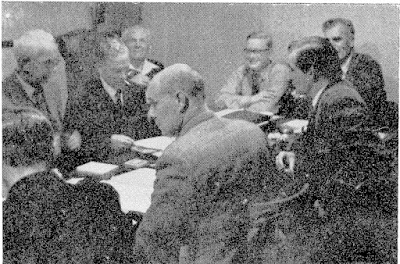
The text accompanying this photograph was 'No leaders: The Executive Committee in session, 1956.' It was part of the article "This is Socialism !'" I believe the younger man with the darker hair in the right of the photograph was Robert Barltrop, and the older, bald man to his left was Harry Young. ('Horatio')
# # # #
Clifford Groves contested the Paddington North constituency for the SPGB at the 1945 General Election. He also stood in the same seat in the 1946 by-election. The July 1945 issue of the Standard carries the Party's election manifesto.
# # # #
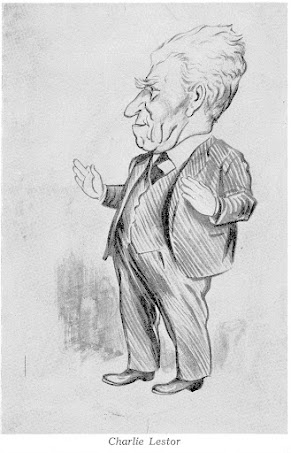
Both the photograph of Jack Fitzgerald and the cartoon caricature of Charlie Lestor were part of the "Some Members" article. I'm guessing that Robert Barltrop drew the image of Lestor.
# # # #
The Metropolitan Theatre was located in Edgware Road, and was used on many occasions in the 1940s and early 1950s when the SPGB were contesting parliamentary seats in Paddington, but also when the Party held mass rallies. By all accounts these mass meetings had upwards of two thousand people in attendance. This photograph accompanied the "Early Election Campaigns" article.
# # # #
No name for speaker on the platform. This photograph illustrated the "On the Platform" article.
# # # #
Sadly, no names are listed but members of Walthamstow Branch in the late 1920s included, amongst others, Mr and Mrs Francis Brooks, Maurice Cole, Thomas Davis, C. Elliott, A. J. Godfrey, A. McDermott, May Otway, L. Otway, Jane Robinson, Frederick Wellavise, J. Wilkinson, S. E. Williams, Byron Young and Percy Young.
Surely May Otway is in this photograph? I know I keep mentioning her but she was one of my favourite Socialist Standard writers in the interwar years.
# # # #
So, here's the conundrum: The June 1974 Socialist Standard states that the Conference photo below dates from 1950 but when it was included in the June 2004 Socialist Standard, the text said the photo was from the 1951 Annual Conference. I demand a recount.
As a point of interest, the September 2004 issue of the Socialist Standard carried a letter from Richard Botterill, identifying two of the delegates from Dartford Branch in the photo. (Spoiler alert: one of them was his dad.)
With regards to the June 2004 Standard already mentioned above, that was also a special anniversary issue and it also carries a number of photographs relating to the history of the SPGB. I recommend you check it out. It serves as an excellent companion to the June 1974 issue.
Tuesday, March 25, 2025
The World To-Day — A Socialist Survey (1946)
In the corrupted currents of capitalist life the wage slave is never, but always to be blest. Good times are said to be coming, but they never arrive. During the war promises were lavishly spread and the workers looked forward to the cessation of hostilities eagerly, and hopefully, under the impression that the strain would then be over and they could relax to some extent from their arduous toil. They were soon disillusioned however. Exhortation was made to them to resume their weary burden, and when relief was sought through the election of a Labour Government there was no respite. The wage slave gets his fodder barely enough to work on—the difference between the working men who lost, and the working men who won the war-is soon levelled up—amid all the confusion of concentration camps, displaced persons, foes and friends, and the chaos existing everywhere, the commodity nature of labour power manifests itself: the slave must receive sufficient to generate within him what he is called upon to deliver.
The conflict now raging between the more powerful groups of capitalists has forced them to do away with internal competition as much as possible, and this is largely responsible for the growth of nationalisation. There are other causes of course, but this fact should not be lost sight of. A Labour Government puts it over for them, and what is more, fools the wage slaves into believing they are receiving Socialism. The pooling of national capitalist groups has had an effect on the international situation, which is revealed in the quarrel over the proposed loan from the United States, and the squabbles at U.N.O. The recipients of surplus value cannot reconcile their sectional interests; these stand out sharply immediately the war ends. The smaller nations are at the mercy of one or the other of the big three, the mighty economic forces are carrying society along, and forcing the thinking section of the community towards the point when they will be forced to perceive that Socialism is the only way out.
The U.N.O. Conference in London has disclosed the relative decline of European capitalism. Out of 51 nations not a quarter are Europeans.
The veil was lifted for a while during the quarrel between Bevin and Vishinsky, and the real character of Russia was revealed, as also of capitalist Britain. The sudden publicity given by Bevin to the part played by the Communists was not to Moscow’s liking. It looked at one time as if the Bear was going to hibernate, but instead he beat a strategic retreat. Whilst this was going on Molotov was telling the slaves of the Soviet Union that Russian would never allow any other nation to interfere in her internal affairs. A sense of humour is essential at these times even when discussing international bickerings.
The Russians are the victims of their own propaganda ; we are told by them that there is no unemployment in the Soviet Union. There was little unemployment in the slave states of old, or under the feudal system, but this is not saying there was no exploitation. Russian has this in common with ancient Rome and the old civilisations—she allows little or no freedom. The masses are taught and induced to believe what the ruling clique consider it is desirable they should know; their contact with the outside world is restricted; a real knowledge of what exists in other lands might make the Russian workers dangerous from the standpoint of their oppressors. The wage slaves of Russia will grasp the facts underlying their real position eventually: the machine may help to clarify their ideas, and although freedom of association with the workers of other lands may be retarded, it cannot be permanently prevented.
We are beginning to obtain a little more information from Germany about the movement there, and it is pleasing to note that the opposition to the Nazi dictators was stronger than we had been asked to believe. The ruthlessness of the Hitler regime did not prevent certain groups standing out for what they believed to be the real interests of the workers, of which freedom of speech was one. The brutality with which they were treated by the Nazi gang is a sign that Hitler feared them. Many articles have been written about Nazism, but it is hard to accept the statement that the children of Germany were educated and trained by the Nazis against the wishes of their parents. The majority of the wage slaves of the Reich were willing tools and for this reason we should appreciate all the more the courage of those who refused to bow the knee and steadfastly stood, during the whole period of Nazi supremacy, for the unity of the working class of all countries.
There are great troubles ahead; the quarrel over the control of the waterways of Europe is now rampant, with Russia taking the place of Germany.
How cynically the Russian rulers act: they apparently consider the masses of all other countries to be as backward as the peasantry of the Steppes. They classify themselves as belonging to the freedom- loving nations whilst holding against their will vast numbers of helpless individuals, whose voices they will not allow to be heard. Let the admirers of Russia read the chapter on Pan Slavism in Marx’s “Revolution and Counter Revolution”: let them take stock of the actions of Russia in the Baltic States, and everywhere where she has been able to get a foothold, and they will realise that this totalitarian power is as much a menace to all members of the working class, who are endeavouring to escape the horrors of capitalism by establishing Socialism, as are the rest of the capitalist Powers.
The Labour Government are still continuing their policy of dangling the carrot before the donkey. When anything was wanted during the war how quickly it was brought into being. What a difference when the wage slaves desire something for themselves. Houses, for instance. What a lot of discussion precedes action. The number of samples on show cause hope to spring in the breast of those who live in over-crowded conditions. Swedish houses, Canadian houses, American houses. The specimens are of wood, brick, aluminium or plastic. The women are being questioned as to why they do not have more children. One would think even a Labour Government would get the shelters ready before asking the slaves why they do not have more offspring. The maternity wards are said to be overcrowded. What more do they want? The fact is the God of Profit must be served first, and unless and until a way can he found to enable capitalism’s deity to obtain his pound of flesh, the woes of his victims will be allowed to continue. It is plain to every observant individual that the Labour Party cannot fulfil its pledges to the electorate. There was to be no unemployment. A visit to the Labour Exchange will soon show differently. Capitalism has its own laws and these are more powerful than governments.
To take something from one section of the working class and give it to another does not decrease the amount of exploitation or the amount of surplus value that goes to the capitalist class.
The above is all the Labour Party’s proposals amount to in reality. No expropriation of the recipients of rent, interest, and profit is seriously contemplated, and until that is done nothing is accomplished of lasting benefit to those who produce the wealth of society.
Charles Lestor
Thursday, September 12, 2024
Problems Facing the Labour Government. The Menace of Unemployment (1945)
The recently elected Labour Government is faced with the responsibility of clearing up the mess caused by war. This is an unenviable task for those who consider the only way it can be done is to restore capitalist “prosperity.”
The ruling class are apparently not seriously perturbed; they have been assured by their advisers that capitalist interests will be preserved. The Financial Times (July 28th) speaks to its readers as follows.
“The result of the election is not regarded tragically. . . . So long as the new Government does nothing to harm the national credit—and it is likely to be very circumspect in this respect—the holders of Government stock will have nothing to fear. This applies indeed to all well established holdings. It would be a mistake for their owners to allow themselves to be frightened into throwing them on the market, and fortunately there is no sign of anything of the kind happening. . . .Apart from political and economic consequences of any move toward nationalization, the financial aspect would turn upon the eventual definition of the fair, but not excessive compensation of which Mr. Attlee has spoken.”
The emancipation of the working class is not anticipated by our masters: economic security even is now relegated to the limbo of forgotten things: “employment for all” has served its purpose, and is now being discarded as impracticable. Those who live by the exploitation of their fellows under Capitalism have but one object in view in regard to Labour and that is to keep their slaves in bondage. Professor Henry Clay recently delivered a lecture on War and Unemployment. He spoke as a Warden of Nuffeld College. He is an economist with practical experience inasmuch as he has been in an advisory capacity in close touch with the Bank of England during the recent expansive period. He was connected with certain key enterprises launched by the Bank while the war was on and his opinion is that the problem is how to survive in a world which threatens Britain? economic destruction.
“But the British economic and social problem can be reduced to terms of the utmost simplicity with an appreciable increase of value. After enduring the storms and stresses and sacrifices of war for six years the British populace, economically untutored and still politically ignorant, has been led to suppose that by the magic of the Beveridge schemes or their pale twin the Government White Paper on Employment Policy, there can be attained for all that mysterious something known as Social Security, and the maintenance of a high and stable level of employment. Some still believe that full employment can be assured. The task of the statesman is to fulfill it, to prevent a disillusioned and hurt populace from overthrowing the social fabric.”
Professor Clay says : —
“If I am right, the unemployment problem with which the last war confronted the country had not been dealt with when the present war broke out, and the identical problem with which this war will confront the country will not be a transient condition which can be left to cure itself. Something more than the proposals of the White Paper in this matter—a continuation of controls to regulate prices and priorities and the erection of controls to direct the location of new enterprise— will be needed if the influence of war in aggravating unemployment is not to be important for a generation or two.”
The Statist goes on to say :
“Again reducing the complexity to a sublime simplicity, the thought behind the official and academic approaches to the employment problem is that if the total national expenditure—spending power exerted—is sufficient to employ the whole population at the current level of wages all will be well, and therefore when the natural and almost instinctive flow of private spending begins to weaken all that; the State has to do to save the situation is to inaugurate or stimulate a flow of public expenditure. This blithe thought Professor Clay combats. ‘Mere expansion of Government expenditure,’ he says, ‘can prevent unemployment only by inflation : the impact of the additional income created will force up prices where there is a shortage and maintain them where there is a redundancy.'”
The Statist comments again :
“In short the problem is not one of merely maintaining purchasing power at a ‘sufficiency.’ It is one primarily of redressing economic maladjustments caused or augmented by the war, or indeed by other abnormalities or developments in human life—redressing them in such a way that their fulfilments can be brought into a proper coincidence, and redundancies distributed or absorbed or liquidated in some tolerable way.”“The Government will be possessed of large stocks of goods with a commercial use. One industrialist of my acquaintance has argued that, since they were created for war purposes, these stocks should not survive the War, but be dumped into the Atlantic, otherwise by competing with current production for limited markets they will prevent industry from recovering its peace time balance. The remedy is too heroic for any conceivable Treasury, but it brings out a problem : more than a quarter of the machine tool makers in this country were forced into bankruptcy after the last war by the competition of war surplus supplies.”“Markets disrupted, interrupted, diverted : production disrupted interrupted and diverted : labour diverted and rendered less fluid than it used to be : skill in making and marketing lost: transit diminished: financial technique warped or perverted—these are the causes of potential British unemployment, rather than the simple mathematical disequilibrium of the power to spend or the will to spend. Until these causes are cured the tendency of the nation may be, thinks Professor Clay, to slip unconsciously into a policy of perpetuating the war economy.”
It is a danger which he sees vividly.
“The Problems which will present themselves if war controls are lifted will offer so terrifying an aspect that a totalitarian direction of the whole economy of the country may have less terrors. I hope we shall rot drift into that solution.”
To show how helpless the ruling class are at the present moment I have quoted extensively from the Statist. The readers of the Standard must bear in mind these quotations are from Capitalist sources and show how helpless is the outlook for capitalist and how hopeless a Labour Government is that thinks it can run the system better than our masters.
The Statist concludes :
“There then is the statesmen’s problem—not to be led by bureaucratic and donnish mind into assuming that mere manipulation with State spending can effect the benefits which the populace has been promised, nor to relieve the fears of a frightened community by offering the tyrannical protection of a totalitarian system, but to find a means of enabling enterprise to restore its markets, restore fluidity to labour, and adjust diverted production and war surpluses in such a way that new production suffers the minimum of delay in catering for peace demands in the minimum of obstruction in disposing of its products.”“In dealing with so complex a problem as the restoration and increase of a high level of stable employment, there is much danger in generalisations, which are unfortunately what constitutes the electoral stock in trade of statesmen and politicians. If the bureaucratic fetish of a mathematical adjustment of spending powers is inadequate to a problem involving manifold human factors, so also is the hustings panacea of a 50 per cent. rise in exports. The British trading community—from producer through to finance negotiator and retailer does not live by exports alone essential though they are. Neither does exporting industry as a whole offer scope for so gigantic an increase.Mr. J. O. M. Clark, Chairman of J. and P. Coates, at the recent annual meeting said quite frankly. ‘Prominent politicians and others at various times have stressed the importance of increased exports after the war and a figure of 50 per cent. increase has at times been mentioned. If this is included merely as a tragic figure, little need be said about it, but if anybody seriously believes that the volume of goods to be exported from this country would within a reasonable period be raised by 50 per cent., without the introduction of an entirely new technique of selling, I fear he is doomed to disappointment. In our own case, of J. and P. Coates, in spite of certain advantages which the Company enjoys, could succeed in increasing the export volume permanently by anything like 25 per cent. after the War I should consider it had accomplished a remarkable performance.'”“So indeed would many other directors of large scale companies with efficient past selling records facing spoilt or invaded export markets. Britain it is clear to everyone outside a bureau or a sanctum of a confirmed Bloomsbury planner cannot survive the post-war struggle for trade, much less provide all the promised social betterments to her people merely by tinkering with the streams of private and public expenditure or by shouting for a 50 per cent. increase in exports. She has to discover much more drastic and realistic methods of stimulating trade and employment than those.”
The events now about to transpire will prove to the hilt the truth of the Socialist Party’s position.
What can the Labour Party or any Party do to improve matters when compelled to operate within the framework of Capitalism? The system is played out. It cannot go until the workers realise it is their job to abolish it. The great task is to make the workers realise this, and what they are called upon to do. In other words Socialists are wanted to establish Socialism.
Charles Lestor
Subscribe to:
Posts (Atom)


.jpg)


.jpg)

.jpg)