Showing posts with label March 2020. Show all posts

Sunday, March 22, 2020

Rear View: Dumb and dumber (2020)

The Rear View Column from the March 2020 issue of the Socialist Standard

Dumb and dumber

Alexandria Ocasio-Cortez Needs to Learn Economics (nationalinterest.org, 26 January). Indeed. But so does the author, Ben Shapiro. He objects to AOC’s claim ‘No one ever makes a billion dollars. You take a billion dollars.’ But that was one of the things she got right. ‘According to AOC, the very mechanisms of capitalism mandate such theft. In her view, successful businesspeople simply exploit their workers while maximizing their profits.’ By contrast, the Conservative Shapiro believes ‘consumers determine the value of products; producers do not. The diffuse informational system of the free market, which rewards the power of entrepreneurship, rather than punishing it…’. Socialists assert that profit can be traced to the additional value generated in the production process. Consider, a US factory worker’s output $73.45/hour vs. hourly pay of just $23.32 (huffpost.com, 6 December 2017) and ‘Almost 80% of US workers live from paycheck to paycheck’ (theguardian.com, 29 July 2018). This ‘surplus value’ is the difference between the labour time workers actually expend in the production process and the amount of labour time embodied in the commodities the workers themselves must consume to reproduce their capacity to labour, which Marx terms ‘labour power’. Even a ‘fair wage’, or co-operatives, which AOC supports, do not change the source of Shapiro’s ‘rewards’. He actually quotes approvingly from the Guardian with regard to the Spanish Mondragon Cooperative Corporation, whose worker-owners have ‘learned to think like the shareholders of any other global business.’ Exploitation of labour as the basis of profit accounts for the merciless drive of capitalists to extend the working day, so as to suck out every last drop of surplus value.


Do no homeopathy

Capitalism is parasitic, seeking out profit wherever it can be made and leaving war and want in its wake. There is potential profit in the coronavirus. ‘The virus appears to have originated from a Wuhan seafood market where wild animals, including marmots, birds, rabbits, bats and snakes, are traded illegally’ (wired.co.uk, 30 January). Imagine the conditions for animals and workers involved with illegal farms and markets. The Indian government is doubling down on the damage done by promoting homeopathic treatment. ‘Far from being a “prophylactic medicine,” as the ministry suggests, this miracle concoction is, in reality, a super-diluted form of arsenic trioxide. Not only is the compound known to be fatal if improperly used, but there’s also no evidence to suggest it works on the coronavirus, or any other condition for that matter. If it weren’t for the Dalai Lama recently telling his followers to chant a mantra as protection, India’s purported tips to fend off the coronavirus might be the least effective advice offered yet. Now, the two will have to battle for that top spot, and India’s ministry of AYUSH (Ayurveda, Yoga & Naturopathy, Unani, Siddha, Sowa Rigpa and Homoeopathy) has even more nonsensical suggestions to offer in the fight… a drop of sesame oil in each nostril upon waking, and a “light and soft” diet…. Ayurveda and other traditional medicines, like Unani, are seen as a legitimate and burgeoning industry. The Prime Minister… wants to make them “a way of life”… and as holistic medicine becomes ever more profitable, the government has started promoting traditional remedies more and more’ (sciencealert.com, 30 January).


A world to win

We live in a sick society, yet a small minority continue to thrive. ‘The richest Americans are set to inherit a staggering $764 billion… The study noted the US has one of the lowest levels of upward mobility, which now “heavily depends” on the circumstances of birth’ (markets.business insider.com, 28 January). Who runs things from top to bottom? Who grows the food, who builds the houses, who mines the minerals, who transports them, who processes them, who fashions them into useful things, who does all the administrative work for this, orders the supplies, draws up the designs – who other than the working class`? The shareholding capitalist and the fat-cat company director are completely redundant as far as the actual work of wealth production is concerned – and new wealth can only be created by the application of human labour to materials that originally come from nature, not by speculating on the stock exchange or planning take-over bids. Their social role is purely parasitic – a mosquito that banks the blood it extracts, part of the wealth created by the rest of us. This is the system which AOC and Shapiro, with more or less governmental intervention, support, and which only a majority of us can end.


Material World: Africa’s food potential (2020)

The Material World Column from the March 2020 issue of the Socialist Standard

The perception of many in the developed countries is that Africa is always associated with poverty, disease, famine and war. It is as if the Four Horsemen of the Apocalypse have made the continent their personal domain.

Yet Africa has considerable riches.

Africa has long been known for its resource abundance in both agriculture and mineral resources. The ore deposits are so abundant that some of it has yet to be discovered. To date, though, Africa has struggled to translate these resources into shared wealth and sustained economic development. South Africa’s potential mineral wealth is estimated to be around $2.5tn, while the mineral reserves of the Congo are thought to be worth $24tn. In natural resources, Africa is still largely unexplored. There is so much natural wealth on the continent that a great deal of it is as yet untapped.

However, most of the continent’s existing natural resources are owned and exploited by foreign, private corporations. There is a common view that believes the wealthier countries are helping and aiding the undeveloped and developing nations in Africa, but such an outlook ignores the imbalance of trade and the relationship that exists with the extractive industries that dominate the African economy.

More wealth leaves Africa every year than enters it. It was calculated that African countries received $162bn in 2015, mainly in loans, aid and personal remittances. But in the same year, $203bn was taken from the continent through multinationals using subsidiaries to transfer profits into tax havens. Trade mis-pricing, that is, transfer pricing, and trade mis-invoicing, over-reporting of costs and under-reporting production output are the most common ways companies seek to maximise profits artificially through maximising expenses in high-tax jurisdictions and maximising income in low-tax jurisdictions. This enables corporations to minimise tax payments and transfer the funds abroad. This is compounded by overly generous tax concessions provided by governments, often under duress. Local political elites, in collusion with the foreign corporations, siphon off the proceeds from the continent’s wealth – lining their own pockets, to the detriment of ordinary Africans.

On a continent with an abundance of arable land, Africa imports billions of pounds worth of basic foodstuffs and still many parts there are not food secure. There is absolutely no reason for Africa to be food insecure. Farming in Africa could theoretically become a major breadbasket for the world. Africa has 65 percent of the world’s remaining arable land. Its vast savannahs are estimated at 400 million hectares, only 10 percent of which is cultivated. The Guinea Savannah, an area across many countries, has the potential to turn Africa into a bulk food producer.

Africa could feed itself and could help feed the world, too. The world is not winning the war against global hunger. Climate change is already worsening the situation, especially in sub-Saharan Africa. The challenge is not a technical issue but rather a question of which type of society we need for production to take place. At the moment the techniques used to cultivate the soil still lag behind what has been adopted in other parts of the world. Improved grain varieties exist which produce harvests that are larger and drought and disease resistant. The structure of agriculture itself can be changed. Smart farming with the use of mobile phones and GPS can give farmers information and advice. New techniques in agriculture such as agro-ecology are proven to be more productive. We know it is possible to restore exhausted soils and damaged ecosystems. In many parts of Africa, the potential for restoration is enormous. Increasing climate change resilience requires greater irrigation and more efficient water management. Over 90 percent of agriculture depends on rainfall, with no artificial irrigation aid. Many small farmers lack access to mechanisation. Equipment such as cold storage and packaging can end the waste of food rotting and ease the transport to the cities and other regions. The technology and the techniques are there. All it requires to harness them is a change in the basis of society so that food can be produced to directly feed people.

We can end and we must end global poverty. We have the solutions for addressing malnutrition. Food produced in Africa could make a big contribution to this. Millions of African farmers need no longer be poor or endure precarious lives. Africa has the land, water and people needed to be an efficient agricultural producer.

Under capitalism and without a change in the economic structure there is good reason to fear the projected rise in Africa’s population. Nevertheless, such a rise should not necessarily be treated as a curse. The share of Africa’s working-age population is rising faster than any other region and it will have a larger potential workforce than either China or India. It is not a matter of an extra mouth to feed but an extra pair of helping hands and another brain to think.

The time is ripe for Africa to make better use of its natural resources but capitalism’s drive for capital accumulation and profits at the expense of people’s consumption precludes long-lasting, sustained prosperity in Africa and will not permit it to bear fruit. Looking at Africa from a socialist perspective, we see the situation is far from hopeless. Africa is one of the most important places for the future and its people among the most useful and needed in the world. The potential is enormous.
ALJO

Pathfinders: Stories from the city (2020)

The Pathfinders Column from the March 2020 issue of the Socialist Standard

People ask a lot of questions about socialism in practice, some we can answer, some we can’t. But nobody ever asks what the architecture would look like.

It’s not a pressing social issue, after all, like food or disease prevention. In fact it’s rarely discussed at all, except to complain about some new local monstrosity. When you think about it though, there’s something a little strange about this. People who live in rural areas often have a great familiarity with their landscape and its features, right down to individual tree and plant species. They know the language and vocabulary of their environment, and this knowledge undoubtedly adds to their appreciation of it.

The majority of the world lives in cities, and the built environment has its own language and vocabulary, that of architecture, but most of us don’t know much about it. We know ‘door’, ‘wall’ and ‘roof’ but not ‘quoin’, ‘corbel’ or ‘voussoir’. We rush past buildings every day without really noticing them. We might acknowledge that some grand buildings are beautiful, but we can’t really understand or appreciate what’s interesting about them because we don’t have the words.

Architecture is applied art on a giant scale, and it’s immersive, because you live in it. Some of the art is good, some terrible. It’s also a living historical record of the past, its moods and crazes and fads. It has a function, obviously, but it likes to make statements too, sometimes grandiose political or aspirational statements, that tell us how ruling class ideas have changed over the centuries. If you know how, you can read these messages as plainly as words on a page. Learning even the rudiments of this language can be a revelation. Your own city reveals itself in a whole new light.

It’s not hard to pick up some basics. Just four category words virtually encompass the past thousand years of building in Britain. They are Gothic, Neo-classical, Vernacular and Modern.

Gothic started with the Normans and became de rigueur for churches and cathedrals, and often for colleges and legal institutions. It was all about the power of God, so it features a lot of pointed arches, lofty verticals and spires reaching heavenward like arms in supplication. The point was for commoners to gaze upward with their jaws on the floor, mutter a reverential What the Fuck? and vow never, ever, to argue with the beings who could create such soaring marvels.

Neo-classical is anything that looks like it’s from Ancient Rome, such as pillars with a triangular ‘pediment’ on top, or rounded triumphal arches. Empires didn’t come more bad-ass and macho than Rome, which is why the growing empires of the Renaissance revived its styles and it finally arrived in Britain with Inigo Jones in the 17th century. Instead of piety, it was all about muscular statements of state power. You often see it on banks or theatres or museums, as well as government buildings. Not surprisingly, the Georgians and the Victorians, who had a high opinion of themselves as rulers of an emerging globally dominant power, couldn’t get enough of the neo-classical style, and neither could Mussolini later on. But changing political priorities could change tastes. When the Houses of Parliament burnt down in 1834, a discussion ensued about what to replace it with. Neo-classical was the obvious choice, however the Americans had just finished rebuilding the White House in the neo-classical style after the British had burnt it down in 1812. Relations were still somewhat frosty, so to avoid any connotation of republicanism the architect Charles Barry was tasked with producing a Gothic design, which in turn kick-started a Victorian Gothic revival.

The Victorians, incidentally, were exuberant mash-up artists who would throw caution to the winds and chuck in any feature from any style they liked without the least concern for artistic or historical integrity. The more you learn to read their architecture, the more you start to understand their mindset. They were world conquerors in matters military and scientific. Rules were for other people.

‘Modern’ architecture is a catch-all for anything post-World War 1, when looking forward started to seem better than looking back, so that revivals went out of the window and modern capitalism was anyway more interested in making money than making grandiose and costly statements. Trends did exist though, like the short-lived Futurism of the 1920s, which swiftly looked dated, and the Brutalism of the 1960s, a distinctly Orwellian statement that said unattractive things about encasing populations in hideous concrete boxes and gave architects a notoriety they’ve never really recovered from.

What’s always gone on in the background and is also hot today is the ‘vernacular’ style, which is designing buildings in local materials and in the local or regional style, so that they fit harmoniously into their surroundings instead of clashing horribly with them. In theory anyway.

When you start thinking about the socialist architecture of the future, you realise that all bets are off. First you would have to ask how people wanted to live. Would they stay in settled communities as now, or move around constantly, exploring the entire world and ‘working their passage’, in the sense of helping out with odd jobs wherever they happen to be? Would the current global urbanisation trend continue, or go into reverse, with cities becoming depopulated? There are pros and cons to this question. Would there be a need for public buildings, perhaps to house representative decision-making bodies, or is this an obsolete democratic methodology when everything can be done directly and online? What weight would be given to aesthetic statements, if it meant more expenditure of work and resources? Perhaps socialist architecture would be plain and functional as people found pleasure in things other than the built environment, or perhaps it would surpass the exuberance of the Victorians, or even the Gothic period, with no effort spared in reflecting the magnificence of a new and free social era. Even the design of the simple domestic dwelling is open to question. The practice of having separate rooms for specific purposes only really started with the Victorians. Would people still want to live private and secluded lives in their little walled space, or would sharing of lives and living space become the new normal? There might be a revival of something like the ancient Roman model, where people use public baths and eat out, and only go home to sleep. Perhaps even the concept of ‘home’, in the sense of a permanent personal abode, could become obsolete.

All of these questions will certainly shape the architecture of the future. And let’s not forget emerging technologies like translucent wood for windows, hydro-ceramics for zero-energy air conditioning, light-generating sulphur concrete and self-repairing concrete, high-insulation bricks, nano-alloys, phase-changing materials, gels, carbon-fibre, aluminium foam mouldings, clear solar panels and much more. In the end, nobody can really answer the question we started with, what socialist architecture would look like. Maybe the best response we can give is: what would you like?
Paddy Shannon

Resource War: Oil, Gas and Aphrodite (2020)

From the March 2020 issue of the Socialist Standard

Another Regional Resource War?

For decades the relationship between Turkey, Greece and the divided island of Cyprus has been volatile. Now with the discovery of gas fields and the development of pipelines to supply the lucrative markets of Europe, the eastern Mediterranean is growing increasingly more unstable. The gas field off the southern coast of Cyprus is called Aphrodite, named after the Greek goddess of love, but there is no love lost between the rivals for possession of that energy.

Cyprus was divided in a Turkish invasion in 1974 in response to a Greek-inspired coup. Turkey is the only nation to recognise a breakaway state on the island, the Turkish Republic of Northern Cyprus (TRNC). Cyprus’s internationally recognised government subsequently discovered offshore gas in 2011 and has granted licences to multinational companies for oil and gas research, commissioning international energy companies, including the French multinational Total and Italy’s ENI to explore allocated blocs off the island for underwater resources.

Turkey claims that some of the drilling operations are either on the Turkish continental shelf or in areas where the TRNC has rights over any finds and has called for a fair and equal distribution of the energy resources. Starting last summer Turkey deployed two exploration and drilling ships accompanied by military escorts. Turkey has called for a fair and equal distribution of the energy resources discovered, insisting that they should not be excluded and stress that their drilling activities are legal and within territorial waters.

Also featuring in the strategic rivalry is the 2,200-kilometre pipeline, called the EastMed, which is planned to transport gas from Israel through Cyprus and Greece into Italy, where it would be distributed to the rest of Europe. Turkey is already part of the TurkStream pipeline which feeds Europe with natural gas coming from Russia. This has provided both Turkey and Russia not only an economic benefit but geo-political leverage as well. If the EastMed pipeline becomes a reality then Turkey and Russia will stand to lose something many in the EU are eager to see – a loosening of that dependency.

The possibility of a military conflict cannot be ignored. The Greek defence minister, Nikos Panagiotopoulos, recently warned that its armed forces were ‘examining all scenarios, even that of military engagement’ and rejected Turkish demands that Greece demilitarise sixteen Aegean islands. He accused Turkey of displaying unusually provocative behaviour such as the rise in the number of violations of Greek airspace by Turkish fighter jets.

France’s President Macron pledged he would strengthen the alliance with Greece. France has dispatched frigates to the eastern Mediterranean as the stand-off with Turkey intensifies and the feud over exploration rights has deepened. Although supposedly to participate in the war against ISIS, the French aircraft carrier will make port at Limassol in Cyprus. The French Ambassador to Cyprus Isabelle Dumont said the nuclear-powered aircraft carrier’s presence was intended ‘to stabilise the region’. France is also planning to enlarge its naval footprint in the eastern Mediterranean and last year signed an agreement with Cyprus to use the Evangelos Florakis naval base in Mari, on the island’s south coast.

Turkey retaliated in early December, 2019, by signing a maritime border deal with Libya’s internationally recognised Government of National Accord (GNA), making a military commitment to send military support in the form of Syrian mercenaries to help in the fight against forces loyal to General Khalifa Haftar who has the aid of Sudanese mercenaries plus the diplomatic support of several foreign powers such as France, Italy, Egypt, Saudi Arabia and the UAE.

The December deal, which would expand Turkish influence in the region, has been deeply criticised by Libya’s neighbours in the Mediterranean. A maritime border agreement between Turkey and Libya’s U.N-backed government is ‘unacceptable’, violates international law and flouts the sovereign rights of other countries, Luigi Di Maio, the foreign minister of Italy, declared. Egypt called it illegal, denouncing the Turkey-Libya deal as infringing on waters where they claim economic rights.

Fuat Oktay, Turkey’s Vice-President, answered that ‘Turkey will not permit any activity that is against its own interests in the region,’ adding that ‘any plan that disregards Turkey has absolutely no chance of success.’

So once again the world is faced with the possible threat of war. The Socialist Party maintains that modern war is an inevitable consequence of capitalist competition for the domination of markets, trade routes, favourable treaties, and possession of valuable resources. Our opposition has a simple basis: wars are fought over issues of interest to the capitalist class while it is workers, either in uniform or in civilian clothes, who are the cannon-fodder. The global working class has no interests at stake worth shedding a single drop of blood. Why should we die defending what is not ours and which we will never benefit from? The only war that need concern us is the class war between the parasites who possess and the workers who produce. Mere moralising against the war is not enough. What we advocate is a war on war to be waged on the battlefield of ideas, for the hearts and minds of the world’s people. And once we unite there will be no force that will stop us.
ALJO

Environmental Problems (2020)

Book Review from the March 2020 issue of the Socialist Standard

Hostile Environment: How Immigrants Became Scapegoats by Maya Goodfellow (Verso £12.99.)

In a world full of euphemisms, the term ‘hostile environment’ really does describe the government’s policies towards migrants. The Immigration Acts of 2014 and 2016 made life much tougher for those who had migrated to the UK, threatening to deprive them of health care and housing or even deport them, if they could not provide the right documents. But, as Maya Goodfellow shows here, complemented by examples of the plight many migrants find themselves in, this is all just part of a much longer history of hostility towards immigrants.

Britain, she says, was made by migrants (see ourmigrationstory.org.uk). The first inhabitants came from southern Europe, and there were plenty of people of different origins here before the Anglo-Saxons arrived in the fifth century. Migration did not always result in prejudice and opposition, but this began to change, especially as many Jews arrived in the nineteenth century, fleeing pogroms in eastern Europe. The Aliens Act of 1905 was the first substantial piece of legislation dealing with immigration, and was aimed at restricting the number not just of Jews who came here but of the poor as well. Irish immigrants, too, were often regarded as inferior to ‘white Britons’.

The 1948 British Nationality Act made it easier for people from the ‘white Commonwealth’ to come to the UK, in contrast to those with black or brown skins. This was passed under a Labour government, and both Conservatives and Labour were responsible for much legislation that limited immigration and even made it harder for those born here to get citizenship. The regulations relating to migrants are complicated and frequently change; legal help to navigate your way through them is expensive and not always reliable. The Commonwealth Immigrants Act of 1968, says Goodfellow, was one of ‘the most reactionary immigration acts that has ever passed through Parliament’; it was brought forward by a Labour government.

A number of other good points are made, among them the following. There is no evidence that immigration has a negative impact on wages. A smaller percentage of migrants than of the general population claim benefits. Racism is not ‘a mistake or a consequence of demographic change; it is a product of history’. The tabloid press consistently peddle lies and exaggerations about migrants. People have inflated ideas about the proportion of migrants in the UK (it is about 13 per cent). If immigration is discussed in terms of numbers, there will always be ‘too much’.

Towards the end, Goodfellow refers to a world ‘without the borders or the immigration controls which give rich people the right to move but treat this same freedom as dangerous in the hands of the poor’; a world without global inequality or climate change. There is much of interest in these pages, but it is a pity that such ideas are not developed further.
Paul Bennett

Thursday, March 19, 2020

Letter: Islands of socialism? (2020)

Letter to the Editors from the March 2020 issue of the Socialist Standard

Dear Socialist Party,

I’m a big fan of yours. I used to be a liberal, but you guys have opened my eyes and I would like to thank you for that. I have realized that the only solution to our problems and the way to a better life for all is through socialism. But, having read the replies under your tweets, I’m aware there is still a long road ahead.

However, there’s also something else that I’d like to address: what do you guys think of the Free Territory of Ukraine that existed from 1918 to 1921? Was that a real example of socialism working? They had no top down control (only a defensive military, which was needed considering they were under threat from all sides); they had collective property; lived in communes; used no money in most parts, and the parts that did use money were planning on abolishing it soon, and not to forget, they had working co-ops and direct democracy. They were quite successful and would have achieved more had the Bolsheviks not invaded them.

There have been other attempts to anarchism as well.

So would you say this was a real and good example of socialism working? If yes, why don’t you mention this in your tweets against all the ignorant people who ask ‘when has socialism ever worked’. Of course you would mention that in the future, socialism would have to be enacted on a larger scale, but this is as close as it gets out of all real life attempts so far, in my opinion.

Greetings from the Netherlands,

Tamee Gözübüyük


Reply:
Thanks for your supportive remarks. It’s nice to feel appreciated. You make some interesting points and we agree that the story of Nestor Makhno and the Makhnovists deserves to be better known, especially as it is a good example of something which leftists often tend to gloss over.

Leninists usually excuse the top-down, authoritarian structure of the Bolshevik regime, as well as its murderous excesses, by saying that ‘there was a war on’. But that war didn’t stop the Makhnovists, who were under attack from both the White Army and the Bolshevik Red Army, from , as you say, trying to set up an egalitarian social system, although given the constraints they were operating under, whether we could call this ‘socialism working’ is somewhat debatable.

What it does show is that the Leninist justification is meaningless, and that the main reason Bolsheviks employed authoritarian repression was because that is the nature and mentality of Leninism. This vanguardist mentality is one of the things that makes Leninism quite different from the socialism/communism that Marx and Engels understood, and that we understand.

Ultimately the anarchist endeavour was defeated by armed force, and the same can be said of other famous attempts to establish such libertarian communities within capitalism, such as the 1871 Paris Commune. Such ‘islands’ will always be swamped by capitalism as long it remains globally dominant.

When we talk about socialism we mean a worldwide sustainable society of common ownership, with no leaders, so by our global definition socialism has never existed before. Temporary or small-scale experiments have certainly occurred at different times in history, but we tend to question their usefulness in convincing anyone of the viability of socialism. If anything, the very fact that they didn’t last long can be trumpeted as proof that socialism is not viable. Of course it’s not proof of any such thing, but neither is it proof that socialism could work long-term. Besides, not everyone finds such obscure historical debates either attractive or relatable. Perhaps what such attempts do show, however, is that the human desire for social equality, real democracy, free access and so on is very real and very strong, and the fact that people have acted on that desire in the past is a very good reason to think they will act on it again in the future, next time we hope with happier results. 
Editors.

Automation & Unemployment (2020)

Book Review from the March 2020 issue of the Socialist Standard

A World Without Work. Technology, Automation and How We Should Respond by Daniel Susskind: Allen Lane. 2020. 326pp.

Will there be enough work to go round? That is the fundamental question discussed in this book by Oxford University economist and former government policy adviser, Daniel Susskind. His main concern is whether the rapid spread of automated work, most of it based on the use of artificial intelligence (AI), will, in the near future, lead to ‘technological unemployment’ and if so how that future society can cope with this.

In a compellingly written and clearly argued narrative, his thesis is that, even if in the past, fears that new technology would lead to unemployment have proved unfounded, the nature of current and ongoing technology, especially AI and the robots it is creating, will indeed mean that the demand for human work will ‘wither away’. He argues convincingly and with many salient examples that the potential of AI is such that even the many tasks which are highly important for human society to operate efficiently involving feeling, empathy and judgement will, contrary to commonly expressed views, soon be able to be done by machines. Such machines, he insists, are already in use or in the process of being invented, even if they cannot ape human means of carrying out certain important tasks, are capable of achieving equally (or more) efficient outcomes than the same work done by the manual or brain power of human beings. And if no action is taken to handle this ‘task encroachment’ (the term he uses to describe this process) the resulting ‘technological employment’ is likely to bring increasing social instability.

So what action does he recommend? Certainly not efforts to prevent technology from taking over human jobs, He quite understandably sees that as an impossibility in a system where the criterion for choosing between human work or automation is which is more profitable and where the increasing trend is for the cost of automation based on AI to fall. Instead, accepting that in the future there will be far less work for people to be employed in, he recommends an increased role for the state. He argues that the state (the ‘Big State’ as he calls it) will have to intervene, to regulate and to effectively prop up the living standards of workers by what he calls a ‘conditional basic income’, a variation of the currently much discussed idea of a ‘universal basic income’.

How this could work leads the author on to some interesting discussion about the difference between work and employment. In particular, though not seeing beyond the need for the current organisation of work as paid employment, he also sees another dimension of work – as ‘a source of meaning, purpose and direction in life’. And this connects with the socialist case for a world of voluntary work and free access to all goods and services. The argument often made against this is that such a system could not work since, without the necessity to make money to buy goods and services, people would not work, would not co-operate to carry out the tasks to make society operate efficiently and things would simply fall apart.

However, even if Susskind’s own field of vision lies firmly entrenched in the current society of wages and salaries, buying and selling and the pursuit of profit, it is possible to draw succour for a different system from much of what he says. His final chapter, especially, entitled ‘Meaning and Purpose’, contains the notion implicit in the socialist idea of a moneyless, wageless society that it is not inevitable for human beings to see work merely as a means of keeping the wolf from the door (i.e. gaining income from employment) but that, over and above the current employment system, work is a basic human need, has a ‘social dimension’ and provides ‘a chance to gain status and social esteem’.

In this connection, as pointed out by the writer, even today, in a situation in which most people have difficulty in imagining how society could be organised differently from the way it is, in the UK 15 million people still volunteer regularly, already half as many as are in paid work, and are engaged in the kind of activity referred to by the author as ‘work in pursuit of purpose rather than productivity’. In this they achieve, as he puts it, ‘value through community recognition rather than through market wages’. Then, towards the end of his book, the author quotes with apparent approval the description of work in Marx’s Critique of the Gotha Programme as ‘not only a means of life but life’s prime want’.

So this is a book well worth reading not only for its knowledge of and insights into likely developments in the field of work within the capitalist system but also for its reflections on the nature and purpose of work generally. While the author does not imagine a society structured fundamentally differently from the current one, he clearly sees that work could, and should, be more than just the grind of employment that it is for so many and as helping to fulfil the basic human need for personal fulfilment and social interaction.
Howard Moss

The LTV: A Bad Criticism of Marx’s Labour Theory of Value (2020)

From the March 2020 issue of the Socialist Standard

In an article on 12 January for the website Dissident Voice entitled ‘Marx’s Labor Theory of Value: Bad Science and Bad for Ecological Socialism’, David Pena launches a stinging attack on the Marxian theory of value and outlines an alternative theory which he evidently considers more appropriate to an age of heightened environmental concern.

Pena is not exactly breaking new ground, though. The intellectual origins of some of his ideas can be traced back to writers such as Sergei Podolinsky, in the 1880s, a pioneer in the field of ‘energetics’, who tried to reconcile Marx’s labour theory of value with the laws of thermodynamics.

Classical economists like Adam Smith and David Ricardo maintained that a commodity’s value depended on how much labour went into making it. This argument was taken up and refined by Marx. It is important to understand that Marx’s theory does not equate ‘value’ with the actual amount of labour it took to produce a good – ‘concrete labour’. If that were case there would never be any incentive to introduce labour-displacing technology since this would mean less value being produced. Rather the metric of value is ‘abstract labour’ – the socially necessary labour time it takes to produce a good, from start to finish, under average industry-wide conditions.

‘Socially necessary labour time’ is not something you can measure with a stop watch – like concrete labour. Moreover, it can only express itself through market exchange. As Marx explained: ‘Social labour-time exists in these commodities in a latent state, so to speak, and becomes evident only in the course of their exchange. Universal social labour is consequently not a ready-made prerequisite but an emerging result’.(A Contribution to the Critique of Political Economy, Lawrence & Wishart, Ch. 1, p. 45). Meaning the value of a product can change even after it has been produced as a result of ongoing technological and other changes.

Pena’s criticism
Pena begins by identifying what he believes is a basic flaw in Marx’s theory:
  ‘“Abstract human labor,” according to Marx, is the “value forming substance” that is “materialized” in commodities. … But how can an immaterial element (an abstraction) become materialized and take up residence in a physical commodity (like the word becoming flesh)? What a confusion of categories!’
This is making rather heavy weather over what is, after all, just a metaphor. That Marx saw value as something immaterial is quite true (even if he used a ‘material’ metaphor like ‘substance’). As he put it ‘the value of commodities is the very opposite of the coarse materiality of their substance, not an atom of matter enters into its composition’ (Capital Vol 1, Ch.1). Value here is a construct in the same way as the statement, ‘the national average for children per family unit is 1.8’, is a construct. As far as we know there is no actual ‘material’ family unit consisting of 1.8 children.

For Pena, however, this smacks of a contradiction. How can something as immaterial and abstract as value become ‘congealed’ in (and thus, according to him, be transformed into) a material substance? Labour is a process not a substance. Consequently:
  ‘Despite all the talk about Marx’s materialism, his theory is obviously based on an immaterialist metaphysics, which holds that all commodities share a common non-material property that gives them exchange value. Marx is not a materialist after all, at least not when it comes to exchange value’
For Marx’s theory to be ‘scientific’, claims Pena, it needs to identify ‘an empirically detectable and measurable property that gives value to commodities, and a theory that is consistent with fundamental propositions of other relevant sciences, such as physics and chemistry’. But since abstract labour is not something physical and therefore not empirically detectable and measurable, it follows that Marx’s theory cannot be materialist or scientific.

Oddly enough, until recently there was no empirical evidence for the existence of black holes in outer space. Were the astrophysicists inferring the existence of such phenomena being ‘unscientific’ in doing so? The value of scientific theory lives in its predictive power and this is the basis on which Marx’s theory must be judged.

Naïve empiricism
It is precisely the kind of naïve empiricism Pena espouses which focusses only on the outer appearance of phenomena that Marx criticised in his analysis of capital. Capital is not a thing but a social relationship. As he explained in Wage Labour and Capital (1847):
  ‘A Negro is a Negro. Only under certain conditions does he become a slave. A cotton-spinning machine is a machine for spinning cotton. Only under certain conditions does it become capital. Torn away from these conditions, it is as little capital as gold is itself money, or sugar is the price of sugar.’
Pena is committing the same error as those who conflate these things. This can be extended to include also natural resources as in Schumacher’s comment that ‘Natural capital is the world’s stock of natural resources’ (Small is Beautiful, 1973). Inadvertently or otherwise this ‘has the effect of ‘naturalising’ capitalism, rendering its categories timeless and ahistorical.

Pena describes ‘value’ in much the same vein:
  ‘value in its original and grounding manifestation, the dual form of matter and energy, pre-exists human and all other life forms. The worker is an arranger and discoverer of values, but not a creator. Nature is the source of all values, not only use values, as Marx erroneously believed.’
So instead of commodities having in common the fact that they are products of human labour, their commensurability hinges on the fact that they all require energy to produce. As Pena puts it: ‘Rationally expended energy is the “common element” of all commodities. The amount of expenditure represented by the finished commodity is its objective exchange value.’

Pena thus wants to make ‘energy’ the fundamental metric of exchange value because it is physical and can be empirically measured (unlike the ‘metaphysical’ concept of abstract labour). However, exchange value presupposes and springs from commodity production and cannot really be understood outside of this context – which, unfortunately, is precisely what Pena wants to do.

We see this in his claim that value, ‘pre-exists human and all other life forms’ and has its source in nature. The perfect riposte to this is the rather colourful observation made by the nineteenth-century Ricardian economist John Ramsay McCulloch, as follows:
  ‘When a fish is caught, or a tree is felled, do the nereids or wood-nymphs make their appearance, and stipulate that the labour of nature in its production should be paid for before it is carried off and made use of? When the miner has dug his way down to the ore, does Plutus hinder its appropriation? Nature is not, as so many would have us to suppose, frugal and grudging. Her rude products, and her various capacities and powers, are all freely offered to man. She neither demands nor receives a return for her favours. Her services are of inestimable utility; but being granted freely and unconditionally, they are wholly destitute of value, and are consequently without the power of communicating that quality to any thing.’ (The Principles of Political Economy, 1864)
Nature, along with human labour, is of course the source of all use values but, as McCulloch points out, makes no contribution whatsoever to the production of exchange values. The latter is a product of human society and even then, only a very particular and recent form of human society called capitalism in which alone the law of value applies.

It makes intuitive sense that abstract labour should be the basis of value under capitalism since this system sprang from alienation of the great majority from the means of producing wealth. The economic compulsion this imposes on them to sell their working abilities – or ‘labour power’ – to the capitalists in return for a wage with which they can buy their own means of subsistence is precisely what makes for the generalisation of commodity production and, hence, for the ‘value’ to come into play.

The worker under capitalism does not approach the capitalist offering a particular bundle of energy (measured in joules) in exchange for a wage. Rather, they offer a particular skill which the capitalist specifically requires. The application of their labour power in the process of labouring is what creates a greater value than the value of the wages they receives and is the source of that capitalist’s great wealth.

True, labour in any society (including societies without commodities or markets) involves the expenditure of energy but so too does leisure, love-making and tending to one’s allotment. But none of these latter activities necessarily entail commodity exchange and the production of exchange values.

Value a social relationship
Pena does not see this because he does not grasp that value is essentially a social relationship based on economic exchange. His physical reductionist approach to the whole subject also informs his absurd claim that Marx’s labour theory is ‘bad for ecological socialism’. Since the theory posits only labour as the source of value it overlooks and devalues, he supposes, the contribution of Mother Nature to our material wellbeing.

But this is to totally miss the point. Marx’s labour theory of value is an explanation of the modus operandi of a system socialists want to get rid of, not perpetuate. We want to bring about a society in which the exchange values no longer exist and use values are the sole consideration. It is the very existence of economic exchange that gets in the way of our fully appreciating, and acting upon, the latter and is incompatible with ‘ecological socialism’.

Ironically, Pena himself calls for the retention of exchange value and even argues ‘If we cannot understand and measure value… we cannot have socialism’. But you cannot divorce ‘exchange value’ from the system of generalised commodity production called capitalism. And you cannot divorce capitalism from the relentless accumulation of capital it entails.

When Marx and Engels talked in the Communist Manifesto of the need to ‘increase the total of productive forces as rapidly as possible’ all they meant by this was that these needed to be developed to the point where human needs could be adequately met as a precondition of socialism itself. This was emphatically not a recipe for infinite growth, as Pena seems to think, or some Promethean desire for ‘production for its own sake’.

Unfortunately, by arguing for the retention of a system of economic exchange (and exchange values couched in units of energy), Pena himself is unwittingly helping to promote the very thing that increasingly imperils our global ecosystem about which he is (quite rightly) concerned.
Robin Cox

Cooking the Books: Capitalism is irredeemable (2020)

The Cooking the Books column from the March 2020 issue of the Socialist Standard

‘Corbyn’s defeat won’t end the debate about capitalism’ wrote the editor of City AM (10 January) commenting on a report entitled ‘The Crisis of Capitalism’ by William Wright who runs a think-tank, New Financial, that puts out propaganda in favour of private enterprise and so-called ‘free’ market capitalism, his rather narrow definition of the term.

In his report Wright claims that ‘Jeremy Corbyn, Bernie Sanders, Elizabeth Warren and millions of their political supporters want to turn capitalism on its head’, adding ‘Capitalism, it seems, is in crisis.’

So, it’s a crisis of legitimacy not an economic crisis that he is talking about. It is true that millions of people in the US, Britain and elsewhere are dissatisfied with the way capitalism is working and want something done about it. Hence the popularity of politicians like Corbyn and Sanders amongst a minority of the population. But to claim these politicians want to overthrow capitalism is going way beyond the evidence. What they want is to reform capitalism, with more government intervention than Wright would like. Warren even openly admits that she wants to reform, in fact save, capitalism. The other two talk of ‘socialism’ but mean a more state-regulated capitalism.

City AM’s editor made a fool of himself when he wrote that ‘Labour’s ideological error was to insist that the system’s vagaries, contradictions and flaws are proof of its irredeemable inadequacies.’ Labour has never claimed that capitalism is irredeemable; on the contrary they have always claimed – and did in their manifesto for the December general election which envisaged the continuation of a dominant private sector – that the profit system can be reformed so as to work in the interests of the many. But it can’t, as the failure of all Labour and other reformist governments has consistently shown.

Wright lists ten reasons why he thinks his version of capitalism has become unpopular with so many people. Basically, he attributes it to increased inequalities of various sorts (as between generations, regions, types of job contracts, as well the rich getting richer). According to him, ‘the relentless pursuit of profit’ in favour only of shareholders over the past 50 years has meant that ‘workers feel expendable, suppliers are beaten into submission on price, and consumers often feel exploited.’ Further, the increase in ‘market power and concentration’ has had the result that ‘large firms become more powerful and monopolistic, stifling competition and undermining the wider benefits of capitalism to consumers.’ Big business acts as if ‘it doesn’t have to play by the same rules, such as paying tax’, so, with governments going along with this, ‘creating an uneven playing field between large and smaller companies – and between capitalism and consumers.’

This seems a fair list of why Wright’s variety of capitalism has become unpopular, but there’s not much that governments can do about it. They can make Amazon and the others pay more tax and bring in some laws against consumers being swindled. But private enterprises can’t be prevented from relentlessly pursuing profit for their owners. Nor can the concentration of capital into larger and larger units be reversed. These are not ‘vagaries’ or ‘flaws’ of capitalism, but are built-in – irredeemable—features of the system.

Wednesday, March 18, 2020

Learning machines: Algorithmic Dreams (2020)

From the March 2020 issue of the Socialist Standard

The apparent brains behind the Johnson ministry, Dominic Cummings, has been ruffling feathers with a blog post [since deleted by the looks of it] calling for ‘data scientists, project managers, policy experts, assorted weirdos’. Tellingly, the posts are advertised via his blog, rather than the usual civil service recruitment routes, and applicants are asked to apply to a Gmail address. Cummings has form for trying to use personal accounts to circumvent freedom of information rules. This is all part of his ‘disruptive’ persona, looking to shake up the stuffy old civil service, and get things done:
  ‘We need some true wild cards, artists, people who never went to university and fought their way out of an appalling hell hole, weirdos from William Gibson novels like that girl hired by Bigend as a brand “diviner” who feels sick at the sight of Tommy Hilfiger or that Chinese-Cuban free runner from a crime family hired by the KGB. If you want to figure out what characters around Putin might do, or how international criminal gangs might exploit holes in our border security, you don’t want more Oxbridge English graduates who chat about Lacan at dinner parties with TV producers and spread fake news about fake news’.
It is a bit strange to complain of liberal arts graduates via citing a work of fiction, and tellingly, Cummings remembers the name of Hubertus Bigend, the uber-capitalist anti-hero of Gibson’s Blue Ant series, but not Cayce Pollard (‘that girl’).

He also wants data scientists to look at models of system change and dynamic modelling of viral information. Seemingly, Cummings wants to bring systems analysis and mathematical thinking into the heart of government. He’d have to be prepared to pay well, since those skilled with such talents can find good work in automated trading and business analysis in the City.

Maths not everything
The mathematics populariser Dr Hannah Fry took issue with Cummings’ call:
  ‘There is some truth to this – there are a host of government questions that could benefit from a more mathematical take. In everything from bin collection timetables to Brexit policy, I’d love to see more decisions made on the basis of evidence over instinct. The big-data revolution has transformed the private sector, and I wholeheartedly believe it has the potential to profoundly benefit broader society too’ (Guardian, 5 January).
She points out there are limits to using maths to model society, and that an understanding of humans must go alongside any such scientific modelling.

As Noam Chomsky has pointed out:
  ‘A vision of a future social order is in turn based on a concept of human nature. If in fact man is an indefinitely malleable, completely plastic being, with no innate structures of mind and no intrinsic needs of a cultural or social character, then he is a fit subject for the “shaping of behavior” by the state authority, the corporate manager, the technocrat, or the central committee. Those with some confidence in the human species will hope this is not so and will try to determine the intrinsic human characteristics that provide the framework for intellectual development, the growth of moral consciousness, cultural achievement, and participation in a free community’ (Language and Freedom).
Fry herself had addressed these questions in the Royal Institution Christmas Lectures (which should be available via YouTube by the time this article comes to print). In one of them she addressed the:
  ‘decade in which we learned the lessons of charging ahead without first carefully thinking about the ethics of forcing equations on to human systems. There were the stories about racist algorithms in the criminal justice system, and sexist algorithms designed to filter job applications. YouTube was accused of unwittingly radicalising some of its viewers. Indeed, some would argue that the world is still reeling from the consequences of mathematical equations gone awry, both during the time leading up to the 2008 financial crash and Facebook failing to consider the consequences of its newsfeed algorithms’.
She also explained, however, how algorithms are being taught to learn, through deep reinforcement learning, being ‘rewarded’ for successfully finding the correct result in their task, and ‘punished’ for failing. She demonstrated this via a pile of matchboxes that had been ‘taught’ to play noughts and crosses.

The problem, as with the racist and sexist algorithms, is that if the original data used to teach the algorithm is skewed: Fry, in her Guardian article, linked to an example of how Amazon’s recruitment algorithm had learned that most successful applications came from men, and thus decided that being male was a desirable quality in an applicant.

Resource allocation
Deep reinforcement learning, though, is a powerful tool. AlphaGo defeated a human grandmaster at the immensely complex Japanese boardgame ‘Go’ after teaching itself the game (this is radically different from when human programmers helped Deep Blue to defeat Gary Kasparov at chess).

‘Systems employing this approach have already been used to optimise system performance in areas including resource management, device payment optimisation and data centre cooling’ (Gemma Church, The maths problems that could bring the world to a halt).

Such systems are beginning to solve problems that have hitherto been considered computationally intractable: involving too many permutations and requiring too much processing time to be realistically solved using traditional computing techniques.

The capacity of such algorithms, Church points out, brings into play the possibility for them to handle resource allocation, to actively supply human wants in a real-time fashion:
  ‘Over the last few decades, researchers have developed a range of pretty effective mathematical solutions that can allocate resources across a variety of industries and scenarios so they can attempt to keep up with the daily demands our lives place on them. But when an allocation made at one time affects subsequent allocations, the problem becomes dynamic, and the passing of time must be considered as part of the equation. This throws a mathematical spanner in the works, requiring these solutions to now take into account the changing and uncertain nature of the real world’.
Amazon is already using the data it collects to train algorithms to anticipate what it needs to stock and ship. Amazon has to solve optimisation problems, trying to maximise use of its warehouses, while minimising its delivery routes and matching that with courier availability and flights, trains, etc. The trick with such immensely complex problems is not to solve them absolutely, but to approximate as closely as possible in a computationally realistic amount of time. It is this non-absolute characteristic that enables algorithms to steadily improve. The solution to the millions of variables in a delivery system is to look for good enough, not the perfect.

The algorithms that YouTube and Amazon use to recommend content to customers are changing and evolving in an ecosystem that drives them to improve and ultimately provide us with the goods and services we want. Effectively, producing a profit-driven, private planned economy.

Algorithms are unhuman, as per Serle’s Chinese room (see: en.wikipedia.org/wiki/Chinese_room) they can learn to follow a set of rules and respond to inputs, but they lack intentionality and the inherent structures of feeling and humanness that people possess. Humans are essential to working with algorithmic artificial intelligence to make it serve our needs, rather than that of the special form of Artificial Intelligence that is the capitalist firm. The computing resources are there to enable us to better model and predict chaotic systems, but they need a political determination on the part of us all to avoid them being used to service the needs of the ruling minority. We don’t need Cummings’ technocratic weirdos to change and shape our world, but we can use their ideas to improve our lives: but only if we are running society on our own behalf.

In the words of D.H. Lawrence:
For God’s sake, let us be men
not monkeys minding machines
or sitting with our tails curled
while the machine amuses us, the radio or film or gramophone.
Monkeys with a bland grin on our faces.
Pik Smeet

Friday, March 6, 2020

Wood for the Trees: The Art of Cynicism (2020)

The Wood for the Trees Column from the March 2020 issue of the Socialist Standard

Those who might be unaware of it can be confidently assured that we live in a ‘Golden Age of Rock Music’. The music of bands like: Disturbed, Ghost, Godsmack, Rammstein, Epica, Kamelot, Nightwish and Band-Maid represent my evidence for this. The last two bands have released new singles that have rekindled the old debate between the cynical and the hopeful. Some see Nightwish’s Noise and Band-Maid’s The Dragon Cries as merely profiting on the environmentalist zeitgeist whereas others hope that these tunes represent the political integrity of the respective bands and will help create political change. Obviously these videos and the music that they promote are extremely costly and can only be made within the capitalist context because they represent a commodity that will, for the investors, sell at a profit. However this fact, beloved of the cynics who choose to believe that nothing will ever change, does not exclude the possibility that the nature of that commodity might itself become subversive of the system which helped create it. Change, for good or ill, is inevitable and we can ask what role music and the arts play within our culture’s restless history.

Nightwish have a long track record of using their music to communicate a political perspective. It is only recently that this Finnish band, courtesy of the internet, has started reaching a global mass audience. They have become commercially powerful enough to only create the music that they want to make rather than bow to the commercial pressures incarnated by studio execs, producers and owners of record companies. The Japanese Band-Maid, although very popular with the rock cognoscenti online have not reached a similar stage of commercial ‘independence’. Their single The Dragon Cries is their first overtly political song but because it was produced in the USA and is sung in English some suspect it of cynically exploiting the environmental and political concerns of its intended youthful listeners. What is beyond dispute is the quality of musicianship that produces the aesthetic catharsis so essential to great rock music (or any art form). Another possible avenue for a cynical critique is the appearance of the band. They wear doll-like house maid uniforms which emphasize the extreme feminine quality of many young Japanese women. Again whether this is purely a commercial decision to attract male audiences or whether it represents an intriguing antithesis to the macho posing and costumes of the traditional purveyors of heavy rock music is debatable. If we like a band we feel the need to defend it against criticism, whether justifiable or not, but is it necessary or important to do so?

Art, as with all concepts, is full of dialectical contradictions; it can serve the powerful or it can subvert their power. It can also, if it’s any good, contradict the intentions of the artist through the interpretation of its audience. Born in the USA by Bruce Springsteen became, famously, an anthem for patriots despite the composer’s opposite intentions. In his effort to communicate with a global audience Bob Marley, according to some, sold his soul to Island Records. Art seems quickly to become independent once it leaves its creators hands. We use the word zeitgeist to emphasise this phenomenon in an attempt to understand why some art becomes iconic whilst other art, despite being of equal aesthetic quality, drifts into historical obscurity. Of course without the artist, recording technology, capital investment, the internet etc. we wouldn’t have any art to discuss but although the motivation, inspiration and integrity of those concerned in its creation is intriguing it is not the most decisive factor in the political and historical fate of any work of art.

In America the music of Jimi Hendrix, Marvin Gaye, The Doors and Creedence Clearwater Revival all fed the anti-Vietnam War zeitgeist that helped to end the conflict. The music of James Brown, Gil Scott Heron, War, the Temptations and Harold Melvin all strengthened the Civil Rights movement in the US. Not that this represented the cause of any political improvement but it would be foolish to deny that it helped create a cultural background for change. Perhaps the reason that we see such a flourishing of rock music is because of another surge of political discontent? Another irony is that many of these bands no longer come from rock’s birthplace (the USA) and oppose its economic and cultural imperialism. The German band Rammstein have said that they will never use English in their lyrics for this reason. Ironically seventy years on from the end of the Second World War we see a young band from Germany’s old axis ally Japan having to make the decision of whether to confront (like Rammstein) the contemporary icon of capitalism and its destructive values or try to subvert it – that is if they do indeed possess the political integrity one might wish them to have. It has always been challenging to believe that those with extraordinary talent might have no moral integrity or political good will and would sell themselves to the highest bidder but, to misquote the lyrics of another great rock band, ‘we’ve all been fooled before’.
Wez.

Thursday, March 5, 2020

Marx in Soho (2020)

Book Review from the March 2020 issue of the Socialist Standard

Marx in Soho – A Play on History” Howard Zinn. South End Press $12

Witty, imaginative, to the point, with the ability to stir the emotions from frustration and anger to amusement, hilarity even, this was originally conceived as a traditional play which Zinn later reworked into this monologue. Zinn read Das Kapital (Volume I at least) before the age of twenty and was excited to recognize ‘certain core truths’ about the value of labour, surplus value and the division of the classes, i.e. labour was the source of all value; labour produced a value beyond its meagre wages; surplus value went into the pockets of the capitalist class.

The play was written at the time when the collapse of the Soviet Union brought on much gloating from the media and politicians because ‘ot only was “the enemy” gone, but the ideas of Marxism were discredited.’ Zinn wanted to show ‘that Marx’s critique of capitalism remains fundamentally true in our time.’ The opening of the play has Marx, having been granted an hour to return to Earth to defend his stance of a century and a half earlier, arriving in the wrong Soho – New York, not London – to point out the relevancy of his writing to today’s working population (the audience). Zinn states that the major events are historically accurate but that there is some literary licence regarding his meetings with Bakunin and the relationships within his own family (especially with Jenny and Eleanor) and although most of the dialogue is invented he uses Marx’s own words liberally.

This is a refreshingly different approach to bringing the fundamental ideas of Marx home, stressing, by using humour, just how relevant the principles of Das Kapital still are. ‘Did I not say 150 years ago that capitalism would enormously increase the wealth of society but that this wealth would be concentrated in fewer and fewer hands?—(reads from newspaper)—“Giant merger of Chemical Bank and Chase Manhattan Bank. 12,000 workers will lose jobs—Stocks rise.” And they say my ideas are dead.’

Commonly held confusions about communism and socialism are laid bare here with Marx becoming angrier as he looks back at Stalin’s legacy. He barks out ‘Socialism is not supposed to reproduce the stupidities of capitalism.’ Industry, war, national borders, prisons, the Paris Commune, education, all subjects are covered with relevant jibes at the situation since his time.

Marx’s anger builds as he remonstrates at the slowness of succeeding generations to accept and act on what he foretold but, realizing that he only has limited time to get his message across at this, his second coming, he mellows somewhat, reiterates the basic premises and leaves us with hope for the future – if we get off our arses!

This book is fun and will serve both to rekindle and enliven the tired socialist spirit and to encourage and further motivate active participation by armchair socialists.
Janet Surman

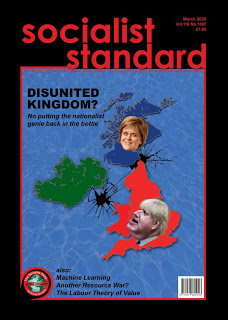
Scottish Independence : Tartan Delusions (2020)

From the March 2020 issue of the Socialist Standard

On the 31 January the blue Euro-banner was hauled down at Westminster and the Union flag raised in its stead. In Edinburgh, though, the self-awarded gold stars flag was pointedly left fluttering in place next to the saltire.

The SNP are making a none too subtle point. The antidote to the referendum they don’t like is to be… another referendum. It would seem the political ‘logic’ is that the best way to counter leaving a union is to leave a union.

It is somewhat ironic that the clash between Holyrood and Westminster stems from a single shared source, nationalism, be it competing nationalisms. The cause is perceived sovereignty, as if Scotland, or England, or Britain can stand alone, or at least break away from a power portrayed as inhibiting its freedom.

However, what would the SNP do in short order should they achieve independence? Give it up to the EU of course. Similarly, should Britain shake off the last vestiges of EU influence, then treaties will be sought and signed with such as the USA.

Not only will the USA want untrammelled access to the NHS for its big pharma, for example, there will be a demand for any arrangements to be subject to America’s legal system. For the USA substitute any other major trading nation/bloc and something similar will apply.

This is what ‘independence’ means in a global capitalist world. Significant change cannot be achieved by a binary vote in a referendum. At best there is some reordering of the arrangements, but essentially, adjustments made, capitalism continues unhindered other than by its own contradictions.

The SNP has previously stated its intention of retaining the monarch as their country’s head of state, continuing the use of sterling and joining NATO. Presumably unaware of any contradiction, they also want to be rid of the Trident submarine bases.

Do they really think that if capitalism degenerates to the point where international warfare results in the use of nuclear weapons, the removal of Trident bases will somehow insulate Scotland from the consequences?

Should the SNP decide the monarch was not to be their head of state, then a president or some such would fulfil that function. Has being a republic lessened the grip of capitalism, with its extremes of war, inequality and crises, on the USA?

If Scotland was denied the use of sterling presumably that would mean embracing the euro with all its financial hazards and, more importantly, subservience to, not independence from, the European Union. If sterling is retained, then economic policy would, ultimately, continue to be determined in London.

The formation of Britain enabled the industrial revolution to create a dynamic economy in which Scots, Welsh and English played full parts. This also led to the formation of the working class with interests transcending those of constituent regional and national parts. Workers in Scotland faced the same exploitative capitalism as they did in England and Wales and expressed their voice through their own organisations, the trade unions.

And nothing has changed. Workers on any side of a border, wherever it is drawn, all face the same fundamental problem, capitalism. To exist, capitalism must exploit workers to make profit. Painting your face blue with crossed white stripes alters this not one iota.

Whatever the outcome of another referendum the people of Scotland will continue to live under a parliamentary system designed to preserve the interests of capitalism. If they have opted for ‘independence’ they will find ‘sovereignty’ surrendered to the EU.

The parliamentary system has evolved to serve the interests of capitalism, not democracy. It does not matter if a parliament is situated in London or Edinburgh, nor if its benches are upholstered in tartan and populated by nationalist MSPs, it will remain subservient to the needs and preservation of capitalism.

Referendums are designed to give apparently simple solutions to complex problems, they are the chosen way of despots and demagogues attempting to garner some semblance of popular support of their self-serving programmes.

The ballot box can indeed be part of the response of the working class to taking economic and political power away from the capitalist class. But this will have to be just one element of a much wider movement in which the working class consciously acts for itself.

No referendum can solve problems for the working class, not in Scotland, not in Britain via Brexit (or re-joining the EU at some point), not anywhere. There is no Tartan alternative to socialism.
Dave Alton

The Irish Election: Sinn Fein Resurgence (2020)

From the March 2020 issue of the Socialist Standard

What about Ireland?

Sinn Féin, recycled from being the political wing of one of the physical-force Irish republican groups into a left-wing reformist party, did surprisingly well in the elections in Ireland last month. They got the most first-preference votes (24.5 percent) and ended up with 37 of the 160 seats in the Dáil. The result was in effect a tie between them and each of the two other rather absurdly named traditional Irish political parties, Fine Gael (‘Tribe of the Gaels’), the party of the outgoing Prime Minister, Leo Varadkar, and Fianna Fáil (‘Soldiers of Destiny’), founded by Republican hard-liner De Valera, which got 35 and 37 seats respectively.

When the original Sinn Féin was founded in 1905 it was an Irish nationalist party (‘We Ourselves’) catering for small-scale Irish capitalists eager to break away from the rest of the UK so as to be able to erect tariffs to protect them from the competition of bigger British capitalists. Its first leader, Arthur Griffith, proclaimed that, if an Irish capitalist firm was being undercut by an English competitor, ‘it is the first duty of the Irish nation to accord protection to that Irish manufacturer’ and that ‘under the Sinn Féin policy… no possibility would be left… for a syndicate of unscrupulous English capitalists to crush out the home manufacturer and the home trader’ (Arthur Griffith, The Sinn Féin Policy, 1907).

This was the policy that the De Valera Fianna Fáil government that came to power in 1932 began to implement, involving a tariff war between Britain and Ireland.

Now it’s a different story. In a 2019 policy document, Ownership Matters, Sinn Féin states that it wants ‘an economy that works for workers’ (mind you, don’t they all, given that workers make up the vast majority of electors?). After citing figures for wealth inequality and poverty in Ireland, SF went on:
  ‘Sinn Féin believes that this wealth inequality is a result of our economy being detrimentally ‘short-termist’ in its outlook – with private firms, through financial intermediaries, weighing near-term profit outcomes too heavily at the expense of longer-term sustainability. This has become the hegemonic strategy for private enterprise. The reality is that ownership shapes purpose. If we allow our economy to be owned and controlled by a small group of elites whose objective is that of profit, then that will be the purpose of our economy. If, however, we agree as a society that our preference is to establish an economy based upon productivity, sustainability and equality then ownership of our economy must be equitably spread across society’.
Then came the punch line: ‘This new economy can be achieved through alternative models of business ownership. Sinn Féin believes that the Worker Co-operative Model offers an exciting and innovative alternative.’ Not to be achieved in one go, but, in the words of a slogan the document coins, ‘Own the Change: Building Economic Democracy One Worker Co-op at a Time’.

Those who voted SF are unlikely to have voted for this, but merely so that something should be done about growing inequality and poverty. However, it does illustrate the illusions of SF’s policy makers. They criticise traditional private enterprises for concentrating on short-term profits, but if worker co-ops are to compete against them with any chance of surviving they, too, would have to pursue the same economic objective of profit. They would have to make profits as they would be operating within the context of a capitalist economy, which is based on competitive profit-seeking.

The capitalist economy

The capitalist economy – which SF would leave unchanged while launching ‘one worker co-op at a time’ – is based on separate enterprises competing to meet paying demand in their sphere of activity. The weapon used in this struggle is to produce more cheaply than your rivals but, to do this, you must re-invest the major part of the profits you make in machinery and other ways that reduce the cost per unit produced. The first enterprise to adopt some cheaper production method reaps extra profits, but this encourages, in fact obliges those that can, to follow suit and the price of the product falls, with the innovator’s profits falling back to normal. If an enterprise were to distribute all the profits it made to its owners for them to spend on their consumption, then its cost of production would not fall and its products would become uncompetitive; eventually it would go under and its owners would lose their money. Very few private enterprises are that short-termist.

The point is that the same pressure to give priority to profit-making and re-investing most of it applies whatever the legal form and internal structure of the enterprise. A worker co-op would have to operate on the same basis. Internally it might be more democratic and less hierarchical but the decisions that have to be taken, whoever takes them, will have to be the same. And of course a worker co-op can also go under, with the workers losing not only their jobs but their savings too. Some succeed but those that do end up behaving like any other business enterprise, even employing non-members as wage-workers.

In any event, given the nature of Irish politics, SF will never govern on its own but only as part of a coalition. Its openly pro-capitalist partners may well indulge it by allowing it to fund setting up a worker co-op or two but that will be as far as it goes. And if the experience of those set up by Tony Benn in Britain when he was minister of industry in the 1970s is anything to go by, their chances of succeeding wouldn’t be that high; all those he patronised eventually folded.

Up the Border?

Sinn Féin still stands for a 32-county Irish Republic – as did, at one time, the more fiercely named Fianna Fáil party – but this has come into prominence, not as a result of SF’s election successes north and south of the Border but as a fall-out from Brexit. Which is rather ironic in itself since Sinn Féin, as an isolationist nationalist party, opposed Ireland joining the EU and urged a No vote in all the referendums to amend and extend the EU’s powers.

People in Northern Ireland voted 56 to 44 percent in favour of Remaining in the EU and the EU insisted – and Boris Johnson acquiesced – that the political border on the island should not become an economic border again. It never was until De Valera and Fianna Fáil came to power in the ‘Free State’ as it then was and pursued a policy of independent capitalist development before they eventually gave up and signed the Anglo-Irish Free Trade Agreement in 1965. In 1973 Ireland and Britain joined the European Economic Community(as the EU was then called and still essentially is) together.

So, the north and south of Ireland will continue to have frictionless trade. As with the EU itself, there are those who think that a single market will be a prelude to a single political entity, especially as in the case of Ireland the Good Friday Agreement provides for a referendum on uniting with the Republic to be held if it is judged that a majority might favour this. But this does not necessarily follow, as the co-existence in Ireland for years of the political border with the economic unity of the single market and customs union showed. Even if a majority were to favour political unity, holding a referendum would risk igniting ‘the Border’ as a burning – and completely irrelevant and dangerously divisive — issue again, with a significant minority likely to be fiercely opposed to it, even to the extent of taking up arms. It would be better from all points of view to let sleeping dogs lie.

But even if it did happen without re-igniting political violence, it wouldn’t make much difference to the life of ordinary people. Capitalism would remain, and they would remain excluded from ownership and control of the means of life and so obliged to work for a wage or salary for those who own and control them. The pillar boxes in the North might be painted green – or maybe the settlement would allow them to remain red – but that would be all.
Adam Buick