Showing posts with label Ken Coates. Show all posts

Tuesday, March 11, 2025

Sting in the Tail: The restrictive society (1995)

The Sting in the Tail column from the March 1995 issue of the Socialist Standard

The restrictive society

Capitalism is a divisive society that not only puts worker against capitalist in a fierce class struggle. It also drives worker against worker in competition for work and wages.

A recent example of this is illustrated in the Independent (24 December) under the headline “Bring back pass laws, says black South Africans”. This report dealt with the influx of illegal immigrants to South Africa from Zaire, Mozambique and other African countries.
"Pass laws may make a comeback in Nelson Mandela's new democratic South Africa. Many black people who were victimised by them under apartheid in the past are now looking with favour on controls for immigrants. "
What a miserable society capitalism is. In the last two months of 1994 the South African government had deported 50,000 workers back to Mozambique. The same sorry story applies to Mexican workers deported from the USA. Capitalism is a world-wide system of exploitation and restriction.

Only inside a socialist system of society will men and women be free to roam the world as they desire.


Shared fantasy

First, the Fantasy Football league and now the Fantasy Share League, a creation of BBC2's Working Lunch programme. Players are invited to compete with the City of London's professionals in forecasting how shares will perform and to back their judgment by pretending to buy and sell them.

But what chance can the amateur forecasters have against the professionals? One clue was provided by Mick Clarke, Stock Market Correspondent of the Times, who confessed on Working Lunch that he had been plugging Asil Nadir’s Polly Peck company prior to its collapse.

And an article in the Guardian (27 December) reviewed how the experts had fared in 1994:
“Most of the City’s leading ‘gurus’ are probably wishing they could have eaten their words — especially those issued with great confidence this time last year. ”
When it comes to predicting how any market will perform, the only real difference between professionals and amateurs is that the former get paid for doing it while the latter do it for nothing.


Muddle-headed Ken

Ken Coates, Labour MEP, is upset over Tony Blair’s plans to change Clause Four of the Labour Party’s constitution. You can tell this from his comments on Blair and the Party “modernisers’’ whom he described as:
“bastards and shits who are going to walk past the unemployed” (Guardian, 14 January)
Does Coates really think that Clause Four, which he says “I cannot live without”, ever made a scrap of difference to unemployment under Labour governments? The fact is that every time Labour left office unemployment was higher than when it came in.

But Coates also asked an interesting question:
“How can you talk about equality and assume the permanent continuation of employers and employees?"
If he is being serious here then what is he doing in a party which, despite the presence of Clause Four, has always endorsed the production from profit system of which the employer/employee relationship is such an integral part?


Trial by torture

Kilroy on BBC1 isn’t one of Scorpion’s favourite TV programmes but the edition on 20 January was riveting stuff.

Two Tories were stuck with the task of defending the government against an angry bunch of OAP’s who complained over and over about their poverty. The luckless pair were Barbara, a County Councillor, and Daniel, a would-be Tory' MP.

And how they floundered as they tried to deal with the pensioners' flood of accusations: Barbara couldn’t even bring herself to say the word “poverty”, preferring instead “lower living standards”, while Daniel could only answer the demand for higher pensions by bleating “Where's the money to come from?” and insisting that “People should save more for their old age.”

It was a joy to see how those Tory' apologists were made to squirm by the pensioners, but the dogged way in which they defended the indefensible must have earned them the admiration of every watching politician.


Alive and kicking

Are trade unions finished? Vicious antiunion laws, large-scale unemployment plus the growth of part-time work have planted the idea among many workers that TUs can no longer produce results. These changed circumstances do mean that unions are not so effective as they once were in some activities, but they are increasingly effective in others.

For example, figures published by the TUC show that the unions won £335 million in 1993/4 in compensation for members who suffered injury or ill-health at work or were unfairly dismissed. This figure represents an eight percent increase over the previous year and is in spite of falling membership.

Socialists are the first to point to the limitation of trade unions, but their value to workers in the industrial struggle remains and should not be underestimated.

Pseudo-revolutionaries corner

In the olden days when the Communist Party used to exist they used to justify every change of “tactics" by reference to “dialectics, comrade, dialectics”. Now their mantle has fallen on the SWP whose leader Tony Cliff spouts the same gobbledegook Here he is writing about the “third stage”of the industrial struggle:
"Now we come to a problem. The level of generalisation is on the one hand quite low, but at the same time it is quite high. This sounds like a contradiction, but the contradiction is reality. ”
Eh?
Scorpion

Saturday, May 21, 2022

May Day Manifesto (1998)

Book Review from the July 1998 issue of the Socialist Standard

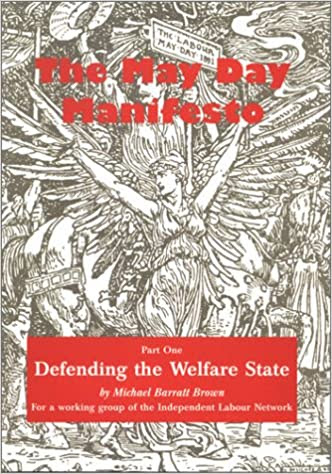
The May Day Manifesto. Part One. Defending the Welfare State by Michael Barratt Brown. Spokesman. £6.99.

Last year two Labour MEPs, Hugh Kerr and Ken Coates, were expelled from the Labour Party. They have formed an Independent Labour Network which (with money from the European Parliament) has published this pamphlet.

It is unashamedly Old Labour, proposing to extend the welfare state, restore full employment by Keynesian techniques of increased government spending, and to tax the rich so as to create a more equal society. It’s all pie-in-the-sky of course since such policies, which imply that capitalism can be reformed so as to work in the interest of the majority, have been tried and failed, most recently under the Callaghan Labour government in the late 1970s and under Mitterrand in France in the early 80s.

New Labour, Kerr and Coates complain in the introduction, has abandoned what Labour used to stand for:
“Redistributive policies, and planned public intervention to create jobs and uphold higher social standards have now gone. Instead, the new Government defends an economic strategy based on ‘the enterprise of the market and the rigour of competition’, a philosophy of deregulation, and ‘a partnership with business . . . that puts industry first’. It seeks ‘to enhance the dynamism of the market economy, not to undermine it’. It is determined ‘to extend the flexible labour markets to the rest of Europe, not to import Euro-sclerosis’. These engagements are linked with a policy of less direct taxation, and refusal to ‘impose burdens on business’ . . .”
All this is very true, but in the argument between them and Blair as to what is possible within capitalism today—and this is where this particular argument is situated—Blair is right: capitalism is incapable of offering the reforms Kerr and Coates are campaigning for. The alternative to New Labourism (the management of capitalism on its terms and according to its rules) is not reformism but socialism.
Adam Buick

Tuesday, May 17, 2022

Party News (1998)

Party News from the June 1998 issue of the Socialist Standard

The results in the three wards in which the Socialist Party stood in the May local elections were:

South Tyneside Metropolitan Borough Council—Primrose ward

Scorer (Lab) 1155, Smith (LD) 220, Armstrong (Con) 181, Bissett (Soc) 104.

Manchester City Council—Levenshulme ward

Whitemore (LD) 1550, McGregor (Lab) 771, Davies (Con) 148, Garratt (SLP) 104, Chislett (Green) 81, Pitts (Soc) 32 .

London Borough of Camden—Brunswick ward

Weekes (Lab) 653, Cousins (Lab) 601, Avery (Con) 443, Norman (Con) 376, Jones (LD) 286, Whitley (Green) 258, Parker (Soc) 58.

London Referendum

The Labour government has claimed public endorsement of their undemocratic proposal to have a directly-elected mayor for London who will have all the power, reducing an elected assembly to the status of a chat show. The actual results were:

Non-voters: 327,897 (65.4%), Yes: 1,230,715 (24.6%), No: 478,413 (9.5%), Rejected (spoiled and invalid papers): 26,188 (0.5%)

It would be nice to think that the unusually high number of rejected votes was due to people writing “Socialism” across the ballot paper, but most were probably blank votes.

 
No, thank you.

Last year two Labour MEPs, Hugh Kerr and Ken Coates, were expelled from the Labour Party for being too reformist. They are seeking support to get re-elected in opposition to Labour and feel that they may have a good chance since these elections will be held under a proportional representation system. In January a group calling itself the Green left issued a statement calling on “all radical and environmentally minded people-organisations to consult on the possibility of a green, democratic and pluralist alternative for the 1999 European elections and beyond. We ask the Green Parties of England, Wales & Scotland, the English Socialist Alliances, the Socialist Party, the Socialist Labour Party and all other Green Left Affiliates to respond positively to our consultation.”

At its meeting in May our Executive Committee adopted the following reply:
“The Socialist Party’s only aim is socialism as a society of common ownership and democratic control with production for use not profit. Because we hold that the best way to further the cause of socialism is to campaign for socialism and socialism alone—’to make Socialists’, as William Morris put it—we have always refused to ally ourselves with organisations which campaign for reforms to be achieved within the context of capitalism. We do not see that the introduction of proportional representation is a valid reason for abandoning this principled stance.

On these grounds, therefore, we decline your invitation to talks with a view to presenting joint candidates in the next European elections.

We shall, in all probability, be standing our own candidates in these elections, in opposition both to candidates who openly support capitalism and to those who are standing on a platform of reforms to be achieved within capitalism.”

Saturday, May 2, 2020

A Siberian Winter in Trottingham (2020)

Book Review from the May 2020 issue of the Socialist Standard

Winter at the Bookshop. Sylvia Riley. Five Leaves. 2019

Essentially a book of short stories and anecdotes, this has been put together by the writer of Switchboard Operators, which years ago was made into the 1990s TV series The Hello Girls starring Letitia Dean.

The bookshop in question was based in the poverty-stricken St Ann’s area of Nottingham and was run by Pat Jordan. Riley was one of the volunteers who helped out. Jordan was one of the leading lights of British Trotskyism, founding the International Group which was for a time the section in Britain of the United Secretariat of the Fourth International. This was the current that was linked to veteran Trotskyist writer Ernest Mandel and to Michel Pablo, who argued that the revolutionary struggle should always take as its starting point the particular situation prevailing in each country concerned. This meant in many cases an emphasis on ‘Third World’ struggles for national liberation and also student revolt, rather than the more usual Trotskyist pre-occupation with the traditional working class.

The International Group – after early dalliances with Ted Grant’s Revolutionary Socialist League (the ‘Militant Tendency’) – eventually morphed into the International Marxist Group and became dominated by Tariq Ali during the student revolts of the late 1960s, which is when the book ends. It is necessarily a highly personal account but generally well written, rather twee on some occasions and moving at others. It tells of a world of backroom duplicators and yellowing pamphlets, of student rebellion and fluid relationships. An air of grinding poverty hangs over it all, in an area long overdue for slum clearance (which happened shortly afterwards).

Nottingham at this time was known nationally as a hotbed of Trotskyist activity in a period when the so-called ‘New Left’ was making its mark as a challenger to the conventional Communist Parties. Pat Jordan and Ken Coates (later to become a Labour MEP) were the most central characters in this milieu and Sylvia Riley writes engagingly about the movement they led, the people in it – and their foibles. Let us say it doesn’t entirely align with the more glamorous image the IMG seemed to have cultivated at the time.

The IMG eventually split and its main successor organisation became ensconced in the Labour Party – with several former IMG members going on to become prominent Labour parliamentary figures, including ex-Chancellor of the Exchequer Alistair Darling and Kate Hoey. A long way indeed from Pat Jordan’s tumbledown bookshop, with its bare light bulbs, Marvel comics and Trotskyist tracts.
DAP

Wednesday, August 21, 2019

Letter: Blind faith in the broad church (1984)

Letter to the Editors from the July 1984 issue of the Socialist Standard

Dear Comrades,

I am writing to you with regard to your opinions of the bankruptcy of the Labour Party as an organisation for radical change, and in particular of the articles "Crisis of the Left" (July) and “Labour in Pain” (August).

The choice before Labour is three-fold: Wilsonian pragmatism, with frontal attacks on working people, the welfare state and unions, all to retain power; revisionist radicalism, primarily attempting to reconcile Labour voters with socialism, not impose it on them; and fundamentalism, not diluting or changing our policies one bit. We have to be realistic in listening to voters' hopes, radical in articulating an alternative system to capitalism’s horrors, and resolute in meaning what we say and making people realise that we will not be blown off by capital, as in 1931, 1948. 1967 and 1976. A little bit of socialism time and time again is better than nothing, and is surely worthwhile in helping radical politics.

May I remind you that in the 1983 general election. Labour on a left reformist programme got 8½ million votes, the SPGB 85 votes, a slight difference. If the dirigisme socialism of Labour, blunted and mellowed by internal contradictions and compromises, is too extreme for voters, they aren't going to vote for a revolutionary Marxist party. Are they? Why not pause and think here; what makes you so sure that eventually the workers will turn to full-blooded socialism?

Ken Coates, in his excellent Socialists and the Labour Party (1973) asks many important questions to revolutionaries which have not been answered by you or theorists such as Miliband, Panitch and David Coates. In Coates' pamphlet, he states the obvious truism that any revolutionary mass party must duplicate “the best features of the old Labour Party . . ." This is for the reason that such a party must draw heavily on former Labour activists, who are at the moment consciously influencing Labour in a socialist direction. The revolutionary left misses the fact that Labour is a living, changing organism, not a monolithic block, and is very susceptible to rank and file activism.

Coates also commented:
Since the collapse of the Independent Labour Party, there has been no group of socialists capable of maintaining a full-scale political presence outside the Labour Party . . . (by which) . . . I mean the ability to secure the election of at least a handful of members of Parliament. . .
So far the history of modern British socialism has involved any group existing outside or independently of Labour and, thus the trade union movement, withering away; no matter whether it was a new revolutionary group as with the Socialist League, SPGB, CPGB. IMG or SWP. or a breakaway from the party—the SDF, ILP. National Labour (the MacDonaldites). Democratic Labour (the Tavernites) and the Scottish Labour Party. Labour, despite the disaster of the last election and its recent record of government, is the only credible representative of the progressive working class. The lessons of the 1880s, 1930s and 1960s, periods of radicalism, must be that the only feasible road to socialism in this country is through the Labour Party.

In “Labour in Pain” (August), you hit on a number of important points about the internal contradictions of the party and hypocrisies of the “Broad Church". Nationalisation of the top 25 companies as the IWC and Labour Conference want, or top 200 as Militant wants, is, as you say, irrelevant. Labour’s paranoid pursuit of public ownership has more to do with Gaitskell’s and Wilson’s opposition to it, than its merits. We have to realise that state control of industries does not alter the plight of workers. They remain wage slaves, no matter their income or material affluence, with no power over the factors of production which decide their lives. State control merely replaces the entrepreneur with the bureaucrat, the capitalist system for the servile state. Workers self-management, or to extend it beyond a narrow industrial front into all walks of life— citizens power, can alter the present undemocratic situation. Citizens power must be built on the ideas of guild socialism and the analysis of human nature and the stale provided by group theory. This must involve seeing the state as an obstacle to radical change, no matter how enlightened those in charge, and limiting its functions and roles. However, it has to be noted, sadly, that guild socialism has been neglected and forgotten about, seen as a throwback to the Medieval age with no pertinence to the industrial age.

The SPGB constitution says it stands for "the common ownership and democratic control of the means and instruments for producing and distributing wealth . . Does this glib phrase “common ownership" mean central planning and state control or "Stalinism plus parliamentary democracy or decentralisation and citizens power over capital? We have a right to know.

The SPGB does, on the other hand, say regularly, and in "Why we are hostile” (November), that all working-class people are "enslaved" and must be "emancipated", not by enlightened Fabian elitists, but the workers themselves. This is fundamentally true. R. H. Tawney in The Acquisitive Society (1921) said:
The workers cannot have it both ways. They must choose whether to assume the responsibility for industrial discipline and become free, or to repudiate it and continue to be serfs.
Workers initiatives, take-overs and local plans, rather than centrally decided blueprints, is the only sure way of avoiding the servile state.

You say that only people who are fully in agreement with the SPGB can join. Your inability to lower the SPGB from its high, puritanical and principled pedestal of fundamental, sacrosanct ideas is sad. Socialist parties desperately need a coherent. dynamic ideological anchor to prevent policies appearing as just a "shopping list" with no underlying philosophy, and to resist the claims of capital. Principles are only of use in relation to short-term policies. You seem to miss this.

The SPGB is a valuable part of the British socialist movement. Labour, for all its faults, is socialist, though as you say in November, most Labourites "belong to a party which they imagine will one day exist . . ." However, if we keep trying, we socialists in and out of Labour can discard the stale heritage of labourism and state socialism. While Marx is still invaluable to analyse modern capitalism, particularly in the surplus theory of value and class critique of production, he cannot be dogmatically interpreted.

Dogmatism is not the answer for socialists. The SPGB should engage in an active, open and free debate with other socialists in the Labour, CPGB and other parties about the failure so far, future and road to British socialism, possibly in the Socialist Society. Any debate must be two-way, with no closed minds. We can learn from one another, sharing our experiences of capitalism and socialist action. You can give us some of your critiques and theories of capitalism, if we can give some, dare I suggest it, flexibility. Remember, together the left has enormous potential to win electoral support and change society. Divided, it has nothing. Despite our numerous differences, which are sincere and cannot be glossed over, we are on the same side—the mosaic of the socialist movement, facing a common enemy, not Thatcher or the Conservatives. but capitalism.
Gerry Hassan 
Dundee

Reply:
The Socialist Party is most willing to engage in "active, open and free debate" with those who call themselves socialists. Repeated efforts have been made to encourage the defenders of Left reformism to take the public platform and debate but, contrary to the impression given in the last paragraph of Mr. Hassan's letter, it is the dogmatism of the traditional left which has prevented them from accepting open debate with the Socialist Party. For example, the leader of Lambeth Council, Ted Knight, was asked recently to debate with us in his own borough and replied that there would be no point in such as event as the Labour Party is bigger than the Socialist Party; our Islington branch has written two lengthy letters to The Militant Tendency, challenging them to debate, but they replied in writing that public disagreement “between socialists” would be embarrassing. So, we would advise our correspondent to write to the Leftist parties and groups urging them to make contact with the Socialist Party; they will meet no dogmatic resistance to discuss ideas from us.

We are reminded that the Labour Party won 8½ million votes in the 1983 general election on the basis of a "reformist programme". What is a reformist programme, be it “left” or "right", but a plan to make capitalism run more efficiently from the point of view of the majority of people in society? That 8½ million workers were conned into believing that a Labour government could do this indicates two things: firstly, there are still plenty of deluded workers around: secondly, there are less workers being taken in by the Labour Party now than has been the case in electoral terms for half a century. The validity of Labour’s ideas is not to be judged by the number of votes they received (on that basis, we would be forced to conclude that the Tories and the Alliance are, between them, substantially more “correct" than Labour), but the extent to which they can be realistically applied as a means of solving social problems. Eight and a half million people voted for Labour’s commitment to the NATO military gang, to the continuation of the wages system, to the acceptance that there must still be poor people for whom the state will have to care. They were voting for capitalism. Our correspondent points to the 85 votes received by the socialist candidate and draws the conclusion that if most voters found Labour's programme "too extreme, they aren’t going to vote for a revolutionary Marxist party". The reason workers did not vote Labour is that they have tried it before and it is no more than another way of voting Tory. Workers did not vote for socialism because they have yet to be convinced that it is in their interests: if there had been no Labour confusion-mongers in Islington South during the last election, making promises to workers which could not be kept, there would have been more votes for socialism. The "workers will turn to full-blooded socialism” when they have had enough of capitalism and are ready to opt for a different way of organising society.

The labour illusion is well summed up by Mr. Hassan when he writes that "A little bit of socialism, time and time again is better than nothing . . .”. Socialism — a system based upon common ownership, democratic control and production solely for use — is the direct opposite of the capitalist system. It is no more possible to have "a little bit of socialism" within a world based on minority class monopoly of the means of wealth production and distribution than it would be to be a little bit pregnant. What the Labour Party’s "little bit” amounts to is a programme to reform capitalism and, as our correspondent rightly points out, these efforts have repeatedly been “blown off by capital". We are told that it is necessary to make people realise that capital will not interfere with Labour’s aims in future, but the Marxist critique of reformism is precisely that such hopes are illusory: if Labour is elected to run capitalism, as it sets out to be, it cannot but bow to the needs of profitability.

Calling in expert witness Coates damages rather than helps the case of our correspondent. What are "the best features of the old Labour Party"? Does he mean their support for two world wars or their racist immigration legislation or their strikebreaking record? Or does he mean their record of reformist promises, such as the promise of full employment made in Labour and the New Social Order or Bevan’s promise that there would be no housing problem in Britain after the Attlee government had served its term? If. by "the best features", they mean Keir Hardie’s statement in the Manifesto of the English Socialists that socialism will entail the abolition of the wages system, then we in the Socialist Party are duplicating the best features, whereas Coates and the rest of the Labourites have ignored the socialist tradition.

After the evidence from the star witness. it is a shame that our correspondent once again returns to the old dogmatic chant that history must go on repeating itself. Evidence points the other way: Labour’s traditional support is crumbling (maybe temporarily, hopefully for good) and workers are looking at alternatives. If “the only feasible road to socialism in this country is through the Labour Party", and if, after seven Labour governments, capitalism is still here, where is the evidence that the road is anything but a dead-end?

We are pleased to note that Mr. Hassan accepts the criticisms made by socialists of Labour and Militant's nationalisation (state capitalist) policies. Indeed, we do "have to realise that state control of industries does not alter the plight of workers” — as the miners will testify. It is a pity that our correspondent's clear recognition that state capitalism is not socialism is not applied to the equally non-socialist theory of "guild socialism", as advocated by reformists like G D H Cole in the distant past. The fallacy of “workers’ control” is based on the failure to recognise that where there is a working class — where wage labour exists as a social relationship to capital — the only result can be exploitative. "Guild socialism" presented a naive plan to decentralise and democratise capitalist exploitation. If it has been "neglected and forgotten about”, as our correspondent states, working-class knowledge will be none the poorer.

We are asked whether our Object implies central planning, Stalinism, or decentralised power over capital. It means none of those things. It would be ludicrous to envisage world socialism as a society run by a bureaucracy on a central plan: clearly, common ownership will require a democracy organised by the majority. We do not advocate Stalinism, and socialism means more than parliamentary democracy: our Object commits us to working for democratic control, that is, the making of decisions about society by its citizens on the basis of full information, as for control over capital, we can only reiterate that there will be no wage labour-capital relationship in socialist society and therefore citizens will no more have power over capital than they will over the banks, the police force or the torture chambers: these social features will not exist.

We are not proposing, then, any "centrally decided blueprints", but will leave it to the workers who establish socialism (who we hope will include us) to make the plans. We agree that most plans can be made locally but, under capitalism, "workers’ initiatives, take-overs and local plans" are constantly inhibited by the fetters of the profit system.

Mr. Hassan's comments about principles invite the Socialist Party to fall into the political pit which the Labour Party is stuck in. We are told that only allowing workers to join who agree with us is "puritanical" and "sad”. We say that letting racists, nationalists, religious cranks. Leninists, pro-NATO supporters, careerists and "Wilsonian pragmatists” into the Broad Church is not just sad. but pathetic; not principled, but disgustingly opportunist.

We are told that “principles are only of use in relation to short-term policies". We have a policy (which is neither short nor long-term, but as long as it takes us to achieve) which is to abolish capitalism and establish a world free of class division, exploitation, property relationships, poverty, war and wage slavery. Those aims are urgent and we are not going to be deterred in struggling resolutely for them by those who tell us to unite with the crumb-collectors of the Left.

How nice to be told that "The SPGB is a valuable part of the British socialist movement". We have been waiting eighty years to meet the other part, but have no illusions that we will find it in the Labour Party or any of the other organisations which seek to re-arrange capitalism. Indeed. “Dogmatism is not the answer for socialists" and that is why those who still hold on to the pathetic belief that Neil Kinnock and his fellow reformists will eradicate the nasty bits of capitalism ought to abandon the Labour Party and join a party which defines socialism with clarity, fights for the new system with enthusiasm and remains uncompromisingly hostile to the apologists for capitalist politics.
Editors

Thursday, February 8, 2018

Get Rid of Wages! (1968)

From the August 1968 issue of the Socialist Standard

Over a hundred years ago, Karl Marx gave a talk to the general council of the International Working Men’s Association, a talk whose main point was to show that workers’ unions really could get wage rises — for already the silly idea was being put about that wage increases led to higher prices and therefore the workers didn’t gain. After proving his case up to the hilt, with his usual forceful logic, Marx naturally drew the conclusion that workers should fight for higher wages. But he added the following remarks, which deserve close attention:
  At the same time, and quite apart from the general servitude involved in the wages system, the working class ought not to exaggerate to themselves the ultimate working of these everyday struggles. They ought not to forget that they are fighting with effects, but not with the causes of those effects; that they are retarding the downward movement but not changing its direction; that they are applying palliatives, not curing the malady. They ought therefore not to be exclusively absorbed in these unavoidable guerrilla fights incessantly springing up from the never ceasing encroachments of capital or changes of the market. They ought to understand that, with all the miseries it imposes upon them, the present system simultaneously engenders the material conditions and the social forms necessary for an economical reconstruction of society. Instead of the conservative motto, "A fair day's wage for a fair day's work'." they ought to inscribe on their banner the revolutionary watchword, "Abolition of the wages system'.
If that doesn’t startle you, then perhaps it should. After all there are dozens of “Marxists” [parties] about, but how many of them advocate the abolition of wages? Take the British “Communist” Party, for example, which is very well-known as a Marxist Party. In vain will you scour its programme, The British Road To Socialism, for the faintest hint of the abolition of the wages system — though it reeks of the conservative motto, “A fair day’s wage for a fair day’s work.” Look through every item of the CPGB's current propaganda material: it is as bare as Mother Hubbard’s cupboard of even the skeleton of Marx’s “revolutionary watchword.”

What about the “Socialist” Labour League then? They’re always accusing the CP of “betraying Marxism” aren’t they? Surely their material is full of revolutionary watchwords? No, not a jot. We could ramble through a lengthy list of so-called Marxist groups in this way; but already you're beginning to lose patience. How ridiculous, really, to take a paragraph out of Marx and use it as a touchstone of the correctness of political parties a century later!

But Marx was not just affected by the heat on that June day in 1865. The abolition of wages used to be taken for granted as the chief aim of nearly everyone who claimed to be socialist. “On this point all Socialists agree,” ran the Manifesto of English Socialists of 1893. “Our aim, one and all, is to obtain for the whole community complete ownership and control of the means of transport, the means of manufacture, the mines and the land. Thus we look to put an end for ever to the wages system, to sweep away all distinctions of class, and eventually to establish national and international communism on a sound basis.”

Frederick Engels in 1881 wrote of the workers’ day-to- day struggle for higher wages: “It is a vicious circle from which there is no issue. The working class remains what our Chartist forefathers were not afraid to call it, a class of wages slaves. Is this to be the final result of all this labour, self-sacrifice and suffering? Is this to remain for ever the highest aim of British workmen? Or is the working class of this country at last to attempt breaking through this vicious circle, and to find an issue out of it in a movement for the ABOLITION OF THE WAGES SYSTEM ALTOGETHER?” (Engels' capitals.) Notice that neither this passage nor the one from Marx were passing brainwaves related to a misty, distant future. They were both addressed urgently and directly to the workers.

Why did Marx and Engels insist on the abolition of wages? They saw that European private property society had gone through phases: chattel slavery, feudalism, and capitalism or wage-slavery. Marx pointed out that capitalism was the only system in which the vast majority of wealth took the form of commodities — articles and services produced primarily for exchange rather than for use. He saw the abolition of capitalism as the abolition of commodity production, and thus the end of money, which only exists to facilitate commodity exchange. (The other form of commodity exchange is barter: socialism will have neither barter nor buying and selling). Marxists claim that capitalism has developed science, technology and automation to such a degree that everything we need could be provided free of charge. The catch is that capitalism itself causes an artificial and unnecessary scarcity, because it is so wasteful and destructive. Things are made for profit instead of for people’s use and enjoyment.

Capitalism is, among other things, a system for rationing out scarcity. But we have reached a stage where the system for rationing scarcity itself keeps the scarcity in existence. Everywhere the forces of production are straining at the leash to flood the world with abundance — but everywhere the wages-profits system restricts, wastes and destroys, prevents this potential from being realised.

In Socialism: Utopian And Scientific Engels stated: “The possibility of securing for every member of society, by means of socialised production, an existence not only fully sufficient materially, and becoming day by day more full, but an existence guaranteeing to all the free development and exercise of their physical and mental faculties — this possibility is now for the first time here, but it is here.”

It is true that since Engels wrote there has been a huge increase in world population. It is also true that much of the easily-available mineral wealth has been consumed. It is further regrettably true that capitalism, in its beserk scramble for profits, has damaged our ecology through such abuses as chemical pollution and irresponsible treatment of the soil leading to erosion. Some of the ill effects of this insane society will take decades to cure. Some of them, alas, can never be cured. The annual extinction of scores of species of animals, plants and birds is a tiny enough matter compared with war on poverty, but our heirs, the people living in Socialism, will no doubt find time to regret such permanent scars on their beautiful planet.

However, alongside the population explosion and the Frankenstein ecology, we must put the rapid advance of science, the potential of computers and robots, the development of new sources of power and materials, and staggering new productive processes (most of the patents for which are snapped up by the big monopolies so that no one can use them).

There could easily be more than enough to go round. There is no need for scarcity. There is thus no need for a money system of allocation. Some folk, forgetting about the threat of nuclear war and imagining that we have all the time in the world, say: “True, we have the potential for abundance, but let’s delay establishing Socialism until we have actual abundance.” But capitalism, which long ago created the potential, will never actually deliver the goods.

What happened to Marxism ?
You miss the whole point of Marx's great work Capital, if you don’t see why he defined “a commodity” on the first page. Capital does not simply describe a certain system of society; it proves that all the main features of that society (things like slumps and unemployment) are necessary consequences of mass commodity production. It is therefore impossible to get rid of them without getting rid of commodity production, in other words getting rid of wages, profits and money.

So we return to the question: where did it all disappear to, this talk about abolishing wages? Did somebody come along and prove Marx wrong, so that socialists started aiming for something different? No, nobody has refuted Marx. And neither did the “Communists” and left-wingers come out and say: “We have broken with Marx. We are now anti-Marxist.” It all happened in a much more subtle, slow and underhand way. Nonetheless, though these people did not say “We have broken with Marx” in words, they have certainly said it in deeds. With every drop of workers’ blood they have shed by their support for the monstrous state capitalist tyrannies in Russia, China and Cuba, every compromise they have engineered with backward forces like patriotism and religion, with every oily-tongued betrayal, they have shouted: “We are anti-Marxist.”

The substitution of means for ends
But how did it happen? Even given careerism, compromise and deceit, how could so many people — some of them dedicated and sincere, let’s face it — make such a momentous about-turn within a few years, and in such a way that many of them hardly realised they had done it? The main outlines of the process are amazingly similar in most cases.

Consider the man who wants the abolition of the wages system, the man who sees that there is no other solution to the problems of the working class. What is he to do? He is in an awkward position, because he soon discovers that the great majority of the working class do not want, and never have wanted, the abolition of the wages system. So there are two alternatives: either a minority can bring about this social revolution, or the majority must be convinced. Of course it is manifestly the case that the majority must be convinced, but that does not end the matter.

The task of trying to convince so many people, even though social evolution is on his side, is a daunting one. Easily scared by this prospect, and maybe wanting a quick career in politics, our man eagerly snatches at another scheme. Why not, he reasons, put forward a less frightening demand than the abolition of the wages system altogether? And why not, having got a big following behind that other demand, then lead this following in the direction of a real socialist revolution, the abolition of wages? This plan has every advantage on the personal level. He can think of himself as a real pioneering socialist, but never actually talk about Socialism, and therefore never suffer the scorn of unimaginative nitwits. He can even make a virtue out of expediency and erects a whole glorious mythology of “vanguardism,” “boring from within,” “transitional demands” and so on. There is just one snag. It is quite impossible to get Socialism this way.

If you advocate some measure, it does not matter what obscure and ingenious implications you may privately see in it: the followers you attract will not see them. You are forced to argue that this measure can solve the basic problem—which is an argument against Socialism. As your movement gets bigger, you find it becomes a straightforward reformist movement for the defence of capitalism. Nothing else could have happened. Your movement may actually capture political power, and at this juncture you turn to the minority who are still advocating Socialism, and you say to them: “Look where we’re heading! Why are you wasting your time in the wilderness?” And when your government, as it inevitably must, attacks the workers you may even have the impudence to say to that minority: “This would never have happened if we’d had more people like you on our side!” In your very success you have failed utterly. At this point you start looking around for a scapegoat, and who knows what trouble you will cause now? You may, for instance, come to the farcical conclusion that the way you took power was the culprit, that there is something intensely corroding and demoralising about parliament, that armed insurrection is the answer.

In this way, by irresponsibly pretending that the vote doesn’t count, you help to pave the way for a new Hitler. Thus the self-styled followers of the ultra-democrat Marx are seen disparaging even the measure of democracy the workers have won within capitalism. Although (and perhaps., more fortunately), you may just get tired, and forget even the word “Socialism”.

Some of the people who took the above road used nationalisation (state capitalism) as their “immediate demand.” (Some of them thought that nationalisation was an actual, material stage on the way to Socialism, but that is simply incompetent economics). It is rather comical, tragicomical of course, to look back on their history and see how even the original “immediate demands” were thought so wild that even milder “immediate demands” had to be put in their place. Thus, it was argued that total nationalisation would lead to Socialism, then that partial nationalisation would lead to total nationalisation, eventually that the mere existence of the government with the right tag (even though this party ruled no differently to its rivals) would do the trick. A further ironic twist is that as this retreat took place, each stage along the road was itself christened “socialism.” And then along came a host of modifiers and tinkerers with all sorts of prescriptions for running the same reformist romance along slightly different lines. Thus we get, for example, laugh-lines like “Socialism Is Nationalisation Plus Workers’ Control” (title of an article by S. Newens in Socialist Review, February 1957).

When will they learn?
That muddled assortment of movements and groups which use socialist-sounding phrases but are opposed to Socialism is sometimes loosely named “the Left Wing.” Occasionally, in all this barren confusion, like tiny shooting stars in a black sky, we see a brief mention of the need to abolish wage-slavery. In a recent essay (in The Incompatibles, Penguin) Ken Coates makes such a mention, and in fact builds up a good case against capitalism, even quoting Marx’s revolutionary watchword. But is he on the right track? Not on your life. He is merely issuing a reminder.

Coates argues that workers in general respect “fairness,” an attitude which is used to support capitalism. He wrote: “Between the idea of a fair day’s pay and the goal of the abolition of the wages system, it is clearly necessary to place a third demand.” This third demand, he believes, should be acceptable in terms of fairness, but should lead to an understanding of Socialism. (Incidentally, someone entirely ignorant of history might assume from Mr. Coates' essay that he was proposing a totally novel strategy. In fact, of course, it is the same old hat of so-called “revolutionary reforms” which has been tried countless times, has always failed, and always will).

Coates seems to realise that the reason workers accept capitalist values is because of the weight of indoctrination to which they are subjected. In other words the problem is NOT that workers are either naturally or by conditioning incapable of understanding Socialism, but rather that they hardly ever hear about it and don’t take it seriously when they do. The reasons for this are plain — the chief one being the comparatively insignificant size of the propaganda for abolishing the wages system. The prognosis is obvious: join the small but growing movement which is uncompromisingly putting the case for Socialism. Coates' strategy, though well-meant, has the effect of reinforcing the capitalist values of fake fair play.

Having taken a clear stand for the abolition of the wages system we must of course use the sort of psychological analysis indicated by Coates to inform our educational tactics. But it is a mistake to suppose that “fairness" is a concept of no use to socialists. It is hazy to be sure, but it can be used to criticise the very capitalist society which relies upon it. Any worker can quite clearly understand, when he is told that 90 per cent of the wealth is owned by ten per cent of the population, that this is hardly fair. The knowledge of economics needed to grasp the point that it is impossible for wages ever to be fixed by merit (even though that’s not what we want) is very slight. These elementary criticisms of the capitalist system are not enough. They must be followed up by the theory of surplus-value, which, again, anybody can understand. But the deeply-entrenched concept of fairness does not in itself put a vast gulf between workers' minds and understanding of revolution.

People never form their attitudes entirely by logically processing the information they get. They do this to an important extent, but they also look particularly for logical arguments in favour of what they already want to believe. So let us repeat: all the essentials of the case again capitalism, and the case for abolishing the wages system, can be readily grasped by any worker. It is not a problem of people’s mental ability which we socialists face: it is a problem of the tremendous continuous pressure of reformist conditioning.

A big obstacle is put in our way by precisely those left-wingers who have prostituted socialist phrases. Go up to any worker and tell him you want Socialism: what is the result? You may spend a couple of hours explaining that Socialism is not slave camps in Siberia, nor the Labour government, nor “workers’ control.” After that, if he has the patience, you can start talking about Socialism.

This is not his fault. And it is not our choice. We don't relish spending our time debunking the Labour and “Communist" parties. We have a straight case to put, which no one else is putting: that in a world of plenty there is poverty, that a society which puts ironmongery on the Moon cannot house people decently, that workers are debased and degraded in useless toil, that our species is threatened with extermination because of capitalist economic conflict — and that all this is absolutely unnecessary for a single day longer.

A world social democracy without frontiers, in which work will be voluntary and enjoyable, in which every member of our society will have equal access to all goods and services, in which poverty and war will not exist — this free society is technically feasible now, and can be established as soon as the majority of people understand and desire it.

The history of the last hundred years has proved time and time again: reformist programmes do not lead the working class to Socialism. They obscure the issue. What is needed is a clear case, uncluttered and uncompromised, for the abolition of wages. Please help us to put it.
Steele.

Sunday, June 25, 2017

Politics First (1968)

Book Review from the April 1968 issue of the Socialist Standard

Industrial Democracy in Great Britain. edited by K. Coates and A. Topham. Macgibbon and Kee. 63s.

It is insolent of those who idealise industrial action to link this, as Coates and Topham do, with Marx. For Marx held that, necessary and useful as industrial action was, what it could achieve was limited; to end wage slavery the working class should take political action to convert the means of production from class to social property. The industrial side of the class struggle is thus in a sense subsidiary. This book is a collection of writings advocating a greater say in industrial administration for workers on the shop- floor and, frankly, is uninteresting. The authors’ comments are mealy mouthed and in places inaccurate. We are told that lames Connolly “split the old Social Democratic Federation to form a new Socialist Labour Party". This move was in fact an expression of the dissatisfaction of the younger SDF members; it is quite wrong to attribute the founding of the SLP to Connolly. Another sign was the founding in 1904 of the Socialist Party of Gt. Britain — not mentioned, of course.

Workers have no special power “at the point of production”. The real seat of power is what controls the government machine and capitalist power rests on their control of this. Industrial action won’t dislodge them. It is significant that Coates and Topham can find nothing to quote on the shop stewards' movement from 1926 to 1935, a period of great unemployment. All the pre-war items on this issue are from members of the so-called Communist Party — Tom Bell. J. T. Murphy. Tom Mann, W. Gallacher, Wal Hannington and Harry Pollitt — thus endorsing the view that at one time the CP was a revolutionary organisation which went off the rails when it embraced parliamentary action after the war. But the CP has always been an opportunistic party, its only principle being to act in accordance with the interests of Russian state capitalism. Thus they called a meeting of shop stewards in April 1940 to protest against the employers using the war as an excuse to attack working conditions. At another meeting in October 1941 the same people were reported as cheering a man who declared “If a man doesn’t pull his weight in war production then, whether he is a labourer or engineer, he should be put in the army". We all know what had happened in between! From 1941 to 1947 the CP supported production drives and this only changed when the wartime alliance broke up. One of the pre-war Communists quoted is J. T. Murphy. Murphy was expelled from the CP in 1932 because he would not accept the slogan “‘stop the transport of munitions"; he wanted "credits for the Soviet Union!" Murphy's following had been built up among engineering workers in eastern Sheffield, an important munition producing area. This incident well shows that the shop steward's following is based on industrial issues. They don't carry their supporters with them when they branch out into politics.

Coates and Topham recognise that democratic control of industry will not work if production is still to be geared to the market (look at the co-ops, they say). They know that for this to be effective the market and money must go. Only they fall for the old stepping stone policy:
Given the establishment of a democratically self-regulating industry in a climate formed and dominated by the market, a struggle will begin between democracy and the market.
Once some people thought that nationalisation was a step to Socialism. All they achieved was to bring certain industries under the collective control of the capitalist class via the state. All this talk about “worker’s control” and industrial democracy will probably have a similar outcome: employers will latch on to it as a stepping stone to involving their workers in production problems—with a view to increasing profits.
Adam Buick

Tuesday, January 26, 2016

Socialism versus Reformism (1967)

Book Review from the November 1967 issue of the Socialist Standard

The Incompatibles: Trade Union Militancy and the Consensus Editors: R. Blackburn & A. Cockburn. Penguin Special, 6s.

This is a collection of essays written in defence of trade unions and of militant trade unionism and, as such, is valuable. Three of the essays, those by Blackburn on 'The Unequal Society", Coates on “Wage Slaves" and Paul Foot on “The Seaman’s Struggle", are well worth reading. The contributions of trade union leaders, Jack Jones, the No. 3 in the TGWU and Clive Jenkins of ASSET, are, as might be expected, boring.

The Socialist Party of Great Britain has always argued that working class problems arise from the monopoly over the means of production of a privileged few. No kind of action, whether trade union or social reform, can solve these problems as long as this class monopoly remains. Trade union action, though necessary and fully supported by the Socialist Party, is limited in what it can do. It is a continuous rearguard action to maintain living standards and working conditions against the downward pressures that capitalism generates. Social reform action, that is, reformist political action, is just as limited. It tries to deal with effects while leaving the cause untouched. So that no sooner is one problem supposedly solved than another arises. Welfare measures amount to little more than a redistribution of misery. The Socialist Party, while not opposed to social reforms as such, has always opposed reformism because of the retarding effect it has on the development of Socialist understanding and organisation.

We had worked all this out before the Russian Revolution and before the rise to power of the Labour Party. Now others are having their doubts but they have the benefit of the failure of reformism.

Thus Blackburn’s opening essay, which is a mine of information on wealth and poverty in Britain, confirms our case completely. He begins:
Britain today is not a significantly more equal society than when the Labour Party was brought into existence by the unions over sixty years ago.
Nationalisation has made no difference as “all public property is hopelessly mortgaged to the private sector.” The unions have to run faster to stand still, that is, to maintain the share of wages and salaries in the national income. The welfare state, with its taxes and doles, is much the same:
The evidence suggests that redistribution within social classes is more significant than redistribution between them. Single adults,, and couples before they have children, tend to subsidize larger families and to finance state pensions for the old.
Blackburn is forced to this conclusion:
There seems to be some parallel between the effect of union activity and the effect of political representation of labour through the Labour Party. When circumstances are favourable both can obtain real advances for those they represent But in the longer term the logic of a private enterprise system erodes these gains and re-establishes the former relative position. It seems that the power of the labour movement in capitalist society is never a static quantity. This power must expand until it encroaches on the property system, or it will be subject to erosion by the unchallenged momentum of capitalist accumulation.
Perhaps, but Labour has never had, nor sought, a mandate to encroach on the property system and the working class have not been prepared to tolerate continuous Labour rule. Not surprisingly, they don't like having their living standards cut by wage freezes.

Once the limitations of trade union and social reform action are recognised, what then? The only barrier to the establishment of the common ownership and democratic control of the means of production is the absence, in the working class, of the desire and will to make this change. Thus Socialists must face the question of how best they can help the evolution of socialist understanding. Capitalism itself is our main ally. It will, in the end, give rise to a desire to change society. This will not, of course, be an automatic process since men make history. Socialists can, by their actions, either hasten or retard this process. The policy of the Socialist Party, which we hold is the best way to hasten the process, is to organise as an independent political party whose sole objective is Socialism. The purpose of this party must not be to lead the working class but to do all it can to put across to them the idea of a new society, a classless democratic world community. Anything else, such as supporting reform parties, nationalisation, Russia, war or nationalism, only delays the process. And this is where those who contribute to this book fall down. They may know the limitations of social reform action but they don’t know the dangers in Socialists supporting it.

Ken Coates tries to defend Socialists having a reform programme. To understand Socialism, he says, requires “a high level of abstract intellectual activity" while the “lives of \the workers are in every sense practical and particular". Or, in plain English, the workers won’t understand Socialism if it is put to them straight. In fact, of course, Socialism is a very simple idea which can easily be grasped by all. As Coates sees it, the problem is to bridge the gap between what Socialists want and what workers now want:
Between the idea of a fair day’s pay and the goal of the abolition of the wages system, it is clearly necessary to place a third demand. This, anchored in fairation, and acceptable within the logic that prevails, leads to the understanding that nothing short of a new structure, a new social order, will meet the workers' aspiration to a fully human status.
This is the case for Trotsky’s transitional programme or for the older idea of revolutionary reforms (reforms that are supposed to develop working class political understanding). But a reform programme is a reform programme, no matter what the theory behind it We would challenge the assumption that such a programme would hasten the development of Socialist understanding. We feel that it would rather have a delaying effect. One result is that those who accept this theory, logically, find themselves in the traditional reformist party working to get their reform programme accepted. Thus, as members of the Labour Party, they become political opponents of Socialism.
Adam Buick

Wednesday, November 27, 2013

Nothing to offer (1968)

Book Review from the June 1968 issue of the Socialist Standard

A Future for British Socialism? Ed. K. Coates (Centre for Socialist Education. 5s.)

Before the Labour Party Conference in Scarborough last year the Leftwingers organised a teach-in. This book—whose title is an obvious dig at Wilson—is a verbatim report of that meeting. Speeches never read well and these are no exception. Only two or three of the speakers seemed to have grasped what is going on: that the Labour Party government is out to cut living standards and, to this end, has also to hamper the weapons we have to resist such cuts, viz., our trade unions. V. L. Allen, author of Militant Trade Unionism, alleged that Labour was moving toward a Corporate State, and correctly pointed out:
"The Labour government in fact has rescued the capitalist system out of a crisis situation by doing things which the Conservative government were incapable of doing, by buttressing up the system with legislation which the Conservatives couldn't possibly have got through, concerning the unions and the control of incomes . . . In fact, the Labour government has been more loyal than the king in this respect. It's done things which I think even the Conservatives would not try to do to trade unions, and to the freedom to strike, and to the right to organise collectively."
J. Mortimer, of DATA, later said of Labour that "in a manner almost unprecedented in British political history, they have undermined fundamental trade union rights".

New Lefter Blackburn has realised that Labour is not even a gradualist party, that it no longer even pretends to be changing capitalism to Socialism by futile, piecemeal reforms.
"Some pessimists in 1964 said this was a Government which was simply going to solve the problems of British capitalism at the expense of the working class, and at the time that sounded like a somewhat dogmatic, possibly even ultra-Left, assertion. But curiously it wasn't Left enough, we can now see in the year 1967. In fact, the Labour Government, though it may have attempted to solve the crisis in British capitalism at the expense of the working classes, has quite visibly failed to do so." 
But still they are loyal to Labour! Blackburn goes on to raise the important issue of how anybody who stands for the interests of the working class can remain associated with Labour:
"Now it seems to me that in this situation, where there's been a wholesale sacrifice of even the attempt to reform capitalism, that we must ourselves ask what is our role in the Labour Party and in the Labour Movement. We must ask ourselves whether we, by our continued activity within this party, are actually encouraging the illusion that this party is a reforming party."
His answer is, wrongly, no. Of course the so called Leftwing, in staying with Labour, helps to keep that party in power and enable it to continue its attacks on our living standards and trade unions.
Adam Buick