Showing posts with label Dialectical Materialism. Show all posts

Tuesday, April 1, 2025

Marx's partner (1983)

From the March 1983 issue of the Socialist Standard

Socialists cannot pay tribute to Marx without at the same time noting the role of his comrade and collaborator, Engels. It was Engels’ financial support which enabled the penurious Marx to carry out his researches into political economy.

But this financial support was not the least of Engels’ contributions. It is reckoned that about 1500 letters passed between Marx and Engels. They thought along the same lines, they spoke the same language, yet their life-experience was different. For Engels, there was the practical world of the Manchester cotton trade, he read widely, keeping himself fully informed of the latest developments in physics, chemistry and other sciences, with a special interest in comparative physiology and the controversies surrounding Darwin’s theory of evolution.

To Engels we owe volumes II and III of Marx's unfinished Capital, which he completed with difficulty from quantities of rough drafts and notes. After Marx’s death. Engels continued to publish translations and new editions of Marx’s works, providing prefaces in many languages. Yet it would be wrong to regard Engels only as Marx's editor, publisher and lifelong friend. His contributions to the socialist movement stand in their own right.

Many of the issues he discussed in his early work, The Condition of the Working Class in England in 1844, were taken up again by Marx in volume 1 of Capital. Engels' passionate indictment of slums, and the diseases and deformities of children at sweated labour (as in his analysis of the real cost of lace for fashionable ladies), such themes permeate his book. Yet there is more in it than indignation at the social evils of industrial capitalism.

Engels described how new technology and the division of labour were accompanied by the emergence of a new class, the urban proletariat. He posed the fundamental question: "What is to become of these propertyless millions who own nothing and consume today what they earned yesterday?’’ Industry, he wrote. ". . . regards its workers not as human beings but simply as so much capital for the use of which the industrialist has to pay interest under the name of wages”. Describing how competition affected the level of wages, he also emphasised the "cycles of boom and slump”; the Malthusian "surplus population” was the reserve army of the unemployed, available for industry's booms, and condemned to destitution and the Poor Law workhouses between-times.

Discussing both the value and the limitations of trade unionism (a theme to which he returned in some later writings [1]), and the main working class movements of the time. Engels criticised the English socialists for being metaphysical, lacking awareness of the significance of historical development. It seemed to him that they preached "philanthropy and universal love . . . the improvement of humanity in the abstract". He reiterated this criticism in his preface to the 1892 edition:
And today, the very people who. from the ’impartiality' of their superior standpoint, preach to the workers a Socialism soaring high above their class interests and class struggles, and tending to reconcile in a higher humanity the interests of both the contending classes — these people are either neophytes, who have still to learn a great deal, or they are the worst enemies of the workers — wolves in sheep’s clothing.
This first socialist examination of the effects of industrial capitalism, written from the standpoint of historical materialism, touched on many issues later developed in other works by Marx and Engels. Written in Germany on Engels’ return from two years in Manchester, The Condition of the Working Class has some faults. He was not able to check all of his quotations, and some are inaccurate; later, he acknowledged that his prediction that with the next crisis would come the revolution was “youthful ardour”.

Although the Communist Manifesto was published as their joint work, Engels himself expressly stated:
The basic thought running through the Manifesto — that economic production and the structure of society of every historical epoch necessarily arising therefrom constitute the foundation for the political and intellectual history of that epoch; that consequently (ever since the dissolution of the primeval communal ownership of land) all history has been a history of class struggles, of struggles between exploited and exploiting, between dominated and dominating classes at various stages of social development; that this struggle, however, has now reached a stage where the exploited and oppressed class (the proletariat) can no longer emancipate itself from the class which exploits and oppresses it (the bourgeoisie), without at the same time forever freeing the w'hole of society from exploitation, oppression and class struggle — this basic thought belongs solely and exclusively to Marx. [2]
One persistent criticism of Marx is that human behaviour is said to be influenced exclusively by class interests and material factors and nothing else. This is a gross distortion and Engels explicitly argued against such nonsense:
According to the materialist conception of history, the ultimately determining element in history is the production and reproduction of real life. More than this neither Marx nor I has ever asserted. Hence if somebody twists this into saying that the economic role is the only determining one he transforms that proposition into a meaningless, abstract, senseless phrase. [3]
In much of Engels' writing, we find the dialectical method explained. He considered phenomena as evolving through often complex interactions. His conception of history was not a simplistic model of a superstructure of laws, religions, ideologies and dogmas perched on top of a separate economic base, with something like a damp course separating one from another. On the contrary, the various elements of the superstructure "also exercise their influence upon the course of historical struggles and in many cases preponderate in determining their form"'. [3]

Criticisms of Marx as an "economic determinist” arise from "the common undialectical conception of cause and effect as rigidly opposite poles, the total disregarding of interaction. These gentlemen often almost deliberately forget that once a historic element has been brought into the world by other, ultimately economic causes it reacts, can react upon its environment and even on the causes that have given rise to it" [4]. In Anti-Dühring Engels showed that science had revealed just such a dialectical process in nature. There are no absolute truths, everything is changing: "motion is the mode of existence of matter".

Anti-Dühring supplies a thorough grounding in dialectical materialism, applied not only to science and philosophy (attacking with gusto the nonsense about "eternal truths" propounded by metaphysical thinkers), but also to the development of socialist theory from "Utopian" socialism to "scientific” socialism. Some chapters from Anti-Dühring were soon republished as a pamphlet, Socialism, Utopian and Scientific, and the central section of the book ("Political Economy”) serves as a helpful introduction to Marx’s Capital. Both the book and the pamphlet had an immediate and lasting influence in many countries.

In his next book, The Origin of the Family, Private Property and the State (1884). based on Lewis H. Morgan’s Ancient Society, Engels analysed the way civilised, class-divided society had evolved from barbaric and savage societies, and how property relationships changed family relationships. Engels also showed how the changing division of labour, with the introduction of herding, "forced women into second place": mother-right gave place to father-right. He showed how the state arose from the need to hold class antagonisms in check, so that the state "is, as a rule, the state of the most powerful, dominant class, which, through the medium of the state, becomes also the politically dominant class". It follows that the socialist has no choice but to emphasise that every class struggle is a political one.

The superficial objection to socialism — that it is against "human nature” — is based on ignorance of the fact that civilised society, with its class divisions and state coercive institutions, "has not existed from all eternity. There have been societies that did without it (the state), that had no conception of the state and state power". Engels described primitive societies which managed their affairs democratically and without the coercion that is considered right and natural today. Such societies demonstrate that it is not "human nature" which requires humanity to be divided into nation-states and opposing classes, or which would make socialism impossible.

This article has only discussed Engels's main works. There were others which are both readable and helpful. How far was the theory of "Marxism” his work? His own view was emphatic and consistent:
What I contributed — at any rate with the exception of a few special studies — Marx could very well have done without me. What Marx accomplished I would not have achieved . . . Marx was a genius; we others were at best talented. Without him the theory would not be what it is today. It therefore rightly bears his name. [5]
Charmian Skelton


References:
1. Cf. The Wages System (Progress Publishers)
2. Preface to the German edition. 1883
3. Letter to Bloch, 1890 (Marx and Engels — basic writings ed. Feuer, Fontana)
4. Letter to Mehring, 1893 (Feuer)
5. Ludwig Feuerbach, 1886 (Chap. IV. footnote)

Friday, March 28, 2025

Marx: a critical view by Brian Crozier (1983)

From the March 1983 issue of the Socialist Standard

                    Marx: a critical view by Brian Crozier

Although Karl Marx lived and died in the nineteenth century, he probably ranks as the most influential political thinker of the twentieth. To me his influence has been almost entirely evil, and I find it hard to think of any redeeming features. I regard him, with Sigmund Freud (whose work does not concern us here) as a philosophical scourge of the twentieth century.

As a prophet, Marx was false, and his predictions have gone unfulfilled. This would not matter very much if the failure of life and history to fulfil his predictions had deprived him of his actual or potential following; but it is one of the curious features of Marxism that its most abysmal prophetic record tends to be blamed upon the failings of individuals or the vagaries of circumstances instead of being attributed to the author of the prophecies.

Above all, however, the fact that Marxism lies at the root of some of the worst totalist tyrannies of our times — from the Soviet autocracy to the genocidal Pol Pot regime in Kampuchea — strengthens the indictment. It is not a defence to assert that Marx himself would not have approved of such horrors, if only because the assertion is by its nature unprovable. The point is that the seeds of totalism are inherent in the Marxian philosophy. with its millenarian assumptions and its confident assertion of absolute truth.

Determinism and Praxis
As with all absolutist philosophies. Marxism abounds in contradictions. There is, for instance, an inherent contradiction between Marx's determinist view of history as the product of contending economic relationships in which men are involved in a manner "independent of their will" (Critique of Political Economy, 1859), on the one hand; and on the other hand, the notion of "Praxis", which calls upon the philosophers to cease contenting themselves with merely interpreting the world, the point being "to change it" (eleventh of theTheses on Feuerbach, 1845).

The contradiction emerges with still greater clarity in respect of Marx's uncompromising forecast that capitalism will collapse under the weight of its own contradictions, to be succeeded by socialism. For if socialism is inevitable, because determined by scientific laws independent of men's will, then there is no need for the expectant to do anything but await its coming. Marx, however, expected his followers to do everything they could to make the prophecies come true, to hasten the breakdown of capitalism and the advent of revolution.

This expectation, in line with the idea of "Praxis", has been responsible for more revolutionary violence and avoidable suffering than any other idea of Karl Marx's. In fact, capitalism has nowhere collapsed spontaneously, even when subjected to great strains and stresses. Even in Russia, it was not "capitalism" (which had been flourishing under the Tsars) that collapsed, but the Tsarist system. Lenin abolished capitalism by decree after his little gang of followers had ousted the liberal/democratic Provisional government of Alexander Kerensky.

Since 1917, the story has been repeated dozens of times: never a spontaneous collapse, always the outcome of force. This is as true of Stalin's East European empire, as of Mao Tse-tung's victory in China, or the conquest of South Vietnam in 1975, or the imposition of communism in South Yemen. Ethiopia and Afghanistan. It was Lenin who developed effective techniques for violent revolution: but the violence, and all that ensued, was inherent in Marx's Praxis.

False Prophecies
One of the most demonstrably untrue of Marx's predictions was the coming "absolute pauperisation of the workers". I shall not attempt here to refute Karl Marx's strictly economic theories, which others better qualified than I have done repeatedly. However. Marx fell into the trap of extrapolating from the present and drawing conclusions which later events proved to have been quite unfounded. He argued in Capital that competition would drive capitalists to accumulate capital, which would become concentrated in monopolistic cartels and trusts. Labour-saving devices and machines would create unemployment by reducing the need for hired hands. But this also would reduce capitalist profits, obliging the capitalists to intensify their exploitation of the workers, whom unemployment forced to work on progressively more disadvantageous terms. Faced with "pauperisation", the masses, in their misery, would be forced to unite and overthrow the system.

The best short answer to this prophecy of workers' doom is the visual one made available to Khrushchev on his visit to the United States in 1959, when he was shown the parked cars of the car workers in Detroit, which, it is said, came as a shock to him.

By whatever measuring rod, it is a fact that not only has there been no inexorable pauperisation of the workers under capitalism, but on the contrary that their living standards have risen consistently. Moreover, the living standards of the workers in the United States and in any West European country are far higher than they are in the Soviet Union after 65 years of Marxist-based socialism. Something has gone wrong somewhere.

Another expectation — an expectation, perhaps, rather than a prophecy — that went awry was the belief that the revolution would start in an advanced capitalist State. Marx had Britain in mind. In fact, it took place in Russia, one of the more backward countries in Europe, in industrial terms.

The Class Struggle
Perhaps the most pernicious of Marx's doctrines is the class struggle. Starkly expressed in The Communist Manifesto of 1848, of which Friedrich Engels was the co-author, it trades upon envy and is a permanent incitement to violence and conflict.

Ultimately the doctrine sanctifies the so-called "dictatorship of the proletariat", in other words the autocracy of the single ruling party in the name of the working class. Translated into international terms, it becomes "the international class struggle"; in other words, what the Soviet rulers call "peaceful co-existence" and those at the receiving end term "the cold war". As the final Resolution of the Conference of 81 Communist Parties of November 1960 put it, peaceful co-existence "implies the intensification of the international class struggle".

The duty to support "national liberation movements", as sanctified by the doctrine of the class struggle is enshrined in the current (1977) Constitution of the USSR.

The Dialectic
In theory, Marxism is a materialistic set of doctrines and dogmas, denying the existence of a God and seeking materialist solutions to the world's problems by the correct application of the "scientific" laws of history, as discovered by Karl Marx. Yet, the Hegelian dialectic of "thesis, antithesis and synthesis", upon which the Marxist hypothesis rests is pure mysticism.

Borrowing from Hegel (who in turn had borrowed from Plato) Marx arbitrarily decided that feudalism was the thesis, changing by degrees until it was replaced by capitalism, its antithesis. Capitalism was in turn destined to develop increasing contradictions until in the end it yielded to the "synthesis" of socialism. Once socialism has been reached, contradictions are eliminated, this being the Marxian version of Hegel's Absolute.

This, however, is a totally unscientific approach to the study of history. Why, for instance, start with feudalism? Why not with imperial Rome, or Chinese despotism, or the Egyptian theocratic State? Capitalism, moreover, did not spring whole into the world as the "antithesis" or "negation" of feudalism, but as the outcome of a complex process that included the violent disproof of the divine right of kings, the decadence of Rome and the emergence of the Puritan ethic, new inventions, the spirit of inquiry of the Renaissance, and so forth.

Nor has "socialism", in practice, proved in any sense a synthesis or an Absolute. While socialism was being imposed upon the Soviet peoples at the cost of millions of lives and total loss of liberty, capitalism was weathering the great crisis of the Depression, finding its self-correcting mechanisms and raising living standards in contradiction of all Marx's expectations.

Life itself, to borrow Khrushchev's favourite phrase, is the disproof of Karl Marx's philosophy.

Why then, do tens of thousands still flock to the banner of a discredited prophet? The answer, I believe, must lie in the continued need for religion, in the widest sense, in an age of scientific scepticism. Marx, to the uncritical, offers certainty. It matters little, to the millenarian mind, that his prophecies lie in ruins or that his doctrine has produced monstrous tyrannies wherever it has been applied. It is not the doctrine that is wrong: the fault lies with the character defects of the tyrants that have followed Lenin's example: with Stalin, with Mao. There is a search for other Gods: although Fidel Castro's failure is as complete as that of any other Marxist-Leninist, attempts are made to cling to the myth of his relative purity.

Just give us a chance, say the Marxist fundamentalists, and we shall succeed where others have failed. For the sake of humanity, it is devoutly to be hoped that they will be denied the opportunity to try.
Brian Crozier


Reply: Marxism Defended
The statement that Marx "probably ranks as the most influential political thinker of the twentieth century" and that this has been "almost entirely evil" is based on an alleged impact of Marxism on aspects of the present world which is asserted, but in no way substantiated. That "Marxism lies at the root of some of the worst totalist tyrannies of our time" is an oft-repeated attack on the ideas of Marx, but one which Brian Crozier makes not the slightest effort to prove. Indeed, there are many tyrannous regimes in the world; not all of them make any claim to be "Marxist", and it is notable that anti-Marxists are usually conspicuously silent about the tyrannous dictatorships in Chile, El Salvador, Paraguay. Pakistan, South Africa and Turkey. But what of the totalitarian dictatorships in Russia, Eastern Europe, China, Albania and Cuba? The dictators in these countries pay lip service to some perverse notion called Marxist-Leninism — just as other tyrants pay lip service to Christianity or Islam — but it is not because of this ideological lip service that "the Soviet autocracy and the genocidal Pol Pot regime in Kampuchea" behave tyrannously. These countries are state capitalist and the oppression which characterises them is not the result of Karl Marx's analysis of capitalism, but of their need to exploit their workers in accordance with the needs of the very capitalist system which Marxism opposes. Far from being examples of something other than capitalism, the state capitalist dictatorships are extra stains on the social system which its supporters, like Brian Crozier, aim to whitewash. Mr. Crozier is right that Marx would not have approved of the horrors of the regimes which pay lip service to him — but it would be with more than hindsight that Marx and Engels could now state that state capitalism is not socialism. As Engels wrote in Socialism: Utopian and Scientific:
The modern State, no matter what its form, is essentially a capitalist machine, the state of the capitalists, the ideal personification of the total national capital. The more it proceeds to the taking over of the productive forces, the more does it actually become the national capitalist, the more citizens does it exploit. The workers remain wage workers — proletarians. The capitalist relation is not done away with. It is rather brought to a head. (Our emphasis.)
On the basis of that — and other similar statements by Marx and Engels — how can anyone claim that Marxism supports centralised, state ownership and control of capital? It would be true to accuse Leninism of such an aim, but Mr. Crozier mistakenly states that Marxism, as opposed to Leninism, "lies at the root" of the state capitalist regimes.

Marxism, unlike the Idealist philosophies which speak of absolute truths, is notable for its historical relativism. Marx was not a socialist because socialism is an absolutist Utopia to be striven for, but because the next stage in social history is a necessary solution to the contradictions of the present. Far from basing his thinking on absolute certainty, Marx's very wise motto was "Doubt Everything".

Determinism and Praxis
"Marxism", we are informed, "abounds in contradictions". Incorrect — Marxism explains social contradictions, between social existence and material, historical potentiality. To examine and solve contradictions is not be contradictory; in other words, contradiction is the object of the Marxist study. Brian Crozier's suggestion that there is an "inherent contradiction" between determinism and consciousness does not show that Marx was illogical, but that Marx's dialectical materialist understanding enabled him to see that history cannot be explained either entirely in terms of fixed determinism or entirely in terms of human will. Would Mr. Crozier not agree that certain social relations involve humans "independent of their will" (those imposed by the social environment into which we are born and conditioned) and others can be brought about by human beings consciously creating them? All that Marx was saying is that there is a massive contradiction between what is and what could be; only conscious human action can resolve that contradiction.

But let us get down to the crux of our critic's confused attack. Would it be fair of us to suggest that he has attacked the social analyses made by Marx without reading them? He tells us that he will not refute "Marx's strictly economic theories, which others better qualified than I have done repeatedly". We are entitled to expect Mr. Crozier to tell us who these great experts are who have refuted Marxist political economy — where are their detailed refutations of Capital to be found; in what way have they demonstrated that Marx was wrong about value and profits and wages and inflation and unemployment and trade cycles? If they have managed to "refute" the economic thinker whom Mr. Crozier regards as the most influential of this century, where are they hiding with their words of capitalist wisdom? According to Brian Crozier, Marx predicted that "capitalism will collapse under the weight of its own contradictions, to be succeeded by socialism". We have searched the collected volumes of Marx for this alleged prediction, but like the critics who have refuted Marxist economics, it is nowhere to be found. Marx did not forecast the collapse of capitalism. A Socialist Party pamphlet published in February 1932 pointed out that
Workers who have accepted the wrong and lazy idea of collapse have neglected many activities that are absolutely essential. They have taken up the fatalistic attitude of waiting for the system to end itself. But the system is not so obliging!
The collapse theory, when advanced by people calling themselves Marxists, is based on the illusion that there are no counter-tendencies to the falling rate of profit. In dealing with the nature of crises Marx points out that these will not cause the collapse of capitalism. In his Theories of Surplus Value Marx categorically states that "Permanent crises do not exist" (p. 497). If. as Mr. Crozier mistakenly states, Marxists believed that capitalism will collapse and socialism is inevitable, "there would be no need for the expectant to do anything but await its coming". But unlike those who are waiting for the Messiah to come down to earth (and presumably be crucified by the Daily Telegraph readers who applaud Mr. Crozier's articles about the need to preserve the status quo) Marxists are not in the business of waiting for the revolution to make itself.

Brian Crozier talks about the "revolutionary violence and avoidable suffering" of recent history as if it somehow demonstrates that Marx was mistaken about something. But the violent changes to which Mr. Crozier refers were consequences of the rise of capitalism in backward countries. For 1917 in Russia read 1798 in France; Engels predicted that a Russian Revolution would be a repeat of 1798. The Bolshevik revolution did not see the destruction of capitalism in Russia, but the beginning of state capitalism.

False Prophecies
We are told that "one of the most demonstrably untrue of Marx's predictions was the coming 'absolute pauperisation' of the workers". Let us put Marx's theory into context; in Wage Labour and Capital he wrote that
A house may be large or small, as long as the surrounding houses are equally small it satisfies all the demands for a dwelling. But let a palace arise beside the little house, and it shrinks from a little house to a hut. The little house shows now that its owner has only very slight or no demands to make; and however high it may shoot up in the course of civilisation, if the neighbouring palace grows an equal or even greater extent, the occupant of the relatively small house will feel more and more uncomfortable. dissatisfied and cramped within its four walls.
In the same pamphlet Marx pointed out that improvement in the worker's material existence "does not remove the antagonism between his interests and . . . the interests of the capitalists". Higher wages do not alter this: "In proportion as capital accumulates, the lot of the labourer, be his payment high or low, must grow worse" (Capital Vol. I, Chap. XXV, p. 645). The fact is that, compared with the potential which now exists for meeting human needs, we are living in a society which faces not only the same social problems as existed fifty and a hundred years ago (starvation, bad housing, poor hospital facilities, unemployment, deprivation), but new, more awful ones: chemical pollution, racism, the nuclear threat, state secrecy using computers, numerous conventional wars using new weapons of mass killing, widespread street crime. The lot of the workers has grown worse. Similarly, Marx's prediction that capital would become increasingly concentrated in fewer and fewer hands has come true.

Poverty has led to widespread working class discontent, but not yet to a working class which is conscious of the need for socialism. The tinny motor cars which Mr. Crozier cites as evidence of working class affluence, like the mortgages and mock-Tudor front doors which some workers acquire, may have shocked Khrushchev, but they do not hide the essential poverty of the class which produces all the wealth of society but who, in general, can only afford to consume the second-rate trash. Poverty is not the absence of a Ford Fiesta or a Sony Hi Fi, but is the social alienation of the wealth producing class from the means of wealth production and distribution. If Mr. Crozier is sure that such poverty is "demonstrably untrue" he could tell us how the 80 per cent of the British population who own between them less of the accumulated wealth than the richest 1 per cent are "demonstrably" affluent?

Incidentally, Brian Crozier is quite incorrect when he states that Marx has been proved wrong in his "belief that the revolution would start in an advanced capitalist state". There has yet to be a socialist revolution, so Marx can hardly have been proved right or wrong.

The Class Struggle
"Perhaps the most pernicious of Marx's doctrines", we are told, "is the class struggle." We are informed that the theory of the class struggle is based on envy and incites violence and conflict. Anyone would think that violence and conflict would be absent from capitalist society unless wicked Marxists invented class division! The opposite is the case: it is the existence of a society in which there are classes which produce social antagonism, often violent. It is impossible to have a society in which the privileged minority monoplises the means of living and the wealth producers are reduced to wage slavery without serious and ceaseless conflict. The Murder Squad do not commit the murders they investigate; Marxists do not invent the class struggle which we experience. Envy will be eradicated by abolishing poverty. If Brian Crozier is as opposed to class conflict as he claims — and as Marxists are — why does he oppose the only political movement in existence which aims to establish a classless society?

It is absurd to suggest that Marxism "sanctifies" the autocracy "of a single ruling party in the name of the working class". Marx's whole political outlook was a reflection of his view that "the emancipation of the working class must be the work of the working class themselves". The Socialist Party of Great Britain, which shares the view of Marx, has never once condoned or ceased to expose parties which rule in the name of the workers. Marxists stand for worldwide democracy — the ownership and control of the earth and everything in it and on it by its inhabitants. That has nothing to do with dictatorship, either of the party or the board room.

Brian Crozier's reference to Russian foreign policy has nothing to do with Marx or Marxism. The rivalry between NATO — representing western capitalism — and the Warsaw Pact — representing eastern capitalism — is a product of the market system which Marx opposed and Crozier accepts.

The Dialectic
Like most critics of Marxism, Brian Crozier is baffled by the theory of historical materialism. It is anything but a dogma. Materialists do deny the existence of god, just as we deny the existence of fairies, pink elephants and other invisible and supernatural creations of human fantasy.

Marx's philosophical writings, far from being based on Hegel's "pure mysticism", rejected Hegelian metaphysics. Again, it is utterly mistaken of Mr. Crozier to suggest that Marx's analysis of historical development started with feudalism. In his Preface to the Critique of Political Economy Marx refers to "Asiatic, Ancient, feudal and modern capitalist modes of production".

Engels' great work, Origin of the Family, Private Property and the State, can hardly be said to consider history to start with feudalism. "Capitalism . . . did not spring whole into the world" writes Brian Crozier. Of course not; neither did feudalism or the ideas of Marx or even Brian Crozier himself— all things evolve. Capitalism, as a network of social relationships, did replace feudalism as a social order; one does not have to take the word of Marx or the Socialist Party on this — virtually all reputable historians will verify it. In saying that socialism will replace capitalism Marxists are not predicting an absolute synthesis — whatever that would be — but a movement in social evolution. Socialism will not be a static, absolute society; it will develop in line with material needs and possibilities.

Conclusion
Why do workers become Marxists? Brian Crozier suggests that tens of thousands flock to the banner of Marxism because it is a new, secular religion offering dogmatic certainty about the world. Perhaps some workers do seek dogmatic certainty in Marxism, but in so doing they are not Marxists. Many workers claim to be flocking to Marxism, but are, in fact, rushing enthusiastically towards ideological platforms which, knowingly or otherwise, perpetuate the capitalist social order. Similarly, many so-called critics of Marx and modern Marxists are not criticising anything but a bogus caricature of the socialist case. The failure of millions of workers to become Marxists has much to do with the fact that it does not provide dogmatic certainty and god-like leadership. The strong conditioning towards working class passivity has made the politics of revolutionary conscious action seem unattractive and frightening for many workers. At the moment the majority of workers are willing to leave the historical driving seat to those, like Brian Crozier and his fellow apologists for capitalism, whom they foolishly think will know what is best for society. For the sake of the working class, let us hope that many workers will study Mr. Crozier's manifestation of his political wisdom and draw from it the obvious lesson that the case against Marxism is unproven — and probably unprovable.
Steve Coleman

Saturday, July 1, 2023

Letter: Philosophical debate (2023)

Letter to the Editors from the June 2023 issue of the Socialist Standard

Dear Editors

There is a world beyond the senses, SJW informs us (May Socialist Standard) (true!) but ‘we are only ever speaking of our experience of it’. This is pure empiricism, the phenomenalism of Kant, the logical positivists (Mach, Carnap) and the phenomenologists (Husserl, Heidegger, Derrida et al) Karl Marx was not a phenomenalist but a dialectical materialist who embraced a ratio-empiricist epistemology (a critical realism or science) that sought to understand the reality of the material world (including capitalism) by going beyond immediate experience of appearances (phenomena). Nobody has ever experienced a dinosaur, or photosynthesis.
Brian Morris, 
Lewes

PS. In my Anthropology and Dialectical Naturalism (Black Rose 2022) I defend philosophical materialism as a metaphysic against its current detractors, especially the postmodernists and phenomenalists like Latour.


SJW writes: 
Marx was a skeptic by confession – his motto was ‘Doubt everything’. He was ‘no Marxist’, but criticised the entire edifice of philosophy that defends the brutal experience of private property with bewildering flights of fancy. The ‘Marxists’ that followed bewailed the fact that Marx did not leave them a philosophy. Engels and Kautsky provided their thoughts as substitute, and the entire edifice of dialectical and other materialisms is based on their works and later the likes of Lukacs and Bukharin. It is my argument that dialectical materialism and other ‘isms’ sometimes mangle the position that Marx took. I don’t claim to know Marx’s mind, as Brian Morris does, or to install him in the pantheon of capitalist thinkers: only to think clearly, as a worker in capitalism, and come to similar conclusions to Marx in the present day. We should expect to do our own thinking, as workers, simple yet profoundly different from capitalist teachings, being more daring than complex.

Saturday, April 22, 2023

Fatalism and Historic Necessity. A Vindication of the Socialist Position. (1911)

From the April 1911 issue of the Socialist Standard

The Perverted Vision.
The opponents of our method and theory – bourgeois scientists, and Syndicalist or Anarchist doctrinaires – are in accord in urging against Marxism the accusation which men like Guyot, of vulgar political economy, levelled of old against Socialism in general: they say we are guilty of an attack upon the individual, of an attempt upon liberty.

It is not the capitalist system which sacrifices the liberty of the many to the greater liberty of the privileged few; it is we who do so. It is not the regime of capitalist property which makes the “free” will of the immense majority of the population obey the hard law of labour for another; it is Socialism!

From the Frenchman De Molinari to the Prussian Eugene Richter, from the Englishman Herbert Spencer to the Italian Syndicalist Arturo Labriola, from the extreme right of the political horizon to the extreme left of “Socialist” opportunism, we hear vituperation against “the Socialist tyranny”, against “the future slavery”, and, above all, against the “suppression of individual liberty” – of capitalists!

But among our opponent there are, it seems, men of good faith who sincerely imagine that Marxism replaces "liberty" with the "fatalism" of immutable economic laws.

Note, in the first place, that the same accusation of fatalism has been made against all modern philosophers who proclaim the subordination of so-called moral phenomena to natural law. When Hippolyte Taine, the author of L’Intelligence, wrote that vice and virtue are as necessary products of certain conditions “as are vitriol and sugar”, he was stupidly accused of recommending the replacing of the consumption of sugar by that of vitriol. The minds of many moderns are so degraded by centuries of theological and metaphysical education that they take plain statements of fact for approvals or condemnations. They resemble the capricious woman who broke her mirror because it revealed the decline of her beauty.

This accusation of fatalism is somewhat comprehensible, and even excusable, when applied to those theories which subordinate human history to the influence of climate or the geographical environment. The climate, within certain limits, is practically invariable. The sky of Greece and of France has varied little from the most remote times; but how many revolutions have occurred under the same sun!

Man Makes History.
Thomas Buckle has been reproached for his climatic fatalism; but hardly with justice, because the celebration author of The History of Civilisation proved that as men developed they emancipated themselves from the influence of the geographical and climatic factors, and began to dominate nature.

But, I repeat, the geographical interpretation of history may well give rise to a fatalistic tendency. The semi-invariable nature of the geographical factor lends itself easily to this. One may say the same of all historic theories which subordinate history to external nature.

Such is not the case with the Marxian theory. Nothing is more human or more varied than the mode of production. To produce, said Marx in his Capital, man needs a plan, a consciousness of the work to be done. He know what he is doing. He thinks his work. After Vico,  Marx affirmed that history is made by man. Revolutions in the method of production which generate political and social revolutions are due to the great and small “inventions” – that is to say, to the products of human talents and genius.

Therefore Marx has not excluded man from history. He did not consider individuals as mannequins launching “new modes of production”, like modes of another kind are “launched” – that of the harem skirt, for example.

That is not all; it is the “dogmatic”, “sectarian”, and “orthodox” Marxians who have insisted, against Bernstein and his more or less idealistic school, on the necessity of affirming and propagating the “final aim” of Socialism.

Marxists alone are Constant.
It is they, and they alone, who have, in the great crisis of International Socialism (which is far from being terminated) remained unshakeably faithful to the Socialist ideal – without stupidly repeating the word – while opportunists of every order, or even of disorder, have allowed themselves to drift at the mercy of the political events of the day, along with the blind and fatal forces of the system which knows only the inexorable struggle of appetites and interests.

But the dialectical method is the enemy of all that is arbitrary. It does not place history in an aeroplane at the mercy of the winds of “His Majesty, Chance”. The movement of history is nothing like the zig-zag of a drunken man. It is governed by necessities. Humanity is not free to renounce its physical and intellectual needs. As it is not suicidally disposed, it submits, in order to live, to the necessities of production. Production gives rise to and determines the social system. To a given social system there correspond definite ideas and conceptions; religion, morality, philosophy, science.

It requires all the interested blindness, all the brutal selfishness, of the capitalist to say to the worker: You are free to cease to work. Absolute liberty is death.

A society is not transformed by the force of The Word, nor by strokes of will. It is necessary that all the forces of the past and present collaborate therein. Already Saint Simon, the true precursor of Marx, had clearly shown that the elements of the new system accumulate during centuries, and prepare themselves within the framework of ancient systems. according to him, the capitalist class has taken seven or eight centuries to become the dominant force in society.

Evolution Includes Revolution.
Isolated men, or small minorities, may, from time to time, indulge their gentle fantasies. They may dream of transformations in the twinkling of an eye. In the name of the “right of abortion” they may apply the forceps of “direct action” to the body social in order to bring the new society into the world before its time. But society as a whole – an entire class – only gives itself such aims as are in the domain of the realisable and possible. And when the time comes it shrinks from no necessary means. Evolution does not exclude revolution, any more than the gradual transformation of the earth excludes cataclysms. Births occur in blood, and are associated with cries and painful rendering. But only monsters come into the world before the normal hour.

A ship is launched. Does it deprive its captain of liberty to give him a nautical chart, prepared with scientific accuracy, and a compass? Would he be more free if he drifted at the will of the waves? The dialectic method, as used by Marx and Engels, provides us with chart and compass to determine the movement of history. It does not fetter us. It simply shows the way. In helping us toward the desired goal, it emancipates us from blind forces, from the fatality of chance. It is, therefore, an influence of freedom – not of slavery.

Primitive man is the slave of Nature. He is literally terrorised by natural phenomena. He seeks by cruel human sacrifices to obtain a mitigation of his lot. Natural science emancipates him. From being the slave of Nature he becomes master. Modern society is still at the mercy of blind, semi-natural forces. We are, in relation to society, what primitive man was in relation to nature. It is necessary to conquer our liberty. We must emancipate ourselves from the blind social forces which bind and oppress us. Society must become our thing, as the great forces of nature have become. We must become masters of society, just as we have become, more or less, the masters of our natural environment.

Science is Liberty.
But how have we conquered nature? By studying it; by learning its laws and making them serve our ends. It is the same with social laws. We shall only vanquish social oppression when we have discovered the laws of the working of society. Science is liberty. And the dialectical method, which powerfully aids toward that discovery, toward the edification of social science, is the tool of liberty, the instrument of precision of our emancipation.

The dialectical method is therefore quite the contrary of fatalism. In making us cognisant of historical necessities, it makes us able to effectively combat the fatalist decree of capitalist ignorance that there always have been poor, and always will be!

No, replies the dialectical method. Capitalist poverty is an “historical category”, which will disappear with the historical conditions which create and nourish it.

The dialectical method of Socialism is the method of science and of liberty.

[Ch. Rappoport in Le Socialisme. Translated by F. C. Watts.]

Sunday, May 8, 2022

The Science of Revolution. (1927)

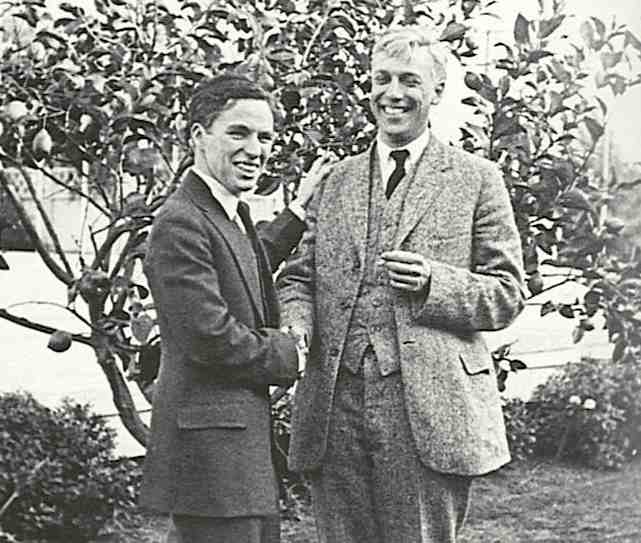
Charlie Chaplin and Max Eastman in Hollywood 1919. 
Book Review from the June 1927 issue of the Socialist Standard

A crimson-covered volume of some two hundred and odd pages has come to hand possessing the above ambitious title. The author, Max Eastman, poses as something of a psychologist of the analytical type, having apparently imbibed Freud in large doses. Thus fortified, he trains his critical guns upon what he regards as the tottering fabric of the Marxian philosophy, or as he terms it, “dialectic materialism” ; which procedure, he would have us believe, is animated by nothing more than a friendly desire to rid Marxism of a paralysing encumbrance, and to convert it, at last, into a real practical science.

The effect is somewhat bewildering, to say the least of it, and the present scribe, afflicted with a mere working-class education, candidly confesses his inability to make any practical head or tail of the involved argumentation in which Mr. Eastman indulges. In his first chapter on “The Function of Thinking,” he drills into the reader the idea that “Thought is purposive,” yet at the end of the book the said reader is left guessing as to just what purpose the author considers himself to have served.

There is not a single criticism of Marx that is new in the whole volume, and nothing is added, even by way of suggestion or example, to our knowledge of the social revolution. All that the author attempts is to shake the confidence of the Marxist in the reality and objective basis of his conclusions. Economic knowledge is derided and belittled, and a simple faith in our own desires and will is offered as a substitute. All this, of course, the author would have us lay at the door of psychology.

According to Mr. Eastman, Marx’s conception of history as a process based upon economic development, was merely a “rationalisation” of his desire for a revolution. We are asked to believe that in the “ideological” and “metaphysical” pages of “Capital,” Marx satisfied the mystic yearnings of his soul by philosophical communion with an “Economic God” of his own invention.

The present writer is not, of course, in a position to divulge what subtle “complex” dominates Mr. Eastman’s mind, but it appears to be one which leads him, for some obscure reason, into hostility against any form of abstract thought as applied to history and economics. He would throw overboard both metaphysics and dialectics and confine himself to the common-sense methods of practical investigation. Yet in the realm of biology he accepts Darwin and in psychology he accepts Freud.

He appears to be unable to see that both of these investigators are compelled to use the dialectical method whenever they generalise their conclusions, and leave for the nonce the realm of particular facts.

Darwin was forced to connect the evolution of organisms with changes in the earth’s crust. Are we therefore entitled to suggest that he was merely “rationalising” a subconscious hostility to the Book of Genesis? Marx, we are told, does not explain the practical variations in prices, etc., by his theory of value. Neither did Darwin attempt to explain the variations which occur in every succeeding generation. He looked for the law of survival and found it—horror of horrors, Mr. Eastman—in the material conditions of existence which alone could determine what were “favourable” variations, regardless of the will and desire of unfavourable ones.

In the sphere of psychological theory, Freud elaborates the conception of a conflict between the conscious and the unconscious mental processes. This he attributes to the existence of a censorship which represses the thoughts and feelings incompatible with civilised behaviour. Obviously, as Freud himself admits, this censorship is nothing but the reflection in the individual mind of the social conventions necessarily arising from a given stage of economic development. The professed object of psychoanalysts is to resolve the conflict, i.e., to bring the buried “wish” into harmony with reality, and what is this, Mr. Eastman, but the essence of dialectics?

It matters not to what realm of investigation we turn, the same law holds good, that a thing is and moves, and has its being only in relation to that which is not itself. So-called realists like our author may wriggle this way and that, but the only practical way of escape from the barren waste of metaphysics is the dialectical materialism which they affect to despise.

This is obvious whenever a scientist leaves his own realm and pronounces as with pontifical authority upon some subject of general interest of which his knowledge may easily be less than that of the average man. Men like Crookes and Lodge, for example, exhibit all the vices of the metaphysician when dealing with the subject of spiritism, while the number of Anti-Socialist professors has not been counted.

Marx’s “metaphysics” were attacked and the attacks answered by him in his own preface to “Capital” long before Mr. Eastman was heard of. Economic forces being social in character, cannot be dealt with in the same way as chemical compounds. Acids and microscopes are useless when we want to analyse a commodity.

Only the force of abstraction can help us. Abandon that force, and a science of economics becomes impossible, and we are left a prey to every Utopian fantasy liable to be misled by any will-o’-the-wisp “reform,” whether proposed by the professional politician or the crack-brained “rebel.”

Mr. Eastman endeavours to maintain that an idea cannot at one and the same time be a “reflex” of conditions, expressing some class interest, and also have objective validity. He holds that the Marxian “ideology” is thus no more scientific than the “ideologies” of the capitalist class, which it attempts to replace. In other words, Marx only saw what he wanted to see and described the result as “science !” This line of argument leads us to the conclusion that a truth ceases to be such if we want to make use of it. Thus, mechanics are no more scientific than magicians, since they simply express in their theories a “rationalised” form of their desire to control the universe.

For sheer puerility, some of the self-styled “psychologists” would be hard to beat, but as Engels has it, “The proof of the pudding lies in the eating, and human action had solved the problem long before human ingenuity had invented it.”

The soundness of Marx’s economic view is evidenced by facts which become daily more obvious, e.g., the concentration of capital and the intensification of exploitation, and of the consequent class-struggle. Mr. Eastman affects to regard these facts as immaterial to the main issue. “Look at Russia !” he exclaims. “Never mind about whether the triumph of the proletariat is inevitable ! Suffice that it is possible.” Yet in a very few pages further on he has to lament the appalling growth of bureaucracy in Russia !

Lenin, of course, comes in for eulogy in comparison with poor old Marx.

We have the “brilliant social revolutionary engineer” held up to admiration in comparison with the “foggy old metaphysician.”

The Bolshevik upheaval proved Marx wrong according to Mr. Eastman. Had it succeeded in its alleged object, we might agree with him, but all the evidence of its failure surely proves that Marx was right, and that social and political forms cannot be forced upon countries where the backward economic conditions make them premature.

Throughout the book the author negligently confuses historical materialism with “economic determinism,” and blind fatalism. He follows innumerable bourgeois “critics” of Marx in attributing contradictions to his thought which do not exist, and generally re-hashes all the stale metaphysical dualism in the guise of psychology. It is difficult, however, to believe that Professor Freud would recognise many of his “disciples” who appear anxious to show themselves off as “Jacks” in all and sundry branches of inquiry and “masters” of none.

As for dialectics, this method of reasoning will no doubt survive the attempts on the part of the “Communists” to drag it in as a support for their alternate criticism and support of Labour leaders; but this is a practical question of working-class politics here and now, which appears to be beneath the notice of such a “practical scientist” as Mr. Eastman.
Eric Boden

Blogger's Note:
The full title of Max Eastman's book was 'Marx and Lenin: The Science of Revolution'.

Sunday, October 13, 2019

A Chapter on Dialectical Materialism - Part 2 (1936)

Book Review from the March 1936 issue of the Socialist Standard


The Scientific Method of Thinking", by Edward Conze, Ph.D. 5/-. Chapman & Hall, Ltd., publishers.


"It is not the consciousness of men that determines their existence," says Marx, “but on the contrary, their social existence determines their consciousness." Of course Marx did not mean that human existence and consciousness are entirely unrelated phenomena, since consciousness is obviously a part of existence. The meaning intended is that as men are grouped together either in tribal or civic societies, so does their social means of getting a living give rise to a general outlook or common ideology. In other words, a causal relationship exists between man's ideas and his material conditions of living. We mention this to indicate that Marxism is not a philosophy which emphasises the influence of environment at the expense of all human action. The same thesis is stated by Marx in another, and perhaps more definite, form, when he says, “Man makes his own history, but he does not make it out of the whole cloth, he does not make it out of conditions chosen by himself, but out of such as he finds close at hand."

From which it follows that in the Marxian sense man is the active agent in historical happenings, even though the conditions in which human beings find themselves form some sort of guiding background to their activities. Marxism is not fatalism any more than it is “ idealism." To the fatalist the course of human history lies outside the pale of human effort—we are but puppets hovering and hobbling through life in accordance with some pre-determined force, ambiguously styled fate. To the idealist, history is the outcome of the machinations of men's “minds": we will things, so to speak, and lo and behold history is made for good or for bad. But both these forms of thought are incapable of explaining the varied and manifold phases assumed by human society at different times and places. In contradistinction to this, the Marxian concept may be given as an example of its own validity. It sees in the class structure of modern society the condition of its own birth and the means of its own fulfilment in the conscious social transformation of existing economic and political conditions—the active element in this process being the working class. But why this class alone, and not society as a whole, is a question which necessitates an understanding of a scientific method of thinking, such as we are now considering. It may, of course, be said that scientific method is essential, apart from the matter of working-class emancipation, to which we would readily assent. But there's the rub. Ours is a special task called forth by the peculiar nature of the problem to be analysed and solved. The composition of class society involves conflicting interests which produce rival interpretations of social phenomena. A capitalist defender of capitalism can hardly view working-class problems in the same way and with similar results as the workers.

The ever-pressing economic needs arising from social status are bound to influence and determine judgment. Old Ludwig Feuerbach stressed this fact from another angle of view when he declared that, "One thinks differently in a palace than in a hut." To remove the conditions of the hut is the need of the working class alone; the capitalists have no such need and can be relied upon to retain possession of the “palace” so long as the working class permit.

It is upon this point that the dialectic of Marx, if rightly interpreted, will serve as a method of our unravelling the complex nature of capitalist society, and as a means toward Socialism.

It should be clearly understood, however, that dialectical materialism in its widest sense embraces a terminology, the subject matter of which needs special study. We have such phrases as "The Unity of Opposites,” “The Negation of Negation,” and “The Transformation of Quantity into Quality,” all of which would necessitate lengthy explanations of their meaning. We suggest that the ablest account yet written is Engels’ classic “Anti-Duehring.” Here Engels presents us with examples of the actual working out of dialectical laws in nature, human history, and thought. In geology, chemistry, agriculture, mathematics and economics Engels gives an account of the way in which the dialectic operates, facts which impelled Engels to remark that “Men thought dialectically a long time before they knew what the dialectic really was, just as they spoke prose a long time before the term 'prose' was used.”

In the immediate sense it is on the subject of social development and change that the knowledge of the dialectic is needed. The principle works as follows : The capitalist system makes the productive forces social in the sense that giant means of wealth production are brought into being requiring the combined operation of masses of workers. The workers in consequence are rendered more and more a subject class. The wealth is socially produced, but individually appropriated. The capitalist class who own the wealth the workers have produced see to it that only such portion of the wealth is allowed the workers as will permit them to maintain themselves as a dependent class. This causes a number of other anomalies to arise. Apart from the effect of the workers being compelled to endure poverty amidst plenty, there is the fact of the capitalists’ failure to keep the productive forces continually operating. Further, they even stultify the otherwise expansion of the means of producing wealth, as their economic interests determine from time to time. The blows from all this fall heaviest upon the working class, which class is compelled sooner or later to seek a way out through taking over the means of living in their own interest by establishing Socialism. The forces making for Socialism are, therefore, historically and socially conditioned by capitalism, as in a somewhat similar manner capitalism was conditioned by the social forces, of feudalism. This historical process is described by Marx and Engels as “the negation of negation.” Capitalism is negated by its own internal contradictions, just as it had negated feudal society through like causes. In their statement of this; principle, both Marx and Engels used fairly clear-cut language to describe their point of view. We wish we could say the same of many who have set out to explain the meaning of dialectical, materialism in general. The great danger hovering around the subject of dialectics seems to be with, those who misuse it to justify every twist and turn of policy. We may be able to reconcile the irreconcilable as a form of thought, but our task chiefly consists of sifting the essential from the non- essential in our purpose. But let us now resume company with Dr. Conze. He postulates what he considers to be the four laws of scientific method; they are as follows:—

  1. "Think concretely, for everything is. concrete.”
  2. "Everything must be studied in its movement and development, for everything changes continually.”
  3. "Wherever we may find opposites we must look for their unity. Opposites are always in unity.”
  4. "We must seek the contradictions in the processes of nature and society, for everything is put into motion by contradictions.”
Regarding the latter, he rightly warns us to distinguish between contradictions of the mind and those of objective reality. Contradictions of the mind may "put” us into awkward "motion” —into the safe custody of a lunatic asylum. In discussing why dialectical materialism is so little understood, Dr. Conze seems to think the Russian Bolsheviks to be among the chief causes. He says that "in casting out religion the Bolsheviks have elevated the fundamentals of Marxism, to the level of a substitute religion,” and further complains that the study of philosophical works is discouraged in Russia "on the ground that since Marxism is the philosophy of the proletariat, all other philosophies are bourgeois (which is partly true) and, therefore, deadly mental poison (which is ridiculous).” But be this as it may, we suggest that the main reason for the non-understanding of Marxism rests upon the fact of the pre-occupation on the part of the workers with the many phases of capitalist thought. On the subject of mind and economics in society, Dr. Conze easily dismisses those "social psychologists” who are all mind and no economics, their failure to recognise the interaction of ideas and economic conditions being well noted. In the case of mass psychology, these people are always apt to regard the “crowd” as "incapable both of reflection and reasoning.” But' Dr. Conze falls into error when he attempts the same charge against Socialists. He asserts that “Socialists are also inclined to despise the masses when they see them desert to the enemy; they suddenly assume that demagogues can swing the masses round and so deprive them of their critical faculties that they will support their own enemies." But Socialists really know better than this. The workers swing from one political position to another because their minds are mainly on the capitalist roundabout. They have not yet realised that capitalism is their real enemy and the way to end it.

Regarding “Great men and history," Dr. Conze contrasts two conflicting lines of thought— one which, à la Thomas Carlyle, regards history mainly as a “biography of great men," the other which denies the influence of great men totally, and counts the masses as everything.

In reply to this, Plekanov is well cited as saying that “If history is made by human beings, it must obviously be made by 'great men' among the rest.” To this, but under proper qualification, all Socialists will agree. Against those who concentrate on the destructive side of Socialist activity, whoever they may be, Dr. Conze thinks with Blanqui that these people are “invaluable before a revolution, but should be shot the day after its victory."

However, in general, we think the author of “The Scientific Method of Thinking" has done well in bringing this volume to life despite the many things we could continue to discuss in disagreement. In the main, we agree with his statement of the dialectical standpoint, and commend his book to students, but in so doing we should like to refer those who are about to take their first plunges into materialist thought to one more statement of Marx. In his celebrated thesis on Feuerbach Marx says: “The life of society is essentially practical. All the mysteries which seduce speculative thought into mysticism find their solution in human practice and in concepts of this practice."
Robert Reynolds

(Concluded)

Thursday, September 26, 2019

Marx and Materialism (2012)

From the July 2012 issue of the Socialist Standard

If Marx had a philosophy it could be best described in his own words as critical materialism as opposed to mechanistic materialism. He believed with Feuerbach that critical materialism would mean the end of metaphysics and religion. Again, Marx regarded materialism as the only valid expression of scientific method. Thus, in a footnote on Page 368, Vol. I of Capital, he refers to a particular method as the only materialistic and, therefore, the only scientific method.

Marx took the world that is man and his relations with nature as they are. Marx then embraced a thoroughgoing naturalism as opposed to the super-naturalism of Hegel and other religious thinkers. He believed that facts are not more real than they are found to be, and do not express some deeper underlying truth. It was because Marx collected his facts and organised the knowledge gained from them on the presupposition that he was dealing with a material world, that his theory can be empirically demonstrated. Because Hegel began with metaphysical as opposed to materialistic assumptions he could offer no empirical guide as to the course of history. He could only assure us that a cosmic self-consciousness would come to pass, but how it would do so he is silent. Even in a brief and sketchy analysis of Marx and Hegel, it can be shown that in outlook and method they were worlds apart.

On the question of religion itself, Marx denied that there was some religious essence in man. Religion itself is a product of social life and it only arises when society has reached a certain stage of development in the division of labour. Like all other forms of culture, it can be critically analysed in a specific social situation, and like all other forms of activity it can be shown to change under the impact of changing conditions. While religion had historic justification in the productive rituals of the past, it serves no useful social purpose today.

Marx also denied that man was endowed with a natural religious sentiment, any more than he is naturally endowed with any other aspect of culture. A religious sense is not the outcome of a timeless abstraction, but the product of social consciousness and bound up with a certain stage of social development. To suppose then that any element of supernaturalism could find a place in Marxism is to invalidate the most basic assumptions of historical materialism. For that reason a belief in super-naturalism is incompatible with Marxism.

From the Socialist Standard, July 1957

Thursday, September 5, 2019

Marxism — The Philosophy of Action (1936)

Book Review from the June 1936 issue of the Socialist Standard

Dialectics, The Logic of Marxism,” by T. A. Jackson (Lawrence & Wishart) 10/6

Marx in his early days was a profound student of philosophy, and proclaimed himself a follower of “that mighty thinker" Hegel, whose system of philosophy had as its central principle the dialectal conception of the universe. This conception is that everything, including human thought, reveals itself as in a process of being and becoming. But, to cut a long story short, how the being and becoming was effected in human thought and social relationships was a question upon which Marx took leave of Hegel, turning the latter's “dialectic right side up.” Where Hegel thought the motion of all things to work through the unfolding of an “Idea,” being and becoming from God-knows-where, Marx saw the movements of human society to arise from the action and interaction of man and external nature. There is, therefore, no “Idea” in the Hegelian sense, there are only ideas, and common, human ones at that. Marx applied the criterion of practice to philosophical speculation —“the question whether objective truth can be attributed to (attained by) human thinking is not a question of theory, but a practical question. In practice, man must prove the truth, i.e., the reality and power, the 'this sidedness' of his thinking. The dispute over the reality or non-reality of thinking which is isolated from practice is a purely scholastic question.” (Marx.)

Reducing this to common phraseology, it means: “The proof of the pudding is in the eating.”

Now we of the Socialist Party of Great Britain have always insisted that the teachings of Marx and Engels provide an indispensable foundation for working-class Socialist activity. The theories of Marx have been stated and re-stated by us almost ad nauseam, as well as ad infinitum. We have battled for the recognition of Marxism amidst abuse and misrepresentation, not to mention the boycott of silence concerning our existence maintained by the pseudo-Socialist, Communist “revolutionist,” and everything “elsist” Press. But as Marx so aptly observed: “Time is the room of human development.” The theories for which we have worked are now being studied and discussed with increasing vitality.

The causes leading to this need not detain us here to discuss. Suffice it to mention that it is a remarkable tribute to Marx and Engels that their theories are interpreted in the light of, not only the age in which they were written, but more forcibly in connection with the happenings of to-day. The volume before us is a “weighty” addition to the various works on Marxism which have appeared in the last few years. In this case it is by one who claims to be an "out and out Marxist,” who tells us his work is “an attempt to clear the ground for a better and fuller appreciation of that which gives Marxism its living unity, namely, the Dialectal Materialist Method.” But for whose benefit, may we enquire, is this attempt made to unravel the method of Marx?

The worker-student who comes fresh into the field of Marxian thought will find in this volume a veritable maze of terminology to drive him into bewilderment. In about 650 pages there are literally hundreds of quotations from the flower of the world's intellects. Besides this there are innumerable phrases appearing in inverted commas and brackets, whilst the exclamation marks are as pronounced as tombstones in a graveyard. From this aspect alone any would-be student might easily be persuaded to adopt the advice which Mr. Jackson cites from Heine: "If you who read become tired of the stupid stuff herein, just think what a dreary time I must have had in writing it. I would recommend you, on the whole, once in a while to skip half a dozen leaves, for in that way you will arrive much sooner at the end.”

Of course all this is what Mr, Jackson would call "swank.” He wants people to read his book and for that reason alone should have concentrated upon making it "readable.” Obviously, if Marxism is to become a weapon in the struggle for working-class emancipation, it should be stated in a way that is within the grasp of those who have need of it. But one easily gathers from this book that Mr. Jackson has been little animated by the need of the enlightenment of "untutored workers.” Rather does he seem to have contrived his effort in the spirit of the ever so clever boy who is ever so eager "to tell the class all about it.”

His habitual use of long-winded, involved and even flashy statements, together with his readiness to knock lumps (spots seem not to be big enough) off all and sundry, will hamper any student who may mistake this book for an easy guide to Marxism.

Much of what Mr. Jackson has written here is comprehensible only to those who have had the opportunity of years and years of study, and into the bargain have been free from necessity of earning their daily bread under capitalist supervision in the workshop.

We cannot hesitate to offer the following example from among many which could be given of what we have said above. Mr. Jackson is explaining Hegel's phrase “Negation of negation,” and this is what we get : "The Hegelian method was 'pelmanised' for its followers in the 'sacramental formula' (as Marx called it): 'Negation of negation.' Both Marx and Engels used the phrase—it was an instance of their ‘coquetting with Hegelian terminology'—with telling effect. Since the phrase is a scandal and abomination to all bourgeoisdom to this day, and is made a chief count in the indictment against Marx by several of his recent critics, we may profitably give it a little attention.
  "Terrifying though this phrase may sound, mystifying to the last degree as it becomes in the hands of an idealist, this formula is none the less capable of a simple and, what is more, an illuminating explanation. Light begins to break through the mystery as soon as it is seen (a) that it summarises the conclusion of a logical operation; (b) that it is preceded by a process whose formula is in turn that of Spinoza, ‘All determination is Negation.'
  "What does this phrase mean? What it says: that all distinguishing of things in thought is a de-term-ination, a setting of limits to that which, the thing is. Or, otherwise stated, all distinguishing of things is an act of mentally separating a thing from that which it is not. Thus all 'determination,' which is particularisation, consists in 'negating’ or breaking up an undifferentiated generalisation. Furthermore, the process of discriminating one particular thing from a general mass is simultaneously a process of distinguishing the counter-particularity of that from which it is distinguished. Hence (and it is here that Hegel’s real contribution begins, all the foregoing being common to him and his predecessors)—hence a full comprehension of the thing involves comprehending it simultaneously in two opposite ways, namely, as distinct from and, at the same time, as one with that from which it is distinguished. Hence all logic consists in the performance with due circumspection of this operation of negating unity by resolving it into multiplicity (analysis) and re-creating it by distinguishing the unity persisting in the multiplicity (synthesis)."
One may gather from this why it was suggested that the study of philosophy is like looking in a dark room for a black cat that isn't there. The writings of Marx and Engels are in every way as clear as crystal compared with the above abracadabra.

However, having had our say so far, let us take Mr. Jackson as he is, as Cromwell preferred it, "Warts and all.” In tracing the rise and development of Marxism he well takes as his starting point an examination of Marx's theses on the philosophy of Feuerbach, which we have reproduced from time to time in these columns. All students of Marx should avail themselves of a study of these theses, since they indicate and illuminate the passage through which Marx passed from Hegelianism on to the philosophy of Feuerbach and thence to Marx. Mr. Jackson illuminates the fundamental distinctions between the older materialism of Hobbes and Locke, etc., the idealisms of Berkeley and Kant, which culminated in Hegel, and the materialism of the Marxian school of thought. If we allow for the drawbacks referred to previously, Mr. Jackson does this part of his work exceedingly well, and particularly so where he deals with the “ Objective Roots of Religion." Marx laid it down that “the criticism of religion is the beginning of all criticism," but as Mr. Jackson ably points out, although the “beginning,” it was by no means the end. In turn the criticism of religion involves a criticism of the legal-political-moral superstructure of human society as this arises from society’s economic foundations. Many passages from the writings of Marx and Engels are given in support of this thesis. But even here, Mr. Jackson cannot restrain his kink for “scalping,” and thus mars an otherwise excellent chapter by a piece of deliberate distortion. He quotes from Casey’s booklet, “Method in Thinking," the following: 
  “If we separate from men and things all thoughts of goodness, power, intelligence, perfection, life and such like, and add them together to form one thought of complete superiority in all matters, this thought is God. When we realise that thought is real and just as objective as anything else we have here!! the explanation!!! of why God is a real and very powerful influence!!! . . . If understanding were more general we should not have the silly quarrel between theists who take God on faith and the atheists who deny God also on faith!!! and agnostics who say they do not know one way or the other. . . .
   “The idea of God is built up just like any other idea, and therefore we can understand God! ! ! and consequently we are able to explain Him. . . . ”
The italics and exclamation marks are all Mr. Jackson’s, who describes Casey’s statement as an attitude of “facing-both-ways-at-once.” But Casey’s meaning is obvious, whatever one may think of his method of presentation. He does not mean what Mr. Jackson would have us believe, as the statement which follows on from where Mr. Jackson left him “ high and dry,” shows.

Says Casey: 
  "If after that any man wants to worship such a God it will be his own fault. Merely to deny God gets us no further, but to explain him is the best way, so far as serious argument is concerned, of clearing up all the nonsense associated with Him. We say nonsense, but it is not nonsense to those who trade on the faith in God, and in the name of God force their authority on their fellow-men, sometimes in sincere belief and sometimes with the utmost hypocrisy.” 
We cannot think that Jackson is unaware of the fact that Casey is dealing with "God” as a concept, and not as an objective reality, independently existing outside the human mind. We suggest Mr. Jackson should hesitate next time he thinks of the "facing-both-ways” charge. When Mr. Jackson was speaking recently at a Church Hall at Hornsey on the subject of ” Communism and Christianity,” he stated that “it was surely criminal to emphasise the disagreements of Communists and Christians when people all over the world clamoured for goodwill.” "The common enemy is Fascism.” (Hornsey Journal, February 21st, 1936.) Is this not facing-both-ways, or is it a variation of Low’s two-headed ass?

However, when dealing with "The Dialectic of Revolution,” Mr. Jackson exposes himself as being no more than an idolator of the Russian Bolshevik regime. He likewise exposes the fact that the mere possession of the dialectal concept is no guarantee that the correct standpoint is taken by the dialectarian. Whatever the Bolsheviks have done, or are doing, or are likely to do in the future, Mr. Jackson perceives in their activity the working out of the Dialectal Materialism of Marx. But he flattens himself out in the task of substantiation. He says, “That which was victorious in Russia in November, 1917, was neither a local nor a national force—but the revolutionary force of the world proletariat, which broke through the bourgeois defences just exactly at that point, because in that section the defences of the world-bourgeoisie were weakest.” (Page 397.)

The revolutionary force of the world proletariat! As Jackson must realise, unless he, like most "Communists,” sees the revolution everywhere, here and now in 1936 the revolutionary force of the world’s working-class is practically negligible. How much more so was it in 1917? Those who bitterly remember the wartime days will recall the almost complete absence of any serious sign of activity to stop the war, let alone commence the social revolution. In Russia alone was there any serious indication to call a halt to the slaughter, and mixed up in that movement to end the war were the Bolsheviks. The “Revolution” came, the Bolsheviks came, but no Socialism. Not even the intense longing and hoping of Lenin for the revolt of the world’s proletariat had any effect. The forces making for “Socialism” were actually subdued in Russia, firstly by the economic backwardness of that country and next by the capture of power by the very people who had been screaming "Socialism.” The Bolshevik Government from its inception, and in order to maintain its dictatorship throughout, had to toe the line to capitalism. Stalin in one of his recent utterances flatly repudiated the notion of the Bolshevik interest in world revolution after 19 years of his party’s rule.

The essential moves for Socialist revolution, which is totally different from a mere uprising to end a war, or dethrone a government, or what not, will take place when the workers understand and desire Socialism. And this Mr. Jackson evidently realises. He contends against the notion that it was Marx’s theory that the idea of Socialism would arise “automatically in the heads of each and every individual proletarian," and says further that "for the idea to arise in the first place, and to become general in the second place, an objective social reality must exist from which the idea has arisen. There must exist, and be felt to exist, a social problem for which a solution must be found—and it is under the promptings of the urgency of the problem as well as their cogency and applicability to the needs viewed in the light of practical everyday reality, that ideas spread and develop into 'forms of public opinion.' " Exactly, Mr. Jackson; but no such form of public opinion existed to any serious degree in the vast expanse of Russia in 1917 with Socialism as its objective. There are many other points made by Mr. Jackson about Russia, which we have refuted over and over again.

In concluding this review we repeat that, with those who are immersed in dialectics, and mistake the Marxian Dialectic for a sort of logic-chopping apparatus for the “use of smart men only," there lies a source of danger to Socialist activity. The concepts of the unity of theory and practice and the unity of opposites might pass muster anywhere and in anything, but to square with the realisation of Socialism it will not do to take one step forward in Socialist theory and two steps backward, not to mention a whole flight, into capitalist practice as Lenin and the Bolsheviks have done. There are numerous other points we should like to have dealt with arising from this provocative, entertaining, polemical, philosophical, historical and generally sociological essay, but we must drop our pen for the present. To all students of Marx we suggest that they sample this.work, but only after they have first studied Marx and Engels.
Robert Reynolds

P.S.—As I concluded this article, the news was broadcast that Russia desires a naval pact with Great Britain. The dialectic scores again.

Monday, April 15, 2019

Joseph Dietzgen - The Workers Philosopher (1975)

Josef Dietzgen (1828 – 1888)
From the Spring 1975 issue of Radical Philosophy magazine

"April the 15th 1888 Joseph Dietzgen died . In memory,  I post this article written by Adam Buick for the journal Radical Philosophy 10. Spring 1975 ." (Via Mailstrom blog.)

Josef Dietzgen is indeed a neglected philosopher. How many people know that he was the man Marx introduced to the 1872 Congress of the First International as ‘our philosopher’? Or that it was Dietzgen, not Plekhanov, who first coined the phrase ‘dialectical materialism’? Or that for the first thirty or so years of this century Dietzgen’s Philosophical Essays were to he found on the bookshelves of any working class militant with Marxist pretensions?

Who, then, was Dietzgen? What were his views? And, indeed, why has he been neglected?

Joseph Dietzgen was born in December 1828 near Cologne. His father was a master tanner and it was in this trade that Dietzgen was trained and worked. He was neither a capitalist nor a propertyless worker but an artisan owning and working his own instruments of production. What distinguished him from other pioneer scientific socialists like Marx and Engels was that he never went to university; he was a self-educated man. Dietzgen was involved in the 1848 rising and after its failure left for America returning, however, after a couple of years. He spent another two years in America after 1859 and went there again in 1884, never to return. He died in 1888 and is buried in Chicago.

Dietzgen was not just interested in philosophy, though this was his main interest. He was also a writer on economic and political matters for the German Social Democratic press, especially in the l870s. Marx commented favourably on Dietzgen’s review of Capital in his Afterward to the Second German Edition.1 The two men were personal acquaintances.

Dietzgen wrote in German, but a number of his writings, including the most important, were translated into English in the early years of this century and published as two books 2 by the Charles H. Kerr Co. of Chicago. The book bearing the title The Positive Outcome of Philosophy contains not only this, his last work originally published in 1887, but also his first work, The Nature of Human Brainwork (1869), and also his Letters on Logic. The other book, Philosophical Essays, contains translations of some of the propagandist articles Dietzgen wrote in the 1970s and also his pamphlet Excursions of a Socialist into the Domain of Epistemology. This pamphlet, especially Chapter 3, ‘Materialism versus Materialism’, is perhaps the best outline of Dietzgen’s views in his own words. For, frankly, Dietzgen’s works are not easy to read, partly because of the subject matter, but partly also because Dietzgen tended to express himself somewhat philosophically and to needlessly repeat himself.

In his introduction, written in 1902, to the English edition of The Positive Outcome of Philosophy, the Dutch Marxist, Anton Pannekoek, described Dietzgen’s philosophical writings as ‘an important and indispensable auxiliary for the understanding of the fundamental works of Marx and Engels.’3 Ernst Untermann, another German Social Democrat who had emigrated to America, expressed a similar view: ‘Dietzgen rounded out the work of Marx and Engels by a consistent monist conception of the universe' 4 Are these opinions justified? In this writer's opinion, yes. Marx’s historical materialism is a materialist theory of history and society; it is not, and was not meant to be, a materialist philosophy. Of course, being an atheist, Marx must have had a materialist conception of the universe but he never wrote much about it. Nor was there any reason why he should have. His specialities were history, sociology and economics, not philosophy or epistemology. Engels made an attempt to back up the materialist conception of history with a materialist philosophy but, in many respects failed to do this satisfactorily. It was Dietzgen who succeeded and in this sense can justly be said to have filled a 'gap' in socialist theory.

Dialectical Materialism

Dietzgen was a thoroughgoing empiricist and materialist. For him all knowledge was derived from sense-perception and what human beings perceived had a real existence independent of their perception of it.

The Nature of Human Brainwork (1869) presents an empiricist theory of knowledge derived from a rejection of Kantian dualism. Kant had claimed that Reason (=science, knowledge) could only deal with the world of experience, but the world of experience, according to him, was only a world of appearances or, to use a word derived from Greek meaning the same, a world of ‘phenomena’. Thus science could never come to understand the world as it really was, the world of what Kant called ‘things-in-themselves’ of which he supposed the world of phenomena to be but appearances. For Kant. there were two worlds: a world of phenomena, which was all the human mind could come to understand, and a world of things-in-themselves beyond human experience and understanding.

For Dietzgen, to posit the existence of a second world beyond the world of experience was simply metaphysical nonsense. ‘Phenomena or appearances appear - voilà tout.’5 The world of phenomena was the only world; phenomena were themselves real, the substance of the real world. Phenomena, however, says Dietzgen, do not exist as independent entities; they exist only as parts or the entire single world of phenomena. The world of reality is a single entity embracing all observable phenomena, past, present and future. Reality is thus infinite, having no beginning nor end. It is constantly changing. The universe and all things in it consist of transformations of matter, which take place simultaneously and consecutively in space and time.

The universe is in every place and at any time itself new or present for the first time. It arises and passes away, passes and arises under our very hands. Nothing remains the same, only the infinite change is constant, and even the change varies. Every part of time and space brings new changes.6

The world of reality is a never-ending, everchanging stream of observable phenomena, and it exists only as a whole. That Reality, Existence, the Universe, Nature – call it what you will (and Dietzgen called it many things drawn from philosophy, e.g., the Absolute, the Good, Truth, even God) – is a united whole a single unit, is the basis of Dietzgen’s theories and is endlessly repeated in the Letters on Logic, written over the period 1880-3 to Eugene, one of his sons.

As can be seen, this conception of the universe is both materialist (since it posits the existence of a world of reality independent of men’s perception of it) and dialectical (since it sees the world of reality as a changing, differentiated unity). It was for this reason that Dietzgen called his philosophy ‘dialectical materialism’, a phrase he first used in his 1870s articles in the German Social Democratic press.7 This was some years before Plekhanov, who is generally said to have originated this phrase (which is not to be found in the writings of Marx or Engels), even claimed to be a Marxist. Plekhanov, it should be noted, meant something rather different by it than did Dietzgen; he was the father of the undialectical state philosophy of present-day Russia which also, unfortunately, goes under the name of ‘dialectical materialism’ and with which Dietzgen’s quite different theories are not to be confused.

What is Knowledge?

The human mind The human mind is not the metaphysical mystery that idealist philosophers try to make it. As something that can be observed and studied, it too is part the world of phenomena. Once this is recognised, as Dietzgen insists it should be, then it is possible to give a materialist explanation of the nature of thinking. Dietzgen’s philosophy is in fact essentially such a materialist epistemology. Human brainwork consists, says Dietzgen, in generalising from experience, in constructing abstract general concepts on the basis of perceptions supplied by the senses. The senses perceive a continuous stream of different phenomena; the role of the mind is to make sense of this stream by distinguishing and naming parts of it. The mind, as the organ of human understanding, understands the world by classifying it:

Knowledge, thinking, understanding, explaining, has not, and cannot have, any other function than that of describing the processes of experience by (division or classification.8

Phenomena are classified by the mind into different categories on the basis of common characteristics. But the categories, or concepts, are abstractions from reality, mental constructs. A table, for instance, does not have a separate, independent existence; it is the name given by the human mind to a certain group of recurring phenomena perceived by the senses. A table (and indeed all other things) is an abstraction, a mental construct. In reality all things are interdependent Darts of the whole which is the entire world of phenomena:

The world is not made up of fixed classes, but is a fluid unity, the Absolute incarnate, which develops eternally, and is only classified by the human mind for purposes of forming intelligent conceptions.9

This dialectical view contrasts with the everyday – and undialectical – view that the world consists of a collection of separate, fixed objects. Dietzgen does not challenge the usefulness of this latter view. On the contrary, he recognises that men must form such a view of the world if they are to orient themselves and survive in it. It is this ability to generalise, to, as it were, stop this continuous stream of phenomena (so that parts of it can become subjects for abstract thought), that distinguishes men from other animals and has enables them to intervene in and control the external world. But, says Dietzgen, we ought to know that stopping the stream of phenomena and classifying it into separate, fixed objects is only a mental operation, however vital to the survival of the human species:

The logical household use of rigid conceptions extends, and should and must extend, to all science. The consideration of things as ‘the same’, is indispensable, and yet it is very salutary to know and remember that the things are not only the same and congealed, but at the same time variable and fluid.10

To state that things are mental constructs can give rise to the misunderstanding that you are saying that they are only mental constructs and that you are therefore an idealist who sees the external world as the creation of the mind. Rut Dietzgen was not saying that things were simply mental constructs: things were mental constructs out of the real world of phenomena as perceived by the senses; things were abstractions, yes, but abstractions from an objectively-existing external reality. Although a thing as such, as a separate independent object, did not exist, there was certainly something in the real world of phenomena which corresponded to it that existed. The mind was not so much constructing the external world as reconstructing an image of it.

Science altogether does not want and cannot want to accomplish more than the classification of perceptible things according to species and varieties; its entire desire and ability is confined to the mental reconstruction of the different parts of a differential unity. [emphasis added] It is the substantial force of the Universe, in which they participate, which has brought about the things that are, and all that the human mind can do is to form a picture of its gradual, consistent and rational working.11

These passages make it quite clear that for Dietzgen the external world existed independently of the human mind. Unfortunately, as we shall see, this did not prevent him from being misunderstood on this point.

A further aspect of Dietzgen’s dialectical materialism is that knowledge can never be absolute or complete, all knowledge is relative; our classification or description of the world must always be regarded as a tentative approximation liable to revision in the light of further experience. Dietzgen’s last work, The Positive Outcome of Philosophy (1887), ends with the following rule for scientific investigation which remains valid to this day:

Thou shalt sharply divide and subdivide and farther subdivide to the utmost, the universal concept, the concept of the universe, but thou shalt be backed up by the consciousness that this mental classification is a formality, by which man seeks to register and Systematize his experience; thou shalt furthermore remain conscious of thy human liberty to progressively clarify thy experience, which is constantly enriched in the course of time, through modified classification.12

Mind and Matter

Dietzgen, as we saw, called himself a materialist. There are however various kinds of materialism and Dietzgen was careful to differentiate his dialectical materialism from what he called ‘onesided,’ ‘narrow’ and ‘mechanical’ materialism. This was the view (indeed the traditional materialist view going back to the philosophers of Ancient Greece) that the world is composed of tiny particles of tangible ‘matter’ and that the mind and thinking are simply the effects of the movement of these atoms. Writes Dietzgen:

The distinguishing mark between the mechanical materialists of the 18th century and the Social-Democratic materialists trained in German idealism consists in that that the latter have extended the former’s narrow conception of matter as consisting exclusively of the Tangible to all phenomena that occur in the world.13

Every phenomenon, everything that occurs, exists, as part of the entire world of phenomena. Since non-tangible phenomena, e.g. ideas, thoughts etc., also occur, they are just as real or, if you like, just as ‘material’ as tangible phenomena:

In the endless Universe matter in the sense of old and antiquated materialists, that is, of tangible matter, does not possess the slightest preferential right to be more substantial, i.e. more immediate, more distinct and more certain than any other phenomena of nature.14

Dietzgen had no objection to the classification of the world of phenomena into two general categories, one consisting of tangible phenomena and called ‘matter’ and the other consisting of mental phenomena and called ‘mind.’ He had no objection either to explanations of mental phenomena in terms of tangible phenomena. What he was concerned to point out was that, in this sense, both ‘mind’ and ‘matter’ were abstractions, even if very general ones, from the real world of phenomena. The rigid distinction between ‘mind’ and ‘matter’ was a mental distinction that did not exist in the world of phenomena which, despite this mental operation, remained an undivided whole:

The mind is a collective name for the mental phenomena, as matter is a collective name for the material phenomena, and the two together figure under the idea and name of the phenomena of Nature.15

This was the basis of Dietzgen’s statement, which, as we shall see, so upset Lenin, that ‘our materialism is distinguished by its special knowledge of the common nature of mind and matter’.16 By this he simply meant that both mind and matter were parts of the world of observable phenomena.

Those Dietzgen called the ‘narrow’ materialists made the mistake of not thinking dialectically, that is, of not realising that the parts of the world of phenomena do not exist independently but only as interconnected parts of that world. In taking one part of the world of phenomena and making it the basis of all the other parts, they were falsely ascribing a real, independent existence to what was in fact only an abstraction:

This materialism is so enamoured of mechanics, that it, as it were, idolizes it, does not regard it as part of the world, but as the sole substance of which the universe is made up.17

This was the same mistake as regarding the objects of everyday use as having an independent, separate existence. ‘Matter’ just as much as ‘table’ was a mental abstraction from the real world of phenomena; in reality tangible phenomena do not exist separately from other phenomena, they exist only as an integral part of the entire single world of all phenomena.

It is worth emphasising again that this equal epistemological status of tangible and mental phenomena does not at all rule out scientific explanations of mental phenomena in terms of tangible phenomena, e.g., in terms of the physiological functioning of the brain and nervous system, or indeed of the explanation of all phenomena in terms of the movement of atoms. The fact that ‘matter’ and ‘atoms’ were metal abstractions from the world of phenomena did not in the least detract from their possible usefulness as concepts for understanding the world. As Dietzgen said of atoms:

Atoms are groups. As smallest parts they exist only in our thoughts and thus give excellent service in chemistry. The consciousness that they are not plastic but only mental things, does not detract from their usefulness, but heightens it still more.18

To understand the world was to divide it into necessarily abstract concepts. It was not Dietzgen’s aim to decide which was the best way to classify, describe and explain the world but to show what we were doing when we did do this. To ascribe reality to any of these mental constructs, even so general a one as (tangible) matter was a confusion, was to think undialectically; the only thing that had a separate, independent existence was the entire world of phenomena itself. Dietzgen’s criticism of one-sided, narrow materialism was a criticism of its confusion on this point, and not at all a criticism of the basic principles of materialism.

Dietzgen was essentially a philosopher of science. We would not want to claim that he always expressed himself clearly or adequately (his ontological proof of the universe and his virtual pantheism will make some readers wince – or smile), but despite his shortcomings he must be given the credit for first formulating a theory of the nature of science – as basically a description of the world for purposes of prediction and control – which is now largely accepted even if it does not call itself ‘dialectical materialism’ or indeed refer to itself as ‘materialist’ at all (mainly for fear of confusion with the narrow, one-sided materialism of the past – and present-day Russia).

Dietzgen’s works, besides being difficult to obtain, make difficult reading. However, his best interpreter, the Dutch Marxist Anton Pannekoek, expressed himself very clearly. Pannekoek was himself a scientist, a professor of astronomy of world renown in fact, and wrote not only the introduction to the Kerr editions of The Positive Outcome of Philosophy but also, later, two short brilliant books applying Dietzgen’s dialectical materialism: Lenin as Philosopher (1938)19 and Anthropogenesis (1944). Unfortunately these are just as difficult to obtain as the works of Dietzgen himself.

Lenin versus Dietzgen

At about the same time as Dietzgen was writing, two other German-speakers, Ernst Mach in Austria and Richard Avenarius in Switzerland, were working out a theory of science which was in a number of ways similar to Dietzgen’s. One of Avenarius’ followers called this theory ‘empirio-criticism.’ We can’t go into this theory here except to say that it too saw knowledge as essentially the classification of experience. However, while Dietzgen never doubted the independent existence of the world of phenomena or experience, empirio-criticism was ambiguous on this point. It wished to construct the world from ‘experience’ (sense-data, etc.) but since experience is the experience of human beings it came very near to saying, and some of its exponents did say, that the human mind (or minds) was as vital to the existence of the external world as external phenomena themselves.

Empirio-criticism, partly because of its similarity with Dietzgen’s dialectical materialism, enjoyed a certain vogue in Social Democratic circles in the early years of the twentieth century. A number of Social Democrats, including Dietzgen’s son Eugene, misinterpreted Dietzgen in an empirio-criticist direction. Included in the Kerr edition of Dietzgen’s Philosophical Essays is an essay on Max Stirner by Eugene wherein we read that ‘whatever does not partake of the psychophysical nature of the universe, cannot exist for us’ and that ‘phenomena outside of us . . . exist independently of individual man, although they cannot exist for mankind independently of human consciousness.20

Eugene Dietzgen would seem to be suggesting here that the external world is not an objective world but only an inter-subjective world, i.e., a sort of collective creation of all human minds which would not exist in their absence. Similar views were expounded also by a number of members of the Russian Bolshevik Party. Lenin was scandalised by this departure from materialism (as indeed it was) and set out to refute this deviation once and for all. In 1908 was published Plekhanov’s Fundamental Problems of Marxism and in 1909 Lenin’s Materialism and Empirio-Criticism. Both contain a denial of the view we quoted earlier that Dietzgen had added something to the work of Marx and Engels. We won’t deal with Plekhanov’s criticism here except to say that he preferred Feuerbach’s materialism to Dietzgen’s dialectical materialism (though he retained the phrase ‘dialectical materialism’).

Lenin devotes a section of Materialism and Empirio-Criticism to Dietzgen entitled ‘How could J. Dietzgen Have Found Favour with the Reactionary Philosophers?’ in which he criticises in particular Dietzgen’s view that the real, or material, world includes the intangible (thoughts, etc.) as well as the tangible:

To say that thought is material is to make a false step, a step towards confusing materialism and idealism.
That the conception of ‘matter’ must also include thoughts, as Dietzgen repeats in the Excursions, is a muddle, for if such an inclusion is made, the epistemological contrast between mind and matter, idealism and materialism, a contrast upon which Dietzgen himself insists, loses all meaning.21

Lenin regards this as a ‘deviation’ by Dietzgen from materialism, without seeming to realise that this view is the basis of Dietzgen’s whole materialist epistemology. It is not a question of Dietzgen expressing himself badly but of there being a fundamental difference between Dietzgen’s materialism and Lenin’s. Lenin was clearly one of those Dietzgen described as a narrow, one-sided, mechanical materialist.

Lenin’s claim about the epistemological contrast between idealism and materialism being blurred if thoughts are regarded as part of the world of phenomena (= the material world) is not true. As we have seen, Dietzgen was quite able to make this the basis of his epistemology and to remain a thoroughgoing materialist who never for one moment doubted the objective existence of the external world. Lenin was quite right, on the other hand, to attack people like Eugene Dietzgen who only gave the external world an inter-subjective existence. This was indeed a departure from materialism in the direction of idealism, but Lenin’s criticism of it was made from the point of view of what Pannekoek in his Lenin as Philosopher called ‘bourgeois materialism’ not that of dialectical materialism.

Pannekoek, in this work (which is a reply to Lenin following the publication of German, English and French translations in 1927 and 1928), attempted to give an explanation of why the Russian Bolshevik Party should have adopted ‘bourgeois materialism’ as its theory. By ‘bourgeois’ materialism Pannekoek meant a materialism which seeks to explain everything in terms of physics and chemistry. When the bourgeoisie had to fight to achieve and retain power, said Pannekoek, they believed in the power of the physical sciences to change the world, practically by developing modern industry, and theoretically by exposing the religious views of their class opponents as superstitious nonsense. That Lenin and the Bolsheviks 22 should have adopted a similar ideology to that of the rising bourgeoisie of Western Europe at an earlier period was to be explained, said Pannekoek, by the essentially similar task that confronted them: to carry out the equivalent of a bourgeois revolution in Russia which would sweep away the obstacles, institutional and ideological, to the development of modern industry there. Pannekoek saw Leninism as the ideology of a new ruling class whose historical task was to industrialise Russia on the basis of state capitalism, with militant physical-science materialism as its ideology. This materialism, though falsely called ‘dialectical,’ is still the dominant ideology in Russia today.

Dietzgen Today

Whatever the explanation as to why Lenin rejected Dietzgen’s dialectical materialism, the fact that he did contributed in large measure to Dietzgen becoming a neglected philosopher.23 Dietzgen’s ideas had been introduced into Britain before the first World War by the English-language translations of his works published by Kerr of Chicago, and had been propagated here by such organisations as the Labour College movement and the Socialist Party of Great Britain. Both of these continued to exist after the War and Russian revolution and both of them proclaimed a Marxism independent of Moscow. A textbook on Dietzgen’s philosophy by an NCLC lecturer, Fred Casey, called Thinking (1922) was widely read in militant working-class circles. Then in 1927 was published the first English translation of Lenin’s Materialism and Empirio-Criticism.24 From then on, as in the 1930s, the Communist Party’s false claim to be genuine Marxists came to be widely accepted, Dietzgen receded into the background. In 1936 T.A. Jackson, a professional Communist Party writer, included a vituperative attack, in true Leninist style, on the unfortunate Casey in his book Dialectics; to be a ‘Caseyite,’ i.e., to accept Dietzgen’s philosophy without Lenin’s ‘correction,’ became a heresy in Communist Party circles.

We would not want to claim that the sole reason for Dietzgen becoming neglected was the fact that his materialism differed from that proclaimed by the State philosophers of Russia. Other factors entered into it too, including the difficult reading that his writings make. Also, with the decline of religion as a social force, working class militants have felt less need to arm themselves with a militant materialism such as Dietzgen provided. Nor is it now really necessary to ‘revive’ Dietzgen. For, as we have said, his basic views have been absorbed into modern science which in practice is both dialectical and materialist. For the historical record, though, it is worth paying a tribute to the working tanner and socialist militant who pioneered these views. Dietzgen, radical philosophers of today should be aware, was the man who first formulated the theory of dialectical materialism as an essential complement to Marx’s materialist conception of history.
Adam Buick

Notes
1 Capital, Vol. I, p.16, FLPH, Moscow, 1961.
2 The Positive Outcome of Philosophy, Charles H. Kerr, Chicago, 1906. A second revised edition was published in 1928, from which the quotes for this article are taken. Philosophical Essays, Charles H. Kerr, Chicago, 1906 and 1917.
3 Positive Outcome p.63.
4 Science and Revolution p.161, Kerr, 1905.
5 ‘The Nature of Human Brainwork,’ Positive Outcome, p.102.
6 Ibid, p.101.
7 Essays, pp.139, 159, 208, 216 (231, 293, 294, 306, 307, 361).
8 ‘The Positive Outcome of Philosophy,’ Positive Outcome, p.425.
9 ‘Excursions,’ Essays, p.322.
10 ‘The Positive Outcome of Philosophy,’ Positive Outcome, pp.374-5.
11 ‘Excursions,’ Essays, pp.361-2 and p.310 respectively.
12 ‘The Positive Outcome of Philosophy,’ Positive Outcome, p.428.
13 ‘Excursions,’ Essays p.298.
14 ‘Excursions,’ Essays p.307.
15 ‘Excursions,’ Essays pp.311-12
16 ‘Excursions,’ Essays p.308.
17 ‘The Positive Outcome of Philosophy,’ Positive Outcome, p.368.
18 Ibid, p.418.
19 Lenin as Philosopher, New Essays, New York, 1948. A French translation was recently published by Spartacus, 5 rue Ste-Croix-de-la- Bretonnerie, Paris IVe. See also Pannekoek’s article ‘Society and Mind in Marxian Philosophy,’ Science and Society, 1, 4, 1937.
20 ‘The Proletarian Method,’ Essays, p.65 and p.61 respectively.
21 Materialism and Empirio-Criticism, p.290 and p.292 respectively, Foreign Languages Press, Peking, 1972.
22 Trotsky too was a mechanical materialist who believed that, in principle, it was possible to explain everything, from the movement of the planets to thinking and consciousness, in terms of the movement and properties of the tangible atomic particles he supposed the world to be made up of. See the extracts from two speeches made in 1925 and 1926, reproduced in The Age of Permanent Revolution: A Trotsky Anthology, edited and introduced by Isaac Deutscher, Dell, New York, 1964, pp.342-55.
23 Dietzgen was not entirely forgotten. See, for instance, ‘Empiricism and Ethics in Dietzgen’ by Loyd D. Easton, Journal of the History of Ideas, January 1958. Also the SPGB, and the World Socialist Party of the United States (from which this writer first learnt of the ideas of Dietzgen and Pannekoek), continued, and continue, to propagate his ideas.
24 There exist two English translations of Lenin’s work. The first, the one published in 1927, evidently had various inaccuracies. For instance, it has a passage ‘all materialists regard Dietzgen as an inconsistent philosopher’ which the second translates ‘materialists . . . regard Dietzgen as a philosopher who is not entirely consistent’!