Showing posts with label Max Eastman. Show all posts

Monday, March 11, 2024

Marxism and Inevitability – The Critics Criticised (1956)

From the March 1956 issue of the Socialist Standard
“There’s a destiny that shapes our ends, rough hew them as we may.”
Is Marxism the prose Rubaiyat of economic fatalism? Many pseudo-Marxists have half believed it. Quite a few critics of Marxism—Eastman, Berlin, Popper, etc., have wholly asserted it. A host of sentimental liberals and political do-gooders have also chosen to see Marxism as a secularised version of—”and the good must come to pass.” For such critics Marxism is either a synonym for Kismet or a variation of “The Lord will provide.”

It is true that the Communist Manifesto states, “Capitalism is its own grave-digger; its fall and the victory of the proletariat are alike inevitable.” This has been taken up by opponents of Marxism and echoed and re-echoed down the corridor of the years as evidence of the fact that Marxism spells out fatalism with a capital f. Yet anything less like religious or philosophical quietism than the Communist Manifesto it would be hard to imagine. Not only do its pages breathe political activism but it ends with a stirring call to action—”Workers of the world unit,” utterly at variance with any predestined assumptions. It is not difficult, however, to tear a sentence from its context and make the author appear to say the opposite of what he actually meant.

Now this particular type of criticism of Marxism pivots on the word “inevitability.” If we are to believe the critics of Marx the term inevitability, especially as related to human society, is synonymous with fatalism or predestination—”The moving finger writes and having writ moves on.” Thus in the Marxist scheme of things, vide the critics, inevitability means that human wills are writ so small as to be virtually non-existent.

The word “inevitability” as used by the critics in reproaching Marx carries a stigma; the stigma being that human beings are but puppets in some vast cosmic process. But is that the only significance which can be given to the word? One of course does not deny that in a given context the word “inevitability” can be synonymous with fatalism. What one does deny is that in the Marxist context they mean the same thing.

Let us, to paraphrase Marx, consider the word “inevitability” a little more closely and see how its meaning varies with the context. Thus we say night, inevitably follows day. Do we imply by such a statement that fatalism or predestination of some kind is involved in the rotation of the earth on its axis? It can, we think, be agreed that the regular sequence of events connected with the solar system has nothing to do with fatalism or any other kind of supernaturalism. Some one might, of course, say “but is it not true that men are nevertheless powerless to control solar events?” Here it would seem that inevitability implies the powerlessness of men. But surely the answer is that such events being non-human have nothing to do with the powers possessed by socially organised men. Therefore the question of powerlessness on the part of humans in non-human processes does not arise. The power of human beings lies in the fact of their ability to understand and utilise natural phenomena to their social advantage.

Again the inevitable sequences of events which occur in the solar system are of inestimable advantage to humans during the course of their lives. It enables one to go to bed supremely confident that after a night’s sleep one will wake up and it is morning. And to feel assured that in making an appointment a week hence the solar sequence of things will not have been reversed. If solar events were so arbitrary that in the words of the song “when it’s night time in Italy it’s Wednesday over here” then life on this planet would be a matter of conjecture. If inevitability, then, entails some aspect of a regularised and sequential eternity one can only add—long live inevitability.

One can further expand the advantage which inevitability has for us humans. Thus if we know that “A” will always bring about “B” then the certainty of this knowledge gives us an assured basis for utilising it. Such knowledge not only gives us power to understand the world but the power to change it.

On the other hand, if events were so capricious that water raised to a certain temperature did not always produce steam, or in switching on an electric kettle the water got colder instead of hotter, then the organisation of knowledge consequent upon an inevitable sequence of things would be impossible.

It does not follow then that inevitability pre-supposes the powerlessness of humans. It can, in fact, imply the contrary. Thus, for example, if the Moscow Dynamos were to meet a scratch village eleven we could say the result would be inevitable. This would not be because of the inability of the scratch side to kick a ball but of the highly trained athletic power of the Dynamos.

Now the working class in Capitalist society constitute not only the bulk of the population but are a highly trained productive class. Potentially they are the most powerful social group and the only section capable of basically transforming existing social conditions. When Marx spoke of social inevitability he was not as vulgar critics such as Eastman and Isaiah Berlin contend, postulating mysterious agencies beyond the control of humans, but had in mind the latent powers resident in the working class.

Marxists recognise, however, that inevitability has a twofold character; one of denial as well as one of affirmation. From one aspect it can be considered as a restraint on human power. From another, a source of possibilities and opportunities. Thus Capitalism through its social productive agencies constitutes a fetter on the free and fullest use of human skills and productive resources; just as the ownership of these productive resources by a class gives them power over the lives of others and inhibits their free development. Only in a classless society can human activity be equal, creative and shared.

If then extant society gives rise to certain social consequences inseparable from its existence, i.e. if “A” always affects “B” then, in order to eliminate “B” we must get rid of “A.” It is this recognition of the “must” which makes possible our decision to achieve the “ought.” Because the pressures and conflicts of Capitalism are permanent, powerful and pervasive, it becomes not a matter of preoccupation for the few but the concern of the many. If “A” is then a necessary condition for “B” this itself promotes the idea and need of getting rid of the cause. To say that in a system such as Capitalism which generates the consequences of its existence as a continuous and cumulative process men will never, never be able to correctly diagnose their social ills is to condemn them to a moronic level utterly out of keeping with their own history.

The Marxist concept of inevitability links the negative and positive aspect of the social situation and reveals the driving force of social change.

Socialists do not deny human will and choice. What they say is that if men are to raise themselves to a truly human stature this exploitative set-up where magic and myth, charlatanism and violence are agencies through which social problems are mediated, must go and the choice can only be a social arrangement of free and equal access to social wealth. Given the means the choice is inevitable.

Among the critics of Marx, and they are numerous, are those who fail to grasp the aspects of affirmation and denial in the concept of inevitability. For them social laws are another name for pre-determinism or an animistic notion of causality. They regard society, if they can commit themselves to such an organised notion, as a laissez-faire arrangement which can be altered and re-altered like a meccano set. Having no social charts or compass they remain as “free” as a cockle boat in mid-ocean.

There is also irony in the criticism of Marxism which asserts that not only is Marx’s inevitability, fatalism, but Socialism is utterly impossible. To the Marxist “aye” they can only counter with an everlasting “nay.” Their inevitability is shot through and through with fatalism, a sublime belief that inscrutable agencies control men and make it impossible for them to master a world.

Such critics can be shown on analysis to be supporters of the “eternal status quo.” For that reason their misunderstanding of Marxism is perhaps—inevitable.
Ted Wilmott

Monday, April 10, 2023

Letter: A Critic of Marx’s Economic Theories (1943)

Letter to the Editors from the November 1943 issue of the Socialist Standard

Editorial Committee, Socialist Party of Great Britain.

Dear Sirs,

In the “Socialist Standard” for June 1943 I find the following explanation of how the worker is said to be exploited under capitalism : “The worker is not paid for the produce of his work for the whole duration of the day. In a working day of eight hours a worker may receive wages equivalent to, say, four hours’ produce of his work. The other four hours are given free to the capitalist. It is thus that the worker is exploited under capitalism. Were he paid for the full produce of his eight hours’ work there would be no profits for the capitalist class.”

It is surprising that a paper such as the “Socialist Standard,” which adopts such a scientific attitude to many of life’s problems, should be found in the year 1943 preaching this exploded and ridiculous fallacy of Marx. There is a case for Socialism—many will say a very strong case—but it is not to be found in the Marxian doctrines of value and surplus-value, the absurdities of which have been exposed by Socialists and non-Socialists alike.

Profit may, under certain circumstances, be robbery, but it is not robbery simply as profit. As Arnold Lunn has said, profit is merely a form of payment, and the fact that in certain cases there may be excessive profit is no more an argument against profit than the fact that in certain cases there may be excessive payment for labour would be an argument against wages. The illustration given in the “Socialist Standard” assumes that the only element entering into production is labour, and entirely ignores all other factors. But surely the contribution of capital and directive ability cannot be thus ignored. If I build a boat and lend it to a friend to go fishing, and if my friend catches ten fish and gives me five of them for the use of my capital (the boat), in what respect am I robbing him ? My capital was a necessary contribution to the final result. And if I am able to direct him to the place where he will catch the most fish because I have devoted lengthy study to the fishing ground, am I not to be rewarded for my contribution? Or let me use another illustration. The firm of Brown & Company print and publish a book, employing a certain number of men in doing so. Smith & Company in the next street do likewise, employing the same number of men. But the sales of the first book amount to 100,000 copies, while those of the second book reach several times that number. The profits in each case are different, but the labour employed is the same. Is it not clear that not labour alone, but the manner in which it is directed determines the difference ? The compositors on the first book no doubt worked as hard as those on the second. They put in the same number of hours. But in setting the type they formed different words. These were the words of the authors. And one was more successful than the other. Not labour alone, therefore, but how it is directed and the part that capital plays in the final result must be considered. Your contributor considers labour only.

I have said that Socialists and anti-Socialists alike have riddled the Marxian doctrine through and through. Permit me to append a few opinions.
“Upon Marx’s theory of value and surplus value it is not necessary to spend much time. It has not stood the test of criticism; it is out of harmony with the facts; and it is far from self-consistent.” “The Marxian theory of value seems clearly untenable not less on theoretic grounds than from an analysis of the facts of business.” (Prof. H. J. Laski : “Karl Marx.”) 
“A mass of congealed fallacies.” (Prof. Flint : “Socialism.”) 
“The greatest intellectual mare’s nest of the century which has just ended.” (W. H. Mallock : “A Critical Examination of Socialism.”) 
“Rests upon superstition and upon a wholly superficial misconception of facts.” (Dr. A. Schaffle: “The Impossibility of Social Democracy.”) 
“The widespread acceptance of it among the labouring classes is doubly mischievous. On the one hand, it makes their justified resentment at the working of the economic order take the form of denouncing one definite alleged injustice; and this gives heat rather than light to their examination of schemes of reform. On the other hand, it exasperates those whom they attack by the injustice of the particular allegation.” (“The Labour Theory of Value in Karl Marx,” H. W. B. Joseph.)
Dr. A. D. Lindsay describes the doctrine as “indefensible,” and Bertrand Russell describes it as “not a contribution to economic theory as much as a translation of hatred into abstract terms and mathematical formulae.” Sidney Webb (“The Decay of Capitalist Civilisation“) says that “the theoretic mistakes of Marx are as patent nowadays as the mistakes of Moses.”

Prof. Hearnshaw (“Survey of Socialism”) makes the following criticism : “The Labour theory of value involves two propositions, both of which are entirely untenable. The first is that the cost of production is the only determinant of value; the second that the only active element in production is labour, and that consequently the wage of labour is the only justifiable element in determining cost of production. The first proposition wholly ignores the vital factor of demand as a determinant of value; the second wholly ignore all the factors of production except labour. . . . And yet this fake and now abandoned and derelict theory has been made for more than a quarter of a century (1867-94) on the one hand the chief weapon of the Marxian attack upon capitalism, and on the other hand the corner-stone of the Marxian economic structure.”

Prof. Flint, in his instructive work “Socialism,” states that : “The view of Marx is undoubtedly erroneous. Profits are derivable from all the factors of production, and not merely from labour. . . . Profit and loss in business are not proportional to what Marx calls the variable capital but to the total capital employed in it. To maintain the reverse implies blindness to the most obvious and indubitable facts of industrial and commercial life.”

Finally (for I cannot claim too great a portion of your space), let me quote the words of the veteran European Socialist, Max Beer (“The Life and Teaching of Karl Marx”) : 
“It is impossible to set aside the view that Marx’s theory of value and surplus value has rather the significance of a political and social slogan than of an economic truth. It is for Marx the basis of the class struggle of the workers against the middle class, just as Ricardo’s theory of rent was the basis of the class struggle of the bourgeoisie against the aristocracy, or as the doctrines of the social contract and of the natural rights of man formed the basis of the struggle of the middle class against aristocracy and divine right. Such militant philosophies need not in themselves be true, only they must accord with the sentiments of the struggling mass. It is with such philosophical fictions that history works. Marx’s theory of value explains neither the vast and unparalleled accumulation of wealth nor the movement of prices during the last sixty years. Wealth, measured in values, has, in the last few decades, increased by many times the increase in living labour power. In this connection the old formula: Wealth increases in geometrical, living labour-power in arithmetical progression. The greatest difficulty in Marx is that the inventors and discoverers, the chemists and physicists, the pioneers and organisers of industry and agriculture, are not regarded by him as creators of surplus values. Thinkers, who by chemical researches or discoveries double the productive capacity of the soil and conjure forth values in millions from the waste products of industry; physicists who place new resources of power and new means of production at the disposal of mankind and multiply the productivity of labour; organisers who co-ordinate the forces of production and introduce new methods of working—all this creative and directive work demanding, as it often does, an infinite amount of intensive intellectual effort, is not considered to increase the total sum of exchange values of the nation.”
In this letter I have confined myself to Marx’s theories of value and surplus-value. For a devastating exposure of the fallacies underlying Marx’s dialectical materialism I refer your readers to Max Eastman’s interesting book, “Marxism : Is it Science ?”—where the author proves that it is not.
Yours faithfully,
H.W. Henderson


Reply—An unconvincing appeal to authority
Our correspondent’s criticisms can be divided conveniently into two parts : (1) an appeal to authority; and (2) an attempt to show where Marx’s theories are wrong.

The appeal to authority calls to witness 13 individuals who have given it as their opinion that Marxian doctrines are absurd.

Let us say straight away that this kind of dispute cannot finally be settled by an appeal to authority; if it could many economic theories once backed by distinguishes economists would not have had to be abandoned later—for example, the mid-nineteenth century economists who held that a reduction of hours of work or the prohibition of child labour would bankrupt the manufacturers, and were therefore impracticable. The logical structure of a theory may be examined to see if it contains flaws, but the final test lies in the realm of experience. Does the theory explain what it sets out to explain ? Is it found to be in accordance with the facts?

Now let us examine these quoted authorities and the basis of their authority.

Our critic, seeing that Marx is repudiated by 13 more or less well-known writers, regards the sum of their 13 opinions as being more weighty than the words of Marx. Is there justification for this? Who are these people? Out of the whole 13, apart from Schaffle, who once had a considerable reputation as an economist, none of them have standing as economists. They comprise historians, writers on philosophy and political science, a mathematician (Russell), authorities on public administration, and several distinguished literary men who have written on a wide range of political and social questions—e.g., Shaw, Mallock and Eastman.

If this economic question could be decided by an appeal to economic authority, then Marx’s opinion is worth more than the rest of them put together. He spent far more time on painstaking study of economic theories and the workings of capitalism than any of them. He had an advantage possessed by none, that of having as his close collaborator Frederick Engels, who was not only a distinguished student of economics in his own right, but was intimately acquainted with the working of capitalism through being first an employee, then director of his father’s Manchester textile business. If it is an appeal to authority that is needed, then Marx and Engels have every claim to be treated as vastly superior to most of the 13, and in some degree superior to all of them.

There are other weaknesses in the appeal. If the 13 speak as experts when they say Marx is wrong, why cannot they agree on where he is wrong and on what is right ? They not only disagree with each other, but some of them deny the right of others to be regarded as useful or reliable witnesses at all. Is Shaw plus Mallock any weightier than either of them alone ? Not if we recall what they said about each other. (For the evidence see “Socialism and Superior Brains,” by G. B. Shaw.) Shaw charged Mallock with “rustic ignorance” of economics; declared that “any Socialist over the age of six could knock Mr. Mallock into a cocked hat ; said that Mallock’s “practical ignorance of society” was so incredible that he found it difficult to persuade his fellow Fabians that Mallock really believed what he wrote; and held him up as proof that “even the cleverest man will believe anything he wishes to believe, in spite of all the facts and all the text-books in the world.”

Mallock retorted that Shaw had entirely misrepresented his views, had obviously not read his book, and that “Mr. Shaw writes about myself very much as a man would write who mistook the Book of Genesis for the Koran.”

Now see where the appeal to authority gets us. If Shaw is an authority then Mallock is a rustic ignoramus about economics, and if Mallock is an authority Shaw is incompetent and untrustworthy.

Other similar illustrations could be given, as, for example, the statement made by Laski when reviewing the Webbs’ “Soviet Communism,” that in this book they had “a mood of ecstatic acceptance which makes them blind to facts which it is simply not possible to deny” Manchester Guardian, November 4, 1941).

Another weakness is that the long list of 13 is largely a duplication. Laski (who is not an economist) acknowledged when he wrote “Communism” (Home University Press, 1927) that in his chapter on Marxian economics he was indebted to Lindsay. A. D. Lindsay (also not an economist) in his book “Karl Marx’s Capital” (Oxford University Press, 1925, p. 53) admitted that though he differed widely from H. W. B. Joseph, he had “been greatly helped by his demonstration … of the indefensibility of doctrines often ascribed to Marx.” So Lindsay stands on Joseph’s shoulders and Laski stands on Lindsay’s, and Joseph anyway is not an economist but primarily a writer and lecturer on philosophy.

Next it could be shown, if space permitted, that many of the 13 put themselves out of court by rejecting Marx’s theories without knowing what they are. Earlier this year Shaw, in an article “What would Marx say about Beveridge,” declared that “Marx’s attempt to measure value by abstract labour-power can lead only to nonsense and bankruptcy.” Now this is not what Marx attempted to do. He expressly and clearly showed that value is determined by the amount of labour socially necessary for its production. When Shaw’s attention was drawn to his error in confusing “labour” with “labour-power” he stuck to his error and claimed that Marx really meant labour-power (Plebs, July, 1943). It would be easy to demolish anyone’s theories if we are permitted to re-write them to suit ourselves.

Then let us glance at Laski. In his “Communism” (p. 95) he assures us that, according to the Marxian theory of value, “we can measure the amount of ‘labour power’ in each man’s effort and so determine scientifically how he ought to be paid” (our italics). This may be Laski’s theory; it certainly isn’t Marx’s.

Laski evidently borrowed it from Lindsay, who wrote : “The labour theory of value … is primarily interested in what a man ought to get in reward for his labour . . .” (Lindsay, “Karl Marx’s Capital,” p. 61.)

This is not true, as any serious student of Marx knows. Marx was not concerned with how a worker “ought to be paid,” but with explaining how, under capitalism, he is paid. Laski is equally wide of the mark when he says (p. 116) that for Marx “Commodities have also an inherent value, which is what they would obtain in exchange where society was properly organised.” Laski ought to know that for Marx the aim was Socialism, a system of society in which there would be neither commodity production nor the system of wage-labour.

Is it then seriously suggested that these gentlemen, who do not know what Marx’s theories are, shall be regarded as good judges of the soundness of these theories?
Edgar Hardcastle

Friday, September 2, 2022

Letter: The Death Penalty in Soviet Russia (1942)

Letter to the Editors from the October 1942 issue of the Socialist Standard

We have received from a reader the following letter about the paragraph in our August issue : —

24/8/42.

Dear Sirs,

In the August issue of the Socialist Standard it is stated that a reader, on enquiring by telephone at the Soviet Embassy as to the truth or otherwise of Boris Souverine’s statement that children in the U.S.S.R. are liable to the death penalty for theft from the age of 12 years upwards, was informed that this statement is false, and that the death penalty applies only to people of 18 years of age and more.

Boris Souverine (formerly leader of the Communist Party of France, and a man with considerable experience of Soviet life) makes the charge on page 612 of his biography entitled “Stalin,” but unfortunately does not give the reference.

The reference, however, can be found by anyone who is interested, in “Stalin’s Russia,” by Max Eastman, friend of Lenin and Trotsky, and formerly editor of the “Liberator,” the only American magazine to support the Bolsheviks from the day they came to power.

On pages 28 and 29 of that work Max Eastman says :
“In the spring of 1935 Stalin’s government issued a decree which made the death penalty for theft—adopted for adults three years before—applicable to minors from the age of twelve. When this fact was announced at a congress of the French Teachers’ Federation in August of the same year, the Stalinists in the Federation indignantly denied it. Being shown a copy of Isvestia (April 8, 1935) containing the decree, they lapsed into silence, but they were ready next day with the information that ‘under Socialism children are so precocious and well educated that they are fully responsible for their acts’ ! It is but a reflection of the manner in which this ideology is being stretched to cover every saddest thing in Russia.”
The law is referred to in many other works on Soviet conditions and I should imagine it is too late in the day for the matter to be disposed of by an anonymous telephone message from the Soviet’s Embassy. The Soviet Government denied the reality of the famine of 1932-33 (in which upwards of 4,000,000 peasants died of hunger), but the facts are now admitted by every prominent newspaper correspondent who was in Russia at the time, many of them (such as Eugene Lyons and W. H. Chamberlin) Communists or Communist sympathisers. The Stalin Constitution to-day guarantees freedom of speech and freedom of the press to the Russian workers, but no one dares to raise his voice against the prevailing administration nor can anyone mention the name of a single newspaper published in opposition to the Government.

As many are puzzled by what is taking place in Russia to-day and at a loss to understand what conditions in Russia really are, I would ask your permission to append a list of several of the most informative works on the subject for the benefit of those who wish to investigate the matter further : —
“I was a Soviet Worker ” : Andrew Smith.
“The Russian Enigma ” : Anton Ciliga.
“Stalin ” : Boris Souverine.
“Stalin’s Russia ” : Max Eastman.
“The Destiny of a Revolution ” : Victor Serge.
“Assignment in Utopia ” : Eugene Lyons.
“A Fake Utopia ” : W. H. Chamberlin.
“I Speak for the Silent ” : Professor Tchernavin.
“Russia Under Soviet Rule ” : N. A. De Basily.
“Russia in Chains ” : Ivan Solonevich.
The first six of these works were written by former Communists, but all are informative, and give a picture of Soviet life and conditions that is as different from the “facts” of Communist propaganda as night is different from day. They should be obtainable at any public library.
—Yours faithfully,
H. W. Henderson

Sunday, May 8, 2022

The Science of Revolution. (1927)

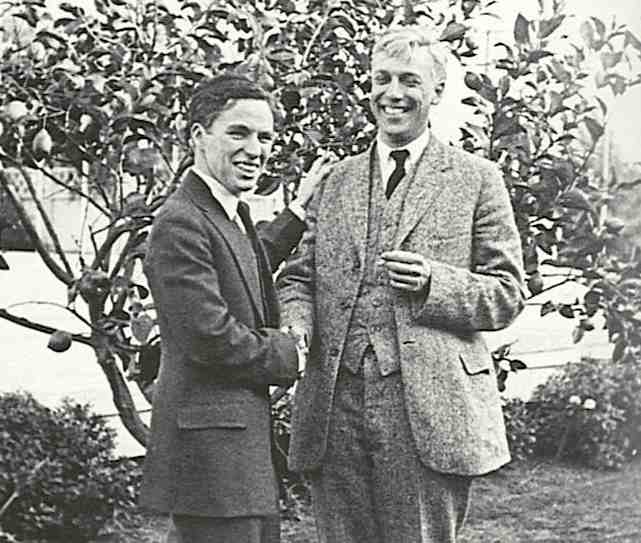
Charlie Chaplin and Max Eastman in Hollywood 1919. 
Book Review from the June 1927 issue of the Socialist Standard

A crimson-covered volume of some two hundred and odd pages has come to hand possessing the above ambitious title. The author, Max Eastman, poses as something of a psychologist of the analytical type, having apparently imbibed Freud in large doses. Thus fortified, he trains his critical guns upon what he regards as the tottering fabric of the Marxian philosophy, or as he terms it, “dialectic materialism” ; which procedure, he would have us believe, is animated by nothing more than a friendly desire to rid Marxism of a paralysing encumbrance, and to convert it, at last, into a real practical science.

The effect is somewhat bewildering, to say the least of it, and the present scribe, afflicted with a mere working-class education, candidly confesses his inability to make any practical head or tail of the involved argumentation in which Mr. Eastman indulges. In his first chapter on “The Function of Thinking,” he drills into the reader the idea that “Thought is purposive,” yet at the end of the book the said reader is left guessing as to just what purpose the author considers himself to have served.

There is not a single criticism of Marx that is new in the whole volume, and nothing is added, even by way of suggestion or example, to our knowledge of the social revolution. All that the author attempts is to shake the confidence of the Marxist in the reality and objective basis of his conclusions. Economic knowledge is derided and belittled, and a simple faith in our own desires and will is offered as a substitute. All this, of course, the author would have us lay at the door of psychology.

According to Mr. Eastman, Marx’s conception of history as a process based upon economic development, was merely a “rationalisation” of his desire for a revolution. We are asked to believe that in the “ideological” and “metaphysical” pages of “Capital,” Marx satisfied the mystic yearnings of his soul by philosophical communion with an “Economic God” of his own invention.

The present writer is not, of course, in a position to divulge what subtle “complex” dominates Mr. Eastman’s mind, but it appears to be one which leads him, for some obscure reason, into hostility against any form of abstract thought as applied to history and economics. He would throw overboard both metaphysics and dialectics and confine himself to the common-sense methods of practical investigation. Yet in the realm of biology he accepts Darwin and in psychology he accepts Freud.

He appears to be unable to see that both of these investigators are compelled to use the dialectical method whenever they generalise their conclusions, and leave for the nonce the realm of particular facts.

Darwin was forced to connect the evolution of organisms with changes in the earth’s crust. Are we therefore entitled to suggest that he was merely “rationalising” a subconscious hostility to the Book of Genesis? Marx, we are told, does not explain the practical variations in prices, etc., by his theory of value. Neither did Darwin attempt to explain the variations which occur in every succeeding generation. He looked for the law of survival and found it—horror of horrors, Mr. Eastman—in the material conditions of existence which alone could determine what were “favourable” variations, regardless of the will and desire of unfavourable ones.

In the sphere of psychological theory, Freud elaborates the conception of a conflict between the conscious and the unconscious mental processes. This he attributes to the existence of a censorship which represses the thoughts and feelings incompatible with civilised behaviour. Obviously, as Freud himself admits, this censorship is nothing but the reflection in the individual mind of the social conventions necessarily arising from a given stage of economic development. The professed object of psychoanalysts is to resolve the conflict, i.e., to bring the buried “wish” into harmony with reality, and what is this, Mr. Eastman, but the essence of dialectics?

It matters not to what realm of investigation we turn, the same law holds good, that a thing is and moves, and has its being only in relation to that which is not itself. So-called realists like our author may wriggle this way and that, but the only practical way of escape from the barren waste of metaphysics is the dialectical materialism which they affect to despise.

This is obvious whenever a scientist leaves his own realm and pronounces as with pontifical authority upon some subject of general interest of which his knowledge may easily be less than that of the average man. Men like Crookes and Lodge, for example, exhibit all the vices of the metaphysician when dealing with the subject of spiritism, while the number of Anti-Socialist professors has not been counted.

Marx’s “metaphysics” were attacked and the attacks answered by him in his own preface to “Capital” long before Mr. Eastman was heard of. Economic forces being social in character, cannot be dealt with in the same way as chemical compounds. Acids and microscopes are useless when we want to analyse a commodity.

Only the force of abstraction can help us. Abandon that force, and a science of economics becomes impossible, and we are left a prey to every Utopian fantasy liable to be misled by any will-o’-the-wisp “reform,” whether proposed by the professional politician or the crack-brained “rebel.”

Mr. Eastman endeavours to maintain that an idea cannot at one and the same time be a “reflex” of conditions, expressing some class interest, and also have objective validity. He holds that the Marxian “ideology” is thus no more scientific than the “ideologies” of the capitalist class, which it attempts to replace. In other words, Marx only saw what he wanted to see and described the result as “science !” This line of argument leads us to the conclusion that a truth ceases to be such if we want to make use of it. Thus, mechanics are no more scientific than magicians, since they simply express in their theories a “rationalised” form of their desire to control the universe.

For sheer puerility, some of the self-styled “psychologists” would be hard to beat, but as Engels has it, “The proof of the pudding lies in the eating, and human action had solved the problem long before human ingenuity had invented it.”

The soundness of Marx’s economic view is evidenced by facts which become daily more obvious, e.g., the concentration of capital and the intensification of exploitation, and of the consequent class-struggle. Mr. Eastman affects to regard these facts as immaterial to the main issue. “Look at Russia !” he exclaims. “Never mind about whether the triumph of the proletariat is inevitable ! Suffice that it is possible.” Yet in a very few pages further on he has to lament the appalling growth of bureaucracy in Russia !

Lenin, of course, comes in for eulogy in comparison with poor old Marx.

We have the “brilliant social revolutionary engineer” held up to admiration in comparison with the “foggy old metaphysician.”

The Bolshevik upheaval proved Marx wrong according to Mr. Eastman. Had it succeeded in its alleged object, we might agree with him, but all the evidence of its failure surely proves that Marx was right, and that social and political forms cannot be forced upon countries where the backward economic conditions make them premature.

Throughout the book the author negligently confuses historical materialism with “economic determinism,” and blind fatalism. He follows innumerable bourgeois “critics” of Marx in attributing contradictions to his thought which do not exist, and generally re-hashes all the stale metaphysical dualism in the guise of psychology. It is difficult, however, to believe that Professor Freud would recognise many of his “disciples” who appear anxious to show themselves off as “Jacks” in all and sundry branches of inquiry and “masters” of none.

As for dialectics, this method of reasoning will no doubt survive the attempts on the part of the “Communists” to drag it in as a support for their alternate criticism and support of Labour leaders; but this is a practical question of working-class politics here and now, which appears to be beneath the notice of such a “practical scientist” as Mr. Eastman.
Eric Boden

Blogger's Note:
The full title of Max Eastman's book was 'Marx and Lenin: The Science of Revolution'.

Tuesday, March 2, 2021

Light on Communist Policy. (1922)

From the June 1922 issue of the Socialist Standard

It is with a certain interest, not to say unfeigned delight, that I learn from Max Eastman (Liberator, April, 1922), that E. T. Whitehead, of the Communist Party of Great Britain, is “inclined to believe “that in the last few years” an unusual number of other-regarding spirits have been thrown down into the physical sphere “from some haunt of the disembodied ! He believes this because it is “more likely to be true than not.” This credulity perhaps explains Whitehead’s little vagaries.

Max Eastman facetiously suggests that the American Communists “solve their problem of perfection by organising a party on the astral plane to control the one which now controls the visible manifestation.” I should be sorry to rob Max Eastman of the credit due to the originator of so charming an idea, but I fear he is too late. It has already been done here. I have tried hard to keep up with and understand the erratic moves in Communist policy, never realising until now that I was following a will-o’-the-wisp, not the product of gross human minds, but of ghostly Third International “pixey wixies.”

For alas, even out of the physical sphere conflict reigns. There are other sources of Communist inspiration; for instance, the much older firm established long before Theosophy raised its upstart head. In the Evening News (27th March, 1922) I read that “at a confirmation service last evening at St. John’s Church, . . . over 40 Socialists and Communists, members of the Church of England, were confirmed by the Bishop of Whalley.” I can’t vouch for the accuracy of this report, but like Whitehead “I am inclined to believe it” about members of the Communist party because “it is more likely to be true than not.” A writer in the Communist recently waxed merry over the untutored person who described them as “communionists.” On second thoughts I think the apparently ignorant one must have known something.

A correspondent of the Daily Herald (31st Dec., 1921) relates how the South Shields Branch of the Communist Party had “a clay bust of Lloyd George with horns” before which apparently they discussed business.

Here are a few other things to be accounted for only by the hypothesis I have accepted. At the Communist Party’s recent policy conference a resolution was introduced which affirmed that “It is our duty also to strive for the formation of a Mass Party . . .” Eden and Cedar Paul reporting the conference in the Workers’ Republic (8th April, 1922), say “The discussion . . . turned on the question as to what was really meant by the Third International slogan of the Mass Party.” However, although “the discussion seemed to leave unsolved the problem precisely what the Third International means by a Mass Party,” the resolution was carried. Puzzling, you say? Not at all : they knew what it meant on the astral plane.

From the Communist (25th March) I find that the Communist Party’s “historic mission” is “the leadership of the working masses — — — .”

Of course, the “working masses” already have leaders, heaps of them, but these it seems are not good leaders : “Watch them,” say the Communists.

Why are they not good ones ? One reason say the Communists is that they have lost contact and sympathy with the rank and file.

But E. and C. Paul, two of the stars, say “the official group (of the C.P.G.B.) unfortunately consists of persons who have become professional politicians and are removed thereby from the activities of working class life” and “the slogan ‘ watch your leaders ‘ is as necessary in the Communist Party as in the Trade Unions.” (Workers’ Republic, 8th April).

Not only that but although Stewart says a mass party “takes leadership of the masses, not by going back to where they are, but by taking them from where they are to where they ought to be,” his fellow member Brain says “they had found by experience that the workers did not come out of the craft unions to the revolutionary movement; they stayed where they were. They would not come out so the Communist Party had to go to them.” (Communist, 25th’ March).

(This points to physic communication with Mahommet, who solved a little problem of his own on just such lines as these).

Some there were like Leckie who thought that it was the party which was going to lead the masses and therefore wanted in it “only those who really understood Communism.” This of course was absurd. What has the Communist Party, the party of “action” to do with an understanding of Communism? Murphy is of the opinion that “only a small minority of our party has any idea of the significance of the mighty task before us” and as a writer in the Worker’s Republic (official organ of the Communist Party of Ireland) remarked, not only do they not understand now, but lots of them never will; the revolution will be here before that can happen !

No, it is evidently the “professional politicians” who are to lead: “It is one thing to call upon the Party leadership to give the lead, another thing to put into operation that leadership.” (Murphy.) While Walter Newbold favours affiliation to the Labour Party, but temporarily opposes it, because he believes “that at this juncture we have not had the constituent parts of the Communist Party sufficiently long together, we have not welded them sufficiently into an intelligent party understanding the implications of political action for us to be able to take them as a. party into the Labour Party.” (Communist, March 25th). (Italics mine).

Excellent advice that “Watch your leaders”—for the members of the Communist Party.

As for Labour Party affiliation it is interesting to note that while the Communist Party proposes to insist on “freedom of criticism and freedom of action,” inside the Labour party (if it gets in), a Daily Herald correspondent writing on the L.C.C. elections stated with regard to Inkpin, who, although a Communist, ran as Labour candidate, that “it should be clearly understood . . . that Inkpin has definitely agreed to the Labour programme and will act in accordance with Labour Party decisions if desired.” (28th February, 1922).

It is all now perfectly clear. The “working masses” will watch their leaders, on the advice of the Communist Party. The latter’s members will watch their leaders on the advice of Eden and Cedar Paul. While the leaders themselves will have their eyes fixed on Whitehead’s hobgoblins and other divine and satanic sprites who sit up aloft and watch over the tribe of Labour fakirs !

Could the revolutionary movement be in better hands than these?
R. Bird

Tuesday, March 17, 2020

On Illegal Organisations. (1921)

From the December 1921 issue of the Socialist Standard

In the July issue reasons were given for our opposition to the Communist Party. Among other things, the opinions were expressed that "it is impossible to organise the working class secretly," and that, with the possible exception of politically and economically backward countries, no necessity for illegal methods of propaganda exists, and no useful purpose is served by devoting energy to them.

America provides interesting confirmation of the inevitable failure of the illegal organisation. In that country a serious attempt was made to apply the Moscow policy, and it was in fact the, boast of the American Communists that "the United States is the only country in the world where the Communist movement, as such, is an underground movement."

In the October Liberator (New York), Max Eastman, himself a supporter of the Third International, examines the present deplorable condition of the American Communist Party, and endeavours to explain it. His appreciation of the result of their work is this: "Two years have passed (since the secession from the Socialist Party), and except for the deepening and confirming of that split, nothing of appreciable value to the cause of Communism has been done by the Revolutionists. A good deal has been done to the detriment of the cause." This is all the more striking because the conditions considered, favourable to Communist propaganda have been present to a degree perhaps never previously known. "In spite of an 'increasing misery' that surpasses the demands of any theory, the workers in America seem to be less friendly to Communism than they were two years ago."

The mistake lay in the acceptance of the fallacy that capitalism had broken down beyond hope of recovery, and the supposition that the form of activity dictated by the semi-Feudal Russian autocracy must have application to the capitalist democracies. The first simply is not true, and the experience has again proved the falseness of the second.

There never was any necessity for propaganda to be illegal in America, any more than in this country. "It is not so much the ruthlessness of the American capitalists as the romanticism of the American Communists which accounts for their being underground. The majority of the leaders want to be underground. They enjoy disciplining the devotees of a rebellion, but educating the workers for the revolution is a less interesting task, and they are not fulfilling it."

The Communists "formed an elaborate conspiratorial organisation excellently adapted to promote treasonable and seditious enterprises, although they have no such enterprises on foot"; yet when subjected to police persecution for their activities they, like the Communists over here, are forced into the position of using the ordinary legal machinery for their protection. "The folly of this policy becomes tragically apparent when members of this underground organisation defend themselves in Court with the eloquent and perfectly truthful assertion that the propaganda they are conducting is not in violation of the laws." It becomes still more tragically apparent when they resort to the distribution of circulars advocating methods of terrorism—for the mere purpose, so far as we can judge, of sustaining and justifying the illegality of their organisation." This degeneration into the futility of sabotage has always been the fate of those who have never been nearer to an appreciation of the class struggle than that of throwing broken bottles at policemen.

Their failure is that they will not recognise the realities of the present situation, and the attitude of the workers towards capitalist institutions.

The capitalist class is, and will remain, in power until such time as the class conscious organised workers are strong enough to wrest that power from them. That power depends on the support of the great mass of the workers, unthinking though that support may be. Capitalist domination will not be overthrown because some relatively weak organisation declares its preparedness to defy constitutionalism, and to damn the consequences. It is a question not of intention, but of effectiveness, and the object of the revolutionary organisation is to strengthen itself until it is a force which cannot be ignored or suppressed. This means neither more nor less than the spreading of the knowledge of Socialism— the unexciting task of making Socialists. The Bolsheviks came to power in Russia because, for the objects they had in view, they had the mass of workers, peasants, and soldiers behind them. Those supporters were not Socialists, and those objects were not Socialism; but the position elsewhere with regard to the needs of the Socialist revolution is the same. The workers of America and Britain have not yet the requisite knowledge of, and sympathy with, Socialism ; in short they do not want it.

The Communist Party therefore, in its insurrectionary attitude to the American Government, alienates those very people for whose ears its propaganda is intended. In the eyes of the average worker the Government which he elects represents his interests, as its proclamations do actually mirror his opinions. It is a fact, and not a surprising one, that the average unthinking worker believes that the existing machinery of Government does give expression to the will of the people. What, then, is he to think of those who deliberately set themselves against what appears to him as the forces of law and order?

It would not matter so much if the Communists bore the burden of their own mistakes ; but the harm they do is much wider than that. They provide the Government with the excuse it desires for repressive legislation such as at ordinary times it would be difficult to introduce; and this legislation is used against every revolutionary propaganda body. They provide the openly capitalist political parties, and more particularly the reactionary "Labour" parties, with easy material for their attempts to discredit Socialism. They confuse, without educating, those workers who are reached by their propaganda, and antagonise the much larger number who hear only the misrepresentation to which it so readily lends itself.

It is a slow and difficult task to remove from the mind of the typical wage earner the pathetic belief in the inevitability of his sufferings, and in the permanency of political institutions and economic forms of society; but there is only one way, the educational way, and to think of challenging those who are now in control, before this educational work has been accomplished, is mere foolishness.

Knowledge of the evolution of human society, and of the origin and development of existing political institutions on the one hand, and knowledge of the present economic structures which makes possible the exploitation of the workers, an exploitation not superficially observable, are the necessary forerunners of successful organisation for the emancipation of the workers. Spectacular defiance of the powers that be has no place in this scheme of things.
P. J. L.

Tuesday, December 4, 2018

What is a Capitalist? (1976)

From the December 1976 issue of the Socialist Standard

Nature in the raw — in fact, on Sunday mornings in Hyde Park. Real-life questions asked at actual meetings by genuine people; nothing added or taken away; nothing invented or simulated.

Question: Am I a capitalist? I run a hairdressing saloon. I am a taxi-driver with my own cab. I run a greengrocer’s shop. I am a jobbing builder. I have an accountant’s office. I am a free-lance photographer, journalist, general practitioner . . . and so on. Short, clear, firm, definite answer: No, you are not!

The long answer is the explanation. Why not?

*

It is a popular fallacy that, since capitalists are obviously rich, all Socialists (who oppose the capitalist system) must be poor. Many people have a hazy notion that all poor people are Socialists and all rich ones anti-Socialists. In other words, they do not know the difference between actual objective conditions and ideas about them.

Nothing is, unfortunately, farther from the truth. The poorer people are, frequently, the more devoted to capitalism. Who has not met the destitute wretch, subsisting by cadging hand-outs, who runs round shrieking nationalistic or religious rubbish (often a psychiatric case through sheer physical deprivation)?

Conversely, nothing is more fallacious than the notion that all rich people are (or were) anti-Socialists. Many rich men and women have been most creditable Socialist thinkers and writers — some outstandingly so. Frederick Engels immediately springs to mind: a successful manager of his father’s cotton mill. In fact, his financial aid made the production of Marx’s Capital possible.

But he was only one of many who contributed, or thought they were contributing, to bringing down capitalism. H. M. Hyndman spent much of his large fortune in publishing Justice and financing the Social Democratic Federation from which the SPGB emerged. Sergei Morosov, the Russian sugar millionaire, financed the Bolsheviks. Ferdinand Lassalle, a founder of the German trades unions, was supported by the fabulously wealthy Countess Hatzfeld. This writer was informed by Max Eastman that Charles Chaplin, when he was running a profitable film venture, regularly supported Eastman’s American radical magazine The Liberator.

It is true that capitalists do not need to work, untrue that no capitalist ever works. They are not all nitwits dedicated to gambling, boozing, etc. The late Lord Rothschild was a biologist of world repute, an acknowledged authority on fleas (though as in other subjects, especially science, this sort of research is not as altruistic as it may seem: nobody wants lousy workers — not only capitalists, but other workers). Other wealthy men and women have spent fortunes on the arts and actually participated in archaeology, exploration and science.

What makes a person a capitalist is not what he thinks, but what he has: his bank balance, not his mental balance. This is the crux of the question. A capitalist is a possessor of capital.

And what is capital? It is wealth invested to produce profit. That is why the Great Train Robbers immediately after their successful “job” were not capitalists. Their problem was to “get rid of it”, i.e. invest it, integrate it with social production. The trinkets and diamonds in the safe-deposits of the French banks robbed recently are wealth, but not capital; they play no part in production, make no profit. They are “hoards”.

This brings us to the mathematics. “Mr. Speaker, am I a capitalist?” Yes — if you have at least £250,000 in readily realizable assets (so-called “liquid funds”) in a bank, company, property or bonds. £250,000 at 10 per cent. (you’ll be lucky!) would perhaps realize £25,000 annually. £25,000 should net a little under £500 a week. Tax deduction (assuming no Capital Gains) at least £200 weekly. Net balance: £300 weekly (approx.).

Not too much, really — because, unless you choose to become a hermit living on raw onions in a shed (as one or two capitalists have done) you’ve got to be like the other capitalists. Not much for the wife’s mink. You could hardly park the Rolls or Merc outside the high-rise blocks in Brixton or Paddington : the neighbours would be ringing the police, and the kids smashing it up. Even the gardener or chauffeur would want about £50 a week.

For a real 1980 capitalist, a quarter of a million is peanuts. As Paul Getty remarked acidly, “How can you call yourself rich if you know how much you’ve got?” Another tycoon, asked by an ingenuous young admirer how much his fabulous yacht cost, said: “Listen, son — when you start counting the cost, you don’t buy one of these boats.”

Howard Hughes paid £500 a night (without Security, which was extra) for his modest pad at “The Inn on the Park”. Statisticians have calculated that if a common soldier landing with William the Conqueror had worked incessantly and frugally from then to now he would still not own as much as Sir John Ellerman in 1976.

No, you are not a capitalist, and you are even less likely to become one. But once you realize what the capitalist system is and how it works — you can become a Socialist.

Next question!
Horatio

Tuesday, October 30, 2018

Trotsky States His Case (1928)

Book Review from the December 1928 issue of the Socialist Standard

The Real Situation in Russia, by Leon Trotsky. Translated by Max Eastman. 364 pages. 7s. 6d. George Allen & Unwin.

This book consists for the most part of the statement submitted by Trotsky (and 12 other minority members) to the Central Committee of the Russian Communist Party in September, 1927. The document was suppressed by Stalin and his supporters, and the opposition group – both in the Central Committee and in the country at large – was broken up by the imprisonment, persecution and exile of its prominent members. As might have been expected a copy of the statement was smuggled out of Russia, and now appears in an English edition. It is translated by Max Eastman, who is an American admirer of Trotsky, and was himself recently in Russia.

Trotsky describes in considerable detail the serious problems which face the workers in Russia under Stalin’s Government, the charges which his group level at the dominant section in the Communist Party, and the remedies which they propose.

The richer peasants in the country, and the trading and money lending capitalists in the towns are increasing in wealth and are becoming a more powerful factor politically. One-fifth of all trade, 50 per cent. of retail trade and more than 20 per cent. of industrial production is in private hands (page 27). The profits of the trading capitalists, the middle men, are big and growing while the workers’ share in the national income has been falling since 1925. The introduction of methods of rationalisation into State industry results in an increase of unemployment, a general intensification of labour, and a lowered standard of living.

The fear of unemployment is such that the workers resist the efforts of the Government to increase production in the factories by machinery and more efficient methods.

Among the 3½ million rural wage workers the rates of pay are often below the legal minimum even on the Soviet State farms. Housing for the town workers grows steadily worse.

Workers’ control is more than ever a mere catch-word without real application. “Never before have the trade unions and the working mass stood so far from the management of the Socialist industry as now” (page 57).

The immense majority of delegates to Trade Union Conferences are people entirely dissociated from actual participation in industry. Factory committees are mistrusted and discontent is driven underground because the man who voices a complaint knows that he will lose his job. Men and women are not equally paid.

Capitalism on the land
During the previous four years Trotsky alleges that from 35 per cent. to 45 per cent. of the landless rural workers and small peasants were unable to continue making a living, while the rich class of peasants (more than 28 acres) increased in number by from 150 per cent. to 200 per cent. (p. 61). In a typical district 15 per cent. of the peasants own 50 per cent. of the land machinery, cattle, etc. Renting of land is on the increase, and the army of landless rural labourers is continually being recruited from the poor peasantry.

The new bureaucracy
Under Bolshevik administration there has grown up a new bureaucracy, divorced from working class life and not subject to any effective control from below. “The city Soviets have been losing in these recent years all real significance.” “The Soviets are having continually less and less to do with the decision of fundamental, political, economic, and cultural questions. They are becoming mere supplements to the executive committees and the praesidiums. . . . The discussion of problems at the full meeting of the Soviets is a mere show discussion” (pages 98 and 99). Elected delegates are promptly removed from office if they express on behalf of the workers any criticism of the official element.

The composition of the Communist Party is deteriorating. At the beginning of 1927 only one-third of the members were shop and factory workers, while two-thirds were peasants, officials, etc. In 18 months over 100,000 industrial workers were lost to membership and an equal number of peasants admitted. The majority of these were “middle” peasants, the percentage of farm labourers being insignificant.

Inside the Communist Party “the genuine election of officials is in actual practice dying out” (page 115). Terms of office are being increased to two or more years. The Party machinery is used to secure the dismissal from their employment of workers who criticise the leadership.

Communist Party groupings
There are, in Trotsky’s analysis, three main groups. First, a right wing group, which combines the aims of the middle peasants with those of the Trade Union leaders and the better paid clerical and other workers. Secondly, there is the ruling section of the Communist Party, the members of the Government and the administration. Their object is to avoid if possible any change in the present balance of forces such as will disturb their own position.

And, thirdly, there is the Trotsky group, which claims to represent the mass of the industrial workers.

Lenin worship
Quite a large part of the book is given up to the personal issues between Trotsky and the members of the Government. Each section and all of the individual disputants try desperately hard to prove not only that their views are in accord with Lenin’s general line of policy, but that during his lifetime they possessed Lenin’s personal regard. These personal issues may be of interest to the English reader, but are not of great importance. They are, however, significant in that they indicate what both Stalin’s group and Trotsky’s group think of the degree of understanding possessed by the members of the Communist Party in Russia. Whatever may be the real opinion of Stalin and Trotsky as to the value of this “Lenin worship” and controversies about personal merits (it is noteworthy that Trotsky specifically credits Stalin’s faction with “sincerity,” p. 185), they both plainly realise that in the life and death struggle which involves the political careers and the very existence of the oppositionists, they have got to canvass support by “arguments” based on abuse and on the kind of trivialities which are the stock in trade of every demagogue appealing to a politically ignorant electorate. This, more than Trotsky’s assertions, indicates the low level which rules among the so-called Communists in Russia. It is not, therefore, surprising to be told that the majority organise regular bands of “Communists” to break up opposition meetings by means of catcalls and whistling in chorus.

Trotsky’s programme
The reader will have noticed that the evils which afflict the Russian worker are very much the same as those which afflict us here or in any other country where the basis of the economic system is capitalism.

Trotsky presents a long list of remedies which serve only to confirm what we have always said as to the necessity for Russia to go through capitalism. Trotsky does not admit this in so many words. In fact, he vigorously denounces Stalin’s “capitalist tendencies.” But when we examine his programme we find that it is all based implicitly on the continuance of capitalism in Russia until such time as a developed capitalist industry and a Socialist revolution outside Russia make Socialism possible.

Most of his proposals might have been lifted out of the programme of any trade-union in Germany or England; “Equal pay for equal work,” less overtime; more unemployment pay; no more Government faking of labour and industrial statistics; retail prices to be brought down to the world price level; no profiteering by capitalist middlemen; no increase in the rents of” working class houses; every effort to be made to lower the cost of production in order to promote the growth of industry ; more taxes on rich peasants; abolition of the State sale of Vodka, etc. A long programme of reforms, but no mention of the abolition of capitalist farming, capitalist trading and capitalist investment. Both Trotsky and Stalin draw up their programmes within the framework of state and private capitalism which prevails in Russia.

By far the most important demand made by Trotsky is for the unfettered expression of opinion by members of the Communist Party, and this does not go far enough. In the past Trotsky, Stalin and Lenin all agreed that “democracy” was merely a capitalist trick for hoodwinking the workers. With their dictatorship of a minority they were going to suppress the defenders of capitalism and impose Socialism on the apathetic majority. Experience has now taught Trotsky that dictatorship is incompatible with sound working class organisation.

It is also still necessary for him and other Bolsheviks to learn that they have not found a substitute for democracy. Without in anyway idealising it, the fact remains that modern industrial society, whether on a capitalist or on a Socialist basis, cannot be run with any degree of smoothness and efficiency without democratic methods. In no other way can the necessary social stability and the indispensable minimum of general interest in administration be secured.

Sooner or later the whole apparatus for suppressing opinion and political propaganda and organisation in Russia will have to be scrapped. The attempt to stifle criticism and hostile propaganda does not hasten the end of capitalism; it may for a time drive the propaganda underground, but the effect of that is to produce a false sense of security and a rapid deterioration among the organised workers themselves.

Trotsky’s errors about England
One fatal weakness of the Bolshevik leaders 10 years ago was their appalling misunderstanding of conditions outside Russia. There was at that time much excuse. Now there is none; but the ignorance remains. In face of the plain evidence of every election and the absurdly small membership of the English Communist Party, despite the waste of hundreds of thousands of pounds on propaganda, Trotsky still bases his hopes on an early revolution in this country. With 85 per cent. of the electorate members of the working class, there is no single constituency where a candidate has yet been returned to Parliament on a Socialist programme. The great majority of the workers still pin their faith to capitalism, a majority of them even continue to vote for the Liberal and Tory parties. To suppose that workers who vote for capitalism will at a signal from Moscow rise in revolt against the Government for which they vote, either in peace time or war time is sheer delusion. If Trotsky or anyone else bases a programme on that fantastic supposition they are in for certain disappointment.

Trotsky deals also with the complete failure of the Third International in China, and lays the blame on their tactic of supporting one after another of the capitalist nationalist leaders.

The book as a whole is valuable as a first-hand and authoritative impression of the recent condition of Russia, although of course we cannot accept Trotsky’s facts or his conclusions without further independent evidence, and this is not available. It is absolutely certain that the means do not exist in Russia for obtaining statistics on prices, production, etc., on a sufficiently general and precise basis to warrant the use made of them by both Trotsky and his opponents, and if Trotsky is as prone to rashness in drawing conclusions about Russian affairs as he is about England, then his views must be treated with considerable caution.

Nevertheless we can confidently assert that Stalin’s group is in the wrong. Not Trotsky’s book, but its treatment by the Russian Government proves this to be the case. Competent, self-reliant Socialists are not produced in an atmosphere of censorship, and Socialism is not to be promoted by the violent suppression of critics and criticism. Party unity which is based on the avoidance of discussion, is a fictitious unity, and a membership which is recruited by the bait of jobs in the State factories is worse than useless. Trotsky’s exile is the Russian Government’s plea of guilty to the charge of hindering the spread of Socialist knowledge and the growth of the Socialist movement. His exile does not prove Trotsky to be in the right, but it does prove his opponents to be in the wrong.
Edgar Hardcastle

Wednesday, March 28, 2018

Do We Need A Five-Year Plan? (1931)

From the November 1931 issue of the Socialist Standard

The Practical Importance of Theory.
It is no uncommon thing for Socialists to be met with the charge that they are only mystics, airy philosophers destitute of any practical notions of how to carry on the society which they propose to establish. The present writer readily confesses to having been struck dumb in his youth by a querulous critic who demanded to know, “Who is going to get the best joints of meat under Socialism?” and proceeded to hint darkly at the possible fate, under such a system, of obstinate wives who refused to sleep with their husbands. What struck me dumb was my amazement that such questions should seriously worry one whose choice of the food he consumed at cheap restaurants during the week was practically nil, and who, as a result of his closely-confined occupation, looked as capable of healthy sex relationships as of knocking out Carnera.

The charge of mysticism was recently made against Socialists by a contributor to a discussion on the Russian Five-Year Plan in the economics section of the (British Association Conference. The suggestion is not new. Max Eastman made it in his “Marx, Lenin and Revolution.” H. G. Wells put it forward in the first volume of “William Clissold"; and Marx himself had to meet similar attempts at criticism after the publication of his work on “Capital.” His reply to this is contained in his preface to the second edition.

Marx owed a debt to the German philosopher, Hegel, which he readily admitted; but he frankly abandoned Hegel’s idealistic standpoint and treated material conditions as the real basis of human society. He saw that these conditions changed and new forms of society arose as a result. He criticised capitalist society from this point of view, and demonstrated that it must give way to Socialism; but he never spent his time in mystical contemplation of the future. He left to others the task of writing out the menus for the Utopian equivalent of Lyons’ cafés.

It is, of course, not surprising that this critical and revolutionary attitude fails to appeal to professional builders of “New Worlds for Old.” They get their living partly by writing about plans for the future, which are pushed aside by events which they fail to foresee. It is only to be expected that they should fall foul of a scientifically cautious mind, and remain apparently unconscious of the absurdity of denouncing Marx for mysticism in one breath and for failing to act as a prophet in the next. Such critics can be left to stew in their own juice.

Of more concern to us are those of our readers who allow themselves to be impressed by such bombast, and write to us complaining of our “destructive criticism” and our failure to propose “measures of reconstruction.” One reader, for example, wants a “Ten Years’ Plan formulated now! in order that the workers can be familiarised with Socialism as a practical rather than a theoretical proposition.” Our correspondent then proceeds to outline in quite a general way the “immediate measures” he considers necessary, and to propose certain “new departments” of administration, including one of “Co-ordination.” This proposal shows how easy it is to allow oneself to be hypnotised by important sounding words. Co-ordination is the special function of a general administrative body and not of a department.

The establishment of Socialism is essentially a practical proposition. It is the definite object of the Socialist Party, the goal of our activity. If the workers do not show any enthusiasm for this object that is not because it is "theoretical," but because they do not understand the need for it. They are quite prepared to accept their slave-status (are indeed unaware that they are slaves), and gladly leave planning to their leaders and masters.

The Socialist Party is not in any doubt as to what it has to do when it has conquered political power. Its job will be to convert the means of living into the common property of Society.

To be sure, that is only a brief statement of our "general, line," and our critic wants details. To his mind it is shirking the question to suggest that particular measures depend upon particular conditions. "Most of us," he says, "do not like to buy a pig in a poke.” Who does he mean by us? Unfortunately the majority of the workers are only too ready to buy a political pig in a poke. Any general election provides ample proof. What political party has ever tied itself down to matters of detail before election? The National Government asks for a "free hand" and cannot tell us even a month ahead what it proposes to do. Leading members of the Labour Party disagree considerably as to the form their measures of nationalisation or "public control" are going to take.

The Communist Party, it is true, has an elaborately detailed programme—which has not a ghost of a chance of securing political victory for the Communist Party. If the S.P.G.B. is still out in the cold, therefore, it is certainly not because the Party’s object is too vague for the practical disposition of the workers.

The political actions of the workers may, as our correspondent suggests, be "more powerfully affected by the emotions than by the intellect,” but that does them no good. The people who benefit are the ones who use their intellects to play upon the workers’ emotions, i.e., the master class. Our correspondent confesses that his "imagination reels" when he contemplates the possibilities of planning. Can the Socialist Party afford to enter the political arena with a reeling mind? On the contrary, we need all the concentration of which we are capable to think out the most effective way of getting our "destructive criticism" into the minds of our fellow-workers here and now. They need it.

When they wake up to the fact that they are slaves and that a change in the basis of .society is necessary, they will also realise that in future they have got to do the planning as they march along the road to their emancipation. They will not look to leaders to plan for them. On the other hand, there is no necessity for a small minority of the working class (such as the Socialist Party is at the moment) to anticipate the decisions of the majority which it will one day become. Certainly "there is no harm in speculation,” so long as it is recognised as such, and so long as the speculators do not attempt to force their speculations upon us as a necessary programme. Discuss, by all means (if and when you have nothing better to do) just what is going to happen in twenty or thirty years' time; but do not forget the fate of the practical programme drawn up by Marx and Engels in the Communist Manifesto eighty-three years ago. In twenty-five years it had, in its authors' own words, become somewhat "antiquated” owing to the rapid pace of industrial development. The pace is even more rapid to-day. That is the main reason why the Socialist Party steers clear of so-called plans and programmes.

A further reason is that outsiders have a fatal knack of confusing a programme which, at its best, can only be a means to an end, with the end itself; or, to put it another way, the "programme" and not the object (i.e., Socialism) occupies first place in their minds. The result can be seen in the fate of the old Social Democratic Parties in this and other countries. Numbers were attracted into these organisations by the immediate programme, the sound Socialist element was swamped, and these parties eventually degenerated into step-ladders for political job-hunters, who in turn operated as tools for the master-class. The preference of the Socialist Party for scientific principles rather than for speculative programmes is thus not a mere foible, it is based upon bitter experience.

No substitute has yet been discovered for Socialist education. It is a slow job and not so exciting or remunerative as that of sweeping the un-class-conscious workers off their feet with stirring "practical measures”; but it has its compensations. There is a certain element of humour in the spectacle of the most practical politicians taking hedges in faultless style, only to land in the mud on the other side. The workers who have prided themselves on their practical commonsense, their superiority to the theorists of the S.P.G.B., are apt to view the situation rather tragically at the moment, having put their savings upon these much-advertised hurdle-jumpers in quite a literal sense. We have confidence that they will recover their balance and treat Socialist principles a little more respectfully in future.

When they have eventually overcome their prejudices in this direction the time will then arrive for practical programmes to take on a new and revolutionary character. Informed with the necessary fundamental knowledge derived from an effort to understand their experience, the workers will address themselves, with much greater energy and immensely superior organisation, to the necessary task of social reconstruction. We may guess at the plans they will make and some of our guesses may turn out to be accurate, but it is more satisfactory and immediately profitable to get on with the job of making Socialists.
Eric Boden

Thursday, January 25, 2018

Misrepresentations of Socialism (1941)

Editorial from the August 1941 issue of the Socialist Standard

It is impossible to exaggerate the harm done to the Socialist Movement by those who, calling themselves Socialists, have taught the workers to believe that State capitalism and social reform are Socialism. Millions of workers all over the world have, through this misdirection, been led to support some form of capitalism, trusting that it would solve their problems. The result was that the way was paved for Hitlers and Mussolinis and other supporters of capitalism to reach their goal. The S.P.G.B. has always been careful to define what Socialism means. Nobody who grasped that definition ever made the error of supposing that State enterprise like the Post Office or public utility corporations like the London Passenger Transport Board had anything to do with Socialism. Nor did they imagine, even for a moment, that Hitler and Mussolini were Socialists or that Socialism could result from the Bolshevist dictatorship in Russia or from a Labour Government in Britain or Australia. But our critics who ridiculed what they called the “doctrinaire” S.P.G.B. all fell into these errors, with disastrous results.

A few recent illustrations will show how deeply those critics have fallen into the mire. In the Readers' Digest (July, 1941) the American writer, Mr. Max Eastman, who used to called himself a Socialist and was an admirer of Labourism and of the Bolsheviks, now dismisses Socialism because, he says, it ignores human nature. In the course of his argument he lumps together Socialism, Syndicalism, Bolshevism, “Guild Socialism,” and Anarchism, and by showing what has happened to the Bolshevist experiment is able to prove that Socialism is impossible. It will be useful to consider Mr. Eastman’s argument more fully in a later issue. At the moment it is sufficient to point out as evidence of his shallow thinking his remark on the Russo-German Pact of 1939 (his article was written before the Nazis invaded Russia): —
   “The Stalin-Hitler pact was not merely a new manoeuvre on the chessboard of nations. it was a drawing together of two halves of the same thing."
Thus is a superficial observer confounded by a hard fact, the Russo-German war!

Mr. Eastman mentions "Guild Socialism” as one of the forms of Socialism. He would no doubt be surprised to learn that when the so-called “Guild-Socialist” Movement was at its height twenty odd years ago it was analysed and denounced [in] the The Socialist Standard and given its proper name, “Guild-Capitalism.” We were right, and it is only necessary to recall that numbers of its advocates, bemused with their own muddled propaganda, recognised their own notions in Mussolini’s and Hitler’s corporate State, and were in greater or less degree taken in by these movements. In the January, 1941, issue of Plebs, Mr. W. T. Colyer quotes from the preface to Otto Strasser’s “Germany Tomorrow,” the following passage, written by those erstwhile “Guildists” and supporters of Bolshevism, Eden and Cedar Paul: —
   “Both brothers were Nazis at a time when the National Socialists were really Socialists as well as Nationalists, and they remained Socialists after Hitler had dropped this part of his creed.”
(Otto Strasser leads, from abroad, a dissident group of Nazis who quarrelled with Hitler. His brother, Gregor, was murdered by Hitler.)

Of course the Nazis were never Socialists or interested in Socialism; but how should the Pauls know this? Had they not for years been preaching various capitalist doctrines in the belief that they were Socialist?

It is forgotten now, but the I.L.P. was likewise deceived by Mussolini, though not so deeply, and its recovery was rapid. Not long after Mussolini obtained power in Italy the New Leader, (November 10th, 1922) published an article, “Fascism and Labour,” by an “Italian correspondent” (he later became a whole-hearted Fascist). In the article the writer, while regretting the destruction by Mussolini of Italian workers’ organisations and murder of workers, urged co-operation with Mussolini in furtherance of the “ new social order.” A typical passage was: —
   “The Fascist victory is a set-back to Socialism, regarded as a party movement and an economic doctrine. . . But Socialism is broader than a party; it is rooted in Labour as a whole, and Fascism desires to-respect the social aspirations of Labour. In the interests of Labour, therefore, we must cease from carping, and make the most of the situation.”
What is significant is that the New Leader, organ of the I.L.P., not only published this article (describing it as “illuminating”), but was unable to decide its own attitude and took refuge in the view that it was too early to decide: —
“Only events can test our correspondent’s optimistic reading of its (Fascism’s) new spirit.’’
What events did prove, in addition to showing the absurdity of the New Leader's wait and see policy, was that the S.P.G.B.’s insistence on the need for clear ideas about Socialism and for the rejection of all spurious imitations was abundantly justified.