Showing posts with label Company Unions. Show all posts

Wednesday, March 3, 2021

America – The Land of Bombast and Poverty. (1922)

Book Review from the June 1922 issue of the Socialist Standard

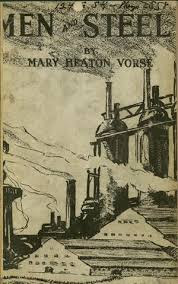
A Review of “Men and Steel,” by Mary Heaton Vorse—published by The Labour Publishing Co., 6, Tavistock Square, W.C. 1. Price 3s. 6d.

This is a book of 185 pages dealing principally with the American Steel Strike of 1918-1919. It is written in a rather rhetorical style, and, apparently, is the work of a visitor—a visitor whose emotions were stirred by the poverty and oppression she witnessed—who went to various districts and recorded impressions received, conversations, odd statements at meetings and descriptions of places visited and people seen. While a good deal of information is given as to housing conditions in the steel towns, and oppressive actions during the strike, there is little information as to the working conditions prevailing in the steel works. At the same time there is a good deal of useful information contained in the book.

On page 17 we are told :—
 "About one-half of the steel industry is owned by the U.S. Steel Corporation. These are the figures of the Corporation’s surplus :—


The “Total undivided surplus” signifies the surplus after paying dividends and setting aside large sums for other purposes. For example, according to a further quotation by the author from the Interchurch Report (same page), it appears that in 1918 the above corporation paid over 96 million dollars in dividends, set aside over 174 millions for Federal taxes due in 1919, and still had an undivided surplus of nearly 500 million dollars !

It will be observed that the undivided surplus has risen by over 200 per cent, in six years !

When, along with the above figures, we recollect the enormous amount of watered capital usually introduced into the actually paid up capital of such corporations as the above, we can obtain a faint idea of the staggering amount of surplus value robbed from the American steel workers by the steel magnates.

On page 26 we learn :—
  ” The United States Steel Corporation’s policy as regard labour dominates the steel industry.
  ” There are, roughly speaking, 500,000 steel workers in the United States.
   ” 191,000 employees work in U.S. Steel Corporation’s manufacturing plants.
   ” 32 per cent. do not make enough pay to come to the level set by Government experts as minimum subsistence standard for family of five.
   ”72 per cent. of all steel workers are below the level set by Government experts as minimum of comfort level set for families of five. That means that three-quarters of the steel workers cannot earn enough for an American standard of living.
    ”50 per cent. of the U.S. Steel Corporation’s employees work 12 hours a day. 50 per cent. of these work 7 days a week.
    ”Steel workers work from 20 to 40 hours longer a week than other basic industries near steel communities.
      ”American steel workers work over 20 hours a week longer than British steel workers.”(*)
(*) “Interchurch Report of Steel Strike.”
Twelve hours a day, seven days a week, for less than the minimum subsistence standard for a family of five ! And the steel workers, according to the author, are in the habit of having large families. It is a pity the author does not state the nature of “the level set by Government experts as minimum of comfort level set for families of five.”

Such are wages and hours in the land of “hustle”—the country to which the sweated slaves of Europe turn hopeful eyes, under the delusion that there they will be able to find the comfort and security denied them in their present surroundings. Many buoyed up by this hope have scraped together what enabled them to reach the hopeful West?—only to find disillusionment in such places as the steel towns. Experience is bitterly teaching the workers that the ugly head of capitalism is reared in practically every land under the sun.

The author of the book under review gives various descriptions of the Steel Towns. One such description is as follows :—
   “The mills of this town were on the flat river bottom. The old river banks mount steeply. The yards of the rickety frame houses slope sharply down. Melting snow had uncovered the refuse of winter. In the air was the sickly sweet smell of rotting garbage. The steep yards were surrounded by ramshackle fences. At the bottom near the street heavier things had slipped down hill—discarded bed springs, coal scuttles with holes in them, rusty pots and pans, old corsets, shoes, and more tin cans. In these towns on the Monongahela refuse and garbage are not taken away. For months it rots where it lies. Spring finds it there.” Page 27.
Here is another description, this time of the steelworkers’ dwelling places in Braddock :—
   “They live some in two-storey brick houses, some in blackened frame dwellings. One set of houses faces the street, the other the court. The courts are bricked and littered with piles of cans, piles of rubbish, bins of garbage, hillocks of refuse —refuse and litter, litter and refuse. Playing in the refuse and ashes and litter—children. The decencies of life ebb away as one nears the mills. I passed one day along an alley which fronted on an empty lot. Here the filth and refuse of years had been churned into viscous mud. A lean dog was digging. Pale children paddled in the squashy filth, and made playthings of ancient rubbish. Beyond was the railway tracks, beyond that the mills. Two-storied brick houses flanked the brick street. No green thing grew anywhere.” Page 33.
Such are the districts occupied by the workers, in filthy courtyards without running water, without conveniences. As the author points out these are the only places they can occupy.
  “If a man is working in the Edgar Thompson Works, he must live in Braddock ; if he is working for the Carnegie Steel Co. in Homestead, he must live in Homestead. If you look around and try to hire a better place, you will find there is none.”
Many of the people who live in these “salubrious” surroundings have come from European villages. They went to America with high hopes, but their hopes and their health were smothered in the smoke and filth of the steel towns.

The power of capital over the lives of the workers is illustrated in a multitude of ways. The following quotation will give an idea of how the much vaunted “democracy” of America works in actual practice : —
   “The men who own the steel mills and the mines and the railways that brought the steel ore down to the water-front and the boats that carried it across the lake, own other things in Alleghany County. They control the law courts. The mounted state police are at their call. The political power—with all burgesses and sheriffs— they own also. In the steel country government is. possessed nakedly by those iron and steel masters and their friends.” Page 49.
In September, 1918, the steel workers struck. Now we have often been told of the way the Americans “get a move on things,” but an examination of the strike demands show that this evidently does not apply to the American workers. The demands illustrate a condition similar to what was general in England before the Factory Acts. The plentiful supply of emigrants to the “New World” kept flesh and blood relatively cheaper in America. It is only in the last twenty years that the American Capitalists learnt how much new men cost; the expensiveness of the shifting and ebbing of labour; the poorness, from a productive point of view, of a discontented and disaffected labour supply. Previously, in the tear and rush and scramble for wealth, they took no note of these things, but experience has at length forced this knowledge upon them, and so they have spent millions of dollars on welfare work.

The demands put forward by the striking steel workers were as follows :—
  ” (1) Right of collective bargaining.
  ” (2) Reinstatement of all men discharged for union activities with pay for time lost.
  ” (3) Eight hour day.
  ” (4) One day’s rest in seven.
  ” (5) Abolition of 24-hour shift.
  ” (6) Increases in wages sufficient to guarantee American standard of living.
  ” (7) Standard scales of wages in all trades and classification of workers.
 ” (8) Double rates of pay for all overtime after eight hours, holiday, and Sunday work.
  ” (9) Check-off system of collecting union dues.
 ” (10) Principles of seniority to apply in the maintenance, reduction, and increase of working forces.
 ” (11) Abolition of company unions.
 ” (12) Abolition of physical examination of applicants for employment.” Page 50.
Further comment on these demands is hardly needed, they speak for themselves, particularly 1, 4, 5, 6, 11 and 12.

Three hundred thousand steel workers came out on strike. Their organisation was poor; the companies controlled all news and the only means the workers had of finding out how things were going on in other districts was by the receipt of an occasional strike bulletin or, still less frequent, the visit of an organiser. Strike meetings were generally prohibited, strikers and sympathisers victimised. The constabulary was given a free hand and thousands of strikers were battered and thousands spirited away to prison to await a charge which was never preferred. The espionage system was in swing.

According to the Author the strike was killed by silence, by violence, and by the ultimate defection of one of the American skilled workers’ unions. The latter point is one upon which we have not sufficient information to form a judgment. Terrorist groups, under the name of citizens’ committees, also played their part in assisting to smash the strike.

Unfortunately the Author’s style prevents her from setting forth the facts of the situation in such a way as to enable us to form an accurate judgment of the immediate cause of the strike, its possibilities of success, and the reason for such a complete collapse in face of such solidarity at its commencement.

Of the strikers the Author writes :—
   ”They were without strike discipline, they were without strike benefits ; they were communities where no strike meetings were allowed to be held, some of the men never heard a speaker in their own language during all the strike.” Page 58.
Of the activities of the masters we learn :—
  “When the men struck violence by the police increased. The Constabulary had already become active. Now the state troopers appeared in all the steel towns. They broke up meetings. They rode their horses into the workers’ very houses. In Braddock no assemblies of peoples were permitted.
  They rode down men coming from mass. Steel workers could not assemble. They chased the children of Father Kazinci’s parish school.”

*********

  “The idea seemed to be to terrorise the workers. There were besides deputised gunmen, Workers were arrested by the hundreds, held, and no charges preferred against them. Then they were fined.” Page 63.

  “The stories of beatings and arrests came in an endless flood. There was no end to them. Within two days one was drenched with them. In three days one was saturated. They made no more, impression. They became part of life.” Page 67.
We think we have now given a fair sample of the contents of the book under review. There are many tales of the patience and self-sacrifice of the strikers, but we have already overburdened this review with quotations.

To those who agree with “the right of the employer to do what he likes with his own,” it will give some staggering information. Generally speaking it is worth reading to obtain an idea of some of the methods used by the employing class of America against the working class of that country. It might help to remove the clouds from the minds of those who exalt “Republican America” over “Monarchical England,” and help to teach them that where capital goes, whether to Republic or Monarchy, there goes also its shadow—slavery and misery.
Gilmac.

Sunday, August 12, 2018

More About Roosevelt's "New Deal" (1934)

From the August 1934 issue of the Socialist Standard

An important element in the N.R.A. is the provision in Section 7a;
   “That employees shall have the right to organise and bargain collectively through representatives of their own choosing, and shall be free from the interference, restraint, or coercion of employers of labour, or their agents, in the designation of such representatives or In self-organisation. . . .” 
The N.R.A. was, of course, framed in such a way as to seem to uphold the prevailing American myth that the interests of capitalists and workers are, at bottom, one and the same. Certainly, Roosevelt, in several broadcast speeches, has attacked certain unnamed, selfish capitalists, who wickedly exploited their workers, but he has made it clear that these are an insignificant minority, that the great mass of employers" are thoroughly fairminded, sound at heart and good Americans to the core. The American Federation of Labour has always officially accepted this absurdly false view of capitalism, and so its leaders saw nothing anti-working class in offering the N.R.A. the fullest co-operation. They openly gloried at the chance to obtain for the first time in American history a sort of quasi-official status for themselves and their organisations.

Under the stimulus of what seemed to be benign encouragement from the President himself, there began a period of intensified activity on the part of the labour unions, and a great drive for membership. Within a few months millions of workers had been recruited, raising the number of organised from about 2½ millions in January, 1933, to around 5 millions in May of this year. Optimism filled the breasts of the unionised workers and their sympathisers amongst the Liberal Radicals. However, within a few months it was dear that the “collective bargaining” guarantee was to have very different consequences from those expected by Roosevelt’s worshippers.

The interpretation of “Section 7a” has led to the bitterest conflict between the unions and employers, more particularly in the Steel and Automobile industries, which have for many years maintained an “open-shop,” anti-union policy with the strongest persistence. Alarmed at the great strides in unionism, and determined to brook no interference from outside organisations, the great capitalist concerns in these and other industries have insisted and acted upon the assumption that “company unions,” largely financed and controlled by themselves, properly complied with the provisions of the N.R.A.

The A.F. of L. has repeatedly urged the Government to come out uncompromisingly in support of the workers’ “rights” under the N.R.A. and against the “open-shop” and company unions. But, as was to be expected, the Government spokesmen, though making rhetorical speeches, apparently favourable to the workers, have sat on the fence on this question, neither daring nor desiring to break the power of the strongest industrial capitalist groups in the country. In the meantime the organisation of company unions has gone on apace, and they now embrace several millions of employees. It is certain that in granting their workers an unsolicited 10 per cent. wage advance recently, the Steel and Auto industries were motivated chiefly by the desire to win over their workers to the company union idea.

The N.R.A. has greatly strengthened the employing class for industrial conflict with the workers. The advantages which they normally possess have been enhanced by the almost complete organisation by industry which the N.R.A. automatically gives them. The workers, on the other hand, are for the most part unorganised. Even after their recent growth the labour unions only embrace about one-tenth of the total number of workers. For purposes of genuine collective bargaining the growing company unions are sheer fakes, having limited “rights” of negotiation, but no means of applying adequate pressure on the employers. In the April, 1934, issue of “The Nation’s Business,” issued by the United States Chamber of Commerce, the chief advantage of company unions over trades unions from the capitalist point of view was stated quite frankly: “The company union does not affiliate in any manner with organisations outside that industry, and generally not outside the operations of a single employer. The employers demand this aloofness or isolation, because its abandonment would mean the strength of alliance for his employees and the ability of his employees to have counsel not dependent upon that company’s pay roll.”

In the numerous strikes that have occurred during the last year a dominant motive has been the desire of the workers to enforce union recognition, which many had naively assumed to be settled once and for all with the coming of N.R.A. In the main, the A.F. of L. leaders have co-operated with the N.R.A. authorities through the Labour Boards in efforts to persuade strikers to return to work on the strength of promises. Where persuasion has been ineffective and the strikes have been prolonged, the State forces have, in the manner usual to pre-N.R.A. days, been used against the struggling workers. The following brief, vivid digest hardly suggests that the workers under the benign wings of the Blue Eagle are on the verge of a millennium:—
   “The New York Sun reported in November that 1,176 policemen were on continuous strike duty, the highest number on record in the department. In the Pittsburgh area the great steel, coal and automobile companies have struck back at their militant workers with the use of armed thugs, barrages of tear and bombing gas and lead. In the coal fields of central Illinois there have been beatings and lawless raids by armed men. In New Mexico the State militia was brought in to break the coal strike, led by the left wing National Miners' Union, and strike leaders were tried by drumhead court martials. In the fruit and cotton strikes, under radical leadership, in the San Joaquin Valley in California, night riders have terrorised Filipino workers; Mexican workers have been threatened with the bull pen and deportation; men have been kept in jail without trial for weeks and then their cases dismissed for want of evidence. The American Civil Liberties Union reports that more than 16 strikers have been killed. 200 injured and hundreds arrested since July 1st, and that more than 40 sweeping injunctions have been issued against workers.” (The Social Questions Bulletin, February, 1984.)
The source of the above quotation is interesting as indicating the intense interest in economic and especially in “labour” questions that four years of depression and the world situation have developed in this country even in the most unlikely quarters. The Bulletin is issued by The Methodist Federation for Social Service.

With the industrial improvement of the past few months has come a rising wave of capitalist criticism directed at the N.R.A. One business house after another has attacked the administration, claiming that its measures are strangling rather than helping recovery. A growing number of capitalists now regret their panicky stampede of a year ago. At that time, as Mrs. Roosevelt in a recent address put it with, shall we say, a little dramatic licence, “Industrial leaders were coming to the government at Washington and saying: ‘Take our business and run it for us.' ” Now, with the first whiff of revival, she complains of their eagerness to throw off all government interference. 

In a summary of the reports of over one hundred local organisations of the Chamber of Commerce throughout the country it is stated that, “There was a large group of complaints about unequal consideration for employers and employees, with so much favour to the latter as to cause disturbances, the effect of which upon recovery locally was feared.” (New York Times, May 1st, 1934.) We have indeed seen how thoroughly the philanthropic policies of the N.R.A. have “favoured” the workers!

The heads of the N.R.A. are wide awake to the rising tide of opposition, and prominent Democrats (who will have to fight the forthcoming elections on the strength of the "vast benefits” the recovery administration has brought to the "common man”) are replying to the attacks with vigour. One class of attack, as, for instance, the much publicised report of the committee headed by Clarence Darrow, claim that the N.R.A. is fostering monopoly and strangling the small business man. There is obviously much truth in this, for by their very nature the clauses in the codes limiting competition mean the virtual suspension of the so-called anti-trust laws. There is abundant evidence that many big industrial concerns which may have strong objections to the labour clauses in the N.R.A. very decidedly approve of the standardisation of trade practices under the control of self-goveming trade associations which the code system provides. From the first, prominent industrialists have been solidly behind the “New Deal,” and have held high official posts in its administration. Charles M. Schwab, head of the Iron and Steel Institute, has declared, “The action of the automobile, textile and other industries in formulating and executing their various codes is . . . the great practical result which has been accomplished thus far. The principles which they adopted are in line with what we have advocated and hoped for over these many years.” (N.Y. Times, May 25th, 1934.) The Nation, which dubs the Steel Code the Magna Charta of Monopoly, points out that “plural voting based upon volume of sales is such as to ensure control by two or three largest steel producers.” "Price cutting loopholes of almost every conceivable variety have been foreseen and corked up.” (May 23rd.)

By the usual irony of history the swarms of petty and middling capitalists who rushed to the support of Roosevelt during his campaign, and who were, according to the rousing speeches of the New Dealers, to be amongst the chief beneficiaries of the recovery programme, are now turning out to be its victims. Many of them must be bitterly wondering if after all they have been but pawns in the game of the powerful interests. They, along with millions of disillusioned workers, will be ready material for the next swing of the political pendulum.

In the old traditional manner, the New Deal is being attacked and defended by appeals to the historical sentiment of the electorate, to their supposed attachment to the ideal embodied in the “glorious constitution.” Ogden L. Mills, cabinet member with Hoover, thunders the awful warning that "the New Deal conflicts with the fundamental principles upon which our government is founded, and to the extent that its philosophy overrides or supplants them it is a revolutionary one.” (N.Y. Times, May 20th.) On the other side of the fence, Richberg, legal counsel for the N.R.A., glowingly proclaims the N.R.A. to be a ”counter revolutionary movement definitely and deliberately designed to perpetuate our American institutions and instrumentalities of individual liberty and self-government.” (N.Y. Times, May 13th.)

All signs point to the developing of a first-class political fight in the near future. Many conflicting capitalist interests are involved, and the form of industrial regulation eventually adopted will necessarily be a compromise between the differing sections. It is impossible to forecast the outcome with any assurance. Much depends on the degree of industrial recovery reached. To any considerable revival of foreign trade there are many obstacles, of which the great growth of artificial trade barriers is only one. Any serious attempt to reorganise American agriculture and manufactures on more nationally self-sufficient lines will entail vast and destructive conflicts, arousing readjustments including the scaling down by government aid of the industries built up primarily on an export basis.

The N.R.A. is involved in a tangle of antagonisms and contradictions. These are a product of the normal development of capitalism the world over. The Socialist does not say that the trends of capitalism cannot be hastened or slowed down by legislative measures, but he does emphatically declare that such modifications are slight and that the general problems of the system can neither be overcome nor circumvented by such methods. This is not to say that America has not now reached a new stage in its evolution, an epoch of still more highly monopolistic and centralized and state regulated capitalism that will bring special problems of its own.

One thing can certainly be said of future developments—that, whatever they may bring, the workers will continue to get the worst of the bargain until they cease to be deluded by the red herring of reform, by attempts to patch up capitalism, and until they unite for the only programme that can solve their problems—the abolition of the whole rotten system itself and the establishment of Socialism.

Though there is abundant discontent, and though the Communists, with their usual cockeyed vision, profess to see “a revolutionary upsurge stirring the American masses,” there is in actual fact a lack of class-consciousness and an abundance of the most confused thinking amongst the workers. This, to a Socialist, is lamentable— but understandable. Economic developments are producing conditions that make the case for Socialism more strikingly clear than was possible in the past era of rampant individualism, and collectivistic ideas of sorts are floating around and being discussed in the most unlikely circles. But in the building up of a sound and powerful party of Socialists, for which The Workers' Socialist Party affords a nucleus, a very great amount of work remains to be done, and must be done. If you are interested, fellow worker, study our principles. If you are convinced, join our ranks.
R. W. Housley
Workers' Socialist Party of the United States

Friday, July 27, 2018

Banana Republic (1986)

Book Review from the July 1986 issue of the Socialist Standard

Richard Lapper. Honduras: State for Sale. Latin American Bureau (London. 1985)

Honduras is the archetypal "Banana Republic" according to the author of this study. Its history can be seen as a series of colonial, political and economic domination from elsewhere and internally the country has been prey to various corrupt administrations. It was a Spanish colony until 1821 when it became politically independent but economically dependent on British financial investment. That British influence waned throughout the nineteenth century as America became increasingly dominant. The Honduran authorities believed that foreign investment would increasingly reap benefits to the whole country but it was Standard Fruit, the Cuyamel Fruit Company and United Fruit who became the dominant forces. By 1918 75 per cent of banana lands were owned by these three companies. Their attitude is epitomised by a letter from H.V. Rolston of United Fruit to his lawyer in 1920 where he laid out his plan for Honduras. This included the need to: 
   take possession of as much state-owned and private land as possible, and acquire as much wealth as we have the capacity and power to absorb . . . secure every possibility of exploiting new areas of operations . . . draw up such irreversible contracts that nobody can compete with us, not even in the distant future . . .
  secure concessions, privileges and exemptions from tariffs and custom duties . . . free ourselves from all public taxes and all those obligations and responsibilities which reduce our earnings
   make it our concern that the privileged class, whom we will need for our exclusive benefit, bend itself to our will. (Quoted p.23)
In this environment the only notion of a state was represented by the companies and their plantations. The success of their operations ensured that internal politics could not be distinguished from the activities of the fruit companies. It was United Fruit who finally emerged as the dominant force after 1929 and this brought an end to the company-backed civil wars that affected Honduras during the 1920s. The banana companies reaped profit of some US $412.5m between 1925 and 1950 and it is estimated that through tax exemptions alone the government lost 50 per cent of its potential revenue.

With increased industrialisation came a rise in working-class trade union activity. But like so much of Honduran life, this activity was influenced by American involvement. In particular ORIT (the Inter-American Regional Organisation of Labour) and AIFLD (the American Institute for Free Labour Development) began to train union leaders into an "anti-communist" pro-American view of the world. At the same time USAID pumped large amounts of money into a number of unions including STRATERCO. the United Fruit Workers' Union. AIFLD is funded by Washington and American corporations (including United Fruit) while ORIT works closely with the State Department.

Politically the military has been the dominant force within Honduras since the mid-1950s. As the author points out, the Honduran elite have been weak because their "political and economic power had been historically eclipsed by the US multinationals" (p.42). The army too has been in close relationship with America since a treaty of 1954. America takes raw materials and semi-processed goods from Honduras in return for military schools, scholarships and military equipment. In 1957 the army had written into the constitution a clause allowing them to disregard presidential orders which it considered unconstitutional and in 1963 the army seized political control. The country has been largely ruled by corrupt military leaders since that time.

By 1980 68 per cent of rural households had insufficient income to cover basic consumption while 10 per cent of the population received 50 per cent of the national income. Five per cent of the population owned more than 50 per cent of the land and seven multinationals controlled 80 per cent of the economy. As part of America's backyard Honduras has increasingly become what the author describes as a "Pentagon Republic" and it is this military dependence that dominates Honduran life throughout the 1980s. Honduras was seen as an ally in combating change in Central America particularly after the Nicaraguan revolution of 1979. Under American pressure elections took place in April 1980 although that has not relaxed the military control of political life in the country. The Honduras/Nicaragua frontier has been described by Ronald Reagan as the "fourth border of the United States" (quoted p.74). Aid has been primarily economic from USAID but also aid for International Military Education and Training. For the Reagan administration Central America represents the battleground between East and West. Honduras is seen as a buffer against the FMLN in El Salvador but it is also a "springboard for the destabilisation of Nicaragua through a US-financed counter-revolutionary force and a base for US military operations in the region" (p.82). Since 1983 US troops in Honduras have numbered 700-800 but have at times increased to several thousand including, in May 1984, a series of naval and land exercises involving some 33.000 troops. This was followed by Big Pine III from February to May 1985. The function of the operation was not only to intimidate the Sandinistas but to prepare for possible invasion. The effect of these operations has been the upgrading of three airports, the construction of ten military bases, the establishment of two radar stations, a military hospital, new roads, communications centres and port facilities. The Honduran government maintained minimal control of American personnel. By mid-1985 it is estimated that at least 11.000 American military personnel were permanently stationed in the country. The study records that:
  Honduras' strategic value remained the priority for the Reagan administration, and not its desperate poverty, (p. 118).
This is capitalism at its most cynical. In 1985 health and education represented seven per cent of the national budget whilst military spending accounted for 30 per cent of total expenditure. In 1984 the Ministry of Health reported the closure of 210 out of 362 of its rural health centres because of lack of medicines, equipment and personnel. Priority is not the fulfilment of human needs but the military and political aspirations of the dominant American economic unit. Honduras is accustomed to this manipulation in terms of its economy, politics and trade union organistions. It epitomises the subjugation of individual nations by dominant economic interests. The people of Honduras have been exploited to satisfy the economic fulfilment of a minority and Honduras as a nation has been exploited for the political and military aspirations of a dominant economy concerned solely for its own self-perpetuation, whatever the level of poverty of the indigenous population. This is a typical manifestation of capitalism. Honduras is the unacceptable interface between East and West. Its domination by America economically, politically, militarily and socially has done little to relieve Honduran poverty. In the propaganda war between the conflicting capitalist interests striving for domination in Central America Honduras is a casualty obscured by the high tech sophistication of the American military machine
Philip Bentley

Wednesday, February 3, 2016

A Communist Leader and the Right to Strike (1937)

From the July 1937 issue of the Socialist Standard

What appears to be an amazingly retrograde step in the history of trade-union agreements is reported in the Manchester Guardian for March 1st, 1937. In anticipation that the agreement would be referred to in Labour and Communist newspapers earlier, comment here has been deferred until now. No reference to it has appeared, or—to be pedantically correct—has been noticed.

The South Wales Miners’ Federation staged a “stay-in” strike at the pits of the Bedwas Navigation Colliery Company in order to force the company to recognise the Federation. For many years the company recognised only the Miners’ Industrial Union, an offshoot of the Nottinghamshire “Spencer Union.” After the intervention of the Mines Department, the Bedwas management agreed on a ballot, which was overwhelmingly in favour of the Federation. As a condition for agreeing to the ballot the Bedwas Company obtained from the Miners' Federation an agreement which, to put it very mildly, is unique in being the opposite of everything considered to be sound trade-union tactics.

The Manchester Guardian quotes as follows from one clause in the agreement: —
The parties signatory hereto and the workmen undertake that no restriction of effort or strike action of any kind shall take place, nor shall any stoppage of the colliery be brought about by them under any circumstances whatsoever, provided that any and every dispute which may arise is dealt with in the manner provided in the foregoing (i.e., clause 13), and that the ultimate decision is accepted and applied by the company.
The same clause says:—
It is mutually agreed that the dismissal of any workman or workmen guilty of a breach of this agreement shall not be regarded as victimisation, but as a protective measure to safeguard the colliery and the general body of workmen from the action of irresponsible individuals. Provided, however, that the question of whether a workman is guilty as alleged may be dealt with in accordance with clause 13 hereof. To this end the workmen are assured of the assistance of the colliery company in fostering complete cooperation between the employers and the workmen engaged at this colliery.
It will be seen to be full of dangerous implications, though that clause in its practical application might be modified by clause 13, which is referred to twice. We reproduce the Guardian's Labour correspondent's summary of this clause:—
COMPULSORY ARBITRATION.
Clause 13, which lays down the conciliation procedure for the pit, is also interesting. There is to be a pit committee composed only of workmen at the colliery. The duties of miners' agent under the agreement are to be undertaken by Mr. A. L. Horner. The duty is assigned to him, apparently, in an individual capacity and is not dependent on his tenure of office as president of the Miners' Federation. If a dispute occurs it must be first discussed between the workmen and the management, then by the pit committee and the manager; if still unsettled, the facts must be reported in writing to the colliery agent and the miners' agent. If the two agents fail to agree, then— still failing settlement the aforesaid miners' agent shall have the right to communicate and endeavour to settle the matter with the company’s consulting engineer or other accredited representative of the owners, and failing a satisfactory agreement the matter in dispute shall be forthwith referred to an arbitrator to be agreed on, or, failing agreement, to be appointed by a statutory body, and his decision shall be final and binding on all parties to the dispute.
Note how the last word is with an independent arbitrator, whose decision is binding on all parties. If this is not giving up the right to strike then what is! This agreement lasts until September, 1941, until which time “ there shall be no stoppage."

If agreements like this are going to be made the existence of trade unions would seem illogical. It certainly appears that the Miners' Federation thinks so. For, read this clause in the agreement:
“The Miners' Federation and the signatories hereto jointly and severally agree not to interfere with the management of this colliery directly or indirectly or to refer to it in any way in their discussions with outside parties."
Embodied in the agreement are “guarantees and assurances required by the company" which were given to it by the Miners' Federation. Under these the Federation undertakes “not to support the claim of any man not now employed at the colliery." That seems to be anticipating awkward claims for compensation from miners unable to work through sickness or injury.

Another provision in the agreement says double shifts “shall be worked when and where required by the company, and the company shall, at their own discretion, be at liberty to introduce machinery and any method of working, notwithstanding that the same may involve a change in the then existing system of working."

The important question of pay raised by either party “must be dealt with between the company and the workman." Failing agreement in that manner, the procedure is to be in accordance with the treacherous “clause 13."

This slipshod agreement, which, with great imagination, at best could be described as compromising and dangerous, which so shocked even the Liberal Manchester Guardian that it headlined it “Right to Strike Given Up," was signed by Arthur Horner, Communist President of the South Wales Miners' Federation. The howls of execration which would have gushed from the Communist Press had A. J. Cook or J. H. Thomas or E. Bevin signed away the powers of bargaining to an independent “arbitrator appointed by a statutory body," whose decision should be binding, can be well imagined. Is this an example of the Communists’ claim that they lead the day-to-day struggles of the workers to drive home their revolutionary lessons?

If it is, then it is hoped that Mr. Horner signs a few more agreements like it and gets himself signed out of trade union leadership for good.
Harry Waite