Showing posts with label Arthur Miller. Show all posts

Wednesday, October 25, 2023

For your night out (1957)

Film Review from the October 1957 issue of the Socialist Standard

If you have five shillings to spare, go and see "The Witches of Salem"—it might come off soon. Even if its title does not sound very interesting, this new French film is unique. A gripping drama—reminiscent of Ibsen at his best—it has everything the heart could desire: a most moving love story, a good deal of direct, down-to-earth sex; a vivid portrayal of puritan life. More important is that you won't need to leave your critical faculties at home, for this is a movie that deals with the lives of real people. Always political, and an impressive study in mass psychology, it shows the struggle between rich and poor, between the Church and the people. One of those rare films that a Socialist should not miss to see. Script by Sartre, based on a play by Arthur Miller. Subtitles in English.
B. J.

Monday, October 30, 2017

"Death of a Salesman" (1952)

Film Review from the August 1952 issue of the Socialist Standard

Death of a Salesman, directed by László Benedek (1951)

This film version of the successful play was recently generally released (though not to the main circuits) and is well worth a visit to one of the few cinemas that will show it. Its theme is somewhat different from the conventional Hollywood dramas and it has a social significance that is all too rare in films. It is the story not merely of Willie Loman, ageing merchandise salesman, but of the whole business of buying and selling in a highly competitive society. Usually, screen characters are shown as wholly “good” or “bad” and undergoing no significant change in outlook as a result of what happens to them. For once we see, in this film, recognition of the fact that men are largely made what they are by the sort of environment in which they have to live.

Willie Loman, superbly played by Frederic March, is portrayed as a failure who refuses to believe that he is not the success that he thinks he should be. At sixty-three, having been “on the road” all his working life, he is worn out, more mentally than physically, through having tried to make himself well known, well liked and remembered by his customers. He makes a fetish of the “power of personality” as a factor in business success. He is, in Hollywood jargon, “all mixed up” and is shown as re-living past episodes and talking in his imagination to people he knows. In one scene he wonders if he has brought up his two sons to believe in the right things, and has an imaginary conversation with his dead, but successful, brother about them. Brother Ben, to show that you must be tough to make your fortune in this world, invites one of the boys to take a punch at him, and after a short struggle the boy is on the ground with a cane pointing in his face. Then come words which should haunt the memories of all who have lauded the merits of the scramble for wealth and power—"Never fight fair with a stranger in the jungle."

The film pulls no punches in depicting the sort of behaviour and situations that result from the condition of cut-throat Capitalism, though unfortunately (but not unexpectedly) it does not refer to the system directly. It has presumably been given an “X” certificate (adults only) because of the suicide, and its failure to disguise the prostitute as the usual “barmaid” or “ hostess.” Other touches of realism are the references to the hand-to-mouth existences of the vast majority of people, even in the “prosperous” cities of America. Faced with the problem of meeting the last payments on his car and refrigerator, Willie remarks, “ It seems they make these things so they’re worn out just when you finish making the payments on them.”

Part of the story deals with the efforts of his two sons to earn their hirings on the basis of their father’s teaching about success, and the importance of being well liked as the royal road to it. One of them has had a number of jobs, most recently working on a farm, and is keen to become an executive with the firm for which he once worked as a shipping-clerk. The fatherly advice includes “Don’t tell him you worked on a farm—say you were in business in the West”— typical of the fantasy and deception that abound in the whole business world.

When, having lost his job, Willie makes it obvious that he intends to commit suicide, his uncle tries to talk him out of it by saying that no one is worth anything dead. But Willie, whose life is insured for 20,000 dollars, knows otherwise. At his graveside his uncle says, “Willie was a salesman and as a salesman he traded in dreams." Yet nobody, no matter how accustomed to the almost ritual happy endings, could really believe that with the death of one salesman had died the evil which was the underlying theme of the film.

The purpose of this review is not to prove that such films as “Death of a Salesman” are a form of propaganda for Socialism. Not for one moment does this particular film hold out the prospect of a world in which the necessity to buy and sell would not exist. But it does, at any rate, constitute a powerful criticism of the capitalist way of life and reinforces the arguments of socialists against prolonging it.
Stan.

Sunday, March 13, 2016

A seller's life (1993)

From the January 1993 issue of the Socialist Standard

One aspect of the market system is the selling of their mental and physical energies by members of the working class to "earn a living". We use the term “working class" in its widest sense: all those men. women and children who depend for their livelihood on selling their ability to work to an employer, dependants of those earners, the self-employed, those seeking an employer or who have had one (or more) and are now living on a pension. In other words, about 98 percent of the population. The other 2 percent own sufficient of the means of wealth production and distribution to enable them to live on profits, rents or interest on capital.

The labour, or more accurately the labour power, of workers—whether skilled or unskilled, experienced or inexperienced, poorly paid or relatively highly paid—is bought and sold in a market. But it is not like a supermarket or a car market or a housing market, where things change hands for money. In the labour market people are bought and sold. Not, of course, quite like slaves. The capitalist system is more subtle than that. It is the working capacities of people that are bought and sold, usually by periods of time, less often by piece-work or the amount of goods produced or finished.

Unequal deal
How fair are the terms of the transaction? Is it a case (as most economists would have us believe) of a willing buyer meeting a willing seller at a mutually acceptable price? Hardly. Capitalists, in their role as as employers, dictate the price at which they will buy labour power and even whether they will buy it at all. They have to make a profit from the use of that labour if they are to stay in business. So they compete with each other, not to bid up the price of labour power—though this does sometimes happen when particular types of labour are scarce—but to make the greatest profit from using it.

Trade unions help to prevent the price of labour power falling. Non-unionists may be exploited more easily by employers happy to pay the lowest wages acceptable to workers often desperate for employment. Such employers have recently been helped by the governments decision to abolish the Wages Councils, which set minimum wages for 2.5 million low-paid workers, 80 percent of whom are women.

The recession verging on slump means that unemployment is rising. Currently the official unemployment rate is just over 10 percent, with the true rate—counting all people who would like paid work— much higher. In Britain as a whole there are now 25 people chasing every job vacancy and in London the figure has risen to 56 (Evening Standard. 4 November).

Job training has a rapidly growing partner: job-seeking training. There are books, talks and classes on how best to present yourself at a job interview, how to write a CV, how to become one of the lucky one-in-25—or 56.

Special problems face those who seek to earn a living selling goods or services. Money is tight and sales resistance high. Only supcrsalespcrsons make decent money. One supersalesman hired the Wembley Conference Centre to bring his message of super- salesmanship to a keenly competitive, if not desperate audience. Part of his act was to carry a skull under his arm, raising its hinged head to display a chocolate-bar-sized product inside. "It gets peoples attention", he claimed enthusiastically. Interviewed briefly on television news, a couple of the punters said why they paid to see such nonsense: they wanted to get one jump ahead of their competitors, they were prepared to learn new and degrading tricks to earn what must mostly be a precarious living.
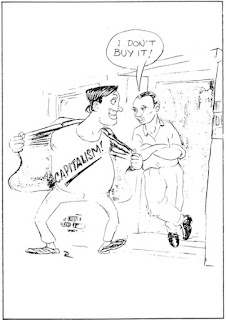
Cartoon by Peter Rigg.
Gavin Kennedy, in his book Superdeal, writes about how sellers are forced to be leaner and meaner if they are to survive. “The hungrier (the sellers) are, the faster they spend their money, preferably while in abject debt, the better they are at reaching their sales targets”. Psychological studies are mined for the help they can give to this process of exploitation. “All good sellers know that one of the most powerful selling closes is to play on the ego, or conscience, of the buyer. They shame you into a ‘buy’ decision".

Leaner and meaner
Fictional literature, which so often reflects real life, dramatizes selling. Willie Loman, in Arthur Miller's Death of a Salesman, epitomizes an ageing pawn in the capitalist game. Desperate to be liked by his potential customers, he is enjoined to "never fight fair with a stranger in the jungle". In the play Glengarry Glen Ross (now also a film) salesmen in a Chicago real estate office vie with each other to sell overpriced land in faraway Arizona, knowing that all but the two most successful of them will lose their jobs at the end of the week.

Buying and selling is the essence of the free-market capitalist system. That system has proved to be more efficient at producing wealth than the state bureaucratic or centrally-planned capitalist system. But at what human cost? It is sometimes claimed that workers’ co-operatives are the answer. But unfortunately these, too, have to work within the capitalist system. In the absence of socialist understanding, they are eventually overwhelmed by that system. The only way to end the exploitation and human degradation inherent in capitalism is to develop socialist ideas of production solely for use, so that corresponding practices may follow. Then buying and selling will be relegated to the status of a game of monopoly, amusing but nothing to do with maintaining a decent life.
Stan Parker

Saturday, November 28, 2015

The Theatre of the Absurd (1997)

Theatre Review from the December 1997 issue of the Socialist Standard

An Enemy of the People by Henrik Ibsen

Regular readers of this column may remember a less than enthusiastic review of Ibsen's John Gabriel Borkman last summer. Now we have more nonsense about nineteenth-century capitalism from the same author: a view of the world so patently absurd that it is surprising that the audience are prepared to take it seriously. But then most people who attend the National Theatre know that Ibsen has a serious reputation, and they react with reverence rather than disbelief.

I find Ibsen enigmatic. Plays like Ghosts, The Wild Duck, Hedda Gabler, and, perhaps especially, A Doll's House are full of insights about the unresolved tensions of family life, the oppression of women, and the hypocrisies which abound in bourgeois life. As credible representations of life in the nineteenth century they seem both psychologically astute and dramatically persuasive. And their resonance are such that it is easy to see their relevance for contemporary audiences.

But on a bigger scale, when Ibsen writes more directly about the impact of the wider society on people, he seems to get it spectacularly wrong. In An Enemy of the People we follow the fate of Dr Tomas Stockman, the medical officer of the spa baths in a small Norweigan town. The town's well-being is much dependent on the appeal of the baths to wealthy tourists, but Stockman has made an unfortunate discovery. The spa waters are polluted by a dangerous effluent from a nearby factory. Stockman sees this as an opportunity to upstage his brother, the town's mayor, and to increase his own reputation in the town by publishing a series of articles in the supposedly radical town paper. Predictably, mayor, factory owner and newspaper proprietor conspire to challenge Stockman's  evidence, and the mass meeting of tradesmen and shopkeepers which Stockman subsequently addresses is similarly more interested in tourism than the "truth". Isolated and enraged, Stockman turns and delivers a devastating critique not of the pernicious evils of a social system which puts profits and people's livelihoods before public health, but of the intelligence of the town's people.

The play is not, as the programme infers, a clash between "The Individual and Society". Rights and wrongs, in a moral sense, must always be informed by the facts of the case and by reasoned argument, and on the basis of the evidence presented in the play it isn't that Stockman is "right" and the townspeople "wrong". As far as we can see Stockman is clearly right about the spa being polluted, but grotesquely wrong in attributing the behaviour of the townspeople to a lack of intelligence. What they do is entirely consistent with, as they see it, their interests. They react, as people will and must do in a capitalist society, precisely in their own interests. Were Stockman the intelligent and principled man that he claims to be, he would have understood the townspeople's motives, and offered them a critique of their situation under capitalism rather than an absurd attack on their intelligence. His position seems to imply the existence of a superior intellectual elite, whose freedoms are being denied by the intellectually challenged. It is, in essence, a fascist, non-democratic position.

An Enemy of the People was first performed in 1882, more than 30 years after Marx and Engels had published The Communist Manifesto. And it prompts the question, "How can a playwright who is so astute about the motivations of people when they are locked in intimate family relations, be so ignorant of the larger world of which families are a part?" Ibsen's position is so extraordinary as to feel contrived. It is almost as thought he deliberately set himself up as an apologist of the capitalist class, intent on deception based on elitism.

On this evidence a plausible case might be made out that it is Ibsen who is "an enemy of the people". And yet I remember a stunning production at the Young Vic ten years ago in which Arthur Miller managed to suggest that it was capitalism rather than the stupidity of people which was at the heart of Stockman's dilemma. But then Miller described his work as an adaptation of Ibsen's text not a translation of it.

Not only is the play misconceived. In Trevor Nunn's production text has been sacrificed to movement. The sophisticated technology of the Olivier Theatre is very much to the fore. The stage revolves interminably, with actors still delivering their lines as they are whisked out of our view. At the slightest pretext the stage is filled with people, a brass band appears regardless of its spurious relevance, only to march off again. It's horribly reminiscent of another production — Nunn's dreadful Les Miserables.
Michael Gill

Monday, July 13, 2015

Venal system under scrutiny (1997)

Theatre Review from the January 1997 issue of the Socialist Standard

Death of a Salesman by Arthur Miller, National Theatre.

In the best television, cinema and theatre we can often observe people living out their lives in contemporary capitalist society, and sometimes we can learn lessons, vicariously, from their experiences. Nowhere can we see the process at work better than in the great plays of Arthur Miller, of which Death of a Salesman is perhaps the peerless classic.

Willy Loman is a salesman possessed of "the American Dream'. While some of the early settlers may well have had a heroic vision of a free and just society, "the American Dream" has, for most citizens, become a tarnished nightmare. But Willy is still a subscriber. Intent on becoming "number one", his vision infects not only his relations with his clients but also those with his family and friends, perhaps especially his two sons. The two acts of Death of a Salesman chart his fall and register its impact on those around him.

There is not a single explicit reference to capitalism in the play but everywhere the venal system is under scrutiny, and its dehumanising impact registered. Miller recalls in his autobiography Timebends that at the first night in 1949 an outraged woman called it "a time bomb under capitalism". And Miller adds, "I hope it was, or at least under the bullshit of capitalism, this pseudo life that thought to touch the clouds by standing on top of a refrigerator, waving a paid-up mortgage at the moon, victorious at last."

The play's greatness lies in its ability to present us with real people with whom we can identify, not to say emphasise. Willy's collapse envelops others in its wake, and we are all engulfed in the tragedy. Capitalism has claimed yet more victims.

There are some memorable lines—lines which bear witness both to the viciousness of contemporary capitalism and the triumphant ability of humanitarian feelings to survive and flourish, come what may. Willy's friend, Charley, remarks icily, "All you've got is what you can sell", and yet it is the self-same Charley who gives Willy money each week and observes on another occasion, "No man just wants a small salary on which to survive", the implication being that money is a counterfeit coinage for things that really matter.

The present production at the National is excellent. It is difficult to imagine anything better. At the end I cheered through my tears.
Michael Gill  

Thursday, March 5, 2015

Focus on Anti-Semitism (1959)

Book Review from the January 1959 issue of the Socialist Standard

Focus, by Arthur Miller (Ace Books, 2s. 6d.), is that brilliant playwright's first and only essay in the novel form. As with all his work, it is an impassioned tirade against a social evil—in this case, race prejudice.

Although the novel is ostensibly concerned with anti-semitism, the moral is clearly intended to apply to all forms of racial intolerance, as where the victim of anti-semitic bullying refuses to help a Puerto Rican woman who screams for help in the night. "She could take care of herself because she was used to this sort of treatment Puerto Ricans were, he knew."

Its principal character is Lawrence Newman, a less-than-ordinary middle-aged American who looks like a Jew, though he isn't one, and is ill-treated for it. Weak, conventional and wife-ridden, he has, however, a tiny spark of dignity and character; the story is of the development of this spark.

It leads from Newman's own persecution, to his talks with the victimized Jewish shopkeeper, down to the time when he finds himself side by side with Jews, fighting off thugs who are intent on beating them up. At this moment he throws off his fears and prejudices; he is able to ignore his wife's pleas to knuckle under, and at least to recognise his kinship with his fellow humans, Jew and gentile, black and white.

The story is told in a compelling and convincing manner, and although one feels the burning indignation of the Jew writing about the wrongs suffered by Jewry, the style never lapses into crudity, over-statement, or tub-thumping. The reader, too, feels indignation building up within him as Newman is subjected to one cruel indignity after another.

If this is an accurate picture of anti-semitism in American, and there is no reason to doubt that it is, then we have a long way to go before society finally eradicates the festering sores of race-hatred, along with its other problems.

Miller vividly portrays the poverty of thought and lack of understanding of those who would blame their poverty and drab lives on a racial minority, and seek to defend their "way of life" by anti-social acts. He clearly indicates that it is not they who are to blame, but rather the nature of the society which throws up these antagonisms and produces the racketeers and demagogues who foster race hatred to serve their own ends. This is not to say that Miller appreciates the revolutionary nature of the social change required to solve this problem, along with all other social problems.

Nevertheless, it is refreshing to find, among the flood of paper-backed detective stories, travelogues and war adventures, a book of this kind which deals in a serious way with a serious problem, and at the same time provides an absorbing story of real people in a situation which we can recognise as being true.
Albert Ivimey

Monday, March 24, 2014

A Social Critic In The Theatre (1957)

From the December 1957 issue of the Socialist Standard

No playwright has been "in the news," in the popular sense, of recent times to the extent of Arthur Miller. His personal contact with two of America's most famous institutions; Miss Marilyn Monroe and the Un-American Activities Committee, has put him before the public gaze in a way that his ability as a writer would not. But for this we might hazard that his name would never have moved beyond the small and inconspicuous criticism. It would be a pity if his achievements as a dramatic writer were obscured by his more publicised activities. This, even at the risk of appearing ungallant to Miss Monroe.

Writers of Mr. Miller's abilities are rare, and those who combine them with a zest for social criticism are even rarer. Arthur Miller therefore is a controversial playwright. He believes in the Theatre as a social force, and deals with certain subjects in a way that might easily incur him the censure of many of those people whom he approaches as an artist.

Such a position for the playwright is far more precarious than for the novelist behind the printed page; the novelist has a public, but no audience, whereas the playwright standing (albeit metaphorically) in full view of them, is on trial for his artistic life and living. For people are less likely to accept what they see and hear as a group, than what they read as individuals.

Among American playwrights of the present day, Arthur Miller occupies a high place. His first successful play All My Sons (1947) was an indictment of war-profiteering and the philosophy of self-interest. Two years later he wrote Death of a Salesman. Here Miller sets out to show the contradiction between what many Americans think and the way they actually live. The "Salesman," Willy Loman, is a failure who, when he is not lamenting his fate, is extolling the virtues of "go-getting," "know-how," and all the other baubles of American jingoism. It is a virulent condemnation of the American way of life with its fetish of personal success at the expense of other values, and well exemplifies the way people can make a religion of social dogma.

When Mr. McCarthy was at his most ebullient (1953) Arthur Miller used the circumstances of a previous witch-hunt in American history, that which occurred at Salem, Massachusetts in 1692, to illustrate in The Crucible how a whole community can be disrupted by fear, ignorance and superstition combined with official dogmatism. The analogy with the Senator from Wisconsin and his inquisition is unmistakably obvious. Here is the same tight-lipped philosophy, the same calculated fanaticism depicted in the character of Deputy Governor Danforth that we have come to associate with McCarthy.

Arthur Miller's dramatic essay, A View from the Bridge, has recently been seen in this country. It is doubtful whether those who do not belong to Theatre clubs such as the 'Arts,' will have the opportunity of seeing it, owing to the restrictions imposed by the law.

That Arthur Miller is no Socialist need not be stressed here. Social critic though he is, there is nothing that could even remotely be considered revolutionary in his work. Nevertheless, writers of his stamp do help to ease the dead weight of social complacency. Even if it is only fractional and relatively of little significance, they at least make a visit to the Theatre more exciting for us than most. We experience the cool breeze of dissent as opposed to the stifling humidity of uncompromising acceptance.

Like many famous writers before him, Arthur Miller has at one time gone the "way of the transgressor" and courted the perils of the road to Moscow. Like them, he has suffered the pain of disillusionment, which has left him a wiser, though not we hope, a sadder man. In his own words, "I had to go to hell to meet the devil."

Unlike them, it is to be sincerely hoped that he will continue in, and develop his aim as a social critic, at the same time enriching the world of drama, and not sit at home with despair on the other side of the fire gate; like Arthur Koestler—waiting for the white mushroom-shaped cloud.
Ian Jones