Showing posts with label June 1922. Show all posts

Wednesday, March 3, 2021

America – The Land of Bombast and Poverty. (1922)

Book Review from the June 1922 issue of the Socialist Standard

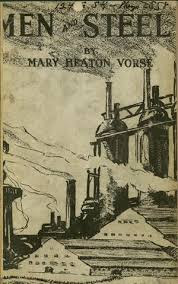
A Review of “Men and Steel,” by Mary Heaton Vorse—published by The Labour Publishing Co., 6, Tavistock Square, W.C. 1. Price 3s. 6d.

This is a book of 185 pages dealing principally with the American Steel Strike of 1918-1919. It is written in a rather rhetorical style, and, apparently, is the work of a visitor—a visitor whose emotions were stirred by the poverty and oppression she witnessed—who went to various districts and recorded impressions received, conversations, odd statements at meetings and descriptions of places visited and people seen. While a good deal of information is given as to housing conditions in the steel towns, and oppressive actions during the strike, there is little information as to the working conditions prevailing in the steel works. At the same time there is a good deal of useful information contained in the book.

On page 17 we are told :—
 "About one-half of the steel industry is owned by the U.S. Steel Corporation. These are the figures of the Corporation’s surplus :—


The “Total undivided surplus” signifies the surplus after paying dividends and setting aside large sums for other purposes. For example, according to a further quotation by the author from the Interchurch Report (same page), it appears that in 1918 the above corporation paid over 96 million dollars in dividends, set aside over 174 millions for Federal taxes due in 1919, and still had an undivided surplus of nearly 500 million dollars !

It will be observed that the undivided surplus has risen by over 200 per cent, in six years !

When, along with the above figures, we recollect the enormous amount of watered capital usually introduced into the actually paid up capital of such corporations as the above, we can obtain a faint idea of the staggering amount of surplus value robbed from the American steel workers by the steel magnates.

On page 26 we learn :—
  ” The United States Steel Corporation’s policy as regard labour dominates the steel industry.
  ” There are, roughly speaking, 500,000 steel workers in the United States.
   ” 191,000 employees work in U.S. Steel Corporation’s manufacturing plants.
   ” 32 per cent. do not make enough pay to come to the level set by Government experts as minimum subsistence standard for family of five.
   ”72 per cent. of all steel workers are below the level set by Government experts as minimum of comfort level set for families of five. That means that three-quarters of the steel workers cannot earn enough for an American standard of living.
    ”50 per cent. of the U.S. Steel Corporation’s employees work 12 hours a day. 50 per cent. of these work 7 days a week.
    ”Steel workers work from 20 to 40 hours longer a week than other basic industries near steel communities.
      ”American steel workers work over 20 hours a week longer than British steel workers.”(*)
(*) “Interchurch Report of Steel Strike.”
Twelve hours a day, seven days a week, for less than the minimum subsistence standard for a family of five ! And the steel workers, according to the author, are in the habit of having large families. It is a pity the author does not state the nature of “the level set by Government experts as minimum of comfort level set for families of five.”

Such are wages and hours in the land of “hustle”—the country to which the sweated slaves of Europe turn hopeful eyes, under the delusion that there they will be able to find the comfort and security denied them in their present surroundings. Many buoyed up by this hope have scraped together what enabled them to reach the hopeful West?—only to find disillusionment in such places as the steel towns. Experience is bitterly teaching the workers that the ugly head of capitalism is reared in practically every land under the sun.

The author of the book under review gives various descriptions of the Steel Towns. One such description is as follows :—
   “The mills of this town were on the flat river bottom. The old river banks mount steeply. The yards of the rickety frame houses slope sharply down. Melting snow had uncovered the refuse of winter. In the air was the sickly sweet smell of rotting garbage. The steep yards were surrounded by ramshackle fences. At the bottom near the street heavier things had slipped down hill—discarded bed springs, coal scuttles with holes in them, rusty pots and pans, old corsets, shoes, and more tin cans. In these towns on the Monongahela refuse and garbage are not taken away. For months it rots where it lies. Spring finds it there.” Page 27.
Here is another description, this time of the steelworkers’ dwelling places in Braddock :—
   “They live some in two-storey brick houses, some in blackened frame dwellings. One set of houses faces the street, the other the court. The courts are bricked and littered with piles of cans, piles of rubbish, bins of garbage, hillocks of refuse —refuse and litter, litter and refuse. Playing in the refuse and ashes and litter—children. The decencies of life ebb away as one nears the mills. I passed one day along an alley which fronted on an empty lot. Here the filth and refuse of years had been churned into viscous mud. A lean dog was digging. Pale children paddled in the squashy filth, and made playthings of ancient rubbish. Beyond was the railway tracks, beyond that the mills. Two-storied brick houses flanked the brick street. No green thing grew anywhere.” Page 33.
Such are the districts occupied by the workers, in filthy courtyards without running water, without conveniences. As the author points out these are the only places they can occupy.
  “If a man is working in the Edgar Thompson Works, he must live in Braddock ; if he is working for the Carnegie Steel Co. in Homestead, he must live in Homestead. If you look around and try to hire a better place, you will find there is none.”
Many of the people who live in these “salubrious” surroundings have come from European villages. They went to America with high hopes, but their hopes and their health were smothered in the smoke and filth of the steel towns.

The power of capital over the lives of the workers is illustrated in a multitude of ways. The following quotation will give an idea of how the much vaunted “democracy” of America works in actual practice : —
   “The men who own the steel mills and the mines and the railways that brought the steel ore down to the water-front and the boats that carried it across the lake, own other things in Alleghany County. They control the law courts. The mounted state police are at their call. The political power—with all burgesses and sheriffs— they own also. In the steel country government is. possessed nakedly by those iron and steel masters and their friends.” Page 49.
In September, 1918, the steel workers struck. Now we have often been told of the way the Americans “get a move on things,” but an examination of the strike demands show that this evidently does not apply to the American workers. The demands illustrate a condition similar to what was general in England before the Factory Acts. The plentiful supply of emigrants to the “New World” kept flesh and blood relatively cheaper in America. It is only in the last twenty years that the American Capitalists learnt how much new men cost; the expensiveness of the shifting and ebbing of labour; the poorness, from a productive point of view, of a discontented and disaffected labour supply. Previously, in the tear and rush and scramble for wealth, they took no note of these things, but experience has at length forced this knowledge upon them, and so they have spent millions of dollars on welfare work.

The demands put forward by the striking steel workers were as follows :—
  ” (1) Right of collective bargaining.
  ” (2) Reinstatement of all men discharged for union activities with pay for time lost.
  ” (3) Eight hour day.
  ” (4) One day’s rest in seven.
  ” (5) Abolition of 24-hour shift.
  ” (6) Increases in wages sufficient to guarantee American standard of living.
  ” (7) Standard scales of wages in all trades and classification of workers.
 ” (8) Double rates of pay for all overtime after eight hours, holiday, and Sunday work.
  ” (9) Check-off system of collecting union dues.
 ” (10) Principles of seniority to apply in the maintenance, reduction, and increase of working forces.
 ” (11) Abolition of company unions.
 ” (12) Abolition of physical examination of applicants for employment.” Page 50.
Further comment on these demands is hardly needed, they speak for themselves, particularly 1, 4, 5, 6, 11 and 12.

Three hundred thousand steel workers came out on strike. Their organisation was poor; the companies controlled all news and the only means the workers had of finding out how things were going on in other districts was by the receipt of an occasional strike bulletin or, still less frequent, the visit of an organiser. Strike meetings were generally prohibited, strikers and sympathisers victimised. The constabulary was given a free hand and thousands of strikers were battered and thousands spirited away to prison to await a charge which was never preferred. The espionage system was in swing.

According to the Author the strike was killed by silence, by violence, and by the ultimate defection of one of the American skilled workers’ unions. The latter point is one upon which we have not sufficient information to form a judgment. Terrorist groups, under the name of citizens’ committees, also played their part in assisting to smash the strike.

Unfortunately the Author’s style prevents her from setting forth the facts of the situation in such a way as to enable us to form an accurate judgment of the immediate cause of the strike, its possibilities of success, and the reason for such a complete collapse in face of such solidarity at its commencement.

Of the strikers the Author writes :—
   ”They were without strike discipline, they were without strike benefits ; they were communities where no strike meetings were allowed to be held, some of the men never heard a speaker in their own language during all the strike.” Page 58.
Of the activities of the masters we learn :—
  “When the men struck violence by the police increased. The Constabulary had already become active. Now the state troopers appeared in all the steel towns. They broke up meetings. They rode their horses into the workers’ very houses. In Braddock no assemblies of peoples were permitted.
  They rode down men coming from mass. Steel workers could not assemble. They chased the children of Father Kazinci’s parish school.”

*********

  “The idea seemed to be to terrorise the workers. There were besides deputised gunmen, Workers were arrested by the hundreds, held, and no charges preferred against them. Then they were fined.” Page 63.

  “The stories of beatings and arrests came in an endless flood. There was no end to them. Within two days one was drenched with them. In three days one was saturated. They made no more, impression. They became part of life.” Page 67.
We think we have now given a fair sample of the contents of the book under review. There are many tales of the patience and self-sacrifice of the strikers, but we have already overburdened this review with quotations.

To those who agree with “the right of the employer to do what he likes with his own,” it will give some staggering information. Generally speaking it is worth reading to obtain an idea of some of the methods used by the employing class of America against the working class of that country. It might help to remove the clouds from the minds of those who exalt “Republican America” over “Monarchical England,” and help to teach them that where capital goes, whether to Republic or Monarchy, there goes also its shadow—slavery and misery.
Gilmac.

Tuesday, March 2, 2021

Light on Communist Policy. (1922)

From the June 1922 issue of the Socialist Standard

It is with a certain interest, not to say unfeigned delight, that I learn from Max Eastman (Liberator, April, 1922), that E. T. Whitehead, of the Communist Party of Great Britain, is “inclined to believe “that in the last few years” an unusual number of other-regarding spirits have been thrown down into the physical sphere “from some haunt of the disembodied ! He believes this because it is “more likely to be true than not.” This credulity perhaps explains Whitehead’s little vagaries.

Max Eastman facetiously suggests that the American Communists “solve their problem of perfection by organising a party on the astral plane to control the one which now controls the visible manifestation.” I should be sorry to rob Max Eastman of the credit due to the originator of so charming an idea, but I fear he is too late. It has already been done here. I have tried hard to keep up with and understand the erratic moves in Communist policy, never realising until now that I was following a will-o’-the-wisp, not the product of gross human minds, but of ghostly Third International “pixey wixies.”

For alas, even out of the physical sphere conflict reigns. There are other sources of Communist inspiration; for instance, the much older firm established long before Theosophy raised its upstart head. In the Evening News (27th March, 1922) I read that “at a confirmation service last evening at St. John’s Church, . . . over 40 Socialists and Communists, members of the Church of England, were confirmed by the Bishop of Whalley.” I can’t vouch for the accuracy of this report, but like Whitehead “I am inclined to believe it” about members of the Communist party because “it is more likely to be true than not.” A writer in the Communist recently waxed merry over the untutored person who described them as “communionists.” On second thoughts I think the apparently ignorant one must have known something.

A correspondent of the Daily Herald (31st Dec., 1921) relates how the South Shields Branch of the Communist Party had “a clay bust of Lloyd George with horns” before which apparently they discussed business.

Here are a few other things to be accounted for only by the hypothesis I have accepted. At the Communist Party’s recent policy conference a resolution was introduced which affirmed that “It is our duty also to strive for the formation of a Mass Party . . .” Eden and Cedar Paul reporting the conference in the Workers’ Republic (8th April, 1922), say “The discussion . . . turned on the question as to what was really meant by the Third International slogan of the Mass Party.” However, although “the discussion seemed to leave unsolved the problem precisely what the Third International means by a Mass Party,” the resolution was carried. Puzzling, you say? Not at all : they knew what it meant on the astral plane.

From the Communist (25th March) I find that the Communist Party’s “historic mission” is “the leadership of the working masses — — — .”

Of course, the “working masses” already have leaders, heaps of them, but these it seems are not good leaders : “Watch them,” say the Communists.

Why are they not good ones ? One reason say the Communists is that they have lost contact and sympathy with the rank and file.

But E. and C. Paul, two of the stars, say “the official group (of the C.P.G.B.) unfortunately consists of persons who have become professional politicians and are removed thereby from the activities of working class life” and “the slogan ‘ watch your leaders ‘ is as necessary in the Communist Party as in the Trade Unions.” (Workers’ Republic, 8th April).

Not only that but although Stewart says a mass party “takes leadership of the masses, not by going back to where they are, but by taking them from where they are to where they ought to be,” his fellow member Brain says “they had found by experience that the workers did not come out of the craft unions to the revolutionary movement; they stayed where they were. They would not come out so the Communist Party had to go to them.” (Communist, 25th’ March).

(This points to physic communication with Mahommet, who solved a little problem of his own on just such lines as these).

Some there were like Leckie who thought that it was the party which was going to lead the masses and therefore wanted in it “only those who really understood Communism.” This of course was absurd. What has the Communist Party, the party of “action” to do with an understanding of Communism? Murphy is of the opinion that “only a small minority of our party has any idea of the significance of the mighty task before us” and as a writer in the Worker’s Republic (official organ of the Communist Party of Ireland) remarked, not only do they not understand now, but lots of them never will; the revolution will be here before that can happen !

No, it is evidently the “professional politicians” who are to lead: “It is one thing to call upon the Party leadership to give the lead, another thing to put into operation that leadership.” (Murphy.) While Walter Newbold favours affiliation to the Labour Party, but temporarily opposes it, because he believes “that at this juncture we have not had the constituent parts of the Communist Party sufficiently long together, we have not welded them sufficiently into an intelligent party understanding the implications of political action for us to be able to take them as a. party into the Labour Party.” (Communist, March 25th). (Italics mine).

Excellent advice that “Watch your leaders”—for the members of the Communist Party.

As for Labour Party affiliation it is interesting to note that while the Communist Party proposes to insist on “freedom of criticism and freedom of action,” inside the Labour party (if it gets in), a Daily Herald correspondent writing on the L.C.C. elections stated with regard to Inkpin, who, although a Communist, ran as Labour candidate, that “it should be clearly understood . . . that Inkpin has definitely agreed to the Labour programme and will act in accordance with Labour Party decisions if desired.” (28th February, 1922).

It is all now perfectly clear. The “working masses” will watch their leaders, on the advice of the Communist Party. The latter’s members will watch their leaders on the advice of Eden and Cedar Paul. While the leaders themselves will have their eyes fixed on Whitehead’s hobgoblins and other divine and satanic sprites who sit up aloft and watch over the tribe of Labour fakirs !

Could the revolutionary movement be in better hands than these?
R. Bird

Phaëton: Fragment of a Conversation. (1922)

From the June 1922 issue of the Socialist Standard


You Socialists (said the Apologist for the Present Social Order) make the mistake of thinking that capitalism is evil in itself.

Nothing (said the Socialist) is evil in itself. It is in our judgment only that things appear as good or evil. Hamlet’s “There is nothing either good or bad, but thinking makes it so,” is sound philosophy. Capitalism is therefore good in some men’s eyes, evil in others ; and it is in the nature of things that it chiefly seems good to those who benefit by it—the masters, and evil mainly to those who suffer by it—the workers.

But it is not a philosophical point that I wish to make (explained the A. for the P.S.O.). I wish to suggest that what you and I as workers regard as evils are the fruit of human failings, which would give a similar crop of evils under any other system.

The truth (replied the Socialist) is precisely the reverse. Within capitalist society, let men be never so desirous of harmony, they cannot but collide in the process of producing wealth ; in the socialist commonwealth, let a minority be ever so rapacious, it has not the means to enslave the majority as now. This is not to say, however, that the socialist pronounces capitalism purely evil. On the contrary, he holds that each succeeding organisation of society was necessary to the development of man’s power over Nature—capitalism among the rest. From the point of view of human progress it is therefore good, until it has served its purpose, and becomes a chain instead of a means of advance.

That time has now arrived.

The old Greeks had a story of Phaëton, son of Phoebus. He would drive the chariot of the sun, which daily moved across the firmament and shed blessed beams upon the world. But the eager steeds disdained his control; and the unguided car, sweeping too near the earth, blasted the life it was designed to nourish.

Economic teams have their Phaëtons too.

The continuous improvement in methods of production extracts an ever-richer return from human labour : makes highly productive even the labour of the weak and unskilled : makes possible that mass production which might minister to the sustenance, the culture, the leisure of mankind. But these forces capitalism, though it has fostered, cannot fitly employ, because it is ultimately concerned not with satisfying human needs, but with selling for profit. So they operate to create surfeit on one hand, emptiness on the other, and run to huge surpluses which compel spasmodic interruptions of work. Like the radiant, mythical horses they plunge and strive. Misery and death are in their track, where life and joy should be.

Socialism will harness them better.
A.

£1000 Fund. (1922)

Party News from the June 1922 issue of the Socialist Standard 


The Story of Mr. Penny. (1922)

From the June 1922 issue of the Socialist Standard

Happy the man who can reflect that when the call came that his King and Country needed him, he was not found wanting. Virtue may have to serve as its own reward in many spheres, but the motherland has never been a niggard in giving her gratitude a tangible form. True, something like a million gave their little lives when called upon; but are not their names inscribed on multitudinous war memorials at every street corner? Are not their sorrowing dependents saved from the wolves of poverty by kindly Pensions Boards?

Some, by bodily infirmity, or other disability were prevented from meeting the hated Prussians face to face. To these fell the humbler task of defending the domestic hearth from the depredations of domestic Prussians. Take the case of Mr. C. E. Penny, as recorded in the Daily Mail of April 13th, 1922, under the caption, “Man who broke a Strike.” When the supreme call came in 1914, Mr. Penny joined the Royal Army Service Corps, but invalided out within a few months, volunteered for the Civil Service. In the strenuous years that followed it was he, who on behalf of the Ministry of Food, prosecuted nearly 50,000 profiteers. This should have been enough to earn imperishable glory for any man, and at least a humble niche in the National Valhalla. But his most brilliant work was yet to come. During the railway strike of 1919, “it has been said that it was the marvellous transport scheme which he evolved that broke the strike.”
  “He had a genius for organising transport. In his little office he had a table resembling genealogical trees, and poring over these various lines of lorry transport he saw that no department went unprovided for. The rest of his time was spent in visiting every corner of the country during that strenuous period.”
Can any reward be too high for a man like that? Well, yes, it can ! There are certain recognisable and reasonable limits. He was given a position in the Board of Trade’s Food Department. Here at last he could rest upon his laurels, assured at least of a competency and comforted in the tangible recognition of his country’s gratitude. But alas, the Daily Mail, with a brevity almost brutal, tells us in the same sentence, that “he left about a month ago owing to departmental economy.”

The worst is to tell. He left his boarding house in Clanricarde Gardens on April 7th, and left a note in which he stated he was one of the thousands of workless and penniless men. He was found dead in bed in an apartment house in Brighton, with a tube attached to a gas bracket in his mouth. Let it never be said that Capital forgets those who serve it well and truly in its hour of need !
W. T. Hopley

Monday, December 23, 2019

Letter: Currency Illusions. (1922)

Letter to the Editors from the June 1922 issue of the Socialist Standard

To the Editor,

Dear Sir,

I am writing on a somewhat perplexing subject, that of Currency. The views of Noah Ablett which I present here, are in my opinion not Marxian, and I shall be obliged if you will give your comments and endeavour to throw some light on the question.

In Easy Outlines of Economics on pages 49 and 50, under the heading "The Paradox of Paper Money," he states the following theory :—Given a certain amount of commodities the quantity of gold which can remain in circulation is definitely limited; but if gold is replaced by paper, the quantity of paper money which can circulate is not limited. Consequently, if the quantity of money required in circulation is one million sovereigns, and two million pound notes are introduced instead, then the commodity previously valued at £1 will want two one pound notes in exchange; if another million notes are introduced the £1 commodity will want three notes in exchange and so on. Ablett explains this by saying that the laws of currency have been violated. Now I understand him to mean that the prices of commodities are determined by the excessive number of notes in circulation, which to me appears to be a negation of the labour theory of value, on the basis of which alone I had thought prices understandable.

To illustrate this, let us take any two dissimilar commodities; for instance, a pair of boots and a bicycle. We know that both are useful and have shape, weight, and colour, but when we put them in exchange relation we find that none of the above attributes can determine how the value of one corresponds to the value of the other. Examination however shows that they have one thing in common, they are both the products of human labour. This provides the rod with which to measure their value, just as distance is measured with a foot rule.

The use of a universal equivalent, e.g., gold, as a measure of value, enables all commodities to express their value in exchange, in one substance; that is, it gives their price in money terms. This serves instead of expressing the value of each commodity in so many hours of labour time necessary for their production. If in our example a pair of boots cost £l, and a bicycle £8, it is at once seen that these different prices represent different values.

Now, if on the introduction of an excessive issue of notes we have to give £2 and £16 for boots and bicycle, where previously we gave £1 and £8 respectively, what will have happened? One of three things must have taken place. Either (1) the value of the boots and the bicycle have increased; also the value of the sovereign measured by Treasury notes, but the value of boots and bicycle to a far higher degree, or (2) the value of gold has fallen, while the values of the boots and the bicycle are the same, thus necessitating more gold in circulation and a higher price for the boots and the bicycle, or (3) the value of gold is the same, but the value of the boots and bicycle have increased.

While I agree that only a given quantity of gold can circulate, I do not see how an unlimited quantity of notes can remain in circulation. An excess of notes, like an excess of sovereigns over the quantity required for circulating the commodities, would lie idle in the banks.

Anyway, if the high cost of living is a result of the so-called excess of notes in circulation, how is it that the Treasury note will buy as much as the sovereign? Again, in the United States of America, where there is a gold medium, we find the cost of living as high as it is here.

Finally, I am told that Marx in Capital, volume I., page 144, (Kerr), under the heading of "Coins and Symbols of Value," deals with Noah Ablett's point .in this way :—If the quantity of paper money issued be double the amount required, then as a matter of fact, £l would be the money name, not of a quarter of an ounce, but of one-eighth of an ounce of gold. The effect would be the same as if an alteration had taken place in the function of gold as a standard of price. Those values that were previously expressed by the price of £l would now be expressed by the price of £2. I ask for information on this point : What does it all mean?
Yours for Socialism, 
Edward Littler.


Reply:
In no subject, except perhaps that of religion, is mankind so prone to accept statements without enquiry or examination, as in the matter of money. As Marx says, "the wildest theories" prevail upon the question. An illustration from present circumstances will show how easy it is to mislead people on this matter.

When prices were at their height, shortly after the war, one of the "explanations" put forward by the Capitalist Press, and repeated by Labour College writers and members of the Labour Party, was that the rise in prices was largely due to "the inflation of the currency." In both articles and correspondence in the Socialist Standard, we have pointed out the falsity of this claim, and have shown that, both from the quantity of currency notes issued compared with prices, and from the fact that the "Bradbury" is convertible, no inflation has taken place.

Money as a measure of value and a medium of circulation, is a necessity under a system of commodity production on a large scale. It is the "universal commodity," set aside for the above purposes in a system where private ownership of the means of life is the ruling factor. Hence, the futility of all the schemes that attempt to solve the social evils by juggling with one item, the currency, while leaving the others intact. As money is a result of the private ownership of the means of life, it is obvious that it cannot be abolished until the cause is removed.

The commodity in general use as money, in the western world, is gold. On the average, the amount of gold exchanged for a given commodity is the quantity that has taken the same amount of social labour time to produce as the commodity has taken. To guarantee the unit of money as to quality, weight, etc., it is issued under Government control.

Inside any national boundary where social conditions are fairly stable, it is easy to replace gold with tokens or symbols for purposes of circulation. In fact, in every country with a "gold standard," metal tokens, usually silver or copper, are used for purposes of small change. Paper notes may also be substituted inside a particular country. In general, this paper is issued under one of two systems.

In one system, such as prevails in this country to-day, the notes are "convertible" into gold upon demand at some central institution, like the Bank of England. It is easily seen that, so long as the promise to pay gold holds good—or is believed to hold good—the notes will exchange at their face denomination, and no inflation of such a currency can take place.

Under the second system, the notes are issued as "legal tender," without any promise to redeem them in gold. This is called an "inconvertible" issue. Inside the national boundary, and for home produced commodities, these notes function similarly to the "convertible" ones, and their issue has no particular effect upon prices under normal circumstances.

Outside of the country issuing notes, the position will depend upon certain other factors. First of these is the confidence of the outsiders in the promise to pay gold in the case of the "convertible" notes. Where there is full confidence in this promise, the notes will circulate at their face denomination, less the amount required to cover the cost of carrying gold to the country in question. If this confidence is lacking, the degree in which it falls below "full" will be shown by the rate of exchange.

With "inconvertible" notes, the matter is somewhat more complicated. These notes will be taken at their power to purchase gold or goods in the world's markets. It is at this point that a great confusion of thought exists on currency matters.

An examination will show that the power of purchase possessed by these notes is based upon the resources of the country issuing them. If the notes are issued in such quantities that their face denomination exceeds these resources, their power of purchase abroad will fall in a similar ratio. This brings forward the factor that has confused Mr. Ablett and so many writers in the Capitalist Press—the factor of Credit.

When Mr. Ablett states (p. 50): "Governments may easily inflate the currency by printing pieces of paper," it is a pity he does not state what they could do with this paper when printed. Moreover, he has been refuted in principle, as long ago as 1682, when a certain writer stated :—
  If the wealth of a nation could be decupled by a proclamation, it were strange that such proclamation have not long since been made by our Governors.
This writer was the famous William Petty, and the above quotation from his work is given on p. 73 of Capital. (Sonnenschein.—ed.)

As Mr. Ablett, probably for quite good reasons, fails to give any description of the functioning of a paper currency, a short account may be useful here.

If the government of a country with an inconvertible paper currency requires certain commodities, such as guns or battleships, it may order firms in its own country to build them, or it may order them from abroad. In the latter case, it may offer to pay in its own currency—if necessary, printing the notes for this purpose—but this would not be inflation, as the currency would only be issued to the amount of the prices to be paid. To the firms supplying the commodities, the notes would be useful only so far as they would purchase gold or goods in the world's markets at their face denomination. If the government were to order goods beyond the capacity of the taxes to meet the bill, then their credit would fall, and their notes—as they stood, without printing a single one extra—would fall below their face denomination outside of their own country. The printing of more notes to meet this fall would not alter the situation, or the price level of the notes. It is this extension of credit that the would-be experts confuse as an "inflation" of currency.

The government in question might purchase gold with its notes, to pay the bill, but of course the more usual way is to issue bonds for the amount, on the taxes of the country, and pass these bonds through the banks and financial houses.

The huge increase in demand, accompanied by an enormous extension of credit, that has taken place between governments and firms, during and since the war, has been the great cause of the rise in prices. Such rise has necessitated a large increase in the currency to' meet the demands of business. This obvious fact has been inverted in the minds of the shallow apologists for Capitalism, who claim the rise in prices has been due to "the inflation of the currency."
Jack Fitzgerald

Tuesday, February 27, 2018

Has Trade Unionism Failed? (1922)

From the June 1922 issue of the Socialist Standard

In the "Penny Pictorial” (4th March), Lord Askwith gives his answer to this question. He writes as an "expert"; for, as chief Industrial Commissioner, 1911—1919, he negotiated in more than 100 trade disputes, and whatever his knowledge of Trade Unionism, he must know a great deal about the Trade Unions. Nevertheless, his answer does not add to the discussion much that is likely to be useful or illuminating to the many workers, who, while equally interested, lack his special experience.

It is really not surprising that Lord Askwith’s statement is unsatisfactory, because he never troubles to explain the object of Trade Unionism, and without that in mind, how can it be decided whether or not there has been a failure?

It is remarkable that such an omission is made, for it must be clear, after a moment’s consideration, that unless there is an accepted basis of judgment, in this instance the aim which brought the trade union movement into being, there can be no useful discussion, and the only criterion possible is Lord Askwith’s own view of what Trade Unionism ought to have done. For instance, if a number of people joined together to bring the heathen to abstain from cannibalism, Lord Askwith might examine the evidence and make the charge of failure if, after years of preaching, the heathen were still eating missionaries; he could not, however, allege failure merely because they killed the missionaries, although he personally and many of the members (the missionaries included) objected equally strongly to murder.

The only measure of the success or failure of trade unionism is the progress made towards its goal, whatever that may be.

Lord Askwith points to the following, which appear to him to be signs of failure: Recent falling membership, exhaustion of funds, the hampering of trade by working restrictions, unemployment, direct action, lack of co-ordination, strikes instead of conciliation, and the consequent raising of prices, and lastly, in his eyes doubtless the most serious, the failure of some unions to "lead the way” to lower wages! On the other hand, he notes with approval the more orderly conduct of strikes, fewer strikes, amalgamations, and better informed members.

Now on examination, we find that this is not so much the success attained for trade unionism, but the methods particular unions have adopted, and the difficulties of maintaining effective organisation, with which Lord Askwith concerns himself. These might be causes of failure, if there has been failure, but they are certainly not evidence that there has been failure.

While the organisation of the workers is a necessary activity for trade unions, it is not an end in itself, and loss of members, while it may reflect on the wisdom of certain policies, is not a proof of the failure of trade unionism. It may, for example, be caused by general trade depression. It may be remarked here that had the trade unions not lost in membership, there might as a consequence have been more strikes and greater resistance to wage reductions, yet Lord Askwith classes together loss of members and too many strikes as signs of failure.

Again, it is doubtful if even the most anti-working class of the trade union officials would proclaim wage reducing as an object of organisation.

As for the few things which meet with his approval, even if good in themselves, Lord Askwith does not show them to be the conscious product of trade unionism.

In short, he does not seem to be able to help us much, and we must go elsewhere for information.

First, what are trade unions, and why do they exist? Sidney Webb defines a trade union as “a continuous association of wage earners for the purpose of maintaining or improving the condition of their working lives.” To understand their origin, it is necessary to have a clear idea of the conditions from which they spring. They are found to grow up wherever and whenever the capitalist system of society comes into being. Capitalism has not always been, and is, in fact, of only recent development in human society, and the rise of the trade unions coincides nearly enough with the industrial revolution which marked the change from individual handicraft to large scale factory production. As Capitalism extends its area over the hitherto undeveloped countries, Japan, India, and China, for instance, so do the workers, whose status is more or less violently upset by the changing economic conditions, combine to form trade unions.

The outstanding features of the capitalist system are these: The ownership by a class small in numbers of the bulk of the means of producing wealth, the land, the railways, mines and factories; and the total absence of property from the hands of the remaining members of society, the great majority. The wealth by which both classes live is produced by the larger class only, by the workers; but the latter may not use the means of producing wealth except by permission of the capitalists who own them. The condition of such use is that the capitalists who produce nothing own the whole of the product. Of this they return a relatively small part in the form of wages. The capitalists are able to live on the wealth which they do not produce, because they own the machinery of production, while the workers, being propertyless, must sell their bodily energies for wages.

We have here a dominant and a slave class, the gulf between them being no less marked than that between chattel slave and slave owner. The main difference is that the wage worker faces the employing class apparently as an equal, because he has the political status of a citizen. He, the seller of his labour power, and the employer, the buyer of his labour power, dispute about the price of sale as do buyers and sellers of other commodities, but with important differences. He, the worker, must sell his commodity week by week or month by month, or he will starve, whereas the merchant who sells goods can usually wait his time without being subjected to the pressure of dire necessity. He can diminish or stop production if the market is unfavourable, but the worker cannot stave off the pangs of hunger until a more fitting opportunity.

Now, just as boot manufacturers combine to keep their prices up, instead of competing with each other, so workers organise to raise or maintain the level of their wages. Where one man is helpless, a body of men may succeed in enforcing certain demands on their employers.

These organisations are trade unions. They are the product of capitalism, and are to be found wherever capitalism is. They could not arise nor continue except where the capitalist organisation of society prevails.

Now “maintaining and improving the condition of working lives” covers a wide field indeed. It has included raising wages, shortening hours, bettering workshop and factory conditions, obtaining more holidays, and, shortsightedly enough, preserving restrictions which are held to protect certain skilled crafts. Perhaps that which loomed largest in the minds of the early trade unionists was simply the desire for a shield against the ruthless exploitation to which they were subjected in capitalism’s early days. Now, has trade unionism done these things? A brief examination of the facts will show to what extent it can be said to have failed. It is only needful to give a few illustrations, which, however, are typical of the position all over the capitalist world.

Take this country first. Real wages, that is, the amount of food, clothing, etc., that money wages will buy, have fallen during the war, and are now generally less than in 1914, which again showed a decline on the closing years of the nineteenth century. While shorter hours have been won during the war, an attack seems to be brewing to bring about an increase again, and in many industries concessions have already had to be made. It is frankly admitted by Sidney Webb, in his “History of Trade Unionism,” that trade union restrictions lost during the war were not regained in anything like their entirety afterwards; as he tersely puts it, the workers were “done.” There is at the same time a constant endeavour by employers to remove protective machinery set up by Act of Parliament to deal with wages and conditions of labour. The Factory Acts themselves are in undoubted danger. Skilled craftsmanship is now rapidly ceasing to give a guarantee of comfort and security, a tendency hastened, no doubt, by the experiences of the war period in the employment of labourers on tasks hitherto regarded as the province of trained men only. The A.E.U., in its October, 1921, Report, admits that during the war, ‘‘the average time rate of the skilled fitter and turner never kept pace with nor equalled the increased cost of living.” (‘‘Industrial News,” March, 1922), and the Boilermakers’ report for September of the same year contains this: ‘‘It took us six years to get 100 per cent. on wages, with the cost of living on an average of 133 per cent, up over the whole period.” Again in 1851, the A.S.E. (now the A.E.U.) was demanding : (1) The abolition of piecework; (2) the abolition of overtime, and (3) the discharge of labourers on self-acting machines, while in 1922, 71 years after, the officials of that union are recommending their members “ to accept an agreement recognising the unlimited right of the bosses to control overtime. The operating of machines by ‘semi-skilled' labour is involved, so also are the piece-work prices for such operating ” (“Industrial News,” March, 1922).

Lastly, there are 2,000,000 workers out of regular employment, and the fear of dismissal is an ever present nightmare in every trade. It is this prevalence of unemployment which is at the same time the terror of the worker, the goad which makes him organise, and the immediate cause of the weakness of his organisation. No trade union can successfully fight unemployment. The latter is a necessary feature of the system inside which trade unions function, and it marks the limit of their usefulness.

In America, the standard of living in 15 chief industries has been declining since 1896; between 1896 and 1907, by 6 per cent. and over the whole 24 years to 1920 by nearly 25 per cent. (“American Economic Review,” Sept., 1921). America, too, has its 6,000,000 unemployed. This is, in fact, a common experience in the victorious as well as the defeated and neutral nations, in spite of the fact that in 1920 the number of workers organised in trade unions reached a record figure, and represented a much higher percentage than ever before of the total number of wage earners.

Wages are still rapidly falling, without hope of a break, and even the most solidly established unions cannot hope to resist effectively. The engineers are crippled by unemployment, the miners shattered by unsuccessful strikes and the decline of the coal trade; the railwaymen forced to accept merely with protest dismissals and wage reductions. The unskilled and agricultural unions, and others who had artificial growth stimulated by the war-time labour shortage, and by the setting up of Wages Boards, Trades Boards, etc., by the Government, have to face disastrous withdrawal of members, discouraged because unable to understand the failure of their officials to prevent wage reductions. The position is desperate, and, owing to lack of real knowledge of the system of society, some of the effects of which they are organising to counteract, the workers as a whole are apathetic and despairing, of the future.

Can we then agree that because the workers' position is wretched, that trade unionism has failed? By no means. The wretchedness is the outcome of the exploitation to which the workers are subjected inside the capitalist system, and it can with truth be said, therefore, that trade unionism has not touched the root causes of the evils which it fought. As against that, however, the workers' position could and undoubtedly would have been much worse than it is if they had not had what protection their trade unions did provide. Furthermore, it would indeed be suicidal to discard the existing weapon while the need for it continues.

Yet the fact remains that the workers are still wage-earners without comfort or security or hope of advancement.

What is the cause and the remedy?

We may first reject most of Lord Askwith's brilliant notions. A recognition of the class division in society shows them to be untrue and often simply ridiculous.

The capitalists as a class do no useful work in the social production of wealth, but by virtue of their being owners of property they draw revenue from the mass of wealth produced.

The more they receive, the less there remains for the workers, and vice-versa, at any given moment.

The relative amounts will depend on the amount of pressure each side can apply in the constant struggle.

Unemployment is a necessity for the continued existence of the capitalist system, for the removal of its cause would mean the cessation of the production on a capitalist —that is, a profit-making—basis.

The advocacy of conciliation instead of strikes is based on the foolish idea that there can be an ideal basis of negotiation between Capital and Labour, between robber and robbed. Each is, in fact, entitled to what it can get, and as external circumstances, trade prosperity, and the condition of the labour market change, so must the quantity of force at the disposal of each of the combatants change. Permanent equilibrium is therefore impossible, and perpetually recurring disputes inevitable.

Lastly, prices are dependent on factors which are not directly altered by variations in wages, as is implied by Lord Askwith. A seller will ask as much as the market will stand, and the condition of the market is not directly affected by the payment of an increased wage to his operatives. For instance, according to the Royal Commission on Grain Markets (Saskatchewan, 1913), the average cost of producing wheat in Canada in 1909 was 48 cents per bushel and the selling price 81 cents. Both cost of production and prices showed a steady alteration during the four following years, and in 1913, while cost had risen to 55 cents, the price had fallen to 66 cents. 

Again, it does not even follow that the cost to the manufacturer is increased by the raising of wages, as the increased wage per head of the employees may be balanced by a reduction in the number employed, while at the same time the introduction of improved machinery correspondingly raises the output of each worker. If the cost does rise, then the employer’s profits suffer.

There are other explanations offered. The form of organisation is attacked, and industrial unionism and workshop committees, etc., are held out as remedies. Now while it is agreed that the present unions have not made the most effective use of their power during or since the war, no change of form can solve the problem of unemployment. No industrial organisation can hope to meet with success the state forces at the disposal of the employers, or wring appreciable concessions at a time when there is a great excess of workers over the number the employers are prepared to engage, or when trade is so bad as to make it more economical to a considerable section of capitalists to close down altogether, or severely to restrict production. Solidarity alone is not an effective defence against the weapon of starvation.

Then it is alleged that many officials are traitors to their members, but the treachery of certain labour leaders cannot disguise the fact that the pressure of the overstocked labour market so far affected the masses of organised workers that they did and still do loyally follow these betrayers, accepting as correct the necessity for their actions and the reasonableness of their explanations. Treachery in leaders is itself an effect, and not an important cause of failure. J. H. Thomas is a wolf because his members are sheep he is also a particularly bold wolf, because he knows his members have a powerful liking for his howl. J. H. Thomas is a defender of the capitalist system, and its mascot the monarchy, because he knows his members are also defenders of the capitalist system. He attends court functions because his members are still more interested in the wedding of “our Princess ” than in the starvation and humiliation which wage slavery means for them and their daughters. Leaders are followed because they say and do those things of which members in the main approve. The members approve because the capitalist press approves, and the press is their chief source of information. Does anyone believe that the workers would follow a lead in an opposite direction against their present inclinations, and in face of opposition from all the organs of capitalist propaganda? No, not if Thomas himself led them. While leaders have jobs to consider, they will play for safety; that is, as long as there are workers who, lacking knowledge, wish to be led.

In workers organisations, as in modern states, only those actions and policies are in the last resort possible which meet with the active approval or at least the acquiescence of the rank and file. The moonshine of the theory of leading the masses to revolution is sufficiently exposed by its adherents, Eden and Cedar Paul, in the “Communist Review,” March, 1922, where they write of Russia in these words :—
   “Despite the dictatorship of the proletariat, her policy is in a large measure dictated by the peasantry—a reactionary class constituting four-fifths of the population.”
The dictators are dictated to!

The trade unions have not aimed at overthrowing capitalism. They endeavoured to make capitalism tolerable for the workers; a hopeless endeavour, because there can be no salvation for the workers inside the system. The continual existence of the exploitation of the one class pre-supposes, as well, as their robbery, also their subordination to another class. The condition of the workers could not even improve relative to its previous state, because the tendency— too obvious to be ignored—of capitalist development is in the direction of simplification of labour from skilled to unskilled, and the replacing of the craftsman by the factory hand, and the trained specialist by the routine worker, the replacing of the man by the machine, on which he becomes increasingly dependent.

To maintain and improve the standard of living or to increase security in face of this would have necessitated power greater than that of the capitalist class, the use of which power must have revolutionised society. The trade unions had no such power, and what is more would not have been prepared to use it if they had. The workers have not wanted and do not want to abolish capitalism. When they wish to do so, the power is at hand for their use, but before they have the will to abolish capitalism, the workers have first to understand what capitalism is, and that its replacement is an immediate possibility.

The workers are kept in subjection by all the forces and institutions of the state, and these in turn are at the disposal of the capitalists because the workers permit them to be. The state power of the capitalist class is derived from the representative assemblies elected for the most part by the votes of the workers. The workers do not organise on the economic field in order to overthrow the capitalist system, nor do they take part in elections for such a purpose. Even if they had the will to face the issue out to its logical conclusion, and recognised that their fight must be against the organised might of the capitalist state, they would yet be doomed to failure if they did not understand the working of the machinery of government; if, like the South African miners, they pitted the puny strength of a few men armed with sporting rifles, and a few more “armed” with pick-axes against well-equipped, numerous and adequately supported troops. That the workers mentioned did lack understanding, even of their class position, is evidenced by their attempt to exclude the unorganised black workers, and by their inviting alliance from the Nationalists; an alliance, that is, which would have put control of the forces which defeated them into the hands of another section of the capitalist class.

When the workers understand the social system, their exploitation, and their relation to the capitalist class, they will organise for the specific purpose of capturing the machinery of government from the capitalist class, in order that they may build a new social system based on the common ownership of the means of wealth production, under the protection it will afford.

The workers have the remedy for their sufferings in their hands; only when they are class conscious will they use it. 
Edgar Hardcastle


Monday, July 17, 2017

Editorial: Councils of the "Peaceful." (1922)

Editorial from the June 1922 issue of the Socialist Standard

Some time ago there was great jubilation (for the worker's benefit!) in the papers over America's advocacy of reducing or abolishing armies and navies. A conference was held in Washington and all powers agreed to reduce armaments—so long as each was left better armed than any of the others! Throughout the business America was hailed as an advocate of peace.

During the discussions, however, America was significantly silent on the question of aerial armament. A little while after we learned that American chemists had devised a method of using deadly germs whereby aerial machines could drop small quantities (germ bombs) on to cities and destroy thousands of the inhabitants more efficaciously than by the cruder method of ordinary explosive bombs.

From the Daily News (10/5/1922) we learn that America has progressed still further in her peaceful pursuits. American inventors have now devised an almost noiseless and invisible aeroplane.
  “The significance of such experiments was revealed the other day, when a huge ‘ bomber,' carrying a load equivalent to enough missiles to lay streets in ruins, climbed—thanks to the special preparation of its engines—until it was at a height impossible during the raiding of the war.”
   "Here is seen the full menace, the winged monster, which, with devices able to silence the roar of its high-flying motors, has added to its terrors laboratory secrets which—applied to a machine already high in the air against a vast elusive background—confer on it the power of a virtual invisibility.”
In face of such things as this workers are still being deluded into supporting campaigns for the reduction of armaments and the abolishing of war. Those who control such campaigns have the object in view of reducing the expenses of running the Capitalist system. The success of such campaigns would increase unemployment but would not materially assist in preventing future wars.

The pretty little game of political chess that is going on at Geneva, and the recent stir over the action of one of the competitors in the Russian oil scramble, should make it obvious to anyone that war is never likely to be a remote contingency so long as capitalism lasts.

Comparatively small wars have been going on ever since “peace ” was established! But another one of the gigantic kind has already been foreshadowed by no less a person than Lloyd George—the man who was so emphatic about the last big struggle, signifying the end of all wars. More humorous still it is the Allies that are falling out now—falling out. over the spoils of “victory.”

Commenting on the general situation the Daily News (10/5/22) says :—
   "Nobody will deny that the danger of war, of war on a vast scale, within the life's span of those who have survived the tremendous slaughter of recent years, is real and formidable.”
Once more let us press the question: What concern of the working class is any war except the class war? All wars outside of the class war are waged in the interests of the Capitalists. Although the workers do the fighting the only reward they obtain is that obtained by the survivors of the too recent carnage in Europe—homes that require heroism to live in.

Thursday, July 13, 2017

A Leisured Class. (1922)

A Short Story from the June 1922 issue of the Socialist Standard

Open Letter to Mike, ESQ.

Dear Fellow-traveller Mike,

You do not know me, and I only know you are Mike because your mate called you by name. You sat at the other end of the ’bus and discoursed of a leisured class; and the mate agreed with all you said. I am sure you are a nice man. Your turns of speech showed that you read; and I think you would be found in the gallery at the Old Vic. on Shakespeare and opera nights. I should have liked a word with you, and as I did not get it I write you a letter. If you do not see it, perhaps others may who think like you.

"In spite of all these socialists say,” you observed, "there’s a good deal to be said for a leisured class. Think of the special benefits it can give to society, having so much time and opportunity.”

Mike, we have had a leisured class for centuries. Has it bestowed benefits on mankind in excess of those contributed by men productively occupied? Has it furnished a preponderant share of the exceptional services? Not from its ranks came our Arkwrights and Stevensons, our Shakespeares and Burns’s, our Mozarts and Beethovens. Many of the greatest benefactors of their race did their work in despite of lack of leisure, in despite of the discouragement and persecution of their masters. You and I can dimly guess by how much we should be the gainers if they had enjoyed their master’s freedom. By all means let our artists, investigators and philosophers have every opportunity for their special work. But so long as Nature is so ill-advised as not to observe our class distinctions, they will be found not chiefly in any class favoured by economic conditions, but scattered throughout the community. Your plea for an idle class, therefore, becomes one for the utmost possible leisure for everyone, an end not to be attained by having the many workers serve the few idlers all day long.

But you said, "What right have we workers to interfere, anyhow? Even suppose they waste their time—ar’nt they enjoying the results of their exertions, or their fathers?” No. Mike, to know what it is they are really enjoying you must understand this. Human labour power is capable of producing more than is necessary to maintain itself. It is precisely this quality which makes it useful to the Capitalist, and you as the repository of labour power a man to be employed. The surplus he appropriates. Realised in sale it constitutes his profit: and the fortune which, if successful, he amasses, is but the embodied labour of his employees. If he himself takes part in his business, then some proportion of his fortune is the fruit of his own labour. But as you know, no producer of commodities grows rich by his own work alone. Even so-called self-made men, who at first are workmen, employ others as soon as they profitably can: and many a member of the idle class, so far from taking a share in the making of his money, hardly knows where it is invested. Thus their wealth, whether they spend it on themselves or bequeath it to their heirs, is by no means the harvest of their own industry, but the product of the hands and brains of men like you and your mate, who cannot take your ease but when you have leisure thrust upon you. Then, your employer conceives, you will be so busy contriving new blessings for humanity that you will have no time to eat—and omits to provide accordingly.

Your trouble is that you are too disinterested. When you discover the part which the leisured ones actually play in Capitalist economy, you will be less solicitous for their welfare and more for your own. You can learn quite a lot about it from this number of the Socialist Standard. But take it next month and every month, Mike ! It gives the knowledge you want!
Yours fraternally,
A.