Showing posts with label July 1998. Show all posts

Monday, May 23, 2022

Voice From The Back: We also tell lies (1998)

The Voice From The Back Column from the July 1998 issue of the Socialist Standard

We also tell lies

First we set you free. Now we set new standards. Total freedom. A state rarely achieved and much sought after. For some it’s symbolised by the vastness of the ocean. For others, it’s the call of the open road. At Mazda it’s a guiding philosophy. Which is why we were the only car company . . . After all, nothing should stand between you and total freedom. Advertisement.


Capitalism’s realities

Russia’s foreign debt stood at more than £78 billion in January. Rescheduling delayed repayment until this year, and in 2003 Moscow is due to start paying back the billions borrowed by the Soviet Union. The backlog of unpaid wages has grown inexorably. The private sector owes employees £5.7 billion, while the state sector owes £700 million in wages. The backlog of pensions in both sectors has reached £8.8 billion. Meanwhile, the popular daily newspaper Komsomolskaya Pravda reported yesterday that the presidential administration was secretly spending millions of pounds on an exclusive leisure centre—including indoor tennis courts, weights and a sauna—inside the Kremlin. Guardian, 2 April.


In case you wondered . . .

. . . the latest initiative from [French Prime Minister] Jospin is a true piece of backward-thinking madness—a proposed 35-hour week to be introduced by 2000. Jospin promises it will ease rocketing unemployment, but it is more likely to exacerbate the problem by hurting the competitiveness of French companies. “The notion of reducing unemployment through a shorter week is just farcical,” says Rob Hayward, senior economist at Bank of America in London. Financial Mail on Sunday, 19 April.


Death merchants

A report by Oxfam singles out Britain as a key player in the small-arms market, exporting to more than 100 countries in the past two years. Despite obsessive official secrecy, it has identified at least 120 British companies involved in the trade. The call for tough controls coincides with threats by the United States to block the export to Britain of more than 14,000 handguns which it believes are to be re-exported to war zones or used in organised crime. In the past year the government has sanctioned at least 11 small-arms export licences to Kenya and at least 20 to Turkey, Oxfam says. In 1995, it estimates, about three-quarters of African countries importing small arms from Britain were suffering political violence and other conflicts. Licences for small arms cover a wide category of weapons, including machine guns, mortars, grenades, shoulder-launched rockets and “chemical irritant” weapons. Guardian, 23 April.


Capitalism needs drugs

In Birmingham there are estimated to be around 22,000 men who are depressed, finding it difficult to motivate themselves to carry on with work, or maintain relationship with their family. But a new prescription anti-depressant drug called Edionax which works on replacing a substance in the brain called noradrenaline is offering new hope. Evening Mail, 24 April.


Drugs make profits

The government is attempting to block a Brussels move to cut the price of medicines. Its motive is to protect the multi-billion-pound profits earned by the UK’s drugs industry. Lord Simon, Minister for trade and Competitiveness in Europe, will defend Britain’s drugmakers at a key meeting of trade ministers that he is chairing next month. He fears that relaxing drug price controls in the European Union would unleash a flood of cheap imports into Britain from southern Europe, slashing profits for UK drug companies . . . It would bring down the prices that the National Health Service pays for pharmaceuticals to the cheaper levels of Spain and Italy. Financial Mail on Sunday, 26 April.


Inherently unstable

In the 10 months since the Asian economic crisis first burst on us, Asian governments have so far managed to contain the anger of their peoples. The crisis itself, and the measures which the West and the world’s financial institutions insisted were necessary to deal with it, have brought bankruptcy, unemployment, and privation on a large scale to societies which only a little time ago thought they had joined the ranks of the world’s winners. How, with the first deaths in Indonesian rioting, which had until now kept this side of serious street violence, and with the confrontation between government and labour in South Korea, a period of increased danger has obviously begun. Guardian, 7 May.


Doing time

BBC researchers in London are looking for three Birmingham volunteers to help make a TV programme about time . . . BBC researcher Mick Conefrey said: “We are interested in people who would be willing to try out time management techniques. People often say there isn’t enough time in the day but now there are people who say ‘yes there is’ and they will show you how to use it.” Mr Conefrey said that American companies were “really obsessed” with time management techniques. British firms were now becoming interested, he added. Evening Mail, 8 May.


How succinct!

We’re meant to accept that in this post-communist (or, as I prefer to think of it, pre-communist) world nothing comes for free, and everything has its price. Julie Burchill, Guardian Weekend, 28 February.

Editorial: Ireland—is it all over? (1998)

Editorial from the July 1998 issue of the Socialist Standard

A wit once claimed that he asked an Ulster Unionist if it was true that the political vocabulary of Unionism was confined to the word “no!” The angry Unionist replied "no. it isn’t!" But before and since the referenda on the Good Friday Agreement the word “democracy” has been peddled so much by Paisley and the hard-line unionists as their justification for opposing the Agreement that it could now be thought to have taken over from the bitter "no!" which covered the policy of all the Unionist parties for three decades.

It should be explained that "democracy” to the Unionists traditionally means that the state of Northern Ireland, tortuously carved out by the British government in 1921 to ensure protestant hegemony, contains about 20 percent more protestants than catholics, which according to the Unionist interpretation of democracy—should allow the former absolute and total political control over the latter. Whatever else, the Agreement demonstrated that the Unionist majority now doubts that this particular definition of democracy is a truly sustainable one.

Appeals to higher authorities and principles than the hatred, violence and competition that have characterised Northern Irish politics have not been confined to the Unionists though. Despite its image, the IRA has always had a moral and legal formula which it claimed gave it the right of a national army to wage war in defence of the Irish Republic. The Republic, in the IRA's view, was established in 1916 at the outset of the Easter Rising and given a mandate by the majority vote of the people of the entire island of Ireland in the elections of 1918—the last time such an all-Ireland election was held. This theory served as a moral platform for the IRA, a Catholic organisation whose individual members are normally obedient to the strictures of their church. Now, for the first time since 1918, the all-Ireland referenda showed an 85.46 per cent vote in favour of the Agreement and thus removed the quasi-moral and legal contention that has supported the argument for Irish nationalist violence.

Not that anyone can be sure that the violence has really ended or that the life of the working class in Northern Ireland is going to hugely improve. The referenda proved that the majority do not want violence but then again, the majority have never wanted violence. The real test applies as ever to the paramilitary groups on both sides, now ever more entwined in more "conventional” forms of illegality, from protection rackets to drug-dealing.

The dispute in Northern Ireland has always, at root, been a turf war. Whether this continues in the form it has previously taken we shall see. But one thing is for sure—until such competitive turf wars have ended there can be no guarantee of a peace worthy of the name in Ireland or, for that matter, any of the other “trouble-spots" which pepper the political map of world capitalism.

Letter: A vanguardist writes (1998)

Letter to the Editors from the July 1998 issue of the Socialist Standard

A vanguardist writes

Dear Editors,

With reference to the February 1998 issue of your journal, most modestly I want to raise a few questions on the articles published on “The Communist Manifesto” written by Lew Higgins and Gwynn Thomas respectively.


(1) fails to trace the historical background of the Communist Manifesto and at the time of the Communist League. Both were mainly the product of the Chartist movement. It is implicit in Marx’s realisation that “the proletarian movement is the independent movement of the immense majority in the interest of immense majority” which has been expressed in the manifesto.

(2) Based on this false premise, Higgins has arrived at a false hypothesis that “the Manifesto was written with Germany in mind”. Whereas the Manifesto has been working as guideline for Communist Parties of the World for the last 150 years, he further writes that it was written for a particular organisation with particular purpose. This is not only unjustifiable, but also it is a biased opinion that tends to misinterpret the Manifesto.

(3) In the concluding part, Higgins has found out six ideas of the Manifesto valid for the 21st century. But in the second point he appears to make one believe that Marx wants to replace the class society through democracy. This idea has also been expressed in another place of the article. But, if one looks at the fourth point, one will find that the change must be brought about by revolutionary political action of the working class. Both the points put together may lead to the idea that Marx’s views were contradictory. But the fact is that Higgins’s views are rather contradictory.

(4) That communism must be world-wide as the system it replaces, i.e. capitalism, is world-wide is a fact, as maintained in the third point; but simultaneously it is also true that the proletariat of one country can not wait for their unprepared counterparts outside their own territorial limit and postpone their struggle even if the conditions in their country are favourable for them. That is why the Manifesto rightly states that proletariat of one country must battle against the bourgeoisie of their own country. The line can not be ignored.

(5) In the penultimate point, Higgins observes that the revolution must be brought about by the majority of the working class, not a minority. The idea is not merely contrary to the science of dialectics that the forces of progress or development, though minority at present, must emerge as the winner, it is also subjective. In order to negate the fact that the November Revolution of 1917 was a socialist revolution and, that though a minority, the working class was in a position to lead the revolution, the notion has been placed. That there may be different phases of Socialist Revolution, as happened in China, has also been deliberately ignored by the author. The attempt is highly condemnable.

(6) The last point as it is written appears to be contradictory in itself. It is beyond my knowledge, if the Communists are being the most organised and political section of the proletariat, why they cannot be the vanguard of the working class. It is almost like the views of anarchist Bakunin.

The less said about the article by G. Thomas, the better. In the very beginning of para 2 under the sub-heading “From Capitalism to Socialism” he writes “. . . Socialist Revolution must be world-wide and cannot be achieved in one country alone”. Marx, while expressing such a view in the Manifesto, also observes, as I wrote earlier that the proletariat of a country has to win the battle with the bourgeoisie of that country at first. Thus the view observed by Thomas is misleading, such view is that of Trotsky, who whatever may he be, was not a Marxist.

In the penultimate sentence of the same paragraph he writes “The Bolsheviks had no possibility of introducing Socialism.” I personally do not agree with the view because I think, though a minority, the proletariat can be and had become the vanguard. The basis of my views is the science of dialectics (as mentioned earlier) which, I suppose, has been ignored in this respect.

From the two articles, it has appeared in my mind that, in the name of Socialism, the World Socialist Party, if it represents the views expressed in them, is a mere petty bourgeois party. It preaches the petty-bourgeois view in the name of Socialism. And that’s why the Socialist Standard does not deserve any attraction for me.
Prof Sakiranjan Basu, 
Bishnupur, India


Reply:
1. The article did give a paragraph on the historical background to the Manifesto. The Chartist movement did have an influence on the Communist League, though it is an exaggeration to say the League and Manifesto were both “mainly the product of the Chartist movement”.

2. The article did say that the Manifesto was written with Germany in mind, “though not exclusively”. The article also did say that in the final section of the Manifesto we can read that in 1848 “Communists turn their attention chiefly to Germany, because that country is on the eve of a bourgeois revolution”. So the Manifesto was written for a particular organisation with particular purposes, such as the measures for a bourgeois-democratic revolution at the end of the second section. You offer no evidence for your claim that this is unjustifiable, biased and a misinterpretation. But if necessary we can provide plenty of evidence that the so-called Communist Parties of the world have consistently misinterpreted the Manifesto.

3. In the concluding part of the article, the second point refers to the replacement of class society with a democratic society. Nevertheless, it is true that this must be brought about democratically, for as the Manifesto pointed out “the first step in the revolution by the working class, is to raise the proletariat to the position of ruling class, which is the struggle of democracy”. You appear to think that democratic political action cannot be revolutionary. Or perhaps you think revolution is synonymous with minority violence and so cannot be democratic? Marx thought a socialist revolution must involve the working class in a democratic struggle. So do we, and the force of numbers means the revolution can be peaceful. We and our comrades in India and elsewhere are living proof of democratic revolutionary political action for socialism.

4. You are right that the Manifesto says the working class must defeat the capitalist class of their own country. That is why we are organised as a political party. It is why we and our companion parties around the world are working for the democratic capture of state power and the replacement of international capitalism with world socialism. However, you would be wrong in supposing that one country alone could throw off capitalism under a global capitalist system of society. The Manifesto does not suggest it and the 150 years since have shown that it was right not to.

5. The working class struggle for socialism, as you note in (1), “is the independent movement of the immense majority, in the interests of the immense majority” (Communist Manifesto). You now say this is contrary to “the science of dialectics” and subjective because the minority must emerge as the winner. You offer the experiences of the Russian and Chinese revolutions, where the working class was a minority of the population in both cases. But this is the dialectical opposite of what Marx argued. Socialism is not possible in one country, especially a semi-feudal country with an overwhelmingly peasant population, where only a minority of the working class supported those who falsely called themselves Communists.

6. There can be no socialism without socialists. Socialism, which can only be democratic world, must be brought about democratically. This point should become obvious if you think about it. Democracy rules out leadership and self-appointed vanguards. Socialists who know what they want and how to get it do not need leaders to tell them what to do.

The capture of power has to be done on a state-by-state basis because this is the way political power is structured in the world today. As the Manifesto pointed out, it will first be necessary for the working class of a country to win the struggle of democracy over the capitalists in that country. But this does not mean that there can be socialism in one country. Nor does it mean that we can expect the workers of one country to be ready for socialism while the rest of the world lags behind. The idea of world socialism cannot be confined to one country.

You disagree with our argument that the Bolsheviks could not introduce socialism because it is your personal view that the working class had become the vanguard. Again you base this on “the science of dialectics”, whatever you may mean by this.—Editors.

Bulgakov's 'Flight' (1998)

Theatre Review from the July 1998 issue of the Socialist Standard

Flight, National Theatre, Olivier.

Flight, by Mikhail Bulgakov, is a knockout. For sheer exuberant theatricality, high octane ensemble playing, and dramatic frisson, I have seen nothing like it for years. And the text is so dense and rewarding that a second visit revealed much that in the excitement of the first occasion we had missed. Rarely does a play provide such a whirligig of different emotions which sit so comfortably together. Through the evening the audience is presented with moments of terror, hope, apprehension, side-splitting humour, poignancy and despair, through all of which shines an indomitable will to survive.

The play, which is set in Russia, Turkey and France in the years immediately following the Bolshevik Revolution of 1917, is a biting commentary on the tragedy and absurdity of civil war. It follows the chaotic journey of two refugees caught in the war between the White Russian Army of the Ukraine and the advancing Red Army, whose fates become enmeshed with the Ukrainians. Called a play in dreams the first act dramatises the bitterness of losing; the second act describes what Lesley Milne calls, “the wish-fulfilment dream of winning”. The style is reminiscent of Bertolt Brecht. Just when you think you have grasped the narrative—the essentials of the plot—Bulgakov throws sand in your eyes. Given the world in which we live, he seems to be saying life is unpredictable.

And Bulgakov, who was born in Kiev in 1891, seems to have enjoyed (or, perhaps more properly, endured) the kind of chaotic existence so typical of many of the characters in Flight. In 1919 he qualified as a doctor and was forcibly recruited into the Ukrainian Republican Arms. He escaped, returned to Kiev and was immediately mobilised by the White Army and sent to the Caucasus. Discharged the next year he began a career in literature, writing a string of novels and plays, many of which were banned or censored.

Small wonder then that Flight, written between 1926 and 1928, was not performed in his lifetime. It is a damning critique of Soviet revolutionary politics; a heart-rending account of the way in which most of the Russian population were little more than pawns in a cruel struggle for power between the emerging Soviet state and the residual White Russian Army. And to think that as recently as the last decade there were so-called communists living in Britain who thought that what happened in Russia in 1917 and the following 70-odd years, had something to do with the triumph of socialism.

As a socialist I loved the final moments. In the last dream one of the White Russians, having won a fortune in a French gambling salon, invests it all on a horse. Standing centre-stage, arms outstretched, Charnota's words end the play. "Put everything on Shooting Star to win!" Occasionally, like Charnota, we need to dream if we are to fight the good fight.
Michael Gill

When the "Lions" Roar (1998)

'Propah Nawty'
TV Review from the July 1998 issue of the Socialist Standard

During the last couple of weeks it has been difficult to miss the World Cup, even if it has been possible to miss the football aspect of it. This is because most of the news and current affairs coverage has had nothing intrinsically to do with the game of soccer at all; rather it has been about some of the people who watch it-the England soccer hooligans.

Wednesday Night Live, an ITV series of debates hosted by Nicky Campbell and Mary Nightingale, led the field. What made it interesting was that, as is usual with these sort of sensationalist “debate” shows, a potentially combustible mix had been cobbled together by way of a studio audience. In this instance the audience included both former and still practising hooligans, including some recently returned from the Battle of Marseilles.

Chief among the former (or should it be “retired”?) hooligans was a character called Dougie Brimson, a former Watford-supporting thug who has co-authored a series of books about soccer violence with his equally bizarre brother, Eddy. When Mary Nightingale asked Brimson whether he had any regrets about his hooligan activities he professed none, arguing that “it just happened”.While adding that he wasn’t particularly proud of what he had done either, he obviously had in the back of his mind all the money he had been able to make out of it. Indeed, the Brimson brothers have been nothing if not prolific, with the pen as much as the boot. In the last two years they have had no less than four books published, each one selling tens of thousands of copies. No wonder they have no regrets.

The Brimsons epitomise the way the popular media approaches problems like soccer violence, and it was entirely fitting that one of them should have been on this programme. Their forte has been to claim to abhor soccer violence, and to have the solution to it, while at the same time making money from recounting all its glorious and gory details. Their books are replete with descriptions of major “offs” and battles between Britain’s rival soccer gangs (known, interestingly, as “firms”), they explain how the soccer gangs are organised and how they operate, and one even contains a list of the most fearsome and prolific gangs, from the likes of West Ham’s notorious Inter-City Firm (ICF) to Bolton’s prosaically named Mongoose Cuckoo Boys and Bradford’s equally bizarre The Ointment.

Murder, she wrote
The approach of the Brimsons, replicated in this debate to an extent, has now become dominant. No longer confined to those authors who profess repugnance at death and murder while making millions out of retelling all the details, it has now well and truly infected the news media at all levels. Both BBC and ITV news programmes showed the violence perpetrated by English soccer fans in France at length. On Wednesday Night Live it was left to Michael Knighton, football “entrepreneur”, to make the point that much of the film shown on British TV had been carefully edited to create a certain story, portray the desired image and reinforce the chosen moral of the day all at one stroke in a style the tabloids can barely hope to keep up with.

For make no mistake about it, while pious TV journalists get all sanctimonious about the Sun and the Star, television is where most people now get their information, and this was a story the news networks were determined to ram down everybody’s throat.

This is not to say that such scenes of violence should be censored, of course—just that the popular news media makes no serious attempt to understand this problem, what causes it and why it is likely to occur time after time as it has in the past. The television approach is essentially no different to that of the tabloids —“tut, tut, isn’t it a disgrace? Look-here’s another picture, with lots of blood this time too.”

Given the ruling morality in the capitalist world it is difficult to know how many people can have a serious difficulty with soccer violence anyhow, and it is surely a subconscious recognition of this which is the basis for so much of the media coverage. How can people who support murder and mayhem in the Gulf or the Falklands seriously take exception to the antics of England’s other “invaders”, the organised soccer firms? Certainly not if they were only “defending themselves”, they can’t, as so many—including Tory MP Alan Clark—claimed they were in France.

Wednesday Night Live had a handful of Paras in the audience who said they were disgusted by the soccer thugs, who made them ashamed to be “British”. They were so convinced of the dichotomy between state-sponsored violence and soccer violence that they suggested that “national service” actually represented the cure for the entire problem. Unfortunately, Dougie Brimson intervened to point out that several of those arrested in “the first wave” at Marseilles were in the forces and that he himself had been in the RAF for years, serving in both the Falklands and the Gulf.

The real problem was only fleetingly referred to, once by a psychologist and once by Mary Nightingale, who made the startling point that in the end it all seemed to boil down to nationalism of one form or another. And that, of course, is the undoubted truth. Next time the news media cares to laud “our boys” as they come back from a glorious victory over devious and untrustworthy foreigners they may care to spare a thought for the poor old English soccer hooligan who they purport to despise in the cynical ratings war. The regiments and the “firms”, after all, believe in the very same nationalism, have the self-same conceptions of honour, brotherhood and loyalty, and, in more than a few instances, are actually made up of one and the same people.
Dave Perrin

Correction (1998)

From the July 1998 issue of the Socialist Standard

Due to a computer error a whole passage was omitted from the third paragraph of the review of Butler and Kavanagh's The British General Election of 1997 in the May Socialist Standard, leaving the impression that the authors argued that the fact that most of the press supported Labour "helped Nicholas Budgen in Wolverhampton". This is of course a contradiction since Budgen was a Tory and lost.

The passage should have read: "Possibly its most interesting chapter is the one on the press and how Labour managed to win over the affections of Wapping and Fleet Street (which helped avoid the press's anti-Labour excesses of the previous election). Another feature highlighted was the lack of success of those candidates who played the race card (such as Nicholas Budgen in Wolverhampton) and the relative lack of hostility to ethnic minority candidates generally."

Saturday, May 21, 2022

World View: Out of Africa? (1998)

From the July 1998 issue of the Socialist Standard
We have received a long contribution from journalist Chido Onumah who is the co-ordinator for Nigeria of the West African Human Rights Committee. We publish below the key points together with our comments.
“Washington has been too willing to downplay democracy and human rights for the sake of natural resources or diplomatic alliances”, the New York Times wrote in its editorial of 20 March 1998. Clearly, nobody is better placed to serve this purpose of giving access to Africa’s natural resources and providing a base in support of US diplomatic alliances than the various mad men who have sprung up (often with the help of Washington) within Africa and much of the developing world.

The US supported Mobutu after killing Lumumba and scuttling Congo’s burgeoning democracy; and Mobutu provided a buffer against Washington’s longest standing bogeyman, the USSR. Today, the US has found it convenient to recant and is calling for democracy in the new Democratic Republic of Congo. On February 4 1966, Osagyefo Kwame Nkrumah was overthrown in a CIA-sponsored coup. The result was the abortion of Ghana’s fledgling democracy. More than three decades after, the country is still grappling with the rudiments of democracy under a military dictator that is making a travesty of democracy, yet Washington is contented and applauding that “democracy is spreading”.

Just name it! Where has Washington stepped into that she has not messed up? The US-supported Marcos and his murderous gang; provided a slaughter slab for the butcher of Uganda, Idi Amin; aborted democracy in Chile and installed the hydra-headed monster, Pinochet; wrecked Haiti, courtesy of the Duvalier clan. In all these places, the US was looking for a mad man who would preside over the wholesale transfer of natural resources to America’s multinationals and do her dirty job in its so-called war with communism. Nothing mattered beyond the immediate economic and political gains of Washington. Not even the sight of mutilated bodies of defenceless and innocent kids who were victims of the dastardly actions of such scum as Jonas Savimbi and his cohorts who were armed and financed by the US could move her to change her position.

The American society is a predatory society and it can survive only by aggressively expanding and conquering new markets from which to extract profit. What Washington aims at creating in West Africa, as in other areas that are under its sphere of influence, is a club of IMF/World Bank puppets. The reason is simple. West African despots—as always quislings of America and her Western accomplices—who mutate into civilian presidents make all the difference between the acceptance or rejection of the West’s obnoxious economic policies and by extension, the survival or collapse of their businesses. The examples of Ghana, Burkina Faso and The Gambia are indicative of this trend. The IMF/World Bank and their host governments cannot be too sure what the “new man” would do (a case of the devil you know); so why not support a Jerry Rawlings, Blaise Campaore or Yahya Jammeh even where their transition to civil rule succeeds only in furthering neo-patrimonialism. As one of the puppets of international monopoly capital, Washington is sure Abacha will execute structural adjustment, devaluation, privatisation and such other infernal policies the IMF/World Bank may deem necessary to recommend for Nigeria’s underdevelopment. This support and manipulation of Abacha is necessary to prevent the toiling masses from uniting in a revolution that would threaten international monopoly capital.

The basic fallout of Mr Clinton’s visit to Africa is that the world would move into the new century with all the prejudices, including the onslaught of imperialism (courtesy of America) which have made the 20th century a nightmare. It is difficult to imagine what could be a greater threat to world peace in the new millennium than the American establishment which is nothing but a scourge. Fanon wrote that every generation must discover its mission. Africa’s emergent activists, from Cape Coast to Cairo, must enter the new millennium boldly determined to confront the monster of imperialism. Those who are ready to liberate Africa from the clutches of poverty, illiteracy and general underdevelopment and expand the frontiers of democracy cannot look up to the West, America particularly. They must be ready to struggle for these rights. Apologies from the great-grand-children of slave traders would not serve any purpose. In fact, the US has committed too many grave crimes against the African continent that apologies would only serve to obfuscate these crimes.

Imperialism is like the common cold; you either fight it or go to bed with it. There cannot be half measures or a middle course. This is a new era in which people, particularly exploited people, do not look up to any godfather. Certainly, the US will fail in Nigeria as she failed in Vietnam, Cuba and everywhere else she has sought to extend her bloody fang.
Chido Onumah, 
Ghana


Reply: 
We fully accept that American foreign policy is determined by economic (trade, investments, raw materials) and strategic considerations, but so is that of every other capitalist country. To single out America for special opposition is to play the game either of other capitalist powers (such as Britain, France, Germany, Japan, China, etc) or of some would-be African ruling class.

We have to say too that we cannot accept that Ghana under Nkrumah or the Congo under Lumumba were examples of “burgeoning democracy”. Certainly, both Nkrumah and Lumumba were anti-US imperialism but they were not democrats either in practice or in theory. They favoured and tried to establish one-party regimes, on the model that then existed in Russia. In fact, they perfectly illustrate our point above about opposition to one particular “imperialist” power playing the game of its rivals—in their time, “anti-imperialism” was the ideology under which state-capitalist Russia sought to further its economic and strategic interests.

If we have put the word “imperialism” in the previous paragraph in inverted commas this is because we don’t accept Lenin’s theory of imperialism (which sees the struggle at world level as being between imperialist and anti-imperialist forces) with its implication that “imperialism” is something different and worse than capitalism. World capitalism, not the “imperialism” of particular capitalist powers, is the cause of the problems workers all over the world suffer from, and the solution to the problems of workers in Africa lies not in kicking American imperialism out of Africa but in uniting with workers in the rest of the world to replace the world capitalist system by world socialism. This is the aim of the World Socialist Movement. –Editors.

Socialism would solve global hunger (1998)

From the July 1998 issue of the Socialist Standard

In recent weeks newspaper headlines have highlighted the plight of starving millions in the Sudan and Burundi. Again we have seen published statistics that show 800 million of our fellow humans suffering from chronic malnutrition, with 1.3 billion, on any one day, going without food.

While these statistics are shocking, we can search and find others, far more obscene, that show governments still ordering the destruction of food and paying farmers to take land out of production in order that prices can be kept high.

Charities and NGOs may do their bit, alleviate a little suffering here and there, but their work in is in reality only addressing the symptoms, not the disease.

The disease is the global profit-drive market system whose golden maxim is “can’t pay–can’t have”. It is a system governments believe they can run in the interests of us all.

The futility of trying to make the present system work is best revealed in the present instance by remembering Henry Kissinger’s promise to the World Food Summit some 25 years ago. There were then 400 million chronically malnourished, a 75 million increase over the previous ten years, and Kissinger vowed world hunger would be eradicated within the next decade. That number has since doubled, and with the best efforts the experts believe the statistics will not improve in the next 25 years.

In the years to come we will see many conferences and summits looking at the problem of global hunger. A lot of rubbish will no doubt be uttered at the same and you can bet no remedy will emerge.

This is because there is only one remedy and governments cannot contemplate it because, as the executive of capitalism, it runs counter to the real interests they serve.

The remedy involves abolishing the money system, freeing production from the artificial constraints of profit and establishing a world of free access to the benefits of civilisation.

A utopian dream you may say, but is it not more utopian to believe the present system can be made to work in all our interests?
John Bissett

50 Years Ago: The Great Radio Drive (1998)

The 50 Years Ago column from the July 1998 issue of the Socialist Standard

The Labour Party, pledged to make capitalism work and pave the way for socialism at the same time, have forgotten the second in face of the obstacles that have frustrated their efforts in pursuit of the first. Without a huge unemployed army they cannot drive, they can only stimulate by persuasion and utter warnings of either increased austerity or widespread unemployment. Two Labour governments have failed to make capitalism work. In 1930 because of the depression; in 1948 because there is no depression, and, therefore, no unemployed millions exercising pressure on those at work.

The Economist in May, 1947, had stated bluntly that the system could not be made to work efficiently unless there was five or six per cent of unemployment. The Labour Party had promised full employment. The demand for labour, under the exceptional circumstances created by the war, favoured the workers if they chose to push their claims for higher wages and better conditions. They had to be side-tracked. Hence their appeals for loyalty to the Labour movement, their attempt to freeze wages, and their promise of profits-limitations they were afraid to enforce (. . .)

To the average worker the propaganda of the Labour Party has, no doubt, been confusing in the past. Today we see the Labour Party in power, and in combination with the Federation of British Industries and the Trade Union Congress engaged in the biggest drive that has ever been organised against the industrial workers of this country. Surely this is sufficient to give every serious-minded worker cause to reflect on the possibility of dispensing with all kinds of leaders and studying the cause of his incessant toil and poverty in the light of Socialist knowledge.

(From an article by “F.F.”, Socialist Standard, July 1948)

The Prawn Cocktail Party (1998)

Book Review from the July 1998 issue of the Socialist Standard

Prawn Cocktail Party by Robin Ramsay. Vision. £9.99

The Prawn Cocktail Party is of course the Labour Party which when in opposition under John Smith and then Tony Blair organised a series of lunches and receptions in order to convince business and the City that they had nothing to fear from a Labour government. According to Ramsay, the City welcomed this as they had already begun to write off, for the time being at least, the Tory Party as a reliable instrument of their political will because of the large inward-looking Eurosceptic element within it.

Ramsay starts from the premise that “there are essentially two economies in the UK. One is the domestic, manufacturing economy and its allied services; the other consists of the City of London, its support services in the ring of shires round the capital, and some multinationals with bases and plant in the UK. Traditionally, he says (and he writes as a Labour Party member), Labour has defended manufacturing industry while the Tories have represented the City. But now:
“British politics has been stood on its head. The Conservative Party, traditionally the party of financial and overseas interests, has been replaced in that role by Labour. Instructed by its new friends in the City, Labour has become the party of financial, pre-Keynesian orthodoxy. Gordon Brown looks determined to re-enact the role of Philip Snowden in 1931—the perfect Labour Party front man for the interests of the overseas lobby”.
This explains, says Ramsay, why one of the first acts of the Labour government last year was to give the Bank of England the freedom to fix interest rates and why Gordon Brown and other Labour ministers defend the policy of allowing the pound to rise in value even though this harms exporting industries. Instead of defending the interest of manufacturing industry as it used to, Labour is now promoting the interests of the City.

To Ramsay the City is the villain of the piece. Certainly they are villainous enough, but he exaggerates when he describes a policy of high interest rates as a “racket” and a “fraud” on the grounds that banks make more profits when interest rates are high than when they are low. If, like Ramsay, you think that banks have the power to create credit out of nothing this would be true. In fact, however, banks are financial intermediaries which make their profits from lending money out at a higher rate than they pay those they borrow it from. This means that what is important for their profits is not the absolute level of interest rates but the difference between the rate charged to borrowers and the rate paid to lenders; if interest rates are high banks don’t necessarily make bigger profits since they have to pay higher rates to their depositors—in fact high bank profits are not at all incompatible with low interest rates.

So there is no basis for Ramsay’s supposition that the banks are somehow worse than manufacturing businesses and that we should therefore support the latter against the former. Since both derive their profits from the surplus value produced by the workers and since it is the capitalist system as a whole that is the cause of our problems, why should we support the manufacturing capitalists against the financial capitalists?
Adam Buick

“How Solidarity (in the Struggle for Reforms) Can Change the World” (1998)

Book Review from the July 1998 issue of the Socialist Standard

How Solidarity Can Change the World. Workers Liberty. £3.95.

Believe it or not, but there are still some Trotskyists in the Labour Party. One such group has published this pamphlet, which is a collection of contradictory articles by Engels, Kautsky, Rosa Luxemburg and Trotsky introduced by their leader, Sean Matgamma.

The leader’s view—as expressed in the title, to be understood as “How Solidarity (in the Struggle for Reforms) Can Change the World”—is that “the struggle for reforms and transitional demands is now the indicated way the British working class—but not only the British—and the labour movement can revive”. This is the old argument, advanced by Trotsky in his founding manifesto for the “Fourth International” in 1938 (included here), that socialist consciousness will develop out of the struggle for reforms within capitalism: when workers realise that they can’t get the reforms they have been campaigning for they will, Trotsky pontificated, turn to the “cadres” of the Fourth International for leadership.

Quite apart from the fact that this has (fortunately) never happened, this argument has always been more of a rationalisation of their reformist practice by shamefaced reformists who want to imagine that they are revolutionaries. Since it is reforms they want there is some logic in being in a party that has a chance of exercising political power. So perhaps after all it is not really surprising that there are Trotskyists in the Labour Party, licking envelopes and knocking on doors for Blair and his crew.
Adam Buick

May Day Manifesto (1998)

Book Review from the July 1998 issue of the Socialist Standard

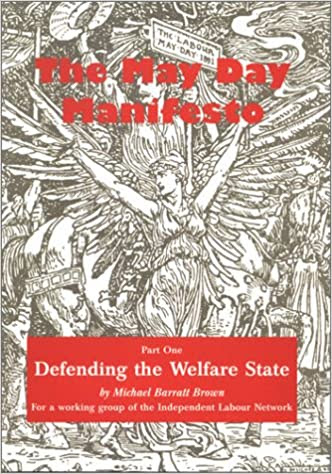
The May Day Manifesto. Part One. Defending the Welfare State by Michael Barratt Brown. Spokesman. £6.99.

Last year two Labour MEPs, Hugh Kerr and Ken Coates, were expelled from the Labour Party. They have formed an Independent Labour Network which (with money from the European Parliament) has published this pamphlet.

It is unashamedly Old Labour, proposing to extend the welfare state, restore full employment by Keynesian techniques of increased government spending, and to tax the rich so as to create a more equal society. It’s all pie-in-the-sky of course since such policies, which imply that capitalism can be reformed so as to work in the interest of the majority, have been tried and failed, most recently under the Callaghan Labour government in the late 1970s and under Mitterrand in France in the early 80s.

New Labour, Kerr and Coates complain in the introduction, has abandoned what Labour used to stand for:
“Redistributive policies, and planned public intervention to create jobs and uphold higher social standards have now gone. Instead, the new Government defends an economic strategy based on ‘the enterprise of the market and the rigour of competition’, a philosophy of deregulation, and ‘a partnership with business . . . that puts industry first’. It seeks ‘to enhance the dynamism of the market economy, not to undermine it’. It is determined ‘to extend the flexible labour markets to the rest of Europe, not to import Euro-sclerosis’. These engagements are linked with a policy of less direct taxation, and refusal to ‘impose burdens on business’ . . .”
All this is very true, but in the argument between them and Blair as to what is possible within capitalism today—and this is where this particular argument is situated—Blair is right: capitalism is incapable of offering the reforms Kerr and Coates are campaigning for. The alternative to New Labourism (the management of capitalism on its terms and according to its rules) is not reformism but socialism.
Adam Buick

Monday, October 22, 2018

Pakistan’s finest hour? (1998)

From the July 1998 issue of the Socialist Standard

There could have been few more depressing scenes on our TV screens in late May than those conveying scenes of tens of thousands of members of the Pakistani working class rejoicing on the streets at news that Pakistan had detonated its first nuclear devices. Such was the jubilation that followed the tests that opinion polls found 90 percent of the population in favour of the news. Similar sentiments were expressed throughout the islamic world, where there was much celebration at the arrival of the “Moslem Bomb”.

The nuclear tests in Pakistan were ostensibly a response to India’s tests of 11 May–the first India had carried out for 24 years–though less attention and condemnation focused on the latter.

While the Pakistani press heralded the blasts as “Pakistan’s finest hour”, talk in the West was of sanctions and the withdrawal of aid programmes.

The most quoted and most hypocritical statements came courtesy of the five permanent members of the UN Security Council–the guardians of world peace who protect us with their joint 36,000 nuclear war heads–and in particular from President Clinton who informed us how we were “about to repeat” the worst mistakes of the 20th Century, when we know it is not necessarily to peace, security and prosperity” (Guardian, 30 May).

These were impressive words from the leader of a country with 15,000 stockpiled nuclear weapons, which carried out 936 tests between 1945 and 1991, which has twice used atomic weapons and which has threatened their use against North Korea, Vietnam and more recently Iraq.

As could be imagined, the tests by both India and Pakistan had the “experts” working overtime in an attempt to come up with new doom and gloom scenarios. While some suggested that China would now be forced to increase its nuclear arsenal, others suggested that Pakistan might pass on its nuclear technology to other moslem countries, and that the Middle East was now a more dangerous region in which a faltering peace process would speed calls for an Arab bomb to counter Israel’s monopoly on nuclear weapons.

What was noteworthy was the total absence of any challenge to the nuclear mentality which located the problem in a wider political and social context.

Of course, none of this appealed to the nuclear apologists of Pakistan. Much of the counter arguments coming out of Pakistan highlighted the hypocrisy of the West and aimed to justify Pakistan’s new found nuclear capability.

While Pakistan and India had not joined the 1970 Non-Proliferation Treaty observed by 185 countries, it was argued they were not morally bound to abide by the agreement, and fingers were pointed at Israel, which also has a nuclear capability, which also refused to sign the NPT and which has received no Western condemnation. France was also drawn into the equation with much reference to the recent atomic testing at Muroroa Atoll carried out without any mention of sanctions.

Speaking on behalf of Pakistan’s ruling party, Prime Minister Kushabhar Tkakre hinted at the implicit racism of the Western standpoint, declaring Pakistan’s tests to be “a repudiation of the policy of nuclear apartheid the West has sought to impose on us . . . we will not accept an unequal system” (Guardian, 28 May).

Fully aware of the misery that sanctions and the withdrawal of aid would mean, President Rafiq Tarar argued that a nuclear capability was worth all the pain, adding that if Pakistanis had to exist on one meal a day in future then he would join them.

Perhaps somebody should have reminded him that for many Pakistanis, one meal a day is a fact of life. Pakistan, like India, is after all no wealthy country. It has a GNP of only £295 per head and a foreign debt of over £18 billion. And in spite of a virtually non-existent social programme, spends almost 50 percent of its budget on debt repayments and defence. Indeed, Pakistan and India together spent £43 billion on defence between 1990 and 1996, while only £7.4 billion went on education.

So is there method in their madness? The corporate elite of both countries think so. They argue that the bombs they are developing bring also independence, respect and prestige, providing not only a means of defence but also a ticket of entry, in some areas, to the top table where the likes of Britain, France and the US do their wheeling and dealing. A nuclear capacity thus has less to do with any external threat–in spite of the fact that both countries have fought each other on three occasions in the past–and more to do with a perceived negotiating clout accorded to the possession of nuclear arms.

The workers of Pakistan and India need to think again. They can never be the beneficiaries of any status accorded the possession of nuclear weapons. If they must be jubilant, then let them celebrate their common identity. At the end of the day there is more that unites them as an exploited and impoverished class, with the same basic needs, than can ever divide them along national or religious lines. The nuclear tests that have rejoiced over alter not one iota the fact that they will continue to exist as malnourished and illiterate wage slaves in a system in which their needs can only ever come a poor second to the selfish interests of their masters.
John Bissett

Nuclear spectre (1998)

From the July 1998 issue of the Socialist Standard

The condemnation by nuclear powers such as the USA and Britain of the underground tests carried out by India and Pakistan once again shows the contradictory and hypocritical nature of world capitalism. That such a reaction should come from states armed to the teeth themselves, with short, medium, and long-range nuclear weapons, is nothing less than pathetic.

Nuclear proliferation, as with the proliferation of conventional weapons, is part and parcel of the capitalist system. To get rid of nuclear weapons, you must first get rid of their cause: the anarchic, competitive nature of this society. Only when this happens will we, as people of the world, be free from the threat of nuclear armaggedon.

CND has proved beyond a shadow of a doubt the futility of trying to rid the world of such weapons of death within capitalism. There are thousands of times more weapons now than when CND was first formed, all far more powerful. That’s what happens when you address the symptoms and not their cause.

The end of the “cold war” was supposed to usher in a new era of stability on the international stage. The recent underground tests carried out by India and Pakistan has put this idea into its proper context.

Talk of stability in a world armed to the teeth has about as much ring of truth about it as the book Alice in Wonderland and is about as sane as the Mad Hatter’s Tea Party.

The spectre of nuclear armageddon once again strides the planet.

Within the last two years China, France and now India and Pakistan have conducted nuclear tests.

If ever there was a time to look at the alternative to insane world capitalism it is now, before we see the sprouting mushroom clouds of nuclear detonations and the horror that will ensue.
Steve Colborn

Obituary: Ernie Higdon (1998)

Obituary from the July 1998 issue of the Socialist Standard

Ernie, who died last September at the age of 71, joined the SPGB as a member of the Camden Branch in the late 1940s. A cable jointer by trade he spent some time working in Rhodesia before emigrating with his wife and children to NZ in 1965. He worked for the Auckland Electric Power Board and was involved in many disputes, local and national as a member of the Electrical Workers’ Union.

Ernie stood for parliament on several occasions, and as the SPNZ candidate in the 1972 election, he campaigned against the Prime Minister, Robert Muldoon. Ernie was a formidable debater—a quality recognised by Muldoon who refused to enter into debate with him during that campaign.

A stalwart socialist Ernie was the driving force in the SPNZ, speaking in Albert Park on Sundays and writing for our monthly journal as well as a steady flow of letters to the editor of the NZ Herald.

Over two hundred people attended the funeral—a testimony to a socialist who walked through life with his principles intact.

The main eulogy was delivered by his son Jon. Other speakers were Auckland MP Sandra Lee and a comrade from the SPNZ who referring to the sickening adulation at the recent funeral of Princess Diana, made the point that none of the parasites of this world royal or otherwise—would be tall enough to clean the boots of Ernie Higdon.

It was a fitting farewell that on his coffin was placed his tools of trade—a blowlamp and his tools of leisure, his fishing rod and reel and a bottle of whiskey. Ernie would have chuckled at that!

Our condolences go to his wife Jean, son Jon and daughter Toni.
Alan Coombes

Saturday, September 12, 2015

The rise and fall of Labour reformism (1998)

Book Review from the July 1998 issue of the Socialist Standard

What’s Left? Labour Britain and the Socialist Tradition. By David Powell. Peter Owen. £22.50.

Socialists should know their history of the Labour Party, if only to be able to refute the claim that it was ever a socialist party and to demonstrate its failure to gradually transform capitalism into something better.

Powell’s book can serve as well as any as a source of the basic facts, especially as it is largely descriptive and devoid of any ideological perspective beyond "they’ve always been divided and that’s a bad thing" and perhaps a hint that the answer to the question "what’s left (of the original Labour Party)?" is "not a lot".

Towards the end of the last century many trade unionists felt that the trade union movement, or "Labour", should have its own party in parliament separate from both the Tories and the Liberals which represented different sections of the ruling class. Despite the election of Keir Hardie as an independent Labour MP in the 1892 election and the formation the following year of the Independent Labour Party (ILP), they didn’t make must headway (Hardie lost his seat at the 1895 election) until the House of Lords handed down their judgement in the Taff Vale case that a union could be sued for damages for loss of trade caused by a strike of its members.

This threat to their funds goaded the largely still Liberal leaders of the TUC to move and in February 1900 a conference of trade unions and various political groups (the ILP, the Fabians and Hyndman’s Social Democratic Federation) voted to set up a Labour Representation Committee. The founding resolution, which had no socialist content whatsoever, read:
"That this Conference is in favour of establishing a distinct Labour Group in Parliament who shall have their own Whips and agree upon their policy, which must embrace a readiness to co-operate with any party which, for the time being, may be engaged in promoting legislation in the direct interest of labour, and be equally ready to associate themselves with any party in opposing measures which have the opposite tendency".
The name Labour Party did not come into use until after the 1906 election when 29 MPs were elected (nearly all of them as a result of a secret, but obvious, deal with the Liberals). It was not until after the First World Slaughter, with the adoption in 1919 of a new constitution including the famous Clause IV, that individuals could join the Labour Party. Even then, Labour still didn’t officially talk about "socialism" but only about "the new social order". This, in fact, was state capitalism rather than socialism, but was seen only as a very long-term goal which the leadership never took seriously then or since.

In so far as Labour did have a theory it was taken from the Fabians, an elitist group of intellectuals (including George Bernard Shaw, H. G. Wells and Beatrice and Sidney Webb), who preached the "inevitability of gradualness": the goal of state capitalism was to be reached by a series of reform measures adopted by successive Labour governments. The first two Labour governments, both minority ones under Ramsay MacDonald, merely showed the capitalist class that Labour was "fit to govern" capitalism on their behalf. The second ended in complete disaster in 1931 when, faced with the slump, MacDonald, his Chancellor Snowden and some others in effect went over to the Tories.

Powell records the various attempts by those who took the state capitalist goal seriously to get Labour to be more than a party out to try to govern private capitalism a little less harshly than the Tories or the Liberals: from the ILP under Maxton in the 1920s (which disaffiliated from Labour in 1932), the Socialist League under Sir Stafford Cripps (later known as Sir Stifford Crapps for his role of Iron Chancellor imposing austerity on the workers in the post-war Attlee government) in the 1930s, the Bevanites in the 1950s and the Bennites in the 1970s and early 80s. They never got very far and only succeeded in ruining Labour’s electoral chances since most people wanted a humanised private capitalism rather than state capitalism.

The lesson the Labour left failed to learn was that you cannot have socialism without a majority who want and understand it. In a situation where most people still want capitalism—a situation which unfortunately has prevailed throughout the Labour Party’s existence, and still does—then what Socialists must do is not to try to get into government on a programme of reforms, but to campaign for socialism, to "make Socialists" as William Morris put it and what we’ve been trying to do since 1904 (yes, the working class could have made a different choice in the 1900s).

We might not be much nearer our goal of socialism than then, but the Labour Party has now abandoned its goal of those days of legislation favourable to trade unions and workers generally and has become Tweedledee to the Tories’ Tweedledum—which is what the Liberal Party was in 1900. They are not even an independent trade union pressure group in Parliament, but an openly pro-capitalist party.

Incidentally, we get a couple of mentions as, along with the British Socialist Party and the Socialist Labour Party (De Leon’s not Scargill’s) , one of "the warring fragments of Hyndman’s SDF" that opposed the First World War (true) and of "the congeries of Marxist factions" that were "in bullish mood following the events of October 1917" (not true).
Adam Buick

Tuesday, June 9, 2015

History as mystery (1998)

From the July 1998 issue of the Socialist Standard

That’s what our rulers want because while we remain ignorant of our past they remain unchallenged. While we remain indifferent to history they reign supreme

The interruption of the Archbishop of Canterbury's sermon on Easter Sunday by gay rights activists caused a flurry of media attention that would normally have been absent from such a pointless event. In the ensuing babble about the Church's hostile attitude to gay sex the content of the original sermon was more or less overlooked. Dr Carey's scholarly and sophisticated contribution to the Millennium Agenda was that we have all forgotten our historical Christian values, and that is why the world's in a mess. His view is that we should "remember history".

Funny that the Italians and the French have the same word for "history" as for "story", implying perhaps that both are made up. What the Arch Cant means by history is of course the official Christian revised and approved version, with nasty bits removed or blamed on someone else, and plenty of selfless martyrdom and soft-focus heroic imagery. History as a religious, spiritual and moral work of art, an aesthetic template to guide our actions in the future, an edifying edition of the highlights of past.

But the past didn’t start as "Once upon a time . . ." and end with "happily ever after". It hasn’t ended, for one thing. For another, facts always get in the way of storybook fiction. Christian history, like everyone else's, was bloody, not nice. Christians slaughtered and burned and pillaged and tortured for the faith. The first crusades were against other Christians in Ireland and France. Dissent was ruthlessly suppressed for over a thousand years, while Jesus and the Blessed Virgin climbed into bed with every baron, prince and dictator with money to hire them, with the result that peasants like us spent centuries robbed blind by the kings and scared shitless by the priests. A very handy arrangement for them, but not for 95 percent of the population. Dr Carey seems to want us to "remember" what his Christians said on Sundays, but not what they did the rest of the week.

Who Cares, Carey?
Most people aren't interested in history. It's boring. It's irrelevant. It's just dates and more dates. On the other hand, if you were betting a large sum on a horse, you'd look up its past form, and if you were buying a car, you'd want to know its service record, and if buying a house, you'd be very interested indeed in certain mediaeval by-laws allowing common access through your front room. When buying into an entire social system, however, we seem willing to forgo any such caution or curiosity.

History is certainly boring and irrelevant in schools. This is not accidental. If you were in charge of a prison and you had to choose videos for the inmates to watch, you'd be unlikely to pick Colditz or The Great Escape. Similarly, when the owning class, represented in Britain by the CBI, exercises its considerable control over the national school curriculum, it is not keen to emphasise the historical struggles that have continually taken place between owners and the vast majority of the dispossessed. Instead it emphasises the historical struggles that have taken place between owners and other owners, a subject not nearly as relevant to most of us. Thus, people leave school baffled and bored by history, and the owning class gets its workers cut-price and docile.

I didn’t grow up a socialist because I didn’t know the idea of socialism existed. I distinctly remember being taught the Franco-Prussian War in school, but no mention of the Paris Commune, and the Crimean War, but nothing about Chartists. Marx was some hairy German yob who wanted us all to wear uniforms and shoot each other. The nineteenth century may have been boiling with revolution right across Europe but to me it was drawing rooms, cucumber sandwiches and the Charge of the Light Brigade. Even where the history syllabus could have been potentially worthwhile, the dreary school culture would always manage to rob it of any significance, and the bored, passionless delivery of the time-serving teachers was enough to convince us that knowledge of any sort wasn’t worth having, except for job purposes.

What we call our history is mostly false but we do everything that we do because of it. Our state-approved history is the reason we get up and go to work all day, pay bills, buy holidays, vote the usual way and generally follow in our parents' footsteps . . . all the way to the grave. And a fake sense of past has bequeathed a fake sense of present. With the contempt of long familiarity, we don’t really look at the present as what it is, an unique passing moment, but as a wallpaper for our individual habitat. Big things don’t change in this bland continuum we decorate our private worlds with wisdom. Banks don’t crash. Princesses don’t have fatal accidents. Revolutions don’t change society.

No Industrial Revelations
If the present in all its technological sophistication was sprung upon us suddenly, as if for the first time, like a revelation, perhaps we would see the exciting possibilities in it, but history, or the popular sense of it, has inoculated us against any sense of this potential. History disguises the present moment as a veil disguises a face. We can shout and protest with the passing anger of the moment, but we cannot presume to pit our puny voices against history's relentless vast yawn.

If, instead of being the motive power of revolution, history has become the pale and feeble provider of excuses for the status quo, if instead of a springboard it is a tether that keeps the future out of reach, maybe we should just forget it altogether. If the little is not enough, maybe nothing is better.

School-kids wouldn’t complain. No dates, no stupid kings and queens with numbers for surnames, no essays marked C-minus "Must try harder". The only losers would be historical theme parks, quiz compilers and all those keen to escape the present through books but unable to get on with science fiction.

Amnesia is Easier?
A human memory only one-day-old would annul long-lasting conflicts, old scores, disputes, campaigns, epic struggles and endless fiascos and tragedies. The wars of the world would be called off through lack of interest. Capitalism would collapse as people forgot who owned what and why it mattered anyway. Jew and Arab would tell each other jokes in the sun. Catholic and Protestant would share their Guinness and wonder what all the silly Parade outfits were for. Soldiers would forget how to shoot, prison guards wouldn’t bother to lock up, policemen would wander off and pick wild flowers . . .

Oh dear. A pinch of salt is called for I fear. In truth it is impossible to forget what once you have learned. Even if it were possible to be more ignorant of history than we already are, it would simply mean that the owning class would treat us worse than they do. They have it their own way as it is. While we remain ignorant of our past, they remain unchallenged. While we remain indifferent to history, they reign supreme. While we watch football instead, they laugh at us.

But there is room in our culture for a better understanding of history (and football too, if you insist). What they school out of us, we can bring back again. What they don’t tell us, we can find out. What they ignore, we can discuss. It is not just that we would have a stronger sense of ourselves in time and place. It is also a revolutionary process, because it means overturning old ideas and beliefs in a ceaseless effort to reinvent our present, and design our future.

The Archbishop of Canterbury's idea of history may exclude the venerable and well documented history of homosexuality, but it also excludes the venerable and even better documented history of class struggle. Dr Carey just doesn’t want you to know about those embarrassing bits. The owning class too would like to cover certain things up, or at least gloss over them. That’s why, for a revolutionary, it is always important to be curious. If we are to succeed as a class in emancipating ourselves, we must know the history and tactics of those who are against us. That way, when next they attack us, we will not be unprepared.
Paddy Shannon

Saturday, March 29, 2014

People (1998)

A Short Story from the July 1998 issue of the Socialist Standard

Some years ago I stood at the top of a hill about to make my descent carrying a flimsy paper bag filled to the brim with fruit and vegetables I had just purchased, when the carrier bag split under the weight of the goods and within seconds apples, oranges, tomatoes, sprouts, onions, potatoes and a cauliflower went cascading down the hill at full pelt. There were several other people on the hill at the same time, either coming up or going down, and they each of them sprang into action whilst I stood transfixed. They gathered up armfuls of anything they could save to give back to me; one man even crossing a busy road at the foot of the hill, risking life and limb in the process of retrieving an orange which had rolled into the gutter. A mundane little story this I know, but an incident in my life that has stayed with me.

People by their very nature are helpful, sociable beings. We hear every day of acts of valour performed by people who, when asked why they risked their lives to save others, will respond that they didn’t know why, that they just did it and had they actually thought about it for any length of time they probably wouldn’t have dived into a lake to rescue a drowning child, climbed up the outside of a high building to save someone bent on suicide, or dragged somebody from a burning house. These are of course extreme examples and not everybody would be capable of such deeds. But what it does say is that given the right circumstances we humans can act altruistically. We can cooperate. We can celebrate the need we have for one another.

Personally I have always been more concerned with people than I ever have with Marxist theory or economics. I chose Marx because the insanity of a capitalist society drove me to it. The evidence for the alienation felt by people in the present world is now so glaring that it will never cease to astonish me that more people are not rushing to join the Socialist Party. The worrying question has always been for me what comes first, the chicken or the egg? We need to get socialism so that people will change but we also need people to change before we can get socialism.

People still revere leaders who will inevitably let them down, though many more people are beginning to realise that living in a world where some have everything and others very little and in consequence suffer both alienation and disempowerment is not good for any of us. We see this all around us or hear about it through the media. Drugs, alcoholism, families where kids are not cherished--parents being often too preoccupied nursing the wounds inflicted by the system.

There is an erosion of everything socialism requires and capitalism despises--cooperation, self-respect, love even. I hesitate to use the word "love" when talking about human relationships; the suspicious, sidelong glances I sometimes get makes me wonder if it is thought I am advocating multiple orgasms for everyone. Love to me represents the possibility of having such good feelings about ourselves and life that we can afford to have them about other people too. Yet in this miserable society where money and exploitation must come first, we are discouraged from showing too much concern for one another in case this detracts from our real purpose--to provide profit and power for the minority.

It has never been enough to have shelter, ample food and leisure. There is more to the human psyche than that. Even those who subscribe to a philosophy of "Bugger you, Jack and Jacqueline, I’m all right" must still be partially aware of the emptiness of their lives. Since we are born and then must perish, and as far as we know that is all there is to it, then it does seem a great pity that, in the interim, we cannot make more sense of existence.

It is distressing to see children beaten about the head in supermarkets, chastised for daring to whinge or cry. The chances are they will also reach adulthood and behave similarly towards their own offspring. We can only speculate on the frustration, misery and ignorance in the lives of people who viciously smack at little legs in pushchairs and issue dire threats about what is going to happen "when we get home". And we can only blame this on a system of society where "success" (often unwarranted) is accredited only to those who make money or, as is often the case, get others to make money for them. There is so much talent, so much flair in all people. It is all there and yet capitalism spurns it unless it can be seen to be profitable.

So all we can do is to look at the world and be glad that a percentage of people see what we see. And it could even be that they are not all members of the Socialist Party . . . yet.
Heather Ball

Sunday, December 29, 2013

Why the Daily Mail Hates Karl Marx (1998)

From the July 1998 issue of the Socialist Standard
Only the most isolated and politically ignorant could have failed to notice the campaign launched recently to defame Karl Marx and discredit the Marxist viewpoint on the one hundred and fiftieth anniversary of the Communist Manifesto.
Hardly a newspaper or magazine failed to join in the collective rubbishing of Marx, the Marxian world view and the possibility of a socialist alternative to the market economy. Radio and TV were at it too. Newsnight was among several programmes contributing fairly lengthy pieces while Talk Radio primed Peter Hitchensred-baiter supreme at the Daily Express—to denigrate Marx in an hour-long programme one afternoon, though his particular excesses were reined-in by an invited interviewee from the Socialist Standard and many of the subsequent callers.
Simple Simon
Possibly the worst episode in this whole sorry campaign was the publication by the Daily Mail on 7 May of an article by one of its regular buffoons, columnist Simon Heffer. Entitled "Obscenity of Celebrating This Man`s Anniversary", this was an article which did not bother with the usual niceties of argumentation and logical analysis or concern itself with such trivialities as facts and figures. It was, instead, one of the most puerile attempts to discredit the working class movement, its history and political development, that there has been in Britain for a long time. In it Heffer accused Marx of being responsible for mass murder, famine, persecution and dictatorshipand that's just for starters. Never one to understate his case, Heffer claimed that Marx was a man "who has caused more misery, bloodshed, death and ruination on our planet than anyone else in history" likening him to Hitler, but worse.
To take the most serious accusationthat of mass murderHeffer makes this charge in the almost certain knowledge that Marx never personally killed anyone, did not personally advocate killing anyone and never occupied any position whereby he was able (or willing) to order systematic murder, like say Hitler or Stalin. Moreover, this crude accusation comes from a journalist who takes his coin from a newspaper which openly supported Hitler and his cosh-wielding friends in the British Union of Fascists during the 1930s. Unsurprisingly, given this level of argumentation, he goes on to call the defenders of Marxism "hypocrites".
In his article Heffer labels Marx "an atrocious man". Accusing him of almost everything short of eating babies, he contends that Marx "plunged his family into poverty and near-starvation while devoting himself to his writings". Though the truthunsurprisinglyis rather more complicated than this, how this accusation can be squared with Heffer's adulation for people like Keith Joseph and Enoch Powell, who were not exactly renowned for their warmth, generosity and personal devotion to others, is difficult to see. But, to take Heifer's sneering tone, he is a Christian and of course Jesus never let his personal convictions or over-weaning sense of his own self-importance impinge on the material well-being of those closest to him . . .
Economical with the truth
Heffer's foolhardiness in this article knows no bounds. Even journalists with the tightest of deadlines to meet know that one of the golden rules is always to check statements and sources before going to print. Not so Heffer. For how else can one account for the following statement:
" . . . his conviction that there was only so much wealth, and that the rich could only enrich themselves at the expense of the poor—was understandable in Marx. He was, after all, one who entirely misunderstood economics. He would not believe that the size of the cake, as well as the size of the slices cut from it, could continue to grow. As a result of this he advocated the persecution of those who controlled the means of production: the capitalists."
There is, to use the old aphorism, so much wrong with this statement it is difficult to know where to start with it. Fundamentally, it is not Marx who "entirely misunderstood economics", it is Heffer. Marx never said anything so daft as the size of the capitalist cake could not grow, and none of the many standard modern economics textbooks that otherwise give little credence to Marx would be as slipshod to say that he did. On the contrary, Marx spent much of his time examining the dynamics of how capitalism grows in practice over the long-term through the accumulation of ever vaster amounts of capital.
Effectively, Heffer has it the wrong way aroundit is not a fixed amount of wealth production in capitalism which forces the rich to exploit the poor if they are to get richer still, it is the rich's exploitation of the poor which provides the very basis for the expansion of capital and therefore of the size of the cake itself. If the rich (the capitalists to be precise) didn't exploit the poor (the workers), or simply weren't able to for some reason, then there really would be no growth of the system, no accumulation of capital. One of Marx's crucial discoveries in the field of political economy was that the working class of wage and salary earners gets paid less than the value of the goods it creates, the difference being a surplus value which accrues to the owning class in the form of ground rent, interest and profit. If capitalists are to successfully compete against their rivals in the market a large proportion of this surplus value generally needs to be re-invested in new and more efficient techniques of production, thereby leading to a long-term expansion in the overall productive capability of society. If there is no exploitation of the working class to produce surplus value, there can be no new investment in production and further expansion of the system. There can be no capitalist growth without working class exploitation.
Heffer is also incorrect when he then goes on to infer that in the market economy opposed by Marx "all prosperity trickles down to improve everybody's lot". Again this is such a ludicrous statement that few defenders of capitalism would now dare utter it. They are no doubt awareunlike Hefferthat while the world capitalist system continues to sporadically grow and while the top one percent of the world's population continues to grow ever richer, the poorest on this planet are poorer than ever (indeed, about half of the countries in the world have seen their GNPs fall this decade whether they be free-market based nations or rigidly state-controlled ones). While Heffer poses as the considerate humanitarian he might care to fly to the Sudan to tell the starving millions the good news that Dixons now have a 21 percent share of their market, with profits up again, and that it will all be trickling their way shortly.
An aunt called Sally
It is evident that Heffer wrote this piece on Marx having read little or nothing by him, though in this he is not alone among those pundits who have an opinion on everything but knowledge of very little. If he did get to grips with reading Marx (or even motivate himself enough to read one of the half-decent books about Marx and his views) he might then be in a position to realise that, far from being an economic ignoramus, Marx correctly outlined:
  • the boom-slump cycle endemic to capitalism and how no government interventionhowever benignwould be able to prevent it;
  • how the market economy would eventually spread its tentacles into every aspect of human life, conquering the entire planet in the process;
  • how an excess issue by governments of paper currency beyond that required by additional value production is the real cause of inflation;
  • class division and the modern development of a world economy where the division between the richest and the poorest is the widest in human history;
  • the growth of a colossal credit-based financial apparatus that, as time goes on, becomes increasingly isolated from the realities of the wealth production process on which it depends.
Heffer was ignorant to this and much else besides (although the term 'ignorance' here may be taken to imply a certain innocence, which in this context would be mistaken). His only motive was to ridicule Marx and rubbish the method of understanding the world he bequeathed to the working class as irrelevant at best and downright dangerous at worst. Hence, like most of the knee-jerk attacks on Marx which have populated the media, Heffer's piece could not resist associating Marx and Marxism with virtually every hideous dictatorship created this century. Without any justification whatsoever, Heffer claimed that Marx wanted to eliminate liberty and is content just like all the other shoddy scholars throughout history, to damn a theory on the basis of the deeds of those who later claimed to uphold it without asking himself whether they actually did uphold it or not. Heffer would never dream of doing this with Christianity (or Conservatism for that matter) but Marxism is apparently fair game and therefore gets damned by association with every tin-pot dictator this side of the Khmer Rouge.
Workers' gain
Throughout the bitter and difficult struggle of the working class against capitalism, the workers have made a number of serious and identifiable gains. Some of these have been economic, others more political in nature, including those relating to the organisation and outlook of the working class. The method of understanding society and social change left by Marx and Engels is one of the most important of these. Without the theoretical tools left by Marxism the working class is bereft of a comprehensive understanding of the market system, class division and why capitalism must be overthrown in a democratic socialist revolution. It is precisely for this reason that it is so feared by the ruling class and their representatives and why, periodically, so much effort is expended on denigrating it. The recent campaigns surrounding the 150th anniversary of theCommunist Manifesto have been but a part of this entire process.
If anyone doubts the prescience of the Marxian analysis and views this defence of it as mere hyperbole, consider the following passages from the Manifesto about the development of world capitalism and the ruling capitalist class:
"The bourgeoisie, by the rapid improvement of all instruments of production, by the immensely facilitated means of communication, draws all, even the most barbarian, nations into civilisation . . . It compels all nations, on pain of extinction, to adopt the bourgeois mode of production; it compels them to introduce what it calls civilisation into their midst, i.e. to become bourgeois themselves. In one word, it creates a world after its own image."
And yet:
"Modern bourgeois society with its relations of production, of exchange, and of property, a society that has conjured up such gigantic means of production and of exchange, is like the sorcerer who is no longer able to control the powers of the nether world whom he has called up by his spells."
In a world of uncontrollable global economic crises, permanent warfare, rampaging environmental destruction, unprecedented income inequality, social dislocation and delinquency, who can in all seriousness say that Marx was fundamentally wrong? And if his identification of the problems of the modern world and their trajectory is so accurateespecially for 150 years agohis proposed solution for them must surely command attention too. That, of course, is a different story, though one elaborated in the pages of this journal often enough and yet still some way up the steep learning curve now confronting the likes of Simon Heffer and those others still to come to terms with the fact that ignorance and abuse are never a defence for long against accurate and coherent analysis. That this is unlikely to stop the Daily Mail and its ilk is more of a reflection of their own self-serving, anti-working class viewpoint than of the alleged "evil" of a long-dead German philosopher with a funny beard and a penchant for libraries.
Dave Perrin