Showing posts with label Racism in the Labour Movement. Show all posts

Wednesday, April 1, 2026

Who is the alien? The working-class view of the burning question. (1911)

From the March 1911 issue of the Socialist Standard

Opportunity is a Fine Thing.
The recent world-stirring East End melodrama (in which provoking police agents seem to have pulled the strings) has afforded another opportunity to the capitalist platform, pulpit and Press to thunder against the “alien”. The pseudo-Socialist organisations and Press have, in their fear of losing supporters through this business, been profuse in their repudiation and condemnation of the “crime”, and in their praise of the armed forces in dealing with it. It is, as usual, left to the Socialist Party to point out the Socialist lesson, both with regard to the “crime” and the anti-alien agitation which it served to stir up.

On contemplating all the facts of this “mysterious anarchistic” display, the question rises uppermost in our minds: “Who are the alien impostors and criminals?” And the Socialist answer is – “the capitalist class”.

Why, the attempt to obtain property without labour is contrary to the very principles of Socialism, which insist upon labour for all and subsistence for all. But those who to-day are endeavouring to obtain wealth by filching – and with the aid of armed force into the bargain – are only carrying out the basic principle of capitalism to its logical conclusion.

Who is more honoured to-day than the successful thief, who filched millions from the product of other people’s toil? For his operations capitalist economists find such high-sounding names as “industry”, “foresight”, and “thrift”. And who is more despised and down-trodden than the worker, whose labour produces all wealth? His outrage and robbery, so long as it is carried on in the orthodox way (which converts the plunder into “rent, interest, and profit), is “legalised” by the robbers and supported by giant instruments of murder, while his aspiration to keep for himself the produce of his own toil, draws upon him every term of reproach and contempt.

Let us look back upon the record of the British Government for the last twenty years, and we shall see that the armed forces of capitalist society have been used again and again against unarmed, defenceless workers – men, women and children. In contrast to this, the modern burglar is up against the whole forces of the State, armed to the very teeth.

A Little Bit of History.
In September 1893, the Liberal Government, with Mr. Asquith as Home Secretary, sent soldiers to Featherstone, and striking miners were fired upon, some being killed and others wounded. (See Hansard, vol 17, pp. 1725-1726.) In 1894 the same Government sent a gunboat to Hull to help quell the dockers on strike in that town. In 1907 a Liberal Government again sent military with Maxim guns to Belfast, where a lock-out of dockers had taken place, and the police had gone on strike out of sympathy. In that instance again unarmed workers were maimed and murdered. And recently during a lock-out of Welsh miners, troops and police were sent to fight the masters’ battle for them, and once more wounds and death were dealt out to defenceless workers who wanted to enjoy a little more of the fruits of their toil.

Now if it can be shown that the capitalist class have obtained their possessions by robbery, that in the process of robbery thousands of workers’ lives have been sacrificed, and that in their effort to protect their ill-gotten gains they employ the armed forces of the State to butcher the workers, then it is proved to the hilt that it is the master class, and not the foreign workmen, who are the real aliens, the race apart from and antagonistic to, the people.

The last point has been sufficiently proved by the preceding descriptions of the British Government’s action during certain strikes and lock-outs. The first point is most fully and effectively established by Karl Marx, in his great work Capital, particularly in the historic chapters, which are based on documentary evidence in the British Museum. The second point, however, still requires substantiation.

And a Few Eloquent Facts.
Now according to Government statistics about 2¼ million members of the working class are annually in receipt of poor relief. That means that they are, to all intents and purposes, on the very verge of destitution. Over 200,000 workers annually meet with accidents (over 5,000 fatal) in the course of their employment, and most of these accidents can be traced to the want of life-protecting contrivances – which are not adopted by the master class because their cost would lessen profits.

In addition to this, many thousands gradually starve to death, for not all unemployed and destitute workers apply for poor relief. Thousands, too, die through over-work, bad housing, and insanitary conditions, or are driven insane by the awful economic stress of the present system of society.

So the Socialist allegation that capitalism spells the robbery and murder of the workers by an alien class is fully justified. And the workers in the East End, against whom the master class direct their epithets of “undesirable aliens”, dirty “foreigners”, and the like, and against whom they assiduously try to foster popular hatred, these workers form part of the army of the exploited. And as such they are received with open arms by the very class which, in order to cover their own plundering, attempt to direct popular anger and scorn against them, as the authors of working-class poverty.

Pocket Patriots.
When in 1905, during the debate on the Alien Bill in Parliament, an amendment was moved to keep the foreign workers out during strikes and lock-outs, the great mass of the members of Parliament, representing the vested interests of the capitalists, – the robbers living upon rent, interest, and profit – of course rejected the amendment.

The patriotism of the master class, like their professions of kindness, generosity, and magnanimity, is sheer hypocrisy. In the quest for profits all barriers are broken down, and the capitalist’s love of his country withers before a fraction percent on the yield of his capital. He has no scruples in the matter of displacing the native worker with the “alien”, provided that it pays him – any more than he hesitates to displace either with machinery, directly he can save wages by so doing.

We do not stand alone when we allege that the “alien” workers of the East End are even more completely robbed and worse treated, if that were possible, than the native workers. The Rev. Canon Barnett, of Toynbee Hall fame, writing in the Daily News of January 10th last on the “Sidney Street Lesson”, made the following statements:
“The great need in East London is that the people by receiving more respect should gain self-respect. They do not receive such treatment. The streets in which they live are not lighted or cleansed according to the standard which respectability demands. The second or third best in buildings or in entertainment are good enough for the East End, and Police Court humour and Police Court law, which most vividly represent the attitude of society, are often insulting. I doubt if it would have been possible for the police to have adopted in a West London Square, the methods they adopted in Sidney Street. Respect for the neighbours and neighbourhood would have prevented them from setting men to fire at and to burn two criminals in the open streets.”
A “Socialist” Adviser.
And what has Robert Blatchford, the jingo cat’s paw of gutter-press journalism, to say on that question? The following are from his article in the Weekly Dispatch of January 8th.
“Our wise and kindly British law was not made to deal with foreign Thugs of the twentieth century type . . . I am not discussing the existing law. I am only suggesting that the police should be legally empowered to deal with undesirable aliens immediately on their arrival at any British port. In all such cases as this, where the foreign police have warned our police against an immigrant, that immigrant should be sent to the right about turn at once. In cases of suspicion the immigrant should be detained and, failing a satisfactory explanation, should be deported.”
The above is not quote with a view to proving Mr. Blatchford to be an anti-Socialist of the worst type. His actions have fully exposed him, and very few people indeed can still believe him to be out for Socialism. His German war scare, his glorification of the Army and Navy, and lastly his present attitude on the “alien” question, show distinctly enough that Mr. Blatchford is ignorant of the very rudiments of Socialism. And that is not the most annoying feature. That which Socialists most resent is that the capitalist class should obtain from professing Socialists, advice as to measures of repression and persecution against members of the working class.

The whole Houndsditch spectacle looks as if it had been instigated by Russian police agents in order to create a popular clamour for legislation against “criminal” aliens, to the end that political offenders (especially Socialists) might have cut off their last means of escape from the savage vengeance of the knout and the appalling horrors of Siberia.

The capitalist press, pulpit and platform continually gloat over the apathy and indifference of the workers hailing from other countries to their own utter poverty, misery, and degradation, and whenever the dominant class make an attack upon the Socialists it suits their purpose to praise these “aliens” to the skies as splendid examples of “peaceable and law-abiding citizens”, On the other hand the master class, when it suits their purpose, ascribe the poverty of the native workers to the presence of “alien workers” in this country, or to the importation of labour products from abroad.

In short, it is the business of the capitalists to set one section of the working class against another in order to prevent them perceiving who are their real enemies. Hence the outcry against the “alien” which has followed upon the recent affray. But the development of the present murderous system is gradually revealing to the workers of all countries, that between worker and worker there can be no alienism, because there can be no alienation. They are bound together by the common ties of their class position – a common class interest. On the other hand, they have nothing in common with the master class, whose interests are everywhere opposed to theirs. Therefore it is the master class who are the aliens.
H. J. Neumann

Sunday, August 17, 2025

“Labour’s” tragic triumph in Australia. (1911)

From the August 1911 issue of the Socialist Standard

“Labour” Prime Ministers and “Labour” leaders of Australia have been prominent in Great Britain of late, owing to the Imperial Conference and the Coronation. They have fraternised with the Lords of Capitalism and rejoiced at the progress of the “greatest Empire (read vampire) the world has ever seen.” All the enemies of Labour have gathered together to do honour to “these men who have risen from the plough.” Amidst the eulogies of Asquith, Balfour, and the rest of the holy capitalist family, they have toured the country urging the propertyless wage slaves to emigrate to the scene of “Labour’s triumphs,” and so escape from the suffering they encounter here.
 
The fact that a “Labour” Party controls the “Commonwealth,” and is supreme in at least two States, has misled some into following their advice. But these unfortunate workers will have a rude and rapid awakening.
 
The Labour Government in the Australian Privatewealth have a platform which includes the conversion of trusts into State monopolies. Already in the Antipodes, although the population is sparse and the land to a great extent uncultivated, the great industries and services are becoming trustified. That is eloquent of the speed with which the newer lands ore influenced by developments in the old.

The State ownership of such services as are already nationalised has been a mixed blessing to the toilers. New South Wales is the State of Labourism’s greatest advance, yet the capital (Sydney) will be remembered as the centre of the great strike of State employed tramway men for “a living wage.”  State ownership is the refuge of the business men being crushed by the trusts.
 
“A White Australia” is another plank in the Labour platform. They have always had a particular preference for “White Slavery” as opposed to other hues. Yet a “White Australia” hasn’t saved the workers from the ills that affect them in “open door” countries. Sydney, for instance, boasts of slums as hideous as the classic ones of the East End of London. The homeworkers of Sydney are a frightful example of how capitalism crushes women, as well as men, “in the land beyond the seas.”

Employment in “White Australia” is precarious. The "Sydney Daily Telegraph" of May 26 contains the following news:
 “Mr. A Rickard, of Messrs. Arthur Rickard & Co., admits he received a surprise yesterday morning. He advertised for forty-one general labourers in the Telegraph, and before noon he had several hundred applicants. When the office opened at nine o’clock there were dozens waiting and the number increased rapidly; they ran over the premises inside and jammed the door outside. Judging the men as a whole they were of the average hard-working type, and were mostly eager to accept the offered 8s. a day. We engaged 59 men and could have had as many more had we wanted them.”
 This in a country where the cost of living is more than double that in Britain, and where the rise in prices in the last decade bas been phenomenal and is still advancing.
 
The Taxation of Land Values is a prominent feature of the Labour programme. Its existence in the Commonwealth has led to it being boomed here, and in view of Australia being the pet example of the “good” effects of land taxes, it would be well to show their real character and influence.

The great merit of land taxes is said to be the releasing of the land and bringing it within the means of the poor man. But the Labour Premier, Mr. Andrew Fisher, told a deputation from the London Chamber of Commerce that “land sold at prices quite as high as, if not higher than, those realised before the tax was passed,” and the report (Manchester Guardian, 14.6.11) goes on to say that “he asserted that since the tax was passed Australian credit had been higher than for many years before.” In face of the criticism of land financiers he “denied that the tax was intended to he vindictive against anybody.” Plaintively he asked: “Could anything be more offensive than to charge his Government with class legislation?”
 
Whether offensive or not, it is but true to charge them with legislation benefiting the capitalist class. Their tax on land values been warmly welcomed by the merchants and store keepers of Australia (for it means a reduction of taxation to them), whilst the capitalist nature of their rule has been shown to all by their institution of compulsory military service to protect the property of Australian plutocrats from seizure by other nations. Conscription! How well it makes for the liberty of the worker in the “land of the free”! Liberty for the employer but continued slavery for the employed – that is the guiding principle of the Labour policy.

The brutal attitude they adopt towards workmen on strike is an instance of this. The Labour Party have control of the State legislature in S. Australia, and they have had many opportunities to show how they stand toward struggling Labour. At the present time down at Renmark, in the agricultural portion of the State, a fight is being waged by the fruit pickers in the endeavour to make their wages cover the increased cost of living. They have been met with the most bitter opposition of the Growers’ Association – the organisation of the masters. The Government have helped the blacklegs and sent down armed police to protect them. The Adelaide Advertiser published an interview on May 11 with Mr. Verran, the Labour Premier, who said: “There is no doubt whatever about the policy of our Government regarding industrial disputes. We stand straight for Compulsory Arbitration. We have no sympathy with Unions that profess a revolutionary tactical policy. Labour in our State has said the strike is a barbarous, out-of-date method of deciding differences between employers and employees”.
 
“Then what are you going to do to prevent trouble like that being experienced at Renmark just now?” he was asked.
 
“Unfortunately we have no power now,” was the reply. “But since the Federal Referenda have decided that local disputes are to be a State matter, my Government has decided to introduce a Compulsory Arbitration Bill. The principal provision of the measure will be to make every union and every association of employers register under the new law, and the Wages Board’s decision must bet be observed, just as any other law is abided by. Once the two Houses of Parliament say all industrial disputes must be decided by law the striker will be treated as any other law breaker.

“What about the Right to Strike?” “There is no Right to Strike recognised,” said Mr. Verran. “When a Labour Government is in power it is just as necessary to have law and order observed as at any other time.”

“Then why does not your Government prevent lawlessness at Renmark?”

“We have taken every precaution to see that the law as we find it is carried out. It is not true that we hesitated regarding action at Renmark. The police authorities there have not asked for additional help. Indeed, they have reported that the police are sufficient to cope with any trouble. In spite of that, when we heard that there was likely to be something special happening there on a certain date, we sent two additional mounted police to Renmark. We do not fear any legitimate unionism, but the leaders in the Renmark strike are men with revolutionary intentions, who make no secret of their opposition to Labour. We have no necessity to pander to them in any way and we attack them openly. This class of opposition causes us no embarrassment.”

In the same paper Mr. J. Murphy, the men’s union organiser, says: “The police action is the result of bias against the workers. Ever since the Hon. J. P. Wilson  (Labour Minister) took up his well-known attitude against the workers and the Hon. C. Vaughan (Labour Treasurer) backed him up, the Growers (masters) and ‘scabs’ have been very aggressive, as they know the Government are behind them.” Speaking of the suppression of the men’s meetings he said: “Our men are prepared to continue holding meetings of protest there against what we regard as the Russian tyranny of the Labour Government over this Free Speech question.”

The employers’ representative (Mr. R. Young), interviewed, said: “In future the employers’ association will not employ any but non-union men or free labourers, as they are called. It appears to me that the Growers can get plenty of non unionist hands. My impression is that the Renmark Growers will always win, as they have won three times already, easily beating all opposition.”

The damning indictment of Labourism these facts contain should make the workers ponder over the actions of the British Labour Party. The latter’s praise of their Australian colleagues, in spite of their open hostility to struggling toilers, is but another of their many crimes. The workers of Australia are in the same abject condition that the English toilers stood in in the time of the Tolpuddle martyrs – the days before the Combination Acts.

The Labour Parliament offer the workers Compulsory Arbitration – a method by which the capitalist arbitrator lets the wage-slaves down every time. Compulsory Arbitration is such an overt fraud that the miners of Broken Hill and Newcastle (Australia) suffered imprisonment rather than agree to it.

The lesson for the working class is well pointed by these facts. They can hope for little while means of living are owned by the capitalist class and controlled by their henchmen, “Labour” or otherwise. At the 1911 Annual Conference of the Political Labour Leagues of New South Wales Mr. Verran (who attended) voiced the following sentiment :
“They must be exceedingly careful not to be intoxicated by their own success, and to remember that they were pledged to carry on the same social order as had developed up to the present time”.
A. Cleveland

Saturday, July 26, 2025

Go West—and Starve! (1908)

From the February 1908 issue of the Socialist Standard

Latest information published by the Emigrants’ Information Office, 31, Broadway, Westminster, will not make satisfactory reading to those who thought of finding employment in our colonies during the next few months at least.

It is pointed out that a new regulation provides that all emigrants landing in Canada until February 15th, 1908, must possess 50 dols. at the time of landing, and all arriving between February 15th and April 1st, 1908, must possess 25 dols. They must in addition in every case have money for their inland railway fares, unless they can satisfy the emigration officers at the time of landing that they are going to already assured employment immediately on arrival or will be cared for by friends.

The demand for labour is over for the season. In parts of the eastern provinces the supply of labour is now more than sufficient, owing to the thousands of persons who emigrated to Canada last summer from Great Britain and the Continent, and to the recent arrival of large numbers of out-of-work mechanics and labourers from the United States in search of employment. No one, therefore, should go to Canada in search, of work during the winter. Persons wishing to go there should wait till April, but even then they should not start—especially those with, young families—unless they go to take up engagements, or have enough money to live on till they find employment.

In New South Wales there is a demand for hard ground miners, but not in the other States. In no part of Australia is there any pressing demand for mechanics, unless they are specially skilled; the best chances are for carpenters, masons, blacksmiths, and plasterers. Clerks, shop assistants, warehousemen, and professional persons are advised not to go to Australia, unless they have situations awaiting them. The cost of living has somewhat increased of late throughout Australia.

The Dominion of New Zealand grants reduced passages to approved farmers, agricultural labourers, shepherds, woodcutters, and men able to milk cows and manage live stock, who possess £25, and to female servants who will have £2 on landing. There is an excellent demand for all these classes. The local supply of mechanics is about equal to the demand, but skilled men would not have much difficulty in procuring work if they could keep themselves while searching ior it. There is a demand for female machinists and workers in the boot and clothing factories.

South Africa should be avoided by emigrants at the present time. In Cape Colony the supply of labour largely exceeds the demand, and mechanics of practically every trade experience extreme difficulty in obtaining employment. There is a steady diminution in the number of men employed in the building trades, and clerical work is quite unobtainable. All mechanics and others, therefore, are warned against going there now, unless they go out to situations engaged for them, or have means of their own sufficient to keep them for some months. The town council of Capetown has issued a warning to this effect, and in other parts of the colony, as Kimberley, East London, and Port Elizabeth, there is a number of cases of distress owing to the scarcity of work.

In Natal the supply of white labour considerably exceeds the demand. Many skilled married mechanics, such as masons, bricklayers, carpenters, painters, &c., and a few unskilled labourers, are being given work by the Peitermaritzburg Town Council at 4s. a day, which is the usual wages of coloured labourers, whose places they take.

No one would go to the Transvaal now in search of work. In view of the depressed state of the labour market there is only a very remote possibility of employment being obtainable, and, as the cost of subsistence is high, those having small means would speedily descend to a state of destitution. Over 500 white men are now being employed as an experiment on the drainage works at Johannesburg, earning 5s. to 6s., and in some cases 10s., a day. A similar experiment is being made on railways, and white men are being found to work at £5 per month as assistants to gangers, platelayers, &c.

Large numbers of men, especially carpenters, masons, bricklayers, and plasterers, have left the Transvaal through inability to obtain work there. The dispute in the printing trade has been compromised by the reduction of wages to £5 10s. a week in place of £5 15s. There is no demand whatever for the “handyman,” nor for shop assistants, and the number of clerks is excessive. There is a limited demand for female servants, the demand being mainly for house-parlour maids, cooks, and cook-generals.

Some assistance is given to female emigrants to the Orange River Colony. There is no demand whatever for anyone else, and many persons are out of work. Labouring work is done by Kaffirs. Miners and others should not go to Rhodesia at the present time, unless they have work guaranteed them.

Sunday, October 22, 2023

Landlordism ! (1905)

From the December 1905 issue of the Socialist Standard

A gentleman in New Orleans was agreeably surprised to find a plump turkey served up for dinner one day, and enquired of his negro servant how it was obtained. “Why, sar, ” said Sambo, “dat turkey him roost on our fence tree nights, so dis morning me seize him for de rent ob de fence.”

Thursday, April 20, 2023

Asked & Answered: Reply to M.H.Geeson (Toronto). (1911)

Letter to the Editors from the April 1911 issue of the Socialist Standard

Reply to M.H.Geeson (Toronto).

(1) The S.P.G.B., as its name implies, is the Socialist Party of this country, and does not claim to be ” the Socialist Party of the world.”

(2) We do not seek recruits among residents in Canada, but accept those temporarily abroad.

(3) The S.P.G.B. is not identical with the S.P. of Canada. We are not sufficiently informed to be in a position to discuss in detail the action of their members on local Governing bodies, but remembering that the interests of the workers are the same the world over, we do not hesitate to condemn such actions as the advocacy, by members of the S.P. of C., of the exclusion of our Asiatic fellow-workers from British Columbia.

(4) The function of Socialists elected to Parliament is to fight for Socialism. In doing so they will expose the fraudulence of measures introduced and use the Parliamentary platform in order to make a wider appeal to the working class.

Upon any measure brought forward the Socialist Member would express the democratically ascertained views of the Socialists he represents, always keeping to the fore the interests of the toilers. It must be understood, however, that we cannot bind the future representatives to a policy that, by its very purpose, must always deal with conditions arising at the time.—Editorial Committee.

Saturday, June 11, 2022

All quiet in Glasgow (1965)

From the June 1965 issue of the Socialist Standard

Certain historical facts have ensured that racialism has never been prominent in Glasgow. For instance, anti-Semitism rarely shows itself, except in the odd golf club, and even during the ’Thirties Mosley’s sole appearance in the City ended in complete fiasco.

The late arrival of the Jews (mid-19th century) was a help, for this meant that the ancient antagonism so typical on the Continent is absent here. Later on, the importation of Irish religious influences provided other means whereby the frustrations of wage-slavery could be worked off without the presence of any other “races”. The roles of “them” and “us” were adequately filled by the Orange and Catholic elements who have been hating one another ever since.

And unless a few pedlars and seamen, could be counted, Afro-Asians were an unusual sight in the City until the early ’Sixties when, it seemed to the Citizens, a flood of “Paki’s” suddenly descended in their midst. This impression was helped by the newcomers finding employment almost exclusively on the Municipal Transport, thereby assuring themselves of a constant place in the public eye, while their habit of taking up group residence gave the impression of whole areas being taken over.

In fact Glaswegians might be surprised to know that compared to Birmingham, which has a similar population, of just over a million, Glasgow's immigrants are rather thin on the ground—about 7,000 against Birmingham’s 70,000.

The reasons for the low numbers are obvious. Glasgow’s unemployed rarely falls below 20,000 while the light industries which can absorb the unskilled immigrant are practically non-existent here. Clydeside is synonymous with heavy engineering and shipbuilding so the demand is for skilled men only and what light industry there is can, in an area where wages are well below the national average, find an abundance of married women to fill any available vacancies.

Anyway, the big problem in Scotland is not immigration but emigration. Around 11.000 left here for overseas in each of the six years between 1958-63 while another 87.000 found work elsewhere in the U.K. during the 1950’s. So concerned with this state of affairs are the local Nationalists and Labourites that they don’t even have a policy on immigration at all, devoting themselves solely to preventing the mass escape of wage-slaves to other parts!

The Trade Unions have discussed the matter and at the 1962 Conference of the Scottish T.U.C. the Association of Scientific Workers, appropriately enough, moved an anti-racialist resolution which concluded ”. . . no barriers on grounds of race, creed or colour should be erected against those who wish to live and work in this country”. The motion was unanimously adopted. Another resolution condemning Apartheid is due to come before the 1965 Conference and doubtless it, too, will carry the day. All of this hardly reflects the attitude of the average union member. As the seconder of the 1962 resolution admitted “. . . we had to be honest. . . there were still some of our own people who had prejudice against a person’s race, religion or colour”.

So even if Glasgow’s record is comparatively clean it must be remembered that the conditions for real prejudice seldom crop up. The immigrants live almost as a separate community and follow their own cultural activities. They aim simply to stick it out for a few years, save enough money, and return home to open a small business. Few intend to stay.

Nor have they added to the local housing or unemployment problems. The ten year residential qualification rules them out for a Council so they live mainly in tenements which were slums years ago, and the jobs they find are usually those which do not, at present, attract local men anyway.

When the necessary conditions have arisen, in isolated instances Glaswegians have shown the same lack of class consciousness as workers elsewhere. Only recently, when some immigrants moved into a once posh street in the City, their neighbours raised the usual howl about the adverse effect this would have on the value of their property. Last Autumn a racial strike occurred at the Gavinsbum Bus Dept, just outside Glasgow, when the strikers claimed too many Pakistanis were getting jobs in an area of high unemployment. Nor should we forget how—earlier immigrants—Italian Cafe owners—had their shops smashed up by patriotic mobs when Italy entered the war in 1940.

The coming of the Immigration Act, plus the existing state of industry, make any immediate influx of immigrants unlikely. It does not follow, however, that the present peacefulness must continue. Capitalism has shown that no great change is required in its socio-economic climate to produce, here, the outbreaks of intolerance so common in other parts of the country.
Vic Vanni (Glasgow)

Sunday, May 22, 2022

Letter: Is the vote a weapon? Some questions and our reply. (1927)

Letter to the Editors from the September 1927 issue of the Socialist Standard

Comrades,—I am prompted to ask the following questions after having read article “Backward Race ” in August S.S,

First of all, I had better state that I am not an “Industrial Unionist” or an “Anti-Parliamentarian.” I agree with the words of Marx that “the workers must first of all acquire political supremacy” in order to control the State machinery for the sole purpose of establishing Socialism.

(1) Yet how are our black comrades to get hold of the State forces if they are “disfranchised” and “legally barred from effective participation in most political activities in South Africa”? Would the S.P.G.B. oppose the agitation of “disfranchised” workers, such as our black fellow workers for the vote, because it was not Socialism?

(2) Does the S.P.G.B. lay it down that the workers can only “acquire political supremacy” through Parliament? I fully agree that this is the only method known at the present time in Great Britain, or in any other country where the workers have the majority of the votes !

(3) Would Socialism be impossible to establish if the workers are without votes? I am not suggesting that the Capitalists have only to disenfranchise the workers whereby making Socialism impossible. That would, I think, not be possible under a highly industrialised country. Am I correct?

(4) When South Africa becomes industrialised, will our fellow black workers be enfranchised by the Capitalists? I am not wanting you to be prophets, but it is a historical fact that, in countries that begin industralism, the franchise is a necessity for the carrying on of the Capitalist system?

Has the Franchise ever been granted to the workers in any country without agitation?
Yours fraternally,
T. W. C.
Clapham.


Reply.
For convenience I have numbered “T. W. C.’s” questions.

(1) It is obvious that the black workers cannot unaided gain political control in South Africa against the might of those who govern, backed up, as the latter are, by the full strength of capitalist Britain. We would strongly urge them to agitate for the franchise, although it is plain that workers who have only just begun to organise, and have had no political experience, are not yet possessed of the knowledge and confidence necessary for the establishment of Socialism.

(2) The S.P.G.B. is concerned primarily and directly with conditions in this country, and our Declaration of Principles is framed accordingly. Speaking generally, however, we may say that the centralised political machinery of the Capitalist State (whatever its name and its peculiarities in different countries) must be controlled by a working class seeking to establish Socialism.

In passing, it is interesting to see how the Irish Republicans, in spite of all their brave words and threats of civil war, have been compelled to enter the Southern Irish Parliament as the only alternative to political extinction.

De Valera says :—
“The alternatives with which the new Free State legislation confronted them were to resign their responsibilities, to dissolve their organisation, sacrifice everything they had built up, or to take the step they took”. (“Manchester Guardian,” 23 August.)
Here we have a striking illustration of the power of Parliament, in spite of the fact that the Free State Parliament is still in its infancy, and that the Government has only a bare majority of votes. (Of course, the Republicans are as Capitalist as their opponents.)

(3) In the long run, the Capitalist State, in its modern developed form, needs representative government as a means of maintaining stability and carrying on the increasingly complex work of administration. In spite of the post-war fascist movement, there has been no general tendency to limit the franchise. Here and elsewhere the tendency is to extend it still further.

(4) The black workers (in Cape Colony only) did possess a limited franchise, which, owing to their own backward condition, has not been of any particular value to them. Under the recent “Colour Bar” legislation, a new and more limited form of representation is to be given to black workers throughout the South African Federation.

We can fairly confidently predict that, in due course, the backward workers drawn into the realm of capitalist production will be given the vote. It must not be forgotten that the Capitalists are themselves divided into groups with sectional interests. While there remains in existence a body of disfranchised workers, there is always the inducement to the competing Capitalist groups to add to their influence by a campaign for the extension of the franchise. Instances are numerous. In this country, after the mainly working class Chartist movement had failed to secure votes for the workers, the Radical movement, under John Bright, rallied them. The objects of the Radicals were entirely capitalist, and their working-class supporters were regarded, and were, in effect, simply so many potential “voting cattle,” to be thrown into the struggle against rival propertied interests.

In Chicago this year the new Mayor, Thompson, appealed directly to the negro vote (hitherto left severely alone). Thompson won, and it is certain that the bosses of other political groups in America will in due course be compelled to bring the negro into the political arena, however little they may like doing so.

In Kenya Colony, during the heated struggle between the Indian trading class and the British landowners (who were in political control), the Indians threatened to start an agitation among the millions of blacks, intending to use them simply as a weapon against the whites.

In South Africa there has always been acute bitterness between the mineowners, who want to employ more cheap black labour and less white, and the white workers, who thought to resist a lowered standard of living by laws preventing the introduction of blacks into white men’s jobs. The Boer farmers, who resented the loss of their cheap black labour by migration to the mining areas, support the white trade unionists. In the great strike and riots of 1922 the mine owners already talked of supporting the claims of the blacks to political equality as a means of outvoting the white workers and Boer farmers, and it is inevitable that one or other of the political parties will sooner or later seek to gain kudos and votes by advocating an extended black franchise.

The franchise has certainly been extended without the existence of any strong agitation on the part of those who received it. (So far as can be seen, there is no strong demand for the vote among women under 30 years of age, who are promised the vote.) Clearly, however, there must be some degree of political knowledge and interest before it would be worth while giving votes. There must, for instance, be sufficient interest to make the newly enfranchised take the trouble to record their votes. What has usually happened in the past is that the struggles of the rising Capitalists for a place in the political sun has communicated some of its enthusiasm to the ranks of the workers underneath, and served to create interest.
Edgar Hardcastle

Friday, May 13, 2022

Backward races. Lessons from South Africa. (1927)

From the August 1927 issue of the Socialist Standard

Socialist Party speakers are continually being asked whether Socialism will have to wait until the black and yellow races have been converted. The questioner usually is very gloomy about the whole business. “What is the use,” he says, “of preaching Socialism here in England if all our work is going to be ruined by the backwardness of Japs and Chinese and negroes and other non-white races?” We have for our part never been much perturbed. Capitalism and the development of industry are the necessary and sufficient producers of Socialist thought and Socialist thinkers. The process is slow, but it is universal wherever the capitalist social system extends. We have no fear that any section of the working class in the industrialised nations will suddenly find itself isolated ahead of the main body of the Socialist forces. Most emphatically we do not expect this in England, despite the fact that the general level of political understanding is probably higher here than in any of the Great Powers. We know well enough what slow and painful work it is to build up a Socialist organisation. The vision which distresses our questioners, of a clear-headed, enthusiastic working class in Great Britain panting for Socialism and impatiently waiting for backward foreign persons to wake up and come into line, is hardly in keeping with the facts. If we get on with our job of propagating Socialism at home we can safely leave the workers in other countries to do likewise.

It is interesting to observe, therefore, what encouraging advances have been made by the black workers in South Africa. The white workers organised in the South African Industrial Federation deliberately and persistently refused membership to blacks, and placed barriers in the way of attempts to organise them. The whites, including the South African “Labour” Party, supported the Government policy of maintaining political, economic and geographical barriers against the black races. In Cape Town the Cape Federation of Labour Unions was a little more alive to working-class interests and admitted “coloured” workers (i.e., those of “mixed” race) to membership, although it still interested itself only in those who were classed as skilled workers. In January, 1919, some two dozen black workers, despairing of assistance from the whites, took on the huge task of forming a Union for all black workers and founded the Industrial and Commercial Union (I.C.U., now the Industrial & Commercial Workers’ Union of Africa). It has made great progress in spite of the difficulties placed in its way by the white organisations and by the Governments, and hopes are entertained of spreading eventually throughout the continent.

The position of the I.C.U. was greatly strengthened last year by the decision of the International Federation of Trade Unions to accept its affiliation in place of the white workers’ S.A. Industrial Federation, which was all but defunct. The condition laid down and accepted was that the I.C.U. must declare its readiness to link up with trade unions of white workers whenever the latter were ready to adopt that policy. The whites in the newly-formed South African Trades Union Congress were so much taken back by this recognition of the black trade unions that they have now declared their willingness to discuss with the I.C.U. the possibility of accepting all workers, without reference to race, into an enlarged Trades Union Congress. There is therefore a likelihood that at no distant date racial divisions among the organised workers in South Africa may be overcome. At least the white “last ditchers” who cannot tolerate association with black skins may be compelled to withdraw from the T.U.C. and conduct their (fortunately) hopeless fight in isolation. And this promising development will be the result not of white but of black common sense and clear thinking.

A declaration setting forth the policy of the I.C.U. will serve to show that a partial understanding of the class position of the workers has been attained by the black if not by the white unions :—
“Whereas the interests of the workers and those of the employers are opposed to each other, the former living by selling their labour, receiving for it only part of the wealth they produce ; and the latter living by exploiting the labour of the workers, depriving the workers of a part of the product of their labour in the form of profit, no peace can be between the two classes—a struggle must always obtain about the division of the products of human labour, until the workers, through their industrial organisations take from the capitalist class the means of production, to be owned and controlled by the workers for the benefit of all, instead of a few.”
This declaration contains one very serious fallacy, but even so it will compare well with the majority of foggy aims contained in trade union rule books even in this country. It is a natural mistake for disfranchised black workers, legally barred from effective participation in most political activities in South Africa, to place their hopes in industrial action. We do not doubt, moreover, that experience of the uses and limits of economic organisation will soon induce the black workers of South Africa to see that control of the State is essential to the achievement of Socialism by the working class.
Edgar Hardcastle

Thursday, May 12, 2022

Greasy Pole: Death of a Dangerous Man (1998)

The Greasy Pole column from the March 1998 issue of the Socialist Standard

No sooner had the nation recovered from its hysteria over Princess Diana than it was rocked by the death of a man reputed to have one of the most powerful and rational brains ever to invade the House of Commons, but who was politically a pathetic failure. We refer, of course, to Enoch Powell and we know about that famous brain because of all those politicians who told us about it. “ . . . magnetic,” crooned Margaret Thatcher, “listening to his speeches was an unforgettable privilege.” “ . . . one of the greatest orators and foremost parliamentarians of his generation,” clucked William Hague. “One of the greatest figures of 20th century British politics, with a brilliant mind,” gushed Tony Blair, during a short break from gushing about the Spice Girls and Bill Clinton.

Well Powell was not a crooner nor a clucker nor a gusher but he obviously had a pretty high opinion of himself, which he liked to express in a number of eccentricities. In the late 1940s for example, when he was working at Tory Headquarters, he would travel to work on the Tube at an hour early enough for him to buy a cheap “workman’s” ticket, dressed in hunting clothes. However hot the weather he always wore a heavy three-piece, no nonsense, suit. He left exact instructions about his funeral, including that he should be buried in his old brigadier’s uniform. Finally, his very name was eccentric; what are we to expect of someone in the public eye who insists on being known as Enoch when his first name was John?

Intellect
This leads us to the all-important question of what is the basis of Enoch’s reputation for having one of the world’s most rational and incisive intellects? Well it was not consistency. This was a man who pioneered the Tories’ opposition to state planning—an idea which flourished under Thatcher, but who as a minister had supported state intervention in education, health and social services and who, according to his friend and colleague Iain McLeod, produced “ . . . the two longest-term social plans in this country, the ten-year plan for hospitals, and for local welfare services”. This was the man who resigned from the government in 1958 because he thought government spending was too high at £6,524 million but who accepted office as a minister in 1960 although it had continued to rise—by 1961 to £8,134 million. Having got the taste for resignation he did it again—or something like it—a couple of years later when he refused to be a minister in Douglas Home’s government. But whatever objection he had to Douglas Home as a boss had been assuaged by 1964, when he felt able to join the Shadow Cabinet under that same dozy, amiable Scottish aristocrat.

In spite of this Powell could still gain public attention when, in April 1968, he produced the most notorious example of his vigorous intellect with his “foreboding” about the effects of non-white immigration. Among the “evidence” he produced to justify his pessimism was a bit which might kindly be described as anecdotal. A woman in Northumberland, he said, had told him about an elderly woman in Wolverhampton—about 200 miles away—who was “ . . . afraid to go out. Windows are broken. She finds excreta pushed through the letterbox”. The implication was clear—immigrants were terrorising this poor woman, white British people never behave in this way. The problem for Powell was that he was not able to identify this woman and all efforts to find her were unsuccessful.

Scared
But the problem for other people was rather different because Powell’s speech had an instant, unexpectedly disturbing effect. Suddenly he was transformed from an aloof and fastidious man into someone who represented popular opinion:
"Powell had become a rallying point for most of the hostility and rage we encountered, a shorthand for hatred and contempt 'I’m with Enoch/they said, or ‘they should let Enoch sort you lot out’ and that was enough’’ (Mike Phillips, Guardian, 9 February).
A woman, now a mother of three, remembers “I was 18 at the time and I was really scared because so many people suddenly became openly hostile. They all thought we ate Kit-E-Kat so I stopped buying tinned food for the cat.”

It really was like that and the dominant mood was represented by those London dockers who marched in support of Powell. At that time the unions in the docks were extremely powerful, always ready to exert their power through strikes and other forms of disruption. How much did the marching dockers know about Powell’s views on the usefulness of their unions—” . . . [the remuneration of labour] is rarely affected appreciably, upwards or downwards, by combination; and then the effect is more or less temporary and purchased at the cost of the general public, including other workers”? How many of them knew about his callous views on people—they are always workers—who have to wait for treatment in hospital:
". . . if people are on a waiting list long enough, they will die—usually from some cause other than that for which they joined the queue. Short of dying, however, they frequently get bored or better, and vanish.”
And how many of them knew that this man who ranted about the alleged devastation the immigrants were bringing to beauty spots like Wolverhampton had done his utmost to encourage immigration to this country when, as Minister of Health, he had organised a drive to recruit workers for the National Health Service from the West Indies?

Callous
Most of the obituaries for Powell went out of their way to be kind to him. On TV Simon Heffer, his biographer, denied that he was a racist—because he was fond of India, he said. So what, we might ask if Powell was not a racist, why did he do nothing when he saw the effect of his “foaming with blood” speech? Was this another example of the bottomless confusion of this supposedly brilliant mind? Or was it a calculated attempt, after all those years of being denied even a hope of leading his party, to leapfrog his rivals, whom Powell held mostly in contempt, with one dangerous, resounding speech?

Whatever the truth of this, one thing needs to be said about this man. He stood for a society of class division, of riches and poverty, of racism, of fear and disunity.The only thing unusual in him was the recklessly callous way he did this. And as for his supposedly brilliant intellect—is this really the best capitalism can offer us?
Ivan

Sunday, March 27, 2022

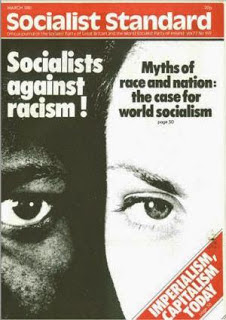
Myths of race and nation (1981)

From the March 1981 issue of the Socialist Standard

An English bus-driver has more in common with a German mechanic than with the Duke of Devonshire. A French accountant shares more experiences with a Russian wages clerk than with Giscard D’Estaing. Across the world there is a mass of people who speak hundreds of different languages and eat a great variety of foods, but who all have one common bond: they own no substantial property and so are forced to work for a living.

As you read this, millions of people are being born into families of workers. They may end up as teachers, miners, dockers, pianists. Of one thing we can be sure. They will be forced to sell their ability to work for a lifetime, simply in order to live. And then, every so often, are born exceptions to this rule—the children of the few families whose names are written over all the stocks and shares, who own the farms, mines and offices. Families of financiers, international business empires, barons of industry. From birth they will be given the best that the world’s workers can produce. They will be taught not how to go looking for jobs, but how to while away their leisure hours in self-indulgent pursuits.

There is a clear class division in present-day society. In capitalism, the world is divided into competing ‘nations’, with a state machine to defend property within each region. The British state, now run by a Tory government, uses armed force to protect private and state property from the indigenous population and from the incursions of foreign powers. Each state, including those of the Warsaw Pact, defends the interests of the small, privileged minority who have power within its boundaries. It is the essentially competitive nature of capitalism which divides the world into rival national blocs.

At the time of writing, the British government is pushing its Nationality Bill through Parliament. If passed, it will create six categories of citizen, only one of which will have the “right to live’’ in Britain. Unemployed workers demonstrating for the “right to work’’ have seen how, in the profit system, there is no such thing. Now workers who have come thousands of miles in the desperate search for employment may find that, if the government does not want them, they don’t even have a right to live. Wage and salary earners are ruthlessly monitored and moved around to where there might be a chance to profit from their work. There is no stability or security.

Workers are endlessly urged to support “the nation”. But we have no stake in Britain; it is just where we happen to sell ourselves. Parties ranging from the Communist Party to the National Front have supported import controls and “British jobs for British workers”. What they are really after is British votes for British politicians. The workers' interest is international. If “British" workers refuse to buy “Japanese" cars, then fellow workers from Japan might lose their jobs. The working class is a global class which owes no allegiance to any nation states. The capitalists themselves invest in whatever country is most profitable for them. Nowadays, one item often includes parts made in ten different countries. This is the background to the question of race and nation.

Recently there has been an increase in violent attacks motivated by racialism. Asians have been stabbed and assaulted with iron bars on housing estates in Islington, where unemployment is more than ten per cent (Guardian, 8/12/80). In 1978, Bethnal Green and Stepney Trades Council documented nearly one hundred such attacks. There has also been racialist violence across Europe, including the bombing of a Paris synagogue last October. It is no coincidence that this is happening at a time of recession and high unemployment. With austerity getting sharper, people turn to look for scapegoats and government, opposition Parties and the Press accept and even encourage this.

The main reason for the decline in National Front support over the last couple of years is the stealing of their political clothes by the Conservative Party. In 1978, Margaret Thatcher announced that Britain was in danger of being swamped by an “alien culture” and that to allay people’s fears, a Conservative government would take steps to prevent further immigration. This was just a piece of opportunist vote-catching, playing on the worst prejudices. Thatcher must have know that in 1977 only 70,000 immigrants had entered Britain, while 200,000 people had emigrated.

The Press encourage racism with headlines like “Asians jump the Housing Queue” (Daily Mail 5/4/76) and “Powell Warning of Erosion of Britain by ‘Alien Wedges’” (Times 10/4/76). The Labour Party, too, has been quick to jump on the bandwaggon. Roy Hattersley has condemned the Nationalist Bill as “racially and sexually discriminatory”. Has he forgotten his speech of 23 March 1965 in defence of the Immigration Act, when he said: “We must impose a test to analyse which immigrants are most likely to be assimilated to our national life".

Our national life? Does Hattersley mean Ascot? Eton College? Workers don’t have a national life. Despite promises to repeal the Immigration Act of the previous Conservative government, in 1965 the Labour government zealously renewed the restrictive measures. Their Home Secretary, Frank Soskice, told the House of Commons, “The government are firmly convinced that an effective control is indispensable". The number of “work vouchers" was even reduced. Bias against negroes and Asians wishing to enter this country continued, as it does to this day. In 1978 Roy Jenkins wrote of “cultural diversity in an atmosphere of mutual tolerance” (Brent Civic Review), but in 1978 he had spoken of the need for “a strict limit on the amount and rate of inward immigration for settlement" (House of Commons 5/7/76).

In 1968, Labour passed their Commonwealth Immigrants Act, an even more overtly racist legislation, which removed the right of entry to Britain from black UK passport holders. The Tories’ 1971 Immigration Act divided British subjects into “patrials”—UK passport holders born here or with parents or grandparents born here—and “non-patrials” who are not permitted to enter without vouchers, of which as few as 2,032 were issued in 1977, The Labour government’s Green Paper on Nationality in 1977 again urged even tighter control. Families from the “New Commonwealth” wishing to join a relation in Britain are brutally stopped. Bone X-rays and virginity tests have been carried out at Heathrow to check age or “marital status”.

In the 1840s, nearly three quarters of a million Irishmen were brought over to build railways and canals in England. In the 1880s refugee Jews and Ukranians supplemented the labour force. Sometimes the flow of labour is actually stimulated through recruitment, at other times it is subject to political controls. After the Second World War, destruction of human life and of machinery stimulated a boom in which the British government recruited workers from the West Indies (1951), then India (1955), and Pakistan (1957). France encouraged migrant workers to come from its ex-colonies of Algeria and Tunisia, and workers flowed into Germany from Turkey and Yugoslavia.

Successive anti-immigration legislation in Britain has aimed to move towards the more flexible and, for the workers concerned, more painful method of short-term migrant contract labour without citizenship, which has been used in France and Germany. Immigrant workers have always been given the hardest jobs and lowest pay, but recently cheap labour has increasingly been provided by European migrant workers. This “gastarbeiter” contract labour costs less in terms of housing, education and social services than a more permanent immigrant workforce, so that is the direction in which capitalism moves. But since the onset of recession in 1974, both France and Germany have introduced cash incentives to encourage the migrants to return “home”.

The racialist attacks on immigrants have no scientific basis at all. The human species has basically uniform physical features and mental potentialities. In that sense there is no race division but only one human stock of homo sapiens. There is no such thing as the British race. National frontiers are arbitrary lines set up by property society and different people within each nation may have a variety of cultural and historical backgrounds. There is no more reason for being preoccupied about whether someone is “black” than for persistently demanding to know the colour of someone’s eyes. In any case, the definition of skin colour is arbitrary. For example, in the USA people of Asian Indian origin are classified as “whites”.

In the days of the slave trade and the growth of the British Empire, racial theories were developed to try to justify the slavery and colonialism as a necessary “civilising mission” of “inferior races”. Lord Leverhulme said at a dinner in honour of the Governor of Nigeria: “The organising ability is the particular trait and characteristic of the white man”. And now blacks whose parents were actually recruited to work in England in the 1950s, and who are often the most exploited and harshly treated section of the working class, are blamed for the economic problems of the system. Workers of all colours are exploited by employers of all colours, but it is black workers who are picked on by racialists, never black (and white) employers. Albert Levy of the Anti-Racialist Movement in France has correctly said that
Fascist groups are useful to the authorities because they turn attention away from genuine struggles by accusing foreigners or Jews of being responsible for all our troubles, as in the 1930s.
but when these groups begin themselves to pose a threat to governing parties, their policies are simply taken over. As a result of major parties taking up the call for immigration control, European neo-fascist groups have found it harder to “rely on racist propaganda and agitation against immigrant workers in order to win popular support” (Guardian 6/10/80).

For the capitalist class, racial strife is seen as a danger threatening the smooth integration and exploitation of highly mobile labour. For example, H. F. Oppenheimer (who amongst other trifles owns a few South African gold mines) has actually put advertisements in newspapers proclaiming “Racial discrimination and Free Enterprise are incompatible” and complaining that he needs more trained and skilled blacks as well as whites if he is going to get the most out of the population who work for him. On the other hand, employers are always ready to use racism to divide and weaken working-class organisation. At the Dunlop strike in Germany in 1967, which involved Turkish migrant workers, a director referred to “members of an alien Mediterranean horde” in the hope of dividing the workforce. Discrimination against immigrants is used to lower wages by isolating sections of the working class.

In trying to blame black immigrants for the problems of capitalism, racialists use several myths.

Population
If this country seems overcrowded, it is because people are concentrated heavily in a few cities, so as not to get in the way of people like the Duke of Buccleuch, who owns more than 250,000 acres of England. If everyone living in Britain were spread evenly over the land, there would be more than an acre for every man, woman and child. The United Nations Food and Agriculture organisation has proved that the earth is capable of feeding and housing several times the present world population. From 1968 to 1977 over half a million more people left than entered Britain. (Office of Population Census and Surveys).

Jobs
In the effort to blame blacks for social problems, two contradictory myths have been made up. On one hand, they are depicted as unemployed “scroungers” and at the same time, they are supposed to be “stealing” jobs from white workers. It is impossible to blame immigration for unemployment. The areas of highest unemployment, such as Scotland and Northern Ireland, are the areas of lowest immigration. During the mass unemployment of the 1930s, there was hardly any large scale immigration at all. Unemployment is a world-wide problem. It is produced by an international recession of capitalism. Blacks are discriminated against in jobs, housing and education. From 1974 to 1977 unemployment increased by about 130 per cent, while unemployment among black workers under 25 years old shot up by 450 per cent (Central Statistical Office).

Housing
In Britain today there are 100,000 homeless families, 600,000 unoccupied houses and no shortage of bricks, wood or labour. There is a “housing shortage” because of the artificial laws of property and profit. Immigrants suffer as a result of this fact, they do not cause it. They are made to wait longer for worse housing. For example, in 1974. 18 per cent of people in Britain did not have the exclusive use of bath, hot water and inside toilet. Among Pakistanis and Bangladeshis, the figure was 57 per cent. Seven per cent of private tenants on council waiting lists wait for three or more years. Among West Indians’ applications the figure was 19 per cent (PEP Survey).

Crime
Racists claim that black immigrants are responsible for a large proportion of violent crime. They are encouraged in this view by police officers like Commander Randall of P Division Metropolitan Police, who described young immigrants as “lazy, vicious little criminals” and David McNee, Police Commissioner for London, whose incredible message to young blacks is “Keep off the streets and you won’t get into trouble”. The figures they produce to support their racial discrimination are distorted in two ways. Firstly, they are based on arrests, not convictions. The “SUS” law has until now allowed police to indulge their prejudices by arresting the people they decide are behaving suspiciously. And even now the Bill to repeal “SUS” contains an escape clause allowing the arrest of people suspected of intending to steal cars. Secondly, immigrants are concentrated in inner city areas where the increased crowding and deprivation causes a desperate frustration which has always given rise to more violent crime.

Neo-Nazi groups like the British Movement have only a minute following, but there is a disturbing tendency now for people to react quite casually to stories of vicious racialist attacks. The only effective way of opposing the mythology of race and nation is in discussion and debate. To prevent the National Front from meeting or broadcasting their views, would be to use the same anti-democratic tactics which they use. A most ridiculous statement of this anti-democratic, tit-for-tat reaction which is so common on the Left, is in a Big Flame pamphlet on racism and fascism, which asks: “Why should we allow ‘free speech’ to those who would take it from us? ”

Of course, if Asians in London’s East End, for example, are intimidated and violently threatened by the National Front marching through the streets, they live in, we could hardly deprecate their attempts to physically defend themselves. We also realise that it is not possible to organise a public debate with the skinhead shock-troopers of the British Movement “Leader Guard”, hired to protect their leader, Michael McLaughlin. But we can constantly expose the false racist ideas which exist in the Conservative and Labour Parties as well as the British Movement and the National Front.

The “Leader Guard” is just the tip of the iceberg, representing an extreme form of the desperation, frustration and racial violence which appears throughout society. Last November, the British Movement marched through London and a group called East London Workers Against Racism attended to physically attack them. The police use this sort of response as an excuse for clamping down even harder; some of the East London Workers Against Racism ended up in prison and now they are campaigning to collect money for bail. But the British Movement remains intact and, more important, so does the social system which continues to give rise to nationalism and racism.
Clifford Slapper

Saturday, February 26, 2022

Editorial: The Fallacies of Opportunism. (1926)

Editorial from the May 1926 issue of the Socialist Standard

Opportunism has been the grave of many a movement that commenced blessed with the brightest hopes. It has an old and disastrous history in the annals of the working class, and yet it flourishes still, alluring with bright but treacherous promises myriads of workers whose energy and enthusiasm is wasted on fleeting and harmful objects instead of being directed towards the abolition of wage slavery.

Opportunism takes two main roads, one the road that is very, very long but has flowers to be picked by the way; the other the road along which emancipation is to come like a thief in the night—ushered in by a handful of “leaders” behind the backs of the people.

But the wayside flowers wither rapidly, and in like manner the “benefits” that are obtained with much labour and misery wither and become burdens in a very short time. Such are Old Age Pensions, Unemployment Insurance, and the like.

The quick road is full of pitfalls and quagmires, and the travellers along it are brought to ruin by the ignorance of the masses, the duplicity of the leaders, and the power of the masters. Along this road secrecy is one of the watchwords, and one after another secret movements have collapsed through betrayal by some of those taking part.

There was one secret movement, however, nearly 100 years ago, which, from one point of view, worked out in an ideal manner until it came to the final plunge—and then its very secrecy sealed its doom. This was the Barbès insurrection in France in 1839. So well was the secret kept that the main body of those taking part knew neither the leaders nor the plan of action until the day appointed for the rising, and when the leaders turned up nobody recognised them and squabbles and disorganisation resulted.

The opportunist brings his panaceas on to the historical stage then bows and vanishes, only to return again with a fresh one or an old one in a new dress. One by one these panaceas fail to accomplish their purpose and are cast aside.

The question arises, how is it that people are so ready to try false paths when the real remedy for their troubles is so simple and lies ready to hand ? There are two principal reasons. First, leadership offers rich prizes to those who covet an easy life, and inflates the vanity of those who seek popular applause. Secondly, when someone offers to do the work and relieve others of the thinking and worrying those others are inclined to support the saviour.

Many of those who profess a desire for a change in the social system and contend that they aim at the same object as we do, yet fall out with us for our methods as being either “unpractical” or “too long.”

We urge that the workers must first understand before they act—understand Socialism before any attempt is made to introduce it.

The difference in method leads to a fundamental difference in propaganda We are all the time engaged in disseminating knowledge of society, in the past and present, among our fellow workers, whilst the opportunists are a great part of the time engaged in disseminating rallying cries, enthusiastic phrases, and heaping abuse upon great men who occasionally play them false.

The results of the opportunists’ methods are plain to be seen by those who care to study history. The Co-operative, the Labour Party, the Industrial Unionist Movement, and the Communist Movement, to name only four, are illustrations to the point. The first two have been netted by the Capitalists, the second is dead, and the third is truly “evolutionary”—in a state of constant change !

The “evolution” of the Reformists becomes more interesting as time passes. After years spent impressing upon the workers the necessity of achieving “something now” and not worrying about “the dim and distant future,” events seem to be bringing the I.L.P. up with a jerk, if the editorial columns of the “New Leader” are anything to go by.

The Editorial of 12th February, commenting on Snowden’s recent speech, runs as follows :—
“Sir John Simon, in his reply, narrowed down our case to ‘gas and water Socialism.’ To gas and water one may add electricity and even, as Mr. Churchill once proposed, the railways. Such changes, conceived in this spirit, would leave the fabric of Capitalism intact, and even the nationalisation of the land would be no more than the last blow at Feudalism.” (Italics ours.)
Well! Well ! So all the pother was simply about seeing the back seams of feudalism’s breeches !

The step by step “evolutionary” method of reaching Socialism has not been a success. Brailsford already made that admission by inference in an article entitled “Socialism in our Generation” in the “New Leader” on January 1st, 1926. The article opens up with the suggestion that the I.L.P. are turning over a new leaf. The opening is so interesting that we cannot refrain from quoting it at length :—
“From its earliest days the Socialist movement has drafted its programme in two chapters. In the first it set out demands attainable here and now. In the second it states its ultimate aim. The first chapter varied, as time went on, with the circumstances of each country : sometimes stress was laid on the Parliamentary vote ; sometimes on the Eight Hours’ Day ; or, again, upon reforms in education and housing, or on the needs of the unemployed. This was the “practical” minimum programme. The second chapter was much less modest: it called for nothing less than the ending of the capitalist system, and the public ownership of all the means of production and distribution.

There were good reasons for this division. Every Labour movement grew as it showed tangible results. It had to interest men and women who cared nothing for theories and Utopias. It could not ignore the needs and wrongs of the moment for the sake of the distant transformation. But the method has its evils : when once you have separated the two chapters it is not easy to bring them together again. You draw a line, you print your Chapter II, in bold capital letters, and straightway you have jumped from the humdrum world of Parliamentary debates and general elections into the millennium. As the pioneers passed away and the second generation of experienced Parliamentarians took their place, the consequences became everywhere apparent. More and more it is the detail of the “practical” programme which absorbs us ; the faith in a hazy, Utopia survives, but the will to realise it is no longer the driving force. Strangers who watch our movement often liken it to a “religion.” The analogy is dangerously true. We have our week-day creed and our Sunday visions. We make ourselves at home in the City of Destruction, and from time to time, with warm hearts, and uplifted eyes, we sing of the New Jerusalem.”
Surely the above is a damaging admission from the side of the “practical” men if ever there was one ! While picking the withering flowers they have forgotten the object they set out to seek. Verily out of their own mouths are they convicted !

If they did but forget the object it were bad enough, but they did worse and it is their leaders who furnish us with the information.

We have already had occasion to comment upon the South African Labour Party, but a little further comment will do no harm, and will illustrate how the “practical” programme of Labour Parties leads them to take action diametrically opposed to the interests of the workers.
“The Bill which enforces the “colour bar” in all the industries of South Africa has passed its third reading in the Lower House. It applies to Indians and to Kaffirs, though not to half-castes. It reserves to men of the white races every skilled or semi-skilled trade, and in effect forbids a native to manage a machine. His place henceforth is fixed by law as a mere labourer. He may contrive to educate himself, but the law forbids him to use his sharpened intelligence in the preserves of the white man. 
This Bill, one of the most inhuman in the records of the white race, represents the joint policy of the more Conservative Boers and the South African Labour Party. It aims at preserving the wage standards of white labour against native and Indian competition. (New Leader, 12/2/26.)
Such is the way of the opportunist. To the class conscious Revolutionist the workers of the world are one as against the International Capitalist Class, whatever be the race, the colour, or the creed.

The many workers who support the opportunist parties must eventually come to the conclusion that short cuts and “practical” programmes are worthless. If they would emancipate themselves from the present sordid struggle for bread then they must accept and struggle for the Socialist solution to their troubles, which involves the avoidance of both the shambles and the sheepfold.

Friday, July 16, 2021

50 Years Ago: Race and Violence (2009)

The 50 Years Ago column from the July 2009 issue of the Socialist Standard 

Race & Violence

With the recent murder of a coloured man in Notting Hill, race-prejudice has once more become a subject of public interest.   It is not possible to say at this stage whether or not Kelso Cochrane died as a result of racial hatred.

What can be said is that passions, hatred and sympathies have been aroused. A large crowd of mourners, both white and black, followed Cochrane’s coffin through the streets. Many organisations have had their say about Notting Hill; some of them, such as the Union Movement, propagating racial discrimination. There is no doubt that the Union Movement is anti-coloured, and rabidly so. It considers that this country should be reserved for Englishmen. This is a “one way only” policy however. Not so many years ago a main plank in Mosley’s platform was the intensive economic development of British Africa; for the benefit of the British, of course. “Keep out the coloureds” does not mean keeping the Pinks out of South Africa, Kenya or Nyasaland. The left-wing too, have been having their little stir. They, poor souls, are in a bit of a quandary, for the Labour Government’s record does not look particularly attractive. The imprisonment of Nkrumah and the banishment of Seretse Khama must make the collection of coloured people’s votes a rather difficult matter. There are, too, plenty of advocates in the Labour Party for the policy of restricting or excluding immigrants. The supporters of such views, to be logical, should exclude or restrict the movement of anybody going anywhere to look for jobs.

(From front page article by F.R. Ivimey, Socialist Standard, July 1959)

Wednesday, April 21, 2021

Circumstances alter attitudes (1950)

Editorial from the April 1950 issue of the Socialist Standard

Before it became the Government the Labour Party built up a reputation on the frail ground that it was in favour of applying the principle of democracy everywhere, with particular reference to the depressed native populations who suffered so much from the profit-hungry greed of the privileged class. Now that the Labour Party has become the Government, administering Capitalism, lofty ideals that gained them support have had to take a back seat and the interests of the British Capitalist class become, and must become, the ruling idea. A recent example is the instance of the native ruler Seretse.

The circumstances are fairly well known owing to the publicity given by opponents of the Labour Party; opponents, it may be added, who would in all probability have acted more or less in the same way had they been the Government. Seretse is chief of a native population in Bechuanaland. He came to England to study and married a white girl. The Regent who had been acting as chief during Seretse’s minority objected to the marriage. After considerable internal discussion the Regent was exiled and the majority of the population accepted Seretse and his wife. In the meantime the Government’s representatives had been taking part in the dispute. Finally Seretse was invited to England for discussions on the express condition, he claims, that he would be allowed to return. When he was here the Government refused to let him return and banned him and his wife from the territory for five years.

Why did the Government take this autocratic action, in face of the wishes of the local population? Obviously not out of consideration for the native people but from motives springing from the needs of national diplomacy; the national diplomacy of a capitalist government. What are these needs? One of them is to placate the South African Government which has passed a number of repressive measures against natives; another is fear of what might happen to the interests of the privileged class in other parts of the "Empire" if they failed to frown upon the union of white with black.

Thus, in spite of the high-flown style of the propaganda against Fascism and Nazism in the past, where capitalist interests are, or seen to be, involved all capitalist governments, including the Labour ones, are prepared to engage in racial discrimination.

Friday, April 16, 2021

50 Years Ago: Circumstances alter attitudes (2000)

The 50 Years Ago column from the April 2000 issue of the Socialist Standard

Before it became the Government the Labour Party built up a reputation on the frail ground that it was in favour of applying the principle of democracy everywhere, with particular reference to the depressed native populations who suffered so much from the profit-hungry greed of the privileged class. Now that the Labour Party has become the Government, administering Capitalism, lofty ideals that gained them support have had to take a back seat and the interests of the British Capitalist class become, and must become, the ruling idea. A recent example is the instance of the native ruler Seretse.

The circumstances are fairly well known owing to the publicity given by opponents of the Labour Party: opponents, it may be added, who would in all probability have acted more or less in the same way had they been the Government. Seretse is chief of a native population in Bechuanaland. He came to England to study and married a white girl. The Regent who had been acting as chief during Seretse’s minority objected to the marriage. After considerable internal discussion the Regent was exiled and the majority of the population accepted Seretse and his wife. In the meantime the Government’s representatives had been taking part in the dispute. Finally Seretse was invited to England for discussions on the express condition, he claims, that he would be allowed to return. When he was here the Government refused to let him return and banned him and his wife from the territory for five years . . .

Thus, in spite of the high-flown style of the propaganda against Fascism and Nazism in the past, where capitalist interests are, or seem to be, involved all capitalist governments, including Labour ones, are prepared to engage in racial discrimination.

(From editorial, Socialist Standard, April 1950)