Showing posts with label January 2022. Show all posts

Saturday, January 29, 2022

Life and Times: To Vax or Not To Vax (2022)

The Life and Times column from the January 2022 issue of the Socialist Standard

To Vax or Not To Vax

A woman in my own home town has made the national headlines by vowing not to apply the Wales Covid pass rule to people visiting the small independent cinema she runs. She said it was ‘nonsensical and unnecessary’ and she was determined ‘to take a stand’. The Covid vaccine passport for cinemas, theatres and concert halls was, she said, ‘an infringement of our human rights and discriminates against those exercising their right to bodily autonomy’. The Wales government said it was introducing the scheme in response to a sharp rise in coronavirus cases and the local authorities responded promptly to the cinema owner’s defiance by shutting down her venue and sticking up closure notices on it. When she attempted to defy the Council by re-opening, she was taken to court where she was ordered to pay the Council’s £5,000 legal expenses and faced imprisonment if she failed to comply. All this elicited a mass of comment on social media and very quickly, in an online appeal, several thousand people raised some £60,000 in support of the cinema and its owner.

Right and Left

What to make of this? Well firstly the issue was taken up and quickly became a cause célèbre among far-right groups. One group in particular calling itself ‘Voice of Wales’ and known for its open Islamophobia and anti-Semitism seized on this to urge people to attend the cinema and its café and form a ‘defence force’ to keep it open. This brought condemnation from the local left-organised ‘Stand Up To Racism’ group calling upon the owner to publicly distance herself from ‘Voice of Wales’ and its supporters. The owner announced that she owed no allegiance to any of these organisations and would not accept any money collected. She repeated that what she was protesting about was ‘an infringement on our fundamental and inherent rights’ (though later she said she would use the money ‘to support others’).

‘Rights’ and freedoms

But what are the ‘rights’ being talked about here and indeed frequently talked about over the last 20 months or so as, in an effort to combat the spread of Covid, governments have brought in laws and rules to curb or limit activities previously permitted? It’s a common belief that, under Western democracies at least, people have inalienable ‘rights’ which it’s illegitimate for governments to try and limit or remove. Among these are said to be the right to ‘free speech’, to peaceful assembly, to move around freely, to use our bodies as we wish, and so on. That’s one reason why the regulations brought in to try and deal with Covid have irked many people, since this has been seen as meaning that these ‘rights’ no longer exist, or at least not to the same extent as before. Of course some of the protesters, those from the extreme right wing of capitalist politics or harbouring fantastical conspiracy theories, have deliberately seized on the Covid restrictions to try and recruit supporters for their views or movements. But there are also many people who genuinely regard the measures, even if seen by most as sensible precautions, as irksome limitations on what they see as their rights or freedoms. The measures we are talking about are such as the compulsory wearing of masks, the prohibition on assembly and now the various regulations to push people into having anti-Covid vaccinations. Hence the protests about people needing to be in possession of ‘vaccine passports’ to attend cinemas, restaurants, etc.

Yet, without judging the efficacy or otherwise of mass vaccination (though this writer finds it hard not to see it as a sensible precaution), it is quite mistaken to think that, in trying to make it compulsory, governments or other authorities are somehow crossing a ‘rights’ line that is fundamental. We all know that the very idea of ‘rights’ is relatively recent. It’s an invention of governments overseeing the system we live under, that of wage and salary work and production for profit. Its underlying purpose is to gain the relative consent of those carrying out the work and ensuring profit is made for the owners of capital. So ‘rights’ form a sort of peace treaty between the ruling capitalist class and the working class allowing routine matters of potential conflict to be resolved and the system to operate in a way which is considered broadly fair by the wider population. But when that peace treaty breaks down, for example through war or unexpected external events such as a killer virus, those ‘rights’ can be easily modified or removed and then there can be open fighting between those who mistakenly considered the previous ‘rights’ situation ‘fundamental’ (such as the owner of ‘Cinema & Co’) and the authorities seeking to impose the new less ‘free’ regime. Disruption can take place and, as we have seen, can happen not only in this country but in the wider world.

Which system?

The plain fact is that, in the system of society we live in, ‘rights’ are not guarantees but, like all reforms instituted by that system, contingent and easily disposable measures. Some readers may remember the hapless ‘right to work’ campaign of the 1980s which fizzled out when it became obvious that the system that rules us does not and can never guarantee such a right. In the moneyless, wageless society of economic equality based on free access to all goods and services, instead of rights on paper, we would have the practical fulfilment of human needs with equal access to the democratic control necessary to secure those needs, making the whole concept of ‘rights’ redundant.
Howard Moss

Pathfinders: Final Frontiers (2022)

The Pathfinders Column from the January 2022 issue of the Socialist Standard

A spectrometer is haunting the universe, the spectrometer of the James Webb Space Telescope. Or it will be if, at the time of writing, the Ariane 5 launch goes ahead on 22 December as planned and doesn’t face yet another delay. The spectrometer will measure the differing light signatures of the various elements making up planets and stars, and space boffins are hyperbolic at the prospects for new science that this might bring. For one thing the JWST is much bigger than the Hubble telescope, about the size of a tennis court, with a gold-covered reflector the height of a 4-storey house (it had to be shipped in secret to South America because of the risk of pirates). The large size means it can see what Hubble can’t see – a lot further into space and so further back in time, almost to the doorstep of the big bang. It’s also an infra-red telescope, because stars are more red-shifted with distance, and spectral patterns show up better in IR than in the visible spectrum. Among other things, scientists are hoping to see very early stars made of nothing but the three lightest elements, hydrogen, helium and lithium. If they see any heavier elements, they’ll know their cosmology needs a rewrite.

What is all this is costing and who’s paying for it? The cost is around $10 billion, stumped up mostly by the US government but with a whip-round from others including the UK and Canada. This is fairly small potatoes to the US, whose 2019 military budget was $686 billion, but still, a capitalist beancounter might ask, why pay good money to discover something which can’t possibly be of any practical use to anyone? Well, government-funded science is always a gamble. They might get nothing out of it, or they might get the next computer revolution. Or just the next Velcro. Either way, you’ve got to be in it to win it, and the Chinese and Russians are in it, so other governments are too.

There’s another reason to invest in big-ass telescopes, of which several more are due in the next few years (bit.ly/3dKcpV3). That is, finding Earth-like planets in other solar systems, since there aren’t any more in ours. Around 4,000 exoplanets have been identified so far, by measuring the relative dimming of stars as large bodies pass in front of them, but this is very low-res and can only detect Jupiter-sized gas giants, which we couldn’t live on, or huge rocky super-Earths, whose gravity would crush us. The JWST should be able to spot Earth-sized planets, particularly those in the relative Goldilocks zones around their stars, by seeing them directly. Spectroscopy will determine if they are Earth-like, ie, with the right life-sustaining mix of elements. If life as we understand it exists anywhere out there, these planets would be the best places to look.

Could we ever live on any of these planets though? The question becomes more compelling the worse the climate situation on Earth gets. But the vastness of space would seem to prohibit that idea. Apollo 11 travelled at a speed of 25,000 miles per hour. The Parker Solar Probe, launched in 2018, is expected to reach 430,000 mph by 2025. That’s over 250 times the speed of an average bullet, but even at that impressive lick, it would still take over 6,000 years to reach Alpha Centauri, the nearest star system.

Not that this has prevented people discussing the possibility. If you loaded up a rocket with 50 breeding pairs of humans (this minimum viable number has been exhaustively calculated, you’ll be pleased to learn – see bit.ly/30isMVK) who didn’t object to themselves and 240 generations of their descendents living and dying in a tin box in space, and if nothing went wrong technically or because they went stir-crazy, they might make it. But the chances are, they would get there and discover that humans were already there, in fact had been there for thousands of years (bit.ly/3pT2jH0). How could that be? Because those left behind on Earth, in the intervening millennia, might have come up with a much faster way to travel, thus passing the first rocket on the way and getting there first, which would defeat the whole purpose of such an unthinkable sacrifice. Given this possibility, at what point would anyone volunteer to get on the first rocket? This is known as the Wait Calculation problem, which concludes that there is no optimal time to volunteer, unless humans somehow manage to invent a Star Trek-like warp drive that can reduce the trip to days or weeks.

Believe it or not, two papers were published last year showing that a warp drive was theoretically possible, ie, travelling faster than light without breaking the laws of physics. Essentially you don’t travel faster than normal, what you do is warp or squash the space-time in front of you so there’s less of it to cross (bit.ly/3DMLaUA). The earliest suggested warp drive technique involved using never-observed negative mass and negative energy equivalent to the mass of the universe. The new papers show how it could be done without either of these.

These are mathematical models only though, so don’t hold your breath. Or maybe do, in cryogenic suspension, with your body and brain embalmed with antifreeze in a container of liquid nitrogen. It might sound unappealing but people are already doing this. For instance, for $28,000 you can have yourself preserved at the Cryonics Institute in Michigan, which already has 137 ‘residents’ (including pets) and 1,273 more on the pending bucket list. It’s cheaper if you only want to preserve your head, by the way. Meanwhile in Colorado a local man is frozen in a shed and the locals supply 700 kg of dry ice a month to keep him that way, and they even hold a Frozen Dead Guy festival every March (bit.ly/3yi7oMQ). Cryogenics might be a way to get to the stars, except that nobody has tried to wake a human up again so nobody knows if it really works.

Would people in socialism be that bothered about visiting or colonising other star systems? Impossible to say. We might regard it as humanity’s ultimate endeavour and a fitting testament to our limitless curiosity. Or we might just see it as a sensible hedge against future extinction when the sun turns red and fills the sky. At first though, we’ll probably be too busy fixing the damage that capitalism has done to the planet. Which brings the question back down to Earth. Whatever else becomes possible later, for now, abolishing capitalism is the frontier we need to cross.
Paddy Shannon

Reading Capital as Crisis Theory: Part 1 (2022)

From the January 2022 issue of the Socialist Standard

Marx never completed a planned book on crisis, but the three volumes of Capital can be read as a theory of crisis that reveals the fundamental contradictions that explode (and are temporarily resolved) in a crisis.

Economic crisis is a troublesome phenomenon for the defenders of capitalism. The problem is not simply the curtailment of economic activities and the bankruptcies and unemployment that ensue. A far bigger problem is ideological because the undeniable reality of crisis exposes that capitalism is not, as economists insist, the ideal engine for satisfying human needs through the creation of wealth. Crisis exposes the limits imposed on wealth creation by production for profit; limits, incidentally, that are always present in capitalism, whether in boom times or bust.

Crisis is the real negation of the argument that capitalism is the ideal means of developing the productive forces of society, an argument that dates back to the emergence of political economy in the 18th century. Adam Smith begins his great work The Wealth of Nations by praising capitalism as the most efficient way to raise the productive power of labour. To be more precise, he uses the term the ‘division of labour,’ not capitalism, but what he has in mind is independent producers creating commodities for the market, a state of affairs that he says gradually emerged from a human propensity to ‘truck, barter and exchange one thing for another’.

David Ricardo, that other great classical economist, shared Smith’s faith in the ability of capitalism to freely develop productive power, and he was fortunate, in a sense, to die at the early age of 51, in 1823, because had he lived just two years longer, Ricardo would have confronted the crisis of 1825, considered the first economic crisis to clearly arise from the workings of capitalism itself, rather than some external cause. The periodic, general crises of the sort that followed in the 19th century would have put Ricardo’s faith in capitalism to a severe test.

The reality of crisis did indeed test the economists who came after Ricardo, forcing them to choose between continuing to extol the virtues of capitalism or seriously considering the implications of periodic crises. Since the livelihoods of most depended on not understanding those implications, this marked the emergence of what Marx called the ‘vulgar economists’, those ‘hired prize fighters’ who abandoned genuine scientific research to instead act as apologists for capitalism. Each time a crisis occurs, economists point to some external or contingent factor as the cause for the temporary disruption of the supposedly splendid ability of capitalism to self-regulate on the basis of supply and demand.

Crises normal under capitalism
Marx, in contrast, explains economic crises that regularly take place as a normal manifestation of the capitalistic accumulation process. He points to the inherent tendency of capitalism toward crisis, which underscores the limitations of this mode of production. An understanding of the significance of crisis is thus at the core of Marx’s investigation of capitalism.

Marx had in fact intended to write an entire book on crisis. We know this from the plans he sketched for a ‘critique of political economy’ in the 1850s. According to his 1857 version of the plan, the book on ‘the world market and crises’ was to be the sixth and final book of the critique, following the other books on capital, landed property, wage labour, the state, and foreign trade.

Marx never completed (or even began) that book however, so he has not left us a coherent, systematic theory of crisis. Nevertheless, we can consider the three volumes of Marx’s great work Capital as broadly constituting a theory of crisis.

The importance of crisis to the overall investigation of capitalism will come into sharper focus if we consider how Marx generally defined crisis. In his manuscript Theories of Surplus Value, Marx describes the crises of the world market as the ‘real concentration and forcible adjustment of all the contradictions of bourgeois production’, and says that those contradictions are ‘strikingly revealed’ in a crisis. In A Contribution to the Critique of Political Economy, we can find a description of how ‘the antagonism of all elements in the bourgeois process of production explode’ in the crises of the world market’. And in the third volume of Capital, Marx calls the crises of the world market ‘the momentary, violent solutions for the existing contradictions’.

Crisis for Marx, in short, is an explosion of all the contradictions of capitalism that brings about a temporary ‘resolution’ of those contradictions, so that through crisis the fundamental contradictions and limitations of capitalism are exposed. This suggests that a theory of crisis must clarify all of the contradictions of capitalism. This is also the task that Marx undertakes in Capital, where he unravels the fundamental contradictions of capitalism, starting with the contradiction of the commodity as a unity of use-value and exchange-value. Reading Capital as crisis theory, in other words, centres on coming to grips with the contradictory nature of capitalism that is manifested in a crisis.

Abstract possibility of crises
Of course, unravelling all the contradictions that explode in a crisis is easier said than done. So immediately we face the question of what step to take first in reading Capital as crisis theory. Fortunately, Marx has left us a passage in Theories of Surplus Value that outlines a basic approach to the investigation of crisis. (This passage can be found in volume 32 of the collected works of Marx and Engels, starting from around page 140.)

In the passage, Marx indicates that the first step toward understanding crisis is a recognition of what he calls the abstract form of crisis or the ‘general, abstract possibility of crisis’ that already exists under simple commodity circulation. The basis for the possibility of crisis, at the most abstract level, he explains, is the fact that there can be a divergence between sale and purchase.

This is something that Marx also points out in the first volume of Capital, where he notes that sale and purchase can diverge since ‘no one directly needs to purchase because he has just sold’. In other words, a person who obtains money by means of selling a commodity is under no obligation to immediately use that money to purchase some other commodity.

By indicating this fact, Marx was refuting what he called the ‘foolish dogma’ of the French economist Jean Baptiste Say, who had insisted that sales and purchases (and hence supply and demand) are in equilibrium ‘because every sale is a purchase, and every purchase a sale’. This was the popular argument used to deny the possibility of overproduction, which Ricardo also adhered to.

It is true, of course, that in the case of barter a direct identity exists between the exchange of one’s own product and the acquisition of the product of someone else. No one can be a seller without being a buyer or a buyer without being a seller. Marx points out how the introduction of money splits that unity of direct exchange into the two antithetical segments of sale and purchase, allowing circulation to ‘burst through all the temporal, spatial, and personal barriers imposed by the direct exchange of products.’

The introduction of money brings to the surface the latent contradiction under barter between the desire to obtain a specific use value and the desire to obtain a product of equivalent value – in other words, the contradiction between use-value and exchange-value. The mediation of money, which splits exchange into the two separate acts of sale and purchase, gives this contradiction ‘room to move,’ as Marx puts it, and in turn generates the possibility of crisis.

But Marx is careful to note that the divergence of sale and purchase cannot be viewed as the direct cause of crisis. Rather it merely denotes the ‘formal possibility of crisis,’ or what he calls ‘the most abstract form of crisis, without content, without a compelling motivating factor’.

Delay between sale and purchase
In the same methodological passage in Theories of Surplus Value, Marx presents a ‘second form’ of crisis related to the divergence of sale and purchase. This is the possibility of crisis arising from money’s function as a means of payment. This function of money, which is explained in Chapter 3 of Capital, concerns transactions in which a seller hands over a commodity to a buyer while providing a ‘promise to pay money’ at a later date, so that the seller becomes a creditor and the buyer a debtor. In other words, the function of money as a means of payment is at the basis of credit. Money as a means of payment allows for sale and purchase to diverge even further, as if the rope connecting them were replaced by a bungee cord.

The time gap between the handing over of a commodity and the payment of money for it raises the possibility for more problems to arise. Marx notes that if ‘in the interval between the handing over and the payment the value has changed’ so that the commodity is not worth as much at the time of its sale as it was worth at the moment when money was acting as a measure of value, then ‘the obligation cannot be met from the proceeds of the sale of the commodity, and therefore the whole series of transactions which retrogressively depend on this one transaction, cannot be settled.’ In other words, the failure to make good on one promise to pay can set off a chain reaction, leading to other failures to settle debts.

This second form of crisis, based on money as a means of payment, is more concrete than the first, but still quite abstract, Marx emphasises. Neither the first nor the second form of crisis can be considered a direct cause of crisis. Rather, they are what Marx calls the ‘most generalised expression’ of crisis or its abstract possibility. He explains that the abstract form of crisis ‘only implies that the framework for a crisis exists,’ but does not contain the factors that transform the possibility of crisis into an actual crisis; a whole series of other conditions is required in order for the possibility of crisis to develop into actuality and those conditions do not yet even exist, he says, from the standpoint of the simple circulation of commodities.

Interruptions to circulation of capital
We have seen, then, that even at the level of commodity circulation there is the potential of a disruption or crisis. Conversely, in a moneyless society, where production is directly for use (with no market mediation), this possibility of crisis would not exist.

In order to better understand the relation between capitalism and crisis we have to move beyond this abstract understanding of the potential for crisis. So here we face the question of how to take a step toward understanding crisis more concretely.

We can get some hints from the same passage in Theories of Surplus Value. Marx points out there that abstract forms of crisis receive what he calls a content or a basis on which to manifest themselves in the circulation/reproduction process of capital. This means that we need to move on to Volume 2 of Capital, where Marx examines that process.

Marx had to set aside the circulation process of capital in Volume 1 so that he would be able to purely examine the immediate production process. That is to say, in order to clarify what goes on in the production process he had to assume that capitalists have unhindered access to the needed means of production and labour power and can also sell their commodities at their value to realise the surplus value contained in them. This means that he had to assume that the circulation or reproduction process proceeds smoothly. In Volume 2, however, Marx shifts his attention to the circulation process that he had set aside so as to examine the circuit of capital from three different starting points: money capital, productive capital, and commodity capital.

Marx explains in the passage in Theories of Surplus Value that the two abstract forms of crisis identified in the process of simple commodity circulation reappear or are ‘repeated’ under the circulation process of capital, but now the content of those forms is more developed or complex. This is because capital circulation is clearly more complex than simple commodity circulation. Whereas simple commodity circulation, or commodity-money-commodity (C-M-C), is nothing more than the exchange of commodities mediated by money, the circulation of capital involves capital, in its continual movement, taking on and casting off the forms of money, elements of production, and commodity.

The significance of this added complexity as far as crisis theory is concerned is that there are more possibilities for sale and purchase to diverge under the circulation of capital as compared to simple commodity circulation.

In Volume 2 of Capital we can find many examples of how the abstract forms of crisis could acquire what Marx calls a ‘content or basis on which to manifest themselves.’ For instance, in the course of the circulation (and reproduction) of capital, the value of the elements of production (or labour power and the means of production) can fluctuate, making it difficult to carry out production at the previous scale. Another way in which the possibility of crisis acquires a more specific content is that capitalists must build up funds for the sake of accumulation and the replacement of constant capital. So they have to hoard money, which means they make sales without subsequent purchases – an example of sale diverging from purchase. Yet another example concerns large-scale projects, such as the building of a highway or railroad, which for many years require purchases without sales (or demand without supply).

We can see, then, that the analysis of the circulation of capital in Volume 2 points to some of the potential problems that can arise, revealing how the abstract forms of crisis acquire a more specific content. So we have taken some steps towards a more concrete understanding of crisis under capitalism, but it is important to note that we are still only dealing with the possibility of crisis. What has not been made clear yet is what factors transform that possibility into actuality. That is a step that brings us to Volume 3 of Capital (as will be discussed in Part 2 of this article).

The ideas on Marx’s theory of crisis presented here are based mainly on the interpretation by the Japanese Marxist Samezo Kuruma. My translation of Kuruma’s writings on crisis theory will be published in 2022 in Brill’s “Historical Materialism” series.
Michael Schauerte

Bird’s Eye View: Imagine no countries (2022)

The Bird’s Eye View Column from the January 2022 issue of the Socialist Standard 

Imagine no countries

Caitlin Johnstone in an article titled ‘Nobody Who Says “You Can Criticize Washington AND Beijing” Actually Does’ on her eponymously named blog writes (19 November):
‘The US and its tight network of allies are indisputably far, far more worthy of criticism than the government of China. But in the western world this reality is not reflected in the criticisms that are voiced; in fact it’s as ass backwards as you could possibly get it. China is criticized far more, and US imperialism is criticized far less.’
She is wrong. Here are two examples of China AND USA being criticised:
‘The United States accused China of intimidating its South East Asian neighbours. The United States declare that freedom of maritime navigation is an issue of ‘national interest’ and for another country to challenge America is to effectively declare war upon the United States, which is exactly what China appears to be doing in the South China Sea, a resource-rich and highly contested waterway’ (War Drums in the China Sea, Socialist Standard, August 2020).
And from one section of the Trotskyist left:
‘In terms of wealth rather than income, the wealthiest 1 percent of individuals owned nearly 31 percent of China’s wealth in 2020, up from around 21 percent in 2000. In the US for instance, the share of wealth of the top 1 percent reached 35 percent in 2020. According to the Hurun Global Rich list, the number of dollar billionaires in China hit 1,058 last year, as compared to 696 in the US’ (Behind Chinese President Xi’s populism, mounting social inequality, wsws, 22 November).
Socialists see no reason to have a debate about which nations belong in the ‘imperialist” premier league as we workers have no country. We do not defend China’s annexation of Tibet or their involvement in the killing fields of Cambodia, Korea and Vietnam. Modifying an old leftist slogan, we say: Neither Washington nor Beijing! No war but the class war!


Nothing to kill or die for

‘As the Chinese very well know, Yemen is rich not only in the so far unexplored oil and gas reserves, but also in gold, silver, zinc, copper and nickel. Beijing also knows all there is to know about the ultra-strategic Bab al Mandab between Yemen’s southwestern coast and the Horn of Africa. Moreover, Yemen boasts a series of strategically located Indian Ocean ports and Red Sea ports on the way to the Mediterranean, such as Hodeidah’ (String of pearls: Yemen could be the Arab hub of the Maritime Silk Road, thecradle.co, 19 November).

Capitalist conflicts between states and within states can result from competition over markets (eg, ‘in one of the world’s worse conflict zones, namely Yemen, the air attacks are mostly by Saudi Arabia and the United Arab Emirates, equipped with arms primarily from the US and UK…’ and ‘since 2011, China has emerged as one of the largest arms suppliers to Ethiopia’ – ipsnews.net, 25 November). Conflict can also stem from competition over sources of raw materials, energy supplies, trade routes, exploitable populations and areas of strategic importance.

All over the world there are conflicts of interest between states which lead to war when other means fail. The vast majority of wars since the end of WW2 in 1945 have been wars within states (‘civil’ wars), in which the victims are overwhelmingly civilians or non-combatants. One such example, Ethiopia, lies across the narrow Red Sea, another resource-rich and highly contested waterway, from Yemen.

‘Ethiopia’s Nobel Peace Prize-winning Prime Minister Abiy Ahmed has said he will lead his country’s army “from the battlefront” starting on Tuesday, a dramatic new step as the year-long conflict moves closer to the capital, Addis Ababa. Tens of thousands of people are estimated to have been killed and hundreds of thousands pushed into famine conditions since November last year when the prime minister ordered a military offensive against the Tigray People’s Liberation Front (TPLF), which dominated the central government for decades before Abiy took office in 2018’ (aljazeera.com, 23 November).


And the world will be as one

‘The outgoing head of the UK Border Force has triggered a political row by describing ‘bloody borders’ as ‘just such a pain in the bloody arse’… Mr Lincoln, who left his position last month as part of a shake-up by Home Secretary Priti Patel, ended his speech by quoting lines from rock star Shane MacGowan, of The Pogues, saying: ‘People are talking about immigration, emigration and the rest of the bloody thing. It’s all bloody crap’’ (dailymail.co.uk, 14 November).

Another singer/songwriter, John Lennon, put it more eloquently in Imagine. And the Wobblie Syd Kingsford writing a year before the start of the war to end all wars stated: ‘Not content with robbing my class of the major portion of its product, the robber class has the colossal impudence to demand that the sons of the robbed workers shall don a uniform, shoulder a rifle, and be prepared to defend the possessions of the robbers… What does it matter to me if the robbers sometimes fall out and quarrel over the division of the spoil wrung from the workers? The point is that I am robbed with impartiality by the capitalist class, no matter what country I am in, or what nation I happen to belong to. To me, no country is so superior to another that I want to get shot in its defence. I prefer to work for the time when national barriers will be thrown down, and the workers united for the purpose of evading a system of society which causes war’ (New Zealand Evening Post, 8 July, 1913).

Land Grabs, Climate Change and Profits (2022)

From the January 2022 issue of the Socialist Standard

By the time anyone reads this there will have been multiple articles, views and opinions both in print and digital regarding November’s COP 26 in Glasgow. Here the aim is not to examine those events or to critique them but to consider various links and connections between climate change, global agri-business, human rights and profit.

First, COP 26. So-called because the very first meeting of the ‘Conference Of the Parties’ was in 1995 (in Berlin 26 years earlier), and was the United Nations Framework Convention on Climate Change (UNFCCC). Founded to assess progress in dealing with climate change and to establish obligations for developed countries to reduce their greenhouse gas emissions – which subsequently became the Kyoto Protocol. Between these annual meetings always held in a different country there have also been many other follow-up meetings around the world but with fewer delegates/attendees and given less public attention.

One of the common criticisms of the Glasgow COP meeting has been the lack of access for the public and protesters while the halls were filled with lobbyists pushing various corporate agendas far removed from the aims of cutting emissions and tailored simply to continuing profit for the corporations.

Clearing the land
‘Land grabbing’ globally has been a talking point for a number of decades now. Basically it is farmland, general agricultural land, forests or common land of indigenous peoples or areas containing minerals which are quite simply stolen from local inhabitants. People affected have probably had access to that land for generations, either as common land, by heredity or in later years by rental from a larger owner. Recent decades have seen more and more thefts by violence, and new laws by local or national decree claiming rights to the land which leave the original users powerless, homeless and without any income. Then there are the deals from big companies which soon turn out to be bad deals putting the original owners in hock to the multi-national companies for annual seed, herbicides, pesticides and fertilizer for a mono-crop which also denies them the ability to even grow their own food. This, in India especially, has been documented as the reason for the enormous number of suicides by farmers deep in debt.

The most recent detailed report from Global Witness reports on human rights and atrocities committed on local populations, forcible removal from ancestral land, documented instances of attacks and killings, especially of protesters and leaders, plus the capture of community water and/or the poisoning of water sources. 317 land and environmental defenders have been killed in Brazil between 2012 and 2020.

Latest figures from Global Witness also show that big agribusiness is responsible for one third of global emissions of carbon dioxide, plus it is the ‘biggest driver of deforestation around the world’. Many people for years have regarded the Amazon region of Brazil as the lungs of the world, absorbing the largest percentage of the world’s carbon dioxide emissions, but it has now been shown to have become a net emitter of CO₂ rather than a CO₂ sink (bit.ly/3Gx8t6x). Over a number of years there has been increasing legal and illegal deforestation sufficient to negatively affect the water table over an enormous area, and all to grow environmentally damaging cash-crop monocultures like soy and cotton. Serious consideration is needed on a global scale to define just what is fact and what is fiction regarding approaches to agriculture, eg, monoculture versus organic farming. And also to take account of the huge profits made by suppliers of machinery, fuel and chemicals including fertilizers, compared with generations-old natural farming methods focusing on mixed crops and healthy food.

As usual with food and farming issues, the most crucial element is the financial and security problems facing the world’s population, closely linked to problems for the environment. And we can certainly add the problem of violence, directed in this case at traditional pastoralist communities which have farmed land sustainably for centuries. One particular area is the Cerrado, Brazil’s second largest biome (a large, naturally occurring community of flora and fauna occupying a major habitat, eg, forest or tundra) covering 2 million square kilometres, an area covering about 20 percent of Brazil with a large part in the Amazon region (the same area discussed in the Socialist Standard, March 2021, ‘Externalities and British Chicken’).

Eight of twelve of Brazil’s major river basins and three aquifers rely on the Cerrado as a source for their water. Traditional communities have been for centuries, and still are, reliant on these waters, having taken care of aquifers and streams that are now drying out due to large-scale agriculture which is proving year on year to be absolutely unsustainable.

Brazil’s Cerrado and Soy
The main monocrop in the Cerrado is soy. Soy is the cause of so many problems, indigenous people made landless, vast areas of forest cut down, huge reductions in water availability in the Cerrado, plus the gradual but dangerous destruction of the lungs of the earth – the world’s single largest carbon sink gone. Why? Quite simply, for profit. It is here we witness the root cause of the climate problem. It’s the same all around the globe whether it’s soy, beef, lithium, zinc, rubber, gold, oil and gas – it’s all for profit.

According to Global Witness, ‘Global commodity traders are fuelling land conflicts in Brazil’s Cerrado.’ ADM, Bunge and Cargill are three of the world’s four biggest commodity traders and Global Witness points out a number of transgressions they are party to in the region. Investors attempt to loosen protection measures in the rules and regulations regarding deforestation, fines are given to some of the traders but it seems that until now this, a subject of interest to many, has been largely ignored. The commodity traders are supposed to follow various ‘international conventions’ regarding the treatment of workers, farmers and citizens, plus care of the environment, but we can read daily of transgressions.

All these problems are connected by profit. So much damage to so many people, because of profit. The capitalist system is built on profit, with businesses operating to make a profit and with far less interest in what, how, where or from whom those profits are to be made.

Human rights, land rights, climate change – wherever there’s a profit being made something bad is happening somewhere for something or somebody else. It’s time people considered an alternative approach.
Janet Surman

Early Socialist Standards online (2022)

Party News from the January 2022 issue of the Socialist Standard

Socialist Standard September 1904 to December 1909 at [the following link.]

When the Socialist Party of Great Britain was founded in June 1904 there was a Tory government, under Arthur Balfour, in office. The Second Boer War had only ended two years previously. The main issues of concern to workers were unemployment and worker representation in parliament. Propertied women were beginning to step up the campaign to give women the vote on the same restricted terms as men.

The general election at the start of 1906 gave the Liberals a landslide victory and Sir Henry Campbell-Bannerman took over as Prime Minister. Twenty-nine members of the Labour Representation Committee were elected and formed themselves into the Parliamentary Labour Party. Most of them had been elected as a result of a deal, not revealed at the time, between Ramsay MacDonald and Herbert Gladstone, the Liberals’ national agent. Under the deal, in selected two-member constituencies, where the electors had two votes, the Liberals and Labour only fielded one each, urging their supporters to vote for both. That there must have been such a deal was obvious and an article in the March 1906 issue provided the detailed evidence for this. This policy was defended by Keir Hardie as well as MacDonald and implemented in by-elections too. The early Labour Party was just the tail-end of the Liberal Party.

The Socialist Standard was all for working class representation in parliament but only as socialist delegates elected by socialist votes, not working men elected through deals with the Liberals or even independently of them on a programme of ‘palliatives’ as reforms within capitalism were then called.

The ‘competition’ was the SDF (which became the SDP in 1908), the ILP and Robert Blatchford’s Clarion which had a circulation in tens of thousands. The LRC did not claim to be socialist but were, most of them, working class Liberals or ‘Lib-Labs’. Readers will get a good idea of what these organisations were really like as opposed to the myths that have grown up about them since.

Internal debates on trade unions and the materialist conception of history are also recorded as were debates against other political organisations, ‘whether alleged labour or avowedly capitalist’.

International affairs were also covered such as the 1905 Russian revolution and Rosa Luxemburg’s trial in December 1906 for incitement to violence. During this period the Party considered itself a part of the anti-revisionist wing of international Social Democracy and the Socialist Standard carried translations from French and German. This did not stop it taking Bebel and Lafargue to task for congratulating the Labour Party on its success in the 1906 elections.

Essential reading, then, not only for its presentation of the unchanging case for socialism, but also as a contemporary source of information on politics, particularly working-class politics, in the Edwardian period.
Adam Buick

Thursday, January 27, 2022

Sewage: Profit first, health second (2022)

From the January 2022 issue of the Socialist Standard

Hot on the heels of all the bullshit and false promises of the world’s leaders at COP26 last month, comes an indicting report from UK based campaign group Surfers Against Sewage (SAS).

No sooner had the dust settled in Glasgow, than SAS published their 2021 Water Quality Report, which reveals shocking evidence of the sewage pollution crisis plaguing the UK’s seas and rivers, with their findings categorically showing that water companies are increasing the discharge of harmful amounts of sewage into the environment. Raw sewage spillages into coastal swimming waters have increased by more than 87 percent in the past 12 months, with devastating consequences to the health of people and ecosystems.

They stated: ‘Water companies treat us like Shit. Discharging sewage into coastal waters. Raking in billions in profit’, adding, somewhat optimistically, that ‘But their days of pay-outs at the expense of people and planet are soon to be over’.

It emerged that water companies spilled raw sewage from storm overflows into coastal bathing waters used by holidaymakers and families no fewer than 5,517 times in the last year. They were polluting beaches that were supposed to be the cleanest and safest in England and Wales, and used frequently by children, surfers and swimmers.

We are in the midst of a new wave of sewage pollution, the report showed: ‘There are thousands of sewage discharges polluting rivers and coastlines, all of which could impact the overall health of aquatic ecosystems.’ Hugo Tagholm, the chief executive of Surfers Against Sewage, said: ‘The findings of our report are shocking and outrageous, but they are by no means unexpected. Time and time again, governments have claimed concern over the pollution of rivers and seas, but have so far failed to take concrete action to change the status quo. Loopholes in laws and systematically defunded regulators have left water companies to run amok.’

The rivers tested were Afon Wyre River, flowing into Llanrhystud Beach, Hoffnant River, flowing into Penbryn Beach, Figgate Burn into Portobello Beach in Scotland, River Bann into Portstewart Beach in Northern Ireland, Seaton Burn into Seaton Sluice Beach, Northumbria, the River Adur into Southwick Beach in southern England, the River Ribble into St Agnes Beach in northwest England and the Cadoxton River flowing into Whitmore Bay Beach, Barry Island, South Wales. E.coli levels in Figgate Burn are at a level that ‘poses an extreme risk to public health’.

Dr Christian Dunn, senior lecturer in natural sciences at Bangor University, said: ‘Untreated sewage can be a death potion to our rivers and waterways. It is a cocktail of harmful viruses, bacteria and chemicals. Some of these can directly harm aquatic life and others lead to devastating disruptions in the oxygen levels of the water – risking entire ecosystems… rivers are essential for the health of entire landscapes, our wildlife depends on them, and there’s no surer way to destroy a river than flooding it with sewage.’

A spokesperson for Water UK, an industry body, said the companies recognised the urgent need for action to protect and enhance the UK’s rivers and seas. ‘We know our performance has to improve and we are driving a step change in investment spending’. Blah, blah, blah, he continued. Of course, by investment we all know that translates to finding the cheapest way to generate maximum profits, rather than the safest way to protect the environment and all of its inhabitants.
Paul Edwards

Cooking the Books: How many working classes are there? (2022)

The Cooking the Books column from the January 2022 issue of the Socialist Standard

In an opinion column in the Times (26 November) James Kirkup, the director of the Social Market Foundation (he is also a Tory journalist), wrote that New Labour was ‘a coalition of voters, including wealthy liberal graduates and the working classes of what we now call the red wall.’

Working classes? How many of them are there?

This was a Victorian term used to describe manual workers of various kinds, whether working for wages or as independents. Earlier it had been in the name of one of the organisations – the National Union of the Working Classes – campaigning for the 1832 Reform Act to extend the franchise to workers. By the end of the century, however, the term employed by politically conscious workers was ‘working class’. Others still used ‘working classes’ as in the title of a number of Housing of the Working Classes Acts passed from 1885 on.

This had an echo in 1929 when the then Earl Cadogan, whose family owned (and still owns) a large chunk of the land in Chelsea and Kensington, sold some of this to the local council on condition that it was to be used only for ‘the housing of the working classes’. Seventy years later some of this land was acquired by a property developer who wanted to build houses on it, to be occupied by people who would not be able to be regarded as being in ‘the working classes’. The current Earl Cadogan, an unlikely champion for the working class, challenged this and the matter went to court.

The property developer won on some other ground, but the judge remarked:
‘I am satisfied that there is a sufficient number of people who in present times would undoubtedly fall within the expression “working classes”’ (Guardian, 22 February 2003).
Today, only out-of-touch – and condescending – Tories use the term ‘working classes’ to refer to people up north and who wear flat caps. It is true, though, that the term ‘working class’ does need to be carefully defined.

In a footnote to the 1888 English edition of the Communist Manifesto Engels defined the ‘proletariat’ (not a word that has ever caught on in Britain) as:
‘the class of modern wage labourers who, having no means of production of their own, are reduced to selling their labour power in order to live.‘
Which is also a definition of the working class, as a class made up of all those excluded from ownership of means of production and so forced by economic necessity to sell their mental and physical energies to an employer for a wage, irrespective of the job they do. It includes not just manual and industrial workers, but those who work in offices, or in health or education; with their dependants the vast majority of the population in a country like Britain.

It is a definition of class based on relationship to the means of production. There are of course other definitions based on occupation or lifestyle. Useful as these might be from some points of view, if applied to politics they become harmful as they can set one section of the working class, properly defined, against another. In fact, that’s exactly what the old Class War group used to do, setting the working class defined by occupation and lifestyle not just against the capitalist class but also against the so-called ‘middle class’.

There is only one working class and all its members have a common interest in getting rid of capitalism.

Proper Gander: Charged Up (2022)

The Proper Gander column from the January 2022 issue of the Socialist Standard

Electric cars are still unusual enough that when one glides past, its lack of noise is more unexpected than the roar of a revved-up engine. Around 2 percent of cars on the road run on electricity, and the number will increase as we head towards 2030, when sales of new cars which only run on petrol or diesel will be banned in the UK. Electric-only and (less so) hybrid cars represent the future because they’re seen as playing a vital role in reaching targets to reduce carbon dioxide emissions.

A recent brace of documentaries aimed to highlight some of the problems with this growing industry. Channel 4’s Dispatches: The Truth About Electric Cars focuses on some of the practical drawbacks to electric cars, while Panorama: The Electric Car Revolution: Winners And Losers (BBC One) looks at how the materials needed for their batteries are mined.

Both programmes cast doubt on the extent to which electric cars should be deemed as just what we need to save the planet. After all, the energy they use comes from somewhere, so even if emissions don’t come out of an exhaust pipe they instead come from a power station which may or may not use renewables. Hybrid cars run partly from an electric battery and partly from petrol or diesel, and so have some exhaust fumes, less than a traditional car. However, the Dispatches documentary runs a test which reveals that some hybrid vehicles emit more carcinogenic ‘volatile organic compounds’ than petrol and diesel cars, especially when they’re started up. Another problem highlighted is the lack of places to charge batteries. There are currently over 26,000 plug-in charging points in the UK: some are state-funded and most are provided by private companies. Long journeys are stressful because drivers fear not being able to find a working charger when they need a top-up, especially away from London and the South East, where almost half are found. The number of new electric cars rolling off the production line is increasing at a faster rate than the number of new chargers being installed. According to one of the experts interviewed, 35,000 new chargers are needed each year to meet upcoming demand, while only 7,000 a year are fitted at the moment. Another consideration is that the efficiency of batteries gradually declines, and one way to slow this is to awkwardly keep them charged at between 20 per cent (or ideally, 50 per cent) and 80 per cent of capacity.

Any new technology will have teething problems as improvements are made. But, like everything else, the development of the electric car as a replacement for petrol and diesel cars is happening through the framework of capitalism. Its need to generate profits pushes this development, rather than what’s needed or most practical. And coordinating the rollout is going to be hampered because the market relies on competition rather than cooperation, shown in the 60+ companies which operate the charging points. Also, electric cars don’t change the structure of the transport network. More and better trains, trams and buses would reduce both pollution and congestion, although in practice these options tend to be less easy to squeeze a profit from. The profitability of electric cars is shown by the rapid rise of Tesla to being market leaders. It’s now the world’s most valuable car company, worth more than most other big players combined.

Tesla aims to have sold a million electric cars in 2021. Each one’s battery contains on average 3kg of the metal cobalt, so demand for this is rising alongside demand for the cars. Nearly two thirds of the world’s cobalt supplies are mined in the so-called Democratic Republic of Congo, and the town of Kolwezi is on the richest seam. Predictably, the wealth generated by the industry doesn’t reach the miners who live in poverty, often without easy access to water or electricity. The Panorama documentary says that this is due to corruption, although it’s built in to the system that wealth will tend to head towards the elite. The Sisters of the Good Shepherd run a charity to help support the mining community in Kolwezi. They’ve bought shares in Tesla with the aim that this will give them influence at board level to encourage ‘ethical partnerships’ and the redistribution of wealth to the workers. Their attempt at Tesla’s online AGM to have commissioned an independent review of the company’s cobalt supply chain was voted down by other shareholders, likely wary of exposing exactly how cobalt is produced. Most of the mines in Congo are large-scale commercial operations, with up to 30 per cent of cobalt being mined by hand. The camera crew visit one of these ‘artisan’ mines, where hundreds of workers use basic tools to dig out surface seams, without any safeguards or facilities which might eat into profits.

Tesla have a deal with Anglo-Swiss mining company Glencore, which has been suspected of using cobalt from artisanal mines, although Tesla claims that the cobalt used in its batteries is ‘ethically sourced’. Publicly, it ‘aspires to be a ‘do the right thing’ company – in other words, engaging in conduct that your family would be proud of’. Some miners have unsuccessfully tried to sue for damages after incidents in the commercial mines, and Panorama interviews those who have been victims of mine collapses and have reported being shot by mine guards. Tesla, Glencore and other corporations can afford lawyers expensive enough to push these cases in their favour.

Glencore’s operations were also associated with a leak of sulphuric acid into local waterways, which it said it had no concerns about outside the immediate area. It has also been trying to evict thousands of artisanal miners from where they have lived and worked for decades, although Glencore’s interpretation is that the miners are occupying their land. If Glencore replace artisanal mines with modern ones then working conditions may improve, but fewer miners will be needed, driving the others further into poverty. There have also been allegations made against Dan Gertler, to whom Glencore pays more than a hundred million Euros a year in royalties. As ‘one of the most notorious middlemen on the planet’, he is accused of making a corrupt fortune in dodgy deals and secret payments. Glencore is now facing criminal investigations in both the UK and USA, although it maintains it operates lawfully and ethically.

The claims of ‘ethical’ practices in the production of electric cars and their green credentials sound less convincing once the details are looked into. Electric cars have a role to play in reducing damage to the environment, but trying to achieve this in capitalism is skewed by the market’s priorities.
Mike Foster

Wednesday, January 26, 2022

Nothing New (2022)

Book Review from the January 2022 issue of the Socialist Standard

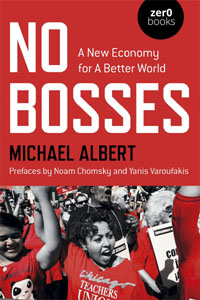
No Bosses. A New Economy for A Better World. By Michael Albert. Zero Books. 2021. 220 pages. £13.99.

Another book by Michael Albert arguing for his blueprint for a future economic and social system that he calls ‘participatory economics’, or ‘parecon’. He presents it as an alternative buying-and-selling economy both to one where wages and prices are determined by the market and to one where they are fixed by the government. His blueprint involves your work and income being decided by your work colleagues and what you consume by your neighbours. It also involves numerous meetings and votes to decide what should be produced.

Yanis Varoufakis, in a politely critical preface, makes the point that it could turn out to be a dystopia rather than a utopia:
‘While I see how Michael’s proposed organisation would rid workers of individual bosses and market pressures, I fear they may end up being bossed around by tyrannical majorities.’
Yaroufakis is writing from the position of someone who thinks that giving the market a role would allow people a greater freedom of choice. We don’t agree with that of course but would make the same criticism on the ground that post-scarcity conditions make free access possible along with the application of the principle ‘from each according to their ability, to each according to their needs’.

Albert, however, insists that consumption should be linked to the ‘duration, intensity and onerousness’ of the work an individual does and is implacably opposed to ‘from each to each,’ devoting four pages to criticising it, or rather a caricature of it. Basically, he thinks that it would lead to people not working hard enough and/or consuming too much. He calls it ‘The Anarchist Objection’ and, indeed, Kropotkin and Alexander Berkman who he cites as among those who have influenced his blueprint, could both have answered his arguments. It is not just an objection made by some anarchists but also by us, as he knows since he has debated with us, both in person and in the columns of the Socialist Standard (April 2006).

There is nothing new in the book except for Varoufakis’s point.
Adam Buick

Scottish Clearances (2022)

Book Review from the January 2022 issue of the Socialist Standard

The Sutherland Clearances: The Highland Clearances, Volume Three. By Alwyn Edgar. Ebook: ISBN-13: 9781838275 006.

Before the Rebellion of Prince Charles in 1745, each Highland clan owned its own land. No one else, including the Government in Edinburgh, had the power to deprive them of it. (Travellers saw that in the mountains every crag was a new fortress for men defending their own country.) But the Highland Jacobite rebels having been defeated at Culloden and scattered, and the Lowland Government in Edinburgh now being much stronger since the Union with England in 1707, the British authorities decided to incorporate the Highlands into Great Britain in fact, as well as in theory. The anglophone legal system was successfully imposed, and the clan chiefs were made into landlords, owning all the land which had once belonged to their clans. Scots law now gave each chief-landlord the right (for any reason or no reason) to turn his entire clan out of their homes and farms, and keep the whole clan land as his private back garden, if he wanted. So when the new landlords realised that big grazing farms, for cattle or sheep, would make a lot of money, the clearances started. Well-to-do Highlanders, Lowlanders, even a few Englishmen, rented the clan lands; the chiefs evicted their folk; and the chief/landlord found his income shooting up over the years to five times or fifteen times what it had been (and there was no income tax!). Many of the evicted Highlanders were given an acre or two of worthless, barren land, and told to make it fertile: and when by donkey-work the crofters were able to grow a few potatoes, they had to pay rent for the value they themselves had created. Others – either immediately or after years of rack-rented drudgery on the croft – went to the Lowland factories, or abandoned Scotland entirely for arduous pioneering lives in North America (those who survived the journey).

The Earls of Sutherland were chiefs of the Sutherland clan, Murrays, MacKays, Sutherlands and others. Adam Gordon married a daughter of the Earl of Sutherland about 1500, and managed to cheat the rest of the family out of their land-charters. After that the Earls of Sutherland were Gordons. The 18th earl died in 1766 leaving a year-old daughter, Elizabeth Gordon, to succeed him. She inherited nearly two-thirds of the county of Sutherland, over 1250 square miles, an estate about the size of Gloucestershire. The long wars with France between 1793 and 1815 meant there was a desperate need of soldiers, such as the Sutherland small tenants could provide: but (despite being married to one of the richest men in England, the Marquis of Stafford) she wanted the much higher rents which big sheep farms would supply. (You can never have too much money.) She was indifferent to the fate of the small tenants – ‘good many of them’, would ‘inevitably be tossed out’, she wrote; they would be ‘driven from their present dwellings by the sheep farms’. She cleared her estate between 1807 and 1821, greatly increasing her rents. She and her husband became the Duke and Duchess of Sutherland.

The second greatest Sutherland landowner was Lord Reay, the chief of the Reay MacKay clan. Reay cleared his estate even before Elizabeth Gordon, beginning about 1800. (Thirteen smaller landlords owned the rest of the county, and rivalled the countess and Lord Reay with their own clearances.) Reay belonged to a London firm which provided finance to slave-traders, and spent most of his time in gambling dens and brothels. Having wasted vast amounts of money, he sold his estate to the Sutherlands in 1830, and bought a slave plantation in the West Indies. When the slaves were freed in 1833, like the other slave-owners he was compensated. (The slaves weren’t.) – from the blurb.

Interview with the author here: https://youtu.be/CrhSuf9TFl0

Blogger's Note:
Alwyn Edgar gave a talk on his series of books last July via the SPGB discord discussion list.

Material World: a world without war (2022)

The Material World Column from the January 2022 issue of the Socialist Standard

We go into another new year and as in previous years, it is under the looming prospect of war. Working people may once again be called upon to take part in another slaughter where men, women and children will suffer.

It is easy to blame individuals for starting wars, and some are certainly guilty, but the fundamental culprit is the capitalist system. Since capitalism is a predatory social and economic system, predatory personalities tend to rise to power who view the world through a lens of aggression. But it’s not merely a capitalist delusion, they are in fact surrounded by enemies.

When the Soviet Union disintegrated into independent regimes of oligarchs, and when China’s Communist Party promoted private enterprise as government policy, the intellectuals who had insisted that the Cold War was a conflict between competing ideologies were proved wrong. Meanwhile the small Marxist voices that had always explained the rivalry between the Great Powers as an economic one for the control of raw materials and trade routes were shown to hold the more accurate analysis. The danger of war arises inevitably out of the very nature of capitalism.

As 2022 begins we are faced with a number of flashpoints that could feasibly ignite into war. These are:
  1. The important sea-lanes of the South China Sea with its scatter of strategic small islands, as well as the unresolved status of Taiwan. The UK, USA and Australia have established the AUKUS security pact, complementing treaties with Japan, the Philippines and others, aimed at the encirclement of China. Capitalism forces countries to compete in the world market and to strive for aims that cannot be satisfied. The rivalry between China and the US is unavoidable and a trade war can so easily escalate into an actual blood-and-guts war.
  2. With echoes of the Eastern Front, at the borders of Ukraine and Belarus, Russian forces confront those of the NATO alliance. Army manoeuvres are regularly taking place to be prepared for military conflict.
  3. Iran, an aspiring regional power in the Middle East, enduring the slow strangulation of stringent economic sanctions, challenges the neighbouring oil sheikdoms using proxy militias, and the Gulf States now have a new friend in Israel. A shadow war is already being engaged in with the mining of ships and in the Straits of Hormuz, the main sea route for oil tankers, the scene is of regular stand-offs between warships.
  4. And then there is the Horn of Africa, where countries are too poor to feed their peoples yet have the ability to build armies and engage in wars which too often involve other countries.
Of all the many problems that capitalism has not solved, war is a perennial and always ominous threat.

War is fought for the interests and advantages of the ruling class, to protect or extend capitalist profits. Of course, no politician will ever admit going to war for such shabby motives. Every war has to be justified with such reasons as ‘humanitarianism’, the defence of the national interest, or upholding international ‘justice’, otherwise, very few citizens would sacrifice their lives or surrender their liberties so willingly. Each nation’s political leaders will argue that ‘our’ government’s foreign policy is ‘just’ while ‘their’ government’s foreign policy exists because their leader is a warmongering militarist adventurer. ‘Our’ side was forced into a ‘defensive’ position due to the other nation’s ‘aggression’. The noble talk about protecting ‘democracy’ is cant and hypocrisy. Every war is justified by a massive propaganda effort to demonise the enemy. It is the bait to hook us into giving our approval to an orgy of armament spending and profiteering.

Capitalism breeds wars. In order to secure peace we need to create a cooperative commonwealth where things are no longer produced for profit, but to satisfy people’s needs. This involves a struggle known as the class war, and this is the only war which workers should engage in. Yet the tragic reality remains that men and women still seem more willing to work and die for capitalism than to work and live for socialism.

If we are to eliminate wars we must understand that we need to transform the minority class ownership of the means of production and distribution into common ownership, producing for use instead of for profit.
ALJO

Unidentified Aerial Phenomena (UAP) – What if? (2022)

From the January 2022 issue of the Socialist Standard

So it’s official – unidentified flying objects are ‘real’ phenomena. So said the US Department of Defense on 27 April 2020. Upon this date they released three videos containing footage of, and reaction to, unidentified aerial phenomena. These videos had been seen some years before on a UFO enthusiast’s website but had been dismissed as hoaxes. Subsequently an investigation by the New York Times revealed them as genuine footage of a real event. As a result of this the Pentagon reluctantly admitted this was true and that they had been studying such phenomena for some years in an attempt to discover if they represented a ‘threat to national security’. Let’s take a look at this evidence with a less paranoid eye to ascertain what possible effect this might have on how we understand nature and technology.

In 2004 the aircraft carriers USS Nimitz and USS Princeton off the California coast, and then in 2014 the USS Theodore Roosevelt off the east coast of the USA, reported similar sightings by radar tracking and then infrared cameras aboard strike force aircraft. The pilots reported swarms of 50 ft. long white capsules (they dubbed them ‘Tic Tacs’) performing impossible aerial manoeuvres at high speed with no evidence of wings, rocket or jet exhausts or propellers. They could seemingly stop and accelerate instantaneously and appeared equally adept in the ocean, sky and space. The objects reacted to the aircraft and appeared to play with them as dolphins sometimes do with human swimmers. The radar and infrared footage seems to rule out any element of mass hallucination or visual illusion or any form of known natural phenomena. The observed ability of these objects to defy the known laws of nature would also seem to preclude the possibility that they were the result of any human technology. Of the many attempts to explain this exceptionally enigmatic phenomenon let’s choose the extraterrestrial origin hypothesis and indulge in a thought experiment to investigate the possible implications for the world of politics.

Many of us have enjoyed films and novels that feature an ‘encounter’ with alien creatures from another world. Depending on when they were made they reflect the different levels of fear and hope represented by such a discovery within certain cultures at certain times. During the Cold War these stories were essentially born of the paranoia around nuclear weapons and any superior technology was seen as a threat. But what is the response of global capitalist culture in 2021? The international bourgeoisie will always be suspicious of anything or anyone that they cannot corrupt or intimidate but most people seem either indifferent or profoundly intrigued by the possibility of an alien encounter. One particularly important possibility represented by the performance of these objects is that the immense distances between stars and their planetary systems may not preclude such visits as scientists have long maintained. Our laws of nature are certainly incomplete and interstellar travel might be a real possibility for advanced alien cultures. That the owners of these Tic Tacs seem indifferent to humanity does not imply that other elements of our planet might not be of more interest to them. If they were to choose to interact with us what might be the result?

It seems reasonable, from a socialist point of view, to believe that if any civilisation has achieved the level of technological sophistication to make interstellar travel possible they would have survived and overcome private property relations and the tribalism and violence associated with it. Therefore it’s unlikely that any alien visitors would be a threat to us or any other species on Earth. Likewise, their technological status would greatly limit any threat from us. What would be the nature of any communication? Perhaps, just as we value the art and culture of our own past, our visitors would be interested in our cultural activities down the centuries. Or perhaps they would be interested in our biological evolution compared with their own – the topics of conversation would be fascinating and endless. Presumably they would be wise enough to observe the ‘prime directive’ and not share any of the secrets of their technology. Of course, should it ever occur our history would change forever once the encounter had happened. Some believe it already has in the distant past but there seems no evidence for this – something our visitors might like to deny or confirm. Perhaps they’re waiting for our species to overcome its atavistic adolescence and establish socialism before they make contact. For socialists it would be a great chance to confirm the process of cultural evolution (materialist conception of history) as universal. It would also be immensely reassuring that intelligent life can evolve beyond the chaos and despair that we see on our own planet.

On close inspection of the footage itself it has to be said that it’s rather underwhelming. The fuzzy objects in themselves are too enigmatic to provide any proof of their nature or origin. It is rather the pilot’s reaction and narration that makes the incident so compelling. These are trained members of the military who are not known for feverish hallucinations. Something is going on. Will it prove to be the beginning of something historically significant or continue to be merely a mysterious but unimportant part of every pilot and astronaut’s working life? Now that the subject has outgrown its pulp fiction origins and has become part of scientific research we can now perhaps all look at the skies and report what we see without the associated ridicule of the past. It may well be that this fear of derision has led to an under-reporting previously and that such sightings are relatively commonplace. Even socialists can now take time out from the relentless class struggle and look up at the sky and ponder the possibility of other intelligent life forms on other worlds, together with ourselves, as aspects of the incarnation of the universe becoming conscious of itself.
Wez.

Monday, January 3, 2022

It’s a rich man’s world (2022)

From the January 2022 issue of the Socialist Standard

Frequently described in the press and TV media as a ‘self-made billionaire’, Richard Branson is anything but self-made. While he may not have inherited his fortune like some of the other super-rich parasites of the capitalist class, it is nonetheless a complete fallacy that he somehow made all of his money through only his individual hard work and efforts. The reality is that Branson and so many of his ilk would not be anything like as wealthy as they are, were it not for the sweat and brains of those workers he has employed and exploited, and who in reality produced the surplus value and profit he has enjoyed in order to make him one of the world’s richest people.

So just how did he manage to become so wealthy? Richard Branson is the founder of the Virgin Group, one of the world’s most recognisable brands, with business interests in everything from travel to telecommunications, health to banking, and music to leisure, and perhaps best known for having started Virgin Records as a mail-order record retailer in 1970. After the first Virgin artist, Mike Oldfield, released Tubular Bells, Virgin Records also went on to sign other household names such as the Sex Pistols and The Rolling Stones.

Nowadays there are more than 40 Virgin companies worldwide in over 35 countries, with a workforce of over 60,000 – so much for being a self-made billionaire. The Virgin Group is made up of Virgin Group Holdings Limited (VGHL) and its subsidiaries, with Branson (BVI) as the sole shareholder.

Call us cynical, but it’s a fair stretch of the imagination to suggest that old Goldilocks amassed his fortune through some sort of magical Midas touch – as is often implied by his arse-licking admirers. Instead, he is just like capitalists the world over, who have to employ the knowledge, skills and physical labour of you and every other member of the working class in order to produce and create their wealth for them. A point not lost on Branson who was quoted as saying: ‘Your employees are your company’s real competitive advantage. They’re the ones making the magic happen – so long as their needs are being met’.

More’s the pity then, that they’re also the first to be dropped when your needs for more and more profit are not being met. Remember these headlines when he furloughed his staff at government expense? ‘FLOG YOUR PRIVATE ISLAND AND PAY YOUR STAFF: Richard Branson among billionaire business owners and shareholders facing furious demand to open their OWN wallets to help staff survive as the coronavirus epidemic batters the economy’.

Zoomed out
Now far be it from us to single out cuddly Richie Rich for special criticism of the capitalist class and the system they thrive on. Just before the ghost of Christmas past becomes a distant memory, who could fail to be incensed by the actions of another big-time capitalist by the name of Vishal Garg, CEO of US online mortgage company Better.com. Just weeks before his staff were preparing for a much-needed festive break from the pressures of meeting profit targets dictated to them by Garg, 900 of them were asked to attend a hastily arranged Zoom meeting. Many of them were under the impression that they were about to receive news of this year’s Christmas bonus pay-out. Instead they were told by Garg that ‘If you’re on this call you’re part of the unlucky group being laid off,’ and ‘Last time I did [this] I cried’. Then just for good measure and to add insult to injury, he went on to blame them for their poor productivity, claiming that ‘staff efficiency and performance’ lay behind the mass-firing of 15 percent of Better.com’s workforce. It seems however the one thing he forgot to mention was the $750m cash infusion Better.com received from Softbank, a Japanese firm and key investor. Which no doubt will have demanded a reduction in the company’s wage bill in order to maximise their profits.

Using online technology to make the house-buying process ‘faster and more efficient’, Garg also announced earlier this year that he planned to float the company on the stock market. A deal which estimated the value of the business – which Mr Garg founded in 2015 – at between $6.9 and $7.7 billion. Soon after the mass firing hit the news, Fortune magazine revealed that Mr Garg was also the author of a previously written anonymous blog post in which he accused sacked staff at his firm of ‘stealing’ from their colleagues and customers by being unproductive and only working two hours a day, while claiming for eight or more. A classic tactic used by his type to divide and conquer the workforce. Garg’s management style has been criticised before, after an email he sent to staff was obtained by Forbes last year. In the email, Garg wrote: ‘You are TOO DAMN SLOW. You are a bunch of DUMB DOLPHINS… SO STOP IT. STOP IT. STOP IT RIGHT NOW. YOU ARE EMBARRASSING ME’.

Meanwhile former employee, Christian Chapman, described his experience of receiving the news of his lay-off via Zoom in a BBC News interview as ‘excruciatingly painful’ (bbc.in/3pQpceq).

Selling our skills
None of this will come as any great surprise to regular readers of this journal. Most will recognise the cold-hearted reality of life under capitalism and the misery that it all too often causes. For the average person, the best we can do in order to survive, is the selling of our acquired skills in return for a wage in the ever-competitive world of jobs and employment. Very occasionally, if market conditions happen to favour workers, then there’s a chance of wages being driven up, as has recently been the case due to the shortage of HGV drivers in the UK. Noticeably pretending to be in favour of a high-wage economy recently, it wasn’t long before buffoon Boris Johnson showed his true blue colours, making a quick U-turn in immigration policy in order to offset the sudden need to increase wages in that particular sector of industry, by opening the UK borders to experienced HGV workers in an effort to help stabilise the wage bill of companies unable to fill vacancies in the UK. That’s the basic capitalist law of supply and demand, which applies not just to goods but also to human labour. If there is an over-supply of something, its price goes down, if a shortage, the price goes up.

Is there a solution?
Indeed there is. Here in the UK and all other advanced countries of the world, there already exits ample technology, raw materials and skilled labour for us to create a more sustainable and productive society for the benefit of all life on earth. All that is needed is the widespread knowledge, understanding and will to make it happen. Workers of the world don’t need to depend on Richard Bransons or Vishal Gargs to create the conditions for a meaningful and satisfying quality of life. If we do, we’ll have a very long wait. What we need to do is come together to share our skills and knowledge cooperatively for the good of all and without the unnecessary burden and barriers created by money and markets. A truly civilised society would bring an end to the current climate of fear and insecurity caused by hiring and firing, an endemic feature of capitalism.

How to?
It’s all well and good thinking, theorising, discussing and debating the rights and wrongs of the system. However what is needed more than anything right now is engagement with our fellow workers, to spell out at every opportunity, be it online, in person, on the street, in the pub, at our places of work and leisure, the brutal reality and lack of opportunity and fulfilment that exists with life under capitalism. We need to explain and present a positive case for socialism, to work towards a better future for all human and other animal life on earth, while at the same time protecting the environment. Let’s stop procrastinating. Let’s do it now!
Paul Edwards