Showing posts with label August 1928. Show all posts

Thursday, August 18, 2022

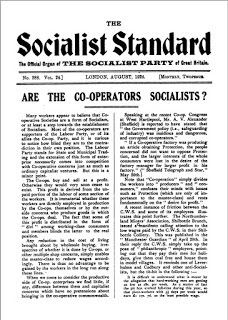
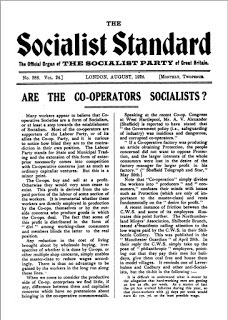
Are the Co-operators Socialists? (1928)

From the August 1928 issue of the Socialist Standard

Many workers appear to believe that Co-operative Societies are a form of Socialism, or at least a step towards the establishment of Socialism. Most of the co-operators are supporters of the Labour Party, or of its allies the Co-op. Party, and it is curious to notice how blind they are to the contradiction in their own position. The Labour Party stands for State and Municipal Trading and the extension of this form of enterprise necessarily comes into competition with Co-operative concerns just as much as ordinary capitalist ventures. But this is a minor point.

The Co-ops. buy and sell at a profit. Otherwise they would very soon cease to exist. This profit is derived from the unpaid portion of the labour of some section of the workers. It is immaterial whether these workers are directly employed in production by the Co-ops. themselves or by the outside concerns who produce goods in which the Co-ops. deal. The fact that some of this profit is distributed in the form of “divi” among working-class consumers and members blinds the latter to the real position.

Any reduction in the cost of living brought about by wholesale buying, irrespective of whether it is done by Co-ops, or other multiple shop concerns, simply enables the master-class to reduce wages accordingly. There is thus no advantage to be gained by the workers in the long run along those lines.

When we come to consider the productive side of Co-op. enterprises we find little, if any, difference between them and capitalist concerns which have no pretensions about bringing in the co-operative commonwealth.

Speaking at the recent Co-op. Congress at West Hartlepool, Mr. A. V. Alexander (Sheffield) is reported to have stated that “the Government policy (i.e., safeguarding of industry) was insidious and dangerous, and corrupted co-operators.”
“If a Co-operative factory was producing an article obtaining Protection, the people concerned did not want to oppose Protection, and the larger interests of the whole consumers were lost in the desire of the factory manager for larger profit in his factory.” (“Sheffield Telegraph and Star,” May 30th.)
Note that “Co-operation” simply divides the workers into “producers” and “consumers,” confuses their minds with issues such as Protection (which are only of importance to the master-class) and rests fundamentally on the “desire for profit.”

A recent instance of friction between the C.W.S. and some of its employees illustrates this point further. The Northumberland Miners’ Association, Shilbottle Branch, issued a manifesto calling attention to the low wages paid by the C.W.S. in their Shilbottle Colliery. This was published in the “Manchester Guardian” of April 20th. In their reply the C.W.S. simply take up the pose of “philanthropic” employers, pointing out that they pay their men for holidays, give them coal free and house them in model villages. It reminds one of Leverhulme and Cadbury and other anti-Socialists, but the tit-bit is the following :—
“It is difficult to understand what is meant by the allegation that hard-working men are getting as low as 28s. per week. As a matter of fact the pit has worked full-time during this year, so that piece-workers with 5½ days per week would earn £1 17s. 7d. as the least possible wage.”
After such an example of the reckless munificence in which they indulge, one can hardly wonder at the Society protesting against the miners’ lodge “appealing to the sentiment of the co-operative movement by a series of mis-statements.” Thirty-seven bob for a week in a pit ! What carping critic dare now say that the emancipation of the wage-slaves is not in sight?

Fellow-workers, Socialism means a system of life in which the instrument of labour will be common property.

Consequently the fruits of labour under such conditions will be freely available to all. There will be no need for the workers to buy and sell that which they own as a result of their collective effort. Organised distribution, democratically controlled according to a definite plan based upon social needs will replace all juggling with “divi.” and wages and such-like features of capitalism. Such a system can replace the existing chaos in which you suffer, just as soon as you are ready to establish it by means of your political power. When you realise the need for this you will have no time left to waste on Labour or Co-op. Parties, which tinker with effects while leaving causes untouched. You will get on with the job in the only way possible, i.e., by joining and helping forward the work of the Socialist Party.
Eric Boden

Correspondence: Ballot or Barricade? Mr. Chapman’s Last Word. (1928)

Letter to the Editors from the August 1928 issue of the Socialist Standard

To the Editor of the Socialist Standard.

(1) “H,” in his reply to my second letter in the June issue of the “S.S.,” tries to make enormous capital from my slightly altered quotation from Marx, so will you kindly state the fact that it merely consisted of substituting “bloody struggles” for Marx’s “sanguinary conflicts.”

(2) Against the two letters that “H” quotes in the May issue of the “S.S.,” re Marx to Kugelman on the Franchise (both are dated 1866), 1 will quote the one of April, 1871, re the policy of smashing instead of conquering the political machine : “If you look again in the last chapter of my ’18th Brumaire’ you will find my (Marx’s) opinion that the next French Revolution will no more attempt to transfer the bureaucratic military state machinery from one hand to another, but will try to break it in pieces.” (Published in the “Labour Monthly,” August, 1922.) Again Marx in his work, “Revolution and Counter Revolution,” Chapter 9, page 68, writes: “When Radetzky, in his camp beyond the Adige, received the first orders from the responsible ministers at Vienna, he exclaimed : ‘Who are these ministers? They are not the government of Austria ! Austria is now nowhere but in my camp; I and my army, we are Austria; and when we shall have beaten the Italians, we shall reconquer the Empire for the Emperor !’ And old Radetzky was right—but the imbecile ‘responsible ministers’ at Vienna heeded him not.“

(3) “H” says (page 150, June “S.S.”), that conditions were different in 1850, etc., and that a policy fit for those times no longer applies. I say that the conditions of the workers were the same in 1850 (in a general sense) as they are now, and that the proletariat at that time were faced with the same fundamental problem as they are now, viz., the forcible overthrow of the bourgeoisie.

(4) “H” says (in the May issue of the “S.S.,” page 141) : “If the workers are com­pelled (in the event of a revolution) to make use of their economic organisation to bring indus­try to a standstill, and to appeal to the armed forces for support,” etc. This has been tried and found wanting in the General Strike of 1926, and with what result? That the present sham democratic government was revealed in its true colours, viz., that it is a bourgeoise military dic­tatorship—Stratocracy !

(5) I should like an academic party like the S.P.G.B. to explain to me the following:—If universal suffrage could emancipate the workers, the tyrants in power would have abolished it years ago !

I remain, Yours faithfully,

Robert Chapman.

N.B.—The onus of explaining how the workers are to be armed, trained, etc., does not rest on me, but on the S.P.G.B., who talk so lightly of conquering the political machinery, and establishing Socialism. I cannot believe that the bourgeoisie would give up their property with­ out a blood-bath.

P.S.—Brevity owing to Editor’s note :—The position that the S.P.G.B. takes up with regard to the Vote is extraordinary in its childish simplicity, and amounts, in effect, to this :—Before a General Election S.P.G.B.’s will say: “Dear Comrades, Just put an X on a card (of so great a value) and everything in the garden will be lovely.” What a revolutionary party ! The Party, in my opinion, fails to realise the enormous obstacles in our path to Socialism.
Robert Chapman.


Our Reply.
(1) The important point was to know whether Mr. Chapman’s alleged quotation came from the section of the address to the Communist League which dealt with the tactics to be pursued in helping the capitalist class to power, or from the section which dealt with the ensuing period after the capitalists had gained control. Until I had from Mr. Chapman the correct wording it was impossible to tell from which section he was quoting. As I have twice pointed out, Marx does not urge the use of armed force for the latter period.

(2) Mr. Chapman quotes from the “Labour Monthly” what purports to be a letter from Marx to Kugelmann. This letter, says Mr. Chapman, is about “the policy of smashing instead of conquering the Political Machine.” He then quotes from the letter and fails to observe that Marx does not even mention the ”political machinery.” Mr. Chapman evidently did not trouble to look up the last chapter in the “18th Brumaire” to which Marx refers. If he will refer to page 142 (Kerr’s edition, 1914), he will see that Marx describes the “tremendous bureaucratic and military organisation” of the then French Government. It is this which must be destroyed, not the political machinery itself. In the last chapter of the “18th Brumaire,” as in all the other passages and works referred to by Mr. Chapman in this and previous letters, there is no statement made by Marx which will support Mr. Chapman’s policy of fighting the armed forces of the State, as distinct from gaining control of the political machinery.

Mr. Chapman instances Radetzky to prove that the workers need not obtain con­trol of the political machinery, and of the armed forces of the capitalist state. As usual, Mr. Chapman ignores most of the deciding factors of the situation. He for­gets that the revolutionaries failed; and that Radetzky was in command of the only effective army in Austria; that the Austrian Emperor had never relinquished power, and had only made certain concessions to the Viennese revolutionaries (including the dismissal of Metternich) expressly at Radetzky’s instruction because the latter rightly considered that the Viennese were not worth serious consideration and could be dealt with at leisure ; that Radetzky’s troops were fully engaged in the much more serious business of the war with Piedmont; and that the revolutionary committee repre­sented no one outside Vienna and only a minority of the Viennese. As soon as the Italian war was settled, the Viennese revolutionaries were dealt with without the least difficulty.

Thus, the Emperor who controlled the political machinery of the Empire (except temporarily in Vienna itself) and the only effective armed forces, defeated the rebels. This, says Mr. Chapman, proves that the workers can use armed force against the capitalist class who control the political machinery and the only armed force. We fail to follow Mr. Chapman’s reasoning.

(3) The proletariat in Germany in 1850 were not faced with the same problem as faces the workers in Great Britain now. They were a small minority and their task was to aid the capitalists to destroy the feudal monarchy. How could they “overthrow the bourgeoisie” when the bourgeoisie were not yet in power? The workers here are the great majority, and their task is to destroy capitalism, not to put the capitalists into power.

(4) In 1926 there was no “general strike” of a Socialist working-class. The working-class were then and are now overwhelmingly anti-Socialist; only a small minority (about 25 per cent.) were orga­nised in trade unions, and only a minority of these were on strike. The workers had not voted Socialist and been faced with the revolt of a capitalist minority. On the contrary, they had in 1924 placed the capitalist class in possession of the political machinery and the armed forces. There is no “sham” at all about the support given by the great majority of the workers to capitalist candidates. It is an unfortunate fact.

I do not know what is meant by “a Bourgeoise Military Dictatorship Strato­cracy/’ and cannot therefore say whether Baldwin’s Government is one or not.

(5) The capitalist class do not abolish the suffrage because the problems of the capitalist system compel them to adopt representative government as a basis for the administration of capitalism.

We might retort with an equally silly “poser” : “If arms could emancipate the workers, the tyrants in power would have abolished them years ago.”

The truth is that the capitalists cannot disregard the needs of their own system. Armed forces and the franchise are equally necessary to the administration of capitalism.

(6) As Mr. Chapman denies that the control of the political machinery can be obtained by the vote, the onus certainly is on him to show how it can be done; or how Socialism can be achieved without it.

(7) It is our aim to make our position “childishly simple,” so that it may be understood by every worker. We have certainly failed to make it understandable to Mr. Chapman. We do not say to the workers, “all you have to do is just put a cross on a ballot paper.” We say that the workers must first understand Socialism, then organise politically, and then use the vote to gain control of the political machinery. After securing control, “everything in the garden will not be lovely.” Only then, in fact, will the real and enormous task of changing the economic basis of Society begin.

We do not underestimate the enormous obstacles in the path to Socialism. The greatest obstacle is to get the workers to understand and want Socialism. If we were ever likely to forget how difficult a work that is, we always have the Mr. Chapmans to remind us.
Edgar Hardcastle

The Treachery of Leaders: A second reply to a critic. (1928)

Letter to the Editors from the August 1928 issue of the Socialist Standard


To the Editor of the Socialist Standard.

Hornsey.

(1) Your statement that “Socialists, like any other beings, cannot escape the pressure of the forces surrounding them, and there is no reason to believe that Socialists would be more trustworthy than other people, except that they at least understand the social forces, and may be expected to avoid gross blunders,” bears out my contention that Parliament would offer the same inducement to modify their tune to S.P.G.B.’s as it has done to Labourites.

(2) It is through no gift of prophetic vision that I hold that the Capitalist class will make use of every weapon to stifle Socialist teaching should it be winning supporters. To-day, sheer force is used to suppress anything that threatens, even minutely, their class interests :—The Colonial oppression, the Great War, imprisonment of agitators, and the E.P.A. are witnesses to the fact that still harsher methods would be used to strangle the Socialist Party should it ever look like becoming dangerous.

Parliamentarism and constitutional action leaves the workers unprepared for this. Capitalists will not interfere with the gradual growth of Socialism, they are led to believe, and will unresistmgly, in accordance with the code of sportsmanship, accede to the enactments (the King not daring as head of the Constitution to veto them) that means their expropriation.

(3) The S.P.G.B. to become the preponderating party in Parliament must pass through the phase of second party. There is no sudden conversion that you speak of, when the S.P.G.B. becomes the strongest party during the office of an anti-Socialist government. The Capitalist government can keep the Socialists waiting for years, and, knowing the constitutional law-abiding character of the Party, feel safe in adding another ten to fifteen years to their life.

(4) Your Party, in such respects, is up in the clouds. These things have got to be faced. To speak about generals and officers as workers is to apply abstract economic categories to existing conditions without any attempt to allow for the modifying factors of the psychology of the men concerned, and their close connection with the Capitalist class.

They are used to ordering workers about, and it is well known the hatred they have for Parliamentary interference. The question of how will the officers and generals act when instructed by a Socialist War Minister, is like that of what shall we do if the sun drops from the sky. The two are possibilities too remote to trouble about. The S.P.G.B. will never get so far as a Government unless it intends to legislate for the Capitalists.

(5) I offer at the moment, no alternative to your policy of following the constitutional path as pointed out to you by the Capitalists. Your readers have only to think deeply and face up to unpleasant facts and alternatives will suggest themselves to them.

Thanking you for answering my previous letter, Yours fraternally,
R. M. Phillips.


Our Reply.
(1) The question is not whether Socialist M.P.’s would be offered inducements to modify their attitude, but whether the electors would tolerate such modification. Labour electors do not want capitalism overthrown, and therefore do not object to their M.P.’s non-Socialist politics and actions. Socialist electors would object and would enforce their wishes.

(2) Mr. Phillips here makes the error of assuming that the actions of the capitalist class are synonymous with their wishes. We do not urge the workers to rely upon the “code of sportsmanship” or the voluntary adherence of the capitalist class to “constitutionalism.” The capitalist class maintained the parliamentary system because the problems of capitalism compelled them to do so. The majority of the English capitalist class are well aware of the limitations and dangers of using force openly against discontented workers. They use, and are likely to continue to use, the much more effective weapon of propaganda in the schools, the newspapers, etc. When they use force now they can still defend them selves by the plea that they have the majority of the electors supporting them. When that plea has been undermined (i.e., when the majority of the electors are Socialist) the capitalist class will have to yield or be faced with the problem of trying to administer capitalism by military force, against a hostile majority of the population. That problem is insoluble, not (as Mr. Phillips thinks we believe) because of any scruples of the capitalists, but because of the nature of modern industry and trade, and the complexity of the administration of capitalism.

(3) Mr. Phillips forgets that the capitalist class, being human beings and desiring to go on living, will not be prepared to pay any price, however great, in order to have the satisfaction of blocking the way to Socialism. When the working-class have become predominantly Socialist, and are organised politically and economically on class lines, they will be easily able to obstruct the normal working of capitalism. The majority of the capitalist class, faced with the alternative of yielding to the wishes of the majority of society, or of entering into a period of continued industrial and administrative chaos, will certainly choose the former.

(4) Mr. Phillips said (June Socialist Standard) : “The generals, officers, bureaucrats, etc. . . . are drawn from the ranks of the capitalist class and its lackeys.”

In reply I pointed out that this is not true. Being dependent on their pay for their livelihood, the great majority of these persons are members of the working-class. Mr. Phillips now agrees that they are members of the working-class, but says that I made no attempt to allow for the “psychology of the men concerned.” By this he means, apparently, that these people, although members of the working-class, do not recognise their class position and are not Socialists. This is perfectly true, but in this respect these people are in no essential way different from other sections of the working-class. The great majority of all workers are still ignorant of their class position, and are not Socialists. As regards those members of the working-class who are army officers, civil servants, etc., the majority, even apart from acquiring greater knowledge of their class position, will act in accordance with their bread and butter interests, i.e., they will take orders from the authorities who control the political machinery and their pay.

Mr. Phillips makes a statement that the “S.P.G.B. will never get so far as a Government unless it intends to legislate for the capitalists.” The meaning is obscure, and he gives no evidence or explanation whatever. What we can reply with confidence is that when the working-class are organised in a Socialist Party they will take control of the political machinery with the object not of legislating for the capitalists, but for the introduction of Socialism.

(5) Mr. Phillips, like other critics, here exposes the hollowness of his case. He makes the elementary error of supposing that a policy is proved unsound if difficulties can be mentioned. He forgets that every policy and every action, great or small, has to deal with some difficulty or other. The only test is to compare the practicability of one policy with that of an alternative, and weigh up the respective advantages and disadvantages. Instead of doing this, Mr. Phillips offers no alternative, but naively assures us that our readers “have only to think deeply …. and alternatives will suggest themselves.”

May we ask Mr. Phillips to believe that dead and living members of the Socialist Party have thought deeply before offering the S.P.G.B. Declaration of Principles, and so far none of our critics has succeeded in discovering a practicable alternative.
Edgar Hardcastle

The Transition to Socialism: A Reply to Mr. Fred Montague, M.P. (1928)

Letter to the Editors from the August 1928 issue of the Socialist Standard
Mr. Montague, Labour M.P. and editor of the “Social-Democrat,” asks us a number of questions in the June issue of that journal. By an oversight our reply was omitted from the July Socialist Standard. We give below in full the paragraphs which explain Mr. Montague’s point of view.
(1) Questions for "the Socialist Standard." 

Discussing the subject of Communist doctrine, “The Socialist Standard” describes the statement that “The workers must destroy the capitalist state and set up their own workers’ state” as dangerous romanticism, leading not to Socialism but to the shambles. We agree. And we agree also with “The Socialist Standard” that it is nonsense to say that Marx and Engels gave support to the advocacy of violence beyond what appears in a purple passage or two to “round off an occasional peroration.” But if the idea of the destroying of the capitalist state and setting up a workers’ state is dangerous romanticism, what is the idea of leaving transitional politics alone ? Of two things one, surely ! Either revolutionary overthrow, which seems to agree with the Communist position, or transformation of such a character that at no point is the stability of society threatened. As a matter of interest and not of mere debate we invite “The Socialist Standard” to examine this point.

(2) The Logic of It. 

Does any Socialist worthy of the appellation “scientific” imagine that capitalism will end one Saturday night and Socialism begin one Monday morning? Members of the S.P.G.B. are strong on logic. Will any responsible member answer the following points? Suppose it is agreed, as we agree, that nationalisation is only another form of capitalism, and that social reform, as we do not altogether agree, is not worth troubling about. Imagine that a satisfactory majority of class-conscious Socialists are one day returned to Parliament. Socialism is declared by the representatives of the working class. What then? Do the workers carry on and, if so, where and how? For instance, will goods be made for export and trade carried on in automatic continuation of the old machinery until Parliament creates an entirely new organisation? Is it seriously contended that no period of transition will be required, and if it is not so contended is it unreasonable to ask what is to guarantee the efficiency of that diminishing area of production still in the hands of none too sympathetic capitalists during that period?

(3) What the change means.

Nationalisation is only another form of capitalism, but transition means the same thing whoever may be in charge of Parliament. It is not a question of whether the change from one system to another is to be slow or rapid. If the machinery of production, distribution, and foreign exchange is to be taken over as a going concern with a view to socialisation an enormous amount of complicated administrative work will have to be done afterwards, involving, for one thing, tremendous displacement of labour in the closing down of parasitical trades. It may seem a small point, but are shopkeepers, small as well as large, to carry on as private capitalists until a Socialist system of co-operative distribution has been created? Or is it proposed to have the plans for socialisation ready beforehand ? Who will have these plans, and how can they be prepared beforehand without participation in and knowledge of pre-Socialist administration? It is not to the point that workers run the capitalist system now. That might be an argument for syndicalists, but it is not one for Socialists. Scientific Socialism means, besides economic and historical theory, Socialism scientifically applied, otherwise we might as well leave the workers to run the capitalist system. And as this tremendous piece of work is being done, are capitalists going to oblige by running things for our convenience whilst awaiting execution?

(4) Wealth of a kind.

One point that came out of the Maxton-Fitzgerald debate is also worth a little extra consideration. “Under Socialism” wealth will be so plentiful that monetary system will be unnecessary and would be absurd, therefore Socialism cannot mean equal remuneration or socialisation of the means of exchange. We have no quarrel with that, but go easy about the plentiful supply. Plentiful supply of what? Iron girders, aluminium pots, baby’s basinettes, or Brummagem idols for Ballabaloo? All these things come into the term “wealth,” and are included in potential production. Have we a likely plentiful supply of food? Do necessary raw materials materialise like the famous Katie King? Are cotton, wool, leather, wood and tobacco available “like water” ? With more countries in the world than ever producing what they want for themselves this repudiation of “exchange“ may acquire a sinister meaning. The fact is, the “plentiful supply” of means of enjoyment is child’s talk unless we are sure of exchanging our goods for the food and raw materials we want. There is plenty in the world, we know, but is non-transitional Socialism possible the world over at the same moment? If not, what allowances and modifications are admissible, and if capitalistic exceptions are to be made in any way, what logical objection is there to nationalisation? “

Our Reply.

What is the Transition Period?

(1) Although Mr. Montague asks a number of questions, most of the points of difference between him and us can be traced back to his use of the term “transition period.” What is the transition period? We live now in a capitalist economic system with the capitalist class in control of the political machinery and the armed forces of society. They make laws and enforce them, laws which are always framed within the limits imposed by the nature of capitalism and (so far as these limits permit) always directly in their interests as capitalists. When, and not before, the working-class, organised for Socialism, have gained control of the political machinery, the transition period will begin. The working-class cannot begin the work of abolishing the present private property basis of society until they have obtained political control from the capitalist class.

Mr. Montague holds a fundamentally different, and as we consider, a fundamentally false view. He asks (paragraph 1) : “What is the idea of leaving transitional politics alone?”

Our answer is plain. We shall not leave “transitional politics” alone, but what Mr. Montague has in mind as “transitional politics” are merely the politics of capitalist reform now carried on by him and his party. We are not in the “transition period,” the workers have not obtained political control, and the advocacy of nationalisation and other reforms is not work towards Socialism or towards the capture of political control for Socialism.

(2) Mr. Montague here agrees that “nationalisation is only another form of capitalism.” It is then for him to justify his support of nationalisation. He must be quite familiar with our opposition based on the contention that it will not benefit the working-class under capitalism.

Mr. Montague’s further questions about foreign trade are presumably based on the assumption that Socialism can be established in Great Britain alone. It certainly cannot. Socialism will be international, and cannot be other than international.

(3) Most of the points in this paragraph depend on Mr. Montague’s view of “transitional politics,“ and are answered above in my reply to his first paragraph. We deny his statement that “transition means the same thing whoever may be in charge of Parliament.” Socialists do not deny or underestimate the difficulties of the economic transformation to Socialism, but the difficulties of the period after the conquest of power have no relation to the policy of supporting capitalist reforms before the conquest of power.

(4) Here Mr. Montague deals further with the economic problems which will face the workers after they have obtained political control. They will, for instance, have to cease the production of articles no longer required, and produce instead larger quantities of certain goods the supply of which is at present too small. Similar problems were solved in 1914. Mr. Montague (who actively participated as private, as First Lieutenant and as recruiting agent) will know how the Government withdrew men from industrial production in order to build up a great machine for slaughtering their fellow-workers in other countries. They also solved the problem of turning out munitions and then, in 1919, they reversed the process when the weapons of destruction were no longer needed in such huge quantities.

Krupp did not personally conduct the similar change-over in Germany from howitzers to harvesters in the factories bearing his name; the change-over, like capitalist production and distribution in general, was carried through by workers. We cannot, therefore, see why Mr. Montague should doubt our ability to do for ourselves what we now do for the capitalists.

Mr. Montague’s other difficulties arise again out of his two misconceptions : first, that the transition to Socialism is already going on while the capitalists are still in power, and secondly, that Socialism can be introduced on a national basis, requiring capitalist trade to continue between the national groups. Under Socialism there will be no trade, home or foreign, individual or collective.
Edgar Hardcastle

Wednesday, August 17, 2022

Letter: The Aims of the I.L.P. (1928)

Letter to the Editors from the August 1928 issue of the Socialist Standard

A Further Reply to a Correspondent.

Catford, S.E.6

Dear Comrades, .

I am sorry I was not able to continue our debate in time for the May number of the “Standard.” However, if you will tolerate a final letter, I should like to reply to two of the points you raise.

(1) You challenge me to quote from I.L.P. literature that the I.L.P. aims at Socialism. Here are four quotations taken at random :—

(a) From the Constitution of the I.L.P. :

Object.—Establishment of Socialist Commonwealth.

The Socialist Commonwealth is that state of society in which land and capital are communallv owned and the processes of production, distribution and exchange are social functions.

(b) From Fred Henderson’s Case for Socialism, Chap. II. (Reprinted as a pamphlet by I.L.P.) 

The whole chapter explains the Socialist outlook on confiscation of ”private” property, e.g., “Socialists advocate the expropriation of the landed and capitalist class, the deprivation of their way of living ; and the organisation of the wealth-producing activities of the nation by nation itself, by the whole people acting in civic co-operation, for the benefit of all the citizens and members of the nation” (pages 31-32).

(c) From a leaflet “Socialism—What it is—What it is not.” (published by I.L.P.) 

“Socialism is the ownership of the means of life by the people and for the people.”

(d) From “Keir Hardie’s Socialism”—Francis Johnson (published by I.L.P.).

Object of I.L.P. : “To secure the collective ownership of all the means of production, distribution and exchange.” (Page 6.)

(2) I appreciated the “Salvation Army” joke —both in the original (Engel's “Socialism,” p. 11), and in your use of the reference on p. 27, but I was annoyed at “my loose method of argument” because I said “Marx and Engels maintain,” etc. In the introduction to Engels' book he explains how the book came to be written and how it expresses “the views held by Marx and myself on this great variety of subjects,” etc. (page 4). The number of times Engels used “we” instead of “I” must be hundreds. “H” is guilty of a lie to score a point—a genuine Socialist would not stoop to that.
Yours fraternally,
H. W. R. Keeble.


Our Reply.
(1) (a) If Mr. Keeble will refer to the June Socialist Standard, he will see that Mr. Maxton, Chairman of the I.L.P., agrees with us that ” communal ownership of capital ” is not Socialism, but a meaningless phrase.

(b) Mr. Fred Henderson’s writings are not the official policy of the I.L.P., but merely his private opinions.

(c) Mr. Keeble forgets that both the I.L.P. and the Labour Party (as we have repeatedly shown from their official publications) regard State Capitalism or Nationalisation, which still permit bondholders to live by owning property, as being “ownership by the people.”

(d) The quotation from Keir Hardie merely bears out our contention in (c). Under Socialism there will be common ownership of the means of production and distribution. There can be no “exchange” except under a private property system.
Edgar Hardcastle

Socialism Smashed Again. (1928)

From the August 1928 issue of the Socialist Standard

A correspondent has sent us a cutting from the “Daily Express” of July 2nd, with a request that we answer it. The cutting is an article entitled “J. D. Beresford Tried Socialism But Found It Wanting—Too Much.” Then follows a portrait of the author’s face and a picture of his mind. Neither is flattering. The article is too long to quote in full, and the reader must accept our assurance that we will summarise Mr. Beresford’s “points” as fairly as muddled sentiment can be summarised.

First, then, he became a convinced Socialist, for a time, more than twenty years ago, through reading one or two of H. G. Wells’ books.

Perhaps we can conveniently pause here and clear away a little brushwood. H. G. Wells is not a Socialist. To a Socialist, his political utterances have been puerile. He has repeatedly confused municipal capitalism and nationalisation with Socialism and believes in the rule of the expert and the bureaucrat. He supported the late War. Wells foams at the mouth whenever the name of Marx is mentioned. Marx, who raised Socialism from the realms of sentiment to those of science.

And now we reach the final stage. “My true argument against Socialism is founded on … first, the present state of human nature; and second, our regard for its development.” So that is his true argument. Poor old human nature ! Dear ! oh dear ! ! The number of times the “human nature” tag has been used is past all counting. What is human nature, anyway? Like all the flat, tepid tribe who use the phrase, Mr. Beresford makes no attempt to define it. He proceeds to false prophecy right away :—
“But your average man or woman under fifty would be bored stiff by life in a Socialist State. There would be no outlet for ambition, no delicious hope from week to week that next year we might be in a better position than we are to-day.

With our eternally fixed income, our everlastingly regulated work and leisure, most of us would find no outlet for our surplus activity other than in quarrelling with our neighbours. There is certainly a minority of people who are content with flat monotony . . . But not the majority. Ours is not the right kind of climate for that sort of life. In the south of France, or in Italy, it might be more endurable.”
Gawd save us from that. One wants to walk through the dung-strewn streets of Bermondsey to see what joys Socialism means to destroy. The streets are alive with adventure. Narrow, foetid thoroughfares are thronged with thousands of kiddies. Their taste for adventure seems fairly divided between dodging the motor lorries they can see and the bacteria they cannot. Fortunately, Guy’s Hospital is on the spot, so that quite a number avoid the flat monotony of a tombstone, and grow up to be carmen, pickle workers, hide scrapers, tanners, gutter merchants, truck pushers, and other outlets for ambition. Not for them the eternally fixed income, the everlastingly regulated work and leisure. Bless you, no ! They are bung full of the delicious hope from week to week that next year they may be better off than they are to-day. Hope seems to be all they are full of. Many exchange it for hops when occasion offers, and, curiously enough, seem happier for it. But what should be still more curious to Mr. Beresford is that if one of the denizens of Bermondsey heard of a monotonous, constant job, with an eternally fixed income, and even everlastingly regulated work and leisure, say, as a porter on the gate of Guy’s Hospital, he would throw all the glorious possibilities of a fugitive to-morrow to the four winds and grab the job. Will any reader of the “Daily Express” blame him?

“Another point,” we learn, “that the Socialists avoid with a shrug of the shoulders is that of invention.” As we said before, Mr. Beresford should read more. If the Socialists he has met have confined themselves to shrugging their shoulders, it is obvious he has been unfortunate or indiscriminating in his acquaintance. One cannot shrug the shoulders in print, and if there is one point that Socialists have dealt with in extenso it is that of invention. It is one of Capitalism’s black chapters. If Mr. Beresford read even the newspapers to which he contributes he would know that the inventors that Capitalism made use of in the Great War are still fighting for their rewards in the Courts. One, only a fortnight ago, complained that his legal expenses already have exceeded his original claim. Capitalism has one test for invention, as it has for most other things— is there money in it?

The remainder of Mr. Beresford’s article is really too vapid for anything. Under Socialism—appalling thought—”our daily newspapers would have been limited to a single and, no doubt, dull sheet.” We cherish the consolation that it could not be flatter than his article, anyway. It proclaims the fact that when Mr. Beresford uses the word Socialism he does not know what he is talking about. Like all the profoundest truths in existence, the elementary case for Socialism can be reduced to a few simple, self-evident statements. Only blindness, prejudice, ignorance and selfishness stand in the way of its realisation. Listen to this:—

The following are mankind’s prime necessities : Air, water, food, shelter and clothing. Without air we should die in a few minutes ; without water, in a few days. Socialism simply means that food, shelter and clothing, etc., shall be supplied similarly without question or condition; that they shall not be the sport of profit-makers, that access to them shall not be through a gate bearing the sign, “Profit First.” Without the necessities of life we die. To obtain them we hire ourselves for a period to those who own the means whereby we live. How do they make and retain themselves masters of our lives? By force and custom. We propose to dissolve the first by converting a majority to our opinion, and at an Election taking control of the machinery of government. We propose to vary the second by substituting common ownership of the masses whereby we all live, for private ownership of them. When people thoroughly understand these simple facts, we venture to think they will chance the monotony of regular and choice food, the boredom of roomy houses instead of stuffy hutches, the lameness of plentiful clothing instead of shoddy and patches. Perhaps Mr. Beresford could recommend the great tonic value of the present system to the 200,000 mine workers whose unemployment the “Daily News” says (July 24th) “is not a temporary difficulty but a permanent condition ; they are definitely and irrecoverably surplus to the industry.” What a chance for Mr. Beresford to explain to them the joys of not knowing from week to week whether they will be better off next year or no ! And there are the other happy million of unemployed who would welcome the joyous gospel. And perhaps they would not.

Anyhow, Mr. Beresford can be reassured on one point. Socialism will not abolish hurricanes, earthquakes, tornados, blizzards and other natural hazards. There will be nearly as many opportunities for the adventurous to risk their necks as now. We can suggest at least a score under Socialism that will be more spicily adventurous than writing for the “Daily Express.”
W. T. Hopley

Letter: Socialists and Rota Committees: Answer to “Revolutionist”. (1928)

Letter to the Editors from the August 1928 issue of the Socialist Standard

We have received from “Revolutionist” a long, rambling and confused letter in which he complains that we have not answered his previous questions. As has already been explained, we receive far too many letters for it to be possible to print them and answer them in the Socialist Standard. We, of course, must decide whether any subject dealt with by a correspondent is of sufficient interest to our readers to warrant insertion of a reply to a letter, and moreover, we cannot undertake to print lengthy letters in full. If “Revolutionist” will be brief and to the point we will try to answer his questions. His last letter was neither brief nor to the point, and we answered what we supposed was the main question at issue.

 He objects to a member of the S.P.G.B. sitting on a Rota Committee because he “must ask such questions as ‘are you genuinely seeking employment?’ “

As this statement is untrue, “Revolutionist” must be unaware of what a member of a Rota Committee must do.

“Revolutionist” is quite willing to receive “charity” from a Board of Guardians because “it is a linking chain in workers’ lives to-day.” But he will only receive “charity” from the Guardians when he applies for it. To obtain this he must state his case, argue his needs, compromise about the amount he will receive, etc.

He must do, in fact, those things which he condemns in a member of a Rota Committee.

The simple fact is that everyone, whether in work or out, helps to administer the capitalist system. The only escape is by suicide.

On the original point about local government, our position is plain, we invite votes from Socialists on a Socialist programme, that and nothing else. We continue to propagate Socialism, telling the workers that no change in the administration of capitalism, either locally or nationally, will raise them from their subject position in society.
Editorial Committee.

The Communists and the Trusts. (1928)

From the August 1928 issue of the Socialist Standard

“The Communist Party declares that such trusts and combines can only be successfully fought by initiating an energetic price war.”

The above is the advice tendered to the Co-op. Societies by the Communist Party (“Workers’ Weekly,” July 6th). The particular trusts referred to are the drapery and cotton combines. Poor Teddy Roosevelt years ago had an election slogan, “Bust the Trusts,” but he demanded State Control as the means.

The Communists have a simpler method—”lower prices” ! While economic evolution inevitably causes competition to lead to monopoly, these Trust Busters—Capitalist or Communist—are doomed to failure. But it is somewhat pathetic to see the so-called Revolutionary Communists advocate a “remedy” which the Trusts themselves have used to “bust” would-be competitors. And the notion that Co-ops. can sustain lower prices than international trusts with large resources to gamble with—well, to say the least, the idea belongs to petty bourgeois and small shopkeepers’ “economics.” How are lower prices going to benefit the working class, whose wages are based on the cost of living?
Adolph Kohn

Letter: Political Means to Economic Ends. (1928)

Letter to the Editors from the August 1928 issue of the Socialist Standard

A. T. Rogers, of Turling (Essex), writes us a lengthy letter criticising our position. The essence of his objection is contained in the following two extracts :—
“The powers of government are of no use to the workers, their disabilities are not political but economic, and therefore their fight is not a political fight but an economic one.

The power of the ruling class is based on the wealth produced by the people which is appropriated by the said class. Consequently to free themselves from this domination the people must refuse to yield up the fruit of their toil to their masters.”
Our critic’s error results from confusing the means with the end. While the end in view must be an economic one, it does not follow that the means to that end is an economic one also. The ruling class do not rule the workers simply because they are owners, but they are able to continue their rule and domination because they control the political machinery which gives them the protection necessary to maintain their position. The working-class, therefore, must get control of this same political machinery in order to get access to economic possession. The mere refusal of the workers to give up the fruits of their toil is insufficient without the power to back up their refusal. Industrial action or striking does not bring the workers into possession, but leaves the owners in complete ownership of all the means of life. A general strike (which our friend supports in his letter) is a policy which brings the workers up against the full forces of government without in any way giving the workers any access to the means and instruments of production, or the wealth already produced.
Editorial Committee.

Monday, February 15, 2021

Hero Worship: A Conversation With a Visitor from Mars. (Part 9) (1928)

From the August 1928 issue of the Socialist Standard 


"Spartacus and Tyler are examples of 'good' leaders, men of courage, sincerity and ability; but history records far more examples of 'leaders' who have betrayed their followers. Indeed, the ruling class in all ages have employed agents to obtain positions of dominance in revolutionary movements that it might be warned of all plans and be prepared against sudden outbreaks. The movements of the Luddites (the name taken by a 'secret' organisation which sprang up when modern machinery was being introduced, its objects being to smash the machines which deprived them of their living as handicraftsmen) and the Chartists were made largely ineffective by such laudable stratagems. The last words spoken on the scaffold by Brandreth, one of the boldest of the Luddites, were: 'I have been betrayed by Oliver the Spy.' This same Oliver, by the way, was also instrumental in causing one of the best organized risings of the Chartists to be abortive. But the supreme tragedy of the Chartist movement, imbued with ideas of the necessity for leadership, was in the support given to its worst enemies—the liberal capitalists— lured by some of its followers by the latter’s promises to gain for them their objects.

"In more recent times, Marty, it has been shown that often the most violent 'leaders' of secret revolutionary organizations are in reality secret police agents. Before the Bolshevic Revolution in Russia, many such agents were proved to have urged bomb outrages against ministers and even to have committed such deeds themselves. The infamous Father Gapon, who led the Russian workers to the terrible shambles at the Tsar's palace in St. Petersburg, Bogrov, who shot the premier Stolypin dead, and Azeff, one of the most influential of the 'social revolutionaries,' were proved to be such 'agents provocateurs.'

"So much for 'secret' movements and the part of 'hero-worship’ in the disintegration of them, whilst for the workers this rule may be formulated: The penalty of trusting to others to do what can be done by themselves has been and always will be the same—trust and you will be 'trussed.'

"I have already pointed out, Marty, how capitalism has weakened the hold of genuine 'hero-worship,' and I now come to a factor which is tending to destroy the idea of 'leadership' in the workers' movements. The growth of industrial and political organizations professing to promote the interests of the workers has led to a wild scramble for 'jobs’ in these bodies. Consequently, we see would-be 'leaders' seeking to shift the old well-entrenched 'leaders' by every kind of denunciation of their words and actions. Thus 'leader' succeeds 'leader' with bewildering rapidity, and the logical outcome of this sordid struggle must be the realization by the workers that all 'leaders’ are equally useless to them in their march to emancipation. The use of 'catch words' and slogans many times repeated has become so familiar as to breed, if not contempt, at least a desire to see something resembling 'results.' Even oratory fails to convey the 'herd-thrill' to the same degree as in the past, and the old 'leaders' are retained only from sentimental feelings of attachment as one keeps an old pair of boots or a threadbare coat. These are hopeful signs, Marty, but only the realization by the workers of their slave position and the knowledge of the means to escape therefrom can finally dispel any fears as to their ability to dispense with 'leaders’ and themselves organize for their own emancipation, which wilL involve the emancipation of all mankind by the setting up of the Universal Classless Republic wherein all will be free to enjoy (without the sanction of 'great' men) the entire bounty of the earth."

I had hoped that this peroration would have ended our conversation, but Marty has the tenacity of a bulldog and the curiosity of a jackdaw.

"When Socialism is finally established and 'hero worship' no longer exists, what ideals do you conceive will produce the effects formerly obtained from personal idolatry—will sincere, able men continue to inspire others less endowed by Nature? ”

“Your question, Marty,’’ I replied, "is like that of the patient to the doctor: 'You have cured me of smallpox, what do you propose to put in its place?’ However, assuming the role of the prophet, I shall attempt an answer. Under Socialism the people will be not only the producers of wealth but the owners of it. At the present time we are told by 'advanced’ capitalists that in firms which allot a portion of the profit for division among the employees, the men work more eagerly, knowing that each will receive a large bonus if the 'common product’ is increased, and become more vigilant and interested in their work. (Although, of course, these capitalists do not point out the fraud of the 'beneficial innovation,' the cheap increased output of the masters, the impaired health of the workers, the speedy glutting of the market and the resultant unemployment.) Also the experiments of Leclaire and Godin show that inventiveness receives a stimulus by this supposed share in the common product. If a zeal is created by participation in a minute fraction of the 'common product,’ how great a zeal will be inculcated in the independent-minded men who will possess in common the entire fruits of their labours —freed from the dominance of the master class. No longer in fear of losing their livelihood, no longer forced to toil the whole weary day in a frantic effort to secure the bare material necessities for sustaining life, each will have the opportunity to develop himself (or herself), physically and mentally, as a member of the Classless Republic. The increase in leisure will lead to a higher level of culture, while the desire to excel, then no longer necessary to be indulged at the expense of others, will be directed towards the betterment of the community. As to your question whether able men will still inspire men of less ability, the answer is that great deeds and thoughts will be acknowledged with approbation by the community, but reverential awe or idolatrous glorification must needs be absent in a Commonwealth based on equality and not privilege."

At this point the Martian arose. "Thank you for your patient explanations," he said, "but I must now return for a season to my planet as the strain of your climate is too much for my Martian constitution." "Look me up when you are down here again," I replied. "For the present, bon voyage, and mind the skylight as you go out!"
W. J.

(Concluded.)

Monday, August 13, 2018

The I.L.P's Confession (1928)

From the August 1928 issue of the Socialist Standard
  The I.L.P. is certainly not committed to advocating “the overthrow of the Capitalist system." Its Socialism in Our Time programme (and I think I have done a little to defend it against its critics) is a carefully reasoned out programme which, as the I.L.P. states in its resolution, “aims at the immediate raising of the standard of life of the working classes and the transference of the key sources of power within Capitalism to the community.” That is a line of policy which does not mean the "overthrow of the Capitalist system.”
The Acting Editor of Forward—the I.L.P. journal—writes the above in the issue of July 7th. It is a very candid and timely confession on the part of these gentlemen of the I.L.P. that they do not stand for the overthrow of the Capitalist System. “The immediate raising of the standard of life” is one of those general phrases which will easily fit into any reformer’s programme and means practically nothing.

Thursday, November 16, 2017

Mr. Guy Aldred and the S.P.G.B. (1928)

From the August 1928 issue of the Socialist Standard

In the July issue of the “Commune,” the editor, Mr. Guy Aldred, writes on the subject of his opposition to the S.P.G.B. In doing so, he makes the statement that the S.P.G.B. refuses to debate with him. This is false, and Mr. Aldred knows it to be so.

He knows quite well that our platform at all our ordinary propaganda meetings is open to him, as to any other opponent of Socialism, to state his case and oppose ours. We cannot admit Mr. Aldred’s claim to greater consideration than this. We cannot, for instance, allow him or any other opponent to dictate to us that we shall go to the expense of engaging a hall expressly to provide publicity for him. If we considered Mr. Guy Aldred’s activities of sufficient importance to warrant this we should do it. We are always willing to debate with our opponents, but we, not they, will decide whether any particular opponent is of sufficient importance to justify special attention of the kind Mr. Aldred demands.

In the same issue Mr. Aldred denounces the holding of set debates such as the recent debate with Mr. Maxton, on the ground that the audience are debarred from participating. This is true, but the reason is obvious. If two opposing political parties are going to cover fully the differences between them, time does not permit of a full debate, and in addition questions and discussion from an audience of several thousand people. At our ordinary propaganda meetings this difficulty does not exist and questions and discussion and opposition are unrestricted. And as Mr. Aldred abhors set debates of this kind, why does he complain because of our refusal to arrange such a set debate with him? Mr. Aldred has also discovered an acid test by which to prove that our principles are unsound. He finds that we referred to Mr. Maxton as “Mr.," instead of calling him “Comrade” or “Maxton” or “Jimmy" or just plain James. This he says is “obsequious.” We do not know whether Mr. Aldred will be indignant or flattered that we are equally “obsequious" to him. It is, moreover, distressing to see that Mr. Aldred is equally “obsequious.” The same issue of the “Commune” contains a reference to "The Earl of Birkenhead.” Why not plain  "Birkenhead” or F. E. Smith?

Do you not think, Mr. Aldred, that it is really rather childish to attack the principles of a Party on such trivialities, as these?

In 1906 Mr. Aldred (although we used that fatal "Mr.” even then) wrote telling us that he accepted "the revolutionary principles ” of the S.P.G.B. and was leaving the S.D.F. and proposed to join us if we would accept him. A few days later he changed his mind and decided to remain in the S.D.F. in order to “use the S.D.F. platform for placing before members” his “revolutionary ideas.” The letters were published in full in the ”Socialist Standard” for November, 1906.

We only mention this because, after a lapse of 22 years, one of Mr. Aldred’s supporters, claiming to speak on his behalf, now denies the authenticity of the letters. As Mr. Aldred has never informed us that he questions their authenticity, this supporter of his is obviously lying when he claims Aldred’s endorsement of his action.

Various other criticisms of the S.P.G.B. by Mr. Aldred will be dealt with in a subsequent issue.
Editorial Committee

Blogger's Note:
A report of the SPGB's debate with James Maxton can be read at the following link.

Sunday, February 26, 2017

Editorial: Keir Hardie and the World War. (1928)

Editorial from the August 1928 issue of the Socialist Standard

In the July issue of the Socialist Standard, we remarked, in passing, that Keir Hardie supported the world war in 1914.

Forward” (July 14th), in reply to a correspondent says "This is nonsense." As it is the fashion among communists, and "left wing” Labourites to pretend that Keir Hardie was essentially different from the men with whom he associated in the Labour Party and the I.L.P., we give below the evidence on which our statement is based.

With regard to Keir Hardie’s attitude in general, it would be interesting to learn from the Communists and others who now worship him, why he continued to work with the Labour Party and the I.L.P. if he differed fundamentally from their advocacy of reforms of capitalism. The only important difference between Keir Hardie and MacDonald and Henderson is that he is dead and they are not.

SOCIALISM AND WAR.
The Socialist attitude to capitalist wars is simple. We seek the abolition of capitalism, of the wages system. In Germany and England the workers were wage-slaves before 1914, and are wage-slaves still. They are wage-slaves in victory and in defeat. Capitalist nations go to war because capitalist interests are at stake. The workers stand to gain nothing, and they risk losing life and limb. There was, in 1914, no interest at stake justifying the sacrifice of a single worker’s life.

Keir Hardie, Ramsay MacDonald and the Labour Party generally, held the view that the workers have something else at stake which is worth defending, i.e. their country. They hold the same view now. They still urge the workers to defend "their” country, although the "country” belongs, not to them, but to their exploiters.

Not being Socialist?, MacDonald and Keir Hardie and their associates never at any time took up the Socialist attitude to the war. They decided the question in the light of their view of the duty of the workers to defend national independence.

OUR INTERESTS AS A NATION.
Thus in the "Labour Leader” (official organ of the I.L.P.) for August 6th, 1914, Keir Hardie, in an editorial, wrote as follows:—
Many of us hoped, though some of us feared, x that the Government would remain steadfast to the end, and refuse to be drawn into the conflict unless our interests as a nation should be directly attacked.
So Keir Hardie was prepared to support war if "our interests as a nation should be directly attacked.” The attitude of the Socialist is quite different. We ask not about "our interests as a nation” (which means in practice the interests of those who own and control the nation, i.e., the capitalist class), but about our interests as workers. We knew then quite well, and we think Keir Hardie also knew quite well that the capitalist class do not go to war because someone or other is directly attacking the interests of the working-class.

Keir Hardie went further a few months later. In the "Merthyr Pioneer” (August 21st, 1914) he said
Any war of aggression against the rights and liberties of my country I would persist In to the last drop of blood in my veins.
KEIR HARDIE—RECRUITING AGENT.
It seems that he soon became convinced that "our interests as a nation” had been directly attacked, for in the "Merthyr Pioneer” on November 27th, he wrote:— 
I have never said or written anything to dissuade our young men from enlisting; 1 know too well all that there is at stake . . .
and not only did he give an assurance that he had not tried to discourage enlistment; he boasted that his efforts at recruiting had been more successful than those of his Liberal opponent.

The same article (“Merthyr Pioneer" November 27th) goes on :—
If I can get the recruiting figures for Merthyr week by week, which I find is a very difficult job, I hope by another week to prove (Keir Hardie's italics) that whereas our Rink meeting gave a stimulus to recruiting, those meetings at the Drill Hall at which the Liberal member or the Liberal candidate spoke had exactly the opposite effect.
A QUESTION TO "FORWARD."
We see, therefore, that Keir Hardie held that the workers ought to fight for national independence, and in defence of “national interests" and he urged them to join the army for that purpose. “Forward” (which itself throughout the war allowed regular contributors to carry on propaganda in its pages in support of the cause of the Allied capitalists) describes our original statement as "nonsense." In face of the evidence, will the Editor of "Forward” admit his error, or allow us to give the evidence in his columns?

Tuesday, June 9, 2015

The Communists' Reform Policy (1928)

From the August 1928 issue of the Socialist Standard

"The fight against MacDonaldism should be advanced on the lines of unemployment being made a national responsibility with a definite scale of relief; for pensions at the age of 55 years, on a scale something similar to that suggested for the unemployed; the immediate nationalisation of the credit system and the basic industries (banks, Insurance companies, electricity generating supply, mines and transport, cotton and woollen textiles, and the rapidly developing artificial silk industry)."

The above appears in the "Workers' Life" (July 6th), as the Communist Party's demands for the Cook-Maxton alliance to adopt as their programme.

Nationalisation of public utilities, etc., means State-ownership with the capitalists in control and capitalism being carried on.

This demand, together with the scales of relief for unemployed and pensions shows the utter hypocrisy and cant in the Communist attacks upon the I.L.P. which are made in Palme Dutt's "Socialism and the Living Wage." This book, written for and published by the Communist Party, says:
The workers will not be tricked into the fight for Socialism. Certainly the propaganda of Socialism must start from the simplest daily needs of life of men, women and children, and the failure of capitalism to meet those needs. But at the same time it must be shown that no short cut can find the way out, no magic panaceas of pretended reforms, money-control or other trickeries, but only the conquest of the means of production by the working class, and, therefore, as the necessary condition of this, the overthrow of capitalist class power and conquest of power by the working class; and it must be shown that this class struggle will involve heavy fighting and sacrifice, demanding the strongest discipline and solidarity of the working class.
Adolph Kohn